Category Archives: Exodus

Exodus 20- The Decalogue

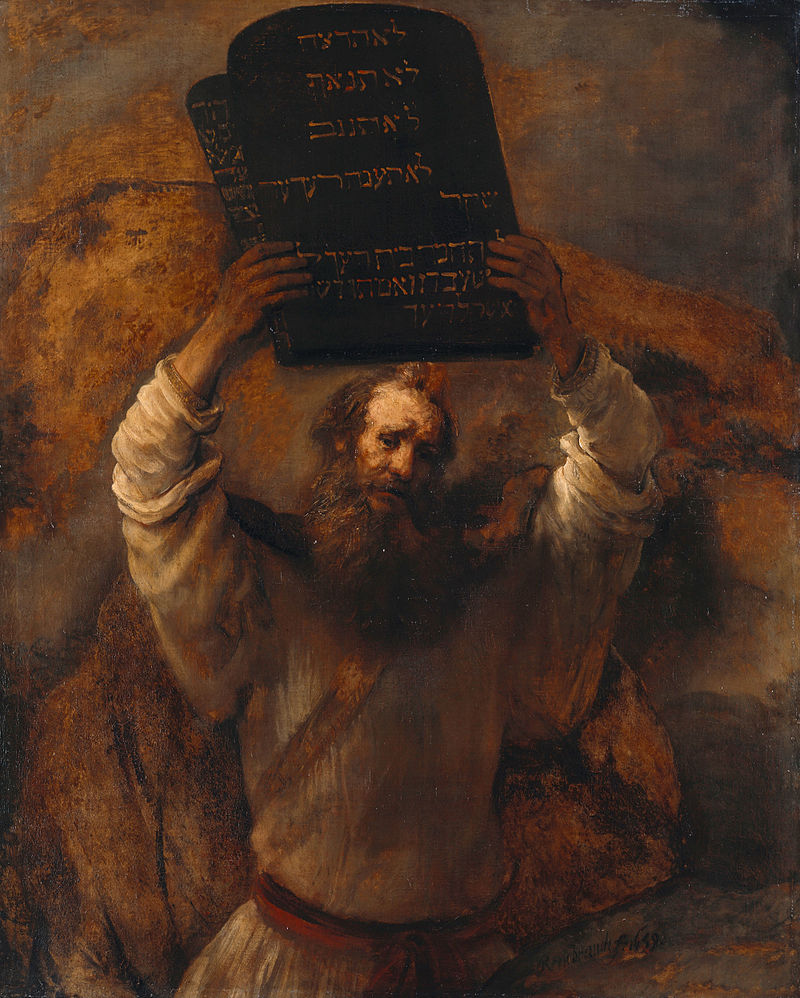
Rembrandt, Moses with the Ten Commandments

Exodus 20: 1-17 The Ten Words

 Then God spoke all these words:

 2 I am the LORD your God, who brought you out of the land of Egypt, out of the house of slavery; 3 you shall have no other gods before1 me.

 4 You shall not make for yourself an idol, whether in the form of anything that is in heaven above, or that is on the earth beneath, or that is in the water under the earth. 5 You shall not bow down to them or worship them; for I the LORD your God am a jealous God, punishing children for the iniquity of parents, to the third and the fourth generation of those who reject me, 6 but showing steadfast love to the thousandth generation1 of those who love me and keep my commandments.

 7 You shall not make wrongful use of the name of the LORD your God, for the LORD will not acquit anyone who misuses his name.

 8 Remember the sabbath day, and keep it holy. 9 Six days you shall labor and do all your work. 10 But the seventh day is a sabbath to the LORD your God; you shall not do any work — you, your son or your daughter, your male or female slave, your livestock, or the alien resident in your towns. 11 For in six days the LORD made heaven and earth, the sea, and all that is in them, but rested the seventh day; therefore the LORD blessed the sabbath day and consecrated it.

 12 Honor your father and your mother, so that your days may be long in the land that the LORD your God is giving you.

 13 You shall not murder.1

 14 You shall not commit adultery.

 15 You shall not steal.

 16 You shall not bear false witness against your neighbor. 17 You shall not covet your neighbor’s house; you shall not covet your neighbor’s wife, or male or female slave, or ox, or donkey, or anything that belongs to your neighbor.

The Ten Commandment, or the Ten Words (Decalogue) occur both here and in Deuteronomy 5 in slightly different forms. I highlight the differences in my discussion on Deuteronomy and here I will focus more on the commandments themselves and the role they have played within both Judaism and Christianity. One of the issues that has been wrestled with across time is how to divide the list into ten with different solutions based upon one’s theology. Is verse two the first commandment of a prologue to the list of commandments (many Jewish traditions), is verse three through six all one commandment (Catholic, Lutheran traditions) or is there a break between verse three and four (Reformed traditions). Ultimately the division into ten probably serves as an easy way to remember these central precepts that all the rest of the law will unfold from and regardless of how they are divided it is ultimately the way they become internalized and lived which will become the primary goal for these words.

When historical critical methods were the favored tool scholars loved to debate whether the Ten Words evolve over time or whether they borrowed from other law codes of the ancient near east (most notably the Code of Hammurabi has been noted for some parallels between what will follow in the next chapters). Ultimately historical questions reaching thousands of years back into history become incredibly difficult to answer and what we have are the Decalogue as they have been handed down in the books of Exodus and Deuteronomy as they are in their final form. For both Jews and Christians, they have served to both pass on the faith and to give some key principles to form their ethics and life from.

The initial statement at the beginning of these words take us back into the narrative of Exodus. The LORD makes a claim upon them, the LORD is their God and the LORD is known by what has occurred. The bringing out of the people from Egypt and God’s choice of them gives the LORD sole claim upon their allegiance and worship. The existence of other gods is not denied here, in the worldview of the time it is assumed and other nations served them (the prophets will later move towards a view we would recognize as monotheistic) but these other gods are not to be worshipped or followed by the people of Israel. The people have been redeemed out of Egypt and are in a covenantal relationship with the LORD their God.

The worship of the LORD is unusual in the ancient world. They are not to use images to represent the LORD their God, and this will be what is at stake in the incident of the golden calf in Exodus 32. The LORD is not to be reduced to the likeness of anything in the creation. The expounding on this prohibition below in verse 23 reinforces this. There will be beauty in the space that will be constructed to worship, but nothing within that space and no other item is to contain God’s image. Perhaps there is a remembrance of the creation narrative where humanity in some manner bears the image of God, but ultimately even humanity it not to be cast in metal and lifted up as a representation of God. The LORD is an impassioned God and does not enter this covenant easily or lightly. God’s vulnerability is highlighted using the term ‘jealous’ and while we may be uncomfortable with the language of punishment we will see that the breaking of this relationship, as will be seen in Exodus 32 and in prophets like Jeremiah and Hosea, brings out an intensely emotional side of God. The LORD presented in the Hebrew Bible is never some unmoved mover or unattached stoic grandfatherly god, the LORD is a God who desires to draw near but who also is vulnerable to being wounded by the unfaithfulness of the people.

The name in the ancient world is a powerful thing. As I discussed in Exodus 3 there is both necessity in a name but especially in the ancient world there was power. The four-letter name of God, transliterated as YHWH (or Yahweh- Jehovah was an old mispronunciation of these letters) is not said by the Jewish people in their worship in respect for keeping the name holy will always say Adonai (and the vowels, which are added above and below the consonants reflect the vowels for Adonai while the consonants are YHWH), in English this is why you see LORD in all caps (frequently with ORD in a smaller font if possible). The name of God was not to be used as a magical incantation, like some other cultures would do when they called upon the names of their gods, but was to be honored and respected.

Sabbath here is linked to creation and the rhythm of the LORD’s work being a model for human life. This is one of the unique portions of the Ten Commandments, since Sabbath is primarily about rest-not worship. It also is essential in the construction of a different type of society than the Egyptian society they came out of. In Egypt they were slaves, forced to work without brake for as long as their taskmasters demanded, but here children, slaves and even animals are commanded to rest. Ultimately, they were not to place their own ability to produce at the center of their lives but they were to learn to rest and trust that the LORD would provide for them and they were to rest with the LORD on this day that has been blessed and consecrated.

The command to honor father and mother, as I mention in Deuteronomy 5, is probably less about young children being obedient to parents and more about older children continuing to respect, honor and care for their parents in their older age. There will always be the temptation to look upon those who are past their prime as a burden to society but here they are commanded to be honored.

I once heard Rolf Jacobson, who teaches Hebrew Bible at Luther Seminary, state that the Ten Commandments are not about my best life now, they are about ‘my neighbor’s best life now.’ Murder, and although I grew up with the King James ‘thou shalt not kill’ the word murder is probably a better word for what is intended, prevents my needs from becoming more important than my neighbor’s life. There are times where the Scriptures do talk about capital punishment or serving in warfare and these may be viewed within the scriptures as times where the greater community is protected by the act of the one being killed or killing others but these actions are not to be the rule of life in the community, they are the exception. Adultery, which in our current culture portrays as a crime where no one gets hurt, is taken with the utmost seriousness. The punishment for those who commit adultery will be death and this may seem in our time overly harsh. Yet, in ancient times there was, “a severe rupture of trust in family trust and structure as well as in patterns of inheritance.” (Myers, 2005, p. 176) After working with couples for years as a pastor and my own personal experiences there is wisdom to learn from the seriousness cultures took adultery. I am not advocating a return to stoning or harsh punishment, but I’ve seen too often the damage that what a person thought was a simple act of pleasure does to their health, finances, to family and to their children. Adultery is one of those acts that can shatter the trust of a family and have profound and long consequences. Similarly stealing can have life threatening consequences in a culture where people are living at a subsistence level and even in our time. In a society where neighbors relied upon one another, theft could fracture the fabric of that community. When one’s home or automobile has been broken into it feels like a violation of one’s safety and security. In some cases, the loss of security may be greater than the physical loss. In other cases, where greed or theft on a large scale has endangered a person’s retirement accounts or even the money that a person needs to pay for food or medical expenses the theft can literally steal life from another person.

For a just society one of the essential elements is truthful speech. Bearing false witness, whether in a legal setting or in casual gossip can cause heavy damage to an individual. In an age where we can see the how gossip, intentional falsehoods, and cyber-bullying in personal relationships in addition to the erosion of trust in our public institutions I do think there is a longing for truthful speech, but also there is a desire for the salacious rumor and it sometimes becomes difficult to tell the two apart. Perhaps Martin Luther’s wisdom of “interpreting my neighbor’s action in the best possible light” may be helpful here as we wrestle with finding true words in a suspicious and distrusting time.

Finally coveting, and the word for coveting is more than just the natural desire of seeing someone or something one finds attractive. Chamada, the Hebrew word behind coveting is, “an intense desire, generated by passion that is not easily controlled.” (Myers, 2005, p. 178 quoting TDOT) The word for house is more than the physical building, it is one’s household which would include the other items listed behind household: spouse, servants, livestock, etc. This type of intense and open desire would erode the trust between neighbors.

Attempting to write about the Decalogue is a challenge, partially because almost every major figure in Judaism and Christianity at some point writes in detail about the commandments. They are a source of catechetical instruction in the basics of the faith for both traditions. Here I have been in more of an exegetical mode attempting to understand and compare what the commandments meant to their original audience and compare that to our time. At other points, if I was trying to instruct someone on how the commandments would impact their faith I would probably highlight different points.

Exodus 20: 18-21 Moses the Mediator

 18 When all the people witnessed the thunder and lightning, the sound of the trumpet, and the mountain smoking, they were afraid1 and trembled and stood at a distance, 19 and said to Moses, “You speak to us, and we will listen; but do not let God speak to us, or we will die.” 20 Moses said to the people, “Do not be afraid; for God has come only to test you and to put the fear of him upon you so that you do not sin.” 21 Then the people stood at a distance, while Moses drew near to the thick darkness where God was.

Moses by Victorvictori, permission granted by author through WikiCommons

The approach of the LORD is a powerful thing and the people are overwhelmed. Although there will be times where Moses’ role as a leader is challenged the people do not want to stand in Moses’ place before God. They desire someone to mediate the divine presence. Moses will spend his life as a person caught between God and God’s people. Even when God’s intention is to graciously draw close it can be terrifying and frequently people want a predictable and not too close God. Ultimately the God of Israel is a God who is not controllable or tame, who is passionate. Moses is somehow safer, more understandable and therefore God’s presence continues to be mediated by the messenger.

Exodus 20: 22-26 How to Worship the LORD

 22 The LORD said to Moses: Thus you shall say to the Israelites: “You have seen for yourselves that I spoke with you from heaven. 23 You shall not make gods of silver alongside me, nor shall you make for yourselves gods of gold. 24 You need make for me only an altar of earth and sacrifice on it your burnt offerings and your offerings of well-being, your sheep and your oxen; in every place where I cause my name to be remembered I will come to you and bless you. 25 But if you make for me an altar of stone, do not build it of hewn stones; for if you use a chisel upon it you profane it. 26 You shall not go up by steps to my altar, so that your nakedness may not be exposed on it.”

The worship of the LORD is both incredibly simple and very challenging. It is simple in the reality that they don’t need images of silver or gold to represent their God. It is challenging because the people will show that they desire some physical representation of their God they can focus on and can manipulate. Idolatry will be more than just worshipping other gods, it will also be any attempt to make an image of the imageless God of Israel. It will be any attempt to limit the ways in which God can present Godself or to even metaphorically limit God’s image to being something in heaven or on earth or in the sea. It is simple that the LORD does not require elaborate tables or structures to offer sacrifices, simply an altar of earth or unhewn stones that is not set above everyone else. The worship of the LORD is to be done at a level where the priests do not ascend above the people to offer sacrifices but stand at their level. It will be a challenge not to emulate the practices of other nations that place the divine above and have their priests ascend to offer sacrifices. It is the paradox of transcendence in the mundane parts of life. God’s desire is to come down to the people’s level and to dwell, but the desire of the people tends to be to send a representative up to mediate the space between God and themselves.

Exodus 19: Arriving at Sinai to Encounter God

View from the Summit of Mount Sinai, Picture by Modammed Moussa. Shared under Creative Commons Attribution-Share Alike 3.0

Exodus 19: 1-9 Borne on Eagles Wings to Sinai

 On the third new moon after the Israelites had gone out of the land of Egypt, on that very day, they came into the wilderness of Sinai. 2 They had journeyed from Rephidim, entered the wilderness of Sinai, and camped in the wilderness; Israel camped there in front of the mountain. 3 Then Moses went up to God; the LORD called to him from the mountain, saying, “Thus you shall say to the house of Jacob, and tell the Israelites: 4 You have seen what I did to the Egyptians, and how I bore you on eagles’ wings and brought you to myself. 5 Now therefore, if you obey my voice and keep my covenant, you shall be my treasured possession out of all the peoples. Indeed, the whole earth is mine, 6 but you shall be for me a priestly kingdom and a holy nation. These are the words that you shall speak to the Israelites.”

 7 So Moses came, summoned the elders of the people, and set before them all these words that the LORD had commanded him. 8 The people all answered as one: “Everything that the LORD has spoken we will do.” Moses reported the words of the people to the LORD. 9 Then the LORD said to Moses, “I am going to come to you in a dense cloud, in order that the people may hear when I speak with you and so trust you ever after.”

The book of Exodus spends the first thirteen chapters with the people in Egypt and with the LORD and Moses working to get Pharaoh to let the people go. I originally thought of the book of Exodus being primarily about the physical journey out of Egypt to the promised land but it is telling that the movement of the people in the book comes to an end here. The books of Numbers, the beginning of Deuteronomy and ultimately the book of Joshua will narrate the long remaining journey into the promised land but in Exodus the movement ends at Mount Sinai. The LORD has made the journey out of Egypt and through the wilderness possible but the events at Mount Sinai will occupy over half of the book of Exodus.

The image of the people being borne on eagles’ wings probably takes many people to the lyrical adaptation of Psalm 91, ‘and he will lift you up on eagles’ wings, bear you on the breath of dawn, make you to shine like the sun and hold you in the palm of his hands.’ This image of God bearing the people on eagles’ wings is a poetic metaphor that gets used in the song of Moses in Deuteronomy 32 where the LORD is the mother eagle hovering over her chicks and lifting them into the air with her feathers as well as being a metaphor used in several Psalms (Psalm 17:8, 36:7, 57:1, 61:4, and 63:7 all mention being sheltered in God’s wings as well as the Psalm 91:4 mentioned above). This powerful image of nurturing strength resonated with the people of Israel and continues to resonate with many people today. While metaphors never completely express who God is, they bear witness to a portion of the divine identity and here the motherly attributes of a mother bird as well as the strength of the protective eagle combine in this potent image. The LORD of Israel is a God of strength who can take the people out of Egypt like a warrior, but who like a mother provides food, water and shelter. Ultimately the destination of the people in Exodus is to come into the wilderness to meet God.

In coming chapters, we will see in greater detail what obedience will mean for the covenant people but here Israel is called to be God’s treasured possession, a kingdom of priests and a holy nation. What each of these three vocations is to mean has been a rich territory for scholarly and holy imagination. We may, with our current sensitivities, be a little uncomfortable with the first vocation where the people of Israel are called to be a treasured possession: possession may call to mind images of slavery or chattel (where women, slave, and children were possessions and not people) but we need not take this image in this way. Israel will occupy a special place in the LORD’s heart and while being drawn near to God in this way in vulnerable for both the people and the LORD. The prophet Jeremiah, for example, will bear witness to a God who is wounded by the people’s betrayal and who wants to find a way to restore the relationship and yet deals intensely with the pain of the brokenness. As Isaiah 43 can state, “Do not fear, for I have redeemed you; I have called you by name you are mine….I give Egypt as your ransom, Ethiopia and Seba in exchange for you. Because you are precious in my sight” (Isaiah 43: 1,3-4)

The people of Israel as a priestly kingdom can also be taken in several directions. On the one hand, there is the intercessory role that may be a portion of this calling. Priests in the ancient world were those who interceded between God and the people. While there is a cultic aspect of the priest’s role in offering prayers and sacrifices in the temple to God there is also the didactic role. The priests will be responsible for reading and interpreting the Torah, the law of God. Perhaps as the priests of Israel will intercede for the people of Israel with God, so the people will intercede on behalf of the nations and the world with God. Perhaps as the priests verbally read and interpret the law to the people so the people may be expected to interpret through their words and actions the content of the law to the nations around them. Both functions occupy a lot of space in the Old Testament: Leviticus for example focuses a lot of text on the priestly/cultic function while Deuteronomy and much of the second half of Exodus focuses on interpreting the law. Rabbi Jonathan Sacks also points to an additional function that may have been a part of this calling: being a society of universal literacy. While the Hebrew people probably didn’t come close to universal literacy in the ancient world he makes an intriguing argument for this type of education being essential for their being able to work with a law that can be read and written. Universal literacy which takes writing and reading out of the hands of the elite and makes possible “a non-hierarchical society” (Sacks, 2010, p. 136) If the people were to be a society different from the Egyptian society they left, and much of the law will be contrasted to their experience of being slaves in Egypt, then a worthy goal would be having a society that could read and write the law of their God and understand as individuals how they were called to live. In this respect, it could be paralleled to Martin Luther’s idea of the priesthood of all believers which required a program of catechetical instruction for all believers into what the basics of faith were.

As a holy people, a people sanctified for a purpose they also have a rich vocation within this calling of being a treasured possession and a priestly kingdom. Their lives as a part of this covenant are set aside to be something different. One of the struggles of both the people of Israel and modern people of faith is the struggle to differentiate their lives from the lives of everyone else. For the people of Israel there will be concrete practices and actions that they do that help to be a boundary marker for who they are as the people of God. Yet, the temptation will be to model their lives based on the lives of the nations around them (especially nations more powerful than them) rather than on the calling their LORD has given them. There will be times where the Torah seems to be lost or forgotten and yet, as Jeremiah can hope there will come a time where the LORD will put the law within them and write it on their hearts (Jeremiah 31: 33).

To be the people of God will be a way of life. The book of Exodus will begin the process of unpacking what it will mean to live as the covenant people of God, as God’s treasured possessions, as a priestly kingdom and as a holy people. The journey is not only the journey out of Egypt to the promised land. It is also a journey from slavery in Egypt to being a people equipped to stand in the presence of God and intercede for the nations and be bearers of the law of God.

Exodus 19: 9b-25 The Consecration of the People and the Approach of the LORD

When Moses had told the words of the people to the LORD, 10 the LORD said to Moses: “Go to the people and consecrate them today and tomorrow. Have them wash their clothes 11 and prepare for the third day, because on the third day the LORD will come down upon Mount Sinai in the sight of all the people. 12 You shall set limits for the people all around, saying, ‘Be careful not to go up the mountain or to touch the edge of it. Any who touch the mountain shall be put to death. 13 No hand shall touch them, but they shall be stoned or shot with arrows;1 whether animal or human being, they shall not live.’ When the trumpet sounds a long blast, they may go up on the mountain.” 14 So Moses went down from the mountain to the people. He consecrated the people, and they washed their clothes. 15 And he said to the people, “Prepare for the third day; do not go near a woman.”

 16 On the morning of the third day there was thunder and lightning, as well as a thick cloud on the mountain, and a blast of a trumpet so loud that all the people who were in the camp trembled. 17 Moses brought the people out of the camp to meet God. They took their stand at the foot of the mountain. 18 Now Mount Sinai was wrapped in smoke, because the LORD had descended upon it in fire; the smoke went up like the smoke of a kiln, while the whole mountain shook violently. 19 As the blast of the trumpet grew louder and louder, Moses would speak and God would answer him in thunder. 20 When the LORD descended upon Mount Sinai, to the top of the mountain, the LORD summoned Moses to the top of the mountain, and Moses went up. 21 Then the LORD said to Moses, “Go down and warn the people not to break through to the LORD to look; otherwise many of them will perish. 22 Even the priests who approach the LORD must consecrate themselves or the LORD will break out against them.” 23 Moses said to the LORD, “The people are not permitted to come up to Mount Sinai; for you yourself warned us, saying, ‘Set limits around the mountain and keep it holy.'” 24 The LORD said to him, “Go down, and come up bringing Aaron with you; but do not let either the priests or the people break through to come up to the LORD; otherwise he will break out against them.” 25 So Moses went down to the people and told them.

Climbing the Trail Near the Summit of Mount Sinai, Photograph by Mark A. Wilson. Copyright holder released work into public domain.

One of the losses of the Christian tradition in recent times has been the loss of this transcendental holiness of the approach of God. One of the central features of the Christian narrative is the descent of God into the mundaneness of humanity. For the past couple centuries, there has been both a philosophical and religious movement away from focusing on this transcendent holiness. Even within my tradition seasons like Lent and Advent, once times of fasting and prayer and times of preparation for holiness, have lost this movement of sanctification. Perhaps this is inevitable in the disenchanted and more secular world in which we live but as I look at this passage I wonder how much we have lost.

The people prepare for three days for the approach of the LORD. They wash, they abstain from sexual activity, they stay away from the sacred space and they prepare for this approach of God at Mount Sinai. Here is the approach of God in all of God’s awesome power. In a description of a scene like the eruption of a volcano with fire, smoke, earthquake and lightning God approaches the people and Moses comes to introduce the LORD to the people and to stand between them. Moses and Aaron will go up to the mountain and speak with the LORD, but the people are witnesses to this display of God’s powerful approach.

There is something dangerous in the approach of God and the people are to keep their distance. One of the great tensions in the book of Exodus is the desire of the LORD to tabernacle (dwell) among the people and the danger the people’s unholiness presents for themselves in the presence of God. The people will struggle with the presence of God. On the one hand, they will want continued demonstration of God’s provision and power against their enemies. On the other hand, the presence of God is a terrifying reality and one they do not want to draw too close to.  A God who bears the power to bring the Egyptian army, its Pharaoh and its gods to their knees is not a safe and controllable deity. As a priestly kingdom, they come into the presence of God for the sake of the world, and their priestly vocation is not a safe one. As a treasured possession, they are the ones that God wants to draw close to God’s presence and they are to be a nation sanctified for the sake of the world. They are made holy to be able to dwell in the presence of the numinous and awesome holiness of the LORD.

Exodus 18: Jethro Models Faith, Worship and Leadership to Moses

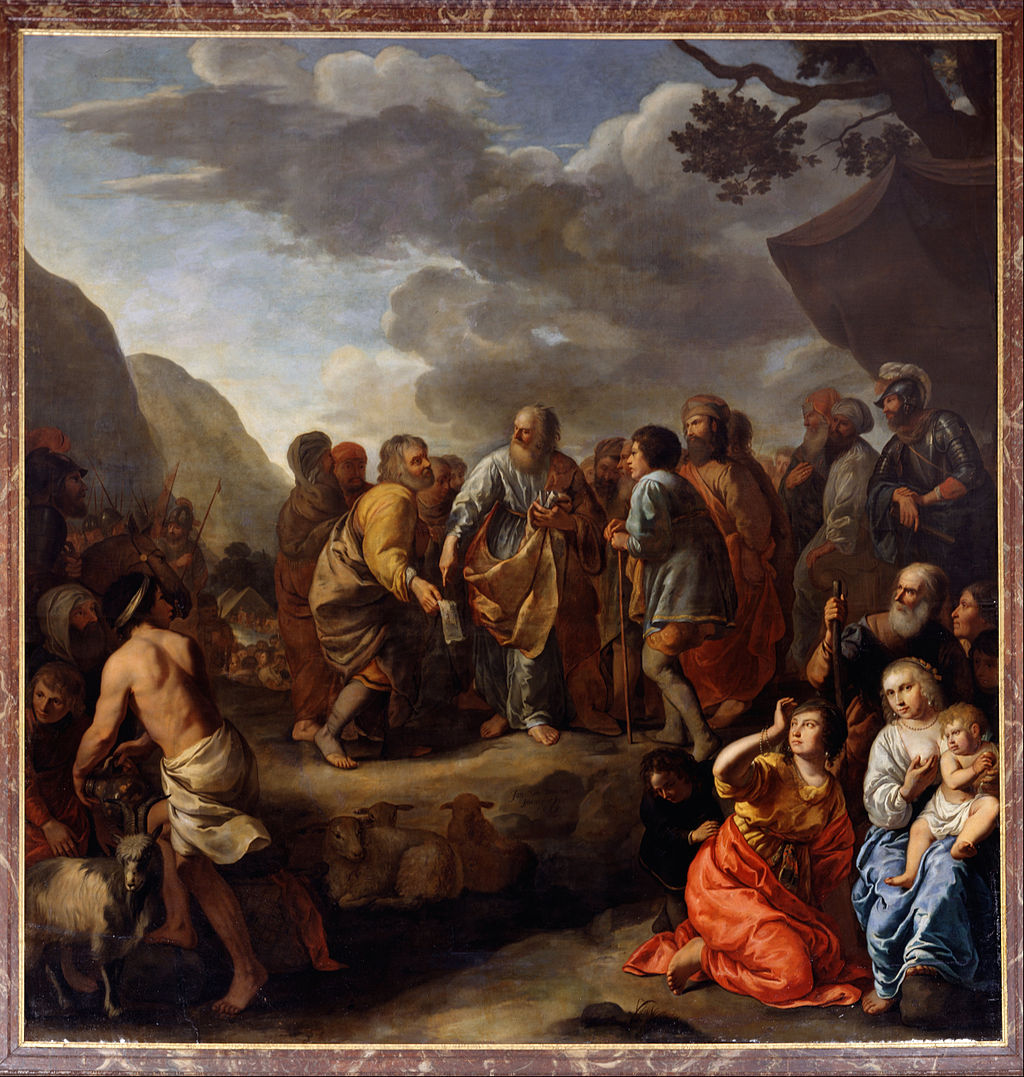
Jethro and Moses by James Tissot (1896-1900)

Exodus 18:1-12 A Family Reunited

Jethro, the priest of Midian, Moses’ father-in-law, heard of all that God had done for Moses and for his people Israel, how the LORD had brought Israel out of Egypt. 2 After Moses had sent away his wife Zipporah, his father-in-law Jethro took her back, 3 along with her two sons. The name of the one was Gershom (for he said, “I have been an alien1 in a foreign land”), 4 and the name of the other, Eliezer1 (for he said, “The God of my father was my help, and delivered me from the sword of Pharaoh”). 5 Jethro, Moses’ father-in-law, came into the wilderness where Moses was encamped at the mountain of God, bringing Moses’ sons and wife to him. 6 He sent word to Moses, “I, your father-in-law Jethro, am coming to you, with your wife and her two sons.” 7 Moses went out to meet his father-in-law; he bowed down and kissed him; each asked after the other’s welfare, and they went into the tent. 8 Then Moses told his father-in-law all that the LORD had done to Pharaoh and to the Egyptians for Israel’s sake, all the hardship that had beset them on the way, and how the LORD had delivered them. 9 Jethro rejoiced for all the good that the LORD had done to Israel, in delivering them from the Egyptians.

 10 Jethro said, “Blessed be the LORD, who has delivered you from the Egyptians and from Pharaoh. 11 Now I know that the LORD is greater than all gods, because he delivered the people from the Egyptians,1 when they dealt arrogantly with them.” 12 And Jethro, Moses’ father-in-law, brought a burnt offering and sacrifices to God; and Aaron came with all the elders of Israel to eat bread with Moses’ father-in-law in the presence of God.

Jethro, called Reuel in chapter two, re-enters the story and brings with him Moses’ wife and two sons. While we aren’t told exactly when Zipporah returns to her father-in-law’s house with her children we last heard about her and Gershom (their first-born son) in chapter four on the journey back to Egypt. There could be any number of reasons for their separation including: to protect her and her two sons from being able to be used as captives by Pharaoh, to prevent Moses from being distracted from his task for the time, to allow Moses to establish his authority among the Hebrews without his foreign wife being present, or perhaps Zipporah was pregnant and it was easier for her to give birth away from the stresses of the exodus journey (based on Eliezar’s name) and we could imagine many other reasons but ultimately the text remains silent on this. We have a separation of an unknown period and what appears to be a joyous reunion.

The relationship of Moses to Jethro is one of respect and honor. Moses’ actions upon Jethro’s arrival convey respect and welcome. He is welcomed into their camp and into Moses’ tent with warmth. Moses tells the story of what the LORD has done and how they have journeyed to this point and Jethro offers his blessing.

One interesting thing to notice in this passage is the blessing that Jethro offers to the LORD in comparison to the first commandment. The first commandment begins with the statement of what the LORD has done in delivering the people from the land of Egypt and then states that the people are to have no other gods before the LORD. Jethro also begins with blessing the LORD who has delivered the people from the land of Egypt and then exclaims his new knowledge that the LORD is greater than all gods, because he delivered the people from the hands of Pharaoh. Here a foreigner demonstrates before the people what the faith of Israel will look like in the future. Like Melchizedek in the book of Genesis, he becomes one of the people of the nations that point to the LORD the God of Israel.

Secondly, Jethro becomes the first in the book of Exodus to offer a sacrifice to God after the departure from Egypt. This is increasingly surprising, as Carol Myers notices, since the justification give to Pharaoh multiple times in the beginning of Exodus is to let the people enter the wilderness to offer a sacrifice to the LORD their God. (Myers, 2005, p. 137) Yet, it is a priest of Midian who before Moses, Aaron and the elders models what this sacrifice to God might look like. As I mentioned when I was discussing Psalm 29 the Jewish people were not afraid to uses the praises uttered about other gods and modify them to talk about the LORD the God of Israel. Here is another time where a faithful outsider, Jethro, demonstrates to the people of God what a life of praise can look like.

Jan van Bronchorst, Jethro Advising Moses (1659)

Exodus 18: 13-27 Jethro’s Advice to Moses

 13 The next day Moses sat as judge for the people, while the people stood around him from morning until evening. 14 When Moses’ father-in-law saw all that he was doing for the people, he said, “What is this that you are doing for the people? Why do you sit alone, while all the people stand around you from morning until evening?” 15 Moses said to his father-in-law, “Because the people come to me to inquire of God. 16 When they have a dispute, they come to me and I decide between one person and another, and I make known to them the statutes and instructions of God.” 17 Moses’ father-in-law said to him, “What you are doing is not good. 18 You will surely wear yourself out, both you and these people with you. For the task is too heavy for you; you cannot do it alone. 19 Now listen to me. I will give you counsel, and God be with you! You should represent the people before God, and you should bring their cases before God; 20 teach them the statutes and instructions and make known to them the way they are to go and the things they are to do. 21 You should also look for able men among all the people, men who fear God, are trustworthy, and hate dishonest gain; set such men over them as officers over thousands, hundreds, fifties and tens. 22 Let them sit as judges for the people at all times; let them bring every important case to you, but decide every minor case themselves. So it will be easier for you, and they will bear the burden with you. 23 If you do this, and God so commands you, then you will be able to endure, and all these people will go to their home in peace.”

 24 So Moses listened to his father-in-law and did all that he had said. 25 Moses chose able men from all Israel and appointed them as heads over the people, as officers over thousands, hundreds, fifties, and tens. 26 And they judged the people at all times; hard cases they brought to Moses, but any minor case they decided themselves. 27 Then Moses let his father-in-law depart, and he went off to his own country.

Beyond modeling a first commandment faith and a sacrificial worship to God, Jethro brings to the people of Israel and to Moses, its leader, worldly wisdom. Moses has taken the central role in leading the people out of Egypt: he is the spiritual, military, political and legal authority and the one who stands between the people and God. He is the one who everyone comes to for support, legal ruling and whenever there has been a crisis. Already Moses has had to deal with two instances of water related strife, food related anxiety, as well as the people’s first military threat. Now the people are waiting for Moses to address their needs, their internal conflicts and to hear their cries. As Carol Myers states, “Jethro notices more than the supremacy of Israel’s god; he also notices that Israel’s leader is overburdened.” (Myers, 2005, p. 137)

Within this passage we have one of only two places in the first five books of the bible (or torah) where the phrase “not good” is used. Throughout the creation narrative in Genesis one we hear God say repeatedly that is was good, but the only other place where the phrase “not good” is used is Genesis 2: 18 where God says it is ‘not good’ for the man to be alone. (Sacks, 2010, p. 128) Here also it is ‘not good’ that Moses is alone, here he needs appropriate partners for his own good and for the people’s.

The critical task of finding officers, people who can be trusted to hear the people’s concerns and to respond fairly and who are not going to be vulnerable to bribes or coercion makes the life of the people of Israel possible. Here these officers are not given the title of judge, and there are probably several reasons for that. The office of judge in the people of Israel’s history gets developed in the times between Joshua and the time of the kings and the judges are people who lead the people for a time and have more of a Moses-like role than a purely judicial one. Also, throughout the book of Exodus, the people has been referred to in a military manner. Within many military units the commanding officer has legal responsibilities for those who serve under them, for example under the Uniform Code of Military Justice (or UCMJ) which provides the basis for the legal system used in the U.S. Military the commanding officer does hear cases and assign punishment. In disciplinary matter the commanding officers is judge and jury while still being the commander. These people who will mediate the commands and instructions of Moses to the people are foundational to the emerging structure of the people.

Moses role becomes one of intercession, instruction and of finding subordinate leaders. Moses will continue to stand between the people and the LORD their God and this will become an increasingly critical role as the people continue their journey. Moses will also become the teacher of the law that is about to be given as well as interpreting the law to the people. Moses will continue to have to teach the people how they are to live and what they are to do. But Moses cannot do it on his own, he will need multiple leaders to share the burdens and responsibility of leading the people of God. Sometimes this is the hardest task: both finding and trusting these new leaders. I, and many other leaders, struggle with this portion of leadership-with equipping others who will not have the same amount of training and experience that you do. Yet, this worldly advice was deemed important enough by the people of God that it was included within their scriptures.

Exodus 17: Water and Conflict, Faith and Sight

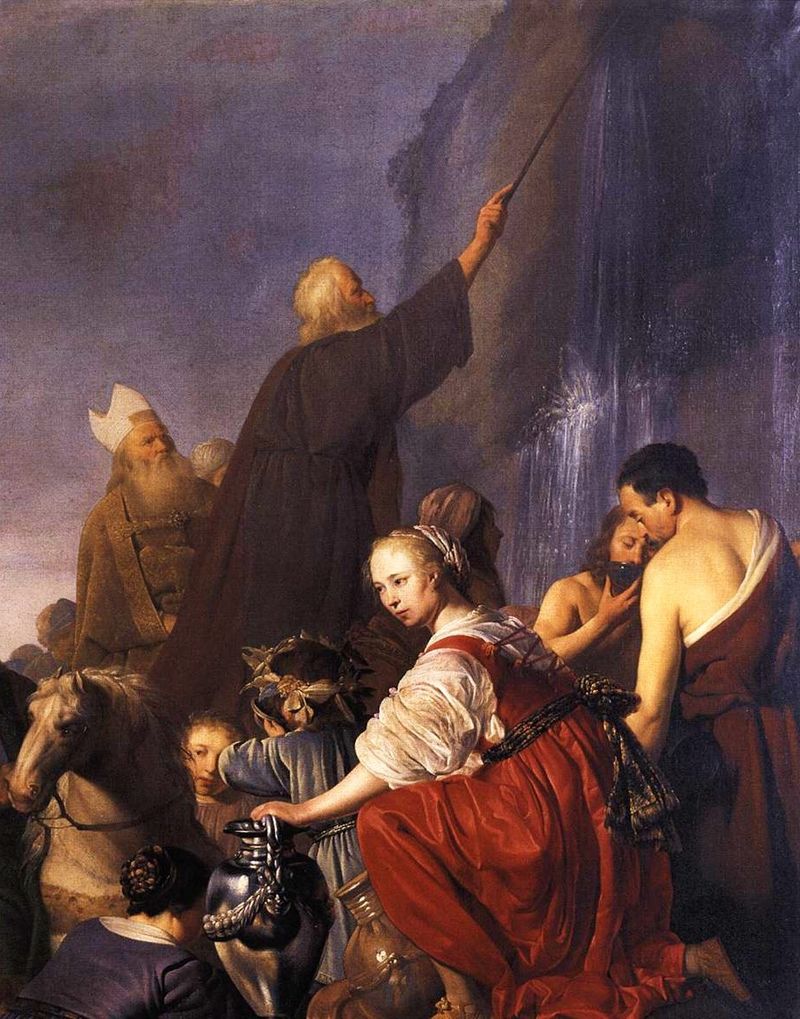
Pieter de Grebber, Moses Striking the Rock (1630)

Exodus 17: 1-7 Massah and Meribah-Physical Needs, Testing God and Quarreling with Moses

 From the wilderness of Sin the whole congregation of the Israelites journeyed by stages, as the LORD commanded. They camped at Rephidim, but there was no water for the people to drink. 2 The people quarreled with Moses, and said, “Give us water to drink.” Moses said to them, “Why do you quarrel with me? Why do you test the LORD?” 3 But the people thirsted there for water; and the people complained against Moses and said, “Why did you bring us out of Egypt, to kill us and our children and livestock with thirst?” 4 So Moses cried out to the LORD, “What shall I do with this people? They are almost ready to stone me.” 5 The LORD said to Moses, “Go on ahead of the people, and take some of the elders of Israel with you; take in your hand the staff with which you struck the Nile, and go. 6 I will be standing there in front of you on the rock at Horeb. Strike the rock, and water will come out of it, so that the people may drink.” Moses did so, in the sight of the elders of Israel. 7 He called the place Massah1 and Meribah,2 because the Israelites quarreled and tested the LORD, saying, “Is the LORD among us or not?”

The wilderness is a place of perpetual struggle for the people of Israel. The LORD makes life for the people possible for they journey across the wilderness to their promised home, but the wilderness is never a place they are meant to dwell in. Once the threat of Egypt’s use of force has been removed the conflicts in the past two chapters and here revolve around the very basic physical needs for sustaining life: food and water. In Exodus 15: 22-25 the crisis revolved around undrinkable water, Exodus 16 the problem was the lack of food and the LORD’s provision of manna and quail, here in Exodus 17 the first crisis is again water. The lack of a predictable water supply is one of the great challenges of the journey across the wilderness and here the lack of water creates a crisis for Moses.

Moses, in his role as the mediator of God’s words and covenant, bears the impact of the anxiety of the people. Even though the LORD has provided in the past, here in a moment of fear and crisis the faith of the people is challenged. Sitting in air conditioned houses, drinking ice water and having our fill of food it would be easy to critique their fear-but when our basic needs of food and water are threatened we probably would not respond as rationally as we want. Moses deals with a desperate people and is caught between their fear and the lack of an immediate response from God.

A part of the Exodus story is the paradox of faith and sight. For so much of the narrative of the Exodus, God demonstrates God’s strength and trustworthiness in physical and tangible ways. The people see the waters part or the manna, for example, or the pillar of fire as demonstrations of the LORD’s presence in their midst. Yet, most of life is lived in these times where, as St. Paul can state, “We walk by faith and not by sight.” (2 Corinthians 5:7) If one’s belief and trust in God is contingent upon a constant and continual demonstration of God’s miraculous provision then faith is transformed into sight. Yet, need continues to be need and the fears and anxiety of the people about surviving in the wilderness would not be assuaged by being told the need to believe when their needs are not being met. Ultimately, God is not threatened here by the people’s cries and actions—it is Moses who is threatened. God hears Moses, speaks to Moses and provides a solution to the needs that the people voice. The place of testing and quarreling (the meaning behind Massah and Meribah) ultimately becomes one more place where water is provided in the wilderness.

One could argue for many natural explanations for water coming out of the mountain, and this would still be consistent with the Exodus narrative. All throughout the signs and wonders, the parting of the Red Sea, and the provision of food and water God uses the things of the earth to provide. Often God is present in the mundane provision of food and water in natural ways. Yet, this does not take away from the reality that for Moses it is the LORD that demonstrates where he is to lead the elders and strike the rock. Yet, in the beautiful language of Isaiah, the LORD is the one who is doing a new thing: “I am about to do a new thing, do you not perceive it? I will make a way in the wilderness and rivers in the desert.” (Isaiah 43: 19) Whether it is through creation or a new act of creation, the LORD is the one for Israel who gives “water in the wilderness, rivers in the desert, to give drink to my chosen people.” (Isaiah 43: 20)

Exodus 17: 8-16 The First Battle for the New People

 8 Then Amalek came and fought with Israel at Rephidim. 9 Moses said to Joshua, “Choose some men for us and go out, fight with Amalek. Tomorrow I will stand on the top of the hill with the staff of God in my hand.” 10 So Joshua did as Moses told him, and fought with Amalek, while Moses, Aaron, and Hur went up to the top of the hill. 11 Whenever Moses held up his hand, Israel prevailed; and whenever he lowered his hand, Amalek prevailed. 12 But Moses’ hands grew weary; so they took a stone and put it under him, and he sat on it. Aaron and Hur held up his hands, one on one side, and the other on the other side; so his hands were steady until the sun set. 13 And Joshua defeated Amalek and his people with the sword.

 14 Then the LORD said to Moses, “Write this as a reminder in a book and recite it in the hearing of Joshua: I will utterly blot out the remembrance of Amalek from under heaven.” 15 And Moses built an altar and called it, The LORD is my banner. 16 He said, “A hand upon the banner of the LORD 1 The LORD will have war with Amalek from generation to generation.”

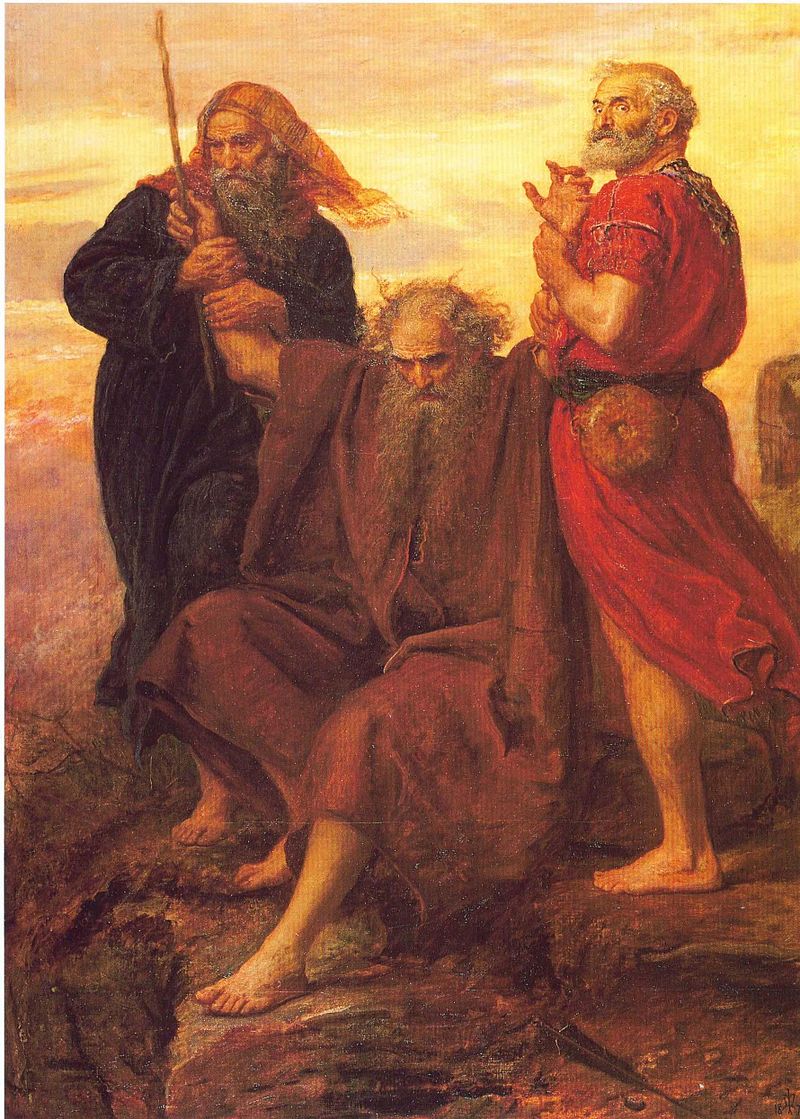
John Everett Millais (1829-1896), Victory O Lord!

Pharaoh’s armies may no longer challenge the people of Israel on their journey but their movement into the promised land will not be conflict free. Here for the first time the people of Israel who left Egypt company by company like an army now for the first time are challenged militarily by Amalek. Joshua enters the narrative for the first time and we see him being the military leader he will be in the book of Joshua. Yet, it is not Israel’s military might which is key factor in the battle’s outcome. Moses again is called upon as a demonstration of the LORD’s presence as the battle rages. The holding up of the staff of Moses to the LORD coincides with the battle’s turning in the people of Israel’s favor, but the people’s strength becomes tied to Moses’ strength. As Moses’ strength fails Aaron and Hur become instrumental in taking some of the burden from Moses’ already overexerted shoulders. They provide a place to sit and support under his arms so that together they can become a demonstration of the combined strength of the people reaching up for the LORD’s aid in battle.

At a simplistic level, the statement that the future of Israel does not rest solely on Moses’ shoulders, or any leader’s shoulders, is an important one. The following chapter will have Jethro giving Moses advice about properly delegating the task of leadership. Yet, Moses will continue to have a unique role among the people and the time where Moses is away from the people will be a time of temptation for Aaron and the people to turn away from God’s stated intent.

The Bible also invites us into many ethical reflections on the use of force and God’s sanctioning of warfare. This is a difficult question that I have dealt with in other places (most completely in Deuteronomy 20). Here Amalek and his descendants become the recipients of an enduring curse that calls for their obliteration. After the Holocaust, Hiroshima, the genocides in Rwanda and Bosnia and several other places throughout the 20th and beginning of the 21st century I will continue to remain uncomfortable with the designation of a people for destruction and I can admit there will be parts of the portrayal of God in the scriptures that will be difficult for me to understand or adopt. This is not the only voice in this conversation of scriptures and so perhaps as Jeremiah 18: 7-8 can state:

“At one moment I may declare concerning a nation or a kingdom, that I will pluck up and break down and destroy it, but if that nation concerning which I have spoken, turns from its evil, I will change my mind about the disaster that I intended to bring on it.”

Exodus 16: A Crisis of Trust

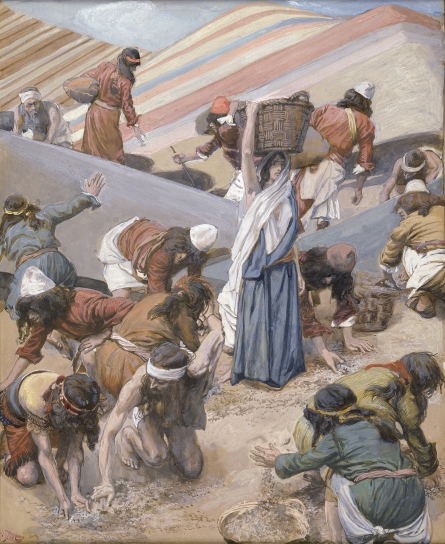
James Tissot, The Gathering of Manna (between 1896 and 1902)

Exodus 16: 1-36

The whole congregation of the Israelites set out from Elim; and Israel came to the wilderness of Sin, which is between Elim and Sinai, on the fifteenth day of the second month after they had departed from the land of Egypt. 2 The whole congregation of the Israelites complained against Moses and Aaron in the wilderness. 3 The Israelites said to them, “If only we had died by the hand of the LORD in the land of Egypt, when we sat by the fleshpots and ate our fill of bread; for you have brought us out into this wilderness to kill this whole assembly with hunger.”

 4 Then the LORD said to Moses, “I am going to rain bread from heaven for you, and each day the people shall go out and gather enough for that day. In that way I will test them, whether they will follow my instruction or not. 5 On the sixth day, when they prepare what they bring in, it will be twice as much as they gather on other days.” 6 So Moses and Aaron said to all the Israelites, “In the evening you shall know that it was the LORD who brought you out of the land of Egypt, 7 and in the morning you shall see the glory of the LORD, because he has heard your complaining against the LORD. For what are we, that you complain against us?” 8 And Moses said, “When the LORD gives you meat to eat in the evening and your fill of bread in the morning, because the LORD has heard the complaining that you utter against him — what are we? Your complaining is not against us but against the LORD.”

 9 Then Moses said to Aaron, “Say to the whole congregation of the Israelites, ‘Draw near to the LORD, for he has heard your complaining.'” 10 And as Aaron spoke to the whole congregation of the Israelites, they looked toward the wilderness, and the glory of the LORD appeared in the cloud. 11 The LORD spoke to Moses and said, 12 “I have heard the complaining of the Israelites; say to them, ‘At twilight you shall eat meat, and in the morning you shall have your fill of bread; then you shall know that I am the LORD your God.'”

 13 In the evening quails came up and covered the camp; and in the morning there was a layer of dew around the camp. 14 When the layer of dew lifted, there on the surface of the wilderness was a fine flaky substance, as fine as frost on the ground. 15 When the Israelites saw it, they said to one another, “What is it?”1 For they did not know what it was. Moses said to them, “It is the bread that the LORD has given you to eat. 16 This is what the LORD has commanded: ‘Gather as much of it as each of you needs, an omer to a person according to the number of persons, all providing for those in their own tents.'” 17 The Israelites did so, some gathering more, some less. 18 But when they measured it with an omer, those who gathered much had nothing over, and those who gathered little had no shortage; they gathered as much as each of them needed. 19 And Moses said to them, “Let no one leave any of it over until morning.” 20 But they did not listen to Moses; some left part of it until morning, and it bred worms and became foul. And Moses was angry with them. 21 Morning by morning they gathered it, as much as each needed; but when the sun grew hot, it melted.

 22 On the sixth day they gathered twice as much food, two omers apiece. When all the leaders of the congregation came and told Moses, 23 he said to them, “This is what the LORD has commanded: ‘Tomorrow is a day of solemn rest, a holy sabbath to the LORD; bake what you want to bake and boil what you want to boil, and all that is left over put aside to be kept until morning.'” 24 So they put it aside until morning, as Moses commanded them; and it did not become foul, and there were no worms in it. 25 Moses said, “Eat it today, for today is a sabbath to the LORD; today you will not find it in the field. 26 Six days you shall gather it; but on the seventh day, which is a sabbath, there will be none.”

 27 On the seventh day some of the people went out to gather, and they found none. 28 The LORD said to Moses, “How long will you refuse to keep my commandments and instructions? 29 See! The LORD has given you the sabbath, therefore on the sixth day he gives you food for two days; each of you stay where you are; do not leave your place on the seventh day.” 30 So the people rested on the seventh day.

 31 The house of Israel called it manna; it was like coriander seed, white, and the taste of it was like wafers made with honey. 32 Moses said, “This is what the LORD has commanded: ‘Let an omer of it be kept throughout your generations, in order that they may see the food with which I fed you in the wilderness, when I brought you out of the land of Egypt.'” 33 And Moses said to Aaron, “Take a jar, and put an omer of manna in it, and place it before the LORD, to be kept throughout your generations.” 34 As the LORD commanded Moses, so Aaron placed it before the covenant,1 for safekeeping. 35 The Israelites ate manna forty years, until they came to a habitable land; they ate manna, until they came to the border of the land of Canaan. 36 An omer is a tenth of an ephah.

The title ‘a crisis of trust’ which I gave to this section reflects on two different directions. On one hand, there is a crisis of trust in the people of Israel for the LORD their God. They quickly revert to their default position of accepting their identity as slaves who had food and water as preferable to their current identity as a free people of God whose food supply is in question at the beginning of this chapter. As they enter the appropriately named (even though the name is simply a transliteration of the Hebrew letters) wilderness of Sin the people have a crisis of trust in the LORD their God and Moses and Aaron the representatives of God. On the other hand, the crisis creates the question of trustworthiness. Crises bring about questions of faith, questions of identity and ultimately can lead the person undergoing the trial to question God’s involvement in their life and in the crisis.

People who are dealing with hunger, and more generally with poverty, often make poor choices. Yet, it is far too easy to blame those who are poor or hungry for the bad choices that they make when a person is sitting in comfort and not having to make choices under the same conditions of scarcity as those struggling. Recent studies have found that people suffering with poverty can have their IQ decline as much as 13 points, comparable to the effects of chronic drinking or sleep deprivation on decision making. The experience of scarcity can lead us to make poor decisions, to revert to unhealthy behaviors and not to trust those who may be able to aid.

As the congregation of the Israelites, the first time they are given this title, moves from the oases of Elim into the wilderness of Sin they encounter the challenges of scarcity. The lack of food creates a crisis of faith. They imagine a return into slavery, to their oppression in Egypt where they remember having their fill of food. Memory in times of crisis can be particularly unreliable and lead to all kinds of poor decisions based on idealistic representations of the past. Here the congregation of Israel turns on its leaders, Moses and Aaron, and ultimately complains about the provision of the LORD on this stage of their journey. The easy position and an interpreter would be to blame the congregation of Israelites for their lack of faith after the LORD has through many signs led them out of Egypt, through the sea and into their journey, but here (in contrast to the parallel scene in Numbers 11) the LORD does not get angry but instead provides for their need in an abundant way.

The name of the wilderness of Sin gives an opportunity to reflect upon the way in which a vision of scarcity in contrast to God’s promise of provision can be an appropriate way to talk about sin. Sin, as Saint Augustine, Martin Luther and later Karl Barth could all refer to it is a state of homo incurvatus in se (the human turned inwards on oneself). A belief that there are a finite number of goods and that one must secure one’s own portion at the expense of the neighbors’ portions and that one’s own needs are more important than the neighbors’ needs leads to hoarding and the consolidation of wealth and power. This is the system that the people of Israel have left behind in Egypt, a pyramid scheme (pardon the pun) where the deprivation of the many allows for the abundance of the privileged few. Here in the provision of manna and the declaration of the sabbath the LORD begins to point to another way of imagining the world and our relationship with our neighbors.

In the Lord’s prayer the petition, “Give us this day our daily bread” refers to the foundational idea in both Judaism and Christianity that God provides for us the things that we need each day. Faith allows a person to receive the food, drink, clothing, job, home, relationships and more as a gift from God to be thankful for and to trust that God will continue to provide. Even in difficult times it provides a way to trust that the LORD will provide enough to help the person of faith in their journey through the wilderness. Here in the wilderness of Sin with the provision of manna this theological concept is given a practical narrative. The journey in the wilderness will be a journey of learning to trust in the LORD’s provision for the congregation of the Israelites in a land that would not normally support them.

The people in the wilderness still operate out of a scarcity mindset, when the manna appears some go out and gather more, others little. Some try to save some of the daily bread for the next day only to find it rotten and infested with worms. Whether they gather much or a little they all end up with the roughly two quarts (omer) per person they needed. This time of testing is a time of learning to imagine the world through a different lens, through the lens of God’s provision. It will be natural to revert to the ways of Pharaoh, to the lessons of their time of enslavement and oppression. Perhaps if we want to use the language of an original Sin, it is the natural state of seeking out for one’s own interest and hoarding resources and providing for one’s own future rather than trusting in God’s provision. It is far too easy for the formerly oppressed to become the oppressor and to construct their own pyramid schemes.

Sabbath becomes a way of enacting this trust in the LORD’s provision as well. There is no theological reason given for the sabbath here (it will be linked to creation in Genesis 2 and in the ten commandments in Exodus 20 and to the experience of being slaves in Egypt and the LORD’s liberation in Deuteronomy 5) Perhaps obedience comes before understanding, sabbath as a practice begets sabbath as a theological concept. Practice gives rise to meaning, or in Prosper of Aquitaine’s phrase lex orandi, lex credenda (the rule of worship leads to the rule of faith). For former slaves the idea of a day of rest would have been foreign, yet now it was to become a part of their life and a weekly practice of trust in the provision of their LORD.

Tamarisk tree near Revivim, Israel, Picture taken by Michael Baranovsky. Shared under creative commons 3.0

Finally, there will be many people who look for a natural explanation of the manna in the wilderness. For example, some people will claim the manna was the resin of the Tamarisk tree or a form of lichen based on the descriptions provided in Exodus and elsewhere. Even if manna is from one of these sources, and remember many of God’s signs throughout the book of Exodus use natural elements, it still doesn’t eliminate the LORD’s provision for the people. As a book of faith, the book of Exodus sees the LORD’s provision of quail and manna as a reflection of God’s provision for the people in the hostile wilderness. If the LORD uses natural phenomena to feed the people or whether the manna itself is an unknown and miraculous substance do not subtract from the provision of God for the people in their wilderness journey. Unfortunately, the omer of manna placed in a jar and kept as a remembrance has long been lost and we have only the story to remind us of the experience of the people in the wilderness. Yet, the story reminds us of the struggle we still face today to trust in God’s provision and to imagine a world where we are content with enough and instead of attempting to secure our own future we can imagine a world where we can ‘love our neighbor as ourselves.’

Exodus 15: The Songs at the Sea

Ivan Aivazovsky, The Passage of the Jews through the Red Sea (1891)

Exodus 15: 1-19 The Song of the People

Then Moses and the Israelites sang this song to the LORD:
“I will sing to the LORD, for he has triumphed gloriously;
horse and rider he has thrown into the sea.
 2 The LORD is my strength and my might,1 and he has become my salvation;
this is my God, and I will praise him, my father’s God, and I will exalt him.
 3 The LORD is a warrior; the LORD is his name.
 4 “Pharaoh’s chariots and his army he cast into the sea;
his picked officers were sunk in the Red Sea.1
 5 The floods covered them; they went down into the depths like a stone.
 6 Your right hand, O LORD, glorious in power –
your right hand, O LORD, shattered the enemy.
 7 In the greatness of your majesty you overthrew your adversaries;
you sent out your fury, it consumed them like stubble.
 8 At the blast of your nostrils the waters piled up, the floods stood up in a heap;
 the deeps congealed in the heart of the sea.
 9 The enemy said, ‘I will pursue, I will overtake, I will divide the spoil,
my desire shall have its fill of them. I will draw my sword, my hand shall destroy them.’
 10 You blew with your wind, the sea covered them; they sank like lead in the mighty waters.
 11 “Who is like you, O LORD, among the gods?
Who is like you, majestic in holiness, awesome in splendor, doing wonders?
 12 You stretched out your right hand, the earth swallowed them.
 13 “In your steadfast love you led the people whom you redeemed;
you guided them by your strength to your holy abode.
 14 The peoples heard, they trembled; pangs seized the inhabitants of Philistia.
 15 Then the chiefs of Edom were dismayed; trembling seized the leaders of Moab;
all the inhabitants of Canaan melted away.
 16 Terror and dread fell upon them; by the might of your arm,
they became still as a stone until your people, O LORD, passed by,
until the people whom you acquired passed by.
 17 You brought them in and planted them on the mountain of your own possession,
the place, O LORD, that you made your abode,
the sanctuary, O LORD, that your hands have established.
 18 The LORD will reign forever and ever.”

 19 When the horses of Pharaoh with his chariots and his chariot drivers went into the sea, the LORD brought back the waters of the sea upon them; but the Israelites walked through the sea on dry ground.

I remember singing the first verse of this ‘song at the sea’ or ‘song of Moses’ in Sunday School or vacation bible school. At the time, I had no idea what the song was referring to, it was just another catchy song that we sang at church. Like many of the Psalms there is a concrete story that the song references and celebrates. Here at the edge of the wilderness after witnessing the acts of the LORD their God to liberate the people from their slavery in Egypt they break into a song of praise which continues to be used today in some manner. Songs tend to capture our memories in many ways and here; in addition to the festival of Passover, the song becomes another way in which the people can remember and praise what God has done for them.

The LORD is portrayed as a mighty warrior. This is a frequent theme in scriptures and can be a source of both great strength and a potential for abuse. I have written about this in multiple places (Deuteronomy 20, Deuteronomy 2, Psalm 18, and Violence and the Bible) and I won’t rehash everything I’ve written here but I will address it briefly. When the powerful utilize the image of the warrior God to endorse the violence they commit on others then the image is being abused and we become the new Pharaoh who is utilizing their gods to endorse their rule and oppression. Frequently in the Bible the image of the warrior God is a source of strength and confidence for a people who are not the strongest, mightiest and most powerful. Often it is used, like in Psalm 46, to dream of an end to the destructive conflict that was a large part of the life of the people of Israel. Here, in the narrative of the Exodus, the LORD has acted as a warrior who defeated the army of Pharaoh and who conquered the gods of Egypt. The signs and wonders as well as the splitting of the sea frequently used the elements of nature and here in the poetry those elements become extensions of God’s features. Like many of the Psalms this is a work of praise and poetry and while it may be theological (it talks about God) it is not systematic theology. It uses the full sweep of metaphor and poetic language to point to the power and experience of God.

I began this section speaking about remembering this song from my youth and songs become bearers of story and memory. In the same way that a song can capture an experience and bring back a memory from when you heard the song, songs also become memory bearers for a community. The hymns and songs that my church sings stretch across hundreds of years and bring with them the experience of the writers. This is one among the hymnbook of ancient Israel that continues to carry its echo of the experience of the people of the Exodus to our time. It is a song of hope, a song of trust, and the song of a people whose God intervened for them. May we also join into the singing to the LORD who triumphed gloriously and may we join in the hope of the song that the LORD will reign forever and ever.

Exodus 15: 20-21 The Song of the Women

Anselm Feuerbach, Mirjam (1862)

 20 Then the prophet Miriam, Aaron’s sister, took a tambourine in her hand; and all the women went out after her with tambourines and with dancing. 21 And Miriam sang to them:

“Sing to the LORD, for he has triumphed gloriously; horse and rider he has thrown into the sea.”

Here the song breaks and the women pick it up led by the Prophetess Miriam. Throughout the Bible women become those who lift up faithful songs. Women like Deborah (Judges 5), Hannah (1 Samuel 2), and Mary (Luke 1: 46-55) become bold singers of songs of faith to their God. Women, even in the ancient world, could lift their voice in song and dance. Carol Meyers suggests that women may had a very large role in the songs of ancient Israel. The word translated tambourine is probably a ‘hand drum’ which is the only percussion instrument mentioned in the bible and it is always played by a woman when it is mentioned. Since ancient music was much more rhythmic than tonal perhaps women were essential to the performance of many types of music if they were the primary percussionists. Also, in a world where men were the primary combatants, women would have been those who greeted the returning soldiers home as they triumphantly return from battle and they would probably be the composers of these songs of victory. (Myers, 2005, p. 117f.) In the ancient world, the primary voice that was heard was the voice of men, but these songs of women continue to resonate and be heard from generation to generation, giving their own voice in praise to the God who brought them through the waters and home to their promised land.

Tarnov literary and art school, Miriams Tanz, Miniatur aus dem bulfarischen Tomic Psalter (1360-1363)

Exodus 15: 22-27: Entering the Wilderness

 22 Then Moses ordered Israel to set out from the Red Sea,1 and they went into the wilderness of Shur. They went three days in the wilderness and found no water. 23 When they came to Marah, they could not drink the water of Marah because it was bitter. That is why it was called Marah. 24 And the people complained against Moses, saying, “What shall we drink?” 25 He cried out to the LORD; and the LORD showed him a piece of wood;1 he threw it into the water, and the water became sweet.

 There the LORD  made for them a statute and an ordinance and there he put them to the test. 26 He said, “If you will listen carefully to the voice of the LORD your God, and do what is right in his sight, and give heed to his commandments and keep all his statutes, I will not bring upon you any of the diseases that I brought upon the Egyptians; for I am the LORD who heals you.” 27 Then they came to Elim, where there were twelve springs of water and seventy palm trees; and they camped there by the water.

The wilderness is a difficult place for life to be sustained. It is a place to be traveled through. Particularly for a large group of people and herds water becomes a necessary part of life. You can only carry so much water on you, and yet in the wilderness water is life. In the journey the people’s complaints will often be around water. Here they have journeyed into the wilderness three days and when they come to a potential source of water it is undrinkable. Here the LORD provides water that is drinkable where only there was bitter water before. This will be the first of many times the LORD provides a way for Moses to give the people water in the wilderness.

The LORD provides but there is also within this covenantal experience of the Hebrew people an expectation from the LORD. Here the people complain against Moses, but complaining to God is not necessarily looked upon as a negative thing within the Bible. The people are expected to lift their needs and the trust that the LORD will provide for them, but when their obedience begins to falter is when their life becomes endangered. The LORD is a God who provides and heals, who will make waters appear in the wilderness and bread where there is no grain. Yet, the LORD is also a jealous God who will not accept any rivals’ allegiances and struggles with the disobedience of the people.

Even in the wilderness there will be oases where the people can rest and renew their strength. Here they are led to Elim, a place with abundant water and a place where they can for the first-time rest on their wilderness journey. It will be a journey of learning to trust in the LORD their God, a journey from generations of slavery to being the chosen people of the LORD, and it will be both physically and spiritually challenging. Leaving Egypt was the easier part of the journey, finding a new life beyond slavery will be the defining journey for the people of Israel.

Exodus 14 Passing Through the Waters

Dr. Lidia Kozenitzky, Painting of the Splitting of the Red Sea (2009) available from http://commons.wikipedia.org/wiki/User:Effib

Exodus 14: 1-9 The LORD of Hosts and the Army of Pharaoh

Then the LORD said to Moses: 2 Tell the Israelites to turn back and camp in front of Pi-hahiroth, between Migdol and the sea, in front of Baal-zephon; you shall camp opposite it, by the sea. 3 Pharaoh will say of the Israelites, “They are wandering aimlessly in the land; the wilderness has closed in on them.” 4 I will harden Pharaoh’s heart, and he will pursue them, so that I will gain glory for myself over Pharaoh and all his army; and the Egyptians shall know that I am the LORD. And they did so.

 5 When the king of Egypt was told that the people had fled, the minds of Pharaoh and his officials were changed toward the people, and they said, “What have we done, letting Israel leave our service?” 6 So he had his chariot made ready, and took his army with him; 7 he took six hundred picked chariots and all the other chariots of Egypt with officers over all of them. 8 The LORD hardened the heart of Pharaoh king of Egypt and he pursued the Israelites, who were going out boldly. 9 The Egyptians pursued them, all Pharaoh’s horses and chariots, his chariot drivers and his army; they overtook them camped by the sea, by Pi-hahiroth, in front of Baal-zephon.

The hardening of the heart of Pharaoh comes up again before this final conflict between the LORD the God of Israel and Pharaoh and the armies of Egypt. I have dealt with the hardening of Pharaoh’s heart, which is an important theme and interpretive decision, both in chapter seven and more fully in chapter ten. I’m not going to revisit that discussion here other than to say our modern views of free will or divine causality would present us with an either/or choice. Either the person has free will or their actions are controlled by something externally. The Hebrew scriptures, and the worldview of the ancient Jewish people have far less problem than we do with these two principles existing together at the same time. Perhaps an analogy to addiction might be helpful at this point: an addict certainly makes choices that impact their life and the lives of those around them but addiction has many components (including genetics, family of origin issues, reinforcing behaviors, etc.) that make the choice to deny the addiction much harder. Regardless, in the story Pharaoh’s heart is again hardened and once again he places his forces in conflict with the people of Israel and the LORD.

In verse five the cost of Israelites’ freedom is realized by Pharaoh and his officials. The suffering of the signs and wonders is eclipsed by the future suffering of the loss of their source of forced labor. Ultimately this conflict is about slavery. Pharaoh and the officials of Egypt have benefited from the economic exploitation of the Hebrew people and imagining a new economy without their laborers proves to be a challenging task. It is far easier to mobilize the military might of the empire to reclaim the fleeing Israelites and return them into bondage in Egypt.

Six hundred picked chariots, this represents the elite military technology of the day. In an era prior to people fighting from horseback, chariots represented a quick and devastating force, especially on the open ground. The chariot provided the rider a platform from which they could use a bow or spear. Chariots became a key part of the army of Egypt and later the Israelites would adopt this weapon in the time of King Solomon, “Solomon gathered together chariots and horses; he had fourteen hundred chariots and twelve thousand horses, which he stationed in the chariot cities and with the king in Jerusalem.” (1 Kings 11: 26) Yet, Deuteronomy 17: 16 insists that ultimately technology, horses and chariots are not to be what the kings of Israel rely upon, but rather they are to rely upon the LORD their God and to fear the LORD and trust in the deliverance of God.

Exodus 14: 10-30 Deliverance at the Sea

 10 As Pharaoh drew near, the Israelites looked back, and there were the Egyptians advancing on them. In great fear the Israelites cried out to the LORD. 11 They said to Moses, “Was it because there were no graves in Egypt that you have taken us away to die in the wilderness? What have you done to us, bringing us out of Egypt? 12 Is this not the very thing we told you in Egypt, ‘Let us alone and let us serve the Egyptians’? For it would have been better for us to serve the Egyptians than to die in the wilderness.” 13 But Moses said to the people, “Do not be afraid, stand firm, and see the deliverance that the LORD will accomplish for you today; for the Egyptians whom you see today you shall never see again. 14 The LORD will fight for you, and you have only to keep still.”

 15 Then the LORD said to Moses, “Why do you cry out to me? Tell the Israelites to go forward. 16 But you lift up your staff, and stretch out your hand over the sea and divide it, that the Israelites may go into the sea on dry ground. 17 Then I will harden the hearts of the Egyptians so that they will go in after them; and so I will gain glory for myself over Pharaoh and all his army, his chariots, and his chariot drivers. 18 And the Egyptians shall know that I am the LORD, when I have gained glory for myself over Pharaoh, his chariots, and his chariot drivers.”

 19 The angel of God who was going before the Israelite army moved and went behind them; and the pillar of cloud moved from in front of them and took its place behind them. 20 It came between the army of Egypt and the army of Israel. And so the cloud was there with the darkness, and it lit up the night; one did not come near the other all night.

 21 Then Moses stretched out his hand over the sea. The LORD drove the sea back by a strong east wind all night, and turned the sea into dry land; and the waters were divided. 22 The Israelites went into the sea on dry ground, the waters forming a wall for them on their right and on their left. 23 The Egyptians pursued, and went into the sea after them, all of Pharaoh’s horses, chariots, and chariot drivers. 24 At the morning watch the LORD in the pillar of fire and cloud looked down upon the Egyptian army, and threw the Egyptian army into panic. 25 He clogged1 their chariot wheels so that they turned with difficulty. The Egyptians said, “Let us flee from the Israelites, for the LORD is fighting for them against Egypt.”

 26 Then the LORD said to Moses, “Stretch out your hand over the sea, so that the water may come back upon the Egyptians, upon their chariots and chariot drivers.” 27 So Moses stretched out his hand over the sea, and at dawn the sea returned to its normal depth. As the Egyptians fled before it, the LORD tossed the Egyptians into the sea. 28 The waters returned and covered the chariots and the chariot drivers, the entire army of Pharaoh that had followed them into the sea; not one of them remained. 29 But the Israelites walked on dry ground through the sea, the waters forming a wall for them on their right and on their left.

 30 Thus the LORD saved Israel that day from the Egyptians; and Israel saw the Egyptians dead on the seashore. 31 Israel saw the great work that the LORD did against the Egyptians. So the people feared the LORD and believed in the LORD and in his servant Moses.

Ivan Kramskoi, Moses at the River Jordan (1861)

The approaching Egyptian army achieves its desired effect upon the host of Israel, they immediately fear the approach of the chariots of Egypt. In comparative size the Egyptian’s 600 picked chariots (in addition to other chariots and forces) comes upon the 600,000 men of Israel (see chapter twelve, verse 37) and if these were truly two armies the mass of the Israelites could repel the Egyptians but despite the military language used in relation to the movement of the Israelites they are still mentally slaves. They have not been trained for combat nor would they be able to match the equipment of the Egyptians. The people panic but Moses exhorts them to stand firm and that the LORD will deliver them.

The history buff and former military officer in me cannot resist the tactical piece of this narrative. Technology in warfare can often be decisive, but not always and frequently terrain may play a key role in neutralizing an advantage in maneuver, firepower or speed. On open terrain, which there is a lot of in the area the people would have to traverse, a chariot gives a decisive edge in maneuver. Yet, like all wheeled or tracked instruments of war in areas or dense forestry, urban landscape, mountainous terrain or swampland these vehicles become mired and unable to move (and conversely relatively easy targets for lighter infantry type forces). Here the chariots and chariot drivers, their horses and riders become ineffective because their wheels have become clogged. They are unable to move where the people previously passed on foot. The technology that provided a decisive advantage on the clear plain where there was easy traction becomes a liability unable to be freed from the soft ground.

Although it would be easy to rest on the tactical piece of the narrative and to discount the action of the hand of God in making the waters form a wall for the people to pass through on dry land in addition to the pillar of cloud and the angel of God taking place behind the people to prevent the Egyptians from being able to overtake them, that would be to miss the primary point of the narrative. It is not because Moses was a military tactician that the Israelites were delivered from the army of Egypt. Through the Exodus we have a God who intervenes, the LORD of hosts (literally LORD of armies) who conquers the Egyptian army, and who allows the people to pass through the waters of the Red (or Reed) Sea. This is a narrative about the LORD’s triumph over Pharaoh, the gods of Egypt and the army of Egypt. The LORD stands on behalf of these former slaves and repels and destroys those who would return them to slavery. The LORD the God of Israel is not an uninterested prime mover or a God who does not become engaged in history, but instead the point of the Exodus narrative is that God does become involved: sees, hears, chooses a side and acts decisively. As children of the Enlightenment, living in our secular and disenchanted world, it may be hard for us to imagine a time when God intervenes this directly in life. Even for the people of Israel they would have to wrestle with times in their story where God seemed uninvolved or to be silent, and yet here at the beginning of their story as the people of Israel they are constituted by the action of God to free them from slavery.

We often refer to tornadoes or earthquakes or floods as acts of God. Here and frequently in the bible God does act specifically through natural actions. All throughout the signs and wonders the river, the frogs, the bugs, the boils, disease, hail, and even the east and west wind (used previously with the locusts and here with the water) are all means by which the LORD showed power. The God of Israel is a God who can use the creation and manipulate it to overcome the power of humanity and the empires they create. Unlike the cinema versions of this story the narrative of Exodus moves more slowly, the wind from God blows through the night drying and then reverses in the morning covering up the Egyptians. The pillar and angel provide time and space for the large and probably disorganized Hebrew people to pass through the waters on the beginning of their journey from slavery into freedom.

Benjamin West, Joshua Passing the River Jordan with the Ark of the Covenant (1800)

The passing through the sea becomes a powerful symbol for both the Jewish and Christians who would continue to tell this story. For the Jewish people it becomes a marker of hope and power and a resonant image for what their LORD can do. In Joshua chapter three now the ark of the covenant becomes a marker of the LORD’s presence with the people and the river Jordan parts so the people can pass through. Centuries later in their exile in Babylon the words of the prophet Isaiah would poetically reference this previous crossing of the waters in preparation for what God would do in their time:

But now, thus says the LORD, he who created you, O Jacob, he who formed you, O Israel: Do not fear, for I have redeemed you; I have called you by name, you are mine. When you pass through the waters, I will be with you; and through the rivers, they shall not overwhelm you; when you walk through fire you shall not be burned, and the flame shall not consume you. (Isaiah 43: 1f.)

 For Christians, this would become a part of the references to the times water was used to set apart a people as a part of the baptismal service. As, “through the sea you led your people Israel from slavery into freedom.” (Evangelical Lutheran Worship, 230) So, Christians understand baptism as a way in which God delivers them to their freedom and calling as children of God as well.


Exodus 13- Sacrifice, Liturgy and Journey to Form a Chosen People

Grigory Mekheev, Exodus (2000) artist shared work under Creative Commons Attribution-Share Alike 3.0

Exodus 13:1-16: Setting Aside Firstborn and Time in Remembrance

The LORD said to Moses: 2 Consecrate to me all the firstborn; whatever is the first to open the womb among the Israelites, of human beings and animals, is mine.

 3 Moses said to the people, “Remember this day on which you came out of Egypt, out of the house of slavery, because the LORD brought you out from there by strength of hand; no leavened bread shall be eaten. 4 Today, in the month of Abib, you are going out. 5 When the LORD brings you into the land of the Canaanites, the Hittites, the Amorites, the Hivites, and the Jebusites, which he swore to your ancestors to give you, a land flowing with milk and honey, you shall keep this observance in this month. 6 Seven days you shall eat unleavened bread, and on the seventh day there shall be a festival to the LORD. 7 Unleavened bread shall be eaten for seven days; no leavened bread shall be seen in your possession, and no leaven shall be seen among you in all your territory. 8 You shall tell your child on that day, ‘It is because of what the LORD did for me when I came out of Egypt.’ 9 It shall serve for you as a sign on your hand and as a reminder on your forehead, so that the teaching of the LORD may be on your lips; for with a strong hand the LORD brought you out of Egypt. 10 You shall keep this ordinance at its proper time from year to year.

 11 “When the LORD has brought you into the land of the Canaanites, as he swore to you and your ancestors, and has given it to you, 12 you shall set apart to the LORD all that first opens the womb. All the firstborn of your livestock that are males shall be the LORD’s. 13 But every firstborn donkey you shall redeem with a sheep; if you do not redeem it, you must break its neck. Every firstborn male among your children you shall redeem. 14 When in the future your child asks you, ‘What does this mean?’ you shall answer, ‘By strength of hand the LORD brought us out of Egypt, from the house of slavery. 15 When Pharaoh stubbornly refused to let us go, the LORD killed all the firstborn in the land of Egypt, from human firstborn to the firstborn of animals. Therefore I sacrifice to the LORD every male that first opens the womb, but every firstborn of my sons I redeem.’ 16 It shall serve as a sign on your hand and as an emblem1 on your forehead that by strength of hand the LORD brought us out of Egypt.”

It is a common religious practice to set aside that which is one’s best in the service of the deity one serves as a sign of trust, and in many ancient fertility religions there was a sense that if one does certain things to appease the god then fertility in the fields or flocks or family would be granted. The sacrificial system in Israel brings animals and they are sacrificed to the LORD, but the family would (as described in Deuteronomy, see Deuteronomy 14, 15, and 26) take part in the eating of the sacrifice as a celebration. This practice of setting aside the first born of animals that can be eaten and redeeming animals which cannot both demonstrates trust in the LORD providing future fertility for the flocks and herds as well as providing opportunities to bring together the family and community to celebrate the abundance of the LORD’s provision. Sacrifice for ancient Israel becomes a way in which the presence of the LORD is mediated through the tabernacle/temple and the priest and the acts of worship to the people. The setting aside of the firstborn animals also adds to the annual storytelling centered around the Passover and reinforces that the people are a people redeemed from the land of Egypt.

The redemption of the firstborn male children also serves as a reminder of the narrative of the people’s deliverance from slavery in Egypt. It is a reminder of the oppression of Pharaoh that sought to kill the male children of the Hebrew slaves (and to represent the oppressive form of government their society was not to represent). It serves as a reminder of the final sign where the LORD breaks the hold of Pharaoh on the people by the death of the firstborns of Egypt and as a reminder of the LORD’s power. Finally, it is a reminder of their own status as redeemed people. Their identity is not based upon their power or might but upon the choice and action of their God. This identity is reinforced through the cultic action of the priests at the tabernacle or temple in their future settled identity in the promised land.

Liturgy, which is what is being discussed here, becomes a visual narrative with signs that point back to the narrative of the Exodus. In a world where people would not be able to attend worship at the temple every Sabbath the festivals and sacrifices become opportunities for the families and communities to re-narrate their constitutive story and reinforce their identity as the chosen, and redeemed, people of the LORD. They become opportunities to reflect with thanksgiving upon the LORD’s provision through the fertility of their flocks and herds and to remember the way in which the LORD acted decisively against the might of the Egyptian empire.

Exodus 13: 17-22: The Long Road to Freedom

 17 When Pharaoh let the people go, God did not lead them by way of the land of the Philistines, although that was nearer; for God thought, “If the people face war, they may change their minds and return to Egypt.” 18 So God led the people by the roundabout way of the wilderness toward the Red Sea.1 The Israelites went up out of the land of Egypt prepared for battle. 19 And Moses took with him the bones of Joseph who had required a solemn oath of the Israelites, saying, “God will surely take notice of you, and then you must carry my bones with you from here.” 20 They set out from Succoth, and camped at Etham, on the edge of the wilderness. 21 The LORD went in front of them in a pillar of cloud by day, to lead them along the way, and in a pillar of fire by night, to give them light, so that they might travel by day and by night. 22 Neither the pillar of cloud by day nor the pillar of fire by night left its place in front of the people.

Paul Hardy, The Pillar of Fire, from the Art Bible (1896)

As the people of Israel begin their long walk to freedom, they begin by taking the circuitous route. The people, fresh from their lives as slaves of the Egyptians, are not an army ready for conflict and are not settled into their new identity as the chosen people of the LORD. They may go out of Egypt physically prepared for battle, marching in formations or carrying what weapons they may have. Yet, mentally they are not prepared for conflict nor are they prepared for the burden of freedom. Ultimately, even the long road to the promised land will not be enough to calm the fear of the people of Israel or to remove from their mind the desire to return to the fleshpots of Egypt. All journeys must begin somewhere.

Recently I was sitting with a family who was watching a loved one struggle with an unexpected illness which eventually led to their loved one’s death. As a part of their devotion one morning they read the verse eighteen which refers to God taking the people on the roundabout way and they found it speaking to their situation. They did not wish for their loved one to suffer but it took time for the family to come to the point to where they were willing to let go and they found the difficult period of waiting as a period of grace where they could come to terms with the grief they would soon experience and they made peace with the decision to follow their loved one’s stated wishes and to let him die rather than prolonging his life through intensive life support. Rabbi Jonathan Sacks, discussing Maimonide’s interpretation of these verses, states, “God sometimes intervenes to change nature. We call these interventions miracles. But God never intervenes to change human nature.” Yet, in Sack’s words, “He (God) gave humanity the freedom to grow.” (Sacks, 2010, p. 99) Perhaps there are times where God grants an instantaneous change of heart but it is my experience that God often allows us to grow into that change of heart through the experiences and relationship that we live through in our lives. The LORD, the God of Israel, is a God of the journey, a God of the Exodus. The people will come to understand both who their God is and who, by extension, they are in relation to God through their experience both in their liberation but even more on their journey in the wilderness along the winding path from Egypt to Canaan and from slavery to their new identity as the people of the LORD, the God of Israel.

Exodus 12: Passover, Departure and a New Identity

Exodus 12: 1-20 Time, Ritual and Eating as Acts of Identity

The LORD said to Moses and Aaron in the land of Egypt: 2 This month shall mark for you the beginning of months; it shall be the first month of the year for you. 3 Tell the whole congregation of Israel that on the tenth of this month they are to take a lamb for each family, a lamb for each household. 4 If a household is too small for a whole lamb, it shall join its closest neighbor in obtaining one; the lamb shall be divided in proportion to the number of people who eat of it. 5 Your lamb shall be without blemish, a year-old male; you may take it from the sheep or from the goats. 6 You shall keep it until the fourteenth day of this month; then the whole assembled congregation of Israel shall slaughter it at twilight. 7 They shall take some of the blood and put it on the two doorposts and the lintel of the houses in which they eat it. 8 They shall eat the lamb that same night; they shall eat it roasted over the fire with unleavened bread and bitter herbs. 9 Do not eat any of it raw or boiled in water, but roasted over the fire, with its head, legs, and inner organs. 10 You shall let none of it remain until the morning; anything that remains until the morning you shall burn. 11 This is how you shall eat it: your loins girded, your sandals on your feet, and your staff in your hand; and you shall eat it hurriedly. It is the passover of the LORD. 12 For I will pass through the land of Egypt that night, and I will strike down every firstborn in the land of Egypt, both human beings and animals; on all the gods of Egypt I will execute judgments: I am the LORD. 13 The blood shall be a sign for you on the houses where you live: when I see the blood, I will pass over you, and no plague shall destroy you when I strike the land of Egypt.

 14 This day shall be a day of remembrance for you. You shall celebrate it as a festival to the LORD; throughout your generations you shall observe it as a perpetual ordinance. 15 Seven days you shall eat unleavened bread; on the first day you shall remove leaven from your houses, for whoever eats leavened bread from the first day until the seventh day shall be cut off from Israel. 16 On the first day you shall hold a solemn assembly, and on the seventh day a solemn assembly; no work shall be done on those days; only what everyone must eat, that alone may be prepared by you. 17 You shall observe the festival of unleavened bread, for on this very day I brought your companies out of the land of Egypt: you shall observe this day throughout your generations as a perpetual ordinance. 18 In the first month, from the evening of the fourteenth day until the evening of the twenty-first day, you shall eat unleavened bread. 19 For seven days no leaven shall be found in your houses; for whoever eats what is leavened shall be cut off from the congregation of Israel, whether an alien or a native of the land. 20 You shall eat nothing leavened; in all your settlements you shall eat unleavened bread.

The taking of an enslaved people and transforming them into a chosen people, a nation of priests and agents of blessing for the entire world is a daring act of identity reconstruction. There will always be the temptation to revert to the former identity, to return to the land of Egypt and resubmit to the yoke of slavery when the call and covenant of the LORD becomes heavy or the passage of the wilderness or the people already occupying the promised land become a real and present danger. Identity is not something that is stated once and naturally becomes a part of one’s character, identity is formed through action, hearing, ritual and practice. If the Exodus is the narrative of Israel’s creation as a nation then Passover could be the ritual of renewal of that identity as it is handed on from generation to generation.

There are many ways in which identity is reinforced. We can trace the calendar most of Americans use back to the Julian calendar in 46 BCE so we may not consider the calendar as an important way of stating identity but you don’t have to spend much time studying ancient documents to realize how important the organizing of time is. For example, the Jewish Pseudepigrapha (A collection of documents from the centuries around the birth of Jesus which didn’t get included as a part of the bible) spends a great deal of time arguing about how to structure the calendar. Festival days which occupy the calendar shape the year and say when and how the year is ordered. For liturgical Christians, as another example, the year begins with the beginning of the season of Advent (four Sundays prior to Christmas) and this is held in tension with the Julian calendar which begins on January 1. Here time begins in the springtime in a time that celebrates the setting free of the people from their captivity in Egypt. Their year, like their new identity, begins and is centered around this act of liberation. The calendar is structured so that time becomes an active participant in the re-narrating this foundational story of the people of Israel.

Eating and practices also becomes an act of identity and remembrance. A couple of secular examples: when I served with 2d Cavalry in the U.S. Army there was a practice of always wearing our sleeves down (long sleeved battle dress uniforms can have their sleeves rolled up in garrison in warm weather for comfort) which while hot, especially serving in Louisiana, was the manner in which they would be worn in combat. It was a way in which the unit’s motto ‘Toujour Pret-Always Ready’ was reinforced through a practice. In the United States the practice of Thanksgiving, where certain foods are shared and eaten as an act of celebration but also a, perhaps unconscious, remembrance of the story told in elementary school of the first Thanksgiving of the Pilgrims in the new world of 1621. Eating becomes an act of remembrance and storytelling in the Passover. The food that is eaten remembers the events of the Passover where a lamb is slaughtered and the people eat unleavened bread. The festival and the food that is eaten also becomes a boundary marker for the people who are gathered. As I mentioned, in connection with Deuteronomy 14, if we understand the prohibitions legalistically we miss the point. The action of not eating leavened bread over the week of the Passover becomes a boundary marker which defines those who are a part of the community and those who are not. They are both expressions of devotion, reminders of a shared identity and bearers of the story. The lamb and the unleavened bread become visual words to pass on the story in a visual form across the generations.

Exodus 12: 21-28 The First Passover

 21 Then Moses called all the elders of Israel and said to them, “Go, select lambs for your families, and slaughter the passover lamb. 22 Take a bunch of hyssop, dip it in the blood that is in the basin, and touch the lintel and the two doorposts with the blood in the basin. None of you shall go outside the door of your house until morning. 23 For the LORD will pass through to strike down the Egyptians; when he sees the blood on the lintel and on the two doorposts, the LORD will pass over that door and will not allow the destroyer to enter your houses to strike you down. 24 You shall observe this rite as a perpetual ordinance for you and your children. 25 When you come to the land that the LORD will give you, as he has promised, you shall keep this observance. 26 And when your children ask you, ‘What do you mean by this observance?’ 27 you shall say, ‘It is the passover sacrifice to the LORD, for he passed over the houses of the Israelites in Egypt, when he struck down the Egyptians but spared our houses.'” And the people bowed down and worshiped.

 28 The Israelites went and did just as the LORD had commanded Moses and Aaron.

The meal within the home, or within the community of faith as it may be practiced today has a teaching purpose and here that purpose is located in the first Passover. The identification with future Passovers with the first Passover goes with one of the basic question of children, ‘what does this mean?’ The act and the ritual becomes an opportunity to tell again the story of God’s action of liberation, of the constitution of the people of Israel as they were taken out of the land of Egypt, and the beginning of the people’s journey to becoming the people of God. In the ancient world the slaughter of an animal was often reserved for a special celebration. In a world before refrigeration the meat would have to be eaten in a short period of time and therefore it was often only at festivals where a large animal like a lamb, goat or bull would be slaughtered and used as a part of the family’s or community’s celebration. It would be a feast looked forward to.

The plant here is probably Origanum Syriacum (Syrian Oregano) pictured above rather than what we call hyssop today

This first Passover has an element that was unique to that celebration: the painting of the lintel and doorposts with blood with hyssop. Here the blood serves as a marker to keep the ‘destroyer’ traveling with the LORD away from the Israelite houses. The ‘destroyer’ may have been thought of as ‘night demon’ which was a part of the folklore of all ancient Near Eastern cultures or, more likely in a biblical context, an angelic being that was dispatched as a means of destruction (see for example 2 Samuel 24: 16f. and 2 Kings 19: 35). (Myers, 2005, p. 99) Hyssop, which was used to apply the blood, is used elsewhere in the scriptures as a means of purification of lepers (see Leviticus 14 and Numbers 19) and that also serves as a metaphorical purpose of purification of sins in Psalm 51:9.

Lamentations over the Death of the First Born of Egypt by Charles Sprague Pearce (1877)

Exodus 12: 29-36: The Final Sign and the Departure of Israel

 29 At midnight the LORD struck down all the firstborn in the land of Egypt, from the firstborn of Pharaoh who sat on his throne to the firstborn of the prisoner who was in the dungeon, and all the firstborn of the livestock. 30 Pharaoh arose in the night, he and all his officials and all the Egyptians; and there was a loud cry in Egypt, for there was not a house without someone dead. 31 Then he summoned Moses and Aaron in the night, and said, “Rise up, go away from my people, both you and the Israelites! Go, worship the LORD, as you said. 32 Take your flocks and your herds, as you said, and be gone. And bring a blessing on me too!”

 33 The Egyptians urged the people to hasten their departure from the land, for they said, “We shall all be dead.” 34 So the people took their dough before it was leavened, with their kneading bowls wrapped up in their cloaks on their shoulders. 35 The Israelites had done as Moses told them; they had asked the Egyptians for jewelry of silver and gold, and for clothing, 36 and the LORD had given the people favor in the sight of the Egyptians, so that they let them have what they asked. And so they plundered the Egyptians.

In the previous chapter the death of the firstborns in the land of Egypt and the people asking for gold and silver from the Egyptians is foretold, now the final sign comes and the cry goes up from Egypt. The loss of the children of Israel and their enslavement which brought about their cry to the LORD now has its echo in the cry of their oppressor. The portrayal of the LORD in the book of Exodus is that of a passionately engaged and involved God taking sides with the people of Israel against the leaders and people of Egypt. Egypt has been devastated, it’s crops, livestock and future have been compromised in seeking to hold on to a reliance upon the enslaved people of Israel. Change is hard and rarely comes without resistance but here, finally, the pain of the signs and wonders is enough to allow Pharaoh and the people to relent. No further conditions or restrictions are placed on the people’s departure to go into the wilderness and worship the LORD. Yet, now Pharaoh is put in the position of the petitioner asking Moses to intercede and bring a blessing for him as well.

The people do receive jewelry and clothing as they prepare for their departure. There is an urgency to the scene as the people of an Egypt, wishing for an end to this drama, open up their wealth and resources to send the former slaves on the way. Perhaps for the Egyptians this is a time of repentance or paying for years of servitude. Perhaps for the Hebrew people this is a recompense for lifetimes of servitude and the beginning of establishing themselves as a new people who are independent and free. The jewelry and clothing may not be the most important things for a long journey but for the departure of the people to worship they are gifts that can be dedicated to the worship of the LORD their God.

David Roberts, The Israelites Leaving Egypt (1830)

Exodus 12: 37-42: Beginning the Journey and Time Renarrated

 37 The Israelites journeyed from Rameses to Succoth, about six hundred thousand men on foot, besides children. 38 A mixed crowd also went up with them, and livestock in great numbers, both flocks and herds. 39 They baked unleavened cakes of the dough that they had brought out of Egypt; it was not leavened, because they were driven out of Egypt and could not wait, nor had they prepared any provisions for themselves.

 40 The time that the Israelites had lived in Egypt was four hundred thirty years. 41 At the end of four hundred thirty years, on that very day, all the companies of the LORD went out from the land of Egypt. 42 That was for the LORD a night of vigil, to bring them out of the land of Egypt. That same night is a vigil to be kept for the LORD by all the Israelites throughout their generations.

The journey of a mixed crowd of six hundred thousand men (not counting women, children) would lead to a departing people of over a million people, probably larger than two million. This is probably hyperbole, populations in the ancient world were much lower than today and even a million people would have been a very large portion of the population of ancient Egypt. Even at the beginning of the Exodus the people are not purely one ethnicity, they are a mixed group. The mixed group may refer to Egyptians and others who either chose to depart Pharaoh’s empire or who were linked to the community through marriage or other relationships. The narrative of a large group of people, Israelite and non-Israelite, and large herds making the initial stage leaving for the wilderness would have been a chaotic scene and yet an urgent one for the Hebrews and the Egyptians. The Egyptians want the people to depart prior to any additional punishment (or changes of heart within Pharaoh) and the Hebrews also now are finally having the opportunity to depart but are also driven out of Egypt.

Four hundred and thirty years of the Hebrew people in Egypt comes to an end. Their new calendar points to a new identity and the beginning of a new epoch. Time now becomes measured by their departure from Egypt and is reinforced by the vigil they are to keep. The move as a host, and military language begins to be used for their people, as they depart by companies.

Exodus 12: 43-51: The Ordinance Restated and Boundaries

43 The LORD said to Moses and Aaron: This is the ordinance for the passover: no foreigner shall eat of it, 44 but any slave who has been purchased may eat of it after he has been circumcised; 45 no bound or hired servant may eat of it. 46 It shall be eaten in one house; you shall not take any of the animal outside the house, and you shall not break any of its bones. 47 The whole congregation of Israel shall celebrate it. 48 If an alien who resides with you wants to celebrate the passover to the LORD, all his males shall be circumcised; then he may draw near to celebrate it; he shall be regarded as a native of the land. But no uncircumcised person shall eat of it; 49 there shall be one law for the native and for the alien who resides among you.

 50 All the Israelites did just as the LORD had commanded Moses and Aaron. 51 That very day the LORD brought the Israelites out of the land of Egypt, company by company.

Defining group boundaries is an important function in any society. With the Passover being the constituting ritual for the people it is important to address who is to eat of the Passover. What does it mean to be a part of the community that takes part in this rite. Circumcision becomes the marker that a person chooses to identify with the Israelite community. Slaves become joined to the household and are circumcised and an alien in the land may choose to have their household circumcised and join in the Passover celebration and by extension the community.


Exodus 11-The Final Deadly Sign

Exodus 11:1-3 Reparation, Respect and the Healing of Slavery

The LORD said to Moses, “I will bring one more plague upon Pharaoh and upon Egypt; afterwards he will let you go from here; indeed, when he lets you go, he will drive you away. 2 Tell the people that every man is to ask his neighbor and every woman is to ask her neighbor for objects of silver and gold.” 3 The LORD gave the people favor in the sight of the Egyptians. Moreover, Moses himself was a man of great importance in the land of Egypt, in the sight of Pharaoh’s officials and in the sight of the people.

These initial verses set the frame for the final and most deadly sign to come as well as the transition for the people of Israel from slavery to freedom. It seems strange to think of the Egyptians giving their former slaves objects of silver and gold and yet this gives a strong narrative resonance to the practice the people of Israel were to have in setting their own slaves free. Deuteronomy 15: 12-17 places this freedom in the seventh year of service and expects that the person will not be set free without the means to take care of themselves. The person who frees the former slave is to give generously so that the new freed person is able to re-enter community with freedom and possibilities and not be quickly reduced to servitude again. It will take the people of Israel many years to truly make the transition from being the Hebrew slaves longing to go back to Egypt to being the people ready to enter the promised land, but this action of receiving payment from the Egyptians may have been a symbolic step in that direction.

The Egyptians are not looked upon as the enemy after the Exodus. As Deuteronomy 23:7 states: “You shall not abhor any of the Edomites, for they are your kin. You shall not abhor any of the Egyptians, because you were an alien residing in their land.” Perhaps after all of this, for the people to truly be free they would have to make peace with the Egyptians. As Rabbi Sacks can insightfully say,

A people driven by hate are not—cannot be—free. Had the people carried with them a burden of hatred and a desire for revenge, Moses would have taken the Israelites out of Egypt, but he would not have taken Egypt out of the Israelites. (Sacks, 2010, p. 93)

Indeed, a wedge is driven in the narrative between Pharaoh and the officials and the people. The Egyptians here are holding the people in favor and granting what they ask. Even Pharaoh’s officials, along with the people, see Moses as a ‘man of great importance’ and a powerful alternative to Pharaoh. Perhaps Pharaoh sees Moses not only as a threat to his authority over the Hebrew slaves but also a threat to his authority and power over the Egyptian people. By the time of the final sign the only heart among the Egyptians still hardened is Pharaoh’s and the only ears that would not listen belong to him as well.

The giving of wealth does not guarantee that it will be used in the right manner. While some of this will ultimately be used in the construction of the tabernacle it will also figure into the construction of the golden calf. Ultimately the construction of the tabernacle will be a place where the best is given to make a place where the LORD can dwell among the people. Yet, the same gold and silver will be used in the construction of the image that makes the LORD’s anger burn hot enough he contemplates the destruction of the people.

Lamentations over the Death of the First Born of Egypt by Charles Sprague Pearce (1877)

Exodus 11: 4-10 The Final Deadly Sign

 4 Moses said, “Thus says the LORD: About midnight I will go out through Egypt. 5 Every firstborn in the land of Egypt shall die, from the firstborn of Pharaoh who sits on his throne to the firstborn of the female slave who is behind the handmill, and all the firstborn of the livestock. 6 Then there will be a loud cry throughout the whole land of Egypt, such as has never been or will ever be again. 7 But not a dog shall growl at any of the Israelites — not at people, not at animals — so that you may know that the LORD makes a distinction between Egypt and Israel. 8 Then all these officials of yours shall come down to me, and bow low to me, saying, ‘Leave us, you and all the people who follow you.’ After that I will leave.” And in hot anger he left Pharaoh. 9 The LORD said to Moses, “Pharaoh will not listen to you, in order that my wonders may be multiplied in the land of Egypt.” 10 Moses and Aaron performed all these wonders before Pharaoh; but the LORD hardened Pharaoh’s heart, and he did not let the people of Israel go out of his land.

This would be a story much more to our modern liking if Pharaoh remained the agent responsible for the continued intransigence against the LORD, but here again the narrative has the LORD as the agent who hardens Pharaoh’s heart. I have talked about this in both chapter seven and more in depth in the chapter ten. The witness of Exodus tells of God being that agent that hardens Pharaoh’s heart so that the ‘wonders may be multiplied in the land of Egypt.’ God is the divine warrior whose blade has been loosed and who acts in wrath on behalf of God’s firstborn, Israel. I am not going to revisit the long discussion from the beginning of chapter ten on the hardening of Pharaoh’s heart other than to say that we as hearers of this witness have to make decisions on how we will receive the witness’ testimony.

Narratively there are many connections between this passage and the beginning of Exodus. An earlier Pharaoh’s policies calls for the death of the male children of the Hebrew people, and now there is a harsh ‘eye for an eye’ type of justice in the loss of the firstborn for the Egyptian people. The same cry that the Israelites make in their oppression and slavery will be the cry of the Egyptians at the loss of their firstborn.

The witness of Exodus is to a passionate God who refuses to allow the continued enslavement of his people. Walter Brueggemann (Actemeir, 1997, p. 773 vol. 1)points to one of the parables of Jesus to help illuminate this passage. In Matthew 21: 33-45 Jesus tells a parable about tenants in a vineyard (a common image in the prophets for Israel) who refuse to give their harvest to the slaves sent to collect and then eventually he sends his beloved son. The tenants kill the son and cast him out of the vineyard and the owners response in the words of the people hearing the parable is one we can understand:“He will put those wretches to a miserable death, and lease the vineyard to other tenants who will give him the produce at harvest time.” (Matthew 21: 41) The people hearing the parable call for a response of violence against those who perpetrate violence against the slaves and the son. We hold this witness in tension with the many other witnesses to the loving and forgiving father, but never dispassionate. Here in Exodus God reacts passionately to the oppression and murder of his people, his firstborn as he names them.

Moses leaves Pharaoh in anger, the first time that Moses shows hot anger as he leaves. The anger, with Pharaoh and perhaps also with God for things coming to this point where children are now the victims of the conflict is striking. Previously Pharaoh has cast Moses out but now Moses storms out on his own and it will be the people who urge the Israelites to hasten their departure. Yet between the declaration of the final sign and its execution there is a liturgical moment where the Passover is instituted and the narrative is brought symbolically into a meal to be told from generation to generation.

The witness to the people being brought out of Egypt is a complicated one even in its brevity. The LORD the God of Israel portrayed in this narrative might seem like a strange one to modern ears, even modern ears familiar with the story. We are used to a picture of God that does not become involved in dramatic ways. Often the portrayal of God by many modern people is benign, kindly or unengaged. The LORD, the God of Israel is none of these things. The God of the Exodus is powerfully engaged in the liberation of the people but who is also a jealous God who refuses to have any other loyalties above him. The God witnessed to in the Exodus is a God who it is wise to fear. God’s passion for Israel will be tried by the Israelites inability to show that same devotion back to the LORD.