Author Archives: Neil

Matthew 9: 18-26 Never Has Anything Like This Been Seen in Israel part 1

Gabriel von Max, The Raising of the Daughter of Jairus *(1881)

Matthew 9: 18-26

Parallels Mark 5: 21-43, Luke 8: 40-56

18 While he was saying these things to them, suddenly a leader of the synagogue came in and knelt before him, saying, “My daughter has just died; but come and lay your hand on her, and she will live.” 19 And Jesus got up and followed him, with his disciples. 20 Then suddenly a woman who had been suffering from hemorrhages for twelve years came up behind him and touched the fringe of his cloak, 21 for she said to herself, “If I only touch his cloak, I will be made well.” 22 Jesus turned, and seeing her he said, “Take heart, daughter; your faith has made you well.” And instantly the woman was made well. 23 When Jesus came to the leader’s house and saw the flute players and the crowd making a commotion, 24 he said, “Go away; for the girl is not dead but sleeping.” And they laughed at him. 25 But when the crowd had been put outside, he went in and took her by the hand, and the girl got up. 26 And the report of this spread throughout that district.

Matthew is an efficient narrator bringing together stories and structure to attempt to prepare us to be sent out as bearers of the good news. Comparing how Mark and Matthew construct their narratives, which are both designed to be heard and remembered, Mark often spends significantly longer in stories, like this one, where Jesus is bringing healing to those who need to receive it. Matthew’s narration of this story is roughly half the size of Mark’s because Matthew is moving quickly to what is commonly know as the ‘Mission discourse’ in Matthew 10. Matthew wants us to hear these final three healing stories as planting the seeds for the plentiful harvest that is coming at the end of the chapter.

Most hearers are familiar with the longer Markan and Lukan narration of this story, and some of the deletions that Matthew makes simply make the story shorter, others are interesting because they change the possible ways of hearing the story. The first major change is not reflected in most translations because in Matthew it is a merely leader who comes to Jesus, not necessarily a leader of the synagogue (of the synagogue is not in the Greek text, most translations harmonize this with the Mark and Luke parallels). The father here comes with an incredible request, to raise a daughter from the dead and although he doesn’t comment on the father’s faith it links the story to two others who ask on behalf of their children: the Centurion in Matthew 8:5-13 and the Canaanite woman in Matthew 15: 21-28. It is possible that Matthew wants us to hear this story in terms of a leader who is not a Jewish leader (although there isn’t the resistance that both the Centurion and the Canaanite woman receive so I view this as less likely), but it also may be Matthew using the bonds of parent to child in a powerful bond that makes us willing to ask the incredible and to believe on their behalf. The other instance of a father bringing a child occurs after the Transfiguration where a father brings his son who has seizures to Jesus and his disciples and bows down to Jesus asking for healing.

Jesus rises up and follows the father with his disciples but is interrupted on his journey. This first healing story, of the familiar pattern of three, actually involves two individuals seeking incredible things: a man on behalf of his daughter and a woman for her own healing. Matthew notes that the woman has been suffering for twelve years but deletes the age of the daughter (which in Mark and Luke is twelve structurally linking the two healings and the two suffers). The woman trusts that merely touching Jesus’ clothing will bring about healing. In both cases, the flow of blood and death, to touch the person would render a person unclean according to the law. By being out among those in the presence of Jesus this woman risks, in the views of the ancient world, contaminating anyone who comes into contact with her. Much like we have at times had erroneous ideas about the spread of diseases, the ancient world believed that contamination was spread by physical contact. The woman would have lost her place in society and in her desperate situation she dares to come up behind Jesus and touch the fringe of his garment. Even as Jesus ignores that taboos of purity violations of blood or death in the law, we have Matthew highlighting the fringe of the garment, a specifically Jewish custom in clothing. Jesus sees her, he doesn’t have to seek her out as in the other gospels’ narration of this scene, but his response is one of encouragement and announcing the healing that is done in her. It is her faith, her trust that Jesus can do that which she asked, which has, in the presence of Jesus, made her whole again.

The crowd in their mourning does not respond to Jesus as the father of the deceased girl does or the woman with the flow of blood. When Jesus tells them to cease their activities of mourning and to depart, ‘for the girl is not dead but sleeping’ they laugh at him. The crowd knows death when they behold it but unlike the girl’s father, they do not trust that Jesus or any other person can have power over death.  Yet, the father’s faith has caused Jesus to rise up and he will not be deterred by the crowd’s lack of faith. Instead he drives them out and proceeds to the girl and takes her by the hand and causes her to rise up. Jesus can do what Elijah and Elisha had done in bringing a child back to life, but Matthew is not content with us hearing Jesus as merely a prophet or wonder worker like Elijah or Elisha. Part of the cumulative effect of these three groups of miraculous stories and the introduction of titles is to draw the disciples and soon the crowds into wondering who this is who is in their midst because, “Never has anything like this been seen in Israel.” The word of this begins to pass throughout the land and the seeds are planted for the future harvest.

Matthew 9: 14-17 The Nature of Discipleship Part 2B

Carvaggio, The Calling of St. Matthew (1599-1600)

Matthew 9: 14-17

Parallels Mark 2: 18-22, Luke 5: 33-39

14 Then the disciples of John came to him, saying, “Why do we and the Pharisees fast often, but your disciples do not fast?” 15 And Jesus said to them, “The wedding guests cannot mourn as long as the bridegroom is with them, can they? The days will come when the bridegroom is taken away from them, and then they will fast. 16 No one sews a piece of unshrunk cloth on an old cloak, for the patch pulls away from the cloak, and a worse tear is made. 17 Neither is new wine put into old wineskins; otherwise, the skins burst, and the wine is spilled, and the skins are destroyed; but new wine is put into fresh wineskins, and so both are preserved.”

I’ve been a pastor long enough and have seen enough conflicts among people to know that sometimes the action of welcoming someone into a congregation who is viewed as an outsider can create a schism in the fabric of the community. Sometimes the people who are the most invested in the community will be the ones who tear away when the community no longer looks or acts like they expect. In this continuation of the reflection about what the nature of the community of disciples will look like we see some older groups, like the disciples of John and the Pharisees, who are uncomfortable in the way in which this community of Jesus’ disciples practice their righteousness. The question the disciples of John ask about fasting identifies one of the differences in practice between Jesus and these other two groups of people attempting to faithfully embody their relationship to but the two portions of Jesus answer point to a different understanding of time and the inability to fit Jesus’ merciful conception of righteousness in the established practices of righteousness of either John’s disciples or the disciples of the Pharisees.

Jesus did address fasting in the Sermon on the Mount (Matthew 6: 16-18) and as I mentioned there fasting is often conceived in terms of a personal piety, but even though most translations of Matthew 6 refer to practicing piety before others the term translated piety is righteousness. One thing to notice is the difference in the practice, the disciples of John are looking for a visible practice of fasting, while in the community of Jesus’ disciples the fasting does not exempt one from interacting with the community in a normal fashion. Their righteousness is practiced in their relationship with their Father who sees their action done in private and their interaction with the community in public ways. They may be those who hunger and thirst for righteousness who enter this time in the hope that they will be filled, but not so that their practice of righteousness is seen by others.

Jesus’ answer to the disciples of John consists in two parts, one focuses on the time in which the disciples of Jesus find themselves and the second takes the two images of old things being incompatible with new. In relationship to time, the time is now a time of celebration, like a wedding. Jesus is metaphorically cast as the bridegroom, an image that in both Psalm 19:5 and Isaiah 62:5 use to refer to God’s presence and Matthew may want us to hear this echo. Weddings are a time of joy in the ancient world, a time of feasting and celebration where the community is invited to share in the joy of the bridegroom and the bride. There are times that are inappropriate for the joyous feasting and celebration of a wedding, like the context of judgement we see in texts like Jeremiah 7:34, 16:9, 25: 10 and Joel 2: 16, but in Jesus’ view the time when he is present with the disciples is a time for eating and drinking and rejoicing rather than a time of mourning and fasting. The Pharisees and John’s disciples may view the times they find themselves in differently. They may look at the continued occupation of Galilee and Israel by Rome or the reign of Herod Antipas over Galilee, who will later execute John the Baptist (Matthew 14: 1-12), as indicative of a time closer to Jeremiah and Joel where feasting is inappropriate. Yet, Jesus views this as a time where tax collectors and sinners are welcomed to recline around the table with him as evidence of the kingdom of heaven continued expansion to those previously excluded.

The two images of an unshrunk patch on old clothing and new wine in old wineskins also point to the inability to fit Jesus’ practices and authority into old patterns of piety or old conceptions of righteousness. The way of Jesus is not the way of John or the Pharisees. The forgiveness of sins and the eating with sinners is bound to create a schism in among the religious community. The word translated tear is the Greek schisma where our English schism comes from. Like a wineskin without the ability to stretch with the release of gas that is a part of the fermentation process or a fabric which shrinks and tears away from the fabric it is sewn onto, sometimes the old is unable to contain the new. Yet, Jesus doesn’t try to force this new wine into the existing wineskins of the disciples of John or the Pharisees. Instead for those who are able to receive this new wine he allows them to receive it rather than attempting to patch up the existing movements that Jesus encounters. Perhaps in God’s economy there is a place where both have value and meaning and both can be preserved. As a person who has seen a church go through a schism in the past, I can only hope that those who viewed the practices and boundaries of the community differently still have a place in the coming of God’s kingdom. Jesus will have conflicts with the Pharisees and different practices than John’s disciples, and yet he seems content with welcoming the sinners and tax collectors that have been previously excluded rather than expecting the Pharisees and followers of John the Baptist to join him in the practice of this manner of righteousness.

Matthew 9: 9-13 The Nature of Discipleship Part 2A

Carvaggio, The Calling of St. Matthew (1599-1600)

Matthew 9: 9-13

Parallels Mark 2: 13-17, Luke 5: 27-32

 9 As Jesus was walking along, he saw a man called Matthew sitting at the tax booth; and he said to him, “Follow me.” And he got up and followed him.

10 And as he sat at dinner in the house, many tax collectors and sinners came and were sitting with him and his disciples. 11 When the Pharisees saw this, they said to his disciples, “Why does your teacher eat with tax collectors and sinners?” 12 But when he heard this, he said, “Those who are well have no need of a physician, but those who are sick. 13 Go and learn what this means, ‘I desire mercy, not sacrifice.’ For I have come to call not the righteous but sinners.”

Matthew composes his gospel for both the scribes who can read and the hearers who hear, and while we have lost the sensitivity to the rhythmic patterns that Matthew uses (especially when we break it up into small sections like is frequently done in worship) it is a skill that can be learned. Like a composer using a set of triplets to set up the following note (think for example of the beginning of Beethoven’s fifth symphony) and what comes before prepares us for what happens next. This interweaving of the narratives that highlight the identity and authority of Jesus with narratives that highlight what it means to follow Jesus prepare us for the next major block of instruction in chapter ten and connect us back to the Sermon on the Mount.

We are finally introduced to the disciple whose name is associated with this gospel, Matthew. Matthew’s name in Greek (Matthion) is closely related to the word translated followed him in verse 9 and disciples in verse 11 (mathetais) as well as the word translated learn in verse 13 (mathete). Ultimately a disciple is a learner, pupil or student of master who learn by listening and by following. Just as the name Matthew for the gospel gives us a clue of the purpose of the gospel, to form followers and learners from Jesus, also here in this central reflection on the nature of discipleship we continue to learn not only what it means to follow Jesus, but who our fellow followers might be. I’ve argued earlier in the Sermon on Mount against a perfectionistic reading of Jesus’ first sermon, here we find tax collectors and sinners reclining at the table with Jesus while the Pharisees protest this arrangement.

Matthew as a skilled editor places this text immediately following a story where Jesus has demonstrated he has the power to forgive sins. Jesus has authority over the elements, over the demons and over sins, stepping into a role that was presided over by the priests in the temple. Jesus claims for himself authority that the priests in the sacrificial system had mediated for the people of God. The sacrificial system was originally intended to be a means of reconciliation between God and the people and a way of restoring relationships within the community. Yet, we see in this story that there are those who by their vocation of by some previous action have been excluded from the reconciliation that the temple was to mediate. Matthew and the fellow tax collectors and sinners are those who, like the leper in Matthew 8: 1-4, would be assumed to be unclean and like the Centurion in 8: 5-13 would be viewed as emmisaries of a hostile empire. Any religious group has the potential to become exclusive with the insiders composing the righteous and the outsides consisting of the ‘sinners’ and yet we are encountering in Matthew a different understanding of what righteousness will consist of than the Pharisees or even the disciples of John the Baptist would conceive.

Matthew quotes Hosea 6:6 twice, once here and later in Matthew 12:1-8 in the context of plucking grain on the Sabbath. In both places we encounter one whose role is greater than the role of the temple. Jesus invites Matthew, and the other tax collectors and sinners to recline with him at the table, to break bread with them and invite them into the circle of followers invited to the banquet. The removal of the barrier for the sinners and tax collectors to gather with Jesus raises concerns among some other watchers of Jesus.

The Pharisees in this text refer to Jesus as ‘teacher’ like the scribe in Matthew 8: 19, and as I mentioned in discussing that scribe, when someone refers to Jesus as teacher in Matthew they are almost always challenging his authority. These Pharisees probably believe that one who shares bread with sinners becomes like them. They may point to a text like Proverbs 4: 14-17

14 Do not enter the path of the wicked, and do not walk in the way of evildoers. 15 Avoid it; do not go on it; turn away from it and pass on. 16 For they cannot sleep unless they have done wrong; they are robbed of sleep unless they have made someone stumble. 17 For they eat the bread of wickedness and drink the wine of violence.

But the way of interpreting scripture and the meaning of righteousness that Jesus embodies centers around mercy, and the use of Hosea 6:6 becomes a key verse to understanding the practices of Jesus. Jesus who has authority to forgive the sins of the paralytic has authority to welcome the sinner who is forgiveable. Jesus who can heal Peter’s mother-in-law, the paralytic, the Centurion’s child, and the Gadarene demoniacs is the physician who can heal the sick (literally the bad/evil ones, Greek kakoos). This the cumulative effect of this narrative in the string of preceding stories illuminates a different way of perceiving the relationship between God and those who have been excluded. As Richard B. Hays can state:

Thus, if the Pharisees go to learn what Hosea 6:6 means, they will need to read more than one verse. Once they search the wider context of God’s scriptural intentions, they will find there, in the midst of a judgment oracle against the people, a call for repentance and a portrayal of a merciful God who wants his people to show mercy, not contempt to those who have gone astray. (Hays, 2016, p. 126)

This merciful reading of scripture points to a merciful God welcoming those who have gone astray. Righteousness is not a perfectionistic bar which sinners and tax collectors can never clear, but instead is an invitation to be a part of a community of disciples like Matthew who recline with Jesus around the table amazed at their inclusion in this community of learners who are learning that it is blessed to be merciful because they to have received mercy.

Matthew 9: 1-8 What Sort of Man is This Part 3

Christ Healing a Paralytic, Mosaic from the Cycle of the Life of Christ, Chora Church, Constantinople (1310-20)

Matthew 9: 1-8

Parallels Mark 2: 1-12; Luke 5: 17-26

1 And after getting into a boat he crossed the sea and came to his own town.

2 And just then some people were carrying a paralyzed man lying on a bed. When Jesus saw their faith, he said to the paralytic, “Take heart, son; your sins are forgiven.” 3 Then some of the scribes said to themselves, “This man is blaspheming.” 4 But Jesus, perceiving their thoughts, said, “Why do you think evil in your hearts? 5 For which is easier, to say, ‘Your sins are forgiven,’ or to say, ‘Stand up and walk’? 6 But so that you may know that the Son of Man has authority on earth to forgive sins” — he then said to the paralytic — “Stand up, take your bed and go to your home.” 7 And he stood up and went to his home. 8 When the crowds saw it, they were filled with awe, and they glorified God, who had given such authority to human beings.

In this final miraculous story of this set of three which have all pointed to the authority Jesus bears and opened windows into who Jesus is in Matthew’s gospel we hear for a second time in this section of Matthew the use of the title the Son of Man. The differences in the way Matthew narrates this story from Mark and Luke probably are elements that may add details to the story (like the house being so full that the friends of the paralyzed man have to dig through the roof) but for all the gospels the central issue of this narrative is the authority that the Son of Man has and how to answer the charge of blasphemy that Jesus and his disciples will encounter.

We are returned to Capernaum which acts as a base of operations for Jesus’ ministry in Galilee and while the return connects us to the previous two stories where Jesus crossed to the other side of the sea, the return voyage is merely noted as we transition back to Jesus’ hometown. Unlike Mark and Luke we are not told that we are in a home and therefore there is no need for the friends of the paralytic find a way through the crowd at the home, climb up on the roof and open the roof to lower their friend. The story could take place in a home or in an outdoor location, but instead of the actions of the friends demonstrating their faith Jesus sees their faith. The faith may include the faith of the paralytic man or it may just be the faith of his friends, but this faith is enough for Jesus to see and speak.

Faith in Matthew’s gospel involves trusting that Jesus can do what is being hoped for, and here the faith can come from those other than the one being healed. I’ve been asked if it is possible to believe for someone else, and in the way the church has traditionally understood belief in terms of cognitive assent to doctrines my answer would be no, but in the way the New Testament discuss faith I think we need to say yes. Here, and in several places in Matthew’s gospel (ex. Matthew 8: 5-13, Matthew 9: 18-26, Matthew 15: 21-28) the trust of another in Jesus’ ability to bring about the healing they desire works on behalf of another person.

Jesus’ initial response to observing the faith of the friends and the paralytic man is to declare forgiveness on the man’s sins. While the declaration of forgiveness may seem strange to those of us who live in a world where injury and sickness are rarely viewed as dependent on the moral character of the ill or injured one, in the ancient world sin and sickness were often viewed as connected. Skin diseases or bleeding made one unclean and untouchable, blindness may be viewed as caused by either the individual’s or the parent’s sinfulness, and even injury or disability was viewed as either an action by a demonic threat or of divine judgment. These views are not limited to Judaism, but were common among cultures and in some strange forms persist even today when those who are sick or injured are viewed as lazy, gluttonous, or have done something morally deviant to incur their disease (Think for example of the way people think about diabetes or in the past the way HIV/AIDS was viewed). Matthew’s placement of this story as the climax of a series of stories where Jesus has demonstrated his authority over the elements, over the demonic prepares us for the declaration that he is one with the ability to forgive sins.

When a person can be labeled as a sinner the community is not responsible for their care, they can be left as an outsider. Forgiveness makes a way for inclusion. Like Job’s friends, religious people can sometimes spend time justifying why a person is dealing with an illness or injury, why they are disabled and while religion does help provide order for people’s lives it can also be used to exclude those who do not fit within the framework that they have established. Job’s friends needed to explain why Job’s suffering was Job’s fault and often it is easier to blame those who are needing assistance than engage the uncomfortable reality that sometimes people suffer and there is no apparent reason. On the other hand there are times where one’s actions do cause pain for oneself or others: one is intoxicated and causes an accident, one is injured while doing something unethical. We don’t know why the man in this story is paralyzed: was he injured while working, was he a revolutionary or a bandit who was injured, we can speculate and create a story behind this story but ultimately whatever the cause his friends trusted that Jesus could provide the answer and Jesus forgives whatever the believed or real cause of his paralysis was.

The reaction of the scribes which is not spoken publicly but only saying among (literally in) themselves and yet Jesus chooses to address this unspoken, or softly spoken deliberations. Unlike the friends of the paralytic who trust that Jesus is able to do what they desire for their friend, the scribes do not believe that Jesus is able to do what he says and that is the evil in their hearts. Jesus commands the paralytic to ‘rise up’ (again the Greek word egeipoo which is frequently used in this section and for Jesus at the resurrection) and take his bed and go home. His command and the paralytics response to the command, which demonstrates the authority Jesus had over the disability of the paralytic, demonstrates to the crowd the authority that has been given to human beings by God (not just Jesus in particular). On the one hand the Son of Man’s authority is implied in the narrative to be granted to the sons of humanity.

The title Son of Man is used in Matthew for the second time (Initially in Matthew 8:20). The title originates in the book of Daniel in a vision of judgment. This is one of the times where the desire for inclusive language in the NRSV obscures the linkage between texts. As the book of Daniel relays the vision:

I saw one like a human being (Aramaic is one like the son of man) coming with the clouds of heaven. And he came to the Ancient One and was presented before him. To him was given dominion and glory and kingship, that all peoples, nations and languages should serve him. His dominion that shall not pass away, and his kingship is one that shall never be destroyed.  Daniel 7: 13-14

The Son of Man is often discussed as an apocalyptic title in writing about the New Testament, but since the word apocalyptic carries a lot of baggage for many Christians that may not be appropriate to the way that scripture actually is used in books like Daniel or Revelation and certainly not in terms of Jesus. In the literature around the time of Jesus we do see a hope for God’s intervention in the world through a representative of God. Much like the earlier Jewish hope where the Davidic king would be the means through which God would provide security and blessings for God’s people, now this ‘heavenly figure’ becomes the one through which the dominion, glory and kingship of the kingdom of heaven is exercised. The term is used frequently in the gospels and with Son of God and Son of David become ways of referring to Jesus. The intentional use of the title Son of Man in relation to the authority to forgive sins links Jesus to operating with the authority of God.

The Son of Man has appeared in two sections related to the scribes at this point in the narrative and it is worth watching as we continue to journey through Matthew when this title continues to be used instead of another title. Matthew is very concerned with demonstrating that who Jesus is and what Jesus does is in accordance with the scriptures and yet the scribes, those with the ability to read and interpret the scriptures seem resistant to Jesus’ authority. Perhaps the introduction of the Son of Man whose authority comes directly from God and doesn’t need to be mediated through scripture is one of the reasons that it is introduced in relationship with the scribes. Jesus as we encounter him in Matthew makes some astounding claims of authority and interprets scripture at times in ways that are either blasphemous or awe inspiring. Perhaps the demons in the previous story may see who Jesus is because the threat he poses to them and their dominion, for them Jesus is an undeniable threat to their power and authority and denies them the ability to continue their oppression. The people in Gadarene and the scribes may see the acts Jesus does, but they are unwilling or unable to grant him the authority he claims. Where the evil that lies in their hearts originates (and the heart is the organ of decision not emotion in scriptures) that stands in contrast to the faith of the centurion and the friends of the paralytic but for the followers of Jesus he is one with authority from God, for the crowds he is one who embodies the authority God is granting to the sons and daughters of humanity, but we will continue to see conflict with those who will be unwilling or unable to see who Jesus is through the actions he does and the words he says.

Matthew 8: 28-34 What Sort of Man is This Part 2

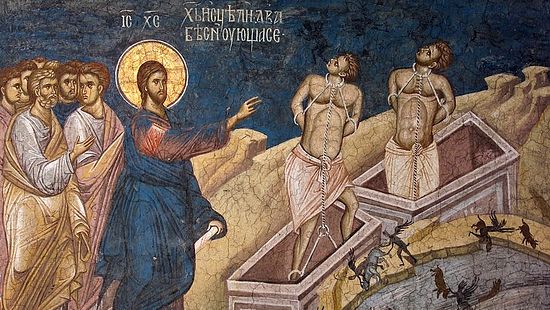
14th Century Slavic Inscribed Fresco from Vyoskie Dechany (Serbia)

Matthew 8: 28-34 What Sort of Man is This Part 2

Parallels Mark 5: 1-20, Luke 8: 26-39

28 When he came to the other side, to the country of the Gadarenes, two demoniacs coming out of the tombs met him. They were so fierce that no one could pass that way. 29 Suddenly they shouted, “What have you to do with us, Son of God? Have you come here to torment us before the time?” 30 Now a large herd of swine was feeding at some distance from them. 31 The demons begged him, “If you cast us out, send us into the herd of swine.” 32 And he said to them, “Go!” So they came out and entered the swine; and suddenly, the whole herd rushed down the steep bank into the sea and perished in the water. 33 The swineherds ran off, and on going into the town, they told the whole story about what had happened to the demoniacs. 34 Then the whole town came out to meet Jesus; and when they saw him, they begged him to leave their neighborhood.

Matthew’s narration of Jesus’ encounter on the other side of the Sea of Galilee with demoniacs is significantly shorter than Mark’s (and Luke which follows Mark’s narration) with the naming of demon as ‘Legion’ being omitted. Matthew will regularly deviate from Mark’s narration for structural, theological and perhaps here social reasons. This is another story where comparing the differences in the stories can illuminate some of the subtle ways Matthew is constructing his gospel to help the disciple understand who Jesus is and what it will mean to follow him in a world of competing loyalties.

The first obvious difference between Matthew’s narrative and Mark’s is the number of people who are possessed. In Matthew there are two, where in Mark (and Luke) there is only one. Structurally the number of demoniacs gives us a structural clue linking this story to the story of the two blind men in Matthew 9: 27-31 (also the second miracle story in a group of three). Both the demon possessed ones and the blind ones see what others cannot. These two loud and fierce demoniacs which have made that portion of the country of Gadarenes their domain understand who Jesus is in a manner that his disciples in Matthew’s gospel do not yet.

As readers we have heard Jesus identified as ‘Son’ in the baptism of Jesus (Matthew 3:17) and will also hear this identification at the Transfiguration (Matthew 17:5) spoken from heaven. Now from the mouths of demon possessed we hear the same linkage as Jesus is titled Son of God. We have already seen Jesus’ power over demons, disease and even the elements but this is the first time we hear the demons speak. As Stanley Hauerwas can state:

Demons recognize the Son because they—more than we—are able to recognize what threatens them…. The disciples fear Jesus’ absence as he sleeps in the boat; the demons fear his presence. (Hauerwas, 2006, p. 97)

Ironically, the demons speak truthfully because they realize that Jesus’ presence is a threat to their domination of their hosts and the area where they are able to overpower others who would transgress the area around the tombs. They know that their time is coming to an end and that the kingdom of heaven is approaching, but they view Jesus’ action as a premature incursion occurring before the appointed time.

The most significant difference in Matthew’s narration is the exclusion of the conversation around the naming of the demon. There may be multiple reasons that Matthew does this. Matthew may be attempting to demonstrate the authority of Jesus and his ability to cast out the demon without its name (obtaining the name of something was considered powerful in the ancient world and this is one of the reasons that the name of God was never spoken). There may also be a social reason for the exclusion of this portion of the scene. Many scholars designate Antioch as the place where the gospel of Matthew was written. As I mention when writing about this passage in relation to the gospel of Mark the combination of Legion and the herd of swine could ask some very provocative questions about the relationship of Rome and the demonic. If Matthew is written near Antioch, it would also be near the Legion X Fretensis (one of two Roman legions in Syria) whose primary emblem was a swine. Matthew, while holding the tension between the kingdom of heaven and the empire of Rome, does not intentionally exclude Rome and even its soldiers from coming under the influence of the kingdom of heaven. I think the gospels in general and Matthew in particular do not portray Jesus as advocating for conflict between Jerusalem and Rome and any resistance is non-violent. Matthew may view the linkage of the demonic with the legions as language that was too near the revolutionary overtones used by zealots in the lead up to the Jewish War (66-73 C.E.) that resulted in the destruction of Jerusalem and the temple.

Miracle of the Gadarene Swine by Briton Reviera (1883)

The community around the two demoniacs has found a way to cohabitate with their presence as marked by the large herd of swine nearby. The demons beg Jesus to cast them into the herd of swine and Jesus grants their plea. Even demons may beg Jesus for mercy. Immediately the herd rushes into the sea and we are connected back to the previous narrative where demonic (or at least dangerous powers) are at work on the sea but in the presence of Jesus the sea remains undisturbed. The casting out of the demons and the death of the herd of pigs causes the swineherds to return to town and to relate what they saw occur. Again, the irony of the story is strong when the whole town comes out to greet Jesus like a visiting dignitary but on seeing him, they but instead of welcoming him they ask him to depart their region. Like the demons they do this from the posture of begging, but Jesus hears and heeds their request.

This scene across the sea takes place among the Gentiles, and here Jesus is not met with great faith (unlike the Centurion or the Canaanite woman). Yet, the disciples, the little faith ones who get into the boat with him are left with another identity to ponder and another way in which Jesus demonstrates his power over the forces of the demonic. The kingdom is not welcome everywhere in Matthew’s story, nor will Jesus’ disciples always be welcome.  Jesus does not force himself on this community of the Gadarenes which is not ready to receive the gospel, nor will he put pearls before those who choose swine with demons to a reality where demons are driven away. Jesus does not condemn the community, but he does depart. The community chooses the world they know over the kingdom of heaven, but even those who attempt to follow Jesus may choose what is safe rather than having faith in the Son of God. But sometimes even those who are directly opposed to the kingdom of heaven bear witness in their own strange way to who Jesus is, and so demons can speak in harmony with the voice from heaven in declaring Jesus as ‘Son of God’ and disciples upon returning to the boat are left to wonder what sort of man this Jesus of Nazareth is.


Matthew 8: 23-27 What Sort of Man is This part 1

Rembrandt, Christ in the Storm (1633)

Matthew 8: 23-27

Parallels Mark 4: 35-41, Luke 8: 22-25

23 And when he got into the boat, his disciples followed him. 24 A windstorm arose on the sea, so great that the boat was being swamped by the waves; but he was asleep. 25 And they went and woke him up, saying, “Lord, save us! We are perishing!” 26 And he said to them, “Why are you afraid, you of little faith?” Then he got up and rebuked the winds and the sea; and there was a dead calm. 27 They were amazed, saying, “What sort of man is this, that even the winds and the sea obey him?”

Matthew weaves a tightly connected narrative that uses placement and word choice to give us several clues to give us insight into who Jesus is and what following him will mean for the chosen disciples. Immediately after a brief interruption where a scribe and a disciple come seeking to follow with stated or unstated conditions where language gives us clues that the scribe probably does not follow, but the disciple likely does we are brought back into a trio of confrontations which give us insight into the power that Jesus’ wields and encourage us to wonder with his disciples, “What sort of man is this?” The scene transitions quickly with Jesus getting into the boat (presumably of the boats of the four fishermen called in Matthew 4: 18-22) and his disciples follow him including, presumably, the disciple who asked Jesus previously for leave to bury his father.

Jesus has among his disciples several who are familiar with the Sea of Galilee because it was the place where they worked as fishermen. Boats at this time are small compared to sea faring ships of modern times, but the storm is literally a ‘great shaking that occurred on the sea.’  The story in both the Markan and Matthean version of this narrative is tied to the story that follows with the Gedarene demoniacs and the original hearers may have understood the storm as demonic and attempting to prevent Jesus from crossing to the other side. In our modern language we can refer to storms as an ‘act of God’ but in the spiritually porous worldview of our ancestors in the faith, spiritual forces both good and evil were actively at work in their world in not only disease but also in weather events like storms or famine. Additionally, at both the crucifixion and the resurrection in Matthew the same word that is the ‘great shaking on the sea’ (seismos) is used for the earthquake in Matthew 27 and 28. There is additional resonance with he crucifixion as the word for sleep here can have the same figurative usage we have in English when we say someone has ‘fallen asleep’ as a way of speaking about death and the word for waking (both by the disciples and Jesus getting up, various forms of the Greek egeipoo) is the same word used for rising up when talking about the resurrection in Matthew 27 and 28.

Another resonance within this story would be the story of Jonah, where Jonah (like Jesus) is asleep in the hull of a small boat while a great storm is overwhelming the small craft. While Jonah’s sleeping through the storm on a sea faring (therefore more robust vessel) is more plausible than the small boat that Jesus was on, but there does seem to be a literary connection with the basic narrative of the stories:

    • Departure by boat
    • a violent storm at sea
    • a sleeping main character
    • badly frightened sailors
    • a miraculous stilling related to the main character
    • a marveling response by the sailors (Marcus, 2000, p. 337)

The literary resonance with the Jonah shines an interesting light upon the question the disciples ask of “who is this.” In Jonah’s narrative the one who provides the great calm upon the waters is the God of Israel, while here Jesus ‘rebukes’ the wind and sea (the word rebuke can be used to silence another person but also can be used in casting out a demon, ex. Matthew 17: 18) and there becomes a great calm. The ‘great shaking’ of the storm and the ‘great calm’ of the sea after the storm are connected and yet whatever the source of the ‘great shaking’ the one who by rebuking the wind and sea brings about the great calm is greater.

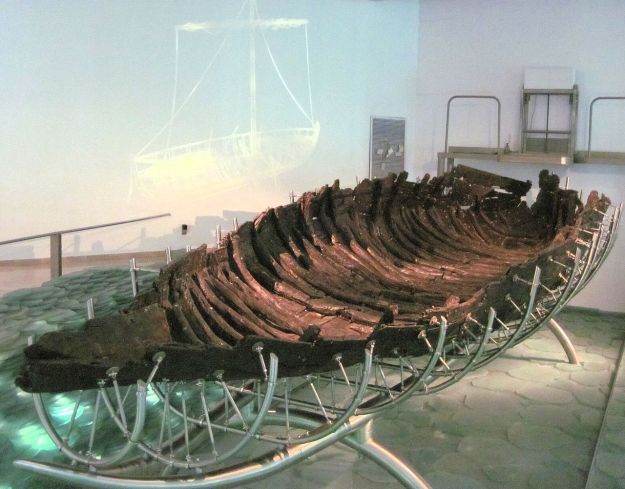
Sea of Galilee Boat or “Jesus Boat” in the Yidal Alon Museum in Kibbutz Ginosar, Tiberias Israel Ancient fishing boat from 1st Century AD. Boat is 27 feet long, 7.5 feet wide.

Unique to Matthew’s telling of this narrative is the disciples’ plea to Jesus, “Lord, save us!” This pairing of Lord and save also resonates with the language of the Hebrew scriptures in relation to the LORD the God of Israel saving the people (2 Kings 19: 19; Psalms 6:4, 55: 16, 106: 47, 109: 26; 116:4, 118:25, 143:9; Isaiah 36:8, 37:20, 38: 28; Jeremiah 30:11). Matthew again invites us to consider who is Jesus in relation to the LORD the God of Israel. Instead of using direct quotations, like earlier in the narrative, now Matthew narrates the story in a manner that alludes to several times in Israel’s story where the LORD acted and allusively invites us into the position of the little faith ones in the boat with Jesus who are asking, “Who then is this that event the wind and the sea are obedient/subject to him?”

As mentioned above when commenting on Matthew 6:30 the translation of oligopistos as ‘little faith ones’ goes to the heart of my struggle with the way that Jesus in Matthew’s gospel is perceived. While “you of little faith” is a correct translation, it is impossible to say this without it being heard as an insult which I do not think is the intention in Matthew. I am going against the grain of the way this term has been read, but the ‘little faith ones’ are always Jesus’ disciples who are caught between the ‘great shakings’ of the storms and the ‘great peace.’ This phrase can be translated harshly as, “why are you cowardly—you of little faith?” but my reading of this is much gentler, spoken not in the commanding voice that rebuked the wind and sea but a softer, more compassionate, “why are you afraid my little faith ones?” Jesus never goes out and calls the ‘great faith ones’ but instead intentionally sticks with these little faith ones and never offers to increase their faith. The little faith ones are the ones who seems to respond in wonder to what Jesus is doing and can be in the place to ask, “who then is this.” Others who we will soon meet in the story will have answers to this question, but as little faith ones we are invited to be astonished and wonder what sort of man Jesus is and how he might be related to the LORD the God of Israel.

Matthew 8: 18-22 The Nature of Discipleship part 1

Matthew 8: 18-22

Parallel Luke 9: 57-62

18 Now when Jesus saw great crowds around him, he gave orders to go over to the other side. 19 A scribe then approached and said, “Teacher, I will follow you wherever you go.” 20 And Jesus said to him, “Foxes have holes, and birds of the air have nests; but the Son of Man has nowhere to lay his head.” 21 Another of his disciples said to him, “Lord, first let me go and bury my father.” 22 But Jesus said to him, “Follow me, and let the dead bury their own dead.”

Matthew’s gospel uses rhythm to help reveal meaning. Previously in chapter eight we’ve seen Matthew use a pattern of three healing stories which climax in the scriptural citation that Jesus is the one who ‘took our infirmities and bore our diseases’ to disclose who Jesus is. Each healing narrative build upon the preceding narrative to help illuminate who Jesus is through what Jesus does. Structures of three are common in ancient literature and here Matthew will use two interconnected patterns of three to continue to help the hearer answer the interconnected questions of who is Jesus? and what does it mean to follow him?

Sometimes it is helpful to see the structure graphically

Miracle story 1 (Matthew 8: 1-4) Healing the person with a skin disease
Miracle story 2 (Matthew 8: 5-14) Healing the centurion’s son
Miracle story 3 (Matthew 8:14-17) Healing Peter’s mother-in-law…healing all
Explanation ‘He took our infirmities and bore our diseases’
Nature of Discipleship: (Matthew 8: 18-22)A scribe and a disciple
Miracle story 1 (Matthew 8: 23-27) Jesus stills a storm
Miracle story 2 (Matthew 8: 28-9:1) Jesus casts out demons from two men
Miracle story 3 (Matthew 9:2-9:8) Jesus heals a paralytic
Explanation ‘God…had given such authority to human beings’
Nature of Discipleship: (Matthew 9:9-17) Call of Matthew and question on
Fasting
Miracle story 1 (Matthew 9: 18-26) Woman and girl healed/raised
Miracle story 2 (Matthew 9: 27-31) Jesus heals two blind men
Miracle story 3 (Matthew 9: 32-34) Healing mute demoniac
Explanation ‘Never has anything been seen like this’ vs. ‘By demons he casts out
demons’
Nature of Discipleship: (Matthew 9:35-11:1) Jesus prepares disciples for
Proclamation

Matthew’s gospel is focused on helping form a community that will continue to follow Jesus amid the challenges of the world around them. From the placement of the sermon on the mount early in the ministry of Jesus to the regular interweaving of teaching and narrative we see Matthew exploring who Jesus is and what it means to follow him. Being a disciple of Jesus will involve embodying a different set of values and practices that will be visible to the surrounding world. As Matthew invites us back to considering the nature of discipleship, we are given several clues within this dialogue with the scribe and the disciple to suggest what the follower is needs to hear about the nature of discipleship even at this early stage in the gospel.

Titles matter in Matthew and the help the reader to gain insight about how each person approaches Jesus. While there are multiple titles used in Matthew’s gospel to help illuminate who Jesus is, Matthew deploys these titles carefully in the mouths of different petitioners. The scribe who comes to Jesus uses the title ‘teacher’ and although Jesus can use this term when referring to himself (Matthew 10: 24,25; 23:8 and 26:18) when it is spoken by someone else it is normally is used when people are challenging Jesus’ identity (Matthew 9:11; 12: 38; 17: 24; 19:16; 22:16; 22:24; 22:36). This scribe who approaches Jesus seems to have positive intentions in the narrative but the initial title and the way he is titled (as a scribe) hints that this scribe probably does not follow Jesus ‘wherever he goes.’ Jesus’ response to the scribe is a challenge, but as we saw in the healing of the centurion’s son when Jesus’ challenges someone there is the opportunity to respond with trust. The other hint we are given is that the scribe is the initiator of the offer of following Jesus rather than Jesus (as in the disciple’s case).

The second in dialogue with Jesus is labeled as a disciple and they come to Jesus asking for permission to do what is expected in a family relationship. We don’t know the condition of the father, whether he has already died, is very sick or whether the disciple is stating, “Once my father dies, then I can follow you” but we do know that Jesus provides resistance to this qualification. Jesus initiates the call using the same words he used with Peter and Andrew (and presumably James and John) in Matthew 4: 19 and will later use for Matthew in Matthew 9:9. We are given two verbal clues that this disciple does follow Jesus, even after the challenge to ‘let the dead bury their own dead.’

The nature of discipleship in Matthew seems to be called rather than chosen. Others outside the disciples may demonstrate great faith, often more than the disciples themselves demonstrate. Outsiders may see what the disciples struggle to see and yet, those who are disciples in Matthew are invited into this group by Jesus. It is critical for Matthew to link Jesus’ identity to the witness of scriptures, but here an interpreter of those scriptures, a scribe, is challenged and presumably does not get into the boat with his disciples, while his disciples, even one who leaves behind a father who will need to be buried, get into the boat to go away from home. Even though Jesus does seem to operate out of Capernaum as a base of operations for portions of Matthew, he will also continue to travel and send his disciples to travel to towns and villages where they are unknown. The disciples will be separated from the support of home and family as they become a part of the proclamation of the kingdom of heaven. In Jesus they will discover one who is more important than the other commitments and callings of life. In entering the journey with Jesus, they will leave behind other things, but those who get into the boat with him have been called to be there and wonder ‘What sort of man he is.’

Matthew 8: 14-17 Jesus Takes our Infirmities and Bears our Diseases part 3

John Bridges, Christ Healing the Mother of Peter’s Wife (1839)

Matthew 8: 14-17

Parallels Mark 1: 29-31, Luke 4: 38-39

14 When Jesus entered Peter’s house, he saw his mother-in-law lying in bed with a fever; 15 he touched her hand, and the fever left her, and she got up and began to serve him. 16 That evening they brought to him many who were possessed with demons; and he cast out the spirits with a word, and cured all who were sick. 17 This was to fulfill what had been spoken through the prophet Isaiah, “He took our infirmities and bore our diseases.”

Matthew places the healing of Peter’s mother-in-law in the final position of this trio of healing stories. The final position of this story fits the pattern of the following groups of healing stories where the final story involves an expansion of the people’s awareness of Jesus’ authority and power. As I’ve alluded to in the previous two stories, the quotation of Isaiah 53: 4 interprets the meaning of the healing stories for Matthew’s readers. Jesus is cast in the role of the suffering servant and the healing and exorcisms will be interpreted through the lens of the first half of Isaiah 53:4, the broader passage will continue to resonate particularly as we approach the crucifixion.

In Mark this story comes before the healing of the person with a skin disease (leper) but theologically needs to because in Mark’s narration Jesus is no longer able to enter town after the healed individual spreads the word. Matthew is a careful narrator and without the ‘Messianic secret’ motif of Mark is able to structurally use the coming of people in the evening for healing as an expansion of the awareness of Jesus’ power and authority. Jesus has returned to Capernaum and now enters the house of one of the fishermen he called before the Sermon on the Mount. Upon seeing Peter’s mother-in-law lying in bed he touches and heals her and she responds by rising up and serving him. Jesus will latter claim that he came, ‘to serve, and not to be served’ (Matthew 10:28) and Peter’s mother-in-law in her own way embodies what the stance that Jesus models for all his disciples. The Greek word diakonia which is translated serve is the word that the office of deacon comes from and this ecclesiastical office is a reminder of the call of all followers of Jesus to serve.

Jesus has healed three by both touch and word, and now many are brought to be healed or to have demons cast out. Words and cures are given for all who are brought to the house and the kingdom of heaven’s power emanates from this foothold in Capernaum. Jesus brings a healing and wholeness that neither Israel nor Rome could offer. Jesus has already crossed many of the boundaries that separated groups of people, clean and unclean, Gentile and Jew, male and female and I do believe the type of community envisioned in the Sermon on the Mount is a place where healing can happen. The healings point to the nature of the kingdom of heaven and prepare us again to examine the nature of discipleship in light of the kingdom’s advent.

Matthew 8: 5-13 Jesus Takes our Infirmities and Bears our Diseases part 2

Paolo Veronese, Jesus Healing the Servant of the Centurion (16th Century)

Matthew 8: 5-13

Parallel Luke 7: 1-14

5 When he entered Capernaum, a centurion came to him, appealing to him 6 and saying, “Lord, my servant is lying at home paralyzed, in terrible distress.” 7 And he said to him, “I will come and cure him.” 8 The centurion answered, “Lord, I am not worthy to have you come under my roof; but only speak the word, and my servant will be healed. 9 For I also am a man under authority, with soldiers under me; and I say to one, ‘Go,’ and he goes, and to another, ‘Come,’ and he comes, and to my slave, ‘Do this,’ and the slave does it.” 10 When Jesus heard him, he was amazed and said to those who followed him, “Truly I tell you, in no one in Israel have I found such faith. 11 I tell you, many will come from east and west and will eat with Abraham and Isaac and Jacob in the kingdom of heaven, 12 while the heirs of the kingdom will be thrown into the outer darkness, where there will be weeping and gnashing of teeth.” 13 And to the centurion Jesus said, “Go; let it be done for you according to your faith.” And the servant was healed in that hour.

This is the second in a trio of interconnected healing stories which will be interpreted in the final story with the quotation from Isaiah that “He took our infirmities and bore our diseases.” As Jesus is compared to the suffering servant from Isaiah by Matthew, this narrative invites us to consider the span of the ‘our’ that Jesus will take infirmities and bear diseases for. Early in Matthew’s gospel we saw an openness to the Gentiles expressing worship for Jesus and understanding what the leaders in Jerusalem did not (Matthew 2: 1-12) and here we have the first request for healing from a Gentile, an action that will demonstrate surprising faith from an unexpected character. Jesus returns home to Capernaum and an emissary of the empire meets him asking for what the empire cannot give him. In contrast to Rome’s claims to heal a sick world, a Roman officer approaches Jesus for what the kingdom of heaven can offer.

There are two translational issues that significantly shape how I believe this passage is intended to be heard that are obscured by most translations. The first issue is the translation of the person needing healing: the Greek word pais normally means child and the masculine article would indicate a son. While in some cases the word can mean servant, its translation here as servant is attempts to harmonize this story with Luke’s version where he translates the Greek doulos as slave or servant. Matthew understands the distinction and uses doulos in verse nine to refer to a slave who the centurion can order to ‘do this’ and the slave does it. If the one needing healing is a son it heightens the connection to the centurion and creates a linkage to the other narrative of surprising faith in Matthew when a Canaanite woman approaches Jesus to heal her daughter. (Matthew 15: 21-28)

The second translational issue is that the initial response of Jesus to the Centurion is structured in Greek as a question: “Am I to come heal him?” Like the Canaanite woman there is a barrier that is present and the question of who Jesus has come for is brought forward. Is this officer in a different empire to be a beneficiary of the kingdom of heaven’s approach? Even though modern readers know that Jesus does heal the Centurion’s child, the initial response does not guarantee it and the petitioning centurion now is placed in the position of answering Jesus’ query. Like the Canaanite woman, the centurion meets this reluctance or resistance with a demonstration of faith that amazes Jesus and is contrasted to the expressions of faith he has encountered among the people of Israel. Jesus does not have to come and heal the child, but only speak the word and it will be done. The centurion uses his experience of earthly authority as a model for the authority of Jesus.

Faith for the centurion, and throughout Matthew’s gospel, is not a solely intellectual thing. Often faith in churches is a type of intellectual assent to beliefs or doctrines about who Jesus or God is, but although the identity of Jesus is an important theme for Matthew faith seems to be trust in what Jesus, or God, can do. The centurion does use his understanding of authority to reason that Jesus can heal by simply saying the word, but that doesn’t mean that the centurion or others seeking healing from Jesus understand who Jesus is (as Matthew is attempting to illuminate through a combination of stories, scriptural references, conflicts and teaching). Nor has the centurion committed to the way of life outlined in the Sermon on the Mount and we don’t have any indication that the centurion’s interactions with Jesus will go beyond this one meeting. Yet, the centurion is able to see what many both opponents and followers of Jesus are unable to see at this time: that Jesus has the authority to do what he says. Yet, as highlighted in the previous story, the address of Jesus as Lord indicates this is a story where there is an attribution of faith. Even if the centurion may intend this as a polite address to authority, Matthew is continually inviting us as hearers to reflect on who Jesus is who has the authority to do these things.

Matthew also uses this narrative as a way to reinterpret the ‘our’ of the hope that . Matthew takes the hope of texts like Psalm 107: 2-3 and Isaiah 43: 5-7 which speak of the regathering of the people of Israel:

Let the redeemed of the LORD say so, those he redeemed from trouble and gathered in from the lands, from the east and the west, from the north and the south. Psalm 107: 2-3

Do not fear, for I am with you; I will bring your offspring from the east, and from the west I will gather you; I will say to the north, “Give them up,” and to the south, “Do not withhold; bring my sons from far away and my daughters from the end of the earth—everyone who is called by my name, whom I created for my glory, whom I formed and made. Isaiah 43: 5-7

Now instead of those coming from east and west being the regathered heirs of the kingdom, now the Gentiles are included in this regathering for the banquet with Abraham, Isaac and Jacob and some of those in Israel will not be included. This is a part of Matthew’s inclusion of the Gentiles in the kingdom of heaven, but the receptions by the Gentiles will not be universal as we see in future stories. Faith will be found within and beyond Israel and the kingdom will be for Jews and Gentiles, men and women, parents and children, centurions, lepers and more.  Even for those serving other empires, they are not beyond the reach of healing and redemption. Centurions can demonstrate faith unseen in Israel, Jesus can heal by saying the word and a child’s distress can be relieved in the hour of Jesus’ declaration that it is done according to the centurion’s understanding of faith.

Matthew 8: 1-4 Jesus Takes our Infirmities and Bears our Diseases part 1

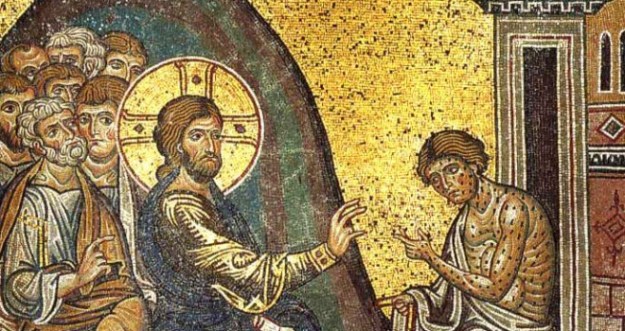
Mosaic, Cathedral of the Assumption in Monreale, Sicily (12-13th Century)

Matthew 8: 1-4

Parallels (Mark 1: 40-45, Luke 5: 12-16)

1 When Jesus had come down from the mountain, great crowds followed him; 2 and there was a leper who came to him and knelt before him, saying, “Lord, if you choose, you can make me clean.” 3 He stretched out his hand and touched him, saying, “I do choose. Be made clean!” Immediately his leprosy was cleansed. 4 Then Jesus said to him, “See that you say nothing to anyone; but go, show yourself to the priest, and offer the gift that Moses commanded, as a testimony to them.”

Jesus comes down the mountain after the Sermon on the Mount and we see the kingdom of heaven in conflict with the forces that keep people enslaved in the world. In chapters eight and nine of Matthew’s Gospel we see three patterns of three stories each separated by some manner of conflict with those hearing the message and some explanation of what we are seeing. It has been noted that like Moses participating in God’s liberation of the people from Egypt with the ten signs and wonders in Exodus 7-12, there are in these two chapters a total of ten acts of healing, exorcism or miracles, (Case-Winters, 2015, p. 125) and while I would agree there is a strong Moses typology in Matthew’s gospel that both places Jesus in comparison and in contrast to Moses these ten signs that announce the kingdom of heaven’s approach. There is also resistance from the forces of the world to the approach of the kingdom of heaven which occur each time Jesus descends a mountain in Matthew’s Gospel. In Matthew eight and nine at the end of each set of three stories there is an expansion of the effect of the individual acts to the many or crowds that are brought into the sphere of influence of the kingdom’s activity.

The first healing in Matthew’s gospel is a person rendered unclean by a skin disease, and while this probably isn’t leprosy, or Hanson’s disease as we have long translated this term, it is for the people of Israel a disease that rendered a person unclean and forced them to live isolated from the community. Skin diseases were a significant concern among the people and the priests are given the role of properly identifying this as a disease that makes one unclean and excluding and reuniting the person with the community. Leviticus 13-14 give the details of how the priest is to diagnose, proclaim unclean, and if the person recovers to ritually declare the person clean again. This type of uncleanness was viewed as a punishment by God, for example Numbers 12 with Miriam, and many diseases in this time were viewed as either an affliction by God or the act of some demonic corrupting force. Yet, I do think it is interesting to note in comparison with Moses that the second sign God gives Moses is turning his hand diseased (leprous in most translations) before Moses goes to witness to Israel. Here Jesus reaches out his hand and touches an unclean man with an affliction of the skin and makes it clean. Matthew in narrating Jesus’ story moves this story ahead of the healing of Peter’s mother-in-law in Mark’s Gospel and perhaps he alludes this connection early in Moses’ ministry.

Regardless of allusions, the issues of what righteousness and the relationship to the law which were important to the Sermon on the Mount are immediately brought into concrete expression as Jesus encounters one who is ritually unclean and acts in ways both contrary and in concert with the law. The law would declare the person unclean and untouchable and there is a view that uncleanness is contagious and because it not only was there a fear of contagion but a fear that the inclusion of the unclean one impacted the purity of the community in its standing before God. Yet, in the kingdom of heaven cleanness is contagious and can be transmitted. Jesus in many of the healings and exorcisms that occur in the next two chapters will cross a barrier to inclusion created by disease, possession, bleeding, being a Gentile, and even being dead. Jesus exercises the authority to make the unclean now clean, unlike the derivative authority of the priest which can only declare that which God has made clean as clean. Something greater than the law is at work here and yet there is still the insistence to offer the gift commanded by Moses as testimony to the priest.

Matthew removes the secrecy motif which is a part of Mark’s narration of this story. In Mark the cleansed leper is commanded not to tell anyone but spreads the word freely which prevents Jesus from being able to enter town. In Mark’s telling there is a great reversal where the formerly unclean leper goes into town telling the message he was to keep silent and Jesus now becomes unable to enter town but now people come from everywhere to touch him. In Matthew the narrative ends after the command to offer the gift to the priest. Matthew also places this story before the healing of Peter’s mother-in-law later in the chapter which has him entering the town of Capernaum. Another key portion of Matthew’s narration is the title people use to address Jesus. Here, and frequently in stories with positive attributions of faith in Matthew, Jesus is referred to as Lord instead of ‘teacher’ (often when faith is questioned) or ‘son of God’ (normally demons but also the Centurion at the cross) or ‘son of David’ (those who are blind but see what others cannot). Lord may simply be a polite address of authority, like ‘sir’ in English, but it also has a strong connection with how the people of Israel referred to the God of Israel (using Adonai, translated LORD instead of the name of the God of Israel). Matthew has already demonstrated a propensity for using language and vocations reserved for the God of Israel to talk about Jesus, so the frequent use of the term Lord in a positive light may point to the nature of faith seeing in Jesus the God who is with us. This is also highlighted by the action of the unclean one kneeling before Jesus in a stance that is appropriate to worship. The act of kneeling could be a stance giving honor to Jesus, but Matthew probably intends for the reader to see in this act the appropriate stance of giving worship to the Lord.