Yearly Archives: 2016

Psalm 12-Save Us from Ourselves

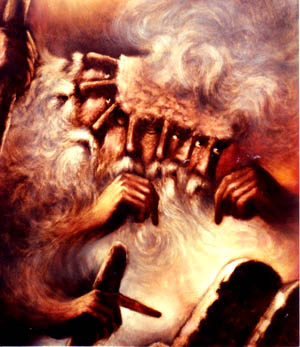
Bible Paintings in Castra center, Haifa- David and Batsheva, David and Avshalom

Bible Paintings in Castra center, Haifa- David and Batsheva, David and Avshalom

Psalm 12

To the leader: according to The Sheminith. A Psalm of David.
1 Help, O LORD, for there is no longer anyone who is godly;
   the faithful have disappeared from humankind.
2 They utter lies to each other;
  with flattering lips and a double heart they speak.
3 May the LORD cut off all flattering lips,
   the tongue that makes great boasts,
4 those who say, “With our tongues we will prevail;
   Our lips are our own—who is our master?”
 5 “Because the poor are despoiled, because the needy groan,
   I will now rise up,” says the LORD;
  “I will place them in the safety for which they long.”
6 The promises of the LORD are promises that are pure,
   silver refined in a furnace on the ground,
   purified seven times.
7 You, O LORD, will protect us;
   you will guard us from this generation forever.
8 On every side the wicked prowl,
   as vileness is exalted among humankind.
 
The Psalm begins as a cry for help and while the cry may come from an individual the cry goes forth on behalf of a community that no longer is the place it was intended to be. What was dreamed to be a place of faithfulness and trustworthy people has turned into a place where tongues have been loosed, boasts have been made and community has been destroyed. The double-hearted nature of the community has broken the heart of the Psalmist and sent them into a search for hope in the midst of the empty words they see in a community that was meant to be something much different. In a toxic environment where the tongues of those who are seeking their own interests rule the day the community of the faithful is in mortal peril.

Many leaders of communities have known times where the community, through conflict or by the actions of a bully, devolves into the opposite of its original intent. Unfortunately, it is all too common for churches and places of worship which preach forgiveness to become unforgiving. Sometimes the message of justice becomes perverted into a message of just-us, and sometimes the boastful words overpower the quiet insistence of those trying to follow whole heartedly. It is from this experience of disillusionment that the Psalmist cries for help. In a feeling of isolation and desolation where the faithful have been replaced by the duplicitous, the powerlessness of the Psalmist on their own is overpowering.

Family Systems Theory can talk about a Karpmann Drama Triangle where people are stuck into roles as the victim, oppressor or hero. Claus Westermann noted that in many of the Psalms of Lament that Israel or the speaker find themselves in the role of the victim where the LORD becomes the liberator of the speaker or Israel from their adversaries. (Brueggemann, 2014, p. 74) With the speaker in the role of the victim in the midst of their adversaries they are reliant upon God as their deliverer from their adversaries. This is the nature of the relationship that the people of God have with their deliverer. However, the danger is that these same people can easily move into the role of the oppressor where now the LORD must stand with the oppressed ones over against them. Perhaps, this is something that the Psalmist feels is now happening among their community. That the empty words have allowed the people to deny the contingency of their existence that is based upon their living into the covenant they have with the God of Israel.

The Psalmist sees those around him denying reality and doing violence to others in that denial. They have arrogated themselves into the position of being their own gods who no one can judge. (Nancy deClaisse-Walford, 2014, p. 156) Their tongues have become the small member that boasts of great exploits, setting fire to the world around them. (See James 3: 1-12) In claiming this place they have denied the reign of God feeling free to craft their own dominions.  Yet, as so often is the case, when the powerful and the boastful feel free to create their own realities it comes at the expense of the poor and the vulnerable. Whether the Psalmist can claim a spot among the alien, the widow and the orphan (the classic way that the Hebrew bible speaks of the vulnerable) or not they are aware of the way in which the law, the commandments and the ordinances of God attempt to create a society where the oppressed are cared for. Yet, as the community moves away from its groundings and devolves into a place where unpleasant truths are denied at the expense of a more convenient illusion it also becomes a place that loses its understanding of hospitality and mercy.

The Psalm rests on the confidence that God will see and God will intervene even when the immediate evidence may point in the opposite direction. In a place where vileness is exalted among humanity and the poor are despoiled and the needy groan the Psalmist sees beyond the present moment to a hopeful future where God sees and acts. The Psalms understand, like the rest of the Bible, that God acts on behalf of the powerlessness and has an ear for the cries of the poor and oppressed.  It is in the LORD’s answer, “I will now rise up” that the Psalmist trusts. The LORD has acted in the past; the LORD’s promises are true and precious. In comparison to the dross the Psalmist hears spoken around him the promises of God to them are like pure silver. As Mary can sing in Luke’s gospel the time is coming when:

He has shown the strength with his arm; he has scattered the proud in the thoughts of their hearts.
He has brought down the mighty from their thrones, and lifted up the lowly;
He has filled the hungry with good things, and sent the rich away empty.
He has helped his servant Israel, in remembrance of his mercy,
according to the promise he made to our ancestors, to Abraham and to his descendants forever. (Luke 1: 51-55)


Living Brave Reflection 9: Learning to Pay Attention (and Making Space for Good Habits)

One of the bad habits I developed in working out is holding my breath. When you run you can’t do this, but when I lift weights or do pushups I have a bad habit of holding my breath until I need to gasp for air and then I hold it again as the bar or my body goes up and down. The proper technique would be to breathe in while you are letting the weight come down and to exhale while the weight goes up. Holding my breath may give me a temporary boost, since I’m less concerned about breathing and form, but for any type of endurance proper breathing is essential. The muscles rely upon oxygen to convert sugar into energy and when they are denied sufficient energy they begin to utilize a process called anaerobic glycolysis which is a very efficient way of transforming sugar into energy, but there is a cost. This process generates lactic acid which will eventually slow your performance and lead to cramps and other symptoms of your body telling you to slow down.

One of the bad habits I never developed, thankfully, was smoking. Smoking would be genetically a very bad decision for me, lots of history of lung related cancers in my family, but something I learned while in the military was an unexpected benefit to smokers. Smokers are typically allowed several smoke breaks throughout the day where they get to break from their work and one of the added benefits was a couple minutes of deep breathing. Deep breathing, even though they are inhaling a harmful substance, lowers the heart rate, reduces anxiety and it also probably reinforces the behavior. As a person who doesn’t drink coffee or smoke (the two acceptable reasons for breaks in most business environments) I tend to work non-stop. Yet, I know that I’m more effective when I can find times to take breaks. I know I am calmer when I take time to pay attention to things as simple as breathing.

Since 2009 (and those who are interested in the significance of 2009 can read more about that here) when I crashed emotionally and my body began to fail after years of chronic stress, I’ve become much more aware of my emotions and the signs my body gives me. Some things are the result of the wisdom and challenges of getting a little older (the body just doesn’t respond to things the way it did at 22) but it is also the gift of learning to be more mindful. Of becoming curious about the emotions I might feel, particularly the emotions in the anger and sadness spectrum, and what is going on. I often discover that when I am feeling angry or sad or frustrated there is some place where I have begun pushing through things and not taking care of myself. Working at a short term pace on a long term project. Not taking the time to do simple things like read or watch a movie that provide me a recharge as an introvert or, on the other hand, seeking out the connections that are beneficial to me and spending time with people and activities that bring me joy.

I’m wondering what it would look like to have a non-smoker, non-coffee break. Some intentional time where I force myself to take 15 minutes away from my work to pause, reflect and wonder. To breathe deeply and pay attention for a few minutes before re-engaging what I do with my usual fervor. To make more space for some of the good habits that would be beneficial to me in my life and work.

Psalm 11: Confident Faith in the Midst of Trouble

Giovanni Francesco Barberi (il Guercino), King David (1651)

Giovanni Francesco Barberi (il Guercino), King David (1651)

Psalm 11

To the leader. Of David.
1 In the LORD I take refuge; how can you say to me,
“Flee like a bird to the mountains;
 2 for look, the wicked bend the bow,
they have fitted their arrow to the string,
to shoot in the dark at the upright in heart.
 3 If the foundations are destroyed, what can the righteous do?”
 4 The LORD is in his holy temple;
the LORD’s throne is in heaven.
His eyes behold, his gaze examines humankind.
 5 The LORD tests the righteous and the wicked,
and his soul hates the lover of violence.
 6 On the wicked he will rain coals of fire and sulfur;
a scorching wind shall be the portion of their cup.
 7 For the LORD is righteous;
he loves righteous deeds;
the upright shall behold his face.

This is another Psalm where we do not know the threat that David (Psalm 11 is attributed to David) faces, yet the advice to flee like a bird to the mountains because of the strength of those opposing the speaker poetically evokes a mortal threat. Yet there is a defiance in the initial line which sets the tone for the rest of the Psalm, “In the LORD I take refuge.” The Psalmist trusts that, even in the midst of a life threatening situation, the LORD sees and will act. This Psalm, like many of the Psalms, revolves around the active move to take refuge in the LORD and to trust that the LORD will act. It means relinquishing control over one’s future and to stand in the trust that even in the midst of the speaker’s powerlessness that God can indeed act on behalf of the righteous and against the wicked.

This defiant stance, of trusting the LORD in the presence of danger, is a frequent theme of the Psalmist. For the writers of the Psalms they trust that God does see, act and judge. That God sustains the righteous and will in time punish the wicked. The author’s trust in God enables them to place themselves into the position of danger even when they may feel powerless. This poetic approach to faith that trusts in the midst of crisis has been a balm for many of the faithful across the generations. Luther’s ‘A Mighty Fortress’, which is inspired by Psalm 46 is an echo of this type of faith. Yet, the Psalms are poetic and not dogmatic and just because the poet is able to appeal to the LORD in the midst of their situation does not condemn a person who may flee in a different situation.

In 1527, during the early reformation at Wittenberg, a case of Bubonic plague was discovered. The students were sent home but Luther remained in the city and was busy with pastoral and practical care of the sick. Late in the year Luther wrote an open letter on ‘Whether One May Flee From A Deadly Plague’ where Luther can endorse the type of faith that is stated here in the Psalm, because in times of death someone must stay: doctors, nurses, preachers and others necessary to care for the afflicted. But Luther also allows that there will be those whose faith is not at this place and they should be allowed to flee and that those who are unnecessary may be acting on a natural tendency, implanted by God to flee death and save one’s life. (Luther, 1989, pp. 736-755) Luther’s caution was not to condemn those whose walk of faith allowed them to flee like a bird to the mountains nor those who for the sake of the neighbor walked into the place where death seemed to reign.

Living Brave Reflection 8: Stockpiling Stress

1.5

1.5


Sometimes your greatest strength has its shadow side. I have always been a very resilient person who is able to keep a clear head in intense and stressful situations. I have high expectations of myself in the way in which I interact with others and try very hard not to offload any emotional or situational stress I feel on them in inappropriate ways. I am very good at being a non-anxious presence and have been able to remain in a more rational space when walking through some of those anxiety filled environments. Yet, you can’t walk through an anxiety filled environment without inhaling the fumes and having the fear and the worry enter into your lungs and pass into the bloodstream. You can’t bear other people’s burdens without a way of unburdening yourself and dealing with your own stress and anxiety. You don’t engage anger or fear without the endorphins which prepare your body to fight or flee flooding through your system leaving their residue remaining in fiber of your being. Yes, there is the healing power of removing oneself from the stress and letting the body work the toxins out of its system. There is the incredible healing power of exercise, sleep, good diet and conversations with trusted friends, of being in places where you are accepted and nurtured. But if you are like me, the longer you remain in the environment the more your stockpile stress and the less attractive the very things that would bring healing appear. I am good at pushing myself to the point where my body finally begins to react to the stockpiled stress and emotions and then begins to plead its case in various ways to force me to slow down or to make changes.

Perhaps I am more aware of this after 2010 when my body reacted to years of dealing with chronic stress by triggering a number of reactions both physically and emotionally. There were a number of standard physical signs-carrying tension in my neck for example, but also others which I didn’t realize until later. During 2008-2010 I suffered a number of very painful cramps in my legs that prevented me from running for significant periods of time (one of my primary stress relief outlets) which partially were due to not replacing shoes often enough but I believe were also aided by the amount of stress I was bearing. Emotionally I began to suffer from panic attacks, had trouble sleeping and drifted into depression.

I have attempted to become better in listening to my body. Granted, I’m no longer in my twenties and my body doesn’t respond to physical and emotional demands in quite the same way but I am still a pretty resilient person. Yet, with that resilience can hide the weakness. The belief that I can continue to push past my limits or endure things that may be unhealthy or violate boundaries that I need to recharge and rejuvenate. I’ve learned that often my body is the canary in the coalmine, the indicator that once again I have been stockpiling stress. So perhaps it is time for a warehouse sale, to open the doors and clear out all the crates.

Reflections From A Year Spent with Deuteronomy

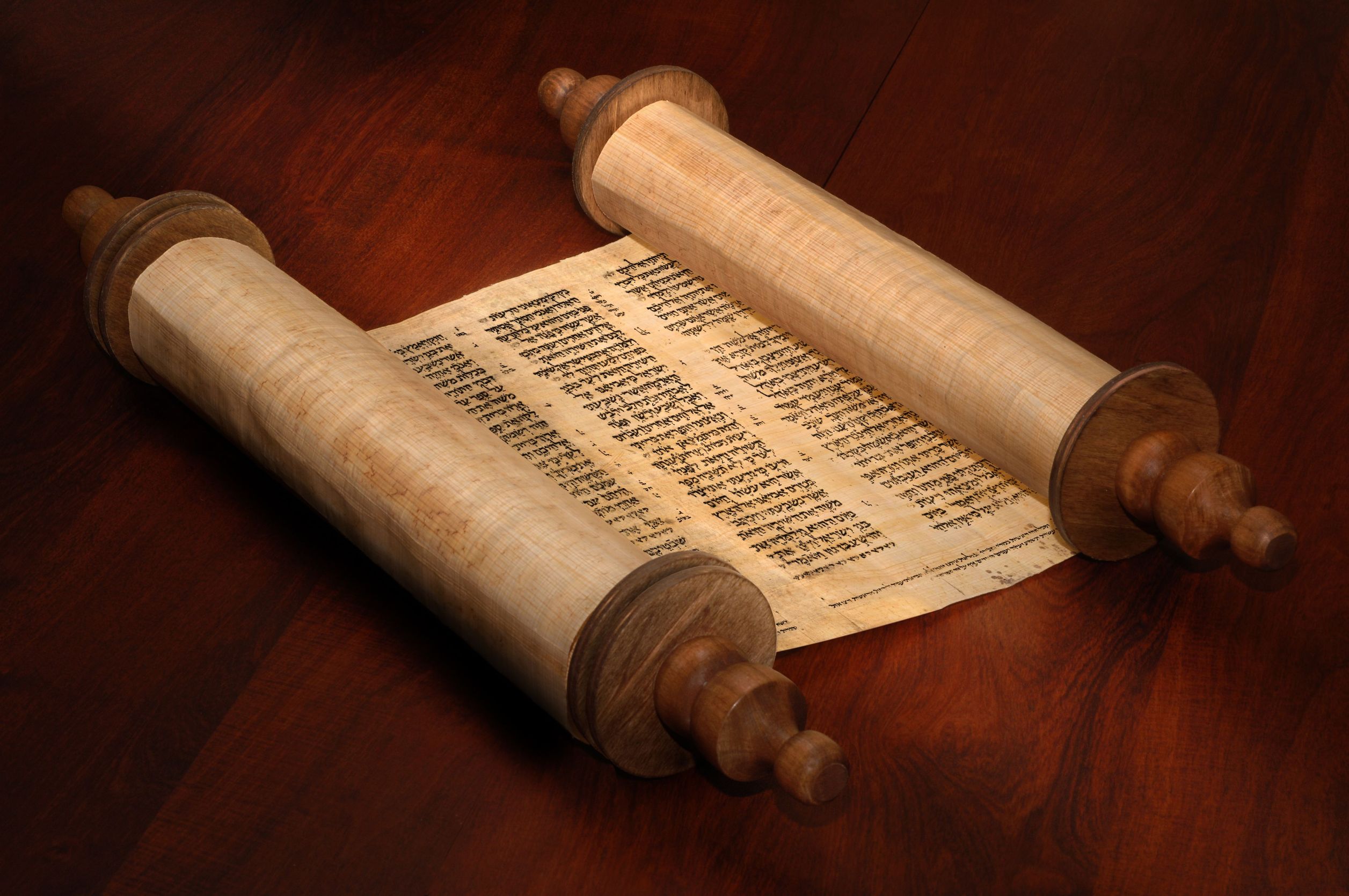
Torah Scroll, Original image from http://www.nachat-austin.org/weekly-torah/

Torah Scroll, Original image from http://www.nachat-austin.org/weekly-torah/

Deuteronomy is the fourth book, and the second large book that I have worked my way through systematically from beginning to end. It took me a little more than a year (13 months and 1 week) from my first post on Deuteronomy 1 to the final entry on Deuteronomy 34. Deuteronomy is not a book that a lot of Christians spend a lot of time with but for our Jewish brothers and sisters it is one of their most important books. Most Christians don’t spend much time with Deuteronomy, well with the exception of Deuteronomy 6 which has become important to those who want to talk about faith formation in the home or Deuteronomy 5 which re-articulates the ten commandments. Many of the ordinances and commandments of Deuteronomy seemed alien to me and yet, I knew that there was a reason that people had gone back to this work for over 2,500 years. Using Walter Brueggemann’s and Deanna A. Thompson’s commentaries on Deuteronomy as my two primary reading companions I began not knowing how the project would turn out but at least motivated to see what wisdom I would glean from this ancient work. I was motivated by the knowledge that I had made it through Jeremiah, a larger and very challenging work, and that I would be able to eventually reach the point of reflecting back again.

I am a Lutheran pastor who has spent most of my time studying the Gospels and Paul’s letters and who comes from a tradition that is open to reading scripture with a critical eye. Deuteronomy has some sections that in the twenty first century we will not be adopting or advocating and so I have tried to bring the issues of the time into conversation with the events and policies and beliefs of our time. I have tried to use Deuteronomy as a helpful conversation partner-trying to understand how the author of Deuteronomy thought about God and society.

Deuteronomy wants to imagine a society ordered around God’s law and living out of the covenant relationship with the LORD the God of Israel. For the people of Israel and Judah their public life was a reflection of their faith and there was no concept of a separation between church and state. In a world where the people of Israel were surrounded by a plethora of religious alternatives the book of Deuteronomy tries to imagine a society centered around the laws and covenant and ordinances of the God of Israel and a manner both catechetically in the home and liturgically in the worship of the community that would pass on this faith from generation to generation. The great anxiety of the book of Deuteronomy is that in the midst of abundance the generations to come would forget the source of their abundance and become attracted by the practices and the gods of the people around them.

I am very aware of the postmodern, secular, pluralistic world in which we live and I have attempted to bring the questions of that worldview into conversation with the strictly ordered worldview of the Deuteronomist. What has emerged at its best is an opportunity to think ethically about what type of world I as a Lutheran Christian in 21st Century would imagine in dialogue with Deuteronomy imagining God’s will for their time. Because our hermeneutics and starting points are different there are times where we come to different answers and that is OK. Even when I may diverge from the way Deuteronomy understands God or the meaning of what God desires I still try to find the wisdom of the people who were wondering God’s story had entered their story through the Exodus and through their experiences.

As a modern scholar I have used a lot of different tools in working through Deuteronomy. The first is an ancient tool, I simply forced myself to listen to the text by slowing down and manually writing out the text as I commented on it. As mentioned above, I am a Lutheran pastor so I do come from a perspective where the cannon within the cannon (or the most important key to understanding scripture) is what conveys Christ and so I have listened to where Deuteronomy spoke in concert and contrast to the witness of Christ throughout the New Testament. I have brought my experiences and listened to the ways my time in the military, as a father, as a divorced person, and as a pastor have been brought into conversation and filled out the way I can hear these texts. I have been intentionally intertextual, allowing Deuteronomy to be in conversation with the rest of the Bible. But I come to this as a person who loves the Bible and the God it tries to bear witness to and as a pastor who wants to communicate this story to others who would have the patience to listen. I am not a PhD in the Hebrew Scriptures, just a willing student of Deuteronomy.

Wrestling with books like Deuteronomy is more challenging than the familiar gospels or even Paul’s letters but there is wisdom. It is hard to understand the way the early church leaders talked about Jesus without understanding the scriptures they were reading. There are portions of Deuteronomy that help make sense of who Jesus was and what he was striving for. For example, look at Deuteronomy 17: 14-20 and then think about what it meant for Jesus to have the title Messiah (anointed king) applied to him. Deuteronomy forms the basic frame that the prophets will work out of as they protest the injustices and idolatry of the nations of Israel and Judah. The thought of Deuteronomy will form one of the loudest voices in informing the rest of the Hebrew Scriptures as they evaluate their history and as they imagine their future.

If you have benefited from these reflections I am thankful. They have been beneficial for me to write. The process continues to allow me to grow in my faith and understanding. I hope that in them I have exercised wisdom. I have benefited from the wisdom of others who have passed on the faith and this tradition to me.

As an update on what is next I am returning to the book of Psalms and will work through Psalms 11-20 as I decide which book I will work through next. I have enjoyed this project but I also am ready to work with something new and there is always a sense of relief at the completion of a work like this (even if I am the only person who ever reads it).


Deuteronomy 34- The Death of Moses

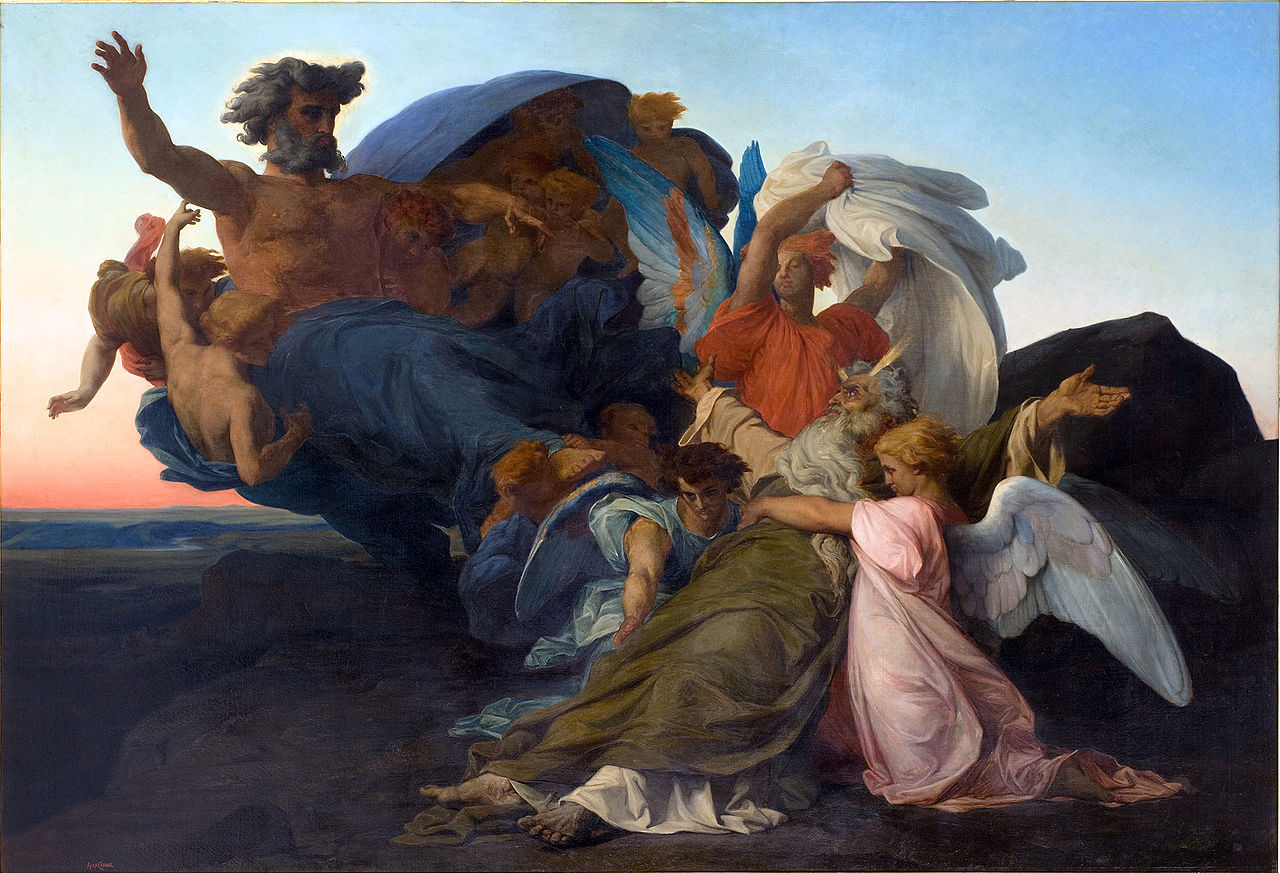
Alexandre Cabanel, The Death of Moses (1850)

Alexandre Cabanel, The Death of Moses (1850)

Deuteronomy 34

1 Then Moses went up from the plains of Moab to Mount Nebo, to the top of Pisgah, which is opposite Jericho, and the LORD showed him the whole land: Gilead as far as Dan,2 all Naphtali, the land of Ephraim and Manasseh, all the land of Judah as far as the Western Sea,3 the Negeb, and the Plain– that is, the valley of Jericho, the city of palm trees– as far as Zoar.4 The LORD said to him, “This is the land of which I swore to Abraham, to Isaac, and to Jacob, saying, ‘I will give it to your descendants’; I have let you see it with your eyes, but you shall not cross over there.”5 Then Moses, the servant of the LORD, died there in the land of Moab, at the LORD’s command.6 He was buried in a valley in the land of Moab, opposite Beth-peor, but no one knows his burial place to this day.7 Moses was one hundred twenty years old when he died; his sight was unimpaired and his vigor had not abated.8 The Israelites wept for Moses in the plains of Moab thirty days; then the period of mourning for Moses was ended.

9 Joshua son of Nun was full of the spirit of wisdom, because Moses had laid his hands on him; and the Israelites obeyed him, doing as the LORD had commanded Moses.

10 Never since has there arisen a prophet in Israel like Moses, whom the LORD knew face to face.11 He was unequaled for all the signs and wonders that the LORD sent him to perform in the land of Egypt, against Pharaoh and all his servants and his entire land,12 and for all the mighty deeds and all the terrifying displays of power that Moses performed in the sight of all Israel.

Deuteronomy and the Pentateuch end with Moses’ death on Mount Nebo. The five central books to the Jewish understanding of faith traditionally attributed to Moses now have come to an end. Moses’ death has been foreshadowed throughout Deuteronomy and has been attributed to both the disobedience of the people and to Moses and Aaron acting without giving proper praise to God the waters of Meribath-kadesh (see Deuteronomy 32: 48-52). Yet, foreshadowing the death of Moses (even though he is reported to be one hundred twenty years old-which is also a way of referring to people being of a good old age) when he can still see well, is still active and vigorous and not suffering from the illness and impairment of old age is still an unexpected death of one who is so alive. The transition from Moses the teacher and leader has been set in motion through the end of the book but Moses will remain a unique figure for the people of Israel.

Many people focus on the unfairness of Moses being unable to enter the promised land but perhaps there is the possibility of grace here in this moment. George Elliot in his poem “the Death of Moses” can speak of Moses’ death as:

A death was given called the Death of Grace
Which freed them, from the burden of the flesh
But left them rulers of the multitude
And loved companions of the lonely. This
Was God’s last gift to Moses, this the hour
When soul must part from self and be but soul. (Thompson, 2014, p. 195)

From a Christian perspective we, perhaps, too quickly make the jump to resurrection or to Moses being with the God of Israel in heaven, but for the ancient Jewish people resurrection was not a part of their understanding of the blessing and promise of God. Yet, after a life of struggle, of constantly being pulled between the needs of the people and their inability to remain faithful and the dangerous engagement of the LORD with those same people. After Moses again and again would place himself between God and the people and after the people would continually disappoint Moses. Perhaps the ending of a powerful but heavily laden life can truly be laying down one’s burdens to, in the words of an old Vince Gill song, go rest high upon the mountain. Or perhaps from another powerful example that Deanna Thompson lifted up was the example of Martin Luther King, Jr. from his speech to sanitation workers on April 3, 1968-the day before his assassination when King prophetically speaks:

I don’t know what will happen now. We’ve got some difficult days ahead. But it really doesn’t matter with me now—because I’ve been to the mountaintop. I don’t mind. Like anybody, I would love to live a long life, but I’m not worried about that now. I just want to do God’s will. And He’s allowed me to go up to the mountain. And I’ve looked over. And I’ve seen the promised land. I may not get there with you. But I want you to know tonight that we as a people will get to the promised land. So I’m happy tonight. I’m not worried about anything. I’m not fearing any man. Mine eyes have seen the glory of the coming of the LORD. (Thompson, 2014, p. 245)

Moses, the reluctant leader who in the desert tried to avoid the calling of God would indeed be the one who God would work through in ways that no one else would share. The people began to trust in Moses as a mediator of the presence of the almighty God, as one who would know unknown intimacy with the LORD by being able to speak to God face to face and not die. He would be remembered for wielding God’s power in incredible ways in the land of Egypt and in the journey through the wilderness. Yet, perhaps there is grace in a death that is away from the people in an unknown grave. If the grave was known it is possible, perhaps probable, that people would begin to venerate it in ways that worshipped Moses rather than God. There are certainly times in the book of Judges where people begin to worship the things of the Judge rather than the God who worked through the judge.

Throughout Deuteronomy we realize that the people of Israel’s life is contingent upon the God of Israel who has drawn close to them. Here in this final chapter where Moses dies at the command of the LORD we see the contingency of one drawn so close to God even more clearly. Moses’ position and power derive from his proximity to the LORD who called him at Mount Horeb. No one will know the intimacy of the relationship that Moses does and linked to that connection is also the reality that no one will perform the wonders of the LORD in the same way either. Moses becomes the mediator of the presence of the divine to the people, he becomes the vessel through which the LORD’s power for the preservation (and sometimes the punishment) of the people will pour.

Moses will continue to echo throughout the story of Israel and the church. Others will attempt to carry on the legacy that he began, but even Joshua’s power is here lifted up as derivative of Moses laying on of hands. The absence of the grave will lead to speculations about Moses. By the time of the emergence of the Christian church there was speculation about Moses assumption directly into heaven like Elijah or Enoch. In Mark 9, and parallels, Moses will be present with Elijah on the mount of the Transfiguration talking with Jesus and Jude 9 is either a reference to The Assumption of Moses a Jewish Pseudapigraphal document which we only have one existent 6th century copy of or another tradition of Moses’ assumption which may predate that. Regardless by the first century CE it was common to think of Moses having been assumed bodily into heaven and the absence of a grave becomes evidence to this. Yet for Deuteronomy, this text seems to know of either whispers of a possible gravesite or the search for one and seeks to assure the reader that no one knows of the site to this day.

So we come to the end of this part of the story and to the end of a remarkable life narrated in between the story of the LORD, the God of Israel and the people of Israel. Moses journey with the people has set the stage for the journey they will continue with Joshua.

Living Brave Reflection 7- There Is No Going Back…

There are experiences that have shaped who I am in various ways. Even though there are parts of my life that were painful and difficult I feel very fortunate to live the life that I have lived. Yet, there is no going back to the person I was prior to any of those points.  Sure, I can romanticize the past occasionally, thinking back to a simpler time. Yet, even if you could turn back the clock I am a different person than I was. There really is no going home the same way as you began your journey. The road has changed each of us, and for me I can be thankful for those changes.

I would have never chosen to be color deficient and be denied the ability to fly (which was my life’s ambition through middle school and high school) or to be able to utilize an appointment to the Naval Academy (which I worked hard to receive), but it led me to being a part of the Corps of Cadets and the band at Texas A&M and a whole different set of experiences. I would have never chosen to receive Chemical Corps as a branch when I graduated from college and was commissioned into the army, with a civil engineering major I was planning on either the Corps of Engineers or a second choice of Armor. Yet, it put me in positions with people who helped form me as a leader and probably made it easier for me to accept my calling to enter seminary. I would have never chosen to have my son diagnosed with autism, and at the time of the diagnosis I raged at the injustice of it and the broken dreams that I had for my son, yet I have learned more from him than I could have ever imagined and as a 17-year-old young man I am proud of what he has accomplished. I would not have chosen going through the experiences of conflict in a congregation that I did in my second call and the amount of emotional and personal upheaval it caused, yet I would not be the person or pastor I am today without that experience. I would not have chosen to be denied entry into PhD programs multiple times during that same period but it forced me to find my own avenue for creative activity. I would not have chosen to see my marriage of 13 years dissolve no matter how much effort, work and love I poured into it, but without that painful experience I’m not sure I would have rediscovered who I am or been ready for the relationship that I am very happy to have with my wife of almost a year. The list could go on and on, for there are countless experiences that formed me to be who I am. Each time I had to make sense of the change and figure out a way forward and there are gifts from each experience, even when they may have been heartbreaking at the time.

Yet, because of each of these experiences I am a different person than I was before. Because of that I see things in a new light. There have been times where I have been told to ignore a part of my story because it didn’t fit where I am. It took me a long time, for example, to reconcile my experiences of seminary and my experiences in the military—they felt like two pieces of a story from two different lives. Each experience was very different and forced me to be able to engage the paradox that is life and the beauty and complexity of the interaction of the stories that shaped me, the experiences of the present and the hope and challenges of the desired future at any time. I am thankful for the wide range of experiences that my forty-three years have allowed me. I am the man I am today because of this journey.

Deuteronomy 33: A Final Poetic Blessing

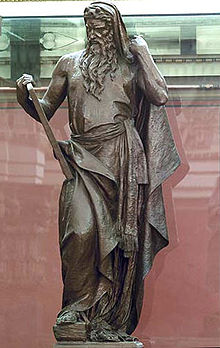
Statue of Moses at the Library of Congress, Washington D.C.

Statue of Moses at the Library of Congress, Washington D.C.

1 This is the blessing with which Moses, the man of God, blessed the Israelites before his death. 2 He said:
The LORD came from Sinai, and dawned from Seir upon us; he shone forth from Mount Paran.
With him were myriads of holy ones; at his right, a host of his own.
3 Indeed, O favorite among peoples, all his holy ones were in your charge;
they marched at your heels, accepted direction from you.
 4 Moses charged us with the law, as a possession for the assembly of Jacob.
 5 There arose a king in Jeshurun, when the leaders of the people assembled– the united tribes of Israel.

Now the final words that Moses speaks in Deuteronomy come out as a blessing. For the first time Moses is given the title the man of God, although he will be referred to as the man of God in retrospect as will other prophets. In contrast to the words of the previous song that are to witness against the people when they become unfaithful the blessing on eleven of the tribes (for reasons unknown Simeon is omitted) is much like a father blessing their children. In a sense Moses has been the parent for a generation of Israel that lived as wanderers with Moses as their primary leader and now like Jacob blessing his sons in Genesis 49.

The blessing begins once again with a lyrical retelling of the beginning of the encounter between Moses and God when Moses is called at Sinai. The poetry is not interested in retelling history but instead of reveling in the power of the God of Israel. In mysterious language that probably refers to The LORD as the greatest among the gods (rather than later monotheistic thought which talks about the LORD as the only God) the people are lifted up as the ones chosen by this God among all the nations. Using Jeshurun, a pet name for Israel, the confederation of tribes was brought together under one king (presumably referring to the LORD rather than a later Davidic king). Here the diversity of the tribes is celebrated within their unity and specific aspects are lifted up for blessing.

 6 May Reuben live, and not die out, even though his numbers are few.
 

The blessings are given beginning with the oldest but do not strictly follow any birth order, with Simeon omitted as stated above, but rather seem to be grouped by the mothers of the children. Reuben was the firstborn of Israel but fell from favor after he slept with Bilhah, his father’s concubine (and mother of Dan and Naphtali). Here in the narrative Reuben’s tribe is already few in numbers. Even though Reuben’s tribe is already in possession of their land they also form the border with the Moabites and will endure struggle in future generations. Here this short blessing only asks for his perseverance.

 7 And this he said of Judah: O LORD, give heed to Judah, and bring him to his people;
strengthen his hands for him, and be a help against his adversaries.

One of the more surprising blessings for its brevity goes to Judah. Judah will be the line that David and the Davidic kings come out of and will also become one of the largest and most powerful tribes. In contrast in Genesis 49 he receives a much longer blessing.  The blessing is simple: that the tribe of Judah would be heard, strengthened and helped in conflict.

8 And of Levi he said: Give to Levi your Thummim, and your Urim to your loyal one,
whom you tested at Massah, with whom you contended at the waters of Meribah;
9 who said of his father and mother, “I regard them not”;
he ignored his kin, and did not acknowledge his children.
For they observed your word, and kept your covenant.
10 They teach Jacob your ordinances, and Israel your law;
they place incense before you, and whole burnt offerings on your altar.
11 Bless, O LORD, his substance, and accept the work of his hands;
crush the loins of his adversaries, of those that hate him, so that they do not rise again.

If the blessings were simply birth order Levi would come prior to Judah, yet Levi receives a much larger and more developed blessing, which also reflects the emphasis of Deuteronomy on the role of the Levites. The Urim and Thummim are the stones to be placed in the breastplate of the high priest, first mentioned in Exodus 28: 31 which are to be used as a manner of casting lots and discerning God’s will.  The ignoring of kin probably refers to the incident of the golden calf in Exodus 32, where the sons of Levi rally to Moses and kill the people who are running wild through the camp. This is the defining part of the tribe’s story where they are set apart to serve the LORD. As we have seen throughout Deuteronomy, with Moses no longer there to be the teacher of the law now that duty will fall to the Levites.

 12 Of Benjamin he said: The beloved of the LORD rests in safety—
the High God surrounds him all day long—
the beloved rests between his shoulders.

Benjamin’s blessing while short reflects a closeness of the LORD with the title of beloved of the LORD. The parental image of the God of Israel allowing the youngest child to rest in safety between the LORD’s shoulders is a peaceful one.
 
13 And of Joseph he said: Blessed by the LORD be his land,
with the choice gifts of heaven above, and of the deep that lies beneath;
14 with the choice fruits of the sun, and the rich yield of the months;
15 with the finest produce of the ancient mountains, and the abundance of the everlasting hills;
16 with the choice gifts of the earth and its fullness, and the favor of the one who dwells on Sinai.
 Let these come on the head of Joseph, on the brow of the prince among his brothers.
 17 A firstborn bull– majesty is his! His horns are the horns of a wild ox;
with them he gores the peoples, driving them to the ends of the earth;
such are the myriads of Ephraim, such the thousands of Manasseh.

Joseph also receives a longer and fuller blessing, like Levi. Although the tribes of Joseph are larger and are frequently referred to by the names of his sons: Ephraim and Manasseh. The blessing called upon the half tribes of Manasseh and Ephraim (or the tribe of Joseph) are for abundance and strength. The image of the bull that gores and the illustration of the size (myriads and thousands) probably reflect the size of the host that Manasseh and Ephraim would contribute to the upcoming battles due to the size of their people.

 18 And of Zebulun he said: Rejoice, Zebulun, in your going out; and Issachar, in your tents.
 19 They call peoples to the mountain; there they offer the right sacrifices;
for they suck the affluence of the seas and the hidden treasures of the sand.

Zebulun and Issachar share a blessing. Their blessing is for wealth. They will share territory next to one another and here they share a common blessing in their going out and tents.

 20 And of Gad he said: Blessed be the enlargement of Gad! Gad lives like a lion;
he tears at arm and scalp.
21 He chose the best for himself, for there a commander’s allotment was reserved;
he came at the head of the people, he executed the justice of the LORD, and his ordinances for Israel.

A simile is used to compare Gad to a lion. Gad seems to be lifted up as a dangerous enemy and one who chooses the best spoils of war. As a leader he is also lifted up as an executor of the justice of the LORD and the LORD’s ordinances.

 22 And of Dan he said: Dan is a lion’s whelp that leaps forth from Bashan.

Here the metaphorical image of a lion’s cub extends to Dan. Dangerous and violent, but perhaps not as dangerous as Gad.

 23 And of Naphtali he said: O Naphtali, sated with favor, full of the blessing of the LORD, possess the west and the south.

Naphtali is blessed with the full blessing of the LORD. The blessing of the LORD is linked to the land they will possess which is consistent with the understanding of land in Deuteronomy.

 24 And of Asher he said: Most blessed of sons be Asher; may he be the favorite of his brothers, and may he dip his foot in oil.
 25 Your bars are iron and bronze; and as your days, so is your strength.

Finally, the blessing for Asher where his position as a favorite among the tribes is combined with a blessing upon his strength metaphorically referred to as iron and bronze.

 26 There is none like God, O Jeshurun, who rides through the heavens to your help,
majestic through the skies.
 27 He subdues the ancient gods, shatters the forces of old;
he drove out the enemy before you, and said, “Destroy!”
 28 So Israel lives in safety, untroubled is Jacob’s abode in a land of grain and wine,
where the heavens drop down dew.
 29 Happy are you, O Israel! Who is like you, a people saved by the LORD,
the shield of your help, and the sword of your triumph!
Your enemies shall come fawning to you, and you shall tread on their backs.

The blessing concludes with a final bit of poetic reference to the strength of the LORD using the imagery of the divine warrior. Again this is poetic imagery that comes from a world where the LORD is the greatest among the pantheon of the gods of the nations and is able to conquer these other gods (and by extension their people). The LORD is sword and shield, a common image of the Psalms, and Israel will stand victorious over the other peoples because of the strength of their LORD.

Deuteronomy 32- The Last Song of Moses

Moses by Victorvictori, permission granted by author through WikiCommons

Moses by Victorvictori, permission granted by author through WikiCommons

Deuteronomy 32: 1-14: The Faithful Rock Provides

1 Give ear, O heavens, and I will speak; let the earth hear the words of my mouth.
 2 May my teaching drop like the rain, my speech condense like the dew;
   like gentle rain on grass, like showers on new growth.
 3 For I will proclaim the name of the LORD;
    ascribe greatness to our God!
 4 The Rock, his work is perfect, and all his ways are just.
    A faithful God, without deceit, just and upright is he;
 5 yet his degenerate children have dealt falsely with him,
   a perverse and crooked generation.
 6 Do you thus repay the LORD, O foolish and senseless people?
   Is not he your father, who created you, who made you and established you?
 7 Remember the days of old, consider the years long past;
    ask your father, and he will inform you; your elders, and they will tell you.
 8 When the Most High apportioned the nations, when he divided humankind,
    he fixed the boundaries of the peoples according to the number of the gods;
 9 the LORD’s own portion was his people, Jacob his allotted share.
 10 He sustained him in a desert land, in a howling wilderness waste;
    he shielded him, cared for him, guarded him as the apple of his eye.
 11 As an eagle stirs up its nest, and hovers over its young;
    as it spreads its wings, takes them up, and bears them aloft on its pinions,
 12 the LORD alone guided him; no foreign god was with him.
 13 He set him atop the heights of the land, and fed him with produce of the field;
    he nursed him with honey from the crags, with oil from flinty rock;
 14 curds from the herd, and milk from the flock, with fat of lambs and rams;
    Bashan bulls and goats, together with the choicest wheat—
    you drank fine wine from the blood of grapes.

This poem of Moses could fit in the book of Jeremiah as easily as the book of Deuteronomy. It in poetic form foreshadows the sweep of the Deuteronomic history which runs from Joshua to 1 and 2 Kings. This is a difficult song to write out and let the words seep out of the pen onto the paper as you hear them. It is dark, and as we heard in Deuteronomy 31:19 the purpose of the song is to be another witness against the people of Israel when they turn to be unfaithful. When they trust in other gods and the LORD abandons them (or actively brings about) the consequences the people are to know and understand. If the song looks forward, peering into the darkness of the future, the poet speaks the darkness in the hope that the words (for those are the only weapons the poet and songsmith have) might alter the path of the future. While the author of Deuteronomy has a dim view of the potential for the people of Israel to remain faithful, it is still their hope. Their anxiety over the disaster they foresee is matched by the intensity of the words they use to try to wake up the people to change the course they seem to be marching upon.

The song begins in praise of the God of Israel and the faithfulness of that God. Throughout this song the Rock will become the metaphorical name for God and be a contrast between the unbending faithfulness of the LORD the God of Israel and the degenerate children of a perverse and crooked generation. Yet, even this generation is called back to their ancestors who still remember and the elders who still trust in the LORD. Just as throughout the book of Deuteronomy it is the responsibility of the previous generation to ensure the fidelity of the upcoming generations, to remind them over and over of the way in which their God has provided for them and the special relationship they have with their God.

One of the reasons that many scholars think this is an early poem (or at a minimum this first section) is that it is not strictly monotheistic. The LORD allots to the other nations other gods, and what make Israel unique is that the Most High God has chosen them and therefore they are to have no other gods before the LORD their God. In beautiful poetic language it expresses that the people are God’s beloved and the ways in which God has sheltered and provided for them. God is an eagle hovering over its nest or bearing its young into the air on its wings. The LORD has provided all the best things: crops of the field, milk and curds from the cows and goats, the best meat from the sheep and bulls and goats, fine wine and bread. Yet, the fear of Deuteronomy is that in the midst of abundance that the people will forget who provided for them. That is where the poem takes its dark turning. 

Deuteronomy 32: 15-25 The Fattened People Forgets

15 Jacob ate his fill; Jeshurun grew fat, and kicked. You grew fat, bloated, and gorged!
    He abandoned God who made him, and scoffed at the Rock of his salvation.
 16 They made him jealous with strange gods, with abhorrent things they provoked him.
 17 They sacrificed to demons, not God, to deities they had never known,
     to new ones recently arrived, whom your ancestors had not feared.
 18 You were unmindful of the Rock that bore you; you forgot the God who gave you birth.
 19 The LORD saw it, and was jealous he spurned his sons and daughters.
 20 He said: I will hide my face from them, I will see what their end will be;
    for they are a perverse generation, children in whom there is no faithfulness.
 21 They made me jealous with what is no god, provoked me with their idols.
    So I will make them jealous with what is no people, provoke them with a foolish nation.
 22 For a fire is kindled by my anger, and burns to the depths of Sheol;
     it devours the earth and its increase, and sets on fire the foundations of the mountains.
 23 I will heap disasters upon them, spend my arrows against them:
 24 wasting hunger, burning consumption, bitter pestilence.
    The teeth of beasts I will send against them, with venom of things crawling in the dust.
 25 In the street the sword shall bereave, and in the chambers terror,
     for young man and woman alike, nursing child and old gray head.

As I’ve been listening to this song of Moses throughout this week I’ve also been reflecting upon the way other popular songs work to try to bring about change and yet may feel overwhelmed by the social forces that seem to be giving rise to the undesired reality. For example, when the punk band Green Day released their American Idiot CD they weren’t desiring the character of the American Idiot to be the reality, they were mocking the emerging culture controlled by a conservative media. Countless songs from numerous genres could be lifted up as attempting to be a voice calling upon the future to change and yet the poets may feel powerless as in the classic Simon and Garfunkel song, The Sound of Silence:

“Fools” said I, “you do not know
Silence like a cancer grows
Hear my words that I might teach you
Take my arms that I might reach you”
But my words like silent raindrops fell
And echoed in the wells of silence

Here the words of the song are placed in Moses’ mouth and just as in the previous chapter the hope is that the words will turn the direction that the people are moving in even when the anxiety is that the words will echo in the wells of silence. The words may bear witness but the people are hearing without listening. Moses prophetically chimes against when the people will bow and pray to the gods of stone and iron and gold they will make. In their fatness and wealth, they will forget the source of their blessings and attribute it to themselves and other things. Later prophets, like Jeremiah, who will attempt to be an echo of the words of this song will be treated as traitors, as woe bringers and will be resisted throughout their life. In the poetry of the song and of the later prophets sometimes the LORD will passively hide God’s face and surrender people to their fate, at other times God will actively bring upon the people their destruction, famine, and illness. In exchanging their Rock for idols of stone they have turned away from their foundation and reason for being. The song desperately rages to try to call the people to return to the LORD their God, and yet it knows people are likely to craft images of other gods rather than accept the God whom they cannot make an image of.


Deuteronomy 32: 26-30 A Remnant but Not for Your Sake

 26 I thought to scatter them and blot out the memory of them from humankind;
 27 but I feared provocation by the enemy, for their adversaries might misunderstand and say,
     “Our hand is triumphant; it was not the LORD who did all this.”
 28 They are a nation void of sense; there is no understanding in them.
 29 If they were wise, they would understand this; they would discern what the end would be.
 30 How could one have routed a thousand, and two put a myriad to flight,
     unless their Rock had sold them, the LORD had given them up?
 
As in the book of Jeremiah, much of the language here is of a wounded God, a God who is contemplating the betrayal of the people of God. Woven into this song is the appeal of Moses in Exodus 32: 11-14 where he appeals to God on behalf of the people after the incident with the golden calf.

11 But Moses implored the LORD his God, and said, “O LORD, why does your wrath burn hot against your people, whom you brought out of the land of Egypt with great power and with a mighty hand? 12 Why should the Egyptians say, ‘It was with evil intent that he brought them out to kill them in the mountains, and to consume them from the face of the earth’? Turn from your fierce wrath; change your mind and do not bring disaster on your people. 13 Remember Abraham, Isaac, and Israel, your servants, how you swore to them by your own self, saying to them, ‘I will multiply your descendants like the stars of heaven, and all this land that I have promised I will give to your descendants, and they shall inherit it forever.'” 14 And the LORD changed his mind about the disaster that he planned to bring on his people.

Here the logic of Moses now becomes woven into the logic of God and the logic of the song. It is so other nations do not become puffed up in their own accomplishment that a remnant is allowed to remain. In a set of brokenhearted lyrics where the LORD no longer appears to love the people and yet feels obligated to save them yet again we find a reason for that remnant to remain.

Deuteronomy 32: 31-43 There is No Rock Like our Rock

 31 Indeed their rock is not like our Rock; our enemies are fools.
 32 Their vine comes from the vinestock of Sodom, from the vineyards of Gomorrah;
      their grapes are grapes of poison, their clusters are bitter;
 33 their wine is the poison of serpents, the cruel venom of asps.
 34 Is not this laid up in store with me, sealed up in my treasuries?
 35 Vengeance is mine, and recompense, for the time when their foot shall slip;
     because the day of their calamity is at hand, their doom comes swiftly.
 36 Indeed the LORD will vindicate his people, have compassion on his servants,
    when he sees that their power is gone, neither bond nor free remaining.
 37 Then he will say: Where are their gods, the rock in which they took refuge,
 38 who ate the fat of their sacrifices, and drank the wine of their libations?
    Let them rise up and help you, let them be your protection!
 39 See now that I, even I, am he; there is no god besides me.
     I kill and I make alive; I wound and I heal; and no one can deliver from my hand.
 40 For I lift up my hand to heaven, and swear: As I live forever,
 41 when I whet my flashing sword, and my hand takes hold on judgment;
     I will take vengeance on my adversaries, and will repay those who hate me.
 42 I will make my arrows drunk with blood, and my sword shall devour flesh—
     with the blood of the slain and the captives, from the long-haired enemy.
 43 Praise, O heavens, his people, worship him, all you gods!
    For he will avenge the blood of his children, and take vengeance on his adversaries;
    he will repay those who hate him, and cleanse the land for his people.

The song ends with a move towards hope, much like in Deuteronomy 30 where now the LORD will turn on behalf of the remnant of the people once they have undergone the judgment. In a poetic turning the vanquished people now mock their former conquerors in their weakness after the LORD’s vengeance. For the people of Israel, the LORD is the primary actor and the gods of the nations are unable to stand in the presence of the LORD. Much like Isaiah 44: 9-20 which mocks the idols of the nations or Jeremiah 50-51 which speaks of the destruction of Babylon, these words can speak for the hopeless people with the hope of the LORD’s actions on the idols and the nations. The poem closes with warrior imagery for God (flashing sword, arrows drunk with blood, etc.) where God’s vengeance is acted out in a bloody fashion. I have talked about the warrior imagery of God in other place, but here for the people of Israel it is a reminder that there is no Rock like their rock. Even in their apparent weakness their God is a mighty God.

 Deuteronomy 32: 44-52 Preparing for Moses Death

 44 Moses came and recited all the words of this song in the hearing of the people, he and Joshua son of Nun. 45 When Moses had finished reciting all these words to all Israel, 46 he said to them: “Take to heart all the words that I am giving in witness against you today; give them as a command to your children, so that they may diligently observe all the words of this law. 47 This is no trifling matter for you, but rather your very life; through it you may live long in the land that you are crossing over the Jordan to possess.” 48 On that very day the LORD addressed Moses as follows: 49 “Ascend this mountain of the Abarim, Mount Nebo, which is in the land of Moab, across from Jericho, and view the land of Canaan, which I am giving to the Israelites for a possession; 50 you shall die there on the mountain that you ascend and shall be gathered to your kin, as your brother Aaron died on Mount Hor and was gathered to his kin; 51 because both of you broke faith with me among the Israelites at the waters of Meribath-kadesh in the wilderness of Zin, by failing to maintain my holiness among the Israelites. 52 Although you may view the land from a distance, you shall not enter it– the land that I am giving to the Israelites.”

As the song ends we are reminded once again that we are approaching the end of Moses’ story. Here, in contrast to the earlier narrative of Deuteronomy where the LORD is angry with Moses because of the people (see Deuteronomy 1: 37, 3: 26, 4:21), now we are linked back to the narrative of Numbers 20: 10-12 as the reason for Moses’ upcoming death. The stage is set for the final chapter of Deuteronomy where Moses ascends the mountain never to return, yet Moses still has a final blessing to declare upon the people prior to the ending of his journey. One final benediction to come from the teacher, leader, mediator, judge and bringer of the law to sustain the people on their journey into the promised land.

I Thirst

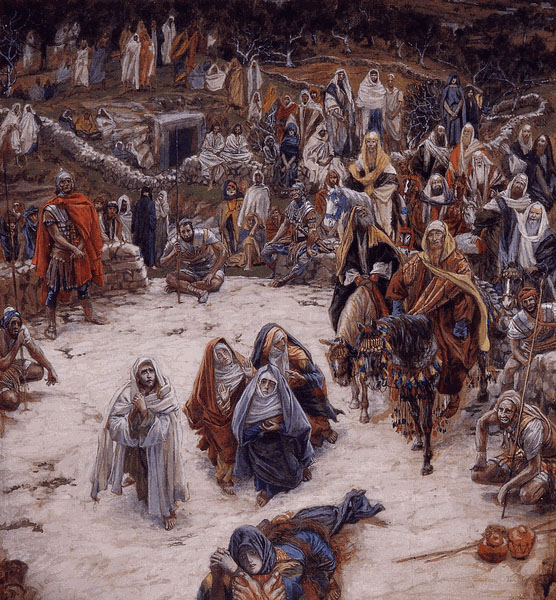
The Crucifixion as Seen from the Cross by James Tissot, 19th Century

The Crucifixion as Seen from the Cross by James Tissot, 19th Century

After this, when Jesus knew that all was now finished, he said (in order to fulfill scripture),” I am thirsty.” A jar full of sour wine was standing there. So they put a sponge on a branch of hyssop and held it to his mouth. John 19: 28-29

I am the thirsty one who longs for the new wine of the kingdom of God
Once I filled the stone jars at the wedding of Cana with this rich elixir
So the guests of the bride and the guests of the bridegroom
Might savor this heavenly fermentation of the vine
Becoming drunk upon its sweetness
 
I am the thirsty one who longs for the inauguration of the royal banquet of resurrection
The dawning of the new age that comes with the rising of the Son of Man
But until that dawn arrive I sit suspended on the hill of death under the blackened sun
Waiting for the long night of death which will only end when light creeps above the horizon
On the first day of the new creation
 
I am the thirsty one whose disciples vied for the places of honor at the coming of the kingdom
Wanting to sit upon the right and the left
To drink of my cup and to endure the baptism which I must bear
Yet, at its initiation it is two bandits who occupy the places of honor in this place of shame
They will be the first to see the gates of heaven open to them beyond this terrestrial hell
 
I am the thirsty one who inaugurated the feast which is a foretaste of the feast to come
I could occupy the places of honor at the royal banquet
With cupbearers longing for the honor of tasting my wine and ensuring the quality of my meal
Yet, for their king they gave me poison to eat and vinegar to drink
And only the enemy soldier extends the stick filled with sour vinegar which might wet my lips
But does nothing to quench the thirst within
 
I am the thirsty one who becomes the door to enter into the halls of God
Through which the righteous must pass
The Passover lamb that was slaughtered and whose blood was lifted up upon branches of hyssop
To coat the doorpost and the lintel so that the angel of death might not pass beyond its boundary
And to preserve those who pass through and lead them to life
 
I am the thirsty one that is the vine upon which the fruit of the kingdom grows and flourishes
Many branches will be grafted into me to feed upon my life and to grow out of my love
In them the grapes will grow sweet and juicy ready to bring joy and celebration to the earth
Their fruit will be the harvest that produces the never ending drink for the kingdom
So that in every season and the nations of the earth might be refreshed

Neil White, 2016