Tag Archives: wisdom

Ecclesiastes 12-The End of Wisdom

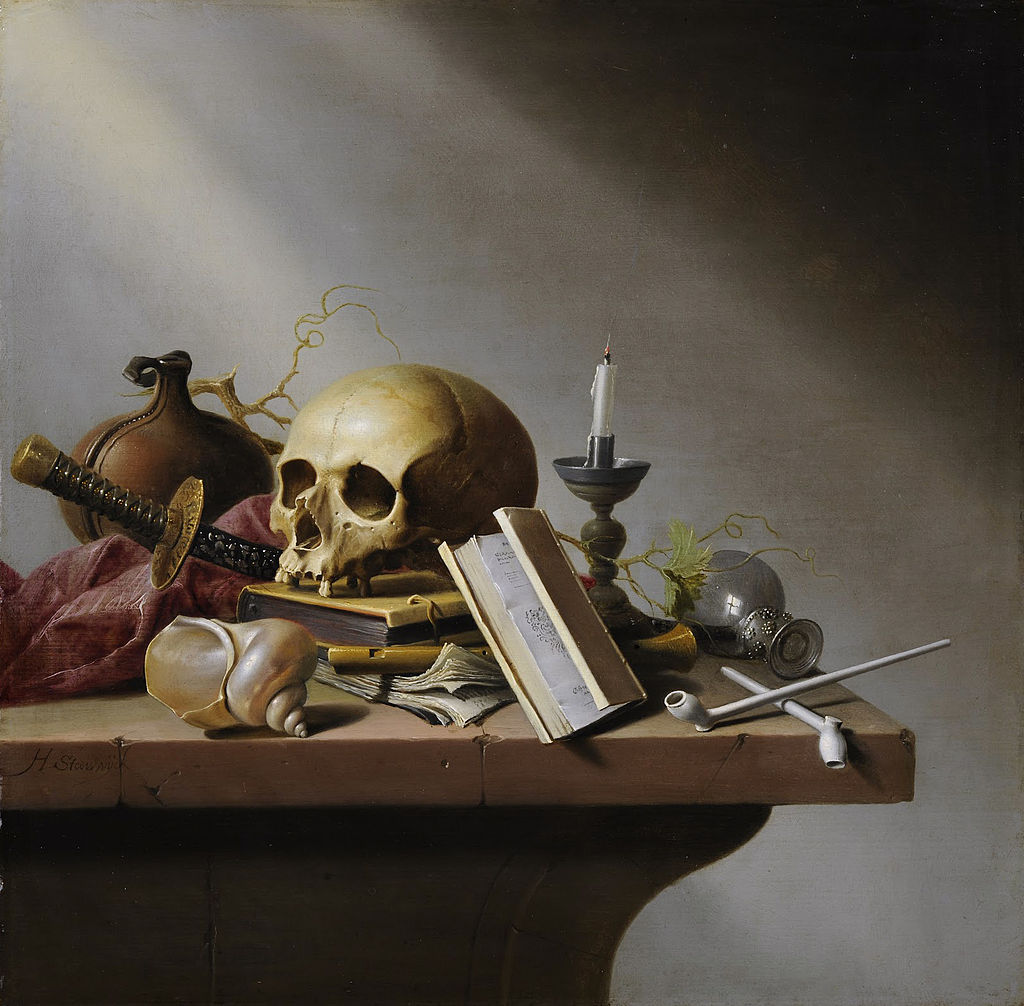
Harmen Steenwijck, Vanitas (1640)

Harmen Steenwijck, Vanitas (1640)

Ecclesiastes 12: 1-8: The End of Things

1 Remember your creator in the days of your youth, before the days of trouble come, and the years draw near when you will say, “I have no pleasure in them”; 2 before the sun and the light and the moon and the stars are darkened and the clouds return with the rain; 3 in the day when the guards of the house tremble, and the strong men are bent, and the women who grind cease working because they are few, and those who look through the windows see dimly; 4 when the doors on the street are shut, and the sound of the grinding is low, and one rises up at the sound of a bird, and all the daughters of song are brought low; 5 when one is afraid of heights, and terrors are in the road; the almond tree blossoms, the grasshopper drags itself along and desire fails; because all must go to their eternal home, and the mourners will go about the streets; 6 before the silver cord is snapped, and the golden bowl is broken, and the pitcher is broken at the fountain, and the wheel broken at the cistern, 7 and the dust returns to the earth as it was, and the breath returns to God who gave it. 8 Vanity of vanities, says the Teacher; all is vanity.

So now we come to the end of things and at the end of things is growing old and death. The final eight verses either talk metaphorically about the aging of the individual or directly about the collapse of a city or town. I read this metaphorically and at the end of all things is the gradual process of letting go that comes with old age, diminished health and eventually mortality. One of my nonagenarians from a previous congregation who had a spry sense of humor even in the midst of her failing vision and health would remind me when I would visit her that, “Old age isn’t for sissies” and that “they can call these the golden years but it must be fool’s gold.” Ecclesiastes has no place for a sentimentalism about how things will be better in some great by and by in the afterlife, it only has place for that which it can see. Perhaps there is an uneasiness with the somewhat agnostic perspective that Ecclesiastes seems to portray at certain points, its willingness to question what many people would rather overlook. Yet, looking at the world through the lens of a person who is willing to call much of what they see ‘vanity’ doesn’t lead the Teacher to desperation but instead a greater sense of peace in the moment. It allows them to counsel their pupils to embrace their youth, to remember the creator of this time and not to rush forward into the responsibility and diminishment of old age. In a culture where old age was valued and youth was not Ecclesiastes was an unusual voice. In our culture where youth is valued and old age is considered a burden and death is to be avoided at all cost perhaps the honesty of Ecclesiastes might help us with our own vain struggles against our mortality.

One of the greatest gifts I think Ecclesiastes brings to things is the wisdom of appreciating the gifts of the day. We can struggle against our mortality and against our limits but they make the time we have precious. Health, wealth, relationships, fame and power may all be transitory but the gift comes in being able to find joy in one’s food and drink, relationships, toil and the work of one’s hands and mind. Vanity of vanities, all may be vanity but that doesn’t have to be a source of struggle. Instead we can be freed to enjoy the day that our creator has made and to indeed be glad in it.

Ecclesiastes 12: 9-14: Epilogue

 9 Besides being wise, the Teacher also taught the people knowledge, weighing and studying and arranging many proverbs. 10 The Teacher sought to find pleasing words, and he wrote words of truth plainly.

 11 The sayings of the wise are like goads, and like nails firmly fixed are the collected sayings that are given by one shepherd. 12 Of anything beyond these, my child, beware. Of making many books there is no end, and much study is a weariness of the flesh.

 13 The end of the matter; all has been heard. Fear God, and keep his commandments; for that is the whole duty of everyone. 14 For God will bring every deed into judgment, including every secret thing, whether good or evil.

The voice shifts suddenly to one talking about the Teacher rather than one talking as the Teacher. This short book was one that barely made it into the canon of Scriptures because it is a very different voice. Here an appreciative epilogue is offered which closes Ecclesiastes as we have it. It evaluates what has come before as both plainly truthful but also pleasing in its composition. That perhaps is a challenge for anyone trying to speak or write in a way that can speak the truth to the best of their ability but also not in a callous or judgmental way. Ecclesiastes writes about some uncomfortable truths and as Ellen Davis can comment, “who in our culture has the moral authority and the imagination to make uncomfortable words heard in the public forum? Few teachers or clergy, even fewer politicians.” (Davis, 2000, p. 226) Yet truth, perhaps most of all the uncomfortable truth that is skipped over in the soundbites and marketing strategies, is needed for both the individual and the public’s life.

Perhaps it is great vanity writing about a book that can claim ‘Of making many books there is no end, and much study is a weariness of the flesh.’ But there has been enjoyment in the toil and a sense of satisfaction coming to the end of these reflections upon this irreverent little piece of the scriptures. Fearing God may be the beginning of wisdom as Proverbs 1:7 can state and here is one of the few times Ecclesiastes sings in harmony with its neighbor in the scriptures. Yet, perhaps it would be vanity to worry about how God will judge this deed in the end and so for me too this is the end of the matter. Vanity or wisdom or both it is done and I go to enjoy the rest of this day that God has provided.

Ecclesiastes 10: Wisdom, Life and the King

Paul Alexander Leroy, Haman and Mordecai (1884)

Paul Alexander Leroy, Haman and Mordecai (1884)

 Ecclesiastes 10

1 Dead flies make the perfumer’s ointment give off a foul odor; so a little folly outweighs wisdom and honor.
 2 The heart of the wise inclines to the right, but the heart of a fool to the left.
 3 Even when fools walk on the road, they lack sense, and show to everyone that they are fools.
 4 If the anger of the ruler rises against you, do not leave your post, for calmness will undo great offenses.
 5 There is an evil that I have seen under the sun, as great an error as if it proceeded from the ruler: 6 folly is set in many high places, and the rich sit in a low place. 7 I have seen slaves on horseback, and princes walking on foot like slaves.
 8 Whoever digs a pit will fall into it; and whoever breaks through a wall will be bitten by a snake.
 9 Whoever quarries stones will be hurt by them; and whoever splits logs will be endangered by them.
 10 If the iron is blunt, and one does not whet the edge, then more strength must be exerted; but wisdom helps one to succeed.
 11 If the snake bites before it is charmed, there is no advantage in a charmer.
 12 Words spoken by the wise bring them favor, but the lips of fools consume them.
 13 The words of their mouths begin in foolishness, and their talk ends in wicked madness;
 14 yet fools talk on and on. No one knows what is to happen, and who can tell anyone what the future holds?
 15 The toil of fools wears them out, for they do not even know the way to town.
 16 Alas for you, O land, when your king is a servant, and your princes feast in the morning!
 17 Happy are you, O land, when your king is a nobleman, and your princes feast at the proper time– for strength, and not for drunkenness!
 18 Through sloth the roof sinks in, and through indolence the house leaks.
 19 Feasts are made for laughter; wine gladdens life, and money meets every need.
 20 Do not curse the king, even in your thoughts, or curse the rich, even in your bedroom; for a bird of the air may carry your voice, or some winged creature tell the matter.

Wisdom is not the exclusive property of the wealthy or nobility as we heard at the end of the previous chapter when the author related the parable of the wise poor man who saved (or might have saved) a town. Yet, even knowing that those who rule are not necessarily wise or diligent, Ecclesiastes is deeply troubled by the thought of the ‘powerful being brought down from their thrones and the lowly being lifted up’ as Mary can sing in Luke 1: 52. The teacher in Ecclesiastes still ultimately believes that ‘a king is for a plowed field’ (Ecclesiastes 5: 9) even with all the oppression that can happen under the sun. Ecclesiastes version of wisdom seeks an ordered world, not necessarily a fair one, but one in which the wise person can learn to live and can make peace with their position within that world. Many other voices in the scriptures will attempt to challenge those in power, particularly the prophets. Ecclesiastes attempts to find a place for wisdom in the midst of all the folly and absurdity that are a part of life.

One bad apple can spoil the batch and a little folly can undo years of working wisely. Wisdom seems to be for Ecclesiastes a way of walking and thinking and acting that are continually cultivated. There is a sharp delineation between the walk of a foolish person and the walk of the wise. Wisdom may be the road less taken and it is a road that requires accountability but eventually the toil of the foolish wears them out.

The proverb in verse four about calmness in the face of the anger of the ruler reminds me of a time when I was a young lieutenant in the army. My unit had been assigned funeral duty, in a time before the omnipresence of cell phones, and we had been on this duty for many weeks. I had sat at home many weekends while my girlfriend at the time was 200 miles away. We would wait for a call to come in to tell us if we had any funerals on Saturday or Sunday but we were expected to remain close to Ft. Polk where I was stationed. One weekend I waited until late Friday, but no call came so I drove to spend the remainder of the weekend with my girlfriend in Texas. Saturday morning a request for a funeral came in and I was not reachable. I returned on Sunday to a couple messages on my phone. As hard as it was I first called my commander, then everyone else involved and apologized and was willing to accept whatever punishment was to come. Later I learned that my willingness to call and be open and honest about my mistake and willingness to accept the consequences earned me a lot of respect in the unit, but that day I was only trying to do what was right after I had made a mistake.

Ecclesiastes has already shown that it is well aware of how nobility and position do not automatically ensure wisdom. Foolish rulers and crooked officials were a part of the experience of the people of Israel. Unlike some other cultures that enshrined their elite with almost godlike status the Hebrew Scriptures have a skeptical view of kings and their motives. Even Solomon who is lifted up for his wisdom often ruled in ways, especially later in his life, that the texts considered unwise and ultimately led to the fracturing of the Davidic kingdom and monarchy. Yet, Ecclesiastes still holds onto the belief that the nobility and the king are ultimately a positive thing and anything that upsets that order or the appearance of that order (like slaves on horseback while a prince walks) upsets the ordered world of the teacher in Ecclesiastes.

One’s wise actions may not prevent the chances of life from coming about, but they still may prevent self-injury. If one refrains from digging a pit one also refrains from falling into it for example. The wise are measured in their speech and know when to remain silent but the foolish in contrast talk on and on. Blessed in the one, in Ecclesiastes view, who lives with the gift of good government and wise rulers who work during the day and celebrate only once the work is done. Laziness in rule and in life can destroy much and a little folly can outweigh wisdom and honor in a person’s home and in a kingdom. Yet, wisdom is not an ascetic’s life. The wise person can enjoy feasts and wine and wealth.

Finally, the chapter closes with a proverb similar to our own times saying that, ‘the walls have ears.’ Cursing those in power over you or complaining about them can make it back to their ears. There will always be people who will use our words to their advantage. Perhaps this also can evoke stories like the story of Esther where Haman’s words and plots become unraveled because he unknowingly plotted against Esther and Mordecai who could in their own way appeal to the king.  Words matter to the wise, speech matters and actions matter. Many things are beyond the control of the wise person but one’s speech, calmness, walk and how one lives are within one’s control.

Ecclesiastes 8 Wisdom in an Unjust World

Still Life with Glass Bowl of Fruit and Vases from the House of Julia Felix in Pompeii around 70 CE

Still Life with Glass Bowl of Fruit and Vases from the House of Julia Felix in Pompeii around 70 CE

Ecclesiastes 8

1 Who is like the wise man? And who knows the interpretation of a thing?
Wisdom makes one’s face shine, and the hardness of one’s countenance is changed.
 2 Keep the king’s command because of your sacred oath. 3 Do not be terrified; go from his presence, do not delay when the matter is unpleasant, for he does whatever he pleases. 4 For the word of the king is powerful, and who can say to him, “What are you doing?” 5 Whoever obeys a command will meet no harm, and the wise mind will know the time and way. 6 For every matter has its time and way, although the troubles of mortals lie heavy upon them. 7 Indeed, they do not know what is to be, for who can tell them how it will be? 8 No one has power over the wind to restrain the wind, or power over the day of death; there is no discharge from the battle, nor does wickedness deliver those who practice it. 9 All this I observed, applying my mind to all that is done under the sun, while one person exercises authority over another to the other’s hurt.

 10 Then I saw the wicked buried; they used to go in and out of the holy place, and were praised in the city where they had done such things. This also is vanity. 11 Because sentence against an evil deed is not executed speedily, the human heart is fully set to do evil. 12 Though sinners do evil a hundred times and prolong their lives, yet I know that it will be well with those who fear God, because they stand in fear before him, 13 but it will not be well with the wicked, neither will they prolong their days like a shadow, because they do not stand in fear before God.

 14 There is a vanity that takes place on earth, that there are righteous people who are treated according to the conduct of the wicked, and there are wicked people who are treated according to the conduct of the righteous. I said that this also is vanity. 15 So I commend enjoyment, for there is nothing better for people under the sun than to eat, and drink, and enjoy themselves, for this will go with them in their toil through the days of life that God gives them under the sun.

 16 When I applied my mind to know wisdom, and to see the business that is done on earth, how one’s eyes see sleep neither day nor night, 17 then I saw all the work of God, that no one can find out what is happening under the sun. However much they may toil in seeking, they will not find it out; even though those who are wise claim to know, they cannot find it out.

Life is not fair, justice is often skewed towards a privileged group or individual, and the wicked may prosper while the righteous suffer. Bad things do happen to good people and one would have to shut one’s eyes tight to the world around them not to perceive the unfairness of the world. No one, not even the greatest president, king or official will be able to by their own wisdom alleviate all the suffering and injustice of the world. Oppression does occur and sometimes is sometimes even praised. Wisdom has to figure out how to live in the world as it is and not in the world as one imagines it should be.

Wisdom making one’s face shine may be a reference to the starting place of all wisdom, to God’s own wisdom. As Ellen Davis can say, “A shining face is, then, a sign of God’s benevolent presence; it shows forth the light of the Holy Spirit.” (Davis, 2000, p. 206) The wisdom in the shining face that reflects God’s benevolent presence is also coming from a softened face. A part of this wisdom that fears God and can place one’s trust in God precisely in the midst of an unfair and unjust world is the ability to find joy and celebration even in the midst of the seasons of the world one cannot control. It is finding peace in the midst of the oppression, joy even in the midst of suffering, and enjoying the food and drink in the moments of prosperity and want for they all come (ultimately in Ecclesiastes view) from God. Wisdom seems to reflect the ability to trust God even when one cannot riddle out the interpretation of a thing. Wisdom is willing to let go of the quest for certainty and is willing to reside in the humility of one’s own knowledge and power. Wisdom fears God and knows that we are at every moment of our life caught up in the movement of things that we have no control over. We cannot control when the time of birth or death is or war or peace or even whom we receive love from and who we might receive hate from. No one, not even the wisest sage can understand all that is going on under the sun.

J.K. Rowling’s character Albus Dumbledore in the Harry Potter series may be an interesting figure to contemplate as one explores Ecclesiastes description of a wise person. In the novels he is a complex character who often has to put people he cares about into situations that may bring about suffering for them or even death and yet he rarely in the novels displays a hard countenance. His face is often light, he seems to enjoy the moments of levity and celebration even when they are brief. He is unafraid to tell the difficult truth that other may want to obscure or hide and he refrains from the certainties that many of the other characters want to cling to. Even for all his wisdom and power there are many things he is unable to prevent and close friends he is unable to protect and yet in his life and death (in the story) he becomes a character who models what wisdom might look like in that fictional world with all its struggles.

As a person who served in the Army I understand the need to follow orders that may be unpopular and the times when unquestioned obedience was called for. In the royal court, in government and in society there are times where we simply have to follow the commands we are given. There are certainly times where one will have to resist and illegal or unjust command or attempt to work with the system (or sometimes oppose it) to work towards a more just system. Yet, most of our lives we live with rules, laws and boundaries that we have to work within.

As a preacher I attempt to invite my congregation into the struggle with the texts and to teach them to wonder what it may speak to them rather than confidently claiming to have all the answers. God’s mysterious ways often elude me and in Ecclesiastes the interpretation of the thing often eludes the author in all their wisdom. In the United States there are a number of preachers and traditions that seem unwilling to allow for this type of wisdom which can reside in the places of uncertainty and instead they fill in the gaps with their own interpretation of the mind of God. “The dangers of overly confident preaching are felt particularly in the homiletic temptation to discern God’s retributive justice in situations of human suffering. In this respect, some preachers seem to have the whole divine road map spread out in front of them and so are in a position to give the rest of us confident progress reports. Qohelet, by contrast, reminds us the wisdom about God’s mysterious ways in the world regularly elude us.” (Pauw, 2015, p. 185) Wisdom could lead us to a homiletical humility, a willingness to acknowledge the limits of our knowledge and to acknowledge the gaps rather than to explain them away. To help oneself and one’s community to learn the wisdom of finding joy precisely in the midst of an unjust world, and the wisdom of trusting God event when one cannot make sense of the senselessness of life. As Søren Kierkegaard said, “It takes moral courage to grieve; it takes religious courage to rejoice.” (Pauw, 2015, p. 189)

Ecclesiastes 7-The Lonely Path of the Seeker

Isaak Asknaziy, Vanita vanitatum et omnia vanitas (19th Century)

Isaak Asknaziy, Vanita vanitatum et omnia vanitas (19th Century)

Ecclesiastes 7: 1-10 The Cost of Wisdom

1 A good name is better than precious ointment, and the day of death, than the day of birth.
 2 It is better to go to the house of mourning than to go to the house of feasting; for this is the end of everyone, and the living will lay it to heart.
 3 Sorrow is better than laughter, for by sadness of countenance the heart is made glad.
 4 The heart of the wise is in the house of mourning; but the heart of fools is in the house of mirth.
 5 It is better to hear the rebuke of the wise than to hear the song of fools.
 6 For like the crackling of thorns under a pot, so is the laughter of fools; this also is vanity.
 7 Surely oppression makes the wise foolish, and a bribe corrupts the heart.
 8 Better is the end of a thing than its beginning; the patient in spirit are better than the proud in spirit.
 9 Do not be quick to anger, for anger lodges in the bosom of fools.
 10 Do not say, “Why were the former days better than these?” For it is not from wisdom that you ask this.

There is a joy that is a gift of God but that joy will not be present in every season and often it is the times of grief where wisdom is refined and tested. Ecclesiastes has no place for the masks of happiness that people often feel constrained to wear. Wisdom, we find here, does not drive the teacher to a life of prosperity, rich relationships, easy decisions or universal popularity. It is the road that is less traveled and engages the moments of joy and sadness, pain and pleasure, life and death.

There is a certain kind of wisdom that is only learned through the process of grief and loss and perhaps this is a part of what these proverbs that begin this section point to. Ecclesiastes’ search for wisdom is not a quest that only takes him to the places that are isolated from pain and suffering, instead wisdom often means wrestling with the more challenging parts of life and death. Even though the quest for a lasting legacy of name may be vanity they still seem better than the sweet smelling oils that spoil even more quickly. A person’s life can only begin to be measured at its completion for when the person is present we often take their contributions for granted and can easily focus upon their failures. There is also the hard wisdom of sitting Shiva with those who are mourning and the value that comes not from the cheap pithy sayings but in the long silence of presence. The wisdom that comes from inhabiting the house of mourning may not be a popular wisdom but it is wisdom nevertheless.

In our social media age where we can surround ourselves with an echo chamber of like-minded people we may find it almost impossible to hear the rebuke of the wise if they disagree with our opinions. Yet, that rebuke and cognitive dissonance is an essential part of wisdom. Wisdom and knowledge only grow when they are challenged and pulled. Too often we settle for the quick flash of the thorns which catch fire easily but produce little heat rather than the coals that actually can bring about warmth and can provide the heat needed for the essential task of transforming a dough into a cake or cooking the meat for a meal.

The gift (bribe), impatience, anger and nostalgia become the traps on the path of wisdom as well. Oppression was discussed in chapters four and five and it becomes one of the things that blocks our enjoyment of life and it can also be a roadblock to wisdom. There are certainly those who rise above what may seem impossible circumstances to phenomenal heights but most of those who are oppressed will remain trapped within that oppression. As Ellen Davis can state, “Evil must be remembered but never romanticized; every period of great oppression produces some heroism and much more madness among its victims.” (Davis, 2000, p. 201) The gift, or a bribe, which turns a person aside from the path of wisdom or justice is also a corruption of not only justice but the character of the person. When we change our actions for the sake of another person’s gift (and this may be something as simple as their approval) we have left the path of wisdom. The path of wisdom is not the quick or easy path, it is a path that needs patience. Anger may be an essential part of life and there is a time for righteous anger, but becoming quickly angered is the way of the foolish. Finally nostalgia tries to walk into the future looking backwards. There are gifts to be learned by the study of the past, but trying to recreate the past or romanticizing it often bankrupts both the present and the future. When our memories of the past become larger than our dreams for the future we become trapped in the pain of nostalgia rather than being open to the potential gift of today and tomorrow.


Ecclesiastes 7: 11-21 Wisdom and Ambiguity

 11 Wisdom is as good as an inheritance, an advantage to those who see the sun.
 12 For the protection of wisdom is like the protection of money, and the advantage of knowledge is that wisdom gives life to the one who possesses it.
 13 Consider the work of God; who can make straight what he has made crooked?
 14 In the day of prosperity be joyful, and in the day of adversity consider; God has made the one as well as the other, so that mortals may not find out anything that will come after them.
 15 In my vain life I have seen everything; there are righteous people who perish in their righteousness, and there are wicked people who prolong their life in their evildoing. 16 Do not be too righteous, and do not act too wise; why should you destroy yourself? 17 Do not be too wicked, and do not be a fool; why should you die before your time? 18 It is good that you should take hold of the one, without letting go of the other; for the one who fears God shall succeed with both.
 19 Wisdom gives strength to the wise more than ten rulers that are in a city.
 20 Surely there is no one on earth so righteous as to do good without ever sinning.
 21 Do not give heed to everything that people say, or you may hear your servant cursing you; 22 your heart knows that many times you have yourself cursed others.
 
Wisdom is better than foolishness and it may even provide some protection and advantage but one person’s wisdom cannot make everything crooked in the world straight. This passage about not being too righteous or too wicked might seem a little Machiavellian but wisdom knows that the complex world rarely falls into absolutes. Life can bring about many border situations where the line between what is right and what is wrong becomes blurred by the ambiguity of the situation. One can apply wisdom and knowledge to the best of one’s ability, one can attempt to be righteous but ultimately in the life lived before God what wisdom we have is incomplete and short lived. There may indeed be times where for the sake of another we might incur guilt or violate what we once believed to be absolutes. Dietrich Bonhoeffer in his Ethics, written in the time when Adolf Hitler was in power in Germany, struggles with many of these border situation and how ethically the Christian was to respond. Eventually his struggle would lead him to take a role within the resistance plot to assassinate Hitler. Shortly before his imprisonment in Christmas of 1942 Dietrich Bonhoeffer wrote, “The ultimate question for a responsible man to ask is not how he is to extricate himself heroically from the affair, but how the coming generation is to live. It is only from this question, with its responsibility towards history, that fruitful solutions can come, even if for the time being they are very humiliating.” (Bethge, 2000, p. 797)

Whether we live life in the position of authority having to use our wisdom on behalf of a community or whether in our private lives attempting to use wisdom in our relationship we never eradicate the evil in ourselves or in society. We live in the paradox of the ending of the Lord’s prayer. In the prayer we pray for the forgiveness of our sins as well as the ability to forgive the sins of others, that we would not be lead into temptation and that we would be delivered from evil. Even our best actions often have unintended harmful consequences and sometimes out of great evil some good can emerge. We are never completely the saint or irreconcilably the sinner and we cannot rely upon our own righteousness nor should we want to immerse ourselves completely into wickedness. We live in times of prosperity and adversity and both come from the same God. 

Ecclesiastes 7: 23-29: The Loneliness of the Seeker

 23 All this I have tested by wisdom; I said, “I will be wise,” but it was far from me. 24 That which is, is far off, and deep, very deep; who can find it out? 25 I turned my mind to know and to search out and to seek wisdom and the sum of things, and to know that wickedness is folly and that foolishness is madness. 26 I found more bitter than death the woman who is a trap, whose heart is snares and nets, whose hands are fetters; one who pleases God escapes her, but the sinner is taken by her. 27 See, this is what I found, says the Teacher, adding one thing to another to find the sum, 28 which my mind has sought repeatedly, but I have not found. One man among a thousand I found, but a woman among all these I have not found. 29 See, this alone I found, that God made human beings straightforward, but they have devised many schemes.

In Ecclesiastes 4: 9-11 the Teacher reflected on the benefit of companionship but here, in what may be a personal reflection, he reflects upon the loneliness of the seeker. Whether he was unsuccessful in love and in developing friendships we will never know, but the nature of the quest that he has embarked on is not one that is likely to endear him with those content with a less questioning existence. Perhaps, like many who perhaps are more introverted and reflective, he simply never mastered (and perhaps never cared to master) the social niceties and small talk that seem to come so easily to others. Perhaps he never moved beyond his quest where women and men, slaves and concubines and singers became anything more than delights of the flesh. (Ecclesiastes 2: 8) There is a loneliness for a companion who is truly able to share in the seekers quest, to delight in the wisdom they can share together. Perhaps in his time, where women were not considered equal, he couldn’t see someone who could be his equal in conversation and reflection, yet even among men this is exceedingly rare. Humanity and the challenge of the human political game perhaps becomes the area where the seekers gifts in wisdom seemingly fail him and leave him unable to partake in the joy of true companionship.

Ecclesiastes 3- Approaching Time Wisely

Ecclesiastes 3

1 For everything there is a season, and a time for every matter under heaven:
 2 a time to be born, and a time to die; a time to plant, and a time to pluck up what is planted;
 3 a time to kill, and a time to heal; a time to break down, and a time to build up;
 4 a time to weep, and a time to laugh; a time to mourn, and a time to dance;
 5 a time to throw away stones, and a time to gather stones together; a time to embrace, and a time to refrain from embracing;
 6 a time to seek, and a time to lose; a time to keep, and a time to throw away;
 7 a time to tear, and a time to sew; a time to keep silence, and a time to speak;
 8 a time to love, and a time to hate; a time for war, and a time for peace.

 9 What gain have the workers from their toil? 10 I have seen the business that God has given to everyone to be busy with. 11 He has made everything suitable for its time; moreover he has put a sense of past and future into their minds, yet they cannot find out what God has done from the beginning to the end. 12 I know that there is nothing better for them than to be happy and enjoy themselves as long as they live; 13 moreover, it is God’s gift that all should eat and drink and take pleasure in all their toil. 14 I know that whatever God does endures forever; nothing can be added to it, nor anything taken from it; God has done this, so that all should stand in awe before him. 15 That which is, already has been; that which is to be, already is; and God seeks out what has gone by.

 16 Moreover I saw under the sun that in the place of justice, wickedness was there, and in the place of righteousness, wickedness was there as well. 17 I said in my heart, God will judge the righteous and the wicked, for he has appointed a time for every matter, and for every work. 18 I said in my heart with regard to human beings that God is testing them to show that they are but animals. 19 For the fate of humans and the fate of animals is the same; as one dies, so dies the other. They all have the same breath, and humans have no advantage over the animals; for all is vanity. 20 All go to one place; all are from the dust, and all turn to dust again. 21 Who knows whether the human spirit goes upward and the spirit of animals goes downward to the earth? 22 So I saw that there is nothing better than that all should enjoy their work, for that is their lot; who can bring them to see what will be after them?


The Byrd’s version of Turn! Turn! Turn!, Pete Seeger’s adaptation of the first half of Ecclesiastes 3, was one of the records I remember my mother and father playing when I was growing up. This is probably the best know piece of Ecclesiastes and its poetic parallelism makes it easier to grasp some sense of rhythm in the contrasts and the seemingly opposing ebb and flow of life and death, happiness and sadness, that which seems good and that which seems evil. This beautiful little poem grasps something of the essence of time which is far different from the way our digital world often thinks about time.

Like many people, I have a schedule that I work out of that maps out my day by hours and minutes, and if I needed to I could measure the precision down to seconds. Chronological time which is mechanically measured by clocks with incredible accuracy is a fixation of the Western world, but it is not that way everywhere. Many cultures the understanding of time is more fluid, transportation is less reliable, schedules are less packed, food takes longer to prepare and many other factors figure into a very different conception of time in many places. Yet, even in these places where the correlation between a watch and time is looser there is still a desire to control time. Yet, the wisdom of Ecclesiastes sees time differently, not measured primarily by what we are able to do but by what is happening to us. We don’t get to choose when we are born or die, when planting and harvest time are. We don’t choose when we fall in love or when we begin to hate someone and most of us don’t occupy an office where we can determine the times of war or peace. Part of wisdom is knowing in which time you are in, embracing the joy of the good times and learning from the difficult times. There is no way to guarantee how the cycle of time will play out in one’s lifetime as it continues to turn, turn, turn, but one can find pleasure in one’s toil.

We are a people of infinite appetites limited by finite time and abilities and placed within a world where our actions frequently are insignificant in the broader movement of seasons. Yet, there is a place for our work under heaven and wisdom can perhaps find joy in the ephemeral. Beginning in verse nine Qohelet (a commonly used way of referring to the author of Ecclesiastes) takes the wisdom and works of mortals and places it within the far wider wisdom and work of God. The wisdom of any person is limited, there is a sense of their current time and some time before and perhaps an intuition of the future, but within the universal scope of time it is infinitesimally small. God is the one who is behind the cycles of time and even though portions of the cycle are painful they can ultimately be beautiful. Yet, between the finite time of humanity and the vast unseen and unending time of the creator, the gift of God is to find joy in the present. God’s work, God’s creation may endure forever but our portion of that is small. Our contributions may be ‘vanity’ and meaninglessness in the larger realm of time but they can still be joyful. Perhaps it is the limits that make the joy more profound, just as happiness without sadness loses its reference and contrast. Perhaps the wisdom of the poem in 3: 2-8 is in placing the opposites in parallel and allowing speech and silence, love and hate, war and peace to dwell together giving meaning to the other and still allowing the wise to know the time they inhabit and the gift of that time.

The flow of time may be beautiful but it is not always just or fair. Too often the places where justice should be are devoid of that justice and the places of righteousness and holiness are often infected by the greed and brokenness of the surrounding world. Ultimately Ecclesiastes leaves the final judgment of these things to God, yet it also is honest that evil things happen to good people and that wicked people often flourish in many ways.

Ecclesiastes, like most of the Hebrew Bible/Old Testament does not have a conception of the afterlife that would be familiar to many Christians or groups like the Pharisees at the time of Jesus. Ecclesiastes and most of the Hebrew Scriptures are concerned with the way in which God’s promises occur within the earthly experience of the writer. Ultimately, within this frame, Ecclesiastes is willing to point out the perceived unfairness of the world-that the righteous may not be blessed while the wicked prosper, that wise and foolish the humans will share the mortality of the rest of the animal world, and that our ambitions and achievements are ultimately vanity. Yet, contrary to my initial expectations when looking at the book, Ecclesiastes far from being dismissive of the joy and pleasure of the earthly things embraces them. They may be ephemeral and transitory but so is joy and that doesn’t make it any less precious. Martin Luther almost 500 years ago could grasp the ways in which we need the lesson of Ecclesiastes:

What is being condemned in this book, therefore, is not the creatures but the depraved affection and desire of us men, who are not content with the creatures of God that we have and with their use but are always anxious and concerned to accumulate riches, honors, glory and fame, as though we were going to live here forever; and meanwhile we become bored with the things that are present and continually yearn for other things, and then still others. For this is the height of vanity and misery, to cheat oneself of the use of present goods and vainly to be troubled about future ones. (LW 15:8)

In a much different time Brené Brown can write about the culture of scarcity which can transform joy into foreboding joy where there is an inability to embrace the present moment because we are vainly rehearsing tragedies that could happen[1]. Ecclesiastes understands the wisdom of knowing what time one is in and knowing that ultimately one is not in control of the movement of the seasons and times within one’s life. Eating, drinking, enjoying one’s labors in the present time are all gifts of God and are to be enjoyed in their time. Our mortality may indeed serve as a gift to limit our ambitions and to allow us to embrace the present that is placed before us. Qohelet, for all the wisdom he or she possesses, doesn’t know how to describe or quantify what happens after death any more than any of us does. In the midst of the unfairness and unpredictability of life the wisdom they find is in the gratitude for the gifts and challenges, the joy and the tears, the eating and drinking and working in the present. Beyond this is vanity and to be unaware of time in which one lives.

[1] She talks about this in Daring Greatly at the beginning of chapter 4 discussing the Vulnerability Armor we use to attempt to protect ourselves.

Ecclesiastes 2- The Quest for Meaning

Edward Poynter, The Visit of the Queen of Shebe to King Solomon (1890)

Edward Poynter, The Visit of the Queen of Shebe to King Solomon (1890)

Ecclesiastes 2: 1-11 The Quest for Meaning Begins

1 I said to myself, “Come now, I will make a test of pleasure; enjoy yourself.” But again, this also was vanity. 2 I said of laughter, “It is mad,” and of pleasure, “What use is it?” 3 I searched with my mind how to cheer my body with wine– my mind still guiding me with wisdom– and how to lay hold on folly, until I might see what was good for mortals to do under heaven during the few days of their life. 4 I made great works; I built houses and planted vineyards for myself; 5 I made myself gardens and parks, and planted in them all kinds of fruit trees. 6 I made myself pools from which to water the forest of growing trees. 7 I bought male and female slaves, and had slaves who were born in my house; I also had great possessions of herds and flocks, more than any who had been before me in Jerusalem. 8 I also gathered for myself silver and gold and the treasure of kings and of the provinces; I got singers, both men and women, and delights of the flesh, and many concubines.

 9 So I became great and surpassed all who were before me in Jerusalem; also my wisdom remained with me. 10 Whatever my eyes desired I did not keep from them; I kept my heart from no pleasure, for my heart found pleasure in all my toil, and this was my reward for all my toil. 11 Then I considered all that my hands had done and the toil I had spent in doing it, and again, all was vanity and a chasing after wind, and there was nothing to be gained under the sun.

Qohelet, a common way of referring to the author of Ecclesiastes, begins his quest for meaning in the meaninglessness and begins to apply his wisdom to the things that might bring pleasure and joy. While the author of Genesis 1 can from God’s perspective call everything ‘indeed, very good’ for the teacher in Ecclesiastes everything is vanity and empty. For other wisdom writers, wisdom itself is something that comes from a parent, a scribe or teacher, and ultimately can be personified (as in Proverbs 8) as a woman who is to be sought. Wisdom for many seekers in the Hebrew Scriptures was something that was primarily revealed but in Ecclesiastes, like many post-moderns, the only foundation for wisdom is their own experience. The teacher is in the privileged space to be able to experience and examine the fullness of their life and experience and draw conclusions based upon that experience. Although Qohelet continues to expand those conclusions to a universal perspective, in many respects not unlike Sigmund Freud developing many of his psychoanalytical theories based on his limited clinical experience at the time, his insights continue to provide a fertile ground for reflection.

Ecclesiastes grand experiment in experiential wisdom attempts to enter the pleasure of life fully: laughter, wine, great works, places for enjoyment, people to serve him, power, wealth and sex. All of these individual things, although the eyes and the appetite desired all these things, they ultimately don’t satisfy the author for long. When wisdom gets turned to the goal of acquisition it quickly meets with the reality of insatiability. Although Qohelet can accumulate more property, wealth, power, stature, as well as physical objects of desire than anyone before him (and here he seems to be modeling his story on Solomon who would turn his wisdom towards accumulation to his eventual peril) he doesn’t find more pleasure, joy or contentment than others. In some respects, many celebrities and rock-stars have taken on Ecclesiastes quest for meaning to the point of even putting their lives in jeopardy in their pleasure seeking. For example, Nicki Sixx from the bands Motley Crue and Sixx A.M. can relate in an interview, “What are you going to write songs about now? You’ve won everything that you can win. You’ve proven everybody wrong. You guys have money beyond any money you could ever spend in your life. You’re all driving Ferraris and seeing girls in bikinis and living in mansions” at a time where Sixx was dealing with a heroin (and alcohol and multiple other drug) addiction that nearly cost him his life. The quest for meaning in pleasure has been tried many times over and many have found that it is indeed meaningless at some point, or that it fails at some point to quench the insatiability of the seeker’s appetite. There are never enough accolades, never enough wealth, never enough cars or relationships or a big enough house or thrill.

Yet, in the midst of all of the things that ultimately fail to satisfy, Qohelet ultimately finds something. In the toil, which the seeker normally refers to as a negative thing, he finds pleasure. In the moments, in the present time the seeker finds the thing that they are seeking. It is transient and evanescent moments and as Ecclesiastes states they may indeed be ‘hebel’ or ‘vanity.’ It is in the quest or the work itself that the joy was found, in the moments and not in the acquisition and end.

Ecclesiastes 2: 12-26 The Unfairness of Death

 12 So I turned to consider wisdom and madness and folly; for what can the one do who comes after the king? Only what has already been done. 13 Then I saw that wisdom excels folly as light excels darkness.

                14 The wise have eyes in their head, but fools walk in darkness.

Yet I perceived that the same fate befalls all of them.15 Then I said to myself, “What happens to the fool will happen to me also; why then have I been so very wise?” And I said to myself that this also is vanity. 16 For there is no enduring remembrance of the wise or of fools, seeing that in the days to come all will have been long forgotten. How can the wise die just like fools? 17 So I hated life, because what is done under the sun was grievous to me; for all is vanity and a chasing after wind.

 18 I hated all my toil in which I had toiled under the sun, seeing that I must leave it to those who come after me 19 — and who knows whether they will be wise or foolish? Yet they will be master of all for which I toiled and used my wisdom under the sun. This also is vanity. 20 So I turned and gave my heart up to despair concerning all the toil of my labors under the sun, 21 because sometimes one who has toiled with wisdom and knowledge and skill must leave all to be enjoyed by another who did not toil for it. This also is vanity and a great evil. 22 What do mortals get from all the toil and strain with which they toil under the sun? 23 For all their days are full of pain, and their work is a vexation; even at night their minds do not rest. This also is vanity.

 24 There is nothing better for mortals than to eat and drink, and find enjoyment in their toil. This also, I saw, is from the hand of God; 25 for apart from him who can eat or who can have enjoyment? 26 For to the one who pleases him God gives wisdom and knowledge and joy; but to the sinner he gives the work of gathering and heaping, only to give to one who pleases God. This also is vanity and a chasing after wind.

The teacher found pleasure, even if only in transitory moments, in the present, in the toil. Yet, as the Teacher reaches into the future his joy dissipates and he continues to dwell on the meaningless of life in its transitory nature. Mortality comes as the great aggravator of the insatiability of the seeker. He seeks the end of his wisdom and toil, end in the sense of the goal or meaning. The more he projects his quest into an unknown future the more he moves from the pleasure of the moment to the hatred of a transitory life with an uncertain future and legacy. Mortality is the great equalizer in all its unfairness. Both the wise and the foolish, even though wisdom excels folly, all die and are forgotten. In the world of Qohelet’s desire there would be some reward for the wise in their life and legacy and yet all of these may be handed over to those who may not appreciate their labor.

For me one of the gifts of Ecclesiastes is its challenge to the ways I, and I am sure many others, have lived my life for the future. I have projected my happiness into some future time as I toiled towards that next degree, next promotion, a time when I am debt free, or have earned a certain amount of wealth, comfort, security or rewards. Yet, the reality of these are that the completion of these goals never satisfies the insatiable nature within me. I frequently have missed moments of joy in the present by being focused on the future. In a work oriented culture, where we pride ourselves on how busy we are and how hard we work Ecclesiastes encourages us to slow down, to notice the moments of pleasure. To find enjoyment in the work itself, not merely in the end. The toil, or work itself may be the end. The quest may be the apex of enjoyment. And ultimately for Qohelet it is God who enables a person to enjoy and perceive the gifts of the day. As Psalm 118 can state, “This is the day that the LORD has made; let us rejoice and be glad in it.” (Psalm 118: 24)

Perhaps in the quest of Ecclesiastes we can learn the peril of a life that is completely oriented on the future. Ultimately death places its verdict on all of us and if we are living our lives in search of some immortal legacy then we are likely to be disappointed. Lives can be too hard or too short, they can be a burden and a toil. Perhaps one of the greatest gifts the Teacher can give us is to learn to pay attention to the joys of bodily life: a good meal with friends, a vacation, the process of learning and growing, the development of a relationship and countless other moments with the potential for joy and happiness. By orienting his life to the future, Qohelet finds only that life is vanity and great evil. Nicki Sixx, mentioned above in his own quest for pleasure which almost cost him his life, could write later in a song that would come out of his Heroin Diaries at the end of his quest for pleasure that ‘Life is Beautiful’ but it took being at the point of death for Sixx, as well as the death of several of his friends, for him to realize the beauty in it.


Ecclesiastes 1- Chasing After the Wind

Ecclesiastes 1: 1-11: All the Vanity and Toil of Life

1 The words of the Teacher, the son of David, king in Jerusalem.
2 Vanity of vanities, says the Teacher, vanity of vanities! All is vanity.
3 What do people gain from all the toil at which they toil under the sun?
4 A generation goes, and a generation comes, but the earth remains forever.
5 The sun rises and the sun goes down, and hurries to the place where it rises.
6 The wind blows to the south, and goes around to the north;
   round and round goes the wind, and on its circuits the wind returns.
7 All streams run to the sea, but the sea is not full;
   to the place where the streams flow, there they continue to flow.
8 All things are wearisome; more than one can express;
   the eye is not satisfied with seeing, or the ear filled with hearing.
9 What has been is what will be, and what has been done is what will be done;
   there is nothing new under the sun.
10 Is there a thing of which it is said, “See, this is new”?
    It has already been, in the ages before us.
11 The people of long ago are not remembered,
    nor will there be any remembrance of people yet to come by those who come after them.

Ecclesiastes is probably one of the latest books written in the Hebrew Bible, or the Old Testament as many Christians known the first portion of their scriptures, and was also one of the books that many ancient and modern people have wondered how it fits in the Bible. Ecclesiastes wanders boldly into the absurdity and senselessness of the world of the Teacher, Qohelet (the word that is translated the Teacher or in other translations the preacher and how I will refer to the author throughout these reflections). It is not only in our time where disillusionment can creep in and mocks any sentimental religiosity or easy answers. Perhaps the entirety of this short work is vanity, perhaps it is wisdom or foolishness, for many it will be unsatisfying and for others it will be a voice singing in the choir of those willing to peer honestly into the unresolved questions of a world that often seems devoid of any cosmic wisdom or justice.

Here in this initial section we encounter three of Qohelet’s favorite words: “All,” “Vanity,” and “Toil.” Since these words are so important to the Teacher it is probably worth spending a moment with them at the beginning. As a philosopher looking at the universal perspective of the human experience “All” (Hebrew kōl) becomes one of the tools to reflect on the universality of the experience of toil, death, disappointment and meaninglessness. Qohelet’s perspective in this universal search is not primarily religious but experiential and by taking his or her reflection on a variety of topics and universalizing them to the shared human experience. Perhaps in a postmodern age we may be skeptical of a universalizing perspective even if it is grounded in the universality of “vanity.” “Vanity” (Hebrew hebel) initially appears in the Bible in Genesis as the name of Cain’s younger brother ‘Abel.’ Just as Abel’s life is short and appears to be meaningless so the word hebel can mean ‘vapor, mist, or emptiness.’ It is an evanescent word that refuses to be grasped hold of and the traditional translation of ‘vanity’ reflects the grasping not only at the meaning of the word but also grasping at meaning in the meaninglessness. ‘Toil’ (Hebrew āmāl) has nothing to do with goal oriented work and more to do with pain and struggle. As W. Sibley Towner, who I am indebted to for the above discussion of the meaning of words, can connect:

Like the writer of the story of Genesis 3, he places human beings in a world from which both the presence and the friendship of God are withdrawn and people are left to fend for themselves on an accursed ground in lives of toil that only end in death. (NIB V: 280)

As we enter into the vanity of vanities, the senselessness in the unending rhythms of the world that surrounds the mortal who will inevitably cease to be, we enter into the insatiability of not only the cosmos but apparently the human appetite as well. The repeating patterns of streams that flow to the sea, winds that blow from the south, sunrise and sunset, and the passing of the generations bring on the steady reinvention of that which has come before. Perhaps in the midst of the mundane the eye and ear search for something new and novel, but all that fills them is the things that have come before. Perhaps there is some irony in reflecting upon a person of long ago whose personage is not remembered and yet their words endure and come to us calling us into their questions. Willing to enter into the search for answers in the toil and in the recurring patterns of life, the Teacher invites us to search with him or her for what may satisfy our insatiability.

Miroslav Volf can identify from Ecclesiastes the central themes of insatiability and mortality. In Ecclesiastes there is no transcendent goal, no heaven to escape to and so Qohelt enters into a very earthly discussion of what life is about. As Volf can say, “We are finite, but our desires are infinite. Our insatiability gives the ever-flowing river of our work and play not just an insuppressible dynamism but also an aura of futility.” (Volf, 2015, p. 51) Just as literature can reflect the way repetition, boredom and meaninglessness can squeeze the joy out of modern life, Ecclesiastes can point back to the same experience among those of our ancestors who were willing to engage their experience without resorting to pious sentimentality. As Herman Melville can state in Moby Dick:

That mortal man who hath more joy than sorrow in him, that mortal man cannot be true—not true or underdeveloped. With books, the same. The truest of all men was the Man of Sorrows, and the truest of all books is Solomon’s and Ecclesiastes is the fine hammered steel of woe. “ALL is vanity.” ALL. This willful world has not got hold of un-christian Solomon’s wisdom yet. But he who dodges hospitals and jails, and walks fast crossing grave-yards, and would rather talk of operas then hell…not that man is fitted to sit down on tomb-stones, and break the green damp mould with unfathomably wondrous Solomon. (NIB V: 291)

If one is willing to enter into the insatiability and mortality and wonder what the toil means, to be at the place where one can honestly engage the brokenness and pain of the human experience then perhaps one can find joy. In foolishness or wisdom the joy may come anyways, but the mind of Qohelet the philosopher and seeker refuses to pull away from his difficult quest for which there are no easy answers. Perhaps in a world where many in the United States have access to more options and luxuries than at any previous point in history and we still are not satisfied we can learn from Ellen Davis’ insight into the one of the issues Ecclesiastes highlights: “the perpetual desire for more does not derive from the enjoyment of what we already have….the fact of the matter is that we are often bored by the good things of this world.” (Davis, 2000, p. 172)


Ecclesiastes 1: 12-18: The Vexation of Wisdom

                12 I, the Teacher, when king over Israel in Jerusalem,13 applied my mind to seek and to search out by wisdom all that is done under heaven; it is an unhappy business that God has given to human beings to be busy with.14 I saw all the deeds that are done under the sun; and see, all is vanity and a chasing after wind.15 What is crooked cannot be made straight, and what is lacking cannot be counted.16 I said to myself, “I have acquired great wisdom, surpassing all who were over Jerusalem before me; and my mind has had great experience of wisdom and knowledge.”17 And I applied my mind to know wisdom and to know madness and folly. I perceived that this also is but a chasing after wind.
 18 For in much wisdom is much vexation, and those who increase knowledge increase sorrow.

The books of Ecclesiastes and Proverbs present two very different approaches to wisdom. The practical wisdom of Proverbs is to be a guide for one’s thoughts and actions and protects one from being entangled in the ways of evil. For Proverbs, “for wisdom will come into your heart, and knowledge will be pleasant to your soul.” (Proverbs 2: 10) Yet, for Qohelet, the wisdom becomes a vexation and the increase of knowledge has brought the seeker sorrow and not happiness. Qohelet seeks to take the universal perspective and to know all of the human experience in its toil and trouble, its wisdom and its folly, its crookedness and brokenness. The Teacher takes on the mantle of Solomon (most scholars would say Ecclesiastes due to its language is written many hundreds of years after the time of Solomon) and applies this wisdom and knowledge that they have acquired to know everything. Their thirst for knowledge was insatiable and the more they grasped the more it escaped like the wind they felt they were chasing. Yet, Qohelet for all his universal perspective cannot claim to know the mind of God. The questions that are raised about God are unanswered and probably unanswerable. Perhaps the folly of this quest for wisdom and knowledge rests in the reality that one never masters “all” for the streams of knowledge flow into larger and larger bodies and perhaps at last to the unreachable and uncontainable sea. Yet, it would be too easy to perhaps makes this about harnessing the uncatchable winds in a sail to blow us down to the sea without being honest about the vexation, struggle and toil that often comes in the journey. Perhaps Qohelet is able to see well before the disillusionment of humanity with modernity’s quest for absolute answers that often the increase of knowledge may indeed bring about sorrow and how, for example, sciences that can be used to save lives often become utilized to wage war. Qohelet’s painful wisdom may not be something that is comfortable to most people, but for those who feel intensely in their lives a sense of brokenness or alienation they may find comfort in hearing within their scripture their own toil and questions and doubts. The vexation of wisdom and the sorrow of knowledge may not be alleviated by hearing Qohelet’s impious words but perhaps in there is empathy found in the presence of a fellow questioner whose questions go unanswered.

Seeking Wisdom

Wisdom by Wes Talbott at Deviantart http://www.deviantart.com/art/Wisdom-287775380

Wisdom by Wes Talbott at Deviantart http://www.deviantart.com/art/Wisdom-287775380

The poet’s quest is to pay attention to the ways in which the secrets of the universe unfold in exploration
Perhaps, in the dusty shelves of a library filled with ancient and venerated tomes wisdom may be found
Or she might be discovered in the exploration of new lands and new world, the open eyed journey into the unknown
Perhaps, it is in paying attention to the mundane and ordinary tasks and chores that form the bulk of each day
Or in the enjoyment of the celebratory feasts where rich wines and fine food dress the banquet table joyously
Maybe wisdom whispers in the conversation of an old friend, a child, a lover, a beloved old saint or a grumpy old miser
Some knowledge can only be learned by passing through the crucible of pain and loss, the moments that break us
There is a certain wisdom that is only learned in the salt of tears and the darkest shadows of our mortal lives
Yet, in her time wisdom makes merry the soul, glad the heart and allows the poet’s spirit to sing new songs
For in her own way lady wisdom brings order to the chaos of creation and paints the heavens with her bright palette
And perhaps seeking wisdom is not merely the means to the end but is the end itself, the answer to the meaning of life
Not as some all-encompassing proverb but in the journey of seeking after wisdom as a lover seeks the object of desire
And to be amazed at the ways in which wisdom in her own time chooses to share her secrets with her seeker

Psalm 14- The Wisdom of Holding to the Covenant

Jozsef Somogyi's statue of the Tired Man in Mako, Hungary

Jozsef Somogyi’s statue of the Tired Man in Mako, Hungary

Psalm 14

To the leader. Of David.
1 Fools say in their hearts, “There is no God.”
   They are corrupt, they do abominable deeds;
   there is no one who does good.
2 The LORD looks down from heaven on humankind
   to see if there are any who are wise,
   who seek after God.
3 They have all gone astray, they are all alike perverse;
   there is no one who does good,
   no, not one.
4 Have they no knowledge, all the evildoers
   who eat up my people as they eat bread,
   and do not call upon the LORD?
5 There they shall be in great terror,
   for God is with the company of the righteous.
6 You would confound the plans of the poor,
   but the LORD is their refuge.
7 O that deliverance for Israel would come from Zion!
   When the LORD restores the fortunes of his people,
   Jacob will rejoice; Israel will be glad.

In the ancient Middle East the idea of a godless world is unknown. However, in the Psalmist’s time and in every time there are those who functioned as practical atheists, whose spoken beliefs had little or no impact on their decisions throughout their lives. The heart in the Hebrew world view was not the seat of emotion but the seat of decision making and will. The heart is where actions spring from. Note that the Psalm does not say ‘Fools say with their mouths’ but ‘Fools say in their hearts.’ As the Psalm unfolds we see the way that the foolish actions are really actions against the covenant that God has made with the people of Israel. The LORD looks for those who are seeking the will of God. As Psalm 1 can state, “but their (the wise/righteous) delight is in the law of the LORD, and on his law they meditate day and night.” (Psalm 1.2)

The fool is known by what they do and their actions reflect a betrayal of the justice that was considered essential to the covenant.  The book of Deuteronomy dwells frequently on the fear that the people in prosperity will “forget the LORD their God, by failing to keep his commandments, his ordinances and his statutes,” (Deuteronomy 8. 11) and the poor, the widow, the orphan and the alien will be denied justice. When the acquisition of wealth becomes more important than the neighbor then the people have forgotten the LORD their God. When the people turn away from placing God at the center of their day to day actions and decisions the result is the perversion of the covenant people. They are no longer the salt of the earth but rather they are corrupt and their corruption spreads to everything around them. The actions of the people have consequences for not only themselves, but also for the community and the very land that they live upon.

The language of the Psalm also reaches into the language of the prophetic. The dark line speaking about the wicked “who eat up my people as they eat bread,” reaches a fuller exposition in Micah. In Micah, speaking to the rulers who have turned away from the covenant, the prophet can say:

you who hate good and love evil, who tear the skin off my people, and the flesh off their bones, who eat the flesh of my people, flay their skin off them, break their bones in pieces, and chop them up like meat in a kettle, like flesh in a caldron. (Micah 3. 2f.)

And yet these same leaders may use their words to cry upon the LORD, but God will not answer them.

Unlike Psalm 13 which cries out for immediate action, Psalm 14 takes more of a tone of the inevitability of God’s action on behalf of the poor. The hearer is cautioned to take the way of the wise and the side of the poor for that is the side of God. God hears and sees and protects the powerless and the vulnerable. Those wise whose hearts are turned to God know that their actions towards the vulnerable and the powerless are also seen and weighed by God.

A biblical image that comes to mind with this Psalm is the ending of Solomon’s reign and the beginning of his son, Rehoboam’s reign. Solomon is initially lifted up as being wise and following the way of the LORD but in 1 Kings 11 Solomon’s heart is turned away from the LORD. When he dies and his son takes the throne there is already conflict within the nation of Israel, the economic policies of Solomon have placed a heavy burden on the population and the assembly of Israel asks for relief from Rehoboam. Rehoboam refuses to relieve any of the economic burdens on the people and the kingdom is spit in two, never to be united again. (1 Kings 12) The book of Kings looks upon this split as God’s judgment upon the house of David for turning their heart away from the LORD, even though God did not act in supernatural ways but rather simply didn’t sustain the reign of the line of David over the entire house of Israel.

So how do we approach this Psalm in our secular world that is influenced by global economic corporations? For me the Psalm speaks to the faithful as a way of remembering what is it to set one’s heart upon the LORD and how loving the LORD with all one’s heart, soul, mind and strength is linked to loving and protecting one’s neighbor. When we forget this connection we too can become corrupt and allow the community and the environment around us to become corrupted by short term economic interests at the expense of our neighbor. Entering into the prophetic worldview of the scriptures forces us to consider the impact of the decisions we make upon the life of my neighbor’s and especially the lives of the vulnerable.

Extracting Wisdom

Stooges

They sat me in a chair today
My wisdom teeth they pulled away
And though my jaw may swollen be
The wisdom it remains with me
 
For pulling teeth is a painful thing
But extracting wisdom has far more sting
Lying deep within its sheltering host
And to pull it out one creates a ghost
 
And yet there is another way
To bring wisdom to the light of day
To take the time to lend an ear
As wisdom is shared by mouth to hear
 
To listen close to stories told
To things once learned, to lessons old
To ask the questions that bring out
The wisdom we cannot live without

Neil White, 2015

Have to have a little fun with the experience.