
Moses by Victorvictori, permission granted by author through WikiCommons
Deuteronomy 27: 1-8 An Enduring Word
1 Then Moses and the elders of Israel charged all the people as follows: Keep the entire commandment that I am commanding you today. 2 On the day that you cross over the Jordan into the land that the LORD your God is giving you, you shall set up large stones and cover them with plaster. 3 You shall write on them all the words of this law when you have crossed over, to enter the land that the LORD your God is giving you, a land flowing with milk and honey, as the LORD, the God of your ancestors, promised you. 4 So when you have crossed over the Jordan, you shall set up these stones, about which I am commanding you today, on Mount Ebal, and you shall cover them with plaster.
5 And you shall build an altar there to the LORD your God, an altar of stones on which you have not used an iron tool. 6 You must build the altar of the LORD your God of unhewn stones. Then offer up burnt offerings on it to the LORD your God, 7 make sacrifices of well-being, and eat them there, rejoicing before the LORD your God. 8 You shall write on the stones all the words of this law very clearly.
Deuteronomy narrates a scene where Moses has dictated the law to the people in its completion prior to their entering into the promised land. We know that Moses is not going to cross over with the people and so in the remaining chapters we see the beginning of a massive transition in the leadership of the people. We live in a time where written texts are readily available and even if we don’t have a physical copy for many texts a digital copy is only a few keystrokes away. In the ancient world there are very few physical texts and a relatively small class who are able to read and create the written texts. Even something as central as the law was lost, intentionally or unintentionally, multiple times in the story of the people of Israel and Judah. For example, in the reign of King Josiah it is reported in 2 Kings 22: 8: “The high priest Hilkiah said to Shaphan the secretary, “I have found the book of the law in the house of the LORD.” When Hilkiah gave the book to Shaphan, he read it. Shortly afterwards the written text is read before the king and the king continues the work of reform.
Moses has been the mediator of the law between the LORD and the people, but with Moses about to leave his role as leader, judge, mediator and teacher there needs to be a way for the people to refer to this critical law he is leaving behind. Oral texts may survive a couple of generations intact, but ultimately for the law to survive it must become a textual document. Much like the recording of the words of the prophet Jeremiah in Jeremiah 36, where the prophet’s haunting and inconvenient words survive both the physical threat to the prophet as well as the burning by King Jehoiakim by being recorded again, now the critical exposition of the law in Deuteronomy 4-26 is to be put on plastered stones to be a visible witness to the people. This “furniture of the covenant” (Brueggemann, 2001 , p. 251) now is to be a manner in which future leaders can refer back to the law that Moses handed on. Moses now begins to step aside from being the teacher of the law to make space for the written law that future leaders and the people will be governed by.
Moses throughout his ministry has occupied a central role in the place between the people and God. Even with the elders and the tribal leaders and priest, ultimately he is the one who mediated the relationship between the people and their God, was the political leader, their chief judge and prophet, their lawgiver, and peacemaker. Yet, as Rabbi Kushner can state,
In the Jewish tradition, we speak of him as Moses Rabeinu—Moses, Our Teacher—not Moses, our Political Leader; not Moses, Who Freed the Slaves. Moses, Our Teacher. He dedicates himself to getting the people to embrace the ideas that they have to live by when he’s no longer around to remind them. (Thompson, 2014, p. 194)
Moses, throughout Deuteronomy has been working to equip the people to live in accordance with the commandments, statutes and ordinances outlined within the book. He has done this with catechetical practices within the home and with worship practices at the place where the LORD’s name will rest that reinforce their identity as the people of God. Here in the recording of the law and the building of an altar to celebrate and worship the LORD the narrative shows Moses preparing the people for a faithful practice of the covenant when he is no longer there to guide or intercede for them. And when the people fail to live out the covenant, then the stones themselves can testify very clearly against them.
Deuteronomy 27: 9-10 Hear One More Time
9 Then Moses and the levitical priests spoke to all Israel, saying: Keep silence and hear, O Israel! This very day you have become the people of the LORD your God. 10 Therefore obey the LORD your God, observing his commandments and his statutes that I am commanding you today.
Moses, along with the priest, charges the people one final time with their identity and calling. Echoing the tone of the Shema in Deuteronomy 6: 4-5 he makes a final appeal for the people to hear. In an aural world they are to be silent and listen so they may remember who they are. They are the people of the LORD their God and therefore they are to be obedient. Their calling comes with blessing and challenges, and in their faithfulness they will be a witness to the nations and a blessing to the world. In their failing they will become the embodiment of the curses that will come in the following chapter.
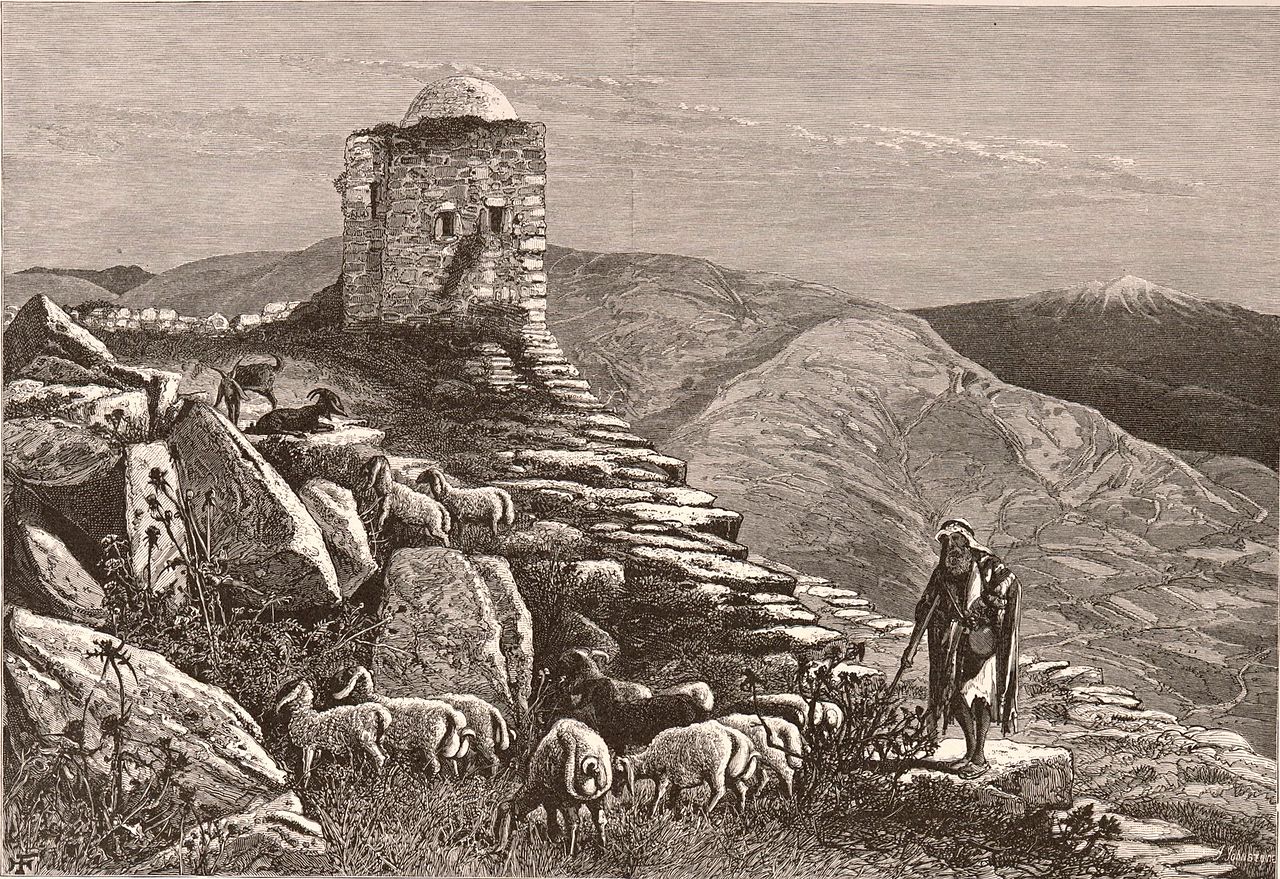
Herny Fenn, Ruins on the Summit of Mount Gerazim, On the Site of the Samaritan Temple (between 1881 and 1884)
Deuteronomy 27: 11-26 A Liturgy of Curses
11 The same day Moses charged the people as follows: 12 When you have crossed over the Jordan, these shall stand on Mount Gerizim for the blessing of the people: Simeon, Levi, Judah, Issachar, Joseph, and Benjamin. 13 And these shall stand on Mount Ebal for the curse: Reuben, Gad, Asher, Zebulun, Dan, and Naphtali. 14 Then the Levites shall declare in a loud voice to all the Israelites:
15 “Cursed be anyone who makes an idol or casts an image, anything abhorrent to the LORD, the work of an artisan, and sets it up in secret.” All the people shall respond, saying, “Amen!”
16 “Cursed be anyone who dishonors father or mother.” All the people shall say, “Amen!”
17 “Cursed be anyone who moves a neighbor’s boundary marker.” All the people shall say, “Amen!”
18 “Cursed be anyone who misleads a blind person on the road.” All the people shall say, “Amen!”
19 “Cursed be anyone who deprives the alien, the orphan, and the widow of justice.” All the people shall say, “Amen!”
20 “Cursed be anyone who lies with his father’s wife, because he has violated his father’s rights.” All the people shall say, “Amen!”
21 “Cursed be anyone who lies with any animal.” All the people shall say, “Amen!”
22 “Cursed be anyone who lies with his sister, whether the daughter of his father or the daughter of his mother.” All the people shall say, “Amen!”
23 “Cursed be anyone who lies with his mother-in-law.” All the people shall say, “Amen!”
24 “Cursed be anyone who strikes down a neighbor in secret.” All the people shall say, “Amen!”
25 “Cursed be anyone who takes a bribe to shed innocent blood.” All the people shall say, “Amen!”
26 “Cursed be anyone who does not uphold the words of this law by observing them.” All the people shall say, “Amen!”
The chapter ends with a series of twelve individual curses that the community is to place on anyone who violates particular actions. This sets the scene as well for the blessings and curses in chapter 28 where six tribes are on Mount Ebal for curses and six tribes are on Mount Gerazim for blessings. The two mountains are on the opposite sides of a valley and for the Samaritans Mount Gerazim would become one of their holy sites. Within Deuteronomy Mount Gerazim becomes the mountain of blessing while Mount Ebal is the mountain of curse, yet for Deuteronomy the tablets of the law and the altar are to be built on Mount Ebal rather than Mount Gerazim.
Many of these are covered earlier in Deuteronomy and rather than spend much time on those I will link you back to the discussion at the appropriate place in Deuteronomy, but a few are new. Verse 15 which concerns idols and images is talked about earlier in Deuteronomy 4: 15-20, and Deuteronomy 5:8-10 and is depending on how you number either part of the first commandment or the second commandment. Verse 16 also harkens back to the ten commandments with the commandment on honoring father and mother in Deuteronomy 5: 16 and is also expanded in Deuteronomy 21: 18-21 with the punishment for children who are rebellious and bring dishonor to their father and mother. Verse 17 concerns the moving of boundary markers which is addressed in Deuteronomy 19: 14. Verse 18 is the first new item on misleading the blind, but it follows in the concern that people care for the vulnerable and the weak in the society. Leviticus 19: 14 also addresses this when it states, “You shall not revile the deaf or put a stumbling block before the blind; you shall fear the LORD your God.” Caring for the vulnerable is a central part of living out of the covenant and one of the places where the prophets are called upon to point out the way the people have not cared for the vulnerable. The next curse continues about those who oppress the representative triumvirate of the vulnerable, the widows, the orphan and the alien. The tithe, addressed in Deuteronomy 14: 29 and Deuteronomy 26: 12-13, the inclusion of the vulnerable in the festivals like outlined in Deuteronomy 16: 11, 14 the practice of allowing the remnant of the harvest and vine to be gleaned by the vulnerable in Deuteronomy 24: 19-22 are all concrete practices to help care for the vulnerable in their community. Verse 20 about lying with the father’s wife is covered in Deuteronomy 22: 30. The next three curses about forbidden sexual relations are new to Deuteronomy but fit within the ordered world of Deuteronomy 22:13-26 for the author of Deuteronomy’s view of sexual relations. Sexual relations with any animal, with a sister or a mother-in-law are forbidden and Deuteronomy doesn’t feel the need to explain these any further. The command in verse 24 about striking a neighbor in secret is new and it addresses disputes outside the purview of the community. For Deuteronomy the community and the elders are key to ensuring that disputes are resolved equitably. The curse about taking a bribe to shed innocent blood is addressed in the judicial context of Deuteronomy 16:19. Finally the last curse is general in nature referring to the entirety of the law and the need for obedience. This final curse may round it out to bring the final number of these individual curses to the representative twelve. Obedience is both an individual and communal responsibility, where the community holds the individual accountable. By placing these curses in the mouths of the people as they enter the land their own words hold them accountable to living in obedience to this law and covenant.


 Sign of the Rose