
Tag Archives: Stopping Clues

Social Media and the Projecting and Mining of the Digital Self

Session 6: Social Media and the Projecting and Mining of the Digital Self

This is the sixth part of a now eight-part series on faith in a digital age. The outline of the series is:

Week one: Advertising in a Digital Age
Week two: Email, Multi-tasking and the blurring of the work/home divide
Week three: The Internet the Backbone of the Digital Age
Week four: The Impact of the Internet and Engaging it faithfully

Week five: Cell phones and a continually connected life
Week six: Social media and the projecting and mining of the digital self
Week seven: Dating and relationships in a digital age
Week eight: The dangers of a digital age

This is a series of classes I’ve been teaching with my congregation that I’ve been attempting to capture digitally so that they could be used by other communities or small groups or for members who are unable to be present in class.

We discussed briefly in session four about our digital identity, how we place a reflection of ourselves out in the digital world when we engage with the internet and with digital technology. As we enter the world of social media the projection of ourselves into the digital world encompasses a larger portion of our life. We project an avatar of ourselves, an icon or representation of what we choose to reveal of ourselves to represent ourselves in this digital world. We share certain pieces of our lives and our network of connections so others can see. At the same time, we project this representation of ourselves that projection is being examined and mined by others, including advertisers, to understand how to relate to us. Prior to social media what we shared digitally, with some exceptions, was passive-others may gather information about searches or websites we went to but normally we weren’t voluntarily sharing this information. With the beginning of social media sites, we began actively sharing a lot of data: from pictures to political opinions, from the places we go and the food we eat to our connections with other people. We can use this to stay connected but we also receive a lot of junk. People value pictures and the connections we have with the people who are important to us, but we also have to sort through a lot of information that may not be valuable to us.

When we use social media, it can create a lot of strong feelings for the user. We can feel connected, valued, loved or conversely, we can feel disconnected, angry, shamed or excluded. Sometimes it leads us into temptation by copying life we see others showing us and it can also make us feel inadequate. Other times, it can feel like we are being taunted or bullied. There is always the possibility that when we share a piece of our life digitally that we will be judged, just like we could be in the real world. All of these feelings of happiness and unhappiness are real and yet for many people there is a strong almost addictive draw to these platforms.

We can’t talk about social media without discussing the basic human need for connection. As humans we are social creatures and our brains are wired to want connection with other people. We want to feel liked, loved, valued, safe and seen by others. We will do some incredible things for this connection. This is why young people will join a gang, because by being a part of the gang they have a family of people and they have some value. This is part of the reason that people will go through the physical ordeal and sometimes hazing to be a part of a team or a group. It is also one of the reasons that we will go to incredible lengths for those who we love as family and those who we have romantic feelings for. One of the things that has been coming out in research lately is one of the greatest predictors of longevity is a strong set of social connections. A lack of social connections has been shown to be a stronger predictor of an early death than many things like environmental pollution or smoking.

When we feel connected it is a powerful thing to our brains. Think back to a time when you fell in love and because of the love you felt everything felt right in the world. When your brain feels safe, valued, and loved the chemical reaction in your brain is a powerful thing which is one of the reasons we seek these feelings so much. Conversely, when we’ve had our heart broken, when we’ve been rejected or ridiculed or shamed this is an equally powerful negative experience. We seek connection and we fear disconnection and sometimes the fear of disconnection is even greater than our fear of physical harm or death.

To talk about connection, I’m going to rely on the work of Brené Brown who teaches at the University of Houston in the Social Work department. In her research she looked for what made people feel connected, but when she asked about connection people would share their experiences of disconnection. These experiences of disconnection she would eventually come to label as shame. She defines shame as, “Shame is the intensely painful feeling or experiencing of believing we are flawed and therefore unworthy of love or belonging.” (emphasis authors) and she lays out twelve categories of shame that frequently emerge in her research:

  • Appearance and Body Image
  • Money and Work
  • Motherhood/Fatherhood
  • Family
  • Parenting
  • Mental and Physical Health
  • Addiction
  • Sex
  • Aging
  • Religion
  • Surviving Trauma
  • Being Stereotyped of Labeled(Brown, 2012, p. 69)

Some of these twelve categories of shame are organized along gender lines and social expectations of gender roles. For example, appearance and body image is more likely to be a source of shame for women while money and work is more likely to be a source of shame for men.

Women and men experience shame differently. Brené Brown describes shame for women as a web of competing expectations and demands: how they are supposed to look, how they are supposed to act, how they are supposed to parent, how they are supposed to balance all the expectations that are put upon them and to make it look easy. This is made more challenging because the expectations are not uniform. For example, women when critiqued on mothering are viewed by widely differing standards and often judged because they are not mothering the way another believes is the right way to mother. These criticisms or places where they don’t conform to these expectations often strike at their greatest places of insecurity.

We often neglect the way that men experience shame and for men it is often a subject that we are unable to talk about. Brené Brown in her work share the story of when earlier in her career she had only researched women and shame and then after a conference a man asked her, “have you studied men and shame?” She admitted she hadn’t and then he went on to explain how men have deep shame but are unable to express it both among other men and with women. For men shame is about failure: a failure to be strong enough, good enough, or to provide enough for others. As I mentioned above, money and work are a strong shame trigger for men and so if a man’s wife comes home and comments about the nice car that her friend’s husband bought it can unintentionally send a message to the man that because he is unable to provide the same or better, he is not valued or loved. Most men learn at an early age that it is socially unacceptable to show weakness or fear. I can remember a point in my elementary school days when I learned I wasn’t allowed to cry anymore and it was reinforced by both peers and family members.

One of the reasons for talking about this with social media is that we go to social media longing for connection and we may experience disconnection. We want to feel good and safe and valued and we may find messages that reinforce how we are not living into the expectations of others or how we are not good, strong or able to provide enough. We may find those things that play on our shame triggers and we are also comparing ourselves to the best projection of someone else. We compare our entire lives to the snapshot that others choose to share of their lives. We measure ourselves unfairly against others without having access to the whole picture of their lives.

The people who designed social media know that we are connection seeking beings and the media are designed to encourage our continued usage of their platforms. When people like or comment on something that we do it feels good to our brains, it feels like we are connected and valued and seen. Because of that desire for connection we do sometimes modify our behavior to seek the approval of others, even when we may not believe that it is the correct thing.

This leads us back to the discussion of lowered social boundaries that I initially introduced when we discussed texting in the previous session. It often feels less stressful to share something through a digital technology because we don’t have to see how the words impact the other person’s body language or voice and there is not the danger of physical consequences to what we say (at least not in the moment). I believe this lowered set of social boundaries also helps to explain some of the bullying or trolling that happens on social media. We may believe that we aren’t interacting with a real person and so our words don’t matter, but they do. Many in the congregations I’ve served have heard my repurposing of the children’s proverb, “sticks and stones will break my bones but words will never hurt me” to “sticks and stones may break my bones but words will send me to therapy.” Words, even online words, can cause real emotional damage. We come in seeking connection and then someone else for their own reasons bullies or insults us in ways that they would never do to our face. Sometimes when we lower our social boundaries, we encounter the basest parts of our self and others. Also, these things are now recorded and we may have to address these things at a later point of our life.

All social media are designed to keep you engaged and to do that they mine your digital projection to figure out what you want to see. Facebook, for example, will categorize you as extremely liberal, moderately liberal, moderate, moderately conservative or extremely conservative and will attempt to tailor your feed based around those political values. One of the dangers of this is that we can be surrounded in our digital world by people who think and believe the way that we do to the exclusion of other viewpoints. This ‘bunker effect’ can shield us from interactions that may challenge our viewpoint and we may be encouraged to view those who think differently than us as our enemy or people unworthy of consideration. Adding into this picture some powerful mental forces like ‘confirmation bias’ we can become susceptible to partial truths and sometimes outright lies that fit within our worldview. This has had major effects on our political dialogue and has increased the polarization we experience in the world.

Social media are advertising platforms, they are not news platforms. They are designed to increase the projection of information for profit. In a profit model where clicks on a website result in greater payments we’ve seen the practice of ‘click-baiting’ evolve to get people to go to an article based on the headline. Social media does not censor things based on their verifiability. There are some practices they have introduced after the last election cycle but ultimately, they are designed to maximize profit and they are not incentivized to remove things that masquerade as news that may merely be opinion. This can present us with a very skewed vision of reality and we may find ourselves confused by the boundaries between someone’s opinion and a verified fact.

Social media are designed for addictiveness. Some of this goes back to our discussion of the internet and platforms like Netflix removing the ‘stopping cues’ to keep you engaged on the platform for longer. Facebook for example, has no stopping cues to keep you from continuing to scroll down the screen and stay on their platform. Some other media like Snap Chat or Instagram reward you for continuing to engage through things like ‘streams’ which are broken if you have a day where you don’t engage. These all send subtle clues to our mind to come back and to seek connection again on these platforms. The technology is not evil, but it does use some of the basic pieces of our psychology to keep us engaged.

As a Christian as I think about social media, I reflect upon the language of Genesis 1 where we are created in the image of God. As Genesis narrates the creation narrative, “So God created humankind in his image, in the image of God he created them; male and female he created them.” (Genesis 1: 27) A person’s value comes not from how other people value them but instead, from a faith perspective, from the reality that they share some portion of the image of God. Especially from my Christian faith it goes back to the language of my baptism where, from my Lutheran Christian theological perspective, I have been marked with the cross of Christ forever and sealed by God’s Holy Spirit.  I am reminded that my identity begins with the reality that my life has been claimed by God and that I am a child of God. That doesn’t mean I am immune to the desire for connection or the feelings of shame, but it does help me to remind myself that I have value and worth already and nothing can take that away. For me it means that even when I disagree with someone, I don’t attack them in a way that attempts to shame them or demean them.

Social media can enable us to connect with a broad network of people. It can be a place where we choose to share the things that we find meaningful and valuable. It can also be place where we encounter disconnection and where we can experience hurt and shame. I think the technology can be a place where we do a lot of positive things but like any technology it helps to understand some of the dangers involved.

Discussion Questions:

  1. What are things that you share on social media? What don’t you share?
  2. How do you feel after being on social media? What made you feel that way?
  3. Can you think of a time where you felt shame? What triggered that feeling?
  4. Which of the categories of shame seem to impact you more deeply? What messages from advertising and from others reinforce those messages?
  5. When have you seen social media misused? What do you like and dislike about the platforms you use?
  6. What ways have you found helpful to have conversations with people who think or believe differently than you?
The Impact of the Internet and Engaging it Faithfully

Session 4: The Impact of the Internet and Engaging it Faithfully

This is the third part of a now eight-part series on faith in a digital age. It expanded due to the richness of the discussion on the internet and the amount of material I couldn’t cover in this first week. The outline of the series is:

Week one: Advertising in a Digital Age
Week two: Email, Multi-tasking and the blurring of the work/home divide
Week three: The Internet the Backbone of the Digital Age
Week four: The Impact of the Internet and Engaging it faithfully
Week five: Cell phones and a continually connected life
Week six: Social media and the projecting and mining of the digital self

Week seven: Dating and relationships in a digital age
Week eight: The dangers of a digital age

This is a series of classes I’ve been teaching with my congregation that I’ve been attempting to capture digitally so that they could be used by other communities or small groups or for members who are unable to be present in class.

In the previous session we talked about how the internet is the infrastructure or the backbone that makes the digital age possible. We will be focusing in this session on how our interactions with the internet shape our minds and our actions and how we as people of faith can responsibly use this technology to live the lives that we want to live.

The first impact we’ll discuss briefly is what I’ve called the ‘Google effect’ but it has the official title of Cognitive Offloading. This deals with the impact of having information easily available on how our mind stores information. I’m in my mid 40s and if you are my age or older you probably remember having a lot of telephone numbers memorized and this memorization was drilled into your memory by having to manually dial or push buttons to dial the phone number of the person you wanted to talk with. Today the number of phone numbers I have in my memory has decreased dramatically-I can still remember my phone number growing up, but I can’t remember my mom’s current phone number since it is stored in my phone. My memory has used the contacts in my phone as a quickly available alternative to dedicating connections to remembering her new phone number. This appears in several ways: you hear a weather forecast and forget what the weather will be, but you can look it up online or on your phone, you look at your watch and then forget immediately what time it is. Our minds our exposed to a lot of data on a regular day and our memory makes choices about what to store in long term memory and what to purge from our memory and so things that were once remembered from constant use or from limited availability are no longer stored. Perhaps when you were growing up you remember having to learn multiplication tables or the square roots of certain numbers by memorization and were told the reason you had to do this was because you wouldn’t always have a calculator with you. If you carry a smart phone you now do carry a calculator with you all the time, but it doesn’t mean the exercises of committing this type of repetitive information to our brains was not a worthwhile exercise. Cognitive offload works like the pensieve that Professor Dumbledore uses in the Harry Potter novels to store his thoughts: we transfer the responsibility for remembering the information from our memories to some other device so that we can use that device to revisit the information later. The reality is that I use this blog that your reading from in a similar way to store work that I’ve done and processed through for easy access later, I remember much of what I write but it also allows me in a positive way to store more information than my memory may retain.

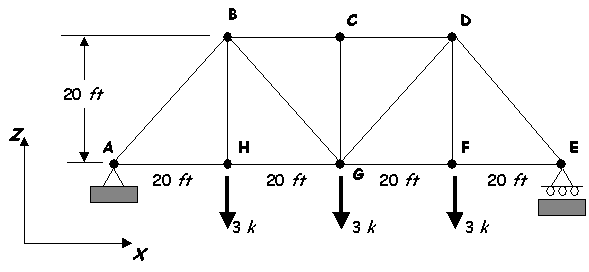
Connected to this is the way that the ease of information can shortcut the learning process. If you were to wonder, for example, what is the second largest snake in the past you would’ve gone probably to a library book on snakes or and encyclopedia and look through the various species to figure out what this answer was but today you would only have to enter in Google or another search engine, “What is the second largest snake” and you’d have easy access to a list of the largest snakes. But if you do this search, you’ll soon find out that the lists don’t agree: it depends on what you mean by the largest. You can refine your search based on what is the longest or the heaviest snake, but not only have you missed the process of learning more about the snake world as you searched (assuming of course that you are interested in snakes to begin with) but you also don’t necessarily have the background information to interpret the answer you’ve been given. When my son was in high school, he was a part of the STEM program (Science Technology Engineering and Mathematics) and in his second year he came home with a bridge truss problem like the one below:

Now my undergraduate was in civil engineering so when I saw this problem, I knew exactly what it was, even if I couldn’t remember exactly how to solve it. This is a problem that most engineers encounter in the second year of college in a course called statics. To solve this problem, you do need some background in trigonometry and physics and my son hadn’t taken either course yet. It took me going back to an old text book, teaching myself and then trying to walk my son through the problem that he didn’t have the background for (I also sent a note to the teacher explaining why I found it strange they were introducing a problem like this and not giving the students the tools to adequately solve it). Although this is a non-internet example lets return to the internet and look at something that you may have experienced. Have you ever self-diagnosed your symptoms using a service like WebMD and then later went to a doctor with your diagnosis you quickly realize that the doctor doesn’t automatically assume that your diagnosis is correct? A medical doctor has spent years in learning about the body, diseases, treatments and has experience in seeing people with different symptoms and has tools to diagnose and treat that we, without going through the discipline and training, do not. There is a difference in a web search and a degree in medicine or engineering or even religion-it doesn’t mean that we can’t know things about these disciplines without the degrees or certifications, but that knowledge is without the same amount of context unless you are willing to dedicate years of study to a topic.

As a person who is curious about curiosity, I’ve tried to learn how imagination and curiosity work. One thing I’ve learned is there are two types of curiosity: a quick distraction and the slow and dedicated digging into a craft or subject. The ‘ooh shiny’ effect of a quick distraction causes us to take our attention away from other things for a brief time, but it does not hold enough interest for us to continue to pursue it in any organized way. Real learning of a craft or discipline takes hours, frustration, mistakes and drive. There are ways we can train ourselves to learn but there is no quick way to master any subject. If we continually distracted by the entertainment or the attraction of something that takes us away from the things we are willing to dedicate our time and sweat to learn. This type of “ooh shiny” distraction is easy to find in an internet connected world where the possibilities for distraction are endless. One of the things that is beginning to happen is societies which are less connected to the internet, and less distracted, are the places where many new innovations in science, mathematics and technology are coming from as they continue to be encouraged to learn their disciplines deeply. Even in Silicon Valley where a lot of the technology of the internet emerges from there is a trend of limiting the exposure of their families to the continual connectivity of the internet.

One of the other things that has changed on many internet platforms is the removal of stopping clues. If you’ve ever spent hours watching Netflix or YouTube or continued to scroll of a social media platform like Facebook or Twitter or Instagram it may be helpful to realize that these platforms are designed for you to do this. There are two major models for how sites are funded that use this trick to keep you engaged: either they are a subscription service that wants to ensure that you value their service (and the more you watch the more you probably value it) or they get paid based on advertisement and the more you watch the more ads you see. Stopping clues are things like the end of a chapter in a book or the end of a television episode, they are natural stopping places. At the end of a chapter in a book it is a natural place to consider whether you put in a bookmark and go onto another task or whether you continue onward in the book. When television shows were episodic and weekly the ending of an episode meant you had to wait a week for the next episode to be available. But with Netflix online, for example, when you complete one episode it automatically prepares the next episode to follow it, removing the stopping clue so you stay engaged. YouTube also follows this pattern by automatically launching the next video they anticipate you would want to see. Social media allows you to continue to scroll without any clue to tell you to pause and disconnect. Ultimately all these services are competing for your time, loyalty and directly (through subscription) or indirectly (through advertising) your money and information.

I come at this series and the rest of my life from a faith perspective and as a pastor I do think it is important to give us a way to think about big issues like this in relation to our faith.  The Sermon on the Mount in Matthew 5-7 brings us a lot of helpful discussions to think about our online interactions: We are called to the salt of the earth (that which preserves the earth) and the light of the world in Matthew 5: 13-16. What does it mean to be salt and light in a digital world? I believe that some people believe that their actions in the digital world don’t matter in the same way and that frees them to say things to other people they would never say face to face, but I do believe that in this world our actions are need to preserve and protect and to be a source of light and illumination rather than pain and darkness. The next section of the Sermon of the Mount I want to highlight is where Jesus reinterprets the commandment on murder (Matthew 5: 21-26) and this is extended to if you insult or curse a brother or sister you are liable to judgment. Our words in both the physical world and the digital world matter. Many in my congregation have heard my reinterpretation of the children’s proverb, “Sticks and stones will break my bones, but words will send me to therapy.” The next commandment reinterpreted is on adultery (Matthew 5: 27-30) where “everyone who looks at a woman with lust has already committed adultery with her.” The reality is there will always be things we are uncomfortable with and this is a challenging discussion that could take an entire series of classes and this is one of those places where we do need some wisdom. I know it is easy to target pornography, but I think if we are going to consider visual images, we also need to consider things like romance novels which create vivid images in our minds. For me where Jesus’ discussion of this commandment points to when we think of women and men as objects rather than people. If a person is an object, something I don’t consider worthy of my respect then it is easy to think of them as something that is merely for my gratification, but I think one of the critical things the Sermon on the Mount points to is the way we are to rehumanize the way we relate to people. That is why we are called to love our enemies rather than to demonize them (Matthew 38-38) and to be people focused on reconciliation rather than retribution. Finally, in this, and other discussions I think it is important not to place ourselves in the role of judge over other people (Matthew 7: 1-5). To me this invites me to engage people curiously, wanting to understand how they are approaching life rather than condemning them for living and valuing things differently than me.

I’ve focused on some of the more challenging aspects of the internet above, but it also gives us a lot of possibilities of how we communicate and live out our practices that are central to our faith. This technology can be used to help us connect. My children are both living in Oklahoma while I live in Texas and I can each week communicate with them by video using Skype as a free service. Twenty years ago, this would have been a long-distance phone call that was both expensive and lost the visual component. Later this week I will have a meeting with several colleagues on a platform called Zoom so that we can meet without having to drive across the city of the state to discuss the topics we need to discuss. I know many churches use email for prayer and some create a virtual prayer wall where people can place prayers for others in the congregation to pray about. If you are reading this or watching the video, you are seeing some of my experimentation with using the technology for teaching. It allows me to reach a much wider audience, yet it does have some limitations in facilitating a discussion. Most digital technology is designed to be consumed rather than interacted with, and while I’m comfortable with teaching in a more lecture like format I’m intrigued by some of the streaming and discussions coming out of the gaming world. Ideally worship would be with a community but for various reasons that is not always possible. For example, I have a colleague whose church live streams their worship and there was a week where the live stream was not available, and they received a call from a small group of people in Wyoming wondering where the live stream was. He discovered that this group was gathering together on Sundays and watching the live stream to be church. I also think it is a way that people who are physically unable to leave home or the hospital can feel like they are also participating in worship.

Finally, I want to talk about our virtual identity. We construct our identity throughout our lives: the education we pursue, the jobs we hold, how we dress in various situations, music we listen to, etc. We also project a digital identity out into the internet, and it is worth wondering how that digital identity matches with our personal identity. One of the topics up for debate currently is whether control of our digital identity is a fundamental human right or whether corporations and governments freely have access to it. Ultimately, we may not be able to control what corporations or governments do but we do have some control about what we broadcast of our identity. If a person from my congregation showed up at my house, they wouldn’t be surprised by the person they encounter there, and even for those who only know me from online who I am there is reflective of who I am as a person. Do I share everything about myself, no and nobody should. There are parts of us that we share only with those who have earned our trust but who say we are should reflect our values and be authentic to the person we are attempting to be. I know when I’ve interviewed with congregations in the past, I’ve invited them to investigate what I write, what I show of myself online as a window to get to know who I am as they discern whether I might be their pastor.

If you are hearing or reading this, you use the internet and most of us use it daily. Hopefully this helps you think about how you want to use the internet. What pieces of our memory are we OK with committing to our electronic devises and what do we want to maintain? How do we use the internet to learn and when do need to dig deeply to learn a master a skill or topic? How do we set our own boundaries and limits to the time we spend online and how do we create clues for us to stop and transfer our energies elsewhere? How does our faith inform not only our virtual identity but also our day to day interactions with others?

Discussion Questions:

What things do you rely on internet connected devices to remember for you?

Have you ever spent what you felt was wasted time online? Why did you stay online when you felt like the time was wasted?

Do you have any boundaries you set to limit the time or ways you or members of your family utilize the internet?

What is something you are genuinely curious about and would be willing to invest time and energy in learning or mastering?

How does our faith inform our interactions online? What are some areas online that you consider dangerous?

Reflect on what makes you who you are (your identity). List things that you think are important to defining your identity. What do you share online and what do you keep private?