Tag Archives: Sign acts

Ezekiel 37 The Valley of the Dry Bones and a Sign of Reunification

Vision of Ezekiel 1640-1650 by Leonhard Kern By Anagoria – Own work, CC BY 3.0, https://commons.wikimedia.org/w/index.php?curid=79010820

Ezekiel 37: 1-14 The Vision of the Valley of Dry Bones

1 The hand of the LORD came upon me, and he brought me out by the spirit of the LORD and set me down in the middle of a valley; it was full of bones. 2 He led me all around them; there were very many lying in the valley, and they were very dry. 3 He said to me, “Mortal, can these bones live?” I answered, “O Lord GOD, you know.” 4 Then he said to me, “Prophesy to these bones, and say to them: O dry bones, hear the word of the LORD. 5 Thus says the Lord GOD to these bones: I will cause breath to enter you, and you shall live. 6 I will lay sinews on you, and will cause flesh to come upon you, and cover you with skin, and put breath in you, and you shall live; and you shall know that I am the LORD.”

7 So I prophesied as I had been commanded; and as I prophesied, suddenly there was a noise, a rattling, and the bones came together, bone to its bone. 8 I looked, and there were sinews on them, and flesh had come upon them, and skin had covered them; but there was no breath in them. 9 Then he said to me, “Prophesy to the breath, prophesy, mortal, and say to the breath: Thus says the Lord GOD: Come from the four winds, O breath, and breathe upon these slain, that they may live.” 10 I prophesied as he commanded me, and the breath came into them, and they lived, and stood on their feet, a vast multitude.

11 Then he said to me, “Mortal, these bones are the whole house of Israel. They say, ‘Our bones are dried up, and our hope is lost; we are cut off completely.’ 12 Therefore prophesy, and say to them, Thus says the Lord GOD: I am going to open your graves, and bring you up from your graves, O my people; and I will bring you back to the land of Israel. 13 And you shall know that I am the LORD, when I open your graves, and bring you up from your graves, O my people. 14 I will put my spirit within you, and you shall live, and I will place you on your own soil; then you shall know that I, the LORD, have spoken and will act, says the LORD.”

The valley of the dry bones along with the imagery of Ezekiel’s initial call are the two portions of this large book that many people are familiar with. For both Jewish and Christian readers this reading appears at critical points in the life of the communities of faith. For Jewish readers this is the reading to accompany the Torah reading (Exodus 33: 12-34:26) on the sabbath of Passover week. Christians who utilize the revised common lectionary encounter it on the fifth Sunday of Lent in year A and the day of Pentecost in year B.[1] Beyond the utilization in worship is this passage in the memory and imagination of people who come back to its imagery of life out of death and hope from hopelessness.

Ezekiel is moved by the powerful force of the hand of the LORD coming upon him and transporting him to an unidentified valley. The valley is not named but it is presumably known to Ezekiel since he refers to it as ‘the’ valley. This valley full of ‘very many’ bones that are laying unburied would be a shocking scene for a person from a priestly household that would know the importance of the proper treatment of the human corpses for the people. Yet in this image he walks through a boneyard of a vast number of people who were unburied and have been long left to be picked over by scavengers whose bones have lost all their connective tissue and internal life.  As Daniel Block states, “the picture is one of death in all its horror, intensity, and finality.” (Block, 1998, p. 374)

We cannot know the inflection of Ezekiel’s answer to the LORD on whether these bones can live, whether his answer to God is delivered with conviction or resignation, whether it is immediate or whether the prophet struggles to answer this question. From the perspective of a mortal these dried out bones in this valley of death are as far removed from life as could be imaginable. Yet, as Tova Ganzel also notes Ezekiel’s answer also is an encapsulation of the prophetic message throughout the book. (Ganzel, 2020, p. 323) Ezekiel has throughout the book been the obedient and submissive prophet, and throughout the book God has known what Ezekiel and other mortals have not.

Bones that are without life have been an image of despair in the scriptures[2] and yet here the prophet is to be a part of a movement from despair to hope. The prophet is commanded to speak the words that come from God and participate in God’s act of recreation. Just as God creating the world by speaking in Genesis 1, now the prophet is involved in the recreation of a people through sharing these creative words. Initially dry bones become bodies, enfleshed and whole again but without breath. The words have done what they could do on their own, but for life to return the breath/wind/spirit is needed.

Throughout this passage the Hebrew ruach is behind the words for breath, wind, or spirit and can mean all three. The prophet calls out to the ruach to come from the four directions and come into the mouths and nostril and enter into the lungs reanimating these newly regenerated bodies. From dry bones of conquered people to a new beginning for the people of Israel. The very large and uncountable number of bones has become a vast multitude that we learn is the whole house of Israel, both those who suffered recently under Nechuadrezzar’s conquest as well as those who were exiled by the Assyrians a century and a half earlier.

Ezekiel’s imagery is probably not imagining the generalized resurrection that Daniel 12:1-2 and later the New Testament would utilize, but it does significantly expand the imagery of life from death in the Hebrew Scriptures.[3] Ezekiel’s reference for the imagery of the dry bones likely emerges from the curses of Deuteronomy 28: 25-26:

The LORD will cause you to be defeated before your enemies; you shall go out against them one way and flee before them seven ways. You shall become an object of horror to all the kingdoms of the earth. Your corpses shall be food for every bird of the air and animal of the earth. There shall be no one to frighten them away.

2 Samuel 21 shares the story of David allowing the Gibeonites to enact revenge against the sons of Saul by impaling them and allowing the birds and animals to feed on them, but Rizpah (the mother of two of the seven sons exposed this way) chases the birds and animals away and the bones are eventually buried. The desolation of the people in the aftermath of the fall of Jerusalem, and the inability to provide proper burials for so many people who lost their lives would have been viewed as a curse upon both the people and the land. But now there is a reversal of the curse. Where previously the people moaned the rhyming (in Hebrew) three-line lament: Our bones are dried up, and our hope is lost; we are cut off completely now bones and flesh are renewed, and hope is restored. A people who lost hope in their future and God now through the prophet are given a vision of a new and vibrant life back on their own soil.

Most of Ezekiel’s visions are dated but this one is left without a date. Elie Wiesel, a well-known holocaust survivor, claimed that this vision has no date because every generation needs to hear in its own time that these bones can live once again. (NIB VI: 1504) Christians and Jewish faithful need to remember that God’s creative words and spirit can take the hopeless valley full of death in all its horror and regenerate both a people and hope. Bones can once again become bodies, bodies can once again breathe, boneyards become filled with a vast multitude making a new beginning as God’s reconstituted people.

Ezekiel 37: 15-28 Two Sticks As A Sign of a Reunified People

15 The word of the LORD came to me: 16 Mortal, take a stick and write on it, “For Judah, and the Israelites associated with it”; then take another stick and write on it, “For Joseph (the stick of Ephraim) and all the house of Israel associated with it”; 17 and join them together into one stick, so that they may become one in your hand. 18 And when your people say to you, “Will you not show us what you mean by these?” 19 say to them, Thus says the Lord GOD: I am about to take the stick of Joseph (which is in the hand of Ephraim) and the tribes of Israel associated with it; and I will put the stick of Judah upon it, and make them one stick, in order that they may be one in my hand. 20 When the sticks on which you write are in your hand before their eyes, 21 then say to them, Thus says the Lord GOD: I will take the people of Israel from the nations among which they have gone, and will gather them from every quarter, and bring them to their own land. 22 I will make them one nation in the land, on the mountains of Israel; and one king shall be king over them all. Never again shall they be two nations, and never again shall they be divided into two kingdoms. 23 They shall never again defile themselves with their idols and their detestable things, or with any of their transgressions. I will save them from all the apostasies into which they have fallen, and will cleanse them. Then they shall be my people, and I will be their God.

24 My servant David shall be king over them; and they shall all have one shepherd. They shall follow my ordinances and be careful to observe my statutes. 25 They shall live in the land that I gave to my servant Jacob, in which your ancestors lived; they and their children and their children’s children shall live there forever; and my servant David shall be their prince forever. 26 I will make a covenant of peace with them; it shall be an everlasting covenant with them; and I will bless them and multiply them, and will set my sanctuary among them forevermore. 27 My dwelling place shall be with them; and I will be their God, and they shall be my people. 28 Then the nations shall know that I the LORD sanctify Israel, when my sanctuary is among them forevermore.

Ezekiel continues his hopeful message with a sign act joining two sticks[4] into one symbolizing the reunification of the tribes of Israel into one nation under one ruler. Judah and ‘Joseph’ or ‘Ephraim’ were the designations for the twelve tribes unified as Israel under King Saul, David, and Solomon. In the aftermath of Solomon’s reign, the nation split with the northern tribes, with Ephraim being the strongest tribe that the kings of ‘Israel’ or ‘Samaria’ emerged from splitting from the people of Judah who remained under the line of Davidic kings. Many prophets had hoped for the reunification of the people into one people, one kingdom, but the people of ‘Joseph’ had disappeared among the nations a century and a half ago. Yet, the concern here is to reinforce the reunification of the people as one nation, hence the use of the Hebrew goy.[5] One people under one king in one kingdom.

It is unusual for Ezekiel to refer to a leader of the people as king (melek) but a restored nation without a restoration of a common ruler was probably beyond Ezekiel’s imaginative capacity. Even in this passage he will revert to his preferred ‘prince’ (nasi). Yet, just as God was the one who would reinvigorate dry bones into a vast multitude or give the people a new heart and new spirit, now God will bring together two nations long divided into one and will not divide them again. They will return to the land, they will be cleansed from their past transgressions, apostasies, and they will never return to the idols of the other nations. The covenant of peace will be an everlasting covenant, and God will dwell among them.

The placement of God’s sanctuary among them is a means for God to dwell among God’s people. It is from this central place in the midst of the people that the people will be made holy, and that God shall be with them. For Ezekiel the people are now one kingdom under one king (who serves as God’s prince) living in obedience with one sanctuary. Ezekiel’s conclusion of his book will be dedicated to this new temple with a new sanctuary, but here we have a renewed people in the land reunited into a covenant of peace.

[1] It is also utilized on the Easter vigil, but relatively few churches still do a liturgical vigil of Easter and even fewer members participate in this liturgically important but underattended service.

[2] See for example Proverbs 17:22, Psalm 31:10, 102:3.

[3] Isaiah 26:19 and Hosea 6:1-3 do utilize ‘resurrection’ imagery but Ezekiel’s vision is much longer engagement with this language.

[4] There is some debate about how best to translate this word which could refer to trees, branches, scepter, staff, or even tablets. Many commentaries go into exhaustive detail on this while I am intentionally noting this and moving on.

[5] The Gentiles, or the nations, are often referred to as the goyim in Hebrew, and it is common to speak of the people or land of Israel, but here Ezekiel is emphatic that it is one nation.
Ezekiel 12 Judgment on the Leaders and People of Jerusalem

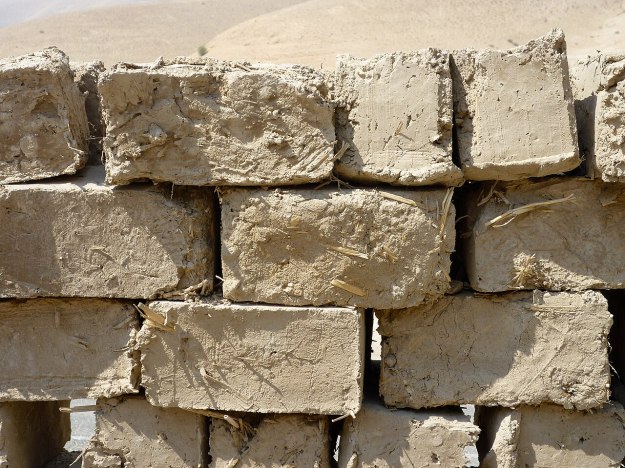
New, unlaid mudbricks in the Jordan ValleyWest Bank Palestine, (2011) By Whiteghost.ink – Own work, CC BY-SA 3.0, https://commons.wikimedia.org/w/index.php?curid=16303999

Ezekiel 12

Ezekiel 12: 1-16 Zedekiah’s End Enacted

1 The word of the LORD came to me: 2 Mortal, you are living in the midst of a rebellious house, who have eyes to see but do not see, who have ears to hear but do not hear; 3 for they are a rebellious house. Therefore, mortal, prepare for yourself an exile’s baggage, and go into exile by day in their sight; you shall go like an exile from your place to another place in their sight. Perhaps they will understand, though they are a rebellious house. 4 You shall bring out your baggage by day in their sight, as baggage for exile; and you shall go out yourself at evening in their sight, as those do who go into exile. 5 Dig through the wall in their sight, and carry the baggage through it. 6 In their sight you shall lift the baggage on your shoulder, and carry it out in the dark; you shall cover your face, so that you may not see the land; for I have made you a sign for the house of Israel.

7 I did just as I was commanded. I brought out my baggage by day, as baggage for exile, and in the evening I dug through the wall with my own hands; I brought it out in the dark, carrying it on my shoulder in their sight.

8 In the morning the word of the LORD came to me: 9 Mortal, has not the house of Israel, the rebellious house, said to you, “What are you doing?” 10 Say to them, “Thus says the Lord GOD: This oracle concerns the prince in Jerusalem and all the house of Israel in it.” 11 Say, “I am a sign for you: as I have done, so shall it be done to them; they shall go into exile, into captivity.” 12 And the prince who is among them shall lift his baggage on his shoulder in the dark, and shall go out; he shall dig through the wall and carry it through; he shall cover his face, so that he may not see the land with his eyes. 13 I will spread my net over him, and he shall be caught in my snare; and I will bring him to Babylon, the land of the Chaldeans, yet he shall not see it; and he shall die there. 14 I will scatter to every wind all who are around him, his helpers and all his troops; and I will unsheathe the sword behind them. 15 And they shall know that I am the LORD, when I disperse them among the nations and scatter them through the countries. 16 But I will let a few of them escape from the sword, from famine and pestilence, so that they may tell of all their abominations among the nations where they go; then they shall know that I am the LORD.

Ezekiel’s sign-acts are designed, by the nature of their strangeness, to garner attention. In a world before internet influencers who attempt to draw attention to themselves for fame and money, prophets like Ezekiel did outlandish and sometimes destructive acts to call attention to a message God wants the people to talk about and share. Especially for a message which will need to be transmitted (in a world without telephones, new reports, or even a newspaper or regular mail) from the exiles in Babylon to the people of Jerusalem requires it to be memorable and significant. Ezekiel’s action of preparing an exile’s baggage, digging a hole in the wall of his house, entering the house with the baggage through the hole he created and then exiting at night by the same whole leaves his curious neighbors seeking an explanation for these actions, an explanation that he communicates from the LORD.

Throughout the passage the contrast between sight and the lack of sight, light, and darkness, “presents a fascinating study in perception and blindness.” (Block, 1997, p. 365) Christian readers will be familiar with Jesus using identical language to Ezekiel’s description of Israel as those “who have eyes to see but do not see, who have ears to hear but do not hear.” This type of language occurs multiple times in the prophets and the psalms. Ezekiel’s older contemporary Jeremiah says in Jerusalem:

Hear this, O foolish and senseless people. Who have eyes, but do not see, who have ears, but do not hear. (Jeremiah 5:21)[1]

And in the psalmist’s protest against idols:

Their idols are silver and gold, the work of human hands. They have mouths, but do not speak; eyes, but do not see. They have ears, but do not hear; noses, but do not smell. Psalm 115: 4-6

Like Isaiah and Jeremiah, Ezekiel’s message attempts to reach people who are blind and deaf to the implications of these divine messages. Yet Ezekiel’s actions are audacious enough to attract the curiosity of his fellow exiles even if they do not lead to repentance. As stated when Ezekiel is called, when these audacious sign-acts and words come to fruition the people will know that a prophet has been among them whether they hear or refuse to hear. (Ezekiel 2:5)

Ezekiel prepares his exile’s baggage[2] and visibly places it on they outside of his house and then proceeds to dig a hole in the wall of his house.[3] The exiles may have interpreted his actions positively as an end to their exile and a return to their homes in Judah. Yet, Ezekiel’s actions of preparing his baggage, digging through the wall, placing his baggage on the inside, and then departing through the hole in the wall at night will be interpreted the next morning for those who are curious enough to see the prophet’s action and hear its interpretation.

The interpretation involves the people still in Jerusalem and in particular king Zedekiah. Zedekiah is never named in Ezekiel and is referred to here as prince (Hebrew navi) rather than king (Hebrew melek). Zedekiah is the target of prophecy for the first time in Ezekiel. Prior to this Ezekiel only referred to the exile of King Jehoichin and the elders acting unfaithfully in Jerusalem. The temple, the city of Jerusalem and the land have all received judgment, but now the appointed leader in Jerusalem is singled out. The prophet Jeremiah had extensive interactions with Zedekiah in Jerusalem (Jeremiah 32-34, 37-38) and narrates the ending of Zedekiah twice in the book of Jeremiah (Jeremiah 39, 52). 2 Kings shares an identical description of Zedekiah’s end:

Then a breach was made in the city wall; the king with all the soldiers fled by night by the way of the gate between the two walls, by the king’s garden, though the Chaldeans were all around the city. They went in the direction of the Arabah. But the army of the Chaldeans pursued the king, and overtook him in the plains of Jericho; all his army was scattered, deserting him. Then they captured the king and brought him up to the king of Babylon at Riblah, who passed sentence on him. They slaughtered the sons of Zedekiah before his eyes, then put out the eyes of Zedekiah; they bound him in fetters and took him to Babylon. 2 Kings 25: 4-7

The actions of Jeremiah foreshadow the actions of Zedekiah fleeing Jerusalem through a hole in the wall with the sword following him. Ezekiel’s prophecy indicates that the LORD is the one casting his net and setting a snare for Zedekiah and Babylon is merely the instrument.[4] The king does leave by a hole in the wall, is quickly captured, and then is taken to Babylon blinded. As the prophet indicates he is taken to Babylon, but he does not see it.

We live in an age where even many biblical scholars are skeptical of prophecy as prediction. Many scholars of the historical critical and source criticism school view prophesies which foretell later events as “prophecy after the fact” which are included in the compilation of the words of the prophets which may have occurred at a later date. This idea would have been foreign to the early readers of scripture who viewed the prophet as one who receives and transmits divine oracles in both word and action. The prophets’ predictions normally speak in generalities, but it is expected (as we will see in the resistance in the remainder of the chapter) that prophets would communicate coming events. Blinding captives was a widespread practice among the Babylonians, but believability based on common practices is not necessary for a prophet. A true prophet was a person who received a message or insight from God whose knowledge is not limited to the present and whose actions may include the actions through another nation as an instrument of God’s judgment or salvation.

Ezekiel 12: 17-20 Portraying a Traumatized People

17 The word of the LORD came to me: 18 Mortal, eat your bread with quaking, and drink your water with trembling and with fearfulness; 19 and say to the people of the land, Thus says the Lord GOD concerning the inhabitants of Jerusalem in the land of Israel: They shall eat their bread with fearfulness, and drink their water in dismay, because their land shall be stripped of all it contains, on account of the violence of all those who live in it. 20 The inhabited cities shall be laid waste, and the land shall become a desolation; and you shall know that I am the LORD.

In the next visual picture, the prophet demonstrates the traumatic nature of the events for those impacted by the LORD’s judgment of Jerusalem. One of the symptoms of prolonged stress and trauma is uncontrollable shaking, and in the public act of eating and drinking[5] and again the sign must be memorable enough to be communicated from Ezekiel’s position in exile to the remnant in Jerusalem. The judgment of the LORD echoes the covenant curses of Leviticus 26:43:

For the land shall be deserted by them, and enjoy its sabbath year by lying desolate without them while they make amends for their iniquity, because they dared to spurn my ordinances, and abhorred my statutes.[6]

Within Hebrew thought there is a connection between the people and the land, and the disobedience of the people has a negative impact on the land. In Leviticus the land is given a sabbath to recover from the damage incurred by the unfaithfulness of the people, but in Ezekiel the focus is on the impact on the people who will bear the fearful consequences of violence committed in the land.

Ezekiel 12: 21-28 The Time of Judgment is At Hand

21 The word of the LORD came to me: 22 Mortal, what is this proverb of yours about the land of Israel, which says, “The days are prolonged, and every vision comes to nothing”? 23 Tell them therefore, “Thus says the Lord GOD: I will put an end to this proverb, and they shall use it no more as a proverb in Israel.” But say to them, The days are near, and the fulfillment of every vision. 24 For there shall no longer be any false vision or flattering divination within the house of Israel. 25 But I the LORD will speak the word that I speak, and it will be fulfilled. It will no longer be delayed; but in your days, O rebellious house, I will speak the word and fulfill it, says the Lord GOD.

26 The word of the LORD came to me: 27 Mortal, the house of Israel is saying, “The vision that he sees is for many years ahead; he prophesies for distant times.” 28 Therefore say to them, Thus says the Lord GOD: None of my words will be delayed any longer, but the word that I speak will be fulfilled, says the Lord GOD.

Although the God presented throughout the book of Ezekiel is a God whose judgment will not be delayed much longer, the character of the God of Israel throughout scripture is a God who desires repentance. The patience of God in continuing to send prophets to warn the people of the consequences of their actions has continued to meet resistance from a people who no longer hear or see. The two proverbs that the LORD responds to in this final portion of the chapter speak to the belief among the speakers that the visions of the prophets come to nothing or they are for distant times. Unfortunately, what these proverb speakers fail to realize is that the time of judgment being delayed is closing and they will soon see these prophecies of doom fulfilled.

Throughout the bible, the patience of God has allowed an opportunity for the wicked to turn from their ways. This patience often has a cost for the righteous, the society, and as mentioned above even the land and God’s costly patience is not infinite. Prophets throughout the bible have encountered rejection[7] as well as dealing with false prophets[8] who often echoed royal or popular desires. The combination of divine patience and conflicting message made it difficult for the population to take the challenging message of Jeremiah and Ezekiel as seriously as they merited. This combination of factors has led to the illusion that God’s judgment will either not come or will be delayed for a future generation to deal with. Ezekiel attempts to communicate with a people who no longer listen with the urgency of the prophecy he has received.

[1] Similar language is used in Isaiah 6:9-10, 43: 8.

[2] Literally “container of exile.” Probably a sort of knapsack to carry the essentials for a long journey. This would be familiar to the exiles who prepared similar baggage for their journey from Jerusalem to Babylon.

[3] The Hebrew qir used here is the word for the wall of a house. Homa is the Hebrew word for a defensive wall. The act of digging through the wall is reasonable because most structures in Babylon used bricks made from dried mud. (Block, 1997, p. 370)

[4] The same claim will be advanced with nearly identical wording in Ezekiel 17: 20.

[5] Eating in the ancient world was normally a communal activity not a private one, and the LORD using this as a prophetic sign act implies an audience to observe the sign act.

[6] A similar stripping of the land will occur in 32:15 (referring to Egypt) and 33:28(referring to Judah). Zechariah 7:10 uses the image of a desolated land in a similar way, while Jeremiah uses the image of a desolate land as the place where God will in the future will know joy and prosperity (Jeremiah 33:10) as he narrates a hopeful future after the exile.

[7] For example, the man of God from Judah (1 Kings 13) the prophets killed by Jezebel (1 Kings 18:4) and later the threat to Elijah (1 Kings 19) Zechariah (2 Chronicles 24: 20-22)

[8] The prophets may have been aligned with other gods like the prophets of Baal in 1 Kings 18 or simply proclaim a message that did not come from the God of Israel like Hananiah in Jeremiah 28.

Ezekiel 5 An Image of Jerusalem’s Destruction

Jerusalem is on Fire from the Art Bible (1896)

Ezekiel 5: 1-4

1 And you, O mortal, take a sharp sword; use it as a barber’s razor and run it over your head and your beard; then take balances for weighing, and divide the hair. 2 One third of the hair you shall burn in the fire inside the city, when the days of the siege are completed; one third you shall take and strike with the sword all around the city; and one third you shall scatter to the wind, and I will unsheathe the sword after them. 3 Then you shall take from these a small number, and bind them in the skirts of your robe. 4 From these, again, you shall take some, throw them into the fire and burn them up; from there a fire will come out against all the house of Israel.

An uncomfortable prophet becomes the embodiment of an uncomfortable message. The God of Israel has transformed from being the protector of Jerusalem to being actively engaged in the scattering and death of the people of Jerusalem. This culmination of the sign-act which through lying on one side, eating a restrictive diet, constructing a model of the siege and now the shaving of the prophet’s hair by a sword has deconstructed the identity of the prophet to demonstrate the destructive forces that are being unleased on Jerusalem. Ezekiel among the prophets has the greatest concern for ritual purity in relation to the Levitical understanding of a priest. Near the end of the book of Ezekiel he will note that priests are not to shave their heads (Ezekiel 44: 20) and this follows the prohibition of shaving bald spots on their heads or shaving the edges of their beards in mourning for all priests (Leviticus 21: 5, see also Deuteronomy 14: 1 where this practice is extended to all people). As before the command of the LORD pushes Ezekiel past the boundaries of what is expected of a priest and perhaps removes him from the role of the priesthood to serve as a strange prophet with a message that embodies the LORD’s disgust at what Israel has become.

Priests were prohibited from shaving their heads, even in the act of mourning but the use of a sharp sword as the instrument may point to the experience of shaving as a mark of dishonor or humiliation as part of a military defeat. Jerusalem is facing a military catastrophe as the continued image of the siege demonstrates. Ezekiel has already been instructed to cook his food in a way that violated his understanding of faithfulness to God’s law, and yet here Ezekiel does not protest. Ezekiel has been commanded to be obedient in contrast with the people. The implication is that the prophet does shave his head and beard, weighs his hair, and divides it in thirds according to the instructions. Two thirds of the city are represented destroyed either within or outside the city by the burning or striking of the representative thirds and the remnant remains under threat of God unsheathing the sword after them. Only a small number is bound to the prophet in order to remain safe.

Ezekiel 5: 5-17

5 Thus says the Lord GOD: This is Jerusalem; I have set her in the center of the nations, with countries all around her. 6 But she has rebelled against my ordinances and my statutes, becoming more wicked than the nations and the countries all around her, rejecting my ordinances and not following my statutes. 7 Therefore thus says the Lord GOD: Because you are more turbulent than the nations that are all around you, and have not followed my statutes or kept my ordinances, but have acted according to the ordinances of the nations that are all around you; 8 therefore thus says the Lord GOD: I, I myself, am coming against you; I will execute judgments among you in the sight of the nations. 9 And because of all your abominations, I will do to you what I have never yet done, and the like of which I will never do again. 10 Surely, parents shall eat their children in your midst, and children shall eat their parents; I will execute judgments on you, and any of you who survive I will scatter to every wind. 11 Therefore, as I live, says the Lord GOD, surely, because you have defiled my sanctuary with all your detestable things and with all your abominations — therefore I will cut you down; my eye will not spare, and I will have no pity. 12 One third of you shall die of pestilence or be consumed by famine among you; one third shall fall by the sword around you; and one third I will scatter to every wind and will unsheathe the sword after them.

13 My anger shall spend itself, and I will vent my fury on them and satisfy myself; and they shall know that I, the LORD, have spoken in my jealousy, when I spend my fury on them. 14 Moreover I will make you a desolation and an object of mocking among the nations around you, in the sight of all that pass by. 15 You shall be a mockery and a taunt, a warning and a horror, to the nations around you, when I execute judgments on you in anger and fury, and with furious punishments — I, the LORD, have spoken — 16 when I loose against you my deadly arrows of famine, arrows for destruction, which I will let loose to destroy you, and when I bring more and more famine upon you, and break your staff of bread. 17 I will send famine and wild animals against you, and they will rob you of your children; pestilence and bloodshed shall pass through you; and I will bring the sword upon you. I, the LORD, have spoken.

If you are making this journey with me through Ezekiel it quickly becomes uncomfortable to hear these harsh words of judgment from God directed at Jerusalem recorded in these first five chapters. This strange prophet’s declarations are unfamiliar to most people who are used to a less judgmental version of Christianity. As Katheryn Pfisterer Darr can state,

Ezekiel has a difficult time securing a place in mainstream Christianity. With a few well-known exceptions (e.g., the valley of dry bones vision in 37: 1-14), his oracles seldom make their way into lectionary readings and sermons, for they are deemed too severe, too complex, and too painful to set before our congregations and Bible study groups. And Ezekiel makes us uncomfortable—a sentiment we surely share not only with his original audience in exile, but also with two and a half millennia of his interpreters, both Jewish and Christian. Among the early rabbis, for example, we find the opinion that reading the book’s beginning and ending was too dangerous to be undertaken by anyone younger than thirty years of age. (NIB VI:1129)

This particular prophetic unit is, “one of the harshest that is delivered to the nation anywhere in Tanakh. It remains difficult to read, even as we are removed by so many generations.” (Ganzel, 2020, p. 54) Yet, even with the harshness and difficulty of reading Ezekiel I still believe it has something to teach us about a passionate God and a people who were once a treasured possession, a holy people, and a nation of priests (Exodus 19: 5-6) but now are viewed as impure and disgusting.

Jerusalem has ceased to be Zion, the home of God. Their privileged status has been forfeited at this time in their story with God, and Ezekiel is concerned with both pronouncing the change of status but also communicating the cause for this change. Throughout the first five chapters we have heard the charge that the people have rebelled against God’s statutes and ordinances. They were intended to be a witness to the righteousness of God revealed to them by the covenant. Instead, they failed to even live up to the righteousness of the nations[1] (ordinances of the nations in NRSV) and this is the root of the LORD’s anger with his people.

Ezekiel frequently uses the language of purity/impurity from the law, particularly Leviticus. Ezekiel uses the terms ‘detestable things’ (Hebrew shikkutzim) and ‘abominations’ (Hebrew to’evot) for the first of more than eighty uses throughout his prophecies. Detestable things typically refer to impure creatures which are forbidden as food, but in Ezekiel they normally refer to the idolatrous practices which have defiled the temple and the people. Abominations in the law are things that is, “hateful, disgusting, or worthy of condemnation.” (Ganzel, 2020, p. 51) and throughout Ezekiel these are the items that defile the bond between husband and wife, the land, the temple, Sabbath, and even God’s name. For Ezekiel these detestable things and abominations corrupt the people, the land, and even the temple making them impure and disgusting to God. The treasured possession is polluted, the holy people are unholy, and the nation of priests have become idolatrous.

The judgment echoes the language of the curses in the law[2] as well as what is found in other prophets.[3] It also remembers the cannibalism that is reported during the siege of Samaria under Ben-Hadad as referenced in 2 Kings 6: 24-41. Ezekiel adds to the reports of eating children or other residents with the reversal of children eating parents. The stress and starvation of siege warfare can make people abandon their humanity in the struggle to survive. Yet, for Ezekiel the Babylonians are not the primary oppressors of Jerusalem. The Babylonians are merely their God’s deadly arrows of famine and destruction.

The God presented by the prophets has a surprisingly human range of emotions from passionate love to anger. Years ago, when I was working through Jeremiah I realized this was the language of a broken-hearted God. God is grieving the loss of what could have and perhaps should have been with the people. Is God reacting rationally, absolutely not, God is reacting emotionally in Ezekiel. This is a painful text which causes us to ask difficult questions. What would cause God the heartbreak which leads to this rage? What actions cause God’s people to go from treasured possessions to detestable things and abominations? How do we explain the disasters within our lives, our churches, and our society and does God have a role in those disasters? What are the ‘idols’ that we trust instead of the God we claim to worship? What are the obligations of our identity as the people of God? All challenging questions without easy answers. The prophet finds himself caught between a rebellious people and a passionate God. He occupies that uncomfortable place of faithfulness is a time a judgment. Yet, even the prophet’s faithfulness may look like disobedience to the strict ideas of purity. There are no easy answers in Ezekiel. The first half of the book leads us unrelentingly to the destruction of Jerusalem, and it is only in the second half where the hope for the surviving remnant can be voiced.

[1] Hebrew mishpat haggoyim this would be a strong condemnation from the perspective of a law observant Hebrew. The righteousness of the Gentiles would be an oxymoron to the Jewish people who viewed themselves as the bearers of God’s vision of righteousness. Ezekiel argues they would not even maintain the standard of those outside the covenant.

[2] Leviticus 26: 29, Deuteronomy 28: 53-57

[3] Isaiah 9:20-21; 49:26 (although here it refers to Israel’s enemies); Jeremiah 19:9; Zechariah 11:9

  Ezekiel 4 The Siege of Jerusalem Portrayed

Jerusalem is on Fire from the Art Bible (1896)

Ezekiel 4

1 And you, O mortal, take a brick and set it before you. On it portray a city, Jerusalem; 2 and put siegeworks against it, and build a siege wall against it, and cast up a ramp against it; set camps also against it, and plant battering rams against it all around. 3 Then take an iron plate and place it as an iron wall between you and the city; set your face toward it, and let it be in a state of siege, and press the siege against it. This is a sign for the house of Israel.

4 Then lie on your left side, and place the punishment of the house of Israel upon it; you shall bear their punishment for the number of the days that you lie there. 5 For I assign to you a number of days, three hundred ninety days, equal to the number of the years of their punishment; and so you shall bear the punishment of the house of Israel. 6 When you have completed these, you shall lie down a second time, but on your right side, and bear the punishment of the house of Judah; forty days I assign you, one day for each year. 7 You shall set your face toward the siege of Jerusalem, and with your arm bared you shall prophesy against it. 8 See, I am putting cords on you so that you cannot turn from one side to the other until you have completed the days of your siege.

9 And you, take wheat and barley, beans and lentils, millet and spelt; put them into one vessel, and make bread for yourself. During the number of days that you lie on your side, three hundred ninety days, you shall eat it. 10 The food that you eat shall be twenty shekels a day by weight; at fixed times you shall eat it. 11 And you shall drink water by measure, one-sixth of a hin; at fixed times you shall drink. 12 You shall eat it as a barley-cake, baking it in their sight on human dung. 13 The LORD said, “Thus shall the people of Israel eat their bread, unclean, among the nations to which I will drive them.” 14 Then I said, “Ah Lord GOD! I have never defiled myself; from my youth up until now I have never eaten what died of itself or was torn by animals, nor has carrion flesh come into my mouth.” 15 Then he said to me, “See, I will let you have cow’s dung instead of human dung, on which you may prepare your bread.”

16 Then he said to me, Mortal, I am going to break the staff of bread in Jerusalem; they shall eat bread by weight and with fearfulness; and they shall drink water by measure and in dismay. 17 Lacking bread and water, they will look at one another in dismay, and waste away under their punishment.

Ezekiel has eaten and ingested the scroll that was given to him by the LORD and now he becomes the physical embodiment of the words of lament, morning, and woe. Previous prophets have used ‘sign-acts’ to convey a message. There is a societal expectation that prophets will do strange actions to convey a symbolic meaning: whether it is Ahijah the Shilonite tearing the new garment he was wearing into twelve pieces and handing ten to Jeroboam to indicate God was handing ten tribes to Jeroboam to reign over (1 Kings 11 29-39) or Zedekiah son of Chenaanah making horns of iron[1] (1 Kings 22: 11) Elisha having King Joash strike the ground with arrows to symbolize victory (2 Kings 13: 14-19), Isaiah walking around naked and barefoot for three years (Isaiah 20. Jeremiah burying and retrieving a loincloth, breaking an earthenware jug, or wearing a yoke[2] (Jeremiah 13: 1-11; 19: 1-13; 27) Hosea’s relationship with his wife becomes an enactment of God’s relationship with Israel (Hosea 1-3) or Zechariah’s creation of a crown to put on the high priest Joshua (Zechariah 6). Yet, Ezekiel makes this type of visual prophecy a central part of his ministry to the people. ‘Sign-acts’ are a part of the modus operandi of the prophet Ezekiel as he embodies the word of God he is given. The nature and duration of the acts assumes an audience. These actions are public actions which are designed to provoke reaction, discussion, and communication.

The actions as commanded by the LORD would take over the prophet’s life for over a year. As Ellen Davis writes, “The prophet so consumed the divine word that finally his life…was important only to illustrate it might well claim to speak for YHWH.” (Davis, 1989, p. 70) Ezekiel is going to feel the pain of his people in his body as he prefigures the action of the siege, the length of exile, and the meager rations that those remaining in Jerusalem will encounter. His strange actions will be observed by his fellow exiles, but they will ultimately be communicated through family, social, political, and religious networks to those in Judah. Although he is already in exile in Babylon and will not endure the siege like those in Jerusalem his actions will embody the pain that is coming upon the people as a result of their hardheaded and hard-hearted ways of resisting the LORD’s covenant.

Ezekiel and Jeremiah both are attempting to deconstruct the “four pillars upon which Judah’s (false) sense of security was built.” (Block, 1997, p. 162) Jeremiah was working among those still in Judah as Ezekiel began his work among the exiles. The four pillars centered on the LORD the God of Israel’s covenant with Israel, God’s commitment to the land, God’s commitment to Jerusalem and the temple, and finally God’s promises to David. The covenant that the LORD entered into with the people at Sinai provided divine protection but included the obligation of faithfulness to the commands and ordinances of the covenant. Although there is an understanding of God being the creator of the heavens and the earth there was also the expectation of their God as the sovereign tied to a specific land and having an interest in defending the territory of Israel. Frequently the Israelites used the framework of the surrounding nations view of their ‘territorial deities’ to shape their imagination of their LORD. Jerusalem and the temple were viewed as special because they were the place that was a residence for the name of God, and the turning away of Sennacherib and the Assyrian threat during the time of King Hezekiah and the prophet Isaiah had reinforced this belief of “Zion’s inviolability.” (Block, 1997, p. 163) Lastly there was the covenant with David in 2 Samuel 7 where the LORD would guarantee the Davidic dynasty. The message both Jeremiah and Ezekiel received demonstrated the fallacy of the trust the people placed on God’s protection of the people, the land, the city/temple, and the king because the people did not attend to the commandments and ordinances that were a part of the covenant. Due to the disobedience and rebellion of the people their LORD was oriented against them and was allowing the punishment to fall first on his prophet and then on the people.

Ezekiel’s sign-act begins with taking a presumably wet slate or brick of clay and inscribing a visual representation of Jerusalem upon it. Archeologists have unearthed similar tablets and bricks depicting other cities in this region of Babylon. (NIB VI: 1143) Then this representation of Jerusalem is placed under siege by building a siege wall to isolate the city, setting up ramps (most cities are built on hills and surrounded by walls thus requiring ramps to assault) encamping a representative army around it and placing battering rams around the city. Siege in the ancient world worked in a double fashion, it isolated the city from sources of food, water, supplies, and reinforcements and it actively worked to destroy the walls that protected the city and to hasten the end of the siege. The iron griddle or iron plate separates the prophet from the city, but also may indicate God’s separation from the city. The prophet can demonstrate the siege but is powerless to prevent its happening.

The prophet is then called to bear the iniquity or punishment of the people of Israel and Judah for a number of days representing the years of punishment. Ezekiel’s act of bearing the iniquities of the people does not serve an atoning function like the scapegoat on the Day of Atonement (Leviticus 16: 21) but instead becomes a demonstration of the consequence of the long-endured stubbornness of the people. The three hundred ninety days (representing three hundred ninety years) of punishment for Israel presents several questions for an interpreter: who is represented by Israel, when are the three hundred ninety years of disobedience and when does the judgment of Israel begin? Israel (Samaria) and Judah separated in 922 and Assyria conquers Northern Israel in 721 BCE (a period of two hundred years) so one may question if the Israel here refers to Samaria or some unified vision of Israel which includes Judah. Perhaps Samaria’s disobedience has continued until this time and that would bring it closer to the period of three hundred ninety years. 1 Kings would indicate from its perspective the northern kingdom of Israel was disobedient to the LORD from its foundation with no ruler who did what was right in the eyes of the LORD. This three hundred ninety years may also harken back to Israel’s history in Egypt and its eventual liberation, and Ezekiel may be imagining a new exodus event in the people’s future. The forty days of Judah is easier to relate to the experience of exile in Babylon, but it also follows the pattern of Israel’s history when the people wandered in the wilderness for forty years for their disobedience.

According to the number of days in which you spied out the land, forty days, for every day a year, you shall bear your iniquity, forty years, and you shall know my displeasure. Number 14: 34

The action of laying on the right side for three hundred ninety days bound in cords and then a further forty days on the left side sounds impossible to accomplish, but Ezekiel is physically putting his body on the line as an image for the people. It is worth remembering that at the end of the previous chapter Ezekiel We are not given the complete details of how the prophet enacted this, but this repeated action would attract curiosity from the exiles and would probably be communicated to the residents of Judah.

During this extended embodiment of Judah’s punishment, the prophet is on a highly restricted diet: roughly six hundred fifty grams of water a day and about one thousand calories of a bread-like cake. This is a nutrient and calorie poor diet which probably gave the prophet little energy to do anything beyond lying around in the warm climate of Babylon. This siege diet which represents “scraping the bottom of each of the storage barrels.” (Block, 1997, p. 184) creates a cake that a third century experiment recorded by the Babylonian Talmud (Erubin 81a) demonstrated that a dog would refuse. (NIB VI: 1148) Yet the only thing the prophet resists is the command to bake the cake over human excrement. This may go back to the provisions in Deuteronomy that required the people to bury their excrement outside the camp. (Deuteronomy 23: 12-13) This request for God to amend his command is the first time the prophet speaks in the book, and God grants the request to allow cow chips to be used instead. Other than this request it appears that Ezekiel obediently embodies God’s commands. He becomes a visual representation of the words of God and an image of a suffering servant bearing the punishment of his people.

Ezekiel used the language of the covenant to challenge the four pillars that the people of Jerusalem have placed their misguided belief in their safety from the Babylonians or any other invasion. The language of ‘the staff of bread’ echoes the language of Leviticus 26:26 where the result of disobedience results in a situation where bread is doled out by weight and those who eat are not satisfied. Ezekiel’s diet would put him in a significant caloric deficit until the end of his ordeal. The upcoming siege of Jerusalem will be an experience of extreme hunger and starvation for many in Jerusalem and they, like the prophet who is embodying this dark future, will waste away as the days crawl on and the food dries up.

[1] Zedekiah was a false prophet, but he illustrates the cultural expectations of a prophet.

[2] Hananiah breaking of Jeremiah’s yoke was also a ‘sign-act’ even though performed by a false prophet.