Tag Archives: Sermon on the Mount

Matthew 5: 13-20 A Visible Vocation Connected to Scripture

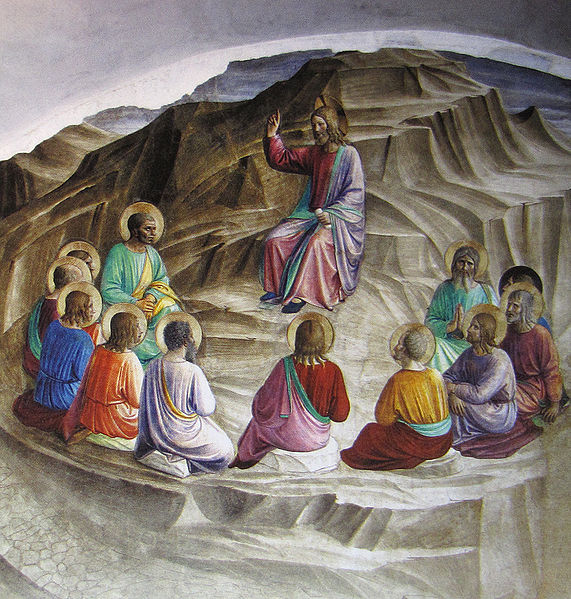
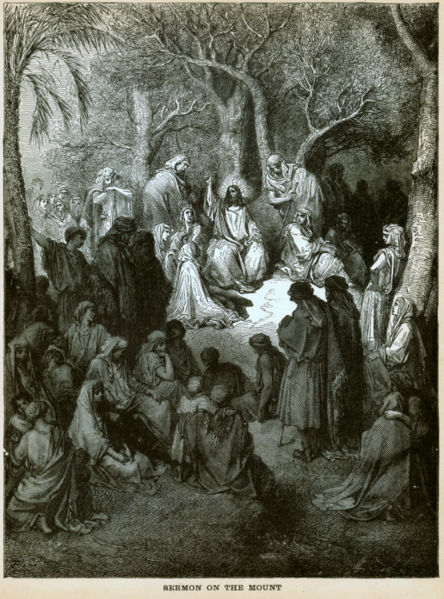
Sermon on the Mount by Carl Bloch (1877)

Matthew 5: 13-20

Parallel Mark 9:49-50 and 4:21, Luke 14: 35-35, 8: 16, 11:33 and 16: 16-17

Highlighted words will have comment on translation below

 13 “You are the salt of the earth; but if salt has lost its taste, how can its saltiness be restored? It is no longer good for anything, but is thrown out and trampled under foot.

14 “You are the light of the world. A city built on a hill cannot be hid. 15 No one after lighting a lamp puts it under the bushel basket, but on the lampstand, and it gives light to all in the house. 16 In the same way, let your light shine before others, so that they may see your good works and give glory to your Father in heaven.

17 “Do not think that I have come to abolish the law or the prophets; I have come not to abolish but to fulfill. 18 For truly I tell you, until heaven and earth pass away, not one letter, not one stroke of a letter, will pass from the law until all is accomplished. 19 Therefore, whoever breaks one of the least of these commandments, and teaches others to do the same, will be called least in the kingdom of heaven; but whoever does them and teaches them will be called great in the kingdom of heaven. 20 For I tell you, unless your righteousness exceeds that of the scribes and Pharisees, you will never enter the kingdom of heaven.

Both Mark and Luke have individual sayings from this portion of the Sermon on the Mount scattered throughout their gospels, but Matthew places them in a crucial place immediately after the opening of the Sermon to help frame the identity the community is to adopt and to connect it with the scripture. As mentioned earlier, Jesus probably used these sayings multiple times, but Matthew has given us a tightly woven net composed of these saying to capture men and women who are being called into the community of disciples. They have been called to choose the wisdom of the Sermon, to embrace the blessedness or happiness of the kingdom of heaven and now they are called to their vocation and connected with the gift and vocation of Israel.

Salt in the modern world is a seasoning, salt in the ancient world was a preservative and that is a critical distinction. Salt is not what keeps the world tasting better, followers of Christ were not called to be the spice of life for the world. Instead salt in a world before refrigeration was that which preserves the earth. They are not called to become salt, they already are. The throughout this section is plural so ‘all of you’ are the salt of the earth and the light to the world. Even though salt is primarily for preservation it does have a distinctive taste, it does make itself tasted with the rest of the meal that is to be consumed. The disciples and hearers are not given a choice of whether they will accept the vocation of being salt, but they can choose the foolish path of not living as salt. The word translated ‘lost its taste’ is the Greek world moraino which literally means to become foolish. This is the verbal form of the word we get the English moron from. As I mentioned in the previous discussion of the Beatitudes an underappreciated linkage of the Sermon on the Mount is to wisdom literature with its choices between the wise and foolish, righteous or wicked and here salt of the earth and foolish salt. There is a vocation in the kingdom of heaven for the sake of the world for the hearers of Jesus’ words who live according to them, but for those who take the path of becoming foolish there is no longer a use for them, they are not called to be salt for their own sake but for the sake of the earth. They, like Israel before them, were given their vocation to be a blessing to all the nations of the earth and if they choose to live in a way that is not distinctive from the earth that they serve then they are no longer good for anything.

Light is another frequent image in scripture for the vocation of the people of God. For example:

I am the LORD, I have called you in righteousness, I have taken you by the hand and kept you; I have given you as a covenant to the people, a light to the nations, to open the eyes of the blind, to bring out from the prison those who sit in darkness. (Isaiah 42: 6-7 emphasis mine)

he says, “It is too light a thing that you should be my servant to raise up the tribes of Jacob and to restore the survivors of Israel; I will give you as a light to the nations, that my salvation may reach to the ends of the earth. (Isaiah 49:6, emphasis mine)

We have already had Jesus identified as a great light (Matthew 4: 16 quoting Isaiah 9:2) and here the vocation of light is granted to those gathered around Jesus and hearing these words. In combination with the image of light is the image of the city on a hill which is meant to be visible. This also taps into Isaiah’s imagery of Jerusalem being a place where the nations are drawn to:

In the days to come the mountain of the LORD’s house shall be established as the highest of the mountains, and shall be raised above the hills; all the nations shall stream to it. May people will come and say, “Come, let us go to the mountain of the LORD, to the house of the God of Jacob; that he may teach us his ways and that we may walk in his paths.” For out of Zion shall go forth instruction, and the word of the LORD from Jerusalem. (Isaiah 2:2-3)

But now the mountain is not the temple mount in Jerusalem but the mountain of the Sermon on the Mount near Capernaum. The transition back to the choice of wisdom literature between wise and foolish is presented. The people do not have the choice to be light, but one can make the foolish choice to put a light under a bushel basket instead of on a light stand. As Dietrich Bonhoeffer would remind his students, “The followers are the visible community of faith: their discipleship is a visible act which separates them from the world—or it is not discipleship.” (DBWE 4:113) The community of disciples is to be light in the midst of the darkness, they are the light of the world and the city on the hill, they are visible to the world around them and their good works give glory to the God they serve.

One of the struggles that many Christians, myself included, wrestle with is the visible nature of their faith in a secular world. For people in the United States, faith has mainly been consigned to the private or spiritual realm, but it was never intended to be so. I know this is one of the things I struggle with as a private person and even as a pastor. As a pastor people do tend to watch my actions and words much closer than the average person of faith and I’m OK with that, but a salty, city on the hill, light of the world faith is much more visible than what I or my congregation often live. That type of faith will meet resistance and even persecution, and I’ve met that type of resistance in congregations I’ve served and from those in the community who disagreed with the hermeneutic of mercy that shapes my understanding of how we are to live our calling. I do struggle with the vanilla nature of the church as it actually exists, and while I’m not willing to embrace the model of some churches which pull away from society it is a challenge to continue to be salt and light in the midst of the world without being shuttered or made foolish. The Sermon on the Mount does not grant us a complete ethical system which can help us answer every question but it does, like all good wisdom literature and attempts to interpret scripture, point us toward the path of wisdom and help us begin to imagine what a life informed by the kingdom of heaven might look like.

The vocation of the hearers of the Sermon on the Mount relates to the vocation of the people of Israel. In being connected with the vocation of Israel the hearers are also connected with the scriptures of Israel. For Matthew it is critical for the reader to see the connection between Jesus and the scriptures, that is one of the reasons he continually alludes and quotes the scriptures to help us understand who Jesus is and what the vocation he calls us into looks like in the world. As we prepare to hear Jesus show us how to hear the scripture, we are not called to forget what came before but instead to hear and learn from it, to preserve and honor it, and to live lives that show forth a righteousness that is different from the scribes and Pharisees. Again we are framed with the question of wisdom literature in terms of the ones who breaks the commandments and teaches others (by words or actions) to do the same is the least while the one who keeps the commandments and teaches other to keep them is the greatest in the kingdom of heaven. This keeping of scripture will be a visible witness which brings glory to God but may also bring persecution to the one living this public faith.

Before we move into hearing Jesus interpreting scripture a brief pause to frame the way Jesus will read scripture. This is often heard as legalistic or pointing towards a type of moralistic perfection and the interpretation below will run counter to this path. A helpful question when approaching either the law in the Hebrew Scriptures or Jesus’ interpretation of it in the Sermon on the Mount is: What type of community/society are they trying to create/imagine? That doesn’t mean that what lies ahead is easy to live into, I struggle with it, but it does give us a different horizon to hear the law within. The law is about a society where my neighbor’s best life is possible. One of the key differences between the scribes and the Pharisees as they are represented in Matthew’s gospel and Jesus is mercy being a central part to understanding what righteousness is about. As we now enter Jesus’ interpretation of the law and prophets which are connected to our vocation may we apply that merciful and, dare I say, gracious hermeneutic to our neighbors and to ourselves.


Matthew 5: 1-12 The Wisdom of the Sermon on the Mount

Mount of Beatitudes, seen from Capernaum. Photo by Berthold Werner, public domain

Matthew 5: 1-12

Parallel Luke 6: 20-26

Highlighted words will have comment on translation below

1 When Jesus saw the crowds, he went up the mountain; and after he sat down, his disciples came to him. 2 Then he began to speak, and taught them, saying:

3Blessed are the poor in spirit, for theirs is the kingdom of heaven.
4Blessed are those who mourn, for they will be comforted.
5Blessed are the meek, for they will inherit the earth.
6Blessed are those who hunger and thirst for righteousness, for they will be filled.
7Blessed are the merciful, for they will receive mercy.
8Blessed are the pure in heart, for they will see God.
9Blessed are the peacemakers, for they will be called children of God.
10Blessed are those who are persecuted for righteousness’ sake, for theirs is the kingdom of heaven.
11Blessed are you when people revile you and persecute you and utter all kinds of evil against you falsely on my account. 12 Rejoice and be glad, for your reward is great in heaven, for in the same way they persecuted the prophets who were before you.

The Sermon on the Mount is designed to be heard as one unit, even though we often break it up into individual readings and for the sake of space I will be dealing with smaller sections (even as I try to address it as an intentionally assembled and compact unit of teaching). Matthew constructs the Sermon on the Mount and places it early in the gospel to help the hearers in his time and later times understand what life in the community of disciples can be like, to open their ears, eyes, hearts, minds and imaginations to the kingdom of heaven. We probably do not have a transcript of Jesus’ teaching on at one specific time and place, but I do assume that the teachings collected in the sermon were among the memorable things that Jesus said and were probably used in multiple teaching opportunities. Several similar teachings are placed in different locations in Luke’s gospel, but the gospel writers were concerned with constructing their gospels to highlight what they felt was critical for their churches to understand about Jesus and the kingdom of heaven.

Location matters in the gospels, and Jesus going up the mountain is not only an action that allows him to be seen and heard by the crowds but it also (especially considering the content of the sermon) links him symbolically with Moses. Moses would go up the mountain to receive the law from God, now Jesus goes up the mountain to fulfill the law and the prophets. Jesus here and at the mountain of transfiguration will be linked to Moses (and Elijah and the rest of the prophets) and will also surpass them. But location helps to emphasize that Jesus is one speaking with the authority to declare the things he states. This will be especially important later in the chapter as he expands on the law.

The Beatitudes, the common name for Matthew 5: 3-12, get their name from the word in Latin that we translate as ‘blessed.’ This is another place where translation can obscure a linkage that may have been obvious to the initial hearers of the message. The Greek makarios is often used to translate the Hebrew asre which is often used in wisdom literature. I do think that we are invited into the framework of wisdom literature with its choice between the way of the wise and the foolish, those who follow the law and those who do not and this linkage is heightened in Luke’s similar blessings and woes in Luke 6: 20-26.  Asre is normally translated happy in the NRSV, for example:

Happy are those who do not follow the advice of the wicked, or take the path that the sinners tread, or sit in the seat of scoffers. (Psalm 1:1)

Happy are those to whom the LORD imputes no iniquity, and in whose spirit there is no deceit. (Psalm 32:2)

Happy are those who live in your house, ever singing your praise. Selah

Happy are those whose strength is in you, in whose heart are the highways to Zion. (Psalm 84: 4-5)

Happy are those whose way is blameless, who walk in the way of the LORD. Happy are those who keep his decrees, who seek him with their whole heart, (Psalm 119: 1-2)

Happy are those who find wisdom, and those who get understanding, (Proverbs 3: 13)

Happy is the one who listens to me, watching daily at my gates, waiting beside my doors. (Proverbs 8: 34)

Several other sayings in both Psalms, Proverbs, the prophets and the law take this form encouraging the people to choose the way that is being stated. Although the translation of makarios into blessed brings its own set of meaning to the passage I am going to begin to highlight terms that I would retranslate to bring in a different shade of meaning. For most people ‘blessed’ may have the sense of happiness with it but when they read religious language they simply take it as declarative language where God declares something ‘blessed’ and it is made holy but it doesn’t necessarily change anything for the ‘blessed one.’ While I agree with those who would highlight the aspect of inclusion for those excluded here in this passage (poor in spirit, mourners, meek, and those hungering and thirsting for righteousness) I also think it is important that we hear, in terms of wisdom literature and the language of the beatitudes, that in this kingdom of heaven those who have been unhappy, oppressed and excluded are invited to a community where they will be happy and the things they need to be happy will be given to them.

The gospel writers were each clever in the way they construct their gospels to link critical stories together and Matthew links this initial teaching section with his final section of teaching in Matthew 25, as Richard B. Hays can highlight:

Matthew creates an inclusio with the Beatitudes of Matthew 5: 3-12 by narrating an unsettling last judgment scene in which Jesus/Emmanuel turns out to have been present among us in the hungry and thirsty and naked and sick and imprisoned of this world. (Matt 25: 31-46). This, too, is an integral part of what “God with us” means in Matthew, as exemplified in the story of Jesus’ own suffering, culminating in the cross. To recognize God’s presence truly, then, Matthew’s readers must serve the needs of the poor, for “just as you did it to one of the least of these brothers, you did it to me:” (25:40) (Hays, 2016, p. 170)

Unlike Luke where the blessings and woes are placed next to one another, in Matthew the inclusion allows us to see the invitation at the beginning of Jesus’ teaching and the consequence for not following this wisdom at the end.

Moving into the Beatitudes themselves I will divide them into two sets of four and then a final saying set off by a change in reference (from blessed are the ones/those to blessed are you). The first set of four are those who God is depicted in scripture frequently being their advocate against those in power. The second set addresses those who are attempting to live in the way that they are called to live, and the final phrase addresses those who are persecuted specifically for living on account of Jesus for their rejection among the unwise will mean reward in the kingdom of heaven.

The ideas that will be articulated in the Beatitudes and the rest of the Sermon on the Mount are grounded in the vision of what Israel was to be for the sake of the world. Israel was always intended to be an alternative vision of society to the model used by Egypt, Assyria, Babylon, Greece, Rome or any other empire or nation ancient or modern. It was to be a society where they loved and feared the LORD their God and they loved and protected their neighbor. Much of the law is imagining a society where not only are the landholding members of the people of Israel protected but also the alien, the poor, the widow and the orphan. Israel often failed to embody this type of society, often emulating the practices of the larger nations around them with the powerful enlarging their own property, power, wealth and households by exploiting or failing to protect their vulnerable neighbors. The society gathered around Jesus are invited again into a kingdom where the poor in spirit, the mourning, the meek and those hungering and thirsting for righteousness are protected both by the community and by God.

The poor in spirit, in contrast to the poor in Luke 6:20, has caused a lot of debate about what Matthew means. My reading of this passage is the ‘poor in spirit’ and the ‘poor’ are referring to the same group, it is not a spiritualization of poverty but instead refers to those who have been oppressed and are holding on to their last thread of hope, against all evidence to the contrary, that God will deliver them. The longstanding wisdom of the Hebrew scriptures is that God is the one who will side with the poor against their oppressors and in the words of Proverbs, “Those who oppress the poor insult their Maker, but those who are kind to the needy honor him.” (Proverbs 14:31) The kingdom of the world may have no place for the poor, but the kingdom of heaven will belong to them. They can be happy because in the society that Jesus is presenting to the disciples and hearers they are included, valued and protected. They can be blessed because they have what they need to have the life God desires for them, and, as we will learn in Matthew 25, Jesus will be found among them.

The mourners are those who weep at the state of the world. The mourning may be personal, due to the loss of a loved one, or it may be social due to the loss of property, occupation, meaning or place in society. In contrast to the Greco-Roman worldview which disapproved of mourning (Carter, 2005, p. 132) and the stoic worldview many in the United States inherited, there was an expectation of mourning and a rich tradition of lament included in the Hebrew Scriptures, especially in the Psalms. Yet, there is also a confident hope in a God who could and would reverse the situations in the world that caused the faithful to mourn and lament. Isaiah 25:7-8 is one of the articulations of hope in a God who can destroy every enemy that haunts them and then comfort them in what should be familiar language for most Christians

And he will destroy on this mountain the shroud that is cast over all peoples, the sheet that is spread over all nations; he will swallow up death forever. Then the LORD God will wipe away the tears from all faces, and the disgrace of his people he will take away from all the earth, the LORD has spoken. (emphasis mine)

 Meekness in English means quiet, gentle, submissive or easily imposed upon which is similar in meaning to praus the Greek word behind it, but this word in Biblical usage is not so simple to translate. This word refers to Jesus twice in Matthew:

Take my yoke upon you, and learn from me; for I am gentle and humble in heart, and you will find rest for your souls. (Matthew 11: 29)

Tell the daughter of Zion, Look, your king is coming to you, humble and mounted on a donkey, and on a colt, the foal of a donkey. (Matthew 21:5)

The highlighted terms are both the Greek praus translated as gentle or humble. I think meek captures a shade of what Jesus is alluding to here, for they are those who rather than rising up in violent reaction to the oppression they may encounter are those who wait for God to deal with the wicked. As Psalm 37 can state:

Yet a little while, and the wicked will be no more; though you look diligently for their place, they will not be there. But the meek shall inherit the land, and delight themselves in abundant property. (Psalm 37: 10-11)

The final Beatitude of the first section is those who hunger and thirst for righteousness who will be filled. As with the previous three I read this as those who have suffered under the oppression of the current state of society and need God’s liberation, they are those who seek righteousness in society and before God but are hungry and thirsty in the midst of their attempt to live a righteous rather than a wicked life. When they strive first the kingdom of heaven, they are promised that all the things they need for food, clothing and life will be granted to them as well (Matthew 6: 25-34).

With the second set of Beatitudes are exhortations which point to the way of life that will be further described in the Sermon on the Mount and throughout Jesus’ life and ministry. Throughout Matthew’s gospel the understanding of what righteousness looks like is always read through the lens of mercy. From Joseph being a righteous man and deciding to act with mercy towards Mary (Matthew 1:19), to Jesus frequent transgressions of a literal reading of the law to act in mercy we are shown a hermeneutic[1] of mercy throughout this gospel. The merciful will receive mercy, and this is a way of reading the law that will contrast with the readings of the Pharisees and Sadducees Jesus encounters in Matthew. For example, in Matthew 9: 9-13, Jesus will tell the Pharisees criticizing his practice of eating with sinners and tax collectors, “Those who are well have no need of a physician, but those who are sick. Go and learn what this means, ’I desire mercy, not sacrifice.’ For I have come to call not the righteous but sinners.” (Matthew 9:11) Jesus’ words and actions will embody this hermeneutic of mercy and Hosea 6:6 (quoted in Matthew 9:11) seems to be a key text that Jesus and his followers are to use to unlock what scripture is to mean for their lives. As Richard B. Hays can state,

Clearly, for Matthew, mercy is a central theme. The important thing to recognize, in all these passages, is that the quality of mercy is not set in opposition to the Torah; rather, Matthew’s Jesus discerns within Scripture itself the hermeneutical principle—expressed epigrammatically in Hosea 6:6—that all the commandments are to be interpreted in such a way as to engender and promote the practice of mercy among God’s people. (Hays, 2016, p. 127)

The pure in heart are those who live in faithfulness to the vision of the kingdom of heaven articulated here and throughout Jesus’ ministry. As Psalm 24 can remind us:

Who shall ascend the hill of the LORD? And who shall stand in his holy place? Those who have clean hands and pure hearts, who do not lift up their souls to what is false, and do not swear deceitfully. (Psalm 24: 3-4)

Those of pure hearts and clean hands may approach the place of God in the psalm, and here the pure in heart are prepared to see God. The preparation for God’s approach is not ritual action or sacrifice but a life properly lived. The heart in Hebrew thought is not the instrument of emotion (that would be the gut) but rather the instrument of will and decision. Those who are pure in their will and decision, who live according to the way of righteousness rather than foolishness will see God. Seeing God may be impossible for mortals in several places in the scriptures, but one of the themes of Matthew’s gospel is that in Jesus we encounter ‘God with us.’ Yet, as discussed above this is also the “God with us” who is found with the hungry, thirsty, naked and poor. Those who are not pure in heart may be those who missed the appearance of God because they did not choose a way of righteousness and mercy which sees the need of the community around them, but in the kingdom of heaven the poor in spirit, mourning, meek and the ones hungering and thirsting for righteousness have already been granted a place with God.

Peacemaking in the kingdom of heaven is meant to be understood in contrast to the image of peace practiced by Rome which was peace through conquest and military might. When I served in Nebraska, near the former headquarters for Strategic Air Command, I would sometimes see stickers on vehicles with a B-52 Stratocaster bomber replacing the arms of a peace sign with a caption, “Peace the old-fashioned way.” This would fit with the Roman understanding of the Pax Romana which, in the language of the ancient historian Tacitus, “pacem sine dubio…verum cruentam. Peace there was, without question, but a bloody one” (Zanker, 1988, p. 187) The peace of the kingdom of heaven will only be a bloody one because the one who embraces it may be crucified by the emissaries of the kingdoms of the world, not because they respond in violence. The kingdom of heaven will be a place where reconciliation is more important than sacrifice, where enemies are loved, and where cheeks are turned in response to being struck. Those who practice this type of community will be welcomed into a familial relationship with the daughters and sons of God.

Those who are persecuted for righteousness sake as those who are persecuted for living a life that is shaped by this merciful, pure in heart and peaceful version of righteousness that Jesus will articulate. Structurally we are also linked back to the first Beatitude since both the poor in spirit and those persecuted for righteousness are inheritors of the kingdom of heaven. Ultimately this righteousness that one will be persecuted for involves standing with the poor in spirit, the mourning ones, the meek and the ones hungering and thirsting for righteousness. Disciples will be continually called to take up their cross. It will be a struggle for the kingdom of heaven to enter this world. Rather than responding to violence with violence they will respond with endurance instead.

The final Beatitude switches suddenly to a second person plural (all of you) where those who are gathered around Jesus now are addressed as ones who may be happy in the midst of being persecuted verbally or physically since it bears witness to their faithfulness to this kingdom. Their reward is great in this community because they are like one of the prophets who remained faithful to God in the midst of a faithless time. They are a part of a community, like the prophets, who believed that in a time of injustice the God’s justice would triumph, in a world of bloody peace believed that God’s true peace would come, who believe in mercy more than sacrifice and in a God who stand with the poor in spirit, the mourning ones, the meek and the one hungering and thirsting for a righteousness they’ve yet to see. Yet, they can be happy or blessed because the kingdom of heaven is being embodied in their hearing.          

[1] A hermeneutic is a way of interpretation, a word that is frequent in the world of scholarship but rarely heard outside the worlds of philosophy, scriptural interpretation and theology but I include it because it is a useful word in framing how to read a text.

Introduction to the Sermon on the Mount

Mosaic on the Mount of Beatitudes in Israel (Images are St. Ambrose,, Moses and the Stoning of Stephen) Shared under Creative Commons 2.5

The Sermon on the Mount (Matthew 5-7) is probably the best know piece that is unique to Matthew’s gospel (as it is assembled, although much of the material in the Sermon is found throughout Luke’s gospel) and there are scholars who have spent their entire careers focused on this small section of Matthew’s gospel. You don’t have to be a scholar to read the Sermon on the Mount and see that it calls the hearer to a different set of values than one will see practiced in the world around them. As a hearer you have the choice of how to respond to this expansion on the law given to Moses, the practices of prayer, fasting, how one values one’s treasurers and what one does with them, judging and more in this initial teaching section of Matthew’s gospel. Matthew constructed the gospel to quickly bring us to this first block of teaching and instruction and Matthew spends a lot of space in the gospel listening to the teaching of Jesus and letting it shape the community that hears it.

The words of the Sermon on the Mount have often been viewed as: an unattainable ethic which serves only to drive us to the grace of Christ, an interim ethic to bring about a radical reorientation in the context of Jesus’ presence and the quickly approaching judgment (which didn’t occur as expected in most reconstructions following this view) or a perfectionist ethic that Christ does expect Christians to follow. Each of these approaches in their own way minimize the imperative to attempt to live into the vision the sermon presents.  Prior to Luther the way of life embodied in the Sermon on the Mount was mainly limited to those who had separated themselves in monastic communities but one of the impacts of the Reformation was the ideal of bringing the reading, interpretation and the living of scripture as actions of the entire church was the perceived impossibility of all the baptized keeping this ethic. The solution for Luther, as one example, was perfect doctrine rather than perfect practice:

We cannot be or become perfect in the sense that we do not have any sin, the way they dream about perfection. Here and everywhere in Scripture “to be perfect,” means in the first place, that doctrine be completely correct and perfect, and then, that life move and be regulated according to it. (LW 21:129)

In fairness to Martin Luther, he did believe that correct doctrine would lead to a reformed way of living, that faith would lead a Christian to be a perfectly dutiful servant of all. Yet the perfectionistic way in which we frame the Sermon on the Mount I believe prevents us from honestly wrestling with the way of life that Matthew is presenting to those who would be disciples of Jesus.

Although I will deal with the translation of Matthew 5:48 when I reach that section, I do believe it is important enough to deal with up front because it is a crucial verse. The NRSV translates this final verse of the fifth chapter, “Be perfect, therefore, as your heavenly Father is perfect.” Many scholars follow the translation in a manner like O. Wesley Allen,

Likewise, there are idealistic expectations in the discourse that seem beyond the reach of any normal, finite, sinful human being or human community summed up in the expression, “Be perfect, therefore, as you heavenly Father is perfect. (Allen, 2013, p. 53)

The word translated as perfect is telios which is a word with the connotation of completeness, or reaching an end/goal, of being mature or grown up. As a person who grew up in the individualistic ethos that is instilled in people who grow up in the United States, perfection is a term which depends upon individual rigor in attending to the letter of the law but one of the things I’ve discovered in my time studying the Hebrew Scriptures is that the law is always directed towards the community. An individual may act righteously or wickedly, they may be innocent or blameless but the law itself is always directed towards the life of the community. When I studied Deuteronomy, for example, I framed my examination of the law in terms of the type of society they were attempting to create. If the Sermon on the Mount is about the type of community that the kingdom of heaven embodies, as I will argue, then perhaps it is a primer in how to live together as the people of God rather than a model for individual perfection.

Jesus doesn’t seem to focus his ministry on attaining moralistic perfection, but instead the kingdom of heaven seems to be much more related toward surprising compassion towards the people Jesus encounters. As E. P. Sanders can state:

Secondly, the overall tenor of Jesus’ teaching is compassion toward human frailty. He seems not to have gone around condemning people for their minor lapses. He worked not among the powerful, but among the lowly, and he did not want to be a stern taskmaster or a censorious judge, who would only add to their burdens…

Thirdly, Jesus did not live a stern and strict life. For most of us the word ‘perfectionism’ calls up images of severe Puritanism: lots of rules, plenty of punishment for error and not much room for fun. This sort of Puritanism, according to Jesus, was all right; an austere life had been fine for John the Baptist, but it was not his own style. (Sanders, 1993, pp. 202-203)

Finally, the way perfection is modeled in the United States does pull on our history of severe Puritanism, even as it has transformed in our secular society under the guise of a non-religious perfectionism.  So for the moment let us set aside our ideas of being perfect or achieving perfection in an individualistic sense and let us enter this world that Jesus is articulating for us in the Sermon on the Mount. Matthew has brought us quickly to the mountain to hear these words from Jesus, so may we have ears to hear, eyes to see, minds whose imagination can dream this dream of the kingdom of heaven, and hearts to courageously strive together for this community of disciples.


Perfection and Blamelessness in the Bible

In looking at how to approach the Sermon on the Mount, I’ve wrestled with how to translate the word translated perfect in Matthew 5:48 and while my suspicion is that perfect is not a good translation for the Greek work telos, I wanted to look more broadly at how the scriptures dealt with the idea of being perfect, perfection or blameless.

Perfect, Perfection and Blamelessness in the Hebrew Scriptures

There are two primary words in Hebrew that end up translated perfect, perfection and blameless and they are related two each other. Hebrew words begin as a verbal form and so the verb root is :תָּם
(Tam) which in its Qal form means to complete, finish, fulfill, to be finished, come to an end and in its Hitp’ael form means finish, complete, perfect, cease doing a thing, complete or shut up.[1]This verb also has a noun form (Tim) and the more common for our current examination adjectival form Tamim. There are a few other Hebrew terms which get translated perfect or blameless (for example Daniel 6:22 translates a term that normally is translated purity (zaku) for blameless and Lamentations and Ezekiel use the word kelil for a poetic reflection of perfection in terms of beauty).

In the Hebrew Scriptures these translations rarely talk about moralistic perfection which is often implied to an English reader of the words perfect, perfection, and blameless and below I am listing my categories of what these translations are referring to:

Innocence/Righteousness

Righteousness/Justice is an important concept in Hebrew thought, but I think it is easy for us to assign a modern interpretation on Justice or the Law which doesn’t coincide with a Hebrew way of understanding the gift implied in these terms. Often when Tam or Tamim is translated blameless it is referring to the concept of a person being innocent or righteous. In both Hebrew and Greek justice and righteousness are rooted in the same term (tszadik in Hebrew, dikaisoune in Greek) and while there is a sense where righteousness is linked to keeping the commands and ordinances of the law, it more broadly encompasses living in a right relationship with God and one’s neighbors. Tamim or Tam can be translated in parallel with righteousness, for example in Genesis 6:9 Tamim is translated blameless in parallel with righteousness and refers to Noah being innocent unlike his generation: “Noah was a righteous man, blameless in his generation” (see also Genesis 17:1 in relation to God calling Abram to be innocent (blameless)). This is also the primary way the book of Job uses the Tam and Tamim family of words, for example: There is no one like him, a blameless and upright man (Job 2:3, see also Job 1:1, 8; 8:20; 9:20, 21,22; 12:4; 22:4). Being blameless is parallel to being upright or righteous but it is not used in the sense of legalistically keeping every possible interpretation of the law, instead it is often used more generally to speak of a person’s character being in accordance with God’s intent for life in the community of faith.

Sacrificial Acceptability or Completion in Dedication to God

Another usage of Tamim or Tam when translated perfect is related to a cultic usage where a sacrifice or item is acceptable for use in sacrifice or the worship of God. Leviticus 22:21 is an example of this usage for a sacrifice, “When anyone offers a sacrifice of well-being to the LORD, in fulfillment of a vow or as a freewill offering, from the herd or from the flock, to be acceptable it must be perfect; there shall be no blemish in it.” This also is used when the temple is dedicated in 1 Kings to talk about the completion of the space in preparation for worship, “Next he overlaid the whole house with gold, in order that the whole house might be perfect; even the whole altar that belonged to the inner sanctuary he overlaid with gold”(1 Kings 6:22). Tamim and Tamm are used to reflect completeness or wholeness, which is the sense of perfect reflected by the translation. A sacrifice must be without injury, illness or blemish or the sanctuary was completely overlaid with gold without missing any area.

Completeness/Righteousness in relation to God

This use of Tamim (always the adjective in this usage) occurs in songs and poetry when talking about God as being complete or whole in relation to God being upright. Deuteronomy 32:4 is the first usage of this type in the song of Moses, “This God—his way is perfect; the promise of the LORD proves true; he is a shield for all who take refuge in him” (also used in this manner in David’s song of Thanksgiving in 2 Samuel 22: 31 and in Psalm 18:30)

Completeness in relation to knowledge or content

In the book of Job, the final human voice to speak prior to God’s answer is Elihu who attempts, like the other friends of Job, to convince Job that he must be unrighteous to merit the suffering he is undergoing. In his boasts he claims to have perfect knowledge (or to be in the presence of God who has perfect knowledge) in the sense of knowing everything correctly or completely. (Job 36:4, 37:16)  Psalm 19:7 can also refer to the law as being complete in a similar (but non-ironic) manner, “The law of the LORD is perfect, reviving the soul; the decrees of the LORD are sure, making wise the simple

Poetic Use in Relation to Beauty or Splendor

Perfect or perfection is often used in compliments to poetically state that a person, city or event was attractive, beautiful or wonderful. This is one of the most common usages of Tamim and Tam in Psalms, Song of Solomon, Lamentations, and Ezekiel (which also uses the Hebrew word kelil) and can be used for a woman, a king, the law or even a city like Jerusalem or Tyre. For example, Song of Solomon can refer to a woman, “Open to me, my sister, my love, my dove, my perfect one; for my head is wet with dew, my locks with the drops of night” (Song of Solomon 5:2, see also 6:9). The king of Tyre is described as a signet of perfection and perfect in beauty (Ezekiel 28:12), the law is perfect in terms of admiration(Psalm 119:96) as are Jerusalem (Psalm 50:2, Lamentations 2:15, Ezekiel 16:14) and Tyre (Ezekiel 27: 3-4, 11).

Translated Perfect or Blameless in the New Testament (other than Telos/Teleo)

There are a couple words that get translated perfect or blameless in the New Testament: amemptos is commonly used in Pauline literature and is translated blameless and echoes the sense of innocence/righteousness discussed above for Tam and Tamim in Hebrew.[2] Other terms that get translated as either perfect or blameless (other than telios which will be the focus of the next section) include: amomos (unblemished in terms of sacrifice, blameless in moral terms, Revelation 14: 5), anegkletos (blameless, irreproachable, 1 Timothy 3:10, Titus 1: 6, 7) akakos (innocent, guileless, Hebrews 7:26) holoklepia (wholeness, completeness, soundness-wholeness of health, Acts 3: 16); kataptisis (being made complete, complete, 2 Corinthians 13:9); pas (all, full, great) and plerow (make full, fill, fulfill, bring to completion, Revelation 3:2). Each of these translations capture one of the senses listed for tam and tamim above but since the focus of this is on the translation of the term telos in Matthew’s gospel, we will now turn our attention to this word.

Translating Telos/Teleo in Matthew and the New Testament.

Teleo (verb) and telos (noun) and their derivatives, especially the adjectival form, in Greek are the most common terms translated perfect by the NRSV. The book of Hebrews frequently uses this term in the sense of completeness or sacrificial acceptability. James and 1 John use the term in the sense of highest in terms of comparison (perfect love, perfect law, perfect gift, etc.).[3]Paul uses telos and teleo derivatives three times to indicate completeness which get translated perfect in the NRSV (Romans 12: 2; 2 Corinthians 7:1; 12:9)[4]

Teleios, the adjectival derivative of telos, occurs three times in the gospels, all in the Gospel of Matthew: Matthew 5:48 (twice) and Matthew 19:21 and the NRSV translates each time as perfect:

Matthew 5: 48 Be perfect, therefore, as your heavenly Father is perfect

Matthew 19: 21 Jesus said to him, “If you wish to be perfect, go, sell your possessions, and give the money to the poor, and you will have treasure in heaven; then come, follow me.

The telos family of words are words of ending, completion and reaching a goal, they don’t carry the connotation of moralistic perfection that placing the word perfect in English does. Apparently, this translation goes back to the Latin Vulgate which translates teleios with the latin perfecti and perfectus and translations tend to value consistency with previous translations when possible. However, the lingering impact of perfect on the history of translation of this passage has caused people to hear the Sermon on the Mount as an unattainable pillar of perfection that is unable for human beings to attain. I would argue for a more literal translation in both Matthew 5:48 and 19:21 of complete instead of perfect for reasons I will argue in the introduction to the Sermon on the Mount and in the comments on Matthew 5: 48.


[1] Hebrew verbs have various forms (Qal, Nif’al, Pi’el, Pu’al, Hitpa’el, Hif’il and Hof’al) the Qal is the simple active form where the Hitpa’el is the reflexive form. The form of the verb can significantly change a meaning, but in the case of Tam they are very similar with minor shades of difference.

[2] Philippians 1:10; 2: 15; 3:6; Colossians 1: 22; 1 Thessalonians 2: 10; 3: 13; 5: 23

[3] Hebrews 2:10; 5:9; 7:19; 9:9, 11; 10:1; 11:40; 12:23; James 1:17, 25; 3:2; 1 John 4:8

[4] I 1 Corinthians 1:8 the NRSV translates telos in its normal meaning as end

The Impact of the Internet and Engaging it Faithfully

Session 4: The Impact of the Internet and Engaging it Faithfully

This is the third part of a now eight-part series on faith in a digital age. It expanded due to the richness of the discussion on the internet and the amount of material I couldn’t cover in this first week. The outline of the series is:

Week one: Advertising in a Digital Age
Week two: Email, Multi-tasking and the blurring of the work/home divide
Week three: The Internet the Backbone of the Digital Age
Week four: The Impact of the Internet and Engaging it faithfully
Week five: Cell phones and a continually connected life
Week six: Social media and the projecting and mining of the digital self

Week seven: Dating and relationships in a digital age
Week eight: The dangers of a digital age

This is a series of classes I’ve been teaching with my congregation that I’ve been attempting to capture digitally so that they could be used by other communities or small groups or for members who are unable to be present in class.

In the previous session we talked about how the internet is the infrastructure or the backbone that makes the digital age possible. We will be focusing in this session on how our interactions with the internet shape our minds and our actions and how we as people of faith can responsibly use this technology to live the lives that we want to live.

The first impact we’ll discuss briefly is what I’ve called the ‘Google effect’ but it has the official title of Cognitive Offloading. This deals with the impact of having information easily available on how our mind stores information. I’m in my mid 40s and if you are my age or older you probably remember having a lot of telephone numbers memorized and this memorization was drilled into your memory by having to manually dial or push buttons to dial the phone number of the person you wanted to talk with. Today the number of phone numbers I have in my memory has decreased dramatically-I can still remember my phone number growing up, but I can’t remember my mom’s current phone number since it is stored in my phone. My memory has used the contacts in my phone as a quickly available alternative to dedicating connections to remembering her new phone number. This appears in several ways: you hear a weather forecast and forget what the weather will be, but you can look it up online or on your phone, you look at your watch and then forget immediately what time it is. Our minds our exposed to a lot of data on a regular day and our memory makes choices about what to store in long term memory and what to purge from our memory and so things that were once remembered from constant use or from limited availability are no longer stored. Perhaps when you were growing up you remember having to learn multiplication tables or the square roots of certain numbers by memorization and were told the reason you had to do this was because you wouldn’t always have a calculator with you. If you carry a smart phone you now do carry a calculator with you all the time, but it doesn’t mean the exercises of committing this type of repetitive information to our brains was not a worthwhile exercise. Cognitive offload works like the pensieve that Professor Dumbledore uses in the Harry Potter novels to store his thoughts: we transfer the responsibility for remembering the information from our memories to some other device so that we can use that device to revisit the information later. The reality is that I use this blog that your reading from in a similar way to store work that I’ve done and processed through for easy access later, I remember much of what I write but it also allows me in a positive way to store more information than my memory may retain.

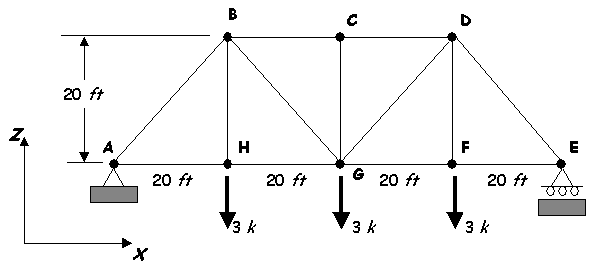
Connected to this is the way that the ease of information can shortcut the learning process. If you were to wonder, for example, what is the second largest snake in the past you would’ve gone probably to a library book on snakes or and encyclopedia and look through the various species to figure out what this answer was but today you would only have to enter in Google or another search engine, “What is the second largest snake” and you’d have easy access to a list of the largest snakes. But if you do this search, you’ll soon find out that the lists don’t agree: it depends on what you mean by the largest. You can refine your search based on what is the longest or the heaviest snake, but not only have you missed the process of learning more about the snake world as you searched (assuming of course that you are interested in snakes to begin with) but you also don’t necessarily have the background information to interpret the answer you’ve been given. When my son was in high school, he was a part of the STEM program (Science Technology Engineering and Mathematics) and in his second year he came home with a bridge truss problem like the one below:

Now my undergraduate was in civil engineering so when I saw this problem, I knew exactly what it was, even if I couldn’t remember exactly how to solve it. This is a problem that most engineers encounter in the second year of college in a course called statics. To solve this problem, you do need some background in trigonometry and physics and my son hadn’t taken either course yet. It took me going back to an old text book, teaching myself and then trying to walk my son through the problem that he didn’t have the background for (I also sent a note to the teacher explaining why I found it strange they were introducing a problem like this and not giving the students the tools to adequately solve it). Although this is a non-internet example lets return to the internet and look at something that you may have experienced. Have you ever self-diagnosed your symptoms using a service like WebMD and then later went to a doctor with your diagnosis you quickly realize that the doctor doesn’t automatically assume that your diagnosis is correct? A medical doctor has spent years in learning about the body, diseases, treatments and has experience in seeing people with different symptoms and has tools to diagnose and treat that we, without going through the discipline and training, do not. There is a difference in a web search and a degree in medicine or engineering or even religion-it doesn’t mean that we can’t know things about these disciplines without the degrees or certifications, but that knowledge is without the same amount of context unless you are willing to dedicate years of study to a topic.

As a person who is curious about curiosity, I’ve tried to learn how imagination and curiosity work. One thing I’ve learned is there are two types of curiosity: a quick distraction and the slow and dedicated digging into a craft or subject. The ‘ooh shiny’ effect of a quick distraction causes us to take our attention away from other things for a brief time, but it does not hold enough interest for us to continue to pursue it in any organized way. Real learning of a craft or discipline takes hours, frustration, mistakes and drive. There are ways we can train ourselves to learn but there is no quick way to master any subject. If we continually distracted by the entertainment or the attraction of something that takes us away from the things we are willing to dedicate our time and sweat to learn. This type of “ooh shiny” distraction is easy to find in an internet connected world where the possibilities for distraction are endless. One of the things that is beginning to happen is societies which are less connected to the internet, and less distracted, are the places where many new innovations in science, mathematics and technology are coming from as they continue to be encouraged to learn their disciplines deeply. Even in Silicon Valley where a lot of the technology of the internet emerges from there is a trend of limiting the exposure of their families to the continual connectivity of the internet.

One of the other things that has changed on many internet platforms is the removal of stopping clues. If you’ve ever spent hours watching Netflix or YouTube or continued to scroll of a social media platform like Facebook or Twitter or Instagram it may be helpful to realize that these platforms are designed for you to do this. There are two major models for how sites are funded that use this trick to keep you engaged: either they are a subscription service that wants to ensure that you value their service (and the more you watch the more you probably value it) or they get paid based on advertisement and the more you watch the more ads you see. Stopping clues are things like the end of a chapter in a book or the end of a television episode, they are natural stopping places. At the end of a chapter in a book it is a natural place to consider whether you put in a bookmark and go onto another task or whether you continue onward in the book. When television shows were episodic and weekly the ending of an episode meant you had to wait a week for the next episode to be available. But with Netflix online, for example, when you complete one episode it automatically prepares the next episode to follow it, removing the stopping clue so you stay engaged. YouTube also follows this pattern by automatically launching the next video they anticipate you would want to see. Social media allows you to continue to scroll without any clue to tell you to pause and disconnect. Ultimately all these services are competing for your time, loyalty and directly (through subscription) or indirectly (through advertising) your money and information.

I come at this series and the rest of my life from a faith perspective and as a pastor I do think it is important to give us a way to think about big issues like this in relation to our faith.  The Sermon on the Mount in Matthew 5-7 brings us a lot of helpful discussions to think about our online interactions: We are called to the salt of the earth (that which preserves the earth) and the light of the world in Matthew 5: 13-16. What does it mean to be salt and light in a digital world? I believe that some people believe that their actions in the digital world don’t matter in the same way and that frees them to say things to other people they would never say face to face, but I do believe that in this world our actions are need to preserve and protect and to be a source of light and illumination rather than pain and darkness. The next section of the Sermon of the Mount I want to highlight is where Jesus reinterprets the commandment on murder (Matthew 5: 21-26) and this is extended to if you insult or curse a brother or sister you are liable to judgment. Our words in both the physical world and the digital world matter. Many in my congregation have heard my reinterpretation of the children’s proverb, “Sticks and stones will break my bones, but words will send me to therapy.” The next commandment reinterpreted is on adultery (Matthew 5: 27-30) where “everyone who looks at a woman with lust has already committed adultery with her.” The reality is there will always be things we are uncomfortable with and this is a challenging discussion that could take an entire series of classes and this is one of those places where we do need some wisdom. I know it is easy to target pornography, but I think if we are going to consider visual images, we also need to consider things like romance novels which create vivid images in our minds. For me where Jesus’ discussion of this commandment points to when we think of women and men as objects rather than people. If a person is an object, something I don’t consider worthy of my respect then it is easy to think of them as something that is merely for my gratification, but I think one of the critical things the Sermon on the Mount points to is the way we are to rehumanize the way we relate to people. That is why we are called to love our enemies rather than to demonize them (Matthew 38-38) and to be people focused on reconciliation rather than retribution. Finally, in this, and other discussions I think it is important not to place ourselves in the role of judge over other people (Matthew 7: 1-5). To me this invites me to engage people curiously, wanting to understand how they are approaching life rather than condemning them for living and valuing things differently than me.

I’ve focused on some of the more challenging aspects of the internet above, but it also gives us a lot of possibilities of how we communicate and live out our practices that are central to our faith. This technology can be used to help us connect. My children are both living in Oklahoma while I live in Texas and I can each week communicate with them by video using Skype as a free service. Twenty years ago, this would have been a long-distance phone call that was both expensive and lost the visual component. Later this week I will have a meeting with several colleagues on a platform called Zoom so that we can meet without having to drive across the city of the state to discuss the topics we need to discuss. I know many churches use email for prayer and some create a virtual prayer wall where people can place prayers for others in the congregation to pray about. If you are reading this or watching the video, you are seeing some of my experimentation with using the technology for teaching. It allows me to reach a much wider audience, yet it does have some limitations in facilitating a discussion. Most digital technology is designed to be consumed rather than interacted with, and while I’m comfortable with teaching in a more lecture like format I’m intrigued by some of the streaming and discussions coming out of the gaming world. Ideally worship would be with a community but for various reasons that is not always possible. For example, I have a colleague whose church live streams their worship and there was a week where the live stream was not available, and they received a call from a small group of people in Wyoming wondering where the live stream was. He discovered that this group was gathering together on Sundays and watching the live stream to be church. I also think it is a way that people who are physically unable to leave home or the hospital can feel like they are also participating in worship.

Finally, I want to talk about our virtual identity. We construct our identity throughout our lives: the education we pursue, the jobs we hold, how we dress in various situations, music we listen to, etc. We also project a digital identity out into the internet, and it is worth wondering how that digital identity matches with our personal identity. One of the topics up for debate currently is whether control of our digital identity is a fundamental human right or whether corporations and governments freely have access to it. Ultimately, we may not be able to control what corporations or governments do but we do have some control about what we broadcast of our identity. If a person from my congregation showed up at my house, they wouldn’t be surprised by the person they encounter there, and even for those who only know me from online who I am there is reflective of who I am as a person. Do I share everything about myself, no and nobody should. There are parts of us that we share only with those who have earned our trust but who say we are should reflect our values and be authentic to the person we are attempting to be. I know when I’ve interviewed with congregations in the past, I’ve invited them to investigate what I write, what I show of myself online as a window to get to know who I am as they discern whether I might be their pastor.

If you are hearing or reading this, you use the internet and most of us use it daily. Hopefully this helps you think about how you want to use the internet. What pieces of our memory are we OK with committing to our electronic devises and what do we want to maintain? How do we use the internet to learn and when do need to dig deeply to learn a master a skill or topic? How do we set our own boundaries and limits to the time we spend online and how do we create clues for us to stop and transfer our energies elsewhere? How does our faith inform not only our virtual identity but also our day to day interactions with others?

Discussion Questions:

What things do you rely on internet connected devices to remember for you?

Have you ever spent what you felt was wasted time online? Why did you stay online when you felt like the time was wasted?

Do you have any boundaries you set to limit the time or ways you or members of your family utilize the internet?

What is something you are genuinely curious about and would be willing to invest time and energy in learning or mastering?

How does our faith inform our interactions online? What are some areas online that you consider dangerous?

Reflect on what makes you who you are (your identity). List things that you think are important to defining your identity. What do you share online and what do you keep private?

An Ongoing Reference to Luther’s Works

Martin Luther (1523) by Lucas Cranach

Martin Luther (1523) by Lucas Cranach

I am a Lutheran pastor but not a Lutheran scholar and the breadth of Luther’s works makes them a staggering task to approach. As a part of my study of various books of the scriptures I have also made it my practice, recently, to attempt to go through Luther’s works interpreting scriptures which may not be as concise as many of his theological works but give me as a reader some exposure to the evolution of Luther’s thought and theology in conversation with the Word that he cherished. I also think it is useful as we approach each volume to honestly look at what Luther’s interpretation over 500 years ago in his earliest works might have to still contribute in our time (and some books will be better handled by Luther’s theology than others).

Luther’s Works, Volume 9- Lectures on Deuteronomy (1523-1525)-This volume was written five years after the 95 theses and Luther’s theology and his Christocentric and preference for a plain text reading of scripture are beginning to emerge. Luther in this work is still heavily dependent on the allegorical methods of interpretation he learned in his earlier work, but we see a hermeneutic beginning to evolve. Luther, due to the subject matter, also speaks a lot about his view of the law and its purpose in the life of the believer. Those familiar with Luther’s theology would see his first and second uses of the law reflected in the theological approach to adopting Deuteronomy. One of the other unfortunate things one sees in this volume is a heavily anti-Jewish tone which Luther becomes famous for in some of his late writings. Those who want to confine Luther’s anti-Semitic comments to those later works will be disappointed in the way they occur frequently in his exegetical work. Luther for all his gifts is a man of his time.

Luther’s Works, Volume 10- First Lecture on the Psalm, Psalms 1-75 (1513-1515)- This is a pre-reformation Luther and so his methodology is still heavily dependent on the allegorical methods taught in the renaissance university. Luther is beginning to exercise the linguistic and explore some new hermeneutic roads but his theology has not developed yet. It is amazing how far Luther will come within a few short years after these lectures. There is not a lot in these lectures that are going to be enlightening to a modern reading of the Psalms or that will shed much light on Luther’s later theology. This is probably best used as a reference to understand where Luther’s theology begins before it fully develops.

Luther’s Works, Volume 11- First Lectures on the Psalms II, Psalms 76-126 (1513-1515)-Like the previous volume, this is a pre-reformation Luther and these lectures on the psalms will be strange to any modern reader unfamiliar with the allegorical and typological readings of the renaissance and earlier. There is not a lot of Luther’s developed theology in these works. The Psalms are mainly read from a Christological perspective and many of the readings are deeply critical of the Jewish people and faith. As with volume 10 there is not much that will be enlightening to a modern reader of the Psalms and should really be viewed as a historical document to understand the early theological perspective of Luther and how is evolves.

Luther’s Works, Volume 12- Selections from the Psalms, contains Luther’s Commentaries on Psalms 2, 8, 19, 23, 45, 51 (1524-1536 depending on the Psalm) These are later approaches to the Psalms by Luther and they reflect his more developed theology. These are primarily Theological/Christological approaches to the Psalms. Luther still relies heavily on an allegorical approach to reading scripture which places each of the Psalms as either spoken through Christ or talking about Christ. Other times the Psalms become launching points for Luther to expound upon the Reformation theology. Some of these expositions can become very lengthy and he can discuss a single Psalm for a hundred pages, but there are some good insights into Luther’s Christological approach to scripture and his more developed theology in this volume.

Luther’s Works, Volume 13-Selections from the Psalms, contains Luther’s Commentaries on Psalms 68, 82, 90, 101, 110, 111, 112 (1521-1535 depending on the Psalm) These continue to show Luther’s theology and way of reading scripture developing as well as illustrating some of the conflicts he was engaged in. You also see Luther the preacher in the expositions on the psalms using very earthy imagery and simple illustrations and proverbs. Luther’s reads the psalms through a very Christocentric lens, and many of the psalms he interprets as either applying directly to Christ or the Lord’s Supper. Luther continues to be verbose in his exposition, covering seven psalms in four hundred pages, and some of these expositions were multiple sermons or teachings. Even as Luther’s theological interpretation of scripture develops it would still be strange to most modern interpreters.

Luther’s Works, Volume 15- Ecclesiastes, Song of Songs, The Last Words of David 2 Samuel 23: 1-7 These are three separate works joined together in one volume and so I will treat each one separately.

Ecclesiastes (Initial lectures 1526, published in 1532)- Luther enjoyed Ecclesiastes and we see him begin to utilize a more plain text reading. There are still times where he falls back into allegory, but there are also times where he has a very lucid reading of the text that would be echoed in some modern commentators. Luther prefers to call this the Politics or the Economics of Solomon and within the later chapters one can see some of Luther’s own political theology (with its respect for temporal authority) being given voice as he wrestles with Ecclesiastes. Luther grasps the way in which our yearning for future things is in his words ‘a part of the depraved affection and desires of men’(8) and reflective of the ‘inconstancy of the human heart’ (10).

Song of Songs (Delivered 1530-31, published in 1539)- Luther, like most classical interpreters of the Song of Songs, reads this work allegorically as an illustration of the relationship between God and the people of God, or specifically for Luther between Christ and the church. Many of Luther’s concepts (law/gospel, two kingdoms, etc.) play into the interpretation and explication of the allegory. It is interesting to see the sexual language of Song of Songs explained away into something ‘purer’ and although Luther does a good job of drawing out an allegorical reading his overall interpretation in not as insightful as many of his other works.

Last Words of David (1543)-This is a polemical work and it bears the same ugly language of On the Jews and their Lies which appeared in the same year. This is the dark side of Luther’s Christocentric way of approaching scripture. If you want to learn about Luther’s later views on the Jewish people and Muslims this is one of the places where his anti-Jewish views are clearly exhibited. Luther spends a lot of time revisiting the Christological debates of the early church and attempting to argue in a way that would be unlikely to convince anyone who wasn’t already a Christian. Perhaps he was trying to erase any perception that he could have been an ally to the Jewish people from some of his earlier writings, but this is really an ugly piece.

Luther’s Works, Volume 21-The Sermon on the Mount and the Magnificat

The Sermon on the Mount composes the majority of this volume and reflects some of the developed theological themes of the Lutheran reformation. Particularly the division of the two kingdoms (the kingdom of God and the secular kingdom) and the division of law and gospel are apparent in Luther’s exegesis of the Sermon on the Mount. The Magnificat is a much shorter work, on a smaller piece of scripture, written for Prince John Fredrick and perhaps most remarkably in this work is Luther’s favorable, for the 1500s, treatment of the Jewish people at the very end of the work.

Treatise on Good Works (1520) This is a part of the Annotated Luther Study Editions published by Augsburg Fortress in preparation for the 500th Anniversary of the Reformation. A good translation of Luther’s 1520 treatise in a good visual presentation. Luther uses the ten commandments as the basis for this treatise to talk about the place of good works in relation to faith. It reads like a series of sermons or some of his other teachings. There are some good theological insights but it is a 1520 document and reflects the thoughts and language of that time.

The Annotated Luther, Volume 4: Pastoral Writings This is a part of the Annotated Luther Study Editions published by Augsburg Fortress in preparation for the 500th Anniversary of the Reformation. The volume is visually attractive to read and well put together. Several of the works are excellent examples of Luther’s creative and pastoral thought including: Selected Hymns, the Small Catechism, and Whether One May Flee From a Deadly Plague. Some of the works like the Little Prayer Book could’ve been left out, but they do show a development of Luther’s thought and style. Overall a good collection of Luther’s writings directed towards his pastoral theology and actions.

Images for the Seventh Sunday after Epiphany

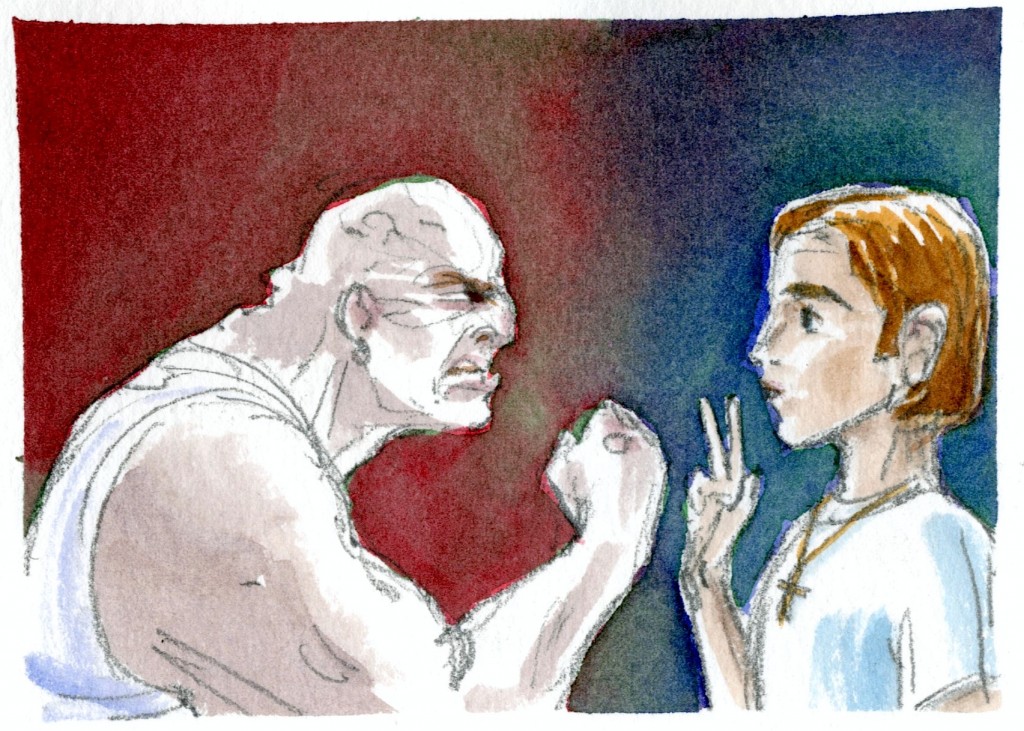
This is another week where some of the linkages artistically are more difficult, since it is Jesus talking about loving enemies, going the second mile, turning the other cheek. There may be images out there that reflect this but I struggled to find direct linkages. There is plenty of images out there that rebel against these ideas. 


Edward Hicks, Peaceable Kingdom 1834

Edward Hicks, Peaceable Kingdom 1834


Maltreatments in the House of Caiphas, James Tissot (1886-1894)

Maltreatments in the House of Caiphas, James Tissot (1886-1894)


Images for the Sixth Sunday After Epiphany, Lectionary 6A

Continuing in the Sermon on the Mount where Jesus interprets the commandments. The ideas for many of these images come out of the images in my copy of Luther’s Small Catechism around the fifth, sixth and eighth commandments

William Blake, Moses Receiving the Law (1780)

William Blake, Moses Receiving the Law (1780)

Peter Paul Rubens, Cain Slaying Abel, (1608-1809)

Peter Paul Rubens, Cain Slaying Abel, (1608-1809)


Jean-Leon Gerome, Bethsabee (1889 or 1885)

Jean-Leon Gerome, Bethsabee (1889 or 1885)

Michelangelo Merisis da Carvaggio, The Denial of Saint Peter

Michelangelo Merisis da Carvaggio, The Denial of Saint Peter


Images for the Fifth Sunday After Epiphany, Lectionary 5A

It is more abstract this week, if you want images for the Sermon on the Mount in General look back at the Fourth Sunday after Epiphany. This week is Matthew 5: 13-20: Jesus telling the disciples they are the salt of the earth, light on a lampstand, a city on a hill and unless their righteousness exceeds that of the Pharisees they will not enter the kingdom of heaven.

Salt and Light by Anacre0n@deviantart.com

Salt and Light by Anacre0n@deviantart.com

More of an abstract image, but I found it helpful for my own meditation

Saltfish drying in Iceland

Saltfish drying in Iceland

A reminder that in the ancient world (pre-refrigerators) salt was mainly a preservative rather than a seasoning

candle

City on a Hill by antonisfes@deviantart.com

City on a Hill by antonisfes@deviantart.com

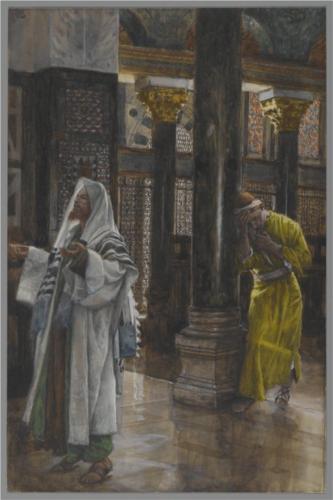
James Tissot, The Pharisee and the Publican (1894)

James Tissot, The Pharisee and the Publican (1894)