
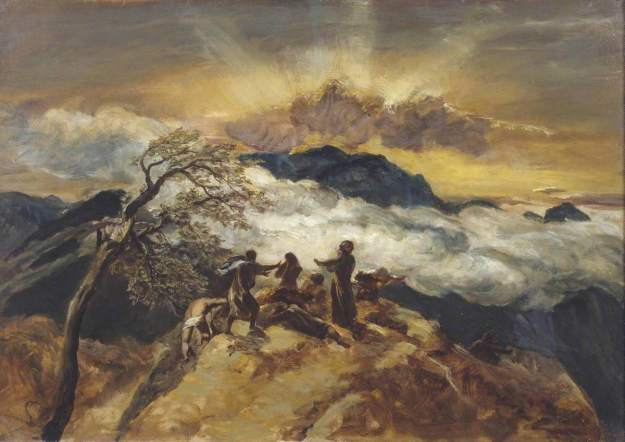
Poole, Paul Falconer; Sketch for ‘Vision of Ezekiel’; Tate; http://www.artuk.org/artworks/sketch-for-vision-of-ezekiel-201293
Chapter 33 of Ezekiel functions structurally as a hinge between the judgment of the previous thirty two chapters and the messages of hope that much of the remaining fourteen chapters involve. This chapter rearticulates numerous themes from throughout the early chapters but also helps to prepare us for the changed situation as the majority of the people find themselves in exile. Like the other biblical prophets, the movement to hope does not mean an abandonment of their message God’s desired repentance.
Ezekiel 33: 1-9 The Sentinel for the People
1 The word of the LORD came to me: 2 O Mortal, speak to your people and say to them, If I bring the sword upon a land, and the people of the land take one of their number as their sentinel; 3 and if the sentinel sees the sword coming upon the land and blows the trumpet and warns the people; 4 then if any who hear the sound of the trumpet do not take warning, and the sword comes and takes them away, their blood shall be upon their own heads. 5 They heard the sound of the trumpet and did not take warning; their blood shall be upon themselves. But if they had taken warning, they would have saved their lives. 6 But if the sentinel sees the sword coming and does not blow the trumpet, so that the people are not warned, and the sword comes and takes any of them, they are taken away in their iniquity, but their blood I will require at the sentinel’s hand.
7 So you, mortal, I have made a sentinel for the house of Israel; whenever you hear a word from my mouth, you shall give them warning from me. 8 If I say to the wicked, “O wicked ones, you shall surely die,” and you do not speak to warn the wicked to turn from their ways, the wicked shall die in their iniquity, but their blood I will require at your hand. 9 But if you warn the wicked to turn from their ways, and they do not turn from their ways, the wicked shall die in their iniquity, but you will have saved your life.
This rearticulation of Ezekiel’s role as a sentinel to the people of Israel echoes a similar passage in Ezekiel 3: 16-20. The word for sentinel in Hebrew (sopeh) comes from the shofar (trumpet/horn) which the watcher would blow. Ezekiel’s warning to the wicked and even the righteous may not be heeded, but he is under an obligation to sound the alarm announcing God’s judgment regardless. Both Hosea and Jeremiah[1] have performed this role of sounding a trumpet in the land or acting as a sentinel before and even if the people do not heed the trumpet call. Yet the prophet’s calling is to raise the alarm even if the people ignore the sound.
The wicked and the righteous are a common polarity used throughout wisdom literature, and Ezekiel who likely grew up schooled to be a priest was likely familiar with this way of engaging the world. Ezekiel uses the term wicked (rasa) more than any prophetic book, but the character of God is to desire repentance even among the wicked. The prophet is not to judge the worthiness of the recipients of God’s alarm but to raise the sound that they may hear. Even those who were once righteous but who commit iniquity are not exempt from God’s judgment. The ‘stumbling block’ (miksol) is “not an occasion for sin but a cause of downfall and ruin.” (NIB VI: 1135) As Katheryn Pfisterer Darr states about Ezekiel’s task,
His life depends solely on his performance of the task; it does not hang on the people’s response. Lives may be saved as a result of his warning. But Ezekiel is not told to hold that possibility before his audience. (NIB VI: 1135)
Like his older contemporary Jeremiah[2] he is charged with bearing an unpopular message to resistant people. Yet, as mentioned above the prophet is not in control. Ezekiel is called as a sentinel to the people, but his call does not come from the people. The words he is to speak are not his words, he is animated by a spirit not his own, and God’s hand will be upon him. Any unfaithfulness of Ezekiel will not save the wicked or righteous, but they will endanger the prophet.
Ezekiel 33: 10-20 The Justice of God’s Ways
10 Now you, mortal, say to the house of Israel, Thus you have said: “Our transgressions and our sins weigh upon us, and we waste away because of them; how then can we live?” 11 Say to them, As I live, says the Lord GOD, I have no pleasure in the death of the wicked, but that the wicked turn from their ways and live; turn back, turn back from your evil ways; for why will you die, O house of Israel? 12 And you, mortal, say to your people, The righteousness of the righteous shall not save them when they transgress; and as for the wickedness of the wicked, it shall not make them stumble when they turn from their wickedness; and the righteous shall not be able to live by their righteousness when they sin. 13 Though I say to the righteous that they shall surely live, yet if they trust in their righteousness and commit iniquity, none of their righteous deeds shall be remembered; but in the iniquity that they have committed they shall die. 14 Again, though I say to the wicked, “You shall surely die,” yet if they turn from their sin and do what is lawful and right — 15 if the wicked restore the pledge, give back what they have taken by robbery, and walk in the statutes of life, committing no iniquity — they shall surely live, they shall not die. 16 None of the sins that they have committed shall be remembered against them; they have done what is lawful and right, they shall surely live.
17 Yet your people say, “The way of the Lord is not just,” when it is their own way that is not just. 18 When the righteous turn from their righteousness, and commit iniquity, they shall die for it. 19 And when the wicked turn from their wickedness, and do what is lawful and right, they shall live by it. 20 Yet you say, “The way of the Lord is not just.” O house of Israel, I will judge all of you according to your ways!
This is the first time we have a confession of sin from the house of Israel in Ezekiel. The people have come a long way from when Ezekiel and other prophets were mocked for their words of doom that had not transpired. Now we hear, through Ezekiel, of a realization by the people that their actions have led to the deathlike state they inhabit. They are weighed down by their sin and it has caused them to waste away[3] and they openly ask how they can live under the weight of their actions. This plaintive cry fits within the Hebrew tradition of lament to attempt to mobilize the God of Israel to bring about their deliverance from the deathlike state of exile. The answer that God grants through the prophet has a hopeful element to it that is often missed.
God’s response begins with the ‘oath of denial’ (NIB VI: 1446) “As I live” which places the trustworthiness of these words in connection with God’s life. The God of Israel immediately declares that God takes no pleasure in the death of the wicked and argues in a manner similar to Ezekiel 18. This may indeed be good news for people who are finally willing to accept responsibility for their previous actions and who are willing to turn from their past wickedness and embrace the way of righteousness. There is an opportunity for those who previously ignored their sentinel and continued in the ways of wickedness to turn and have their sins no longer remembered against them.
Throughout the book of Ezekiel the prophet has argued for the ‘justness’ of God. The current generation look at God’s patience with previous generations who continued to live in the land while they sinned and may have viewed their generation as bearing the judgment of their ancestors. Yet, for Ezekiel, God is just. God has repeatedly sent sentinels for the people, God has desired their repentance, and even now the judgment of God is not eternal. For Ezekiel the ways of God are simple: if the people turn from wickedness and live in righteousness there is a future. If they turn from righteousness to wickedness there is death. It is the classic pattern of wisdom literature in the bible.
Post Reformation Protestant readers often read scripture through the lens of God’s mercy, but the Hebrew Scriptures are probably better understood through being at the mercy of God. Both individuals and the people as a whole are dependent upon God for their protection and provision. There are times where they will protest the perceived injustice of God’s ways, but this is to provoke God to action rather than as a lack of faith. Ezekiel perceives the people’s future as dependent upon God’s action, and God’s action is tied to the people’s righteousness or wickedness.
Ezekiel 33: 21-29 The Fall of the City and Those Who Remain
21 In the twelfth year of our exile, in the tenth month, on the fifth day of the month, someone who had escaped from Jerusalem came to me and said, “The city has fallen.” 22 Now the hand of the LORD had been upon me the evening before the fugitive came; but he had opened my mouth by the time the fugitive came to me in the morning; so my mouth was opened, and I was no longer unable to speak.
23 The word of the LORD came to me: 24 Mortal, the inhabitants of these waste places in the land of Israel keep saying, “Abraham was only one man, yet he got possession of the land; but we are many; the land is surely given us to possess.” 25 Therefore say to them, Thus says the Lord GOD: You eat flesh with the blood, and lift up your eyes to your idols, and shed blood; shall you then possess the land? 26 You depend on your swords, you commit abominations, and each of you defiles his neighbor’s wife; shall you then possess the land? 27 Say this to them, Thus says the Lord GOD: As I live, surely those who are in the waste places shall fall by the sword; and those who are in the open field I will give to the wild animals to be devoured; and those who are in strongholds and in caves shall die by pestilence. 28 I will make the land a desolation and a waste, and its proud might shall come to an end; and the mountains of Israel shall be so desolate that no one will pass through. 29 Then they shall know that I am the LORD, when I have made the land a desolation and a waste because of all their abominations that they have committed.
Ezekiel reports the community in exile receiving the news of Jerusalem’s fall. The dating system makes the best sense if it follows the dating system referred to in Ezekiel 24, which follows the dating of 2 Kings and Jeremiah, rather than Ezekiel’s normal dating system. This allows the word to reach the exiles just under five months after the fall of Jerusalem, which seems like a long time for us, but if this is a person traveling with the first wave of new exiles traveling with families and animals by foot, the slow passage from Judah to Babylon is understandable. Travel in the ancient world was a slow and arduous process, especially when we are talking about moving entire communities. This confirmation of the destruction of the city now opens the possibility of Ezkiel opening his mouth to intercede for the people. Previously the prophet was not to intercede for the people, God no longer wanted to listen, but now the prophet’s mouth is opened.
Yet not all the inhabitants of Judah are deported. There is a remnant of people in the country and the poorest in the land. Now this remnant believes that they can now inherit the land, just as Abraham’s descendants did. This reference back to Abraham may involve a return to the story of the people, but the prophet’s words indicate that the actions of these remaining in Judah have not changed. The evocation of Abraham’s name has not brought about a reformation of practices. They still eat meat with blood in it, like the Gentiles, shed blood, and lift up their eyes to idols. The practices of the people have not changed. They depend on their ability to force their will by the sword, they commit the abominations that Ezekiel has protested throughout his time as a prophet, and they do not respect the boundaries of relations between neighbors. They have continued to practice wickedness and although they may have avoided punishment previously, their actions have not gone unseen by God. They stand under the same judgment that their neighbors enroute to Babylon or deceased in Judah endured. The evocation of Abraham’s name do not make them the heirs to the land.
If the people remaining in the land began appropriating the land, resources, and wealth left behind by the exiles and the dead they did not endear themselves to the exiles in Babylon or those enroute. Like the villainous Thenardiers couple in Les Misérables looting the corpses of the dead to ensure their prosperity, these remaining Judeans who benefited from the looting of Judah would likely be viewed in a similar way to the nations which took advantage of Jerusalem’s precarious position during and after the siege of the city. Ezekiel is one of our windows into this time in the life of the people of Judah, and we see a shattered and conflicted community. Sometimes the vultures picking over the corpse of the nation are not from outside the community, but those who see an opportunity for profiting off their neighbors’ misfortune.
Ezekiel 33: 30-33 The Toleration of the Prophet
30 As for you, mortal, your people who talk together about you by the walls, and at the doors of the houses, say to one another, each to a neighbor, “Come and hear what the word is that comes from the LORD.” 31 They come to you as people come, and they sit before you as my people, and they hear your words, but they will not obey them. For flattery is on their lips, but their heart is set on their gain. 32 To them you are like a singer of love songs, one who has a beautiful voice and plays well on an instrument; they hear what you say, but they will not do it. 33 When this comes — and come it will! — then they shall know that a prophet has been among them.
Even the people who now listen to Ezekiel’s words have not changed. The prophet may be the talk of the community, his words have not caused them to change. They like to listen to his words, they may have enjoyed his metaphors or sign actions, but they are entertained, not challenged to change. There will come a time when they understand this strange messenger is indeed a prophet among them, and many of Ezekiel’s words have come to pass. At this point, but for now the heart of the people has not changed. Their words may be kind or flattering. They may appreciate the prophet’s artistry, but they miss the point of the art.
[1] Hosea 9:8, Jeremiah 4: 5, 19, 21; 6: 1, 17; 51:27
[2] As Daniel Block notes (assuming that the thirtieth year at the beginning of Ezekiel reflects his age) Jeremiah would begin his ministry about the time Ezekiel was born. (Block, 1997, p. 148) It is likely that Ezekiel may have grown up knowing Jeremiah’s voice or message and both prophets share the challenging job of dismantling the theology that had grown up around Jerusalem, the temple, and the Davidic kings. Both were probably never popular but proved to be essential voices to make sense of the destruction of Jerusalem and the temple by Babylon.
[3] The Hebrew maqoq (NRSV waste away) is used elsewhere of gangrenous flesh. (Block, 1997, p. 246)
 Sign of the Rose