
Tag Archives: Name of God

Psalm 113 The God On High Who Lifts The Lowly

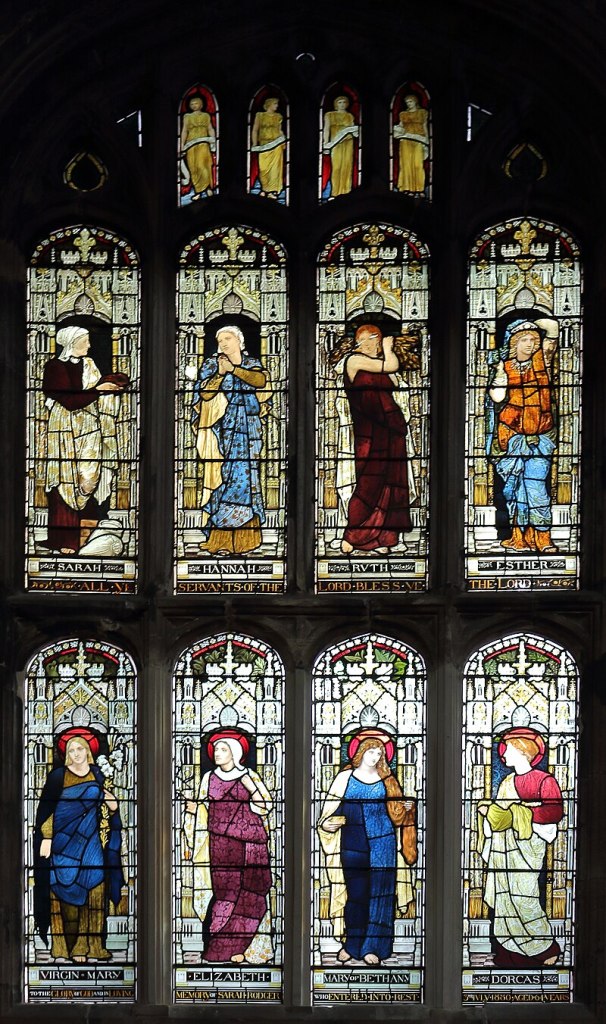
Window on the south wall of St Andrews just outside the Feilden chapel, by Henry Holiday and depicting Holy Women of the Old and New Testaments: Sarah, Hannah, Ruth and Esther in the top four panels and the Virgin Mary, Elizabeth, Mary of Bethany and Dorcas in the lower. By Rodhullandemu – Own work, CC BY-SA 4.0, https://commons.wikimedia.org/w/index.php?curid=73469366

Psalm 113

1Praise the LORD! Praise, O servants of the LORD; praise the name of the LORD.
2
Blessed be the name of the LORD from this time on and forevermore.
3
From the rising of the sun to its setting, the name of the LORD is to be praised.
4
The LORD is high above all nations and his glory above the heavens.
5
Who is like the LORD our God, who is seated on high,
6
who looks far down on the heavens and the earth?
7
He raises the poor from the dust and lifts the needy from the ash heap,
8
to make them sit with princes, with the princes of his people.
9
He gives the barren woman a home, making her the joyous mother of children. Praise the LORD!

The God of the songs and stories of Israel is a God who turns the world upside down. The LORD of Israel is the one who is high above all nations and lords yet this God raises up the “triad of the wretched” (Bellinger, 2014, p. 490) the poor, the needy, and the barren. This is the LORD on high who lifts up the lowly. Psalm 113 echoes this paradoxical reality in Hebrew thought: the LORD is high above all things, and the LORD looks down and sees the lowliest of all things.

Psalm 113 begins and ends with Hallelujah (NRSV Praise the LORD!). Unlike the previous two psalms it is not an acrostic, instead it is a short poem with two easily discerned parts. In the first four verses the praising and honoring of the LORD is the focus. Verse five forms pivot where the psalmist asks, “Who is like the LORD our God, who is seated on high.” The final four verses consider how this LORD who is seated on high cares for the lowly.

The praise of the LORD in the first four verses continually mentions the LORD and the name of the LORD as the focus of the praise of the servants of the LORD. The name of the LORD, enshrined in the commandment to “not make wrongful use the name of the LORD your God,” (Exodus 20:7, Deuteronomy 5:11) is critical to the proper reverence of the God of Israel. Names in the ancient world were powerful things and this God whose name is to be praised at all times (from this time on forevermore and from the rising of the sun to its setting) was due the reverence afforded to the name of the LORD.[1] This God who is above all things and whose name is worthy of reverence is seated on high.

The LORD on high lifting up the lowly is easily seen in the English translations, but when the Hebrew is rendered in a more literal translation[2] the parallel is even clearer as J. Clinton McCann Jr. shows:

A more literal translation captures the effect; God “makes God’s self high in order to sit,” (v.5b) “makes God’s self low in order to see,” (v. 6a) “causes the poor to arise” (v.7a), “makes exalted the needy…to cause them to sit with princes.” (NIB IV: 1139)

God intervenes in the life of the poor, the needy and the barren woman. God uses God’s position and power to lift up the lowly. This is the God of Sarah. Rebekah, and Rachel in the book of Genesis, these formerly barren women who became the joyous mothers of children. This is the God of the exodus who took a poor and needy people out of their captivity through the wilderness into the promised land. This is the God who hears the song of Hannah (1 Samuel 2) and Mary (Luke 1:46-55) which both share common themes with the second half of Psalm 113.

Psalm 113 in modern Jewish life is the first of the “Egyptian Hallel” psalms which are utilized in the Passover celebration. It is possible that this was the psalm that Jesus and his followers sang before they went out to the Mount of Olives after the Last Supper (Mark 14:26). The Psalm resonates strongly with many of the themes of the ministry of Jesus, just as it resonates with the story, songs, and the law. As Deuteronomy reminds the people:

For the LORD your God is God of gods and Lord of lords, the great God, mighty and awesome, who is not partial and takes no bribes, who executes justice for the orphan and the widow, and who loves the strangers, providing them with food and clothing. (Deuteronomy 10: 17-18)

This short psalm captures a central theme of the Hebrew and Christian scriptures: the paradox that the God who is high over all things sees and lifts up the lowly.


[1] The four letters of the divine name given to Moses in Exodus 3:14 are behind the English translation of LORD in all capitol letters. The practice of translating this LORD comes from the practice of using the vowel pointings for ‘Adonai” (Hebrew lord) on the consonants in Hebrew so that the reader knows not to utter the name of the LORD the God of Israel.

[2] Translators have to make a difficult choice when rendering a language into another of how to balance the literal meaning of the words with the different syntax and expectations of the language they are translating into. A “wooden” or “literal” translation is often difficult to read or understand because Hebrew sentences often do not include elements that most English readers are used to.

Psalm 75 God’s Answer to the Boastful and Arrogant

The Temple by Radojavor@deviantart.com

Psalm 75

<To the leader: Do Not Destroy. A Psalm of Asaph. A Song.>
1 We give thanks to you, O God; we give thanks; your name is near. People tell of your wondrous deeds.
2 At the set time that I appoint I will judge with equity.
3 When the earth totters, with all its inhabitants, it is I who keep its pillars steady. Selah
4 I say to the boastful, “Do not boast,” and to the wicked, “Do not lift up your horn;
5 do not lift up your horn on high, or speak with insolent neck.”
6 For not from the east or from the west and not from the wilderness comes lifting up;
7 but it is God who executes judgment, putting down one and lifting up another.
8 For in the hand of the LORD there is a cup with foaming wine, well mixed; he will pour a draught from it, and all the wicked of the earth shall drain it down to the dregs.
9 But I will rejoice forever; I will sing praises to the God of Jacob.
10 All the horns of the wicked I will cut off, but the horns of the righteous shall be exalted.

This short psalm which points to trusting God in the presence of those who are boastful and wicked may, like the previous psalm, originate in the context of the destruction of Judah by Babylon. The first three psalms of book three of the psalter are likely placed together intentionally at the beginning of the psalms of Asaph. Although the psalm itself does not have many references that would specifically point to the destruction of Jerusalem or the exile in Babylon it shares common language with the prophets of that time, particularly Habakkuk. Yet, the psalm itself can be a source of strength for anyone who is waiting for God to lift up the weak and bring down the arrogant, silence the boastful, and judge the wicked.

The psalm likely takes place in the context of a worshipping community praising God in preparation for petitioning God with their concern. The initial verse is a challenge to translate and understand because of the phrase ‘your name is near.’[1] Yet, if this is initially spoken within the context of a worshipping assembly in the temple (your name’s dwelling place in the previous psalm) it is a community giving God thanks in the midst of the temple. The words of the assembly are interrupted by God’s voice beginning in the second verse where God declares that at the appointed time God will judge with equity. The divine oracle may extend through verse five or verse six, but these words from the God who holds the pillars and foundations of the earth in the midst of the chaos tells the wicked and boastful not to sound their own horn. Perhaps this is the boastful Babylonians who are gloating in their military might and national power, but in the presence of the God of Israel their insolence is an annoyance. The solution to the crisis of that time will not come from the east (Egypt) or the west (Babylon) or the wilderness. The lifting up of the oppressed and lowly will be accomplished by the God of Israel. Verse eight uses a common image in scripture for God’s judgment, a cup,[2] and like the prophets the psalm expresses God’s judgment on the wicked and arrogant as a hope for the righteous who are suffering in the turmoil of the world. The divine voice returns for the final verse where the power (horns) of the wicked are cut off and the righteous are lifted up.

For the psalms, and the bible as a whole, the righteous live in dependence on God while the foolish, arrogant, and wicked boast in their own power and accomplishments. Even in the midst of the chaos of the world around them where the wicked seem to be powerful the faithful still assemble to give thanks to God and to anticipate God’s action to set the world aright.  The people of God have always been a “community waiting and hoping for justice.” (Brueggemann, 2014, p. 327) God’s justice may not be seen in the moment, but the community lives in hope and seeks out the places where they can hear God’s voice speaking to them. They wait for the time when the boastful are silenced and the wicked are brought down so that all of humanity and all creation can live in shalom (peace).

[1] The Hebrew versions of this (MT) reads “and near your name, they recount.” The Greek (LXX) and Syriac ancient translations read “and we call on your name.” (Nancy deClaisse-Walford, 2014, p. 602) I agree with the NRSV and NIV which follow the Hebrew as explained above.

[2] Isaiah 51: 17, Jeremiah 25: 15; 49: 12, Ezekiel 23: 32-34, Habakkuk 2: 15-16, Revelation14: 10; 16:19; 18:6

Exodus 3: The Calling of Moses and the Name of God

Burn by JustinChristenbery from deviantart.com

Burn by JustinChristenbery from deviantart.com

Exodus 3:1-12- Moses, the Mountain, the Burning Bush and the Voice of God

Moses was keeping the flock of his father-in-law Jethro, the priest of Midian; he led his flock beyond the wilderness, and came to Horeb, the mountain of God. 2 There the angel of the LORD appeared to him in a flame of fire out of a bush; he looked, and the bush was blazing, yet it was not consumed. 3 Then Moses said, “I must turn aside and look at this great sight, and see why the bush is not burned up.” 4 When the LORD saw that he had turned aside to see, God called to him out of the bush, “Moses, Moses!” And he said, “Here I am.” 5 Then he said, “Come no closer! Remove the sandals from your feet, for the place on which you are standing is holy ground.” 6 He said further, “I am the God of your father, the God of Abraham, the God of Isaac, and the God of Jacob.” And Moses hid his face, for he was afraid to look at God.

 7 Then the LORD said, “I have observed the misery of my people who are in Egypt; I have heard their cry on account of their taskmasters. Indeed, I know their sufferings, 8 and I have come down to deliver them from the Egyptians, and to bring them up out of that land to a good and broad land, a land flowing with milk and honey, to the country of the Canaanites, the Hittites, the Amorites, the Perizzites, the Hivites, and the Jebusites. 9 The cry of the Israelites has now come to me; I have also seen how the Egyptians oppress them. 10 So come, I will send you to Pharaoh to bring my people, the Israelites, out of Egypt.” 11 But Moses said to God, “Who am I that I should go to Pharaoh, and bring the Israelites out of Egypt?” 12 He said, “I will be with you; and this shall be the sign for you that it is I who sent you: when you have brought the people out of Egypt, you shall worship God on this mountain.”

Chapters three and four are the calling of Moses into his large task of being the leader, law bringer, prophet and teachers of the people of Israel. The call of Moses on the mountain with the burning bush, the angel of the LORD, the voice of God and Moses’ reluctance to take up the call is a very rich text densely condensed into the narrative we have handed on to us. Moses’ transition from tending the flock of his father-in-law to tending the people of the God of Abraham, Isaac and Jacob and the task of confronting the king of Egypt is a daunting one.

Moses’ father-in-law is here called Jethro instead of Reuel. There are multiple interpretations of why the name changes in this part of the story. One is that Jethro is a title, perhaps an honorary title given to a priest of Midian, while Reuel is the name of his father-in-law. Another theory comes from the source theory that was particularly popular in scholarly interpretations of the Pentateuch in the previous generation of scholars. Much as scholars in this vein would discern different source material behind the books of Genesis, Exodus, Leviticus, Numbers and Deuteronomy based on the way that the texts referred to God and their theology (the classic J-E-P-D, or Jehovah {or YHWH}, Elohist {primarily using the term Elohim to refer to God}, Priestly and Deuteronomist divisions that some may have learned in a bible class came out of this theoretical approach). According to this theory we see a seam where the compiler of the book of Exodus uses a different source to tell this part of the story. Regardless, in the narrative of Exodus we have Reuel and Jethro are referring to the same person, the father-in-law of Moses and the one out of whose household the LORD will call the leader to bring the Israelites out of Egypt.

Mountains in ancient literature are the typical places where a theophany (appearances of a divine being) occur, perhaps because of their proximity to the skies (the heavens) and perhaps because of their inaccessibility. Mount Horeb, Mount Sinai, the temple mount, the Mount of the Transfiguration or the mountain where the Sermon on the Mount and even Golgotha in its own way become places where the presence of the divine somehow encounters the people who are on the mountain when God appears. These mountaintop experiences of the immanent presence of the divine are both clarifying and terrifying. They often represent critical points within the communication of God with God’s people and so here, like in the giving of the law, God will set apart the people of Israel for a special purpose within the world and Moses for a special purpose with the people.

Many people of all ages are familiar with the story of the burning bush, where God speaks to Moses out of the fire but the story is more complex than that. Much as in the book of Genesis (example Genesis 22: 15) the angel of the LORD is the one who appears and speaks, and yet God’s voice is heard through this mediating messenger. The burning bush, which is not consumed by the fire, catches Moses’ attention. This magical moment is designed to lure Moses into this experience of the God’s words and call. The LORD is portrayed as watching for the moment when Moses is lured into this experience and encounters the fire and the angel of the LORD. Even though later in Exodus Moses will speak to God ‘face to face’ here the presence of God is mediated. Somehow the angel of the LORD is a messenger and yet an extension of the voice of God and here, even though mediated, the presence of God draws closer and makes this piece of mountainous property a holy place where God is present in a more immediate way. Much as the angel of the LORD will be the mediator of God’s presence to Moses, now Moses is being prepared to be the mediator of God’s presence to the people of both Israel and Egypt.

The fear of the LORD is the beginning of wisdom, and knowledge of the Holy One is insight” Proverbs 9:10 can state, and here Moses’ initial reaction to this intensified presence of the LORD is to hide his face and to fear.  Rabbi Jonathan Sacks has a fascinating discussion of ‘of what was Moses afraid?’ (Sacks, 2010, pp. 35-40) where he pulls on Rabbinic wisdom to draw several parallels in Moses’ life: Moses here hides his face and later the Israelites will see Moses’ face radiant after he talks with God and be afraid to approach him; he is afraid to look upon God here and later in Exodus he will see the form of God. And yet, why is the fear of the LORD the beginning of wisdom, or why is Moses afraid. Rabbi Sacks argument that to see the face of God is also to see ultimate justice of history and to understand why sometimes humans must suffer would be a wisdom whose price was too high. Whether these thoughts in any way parallel Moses’ thoughts we will never know but there is a perspective that we, no matter how broad minded we try to be, cannot see. Certainly, leaders at times must make choices that will cause pain for a portion of their followers to forward some greater good, or parents at times deny their children momentary pleasures for their health, security or well-being. Yet, we as people, while we can say with Martin Luther King, Jr. that ‘the moral arc of the universe is long, but it bends towards justice’ we still are, like Moses, called to become angry and upset about oppression and the injustice of this world. Moses is probably chosen because he could see the injustices, like those committed towards the Hebrew people or the daughters of Jethro in the previous chapter and felt compelled to act upon those injustices.

God has heard and seen the misery of the people and now God is going to act upon that observation. Moses will be the instrument that the LORD uses to bring the people from slavery to the promised land. God’s actions in the world often are mediated through the people God calls, indeed Israel as a people’s calling is to mediate God’s presence and blessing to the world. Being an instrument of God is both an incredible but also a fearful calling, perhaps this is one of the central reason why so often one of the first things said is ‘Do not be afraid’ but that is not said here. Instead the promise of God’s presence with Moses is to be the reassurance that he will need to boldly go before Pharaoh.

The land that the Israelites are to go to is here referred to for the first time as a land of milk and honey. As Carol Myers, can remind us this refers to, “The products of animal husbandry (represented by “milk”) and viticulture (represented by “honey,” or grape syrup) represent the productivity of a land that, in fact, has a difficult topography and chronic water shortages.” (Myers, 2005, p. 54) Honey in the bible is rarely bee honey, there are expectations like Judges 14 in the story of Samson, and mainly this fruit syrup. The land of milk and honey is only a productive land on the condition of the LORD of Israel granting fertility and rains at the appropriate time. It is not, like the American heartland, a comparatively easy place to grow crops and herds. The people’s prosperity, like their entire life will always be dependent upon the generative gift of the LORD their God.

Moses’ response to the call is one of self-doubt. It is easy to forget in the boldness that Moses will need to later embody before the people, before Pharaoh and before God that his initial response is one of self-doubt. Perhaps for most of us this is the natural response. We are unable to see within ourselves the very characteristics that God based God’s calling upon. The things that we may see as challenges, perhaps in Moses’ case his inability to see the injustices occurring without acting, may be the very characteristics that God sees as necessary for the calling we have. Moses will bargain with God here and in chapter four about Moses’ perceived insufficiencies and needs for reassurance and even when it may not be the way the LORD would prefer God accommodates Moses. Moses the man is critical to God’s work of liberation and even though he cannot see who he will become God sees within him the potential and the characteristics that God needs for him to be the instrument chosen for this task.

Hebrew Letters for the Name of God

Hebrew Letters for the Name of God

Exodus 3: 13-22 The Name of God

13 But Moses said to God, “If I come to the Israelites and say to them, ‘The God of your ancestors has sent me to you,’ and they ask me, ‘What is his name?’ what shall I say to them?” 14 God said to Moses, “I AM WHO I AM.” He said further, “Thus you shall say to the Israelites, ‘I AM has sent me to you.'” 15 God also said to Moses, “Thus you shall say to the Israelites, ‘The LORD, the God of your ancestors, the God of Abraham, the God of Isaac, and the God of Jacob, has sent me to you’:

This is my name forever, and this my title for all generations.

 16 Go and assemble the elders of Israel, and say to them, ‘The LORD, the God of your ancestors, the God of Abraham, of Isaac, and of Jacob, has appeared to me, saying: I have given heed to you and to what has been done to you in Egypt. 17 I declare that I will bring you up out of the misery of Egypt, to the land of the Canaanites, the Hittites, the Amorites, the Perizzites, the Hivites, and the Jebusites, a land flowing with milk and honey.’ 18 They will listen to your voice; and you and the elders of Israel shall go to the king of Egypt and say to him, ‘The LORD, the God of the Hebrews, has met with us; let us now go a three days’ journey into the wilderness, so that we may sacrifice to the LORD our God.’ 19 I know, however, that the king of Egypt will not let you go unless compelled by a mighty hand. 20 So I will stretch out my hand and strike Egypt with all my wonders that I will perform in it; after that he will let you go. 21 I will bring this people into such favor with the Egyptians that, when you go, you will not go empty-handed; 22 each woman shall ask her neighbor and any woman living in the neighbor’s house for jewelry of silver and of gold, and clothing, and you shall put them on your sons and on your daughters; and so you shall plunder the Egyptians.”

There is both power and necessity in a name. There is necessity in a name in being able to differentiate creatures, people, things and even God. Just as in Genesis 2: 19-20 where God brings Adam each of the different creatures to name, so there is a need to have a way to distinguish the God of Abraham, Isaac and Jacob from the gods of Egypt or Canaan. One of the things that people throughout the narrative of Genesis did was give names for the God they encountered (for example Hagar will name God ‘El-Roi’, Melchizedek will call God ‘El-Elyon’).  Here God is asked for what God’s name is and God’s response ‘I AM WHO I AM’ and its later four Hebrew Letter YHWH will be the one name that of God that is spoken rarely if ever among the Jewish people.

The divine name is behind the later commandment in Exodus 20:7 “You shall not make wrongful use of the name of the LORD your God, for the LORD will not acquit anyone who misuses his holy name.” Many Jewish people will not even write the word God, substituting G_d. Even in the translation of the Bible the name is not casually written. Only here is the name translated “I AM” and throughout the rest of the Hebrew Scriptures (or Old Testament) the four-letter name of God is translated LORD. A person reading in Hebrew would pronounce ‘Adonai’ the Hebrew word for Lord rather than Yahweh which is scholarship’s best guess at the proper pronunciation of the divine name.

In the fantasy series Eragon to know the true name of something is to have power over that item and magic was worked by knowing something’s true name. This is an ancient idea that Christopher Paolini picked up knowingly or unknowingly in those stories. For example, in an exorcism if one can call upon the name of the demon being exorcised it is a sign of power (an example of this is in the story of Jesus and the Gerasene demoniac in Mark 5: 1-20 and parallels). There is an entire tradition of Jewish mysticism based upon the names of God which have some resonance of magical power. Here the name of God is both necessary and powerful, in a certain sense God unveils a part of God’s identity in releasing this name. Yet, the name itself, “I AM,” has a certain veiling quality as well. Coming from the ‘to be’ verb of Hebrew it both reveals and refuses to reveal. The LORD says, “I exist” and perhaps I am behind all existence (which would fit with the Hebrew understanding of God as the creator of all things) and yet it is only four letters. Yet, those four letters would necessitate a commandment to prevent their misuse, the name of God is a powerful thing. This is also a dynamic that the Gospel of John uses in respect to Jesus’ numerous ‘I am’ sayings (I am the bread of life, I am the good shepherd, I am the gate, I am the way, the truth and the light, etc.)

God calls Moses to go and assemble the elders and then foreshadows much of what is to come in the remainder of Exodus through Joshua. The land to which they are going is now named as the land of the Canaanites, Hittites, Amorites, Perizzites, Hittites and Jebusites. The initial request is to go out for three days to sacrifice, a request that will be denied multiple times by Pharaoh. Also foreshadowed is the conflict between Pharaoh, and by extension the gods of Egypt, and the LORD. Finally, the Egyptians giving to the people of Israel as they begin their journey jewelry, wealth and clothing. God may see what is ahead for Moses and the people and yet Moses will still need to see some evidence from God how this may come about.


Psalm 19- Creation, the Law and a Faithful Life

James Tissot, The Creation (between 1896 and 1902)

James Tissot, The Creation (between 1896 and 1902)

Psalm 19

 <To the leader. A Psalm of David.>
1 The heavens are telling the glory of God; and the firmament proclaims his handiwork.
2 Day to day pours forth speech, and night to night declares knowledge.
3 There is no speech, nor are there words; their voice is not heard;
4 yet their voice goes out through all the earth, and their words to the end of the world.
  In the heavens he has set a tent for the sun,
5 which comes out like a bridegroom from his wedding canopy,
  and like a strong man runs its course with joy.
6 Its rising is from the end of the heavens, and its circuit to the end of them;
  and nothing is hid from its heat.
7 The law of the LORD is perfect, reviving the soul;
  the decrees of the LORD are sure, making wise the simple;
8 the precepts of the LORD are right, rejoicing the heart;
  the commandment of the LORD is clear, enlightening the eyes;
9 the fear of the LORD is pure, enduring forever;
  the ordinances of the LORD are true and righteous altogether.
10 More to be desired are they than gold, even much fine gold;
  sweeter also than honey, and drippings of the honeycomb.
11 Moreover by them is your servant warned; in keeping them there is great reward.
12 But who can detect their errors? Clear me from hidden faults.
13 Keep back your servant also from the insolent; do not let them have dominion over me.
  Then I shall be blameless, and innocent of great transgression.
14 Let the words of my mouth and the meditation of my heart be acceptable to you,
   O LORD, my rock and my redeemer.

Psalm 19 as a psalm of praise brings together the wonder and mysterious natural knowledge of God uttered in the unheard speech of creation and the revealed wisdom of the LORD in the gift of the Torah (the law). Like Psalm 8, the other psalm of praise we have encountered at this point in the book of Psalms, it reflects upon the majesty of creation from a sense of wonder and awe. It can look at the heavens above, the earth below and the seas in their vastness and be amazed at the creator God who has done all of these things. Here in the first verse the word for God is the generic El which can be either God, a god, or in plural gods, but it is not a name like will be used beginning in verse seven. Yet, the heavens and day and night and sun are all poetically personified in the psalm, speaking in words that are unheard and voices that human ears cannot perceive. Perhaps the psalmist, just straining, can barely hear the silent resonance of the Creator echoing through the creation. Perhaps they can perceive the God that stands behind the creation where others have taken the created parts of creation and deified them. In verses four and five, it is possible that the Psalmist makes use of an existing Akkadian/Summerian bilingual hymn that refers to the sun as a hero, warrior and bridegroom (Nancy deClaisse-Walford, 2014, p. 208) yet instead of leaving the sun as a deity in its right (like the surrounding cultures) now the sun becomes a rejoicing servant reveling in the course that the creator God has set for it.  The first half of the Psalm revels with the song of creation in the artistry and majesty of the creator and the Psalmist lifts up in their own way an audible voice for the unheard creation’s song.

It may seem unusual to bring together creation and the law in a poem, and perhaps these originated in two different places, but bringing these two together makes sense of the broader understanding of how God works with the Hebrew people. Creation is a gift of God for all the world, but the law (the Torah) is the special revealed gift for God’s chosen people. The God referred to initially only with the generic El now receives the revealed name YHWH (frequently pronounced Yahweh, anytime you see LORD in the Hebrew Scriptures (Old Testament) the proper name of God revealed to Moses is behind that, it is typically pronounced Adonai when read (translates to Lord) to not take the LORD’s name in vain). Together with Psalm 1 and the much longer Psalm 119, Psalm 19 praises the law of the LORD. The revealed will of God in the law becomes the nourishment, which revives the faithful, brings wisdom and purity and clarity and are a rich gift fit for a king. The ideal leader was to have the law always before them and to diligently observe and follow it all the days of their life. (see Deuteronomy 17: 18-20) If the king is the one lifting up this prayer the wonder of the cosmos is combined with the revealed wisdom of the Torah to keep them in obedience to God’s will for their life and God’s people.

The Psalm ends with a petition to be kept in this way revealed by the LORD in the midst of all the temptations that life brings forward. There is a humility in realizing that even though the law may reveal the human may conceal from themselves the faults of their hands and hearts. Even with the wisdom of Solomon one may fail to see the divergence in one’s life from the way of the covenant which coheres with God’s law. The Psalmist petitions their LORD to clear them of hidden faults, to keep them away from the insolent and foolish and to allow them to be blameless. God is their rock and their redeemer, the word for redeemer is go’el the kinsman redeemer who is able to, and is expected to, purchase their enslaved kin from slavery. Here the LORD is the one who is able to set the Psalmist free to live the life they are called to live: a life that can revel in God’s creation and delight in God’s law.