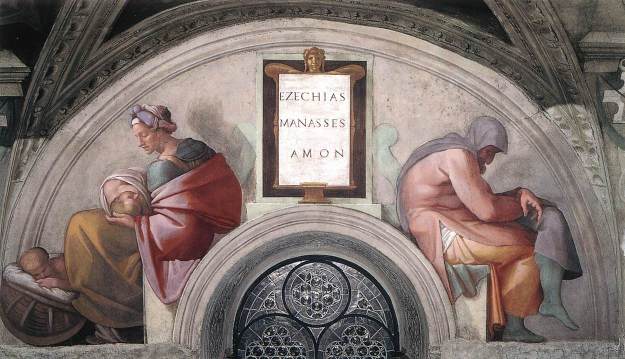
2 Kings 21: 1-18 The Wicked Reign of King Manasseh of Judah
1 Manasseh was twelve years old when he began to reign; he reigned fifty-five years in Jerusalem. His mother’s name was Hephzibah. 2 He did what was evil in the sight of the LORD, following the abominable practices of the nations that the LORD drove out before the people of Israel. 3 For he rebuilt the high places that his father Hezekiah had destroyed; he erected altars for Baal, made a sacred pole, as King Ahab of Israel had done, worshiped all the host of heaven and served them. 4 He built altars in the house of the LORD, of which the LORD had said, “In Jerusalem I will put my name.” 5 He built altars for all the host of heaven in the two courts of the house of the LORD. 6 He made his son pass through fire; he practiced soothsaying and augury and dealt with mediums and with wizards. He did much evil in the sight of the LORD, provoking him to anger. 7 The carved image of Asherah that he had made he set in the house of which the LORD said to David and to his son Solomon, “In this house and in Jerusalem, which I have chosen out of all the tribes of Israel, I will put my name forever; 8 I will not cause the feet of Israel to wander any more out of the land that I gave to their ancestors, if only they will be careful to do according to all that I have commanded them and according to all the law that my servant Moses commanded them.” 9 But they did not listen; Manasseh misled them to do more evil than the nations had done that the LORD destroyed before the people of Israel.
10 The LORD said by his servants the prophets, 11 “Because King Manasseh of Judah has committed these abominations, has done things more wicked than all that the Amorites who were before him did, and has caused Judah also to sin with his idols, 12 therefore thus says the LORD, the God of Israel: I am bringing upon Jerusalem and Judah such evil that the ears of everyone who hears of it will tingle. 13 I will stretch over Jerusalem the measuring line for Samaria and the plummet for the house of Ahab; I will wipe Jerusalem as one wipes a dish, wiping it and turning it upside down. 14 I will cast off the remnant of my heritage and give them into the hand of their enemies; they shall become a prey and a spoil to all their enemies 15 because they have done what is evil in my sight and have provoked me to anger, since the day their ancestors came out of Egypt even to this day.”
16 Moreover, Manasseh shed very much innocent blood, until he had filled Jerusalem from one end to another, besides the sin that he caused Judah to sin so that they did what was evil in the sight of the LORD.
17 Now the rest of the acts of Manasseh, all that he did and the sin that he committed, are they not written in the Book of the Annals of the Kings of Judah? 18 Manasseh slept with his ancestors and was buried in the garden of his house, in the garden of Uzza. His son Amon succeeded him.
Manasseh in 2 Kings is the paradigm of the wicked king. Not only is he articulated as the ultimate cause of the exile of the Judeans under Babylon in 2 Kings and Jeremiah[1]but he is placed in parallel with Ahab who was the king who opposed the prophet Elijah and led Israel astray. At the same time Manasseh has an exceptionally long reign, the longest of any of the Davidic kings. For the narrator of 2 Kings any events during this fifty-five-year reign are secondary to the practices of idolatry and violence that Manasseh led Judah to practice.
From Assyrian records we know that Manasseh was a vassal king and provided soldiers for Assyria’s campaign against Egypt. (Cogan, 1988, p. 265) Rabbinical sources highlight that Manasseh’s young age means he was born after Hezekiah’s illness and they speculate that Hezekiah did not have children before then. Yet Hezekiah would be age forty-two at that point and it is unlikely that Manasseh was his first born. It is more likely that Manasseh was selected at a young age to be amenable either to the Assyrian king or forces within Jerusalem. A twelve-year-old king would need support as his long reign begins.
When I read 2 King’s narration of the change between Hezekiah and Manasseh it makes me suspicious that something is rotten in Jerusalem for things to change so rapidly. Some commentaries connect the actions of Manasseh with the expectations of being a vassal of Assyria, but the actions that are listed are the practices of the surrounding Canaanites which have plagued Israel throughout its history. It is possible that Manasseh integrated some of the worship of Assyrian gods and certainly adopted Assyrian practices and morality, but Assyria is never mentioned in the text. Manasseh intensifies the practices of previous kings who did what was evil in the eyes of the LORD and even exceeded of the nations that were dispossessed from the land by God when they entered the promised land. (Deuteronomy 9:5) The entirety of the accusation against Manasseh combines the continual witness of prophets throughout the narrative of 2 Kings with the Deuteronomic prohibitions, particularly Deuteronomy 18: 9-14.
The result of this long period of practices abhorrent to the LORD brings a judgment against Judah. The language of making the ears tingle echoes the judgment on the house of Eli.[2] To this is added the language of the plummet and measuring line[3] where now Judah becomes like Ahab, reaching the end of their dynasty. Finally, Jerusalem is wiped like a dish. The term rendered “wipe” in English is the verb for “blot out” or “exterminate” which carries far more force. (Brueggemann, 2000, p. 533) Although the language is rough, God is heartbroken by the actions of the people under Manasseh, heartbroken to the point where the relationship cannot continue without a break. God’s patience has finally come to a breaking point.
The main force of the judgment of 2 Kings against Manasseh is focused on the idolatry the king leads the nation into, but before closing it highlights the second accusation: the spilling of innocent blood. Innocent blood is an important theme in the law from Abel’s innocent blood calling out from the earth (Genesis 4:10) to Deuteronomy’s instructions on how to deal with an unsolvable murder (Deuteronomy 21:1-9). Innocent blood is frequently paired with the persecution of the vulnerable in the prophets.[4] The kings were supposed to prevent the shed of innocent blood, but as Micah can accuse:
9Hear this, you rulers of the house of Jacob
and chiefs of the house of Israel,
who abhor justice
and pervert all equity,
10 who build Zion with blood
and Jerusalem with wrong!
11 Its rulers give judgment for a bribe;
its priests teach for a price;
its prophets give oracles for money;
yet they lean upon the Lord and say,
“Surely the Lord is with us!
No harm shall come upon us.” Micah 3:9-11
The innocent blood likely included the vulnerable and political opponents but also those who opposed Manasseh’s religious policies. Talmud states that the prophet Isaiah was killed under Manasseh’s instructions.
In 2 Kings Manasseh is wicked until the end and he is the only king whose sin is mentioned in the final summary of his reign. It is worth noting that in the parallel narrative in 2 Chronicles 33 Manasseh repents at the end of his life. Ultimately for the narrator of 2 Kings if there is any repentance it is too little and too late. In Rabbinic tradition Manasseh is one of three kings excluded from the afterlife, along with Jeroboam and Ahab. (Israel, 2019, p. 322)
2 Kings 21: 19-26 The Brief Reign of King Amon of Judah
19 Amon was twenty-two years old when he began to reign; he reigned two years in Jerusalem. His mother’s name was Meshullemeth daughter of Haruz of Jotbah. 20 He did what was evil in the sight of the LORD, as his father Manasseh had done. 21 He walked in all the way in which his father walked, served the idols that his father served, and worshiped them; 22 he abandoned the LORD, the God of his ancestors, and did not walk in the way of the LORD. 23 The servants of Amon conspired against him and killed the king in his house. 24 But the people of the land killed all those who had conspired against King Amon, and the people of the land made his son Josiah king in place of him. 25 Now the rest of the acts of Amon that he did, are they not written in the Book of the Annals of the Kings of Judah? 26 He was buried in his tomb in the garden of Uzza; then his son Josiah succeeded him.
After the long and disastrous, in the eyes of 2 Kings, reign of Manasseh is the short but still wicked reign of his son Amon. The description of his two-year reign is consumed with relating the conspiracy which leads to the end of his life and his reign. The significant oscillation between the faithfulness of Hezekiah’s reign and the odious nature of Manasseh’s reign likely means that there are groups and beliefs competing for the loyalty of the people and in our story two groups, the servants of the king and the people of the land are mentioned. As Walter Brueggemann describes it, “Amon is yet one more victim of a deep and abiding dispute over the shape and character of Israel.” (Brueggemann, 2000, p. 540)The assassination of Amon and the anointing of the boy king Josiah allows the pendulum to swing once more to loyalty to the LORD the God of Israel and the covenant and a stay of the execution of God’s judgment.
[1] Jeremiah 15: 1-4; 2 Kings 23: 26-27; 24: 3-4.
[2] 1 Samuel 3:11, see also Jeremiah 19:3.
[3] Isaiah 34:11; Lamentations 2:8.
 Sign of the Rose