Tag Archives: Justice

Psalm 101 A Leader Shaping a Community of Character

The Presentation of the Torah By Édouard Moyse – Own work Musée d’art et d’histoire du Judaïsme, CC BY-SA 4.0, https://commons.wikimedia.org/w/index.php?curid=41893002

Psalm 101

Of David. A Psalm.
 1I will sing of loyalty and of justice; to you, O LORD, I will sing.
 2I will study the way that is blameless. When shall I attain it? I will walk with integrity of heart within my house;
 3I will not set before my eyes anything that is base. I hate the work of those who fall away;
 it shall not cling to me.
 4Perverseness of heart shall be far from me; I will know nothing of evil.
 5One who secretly slanders a neighbor I will destroy. A haughty look and an arrogant heart
 I will not tolerate.
 6I will look with favor on the faithful in the land, so that they may live with me; whoever walks in the way that is blameless shall minister to me.
 7No one who practices deceit shall remain in my house; no one who utters lies shall continue in my presence.
 8Morning by morning I will destroy all the wicked in the land, cutting off all evildoers from the city of the LORD.

As modern readers we tend to read the psalms individualistically, and from that perspective this psalm can sound judgmental. “Do not judge, so that you may not be judged”[1] may resonate with many modern readers but if we read the psalm from this perspective, we fundamentally have missed the point of this psalm written for or by a ruler in a communal society. I am heavily influenced by Charles Taylor’s description of society prior to our disenchanted view of the world, and I think his description of the community or parish deploying the collective power of its prayers, worship, and faith for blessing and protection is instructive here. In Taylor’s words, “Villagers who hold out, or even denounce the common rites, put the efficacy of these rites in danger, and hence pose a menace to everyone.” (Taylor, 2007, p. 42) Especially after working through the prophet Ezekiel, it is clear that the Hebrew view of the world in relation to God expects a society of justice and a ruler who enforces the character of the world that God’s law articulates. The king in Jerusalem, and leaders throughout history have been responsible for checking the selfish impulses of those who have the power to exploit others. Allowing injustice to take root in their kingdom quickly corrupts not only the individual practicing the injustice but the entire society.

This is a psalm of loyalty (hesed)[2] and justice, two primary characteristics of God that are to be embodied in the community of the faithful. Throughout this psalm the ideas of being blameless and having integrity translate the Hebrew terms tam and tamim.[3] This psalm is a royal psalm, and so the one studying the way of blamelessness (tamim) likely points to the ideal of a king articulated in Deuteronomy 17:14-20. Yet, the king can acknowledge that their practice of these ideals of loyalty and justice and the way of blamelessness are still aspirational.

The leader aspires to walk with integrity of heart and to keep its opposite, perverseness in heart, far from them. The metaphor of walking (halak) is often used in Hebrew about the way one lives one’s life. Halakah is a term commonly used to talk about the law and one’s life is to be oriented around the practices outlined in the law of God. In addition, the heart in Hebrew thought is not the seat of emotion, but the seat of will and discernment. This leader’s life and will are set upon God’s way for the community and not on the way that will enrich themselves or allow them to accrue more power. This leader in following God is walking in God’s way, learning to set their heart on the things of integrity and justice, and their character is shaped by the God they serve.

The character of the leader shapes the character of the community. One of the critical acts of leading a community is setting boundaries that protect those under the leader’s authority. Those who slander a neighbor, who are haughty and arrogant and feel they are above the law, who practice deceit and utter lies undermine the ethos the leader is attempting to cultivate. The leader seeks the way of loyalty and justice, a blameless way that models the character of God, and the presence of those who follow the path of wickedness, deceit and injustice are a danger to the life of the community.

James Mays notes that Martin Luther called this psalm, “the mirror of a monarch” and relates the story of Ernest the Pious, Duke of Saxe-Gotha who would send an unfaithful minister a copy of the 101st Psalm when that official had done anything wrong. (Mays, 1994, pp. 321-322) A leader who models their leadership on the loyalty and justice of God, who strives to study the way that is blameless and walk in integrity of heart was unusual both in biblical times and in our own time. Yet, it is path that the way of God expects for those entrusted with power in family, land, city, congregation, or the world. The things we invest in with both our resources and our actions show where our heart is located. As Jesus would state in the Sermon on the Mount, “where your treasure is, there your heart will be also.”[4] The life of faith is not merely a quest for individualistic righteousness, but to shape a community of loyalty and justice that seek the way of blamelessness and walk in integrity. Both Hebrew and Christian communities have often fallen short of the vision of this psalm, but leaders can call the community together to this of life shaped by the character of the God we attempt to follow. Communities that are in the heart shaping business of studying the way that is blameless and modeling walking with integrity.


[1] Matthew 7:1.

[2] Hesed is one of those rich Hebrew concepts that loses richness in translation. It is often translated as steadfast love in English. I am partial to ‘covenantal faithfulness’ as a translation of this term but it almost always points to the connection between God and God’s people. A Christian/New Testament term that is heavily related to God’s hesed is grace.

[3] See my discussion on Perfection and Blamelessness in the Bible.

[4] Matthew 6:21.

Ezekiel 18 Life for the Righteous Ones

Grigory Mekheev, Exodus (2000) artist shared work under Creative Commons Attribution-Share Alike 3.0

Ezekiel 18

1 The word of the LORD came to me: 2 What do you mean by repeating this proverb concerning the land of Israel, “The parents have eaten sour grapes, and the children’s teeth are set on edge”? 3 As I live, says the Lord GOD, this proverb shall no more be used by you in Israel. 4 Know that all lives are mine; the life of the parent as well as the life of the child is mine: it is only the person who sins that shall die.

5 If a man is righteous and does what is lawful and right — 6 if he does not eat upon the mountains or lift up his eyes to the idols of the house of Israel, does not defile his neighbor’s wife or approach a woman during her menstrual period, 7 does not oppress anyone, but restores to the debtor his pledge, commits no robbery, gives his bread to the hungry and covers the naked with a garment, 8 does not take advance or accrued interest, withholds his hand from iniquity, executes true justice between contending parties, 9 follows my statutes, and is careful to observe my ordinances, acting faithfully — such a one is righteous; he shall surely live, says the Lord GOD.

10 If he has a son who is violent, a shedder of blood, 11 who does any of these things (though his father does none of them), who eats upon the mountains, defiles his neighbor’s wife, 12 oppresses the poor and needy, commits robbery, does not restore the pledge, lifts up his eyes to the idols, commits abomination, 13 takes advance or accrued interest; shall he then live? He shall not. He has done all these abominable things; he shall surely die; his blood shall be upon himself.

14 But if this man has a son who sees all the sins that his father has done, considers, and does not do likewise, 15 who does not eat upon the mountains or lift up his eyes to the idols of the house of Israel, does not defile his neighbor’s wife, 16 does not wrong anyone, exacts no pledge, commits no robbery, but gives his bread to the hungry and covers the naked with a garment, 17 withholds his hand from iniquity, takes no advance or accrued interest, observes my ordinances, and follows my statutes; he shall not die for his father’s iniquity; he shall surely live. 18 As for his father, because he practiced extortion, robbed his brother, and did what is not good among his people, he dies for his iniquity.

19 Yet you say, “Why should not the son suffer for the iniquity of the father?” When the son has done what is lawful and right, and has been careful to observe all my statutes, he shall surely live. 20 The person who sins shall die. A child shall not suffer for the iniquity of a parent, nor a parent suffer for the iniquity of a child; the righteousness of the righteous shall be his own, and the wickedness of the wicked shall be his own.

21 But if the wicked turn away from all their sins that they have committed and keep all my statutes and do what is lawful and right, they shall surely live; they shall not die. 22 None of the transgressions that they have committed shall be remembered against them; for the righteousness that they have done they shall live. 23 Have I any pleasure in the death of the wicked, says the Lord GOD, and not rather that they should turn from their ways and live? 24 But when the righteous turn away from their righteousness and commit iniquity and do the same abominable things that the wicked do, shall they live? None of the righteous deeds that they have done shall be remembered; for the treachery of which they are guilty and the sin they have committed, they shall die.

25 Yet you say, “The way of the Lord is unfair.” Hear now, O house of Israel: Is my way unfair? Is it not your ways that are unfair? 26 When the righteous turn away from their righteousness and commit iniquity, they shall die for it; for the iniquity that they have committed they shall die. 27 Again, when the wicked turn away from the wickedness they have committed and do what is lawful and right, they shall save their life. 28 Because they considered and turned away from all the transgressions that they had committed, they shall surely live; they shall not die. 29 Yet the house of Israel says, “The way of the Lord is unfair.” O house of Israel, are my ways unfair? Is it not your ways that are unfair?

30 Therefore I will judge you, O house of Israel, all of you according to your ways, says the Lord GOD. Repent and turn from all your transgressions; otherwise iniquity will be your ruin. 31 Cast away from you all the transgressions that you have committed against me, and get yourselves a new heart and a new spirit! Why will you die, O house of Israel? 32 For I have no pleasure in the death of anyone, says the Lord GOD. Turn, then, and live.

The eighteenth chapter of Ezekiel is one of the portions of Ezekiel that does get utilized in the readings of churches that follow the lectionary, particularly the first four verses combined with verses twenty-five through thirty-two. Many readers of the particular Ezekiel text have found the prophet advocating for an individualistic spirituality of responsibility, ignoring the corporate influence present throughout other portions of the book. In Ezekiel’s context where the destruction that comes in the aftermath of King Zedekiah’s rebellion against King Nebuchadrezzar of Babylon appears imminent for those still in Jerusalem, the actions of individuals may seem futile. If society is going to be judged as wicked or bearing the sins of previous generations a malaise can set in where living according to the covenant seems pointless.

The theme of individuals attempting to live righteously in an unrighteous time is not new to Ezekiel. In Ezekiel 9 a scribal figure is sent out into the city of Jerusalem to mark the righteous and preserve them from judgment and in Ezekiel 14: 12-20 the themes of this chapter are prefigured when even Noah, Daniel, and Job can only save themselves by their righteousness. Here the prophet takes central ideas from the law (torah) and wrestles with the tradition. As Ellen Davis states,

Ezekiel appears primarily in conversation with the tradition. Like a creative archivist, he desires not only to preserve the treasures of the past but also to make them available and meaningful for the present. Even his disputation speeches are aimed as much at the tradition as at the people, purging it of its useless elements (12,22-28, 18.2-4) and correcting disastrous interpretations (33. 24-29. (Davis, 1989, p. 62)

The proverb spoken by the people about parents eating unripe grapes and the children’s teeth being blunted (or set on edge)[1] is also found in Jeremiah 31: 29-30 and both prophets answer in identical ways. Unlike Jeremiah, Ezekiel proceeds into a much longer discussion of the implications of righteousness and unrighteousness from a perspective of the law.

The proverb seems to derive from language of the second commandment:

You shall not make for yourself an idol, whether in the form of anything that is heaven above, or that is on the earth beneath, or that is in the water under the earth. You shall not bow down to them or worship them; for I the LORD your God am a jealous God, punishing children for the iniquity of parents, to the third and fourth generation of those who reject me, but showing steadfast love to the thousandth generation of those who love me and keep my commandments. Exodus 20:4-6; Deuteronomy 5: 8-10

This people attempting to make sense of the impending destruction probably understood that they were bearing the judgment of previous generations and that they were powerless in their actions to change the course of events for the nation or for their own lives. Yet, throughout this chapter the LORD’s response is that the life of the parent and child belongs to the LORD and the LORD will judge each by their actions. The word translated life throughout is the Hebrew nephesh which is not the Greek idea of soul (which English translations sometimes render it) but is that which is the essence of life. As Daniel Block helpfully states,

“life” is not merely the absence of judgment, any more than šālôm, “peace,” is simply the absence of war. Ezekiel holds out life in all its fullness and blessing to the righteous person, even for those who are exiles in Babylon. (Block, 1997, p. 574)

This promise of life for the righteous is not merely survival. Like Moses in Deuteronomy, Ezekiel holds out before the people a choice between a way that leads of condemnation and death and a way that leads to life. Yet, one of the crucial differences within Ezekiel is there is a provision for the righteous surviving in the midst of an unrighteous people.

To wrestle with this multigenerational judgment outline in the commandment Ezekiel goes to another portion of Deuteronomy:

Parents shall not be put to death for their children, nor shall children be put to death for their parents; only for their own crimes may persons be put to death. Deuteronomy 24: 16

This portion of the law meant to restrain human judgments is now applied to God’s working with humanity. On one hand this is a surprising use of the law of interpersonal judgments in the relationship between God and the people. On the other hand, the justice of God is expected to be at least as fair as the justice of humanity. Now this pattern is examined over three hypothetical generations.

The first generation is a prototypical righteous man according to the law. Eating on the mountains was probably associated with the worship of the idols.[2] Defiling a neighbor’s wife would violate the commandment on adultery. Ezekiel shares the Levitical view of menstruation in particular (and blood in general) causing uncleanness. (Leviticus 18:19) The concerns for the proper economic treatment of the neighbor: not oppressing, restoring the pledge, not robbing, giving food and clothing to the needy, not taking interest, and living in justice are present throughout the law (for example Deuteronomy 24:6-22) and this is the pattern of a wise and righteous life. Ezekiel is following both the pattern of the law and wisdom literature which differentiate between wise choices that lead to life and foolish choices that lead to death.

The wise father has an unwise son who does all the things the father does not do in addition to being violent. The violations of idolatry, the neighbor’s household, and economic justice all are characteristics of an unrighteous life that leads to death. These are the type of people Ezekiel was informed he would have to warn at the Chebar River. (Ezekiel 2:17-21) Yet the sins of the father do not dictate the life of the child. When a third generation sees the folly of their parents and returns to the way of righteousness they are promised life.

Ezekiel and Jeremiah engaged in the deconstruction of a Zion theology which focused on Jerusalem, the temple, the Davidic king, and the land as central symbols of the LORD’s relationship with Israel. Yet, the reorganization of faith without these central symbols was challenging and probably involved multiple attempts to reconstruct faith in the aftermath of disaster. The Deuteronomic history attempts to understand the destruction of Jerusalem and the loss of the land in terms of this multigenerational pattern of unfaithfulness, and this attempt to make sense of their world probably brought comfort to the people attempting to reorganize their life and faith as exiles in a strange land. In verse nineteen there appears to be resistance to Ezekiel’s message of a path forward for individuals who are righteous and a return to the way of thinking behind the proverb. The rhetorical question “should not the son suffer for the iniquity of the father?”  may seem strange to our individualistic mindset but it may have brought some comfort for people attempting to understand the time they were navigating. Blaming their situation on their ancestors also allowed the current generation to avoid an examination of their own practices. If God’s justice was unjust to them, but fair over the course of the generations, then they only had to wait for God’s wrath to pass and endure. Yet, Ezekiel is calling them to a path of examination in light of the covenant expectations. Ezekiel clings to the pattern of Deuteronomy 24:16 and presses forward with his claims that God’s ways are just.

The actions of individuals will not turn away the armies of Babylon from the walls of Jerusalem or save the temple, nor will they save the lives of the entire people. Ezekiel is committed to the idea of God delivering the righteous individuals from this situation and providing for them in the time of exile. Yet, the provision of God is dependent upon the actions of the individual in this portion of Ezekiel, and people are called to choose the way of life. Surprisingly, they are called to get for themselves a new heart and a new spirit, an action that will be God’s work in other parts of Ezekiel. Yet, the LORD as presented here is not a God who wants judgment, but who desires the people of Israel to individually and collectively adopt the practices of righteousness that will lead them to life.

Sometimes modern believers can break apart two ideas that ancient people had no problem holding together. I was formed by the Lutheran tradition of Christianity where there is a heavy focus on God’s gracious action and a discomfort with anything that seems to be legalistic or require a person to work out their own salvation. Other traditions focus exclusively on a person’s actions to be in a right relationship with God. Individual responsibility is a heavy focus of our modern age while corporate responsibility is often obscured. Ezekiel, like most authors of scripture, hold both God’s action and personal responsibility together as well as individual and corporate responsibility. At some points they may lift up one aspect, while at others they will lift up another. Sometimes multiple aspects can appear together baffling modern theological systems like Philippians 2: 2-13

Therefore, my beloved, just as you have always obeyed me, not only in my presence, but much more now in my absence, work out your own salvation with fear and trembling; for it is God who is at work in you, enabling you both to will and to work for his good pleasure.

Ezekiel can appeal to the people to get a new heart and new spirit here, and then can point to God’s action to place a new heart and new spirit in the people. (Ezekiel 11:19, 36:26) Sometimes people need to hear, in Luther’s terms, law that causes them to take responsibility for their own actions and sometimes they need gospel to give them hope in their hopelessness of God’s actions. Ezekiel attempts to get his hearers to claim their own agency in how they live their life despite the destruction occurring around them. There is promise that if they persist in righteousness they individually can find life even if their society corporately is choosing unrighteousness and death. In all this Ezekiel want to demonstrate the justice of God in a way that highlights many previous themes in the prophet’s imagery.


[1] The Hebrew qaha is a rarely used word and outside of this proverb is only used in Ecclesiastes 10:10 for iron being blunt. (Block, 1997, p. 558)

[2] Again, Ezekiel’s derogatory term gillum which Block and others argue means something like “shit gods.” See comments in Ezekiel 6.

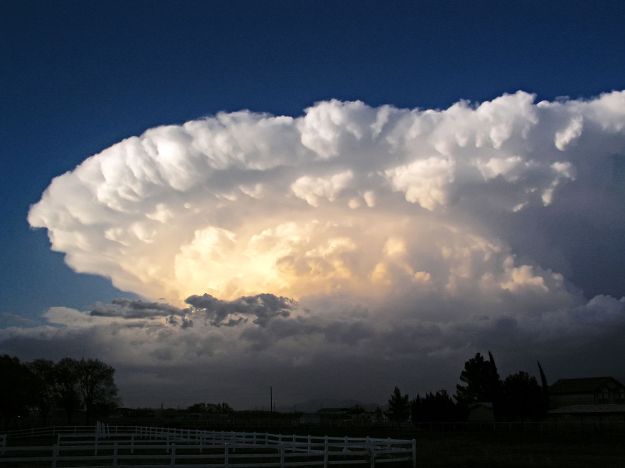
Psalm 97 The Righteous Reign of God

Supercell Thunderstorm over Chaparral, New Mexico on April 3, 2004

Psalm 97

1 The LORD is king! Let the earth rejoice; let the many coastlands be glad!
2 Clouds and thick darkness are all around him; righteousness and justice are the foundation of his throne.
3 Fire goes before him, and consumes his adversaries on every side.
4 His lightnings light up the world; the earth sees and trembles.
5 The mountains melt like wax before the LORD, before the Lord of all the earth.
6 The heavens proclaim his righteousness; and all the peoples behold his glory.
7 All worshipers of images are put to shame, those who make their boast in worthless idols; all gods bow down before him.
8 Zion hears and is glad, and the towns of Judah rejoice, because of your judgments, O God.
9 For you, O LORD, are most high over all the earth; you are exalted far above all gods.
10 The LORD loves those who hate evil; he guards the lives of his faithful; he rescues them from the hand of the wicked.
11 Light dawns for the righteous, and joy for the upright in heart.
12 Rejoice in the LORD, O you righteous, and give thanks to his holy name!

One of the losses of our modern, technology filled world is the patient hope of the psalmist and the prophets for the arrival of God’s kingdom. James L. Mays notes that Psalm 97 shares several key images and ideas with the portions of Isaiah most scholars attribute to Judah’s time in exile.[1] (Mays, 1994, p. 311) The psalmist’s proclamation of God’s reign causing the earth, Judah, and the righteous to rejoice were always contested claims. Israel and Judah lived in a world of multiple religious options and empires who exercised military, economic, and political might over Israel or Judah. Yet, the psalms and the prophets exhibit a persistent faith that despite the evidence to the contrary the God of Israel reigns over creation, is chief among the gods of the nations, and continues to sow joy and righteousness in the upright in heart. It is only through the eyes of faith that these poets can rejoice with the earth and the coastland because their vision has revealed to them that the LORD, the God of Israel and Judah, is king.

The vision of God in the psalms and the prophets may, as Brueggemann and Bellinger comment, retain the “remnants of a storm god.” (Brueggemann, 2014, p. 418) but as in Psalm 29 the use of the language of clouds and darkness, fire, lightning, and earthquake takes the primary language for the power of the Canaanite god Baal and now uses it to describe the power of the LORD the God of Israel. This imagery also resonates with the appearance of the LORD to the people at Mount Sinai in Exodus 19:16-19. The psalmist longs for the day for all the people to see what the eyes of faith trust: that the idols of the nations are worthless, that the kings of the earth and the gods of the nations are powerless before the LORD who is king, and that the power of the wicked over the faithful will end as God rescues them.

God’s righteousness and justice are the foundation of God’s throne, and they are also the foundation for the hopeful imagination of the psalmist. The heavens can proclaim God’s righteousness and the people of Judah can find reasons for rejoicing and gladness because of God’s judgments. Because God’s reign is based on righteousness it opens the possibility that people in Judah and beyond the borders of Judah can live as righteous ones rather than adopting the ways of the wicked. The response throughout the poem to the righteousness and justice of God is joy and gladness. The earth can rejoice, and the coastlands can be glad because the creation bears witness to the just reign of God. Zion can be glad, and the towns of Judah can rejoice because God judges with righteousness. The ones loving the LORD will hate evil[2] and God will guard their lives and sows[3] light and joy in these faithful ones of upright hearts. These righteous ones planted with light and joy in the rejoicing earth now join the earth’s joy at the celebration of God’s reign.

[1] See for example Isaiah 40: 5, 9-11; 42:17, and 52: 7-10

[2] In both the MT (Hebrew) and LXX (Greek translation) the direct translation is “The ones loving the LORD hate evil” as the NIV captures. The NRSV follows the translation of scholars who in their attempt to smooth our the translation change the subject to God, but there is no reason to make this change to the original text. (Nancy deClaisse-Walford, 2014, p. 724)

[3] Some change this word to a similar Hebrew word for ‘rise, shine’ (hence the NRSV translation) but the metaphor of sowing light fits with the imagination of the psalmist. (Nancy deClaisse-Walford, 2014, p. 724)

Psalm 94 Thy Kingdom Come

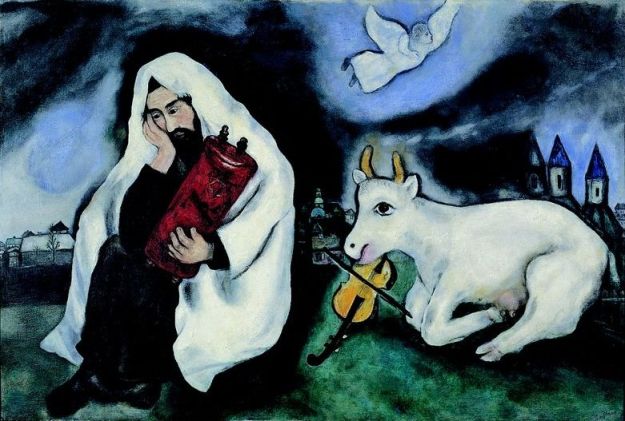
Marc Chagall, Solitude (1933)

Psalm 94

1 O LORD, you God of vengeance, you God of vengeance, shine forth!
2 Rise up, O judge of the earth; give to the proud what they deserve!
3 O LORD, how long shall the wicked, how long shall the wicked exult?
4 They pour out their arrogant words; all the evildoers boast.
5 They crush your people, O LORD, and afflict your heritage.
6 They kill the widow and the stranger, they murder the orphan,
7 and they say, “The LORD does not see; the God of Jacob does not perceive.”
8 Understand, O dullest of the people; fools, when will you be wise?
9 He who planted the ear, does he not hear? He who formed the eye, does he not see?
10 He who disciplines the nations, he who teaches knowledge to humankind, does he not chastise?
11 The LORD knows our thoughts, that they are but an empty breath.
12 Happy are those whom you discipline, O LORD, and whom you teach out of your law,
13 giving them respite from days of trouble, until a pit is dug for the wicked.
14 For the LORD will not forsake his people; he will not abandon his heritage;
15 for justice will return to the righteous, and all the upright in heart will follow it.
16 Who rises up for me against the wicked? Who stands up for me against evildoers?
17 If the LORD had not been my help, my soul would soon have lived in the land of silence.
18 When I thought, “My foot is slipping,” your steadfast love, O LORD, held me up.
19 When the cares of my heart are many, your consolations cheer my soul.
20 Can wicked rulers be allied with you, those who contrive mischief by statute?
21 They band together against the life of the righteous, and condemn the innocent to death.
22 But the LORD has become my stronghold, and my God the rock of my refuge.
23 He will repay them for their iniquity and wipe them out for their wickedness; the LORD our God will wipe them out.

James L. Mays begins his comments on this psalm by quoting a line from Maltbie D. Babcock’s song “This is my Father’s world”: “Though the wrong seems oft so strong, God is the ruler yet.” (Mays, 1994, p. 302) The opening line of the psalm names God as the God of vengeance, and yet God’s vengeance is necessary to avenge the wrongs done to the vulnerable and powerless who suffer in an unjust society. Because of this beginning this is sometimes called a psalm of vengeance, yet it is important to realize this vengeance is an action to restore society and to undo the work of those who utilize their positions of power to oppose God’s justice on earth and to oppress the ones God promised to defend. Much as the petitions in the Lord’s Prayer call for “God’s kingdom to come and God’s will to be done on earth as it is in heaven,” this psalm calls on God to act in concrete and visible ways to repair a society that has become controlled by those who have abandoned the ways of the covenant righteousness.

The proud and wicked have prospered in the society the psalmist lives in and they have turned the dream of a just society on its head. They have killed and oppressed the widow, the stranger, and the orphan who God has promised to protect, and who the leaders who work on God’s behalf are to ensure justice for. These arrogant evildoers perceive that they are not bound by the requirements of the law for the God of Israel has not acted to judge them. In their view, “without God everything is possible.” (Brueggemann, 2014, p. 407) These wicked ones view the LORD the God of Israel as either unwilling or unable to respond to their actions which violate God’s command, oppress the vulnerable among God’s people, and threaten God’s own heritage.

The psalmist testifies to the tension of an unjust present and a life in hopeful expectation of God’s intervention in the world. In the present the wicked are prospering and crime does pay. (NIB IV: 1019) To challenge this honest observation of the present the psalmist relies on the language of the wisdom tradition in scripture. The proud, arrogant, wicked evildoers who profit by oppressing and murdering the vulnerable and believe that God does not see or hear about their actions are foolish. The wise are glad to be disciplined by God and God’s law, but the foolish will ultimately perish. They may prosper in the moment, but that moment is an empty breath.[1] Yet, even though their time in power may be short the threat to the vulnerable is acute and needs God’s intervention.

In the meantime, the psalmist also testifies to the ways God has continued to provide respite and protection for the faithful ones in the midst of injustice. In times where their feet were slipping, God held them fast. When their worries were great God provided consolation. Without God’s protection they would dwell in the silence of the dead. These actions of God may not have brought about the fullness of God’s kingdom for the psalmist, but they have been the necessary provision and protection in their time of waiting and the actions which renewed their hope for God’s intervention which they trust is coming.

For people of faith a part of the desire for God to reign as king comes from the experience of injustice in this world and the desire for the God of vengeance to bring God’s justice to those who exploit God’s people and God’s world. When wicked people sit in the positions of power and the laws and statutes that should provide protection have become warped and utilized to oppress, the faithful cry out for God’s reign and God’s vengeance to create a society where the vulnerable are protected and justice prevails. (Mays, 1994, p. 303) The work of the wicked is a concrete and visible reality in the world of the psalmist and the cry of the psalmist is not for some otherworldly deliverance from the toils of this earth. The psalmist demands the judge of the earth to rise up and cause justice to return to the righteous. The prayer is for God’s justice to be a concrete and visible reality which displaces the injustice of the world.

[1] This is the Hebrew hebel which is translated as vanity in Ecclesiastes. The word means ‘vapor, mist, or emptiness.’ It is an evanescent word which points to the impermanence of the object it describes.

Psalm 82 The God Who Upholds Justice for the Vulnerable

Council of the Gods Giovanni Lanfranco (1582–1647), Galleria Borghese By Architas – Own work, CC BY-SA 4.0, https://commons.wikimedia.org/w/index.php?curid=70138442

Psalm 82

<A Psalm of Asaph.>
1 God has taken his place in the divine council; in the midst of the gods he holds judgment:
2 “How long will you judge unjustly and show partiality to the wicked? Selah
3 Give justice to the weak and the orphan; maintain the right of the lowly and the destitute.
4 Rescue the weak and the needy; deliver them from the hand of the wicked.”
5 They have neither knowledge nor understanding, they walk around in darkness; all the foundations of the earth are shaken.
6 I say, “You are gods, children of the Most High, all of you;
7 nevertheless, you shall die like mortals, and fall like any prince.”
8 Rise up, O God, judge the earth; for all the nations belong to you!

The vision of a council of gods presided over by the God of Israel seems strange to many modern readers who view the world through a secular lens. The activity of one God who remains active in the midst of the creation may seem difficult to imagine, much less numerous gods responsible for various regions or powers. Despite the distance between the ancient view of the world and our own this short poetic vision of a divine council reiterates the central Hebrew idea of justice and the role of God in ensuring justice for the vulnerable. The foundations of the creation are sunk into this justice for the weak and needy. The neglect of justice by these gods has undermined the foundations upon which the world rests.

Most modern readers of the bible assume that the Jewish monotheism meant that they did not believe the gods of the other nations existed, but throughout the Hebrew scriptures it assumes the existence of the gods of the nations while maintaining the superiority of the God of Israel. The signs and wonders[1] that the LORD the God of Israel used to bring the people out of Egypt are written in a way that demonstrates the LORD triumphing over the gods of Egypt. Elijah’s victory over the prophets of Baal likewise demonstrates the superiority of the LORD over Baal. Elijah may ridicule Baal for being busy or asleep, but Elijah never claims that Baal does not exist. There are moments where the Hebrew scriptures do move towards a monotheism where the idols of the nations are merely the work of human hands, but the faith of Israel grows in a polytheistic world where different nations worshiped a collection of gods and where the people of Israel continually struggled to maintain their trust in the LORD the God of Israel when these other gods were viewed as attractive alternatives.

Psalm 82 is a vision that presumes the superiority of the LORD, the God of Israel, over the gods. The God of Israel summons all these deities, asks them how long they will remain unjust and partial to the wicked, and charges them to maintain justice. For Israel The role of leaders in society was to be modeled on God’s role of protecting the vulnerable. As Brueggemann and Bellinger state:

The proper role, so defining for Israel’s faith and ethics, is to be guardian, protector, and guarantor of the vulnerable—the weak, the widow, the orphan, the lowly, the destitute—all those who lack the resources to sustain and protect themselves. (Brueggemann, 2014, p. 355)

Yet, one of the persistent dangers of religion and its proximity to power is to reimagine the ‘gods’ of the nations as authorizing the rule of the powerful. The gods, and by extension their servants in the nations, have served the powerful and those who have not upheld justice. Instead, these gods and their representatives on earth have become powers of oppression instead of justice. They have corrupted their calling and now they are called to judgment in the divine council.

In verse five the pronoun changes from second person plural to third person plural (you to they) and this may represent a change in tone or a change in voice. I am reading this as a change in voice, where we see the entrance of an unnamed accuser[2] who declares that these gods are so corrupted that they lack the knowledge to change. These gods exist in darkness unable to see how their unjust ways jeopardize the foundations of the creation. It is possible that the poet stays with the God of Israel speaking and changes the tone moving from charge to realization of the gods’ inability to embody the justice they are called to defend.

The voice shifts in verse six back to the God of Israel pronouncing judgment upon the assembled gods. They are all lifted up as children of the Most High, but they will not reign forever. Being ‘gods’ has not granted them immortality and they are told they will perish like mortals. They have been unfaithful in their administration and appear unable to change. Rather than continually imperiling the foundations of the earth and the practice of judgment their time they, and the systems they represent, will come to an end. Finally, another voice, perhaps the poet who has this vision revealed to them or a member of the LORD’s party, calls for the God of Israel to rise up and judge the earth and the nations in the ways of justice. The LORD is to establish justice for all the nations.

Neil Gaiman’s creative fantasy American Gods imagines the American landscape as a polytheistic space where the ‘old gods’ which the immigrants brought with them from their homeland come into conflict with the ‘new gods’ of technology and power. All of the gods in Gaiman’s story are interested in their own power and often stand behind the powerful and authorize their actions. The God of Israel has a ‘preferential option for the poor’ to use the famous phrase of Liberation theology. The biblical witness points to the God of Israel as the protector of the lowly and destitute and the one who brings down the might from their thrones when they become the oppressors of the vulnerable. Within this brief poem any religion whose gods authorize the oppression of the powerless by the powerful is a danger to the foundation of the earth and stands under God’s judgment.

[1] Most people refer to these as the plagues, but Exodus continually articulates these as being signs and wonders.

[2] This is the role of Satan in the book of Job, but it could be any member of the council of the LORD. This short poem leaves the figure unnamed and merely suggested.

Psalm 35 Lord, Fight for Me in the Struggle

Wartburg Castle, Eisenach, Germany. Photo by Robert Scarth shared under creative commons 2.0

Psalm 35

Of David.
1 Contend, O LORD, with those who contend with me; fight against those who fight against me!
2 Take hold of shield and buckler, and rise up to help me!
3 Draw the spear and javelin against my pursuers; say to my soul, “I am your salvation.”
4 Let them be put to shame and dishonor who seek after my life. Let them be turned back and confounded who devise evil against me.
5 Let them be like chaff before the wind, with the angel of the LORD driving them on.
6 Let their way be dark and slippery, with the angel of the LORD pursuing them.
7 For without cause they hid their net for me; without cause they dug a pit for my life.
8 Let ruin come on them unawares. And let the net that they hid ensnare them; let them fall in it — to their ruin.
9 Then my soul shall rejoice in the LORD, exulting in his deliverance.
10 All my bones shall say, “O LORD, who is like you? You deliver the weak from those too strong for them, the weak and needy from those who despoil them.”
11 Malicious witnesses rise up; they ask me about things I do not know.
12 They repay me evil for good; my soul is forlorn.
13 But as for me, when they were sick, I wore sackcloth; I afflicted myself with fasting. I prayed with head bowed on my bosom,
14 as though I grieved for a friend or a brother; I went about as one who laments for a mother, bowed down and in mourning.
15 But at my stumbling they gathered in glee, they gathered together against me; ruffians whom I did not know tore at me without ceasing;
16 they impiously mocked more and more, gnashing at me with their teeth.
17 How long, O LORD, will you look on? Rescue me from their ravages, my life from the lions!
18 Then I will thank you in the great congregation; in the mighty throng I will praise you.
19 Do not let my treacherous enemies rejoice over me, or those who hate me without cause wink the eye.
20 For they do not speak peace, but they conceive deceitful words against those who are quiet in the land.
21 They open wide their mouths against me; they say, “Aha, Aha, our eyes have seen it.”
22 You have seen, O LORD; do not be silent! O Lord, do not be far from me!
23 Wake up! Bestir yourself for my defense, for my cause, my God and my Lord!
24 Vindicate me, O LORD, my God, according to your righteousness, and do not let them rejoice over me.
25 Do not let them say to themselves, “Aha, we have our heart’s desire.” Do not let them say, “We have swallowed you up.”
26 Let all those who rejoice at my calamity be put to shame and confusion; let those who exalt themselves against me be clothed with shame and dishonor.
27 Let those who desire my vindication shout for joy and be glad, and say evermore, “Great is the LORD, who delights in the welfare of his servant.”
28 Then my tongue shall tell of your righteousness and of your praise all day long.

Life can be difficult and painful and a crisis can overwhelm our ability to focus on anything beyond the anxiety and suffering of the present. The psalms speak from the height and breadth of human emotion and experience. They cry out to God to attempt to reconcile the promise of a loving God who cares for and protects us and those times those times where it seems God has turned away or abandoned us to our enemies. Yet, against all evidence that God is absent or distant the psalmist cries out zealously for the LORD to intervene and fight for them against their enemies. The poet asks for God to take sides, to not stand with their oppressors any longer. To be the God who sees and hears and acts. To be the divine warrior who rouses the armies of the heavens to defend the righteous ones and to punish the wicked and evil ones.

For some Western Christians the idea of praying for God to intervene in such an active way using such militaristic language may be initially troubling. We may be captive to the image of God which was used by many thinkers of the last several centuries who imagined god as an ‘unmoved mover’ who doesn’t become involved in the affairs of this earth, or we may imagine a philosopher’s god that remains stoic and passive but neither of these gods resembles the God portrayed throughout the scriptures. A god who refuses to judge and who is merely noncoercive love might work in a suburban life where we believe that we can secure our own future but the God of the psalmist is a God who helps those who are unable to deliver themselves. Who seeks justice for the oppressed of the earth who call upon their Lord and who hears their cries for God’s kingdom to come and God’s will to be done on earth as it is in heaven.

In Psalm 35 the poet speaks of a time where crisis is overwhelming them and they require God’s deliverance. The cry for the LORD of the heavens and the earth to contend against their enemies and to become their salvation becomes, as Brueggemann and Bellinger state it,

a passionate clinging to God when everything really speaks against God. For that reason they can rightly be called psalms of zeal, to the extent that in them passion for God is aflame in the midst of the ashes of doubt about God and despair over human beings. (Brueggeman, 2014, p. 176)

One could imagine this psalm on the lips of many faithful people throughout the history of Israel and the history of the church: Martin Luther King, Jr. and many other civil rights leaders as they received death threats or were beaten as they attempted to peacefully point towards a more just society. Martin Luther as he was hidden away at Wartburg Castle and felt like the world was falling apart around him as the gospel was misinterpreted by some and his life was sought by others. Jesus as he prayed in the garden knowing that he was going to be handed over to Pontius Pilate, beaten and then crucified. Jeremiah as he proclaimed the LORD’s judgment to the people of Judah and was met with scorn and persecution. These and countless others could easily have had these words upon their lips as they continued to trust in God in the midst of the evil and wickedness they saw in their own time and lives.

Within this cry of the psalmist is the painful language of betrayal and the confusion it can cause in a life. The opponent set a trap for them and a pit for them to fall into, and the poet doesn’t know how to answer the malicious witnesses that have risen against them. From their perspective they have done good and evil has been returned to them. They attempted to treat the other with empathy and compassion and they have received mocking and disdain. The experience of this has left a deep pain upon the soul of the psalmist as they attempt to navigate these treacherous waters they find themselves in.

The cry, “How long, O LORD” resonates as the poet waits for their deliverance. They trust that the deliverance will come as they zealously cry out to God, but they wait on the LORD’s response. They cry for God to awaken and stir, to draw near and to vindicate. They cry for justice in the face of injustice and God’s triumph over their oppression and oppressors. One of the gifts of the psalms is that they give us a model of people who lift up the cries of their heart before their God. This prayer comes from a place where others would succumb to doubt and hopelessness, but this faithful psalmist continues to zealously cry out for God’s intervention in their crisis.

Exodus 23: Justice, Celebration and Presence

Torah inside of the former Glockengasse Synagogue in Cologne. Photo shared under Creative Commons Attribution- Share Alike 4.0, source Zeughaus

Exodus 23:1-9 And Justice for All

 You shall not spread a false report. You shall not join hands with the wicked to act as a malicious witness. 2 You shall not follow a majority in wrongdoing; when you bear witness in a lawsuit, you shall not side with the majority so as to pervert justice; 3 nor shall you be partial to the poor in a lawsuit.

 4 When you come upon your enemy’s ox or donkey going astray, you shall bring it back.

 5 When you see the donkey of one who hates you lying under its burden and you would hold back from setting it free, you must help to set it free.1

 6 You shall not pervert the justice due to your poor in their lawsuits. 7 Keep far from a false charge, and do not kill the innocent and those in the right, for I will not acquit the guilty. 8 You shall take no bribe, for a bribe blinds the officials, and subverts the cause of those who are in the right.

 9 You shall not oppress a resident alien; you know the heart of an alien, for you were aliens in the land of Egypt.

The end of the Pledge of Allegiance for the United States ends with the phrase, “with liberty and justice for all.” Yet, liberty and justice for all people has been a challenging part of the United States’ story as it attempts to live into these words. Who does the ‘all’ encompass? In the United States that definition was initially white landholding males. The Civil War and the long struggle for Civil Rights attempted to expand the all to include people of color. Women’s movements have attempted to increase the equity in the world and the workplace for women. Probably the place where this generates the largest amount of friction in our current civil discourse relates to men and women who are LGBTQ in their identity. Without justice, the alternative society the people of Israel were tasked to create would devolve into a mirror of the Egyptian society they left.

Initially the ‘all’ in Exodus 23 extends to all citizens, both the rich and the poor. Truthful speech on behalf of the neighbor was essential. Not only does the command to not bear false witness get included in Exodus 20:16 but here it is amplified. They are to be people of truthful speech on behalf of their neighbor, they are not to be deceitful for their own gain of to remain in good standing with the majority. They are to be willing to speak inconvenient truths rather than to pervert justice. The prophets will be examples of those who are charged to speak in ways that rely upon God’s witness and the truth to both leaders and people who may not want to hear. Judgment is not to favor the rich and the powerful but it is also not to be swayed by a bias towards the poor (or against the rich).

Secondly the ‘all’ extends to the enemy and their property, particularly here the animals. Exodus is realistic enough to understand that all relationships within a society will not be friendly. Yet, my enemy’s animal being loose or overburdened becomes my responsibility. Even though the loss of an animal would hurt the one who hates me, for both my enemy and the animal I bear responsibility to set it free from its burden or to bring it back to my enemy.  Ultimately my enemy is my neighbor and the law protects my enemy and their property.

The ‘all’ includes my neighbor, rich or poor, and neither are to be denied justice. Justice requires the people in authority not to take bribes, for people not to bring false charges to steal a neighbor’s property, life or reputation, or any other practice that subverts justice. Finally, the ‘all’ extends to the stranger, or the resident alien as the NRSV translates it. As in the previous chapter, these strangers who are not a part of the people of Israel are not to be oppressed. The experience of the people of Israel being oppressed as ‘strangers’ or ‘resident aliens’ in Egypt is to form a contrast to the society they are to create. Within the immigration debate in the United States is another realm where our nation struggles with the ‘all’ of the pledge. Within the Torah the inclusion of the ‘resident alien’ into the ‘all’ is stated frequently as a reminder to the people of Israel, and those who would claim their scriptures as a part of their own scriptures, that they are to be a people where the ‘all’ is very expansive.

Exodus 23: 10-13 Creation’s Sabbath Rest

 10 For six years you shall sow your land and gather in its yield; 11 but the seventh year you shall let it rest and lie fallow, so that the poor of your people may eat; and what they leave the wild animals may eat. You shall do the same with your vineyard, and with your olive orchard.

 12 Six days you shall do your work, but on the seventh day you shall rest, so that your ox and your donkey may have relief, and your homeborn slave and the resident alien may be refreshed. 13 Be attentive to all that I have said to you. Do not invoke the names of other gods; do not let them be heard on your lips.

The practice of a fallow year for the fields may have had a positive impact on the fertility of the ground but here the justification goes back to the care of the neighbor. The year where the field lies fallow and vineyards and olive orchards grow without the tending allow for the poor and the wild animals to benefit. Much as the gleaning provisions in Leviticus 19: 9-10, 23:22 and Deuteronomy 24: 21 provide a way for the vulnerable of the land to be cared for, here this seventh-year practice is another way in which the community is to provide an opportunity for survival of the at-risk neighbor.

The Sabbath commandment is re-visited here as well along with the reminder that the Sabbath is rest not only for the people of Israel but for all in their borders to rest. Animals, slaves and resident aliens are beneficiaries along with the people of Israel in this commandment to rest. Here in Exodus there is a creation pattern which the Sabbath is modeled after: In six days the earth was created (according to Genesis 1) and on the seventh day the LORD rested. Now this seventh day which the LORD hallowed becomes the model for the seventh year where the fields lie fallow and the seventh day where people and animals of creation rest.

Painted Sukkah with a view of Jerusalem, Late 19th Century, Austria or South Germany

Exodus 23: 14-19 Festival and Sacrifice

 14 Three times in the year you shall hold a festival for me. 15 You shall observe the festival of unleavened bread; as I commanded you, you shall eat unleavened bread for seven days at the appointed time in the month of Abib, for in it you came out of Egypt.

No one shall appear before me empty-handed.

 16 You shall observe the festival of harvest, of the first fruits of your labor, of what you sow in the field. You shall observe the festival of ingathering at the end of the year, when you gather in from the field the fruit of your labor. 17 Three times in the year all your males shall appear before the Lord GOD.

 18 You shall not offer the blood of my sacrifice with anything leavened, or let the fat of my festival remain until the morning.

 19 The choicest of the first fruits of your ground you shall bring into the house of the LORD your God. You shall not boil a kid in its mother’s milk.

The calendar of festivals for the people of Israel is centered around the Exodus narrative and the yearly cycle of harvest. Exodus 12 and 13 narrate the celebration of Passover as a part of the narrative of the people leaving Egypt. This was to be the defining narrative of the people and the community in their gathering, sacrifice and ritualized eating would tell again the narrative of what made this celebration unique and how these actions defined their life as the people of God.

Deuteronomy 16 also narrates the festivals of first fruits and the festival at the end of the harvest. These were to be the times when the males of Israel would appear before the LORD. In a time where people would have to travel to the place where the LORD placed his name (either the tabernacle, shrines or later the temple) there was not the ability for most people to worship weekly like many people are familiar with. These festivals became communal gathering times and times of celebration for the harvest that was a part of the year.

The people were to bring their best to the LORD at these celebrations and times of sacrifice. There were practices they were not to do: like boiling a kid in its mother’s milk or offering anything leavened with the blood of the sacrifice, but most of these offerings were used as a part of the community’s celebration. They were times of feasting and celebration, storytelling and gathering.

Exodus 23: 20-33 Promised Presence in Future Conflicts

 20 I am going to send an angel in front of you, to guard you on the way and to bring you to the place that I have prepared. 21 Be attentive to him and listen to his voice; do not rebel against him, for he will not pardon your transgression; for my name is in him.

 22 But if you listen attentively to his voice and do all that I say, then I will be an enemy to your enemies and a foe to your foes.

 23 When my angel goes in front of you, and brings you to the Amorites, the Hittites, the Perizzites, the Canaanites, the Hivites, and the Jebusites, and I blot them out, 24 you shall not bow down to their gods, or worship them, or follow their practices, but you shall utterly demolish them and break their pillars in pieces. 25 You shall worship the LORD your God, and I1 will bless your bread and your water; and I will take sickness away from among you. 26 No one shall miscarry or be barren in your land; I will fulfill the number of your days. 27 I will send my terror in front of you, and will throw into confusion all the people against whom you shall come, and I will make all your enemies turn their backs to you. 28 And I will send the pestilence1 in front of you, which shall drive out the Hivites, the Canaanites, and the Hittites from before you. 29 I will not drive them out from before you in one year, or the land would become desolate and the wild animals would multiply against you. 30 Little by little I will drive them out from before you, until you have increased and possess the land. 31 I will set your borders from the Red Sea1 to the sea of the Philistines, and from the wilderness to the Euphrates; for I will hand over to you the inhabitants of the land, and you shall drive them out before you. 32 You shall make no covenant with them and their gods. 33 They shall not live in your land, or they will make you sin against me; for if you worship their gods, it will surely be a snare to you.

The God of the Exodus has brought the people out of the land of Egypt and is bringing them on a journey to a new, promised land. The angel of the LORD who goes with the people becomes an intermediary of God’s promised presence and a guarantee of the LORD’s provision of security. There is both promise and threat here, much as Deuteronomy’s blessings and curses in Deuteronomy 28 and 29. If the people will listen to the voice of God, mediated through the angel (in addition to Moses) then God will be with them. However, if they do not there are consequences-this representative of God is not a forgiving presence. As people who have grown up with different sensibilities than the ancient Hebrew people there may be a tension between this demanding voice of God and many passages where God is portrayed as more gracious. Yet, obedience is one of the covenant expectations for the people.

The promise of God’s presence in the conquest of the promised land as it occurs in Deuteronomy 2, 3 and the book of Joshua presents many ethical challenges which I have addressed other places (see additionally Exodus 15, Deuteronomy 20, Psalm 18 and Violence and the Bible). There is an unavoidable tension between the concern for the resident alien and the command to utterly demolish the people of the land. Especially in the United States where there is a ‘new Exodus’ narrative (the United States becoming for many early Americans a new promised land and what that meant for the native Americans who were driven from their homes). There are no easy answers, every people has times where religion has been used to justify acts of violence. Every nation has parts of their history that have been glossed over. One of the struggles and gifts of going back to parts of the Bible that are rarely used is the opportunity to wrestle with the uncomfortable parts of the tradition and see what parts of the narrative we can lift up and what parts we need to acknowledge and ask forgiveness for.

Without dwelling on this in the same way I have in the other places listed above, the positive force in this is the command to trust in the promised presence of God in the people’s future conflicts. Ultimately, this formerly enslaved people have been promised God’s intervention as they make their way beyond the wilderness into their promised land. For the people, the promise of God’s presence makes the difference between their weakness on their own and their ability to conquer their foes through God’s strength.

Exodus 2: Moses’ Story Begins

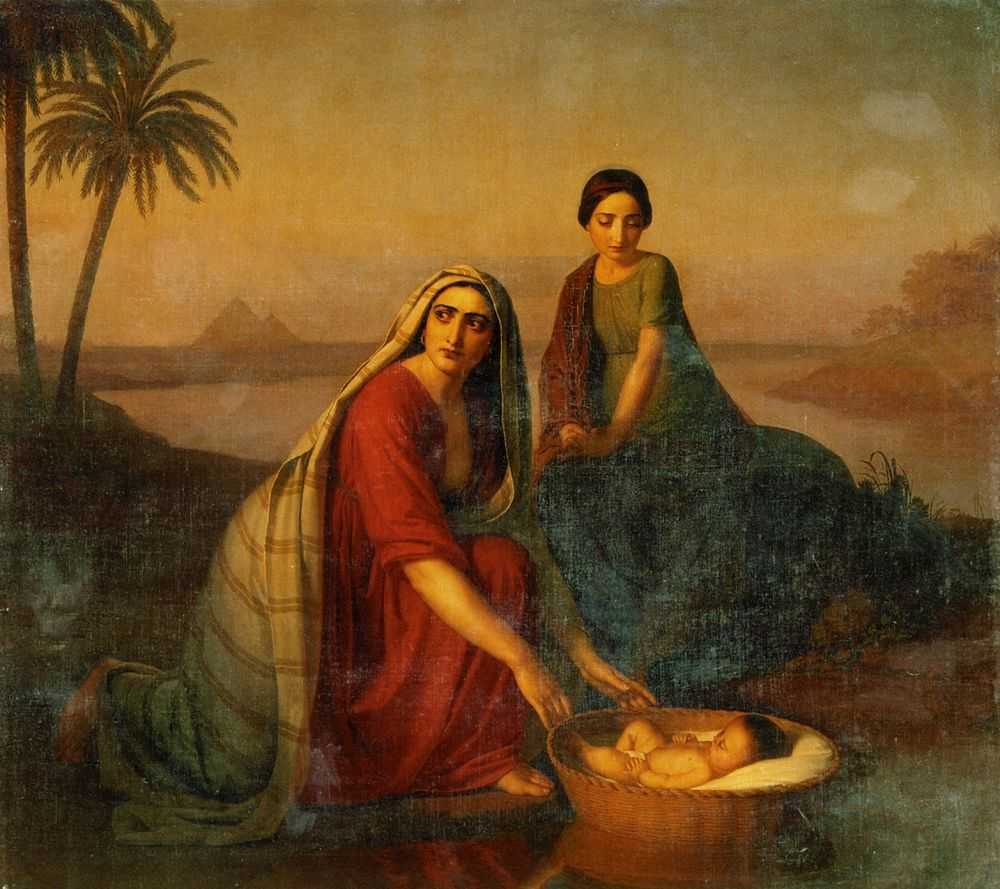
Alexey Tyranox, Moses Being Lowered into the Nile by His Mother (1839-1842)

Alexey Tyranox, Moses Being Lowered into the Nile by His Mother (1839-1842)

Exodus 2: 1-10 The Continued Resistance of Women

Now a man from the house of Levi went and married a Levite woman. 2 The woman conceived and bore a son; and when she saw that he was a fine baby, she hid him three months. 3 When she could hide him no longer she got a papyrus basket for him, and plastered it with bitumen and pitch; she put the child in it and placed it among the reeds on the bank of the river. 4 His sister stood at a distance, to see what would happen to him.

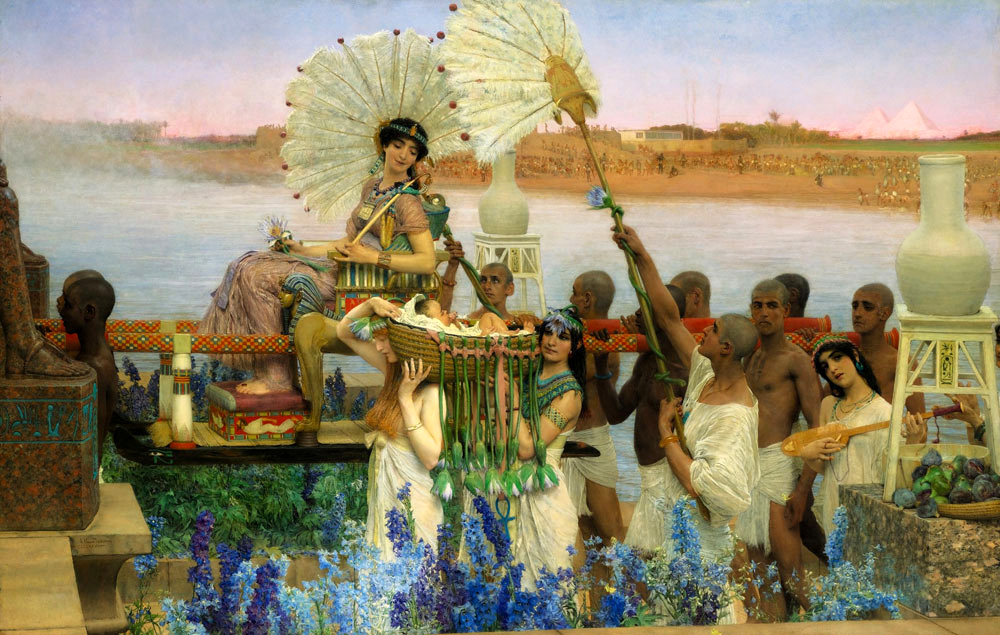
 5 The daughter of Pharaoh came down to bathe at the river, while her attendants walked beside the river. She saw the basket among the reeds and sent her maid to bring it. 6 When she opened it, she saw the child. He was crying, and she took pity on him, “This must be one of the Hebrews’ children,” she said. 7 Then his sister said to Pharaoh’s daughter, “Shall I go and get you a nurse from the Hebrew women to nurse the child for you?” 8 Pharaoh’s daughter said to her, “Yes.” So the girl went and called the child’s mother. 9 Pharaoh’s daughter said to her, “Take this child and nurse it for me, and I will give you your wages.” So the woman took the child and nursed it. 10 When the child grew up, she brought him to Pharaoh’s daughter, and she took him as her son. She named him Moses, “because,” she said, “I drew him out of the water.”

The resistance to the policies of the unnamed king of Egypt begins with Shiphrah and Puah, the Hebrew midwives, and continues with a mother, a daughter of the Hebrews and a daughter of the king’s own household. Even in the time of oppression the Israelites continue to marry and bear children, even though the lives of those children are now threatened by a command to all the people of Egypt. Yet, even in ancient Egypt we hear a memory of the subtle and artful resistance to the abhorrent policies of murder. This one child rescued from being thrown into the Nile will later lead the people out of slavery and into a new calling and identity.

A mother looks upon her newborn son and seeing that, in similar language to the creation narratives in Genesis, that he is good attempts to preserve this small piece of God’s creation she holds in her hands. For three months she manages to keep the child hidden but ultimately the wickedness of humanity forces her, like God sealing up Noah and his family in an ark (and the word for the basket here is the same used for the ark in Genesis), places him in the waters of the Nile-the same waters that Pharaoh demanded the Egyptians cast the Hebrew sons into, and hopes against hope for deliverance from those very waters. The mother moves away from the basket leaving a final hope in God’s unseen hands but his sister, perhaps Miriam but unnamed here, continues to watch.

Deliverance comes from the household of the man who ordered the death of the Hebrew children. This daughter of Pharaoh has nothing to gain by being involved in this story. She could’ve easily allowed the basket to remain undisturbed by human hands and still she sees, she acts, and she becomes the deliverance for this child and a medium God will use in the deliverance of the people. She is able to see in this child the human cost of her father’s oppression and she takes pity and acts. She realizes that this indeed must be one of the Hebrew’s children consigned to death and she hears his cries, much as God will later hear the Israelite’s cries. All throughout this beginning of Exodus it is women who prefigure the ways in which God will act.

The surprising nature of the story continues when the daughter of Moses’ mother speaks openly to the daughter of Pharaoh and together they conspire to save the child’s life. It is Moses’ sister who suggests a subtle resistance that allows the mother of Moses’ to be shielded from losing her son and to be compensated by Pharaoh’s household for resisting the deathly order of Pharaoh himself. Moses will grow to be a child of two worlds, both the world of the Hebrews still connected to his family of birth and connected to the household of Pharaoh where he receives not only protection and privilege but also his name. Yet, like Pharaoh’s daughter, his mother and his sister, he too will see the cost of the oppression around him as a young man and be compelled to act.

Lawrence Alma-Tadema, The Finding of Moses (1904)

Lawrence Alma-Tadema, The Finding of Moses (1904)


Exodus 2: 11-15a: Reacting to the Oppression

 11 One day, after Moses had grown up, he went out to his people and saw their forced labor. He saw an Egyptian beating a Hebrew, one of his kinsfolk. 12 He looked this way and that, and seeing no one he killed the Egyptian and hid him in the sand. 13 When he went out the next day, he saw two Hebrews fighting; and he said to the one who was in the wrong, “Why do you strike your fellow Hebrew?” 14 He answered, “Who made you a ruler and judge over us? Do you mean to kill me as you killed the Egyptian?” Then Moses was afraid and thought, “Surely the thing is known.” 15 When Pharaoh heard of it, he sought to kill Moses.

Moses has grown up as a person of two worlds. He has both his identity as a child brought into the household of Pharaoh as well as his identity as a Hebrew. Perhaps he was shielded during his upbringing from the friction between these two identities but upon seeing the oppression of his people he feels compelled, like God will at the end of chapter two, to act. Moses reacts violently, he feels his kinship with the Hebrew being beaten, and he commits murder. His action may not be a reasoned and calm reaction, most likely we would brand this type of action today a terrorist action, and yet he sees the oppression and feels compelled to act. Perhaps this is something that God sees in Moses, one who cannot stand aside while the powerful abuse the powerless. Moses believes that he is able to act without his action being seen and known, yet he soon finds he is now seen by both sets of peoples as a murder. His fellow Hebrew sees his quest for justice in a different manner, as yet another person who acts with violence to achieve his goals.

Moses’ resistance is more violent and less effective than the resistance of the women who came before him. Moses ultimately ends up fleeing to preserve his life and going from being a person of two people to a man without a people. Yet, he will continue to see and act when he sees those with power taking advantage of those without. Moses will be unable to be the liberator of the people from their oppression on his own, ultimately he, like God, needs to see and to choose how to act. For Moses his actions mean giving up the protection that Pharaoh’s daughter was able to provide for him and he identifies with a people who is not ready to accept him.

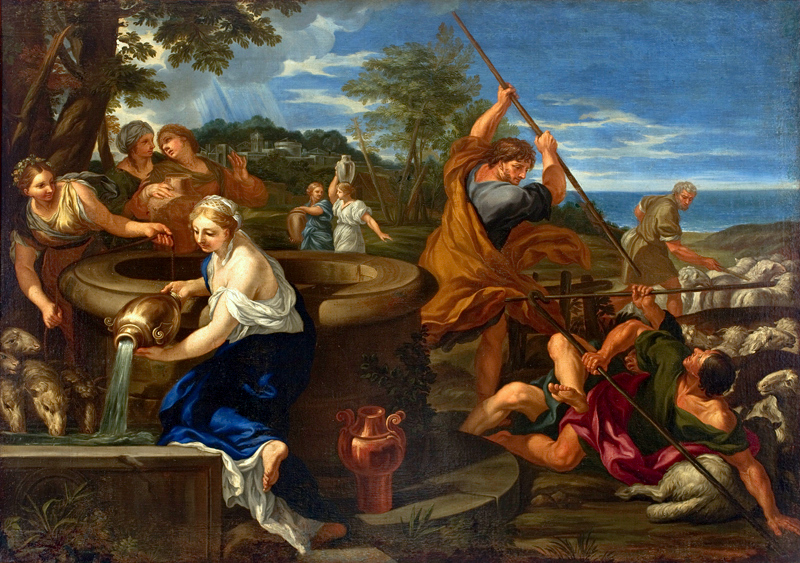
Ciro Ferri, Moses and the Daughters of Jethro (between 1660 and 1689)

Ciro Ferri, Moses and the Daughters of Jethro (between 1660 and 1689)

Exodus 2: 15b-22: An Alien Residing in a Foreign Land

But Moses fled from Pharaoh. He settled in the land of Midian, and sat down by a well. 16 The priest of Midian had seven daughters. They came to draw water, and filled the troughs to water their father’s flock. 17 But some shepherds came and drove them away. Moses got up and came to their defense and watered their flock. 18 When they returned to their father Reuel, he said, “How is it that you have come back so soon today?” 19 They said, “An Egyptian helped us against the shepherds; he even drew water for us and watered the flock.” 20 He said to his daughters, “Where is he? Why did you leave the man? Invite him to break bread.” 21 Moses agreed to stay with the man, and he gave Moses his daughter Zipporah in marriage. 22 She bore a son, and he named him Gershom; for he said, “I have been an alien residing in a foreign land.”

Moses may have fled Egypt but he has not left his sense of justice behind. In Midian, where he comes to rest after his flight, he feels compelled this time to act on behalf of the daughters of Midian who are being harassed by the shepherd in that region and being made to wait until their flocks are watered so they can water their own flock. Moses again acts and breaks what was apparently an ongoing struggle. When their father is surprised by their early return he realizes something must have changed. Moses again sees and chooses to act and this action opens up a new home for the wanderer.

Reuel, the priest of Midian, after inquiring of his daughters about their early arrival challenges them to welcome in this stranger. “Where is he? Why did you leave the man? Invite him to break bread.” Reuel in extending his hospitality to Moses welcomes the alien residing in his land. This hospitality eventually transforms into a new kinship when he gives his daughter, Zipporah, to become Moses’ wife and later bear Moses his son Gershom. Moses now becomes a man of a third people and family and makes his home in the land of Midian away from the empire of Egypt and away from the oppression of the Hebrew people. His choices have led him to a new home away from the homes he knew. He once again is extended the unexpected saving hospitality of another and his life begins again. It will take God’s call to get him to reluctantly return to Egypt and become the one God uses to liberate the Israelites, and yet in his son’s name there is perhaps the longing for home and the identification of displacement he feels being an Egyptian and an Israelite in the household of the priest of Midian.

Exodus 2: 23-25: The God of the Israelites

 23 After a long time the king of Egypt died. The Israelites groaned under their slavery, and cried out. Out of the slavery their cry for help rose up to God. 24 God heard their groaning, and God remembered his covenant with Abraham, Isaac, and Jacob. 25 God looked upon the Israelites, and God took notice of them.

Up to this point in Exodus we have seen a human drama where the Israelites and Egyptians have struggled to live within the fear of Pharaoh. But the God of the Israelites is a God who, like the midwives, Moses’ mother and sister, Pharaoh’s daughter, and ultimately Moses, sees and acts. Unlike the gods of the Egyptians or the many gods of the nations than will surround the Israelites in the promised land the God of Israel has an eye for the oppressed. The pivot of Exodus is here where God hears their cry, God remembers the promises made to Abraham, Isaac and Jacob, God takes notice and God decides to act.

The death of the king of Egypt doesn’t change the position of the Israelite people. Individual policies may have changed and the order to kill infants may not have continued but the people are reduced to cries and groans. They may be numerous but they also feel powerless in their captivity. The God of the Israelites, who is ultimately the God of the whole earth, will challenge the gods of Egypt and their emissaries to bring out of the empire of the day a slave people who might learn to be the covenant people of God.

Psalm 15- Entering the Sacred Presence of God

The Temple by Radojavor@deviantart.com

The Temple by Radojavor@deviantart.com

Psalm 15

 <A Psalm of David.>
1 O LORD, who may abide in your tent? Who may dwell on your holy hill?
2 Those who walk blamelessly, and do what is right, and speak the truth from their heart;
3 who do not slander with their tongue, and do no evil to their friends,
  nor take up a reproach against their neighbors;
4 in whose eyes the wicked are despised, but who honor those who fear the LORD;
  who stand by their oath even to their hurt;
5 who do not lend money at interest, and do not take a bribe against the innocent.
  Those who do these things shall never be moved.

How does one prepare to enter the sacred spaces of the world, those places where the presence of the divine makes holy the profane? In many cultures there are a number of rituals one must undergo to purify oneself and prepare to enter the holy places of the world-those places where heaven and earth seem to meet. Even within the Bible there are places where there are actions that the priest must do to prepare for their tasks and in places like Leviticus 21: 17-21 and Deuteronomy 23: 1-6 there are limits placed upon who may enter the tabernacle or the temple to serve. Yet here, in Psalm 15, as is frequently the case in the Psalms and prophets there is no physical requirements, exclusions or cultic actions that prepares one to enter into the house of the LORD, instead the focus is on the way one lives out one’s relationship with one’s neighbor. Perhaps echoing this Psalm, the prophet Micah can say:

“With what shall I come before the LORD, and bow myself before the God on high?
Shall I come before him with burnt offerings, with calves a year old?
Will the LORD be pleased with thousands of rams, with ten thousand rivers of oil?
Shall I give my firstborn for my transgression, the fruit of my body for the sin of my soul?
He has told you, O mortal, what is good; and what does the LORD require of you
but to do justice, and to love kindness, and to walk humbly with your God. Micah 6: 6-8

In contrast to the duplicitous hearts in Psalm 12 and those who say in their hearts “there is no God” as in Psalm 14, stand the righteous ones who speak truth from the heart and who honor and fear God are allowed to enter into the presence of God.  It is one’s life in relation to one’s neighbor that prepares one to enter into the temple or tabernacle, one’s life in the mundane life of community that is the preparation for the sacred encounter with God. Loving one’s neighbor and living as truthful and righteous people toward the community is preparation for encountering God in the promised communion. As Rolf Jacobson can state, “when the Lord extends an invitation for a person to enter the sacred space, God insists that one’s neighbors are also invited.” (Nancy deClaisse-Walford, 2014, p. 173)

This short Psalm has a number of phrases that point towards what a life that is prepared to see God’s presence not only in the holy spaces but in the normal secular spaces of life as well. Speaking truth from one’s heart refers both to a person whose speech reflect truly their own character but also their character is pure and peaceful as well. The refuse to speak of a neighbor in a way that compromises the person’s participation within the community but instead as Martin Luther can talk about in his explanation to the eighth commandment:

We are to fear and love God, so that we do not tell lies about our neighbors, betray or slander them, or destroy their reputations. Instead we are to come to their defense, speak well of them, and interpret everything they do in the best possible light. (Luther, A Contemporary Translation of Luther’s Small Catechism, 1978, p. 20)

While we may struggle a little initially with the language of, “in whose eyes the wicked are despised” there is a strong need for the community not to tolerate or ignore things that are contrary to the justice their God has called for. When we turn a blind eye or accept, for example, the abuse of children or the oppression of the homeless then we have also turned away from the God who cares for the children and the vulnerable. After wrestling with Deuteronomy and Jeremiah I’ve come to appreciate the urgency the people of Israel felt for attempting to create a society that lived into the vision God called them to. A trustworthy society where the words and actions represented the God’s dream for them and the world. A society where mercy for one’s neighbor was more important than profit one could make upon one’s neighbor by charging interest to them in their need.

The Psalm is a bold vision and a vision that is challenging in our time. It is a vision that looks at holiness in terms of how we treat our neighbors rather than some version of piety or orthodoxy. In this Psalm and in many other places, particularly in the Psalms and prophets, issues of proper attire or cultic actions are disregarded or at least given a far lower place than one’s relationship with the neighbor. In the Sermon on the Mount, Jesus can echo this sentiment when he talks about leaving one’s gift before the altar to be reconciled to one’s neighbor (Matthew 5: 23-24). In contrast to the previous three Psalms, where one finds oneself in the position where the wicked seem to be prospering, the Psalmist now returns to the vision of the first Psalm, where the LORD watches over the righteous and they will not be moved. Their words and their actions truthfully come out of their heart and even when their truthful words and actions or their willingness to stand with their neighbor causes them hurt they are not moved. They look at the world through the lens of mercy rather than profit, through the lens of love rather than acquisition and they are perhaps ready to enter into the sacred spaces of the world where God meets them because they lived a godly life in the secular places of life.

Psalm 14- The Wisdom of Holding to the Covenant

Jozsef Somogyi's statue of the Tired Man in Mako, Hungary

Jozsef Somogyi’s statue of the Tired Man in Mako, Hungary

Psalm 14

To the leader. Of David.
1 Fools say in their hearts, “There is no God.”
   They are corrupt, they do abominable deeds;
   there is no one who does good.
2 The LORD looks down from heaven on humankind
   to see if there are any who are wise,
   who seek after God.
3 They have all gone astray, they are all alike perverse;
   there is no one who does good,
   no, not one.
4 Have they no knowledge, all the evildoers
   who eat up my people as they eat bread,
   and do not call upon the LORD?
5 There they shall be in great terror,
   for God is with the company of the righteous.
6 You would confound the plans of the poor,
   but the LORD is their refuge.
7 O that deliverance for Israel would come from Zion!
   When the LORD restores the fortunes of his people,
   Jacob will rejoice; Israel will be glad.

In the ancient Middle East the idea of a godless world is unknown. However, in the Psalmist’s time and in every time there are those who functioned as practical atheists, whose spoken beliefs had little or no impact on their decisions throughout their lives. The heart in the Hebrew world view was not the seat of emotion but the seat of decision making and will. The heart is where actions spring from. Note that the Psalm does not say ‘Fools say with their mouths’ but ‘Fools say in their hearts.’ As the Psalm unfolds we see the way that the foolish actions are really actions against the covenant that God has made with the people of Israel. The LORD looks for those who are seeking the will of God. As Psalm 1 can state, “but their (the wise/righteous) delight is in the law of the LORD, and on his law they meditate day and night.” (Psalm 1.2)

The fool is known by what they do and their actions reflect a betrayal of the justice that was considered essential to the covenant.  The book of Deuteronomy dwells frequently on the fear that the people in prosperity will “forget the LORD their God, by failing to keep his commandments, his ordinances and his statutes,” (Deuteronomy 8. 11) and the poor, the widow, the orphan and the alien will be denied justice. When the acquisition of wealth becomes more important than the neighbor then the people have forgotten the LORD their God. When the people turn away from placing God at the center of their day to day actions and decisions the result is the perversion of the covenant people. They are no longer the salt of the earth but rather they are corrupt and their corruption spreads to everything around them. The actions of the people have consequences for not only themselves, but also for the community and the very land that they live upon.

The language of the Psalm also reaches into the language of the prophetic. The dark line speaking about the wicked “who eat up my people as they eat bread,” reaches a fuller exposition in Micah. In Micah, speaking to the rulers who have turned away from the covenant, the prophet can say:

you who hate good and love evil, who tear the skin off my people, and the flesh off their bones, who eat the flesh of my people, flay their skin off them, break their bones in pieces, and chop them up like meat in a kettle, like flesh in a caldron. (Micah 3. 2f.)

And yet these same leaders may use their words to cry upon the LORD, but God will not answer them.

Unlike Psalm 13 which cries out for immediate action, Psalm 14 takes more of a tone of the inevitability of God’s action on behalf of the poor. The hearer is cautioned to take the way of the wise and the side of the poor for that is the side of God. God hears and sees and protects the powerless and the vulnerable. Those wise whose hearts are turned to God know that their actions towards the vulnerable and the powerless are also seen and weighed by God.

A biblical image that comes to mind with this Psalm is the ending of Solomon’s reign and the beginning of his son, Rehoboam’s reign. Solomon is initially lifted up as being wise and following the way of the LORD but in 1 Kings 11 Solomon’s heart is turned away from the LORD. When he dies and his son takes the throne there is already conflict within the nation of Israel, the economic policies of Solomon have placed a heavy burden on the population and the assembly of Israel asks for relief from Rehoboam. Rehoboam refuses to relieve any of the economic burdens on the people and the kingdom is spit in two, never to be united again. (1 Kings 12) The book of Kings looks upon this split as God’s judgment upon the house of David for turning their heart away from the LORD, even though God did not act in supernatural ways but rather simply didn’t sustain the reign of the line of David over the entire house of Israel.

So how do we approach this Psalm in our secular world that is influenced by global economic corporations? For me the Psalm speaks to the faithful as a way of remembering what is it to set one’s heart upon the LORD and how loving the LORD with all one’s heart, soul, mind and strength is linked to loving and protecting one’s neighbor. When we forget this connection we too can become corrupt and allow the community and the environment around us to become corrupted by short term economic interests at the expense of our neighbor. Entering into the prophetic worldview of the scriptures forces us to consider the impact of the decisions we make upon the life of my neighbor’s and especially the lives of the vulnerable.