We enter into a world full of broken people and shattered stories
Am I my brother’s keeper? Who is my neighbor and who can I ignore? Can’t I just send the crowds away with their insatiable appetite and needs? Or ignore the foreigner on my doorstep who cries out for her daughter? Who can I, in my mental and physical fatigue, exclude so I don’t see? Where can I go to escape the cries of creation that fill my ears? In the highest heaven they ascend to God rending the creator’s heart And they echo from the walls of the endless abyss creating a hell of brokenness I don’t want to see, I don’t want to care, I want to block it out To plug my ears, cover my eyes, harden my heart and distract my mind To hear no evil, see no evil and to feel no compulsion to speak back to evil To wall my broken heart away behind immense walls of cold stone Some safe shelter where I can isolate myself from the needs of the world To buy in to the promise of despair, that in giving up hope I can save myself That the promises of the kingdom of God are not worth the birth pangs of creation And that by pulling away and shutting out the world that the pain may simply cease From a young child I was taught to hide the feelings, the emotions, the pain That to be a man was to be like some distant unloving picture of a god Who was unaffected and unattached to the world around him Whose heart did not break, but rather this deistic god was unmoved And to live a life in that stoic god’s image was not to feel, not to love For in feeling there was fault and in love there was weakness And to be weak was to fail and to fail was to be worthless It was a god that seemed to demand nothing and to give nothing But its sacrifice was the very marrow of life, it sucked dry the bones Exchanging the risk of love for the a hollow security of disconnection For in love there is joy and pain, in losing there is loss and gain And I could never exchange the fleshy heart in my breast for a stone one Yet, from a young child I was taught to hide the feelings, the emotions, the pain As a man I began to realize the pain and cries of a loving God Foolish enough to love the world, to cry for its hurts, to enter its rejection A God of crazy dreams of new creation that emerges out of the brokenness Where shattered shields and broken spears become the instruments of harvest time Where even in the midst of death, life can emerge from an unending well of love That the world in all its broken people and shattered stories can be taken in That it can be loved, not because it is loveable but because that is what the softhearted do And that perhaps, in a company of bumbling fools who dare to hope and dream Who put aside the false promise of despair and have the courage to love God’s beloved That perhaps in those moments where stones slowly removed change mountains We see the hope that the creation has long been waiting for The instruments of God’s work being those who can take up the sensitivity of a child To see the world as it is and to dare to believe that it can be better And that the discomfort I feel is not weakness, but the strength of a soft heart A heart not content to be locked behind walls of stone separate from the world But rather that sees the evil, hears the evil and dares to speak and name the evil And perhaps to do my small part in the struggle, for the dream of a better world A world of compassion and justice and joy and love, the world that could be To dream and speak that world into being one small act of love at a time A world where hearts of stone are replaced by soft fleshy hearts That dare to love, the courage to hope and the audacity to dream Of a time where tears are wiped away, where pains are healed And we can enter into a world of healed people and mended lives Neil White, 2014Tag Archives: Hope
Quiet Courage
We see it everyday and seldom give it a second thoughtFor the courage we are trained to see rests in the extraordinary
Acts of heroism that loudly demand us to stand up and take notice
But far more common and often more daring is the quiet courage
The daily decision to enter into the little battles to make it past our fears
A refusal to let the past failures place a limit on the futures potential
The silent struggles against illness, weakness, depression and fatigue
Courageously embracing the pain we carry with us without losing hope
Hope that someday the unseen struggle will light a better way
For us or for those who will follow in the footsteps and pathways
We leave behind us in the sedimentary soil of others’ pasts
And perhaps the sun that will light the skies of tomorrow
Will not be the short burning explosion of one time heroics
But the billions of small flames of quiet courage that are lit that day Neil White, 2014
Re-enchantment-A Poem
The demons and angels and magical forces that reigned in the world no longer hold sway
In a world of people governed by rules and laws and discipline, order and civility
In the grave seriousness of the moment where the past is closed off
And fairy tales and ghost stories belong to the world of children
Walled off from the worlds of imagination in our buffered realities
Carefully constructed to ward off the shock of the unknown
Ballasted with the bulwarks of certainty to hold off the devilry of doubt
Where the only monsters left are ourselves
Yet our souls were never created to inhabit a mechanistic world
Nor our spirits excommunicated from our body
For all our science, suffering still calls out for an answer
For some new type of heroism that might call us from the banality of a disenchanted world
Yearning not merely for some romanticized past but a present that is not ultimate
To move us again to the transcendence of our excarnate realities and disembodied feelings
To the incarnate immanence that can somehow re-enchant the cosmos
Allowing the winds of creation to penetrate the armor of our buffered reality
And breathing free the breath of God in the midst of the polluted heavens
Neil White, 2014
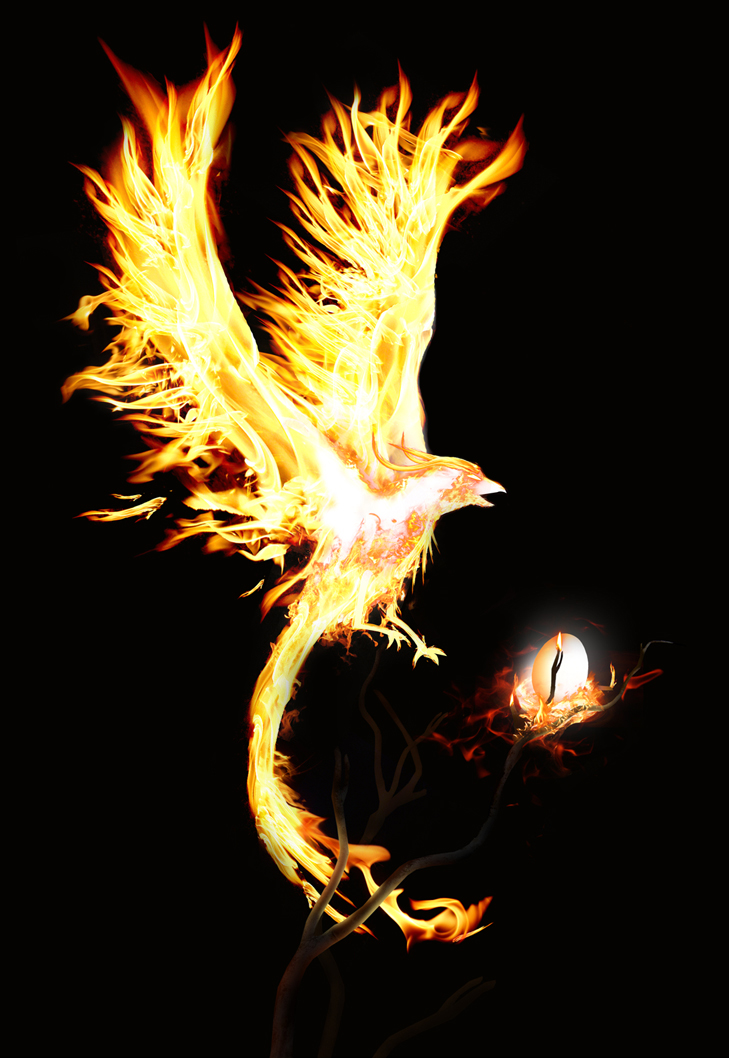
Phoenix Rising- A Poem
Rising from the ashes of a past that consumed the dreams of the day
Embracing the rising sun of the new life and possibilities
The flaming pyre that were supposed to consume me
Became the necessary predecessor to resurrection
As the strength long lost returns as the desperation of the past dies
The pinions once clipped to prevent flight have regenerated stronger than ever
As the fiery feathers cover my contours radiate life and light
And my brightly covered wings yearn to taste the breath of the heavens
The phoenix rises from the ash pile of the past
To boldly fly into a new future, to climb the updrafts
And return his magic to the kingdom of the air
Neil White, 2013
The Scars of the Past
We all bear the marks of
Mistakes made that cannot be undone
Hearts broken by betrayal
Regrets of roads not taken
Days when dreams are dashed
False hopes that proved to be illusions
And the wear and tear of life
That left scar tissue in the places
Where we knit ourselves back together
Most days the scars blend into the background
Blending in with the rest of us that is good and whole
Yet, sometimes the scars burn red hot
As old wounds are reopened
As an instant takes us back to the mistakes of yesterday
When our hearts are broken anew
When doors close
When our dreams seem to slip through our fingers
And the wear and tear of life
Tears at the skin still trying to make itself whole again
We all have scars and wounds
We all are in the process of healing
In this journey we call life
Sometimes we are able to bind another’s wounds
Othertimes we can only sit by holding a hand
Praying they will stop wounding themselves
Sometimes all we can see are the scars of the past
Unable to see the living tissue that moves towards tomorrow
But our scars, though they mark us
They do not make us
We walk towards the day when mistakes are forgiven
When hearts are healed by love
When we can choose the road of our destiny
When we dare to chase our dreams again
Where hope does not disappoint
And where the laughter and love of life
Allow us to accept ourselves as we are
As whole, even able to accept the beauty
Of the scars of the past
Neil White, 2013
La Magdalena
A poem inspired by Michael Parkes’ picture ‘La Magdalena’ and by extension Mary Magdalene. La Magdalena is a copyrighted image but click the link at the name to see the image that inspired the poem.
The cards of destiny were stacked against me
No hearts or diamonds, only clubs and spades
The scars of my past and the demons of my present
Howl for my skull in the fish town of Magdala
Outcast. Harlot. Sinner. Prostitute. Pariah.
The names and titles I bear before the world
A lover, unloved.
A heart shattered under the weight of misdeeds, real and imagined
No longer whole, but made to be defiled
Invisible to all who might help, a face unseen and a voice unheard
In the dust-filled wilderness of my captivity
No sun or moon or stars to light my way underneath the brimstone skies
A future damned by the past which forced itself upon me and violated my soul
No way to master the rock of my shame
Liberated from the demonic debris of my desolation
From the top of the boulder of an identity I could not remove
I let the cards of destiny fly in the wind
The darkness of the night gives way to a new dawn
Death dies to make way for the fecundity of a new creation
The sinner becomes the saint. The outcast becomes the sister.
The harlot is drawn near by the friend of sinners and tax-collectors
The pariah becomes the disciple
The unloved one will see love itself die and be reborn
For no tomb can contain love
I will be the first, but not the last, to weep tears of joy for a tomb opened
The gates of Gehenna shattered and the prisoners of Hades set free
Freed from having to seek a better past I sit upon the rock of eternity
Watching the beginning of the life of the new eon
Leaving the wastelands behind, I journey towards the horizon
composed Neil White, 2013
The Place of Authority: A Brief History Part 3b: The Exile, Reconstructing Identity-Narrative, Practice and Hope
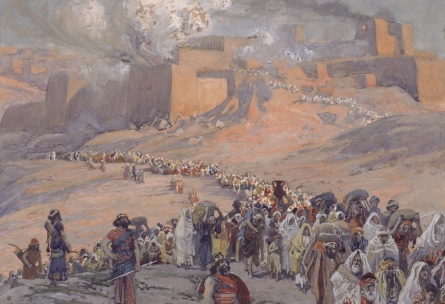
James Tissot, The Flight of the Prisoners
Thus says the Lord of hosts, the God of Israel, to all the exiles whom I have sent into exile from Jerusalem to Babylon: Build houses and live in them; plant gardens and eat what they produce. Take wives and have sons and daughters; take wives for your sons, and give your daughters in marriage that they bear sons and daughters; multiply there, and do not decrease. But seek the welfares of the city where I have sent you into exile, and pray to the Lord on its behalf, for in its welfare you will find your welfare. Jeremiah 29. 4-7 NRSV
Even when the world as you know it ends, life still goes on, and we have to make sense of the conflict, the struggle and our place within it. The communal memory becomes important, the stories parents have told their children, the history of families. In the midst of competing narratives what is the story that one can identify with? With the loss of the Davidic monarchy, the temple, the land of their ancestors the people did something amazing, they recast their identity. They dug deep into their narrative, they began bringing together their stories, and in fact much of the Old Testament is brought together at this point. Stories of creation and exodus begin to be the patterns in which the present is made sensible and the community begins to come up with answers to the hardest question, “why did this happen?” They don’t come up with just one answer, they come up with many. They bring together their stories and the Torah (typically translated into English as law, but it is a term that is much more than what we understand as law in our context) begins to be center of their life. Practice and story come together to bind together this community in exile.
This does not mean that everyone agrees, there is not a central authorizing authority for the narrative at this point, it is constructed mainly by the remnant of the elite (everyone else would have been illiterate at this point) from both the priestly and prophetic side. Some of the central ideas to emerge include:
Justice: a sense of living in harmony (shalom) with God’s desire for the way things are to be structured in society. This includes a strong sense of economic justice, compassion for the widows, orphan, immigrant, and the dispossessed. It is from this vision that many prophets operate out of, and this is a central image for the prophetic hope. The new Jerusalem, the new Israel is to be a place of justice where the nations around can look and say “Come, let us go up to the mountain of the Lord, to the house of Jacob; that he may teach us his ways and that we may walk in his paths” (Isaiah 3b, NRSV) and within God’s plan the nations will stream to Jerusalem.
Purity/Holiness: For us there is often a tension between Purity/Holiness and Justice, but it was not necessarily seen that way by the Jewish people. Especially for priests there are practices that are to be done to prevent the contamination of unholiness from infecting them as a people and making them repulsive to the holiness of God. It also becomes a powerful way of distinguishing between themselves as a Hebrew people and the nations around them who are the Gentiles, the unclean ones. This tends to be more of a priestly focus and there are conflicts between which will dominate going forward, but at the root both justice and holiness are practices which distinguish them from the hostile surrounding culture.
With these two distinctive directions emerges a new strand of a hope for a new beginning, a new temple, a New Jerusalem, a new anointed (and Davidic) king, a messiah. Wrapped up within the memory of the stories of creation and the exodus of the people from Egypt hope springs forth of a return home and a new beginning:
Do not remember the former things, or consider the things of old. I am about to do a new thing: now it springs forth, do you not perceive it? I will make away in the wilderness and rivers in the desert. The wild animals will honor me, the jackals and the ostriches; for I give water in the wilderness, rivers in the desert, to give drink to my chosen people, the people who I formed for myself so that they might declare my praise. Isaiah 43.18-21
2nd Isaiah (Isaiah 40-55, which reflects the time of preparation for the return home, while Isaiah 1-39 deals with the time before the exile) in particular is full of this vibrant hope, along with other voices. Empires rise and empires fall, and a generation later Babylon falls to Persia (modern day Iran) and Cyrus (who Isaiah interestingly calls Messiah/Christ-same word in Hebrew/Greek) makes possible the beginning of a return home. Their stories and practices have maintained their identity and given them hope of a new beginning. With the return to Jerusalem, the land, and the possibility of reconstructing the temple comes yet another transition. It is to that transition that we turn next.