Review of D-Day:June 6, 1944: The Climactic Battle of World War II by Stephen Ambrose (1994)
For me a five-star book is something that either I want to read again or something that is so profound it makes an immediate impact. There are lots of ways that books can be compelling: a unique idea, an interesting set of characters, a complex plot, an artistic use of the English language and more. Reading is also a subjective experience, so what appeals to me as a reader may be very different for you. I read a lot for both pleasure and work, but these short reviews are a way for me to show my appreciation for the work and the craft of the author of the reviewed work.
Stephen Ambrose’s phenomenal telling of D-Day accomplishes the daunting task of bringing together the first-person experiences of both allied and axis soldiers, placing the experiences together with the units and locations within the overall plan and execution of the D-Day invasion of Normandy. This is like a mosaic where the author takes a variety of perspectives on the invasion and places them together into a coherent picture which still conveys the chaos the soldiers often felt on the beaches. The first third of the book examines the preparations for the invasion. Stephen Ambrose is able to narrate the personalities and styles of both Eisenhower and Rommel who were the respective commanders on D-Day as well as the command structures they operated within. The D-Day invasion was involved a mammoth effort of logistics and construction to mount and the author walks the reader through the construction of the landing craft, the planning of the invasion and the disinformation campaigns designed to keep German forces away from the landing site, and the training of the soldiers, sailors, and coast guardsmen who would conduct the landing and axis construction and forces designated to repel the invasion. The preparation was critical, and it both made the invasion possible and saved lives, but the book demonstrates all the ways that the plans for the invasion could not account for the reality the soldiers on the beach or who were dropped behind the beach encountered. Moving from west to east he narrates the individual experiences of the battle beginning with the experiences of the 82nd and 101st Airborne Divisions in their night drop and ending with the British 6th Airborne Division on the eastern edge of the battlefield. Particularly with the airborne landings and the 16th and 116th Regiments landing on Omaha beach, the author does an excellent job of portraying the chaotic environment that soldiers found themselves in. The battle in these spaces often relied on junior officers and non-commissioned officers rallying any soldiers they could gather and the training these soldiers received. The book does a good job of combining the epic scale of the invasion with the narrow experiences of the individuals who were a part of this. It was readable and comprehensive at the same time, and I greatly appreciate the dedication and devotion that went into this massive narration of one of the critical days of World War II.
Grigory Mekheev, Exodus (2000) artist shared work under Creative Commons Attribution-Share Alike 3.0
Psalm 106
1Praise the LORD! O give thanks to the LORD, for he is good; for his steadfast love endures forever. 2Who can utter the mighty doings of the LORD, or declare all his praise? 3Happy are those who observe justice, who do righteousness at all times. 4Remember me, O LORD, when you show favor to your people; help me when you deliver them; 5that I may see the prosperity of your chosen ones, that I may rejoice in the gladness of your nation, that I may glory in your heritage. 6Both we and our ancestors have sinned; we have committed iniquity, have done wickedly. 7Our ancestors, when they were in Egypt, did not consider your wonderful works; they did not remember the abundance of your steadfast love, but rebelled against the Most High at the Red Sea. 8Yet he saved them for his name’s sake, so that he might make known his mighty power. 9He rebuked the Red Sea, and it became dry; he led them through the deep as through a desert. 10So he saved them from the hand of the foe, and delivered them from the hand of the enemy. 11The waters covered their adversaries; not one of them was left. 12Then they believed his words; they sang his praise. 13But they soon forgot his works; they did not wait for his counsel. 14But they had a wanton craving in the wilderness, and put God to the test in the desert; 15he gave them what they asked, but sent a wasting disease among them. 16They were jealous of Moses in the camp, and of Aaron, the holy one of the LORD. 17The earth opened and swallowed up Dathan, and covered the faction of Abiram. 18Fire also broke out in their company; the flame burned up the wicked. 19They made a calf at Horeb and worshiped a cast image. 20They exchanged the glory of God for the image of an ox that eats grass. 21They forgot God, their Savior, who had done great things in Egypt, 22wondrous works in the land of Ham, and awesome deeds by the Red Sea. 23Therefore he said he would destroy them — had not Moses, his chosen one, stood in the breach before him, to turn away his wrath from destroying them. 24Then they despised the pleasant land, having no faith in his promise. 25They grumbled in their tents, and did not obey the voice of the LORD.
26Therefore he raised his hand and swore to them that he would make them fall in the wilderness, 27and would disperse their descendants among the nations, scattering them over the lands. 28Then they attached themselves to the Baal of Peor, and ate sacrifices offered to the dead; 29they provoked the LORD to anger with their deeds, and a plague broke out among them. 30Then Phinehas stood up and interceded, and the plague was stopped. 31And that has been reckoned to him as righteousness from generation to generation forever. 32They angered the LORD at the waters of Meribah, and it went ill with Moses on their account; 33for they made his spirit bitter, and he spoke words that were rash. 34They did not destroy the peoples, as the LORD commanded them, 35but they mingled with the nations and learned to do as they did. 36They served their idols, which became a snare to them. 37They sacrificed their sons and their daughters to the demons; 38they poured out innocent blood, the blood of their sons and daughters, whom they sacrificed to the idols of Canaan; and the land was polluted with blood. 39Thus they became unclean by their acts, and prostituted themselves in their doings. 40Then the anger of the LORD was kindled against his people, and he abhorred his heritage; 41he gave them into the hand of the nations, so that those who hated them ruled over them. 42Their enemies oppressed them, and they were brought into subjection under their power. 43Many times he delivered them, but they were rebellious in their purposes, and were brought low through their iniquity. 44Nevertheless he regarded their distress when he heard their cry. 45For their sake he remembered his covenant, and showed compassion according to the abundance of his steadfast love. 46He caused them to be pitied by all who held them captive. 47Save us, O LORD our God, and gather us from among the nations, that we may give thanks to your holy name and glory in your praise. 48Blessed be the LORD, the God of Israel, from everlasting to everlasting. And let all the people say, “Amen.” Praise the LORD!
Psalms 105 and 106 form two complementary but very different lenses to examine the history of God and God’s people. Like the yin and yang in Chinese philosophy represents two opposite but connected forces, these two psalms are connected by an understanding of God’s steadfast love operating throughout the story of Israel, but where Psalm 105 is a psalm which accentuates the positive aspect of the relationship Psalm 106 eliminates the positive aspects of the relationship from the side of Israel. (Nancy deClaisse-Walford, 2014, p. 796) God has remained faithful despite Israel’s history of unfaithfulness. Psalm 106 reminds us that any telling of the story of God’s people is a story of a people who are disobedient and unworthy of the steadfast love they have received, and the psalmist cries out to God not because they are worthy but because the LORD is a God nature is to be a God who is merciful and gracious, slow to anger, and abounding in steadfast love and faithfulness. (Exodus 34:6)
The confession of Psalm 106 emphasizes the unworthiness of God’s people of receiving the gracious actions of God on their behalf. It echoes the sentiment of Isaiah standing before God stating, “Woe is me! I am lost, for I am a man of unclean lips, and I live among a people of unclean lips; yet my eyes have seen the King, the LORD of hosts.” (Isaiah 6:5) For the psalmist, the LORD is good, and God’s steadfast love endures forever but in contrast none of the people of God can utter the mighty works of God without the realization that they are a people of unclean lips and actions. Yet, this psalmist joins himself to the people in need of rescue and God’s unmerited provision and protection. Happy/blessed[1] are those who observe justice is “an ironic beatitude”[2] (Nancy deClaisse-Walford, 2014, p. 801) since the remainder of the psalm will demonstrate how the people have failed to observe justice and maintain righteousness throughout their journey with God. The psalmist longs to enjoy the prosperity of God’s chosen ones, the gladness of the people of God, and the glory of God’s heritage but they also know that they and their ancestors have fallen short of their calling as the people of God. Instead of living in justice they have lived in iniquity, instead of righteousness they have produced wickedness. The psalmist’s words of confession place them before God needing forgiveness and redemption. Unworthy of grace but longing for it. This is an act of remembering what has been forgotten that they may learn from the mistakes of their ancestors and live into their calling under the covenant.
Even in Egypt, surrounded by the fearful power of God’s signs and wonders to bring this enslaved people out of their bondage to Pharoah, the people take God’s actions on their behalf for granted. Once they arrive at the Red Sea, they fail to trust in the God who delivered them from Egypt and again God acts for their deliverance, but early in this telling God is acting for the sake of God’s name. These mighty acts in Egypt and at the Red Sea bring a momentary faithfulness and trust in the LORD, but quickly the people resort to grumbling against both God and God’s emissaries. The psalm narrates in quick succession the rebellions of Israel articulated in Numbers 11-17 and the creation of the Golden Calf in Exodus 32. All of Israel’s rebellions are tied to their forgetfulness of the mighty works God had done on their behalf to bring them out of Egypt and to sustain them in the wilderness. Moses stands in the breach for the people and intercedes with God on their behalf, calling God back to God’s self-articulated identity in Exodus 34:6-7 and God continues to bring them to the promised land.
On arriving in the promised land, the people continue to forget what their God has done to bring them out of Egypt and through the wilderness and ‘they despised the pleasant land’ which leads to the generation falling in the wilderness prior to the entry into the promised land. They intermarry with women of Moab and begin to adopt the practices of the Moabites, including the worship of Baal of Peor (Numbers 25) when Aaron’s son Phineas zealously fights against the idolatrous actions of the people and turns aside God’s wrath. Even Moses is made bitter and claims to bring forth the waters at Meribah instead of continuing to point to God’s action of provision (Numbers 20).
Even when the people occupy the promised land under Joshua, they fail to carry out the LORD’s instructions for their claiming of the land. They do not drive the people out and they eventually intermarry with the residents of the land and adopt their practices. This brief retelling of the people’s history of unfaithfulness only alludes to the cyclical nature of disobedience and rescue articulated in Judges when it indicates that ‘Many times he delivered them.’ Throughout this narrative poem the people’s unrighteousness has been contrasted with God’s continuing actions of faithfulness to come to the people’s deliverance in their time of disaster and need.
The final verses of the poem indicate a time where they are in exile among the nations, and yet even in this exile away from the land God has caused them to be pitied by their captors. They long for a time when God acts to gather them from among the nations and bring them home, not because they have earned God’s favor but due to God’s gracious and forgiving nature. The final verse closes both this psalm and book four of the psalter. Psalms 105 and 106 belong together as two narrations of the history of God and God’s people and it is worth noting that while the psalm in 1 Chronicles 16 appointed by David begins with Psalm 105: 1-11 it ends with Psalm 106:35-36. These two narratives which close book four demonstrate that praise and the confession are two halves of the songs and stories of the people of God. God is a gracious God of steadfast love and faithfulness and yet the people and their ancestors have sinned and fallen short of their calling as the people of God.
The scriptures that both Christians and our Jewish ancestors have inherited are a deeply varied collection of works that attempt to make sense of the encounter between the people of God, the world around them, and the God who has called them. The reality that our scriptures include a narration of Israel’s story that does not attempt to hide their history of unfaithfulness is exceptional because many ancient histories[3] attempt to hide the stories that paints a nation in an unflattering light. Confession is a part of the life of the people of Go and I believe that in a world that attempts to conceal or deny any foolishness, wickedness, or unfaithfulness it is essential for people of faith to begin with the reality that we have fallen short of God’s vision for our lives. We have failed to fear, love, and trust God above all things and that has led us not to love our neighbors as ourselves. Yet, the God of the scriptures is a God who is merciful and gracious who often responds not as we deserve but out of the abundance of God’s steadfast love and faithfulness.
[1] The Hebrew ‘asre is typically an indication of wisdom literature contrasting the way of the good/just/righteous/wise with the bad/unjust/evil/foolish. Is often translated ‘happy’ in the Old Testament. In Greek it is translated as markarios which is rendered ‘blessed’ in the New Testament (see for example the Sermon on the Mount).
[2] Rolf A. Jacobson captures this term insightfully since ‘beatitude’ comes from ‘blessed’ which is what ‘asre points to.
[3] This is not exclusive to ancient retellings of history as the ongoing debate about how to teach history in my own country shows. History can easily fall into propaganda and all true historical narratives have both heroic and tragic elements. Yet, history is often closely tied to identity and in an age of bespoke realities, to use a phrase I learned from studying social media, we often shape our historical remembrances to fit our preferred view of our group. We, like the ancient Israelites, also stand in need of narratives of confession.
An Old Woman Reading, Probably the Prophetess Hannah by Rembrandt (1631)
G.K. Chesterton once wrote, “Though St. John the Evangelist saw any strange monsters in his vision, he saw no creature so wild as one of his own commentators.”(Richard B. Hays and Stefan Alkier, 2012, p. 11) Particularly in the last couple hundred years we have seen some strange creatures emerge as interpreters of Revelation. Certain groups within Christianity, who are looking for certainty and answers, have found the book of Revelation as an irresistible puzzle to decode as they attempt to find a way to predict the future. Yet, the church has always puzzled with how to use the book of Revelation. While its original readers would have heard this as a text in a way that helped make sense of their position as a small minority in a hostile empire the position of the church in society would continue change. How does a church which eventually would become the religion of the land deal with these odd visions? Sometimes Revelation would be virtually ignored within the larger canon of the scriptures, while at other times it would capture the imagination of writers, interpreters, and artists.
John, the stated author of Revelation, probably writes somewhere between the year 80 and 100. The book of Revelation, as it is originally written, is a sharp challenge to the claims made by the Roman empire. As Christianity strove for recognition within the Roman empire Christian apologists tended to distance the anti-imperial rhetoric from the way they discussed Revelation. Revelation’s images would be used by early witnesses of the western church, like Justin Martyr and Ireneaus, in their apologetics to attempt to show how Christianity was related to Judaism. Ireneaus in his conflict with Marcion used the image of the four beasts around the throne to argue why there should be four gospels in contrast to Marcion who wanted only an edited version of Luke’s gospel along with Paul’s letters. In the eastern church the book of Revelation received even less usage. Dionysius of Alexandria (d. ca. 254) showed that the Revelation and the Gospel of John could not have been written by the same person due to literary form, writing style, and theological content. The church historian Eusebius (d. 339) listed Revelation as one of the recognized books but acknowledged that some grouped it with the rejected writings. The first known commentary on Revelation wasn’t written until the end of the second century by Victorinus of Pettau (d. 304) and this work would inform many future writings on Revelation. As Craig Koester can relate on this commentary, “In his view, the vision of the Lamb breaking the seals on God’s scroll shows that Christ reveals the meaning of Scripture through his death and resurrection (In Apoc. 1.4; 4.1-5:3; Huber, “Aspekte”). Like many modern interpreters, Victorinus observed that the beast has traits of the Roman emperors, especially Nero.” (Koester, 2014, p. 33)
In the time after the edict of Milan (313), which made Christianity tolerated throughout the Roman empire, the church had a new struggle: to define the faith. Within this struggle to articulate how they would talk about who Jesus was and how Jesus was related to God images from Revelation would continue to play their role along with the gospels and letters of Paul. Particularly the identity of Christ as the Alpha and the Omega would become decisive for the way the church would talk about Jesus in the time after the council of Nicea (325). In this time artwork of Christ victory and reign over the world would begin to integrate Revelation motifs. Yet, the Roman empire itself would be challenged by both internal and external forces and as Christianity continued to exist in this world Revelation would provide some of the theologians of the church a lens to view the world. St. Augustine’s adapted a reading of Revelation (from Tyconius) which saw a conflict between the city of God and the city of the world: interpreting both the present age but also the internal spiritual struggle between the powers of sin and grace in the life of the believer. St. Jerome, best known for his translation of the bible into Latin, created his own spiritualistic reading of Revelation where separating oneself from Babylon means resisting sin, but it may also involve retreating to a monastic lifestyle.
The Medieval Period (500-1000) would see Rome’s empire divided: North Africa would be captured by Islamic forces, Germanic kingdoms would rise in the west and the Byzantine empire would rise in the east. It was a time of plagues and instability, of invasions by Vikings from the north and Magyars from the Balkans. During this time of instability the church continued to grow in power and influence. There would be frequent calls for reform of the church but frequently these reforms would be resisted by the church’s leadership. This resistance made some turn Revelation’s vision of Babylon into a critique of the papacy—which would continue into the sixteenth century and beyond. In the late Medieval period, Joachim of Fiore’s (d. 1202) mystical view of history where there were three ages (the age of the Father, the age of the Son and the age of the Spirit) reawakened an interest in the thought of Revelation. He believed that history was progressing towards the age of the Spirit and reforming pope might lead the way into that age. In his view the seven heads of the dragon symbolized the persecutors of the church from Herod and Nero to the Muslim warrior Saladin in his own time.
The age of reform in the sixteenth century would bring about very different views about the book of Revelation. Erasmus (d. 1536) reopened the question about the status of Revelation, and Revelation held little attraction for his piety centered on the imitation of Christ. Luther (d. 1546) also questioned the place of Revelation, especially since in his view, “Christ is neither taught nor known in it.” (LW 35: 399) Yet, even as Revelation would be added at the end of the New Testament with Hebrews, James, and Jude (the other books Luther questioned) and be unnumbered we also see within the artists of Luther’s time the capturing of Revelation’s images. For example, Revelation was the only book in Luther’s German NT that was fully illustrated by woodcuts from Lucas Cranach and Philip Nicolai (d. 1608) used images from Revelation to respond to an outbreak of plague that took thousands of lives by writing “Wachet Auf,” or “Wake, awake, for night is flying.”
Although Zwingli also believed that Revelation was not a biblical book and it would be the only book in the New Testament that Calvin would not write a commentary on, the reformed church’s theological belief in an orderly history allowed many later writers to see Revelation as a part of God’s prophetic outlying of how history would unfold. In the seventeenth century figures like John Napier, Joseph Mede and even Isaac Newton became fascinated with using mathematics to attempt to decode the imagery of Revelation. They desired to see order even within the book of Revelation and that showed God’s overarching providence. The anabaptist movement was also heavily influenced by Revelation. In 1525 Thomas Müntzer would call for the common people to take up arms as instruments of the four horsemen bringing the wrath of God to the world. Müntzer’s rebellion would be dealt with brutally by the armies of the authorities. Other anabaptist communities would form communities of purity and nonviolence interpreting the book as an image of the church’s spiritual life on earth.
Music continued to be a place where the images of Revelation would resonate. Handel’s Messiah, focused on the hopeful aspects of Revelation’s imagery and worship. “The Battle Hymn of the Republic” was written by Julia Ward Howe in 1862 to advocate for the abolition of slavery and turned these images to rally support for the Northern war effort. Robert Lowery would use the image of the river at the end of Revelation for consolation in “Shall We Gather at the River.” Revelation would figure prominently in African American worship of the time and several songs, perhaps most famously, “When the Saints Go Marching In” utilize imagery from Revelation.
Futuristic interpretations begin to arise in the 1800s particularly in England and the United States. When the French Revolution brought in an era of terror and conquest rather that hope and peace, interpreters began to lose the optimism that reason would bring us into God’s kingdom and began to look for a sudden, cataclysmic return of Christ. In the United States, William Miller (d. 1849), whose theological heritage would lead to the Seventh Day Adventists, attempted to predict from Daniel and Revelation when Christ would return. When October 22, 1844, his predicted date, passed he continued to look for mistakes in his calculations and when he died in 1849 others would continue this work. One of the most popular interpretive frameworks in the United States is Dispensationalism which goes back to Nelson Darby (d. 1882) and was brought in popular form to the United States by Cyrus Scofield (d. 1921) in his Scofield Reference Bible. Two markers of this interpretation are that Revelation 4-22 prophesied times yet to come, rather than referring to events that have happened, and that the faithful church would be raptured (removed) prior to the seven years of tribulation on earth. This theology would be put into narrative form in the Late Great Planet Earth by Hal Lindsey and the Left Behind series by Timothy LaHaye and Jerry B. Jenkins.
Revelation has proved illusive to being locked into a single interpretation, and perhaps that is a part of why it resonates. Its images are powerful and poetic, and particularly for the artists and musicians of the church Revelation has provided some fertile ground. There are interpretations, like Dispensationalism, which I don’t find particularly helpful and do not make sense from the perspective of a first century audience or for the way I read scripture. As an heir of Luther’s tradition, I can understand his hesitance in assigning Revelation a place within the canon alongside the gospels and Paul’s letters, and yet I am convinced that read alongside these writings we can hear Revelation as a witness to Christ. My goal is to attempt for a reading of Revelation that can be faithful to its original intent but also continue to speak to the church in its context. I am humble enough to realize that I am a part of the long history of readers attempting to make sense of this book and yet I do believe that we need, in a time where Revelation’s imagery is all around us in popular culture. I am heavily indebted to Craig Koester for the above discussion on the history of interpretation and you can find a much fuller witness to the history of interpretation in his commentary on Revelation. (Koester, 2014, pp. 29-64)
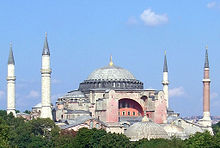
As a symbol and expression of the universal prestige of the Patriarchate of Constantinople, Justinian built the Church of the Holy Wisdom of God, Hagia Sophia, which was completed in the short period of four and a half years (532–537).
One of the things I’ve been doing as I took an extended break from my more historical work on the place of authority within society and religion was to do some broader thinking about where this all might be heading and to try to bring in some other disciplines that could help me process the large historical stories in a way that both made sense and was as fair as possible to the historical narrative. I’m going to take you on a brief journey into the sometimes scary process of how my mind thinks through things (clearing away as much of the clutter as possible) and hopefully you will be able to see why I am drawing some of the conclusions I am at this point and as I move forward and then I will apply the scheme I develop to the period of the Byzantine empire (what remains of the former Roman empire after Rome collapses based out of Constantinople) and then we shall see how far I move forward in history before I feel the need to re-evaluate.
One thing that every society seeks is stability, instability is notoriously bad (at least in the short term) for the people in any society and people will endure a lot of things to avoid a drastic upheaval of what is considered normal. That got me thinking about Bowen System Theory and specifically his (and other’s who followed Murray Bowen’s work from the 1970s on) work on triangles:
“The theory states that the triangle, a three person emotional configuration, is the molecule or the basic building block of any emotional system, whether it is in the family or any other group. The triangle is the smallest stable relationship system. A two-person system may be stable as long as it is calm, but when anxiety increases, it immediately involves the most vulnerable other person to become a triangle. When tension in the triangle is too great for the threesome, it involves others to become a series of interlocking triangles”[i]
If any place in this time period could be talked about as stable and able to resist major changes it was the Byzantine empire and the Orthodox Church which was the dominant expression of religion within the empire. Thinking about what a triangular system might look like from the Byzantine perspective might look like took me back to another three fold characterization.
There is an ancient way of talking about Jesus which is called the three-fold office, which goes back into the ancient church, at least to the early church father Eusebius (263-339) and probably earlier than that. It breaks down the offices of Jesus as: prophet, priest and king- and as I mentioned in an earlier post for the early followers of Jesus he occupied the central defining role in forming their identity as Christians. Let me expand each of these roles briefly:
The kingly role is the role of political power, to those familiar with a Lutheran two kingdom way of thinking this is the left handed kingdom which deals with military power and security, taxes and wealth, roads and trade. Typically in every layer of society there is someone who occupies a place of political power and who guarantees safety, peace and security for the price of obedience and taxes. This is the role of the secular power, and it can be abusive or benevolent (although it more often trends towards abusive) and it often depends on the next office for it’s authorization in some manner.
The priestly role is the role of religious authority, this would be the right hand kingdom of Lutheran two kingdom typology, which deals with placing people in a right relationship with the sacred, whatever that may mean for a society. In almost every society that I am aware of the priestly function is carried out by those who are closely aligned with those in the kingly role. In a theocracy the priestly office will dominate the political office, this is less common but there are societies and times where the priestly office will hold sway. More commonly the political office will exercise greater power than the priestly office and the priestly office will give additional legitimacy to the political office. This may sound skeptical and there is give and take in the relationship, however for stability there is a mutual self interest involved since the political office protects the priestly office and the priestly office legitimizes the political office.
The prophetic role is that place, person or thing within a society which places a check on the political and the priestly offices when they are not acting in accordance to whichever divine source of authority , they are the mouthpiece of God that challenges the excesses, abuses, deceptions, oppression, idolatry or hubris of the other two offices. The prophetic role may be occupied by a person or persons or it may be an idea, book, etc…as we will see in some of the upcoming transitions. All three roles are necessary and linked together.
In the Byzantine empire the emperor remained the dominant political figure, and had a lot of authority within all realms of both political and religious authority. The bishops had and exercised their authority with the protection and in cooperation with the emperor, but for the Orthodox church and the Byzantine empire the prophetic role was occupied by tradition. Tradition was what the church had believed and confessed, hence orthodoxy, and anything that deviated from that tradition of the earlier church fathers and councils was considered heresy or at least unorthodox. After the reign of Theodosious I (379-395 CE) the eastern half of the empire based in Constantinople would remain in some form with the emperor reigning and the Orthodox church intact until Constantinople falls in 1453.
In Gruene, Texas there is a dancehall which proudly proclaims “Gently resisting change since 1872” and in many ways the Byzantine empire was able to gently resist significant changes for 1,000 years. The world around its borders changed and went through a number of upheavals and eventually it would find itself caught between the Catholics on one side and the Muslims on the other, and yet the emperor, orthodox priests and the tradition of the fathers provided stability while the world around them was filled with chaos.
[i] Murray Bowen, 1976 quoted in Roberta M. Gilbert, The Eight Concepts of Bowen Theory: A New Way of Thinking About the Individual and The Group, Falls Church and Basye, Virginia: Leading Systems Press, 2004 and 2006, 47.




 Sign of the Rose