Tag Archives: Grief

Lamentations 2 Speaking Up For Daughter Zion

Christ and the Sinner by Andrey Mironov -2011 Oil on Canvas, CC BY-SA 4.0, https://commons.wikimedia.org/w/index.php?curid=30518018

Lamentations 2

1How the Lord in his anger has humiliated daughter Zion! He has thrown down from heaven to earth the splendor of Israel; he has not remembered his footstool in the day of his anger.
2The Lord has destroyed without mercy all the dwellings of Jacob; in his wrath he has broken down the strongholds of daughter Judah; he has brought down to the ground in dishonor the kingdom and its rulers.
3He has cut down in fierce anger all the might of Israel; he has withdrawn his right hand from them in the face of the enemy; he has burned like a flaming fire in Jacob, consuming all around.
4He has bent his bow like an enemy, with his right hand set like a foe; he has killed all in whom we took pride in the tent of daughter Zion; he has poured out his fury like fire.
5The Lord has become like an enemy; he has destroyed Israel. He has destroyed all its palaces, laid in ruins its strongholds, and multiplied in daughter Judah mourning and lamentation.
6He has broken down his booth like a garden, he has destroyed his tabernacle; the LORD has abolished in Zion festival and sabbath, and in his fierce indignation has spurned king and priest.
7The Lord has scorned his altar, disowned his sanctuary; he has delivered into the hand of the enemy the walls of her palaces; a clamor was raised in the house of the LORD as on a day of festival.
8The LORD determined to lay in ruins the wall of daughter Zion; he stretched the line; he did not withhold his hand from destroying; he caused rampart and wall to lament; they languish together.
9Her gates have sunk into the ground; he has ruined and broken her bars; her king and princes are among the nations; guidance is no more, and her prophets obtain no vision from the Lord.
10The elders of daughter Zion sit on the ground in silence; they have thrown dust on their heads and put on sackcloth; the young girls of Jerusalem have bowed their heads to the ground.
11My eyes are spent with weeping; my stomach churns; my bile is poured out on the ground because of the destruction of my people, because infants and babes faint
 in the streets of the city.
12They cry to their mothers, “Where is bread and wine?” as they faint like the wounded
 in the streets of the city, as their life is poured out on their mothers’ bosom.
13What can I say for you, to what compare you, O daughter Jerusalem? To what can I liken you, that I may comfort you, O virgin daughter Zion? For vast as the sea is your ruin; who can heal you?
14Your prophets have seen for you false and deceptive visions; they have not exposed your iniquity to restore your fortunes, but have seen oracles for you that are false and misleading.
15All who pass along the way clap their hands at you; they hiss and wag their heads
 at daughter Jerusalem; “Is this the city that was called the perfection of beauty, the joy of all the earth?”
16All your enemies open their mouths against you; they hiss, they gnash their teeth, they cry: “We have devoured her! Ah, this is the day we longed for; at last we have seen it!”
17The Lord has done what he purposed, he has carried out his threat; as he ordained long ago, he has demolished without pity; he has made the enemy rejoice over you, and exalted the might of your foes.
18Cry aloud to the Lord! O wall of daughter Zion! Let tears stream down like a torrent day and night! Give yourself no rest, your eyes no respite!
19Arise, cry out in the night, at the beginning of the watches! Pour out your heart like water
 before the presence of the LORD! Lift your hands to him for the lives of your children, who faint for hunger at the head of every street.
20Look, O LORD, and consider! To whom have you done this? Should women eat their offspring, the children they have borne? Should priest and prophet be killed in the sanctuary of the Lord?
21The young and the old are lying on the ground in the streets; my young women and my young men have fallen by the sword; in the day of your anger you have killed them, slaughtering without mercy.
22You invited my enemies from all around as if for a day of festival; and on the day of the anger of the LORD no one escaped or survived; those whom I bore and reared my enemy has destroyed.

Within these first two connected poems there are three primary figures: the narrator (or the poet), daughter Zion (Jerusalem personified) and the LORD who was once the divine protector of daughter Zion but has now become her humiliator and destroyer. In the first poem (Lamentations 1) the voice of the poem was split equally between the narrator (poet) and daughter Zion. The narrator in Lamentations one attempted to remain detached and narrate the plight of the broken relationship between daughter Zion and the LORD, while daughter Zion spoke out of the desolation of herself and her people. Ultimately throughout the poems of Lamentations the LORD remains an unspeaking figure, but that does not mean that daughter Zion’s words spoken to both the LORD and those she once believed as friends go unheard and her plight goes unobserved. In this second poem the narrator, once content with reporting on her fall, can no longer remain a detached observer. Her plight has undone him and now he steps into the space between daughter Zion and the God of Israel.

An important difference between the first and second poem is the way the narrator refers to the God of Israel. In English translations of the Hebrew Scriptures when the English word LORD is capitalized throughout the word[1] the four Hebrew consonants for the name of God (YHWH) given to Moses is behind the translation with the vowels pointed to tell the speaker to pronounce the word as ‘Adonai.’[2] Yet, if you look closely at your English translation you should notice that most of the occurrences of Lord in this poem are not capitalized throughout. There are six occurrences of the divine name, but every other time it is ‘Adonai’ which is normally translated Lord. This can be as simple as calling someone “Sir” or “master” in deference or it can be an indication of rank, but it is not the normal way the prophets, poets, and narrators of the Hebrew Scriptures refer to God. Combining this observation with the content of the poem there seems to be a gap introduced between the narrator and the LORD.

Perhaps to the poet this Lord who has become an enemy is no longer acting like the LORD the God of Israel is supposed to act. Previously this narrator pointed out the unfaithfulness of daughter Zion but looking upon her desperate plight he cannot remain silent. He is committed to raising his voice the Lord may hear him. Roughly half of the utilizations of the word ‘Zion’ in the book of Lamentations occur in this second poem. (Goldingay, 2022, p. 84) This narrator steps into the space between Zion and her Lord and demands the Lord to see the impact of his anger. Perhaps this mighty God does not realize the damage that has been done and so this poet in forceful verbs attempts to gain a hearing for daughter Zion who has been humiliated and thrown down from heaven to earth. Like a child throwing a tantrum Jerusalem (or the temple)[3] has been kicked about unremembered in the wrath of this God. This Lord has destroyed, broken down, and brought down to the ground. He cut down and removed his restraining hand from daughter Zion’s enemies, but rather than passively allowing her enemies to triumph the Lord has become her enemy, burning and consuming, drawing back his bowstring to strike, killing and pouring out his fury like fire. That which was supposed to stand forever has been carelessly dismantled like a booth or tent. Stronghold and temple, kings and priests, young and old, men and women, walls and dwellings all lay ruined. Yet, in the midst of all this devastation there is no word of the LORD coming to the prophets. God’s voice remains silent as God’s devastation leaves the elders of Zion and the young girls of Jerusalem sitting on the ground in silence. The elders and the young girls represent the two extremes of the population, and the poet wants us to see a shattered people reduced to sitting in the dust of the earth in sackcloth and mourning.

In Lamentations 1:20 daughter Zion stated that “her stomach churned within her,” and now this narrator forced to hear her plea and see her plight shares her emotional reaction. In verse eleven the poet reports that his eyes are spent with weeping; my stomach churns; my bile is poured out on the ground. The poet cannot stay detached in the face of this violence against his own people. He is one of them. The children who are dying are the future of his people. The suffering of these young children with nothing to eat and nothing to drink has turned his stomach. Mothers who are powerless to prevent the starvation of their own children fill their eyes with tears. His words may not be able to comfort daughter Zion, but perhaps they can rouse her Lord to pay attention to the damage his unrestrained wrath has done. Daughter Zion through the first poem was referred to by the narrator in third person, but now he sees, and she is now the ‘you’ of his direct address. Daughter Zion who in the previous poem was implied to be adulterous has become virgin daughter Zion, one who is suffering innocently.

The poet points to the prophets who failed by giving the people false visions that allowed them to persist in their disobedience. They covered over the failings in the relationship between the people and their God and perhaps worked against prophets like Jeremiah who attempted to speak the truth. Yet, these now silent prophets are replaced by enemies who gloat at the way they have destroyed Jerusalem. The poet knows that it is the Lord who opened his mouth and allowed this to happen. The enemies who waited for this day did not know they were participating in the premeditated act of destruction unleashed by the anger of their God.  

The narrator calls for the walls of the city to cry out to the Lord as the poet himself is crying out. The identity of their God is one who sees and hears, and their only deliverance is in God turning from God’s action. This destroyed wall of Jerusalem becomes a ‘wailing wall’. (Goldingay, 2022, p. 113) The city and the poet refuse to remain silent amid their weeping and stomach-turning reality. They now stand together calling on their Lord to once again be the LORD who rescues, delivers, protects, and provides.

Kathleen O’Connor views the voice of the poem returning to daughter Zion in verse twenty (NIB VI: 1043) but the poem is not explicit about a voice change and for me retaining the entire poem in the narrator’s voice makes logical sense. This narrator who once stood observing both daughter Zion’s disobedience and punishment now has come to her side and asks the LORD (and it is the divine name used here) to look and consider if God’s actions are just or proportional. The question to whom have you done this is even more direct in Hebrew. Kathleen O’Connor indicated that even ‘who have you ever treated (‘alal) like this’ needs to be strengthened because ‘alal suggests affliction and abuse. (NIB VI: 1043) and the word for children (‘ol ale) parallels this word for affliction. Even in English the implication of the Lord being responsible for a starvation so vast that it forces women into cannibalism, creating a reality where priests and prophets are slain in the holy place of the temple and that young and old die indiscriminately is a bold claim, but it is also a claim that fits within the language of Jeremiah and the Psalms. The young men and young women have died in the streets, the future itself is dying, and it is the Lord’s fault. Instead of allowing the people to celebrate the festivals to the LORD, now it is the enemies who are invited to Jerusalem to celebrate. But the LORD, the protector, has transformed in his fury into the Lord who is now the enemy of daughter Zion, and by extension the narrator who speaks up for her.

These poems in Lamentations attempt to make sense of a reality turned on its head. Their world has collapsed. Jerusalem, the king, the priests and prophets, the temple, and the land have all been devastated. Children, men and women in their prime, and the elders have all fallen victim to starvation and the sword. As Kathleen O’Connor states eloquently:

They (the poems of Lamentations) create a rhetoric of fury, a swirling language of pain, distrust, and betrayal, both divine and human. In this language what is awry and causes unspeakable suffering is the way that God relates to humans, the way God has abandoned covenant mutuality and faithfulness. This causes profound rage. (NIB VI:1043)

Yet, even in this profound rage the poet and the city cry out to the Lord. The desire God to turn from God’s anger and see the devastation God has wrought and to repent. They may feel that God’s actions and anger have gone too far, that God has abandoned God’s covenant responsibilities just as they had done. This second acrostic poem is an exercise of attempting to bring order to a disordered world. Of utilizing words to speak of a suffering which surpasses what words can communicate. Their world, their home, their lives, and their relationship with their God is broken. They speak these words into the silence of the void waiting for an answer from their LORD which they have not received.


[1] Many printings of English bibles will use drop cap for this where the first L is in the normal font size and the ORD drops down one font size.

[2] In Hebrew the vowels were added later and are above and below the consonants. This is done to not casually pronounce the divine name in keeping with the commandment of not using the name of the LORD your God in vain.

[3] Footstool often is used to refer to the cover of the ark of the covenant and by extension the temple or Zion as a whole.

Lamentations 1 The Cry of Daughter Zion

By Antoine Coypel – Susanna Accused of Adultery (1695-1696)http://www.museodelprado.es/imagen/alta_resolucion/P02247.jpg, Public Domain, https://commons.wikimedia.org/w/index.php?curid=12894461

Lamentations 1

1How lonely sits the city that once was full of people! How like a widow she has become, she that was great among the nations! She that was a princess among the provinces has become a vassal.
2She weeps bitterly in the night, with tears on her cheeks; among all her lovers she has no one to comfort her; all her friends have dealt treacherously with her, they have become her enemies.
3Judah has gone into exile with suffering and hard servitude; she lives now among the nations, and finds no resting place; her pursuers have all overtaken her in the midst of her distress.
4The roads to Zion mourn, for no one comes to the festivals; all her gates are desolate, her priests groan; her young girls grieve, and her lot is bitter.
5Her foes have become the masters, her enemies prosper, because the LORD has made her suffer for the multitude of her transgressions; her children have gone away, captives before the foe.
6From daughter Zion has departed all her majesty. Her princes have become like stags that find no pasture; they fled without strength before the pursuer.
7Jerusalem remembers, in the days of her affliction and wandering, all the precious things that were hers in days of old. When her people fell into the hand of the foe, and there was no one to help her, the foe looked on mocking over her downfall.
8Jerusalem sinned grievously, so she has become a mockery; all who honored her despise her, for they have seen her nakedness; she herself groans, and turns her face away.
9Her uncleanness was in her skirts; she took no thought of her future; her downfall was appalling, with none to comfort her. “O LORD, look at my affliction, for the enemy has triumphed!”
10Enemies have stretched out their hands over all her precious things; she has even seen the nations invade her sanctuary, those whom you forbade to enter your congregation.
11All her people groan as they search for bread; they trade their treasures for food to revive their strength. Look, O LORD, and see how worthless I have become.
12Is it nothing to you, all you who pass by? Look and see if there is any sorrow like my sorrow, which was brought upon me, which the LORD inflicted on the day of his fierce anger.
13From on high he sent fire; it went deep into my bones; he spread a net for my feet; he turned me back; he has left me stunned, faint all day long.
14My transgressions were bound into a yoke; by his hand they were fastened together;
 they weigh on my neck, sapping my strength; the LORD handed me over to those whom I cannot withstand.
15The LORD has rejected all my warriors in the midst of me; he proclaimed a time against me to crush my young men; the LORD has trodden as in a wine press the virgin daughter Judah.
16For these things I weep; my eyes flow with tears; for a comforter is far from me,
 one to revive my courage; my children are desolate, for the enemy has prevailed.
17Zion stretches out her hands, but there is no one to comfort her; the LORD has commanded against Jacob that his neighbors should become his foes; Jerusalem has become a filthy thing among them.
18The LORD is in the right, for I have rebelled against his word; but hear, all you peoples,
 and behold my suffering; my young women and young men have gone into captivity.
19I called to my lovers but they deceived me; my priests and elders perished in the city
 while seeking food to revive their strength.
20See, O LORD, how distressed I am; my stomach churns, my heart is wrung within me, because I have been very rebellious. In the street the sword bereaves; in the house it is like death.
21They heard how I was groaning, with no one to comfort me. All my enemies heard of my trouble; they are glad that you have done it. Bring on the day you have announced, and let them be as I am.
22Let all their evil doing come before you; and deal with them as you have dealt with me because of all my transgressions; for my groans are many and my heart is faint.

Poetry can be used to speak to things that are at the edge of our ability to articulate. It can be utilized to speak to moments of profound joy, of awe and wonder, of emotions like love and happiness whose meanings seem to transcend our words. Yet poetic words can be utilized in our moments of heartbreak, depression, grief, and trauma as we attempt to make sense of a world which seems senseless. Lamentations is the work of a poet or poets attempting to make sense of their reality in the aftermath of the destruction of Jerusalem in 586 BCE. The poet has seen death from war and starvation, has seen the foundations upon which their life was built collapse, and the LORD who was supposed to protect Zion has turned away. The poet attempts to make sense of the loss of the home they knew, grieve the family and friends who did not survive the siege and the beginning of the exile, and to walk among a shattered people with shattered dreams into a previously unimagined reality.

The survivors of Jerusalem not only retained the words of the prophets who warned of this reality, but they also retained the words of the prophets and poets wrestling with God, attempting to reconcile their faith with the world they experience. They are living in a disordered world, and yet in their words they attempt to bring some order into the disorder. Kathleen O’Connor in her book Jeremiah: Pain and Promise talks about the way these works written in the time surrounding the exile invite not only the contemporary generation but also future generations to enter the process of being meaning-makers.

It not only reflects the interpretive chaos that follows disasters, when meaning collapses and formerly reliable beliefs turn to dust. Jeremiah’s literary turmoil is also an invitation to the audience to become meaning-makers, transforming them from being passive victims of disaster into active interpreters of their world. (O’Connor, 2011, p. 31)

Making sense of a traumatic world-changing event is not an overnight process. It is a journey through the dark shadows of grief and fear, depression and guilt, the struggle to survive as others surrender to the end. This first poem in the book of Lamentations attempt to bring some order to the disorder and give voice to the pain and humiliation felt by the people. They, like Jeremiah and Ezekiel, understand that the tragedy is a result of their own rebellion and disobedience which have broken their relationship with the LORD who protected them. They also understand that they have no future without the LORD looking, seeing, and considering the fate of this disgraced and displaced people.

The poem has two voices, a narrator and daughter Zion. The narrator is the primary speaker for the first half of the poem and attempts to relate the fate of daughter Zion as an observer of the fall of this city personified as a woman. The poem begins with the interrogative “How?” Although in English translations the word how is used primarily as an inquiry about the state of daughter Zion: How lonely, How like a widow. The word also inquires about the manner or way in which something comes to pass: How did it happen that lonely sits the city, How did she become like a widow? How did this place of honor among the nations become dishonored? How did the princess become the vassal? What has brought about this reversal for daughter Zion and those who made their home in this great city. Something has changed that has brought about the reversal of fortunes for the city and the people.

The narrator voice in the poem has a greater detachment from the suffering and events occurring to daughter Zion. Daughter Zion may weep, but the narrator reports. Yet, the narrator’s reports begin to allude to the reason why daughter Zion weeps. In a world where women were not to have lovers, they were to be faithful to their husband, now this one who has become like a widow[1] we learn is also abandoned by her lovers and friends. Something has gone wrong in the relationships that were supposed to provide support. The narrator slips out of the metaphor to narrate Judah’s entry into exile and the suffering that comes with her displacement from the promised land into the hostile nations. The exclamation that Judah found no resting place echoes the language of the curses for disobedience in Deuteronomy 28:65. As Lamentations, like Ezekiel and Jeremiah, make sense of the catastrophe of the Babylonian exile the utilize the theological perspective of Deuteronomy.

Now the roads that pass through Jerusalem mourn the loss of the pilgrim traffic to the festivals, and the priests who officiated at the festivals groan as the young women grieve. The young women here are teenage women of marriageable age. These may be the women at greatest risk of sexual violence from the enemy soldiers who have breached the city and who now escort them into exile. They also would be the women whose potential partners died in the defense of the city or in the aftermath of the breach. Daughter Zion now returns to the poem as one with a bitter lot, whose foes are now her master, whose enemies prosper. The reason is for the first time explicitly stated by the narrator: she is being made to suffer by the LORD for her transgressions. Jeremiah, Ezekiel, and Lamentations all share a common perspective on the disastrous events. The tragedy of the siege, destruction, and exile are all a result of Judah’s disobedience to God and the curses of Deuteronomy 28 echo throughout Lamentation’s poetic remembrance.

Yael Zigler has a powerful explanation of the poetic image of the princes being like stags which find no pasture:

The verse portrays the previously powerful leadership as drained of energy, unable to find pastures or the basic means of survival. If they cannot find pasture for themselves, they certainly cannot help their people, whose sufferings are compounded by their leaders’ impotence. (Ziegler, 2021, p. 92)

Nobles, priests, and elders all failed the people in this crisis, but now they are unable to even deliver themselves. Both Jeremiah and Ezekiel had harsh words for these leaders who failed to care for the people and who compounded the upcoming crisis, but now as the world is turned upside down the powerful in Jerusalem are now impotent.

As the image once again returns to Jerusalem personified as mourning over her past riches and glories. She is isolated among the nations. Lamentations adopt a similar image to Hosea 1-3, Jeremiah 24, and particularly the harsh language of Ezekiel 16. Jerusalem’s past actions have led those who once admired her to despise her. Like the imagery of Ezekiel 16:35-43, Jerusalem is like a woman who is shamed by having her clothing taken away as an act of humiliation. The language of uncleanness enters the poem for the first time, but the uncleanness is literally in her hems at the bottom of her clothing. Whether the poem imagines her walking through the uncleanness of the world around her and it clinging to the skirts or whether it utilizes the image of menstruation[2] (which will come up with uncleanness later in the poem) without rags to catch the blood. Regardless of how exactly her uncleanness is visualized in the imagery of the poem, from the narrator’s perspective her actions which took no thought of the future, are the reason for her humiliated state. Her fall from grace was appalling and former friends and lovers are distant as daughter Zion for the first time raises her voice in the poem calling out to the LORD to “look at my affliction, for the enemy has triumphed!

The narrator concludes his portion of the poem with the enemies of Zion taking her precious things and invading her sanctuary. Nations that were not to be a part of the congregation of Israel in the law now stand in the center of the temple where even priests would not enter. The language behind invade, often rendered “come into,” often denotes sex in the Hebrew scriptures and the poetic intent of the imagery may be to communicate that this is both the pillaging and rape of Zion. (Goldingay, 2022, p. 67) Daughter Zion is stripped, humiliated, dishonored, and disgraced as her people struggle to find the food, they need for the strength to endure the ravages of the siege and now exile. For most of the first half of the poem the narrator has described her sorry state, but now she turns to the LORD and to those who see her and raises her voice to command people to look, see, and consider her.

Rather than cowering in her pitiful state, daughter Zion lifts her voice and demands to be seen. The first one she cries to is the LORD to see the state that the LORD’s fierce anger has left her in. Then she cries to those who pass by to look and see her sorrow. Former friends and lovers who pass by ashamed of her are commanded by daughter Zion to see her in all her suffering and to understand the reason for her suffering. Her betrayal of the LORD has resulted in the LORD’s actions. As Kathleen O’Connor narrates,         

Using vivid, violent verbs; she relates Yahweh’s brutal treatment of her. He sent fire; he spread a net; he turned her back; he left her devastated. Divine attacks of the female body again serve as a metaphor for the destruction of the city. (NIB VI: 1033)

In addition to the violent verbs listed above, the transgressions become a yoke which daughter Zion bears. The harsh language of daughter Zion’s appeal may also be designed to call upon the LORD to again assume the protector role. She now is the vulnerable one who needs the protection of the LORD. Like in the Psalms, the LORD may be both the cause of their suffering and the only one who can end the suffering.

The warriors, young men, daughters, and children of Zion now bear the crushing weight of the defeat of Zion by her foes. Warriors and young men have been crushed in the crucible of war and starvation, and in an image that will resonate in Isaiah 63, Joel 3, and Revelation 14 now “girl daughter Judah” is treaded as in a wine press. Daughter Zion weeps, and there is no one to comfort her or wipe away her tears. Children, perhaps orphaned by war or the first to suffer from starvation, are a prime example of the vulnerable caught in situations they cannot control.

In verse seventeen the narrator interrupts daughter Zion’s cries. This narrator can describe her isolation where no one will comfort her because the LORD has commanded her neighbors to become her foes. Yet, even beyond foes Jerusalem has become a “filthy thing” among them. “Filthy thing” (NRSV) or “unclean thing” (NIV) translates the Hebrew term nidda which refers to a “menstrual rag.” As Kathleen O’Connor states daughter Zion, “is not only ritually unclean, but she is also repulsive and dirty.” (NIB VI: 1033) Yet, rather than refute the narrator’s claim daughter Zion proclaims, “the LORD is in the right.” The woman does not deny that her suffering is justified but she also cries out the peoples once again to look and see her sufferings. Her bowels churn and her heart is wrung and death reigns both in the house and in the streets.

The enemies of Zion have seen and heard but their reaction is one of joy. In one final appeal the woman asks for the LORD to judge these enemies. That they may be judged as she was judged. That their evil may come before the LORD as her own rebellion came before the LORD. The LORD has dealt fairly if violently with her, now dealing in a similar fashion with those who abuse and taunt her. With a groaning body and a faint heart, she appeals to God out of her desolation asking for her God to look, see, and consider her words.

This acrostic poem utilizes the voice of a narrator and daughter Zion to express the pain and desolation of the collapse of the world as the people of Jerusalem gives words to the trauma of the exile. Like reading Elie Wiesel’s Night it allows a reader to encounter a small part of the tragic reality that the author encounters. Its language may at times make us uncomfortable, but we should never feel comfortable looking into the courageous act of someone trying to use words to express the inexpressible depths of their pain, their attempts to reimagine the relationship between themselves and their God in the midst of an earthshattering tragedy, and their attempts to make sense in a senseless world. One appeal of the acrostic form is that it imposes order on a chaotic world.

Any time we engage with the scriptures it is helpful to remember that there is some distance between the worldview of the exiles of Jerusalem in 586 BCE and ourselves. To appreciate the courage of the poet in their attempt to make sense of the world with words does not require us to fully endorse the use of vivid, violent verbs against a metaphorical female body. Although I cannot speak with authority about the view of masculinity of this time, I do believe one of the intentional uses of this language is to invoke in the LORD, who plays the masculine role in this imagery here and throughout the prophets, the role of protector. Jeremiah, Ezekiel, and Lamentations do not shirk from the perspective that Jerusalem’s punishment is justified but that does not prevent Jeremiah, Lamentations, and the Psalms[3] from calling out to the LORD to look, see, consider and to respond in mercy.

The first poem of Lamentations may be able to articulate the pain of daughter Zion, but it is unable to resolve that pain. Even though the poet has worked through their crisis from aleph to tav, the acrostic poem has not brought about a complete expression of the pain. Perhaps that leads to the second poem which also speaks out of the pain of defeat, grief, and an uncertain future. These poems are steps on the way to healing. They are the articulation of the pain and loss of the people of Jerusalem. The loss of home, the loss of identity, the loss of meaning. Yet, in a strange way, these poems are a part of the rediscovery of faith. The LORD is the focal point of daughter Zion’s appeal. Daughter Zion hopes for a future beyond the anger of the LORD in this moment which has brought such devastation and disgrace.


[1] Widows in the bible are not only women who have lost their husbands but also people who have lost familial support and are therefore vulnerable. A person may be a widow and have a son or son-in-law to take her into her house, but widows as a vulnerable portion of the population (like orphans and strangers/resident aliens) would be those outside the familial support structure. (NIB VI: 1029)

[2] This may be a source of discomfort for modern readers, but menstruation occupies a significant place in the law in relation to cleanness and uncleanness. Similar language appears in the prophets.

[3] Ezekiel rarely appeals to the LORD for mercy. Ezekiel tends to value obedience to the LORD and rarely protests like his older colleague Jeremiah.

Psalm 89 Shattered Worlds and Broken Symbols

The Siege and Destruction of Jerusalem by Romans Under the Command of Titus, A.D. 70 by David Roberts 1850

Psalm 89

<A Maskil of Ethan the Ezrahite.>
1 I will sing of your steadfast love, O LORD, forever; with my mouth I will proclaim your faithfulness to all generations.
2 I declare that your steadfast love is established forever; your faithfulness is as firm as the heavens.
3 You said, “I have made a covenant with my chosen one, I have sworn to my servant David:
4 ‘I will establish your descendants forever, and build your throne for all generations.'” Selah
5 Let the heavens praise your wonders, O LORD, your faithfulness in the assembly of the holy ones.
6 For who in the skies can be compared to the LORD? Who among the heavenly beings is like the LORD,
7 a God feared in the council of the holy ones, great and awesome above all that are around him?
8 O LORD God of hosts, who is as mighty as you, O LORD? Your faithfulness surrounds you.
9 You rule the raging of the sea; when its waves rise, you still them.
10 You crushed Rahab like a carcass; you scattered your enemies with your mighty arm.
11 The heavens are yours, the earth also is yours; the world and all that is in it — you have founded them.
12 The north and the south — you created them; Tabor and Hermon joyously praise your name.
13 You have a mighty arm; strong is your hand, high your right hand.
14 Righteousness and justice are the foundation of your throne; steadfast love and faithfulness go before you.
15 Happy are the people who know the festal shout, who walk, O LORD, in the light of your countenance;
16 they exult in your name all day long, and extol your righteousness.
17 For you are the glory of their strength; by your favor our horn is exalted.
18 For our shield belongs to the LORD, our king to the Holy One of Israel.
19 Then you spoke in a vision to your faithful one, and said: “I have set the crown on one who is mighty, I have exalted one chosen from the people.
20 I have found my servant David; with my holy oil I have anointed him;
21 my hand shall always remain with him; my arm also shall strengthen him.
22 The enemy shall not outwit him, the wicked shall not humble him.
23 I will crush his foes before him and strike down those who hate him.
24 My faithfulness and steadfast love shall be with him; and in my name his horn shall be exalted.
25 I will set his hand on the sea and his right hand on the rivers.
26 He shall cry to me, ‘You are my Father, my God, and the Rock of my salvation!’
27 I will make him the firstborn, the highest of the kings of the earth.
28 Forever I will keep my steadfast love for him, and my covenant with him will stand firm.
29 I will establish his line forever, and his throne as long as the heavens endure.
30 If his children forsake my law and do not walk according to my ordinances,
31 if they violate my statutes and do not keep my commandments,
32 then I will punish their transgression with the rod and their iniquity with scourges;
33 but I will not remove from him my steadfast love, or be false to my faithfulness.
34 I will not violate my covenant, or alter the word that went forth from my lips.
35 Once and for all I have sworn by my holiness; I will not lie to David.
36 His line shall continue forever, and his throne endure before me like the sun.
37 It shall be established forever like the moon, an enduring witness in the skies.” Selah
38 But now you have spurned and rejected him; you are full of wrath against your anointed.
39 You have renounced the covenant with your servant; you have defiled his crown in the dust.
40 You have broken through all his walls; you have laid his strongholds in ruins.
41 All who pass by plunder him; he has become the scorn of his neighbors.
42 You have exalted the right hand of his foes; you have made all his enemies rejoice.
43 Moreover, you have turned back the edge of his sword, and you have not supported him in battle.
44 You have removed the scepter from his hand, and hurled his throne to the ground.
45 You have cut short the days of his youth; you have covered him with shame. Selah
46 How long, O LORD? Will you hide yourself forever? How long will your wrath burn like fire?
47 Remember how short my time is —  for what vanity you have created all mortals!
48 Who can live and never see death? Who can escape the power of Sheol? Selah
49 Lord, where is your steadfast love of old, which by your faithfulness you swore to David?
50 Remember, O Lord, how your servant is taunted; how I bear in my bosom the insults of the peoples,
51 with which your enemies taunt, O LORD, with which they taunted the footsteps of your anointed.
52 Blessed be the LORD forever. Amen and Amen.

The approach to Psalm 89 will be different than my approach to most of the other psalms because it evokes for me an important question that continues to be wrestled with in communities of faith. This psalm likely originates in the collapse of the Davidic line of kings in the aftermath of Babylon’s destruction of Jerusalem in 587 BCE and wrestles with the contrast between the psalmist’s understanding of God’s promises and their present experience. It is plausible that Psalm 89 may be a combination of one (or more) psalms which expressed the royal theology of the Davidic kings with the tough questions of verse thirty-eight onward. Like Psalm 88 it takes us into the darkness of the psalmist’s experience where no light appears on the horizon, but unlike the previous psalm this is the experience of the community of the faithful questioning how the God’s faithfulness proved unfaithful. The psalm is still processing the anger, grief, and the disillusionment over the loss of institutions they thought would continue perpetually.

The language of Psalm 89 weaves together the kingdom of God and the monarchy of David into a common tapestry. Psalm 89 is built upon the words through the prophet Nathan to David in 2 Samuel 7: 8-17, but the rough edges of this prophecy where the ‘seeds of arrogance’ (Nancy de Claisse-Walford, 2014, p. 681) seen in David are smoothed out. Like Psalm 2 the strength of the Davidic kings is directly linked to the strength of the LORD. Their victories are the LORD’s victories, their enemies are the LORD’s enemies, their unfaithfulness is punished but they are never separated from God’s steadfast love and faithfulness (unlike King Saul or the Kings of Northern Israel). The first seventy percent of the psalm weaves God’s reign which is founded on steadfast love and faithfulness into experience of life under David’s descendants. The royal theology is expressed through the temple, and the temple, Jerusalem, and the Davidic kings all become important symbols of God’s reign on earth. The covenant language of Psalm 89 leaves no space for God to change God’s mind despite the unfaithfulness of many of the kings in Jerusalem. Yet, when the seam holding God’s reign and the Davidic king’s reign unravels in verse thirty-eight, the psalmist now takes God to task for renouncing the covenant. The situation of humiliation that the people experience now moves the psalmist to the dangerous and perhaps blasphemous conclusion that God whose reign is built on steadfast love and faithfulness has now proven unfaithful. God who was once Father and Rock who exalted David’s horn and strengthened his arm now strengthens the arms of the foes of the people, has rejected God’s children, and has renounced the covenant.

Moving beyond the psalm for the moment, the close alliance of God’s kingdom with any individual or government always presents the danger of idolatry. King David occupies an almost mythical role in the story of Israel as the ‘once and future king’ who was a man after God’s own heart. The narrative of David in First and Second Samuel, and the experience of the Davidic kings in First and Second Kings is often disconnected from the interwoven theology which connects the stability of the kings in Jerusalem with a larger vision of God’s cosmic reign over the forces of creation and the nations of the world. When the destruction of Jerusalem by Babylon occurs and the Davidic line of kings seems to be a stump which is cutdown and never to rise again the Jewish people would have to reckon with their relationship with God in a new way and to discover their new identity as a people of God in exile without king, temple, or land. They would have to reimagine the role of David within their life of faith and to reexamine how the hopes of 2 Samuel 7 and Psalm 89: 1-36 ended in the desolation of 2 Kings 25 and Psalm 89: 37-51.

Although the United States there is the concept of the ‘separation of the church and the state’ there is also a semi-religious understanding of manifest destiny and exceptionalism which exists within the political language of the country. Recently there has been a strong movement among both individuals and churches towards a Christian nationalism which weaves these ideas of manifest destiny and exceptionalism into a religious retelling of the story of the United States which ignores many aspects of the country’s past and present. This Christian nationalism has coalesced around the Republican Party in the United States and is still wielded by former President Trump to link his presidency with the faith of many of his followers. The almost messianic fervor that some have placed upon him and the sharp polarization between adherents and opponents highlights the danger of this interweaving of God’s reign and any individual or political group.

As an heir of the Lutheran reformation, I am a part of what is sometimes referred to as the magisterial reformation. The magisterial reformation includes the Lutheran, Reformed, and Anglican reform movements that still believed that secular authority should be followed (in contrast to the radical reformers who rejected any secular authority). Yet, the Lutheran (as well as Reformed and Catholic churches) in Germany had to struggle with the demands for loyalty from the National Socialist party as they assumed power in the 1930s. Many prominent Lutheran scholars, like Paul Althaus,[1] welcomed the rise of the National Socialist and Althaus viewed the government of the state as an order of God’s creation which was given by God. If the government of the state was an order of creation it was not subject to critique by the church, but there were others in the church who would criticize the National Socialist. Dietrich Bonhoeffer is the most well known of these resisters to the demands of loyalty. For Bonhoeffer he viewed the government as a vessel God uses to preserve life and when the government fails in its responsibility the church has a responsibility to speak. Many in Germany in the 1930s were able to combine their practice of Christianity with the demands of the state. Looking back upon this time it is easy to wonder how many people of faith were able to participate in or tolerate actions which seem antithetical to the scriptures, yet it is amazing how malleable peoples’ interpretation of scripture can be to fit their political dispositions.

Within Psalm 89 the kingdom of God and the reign of the Davidic kings is woven together until the tapestry is ripped apart by the experience of the present. There were Christians during the Third Reich who viewed Adolf Hitler as God’s gift to Christianity[2] and I fear there are many Christians in the United States making a similar mistake today. Unfortunately for many in Germany and in the United States participation in these movements has drowned out critical voices that questioned this interweaving of God and nationalism. For Judaism the crisis of exile in Babylon led to a reexamination of their faith in light of their new situation. I fear that for many Christians the eventual collapse of Christian nationalism will lead to an abandonment of their faith.

For me the conclusion of this psalm in verse fifty-two is also a moment of hope. It closes the third book of the psalter and brings this open question into the continued act of praise. Even when there are no easy answers for shattered symbols, broken communities, and even a broken nation there is a community that sits in the discomfort and still brings these questions into the blessing of their God. It closes with a double ‘amen’ which acknowledges the still unanswered questions of the prayers while allowing them to be lifted up to the God who may be Father, may be opponent but still remains connected to the community of the faithful. Elie Wiesel in his memoirs All Rivers Run to the Sea captures the relationship of these faithful crying out to God when he says of his own experience of the Holocaust:

I have never renounced my faith in God. I have risen against His justice, protested His silence and sometimes His absence, but my anger rises up within faith, not outside of it. (Wiesel, 1994, p. 84)

[1] Paul Althaus was not an isolated example, but he was in the 1930s viewed as the leading scholar on Luther’s theology. When I was studying in seminary in the early 2000s his works The Theology of Martin Luther and The Ethics of Martin Luther were still used.

[2] Paul Althaus in 1933 stated, “Our Protestant churches have greeted the turning point of 1933 as a gift and miracle of God” (Ericksen, 2012, p. 37)

Someone Else’s Fortune


As the slip of paper emerges from the cracked cookie
My eyes focus on words that can only be
Someone else’s fortune

The words may have fitted any number of the possible lives I’ve grieved
Sure, they are supposed to be generic enough to fit many lives
But the particularity of my experiences transgresses the boundaries
Of Someone else’s fortune

This simple sentence of a throw away piece of paper
Becomes a mental pathway to the present that never was to be
To dreams stillborn and paths that receded into the past
An invitation to rumination upon hopes I thought long buried
Of the someone else that those paths would have created
If this wasn’t someone else’s fortune, but mine

The Gravity of Grief

Artist Concept of a Supermassive Black Hole, NASA/JPL-Caltech. Public Domain under NASA policy

Tragic events expose the fragility of the worlds we inhabit.
Undoing the meaning of the words that we speak and hear.
The gravity of the grief is so powerful that nothing escapes it.

There are no beautiful words that can undo betrayal.
Letters litter the lawn as they lose their creative power.
Words are worthless when the unspeakable occurs.
Tragedy transforms treasured truths into discarded trash.
Narratives go nowhere. Sacred stories are suddenly suspended.
Poetry enters a precarious pause. Its rhymes and rhythms undone.

Someday the words will regain their meaning for the wounded one.
When the gravity of grief is not so great. But not yet.
First the fragile pieces must be gathered, their world recreated.

Only time can transform the truths tragedy trashed.
Patient presence with survivor of the unspeakable
May once again allow words their worth in the world.
Narratives may find their new way. Sacredness seen in stories.
Poetry and prose relate reality in rhyme and rhythm.
Beauty beyond the brokenness of betrayal as new words emerge.

Lost Dreams

Child by fabii from http://www.deviantart.com/art/child-61251692

Sometimes I imagine you running through some unending shopping mall

Realizing that somewhere along the trip you lost hold of me in the crowd

Perhaps you stopped to gaze at some curiosity in a shop window for a moment

And I was gone, moved on by the crush of the crowd’s unending, unfeeling flow

Tears streaming down your cheeks for the companion no longer there

As both our futures were severed by forces beyond our control


Like a parent who came to a new country seeking hope for their family

Only to find that family ripped asunder at the border, children caged

Fighting bureaucrats and their cold, unfeeling mountains of paperwork

Fanning the embers of hope for some eventual reunification

Only to find out that you are gone, given to a new family to foster

Just a dream who has hopefully found a new father to be cherished by


Some part of me won’t accept that dreams die when reality shatters them

When life moves on, when circumstances change, when new dreams are born

Something makes me hope that they find a new heart that beats with theirs

Someone who cherishes them the way that I did as they grew and changed

That they have a future beyond the fracture, and that they find joy and love

That you may be the dream that another person raises up for the world to see

The Air is Heavy


The air is heavy as it fills my lungs with its leaden weight
For in this springtime of the year in addition to the pollen,
The heavy perfume of the earth reawakening from its slumber
The emergence of wildflowers and bees and leave on the trees
Comes the weight of our fears over the death of the world we know
While the rest of creation emerges from its wintry hibernation
We confine ourselves to our modern caves repaying sabbaths missed
While the bird songs fill the morning light, we sing a dirge
Like children caught between dance and death we are unsatisfied
And we grieve the world transformed in ways we didn’t forsee

The air is heavy as the alveoli slowly force it back into the sky above
Breathing out the pain and the sadness, the life and the death
As each lobe automatically works to push the moist carbon dioxide
Through the bronchi and trachea to be expelled out of the mouth
Carrying on its respiration a heavy prayer for some lighter air
When we gathered in great numbers to sing and dance and jump
Sitting at the banquet table eating rich food and drinking well aged wine
Eating the marrow of life and drinking the wine strained clear
Never thinking that death could swallow this up so quickly
And the shroud would lie over so many people from so many nations

The air that bears the unweighable virus can seem so heavy
As we try to launch our saline filled cries up into the heavens
Waiting behind the high fortifications of our walls for the day
When we can open the gates in joyous celebration and lightness
For the air is no longer heavy and we can breathe freely again
For the shroud has been removed and death is swallowed up
And prayers are finally answered as tears are wiped away
The city’s life which has been placed in a coma awakens
As our lungs fill with the warm but lighter air of summer

Bleeding Words

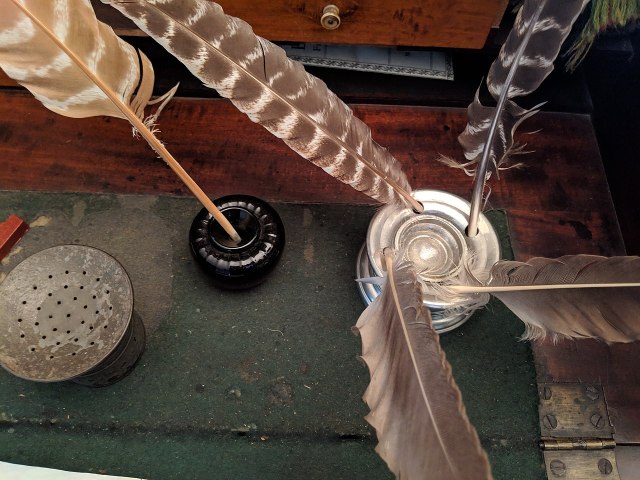
Captain Jay Ruffins, 17th Century Quills from Rufus King Manor museum in Jamaica, Queens shared under Creative Commons 4.0 Share Alike

Forgive the words that bleed out from this pen
For the ink that forms them is a torturous mixture
Of a wounded heart’s flow mixed with the saline
Of the river of tears which flow to the sea of grief
And the trembling hands which wield the implement
Shake as they attempt to record the wounds of the world
And like so much spilled blood it rushes like streams
To poison the wells of joy that once nourished

Perhaps like the prophets’ words later generations may see
That these harsh words were the fertilizer for some new growth
Where those who mourn may be comforted as the tears dry
And the poet’s heart is lovingly knit back together by time
Then perhaps the words will be the creative words of spring
But now those words are an unknown language strange to the ear
Words whose syllables have no meaning to the grieving soul
Who must drink of the putrid waters of their own well

For everything there is a time, a time to bleed and a time to heal
And I must speak the words of that bubble up from the well of the soul
Where the light of life seems a tremulous flame in the squall
Where the cold of winter penetrates into the marrow of the bones
And where the slow tick of the clock marks the passage of pain
While I wait for the pen to slowly run out of this tortured ink
For the rivers to dry up as the sun reemerges from its dormancy
Longing for the language whose sounds my tongue cannot form
Joyously drinking from the sweet waters of newly dug wells

The Lament of the Forgotten Son

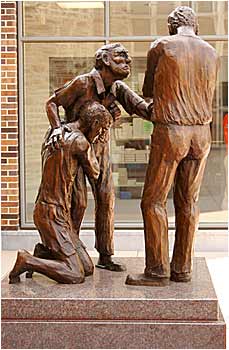
Margaret Adams Parker, Reconciliation: Sculpture of the Parable of the Prodigal Son for Duke Divinity School (2005) View 1

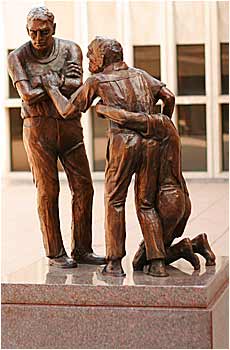
Margaret Adams Parker, Reconciliation: Sculpture of the Parable of the Prodigal Son for Duke Divinity School (2005) View 2


You stand out on the crossroads looking for the prodigal
Waiting for the return of the one who cashed in his heritage
Who took what we worked so long to build and walked away
He wished for your death and plundered your house
And yet day after day you wait for his return, this lost son
Like some wandering sheep you set out in search of him
Like some lost coin you search every corner to find again
And so, you stand out at the crossroads today and every day
While I rise up in your stead, tending the flock, sowing the seed
Working to ensure that for all of us there will be a harvest
You pine for your lost son, I grieve for my lost father

This son of yours, this spoiled younger brother of mine
Unwilling to dirty his hands among the fields or to care for the home
Who shirked the yoke that I bore for you countless seasons
There were always excuses that were made on his behalf
I thought that his last request might finally cross a line
That this final insult, this slap in the face might raise your ire
Is there nothing he could do, no request he might make
That might cause you to put your foot down and say, ‘no more’
How could you let him take away the work of our hands
Going off to a distant land with the wealth of generations
This son of yours, this spoiled younger brother of mine

The days you spent on the crossroads looking for the prodigal
Are the days you never once looked at me managing the house
Sweating with the servants in the field to sow and reap a harvest for you
Holding everything together while you stayed lost in your grief
Did your eyes never fall upon me as I shepherded your flock?
Was a word of praise ever uttered from your lips for my longstanding obedience?
Did your desire to see what was lost blind you to what remains?
The absent son who erased the son with calloused hands and burnt skin
Who stayed and never strayed from the homestead
And who is still waiting here for you to join him as he works in the vineyard

Then, one day, as I exit the fields at the end of a weary day
I hear merriment as the town eats our food and drinks our wine
The fatted calf has been slaughtered for the prodigals return
And while the entire town was invited to the celebration
You never considered coming to the fields to retrieve me?
It is only from a slave that I learn that my brother has returned
And my father as well, back from the crossroads and the ends of the earth
You rejoice with the town while my soul bleeds outside the home I sustained
What must I do to be seen, heard, loved and welcomed?
Must I also become the prodigal for you to celebrate me?
Must I deny you so that you might accept me?

How long before you realize that there is a son missing from your feast?
Before you make the journey into the fields you abandoned for the crossroads?
Until you see the son who didn’t squander your wealth with prostitutes
He feasted away your fortune and you throw him a feast of rich foods
I worked your fields, maintained your table, fed your flocks
Yet, not even a goat was to be spared for me and my friends
Welcome home father, I hope you appreciate the pantry I stocked
Welcome home brother, I hope you enjoyed the calf I raised
Hear this lament of the forgotten son who awaited your return
To the family you both turned your backs upon