Tag Archives: Grace

Psalm 5- The God Who Hears and Protects

Gustave Dore, David Mourning Absalom (1866)

Gustave Dore, David Mourning Absalom (1866)

Psalm 5

<To the leader: for the flutes. A Psalm of David.>
 Give ear to my words, O LORD;give heed to my sighing.
 2 Listen to the sound of my cry, my King and my God, for to you I pray.
 3 O LORD, in the morning you hear my voice; in the morning I plead my case to you, and watch.
 4 For you are not a God who delights in wickedness; evil will not sojourn with you.
 5 The boastful will not stand before your eyes; you hate all evildoers.
 6 You destroy those who speak lies;the LORD abhors the bloodthirsty and deceitful.
 7 But I, through the abundance of your steadfast love, will enter your house,
 I will bow down toward your holy temple in awe of you.
 8 Lead me, O LORD, in your righteousness because of my enemies;
 make your way straight before me.
 9 For there is no truth in their mouths; their hearts are destruction;
their throats are open graves; they flatter with their tongues.
 10 Make them bear their guilt, O God;let them fall by their own counsels;
because of their many transgressions cast them out, for they have rebelled against you.
 11 But let all who take refuge in you rejoice;let them ever sing for joy.
Spread your protection over them,so that those who love your name may exult in you.
 12 For you bless the righteous, O LORD;you cover them with favor as with a shield.


The God of the Psalmist, and the God presented throughout the bible, is a God who takes sides and values certain things and does not like others. This is not the impassive, unmoved mover of the philosophy of the 1700s-1900s who set the world in motion and then allowed it to move through time like a machine. The passionate cries of the Psalmist assume a God who not only hears but actively responds to the complaints and needs of the poet. Again and again God is named, implored to hear, listen, heed and ultimately to act. One of the courageous acts of the Psalmist and those who pray the Psalms is calling on God to be the God they expect God to be. They remind God of the contrast between the situation they perceive and the things they understand God to value.

In Psalm 5 the contrast is stated in terms of wickedness, lies, bloodshed, deceit and evil. The Psalmist is one who seeks righteousness, and as in Psalm 1 trusts, “for the LORD watches over the way of the righteous, but the way of the wicked will perish” (Psalm 1.6) and so the poet reminds the LORD again that “you are not a God who delights in wickedness.” Yet the complaint of the Psalmist arises out of the situation where the wicked, the evil, the boastful, liars, bloodthirsty and deceitful are the ones who the Psalmist perceives as their troublemakers. The Psalmist calls on God to act and to do something about this. Perhaps there are those by flattery who are obtaining power or who are accusing the writer of the psalm and the Psalmist asks for the guilt to fall upon them. As in Psalms three and four the Psalmist calls out for protection and for the LORD’s deliverance from the situation that the Psalmist finds themselves caught up within.

There is also the reality that the Psalmist, while attempting to be faithful, relies upon God’s steadfast love. The word translated steadfast love is hesed which also can be translated as grace. This is one of the many places in the Psalms where Martin Luther and others could find evidence of the gracious God who met the hearer in the midst of their own unworthiness. As in the reformation where the response to God’s grace was to love, serve, worship, and obey the LORD, so in the Psalm the steadfast love of the LORD is cause for awe and worship. The LORD is the Psalmist’s refuge and the refuge of all who seek the LORD. In language that would be familiar to many the LORD is refuge and shield, protection in the midst of their trouble and a safe place where the faithful may sing for joy and rejoice.

Gracefully Unfair

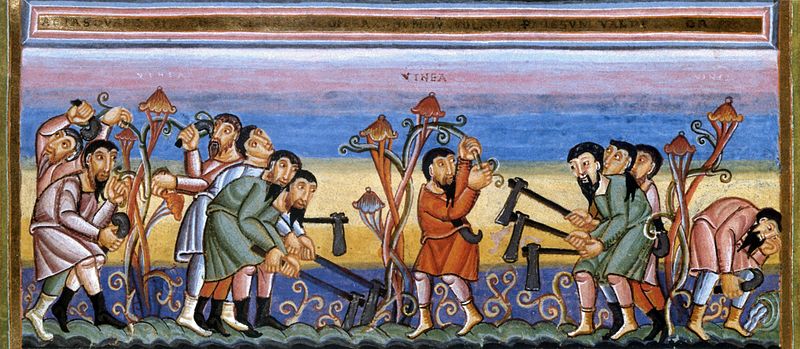
The Parable of the Workers in the Vineyard, Codex Aureus Epternacensis, 11th Century

The Parable of the Workers in the Vineyard, Codex Aureus Epternacensis, 11th Century

It’s not fair, this may be what I signed up for but it’s not fair
That in this crazy mixed up world of grace the last are first and the first last
Where a person can work from sunup to sundown laboring in the vineyard
Bearing the brutal rays of the sun beating down upon their backs
Getting up early to be the early bird that gets called out into the fields
Being the ant who works all day every day unlike those others
Those others who might look different, party different, act different, smell different
So that they get left behind among the other laborers, for it is about my skills
The sweat of my brow, the skill of my hands, the pain in my back from the harvest
And yet others work less, coming in later, leaving earlier, getting the same recompense
In a world of continually increasing worker productivity and efficiency
What is this inefficient master doing in the distribution of grace
Don’t I deserve more for my labor, for my conscientious and diligent striving
For I could manage the field better than this crazy master and the world would know no rest
For everyone would work as hard as I do or they would never work at all.
Yet maybe in this crazy and gracious world a new and strange master emerges
One who challenges the lords of commerce and time or wage and resource
One who sees the people left behind in the world of competition
Those in the market at 9 o’clock and noon and even at 3 or 5 o’clock
Those who no one sees or cares about, those who no one will hire
Those who wait all day in the hope that they too might enter into the fields
Perhaps in this crazy mixed up world of grace they are seen and valued and fed
They receive the same in some injustly and unfairly gracious manner
And why does my heart grow angry against those for whom the master’s heart breaks
Neil White, 2014

Little Faith Ones

Extract of Herbert Boeckl's fresco "Saint Peter's rescue from the Lake Galilee" inside the cathedral of Maria Sall, Carinthia, Austria

Extract of Herbert Boeckl’s fresco “Saint Peter’s rescue from the Lake Galilee” inside the cathedral of Maria Saal, Carinthia, Austria

Do we enter into the storms of life under the judging eyes of some untouchable creator?
So enmeshed in the separation between the our own unworthiness and his perfection
And the magnification of every misstep to the point where each trespass and violation
Is magnified to take upon the unshakeable weight of the world in our lives
Tipping the scales of justice from the possibility of salvation to certainty of damnation
Living a purgatorial existence of trying to love a creator that seems to no longer care
In a world that is anthropocentrically centered around our actions and failures
“You of little faith, how could you doubt?”
 
Yet, perhaps we enter the storms of life under the eyes of a God who approaches us
Who comes to us in the storms, who beckons us to come beyond the safety of the ship
And perhaps rather than pointing out to us every failure, instead in the moment of need
Reaches out the hand and grasps the hand thrashing about in fear and returns us home
To the belly of the boat where the winds can subside and the waves diminish
Tipping the scales of justice from the certainty of damnation to the possibility of healing and life
Entering the purgatories of our own lives and opening to us kingdoms of hope and peace
Where steadfast love and faithfulness meet and righteousness and peace kiss
In a world that is theologically centered upon the God who comes near uttering
Take heart, it is I, do not be afraid as I come to you in the midst of the storms of life
“My little faith ones, why do you doubt?”
 
Neil White, 2014

The Unforced Rhythms of Grace

Jozsef Somogyi's statue of the Tired Man in Mako, Hungary

Jozsef Somogyi’s statue of the Tired Man in Mako, Hungary

It is not the unreachable bar of perfection that we strive to attain day after day
The unending race to outpace our neighbors, our competitors or ourselves
It is not the daily grind of constantly trying to achieve and be seen that we need
It is not the frown of some angry and unappeasable god condemning us to perdition
But rather it is an invitation to lay down the heavy burdens of an alien religiosity
And enter into the unforced rhythms of grace, to know the shalom of the cosmos
The kingdom of heaven brought into our midst by the one who comes to take away our yokes
Yokes of wood and iron and steel wrought in our own striving to play god
So that we might look down on the world as its master
The burdens of carrying the expectations of others in the harsh summer of judgment
The expectation that Sabbath is wasted time
That the lords of commerce hold the keys to the kingdom
Come to me, all you who are heavy laden and I will give you rest
I will offer you the rest of creation’s Sabbath
In the wilderness, away from the cries of the city
Come and sit and learn the unforced rhythms of grace
That learning to be the people of God involves learning to rest in peace
That my shalom I give to you, not as the world gives
But in the undying love of a creator that offers the dreams of a kingdom
It is more about surrender and less about control
It is the way, the truth, and the life you seek not for some distant future
But it is an invitation to learn the unforced rhythms of grace
Precisely in your time of being overburdened, tired and beaten down
Enter my Sabbath, my kingdom, take upon you a far lighter and more graceful yoke
And I will give you rest.
 
Neil White, 2014


An Authentic People: Being the Body of Christ- A Sermon from July 28, 2013

Aime Nicolas Morot, Le bon Samaritain (1880)

Aime Nicolas Morot, Le bon Samaritain (1880)

Last week I talked about who we are, that at our root we are baptized children of God, marked with the cross of Christ and sealed by God’s Holy Spirit. That nothing can separate us from the love of God in Christ Jesus our Lord and nothing can take that away from us, nothing can change who we are, that we are God’s chosen people. So I guess the next logical question to come out of this is so now what do I do with this? How do I live out of this?You see for a lot of Christian traditions the way they understand the journey of faith is it ends when they make a choice for God and that is the high point and you have reached the goal, but as Lutherans Christians we understand it differently…God made a choice for us and we spend the rest of our lives trying to live out of that incredibly gracious calling that God has for us, to make sense of the new world of possibilities that creates for us. And God does have a dream for us and a calling for each of us in the midst of our lives. And God has always had this dream and vision for working through God’s people. Of us being the body of Christ, to use Paul’s language, of being the hands and feet of Christ reaching out into the world. If you remember through the Story that we went through last year God begins by setting a family and then a people aside to be a blessing to the world. As we recall from Genesis 12: 1-4

Genesis 12:1 The LORD had said to Abram, “Leave your native country, your relatives, and your father’s family, and go to the land that I will show you. 2 I will make you into a great nation. I will bless you and make you famous, and you will be a blessing to others. 3 I will bless those who bless you and curse those who treat you with contempt. All the families on earth will be blessed through you.”

James Tissot, Abraham and the Three Angels

James Tissot, Abraham and the Three Angels

Abram, later renamed Abraham was not set apart for his own benefit, but so that all the families on earth would be blessed through him. His life was to be a blessing to others and he was to live out of this calling and adventure that God set before him. Did Abram lose sight of this vision at times, yes, did he focus on his own understanding and his own strength, yep, but God kept calling him back to the vision that God had, to the adventure God had laid before him. God never abandons Abraham and Sarah or leaves them. Later when it was no longer just a family, but an entire nation Moses reminded them (Deuteronomy 4: 37)

37 Because he loved your ancestors, he chose to bless their descendants, and he personally brought you out of Egypt with a great display of power.

And in Isaiah we see some of the vision that the people were to be if they could live into God’s vision of shalom and peace:

Isaiah 2: 2-5
2 In the last days, the mountain of the LORD’s house will be the highest of all– the most important place on earth. It will be raised above the other hills, and people from all over the world will stream there to worship. 3 People from many nations will come and say, “Come, let us go up to the mountain of the LORD, to the house of Jacob’s God. There he will teach us his ways, and we will walk in his paths.” For the LORD’s teaching will go out from Zion; his word will go out from Jerusalem. 4 The LORD will mediate between nations and will settle international disputes. They will hammer their swords into plowshares and their spears into pruning hooks. Nation will no longer fight against nation, nor train for war anymore. 5 Come, descendants of Jacob, let us walk in the light of the LORD!

Paul captures this vision in Romans when he speaks of creation’s redemption is waiting on us:

Romans 8: 18 Yet what we suffer now is nothing compared to the glory he will reveal to us later.
19 For all creation is waiting eagerly for that future day when God will reveal who his children really are.
20 Against its will, all creation was subjected to God’s curse. But with eager hope,
21 the creation looks forward to the day when it will join God’s children in glorious freedom from death and decay.
22 For we know that all creation has been groaning as in the pains of childbirth right up to the present time.
23 And we believers also groan, even though we have the Holy Spirit within us as a foretaste of future glory, for we long for our bodies to be released from sin and suffering. We, too, wait with eager hope for the day when God will give us our full rights as his adopted children, including the new bodies he has promised us.
24 We were given this hope when we were saved. (If we already have something, we don’t need to hope for it.
25 But if we look forward to something we don’t yet have, we must wait patiently and confidently.)
Creation is waiting on us to become the people we have been created and called to be. Paul has a lot of confidence in this vision of what we as a gracious people can be and how powerful that would be, but as I think about it-Paul has every reason not to trust people, Paul who has seen the very churches he founded bicker and squabble over leadership, spiritual gifts, money, power, becoming intoxicated with the way things are in the world, becoming impatient for God to come and act now, and yet, in the midst of all of this, Paul has an amazing confidence in God to take these people with all their problems and addictions, these people who don’t know their right hand from their left and for them to be transformed by God’s love and turned into a gracious people who can reflect this transforming love of God into the world by being transformed into the people they were always created to be. People who can love the Lord their God with all their heart and soul and mind and strength and to love their neighbor as themselves. Yet I think often we are like the lawyer in Luke’s gospel, we come in asking the wrong question:

Luke 10: 25-37
25 One day an expert in religious law stood up to test Jesus by asking him this question: “Teacher, what should I do to inherit eternal life?”

Now to be fair, when the people of Jesus time talk about what we translate as eternal life they are talking about a very earthly reality, it is the new creation and it is something that God going to do on earth and it is tied in with Jesus’ vision of the kingdom of God. In effect this lawyer or scribe asks, “what must I do to be a part of what is going on with this kingdom of God you are always talking about.” It is something Jesus’ has pointed to so many times that he lets the lawyer answer the question:

26 Jesus replied, “What does the law of Moses say? How do you read it?”
27 The man answered, “‘You must love the LORD your God with all your heart, all your soul, all your strength, and all your mind.’ And, ‘Love your neighbor as yourself.'”
28 “Right!” Jesus told him. “Do this and you will live!”

I think we also know the right answer, if you listened last week you know that for Jesus love is the law, you shall love the Lord your God with all you heart and soul and mind and strength, from the very heart of the Jewish understanding of the law (Deuteronomy 6:5) and love your neighbor as yourself ( Leviticus 19:18). Jesus had been calling people back to this throughout his ministry, it wouldn’t have been a surprise and it wouldn’t even have been very controversial, yet doing it-that is another matter, and how far does it extend, who can I justify excluding from this, who is my neighbor and who isn’t

29 The man wanted to justify his actions, so he asked Jesus, “And who is my neighbor?”

Where can I put up fences, where can I draw a line between holy people and unholy people, between righteous and sinners, between insiders and outsides, who can I eliminate, help me see where the boundaries are. You certainly can’t mean everyone…not the Samaritans, the Romans, the revolutionaries, the Greeks, the Egyptians, the sinners and tax collectors, the prostitutes, the uneducated, the out of work, the poor, those who speak different, who believe different, who act different, who worship other gods, surely not them. Who can I leave out?

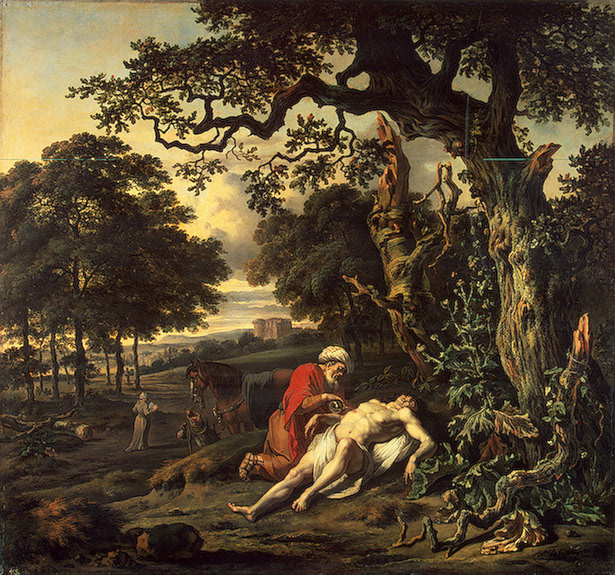
Jan Wijnants, The Parable of the Good Samaritan (1670)

Jan Wijnants, The Parable of the Good Samaritan (1670)

30 Jesus replied with a story: “A Jewish man was traveling from Jerusalem down to Jericho, and he was attacked by bandits. They stripped him of his clothes, beat him up, and left him half dead beside the road. 31 “By chance a priest came along. But when he saw the man lying there, he crossed to the other side of the road and passed him by. 32 A Temple assistant walked over and looked at him lying there, but he also passed by on the other side. 33 “Then a despised Samaritan came along, and when he saw the man, he felt compassion for him. 34 Going over to him, the Samaritan soothed his wounds with olive oil and wine and bandaged them. Then he put the man on his own donkey and took him to an inn, where he took care of him. 35 The next day he handed the innkeeper two silver coins, telling him, ‘Take care of this man. If his bill runs higher than this, I’ll pay you the next time I’m here.’ 36 “Now which of these three would you say was a neighbor to the man who was attacked by bandits?” Jesus asked.
37 The man replied, “The one who showed him mercy.” Then Jesus said, “Yes, now go and do the same.”

Go and live like this, and you will know what the kingdom is all about, live in a world where you build walls to separate us from them and you will never know. Live in mercy and grace, unafraid of what might happen, unafraid of the contamination of unholiness, willing to risk that in caring for someone else: a stranger, a beaten down one left on the side of the road that you also might be looked upon as the ceremonially unclean social outcast and religious heretics that most of the Jews believed the Samaritans to be. They were in many ways worse than the rest of the gentiles for in their eyes they were an unholy mingling of the chosen people with the other nations and they worshipped the same God in the wrong way at the wrong places and they refused to admit that the ways that the real Jews did it was right. Generations of hostility marked the border between Jew and Samaritan, Yet Jesus calls us to imagine a world beyond walls, where our own actions make neighbors of those in need and our love is a part of the healing of humanity and the rest of the world.

I want to invite you to imagine with me what the body of Christ, as Paul called the early church would look like if we could be captured by this kind of a vision. I want you to imagine what it would be like if everyone was here not because they felt they were supposed to be, or that they were trying to take care of the afterlife, or that they were here because mom or dad, of husband or wife, or friends thought they should be but rather imagine for just a moment if everyone was really here because they loved God with all their heart and soul and mind and strength and every song sung was a love song toward the God who loved us and would not allow us to be separated from that love, every prayer was in the confidence that God not only heard but cared for the words that were said, and we trusted that we were here in this place because as the Greeks in Jerusalem said to the disciples, “Sir, we want to see Jesus”. And what would it look like for the body of Christ to live out of that love, carrying it out into the world unafraid of the boundaries that had been set up between righteous and unrighteous, between classes and races and sexes, between us and them and we really were planted like the trees of life around the trees on each side of the river of God in the new creation with leaves for the healing of the nations. Where we are so grounded in the love of God that we really can love ourselves and from that place of love we can risk going out to love our neighbors. Where we begin to lean into the new creation and we begin to heal ourselves and heal the world, for as Paul points to the world is indeed waiting on the revelation of these children of God. And it begins with acts of love, caring for the man on the side of the road or the person going through a divorce, or the child who doesn’t seem to fit in, or the mother dealing with a screaming infant, or the person who doesn’t speak English or who can’t seem to find a job. It means being willing to be a part of Christ’s reaching out into the world through us to be a foretaste of the feast to come in the new creation. Sometimes it means bearing the disbelief of a society that cannot believe that we would give away some of our money to someone else, or that we would reach out to talk to and touch those who no one wants to touch. There is a story of a young priest who went to see Mother Teresa in Calcutta and after following her around during the day was struck by how unreligious her work seemed and then when he remarked to her how unclean and unholy it seemed she reached down and picked up a man dying who weighed very little and turned towards the this young priest and said here is the body of Christ given for you, for it was there in the poor that Christ was appearing and she was able to serve him.

purple rose 01 by picsofflowers.blogspot.com

Freedom for Fear and Shame: Grace in our Lives-A Sermon from July 21,2013

I don’t think it is a coincidence that the most common command in the bible is “do not be afraid.” And yet fear is a very real force in all of our lives and it causes us to do some things we are often not proud of. Fear causes us to shut ourselves off from others and even from God, and shame does this as also. Fear and shame are a little different, fear is related to something external, it can be another person, something in our environment, something that might happen, but it is fixed on something outside of oneself. Shame is focused internally, it focuses on the fear that someone else will not accept us if they know something about us, that they won’t like or love or care about me anymore. That they won’t want to be near me, it is the fear of disconnection with other people. Both fear and shame have a profound impact on our lives, they begin to tell us “we aren’t good enough” or “who are you to believe that you can do this” and they can keep us trapped inside that which is known and safe. We may shut ourselves off from other things or other people.

There has been a lot of coverage in the news over the last couple of weeks of the George Zimmerman trial, and I’m not going to go back into the trial itself, nor am I going to try to guess what the jury should or should not have decided. But the incident between George Zimmerman and Travoyn Martin was an episode based out of fear. You see, it arose out of one man seeing another man walking through the neighborhood on a stormy night, reacting out of fear and confronting him and eventually killing him. George Zimmerman believed Trayvon was a threat and he reacted out of that. Now we can’t go back and change the past, we can’t wave a magic wand and make everything better, but can we imagine a better future.  This one of the things posted last week that I really liked was from Jermaine Paul, who is a singer, but he wrote, “How cool would it be to live in a world where George Zimmerman offered Trayvon a ride home to get him out of the rain that night.” That’s a different world than what we live in, but it is a world worth imagining and a world worth fighting for. I think it is a world that Jesus envisioned and  we are going to hear more about as we go through the sermon today, but it is not the world I grew up in.

Those who know my story know that I spent four years in the Corps of Cadets and another 4 ½ years in the Army and they taught me a lot of the same things. They taught me a lot of what we commonly think about as courage, but courage as they taught is was to be bigger, badder and stronger than whoever else might be a threat. So instead of someone else being a threat you then you can be a threat to them but over the last thirteen years I’ve had to learn about a much different type of courage. The word courage comes from the latin word for heart ‘cur’ and courage literally means to be able to tell the story of one’s heart. That’s vulnerability, that being able to open up to who you really are. To be honest in my time in the Army you didn’t open up who you are but you pushed it down inside and you built up your own little suit of armor around yourself so that you were impervious to anything anyone might say or do about you. But real courage is being willing to take off that armor and to be open and vulnerable knowing that you are able to show who you really are. Knowing that you can be hurt and wounded because your armor is down, that someone might not accept you or the things you create or do. It is the courage to be who you are because who you are is valuable.

We live in a culture that doesn’t understand the very well, we live in a culture where our biggest idol is not money or power, at least as I’m coming to believe our biggest idol is security. We are so desperate to feel safe and secure. A lot of these things come in different forms and we are afraid to have enough to retire, afraid that someone might break into our house, someone might strike as a terrorist in the heart of our city. Yet, I think we have become more and more willing to surrender pieces of who we are to feel safe. We begin to give away pieces of our identity in order to feel safe. Yet, I need to be honest with you: security is a cruel, cruel god. If security is your god, then faith becomes transformed into certainty. There is no longer any room to question or to doubt, and yet when faith is transformed into certainty you are a short, short step from extremism. Faith as the bible understands it is about relationship and a journey, and if you notice from the stories of the bible the disciples often don’t get it and yet they keep following behind Jesus and in the journey they learn and grow. Love becomes trumped by the law. We begin to lock things down, making it more about absolutes and less about getting to know and love others. The world becomes transformed into them and us and we build up walls between us and them. Some of the walls are physical and some of the walls are emotional and social. This was the image of the wall I grew up with:

Berlin Wall

This is the Berlin Wall, it was built before I was born and while I was in college I got to see it come down, it was the wall that everyone knew about as I was growing up. The Berlin Wall separated East from West Berlin, two groups of people who were not really separate ethnically, sometimes even a family was split apart by the wall, but they were divided by two political systems. The wall separated two groups of people and it kept one group in and one group out and it was built out of fear, for security and honestly I believe it also was built out of a sense of shame.

But we come to know a very different God in Jesus, you see for Jesus faith is learned by following and we are following the one for whom love is the law. If you remember Jesus’ two great commandments, you shall love the Lord your God with all your heart, with all your soul, with all your mind and with all your strength and you shall love your neighbor as yourself. Jesus goes even further in the Sermon on the Mount when he tells them “you shall love your enemies” or in John’s gospel when the disciples are gathered around the table and he says, “I give you a new commandment, that you are to love one another.”And love comes up again and again and again as what Jesus commands and that is much different than trying to get it all locked down into a particular way. And as we follow Jesus we realize the world is no longer broken down into them and us, but rather as Paul can say in Galatians:

28 There is no longer Jew or Gentile, slave or free, male and female. For you are all one in Christ Jesus. (Galatians 3: 28)

All these things that in Paul’s life that had been the defining things became unimportant. Are you a Jew like or are you a Gentile, not a Jew, are you like us or are you not. Are you a slave or are you free, are you a man or are you a woman, rich or poor, college educated or not and we can put all those things in there, but ultimately in Christ all those things no longer matter. And Paul had to learn this in his own life. If you remember Paul’s story, he started out as a Pharisee and he understood that there were certain things that made him right with God and he was so convinced that these early followers of Jesus were wrong that he was out to wipe them out. He stood there looking on as they stoned Stephen and then he was on his way to Damascus to find any of Jesus early followers he could and bring them back to Jerusalem in chains. Until Jesus met him on the way. Paul recounts this way of thinking in Philippians 3:

4 though I could have confidence in my own effort if anyone could. Indeed, if others have reason for confidence in their own efforts, I have even more! 5 I was circumcised when I was eight days old. I am a pure-blooded citizen of Israel and a member of the tribe of Benjamin– a real Hebrew if there ever was one! I was a member of the Pharisees, who demand the strictest obedience to the Jewish law. 6 I was so zealous that I harshly persecuted the church. And as for righteousness, I obeyed the law without fault.

Paul may have been righteous, and I don’t think Paul had any sense of guilt for the way he followed the law, but it was a righteousness without love. And Paul realizes that now everything has changed because of what is now important in his life. Paul continues:

7 I once thought these things were valuable, but now I consider them worthless because of what Christ has done8 Yes, everything else is worthless when compared with the infinite value of knowing Christ Jesus my Lord. For his sake I have discarded everything else, counting it all as garbage, so that I could gain Christ

You see Paul had to go through this transformation in his own life, from a world where he was separated from those who were not like him: I am a Jew and beyond that I am a Pharisee and a very zealous Pharisee, so zealous I persecuted these early Christians. I’m righteous, these other people are unrighteous, I’m a saint, they are a sinner, I am good they are bad.

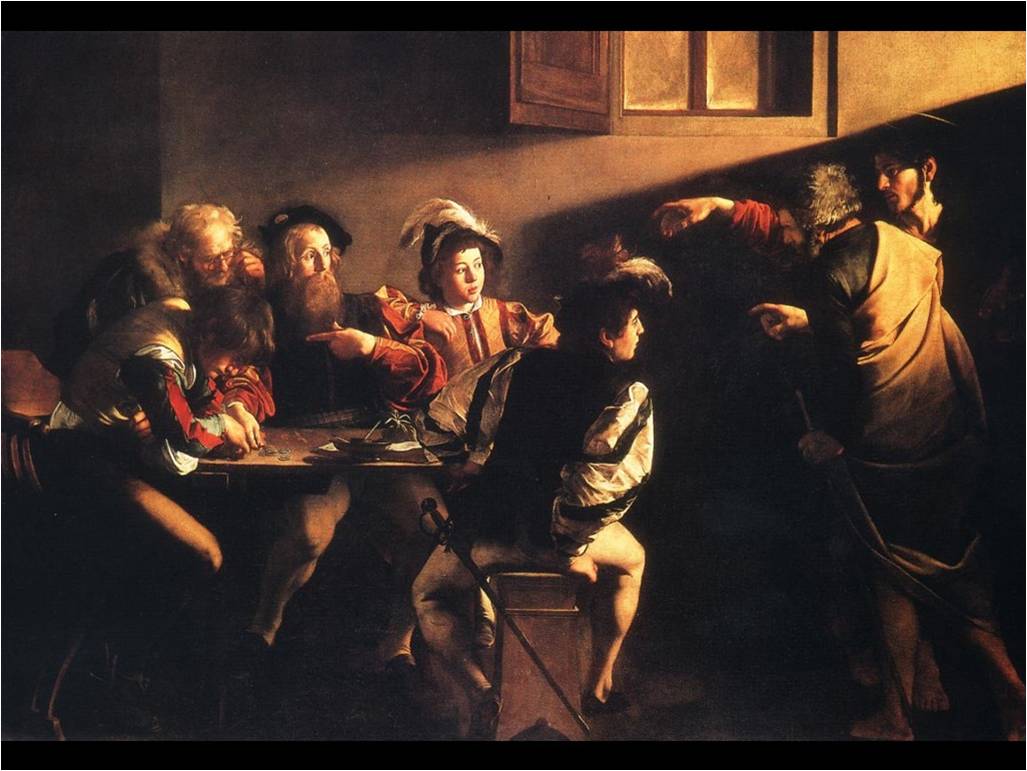
And then we encounter Jesus, and have you ever noticed that Jesus is always getting in trouble for being with the wrong people at the wrong? Almost all his controversies are because he either is healing on Sabbath or he is touching and eating with the wrong people. He touches a leper, that should make him unclean- and yet instead it makes the leper clean. He is sitting at the house of a Pharisee and then a woman comes in and anoints him with perfume and washes his feet with her tears, and while the Pharisee is thinking, ‘if this Jesus was really a prophet he would know what kind of woman this is and not let her touch him’ but instead Jesus says to him ‘do you see this woman, when I came in you didn’t anoint me nor did you wash my feet, but she anointed me and has washed my feet with her tears and her sins which are many are forgiven.’ Or he hangs out with sinners and tax collectors, like Matthew. This is Carvaggio’s painting of the calling of Matthew:

The Calling of St. Matthew by Carvaggio (1599-1600)

The Calling of St. Matthew by Carvaggio (1599-1600)

Jesus is on the right pointing and Matthew is in the center of the table with a bewildered look on his face, with his fingers pointing to himself as if to say, ‘me, you are calling me.’ This is how Matthew records it in the 9th chapter:

9 As Jesus was walking along, he saw a man named Matthew sitting at his tax collector’s booth. “Follow me and be my disciple,” Jesus said to him. So Matthew got up and followed him.

10 Later, Matthew invited Jesus and his disciples to his home as dinner guests, along with many tax collectors and other disreputable sinners. 11 But when the Pharisees saw this, they asked his disciples, “Why does your teacher eat with such scum?”


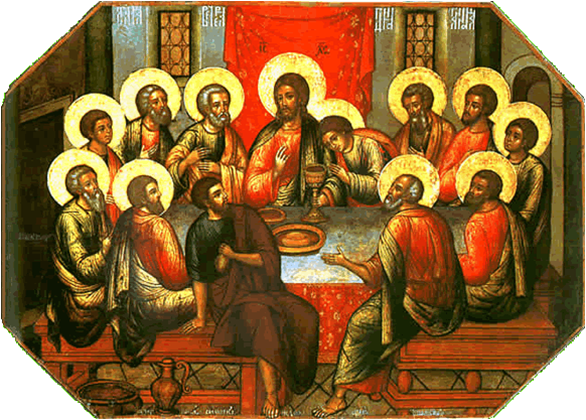
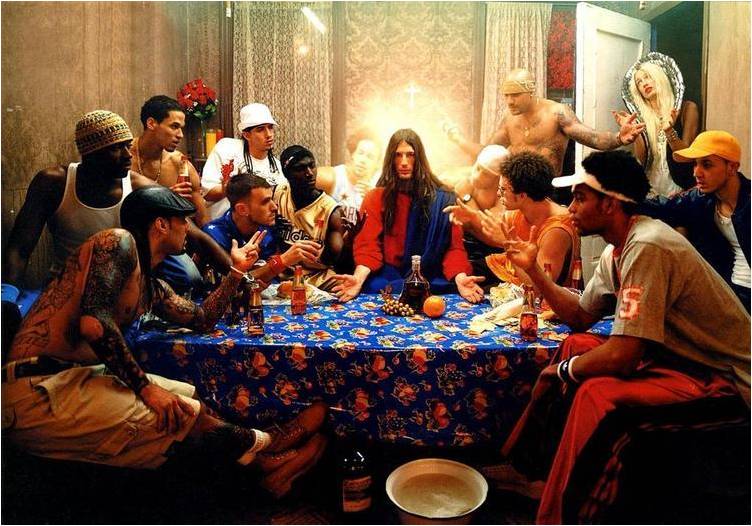
I actually like that translation, even though they take a little freedom with the word there, for I think we often think of being at the table with Jesus being like this:

Picture1

Where everyone is holy and righteous and good, yet people in Jesus day saw it being more like this:
 

Lords supper modernWhere Jesus is there with the sinners, tax collectors, all the wrong people the people they didn’t want to hang out with. Sinners and tax collectors in Jesus day were no less likely than the people in the picture above. In my own experience I keep being stretched as I encounter Jesus among the least likely people I expected. Matthew continues the story

12 When Jesus heard this, he said, “Healthy people don’t need a doctor– sick people do.” 13 Then he added, “Now go and learn the meaning of this Scripture: ‘I want you to show mercy, not offer sacrifices.’ For I have come to call not those who think they are righteous, but those who know they are sinners.”


We come from a tradition, the Lutheran tradition, that gives us a great place to wrestle with this because the person we take our name from, Martin Luther, wrestled mightily with this. Luther started out as an Augustinian monk, the most rigorous of the religious orders of his day, and Luther strove to do everything the right way, to live according to all the rules to try to be right with God and Luther never felt he could achieve that. Staupitz who was Luther’s superior in the order as well as his confessor, after sitting through hours and hours of hearing Luther confess is reported to have said, ‘Luther you come in here confessing every little thing you have done, you can’t so much as fart without coming here fearing condemnation and yet I’ve never once heard you confess anything remotely interesting.’ Yet Luther was afraid that he couldn’t keep all the commandments and love God. He was convinced that God didn’t love him, at least before the reformation breakthrough where he realized that God loved him well before he ever began his journey that led him to monasticism. It transformed him so much that later in his life he could tell his friend and younger colleague, Philip Melancthon who was trying to get everything right and was afraid of making a mistake, “Be a sinner and sin boldly, but believe and rejoice in Christ evermore boldly, for he is victorious over sin, death and the world.”

Paul also had to come through this transformation from being viewing righteousness as being a part of the law to being transformed by the righteousness of God that comes through the love of Christ. As he writes in Romans 8:

So now there is no condemnation for those who belong to Christ Jesus. 2 And because you belong to him, the power of the life-giving Spirit has freed you from the power of sin that leads to death.

There is no condemnation for those who are in Christ. Who can take that away from you? Nobody. You have been freed from the power of sin and death, now that doesn’t we don’t find ourselves struggling, but the victory has already been decided. Paul continues

3 The law of Moses was unable to save us because of the weakness of our sinful nature. So God did what the law could not do. He sent his own Son in a body like the bodies we sinners have. And in that body God declared an end to sin’s control over us by giving his Son as a sacrifice for our sins. 4 He did this so that the just requirement of the law would be fully satisfied for us, who no longer follow our sinful nature but instead follow the Spirit. 5 Those who are dominated by the sinful nature think about sinful things, but those who are controlled by the Holy Spirit think about things that please the Spirit.


So who gets to say who we are, who gets to have that word. Is it others who say that we should be afraid of those who are different from us, who ask us to build walls between ourselves and others. No. Is it our own selves telling us that we are not good enough, smart enough, worthy enough. No. It is the God who made us the baptized children of God, who marked us with the cross of Christ forever and sealed us by the Holy Spirit. That God who promises that nothing will be able to separate us from the love of God in Christ Jesus our Lord, nothing in our lives, nothing in heaven or on earth, no rulers or powers, nothing.Who are you, you are baptized children of God and no one, nothing can take that away from you, and you are loved. And it is in that love that we can imagine the way the world looks in light of that love, Jesus spends most of his ministry talking about the kingdom of God, talking about his vision of the way life should be. This was not a new thing, in the Old Testament this would have been talked about in terms of living in God’s shalom, God’s peace and vision for the world and harmony with God and the world around them. That is why the two great commandments are you shall love the Lord your God with all your heart, with all your soul, with all your mind and with all your strength and you shall love your neighbor as yourself. And as we begin to claim who we are in light of this love and identity those things like fear and shame which cause us to give away potions of who we are begin to lose their hold on us. Now this isn’t easy, I certainly don’t claim to be the one who has mastered this. There are times in my own life where fear kept me paralyzed or shame made me believe that I was unloveable. I can own that, and the reality is that I didn’t earn it. Martin Luther would say that “God’s love doesn’t find that which is pleasing to it; God’s love creates that which is pleasing to it.” We weren’t right with God on our own, God went out and made us right, God goes out seeking us because that is who God is. That gives us a great opportunity. You see, in the midst of Jesus ministry he never built any walls, but he sat at a lot of tables and tables bring us together. He sat at tables with those many in his day would have excluded. I had the opportunity to hear Bishop Mark Hanson, the Bishop of the ELCA a couple years ago and he related a story how when he was elected bishop a colleague who he trusted told him, ‘your calling is to take the walls that divide us and turn them into tables for conversation.’ I think that is what Jesus did, he took the walls that divided Matthew from the rest of the community, ‘he’s a sinner, he’s a tax collector’ and he brought him to the table where he was included as well as the other sinners and tax collectors. That’s what Paul did in going from the ministry that divided Jew and Gentiles to being the apostle to the Gentiles. And grace frees us from that shame, that fear that we need to create a different and better past, indeed grace is freedom from having to seek a better past. The reality is that who you are is accepted right now, God has made you and claimed you. So take down the walls and join those at the table. Amen.

 

 purple rose 01 by picsofflowers.blogspot.com