Tag Archives: Gospel of Matthew

Matthew 24: 1-28 Hope in the Midst of Suffering

Section of the Arch of Titus showing the Spoils of Jerusalem

Matthew 24: 1-28

Parallel Mark 13:1-28; Luke 17:5-24,37b

As Jesus came out of the temple and was going away, his disciples came to point out to him the buildings of the temple. 2 Then he asked them, “You see all these, do you not? Truly I tell you, not one stone will be left here upon another; all will be thrown down.”

3 When he was sitting on the Mount of Olives, the disciples came to him privately, saying, “Tell us, when will this be, and what will be the sign of your coming and of the end of the age?” 4 Jesus answered them, “Beware that no one leads you astray. 5 For many will come in my name, saying, ‘I am the Messiah!and they will lead many astray. 6 And you will hear of wars and rumors of wars; see that you are not alarmed; for this must take place, but the end is not yet. 7 For nation will rise against nation, and kingdom against kingdom, and there will be faminesand earthquakes in various places: 8 all this is but the beginning of the birth pangs.

9 “Then they will hand you over to be tortured and will put you to death, and you will be hated by all nations because of my name. 10 Then many will fall away,and they will betray one another and hate one another. 11 And many false prophets will arise and lead many astray. 12 And because of the increase of lawlessness, the love of many will grow cold. 13 But the one who endures to the end will be saved. 14 And this good newsof the kingdom will be proclaimed throughout the world, as a testimony to all the nations; and then the end will come.

15 “So when you see the desolating sacrilege standing in the holy place, as was spoken of by the prophet Daniel (let the reader understand), 16 then those in Judea must flee to the mountains; 17 the one on the housetop must not go down to take what is in the house; 18 the one in the field must not turn back to get a coat. 19 Woe to those who are pregnant and to those who are nursing infants in those days! 20 Pray that your flight may not be in winter or on a sabbath. 21 For at that time there will be great suffering, such as has not been from the beginning of the world until now, no, and never will be. 22 And if those days had not been cut short, no one would be saved; but for the sake of the elect those days will be cut short. 23 Then if anyone says to you, ‘Look! Here is the Messiah!’or ‘There he is!’ — do not believe it. 24 For false messiahsand false prophets will appear and produce great signs and omens, to lead astray, if possible, even the elect. 25 Take note, I have told you beforehand. 26 So, if they say to you, ‘Look! He is in the wilderness,’ do not go out. If they say, ‘Look! He is in the inner rooms,’ do not believe it. 27 For as the lightning comes from the east and flashes as far as the west, so will be the coming of the Son of Man. 28 Wherever the corpse is, there the vultures will gather.

Among Christians in the United States, this chapter which is sometimes called the ‘little apocalypse’ has become difficult to hear for two opposing reasons. The first reason is the way this, and other texts in both the New Testament and Hebrew Scriptures often labeled apocalyptic have been used and obsessed over in various Christian theologies and groups which focus on the return or coming (Greek parousia) of Christ and the advent of God’s kingdom almost like a script out of a horror movie where a vengeful God inflicts God’s wrath on all who oppose God’s will. While there is a grain of truth in this perspective when it comes to God’s judgment, it is helpful to remember that the grain of truth has often been overwhelmed by a barn full of chaff laid upon it in many modern Christian theologies. The second struggle is that the enlightenment has regarded the apocalyptic as an embarrassment and has often attempted to distance itself from the concept of God’s intervention in the world. It is important to realize that what we often transform into fear was the hope of the early followers of Jesus, they longed for Christ’s return and expected it and were willing to endure the struggles of their time to proclaim what they felt was a gospel of hope. This message also helped the early church endure the loss of several key symbols to the Jewish worldview and to see the suffering of the present as the painful but ultimately life-giving birth pangs of God’s new kingdom emerging in the midst of the world.

The temple was a focal point of the Jewish people in Judea and beyond. The temple in Jerusalem takes up a large amount of the city’s overall footprint and as N.T. Wright can state helpfully,

Jerusalem was not, like Corinth for example, a large city with lots of little temples dotted here and there. It was not so much a city with a temple in it; more like a temple with a small city round it. (Wright 1992, 225)

Matthew is not explicit that with Jesus departing the temple that the presence of God has left the temple, but with Matthew’s Emmanuel theology which permeates the gospel it may be implied in this scene. The temple, for all the grandeur of its reconstruction, will soon for not only the Christians but also for the rest of the Jewish people, will be displaced as a central symbol of their faith with its destruction. The coming destruction of the temple and Jerusalem, which occurs in the Jewish War of 66-70 CE, will cause a crisis which forces both the Jewish people and the early followers of Jesus, both Jew and Gentile, to reexamine their faith in terms of a new central place where God will meet them. For the followers of Jesus, one greater than the temple is currently among them and for Matthew’s community they await his return.

One of the consistent struggles of the disciples throughout the gospel is attempting to understand Jesus’ message in light of the traditional symbols and paradigms the learned. They are still ‘little faith ones’ which see in part, trust in part but still are struggling to let go of the beliefs and practices they learned over a lifetime. They see the temple primarily as a structure dedicated to God’s service, and so the destruction of the temple and Jerusalem seem like the opposite of what to expect after the coming of the long-awaited Messiah. Just like Jeremiah’s message which often fell on deaf ears before the destruction of the temple and Jerusalem by Babylon, only to be remembered as the people reconstructed their identity in exile, these words of Jesus which at the time seemed strange, provided meaning, and hope in a future where the followers of Jesus are scattered among the nations. At a time when the Roman empire seems to be consumed by struggles for power, and when the early Christians themselves may be beginning to experience exclusion from their identity with the Jewish people and persecution among the nations these words encourage them to persevere.

Jesus’ proclamation of the kingdom of heaven has prepared his followers to expect God’s intervention in the world, and there are others in Judaism of the time who also expected God’s intervention in various ways. We know the Essenes and the Pharisees expected God to intervene in history to deliver Israel from its enslavement to foreign powers and (in the Essenes case) unfaithful shepherds leading in the temple. Jewish hope was not for an ending of the world, as is present in popular culture and several late Christian movements, but rather for a reordering of the world around God’s reign through Israel. When the disciples ask about Jesus’ coming (parousia) at the end of the eon (suntelias tou aionos)[1] they are not asking about the end of the world but the advent of God’s kingdom which will replace the kingdoms of Herod or the empire of Caesar. The idea of Christ’s return is probably imagined in imagery similar to a celebration after one of King David’s victories. The other source of imagery would be the celebrations of imperial might by Caesar, but these would be considered only a parody of the expected victorious celebration of the advent of the kingdom of heaven on earth. Yet, Jesus does not answer the disciples with signs of his coming to inaugurate the kingdom of heaven but instead gives warnings about events, false prophets and false messiahs/Christs which will lead people to trust in the wrong things.

Jesus warns his disciples “See (blepete) that no one leads you astray.” While the NRSV’s use of beware does capture the sense of warning, the disciples are to take an active role in ensuring that they do not follow false prophets and false Christs. It is helpful to remember that Christ and Messiah are the same term, ultimately meaning anointed king, in Greek and Hebrew respectively rather than a part of Jesus’ name. Others will come claiming the same title that Peter has previously applied to Jesus, and they will gather followers. It is helpful to know that in the decades after Jesus’ death there would be those making the claim to be the ‘king of the Jews’ who would lead the people of Judea in multiple uprisings against Rome (not only the Jewish War of 66-70 which resulted in the destruction of Jerusalem, but also the 115-117 Jewish revolts in Egypt, Cyrene and Cyprus and the 133-135 rebellion of Bar-Kochba). This was a violent time for the Jewish people, and these followers of Jesus were not to follow these claimants who are attempting to establish God’s kingdom by force. Jesus’ followers are not to look for certain events which herald the advent of God’s kingdom on earth but to continue in their mission of teaching and proclamation to all nations. As Richard B. Hays can state, “The reality of the final judgment is crucial for Matthew, but not its timing.” (Hays 1996, 104) If these followers of Christ seek meaning in the midst of the struggle that is coming it can be read in the feminine imagery of ‘birth pangs’ that must occur before the advent of the new kingdom, or new creation in Paul’s language[2].

The suffering of these followers of Jesus in the midst of wars and rumors of wars, famines, and earthquakes in to be expected. As Jesus could tell them in the Sermon on the Mount, “Blessed are those who are persecuted for righteousness’ sake, for theirs is the kingdom of heaven.” (5:10) now they are told they will face ‘oppression’[3] and some will be killed. Matthew, unlike Mark and Luke, indicates that this oppression will come from the nations[4] instead of perhaps their own people which may be assumed in Mark and Luke and this may reflect the situation of Matthew’s community being away from Judea and experiencing persecution primarily from sources outside the Jewish people. Even among the community of Jesus followers some may be ‘caused to stumble,’[5] and others will ‘hand over,’[6] and hate will enter into these communities formed around loving God and one’s neighbor. In addition to false Christs there will be false prophets who tell people a message that did not come from God. The identity of the community is at stake here. Anna Case-Winters helpfully illustrates:

Lawlessness will afflict them and “the love of many will grow cold (v.12). This latter is perhaps the most serious threat for Matthew. Lawlessness (Greek anomia) is the ultimate crisis for a community centered around Torah. For love to “grow cold” signifies the loss of the very heart of Torah, which is love of God and neighbor. (Case-Winters 2015, 271)

The crisis of oppression, death, stumbling, betrayal, and hate threaten to extinguish[7] the love that the community is grounded in. But those who endure to the completion[8] will not be left on their own. This scene anticipates the great commission with its promise of both the authority and presence of Christ as well as the commission to take this gospel to all nations. As David Garland can helpfully state,

the church is not to circle the wagons until the danger passes but is to engage in active mission. In spite of the trauma, the community’s responsibility to love and proclaim the gospel of the kingdom remains in force. (Garland 2001, 242)

Matthew, who has been intent throughout the gospel in helping the reader understand scripture, adds the citation of Daniel to the comment about the ‘blasphemy’[9] standing in the holy place so the reader might find:

Forces sent by him shall occupy and profane the temple and fortress. They shall abolish the regular burnt offering and set up the abomination that makes desolate. Daniel 11:31

Daniel, which most scholars would say is pointing to Antiochus IV Epiphanes a Seleucid king who persecuted the Jewish people leading to the Maccabean revolt, is now read in light of the actions of the Romans conquering the temple and removing the holy items for their victory parade in Rome. Instead of being drawn into this conflict with the empire of Rome, those followers of Christ in Judea are to flee. The war, which will continue beyond 70 as the imperial forces continue to quell their rebellious Jewish province, will indeed bring great suffering for the people of Judea. Ironically, these warnings to flee throughout this chapter are misread drastically by some later Christians into talking about a ‘rapture’ where the hope is to be the one taken but to the original hearers they would understand this as a warning to prepare to flee on short notice. They may need to flee without packing, without re-entering the house or taking additional garments.[10] Into this time of great affliction (thlipsis) those claiming authority as leaders, or those who claim the authority to interpret God’s will as prophets will come claiming to create meaning out of the suffering, but they are telling a false story. These false prophets and false Christs, who most likely portrayed themselves as being the saviors of Israel from her oppressors, were probably an attractive alternative to the message of Matthew’s community and the gospel they proclaimed. Yet, they are warned not to go out seeking these leaders and prophets.

To the early community of Jesus followers these warnings probably were intended to keep them away from the revolutionary movements gaining strength in Judea, Galilee and beyond. Matthew’s closing line that Wherever the corpse is, there the eagles[11]will gather may refer to the massing of Roman standards (eagles) gathered around Jerusalem. Although I believe Warren Carter rightly discerns the echo of Rome in this verse, I believe he misinterprets the direction of the verse. Carter indicates that the verse indicates a judgment on Rome and the corpse is the Roman army, (Carter 2001, 87-88) but I believe the plainer reading in the context is to avoid Judea and Jerusalem in revolt where the legions assemble to wage war against the revolt. The corpse may refer to the crucifixion, to the temple (especially in the context of this chapter) or to Jerusalem, but the geographical location would be understood.

In a passage like this one, especially where I have covered a lot of historical ground, it is perhaps more difficult to allow it to speak to the church today, yet I believe there is no way to separate Christianity from the apocalyptic portions of its scriptures.  Every time one prays the Lord’s Prayer asking for God’s kingdom to come and God’s will to be done on earth as it is in heaven, one is praying for God’s intervention to bring about God’s promised new eon. Yet, throughout the gospel and throughout history there have been forces which are opposed to God’s reign and the changes that will bring. What may be perceived as a blessing to the poor in spirit, the meek, those hungering and thirsting for righteousness and the others mentioned in the beatitudes may be experienced as a woe to those who have become invested in the maintaining of the current order or who may want to bring about God’s order in their own terms. This chapter, even as it has been frequently misused in modern times, holds a key insight for the way of Christ: it is a way of hope even as one endures suffering. The Christians were not zealots who attempted to bring about God’s order by driving out the Gentiles from the promised land, rather they were those sent into the nations bearing witness to the gospel of peace. They meet violence by turning the other cheek, the learn to find blessing even when they are oppressed, and they find meaning amidst the times of affliction and tribulation by trusting in God’s hearing of their prayers and acting on them. This is a hope that would be at home in the psalms and the prophets and has sustained Christians for millennia. It is a hope that has sustained non-violent groups through the years and as I write this the lyrics of “We Shall Overcome,” used in the civil rights movement but has its origins in Charles Tindley’s adaptation of the 19th Century Spiritual “No More Auction Block for Me.” Oh deep in my heart, I do believe, that we shall overcome one day, and that overcoming comes when God changes the world bringing down the mighty and lifting up the lowly.  Until that day we work, and we wait, and we suffer, and we hope. We hold fast to what we have received and are alert for false prophets and false messiahs which proclaim cheap and easy paths to claiming God’s kingdom


[1] We again encounter the common Matthew word telos, here with the prefix sun attached to it, meaning completion, consummation, end. I think the older word eon is helpful, since it is both a direct transliteration of the Greek aion but also does not have some of the baggage of ‘the end of the age’ in Christian parlance.

[2] Paul can also use the imagery of labor pains of the creation giving birth to something new in Romans 8:18-25

[3] This is the Greek word thlipsis which occurs twice in this passage meaning ‘oppression, affliction, or tribulation’

[4] Ethnos can also be translated Gentiles.

[5] This is a passive form Scandalizo, where we get the English scandalize from, which has the connotation of stumbling. Has been used frequently in Matthew.

[6] Paradidomi is an important word in all the gospels which means both betray, but more literally to hand over (presumably into another’s custody)

[7] The Greek Psucho can mean grow cold or extinguish. I think the future indicative tense leads to the more absolute reading, especially when paired with lawlessness.

[8] Telos again used as a term of completion in verses 13 and 14.

[9] Bdelugma-blasphemy, abomination, detestable thing. NRSV ‘desolating sacrilege’

[10] Imation, which is translated a coat by the NRSV, means garments or clothing in general.

[11] Aetoi can be translated vultures, as the NRSV does, but it often refers to eagles

Matthew 22: 34-46 The Heart of Scripture

By James Tissot – Online Collection of Brooklyn Museum; Photo: Brooklyn Museum, 2007, 00.159.143_PS2.jpg, Public Domain, https://commons.wikimedia.org/w/index.php?curid=10195994

Matthew 22: 34-46

Parallel Mark 12:28-37; Luke 10:25-28, 20:41-44

34 When the Pharisees heard that he had silenced the Sadducees, they gathered together, 35 and one of them, a lawyer, asked him a question to test him. 36 “Teacher, which commandment in the law is the greatest?” 37 He said to him, “‘You shall love the Lord your God with all your heart, and with all your soul, and with all your mind.’ 38 This is the greatest and first commandment. 39 And a second is like it: ‘You shall love your neighbor as yourself.’ 40 On these two commandments hang all the law and the prophets.”

41 Now while the Pharisees were gathered together, Jesus asked them this question: 42 “What do you think of the Messiah?Whose son is he?” They said to him, “The son of David.” 43 He said to them, “How is it then that David by the Spiritcalls him Lord, saying, 44 ‘The Lord said to my Lord, “Sit at my right hand, until I put your enemies under your feet” ‘? 45 If David thus calls him Lord, how can he be his son?” 46 No one was able to give him an answer, nor from that day did anyone dare to ask him any more questions.

Many of Jesus’ conflicts with religious leaders throughout Matthew’s gospel rotate around the interpretation of the law and prophets and Jesus’ identity. This final challenge from a religious teacher followed by Jesus’ challenge to the Pharisees and sets the stage for Jesus’ condemnation of the scribes and Pharisees in the following chapter. Although Jesus’ declaration of Deuteronomy 6:5 and Leviticus 19:18 being the central commandments of the law is not unique among Jewish readers of scripture, this passage forms a final lens which clarifies Jesus’ teaching and way of understanding scripture. This is one of the reasons I believe many readers misread the Sermon on the Mount, because they fail to read it through the lens of loving neighbor and instead understand it as an impossible burden of moralistic perfectionism. This way of reading scripture centered on loving God and neighbor allows us to read back through Matthew’s gospel and see how love and mercy become central to Jesus’ teaching and allows the disciple to hold the call to be complete in their living out of the law and the forgiveness of sinners together.

The translation of the questioner as a ‘lawyer’ (Greek nomikos) in our culture places us in the judicial sphere with a professional nuance that is not present at this time in history. Instead this is a person coming from a religious group with a particular way of reading scripture and this expert in the law is a scholar of the Torah (the first five books of the bible). (Sigal 2007, 21) The question, which in Matthew is asked as a test or temptation rather than Mark’s more positive portrayal, asks Jesus for clarification on how he reads scripture. In Luke’s gospel Jesus turns the question back to the questioner, but in Matthew and Mark it is Jesus who gives us this central way of understanding the law and the prophets. The addressing of Jesus as ‘teacher’ combined with Matthew’s statement that the question is ‘to test him’ and the lawyer’s association with the Pharisees prepare us to expect that the questioner will not respond to the answer in the openness of faith. Yet, like the previous conflict with the Sadducees, the answer will silence this questioning ‘lawyer.’

The question of how to interpret scripture rightly is an important one in any generation, and Matthew’s gospel has slowly been opening the law and the prophets to the attentive reader throughout. Central to Jesus’ ministry has been a merciful reading of scripture where Hoses 6:6, ”I desire mercy and not sacrifice” has been used multiple times (9:13, 12:7) to point to a different way of understanding scripture than Jesus’ opponents use. Now this double love commandment that, in Jesus view, form the foundation that all the law and prophets are built upon also highlights why this particular verse from Hosea can demonstrate Jesus’ merciful and prophetic way of reading scripture.

The Pharisees, as they are portrayed in Matthew, are operating from a different way of reading scripture, and although Jesus’ answer may not be something that they could dispute they still are not in harmony with Jesus’ way. Yet now Jesus turns to them and asks how they read scripture and how they understand the Christ (Messiah). Matthew has used the Son of David title for Jesus throughout, most recently in the entry to Jerusalem and the cleansing of the temple (Matthew 21), but Matthew is not content to use this or any other title on its own to describe Jesus. Son of David may be a part of Jesus’ identity, but something greater than David is before these Pharisees. Psalm 110, for early followers of Christ, is frequently used to provide language to help explain who Jesus is[1]. Jesus reads these words as David speaking prophetically, which would not be an unusual way of thinking about the psalms, where the LORD the God of Israel speaks to ‘my lord’ and Jesus argues that one who David calls lord must be greater than David. These parables and conflicts in Matthew all occur in a day that begins with the chief priests and the elders questioning Jesus’ authority (21:23) and although Jesus’ has continually alluded to the answer, once more Jesus links the title of Christ/Messiah to one greater than the Son of David. Now that the Pharisees, the Sadducees, and the rest of the religious teachers are silenced for the moment, Jesus is about to proclaim judgement on both the religious leaders and the temple.


[1] For example, the book of Hebrew picks up on Psalm 110:6 in Hebrews 5-7 referring to Jesus as a priest forever according to the order of Melchizedek.

Matthew 22: 23-33 One Bride for Seven Brothers

By James Tissot – Online Collection of Brooklyn Museum; Photo: Brooklyn Museum, 2007, 00.159.143_PS2.jpg, Public Domain, https://commons.wikimedia.org/w/index.php?curid=10195994

Matthew 22: 23-33

Parallels Mark 12: 18-27, Luke 20: 27-40

23 The same day some Sadducees came to him, saying there is no resurrection;and they asked him a question, saying, 24 “Teacher, Moses said, ‘If a man dies childless, his brother shall marry the widow, and raise up children for his brother.’ 25 Now there were seven brothers among us; the first married, and died childless, leaving the widow to his brother. 26 The second did the same, so also the third, down to the seventh. 27 Last of all, the woman herself died. 28 In the resurrection, then, whose wife of the seven will she be? For all of them had married her.”

29 Jesus answered them, “You are wrong, because you know neither the scriptures nor the power of God. 30 For in the resurrection they neither marry nor are given in marriage, but are like angelsin heaven. 31 And as for the resurrection of the dead, have you not read what was said to you by God, 32 ‘I am the God of Abraham, the God of Isaac, and the God of Jacob’? He is God not of the dead, but of the living.” 33 And when the crowd heard it, they were astounded at his teaching.

The second conflict story in this pattern of three shifts opponents to the Sadducees. This is the second time in Matthew the Sadducees are mentioned as challenging Jesus, previously they were mentioned with the Pharisees in Matthew 16:1-4, but now in Jerusalem they act on their own. Their question uses the practice of Levirate marriage and a story of one bride for seven brothers to mock the idea that both Jesus and the Pharisees apparently preached of the resurrection. Even though this is the only time the Sadducees are explicitly mentioned in the final week in Jerusalem, the chief priests and elders were probably composed mainly of Sadducees, and the silencing of the Sadducees before the crowds contributes to their desire to end the words of Jesus.

Just as the Pharisees and the Herodians can work together for mutually beneficial purposes, the Sadducees have maintained their power in the temple through their relationship with Rome. There is an old Christian saying that Sadducees did not believe in the resurrection, so they were sad-you-see, and while this is a catchy play on words it misses the point of who the Sadducees are. The Sadducees, like much of the Hebrew Scriptures, do not have a concept of the resurrection and their belief that God’s blessings are a part of their experience in the world is probably confirmed in their minds by the more affluent priestly positions they occupied. Their faith centers on the first five books of both the Hebrew and Christian scriptures, and particularly their actions as the cultic leaders for the temple.

The story that the Sadducees use focuses on the practice of Levirate marriage (the term comes from the Latin levir meaning husband’s brother, not Leviticus) which is outlined in Deuteronomy 25:5-10

When brothers reside together, and one of them dies and has no son, the wife of the deceased shall not be married outside the family to a stranger. Her husband’s brother shall go in to her, taking her in marriage, and performing the duty of a husband’s brother to her, and the firstborn whom she bears shall succeed to the name of the deceased brother, so that his name may not be blotted out in Israel. Deuteronomy 25: 5-6

This practice is active in both the stories of Tamar (Genesis 38, Matthew 1:3) and Ruth (Ruth 4, Matthew 1:5) and was to ensure security for the widow by providing her both with a household and children (who will take care of her in old age), The story of seven brothers and one bride takes the practice to a ridiculous end, which is intentional, as the Sadducees attack the belief in a resurrection which they found contrary to their reading of scripture.

Jesus claims they have been led astray (Greek planao) in both their knowledge of scripture and their understanding of God’s power. Jesus answers first from God’s power to transform humanity in the resurrection where the values of securing one’s future through familial ties and reproduction are no longer important. In challenging the Sadducees’ reading of Moses, Jesus returns to God’s initial call of Moses where God refers to Godself as: “I am the God of your father, the God of Abraham, the God of Isaac, and the God of Jacob.” (Exodus 3: 6) Even though the patriarchs Abraham, Isaac, and Jacob died millennia earlier, Jesus refers to this ancient self-titling of God to point to both an ongoing relationship between God and these patriarchs and that the promises God made to them have not been broken by death. As Richard B. Hays, following J. Gerald Janzen, can state:

ust as God delivered and saved the patriarchs, so he will do for his people in their plight in Egypt. Furthermore, if God acted to deliver his people from the “death” of slavery in Egypt, surely he will do so again in the future—not precisely in the same way, but in ways that are recognizably analogous. Consequently, Jesus’ use of Exodus 3:6 in support of the resurrection—that claim that God will finally save his beloved people from death—is nothing other than a metaphorical extension of the Exodus theophany claim. (Hays 2020, 59)

Jesus’ claim and repurposing of the title God claims as the God of Moses’ father, Abraham, Isaac, and Jacob places the resurrection of the dead alongside God’s work to fulfill God’s promises to God’s people. The language of raising up seed (NRSV childless, the Greek is sperma where we get the English sperm) which is used frequently in the Hebrew scriptures in the stories of Abraham, Isaac and Jacob. The failure of the seven brothers to ‘raise up seed’ for the first one corresponds to the misunderstanding of the scriptures and the power of God that the Sadducees have in their inability to believe God will raise the dead. In a manner, Jesus points to a sterility in their claims which matches the sterility in their story. Only a God who can raise up children for ones as good as dead and who can raise the dead can open their eyes where they have been led astray. In Matthew, Jesus comes out the victor in the eyes of the crowd and the Sadducees are silenced. Yet, the conflict between Jesus and those in religious authority will continue until his death.

Matthew 22:15-22 Rendering to Caesar and God

Roman Denarius Depicting Caesar Augustus

Matthew 22: 15-22

Parallels Mark 12:13-17; Luke 20:20-26

15 Then the Pharisees went and plotted to entrap him in what he said. 16 So they sent their disciples to him, along with the Herodians, saying, “Teacher, we know that you are sincere, and teach the way of God in accordance with truth, and show deference to no one; for you do not regard people with partiality. 17 Tell us, then, what you think. Is it lawful to pay taxes to the emperor, or not?” 18 But Jesus, aware of their malice, said, “Why are you putting me to the test, you hypocrites? 19 Show me the coin used for the tax.” And they brought him a denarius. 20 Then he said to them, “Whose head is this, and whose title?” 21 They answered, “The emperor’s.” Then he said to them, “Give therefore to the emperor the things that are the emperor’s, and to God the things that are God’s.” 22 When they heard this, they were amazed; and they left him and went away.

Three parables are followed by three challenges of Jesus’ authority as the Pharisees and Sadducees attempt to respond to Jesus in this charged situation. The Pharisees, which have been in conflict with Jesus from early in his ministry, now reemerge as those challenging his authority and putting him to the test. Jesus’ response to their question, which is often lifted out of its context and used with a couple other texts, particularly Romans 13:1-7, by many conservative Christians as a basis for a church/state theology where being a Christian means being serving those in political power, but for those who listen to Matthew’s presentation of Jesus’ message should understand that something much greater lies underneath these words and the way Jesus skillfully answers the question that is designed to either alienate Jesus from the crowds or to give the religious leaders a way to paint Jesus as an insurrectionist to the Romans.

Jesus’ proclamation of the kingdom of heaven presents an alternative to the bloody peace of the pax Romana, and yet throughout Matthew, Jesus often subverts the way of Rome from within. Jesus’ presence has resulted in reaction from those with political power since his birth, and yet Jesus has not sought out direct conflict with those in power but has instead modeled a way of peacemaking that is an alternative to the ways of the empire. This is the second time Jesus has been asked about taxes in Matthew and, as in 17:24-27, Jesus finds a way to grant to temple or Caesar what they claim without impinging on God’s claims. It is also important to remember the audacious claim of Israel’s faith: that their God is not merely the God of Israel, but the God of all the nations and God can use the nations, whether they are aware of it or not, to be forces of judgment and blessing for Israel. In the revised common lectionary this text is paired with Isaiah 45:1-7 where God anoints Cyrus the Great for God’s mysterious purposes. The prophet Jeremiah dealt with people who withheld tribute from Babylon, an unforgivable move from not only Babylon’s perspective but also in Jeremiah’s understanding, of God’s. As Rabbi Binyamin Lau can state:

Jeremiah keeps returning to his most deeply held principles: God controls geopolitics, and He has chosen Nebuchadnezzar to rule the world at this time. The decision cannot be revoked, and anyone who rebels against it is in fact rebelling against God. (Lau 2010, 141)

In the parable which precedes this question, it is probable that Matthew understands Rome’s destruction of the temple and the city in 70 CE as God’s working through Rome in judgment of the leaders refusal to accept the invitation to meet the bridegroom (22:1-14) or present the harvest as in the second parable of the series (21:33-46).

I’m writing this at the end of a contentious election cycle in the United States, and while many Christians may tacitly acknowledge that God is the ruler of all the nations, there is an amazing propensity to try to turn that God into a tribal god who is primarily concerned for one group or nation and to align religious and political power in unhealthy ways. We know that in Jesus’ time there was significant political unrest in Galilee and Jerusalem with the Roman rule and occupation, but there was also coordination between political and religious authorities for mutually beneficial purposes. IAlthough very little is known about the Pharisees as a group in Jesus’ time, and the two primary sources we have: the gospels (where the Pharisees are continually in conflict with Jesus and his disciples) and Josephus, who writes in the aftermath of the destruction of Jerusalem, must be read closely and at the same time critically. I have attempted to limit the Pharisees, as they are portrayed in the gospel, to a group Jesus was in conflict with and allow the story to illustrate the nature of that conflict. What we can point to is the Pharisees, as portrayed in Matthew coordinate with the Herodians, presumably those allied with Herod Antipas who is ruling in Galilee, and with the Pharisees’ presence in conflict with Jesus in Galilee it is reasonable to assume that Matthew sees some alignment between the Pharisees and Herod Antipas’ desire to assume the mantle of his father, Herod the Great. Narratively it would make sense that the Pharisees alignment with power in the person of Herod and the Sadducees alignment with Pilate would be a continuation of their struggle for power among Israel. I have also suggested that John the Baptists’ and Jesus’ condemnation of the Pharisees and Sadducees may be linked to the accommodation they’ve made with these powers.

Any question of what is permissible is bound to be contentious, and this has been a frequent part of the challenges Jesus has encountered from the Pharisees (12:2,4,10; 19:3), it was how John the Baptist challenged Herod Antipas’ relationship with Herodias (14:4) and how Jesus, in a parable, challenges those unhappy with the ‘housemaster’ paying each worker the same. (20:15) The question is framed to entrap Jesus as either in rebellion against Roman authority or being viewed by the crowd as sympathetic to Rome. Jesus’ answer, which uses the imagery and inscription of Roman coinage, coinage which would not be accepted in the temple because of the image and the claims made by the inscription about Caesar being a ‘son of a god’, both accepts and qualifies Roman authority. Rome may demand the coinage they mint, and yet God’s claim on the disciples is far greater. There may be times where to resist authority is to resist God who is in control of geopolitics, but even when the empire doesn’t know the God of Israel its authority is contingent upon God’s sometimes mysterious work in the world and the nations.

Christians of every time have had to navigate between when they can accommodate the practices of the empire and when they must prophetically resist. When it comes to taxes to the temple (17:24-27) or Rome, Jesus points to a way to render to Rome and temple what belongs to them without losing one’s primary allegiance to God. Much of the New Testament involves the early Christian church navigating their citizenship of the kingdom of heaven within the world of the Roman empire. Two thousand years later, Christians still have to navigate their primary allegiance to God and the often bellicose demands of nation, culture and one’s political tribe. As St. Paul would say in Romans, “If it is possible, so far as it depends on you, live peaceably with all.” (Romans 12:18) while at the same time insisting that followers of Christ are not to be “conformed to this world, but to be transformed by the renewing of you minds, so that you may discern the will of God.” (12:2) Just as Jesus reframed the question of the Pharisees, so modern Christians will often have to reframe the questions the culture asks them based on their understanding of the will of God.  

Matthew 22: 1-14 The Call of the King

By Bernardo Strozzi – Own work, Daderot, 2013-09-25 11:42:46, CC0, https://commons.wikimedia.org/w/index.php?curid=33266293

Matthew 22: 1-14

Parallel Luke 14: 15-24

Once more Jesus spoke to them in parables, saying: 2 “The kingdom of heaven may be compared to a king who gave a wedding banquet for his son. 3 He sent his slaves to call those who had been invited to the wedding banquet, but they would not come. 4 Again he sent other slaves, saying, ‘Tell those who have been invited: Look, I have prepared my dinner, my oxen and my fat calves have been slaughtered, and everything is ready; come to the wedding banquet.’ 5 But they made light of it and went away, one to his farm, another to his business, 6 while the rest seized his slaves, mistreated them, and killed them. 7 The king was enraged. He sent his troops, destroyed those murderers, and burned their city. 8 Then he said to his slaves, ‘The wedding is ready, but those invited were not worthy. 9 Go therefore into the main streets, and invite everyone you find to the wedding banquet.’ 10 Those slaves went out into the streets and gathered all whom they found, both good and bad; so the wedding hall was filled with guests.

11 “But when the king came in to see the guests, he noticed a man there who was not wearing a wedding robe, 12 and he said to him, ‘Friend, how did you get in here without a wedding robe?’ And he was speechless. 13 Then the king said to the attendants, ‘Bind him hand and foot, and throw him into the outer darkness, where there will be weeping and gnashing of teeth.’ 14 For many are called, but few are chosen.”

This final parable continues to be challenging for many modern readers of Matthew who struggle with the wrathful king’s judgment on both those who reject their calling and on the improperly attired guest. Many scholars who view the versions of this parable in Matthew and Luke coming from a common source argue that Luke’s easier to reconcile version is closer to the parable that Jesus originally told as a way of distancing themselves from the portions of the parable which make them uncomfortable. Yet, Matthew’s version uses several prophetic motifs which are probably unfamiliar to many modern readers of the New Testament which are worth slowing down to engage and hear. Perhaps Matthew has something to teach our communities about the way we attempt to eliminate God’s judgment because it is uncomfortable for people living in peaceful, affluent communities very different from either Jesus or Matthew’s time.

Matthew groups parables together in a way that they build upon one another in a group of three. In hearing this parable, it is important to place it alongside the previous two vineyard parables (two sons and wicked stewards) as Jesus uses a new image, that of a wedding banquet. While there are images in Israel of people being invited to a great feast prepared by God for people, perhaps the best known coming in Isaiah 25: 6

On this mountain the LORD of hosts will make for all peoples a feast of rich food, a feast of well-aged-wines, of rich food filled with marrow, of well-aged-wines strained clear.

Yet, the idea that this feast is a wedding celebration is unique to Matthew and there is not an echo of God throwing a wedding banquet that I am aware of in either the Hebrew Scriptures or the Apocrypha. Yet, Matthew has used this image previously in 9:15 with Jesus referring to his disciples’ conduct during his presence among them:

And Jesus said to them, “The wedding guests cannot mourn as long as the bridegroom is with them, can they? The days will come when the bridegroom is taken away from them, and then they will mourn.”

This image of a wedding celebration will also link this parable to the first parable in the next and final set of parables in 25: 1-13. The parable links both images of the feast of rich foods prepared by God for all people and with the identity of Jesus as the bridegroom and son of the king in Matthew.

Yet, the story turns upon the rejection of the call of those who are called. The Greek work kaleo (to call) occurs frequently throughout this narrative as the king sends his slaves to call the ones ‘having been called.’ In our culture we think of invitations as optional, but these who have been called to appear by the king and snub that call by extension reject the authority of the king to summon them. As Warren Carter notes, “Refusing the king’s invitation is tantamount to rebellion.” (Carter 2001, 434)  This is heightened by the action of those who seize, mistreat, and kill the slaves sent[1] who like the vineyard workers in the previous parable invite, and in the answer of the hearers of the previous parable require the ‘housemaster’ and now the king to “put those wretches to a miserable death.” (21:41)

The wrath[2] of the king is perhaps difficult to many modern readers who are used to thinking about God as unemotional or immovable, but these modern conceptions of God are based more on Greek philosophical ideals rather than the God of the scriptures. A God who sends his loyal slaves over and over with the hope of a harvest or the invitation to the celebration of the wedding of his Son, only to see these slaves mistreated and killed is compelled to act on behalf of the slaves. If, as most interpreters assume, Matthew is using this parable as an explanation of the destruction of Jerusalem and the temple by Rome in 70 CE (destroyed those murders and burned their city) they seem unable to reconcile this God who invites with the God who destroys. Yet, perhaps this says more about our unwillingness to stand under God’s judgment or our desire to take judgment into our own hands. That God’s troops would include the Roman legions which destroyed Jerusalem, who like Babylon and Persia previously had served God’s purposes without knowing it, should not surprise, nor should the experience of  God’s people receiving judgment for being unwilling to respond to God’s continued call.

I am not a fire and brimstone preacher, as a Lutheran pastor I’d rather focus on the grace of God, but I’ve also come to understand that the wrath of God or anger of God is not the opposite of God’s grace. God is angry because God care: God cares about the slave sent to carry the message, God cares about the wedding banquet which they have been invited to, and, although it may seem strange to modern ears, God does care about the called ones. The God of Israel may be patient and slow to anger, but this God will not be taken for granted. God continues to desire repentance and is willing to continue to send those precious to God to seek a change, but eventually God’s patience becomes too costly for those who carry God’s message, and like the saints under the altar in Revelation 6: 9-11 they cry out,“Sovereign Lord, holy and true, how long will it be before you judge and avenge our blood on the inhabitants of the earth.

That Jesus, and Matthew, understand God at work in the movement of the nations is a part of the bold claim of the faith of Israel that their God is not only their God, but the creator of the world and the Lord over all nations. This may be challenging for modern believers who have separated the spiritual world from the political world and who may be slightly embarrassed to suggest that God can be at work in the world in strange and mysterious ways, but that also highlights the way culture has changed our faith. The early followers of Jesus could trust that God’s kingdom would come into the world, that God’s will would be done on earth just as they assumed it was done in heaven. This is faith was an openness to perceive the ways that God was at work in the world, an awareness of the time they found themselves within with the bridegroom, and a trust that while God will is ultimately good for them, for the people of God and for all the nations, God the creator of the world should neither be tamed or domesticated into a household god that served the desires of those who called upon the name of the Lord.

There is a common strand with this parable and wisdom literature where the character of wisdom is not heeded:

Because I have called and you refused, have stretched out my hand and no one heeded, and because you ignored my counsel and would have none of my reproof, I also will laugh at your calamity; I will mock when panic strikes you, when panic strikes you like a storm, and you calamity comes like a whirlwind, when distress and anguish come upon you. Then they will call upon me, but I will not answer; they will seek me, but will not find me. Proverbs 1: 24-28 (see also Proverbs 8:35-36 and Jeremiah 6:16-17)

There is an call from their God (or from Wisdom on behalf of God) which is refused, and although the call is extended with the hope that the called ones will finally turn (or repent) the continued reality of rejection is not met with indifference by God. Yet, this rejection can also be used in strange ways to extend the invitation to others. In the parable now the slaves are sent to the crossroads or the roads leading out of town to gather everyone to the banquet, both good and bad, filling the wedding celebration with guests. Just as the tax collectors and prostitutes heard John the Baptist’s message and turned even though the Pharisees and Sadducees did not (21:31) now those on the streets find themselves in the wedding hall.

The final scene of this parable, unique to Matthew, with the guest not wearing the proper attire has also caused distress for many readers for the same reason as the earlier judgment, and again many scholars want to view this as an addition to the original parable of Jesus, but before we pass judgment on it, perhaps we should hear it out. Just as the rejection by the ones called to the banquet was tantamount to rebellion, so is being present in a way that is disrespectful to the host. We often assume referring to someone as ‘friend’ assumes intimacy, but in Matthew’s gospel, and in ancient cultures, it can imply a power differential or distance between the speaker and hearer. (20:13, 26:50) The fact that one is invited later does not give one permission not to heed counsel or ignore reproof, and as Matthew’s gospel has focused on building a community of Christ where the actions of the individuals in the community matter, just as the original invitees can find themselves encountering their king’s wrath, so can the newly invited.

One final word, Matthew’s gospel paradoxically is viewed both as the most Jewish and the most hostile to the Jewish people, since these parables and many other things we will encounter in these final chapters have often been read in a supersessionist way by Christians.  I will continue to address this as we move through these final chapters, but it is important to note that in this parable those invited are still a part of the king’s original people, not from new nations, and throughout these parables what are sought are more responsive sons, tenants, and subjects, not a new people. Much of Jesus’ conflicts will be with the chief priests, the scribes, the elders, the Sadducees and the Pharisees and not with the people as a whole, and Jesus’ life from the beginning of Matthew is to, “save his people from their sins.” (1:21) That Jesus, like the prophets (or in the parables slaves), who went before him challenges the leaders of the people is a part of the reason the people are able to see him as a prophet, and like the prophets his calls often fall upon ears that cannot hear. Yet, I think Matthew would echo Paul when he says to Gentile Christians who came to be a part of the community of Christ:

But if some branches were broken off, and you, a wild olive shoot, were grafted in their place to share the rich root of the olive tree, do not boast over the branches. If you do boast, remember that it is not you that support the root, but the root that supports you. You will say, “Branches were broken off so that I might be grafted in.” That is true. They were broken off because of their unbelief, but you stand only through faith. So do not become proud, but stand in awe. For if God did not spare the natural branches, perhaps he will not spare you. Romans 11: 17-21


[1] The word for sent is the verb apostello where we get our English apostle (sent ones).

[2] This is the Greek orgizo, which is the verbal form of orge, which often is used to refer to the wrath of God in judgment against God’s people (for example in Exodus) or upon those in continued rebellion in Revelation.

Matthew 21:33-46 The Parable of the Wicked Tenants

By James Tissot – Online Collection of Brooklyn Museum; Photo: Brooklyn Museum, 2007, 00.159.139_PS2.jpg, Public Domain, https://commons.wikimedia.org/w/index.php?curid=10957416

Matthew 21: 33-46

Parallel Mark 12: 1-12; Luke 20: 9-19

33 “Listen to another parable. There was a landowner who planted a vineyard, put a fence around it, dug a wine press in it, and built a watchtower. Then he leased it to tenants and went to another country. 34 When the harvest time had come, he sent his slaves to the tenants to collect his produce. 35 But the tenants seized his slaves and beat one, killed another, and stoned another. 36 Again he sent other slaves, more than the first; and they treated them in the same way. 37 Finally he sent his son to them, saying, ‘They will respect my son.’ 38 But when the tenants saw the son, they said to themselves, ‘This is the heir; come, let us kill him and get his inheritance.’ 39 So they seized him, threw him out of the vineyard, and killed him. 40 Now when the owner of the vineyard comes, what will he do to those tenants?” 41 They said to him, “He will put those wretches to a miserable death, and lease the vineyard to other tenants who will give him the produce at the harvest time.”

42 Jesus said to them, “Have you never read in the scriptures: ‘The stone that the builders rejected has become the cornerstone;this was the Lord’s doing, and it is amazing in our eyes’?

43 Therefore I tell you, the kingdom of God will be taken away from you and given to a people that produces the fruits of the kingdom. 44 The one who falls on this stone will be broken to pieces; and it will crush anyone on whom it falls.”

45 When the chief priests and the Pharisees heard his parables, they realized that he was speaking about them. 46 They wanted to arrest him, but they feared the crowds, because they regarded him as a prophet.

The imagery of the vineyard in this and the preceding parable, combined with the fig tree in the prophetic sign prior to the parables and the great banquet in the closing parable of this trilogy all work together in ways that reinforce Jesus’ answer to the chief priests and the elders. Even if the hearers of the previous parable did not catch the imagery of the vineyard representing Israel, now Matthew (and Mark beforehand) include the references of digging a wine press in it and building a watchtower which show that Isaiah 5 provides the imagery for this parable:

Let me sing for my beloved my love-song concerning his vineyard: My beloved had a vineyard on a very fertile hill. He dug it and cleared it of stones, and planted it with choice vines; he built a watchtower in the midst of it, and hewed out a wine vat in it; he expected it to yield grapes, but it yielded wild grapes. Isaiah 5: 1-2

Yet, even as the imagery of Isaiah 5 is used, some important transformations are made which recast the imagery into a new image to fit the context of Jesus’ interactions with the chief priests and elders in the temple. Into the midst of the space between the beloved (the LORD of hosts in Isaiah) and the vineyard (Israel in Isaiah) the parable introduces workers responsible for the care of the vineyard of the ‘house master.’[1] Many modern commentators have missed the point of this parable by assuming the that the ‘housemaster’ is neglectful of the vineyard, and this is not helped by the NRSV and other translations adding ‘to another country’ which is not in the Greek. The ‘housemaster’ merely departed on a journey after hiring workers to care for the vineyard during the time the ‘housemaster’ is away.[2] The imagery in this parable, pulled from Isaiah, explicitly links the vineyard as Israel and God as the master of the vineyard (Isaiah 5:7), and even though in the Hebrew Scriptures the LORD is the God of Israel, the LORD is not only the God of Israel but the God of the entire earth and who watches over the Gentiles (the nations) as well. The people of Israel’s relationship with the land is contingent upon their relationship with their God, and they are reminded:

the land shall not be sold in perpetuity; for the land is mine; with me you are but aliens and tenants. Leviticus 25:23

While the people of Israel are ‘aliens and tenants’ on land that is owned by God, here Israel is also the vineyards and the ‘tenants’ or ‘vinedressers’ are the leaders. Jesus stands in a long prophetic line of criticizing the leaders of Israel (both political and religious) who have led the people away from the way of the LORD. One example of this is both Jeremiah 50: 6-7 and Ezekiel 34 criticizing the ‘shepherds’ who have led the sheep astray. The language that Jesus is using is understood by the chief priests, elders, Pharisees as well as the crowds who are present with him in the temple. The slaves of the ‘house master’ who come to collect the fruit in this parable and who invite to the banquet in the following parable are the prophets and messengers of God who have come to Israel and have often been abused or killed. Jesus tells this parable in Jerusalem, a city whose leaders have often not heeded the prophets when they came. The parables follow the question of the chief priests and the elders about the authority of Jesus to do these things, and now, in parable form, the answer is presented by his identification with the son of the ‘house master’ who the ‘house master’ believes the tenants will respect but whom they see as a hindrance to their continued control and possession of the fruit of the vineyard. The ‘house master’ has shown incredible forbearance with these recalcitrant tenants who have abused and killed his servants, but with the death of the son outside the vineyard the response of the ‘housemaster’ is given not by Jesus but by those he is speaking to.

Irony is at work in the scene as these religious leaders call for the condemnation of the ‘tenants’ speaking their own condemnation, much like the scene where king David condemns the man in the prophet Nathan’s telling only to be told, “You are the man!” (2 Sam. 12:1-15) Yet, for David there was repentance and mourning after his condemnation but for these leaders their desire is to remove this pesky prophet. Instead of being righteous who are “like trees planted by streams of water, who yield their fruit in its season”(Psalm 1:3) they find themselves in the place of the wicked who “will not stand in the judgment,”(Psalm 1:5) Throughout scriptures the desire of God is for repentance, just like the ‘house master’ who continues to send slaves for the harvest even when they have been met with hostility in the past. Just as the religious leaders were unable to acknowledge God’s work in the ministry of John the Baptist, they remain unable to acknowledge their positions as ‘tenants’ before the son.

Jesus’ quotation of Psalm 118:22 changes the metaphor from tenants and slaves/sons/’housemaster’ to builders and cornerstones, but the central point remains the same. The leaders are charged with rejecting that which is central, and while they have been a stumbling block preventing others from recognizing the kingdom of heaven’s work in their midst, now they will stumble over this stone they rejected. The chief priests and the Pharisees, now introduced to the Jerusalem narrative, perceive that they are the targets of these words, but they are constrained by fear of the crowds who have gathered around Jesus.

Although this has often been used to support a reading where Israel is bypassed for the Gentiles, that is not the intent of Matthew. In the parable it is not Israel, the vineyard, who is replaced, but rather the leaders, the tenants. While, ironically, they can realize they are the focus of Jesus’ parables, they also speak their own judgment. If, like most scholars believe, that Matthew is written after the war with Rome in 66-73 CE it is apparent that Matthew understands the destruction of Jerusalem and the temple by Rome in 70 as a part of God’s judgment on these leaders who have not produced the fruits of the vineyard. But the ‘house master’ is seeking better sons to work in the vineyard, better tenants to produce the fruits at the appointed time, and as we will soon see in the final parable those who respond to the summons to the long awaited great banquet.


[1] This is the Greek oikodespotes which links this passage with the parable in 20:1-16 and Matthew is the only gospel which titles the owner of the vineyard as a ‘house master.’ See the fuller discussion of oikodespotes in my comments on Matthew 20:1-16

[2] The Greek apedemesen is depart on a journey, the addition of to another country attempts to harmonize this telling with Luke’s version of the story, but the departure for another country is not there in the Greek in Matthew and Mark.

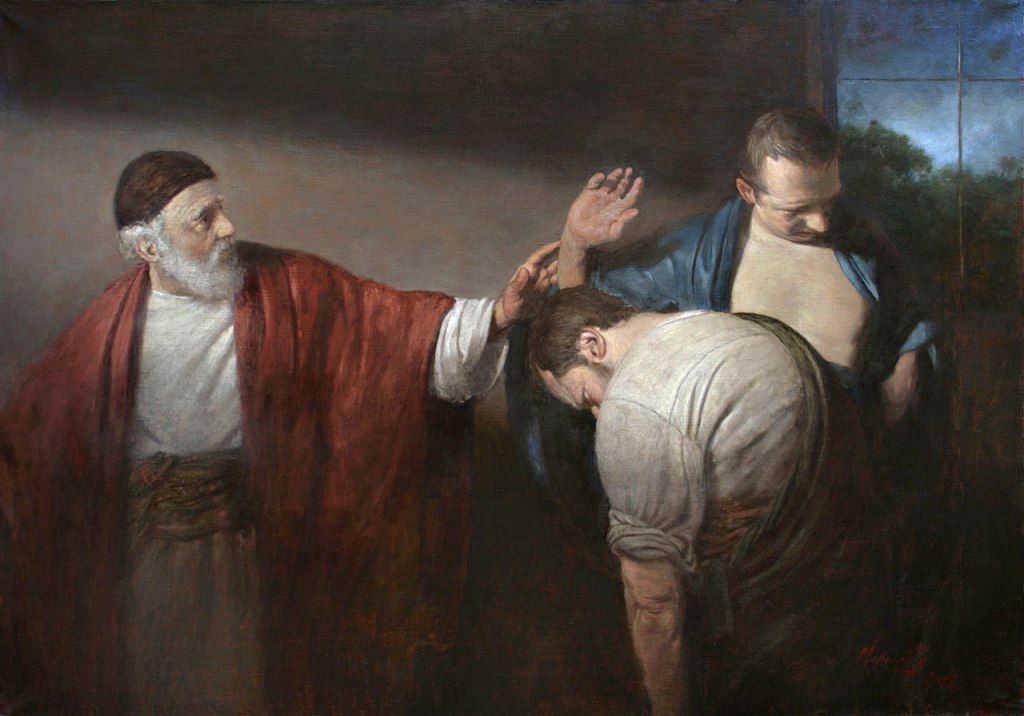
Matthew 21: 23-32 Authority and the Parable of the Two Sons

A.N. Mironav, Parable of the Two Sons, CC by SA 4.0, https://commons.wikimedia.org/wiki/Category:The_Two_Sons

Matthew 21: 23-32

Mark 11: 27-33, Luke 20: 1-8

23 When he entered the temple, the chief priests and the elders of the people came to him as he was teaching, and said, “By what authority are you doing these things, and who gave you this authority?” 24 Jesus said to them, “I will also ask you one question; if you tell me the answer, then I will also tell you by what authority I do these things. 25 Did the baptism of John come from heaven, or was it of human origin?” And they argued with one another, “If we say, ‘From heaven,’ he will say to us, ‘Why then did you not believe him?’ 26 But if we say, ‘Of human origin,’ we are afraid of the crowd; for all regard John as a prophet.” 27 So they answered Jesus, “We do not know.” And he said to them, “Neither will I tell you by what authority I am doing these things.

28 “What do you think? A man had two sons; he went to the first and said, ‘Son, go and work in the vineyard today.’ 29 He answered, ‘I will not’; but later he changed his mind and went. 30 The fatherwent to the second and said the same; and he answered, ‘I go, sir’; but he did not go. 31 Which of the two didthe will of his father?” They said, “The first.” Jesus said to them, “Truly I tell you, the tax collectors and the prostitutes are going into the kingdom of God ahead of you. 32 For John came to you in the way of righteousness and you did not believe him, but the tax collectors and the prostitutes believed him; and even after you saw it, you did not change your minds and believe him.

Jesus re-enters the temple after the night in Bethany. He has already upended, at least temporarily, the business of the temple and once again his presence brings conflict with the religious leaders in the temple. Throughout Jesus’ ministry he has evoked conflict with the religious leaders in the area he works, primarily with the Pharisees in Galilee and now with the religious elite of Jerusalem. Like the prophets who clashed with religious authorities before Jesus, it is helpful to remember that Jesus’ words, actions, and presence is unsettling to those with religious and political authority in his world. As Richard B. Hays can state:

Jesus’ message was controversial and threatening to the established institutions of religious and political power in his society: the message carried with it a fundamental transvaluation of values, an exalting of the humble and a critique of the mighty. The theme of reversal seems to have been pervasive in his thought. (Hays 1996, 163)

This conflict which opens a series of parables about reversal is a conflict between two perspectives on faithfulness. The chief priests and the elders represent the voice of the established order of the temple and in a reductionist way the priestly voice speaks to orthodoxy (right prayer/worship)[1] while Jesus, John, and the prophets have generally focused on orthopraxis (right actions). The authority of the chief priests and the elder comes from their position in the temple, but they do not have faith which allows them to see how God is at work in the things Jesus does and says.

The prophets and the psalms frequently criticize the people who continue to worship God in the temple but who fail to live in accordance with the covenant. Both John and Jesus have, in their own way, attempted to call the people into the ways of righteousness and have been resisted by the religious and political leaders in their proclamation and work. Jesus is now doing this work in the temple, and the chief priests and the elders say to him, “by what authority are you doing these things, and who gave you this authority?” Jesus is doing the work, which included healing and teaching as well as the work of driving out the moneychangers, and especially with works like healing the authority must come from somewhere. The primary question is not whether Jesus has the authority to do what he is visibly doing, but where the authority is coming from. Previously Jesus was accused by the Pharisees of deriving power from Beelzebul (12:22-32), and while Warren Carter is correct that “the question is not about his identity but whether they will recognize it.” (Carter 2005, 423) Yet, from Matthew’s perspective the issue is not the ability of the chief priests and the scribes to acknowledge Jesus’ authority as proper but rather will the chief priests and elders have faith to recognize the works, the baptism of John, and John (and Jesus’) way of righteousness coming from heaven.

Politicians are famous for not answering the question that is asked, but I do not believe that is what Jesus is doing here. This scene sets up three interlocking parables, but Jesus’ question helps the reader (and has the potential to help the religious leaders) understand the first question better. Matthew links the language of Jesus and John the Baptist throughout the gospel[2] and so a question about the things John does gives the answer to the authority for the things Jesus does. If the authority of John is from heaven, the works that Jesus does are authorized by heaven, but if one cannot see the baptism of John and the transformation it brought into the lives of those who came to John as an action of the kingdom of God then one will not have the faith to understand how God is at work in the things Jesus does. Throughout this passage what the NRSV renders ‘believe’ is ‘have faith’[3] but even though Jesus does not directly answer their question, the first short parable gives them the answer.

Entering this and the following parable, it is helpful to understand that just like the fig tree the vineyard is a representation of Israel. Probably the most familiar reference to Israel being the vineyard of the Lord is Isaiah 5 where the LORD does everything possible for a vineyard to be fruitful, but it only bears wild grapes:

For the vineyard of the LORD of hosts is the house of Israel, and the people of Judah are his pleasant planting; he expected justice, but saw bloodshed; righteousness but heard a cry. Isaiah 5:7

It is important to note that in these parables of Jesus the vineyard is not destroyed, instead better sons (in this parable) and faithful stewards (in the following) parable are sought to work in the vineyard. It is not Israel that is the primary problem but the leaders who resist the will of the father. In this parable the father goes to the first son who states “I do not will/desire to go[4] but this son repents[5] and does the work of the father. The second son in contrast declares “I am, lord” but does not go. The inclusion for the second son of lord (Greek kurios) which can mean ‘sir’ but missing that this means ‘lord’ misses the connection with Matthew 7:21:

Not everyone who says to me, ‘Lord, Lord,’ will enter the kingdom of heaven, but only the one who does the will of my Father in heaven.

The one who repents and goes into the vineyard does the will of their father, just like the sinners that observed John’s coming in the way of righteousness and had faith in him by repenting and changing their life did the will of God and enter into the kingdom of God. The religious leaders have seen the change in others but have resisted both John and Jesus and could not see God’s kingdom at work in the things they do.


[1] Orthodoxy is normally understood as correct beliefs, but the word itself means ‘right praise/prayer.’ The high priests and the elders are primarily concerned (as they are portrayed) focusing on the proper operation of the temple in its worship of God.

[2] Compare John’s message in 3:1-12 with Jesus in 4:17 and 10:7

[3] This may seem like semantics, but faith in Matthew’s gospel is an openness to where God is at work in the things Jesus (and John) are doing. For more on this see my discussion on Faith in Matthew’s gospel.

[4] The Greek thelo is the act of willing or desiring, so the action is not merely declining but stating it is not the desire of the son to do what the father asked.

[5] Greek metamelomai which means regret or repent.

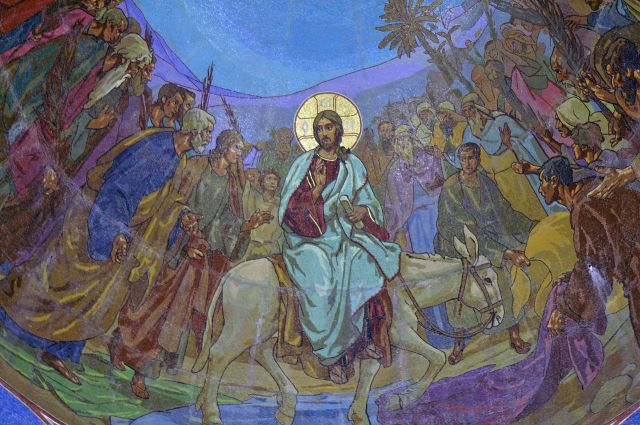
Matthew 21: 1-11 The Entry into Jerusalem

Matthew 21: 1-11

Parallels Mark 11: 1-10; Luke 19: 28-40; John 12: 12-29

When they had come near Jerusalem and had reached Bethphage, at the Mount of Olives, Jesus sent two disciples, 2 saying to them, “Go into the village ahead of you, and immediately you will find a donkey tied, and a colt with her; untie them and bring them to me. 3 If anyone says anything to you, just say this, ‘The Lord needs them.’ And he will send them immediately.” 4 This took place to fulfill what had been spoken through the prophet, saying,

5 “Tell the daughter of Zion, Look, your king is coming to you, humble, and mounted on a donkey, and on a colt, the foal of a donkey.”

6 The disciples went and did as Jesus had directed them; 7 they brought the donkey and the colt, and put their cloaks on them, and he sat on them. 8 A very large crowd spread their cloaks on the road, and others cut branches from the trees and spread them on the road. 9 The crowds that went ahead of him and that followed were shouting,

“Hosanna to the Son of David! Blessed is the one who comes in the name of the Lord! Hosanna in the highest heaven!”

10 When he entered Jerusalem, the whole city was in turmoil, asking, “Who is this?” 11 The crowds were saying, “This is the prophet Jesus from Nazareth in Galilee.”

The entrance to Jerusalem, celebrated at the beginning of Holy Week in liturgical churches, is often viewed as a triumphal procession, which in one way it is, but this rich prophetically symbolic event is sometimes lost amid the palm branches and joyous songs. The entrance to Jerusalem initiates the final section of the gospel which narrates the time between the entrance to Jerusalem and the resurrection. This even is narrated by all four gospels, but only in John are the branches mentioned to be the palms which give the liturgical celebration of Palm Sunday its name. Even though this initiates a new section as Jesus enters into conflict with the religious leaders in Jerusalem, Matthew as a skillful editor and storyteller weaves in numerous threads that connect this scene and the coming conflicts, parables, events and ultimately the crucifixion and resurrection to the teaching, parables, healings, and conflicts that have been a part of the ministry in Galilee and the approach to Judea.

The first connecting thread which ties this scene to the preceding narration in Matthew is the continued presence of doubling. Just as in the previous section where two blind men are healed (and this links the final scene of the narrative prior to entering to Jerusalem to scenes throughout Jesus’ ministry) now in this initial scene of the Jerusalem narrative we have two disciples sent to retrieve two animals. Just as Matthew begins his gospel with a genealogy which ties the gospel to the story of Israel, now Matthew begins his narration of the events that lead to Jesus’ death by connecting it structurally with the narration of Jesus’ ministry.

Throughout this journey through Matthew I have linked Jesus’ vision of the kingdom of heaven with the vision God intended for Israel as an alternative community to the ways of Egypt, Assyria, Babylon and now Rome. This insight helps hold together both sides of Jesus’ action of coming into Jerusalem on ‘a donkey and on a colt, the foal of a donkey.’ While David Garland is right to identify Jesus’ action of riding a donkey into Jerusalem with this action by previous claimants to the throne of David[1] and with the expectations of the actions of the awaited messiah (Garland 2001, 213) but Warren Carter is also correct that this act is “making an ass out of Rome” in entering Jerusalem in a way that is a parody of the Roman triumphs, victories and arrivals of a governor or emperor. (Carter 2005, 413) The vision of what a king of Israel is to be, according to the law as outlined in Deuteronomy 17: 14-20 ,is the opposite of the ways the kings and rulers of nations like Egypt and Rome acted. The problem Israel experienced is that the kings of Israel often imitated the kings of the empires rather than the vision of God for Israel. Even the disciples of Jesus will struggle to understand what it means for Jesus to be the Christ (messiah) as they think of ‘earthly things’ rather than ‘heavenly things.’ Jesus’ birth caused Herod to be frightened and all Jerusalem with him, and now his entry the city is shaken (this is the Greek seio, where the English seismic comes from, this will also be used for the earthquake at the death and resurrection of Jesus) by this act of approaching on a donkey and a colt, surrounded by the crowds that have approached Jerusalem in his presence. The people of Jerusalem, the urban center where now Pilate sits as the emissary of Caesar instead of Herod and they understand the prophetic significance of the actions and words of Jesus and his followers.

Matthew makes explicit what Mark implied about the biblical symbolism by weaving together Isaiah 62:11 and Zechariah 9:9. While most readers probably assume Matthew’s use of scripture is merely predictive (pointing to texts from the Hebrew scriptures which demonstrate how Jesus fulfills scripture) but Matthew’s rich weaving of scripture can, for the careful reader, help illuminate a deeper engagement with what Jesus’ actions mean. As we begin this section of the story in Jerusalem Isaiah 62 and Zechariah will be two of the texts which help provide language which can explain what Jesus’ actions and eventual death will mean in this final section of Matthew. Isaiah 62 is a song of the restoration of Zion, and although Jesus’ actions will challenge the religious authorities in Jerusalem, this approach is ‘for Zion’s sake’ (Isaiah 62:1). This passage in Isaiah talks about the ending of Israel’s long exile and captivity to other empires. The specific verse which begins this intertwined quotation (the portion Matthew uses is underlined) is:

The LORD has proclaimed to the end of the earth: Say to daughter Zion “see your salvation has comes; his reward is with him, and his recompense is before him. (Isaiah 62:11)

Matthew is a careful editor, when he quotes scripture and brings together verses it is intentional rather than a scribal error. Matthew seems to have access to the Septuagint (the Greek translation of the New Testament) as he is writing this and is very skilled in reading texts. The remainder of this text comes from Zechariah 9:9 which Matthew slightly modifies (again what Matthew uses is underlined):

Rejoice greatly, O daughter Zion! Shout aloud, O daughter Jerusalem! Lo, your king is coming to you; triumphant and victorious is he, humble, and mounted on a donkey, on a colt, the foal of a donkey.

Matthew leaves off the note of triumph and victory from this quotation, even as he carefully includes the two animals (which again works in Matthew’s doubling pattern). Zechariah will continue to echo in Matthew’s narration of the passion narrative, especially in the Lord’s Supper where both the language of the blood of the covenant and striking the shepherd are rich echoes of Zechariah.

This blended quotation also allows Matthew to reintroduce the adjective ‘meek’ when referring to Jesus (NRSV humble, the Greek praus is the same term used in 5:5 and 11:29). Jesus’ actions help us understand this important term for Matthew, it does not mean silence or temerity but rather it refers to those who wait upon the Lord to deliver them rather than rising up in resistance. If there is a triumph here, the triumph belongs to the Lord, the God of Israel, rather than any king. But for Matthew we have God’s action on behalf of Israel and the ‘God who is with us’ in Jesus blended together in a way that defies easy categorization. Jesus may embody titles like savior (which may be why the beginning of Isaiah 62:11 is used), messiah/Christ/king, Son of David, and prophet, but none of them adequately describe the totality of Jesus in Matthew. Each may illustrate some amount of openness to God’s work in Jesus’ presence, but they also remain open to misinterpretation.

The crowds who enter with Jesus can declare Jesus as ‘Son of David,’ ‘one who speaks in the name of the Lord’ and ‘prophet’ which illuminates that they understand in part who Jesus is, unlike Jerusalem which quakes at his approach. Although Matthew does not specify, this crowd which enters Jerusalem with Jesus is probably not the same crowd that calls for his crucifixion. It is likely that it is the crowds from the urban center of Jerusalem who do not, at the urging of the religious leaders in the city, embrace Jesus’ words and actions. It is possible that some of the approaching crowd become disillusioned with the way Jesus embodies these titles, like Judas Iscariot who moves from a disciple to one who betrays. This scene probably reflects those who have journeyed with Jesus to Jerusalem in this festival season who enter as outsiders to the city. The people of Jerusalem may have heard stories of Jesus’ ministry and work, but in Matthew this is the first time and only time that Jesus comes to Jerusalem.

Unlike in Mark, where Jesus withdraws to Bethany after arriving at the temple late in the day, we will see Jesus immediately move from one symbolically rich action in the approach of the city directly to the symbolically rich action of clearing out the money changers and animal sellers in the temple. From a perspective where this action parodies the Roman practice of a victory parade where the conqueror proceeds to the temple to offer a sacrifice, we see Matthew joining the action on entry together with the action in the temple. But from the prophetic and Jewish perspective there is the action of Jesus embodying what a king is supposed to be. For Matthew’s narration of these linked scenes the figure of David will stand in the background of the narration as Jesus is acclaimed as Son of David, and particularly in the next scene there are some clever allusions to David’s capture of Jerusalem. But hauntingly the people entering with Jesus describe him as a prophet who is entering a city with a reputation for rejecting prophets. While David was often thought of as a prophet, especially as he is attributed with many of the Psalms, we see in Jesus one who brings together the role of prophet and king in a way not seen in Israel, with the possible exception of Moses.

[1] Absalom is riding a mule in 2 Samuel 18:9 when he dies during his rebellion against David, Solomon rides a mule to is anointing in 1 Kings 1: 33

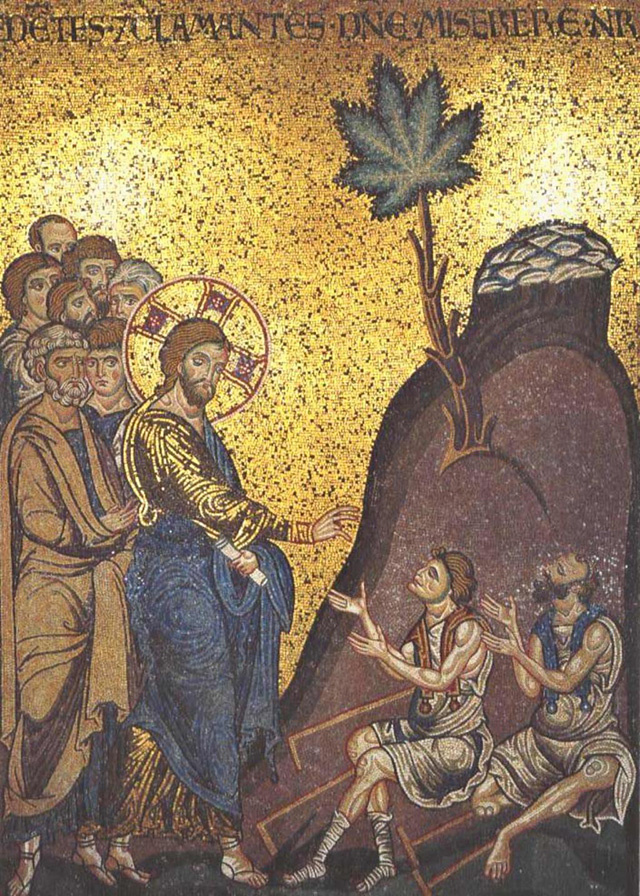
Matthew 20: 29-34 Opening Eyes on the Way to Jerusalem

Jesus Healing the Blind From 12th Century Basilica Catedrale di Santa Maria Nouva di Monreale in Sicily.

Matthew 20: 29-34

Parallel Mark 10: 46-52; Luke 18: 35-43

29 As they were leaving Jericho, a large crowd followed him. 30 There were two blind men sitting by the roadside. When they heard that Jesus was passing by, they shouted, “Lord, have mercy on us, Son of David!” 31 The crowd sternly ordered them to be quiet; but they shouted even more loudly, “Have mercy on us, Lord, Son of David!” 32 Jesus stood still and called them, saying, “What do you want me to do for you?” 33 They said to him, “Lord, let our eyes be opened.” 34 Moved with compassion, Jesus touched their eyes. Immediately they regained their sight and followed him.

Matthew is a careful narrator bringing together the pieces of Jesus’ story in a way that illustrates connections across the gospel and bringing enhanced meaning to each individual scene. The first disciples called to follow Jesus are two sets of brothers, (4:18-22) and the last who follow are two blind men enabled to see. Just as the request of the demons possessing two men make a request of Jesus (8: 28-34) is closely followed by the previous healing of two blind men (­9:27-31) so this healing of the two blind men is preceded by the formal request of the mother of James and John (see previous section). This pattern of twos provide clues to the oral structure underlying Matthew’s narration and provide signposts that allow the hearer to pay attention to commonalities in the stories. This narration of healing the two blind men outside of Jericho closes the gathering of Jesus’ followers in Galilee and on the road to Jerusalem. Its use of the Son of David title for Jesus recalls the previous usages of this title in the gospel[1] and prepares us for the crowds proclamation of this title as Jesus enters Jerusalem.

Jesus begins his final approach to Jerusalem making his way up from Jericho and a great crowd is with him. The crowds, like the disciples with the children, are a barrier for these two blind men to be in the presence of Jesus, but the use of both ‘Lord’ and ‘Son of David’ in their address to Jesus prepare us for Jesus’ eventual granting of their request. Previously when Jesus healed two blind men he ordered them to be silent, but instead they go and spread news about Jesus to the surrounding district. Here, the great crowds attempt to silence the two blind men only results in the blind men shouting greatly for mercy from the Lord, the Son of David. Matthew uses Hosea 6:6, “I desire mercy, not sacrifice.” as a key to understanding a merciful interpretation of scripture,[2] and just as the merciful are blessed and will receive mercy, Jesus responds with healing to numerous requests for mercy.[3] Jesus responds to this request for mercy with compassion.[4]

In contrast to the previous scene where the audacious request of the mother of James and John for a position of honor for her sons is met with a paradoxical partial fulfillment which points to James and John suffering, in this scene the request for mercy is met with healing. The response of Jesus to both the mother of James and John and the two blind men is and identical “What do you will (Greek theleo). There is irony in these two stories placed next to one another where disciples are unable to see what they ask, where these blind men are aware of their blindness and ask to be able to see. Despite the attempts to silence them by the crowds, they are invited into the presence of Jesus, touched by him, and have their eyes opened. Unlike the previous healing of blind men where faith was a primary portion of the story, the question of faith is unaddressed but assumed by both the titles used and the persistence of these blind men who become followers on the road to Jerusalem. Ironically, the words that the crowds attempt to silence from these two blind men becomes their shout as they surround Jesus to enter Jerusalem.

[1] The two blind men in 9:27 and the Canaanite woman in 15:22 use this title asking for healing and the crowd wonders could this be the Son of David in 12:23. For a fuller discussion of the use of the Son of David title see Son of David, Son of God, Son of Man Titles in Matthew’s Gospel.

[2] See 9:13 and 12:7

[3] 5:7 in the Sermon on the Mount; healings after requests for mercy: 2 Blind men (9:27-31), Canaanite woman (15: 21-28), Father of the moonstruck son (17:14-21) see also the request for mercy in the parable of the unforgiving slave (18:30-32)

[4] Previously Jesus has had compassion for the crowds (9:36, 14:18, and 15:32) but not for individuals. Compassion also is the expected action of the unforgiving slave in the parable (18:27)

Matthew 19: 16-30 The Life of the Coming Age

Matthew 19: 16-30

Parallel Mark 10: 17-31; Luke 18: 18-30

16 Then someone came to him and said, “Teacher, what good deed must I do to have eternal life?” 17 And he said to him, “Why do you ask me about what is good? There is only one who is good. If you wish to enter into life, keep the commandments.” 18 He said to him, “Which ones?” And Jesus said, “You shall not murder; You shall not commit adultery; You shall not steal; You shall not bear false witness; 19 Honor your father and mother; also, You shall love your neighbor as yourself.” 20 The young man said to him, “I have kept all these; what do I still lack?” 21 Jesus said to him, “If you wish to be perfect, go, sell your possessions, and give the money to the poor, and you will have treasure in heaven; then come, follow me.” 22 When the young man heard this word, he went away grieving, for he had many possessions.

23 Then Jesus said to his disciples, “Truly I tell you, it will be hard for a rich person to enter the kingdom of heaven. 24 Again I tell you, it is easier for a camel to go through the eye of a needle than for someone who is rich to enter the kingdom of God.” 25 When the disciples heard this, they were greatly astounded and said, “Then who can be saved?” 26 But Jesus looked at them and said, “For mortals it is impossible, but for God all things are possible.”

27 Then Peter said in reply, “Look, we have left everything and followed you. What then will we have?” 28 Jesus said to them, “Truly I tell you, at the renewal of all things, when the Son of Man is seated on the throne of his glory, you who have followed me will also sit on twelve thrones, judging the twelve tribes of Israel. 29 And everyone who has left houses or brothers or sisters or father or mother or children or fields, for my name’s sake, will receive a hundredfold, and will inherit eternal life. 30 But many who are first will be last, and the last will be first.

This encounter with the young man with an abundance of possessions provides a rich opportunity to reconsider several elements of Matthew’s gospel in a fuller light. Unfortunately Matthew’s usage of the kingdom of heaven in many places and what many translations render as ‘eternal life’ combined with the long history of the church’s proclamation about heaven being a place where one’s soul departs to after death makes this passage sound like it is primarily concerned about life after death, but that presents a stumbling block to hearing what is at stake in the dialogue between this young man, Jesus, and the disciples. All of the gospels are primarily concerned with life on earth, and while Jesus’ teaching does have an element of judgment and reward beyond this age it is, Jesus never focuses on Gehenna or heaven as destinations but is instead focused on the kingdom of heaven’s approach to earth. It is the interaction between the alternative values of the kingdom of heaven and the values of the empires of the earth that leaves both the wealthy young man and Jesus’ disciples perplexed.

The someone who approached Jesus, who we later learn is a wealthy young man, asks Jesus about what ‘good he might do in order that he might have the life of the coming age.’ There is a lot in this first line that needs unpacking and perhaps much acquired baggage that many modern Christians must leave behind so they might enter into a richer hearing of this interaction. The young man’s addresses to Jesus as ‘teacher’ should alert us that the young man’s understanding of who Jesus is comes from the perspective of how he views him within the structures of society and not with eyes that are open to who Jesus is. In Matthew’s gospel the term teacher[1] prepares us that this young man will leave unsatisfied even though Jesus will extend the invitation to this man to follow him. The question about ‘what good I might do’ (many translations limit this to state what good ‘deed’ he might do, but the question is broader than a single good ‘deed’) ‘in order that I might[2] have the life of the coming age.’ This young man has seen something of the life that Jesus and his disciples are living and he comes seeking a way that he might share with them in their experience of the kingdom of heaven’s approach. Before we encounter Jesus’ answer, let’s examine this idea of the ‘life of the coming age.’

When most Christians hear this story they think the young man is asking Jesus what he needs to do to get to heaven, but what this young man sees is the life that Jesus is partaking of now and he is asking how he can partake of it. The primary reason I render this ‘the life of the coming age’ is that our understanding of ‘eternal life’ often obscures what the New Testament is talking about (see Afterlife, Eternal Life and the Life of the Kingdom). This young man knows there is something missing in his own life, and he has come to Jesus who he sees as a teacher who can give him the answer that will fill the emptiness that apparently his possessions and current life are not.

Jesus’ initial response to the young man both points back to the center of the Jewish faith but also invites the hearer question Jesus’ identity beyond being only a teacher. The Shema (Deuteronomy 6:4-5) is the central confession of the Jewish people where they confess “The LORD is our God, the LORD is one” (or alone as the NRSV renders) and the Psalms and the prophets often link the LORD as the one who is good.[3] While the young man is called to center of God and God’s commandments as the revelation of goodness, we have also seen throughout Matthew’s gospel the continual drawing of Jesus’ authority and God’s authority close together and so the question of “Why do you ask me what is good?” also asks “how do you see my words and God’s words linked?” The young man is still viewing Jesus through the lens of a teacher, so he focuses only on the keeping of the commandments by asking a clarifying question of “which ones?”

Jesus’ answer joins Leviticus 19:18 to the commandments dealing with one’s relationship with others, emphasizing the communal nature of this life that the young man is desiring to enter into with the interesting omission of the command on coveting. The young man still realizes something is missing and desires what he is lacking, and this is where the command of coveting enters the discussion. Jesus’ final words to this young man are, “If you will/desire (Greek thelo) to be whole/complete (this is again the Greek telios[4]), go…” Will/desire has a stronger force than simply wishing for wholeness, there is an active element of the heart (the instrument of will in Hebrew thought) working towards that end. Again, we often think of perfection in terms of an individualistic moral perfection which would be alien to biblical thought which is communal. The term wholeness or completeness better captures what Jesus is offering this young man. The young man realizes something is missing, but what he fails to comprehend is that finding this new treasure will mean giving up all that he owns to possess it like the one who finds a treasure in a field or the merchant who finds a pearl of exceeding value. (13:44-46) The command to sell his possessions, give to the poor, and having a storehouse in heaven echoes the Sermon on the Mount when it talks about possessions (6:19-21) but it also is accompanied by the calling that the disciples received (4: 18-22) The lure of wealth (13: 22) perhaps chokes the seed of this calling to follow Jesus and the young man departs disappointed and the disciples remain perplexed.

As the young man departs, Jesus turns to his disciples who even though they have left behind their lives to follow him still remain bound to thinking in the terms of the empires of this world. If a person who is young, wealthy, Jewish and male has great difficulty entering the kingdom of heaven, a person who in the eyes of Judaism has every privilege, then how can a humble child? The values of this kingdom are truly upside down: where the last are first and the first are last. The saying about the camel passing through the eye of a needle is not about some mythical gate where a camel must be unburdened and kneel down to pass through (that is a story about a gate that never existed and obscures the meaning of the image) but instead the image points to an impossibility. A camel cannot pass through the eye of a needle, nor do a rich men give up their wealth and privilege without divine intervention. Yet, with the advent of the kingdom of heaven God is at work making incredible things possible.

Peter, on behalf of the disciples, asks what their reward is for what they have given up. Peter still thinks in the value system of the world and is focusing on what he and the other disciples have left behind instead of what they have gained. I do not say this as a critique of Peter, few if any followers of Jesus completely unlearn the values of the world they grew up with, but Jesus points Peter and the disciples to the ‘renewal of all things’ where they will have positions of honor and the investment they made in the kingdom of heaven will be revealed as they participate in this life of the coming age. But being the greatest in the kingdom is like being a child (18:1-5) or a servant  or slave (20:26-27), it is the upside down values of a kingdom which approaches the earth, of a Lord who serves, where the first are last and the last are first. This vision of the kingdom taps into the hope for the regathering of all of Israel, but as we will learn at the end of the gospel it will continue with the spread beyond Israel to all the nations.

[1] In Matthew when someone refers to Jesus as teacher it often indicated either that the person is challenging Jesus’ authority or that their insight into who Jesus is (faith) is not open to the answer he will give them (8: 18, 9:11; 12: 38; 17: 24; 22:16; 22:24; 22:36).

[2] The verb is an aorist (undefined) subjunctive which is the mood of possibility often expressed with ‘may’ or ‘might’ (Mounce 1993, 282-283)

[3] See for example Psalm 34:8; 100:5; 119: 68; 135: 3; 136:1; Jeremiah 33:11; Lamentations 3: 25, 28 and Nahum 1:7

[4] I’ve written about telios in both Perfection and Blamelessness in the Bible and when I discuss Matthew 5:48