Tag Archives: Generosity

Psalm 112 An Authentic Life Shaped by Wisdom

The Presentation of the Torah By Édouard Moyse – Own work Musée d’art et d’histoire du Judaïsme, CC BY-SA 4.0, https://commons.wikimedia.org/w/index.php?curid=41893002

Psalm 112 

1Praise the LORD! Happy are those who fear the LORD, who greatly delight in his commandments.
2Their descendants will be mighty in the land; the generation of the upright will be blessed.
3Wealth and riches are in their houses, and their righteousness endures forever.
4They rise in the darkness as a light for the upright; they are gracious, merciful, and righteous.
5It is well with those who deal generously and lend, who conduct their affairs with justice.
6For the righteous will never be moved; they will be remembered forever.
7They are not afraid of evil tidings; their hearts are firm, secure in the LORD.
8Their hearts are steady, they will not be afraid; in the end they will look in triumph on their foes.
9They have distributed freely, they have given to the poor; their righteousness endures forever; their horn is exalted in honor.
10The wicked see it and are angry; they gnash their teeth and melt away; the desire of the wicked comes to nothing.

Psalm 112 and Psalm 111 share a lot of commonalities. Both are acrostic poems with each cola beginning with successive letters of the Hebrew alphabet. They share commonalities in vocabulary[1] with each other and with wisdom literature in general. If Psalm 111 is the beginning of wisdom then Psalm 112 would be a life lived in wisdom. The fear of the LORD[2] here leads to a delighting in the commandments of the LORD and a life that is authentic and in harmony with God, society, and the creation.

Like Psalm 111 and 113, the first word of the psalm is Hallelujah (NRSV Praise the LORD). The acrostic poem begins with the second word asre (NRSV happy) which is a common indicator of wisdom literature. Like Psalm 1, which also begins with asre we are examining the contrast between a righteous life in harmony with God’s will for the world and a wicked life in conflict with God’s will. The Hebrew asre often translated ‘happy’ or ‘blessed’ or even ‘contented’ but the concept in Hebrew thought is closer to ‘wholeness’ or ‘completeness.’ This integrated life is a life of shalom, itself a word that has a much larger function than the standard English translation of peace. The way of wholeness and completeness is the way of wisdom. Those who ‘fear’ the LORD greatly delight in the LORD’s commandments. This is not a burdensome set of commands but the boundaries which provide the safe space where an individual can live a whole and integrated life.

The blessings of this whole person reflect the ideals of Hebrew thought. Abraham when he begins his journey with God is promised descendants, a blessing, house, land and prosperity and through his household all the nations will be blessed. For the ‘happy’ ones who follow the way of wisdom their descendants are mighty, their generation is blessed, their households are prosperous, and their righteousness endures. The Hebrew scriptures trust that God will provide for the righteous ones who follow God’s ways. Those who fear, love, and trust the LORD above all things will find that they have enough and even an abundance beyond what they need.

These wise and righteous ones reflect the God who they worship and serve. In Psalm 111 the LORD’s righteousness endures forever, and in verse three now the righteousness of these ‘happy’ ones endures forever. In Psalm 111 God was characterized as gracious and merciful and now these ones who fear the LORD are also gracious, merciful, and righteous. They become the image of the LORD they fear, obey, and worship. They become a light that reflects the light of the LORD for the upright in the darkness of the world.

This life of faithfulness is a life of generosity. They do not hoard what they have but deal generously and lend. They distribute freely and give to the poor trusting that God will provide what they need. They conduct their affairs in justice/righteousness[3] and that justice/righteousness has a gracious and merciful character. Their practices remain constant throughout their lives and they are examples who are remembered of a life well lived. They trust in the LORD and even in evil/wicked times they remain secure in their trust. Their horn, which is reflective of power and status, is exalted in honor.

In classical wisdom literature duality these ‘happy’ ones are contrasted with the wicked. The wise and the wicked are opposing ways of life. The wise life is generous and merciful while the wicked one does not care for the poor, does not live generously, and may aggressively attempt to take advantage of both the vulnerable and the generous righteous ones. Yet, the anger and aggression of the wicked melts away before the sustaining power of the LORD that the wise ones fear. The desire of the wicked comes to nothing.[4]

The way of wisdom in the Hebrew scriptures is a way of life that lives in harmony with God’s commandments. The law and wisdom are connected in Hebrew thought. The law provides the vision of a society where the weak are protected and harmony and peace are possible. A way that is wise fears and reverences the LORD, the God of Israel and reflects the generous and merciful nature of that God. It trusts that even when the wicked seem to prosper that their foolish path will lead to their demise.


[1] Nancy deClaissé-Walford notes eleven key terms and phrases that occur in both relatively short psalms including: fear, delight in, upright, good, gracious, merciful, righteousness, remember, steady, give, and for all time. (Nancy deClaisse-Walford, 2014, p. 843)

[2] See the discussion of the Hebrew word yare translated fear in English in my notes on Psalm 111.

[3] The Hebrew tsaddik is a key idea in the Hebrew Scriptures. Both justice and righteousness emerge from the family of terms in Hebrew, like the Greek dikaios/dikaisune.

[4] This is the same word that ends Psalm 1, ‘abad which means to perish.
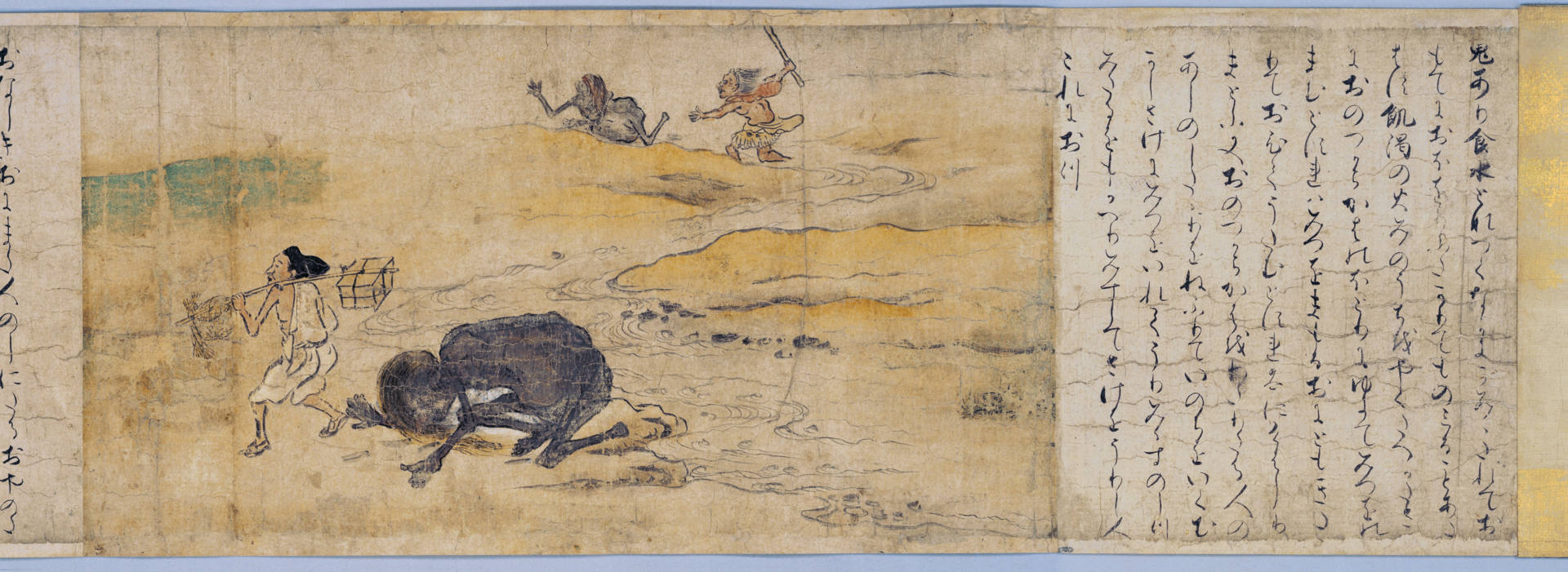
Hungry Ghosts

By Unknown – Tokyo National Museum, Emuseum, Public Domain, https://commons.wikimedia.org/w/index.php?curid=8005338

These insatiable spirits prowl on the edges of our vision
Consuming the gifts left for them but remaining unsatisfied
You can open the storehouse of your treasures in offering
But these hungry ghosts will always leave with wails of despair
And if you let them, they will invite you to join them in their cries
To see the scarcity where once abundance filled the table
To be consumed by comparison between yourself and others
Becoming a haunted and gaunt person whose joy has left them
Locked into their spiritual plane of hoarding and isolation
Where others become those whose happiness you must haunt
And you are only a shadow of man or woman of generosity

But these ghosts that haunt the edges of your happiness aren’t dead
Like emotional vampires they seek those whose joy they can drain
For they believe that in draining the life of others than can return
Resurrected in the act of dogging another’s actions for the moment
Living off the sacrifice of another’s ego, creating another hungry ghost
But their curse is to remain unsatisfied, consumed by their greed
Seeking that which can never satisfy, spending on that which is not food
Seeking life in the paths of death, seeking happiness in their gluttony
Show them kindness, but never look for their thankfulness
For these hungry ghosts are never satisfied, though their bellies burst
And don’t dwell in their haunts, don’t heed their haunted cries
Lest you too take up their ungrateful calls and their mournful cry

Ecclesiastes 11- Proverbs for Life in an Uncertain World

Rachel Ruysch (1664-1750) Vanitas

Rachel Ruysch (1664-1750) Vanitas

Ecclesiastes 11

1 Send out your bread upon the waters, for after many days you will get it back.
2 Divide your means seven ways, or even eight, for you do not know what disaster may happen on earth.
3 When clouds are full, they empty rain on the earth; whether a tree falls to the south or to the north, in the place where the tree falls, there it will lie.
4 Whoever observes the wind will not sow; and whoever regards the clouds will not reap.
5 Just as you do not know how the breath comes to the bones in the mother’s womb, so you do not know the work of God, who makes everything.
6 In the morning sow your seed, and at evening do not let your hands be idle; for you do not know which will prosper, this or that, or whether both alike will be good.
7 Light is sweet, and it is pleasant for the eyes to see the sun.
8 Even those who live many years should rejoice in them all; yet let them remember that the days of darkness will be many. All that comes is vanity.
9 Rejoice, young man, while you are young, and let your heart cheer you in the days of your youth. Follow the inclination of your heart and the desire of your eyes, but know that for all these things God will bring you into judgment.
10 Banish anxiety from your mind, and put away pain from your body; for youth and the dawn of life are vanity.

As we approach the end of the reflections that make up Ecclesiastes there is a sense of peace as the mundane moments of day to day life are lifted up against the vanity and uncertainty of the future. In the much more secular age that we live within perhaps Ecclesiastes is one of the voices of the canon that rings truest to our experience. While there is much in the New Testament, and some in the Hebrew Scriptures as well that deals with the transcendent the wisdom of the author of Ecclesiastes is in the discovery (or rediscovery) of the pleasure of the present. As Charles Taylor can describe our time as one where, “many people are happy living for goals which are purely immanent; they live in a way that takes no account of the transcendent.” (Taylor, 2007, p. 143) These proverbs for life in an uncertain world lift up joy and generosity in the face of foolishness and vanity.

Over 105 years ago the Danish philosopher Søren Kierkegard stated:

Philosophy is quite right in saying that life must be understood backward. But then one forgets the other clause—that life must be lived forward. The more one thinks through this clause, the more concludes that life in temporality never becomes properly understandable, simply because never at any time does one get perfect repose to take a stance—backward. (Pauw, 2015, p. 200)

Or put more simply, ‘hindsight may be 20:20 but we don’t walk through life backwards.’ We may understand much of our life much better with the hindsight of experience and the separation of time but we don’t have that option. Life is lived forward and so within the unknowable future and in the immanent present one chooses how one will approach it. The approach to life in these initial verses of chapter eleven is one of generosity, of spreading rather than hoarding. Of letting one’s bread float out upon the waters and dividing one’s wealth numerous ways. There are no guarantees but generosity and trust seems to be the way lifted up here by the Teacher. If we wait for the rains to come down from the heavens or trees to fall or until we understand all the secrets of life we will not act and we will miss life. Going out to work and planting without a guarantee of harvest is a part of the risk of life. Sometimes our work will come to nothing, sometimes the things we nurture and care for will fail. Here there is the ability to enjoy the light when it comes in all its sweetness while rejoicing even in the dark days. Ecclesiastes is not a moralistic crusader trying to put off passion, he encourages those who are young to follow the inclination of their heart even while knowing that their lives ultimately rest in God’s hands. We do not always see or understand the interaction between the work of our hands and the gifts of God’s work for our sake, yet we can move ahead without knowing the “blueprint for God’s work.” (Pauw, 2015, p. 201)

Finally, the chapter closes with a note on anxiety which has several echoes in the New Testament, probably the most famous being in Matthew 6:

Therefore I tell you, do not worry about your life, what you will eat or what you will drink, or about your body, what you will wear. Is not life more than food, and the body more than clothing? (Matthew 6:25)

Many of the things that cause anxiety are indeed hevel (vanity). This is not to belittle those who suffer from anxiety but Ecclesiastes’ focus is on the present. Often anxiety or worry may come from an unknown future and the desire to secure that future and that is in Ecclesiastes’ view hevel. Youth and the dawn of life may be vanity but they can also be joyful. Often joy is stolen by trying to hoard one’s gifts to ensure an uncertain future but we are reminded to enjoy the immanent present. To enjoy the sweet times of light even though days of darkness may be many. To go out and sow without guarantees and to follow the inclination of your heart before it is too late. Carpe diem, to seize the day not because one is fatalistic about the future but instead because they have not invested securing the future as an ultimate concern.