Tag Archives: Forgiveness

Review of Exclusion and Embrace: A Theological Exploration of Identity, Otherness, and Reconciliation by Miroslav Volf

Review of Exclusion and Embrace: A Theological Exploration of Identity, Otherness, and Reconciliation (1996) by Miroslav Volf.

This is the volume that introduced me to the work of Miroslav Volf and from the first page of the preface, where he lays out what is at stake in this theological exploration, through the final chapter on Violence and Peace it is a passionate and articulate formulation of a theology of the cross for our time. Volf is both honest about the challenges of reconciliation while holding before the reader the dream and hope of embrace as the end for which we are called to work. He powerfully weaves together theology, scripture, philosophy, and personal experience into a work that I have gone back to multiple times in my own ministry. Re-reading this work over twenty years after my initial reading Exclusion and Embrace is still a powerful work, but it also highlights my own evolution as a reader and scholar in the years between readings.

I first saw Exclusion and Embrace at the bookstore at Wartburg Seminary, and I felt drawn to it. I integrated it into an independent study attempting to flesh out Luther’s theology of the cross for our time in my senior year of seminary. At that point I was a young scholar reading everything I could get my hands on, and Volf’s work combined a deeply personal search for a Christian practice that was authentic with an academic rigor that was inspiring. This was the type of scholar I hoped to be. I was still attempting to integrate the diverse voices I had encountered in the previous two years of seminary into something that I could carry beyond the seminary walls. I was still wrestling with postmodernism as a way of thinking, knowing enough to be attracted and repelled by this alien way of encountering the world I was introduced to tangentially (although rarely under the name postmodernism) in academics. In Volf I found someone who was far more versed in authors like Nietzsche, Foucault, Deleuze, Said, and many other authors from a variety of perspectives who still took the scriptures, theology, and Christian practice seriously.

One of the major differences between my original and this reading is I have engaged enough with postmodern, feminist, and other voices to have developed my own perspective. I understand the influence of postmodern voices and perspectives, but in my own journey I have walked away from these perspectives because at their root I find them nihilistic. They serve as good critiques which fail to provide a viable alternative to the modernity they critique. Exclusion and Embrace is still an incredibly valuable work, but I found the central chapters speaking to dialogue partners who have little interest in a constructive dialogue with Christianity. I still believe the first two chapters and final chapter are incredibly important and make this a book that deserves wide reading. These are the places I have found myself referencing over the past twenty years and have caused me to read most of what Volf has written before and after Exclusion and Embrace.

One of the things I am most thankful for in Volf’s work is the way he bridges the divide between the academic world and the world which the academy often neglects. Like the three cities which form the concrete background of the reflection of the initial chapter (Los Angeles where Volf taught at the time, Berlin where he was giving the presentation that formed the chapter, and Sarajevo the war torn city from the land of Volf’s background as a Croatian) this is deals with the broken stories in need of forgiveness. Volf’s critique of the “pleasant captivities of the liberal mind” when he critiques the ‘God of perfect non-coercive love’ (Volf, 1996, p. 304) has stuck with me for the life of my ministry and resonates with my engagement with scriptures. This is a work that helped form my theology and gave me tools that would help me continue to grow as a pastor who engaged the scriptures and the questions of the surrounding world.     

Psalm 109 A Prayer For God’s Vengeance

From Susan Harris Anger and art// A Rage to Paint https://www.susanharrisart.com/blog

Psalm 109

To the leader. Of David. A Psalm.
1Do not be silent, O God of my praise.
2For wicked and deceitful mouths are opened against me, speaking against me with lying tongues.
3They beset me with words of hate, and attack me without cause.
4In return for my love they accuse me, even while I make prayer for them.
5So they reward me evil for good, and hatred for my love.
6They say, “Appoint a wicked man against him; let an accuser stand on his right.
7When he is tried, let him be found guilty; let his prayer be counted as sin.
8May his days be few; may another seize his position.
9May his children be orphans, and his wife a widow.
10May his children wander about and beg; may they be driven out of the ruins they inhabit.
11May the creditor seize all that he has; may strangers plunder the fruits of his toil.
12May there be no one to do him a kindness, nor anyone to pity his orphaned children.
13May his posterity be cut off; may his name be blotted out in the second generation.
14May the iniquity of his father be remembered before the LORD, and do not let the sin of his mother be blotted out.
15Let them be before the LORD continually, and may his memory be cut off from the earth.
16For he did not remember to show kindness, but pursued the poor and needy and the brokenhearted to their death.
17He loved to curse; let curses come on him. He did not like blessing; may it be far from him.
18He clothed himself with cursing as his coat, may it soak into his body like water, like oil into his bones.
19May it be like a garment that he wraps around himself, like a belt that he wears every day.”
20May that be the reward of my accusers from the LORD, of those who speak evil against my life.
21But you, O LORD my LORD, act on my behalf for your name’s sake; because your steadfast love is good, deliver me.
22For I am poor and needy, and my heart is pierced within me.
23I am gone like a shadow at evening; I am shaken off like a locust.
24My knees are weak through fasting; my body has become gaunt.
25I am an object of scorn to my accusers; when they see me, they shake their heads.
26Help me, O LORD my God! Save me according to your steadfast love.
27Let them know that this is your hand; you, O LORD, have done it.
28Let them curse, but you will bless. Let my assailants be put to shame; may your servant be glad.
29May my accusers be clothed with dishonor; may they be wrapped in their own shame as in a mantle.
30With my mouth I will give great thanks to the LORD; I will praise him in the midst of the throng.
31For he stands at the right hand of the needy, to save them from those who would condemn them to death.

This process of reflecting on scripture, particularly the parts of scripture that the church rarely utilizes, has opened my eyes to a far more dynamic and honest relationship between God and God’s people. Sometimes that dynamic and honest relationship is uncomfortable for people who grew up, like me, in churches where prayer was always a calm and measured practice. Psalm 109 rarely will find its way into a church bulletin or a sermon, but this psalm of imprecation that prays for harm to come to a wicked person provides a fertile place for discussion of the relationship between ourselves, others who have wronged us, and God. Anger and the desire for vengeance are powerful emotions, and too often we as people of faith have refused to give voice to these human feelings. Yet, these feelings will find their way into our lives and into the culture around us.

In a situation where the relationships that shape our society are shattered the faithful ones cry out to God. They name the brokenness that they encounter. They name those who have wronged them. But the brokenness of the world and the person who has brought about the suffering are placed into God’s hands. The person lifting up this cry to God has no ability to determine what God will do with the prayer and the ‘wicked one.’ Here, instead of suppressing the reality of suffering and pain or taking vengeance into their own hands, the faithful one cries out in desperation to God to act on their behalf.

Ellen Davis’s chapter on the cursing psalms in Getting Involved with God: Rediscovering the Old Testament (Davis, 2001, pp. 23-29) has shaped a lot of my thinking about the imprecatory (or cursing) psalms in general and this psalm in particular. The language of the bible shapes should shape our practices of faith, and the psalms and the prophets can give us language to articulate our honest feelings in our conversations with God. These may not be the more attractive offerings of thanksgiving or praise, but these words and feelings we also commit to God’s steadfast love. Ellen Davis shared the advice she received from a professor to take the imprecatory psalms into the chapel at a time when it was unoccupied and pray them at full voice. The experience helped her to move beyond her hurt and begin the needed journey to forgiveness. She remarks afterwards,

For the cursing psalms confront us with one of our most persistent idolatries, to which neither Israel nor the church has ever been immune: the belief that God has as little use for our enemies as we do, the desire to reduce God to an extension of our own embattled and wounded egos. (Davis, 2001, p. 26)

God cares for both the faithful and the wicked. Yet, that does not mean that the crimes of the wicked are not noticed by God. Psalm 109 anticipates a God who both hears this petition and acts upon it. The wicked and deceitful seem to have no problem using their words to shatter or their lies to cause harm to both the individual and the community. There are times when the innocent are surrounded by words of hate or attacked without justification. There are situations where love is repaid with hate and good with evil. As I was working through this psalm, I was reading Elie Wiesel’s Night where he shares his experience of being a young Jewish boy whose hope and faith were broken in Auschwitz in 1944 and Suzanne Collins, Sunrise on the Reaping which continues the fictional Hunger Games series where children are put into a fatal game for the entertainment of the powerful. Both the historical and the fictional may be extreme examples of a world where wickedness has triumphed over kindness, but the origin story of the people of Israel is the story of a God who rescued them from oppression and slavery. It is a story of a God who heard their cries and acted for their rescue from that a world without steadfast love.

One of the keys to hearing this psalm occurs in verse six. Most English translations being the verse with “They say” which places the most extreme portions of the psalm in the mouths of the adversary. Yet, there is no textual support in Hebrew for the words “they say.” (Bellinger, 2014, p. 473) Even if these words are put into the mouth of the adversary, the psalmist still wishes for these words that the adversary pulls around themselves like a cloak may become the garment they wear every day and soak into their body like water or oil all the way to the bones. Whether you read these words as being spoken by or toward the adversary, this brokenhearted prayer ascends to God bearing the hurt and brokenness of the psalmist’s world asking for God to intervene on the psalmist’s behalf and answer the psalmist’s pain.

The Hebrew word hesed, often translated steadfast love when coming from God or kindness (as in verse 12 and 16) when coming from other people, is a key idea throughout the Old Testament. Hesed is tied to the covenant between God and God’s people, as well as the covenant between the people of God. Central to the accusation of this individual is their failure to show hesed.

For he did not remember to show kindness (hesed), but pursued the poor and needy and the brokenhearted to their death. Verse 16.

Hesed is the glue that holds the Hebrew society together. It is both the proper relationship between God and God’s people but also the proper relationship among the people. When hesed is not present, the poor, needy, and brokenhearted die. The implications of a person living in disregard for the standards of society may be fatal. This could apply to a nobleman in Jerusalem who takes advantage of the vulnerable or a businessperson or politician who uses their influence in a way that impacts the physical and emotional health of others. The bible’s way of thinking assumes a common obligation between humanity and creation to care for one another. I once heard Rolf Jacobson remark that the Ten Commandments and the law in general were about, “my neighbor’s best life.”

The words directed at the wicked adversary are sharp. That a wicked person would be appointed against him, someone to accuse him on his right hand, when he is tried to be found guilty (Hebrew wicked), and that his prayers would be sin (either missing the mark or something refused by God). That his life would be short and another would claim his position, that even his wife and children would bear the repercussions of his fall. The adversary created a world without hesed (kindness) for the psalmist and now may the world fail to show him hesed. That the sins of his ancestors would be remembered and yet his memory fade. In Hebrew I don’t think there could be a stronger curse than to encounter a world devoid of hesed.

 One verse of this psalm has entered the political dynamics of the United States. I first encountered a bumper sticker with Psalm 109:8, “May his days be few, may another seize his position” referring to Barak Obama. The psalm is used to appear to be prayerful and cursing at the same time. Psalm 109:8 may have been utilized before Barak Obama, but I have seen it used to piously point to Donald Trump and Joe Biden since. It is unlikely that most people who have worn this psalm proudly on a shirt, button, or on their car read the entirety of the psalm, but unfortunately in the polarized and angry political climate the vengeful desires against not only those in power but their entire family would probably be embraced by many. Verse eight is also the only verse of this psalm that appears in the New Testament, in Acts 1:20, when Peter makes the case for replacing Judas. Yet, the use in the New Testament bears no desire for vengeance on Judas, merely understands the psalm as authorizing the search for a new disciple to fill the twelfth position after Judas’s death.

How do we use this rarely utilized psalm. My first reflection comes from Dietrich Bonhoeffer in his The Prayerbook of the Bible:

So the psalm of vengeance leads to the cross of Jesus and to the love of God that forgives enemies. I cannot forgive the enemies of God by myself, only the crucified Christ can; and I can forgive through him. So the carrying out of vengeance becomes grace for all in Jesus Christ. (DBWE 5:175)

Bonhoeffer takes the traditional Lutheran law-gospel hermeneutic where the psalm of vengeance (as law) pushes us to the love of God in Christ (gospel). As Ellen Davis mentioned earlier our inability to see anything redeemable in our enemies does not preclude God from acting in mercy and grace towards them. But Ellen Davis also has a wise if uncomfortable way of utilizing these psalms of cursing:

If you have the courage (and it will take some), try turning the psalm a full 180 degrees, until it is directed at yourself, and ask: Is there anyone in the community of God’s people who might want to say this to God about me—or maybe, about us? (Davis, 2001, p. 28)

We may not feel oppressed. We may not have anything we need to forgive in another, but perhaps there is someone who we have wronged. Whose futures have we, intentionally or unintentionally, harmed? Whose wives and children have learned to curse our names as individuals or as a group? Whose reputations have we destroyed? In her own way she encourages this use of the psalm as law which highlights the places where we also have not shown hesed.

Yet even a psalm of cursing ends with thanks to the God who defends the needy and saves from those who would condemn. Ultimately hesed, so important to this psalm and the Old Testament in general, is one of the defining characteristics of God. God is both the model of what hesed looks like, but also the one who intervenes when hesed is not found. This psalm has demonstrated all the differences between the world of oppression the psalmist lives in and the world God intends for God’s people. It resonates with the Lord’s prayer which calls out to God for God’s kingdom to come and God’s will to be done on earth as it is in heaven.

Psalm 106 Confessing the Unfaithfulness of the People of God

Grigory Mekheev, Exodus (2000) artist shared work under Creative Commons Attribution-Share Alike 3.0

Psalm 106

1Praise the LORD! O give thanks to the LORD, for he is good; for his steadfast love endures forever.
 2Who can utter the mighty doings of the LORD, or declare all his praise?
 3Happy are those who observe justice, who do righteousness at all times.
 4Remember me, O LORD, when you show favor to your people; help me when you deliver them;
 5that I may see the prosperity of your chosen ones, that I may rejoice in the gladness of your nation, that I may glory in your heritage.
 6Both we and our ancestors have sinned; we have committed iniquity, have done wickedly.
 7Our ancestors, when they were in Egypt, did not consider your wonderful works; they did not remember the abundance of your steadfast love, but rebelled against the Most High at the Red Sea.
 8Yet he saved them for his name’s sake, so that he might make known his mighty power.
 9He rebuked the Red Sea, and it became dry; he led them through the deep as through a desert.
 10So he saved them from the hand of the foe, and delivered them from the hand of the enemy.
 11The waters covered their adversaries; not one of them was left.
 12Then they believed his words; they sang his praise.
 13But they soon forgot his works; they did not wait for his counsel.
 14But they had a wanton craving in the wilderness, and put God to the test in the desert;
 15he gave them what they asked, but sent a wasting disease among them.
 16They were jealous of Moses in the camp, and of Aaron, the holy one of the LORD.
 17The earth opened and swallowed up Dathan, and covered the faction of Abiram.
 18Fire also broke out in their company; the flame burned up the wicked.
 19They made a calf at Horeb and worshiped a cast image.
 20They exchanged the glory of God for the image of an ox that eats grass.
 21They forgot God, their Savior, who had done great things in Egypt,
 22wondrous works in the land of Ham, and awesome deeds by the Red Sea.
 23Therefore he said he would destroy them — had not Moses, his chosen one, stood in the breach before him, to turn away his wrath from destroying them.
 24Then they despised the pleasant land, having no faith in his promise.
 25They grumbled in their tents, and did not obey the voice of the LORD.

 26Therefore he raised his hand and swore to them that he would make them fall in the wilderness,
 27and would disperse their descendants among the nations, scattering them over the lands.
 28Then they attached themselves to the Baal of Peor, and ate sacrifices offered to the dead;
 29they provoked the LORD to anger with their deeds, and a plague broke out among them.
 30Then Phinehas stood up and interceded, and the plague was stopped.
 31And that has been reckoned to him as righteousness from generation to generation forever.
 32They angered the LORD at the waters of Meribah, and it went ill with Moses on their account;
 33for they made his spirit bitter, and he spoke words that were rash.
 34They did not destroy the peoples, as the LORD commanded them,
 35but they mingled with the nations and learned to do as they did.
 36They served their idols, which became a snare to them.
 37They sacrificed their sons and their daughters to the demons;
 38they poured out innocent blood, the blood of their sons and daughters, whom they sacrificed to the idols of Canaan; and the land was polluted with blood.
 39Thus they became unclean by their acts, and prostituted themselves in their doings.
 40Then the anger of the LORD was kindled against his people, and he abhorred his heritage;
 41he gave them into the hand of the nations, so that those who hated them ruled over them.
 42Their enemies oppressed them, and they were brought into subjection under their power.
 43Many times he delivered them, but they were rebellious in their purposes, and were brought low through their iniquity.
 44Nevertheless he regarded their distress when he heard their cry.
 45For their sake he remembered his covenant, and showed compassion according to the abundance of his steadfast love.
 46He caused them to be pitied by all who held them captive.
 47Save us, O LORD our God, and gather us from among the nations, that we may give thanks to your holy name and glory in your praise.
 48Blessed be the LORD, the God of Israel, from everlasting to everlasting. And let all the people say, “Amen.” Praise the LORD!

Psalms 105 and 106 form two complementary but very different lenses to examine the history of God and God’s people. Like the yin and yang in Chinese philosophy represents two opposite but connected forces, these two psalms are connected by an understanding of God’s steadfast love operating throughout the story of Israel, but where Psalm 105 is a psalm which accentuates the positive aspect of the relationship Psalm 106 eliminates the positive aspects of the relationship from the side of Israel. (Nancy deClaisse-Walford, 2014, p. 796) God has remained faithful despite Israel’s history of unfaithfulness. Psalm 106 reminds us that any telling of the story of God’s people is a story of a people who are disobedient and unworthy of the steadfast love they have received, and the psalmist cries out to God not because they are worthy but because the LORD is a God nature is to be a God who is merciful and gracious, slow to anger, and abounding in steadfast love and faithfulness. (Exodus 34:6)

The confession of Psalm 106 emphasizes the unworthiness of God’s people of receiving the gracious actions of God on their behalf. It echoes the sentiment of Isaiah standing before God stating, “Woe is me! I am lost, for I am a man of unclean lips, and I live among a people of unclean lips; yet my eyes have seen the King, the LORD of hosts.” (Isaiah 6:5) For the psalmist, the LORD is good, and God’s steadfast love endures forever but in contrast none of the people of God can utter the mighty works of God without the realization that they are a people of unclean lips and actions. Yet, this psalmist joins himself to the people in need of rescue and God’s unmerited provision and protection. Happy/blessed[1] are those who observe justice is “an ironic beatitude”[2] (Nancy deClaisse-Walford, 2014, p. 801) since the remainder of the psalm will demonstrate how the people have failed to observe justice and maintain righteousness throughout their journey with God. The psalmist longs to enjoy the prosperity of God’s chosen ones, the gladness of the people of God, and the glory of God’s heritage but they also know that they and their ancestors have fallen short of their calling as the people of God. Instead of living in justice they have lived in iniquity, instead of righteousness they have produced wickedness. The psalmist’s words of confession place them before God needing forgiveness and redemption. Unworthy of grace but longing for it. This is an act of remembering what has been forgotten that they may learn from the mistakes of their ancestors and live into their calling under the covenant.

Even in Egypt, surrounded by the fearful power of God’s signs and wonders to bring this enslaved people out of their bondage to Pharoah, the people take God’s actions on their behalf for granted. Once they arrive at the Red Sea, they fail to trust in the God who delivered them from Egypt and again God acts for their deliverance, but early in this telling God is acting for the sake of God’s name. These mighty acts in Egypt and at the Red Sea bring a momentary faithfulness and trust in the LORD, but quickly the people resort to grumbling against both God and God’s emissaries. The psalm narrates in quick succession the rebellions of Israel articulated in Numbers 11-17 and the creation of the Golden Calf in Exodus 32. All of Israel’s rebellions are tied to their forgetfulness of the mighty works God had done on their behalf to bring them out of Egypt and to sustain them in the wilderness. Moses stands in the breach for the people and intercedes with God on their behalf, calling God back to God’s self-articulated identity in Exodus 34:6-7 and God continues to bring them to the promised land.

On arriving in the promised land, the people continue to forget what their God has done to bring them out of Egypt and through the wilderness and ‘they despised the pleasant land’ which leads to the generation falling in the wilderness prior to the entry into the promised land. They intermarry with women of Moab and begin to adopt the practices of the Moabites, including the worship of Baal of Peor (Numbers 25) when Aaron’s son Phineas zealously fights against the idolatrous actions of the people and turns aside God’s wrath. Even Moses is made bitter and claims to bring forth the waters at Meribah instead of continuing to point to God’s action of provision (Numbers 20).

Even when the people occupy the promised land under Joshua, they fail to carry out the LORD’s instructions for their claiming of the land. They do not drive the people out and they eventually intermarry with the residents of the land and adopt their practices. This brief retelling of the people’s history of unfaithfulness only alludes to the cyclical nature of disobedience and rescue articulated in Judges when it indicates that ‘Many times he delivered them.’ Throughout this narrative poem the people’s unrighteousness has been contrasted with God’s continuing actions of faithfulness to come to the people’s deliverance in their time of disaster and need.

The final verses of the poem indicate a time where they are in exile among the nations, and yet even in this exile away from the land God has caused them to be pitied by their captors. They long for a time when God acts to gather them from among the nations and bring them home, not because they have earned God’s favor but due to God’s gracious and forgiving nature. The final verse closes both this psalm and book four of the psalter. Psalms 105 and 106 belong together as two narrations of the history of God and God’s people and it is worth noting that while the psalm in 1 Chronicles 16 appointed by David begins with Psalm 105: 1-11 it ends with Psalm 106:35-36. These two narratives which close book four demonstrate that praise and the confession are two halves of the songs and stories of the people of God. God is a gracious God of steadfast love and faithfulness and yet the people and their ancestors have sinned and fallen short of their calling as the people of God.  

The scriptures that both Christians and our Jewish ancestors have inherited are a deeply varied collection of works that attempt to make sense of the encounter between the people of God, the world around them, and the God who has called them. The reality that our scriptures include a narration of Israel’s story that does not attempt to hide their history of unfaithfulness is exceptional because many ancient histories[3] attempt to hide the stories that paints a nation in an unflattering light. Confession is a part of the life of the people of Go and I believe that in a world that attempts to conceal or deny any foolishness, wickedness, or unfaithfulness it is essential for people of faith to begin with the reality that we have fallen short of God’s vision for our lives. We have failed to fear, love, and trust God above all things and that has led us not to love our neighbors as ourselves. Yet, the God of the scriptures is a God who is merciful and gracious who often responds not as we deserve but out of the abundance of God’s steadfast love and faithfulness.


[1] The Hebrew ‘asre is typically an indication of wisdom literature contrasting the way of the good/just/righteous/wise with the bad/unjust/evil/foolish. Is often translated ‘happy’ in the Old Testament. In Greek it is translated as markarios which is rendered ‘blessed’ in the New Testament (see for example the Sermon on the Mount).

[2] Rolf A. Jacobson captures this term insightfully since ‘beatitude’ comes from ‘blessed’ which is what ‘asre points to.

[3] This is not exclusive to ancient retellings of history as the ongoing debate about how to teach history in my own country shows. History can easily fall into propaganda and all true historical narratives have both heroic and tragic elements. Yet, history is often closely tied to identity and in an age of bespoke realities, to use a phrase I learned from studying social media, we often shape our historical remembrances to fit our preferred view of our group. We, like the ancient Israelites, also stand in need of narratives of confession.

Psalm 103 A Meditation on the Steadfast Love of God

A Frosty Morning By USFWS Mountain-Prairie – A Frosty Morning, Public Domain, https://commons.wikimedia.org/w/index.php?curid=110781726

Psalm 103

Of David.
 1Bless the LORD, O my soul, and all that is within me, bless his holy name.
 2Bless the LORD, O my soul, and do not forget all his benefits —
 3who forgives all your iniquity, who heals all your diseases,
 4who redeems your life from the Pit, who crowns you with steadfast love and mercy,
 5who satisfies you with good as long as you live so that your youth is renewed like the eagle’s.
 6The LORD works vindication and justice for all who are oppressed.
 7He made known his ways to Moses, his acts to the people of Israel.
 8The LORD is merciful and gracious, slow to anger and abounding in steadfast love.
 9He will not always accuse, nor will he keep his anger forever.
 10He does not deal with us according to our sins, nor repay us according to our iniquities.
 11For as the heavens are high above the earth, so great is his steadfast love toward those who fear him;
 12as far as the east is from the west, so far he removes our transgressions from us.
 13As a father has compassion for his children, so the LORD has compassion for those who fear him.
 14For he knows how we were made; he remembers that we are dust.
 15As for mortals, their days are like grass; they flourish like a flower of the field;
 16for the wind passes over it, and it is gone, and its place knows it no more.
 17But the steadfast love of the LORD is from everlasting to everlasting on those who fear him, and his righteousness to children’s children,
 18to those who keep his covenant and remember to do his commandments.
 19The LORD has established his throne in the heavens, and his kingdom rules over all.
 20Bless the LORD, O you his angels, you mighty ones who do his bidding, obedient to his spoken word.
 21Bless the LORD, all his hosts, his ministers that do his will.
 22Bless the LORD, all his works, in all places of his dominion. Bless the LORD, O my soul.

This poem of blessing and praise attempts to capture the fulness of God’s steadfast love and compassion from the experience of the individual, the community of the faithful, and all of creation. This psalm is not an acrostic[1] but like an acrostic poem it is twenty-two lines long and it is likely that the author is using form to denote a whole or complete treatment of the steadfast love and compassion of God. In twenty-two lines the poet covers a remarkable breath of issues. Rolf A. Jacobson can state,

Psalm 103 is a wide-reaching hymn of praise that reaches out and touches most of the great theological issues of life and faith—sin and forgiveness, sickness and health, oppression and vindication, God’s election of Israel and the gift of the law, God’s transcendence and God’s mercy, human mortality and divine immortality, and the reign of God. (Nancy deClaisse-Walford, 2014, p. 759)

This psalmist joins its voice with the hosts of heaven and the works of God’s creation in lifting their humble blessing on the God of steadfast love and compassion.

This is a psalm where a little knowledge of Hebrew can bring a lot of richness to one’s reading because translations restrict the meaning of some key Hebrew ideas. “Bless,” Hebrew barak, originally meant to bow in homage to one’s king or lord and it does not have the connotation of providing a gift or benefit that the English bless/blessing has. This poem or praise or worship is framed by “bless” and the imperative to “bless” begins with the psalmist and then extends to the heavens and earth joined by the psalmist’s “soul.” “Soul” in Hebrew thought, Hebrew nephesh, is not the Greek idea of a soul which is different from the body but instead is the essence of life and the totality of oneself. It is not only the spiritual Greek “soul” which is to praise God but the center of one’s life and everything else that is a part of the psalmist joined in the action of praising God’s name.

Martin Luther’s contemporary Philip Melanchthon once stated memorably in his Loci Communes, “that to know Christ is to know his benefits.” (Melanchthon, 2014, p. 24) Now this psalm attributed to David[2] reflects on several of the primary characteristics of God and their benefits for the psalmist and all of creation. The thirteen attributes articulated in Exodus 34: 6-7 provide the language for much of reflection on God’s characteristics throughout the scriptures. In the aftermath of the golden calf, God has chosen not to destroy the people of Israel and declares to Moses:

The LORD passed before him, and proclaimed,

“The LORD, the LORD,

a God merciful and gracious,

slow to anger,

and abounding in steadfast love and faithfulness,

7 keeping steadfast love for the thousandth generation,

 forgiving iniquity and transgression and sin,

yet by no means clearing the guilty,

but visiting the iniquity of the parents upon the children

and the children’s children,

to the third and the fourth generation.”

The psalmist begins with the LORD’s action of forgiving iniquity which is linked to the healing of diseases. The word for diseases can refer to illness, weakness, or pains that come from hunger, famine, disease, or old age (Nancy deClaisse-Walford, 2014, p. 763) and the cause of  ‘disease’ is often a punishment for iniquity in Hebrew thought.[3] Yet, it is the forgiveness of the LORD which brings about the rescue from death for this poet. The rescue from the Pit may be a time when their life was at death’s door or it may be a metaphor for God’s rescue from a time of urgency, but regardless the psalmist has benefited from the forgiving nature of the LORD for the LORD’s servant and the poet understands the benefits they have received from their God.

Instead of crowning the psalmist with gold or silver they are crowned with steadfast love and mercy. Steadfast love and mercy are traits associated with God and God has reached into the divine character to place these traits upon the servant of the LORD. Steadfast love, Hebrew hesed, is the central feature attributed to God and hesed is the root of the New Testament concept of the grace of God. Hesed is a relational love and within this psalm God’s hesed is for those who fear him. Hebrew thought is covenantal in nature and the steadfast love of God is tied to the fear, honor, and respect of God’s people. Transgressions can be removed but the mercy of God is only known in relationship with the LORD. Frequently in the psalms hesed is paired with faithfulness, but in this psalm and other psalms relating to human sin and divine anger resolved by faithfulness it may instead be paired with compassion/mercy. [4](Mays, 1994, p. 328) The psalmist trusts that God’s hesed and mercy/compassion will prevail over any anger at the transgressions of either the psalmist or the people.

The dimensions of the “steadfast love”/hesed of God and the forgiveness of God are measured by the vastness of the heavens. The vertical distance between the heavens and the earth are used metaphorically to speak of the unmeasurable hesed of God. Yet, although English translations obscure this, the length of the heavens is used to envision God’s forgiveness of transgressions. The Hebrew behind “as far as the east is from the west,” is literally rendered as distant as the sunrise (rising) is from the sunset (setting). The compassion/mercy of the LORD is compared to the compassion of a father for their child. God’s steadfast love and forgiveness are as vast as can be comprehended and yet God’s compassion is as tender and intimate as what one hopes to experience within the family.

The immeasurability of the steadfast love of God and the forgiveness of God is contrasted by the impermanence of God’s human servants. The psalm picks up the play on words of Genesis 3:18 “you are dust, and to dust you shall return.”[5] The impermanence of humanity is poetically rendered by the metaphors of dust and grass, flowers and wind. In contrast to the impermanence of humanity is the permanence of the hesed of God which lasts from everlasting to everlasting to those who live in faithfulness to the covenant and obedience to the commandments. The steadfast love of God in Hebrew is a relational concept and the gracious, eternal, and forgiving love of God is tied to the fear, respect, obedience, and faithfulness of the servant.

The psalm ends where it begins, in ‘blessing’ the LORD. The blessings begin with the angels and the hosts and ministers of the LORD and then extends to all the works of God’s hands (the creation of God) and finally resides in the voice of this poet praising God in harmony with all creation. The psalmist has seen the way God has crowned their life with the attributes of God, and they have come to celebrate the benefits of living in a relational covenant of steadfast love and compassion/mercy with their God. Martin Luther would later echo the sentiment of the psalmist in reflecting on God’s act of creation when he stated, “For all this I owe it to God to thank and praise, serve and obey him. This is most certainly true.” (Luther, 1978, p. 25) Like the psalmist we can reflect upon the benefits of this life lived in blessing and praise of God, we can marvel at the immeasurable depth of God’s steadfast love and forgiveness, and we can strive to live in faithful obedience to the God whose love and compassion shape our lives.


[1] In an acrostic poem each line begins with a successive letter in the alphabet. In Hebrew there are twenty-two letters and a multiple of twenty-two is often a clue that a psalm or other Hebrew poetry is acrostic. Acrostic poetry tends to denote dealing with a topic in a complete manner.

[2] Some scholars attribute this psalm to a post-monarchical period and point to the reference to Moses instead of a king as evidence of this reaching back to a pre-Davidic period for a foundation for their faith. Although this historical reconstruction is possible, it is also possible that a psalm written by David, particularly before he is king, would refer back to the last common leader of the people of Israel and the creator of the law.

[3] Although this is not absolute. Within Deuteronomic thought suffering and illness is linked to iniquity, but there are significant counter voices like Job which challenge this linkage.

[4] Psalm 51:1; 77: 7-10.

[5] The name Adam in Genesis 3 is taken from the Hebrew word for soil/ground adamah. In both the psalm and Genesis 3 the word for dust is aphar, but even though the Hebrew utilizes two words in the wordplay the connection between the two words is clear in Genesis 3.

Psalm 90 Remembering the Character of God in Crisis

Grigory Mekheev, Exodus (2000) artist shared work under Creative Commons Attribution-Share Alike 3.0

 Psalm 90

<A Prayer of Moses, the man of God.>
1 Lord, you have been our dwelling place in all generations.
2 Before the mountains were brought forth, or ever you had formed the earth and the world, from everlasting to everlasting you are God.
3 You turn us back to dust, and say, “Turn back, you mortals.”
4 For a thousand years in your sight are like yesterday when it is past, or like a watch in the night.
5 You sweep them away; they are like a dream, like grass that is renewed in the morning;
6 in the morning it flourishes and is renewed; in the evening it fades and withers.
7 For we are consumed by your anger; by your wrath we are overwhelmed.
8 You have set our iniquities before you, our secret sins in the light of your countenance.
9 For all our days pass away under your wrath; our years come to an end like a sigh.
10 The days of our life are seventy years, or perhaps eighty, if we are strong; even then their span is only toil and trouble; they are soon gone, and we fly away.
11 Who considers the power of your anger? Your wrath is as great as the fear that is due you.
12 So teach us to count our days that we may gain a wise heart.
13 Turn, O LORD! How long? Have compassion on your servants!
14 Satisfy us in the morning with your steadfast love, so that we may rejoice and be glad all our days.
15 Make us glad as many days as you have afflicted us, and as many years as we have seen evil.
16 Let your work be manifest to your servants, and your glorious power to their children.
17 Let the favor of the Lord our God be upon us, and prosper for us the work of our hands — O prosper the work of our hands!

We can only guess at the reason the editor of Psalms assembled the collections of songs and prayers in the order they did, but the ending of book three with the darkest two psalms of the collection which enter the dark night of the individual soul and the community lament over the loss of the Davidic king, the land, the temple, and Zion is suggestively answered by a psalm attributed to Moses. A community that has lost its land now learns again that God is their dwelling place. A community wondering about how they will survive in a foreign land remembers the person that God used to lead them out of the land of Egypt. In a time when God’s judgment seems like it will never end the people of Israel are taken back to when their lives were threatened by God’s anger and Moses stood between God and the people asking God to change God’s mind about the judgment God intended.

The beginning of this psalm is often used in funeral services and many people may stop at the comforting tone of verse one. Beth Tanner notes that the translation of the Hebrew by many translations as “our dwelling place” misses the emphasis of the Hebrew which translated literally is “Lord, a dwelling place YOU have been to us.” (Nancy deClaisse-Walford, 2014, p. 691) God has provided a place for the people as a place of refuge and safety, rather than the people being entitled to God being that dwelling place. The psalm rests in the space of insecurity where the people are reliant upon God’s steadfast love and compassion for their continued existence, and they do not take this for granted. They know that their lives hang in the balance between their experience of God’s wrath and the promise of God’s compassion.

This psalm attributed to Moses also mirrors the language of Exodus 32-34 where Moses stands in the space between God and the people. Moses led the people to Mount Sinai where Moses received the commandments and the instructions for the Tabernacle, but while Moses was on the mountain the people constructed the golden calf. God’s anger burns hot against the people and poses a lethal threat to the people of Israel. Moses confronts both the people of Israel and the God of Israel and boldly asks God to repent of God’s anger and spare God’s people. In Exodus 34 God’s declaration makes it clear that God is choosing to be a God who is “merciful and gracious, slow to anger, and abounding in steadfast love and faithfulness.” (Exodus 34: 6-7) God’s anger had threatened to consume the people, but now God’s presence will continue to abide among the people in their wilderness journey and in their new residence in the promised land. God chooses to continue to be a dwelling place for a people who have failed to keep God’s covenant.

The psalm oscillates between the permanence and steadfast nature of God and the frailty and transience of human life. In the Hebrew God is the eternal and mighty great birth mother[1] of the world while humans are pulverized dust.[2] The seventy or eighty years of a mortal life is comparatively a couple hours of lost sleep to God (a watch in the night). Reminding God of the fragility of human life the psalmist asks for God’s compassion upon these frail beings unable to live in the presence of God’s wrath without being consumed. The psalmist asks God for the ability to count the days of God’s anger so they will understand that there is an end.

I am writing this post near the end of August in Texas in 2023 which has been a brutally hot summer in the Dallas/Fort Worth metroplex where I live. Through July and the first twenty days of August there have been over forty days above 100 degrees, no rain, and temperatures rarely drop below 80 degrees at night. Looking at the forecast through the end of August, there is no change in sight and although I know that the temperature has to change at some point as we enter into the fall, the oppressive temperatures and the worsening drought makes every day harder. As the plants die and the soil is blown about by the hot winds it can seem like the present experience will never change. Yet, I know that September is on the horizon, and that eventually the cooler temperatures will come. It may seem trivial compared to the struggles of the people of Israel during the Exodus or during the exile in Babylon, but without a hope that things will change in the future the blast furnace of the present would be hard to endure. And just as I have no control over the weather, the people of Israel could not control how long they would be in exile. They rely upon their God’s compassion to change their situation.

For the people of Israel their problem is that God is angry with them, and that God has been angry for a long time. In the midst of God’s anger, they are like grass dying under unrelenting temperatures and persistent drought. They are waiting for the return of God’s compassion to nourish their life and God’s steadfast love to cause them to grow again. They hope, pray, and long for the end of this time of tribulation and hope to know and even longer time of gladness, joy, and growth. In their sojourn in a land that is not their own they can only rely upon God to be a place of shelter in their homelessness.


[1] The NRSV follows the Greek Septuagint reading “to mold or to form” but the Hebrew indicates that God gives birth to the earth and the world. Parallel language to Deuteronomy 32:18You were unmindful of the Rock that bore you; you forgot the God who gave you birth.” (Nancy deClaisse-Walford, 2014, p. 692)

[2] It is possible that there is an echo of Genesis 3:19, but a different word for dust is used here. The word in Psalms is only used here and is likely derived from the word for being crushed or pulverized. (Nancy deClaisse-Walford, 2014, p. 692)

Psalm 85 Waiting For God’s Kingdom to Come

Kiss of Peace and Justice by Laurent de La Hyre (1654) – The figures of Peace (burning the weapons of war) and Justice (holding a sword and scales) embrace in a quiet landscape. The Latin inscription under the antique urn reads “Justice and Peace kissed” (referring to an Old Testament verse, Psalms 85:11). The subject may have had political significance: the painting’s date coincides with the end of the Fronde, a period of civil war in France during which the parliament (courts of appeal) and the nobility sought—unsuccessfully—to limit the power of the monarchy, Taken in 2012, CC0, https://commons.wikimedia.org/w/index.php?curid=18176364

Psalm 85

<To the leader. Of the Korahites. A Psalm.>
1 LORD, you were favorable to your land; you restored the fortunes of Jacob.
2 You forgave the iniquity of your people; you pardoned all their sin. Selah
3 You withdrew all your wrath; you turned from your hot anger.
4 Restore us again, O God of our salvation, and put away your indignation toward us.
5 Will you be angry with us forever? Will you prolong your anger to all generations?
6 Will you not revive us again, so that your people may rejoice in you?
7 Show us your steadfast love, O LORD, and grant us your salvation.
8 Let me hear what God the LORD will speak, for he will speak peace to his people, to his faithful, to those who turn to him in their hearts.
9 Surely his salvation is at hand for those who fear him, that his glory may dwell in our land.
10 Steadfast love and faithfulness will meet; righteousness and peace will kiss each other.
11 Faithfulness will spring up from the ground, and righteousness will look down from the sky.
12 The LORD will give what is good, and our land will yield its increase.
13 Righteousness will go before him, and will make a path for his steps.

Throughout the psalms there is a rhythm that moves between the memory of God’s actions in the past, the crisis of the present, and a hopeful vision of the world that God brings when God acts on behalf of the psalmist and the people. God has acted in the past, God hears the cries of God’s people as they endure a time of judgment, but God’s anger will always yield to God’s steadfast love and faithfulness. The crisis which is a part of the people’s wanderings into a spiritual wilderness will be resolved by God’s shalom (peace) and righteousness which are united in embrace. The poetry of hope emerges out of the reservoir of memory which calls the people to return to the practices of faithfulness and to a life in covenant with the LORD.

The narrative of Israel is filled with times when the people turned from the ways of God and do evil in the sight of the LORD and then their God in anger abandons them to their enemies. From the construction of the golden calf and the reestablishment of the covenant (Exodus 32-34) to the pernicious pattern which repeats continually through the book of Judges, David’s betrayal with Bathsheba, Solomon’s adoption of the worship of other gods, and then the various kings of Israel and Judah who do evil and lead the people away from the way of the God of Israel there are numerous touchpoints in the people’s history where they can reflect on how God was anxious to receive their repentance. The LORD has proven that their God does forgive and pardon, does withdraw wrath and turn from hot anger, and does restore the people.

The petitioners ask for what their ancestors have received in the past. God’s anger may be justified but the people cannot endure it much longer. They present no argument for God’s restoration of the people other than God’s history of doing so. They appeal to the steadfast love of God to grant them the salvation they need and to overcome God’s indignation. Yet, the psalmist also desires more than a temporary return to the LORD’s ways. The poet trusts that God will speak shalom to the people. Yet, the end of verse eight in Hebrew is “but let them not return to stupidity.”[1]

The hoped for “renewal, restoration, and revival of the community is completely a gift from God.” (Brueggemann, 2014, p. 369) Poetry moves beyond a tame hope for the restoration of the past and leaps into a beautiful and lyrical vision of a world where the ways of God and the ways of the world unite. They trust that God’s salvation is at hand and that the longed-for reunion will occur after the desperate time of separation. God’s presence and glory will again dwell among the people. God’s hesed (steadfast love) meets with faithfulness among the people. Righteousness (living in the way of the law) and shalom[2] (God’s gift of peace and harmony) embrace in a kiss of reconciliation. Faithfulness grows like the grain from the earth while righteousness comes down like the sun and rain from the heavens. The reconciliation between God and God’s people doesn’t just mean peace for the people, but restoration for the creation as the land yields its increase. This is a beautiful lyrical imagination of what God’s kingdom arriving on earth as in heaven looks like through the poet’s words. Righteousness goes before God on the journey as God’s arrival with steadfast love and peace are at hand.

[1] The NRSV follows the Septuagint (LXX, the Greek translation of the Hebrew Scriptures) by stating “to those who turn to him in their hearts.” But as Beth Tanner points out the Hebrew (MT) is readable and there isn’t a compelling reason to adopt the LXX reading instead. (Nancy deClaisse-Walford, 2014, p. 656)

[2] Shalom is not just the absence of conflict. It also includes the idea of wholeness or harmony where people and creation live in comfort without fear. (Nancy deClaisse-Walford, 2014, p. 658)

Psalm 80 A People Waiting For God’s Forgiveness

By Hans Peter Feddersen – anagoria, Public Domain, https://commons.wikimedia.org/w/index.php?curid=47028911

Psalm 80

<To the leader: on Lilies, a Covenant. Of Asaph. A Psalm.>
1 Give ear, O Shepherd of Israel, you who lead Joseph like a flock! You who are enthroned upon the cherubim, shine forth
2 before Ephraim and Benjamin and Manasseh. Stir up your might, and come to save us!
3 Restore us, O God; let your face shine, that we may be saved.
4 O LORD God of hosts, how long will you be angry with your people’s prayers?
5 You have fed them with the bread of tears, and given them tears to drink in full measure.
6 You make us the scorn of our neighbors; our enemies laugh among themselves.
7 Restore us, O God of hosts; let your face shine, that we may be saved.
8 You brought a vine out of Egypt; you drove out the nations and planted it.
9 You cleared the ground for it; it took deep root and filled the land.
10 The mountains were covered with its shade, the mighty cedars with its branches;
11 it sent out its branches to the sea, and its shoots to the River.
12 Why then have you broken down its walls, so that all who pass along the way pluck its fruit?
13 The boar from the forest ravages it, and all that move in the field feed on it.
14 Turn again, O God of hosts; look down from heaven, and see; have regard for this vine,
15 the stock that your right hand planted.
16 They have burned it with fire, they have cut it down;  may they perish at the rebuke of your countenance.
17 But let your hand be upon the one at your right hand, the one whom you made strong for yourself.
18 Then we will never turn back from you; give us life, and we will call on your name.
19 Restore us, O LORD God of hosts; let your face shine, that we may be saved.

Over the years I have done a lot of work with couples preparing for a marriage or dealing with conflict in a marriage. One of the things I will remind them is that for a relationship to work it takes both parties working on the relationship. Both parties have to be willing to enter the dance, to move in complement to one another. In a time where forgiveness is needed and where trust is broken, both parties have to be willing to reenter into the relationship and enter into the hard work of offering and receiving forgiveness. Although the metaphor of marriage is not one of the images used in this psalm, these words revolve around a call to God to restore the relationship. It is a commitment that the people turned away from. In the aftermath of God’s act of turning away from the people and removing their protection they call upon God for forgiveness and a renewal of the relationship. Yet, the repentance of the people is not enough. They ask for a change in God’s stance towards them because there is no renewing of the relationship without God’s participation.

Psalm eighty deploys several images for God’s relationship with the people. God is the shepherd of Israel who leads the people like a flock, the one seated among the cherubim, the God of hosts, and the vintner who cultivates a vineyard. Shepherds are those responsible for the care and feeding of the flock and in the poetic dualism of the poem the feeder of Israel is now allowing it to be consumed. God who has been the faithful shepherd has turned away from caring for the flock as Ephraim, Benjamin, and Manasseh now wander in the wilderness unprotected. Being a shepherd in the bible is also a common metaphor for kings/rulers. The flock stands in desperate need of God’s protection and provision as a shepherd or king. God as one seated among the cherubim is an image often associated with the ark of the covenant, which has two cherubim on the lid. Within the space of worship or within the tabernacle (or temple) God’s absence has been felt where God’s presence is expected. The LORD God of hosts is an image of God’s military might. The common translation of ‘God of hosts’ often obscures that what is being referred to is the God of armies.[1] The power of the ‘God of hosts’ is contrasted to the weakness of the ‘child of humanity’[2] Finally a second agricultural image is introduced as God is the vintner who transplants the vine from Egypt to the land of Canaan, clears the ground and allows for it to grow only to remove the walls protecting it allowing travelers and wild animals to leave it fruitless.

The reference to Ephraim, Benjamin, and Manasseh may refer to a time when the northern kingdom of Israel is encountering a crisis where they feel abandoned by God, perhaps the conquest of Assyria in 721 may form the backdrop of this psalm, but the words would provide language to call upon God to renew the relationship with the people of God in multiple situations. The psalmist asks three times for people to be restored with the full understanding that any reconciliation in the relationship now rests in God’s hands. The image of the vine transplanted, tended, and now abandoned calls attention to all the work God has put into the people as a motivation to resume God’s care. As Beth Tanner skillfully distills the question of these verses: “Why have you, God, destroyed what you have worked so hard to build?” (Nancy deClaisse-Walford, 2014, p. 634) Now God must decide whether the sunk cost into this relationship and the promise of faithfulness in the future is enough to overcome God’s broken heart and grief.

This psalm exists in the space between the confession and repentance of people of God and the broken heart of God. The people have begun to experience the consequences of the sins of the past as God’s countenance has turned away from them. They are fruitless without God’s protection, they are vulnerable without God’s guidance, and they are powerless without the might of the God of hosts. Yet in the aftermath of the broken covenant the congregation’s actions can only wait for a response in God. They can only hope for a turning in God: a turning back to them in grace, an assumption of the mantle of shepherd to the flock, returning to the space of worship, resuming the protection of the children of humanity and the rebuilding of the wall of the vineyard. They long, in the words of the priestly blessing given to Aaron, for a time when:

The LORD bless you and keep you; the LORD make his face to shine upon you and be gracious to you; the LORD lift up his countenance upon you, and give you peace. Numbers 6:24-26

But they speak from an experience where God’s countenance has turned away and they wait for God’s gracious turning towards them again.

[1] This is what ‘hosts’ refers to. God as a leader of military might whether heavenly or earthly. The divine warrior is expanded to the divine general.

[2] Hebrew ben’adam literally ‘son of Adam, son of humanity, or son of man.’ Like the usage of the ‘son of man’ imagery in Daniel and the New Testament it is in the recognition of God that the ‘one’ is given authority or power.

Matthew 18: 21-35 A Forgiving King and Community

By Domenico Fetti – The Yorck Project (2002) 10.000 Meisterwerke der Malerei (DVD-ROM), distributed by DIRECTMEDIA Publishing GmbH. ISBN: 3936122202., Public Domain, https://commons.wikimedia.org/w/index.php?curid=150920

Matthew 18: 21-35

21 Then Peter came and said to him, “Lord, if another member of the church sins against me, how often should I forgive? As many as seven times?” 22 Jesus said to him, “Not seven times, but, I tell you, seventy-seven times.

23 “For this reason the kingdom of heaven may be compared to a king who wished to settle accounts with his slaves. 24 When he began the reckoning, one who owed him ten thousand talents was brought to him; 25 and, as he could not pay, his lord ordered him to be sold, together with his wife and children and all his possessions, and payment to be made. 26 So the slave fell on his knees before him, saying, ‘Have patience with me, and I will pay you everything.’ 27 And out of pity for him, the lord of that slave released him and forgave him the debt. 28 But that same slave, as he went out, came upon one of his fellow slaves who owed him a hundred denarii; and seizing him by the throat, he said, ‘Pay what you owe.’ 29 Then his fellow slave fell down and pleaded with him, ‘Have patience with me, and I will pay you.’ 30 But he refused; then he went and threw him into prison until he would pay the debt. 31 When his fellow slaves saw what had happened, they were greatly distressed, and they went and reported to their lord all that had taken place. 32 Then his lord summoned him and said to him, ‘You wicked slave! I forgave you all that debt because you pleaded with me. 33 Should you not have had mercy on your fellow slave, as I had mercy on you?’ 34 And in anger his lord handed him over to be tortured until he would pay his entire debt. 35 So my heavenly Father will also do to every one of you, if you do not forgive your brother or sister from your heart.”

This parable is unique to Matthew’s gospel but is well known as the parable of the unforgiving servant (or slave). In the individualistic culture of modernity it is natural that we focus primarily on this one slave who has an incredible debt forgiven, but the placement of this parable within a chapter that is focused on forgiveness and reconciliation within a community setting should alert us that something beyond an individualistic interpretation which neglects the surrounding community is insufficient. In Matthew individual actions and communal responsibility go together just like forgiveness of sins/trespasses and the forgiveness of economic debts. We have already seen Jesus model for the disciples in Matthew 6: 12-15 where in the Lord’s prayer the disciple asks for God to “forgive us our debts, as we also have forgiven our debtor.” And follows this with, “For if you forgive others their trespasses, your heavenly Father will also forgive you; but if you do not forgive others, neither will your Father forgive you.” In response to Peter’s question about forgiveness these statements are given narrative form in the parable.

Peter’s question, narratively prompted by the practices of reconciliation with a member of the community of Christ who sins against another member, about the limits of forgiveness and Jesus’ response about the expansiveness of forgiveness provide the foundation for the world of the parable. Peter’s question of limits is a practical one in discerning when a fellow member of the community is beyond redemption, when a lost sheep should remain lost of a fellow member be perpetually condemned as a Gentile and tax collector. Jesus’ answer invokes the figure of Lamech and stands in direct opposition to Lamech’s way of retaliation:

Lamech said to his wives: “Adah and Zillah, hear my voice; you wives of Lamech listen to what I say: I have killed a young man for wounding me, a young man for striking me. If Cain is avenged sevenfold, truly Lamech seventy-sevenfold.” (Genesis 4: 23-24)

Lamech, the descendant of Cain, responds to violence with greater violence, Jesus responds to sin and violence with the offer of forgiveness and reconciliation. As David Garland can state, “Under Lamech there was no limit to hatred and revenge; under Moses it was limited to an eye for an eye, a tooth for a tooth, a life for a life; under Jesus there is no limit to love, forgiveness, and mercy.” (Garland, 2001, p. 197)

Entering the parable, we have the kingdom of heaven placed alongside a king settling accounts with his slaves. Although the slavery imagined in this parable is different from slavery as it was practiced in the United States, the people ordered by the king are not merely servants who are bound by an economic arrangement that either party could terminate. The slave, their relationships and their property are ultimately the property of this king who has the power, as we will see in the parable, to dispose of as he sees fit. On the other hand, this king delegates incredible economic authority, and presumably power as well, to the first slave in particular. In settling accounts (literally settling words) with the slaves of the king only one debtor is significant enough to bear mention for the story. We can become fixated on how to communicate the value of 10,000 talents, but both the word for 10,000 is like seventy times seven, a number too high to account for and the unit of measure, a talent, is too large for most of Jesus’ hearers to ever possess. As M. Eugene Boring can state:

A talent is the largest monetary unit (20.4 kg of silver), equal to 6,000 drachmas, the wages of a manual laborer for fifteen years. “Ten thousand” (mupia,j myrias, “myriad”) is the largest possible number. Thus the combination is the largest figure that can be given. The annual tax income of Herod the Great’s territories was 900 talents per year. Ten thousand talents would exceed the taxes for all of Syria, Phoenicia, Judea, and Samaria. The amount is fantastic, beyond all calculation. (NIB VIII: 382)

For Matthew debt and sin are closely related and so it is a short jump from a question of forgiveness of sin to a narrative where an unpayable debt is owed and forgiveness is granted on account of compassion and mercy. In the narrative the king is entitled to sell of the slave, his family, and his possessions to regain as much of the impossible amount that this slave is unable to pay back. The slave prostrates himself and asks for patience, the king responds with compassion and grants a release from the loan and from the impending punishment of himself and his family.

The first slave forgiven the impossible debt then encounters another slave who is indebted to him for a realistic and repayable amount (1/600,000 of the forgiven debt if one wants to be literal). The violence of the forgiven slave’s action towards the debtor where he grabs him and is choking him as he makes his demand for repayment stands in contrast to the king’s summoning. While in the world of court political intrigue where the forgiven slave is attempting to reassert power over his subordinates may make sense in a normal kingdom (Carter, 2005, p. 373) it is anathema to the kingdom of heaven. It is helpful to remember that a parable is a narrative world based upon but not dependent upon a concrete reality, a real king or an earthly kingdom. The forgiven slave claims a power the king did not use initially, the power of violence and threat, the power to imprison and demand. The still indebted and choked slave responds to the assaulting slave with the exact stance and words used before the king, asking not for forgiveness but time. Yet, this former debtor shows no patience or mercy to the current debtor. Instead he imprisons him, perhaps to demonstrate his own power or to sooth his own ego. Regardless of the reason it impacts the community of those who serve the king.

The community knows what has happened in its midst, it grieves exceedingly the violence and injustice done to one of their own. In their grief they report it to their lord, hoping that their lord will intervene. The slaves of the king are heard and noticed, and this type of activity within the king’s reign, especially in light of the previous forgiveness, is unacceptable. The king’s will is to show mercy and to have mercy shown (perhaps a strange king but what normal king is like the kingdom of heaven). It is necessary to forgive others as one has been forgiven in this community. The forgiven slave may have a claim on the slave indebted to him, but the king of both has the final claim. The king finally responds to the previously forgiven slave in the same manner he responded to his debtor.

Some modern interpreters and many modern Christians are troubled by a God who judges. We may either believe in the distant god of modernity which is an unmoved mover, or we may imagine a god whose love excludes punishment of any kind. Neither of these gods are the God we encounter in scripture. God does take sides and God does judge and this is a corollary of God’s love for God’s people and the creation not in opposition to it. A community committed to reconciliation and doing the hard work of advocating and including lost sheep, Gentiles and tax collectors and debtors is an alternative to the ways of power in the world. The kingdom of heaven is not like a regular king, but a forgiving one. At the same time, it is still better for a millstone to be hung around the neck of those who place barriers for the little ones of the kingdom for God judges what the community cannot. The community of Christ may have the hard work of binding and loosing on earth, and God values that work, but it is always directed towards a community of forgiveness and mercy. Just as Christ is present where two or three are gathered, so the community’s cries when an individual or group does not practice forgiveness are heard by their heavenly Father. There is an edge to God’s dwelling with the community that does not practice the life God calls them to. This is the edge in the prophets’ voices as they spoke to Israel when they did not live in accordance with God’s covenant for them and this is the edge of the parable when a community or individual does not forgive as they have been forgiven.


Matthew 18: 15-20 A Reconciling Community

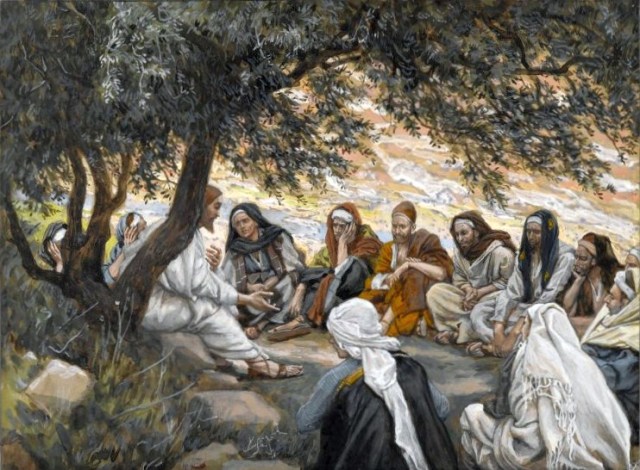
James Tissot, The Exhortation to the Apostles (between 1886 and 1894)

Matthew 18: 15-20

15 “If another member of the church sins against you, go and point out the fault when the two of you are alone. If the member listens to you, you have regained that one. 16 But if you are not listened to, take one or two others along with you, so that every word may be confirmed by the evidence of two or three witnesses. 17 If the member refuses to listen to them, tell it to the church; and if the offender refuses to listen even to the church, let such a one be to you as a Gentile and a tax collector. 18 Truly I tell you, whatever you bind on earth will be bound in heaven, and whatever you loose on earth will be loosed in heaven. 19 Again, truly I tell you, if two of you agree on earth about anything you ask, it will be done for you by my Father in heaven. 20 For where two or three are gathered in my name, I am there among them.”

This short passage, unique to Matthew’s gospel, has exercised a powerful influence on the shaping of church practices and understandings. In five short verses we have the background of the church’s practice of excommunication, a second reiteration of the ability to bind and loose, and the promise of Christ’s presence where two or three are gathered. Our understanding of these verses is often locked into our understanding of church as it exists two thousand years after Jesus’ life with all its accumulated traditions and practices. Every act of interpretation is an act of imagining the context in which these words were spoken to an early community of disciples attempting to enact the assembly that Jesus calls into being with his words and presence. Yet, for Matthew more than any other gospel, the formation of a community that can embody Jesus’ vision for the kingdom of heaven in their proclamation and life together is an important feature.

When we use the term church to translate the Greek ekklesia it ensures that most readers will bring to this reading their concrete experiences of church and their intellectual and emotional baggage that the term may carry. Ekklessia in the Greco-Roman environment is typically an, “assembly, as a regularly summoned political body” or when used in the Septuagint to talk about the gathered community of the Israelites is typically the “congregation” of the Israelites. (BAGD, p.241) Matthew’s understanding of the ekklesia taking on the role of Israel on behalf of the world probably leads to ‘congregation’ being a better term, but that is also associated in modern times with the experience of church. Ultimately for the purposes of this I would translate this as the ‘congregation of Christ’ or ‘the assembly of Christ’ hopefully calling attention to the unique nature of this community in relation to the world around it and its distinction from our experience and understanding of ‘church.’

In the church the historical practice of excommunication was used to enforce the boundaries of the church, to exclude those who by beliefs or practices were felt to be a danger to the right worship of Christ. Unfortunately, the manner in which it has often been practiced in the life of the church was centered upon exclusion rather than reconciliation which is the direction of Matthew 18. The congregation of Christ that Matthew speaks to does have the difficult task of holding a brother or sister accountable for their actions towards an individual or the community. The imperative to act is placed upon the one who perceives they have been sinned against. Here the action is against a one person, and the initial response is for the individual to point out the fault while they are alone.

The action of bringing the action of the brother or sister to light in a way that encourages reconciliation and forgiveness is countercultural in our society of shame and blame. This is a courageous action which hopes for healing, rather than an identification of faults for the sake of exercising power over the individual or to justify their exclusion. The entire direction of this fourth block of teaching is directed towards forgiveness and reconciliation, the hope that the lost sheep might be rejoined to the flock. As Dietrich Bonhoeffer would say as he tried to re-imagine a community of Christ in Life Together:

Nothing can be more cruel than that leniency which abandons others to their sin. Nothing can be more compassionate than that severe reprimand which calls another Christian in one’s community back from the path of sin. (DBWE 5: 105)

This community called into existence by Christ is called to practice a way of life that can hold another brother or sister accountable for their actions and let them know that by their actions they are walking outside the way of the community of Christ in the hope of repentance and reconciliation between the one whose sin has placed a stumbling block before others in the community.

The one who is sinned against had the responsibility to bring the action to light, but this also requires a community that supports this practice of accountability. Just like the owner of the sheep who realizes that one of their flock has gone astray, so the individual who realizes a brother or sister has sinned goes to seek them and to try to heal the brokenness. Yet, just as there is the possibility that a sheep may not be found, there is the possibility that a sinner will not change; but the community bears responsibility for providing them every opportunity for repentance and reconciliation. If one on one the reproving is not received, then they are to go as a group of two or three. This parallels the requirements in Deuteronomy 17:6 and 19:15 where the evidence of two or three witnesses is required to sustain the punishment or exclusion from the community (by death in Deuteronomy 17). Matthew’s community may not practice the death penalty, but it is attempting to figure out how it can model a society based upon a merciful reading of the law. If even in the presence of witnesses the person refuses to hear reproving, then the matter is brought before the congregation for an additional opportunity at public reconciliation. It is now the congregation of Christ that bears the power to receive or release the individual from the community, they can declare that one is no longer living in accordance with the congregation and are therefore an outsider who would need to be evangelized and repent before being considered a brother or sister once more. The congregation bears this authority because of Christ’s presence among the congregation.

As I argued in the Sermon on the Mount, Matthew is trying to articulate a community of Jesus followers who can live and hand on Jesus’ teaching. As Richard B. Hays can state: “There can be no question here of a purely individualized spiritual formation. Matthew is strongly ecclesially oriented.” (Hays, 1996, p. 97) This community is always oriented towards forgiveness. Yet, it is a community that cares enough to declare some actions as inappropriate and scandalous towards the little ones of the community of Christ. It is a place that is an alternative to the practices of the kingdoms of the world and provides a place where forgiveness can be learned, and courage is practiced as sins are named and sinners have an opportunity for reconciliation.

The gospel of Matthew begins and ends by referring to Jesus as Emmanuel, ‘God with us’ and here within the guidance about life in the community of Christ the reference to Jesus’ presence among the gathered community is highlighted once more. In Matthew 1:23 the narrator uses the name Emmanuel to introduce Jesus’ coming birth and here in this passage we have Jesus promising for the first time his continued presence among the congregation of Christ (this theme returns at the end of the gospel). There is an oft noted parallel teachings in the Rabbinical Jewish tradition where the rabbis state: “But if two sit together and the words between them are of Torah, then the Shekinah[1] is in their midst.” (m. Aboth 3:2) The community of Christ gathered around Jesus’ words experiences the presence of God in the way the rabbis expected of observant Jews gathered around Torah. This is heightened when one anticipates Jesus’ teaching in Matthew 24:35 where, “Heaven and earth will pass away, but my words will not pass away.” and that passage’s connection to Isaiah 40:7-8,

The grass withers, the flower fades, when the breath of the LORD blows upon it; surely the people are grass. The grass withers, the flower fades; but the word of our God will stand forever.

There is a theological boldness to the claiming in a manner parallel to God’s words not fading, Christ’s words will not fade, and that as God’s Shekinah is present in the gathering around Torah, the community gathered around Jesus’ words for discernment shares the presence of Jesus in their midst. The formation of a community of Christ that can both name sins that are committed and practice reconciliation is a community that will later be called to make disciples of not only the little ones of Israel, but all nations, handing on all that they have been commanded. Yet, they go in the presence of the Jesus who is with them always.

[1] The Shekinah is from the Jewish word for ‘settle’ or ‘dwell’ and while not mentioned in the Hebrew Scriptures is an idea in rabbinic writing that refers to the presence of God among God’s people. It can refer to the presence of God in the temple, but also as here to God’s presence in the midst of the studying of Torah, also in prayer, in judging, in relationships and in times of need.

Matthew 18: 12-14 The Parable of the Lost Sheep

Lamb By © Nevit Dilmen, CC BY-SA 3.0, https://commons.wikimedia.org/w/index.php?curid=1377638

Matthew 18: 12-14

Parallel Luke 15: 3-7

12 What do you think? If a shepherd has a hundred sheep, and one of them has gone astray, does he not leave the ninety-nine on the mountains and go in search of the one that went astray? 13 And if he finds it, truly I tell you, he rejoices over it more than over the ninety-nine that never went astray. 14 So it is not the will of your Father in heaven that one of these little ones should be lost.

This short little parable is placed here in the midst of the discussion of the community Christ is imagining for those who will follow him and it demonstrates the continuing concern for the little ones who may be ‘scandalized’ and lost to the community. Both Matthew and Luke use this brief illustration of a flock of sheep with one missing whom the master of the sheep seeks out and rejoices over, but their placement of this parable within the context of the gospel and the structure of the surrounding text are used to illustrate different points. In Luke’s gospel, this parable is the first of three familiar parables which answer the accusation that Jesus, “eats with sinners and tax collectors” and through stories of a lost sheep, lost coin, and lost son Jesus points to the joy in heaven over a sinner repenting and a child returning home. In Matthew’s gospel the primary issue is the finding of one lost to the community and it is set within parables and teaching about reconciliation and it is paired with two different parables about unforgiving servants and ungrateful workers.[1]  For Luke this parable is used to explain to outsiders the inclusive nature of the community of Christ, in Matthew the parable reminds insiders of their continual need to seek out those led astray and to welcome them home with forgiveness and rejoicing.

In the parable a person has a hundred sheep. It is important that the person is not labeled as a shepherd in the original Greek but is ‘a certain person’ having 100 sheep. The person is not merely the ‘caretaker’ of someone else’s flock but they both own and are present with the flock.  Most translations tidy up the parable to indicate that the missing sheep has ‘gone astray’ but the Greek plano has the primary meaning of being led astray or deceived, this is language unique but important to Matthew’s narration of this parable, especially sandwiched between a discussion of those who ‘scandalize’ the little ones by their actions and the upcoming discussions on forgiveness and reconciliation. The sheep has not merely wandered off, but has actively been deceived or mislead to be away from the remainder of the 99. Likewise the action of the owner of the flock is not merely leaving the ninety nine on the mountain, but the Greek aphimi has the connotation of abandoning and the act of leaving behind the majority of one’s sheep to search for the lost one who might be found would not be a normal action for a person caring for a flock but this again demonstrates the point of the parable, that the one rejoiced over in the kingdom of heaven is the little one who was lost and regained.

Even though the owner of the sheep in the parable values the restoration of the lost one, in Matthew’s relation of this parable there is no guarantee that the lost one is regained. While Luke’s parables states ‘when’ the owner finds the sheep, Matthew says ‘if’ leaving the possibility that even with the owner’s search the led astray sheep may not be recovered, just as an corrected member may not accept correction in the following section. Matthew’s placement of this parable within a discussion of relations between members in the church and the continual emphasis on reconciliation and forgiveness can realistically acknowledge the danger that a little one can be led astray by the actions of those inside or beyond the community, but the hope is always for restoration. The lost little one restored is the source of joy of the owner and the will of the heavenly Father.

Amy-Jill Levine points to a midrashic text which has an interesting resonance to this parable. In Exodus Rabbah, Moses is shown as a paradigm of what it means to care for a flock. The story in Exodus Rabbah states:

The Holy One tested Moses by means of the flock, as our rabbis explained: when Moses rabbenu (Moses our teacher) was tending Jethro’s flock in the wilderness, a lamb scampered off, and Moses followed it, until it approached a shelter under a rock. As the lamb reached the shelter, it came upon a pool of water and stopped to drink. When Moses caught up with it, he said, “I did not know that you ran away because you were thirsty. Now you must be tired.” So he hoisted the lamb on his shoulders and started walking back with it. The Holy One then said, “Because you showed such compassion in tending the flock of a mortal, as you live, you shall become the shepherd of Israel, the flock that is mine.” (Levine, 2014, pp. 43-44)

Matthew’s placement of this parable in the context of discussions of the community that will be shaped by the message of Jesus, the ekklesia (often translated church) indicates the stance of compassion that God has for those who have been led astray. This also should is to shape the response of those called to participation in this community and the compassion they are to have for the little ones who are led astray. When possible they are to be restored and that restoration is to be greeted with joy. Restoration may not always be possible, but the owner of the flock is willing to leave behind the majority to seek the sheep who is missing. Leaders in this ekklesia are to model the compassion of Moses in the parable above and the compassion for the little ones who trust in him that Jesus shows throughout his teaching. If the owner of the flock will abandon the herd to search for the lost one, those who shepherd the flock are called to practice this type of care for those they guide. Throughout Matthew’s gospel and throughout most of scripture there is always an opportunity for repentance and reconciliation. Sometimes the led astray little one may need to repent and sometimes the individual or community that allowed a stumbling block to be placed before the little one will need to repent so they can participate in the joy over the reconciliation between the lost little one and the remainder of the flock.

[1] As mentioned in the previous sections I view Matthew 18: 1-20:28 as a unit structurally. Many scholars end this unit at 19:1 with “When Jesus had finished saying these things…” but I view the section beginning and ending with questions of ‘the greatest in the kingdom’ and it also includes Matthew’s (and Mark’s and Luke’s) normal pattern of groups of three parables which center around a common theme.