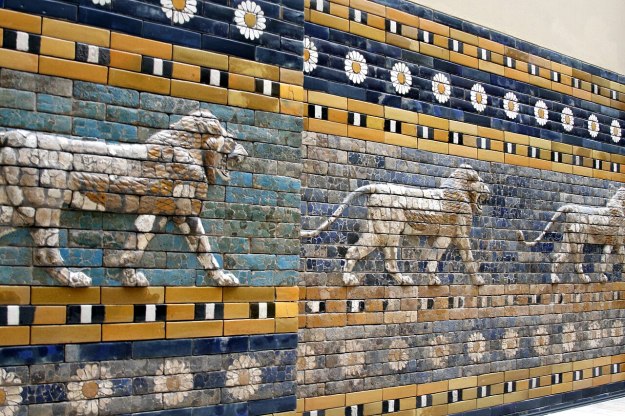
Striding lions from the Processional Street of Babylon. Exhibited at the Pergamon Museum in Berlin.
2 Kings 24: 1-7 The Reign of Jehoiakim
1 In his days King Nebuchadnezzar of Babylon came up; Jehoiakim became his servant for three years, then turned and rebelled against him. 2 He sent against him bands of the Chaldeans, bands of the Arameans, bands of the Moabites, and bands of the Ammonites; he sent them against Judah to destroy it, according to the word of the LORD that he spoke by his servants the prophets. 3 Surely this came upon Judah at the command of the LORD, to remove them out of his sight, for the sins of Manasseh, for all that he had committed, 4 and also for the innocent blood that he had shed, for he filled Jerusalem with innocent blood, and the LORD was not willing to pardon. 5 Now the rest of the deeds of Jehoiakim and all that he did, are they not written in the Book of the Annals of the Kings of Judah? 6 So Jehoiakim slept with his ancestors; then his son Jehoiachin succeeded him. 7 The king of Egypt did not come again out of his land, for the king of Babylon had taken over all that belonged to the king of Egypt from the Wadi of Egypt to the River Euphrates.
Jehoiakim was installed by Pharaoh Neco to replace his younger brother Jehoahaz who Neco took into imprisonment at Riblah. Jehoiakim begins his reign as a vassal of Egypt but during his eleven years as king the situation dramatically shifts as Nebuchadnezzar of Babylon becomes the dominant power in the region forcing Egypt’s influence to recede back beyond the Wadi of Egypt. The forces of Babylon (Chaldeans,[1] Arameans, Moabites, and Ammonites) raid into Judah, and although the siege of Jerusalem will not occur until Jehoiakim’s sons brief reign, the forces that will bring about the end of the time of Judah are in motion.
Jehoiakim appears frequently in the book of Jeremiah in a negative light. The king is portrayed as living in luxury while the nation struggles, mistreating the poor and executing those who speak against his policies.[2] The king executes Uriah son of Shemiah who prophecies in a manner similar to Jeremiah and Jeremiah is protected by some of the officials, including Ahikam son of Shaphan (secretary during the time of Josiah)[3] Jeremiah sends a scroll with God’s words to Jehoiakim but in contrast to his father Josiah who tore his clothes in mourning Jehoiakim tore (same verb in Hebrew) the scroll after it was read and cast it into the fire.[4]
Jeremiah declares the Jehoiakim will die “the death of a donkey…dragged off and thrown out beyond the gates of Jerusalem.” (Jeremiah 22:19) 2 Kings states that Jehoiakim slept with his ancestors indicating a normal death and burial. Jehoiakim rebels against Babylon after being a vassal for three years, likely in response to a defeat in Egypt which Nebuchadnezzar returns to Babylon to give his forces time to recover and rebuild. This time the rebellion of Judah does not go unpunished, and this leads to the first siege of Jerusalem by Babylon. Jehoiakim is roughly thirty-six when he dies so it is possible that he is killed by elements within Jerusalem seeking a different leader to attempt to negotiate with the threat of Babylon.
2 Kings 24: 8-17 The Reign of Jehoiachin and the First Siege of Jerusalem
8 Jehoiachin was eighteen years old when he began to reign; he reigned three months in Jerusalem. His mother’s name was Nehushta daughter of Elnathan of Jerusalem. 9 He did what was evil in the sight of the LORD, just as his father had done.
10 At that time the servants of King Nebuchadnezzar of Babylon came up to Jerusalem, and the city was besieged. 11 King Nebuchadnezzar of Babylon came to the city while his servants were besieging it; 12 King Jehoiachin of Judah gave himself up to the king of Babylon: himself, his mother, his servants, his officers, and his palace officials. The king of Babylon took him prisoner in the eighth year of his reign.
13 He carried off all the treasures of the house of the LORD and the treasures of the king’s house; he cut in pieces all the vessels of gold in the temple of the LORD that King Solomon of Israel had made, all this as the LORD had foretold. 14 He carried away all Jerusalem, all the officials, all the warriors, ten thousand captives, all the artisans and the smiths; no one remained except the poorest people of the land. 15 He carried away Jehoiachin to Babylon; the king’s mother, the king’s wives, his officials, and the elite of the land, he took into captivity from Jerusalem to Babylon. 16 The king of Babylon brought captive to Babylon all the men of valor, seven thousand, the artisans and the smiths, one thousand, all of them strong and fit for war. 17 The king of Babylon made Mattaniah, Jehoiachin’s uncle, king in his place and changed his name to Zedekiah.
The short reign of Jehoiachin is significant because it marks a critical change for Judah. Jehoiachin inherits the troubles his father inflamed by rebelling against Babylon and reigns briefly over a besieged city. We know that the king and his royal household surrender on March 16 (the second of Adar) 597 BCE and the royal household, warriors, artisans and smiths are taken into exile while the remainder of the people remain under the charge of Zedekiah. This initial exile of the leaders, elites, and skilled members of the population are the setting of the narrative at the beginning of Daniel. We also know that the prophet Ezekiel was among those exiled.[5] The city of Jerusalem and the temple remain but ten thousand people and the riches of the temple and royal household are removed into Babylon.
This creates a new situation for Judah which now has two centers of life: one in exile in Babylon and one remaining in the land. Jeremiah will be the prophet remaining in the land while Ezekiel will emerge to be the prophet for those in exile. The prophet Jeremiah will receive a vision of two baskets of figs, one very good and one rotten, and in this vision the good figs will be Jehoiachin, and the people taken into exile who God views favorable and the rotten figs are Zedekiah and those remaining in Jerusalem.[6] Ezekiel also shares this perspective that the population in exile will be the population of Judah that endures.
2 Kings 24: 18-20 The Reign and Rebellion of Zedekiah
18 Zedekiah was twenty-one years old when he began to reign; he reigned eleven years in Jerusalem. His mother’s name was Hamutal daughter of Jeremiah of Libnah. 19 He did what was evil in the sight of the LORD, just as Jehoiakim had done. 20 Indeed, Jerusalem and Judah so angered the LORD that he expelled them from his presence.
Zedekiah rebelled against the king of Babylon.
Zedekiah is left in charge of the remnant in Jerusalem. The final line of the chapter strikes the critical note for Zedekiah’s reign. He is portrayed in Jeremiah as a king who does seek the prophet’s words but is ultimately unable or unwilling to resist his advisors who lead him into conflict with Babylon. Jehoahaz, Jehoiakim, Jehoiachin, and Zedekiah all reign under the thumb of external powers, Egypt for Jehoahaz and Jehoiakim initially and then Babylon for Jehoiakim through Zedekiah. Yet for the narrator of 2 Kings all of this is a part of God’s action to judge the unfaithfulness of Judah which reaches its climax under Manasseh but extends back to Solomon and beyond. Judah and Jerusalem are expelled from the presence of God because of their disobedience in 2 Kings. Zedekiah’s rebellion sets Babylon in motion to be the instrument of that judgment.
[1] Although we think of Babylon as the empire, the Chaldeans were the dominant people of this empire. All ancient empires were coalitions of groups and so the presence of Arameans, Moabites, and Ammonites (neighbors of Judah) are not surprising.
[2] See Jeremiah 22.
[5] Ezekiel would receive his call as a prophet while in exile (Ezekiel 1). Kish the grandfather of Mordecai (uncle of Esther) was also among this group of exiles in Esther 2:5-6. Many scholars view the book of Daniel as a later book written well after the exile, but the setting of the initial chapters of the book are this initial exile of the elites to Babylon.
 Sign of the Rose