Tag Archives: Destruction of Jerusalem

Lamentations 3 The Cry of the Strong Man

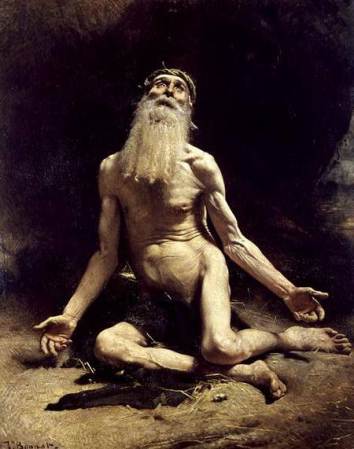
Job (oil on canvas) by Bonnat, Leon Joseph Florentin (1833-1922)

Lamentations 3

1 I am one who has seen affliction under the rod of God’s wrath;
2 he has driven and brought me into darkness without any light;
3 against me alone he turns his hand, again and again, all day long.
4 He has made my flesh and my skin waste away, and broken my bones;
5 he has besieged and enveloped me with bitterness and tribulation;
6 he has made me sit in darkness like the dead of long ago.
7 He has walled me about so that I cannot escape; he has put heavy chains on me;
8 though I call and cry for help, he shuts out my prayer;
9 he has blocked my ways with hewn stones, he has made my paths crooked.
10 He is a bear lying in wait for me, a lion in hiding;
11 he led me off my way and tore me to pieces; he has made me desolate;
12 he bent his bow and set me as a mark for his arrow.
13 He shot into my vitals the arrows of his quiver;
14 I have become the laughingstock of all my people, the object of their taunt-songs all day long.
15 He has filled me with bitterness, he has sated me with wormwood.
16 He has made my teeth grind on gravel, and made me cower in ashes;
17 my soul is bereft of peace; I have forgotten what happiness is;
18 so I say, “Gone is my glory, and all that I had hoped for from the LORD.”
19 The thought of my affliction and my homelessness is wormwood and gall!
20 My soul continually thinks of it and is bowed down within me.
21 But this I call to mind, and therefore I have hope:
22 The steadfast love of the LORD never ceases, his mercies never come to an end;
23 they are new every morning; great is your faithfulness.
24 “The LORD is my portion,” says my soul, “therefore I will hope in him.”
25 The LORD is good to those who wait for him, to the soul that seeks him.
26 It is good that one should wait quietly for the salvation of the LORD.
27 It is good for one to bear the yoke in youth,
28 to sit alone in silence when the LORD has imposed it,
29 to put one’s mouth to the dust (there may yet be hope),
30 to give one’s cheek to the smiter, and be filled with insults.
31 For the LORD will not reject forever.
32 Although he causes grief, he will have compassion according to the abundance of his steadfast love;
33 for he does not willingly afflict or grieve anyone.
34 When all the prisoners of the land are crushed under foot,
35 when human rights are perverted in the presence of the Most High,
36 when one’s case is subverted — does the LORD not see it?
37 Who can command and have it done, if the LORD has not ordained it?
38 Is it not from the mouth of the Most High that good and bad come?
39 Why should any who draw breath complain about the punishment of their sins?
40 Let us test and examine our ways, and return to the LORD.
41 Let us lift up our hearts as well as our hands to God in heaven.
42 We have transgressed and rebelled, and you have not forgiven.
43 You have wrapped yourself with anger and pursued us, killing without pity;
44 you have wrapped yourself with a cloud so that no prayer can pass through.
45 You have made us filth and rubbish among the peoples.
46 All our enemies have opened their mouths against us;
47 panic and pitfall have come upon us, devastation and destruction.
48 My eyes flow with rivers of tears because of the destruction of my people.
49 My eyes will flow without ceasing, without respite,
50 until the LORD from heaven looks down and sees.
51 My eyes cause me grief at the fate of all the young women in my city.
52 Those who were my enemies without cause have hunted me like a bird;
53 they flung me alive into a pit and hurled stones on me;
54 water closed over my head; I said, “I am lost.”
55 I called on your name, O LORD, from the depths of the pit;
56 you heard my plea, “Do not close your ear to my cry for help, but give me relief!”
57 You came near when I called on you; you said, “Do not fear!”
58 You have taken up my cause, O LORD, you have redeemed my life.
59 You have seen the wrong done to me, O LORD; judge my cause.
60 You have seen all their malice, all their plots against me.
61 You have heard their taunts, O LORD, all their plots against me.
62 The whispers and murmurs of my assailants are against me all day long.
63 Whether they sit or rise — see, I am the object of their taunt-songs.
64 Pay them back for their deeds, O LORD, according to the work of their hands!
65 Give them anguish of heart; your curse be on them!
66 Pursue them in anger and destroy them from under the LORD’s heavens.

This third poem in Lamentations intensifies the acrostic pattern exhibited in the first two poems. In Lamentations one and two each stanza, as noted by the verse numbers in those poems, begins with a successive letter of the Hebrew alphabet. In Lamentations three we jump from twenty-two to sixty-six verses because every line of the three-line stanzas begins with the appropriate letter. Three verses for aleph, three for bet, and through the Hebrew alphabet to tav. Although the poem is approximately the same length as the previous two poems the poet increases their reliance on form in a way only exceeded by Psalm 119 which has eight verses utilizing each starting letter as it moves through the acrostic pattern.

In poetry form matters. Acrostic is a form used to denote completion, and it brings an external order to a disordered world. Like the acrostic poem of Psalm 25, the poet attempts to reconcile the promises of the steadfast love (hesed) of God in a world where that love is challenged by the absence of God’s protection or the presence of God’s wrath. It is an act of faith that holds onto the language the poet learned throughout their life in a time where their life is turned upside down. Yet, here in this central poem of the book of Lamentations we do get a small glimmer of hope and as Kathleen O’Connor suggests, like Jeremiah 3033, the placement of hope at the center may be intentional, yet that hope “remains muted at best.” (NIB VI: 1057)

In the first two poems there were two primary voices: the feminine voice of daughter Zion and the masculine voice of the witness reporting on daughter Zion’s experience of trauma, destruction, grief, and rage. In the second chapter of Lamentations this witness transforms into an advocate for daughter Zion unable to remain a passive observer. Yet, in this third chapter or third poem the voice throughout is that of a man. The first two poems have examined the impact of war and defeat on a feminine voice, but now the impact is viewed through a male lens. The NRSV overcorrects in its agenda for inclusive language when in the initial verse it translates “I am one.” The Hebrew geber may not mean warrior but it does have a definitively macho sense of standing up for oneself and others who are defenseless. The geber is a defender of women, children, and other non-combatants. In Job 38:3 and 40:7 this is the term utilized when Job is commanded by God to “Gird up your loins like a man (geber), I will question you and you shall declare to me.” The experiences of men and women are different and what they experience in this moment of defeat are different. Now this man, in the poem, who was supposed to provide security for the women and children of Judah stands, “injured, struck down, shot, pursued, captured, chained up, terrified, defeated, and taunted.” (Goldingay, 2022, p. 125) This man has lost two of the primary components of masculine identity traditionally understood. They have lost their ability to protect those under their protection and to provide for themselves and others.

Also in the first verse, the NRSV introduces that the man has suffered under the rod of God’s wrath, although God is not mentioned in the Hebrew at this point. Although from the first two poems as well as the later imagery of this poem we know that ultimately God is the one responsible for the suffering of the man and those around him, the one who causes the suffering is not explicitly named until verse eighteen when the LORD is finally named. Although it is the speaker’s God, the LORD of Israel, who is responsible for all the violent actions upon this man it may be that in the initial declaration of suffering it is difficult to voice that the LORD of steadfast love became the bringer of affliction and wrath in this moment.

 Violent verbs drive the action that has broken this man into a world of darkness. This was not a single wound that the man can recover from, but his assailant has turned his hand against this once strong man again and again. Flesh, bone, and skin: the whole of his person is devastated and although he still lives and speaks in pain he is on the path to becoming a resident of the broken boneyard of Ezekiel 37. The language then moves to the language of siege and imprisonment. The people of Judah would have recently experienced the siege, and imprisonment was typically a political punishment in the Middle East rather than the default punishment for wrongdoings in became in Western societies.[1] Poetry does not need to be consistent to be powerful. On the one hand the man is surrounded and besieged, on the other he is isolated and alone. Ultimately the besieging and imprisoning presence has cut him off from world and most critically for the poet, from God’s steadfast love.

Martin Luther once spoke of the wrath of God as God’s alien work, while the grace of God was God’s proper work. Although still unnamed, it has become clear that the LORD has become like a dangerous animal[2] waiting to attack or an archer with this strong man in his sights. He has fallen from being a person worthy of respect to the laughingstock of the people. The good things have turned to bitterness, and wormwood a plant with a strong smell, bitter taste and reputation for toxicity (Goldingay, 2022, p. 134) utilized in the prophet Jeremiah’s writings,[3] becomes the unappealing drink provided. This once strong man now lies with his face and teeth on the ground among the gravel and cowering in ashes either in mourning or more likely in the aftermath of the destruction of Jerusalem. This man’s life (nephesh)[4] has been deprived of peace (shalom) and happiness (tob). Finally in verse eighteen we have the LORD named when all that the man had hoped from the LORD is gone. Reflection on his desperate and homeless situation only brings more bitterness.

Faith is not a straight path. Grief also is not a linear journey. This man has moved from bitterness to a remembrance of the faith he learned and the God he still trusts. The steadfast love of the LORD never ceases, his mercies never come to an end becomes a pivot point in this poetic reflection as the faith this man has learned is confronted by the reality of a life made bitter. The LORD is his inheritance and the one he can hope in. The good (happiness NRSV) that the man has forgotten is now emphasized as the starting word of the three ‘tet’ verses[5] which each begin with tob (good). Good is the LORD, good that one should wait, good that one should bear. The path of faithfulness that the man discerns is one of seeking God, staying silent and submissive, and bearing the suffering that is imposed, of bowing down and turning the other cheek. God will turn from wrath to grace because that is the character of the LORD of the man’s faith.

Verses thirty-four to thirty-six are translated as a question in most English translations, but the question form is not required in Hebrew. Another possible reading of these verses is that God does not see the way prisoners are crushed, and human rights are being violated, and justice is subverted. Yet, this also conflicts with the faith the man has learned where the LORD is responsible for everything both good and bad.[6] So the man turns inward to examine whether he individually and his people collectively have sinned testing and examining their ways. Ultimately the man’s verdict is that we have transgressed but also you have not forgiven. This final realization for the man forms a final pivot where the path of silence and submission is left aside for a final protest even more heated than the first. For this man the difference between the character of God represented by steadfast love and the experience of God as unforgiving requires him to raise his voice to attempt to pierce God’s obscuring anger.

The problem is that the God who sees and hears is shielding Godself from seeing and hearing. Wrapped in anger and a cloud no prayer can pass through God has abandoned the people. The poet digs into their humiliation and declares that God has made them filth and rubbish among the people. We open our mouths and God does not hear, but our enemies open their mouths, and we cannot help but hear them. Panic and pitfall, devastation and destruction[7] have come upon the man and his people and like both daughter Zion and the witness in the previous two psalms[8] his eyes flow an unceasing river of tears. Yet, these tears are now a part of this man’s protest to God. He can be broken in body and spirit, eating the dirt and covered in ashes, isolated and imprisoned, and caught up in a seemingly unending flood of tears if God will see. This man is able to remember God’s words from the past, “Do not fear!” the only words attributed to God in the book of Lamentations, but even these words come from the past. In repetitive fashion this poet calls on God as the ‘you’ who can act. Ultimately ‘You’ the LORD have heard their taunts and in the final verses this man asks for what daughter Zion cried for. Treat my enemies the way you have treated me. You have punished me for my transgressions, now punish them. I have known the anguish of the heart as I sit here in dust and ashes, the object of their taunt songs, let them know the impact of your curse on their lives. I have seen affliction under your wrath, turn your anger to them and destroy them. The poems of Lamentations attempt to make sense of a world that makes no sense. It is highly ordered by the poetic structure as it encounters a disordered world. It attempts to reconcile the faith in a God of steadfast love with the experience of God’s wrath. Their world, their home, their lives, and their relationship with their God is broken. They speak these words into the silence of the void waiting for an answer from their LORD which they have not received. This man, geber, is attempting to gird his loins like Job and stand before God and pierce the cloud of God’s wrath which seems to have silenced prayers. It is an act of audacity, but we inherited an audacious set of scriptures.


[1] There is no provision in the Torah for imprisonment. Jeremiah in Jeremiah 38 was imprisoned not because he broke no laws but because he was an annoyance to the leaders in Jerusalem.

[2] Bear and lion are paired as dangerous animals (Hosea 13;8; Amos 5:19) (Goldingay, 2022, p. 132)

[3] Jeremiah 9:15; 23:15

[4] The Hebrew nephesh often translated soul in English is a very different concept than most modern conceptions of ‘soul.’ For Hebrew the nephesh is about life and not about something that is freed after death.

[5] Verses 25-27 which begin with the Hebrew letter ‘tet.’

[6] See my Reflection: A Split In The Identity of God.

[7] The NRSV does a good job of capturing the alliteration of this phrase in Hebrew.

[8] 1:16; 2:18.

Lamentations 1 The Cry of Daughter Zion

By Antoine Coypel – Susanna Accused of Adultery (1695-1696)http://www.museodelprado.es/imagen/alta_resolucion/P02247.jpg, Public Domain, https://commons.wikimedia.org/w/index.php?curid=12894461

Lamentations 1

1How lonely sits the city that once was full of people! How like a widow she has become, she that was great among the nations! She that was a princess among the provinces has become a vassal.
2She weeps bitterly in the night, with tears on her cheeks; among all her lovers she has no one to comfort her; all her friends have dealt treacherously with her, they have become her enemies.
3Judah has gone into exile with suffering and hard servitude; she lives now among the nations, and finds no resting place; her pursuers have all overtaken her in the midst of her distress.
4The roads to Zion mourn, for no one comes to the festivals; all her gates are desolate, her priests groan; her young girls grieve, and her lot is bitter.
5Her foes have become the masters, her enemies prosper, because the LORD has made her suffer for the multitude of her transgressions; her children have gone away, captives before the foe.
6From daughter Zion has departed all her majesty. Her princes have become like stags that find no pasture; they fled without strength before the pursuer.
7Jerusalem remembers, in the days of her affliction and wandering, all the precious things that were hers in days of old. When her people fell into the hand of the foe, and there was no one to help her, the foe looked on mocking over her downfall.
8Jerusalem sinned grievously, so she has become a mockery; all who honored her despise her, for they have seen her nakedness; she herself groans, and turns her face away.
9Her uncleanness was in her skirts; she took no thought of her future; her downfall was appalling, with none to comfort her. “O LORD, look at my affliction, for the enemy has triumphed!”
10Enemies have stretched out their hands over all her precious things; she has even seen the nations invade her sanctuary, those whom you forbade to enter your congregation.
11All her people groan as they search for bread; they trade their treasures for food to revive their strength. Look, O LORD, and see how worthless I have become.
12Is it nothing to you, all you who pass by? Look and see if there is any sorrow like my sorrow, which was brought upon me, which the LORD inflicted on the day of his fierce anger.
13From on high he sent fire; it went deep into my bones; he spread a net for my feet; he turned me back; he has left me stunned, faint all day long.
14My transgressions were bound into a yoke; by his hand they were fastened together;
 they weigh on my neck, sapping my strength; the LORD handed me over to those whom I cannot withstand.
15The LORD has rejected all my warriors in the midst of me; he proclaimed a time against me to crush my young men; the LORD has trodden as in a wine press the virgin daughter Judah.
16For these things I weep; my eyes flow with tears; for a comforter is far from me,
 one to revive my courage; my children are desolate, for the enemy has prevailed.
17Zion stretches out her hands, but there is no one to comfort her; the LORD has commanded against Jacob that his neighbors should become his foes; Jerusalem has become a filthy thing among them.
18The LORD is in the right, for I have rebelled against his word; but hear, all you peoples,
 and behold my suffering; my young women and young men have gone into captivity.
19I called to my lovers but they deceived me; my priests and elders perished in the city
 while seeking food to revive their strength.
20See, O LORD, how distressed I am; my stomach churns, my heart is wrung within me, because I have been very rebellious. In the street the sword bereaves; in the house it is like death.
21They heard how I was groaning, with no one to comfort me. All my enemies heard of my trouble; they are glad that you have done it. Bring on the day you have announced, and let them be as I am.
22Let all their evil doing come before you; and deal with them as you have dealt with me because of all my transgressions; for my groans are many and my heart is faint.

Poetry can be used to speak to things that are at the edge of our ability to articulate. It can be utilized to speak to moments of profound joy, of awe and wonder, of emotions like love and happiness whose meanings seem to transcend our words. Yet poetic words can be utilized in our moments of heartbreak, depression, grief, and trauma as we attempt to make sense of a world which seems senseless. Lamentations is the work of a poet or poets attempting to make sense of their reality in the aftermath of the destruction of Jerusalem in 586 BCE. The poet has seen death from war and starvation, has seen the foundations upon which their life was built collapse, and the LORD who was supposed to protect Zion has turned away. The poet attempts to make sense of the loss of the home they knew, grieve the family and friends who did not survive the siege and the beginning of the exile, and to walk among a shattered people with shattered dreams into a previously unimagined reality.

The survivors of Jerusalem not only retained the words of the prophets who warned of this reality, but they also retained the words of the prophets and poets wrestling with God, attempting to reconcile their faith with the world they experience. They are living in a disordered world, and yet in their words they attempt to bring some order into the disorder. Kathleen O’Connor in her book Jeremiah: Pain and Promise talks about the way these works written in the time surrounding the exile invite not only the contemporary generation but also future generations to enter the process of being meaning-makers.

It not only reflects the interpretive chaos that follows disasters, when meaning collapses and formerly reliable beliefs turn to dust. Jeremiah’s literary turmoil is also an invitation to the audience to become meaning-makers, transforming them from being passive victims of disaster into active interpreters of their world. (O’Connor, 2011, p. 31)

Making sense of a traumatic world-changing event is not an overnight process. It is a journey through the dark shadows of grief and fear, depression and guilt, the struggle to survive as others surrender to the end. This first poem in the book of Lamentations attempt to bring some order to the disorder and give voice to the pain and humiliation felt by the people. They, like Jeremiah and Ezekiel, understand that the tragedy is a result of their own rebellion and disobedience which have broken their relationship with the LORD who protected them. They also understand that they have no future without the LORD looking, seeing, and considering the fate of this disgraced and displaced people.

The poem has two voices, a narrator and daughter Zion. The narrator is the primary speaker for the first half of the poem and attempts to relate the fate of daughter Zion as an observer of the fall of this city personified as a woman. The poem begins with the interrogative “How?” Although in English translations the word how is used primarily as an inquiry about the state of daughter Zion: How lonely, How like a widow. The word also inquires about the manner or way in which something comes to pass: How did it happen that lonely sits the city, How did she become like a widow? How did this place of honor among the nations become dishonored? How did the princess become the vassal? What has brought about this reversal for daughter Zion and those who made their home in this great city. Something has changed that has brought about the reversal of fortunes for the city and the people.

The narrator voice in the poem has a greater detachment from the suffering and events occurring to daughter Zion. Daughter Zion may weep, but the narrator reports. Yet, the narrator’s reports begin to allude to the reason why daughter Zion weeps. In a world where women were not to have lovers, they were to be faithful to their husband, now this one who has become like a widow[1] we learn is also abandoned by her lovers and friends. Something has gone wrong in the relationships that were supposed to provide support. The narrator slips out of the metaphor to narrate Judah’s entry into exile and the suffering that comes with her displacement from the promised land into the hostile nations. The exclamation that Judah found no resting place echoes the language of the curses for disobedience in Deuteronomy 28:65. As Lamentations, like Ezekiel and Jeremiah, make sense of the catastrophe of the Babylonian exile the utilize the theological perspective of Deuteronomy.

Now the roads that pass through Jerusalem mourn the loss of the pilgrim traffic to the festivals, and the priests who officiated at the festivals groan as the young women grieve. The young women here are teenage women of marriageable age. These may be the women at greatest risk of sexual violence from the enemy soldiers who have breached the city and who now escort them into exile. They also would be the women whose potential partners died in the defense of the city or in the aftermath of the breach. Daughter Zion now returns to the poem as one with a bitter lot, whose foes are now her master, whose enemies prosper. The reason is for the first time explicitly stated by the narrator: she is being made to suffer by the LORD for her transgressions. Jeremiah, Ezekiel, and Lamentations all share a common perspective on the disastrous events. The tragedy of the siege, destruction, and exile are all a result of Judah’s disobedience to God and the curses of Deuteronomy 28 echo throughout Lamentation’s poetic remembrance.

Yael Zigler has a powerful explanation of the poetic image of the princes being like stags which find no pasture:

The verse portrays the previously powerful leadership as drained of energy, unable to find pastures or the basic means of survival. If they cannot find pasture for themselves, they certainly cannot help their people, whose sufferings are compounded by their leaders’ impotence. (Ziegler, 2021, p. 92)

Nobles, priests, and elders all failed the people in this crisis, but now they are unable to even deliver themselves. Both Jeremiah and Ezekiel had harsh words for these leaders who failed to care for the people and who compounded the upcoming crisis, but now as the world is turned upside down the powerful in Jerusalem are now impotent.

As the image once again returns to Jerusalem personified as mourning over her past riches and glories. She is isolated among the nations. Lamentations adopt a similar image to Hosea 1-3, Jeremiah 24, and particularly the harsh language of Ezekiel 16. Jerusalem’s past actions have led those who once admired her to despise her. Like the imagery of Ezekiel 16:35-43, Jerusalem is like a woman who is shamed by having her clothing taken away as an act of humiliation. The language of uncleanness enters the poem for the first time, but the uncleanness is literally in her hems at the bottom of her clothing. Whether the poem imagines her walking through the uncleanness of the world around her and it clinging to the skirts or whether it utilizes the image of menstruation[2] (which will come up with uncleanness later in the poem) without rags to catch the blood. Regardless of how exactly her uncleanness is visualized in the imagery of the poem, from the narrator’s perspective her actions which took no thought of the future, are the reason for her humiliated state. Her fall from grace was appalling and former friends and lovers are distant as daughter Zion for the first time raises her voice in the poem calling out to the LORD to “look at my affliction, for the enemy has triumphed!

The narrator concludes his portion of the poem with the enemies of Zion taking her precious things and invading her sanctuary. Nations that were not to be a part of the congregation of Israel in the law now stand in the center of the temple where even priests would not enter. The language behind invade, often rendered “come into,” often denotes sex in the Hebrew scriptures and the poetic intent of the imagery may be to communicate that this is both the pillaging and rape of Zion. (Goldingay, 2022, p. 67) Daughter Zion is stripped, humiliated, dishonored, and disgraced as her people struggle to find the food, they need for the strength to endure the ravages of the siege and now exile. For most of the first half of the poem the narrator has described her sorry state, but now she turns to the LORD and to those who see her and raises her voice to command people to look, see, and consider her.

Rather than cowering in her pitiful state, daughter Zion lifts her voice and demands to be seen. The first one she cries to is the LORD to see the state that the LORD’s fierce anger has left her in. Then she cries to those who pass by to look and see her sorrow. Former friends and lovers who pass by ashamed of her are commanded by daughter Zion to see her in all her suffering and to understand the reason for her suffering. Her betrayal of the LORD has resulted in the LORD’s actions. As Kathleen O’Connor narrates,         

Using vivid, violent verbs; she relates Yahweh’s brutal treatment of her. He sent fire; he spread a net; he turned her back; he left her devastated. Divine attacks of the female body again serve as a metaphor for the destruction of the city. (NIB VI: 1033)

In addition to the violent verbs listed above, the transgressions become a yoke which daughter Zion bears. The harsh language of daughter Zion’s appeal may also be designed to call upon the LORD to again assume the protector role. She now is the vulnerable one who needs the protection of the LORD. Like in the Psalms, the LORD may be both the cause of their suffering and the only one who can end the suffering.

The warriors, young men, daughters, and children of Zion now bear the crushing weight of the defeat of Zion by her foes. Warriors and young men have been crushed in the crucible of war and starvation, and in an image that will resonate in Isaiah 63, Joel 3, and Revelation 14 now “girl daughter Judah” is treaded as in a wine press. Daughter Zion weeps, and there is no one to comfort her or wipe away her tears. Children, perhaps orphaned by war or the first to suffer from starvation, are a prime example of the vulnerable caught in situations they cannot control.

In verse seventeen the narrator interrupts daughter Zion’s cries. This narrator can describe her isolation where no one will comfort her because the LORD has commanded her neighbors to become her foes. Yet, even beyond foes Jerusalem has become a “filthy thing” among them. “Filthy thing” (NRSV) or “unclean thing” (NIV) translates the Hebrew term nidda which refers to a “menstrual rag.” As Kathleen O’Connor states daughter Zion, “is not only ritually unclean, but she is also repulsive and dirty.” (NIB VI: 1033) Yet, rather than refute the narrator’s claim daughter Zion proclaims, “the LORD is in the right.” The woman does not deny that her suffering is justified but she also cries out the peoples once again to look and see her sufferings. Her bowels churn and her heart is wrung and death reigns both in the house and in the streets.

The enemies of Zion have seen and heard but their reaction is one of joy. In one final appeal the woman asks for the LORD to judge these enemies. That they may be judged as she was judged. That their evil may come before the LORD as her own rebellion came before the LORD. The LORD has dealt fairly if violently with her, now dealing in a similar fashion with those who abuse and taunt her. With a groaning body and a faint heart, she appeals to God out of her desolation asking for her God to look, see, and consider her words.

This acrostic poem utilizes the voice of a narrator and daughter Zion to express the pain and desolation of the collapse of the world as the people of Jerusalem gives words to the trauma of the exile. Like reading Elie Wiesel’s Night it allows a reader to encounter a small part of the tragic reality that the author encounters. Its language may at times make us uncomfortable, but we should never feel comfortable looking into the courageous act of someone trying to use words to express the inexpressible depths of their pain, their attempts to reimagine the relationship between themselves and their God in the midst of an earthshattering tragedy, and their attempts to make sense in a senseless world. One appeal of the acrostic form is that it imposes order on a chaotic world.

Any time we engage with the scriptures it is helpful to remember that there is some distance between the worldview of the exiles of Jerusalem in 586 BCE and ourselves. To appreciate the courage of the poet in their attempt to make sense of the world with words does not require us to fully endorse the use of vivid, violent verbs against a metaphorical female body. Although I cannot speak with authority about the view of masculinity of this time, I do believe one of the intentional uses of this language is to invoke in the LORD, who plays the masculine role in this imagery here and throughout the prophets, the role of protector. Jeremiah, Ezekiel, and Lamentations do not shirk from the perspective that Jerusalem’s punishment is justified but that does not prevent Jeremiah, Lamentations, and the Psalms[3] from calling out to the LORD to look, see, consider and to respond in mercy.

The first poem of Lamentations may be able to articulate the pain of daughter Zion, but it is unable to resolve that pain. Even though the poet has worked through their crisis from aleph to tav, the acrostic poem has not brought about a complete expression of the pain. Perhaps that leads to the second poem which also speaks out of the pain of defeat, grief, and an uncertain future. These poems are steps on the way to healing. They are the articulation of the pain and loss of the people of Jerusalem. The loss of home, the loss of identity, the loss of meaning. Yet, in a strange way, these poems are a part of the rediscovery of faith. The LORD is the focal point of daughter Zion’s appeal. Daughter Zion hopes for a future beyond the anger of the LORD in this moment which has brought such devastation and disgrace.


[1] Widows in the bible are not only women who have lost their husbands but also people who have lost familial support and are therefore vulnerable. A person may be a widow and have a son or son-in-law to take her into her house, but widows as a vulnerable portion of the population (like orphans and strangers/resident aliens) would be those outside the familial support structure. (NIB VI: 1029)

[2] This may be a source of discomfort for modern readers, but menstruation occupies a significant place in the law in relation to cleanness and uncleanness. Similar language appears in the prophets.

[3] Ezekiel rarely appeals to the LORD for mercy. Ezekiel tends to value obedience to the LORD and rarely protests like his older colleague Jeremiah.

Ezekiel 22 A Bloody City, Impure Ore, and No One to Stand in the Breach

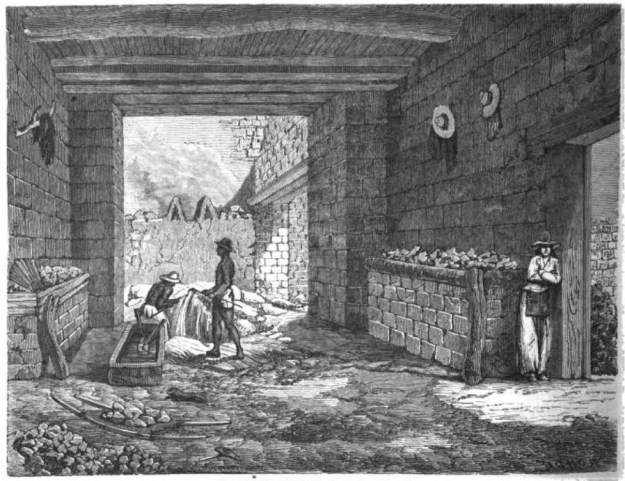
Interior of the Silver Smelter of Corralitos By Philippe Rondé – Le Tour du Monde, volume 4 [1], Public Domain, https://commons.wikimedia.org/w/index.php?curid=82418139

Ezekiel 22: 1-21 The Bloody City

The word of the LORD came to me: 2 You, mortal, will you judge, will you judge the bloody city? Then declare to it all its abominable deeds. 3 You shall say, Thus says the Lord GOD: A city! Shedding blood within itself; its time has come; making its idols, defiling itself. 4 You have become guilty by the blood that you have shed, and defiled by the idols that you have made; you have brought your day near, the appointed time of your years has come. Therefore I have made you a disgrace before the nations, and a mockery to all the countries. 5 Those who are near and those who are far from you will mock you, you infamous one, full of tumult.

6 The princes of Israel in you, everyone according to his power, have been bent on shedding blood. 7 Father and mother are treated with contempt in you; the alien residing within you suffers extortion; the orphan and the widow are wronged in you. 8 You have despised my holy things, and profaned my sabbaths. 9 In you are those who slander to shed blood, those in you who eat upon the mountains, who commit lewdness in your midst. 10 In you they uncover their fathers’ nakedness; in you they violate women in their menstrual periods. 11 One commits abomination with his neighbor’s wife; another lewdly defiles his daughter-in-law; another in you defiles his sister, his father’s daughter. 12 In you, they take bribes to shed blood; you take both advance interest and accrued interest, and make gain of your neighbors by extortion; and you have forgotten me, says the Lord GOD.

13 See, I strike my hands together at the dishonest gain you have made, and at the blood that has been shed within you. 14 Can your courage endure, or can your hands remain strong in the days when I shall deal with you? I the LORD have spoken, and I will do it. 15 I will scatter you among the nations and disperse you through the countries, and I will purge your filthiness out of you. 16 And I shall be profaned through you in the sight of the nations; and you shall know that I am the LORD.

The prophet Nahum in the 7th Century BCE issues oracles against the Assyrian capital Ninevah he declares that it is a city of bloodshed. Ninevah had been responsible for the conquering of Samaria and Nahum viewed their violent actions as meriting God’s judgement. “Ah, City of bloodshed, utterly deceitful, full of booty—no end to plunder” (Nahum 3:1) Although it is not certain that Ezekiel would have known these words from a prophet a couple of decades prior to his ministry, the content of this oracle reflects similar language, although now the bloody city is Jerusalem instead of Ninevah. Ezekiel is now called to judge the city which has transformed itself by its actions from the city of God to the bloody city.

The actions of bloodshed and idolatry have led the city to this space where they stand under God’s judgment. The punishment long withheld is finally arriving and Jerusalem instead of occupying a privileged space of honor as Zion now occupies a space of mockery and dishonor before the nations. The society of Judah has unraveled. They have lost their grounding in the covenant and in this dangerous city the fundamental building block of society (the family) has broken down and the vulnerable are exploited.

Throughout the law it is clear that leaders in Judah have a responsibility to maintain justice among the citizens. Their position is one of responsibility and not primarily one of privilege. Ezekiel accuses the princes of Israel of practicing exploitation instead of justice. Family is treated with contempt, the vulnerable (aliens, orphans, and widows) are exploited, the holy things of God are profaned, dishonest words are used to spill blood, unholy actions and things are lifted up, the boundaries of decency in family and among neighbors is broken, profit is made upon the misfortune of others (by charging interest) and all of this points to the reality that the people has forgotten the LORD. The list of unrighteous actions is the opposite of the righteous man who can save his own life in Ezekiel 18:5-9 and both build upon the understanding of holiness expressed in Leviticus 18-19.

Ezekiel paints a bleak picture of the communal life of Jerusalem. When they can be referred to in a similar way to Ninevah (or Samaria and Sodom as in 16: 44-58) then they are a society that has lost its moorings. When the city of shalom (Jeru-shalom) has become the bloody city the world has turned upside down. Ezekiel’s language is evocative. He paints this blood red image of violence to demonstrate the brokenness of Jerusalem and the righteousness of God in calling for judgment. These words, which are preserved beyond the judgment may have enabled the children to look upon the actions of their parents, consider and not do likewise. (Ezekiel 18:14)

Ezekiel 22: 17-22 Israel is Dross

17 The word of the LORD came to me: 18 Mortal, the house of Israel has become dross to me; all of them, silver, bronze, tin, iron, and lead. In the smelter they have become dross. 19 Therefore thus says the Lord GOD: Because you have all become dross, I will gather you into the midst of Jerusalem. 20 As one gathers silver, bronze, iron, lead, and tin into a smelter, to blow the fire upon them in order to melt them; so I will gather you in my anger and in my wrath, and I will put you in and melt you. 21 I will gather you and blow upon you with the fire of my wrath, and you shall be melted within it. 22 As silver is melted in a smelter, so you shall be melted in it; and you shall know that I the LORD have poured out my wrath upon you.

Israel was to be a treasured possession, a priestly kingdom, and a holy nation (Exodus 19: 5-6). Just as the city of peace became the blood city, now the treasured possession has become dross. The imagery of the refinement of silver from the silver ore which contains multiple elements (copper, iron, lead and tin) becomes the metaphor for God’s action of pouring out anger to melt the elements to separate the dross from the precious metal. There is a resonance with the metaphor here and Egypt as the iron smelter which God delivered his people from (Deuteronomy 4:20) but a stronger resonance exists in Isaiah’s earlier description of Judah:

How the faithful city has become a whore! She that was full of justice, righteousness lodged in her—but now murderers! Your silver has become dross, your wine is mixed with water. Your princes are rebels and companions of thieves. Everyone loves a bribe and runs after gifts. They do not defend the orphan, and the widow’s cause does not come before them. Isaiah 1: 21-23 (emphasis mine).

Yet, Ezekiel’s image may indicate that there is nothing precious left in Israel. They are completely dross. It is only God’s action that dross which has nothing precious can emerge from the smelter as silver. Any hope for Israel’s future lies in the same God whose blast of wrath is melting the people in their current state.

Ezekiel 22: 23-31 No One to Stand in the Breach

23 The word of the LORD came to me: 24 Mortal, say to it: You are a land that is not cleansed, not rained upon in the day of indignation. 25 Its princes within it are like a roaring lion tearing the prey; they have devoured human lives; they have taken treasure and precious things; they have made many widows within it. 26 Its priests have done violence to my teaching and have profaned my holy things; they have made no distinction between the holy and the common, neither have they taught the difference between the unclean and the clean, and they have disregarded my sabbaths, so that I am profaned among them. 27 Its officials within it are like wolves tearing the prey, shedding blood, destroying lives to get dishonest gain. 28 Its prophets have smeared whitewash on their behalf, seeing false visions and divining lies for them, saying, “Thus says the Lord GOD,” when the LORD has not spoken. 29 The people of the land have practiced extortion and committed robbery; they have oppressed the poor and needy, and have extorted from the alien without redress. 30 And I sought for anyone among them who would repair the wall and stand in the breach before me on behalf of the land, so that I would not destroy it; but I found no one. 31 Therefore I have poured out my indignation upon them; I have consumed them with the fire of my wrath; I have returned their conduct upon their heads, says the Lord GOD.

This third section within the chapter continues to build upon previously used imagery and has echoes of the words of Jeremiah, Micah,[1] and especially Zephaniah. The image of princes as roaring lions was seen in chapter 19 and prophets are covering up the flaws in the society with whitewash as in chapter 13. Like many speakers these images are brought again to hearers to reinforce the injustice done by the rulers of the society.  For the first time in Ezekiel the priests are brought into the condemnation. The overall passage, as mentioned above, echoes the language of Zephaniah 3:

Ah, soiled, defiled, oppressing city! It has listened to no voice; it has accepted no correction. It has not trusted the LORD; it has not drawn near to its God. The officials within it are roaring lions; its judges are evening wolves that leave nothing until the morning. Its prophets are reckless, faithless persons; its priests have profaned what is sacred they have done violence to the law. Zephaniah 3: 1-4 (emphasis mine).

The echoes between prophets may originate in a tradition of preserving the words of the prophets and studying these words, but if we take seriously the claims that the prophets are proclaiming the word of the LORD, then they share a common source. Through multiple voices similar images and messages have attempted to break through the resistance of the people of Israel, but now the people stand at the precipice of judgment with no one to stand in the gap for them.

The narrative of the flood in the book of Genesis (Genesis 6-9) deals with God’s attempt to cleanse the land from the wickedness, corruption, and violence of humanity. Now this violence, wickedness and corruption are focused in Judah and the action of the LORD is to purify the land once again. The princes, officials, priest, and prophets have all practiced violence, corrupted the teaching of the law and profaned the holy things, shed blood for dishonest gain, and covered up the corruption in the society. The result is a society that was intended to provide justice to the poor, needy, and the alien are now exploiting those vulnerable members of society.

The LORD seeks someone who will stand in the breach before God on behalf of the land. Gary Anderson points to the way Moses filled this role for the people in both Exodus 32: 7-14 and Numbers 14: 11-20. (Anderson, 2008, p. 223) Moses after both the Golden Calf and the rebellion against Moses and Aaron stands between the people and God and calls upon God not to destroy the people, initially for the sake of the name of God and then later picking up on God’s declared identity in the aftermath of the first betrayal. There is no Moses to stand in the breach for the people, to both defend the people from the wrath of the LORD, but also to reorient the people on the way of the law.

In a time where there is no Moses to stand in the breach and the princes, prophets, officials, and priests have all betrayed the ways of God the society is disordered. There is no reform that will reorient this broken society, only the wrath of God which washes over and consumes can purify the dross into silver. When Jerusalem is bloodier than Ninevah then perhaps only the destruction of the city can bring about the healing of the land. There is no hope in Ezekiel which does not pass through the destruction of Jerusalem, the temple, the Davidic line of kings, and the loss of the land.  There are only two more chapters of Ezekiel prior to the exile of the majority of the people, and throughout the book there has been no expectation that the people would hear and respond to the words of the prophet. Ezekiel does provide a lens for the people to look backward through in the aftermath of exile once they realize that there has been a prophet among them.

[1] Jeremiah 5: 1-5, 31; Micah 3:11.

Ezekiel 11 Judgment on Jerusalem and Hope for the Exiles

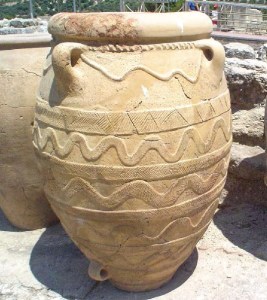
A smaller pithos, probably not semi-subterranean, as the decorative bands cover the entire body. There is a rope decoration around the neck; however, the body features distributed fasteners for handling via a rope harness. From Knossos, Crete 2004 Shared by CC 2.5 https://en.wikipedia.org/wiki/Pithos#/media/File:Aardewerk_knossos.JPG


Ezekiel 11: 1-13 The Judgment of the Jerusalem Leaders

1 The spirit lifted me up and brought me to the east gate of the house of the LORD, which faces east. There, at the entrance of the gateway, were twenty-five men; among them I saw Jaazaniah son of Azzur, and Pelatiah son of Benaiah, officials of the people. 2 He said to me, “Mortal, these are the men who devise iniquity and who give wicked counsel in this city; 3 they say, ‘The time is not near to build houses; this city is the pot, and we are the meat.’ 4 Therefore prophesy against them; prophesy, O mortal.”

5 Then the spirit of the LORD fell upon me, and he said to me, “Say, Thus says the LORD: This is what you think, O house of Israel; I know the things that come into your mind. 6 You have killed many in this city, and have filled its streets with the slain. 7 Therefore thus says the Lord GOD: The slain whom you have placed within it are the meat, and this city is the pot; but you shall be taken out of it. 8 You have feared the sword; and I will bring the sword upon you, says the Lord GOD. 9 I will take you out of it and give you over to the hands of foreigners, and execute judgments upon you. 10 You shall fall by the sword; I will judge you at the border of Israel. And you shall know that I am the LORD. 11 This city shall not be your pot, and you shall not be the meat inside it; I will judge you at the border of Israel. 12 Then you shall know that I am the LORD, whose statutes you have not followed, and whose ordinances you have not kept, but you have acted according to the ordinances of the nations that are around you.”

13 Now, while I was prophesying, Pelatiah son of Benaiah died. Then I fell down on my face, cried with a loud voice, and said, “Ah Lord GOD! will you make a full end of the remnant of Israel?”

In George Orwell’s famous short story Animal Farm the new leadership of the fictional farm ruled over by the animals quickly devolves as the pigs adopt the role of leaders. Napolean and the rest of the pigs soon take over the farmer’s house as their home and office. Instead of being compatriots who uphold the principles of animalism in the book, they become new masters willing to sell other animals for profit. Proverbs warns of the dangers of a dramatic change in leadership in its own manner:

Under three things the earth trembles; under four it cannot bear up: a slave when he becomes king, and a fool when glutted with food; an unloved woman when she gets a husband, and a maid when she succeeds her mistress. Proverbs 30: 21-23

The situation in Jerusalem that Ezekiel is visiting in this spiritual vision shows us the twenty-five men who are the new leaders in Jerusalem now that many of the leaders, priests, and counselors have been exiled to Babylon. Jaazaniah and Pelatiah and the remaining leaders who exercise authority in the absence of the exiles view themselves as safe within the city walls. In their view God’s judgment has fallen upon the exiles and they are now outside the pot, while they are the prime cuts left on the inside. To use a different metaphor, the city is now their oyster and they mean to extract the pearl of great price for their own profit.

When we think of the pot as a metaphor, it often is a place of difficulty rather than safety since pots are primarily used as instruments of cooking in modern kitchens. The image in Ezekiel is likely viewing the pot as a sealed vessel used for the storage of meat and other items, like the pithos in the image above, rather than primarily a vessel for cooking. (NIB VI: 1186) With the city walls functioning as the metaphorical pot that will keep the meat (these officials) safe they have run the city as ‘false shepherds’ as Ezekiel will later describe in Ezekiel 34: 1-10. The officials’ comments that “the time is not near to build houses” may indicate that building materials are needed to secure the city walls, but another insidious possibility is that these new officials are appropriating the property and wealth of the exiles and exploiting their new power to confiscate the property of the vulnerable within the city, as verse six seems to indicate. In the LORD’s view their actions have been death dealing to the very people they were entrusted to protect. They used their apparent safety and the power vacuum to enrich themselves at the expense of others, but their safety was an illusion.

God reverses their metaphor; they were the meat safe in the pot but now God has determined they are the spoiled portion that needs to be removed from the pot. These officials were probably exempted by their position from serving in the conflict around the walls, but now God promises to take them outside the walls and to expose them to the sword they have previously avoided. Like the pigs in Animal Farm who end the story indistinguishable from the surrounding farmers, these officials have acted like the nations around Israel. They have not cared for the vulnerable in the city, nor the exiles from their own people. As the prophet Micah would declare of leaders in his time, they became the butchers of the people:

And I said: Listen, you heads of Jacob and rulers of the house of Israel! Should you not know justice?—you who hate the good and love the evil, who tear the skin off my people, and the flesh off their bones; who eat the flesh of my people, flay their skin off them, break their bones into pieces, and chop them up like meat in a kettle, life flesh in a cauldron. Micah 3: 1-3

Throughout these chapters God has declared judgment upon the temple, the city, and the nation because of their unwillingness to live according to the way of God’s covenant. These leaders may have escaped the effects of the famine and conflict temporarily, but now they too will experience the consequences of their unjust actions while they were leading the people. Pelatiah, whose name means YHWH reserves a remnant, dies while Ezekiel is prophesying. Ezekiel protests to God that God is making a full end to the remnant of Israel.[1] Ezekiel’s protest results one of the first windows of hope in the book of Ezekiel.

Ezekiel 11: 14-21 Hope for the Exiles

14 Then the word of the LORD came to me: 15 Mortal, your kinsfolk, your own kin, your fellow exiles, the whole house of Israel, all of them, are those of whom the inhabitants of Jerusalem have said, “They have gone far from the LORD; to us this land is given for a possession.” 16 Therefore say: Thus says the Lord GOD: Though I removed them far away among the nations, and though I scattered them among the countries, yet I have been a sanctuary to them for a little while in the countries where they have gone. 17 Therefore say: Thus says the Lord GOD: I will gather you from the peoples, and assemble you out of the countries where you have been scattered, and I will give you the land of Israel. 18 When they come there, they will remove from it all its detestable things and all its abominations. 19 I will give them one heart, and put a new spirit within them; I will remove the heart of stone from their flesh and give them a heart of flesh, 20 so that they may follow my statutes and keep my ordinances and obey them. Then they shall be my people, and I will be their God. 21 But as for those whose heart goes after their detestable things and their abominations, I will bring their deeds upon their own heads, says the Lord GOD.

Ezekiel is the first prophet to a people in exile, and it is to the exiles that this vision of hope is imparted. The people of Jerusalem may have viewed the exiles as those removed far from the LORD, but the LORD imparts through the prophet that these are the ones who the hopeful future will come through. Although they have been removed from the physical presence of the temple, now the LORD promises to be their sanctuary in this time of exile. As Psalm 90, attributed to Moses, declares about the LORD, “Lord, you have been our dwelling place in all generations.” (Psalm 90:1) Their exile will not be forever, and they will be regathered by their God and returned to the land. There have been little windows into hope in the previous texts (Ezekiel 5:3, 6: 8-10) but those slivers of hope were surrounded by seas of darkness. In a further reversal, although the LORD has given up on those dwelling in Jerusalem, the remnant of the people is already in exile. The LORD will not abandon the land of Israel or the people.

This is the first time that Ezekiel will utilize the image of a ‘heart’ transplant: replacing a stony heart with a fleshy one. The heart in Hebrew thought is the organ of will, not emotions, so perhaps this is as much about a fleshy mind as a fleshy heart. Yet, Ezekiel will diagnose the problem with Israel as a heart problem, and only by replacing the sick and hard heart can there be a new life that is responsive to the LORD’s covenant and ordinances. This people of obedient and fleshy hearts will return and purify the land from the idols and detestable things that are present during this time. This renewed land and renewed people allow for the reestablishment of the covenant as the rearticulation of the covenant formula indicates: “Then they shall be my people, and I will be their God.”  As the prophet Jeremiah could state in a similar manner:

I will give them one heart and one way, that they may fear me for all time, for their own good and the good of their children after them. I will make an everlasting covenant with them, never to draw back from doing good to them, and I will put the fear of me in their hearts, so that they may not turn from me. I will rejoice in doing good to them, and I will plant them in this land in faithfulness, with all my heart and soul. (Jeremiah 32: 39-41)

Yet, for any who would not embrace this new future with a new heart and new faithfulness, their wicked deeds will not be exempted from the judgment Ezekiel proclaims.

Ezekiel 11: 22-25 The End of the Vision

22 Then the cherubim lifted up their wings, with the wheels beside them; and the glory of the God of Israel was above them. 23 And the glory of the LORD ascended from the middle of the city, and stopped on the mountain east of the city. 24 The spirit lifted me up and brought me in a vision by the spirit of God into Chaldea, to the exiles. Then the vision that I had seen left me. 25 And I told the exiles all the things that the LORD had shown me.

The LORD has left Jerusalem. Ezekiel never sees the glory of God move further than the mountains east of the city, although it has appeared to him in his exile in Babylon. Daniel and Revelation will assume that the presence of God is in heaven, but for Ezekiel God’s presence stops here and the vision ends with Ezekiel being returned to the exiles. Now the prophet shares this vision, both its terror and its hope, with these exiles, presumably starting with the elders of Judah who were seated in his house when the vision began.

Ezekiel has seen in this vision a people who worship other gods, but also a people whose misdirected worship has caused them to be an unjust society. The officials leading both the civic and religious life of Jerusalem have done violence to the city. Jerusalem as it stands is irredeemable in the LORD’s eyes, and it will require beginning fresh with a remnant already in exile. During this exile the LORD will be their sanctuary, will put a new and willing heart within them. I am reminded of the words of Psalm 51:

Create in me a clean heart, O God, and put a new and right spirit within me. Do not cast me away from your presence, and do not take your holy spirit from me. Restore to me the joy of your salvation and sustain in me a willing spirit. Psalm 51: 10-12

Yet, Psalm 51 is a prayer for individual renewal while Ezekiel’s vision is the recreation of a covenant people from the remnant in exile in Babylon whose clean hearts will lead to a clean land.

[1] Most English translations make this a question, but in Hebrew there is no interrogative. Rather than a question, Ezekiel is here protesting the perceived totality of God’s judgment on Israel. (NIB VI: 1187)

Ezekiel 10 God Prepares to Leave the Temple

Augsburger Wunderzeichenbuch — folio 15? „Vision des Hesekiel“

 Ezekiel 10

1 Then I looked, and above the dome that was over the heads of the cherubim there appeared above them something like a sapphire, in form resembling a throne. 2 He said to the man clothed in linen, “Go within the wheelwork underneath the cherubim; fill your hands with burning coals from among the cherubim, and scatter them over the city.” He went in as I looked on. 3 Now the cherubim were standing on the south side of the house when the man went in; and a cloud filled the inner court. 4 Then the glory of the LORD rose up from the cherub to the threshold of the house; the house was filled with the cloud, and the court was full of the brightness of the glory of the LORD. 5 The sound of the wings of the cherubim was heard as far as the outer court, like the voice of God Almighty when he speaks.

6 When he commanded the man clothed in linen, “Take fire from within the wheelwork, from among the cherubim,” he went in and stood beside a wheel. 7 And a cherub stretched out his hand from among the cherubim to the fire that was among the cherubim, took some of it and put it into the hands of the man clothed in linen, who took it and went out. 8 The cherubim appeared to have the form of a human hand under their wings.

9 I looked, and there were four wheels beside the cherubim, one beside each cherub; and the appearance of the wheels was like gleaming beryl. 10 And as for their appearance, the four looked alike, something like a wheel within a wheel. 11 When they moved, they moved in any of the four directions without veering as they moved; but in whatever direction the front wheel faced, the others followed without veering as they moved. 12 Their entire body, their rims, their spokes, their wings, and the wheels — the wheels of the four of them — were full of eyes all around. 13 As for the wheels, they were called in my hearing “the wheelwork.” 14 Each one had four faces: the first face was that of the cherub, the second face was that of a human being, the third that of a lion, and the fourth that of an eagle.

15 The cherubim rose up. These were the living creatures that I saw by the river Chebar. 16 When the cherubim moved, the wheels moved beside them; and when the cherubim lifted up their wings to rise up from the earth, the wheels at their side did not veer. 17 When they stopped, the others stopped, and when they rose up, the others rose up with them; for the spirit of the living creatures was in them.

18 Then the glory of the LORD went out from the threshold of the house and stopped above the cherubim. 19 The cherubim lifted up their wings and rose up from the earth in my sight as they went out with the wheels beside them. They stopped at the entrance of the east gate of the house of the LORD; and the glory of the God of Israel was above them.

20 These were the living creatures that I saw underneath the God of Israel by the river Chebar; and I knew that they were cherubim. 21 Each had four faces, each four wings, and underneath their wings something like human hands. 22 As for what their faces were like, they were the same faces whose appearance I had seen by the river Chebar. Each one moved straight ahead.

The four living creatures and wheels that made up the divine chariot with the divine presence of God above it that appeared in Ezekiel’s initial vision now reappear in this scene before the temple. The passage of time and the presence of the temple have now given Ezekiel a clearer understanding of the vision he sees. As Daniel Block states:

Most of the grammatical difficulties plaguing ch. 1 have been smoothed out; the abstract has become concrete; much of the analogical language has been eliminated; the sheer brilliance of the first vision has been toned down; and details that seemed out of place in ch. 1 now play a vital roles. Whereas Ezekiel’s first encounter with the heavenly throne-chariot had left the prophet struggling to describe what he saw, when the vehicle reappears more than a year later, he is able to deal with the encounter more rationally, and his description is more calculated. (Block, 1997, pp. 316-317)

The difficult to describe living creatures now realized to be cherubim and the wheels within wheels are now the wheelwork. The presence of the temple likely helped Ezekiel make the connections between the living creatures and the cherubim. The cherubim were crafted on the lid of the ark of the covenant and inside the holy of holies in the tabernacle (Exodus 25-26, 1 Kings 6) and while the statues of the cherubim and their presence on embroidery are stated they are not described beyond the wings of the cherubim touching. There is tradition of both the LORD meeting the people between the cherubim (referring to the ark of the covenant Exodus 25:22) the LORD above the cherubim (2 Kings 19:15) and the LORD who rides on the cherubim (2 Samuel 2: 2-15, Psalm 18: 1-15, Psalm 104:3). The visual imagery of the temple and song now are combined in this living throne-chariot where the presence of the LORD is above the cherubim and the wheelwork, and yet this is not a static throne but a wheeled one that the LORD rides upon.

The man clothed in linen is commanded to go into the wheelwork and take fire from it. In Isaiah 6: 6 a burning coal was taken from the altar to purify the prophet Isaiah, and although there are priestly echoes in this passage the implication here is that the coals are to burn the city. The word for scatter (Hebrew zaraq) is used in Leviticus 3 for the act of dashing blood on the altar for offerings of well-being. Yet, the action here is similar to the seventh seal in Revelation 8:1-5 where the fire from the altar is thrown upon the earth. The man who sealed those who moaned and groaned over the state of Israel, now becomes an agent of destruction. This man receives the burning coals from the cherubim depart to fulfill his instructions.

As I mentioned after discussing the living creatures/cherubim, wheelwork, and the heavenly throne-chariot in chapter 1, it is easy to become drawn to the images and miss the message. The imagery of the divine presence and the throne chariot indicate the movement of the LORD of Israel away from the temple. The actions of the executioners in the previous chapter and the man in linen with fire from the wheelwork in this chapter are communicating the judgment of the LORD upon the city of Jerusalem. The movement of the God of Israel has been deliberate throughout the past two chapters, only moving as far as the entrance of the east gate of the temple, but the overall direction is clear. God is leaving the building and in the next chapter the presence of God will leave the city.

Ezekiel 5 An Image of Jerusalem’s Destruction

Jerusalem is on Fire from the Art Bible (1896)

Ezekiel 5: 1-4

1 And you, O mortal, take a sharp sword; use it as a barber’s razor and run it over your head and your beard; then take balances for weighing, and divide the hair. 2 One third of the hair you shall burn in the fire inside the city, when the days of the siege are completed; one third you shall take and strike with the sword all around the city; and one third you shall scatter to the wind, and I will unsheathe the sword after them. 3 Then you shall take from these a small number, and bind them in the skirts of your robe. 4 From these, again, you shall take some, throw them into the fire and burn them up; from there a fire will come out against all the house of Israel.

An uncomfortable prophet becomes the embodiment of an uncomfortable message. The God of Israel has transformed from being the protector of Jerusalem to being actively engaged in the scattering and death of the people of Jerusalem. This culmination of the sign-act which through lying on one side, eating a restrictive diet, constructing a model of the siege and now the shaving of the prophet’s hair by a sword has deconstructed the identity of the prophet to demonstrate the destructive forces that are being unleased on Jerusalem. Ezekiel among the prophets has the greatest concern for ritual purity in relation to the Levitical understanding of a priest. Near the end of the book of Ezekiel he will note that priests are not to shave their heads (Ezekiel 44: 20) and this follows the prohibition of shaving bald spots on their heads or shaving the edges of their beards in mourning for all priests (Leviticus 21: 5, see also Deuteronomy 14: 1 where this practice is extended to all people). As before the command of the LORD pushes Ezekiel past the boundaries of what is expected of a priest and perhaps removes him from the role of the priesthood to serve as a strange prophet with a message that embodies the LORD’s disgust at what Israel has become.

Priests were prohibited from shaving their heads, even in the act of mourning but the use of a sharp sword as the instrument may point to the experience of shaving as a mark of dishonor or humiliation as part of a military defeat. Jerusalem is facing a military catastrophe as the continued image of the siege demonstrates. Ezekiel has already been instructed to cook his food in a way that violated his understanding of faithfulness to God’s law, and yet here Ezekiel does not protest. Ezekiel has been commanded to be obedient in contrast with the people. The implication is that the prophet does shave his head and beard, weighs his hair, and divides it in thirds according to the instructions. Two thirds of the city are represented destroyed either within or outside the city by the burning or striking of the representative thirds and the remnant remains under threat of God unsheathing the sword after them. Only a small number is bound to the prophet in order to remain safe.

Ezekiel 5: 5-17

5 Thus says the Lord GOD: This is Jerusalem; I have set her in the center of the nations, with countries all around her. 6 But she has rebelled against my ordinances and my statutes, becoming more wicked than the nations and the countries all around her, rejecting my ordinances and not following my statutes. 7 Therefore thus says the Lord GOD: Because you are more turbulent than the nations that are all around you, and have not followed my statutes or kept my ordinances, but have acted according to the ordinances of the nations that are all around you; 8 therefore thus says the Lord GOD: I, I myself, am coming against you; I will execute judgments among you in the sight of the nations. 9 And because of all your abominations, I will do to you what I have never yet done, and the like of which I will never do again. 10 Surely, parents shall eat their children in your midst, and children shall eat their parents; I will execute judgments on you, and any of you who survive I will scatter to every wind. 11 Therefore, as I live, says the Lord GOD, surely, because you have defiled my sanctuary with all your detestable things and with all your abominations — therefore I will cut you down; my eye will not spare, and I will have no pity. 12 One third of you shall die of pestilence or be consumed by famine among you; one third shall fall by the sword around you; and one third I will scatter to every wind and will unsheathe the sword after them.

13 My anger shall spend itself, and I will vent my fury on them and satisfy myself; and they shall know that I, the LORD, have spoken in my jealousy, when I spend my fury on them. 14 Moreover I will make you a desolation and an object of mocking among the nations around you, in the sight of all that pass by. 15 You shall be a mockery and a taunt, a warning and a horror, to the nations around you, when I execute judgments on you in anger and fury, and with furious punishments — I, the LORD, have spoken — 16 when I loose against you my deadly arrows of famine, arrows for destruction, which I will let loose to destroy you, and when I bring more and more famine upon you, and break your staff of bread. 17 I will send famine and wild animals against you, and they will rob you of your children; pestilence and bloodshed shall pass through you; and I will bring the sword upon you. I, the LORD, have spoken.

If you are making this journey with me through Ezekiel it quickly becomes uncomfortable to hear these harsh words of judgment from God directed at Jerusalem recorded in these first five chapters. This strange prophet’s declarations are unfamiliar to most people who are used to a less judgmental version of Christianity. As Katheryn Pfisterer Darr can state,

Ezekiel has a difficult time securing a place in mainstream Christianity. With a few well-known exceptions (e.g., the valley of dry bones vision in 37: 1-14), his oracles seldom make their way into lectionary readings and sermons, for they are deemed too severe, too complex, and too painful to set before our congregations and Bible study groups. And Ezekiel makes us uncomfortable—a sentiment we surely share not only with his original audience in exile, but also with two and a half millennia of his interpreters, both Jewish and Christian. Among the early rabbis, for example, we find the opinion that reading the book’s beginning and ending was too dangerous to be undertaken by anyone younger than thirty years of age. (NIB VI:1129)

This particular prophetic unit is, “one of the harshest that is delivered to the nation anywhere in Tanakh. It remains difficult to read, even as we are removed by so many generations.” (Ganzel, 2020, p. 54) Yet, even with the harshness and difficulty of reading Ezekiel I still believe it has something to teach us about a passionate God and a people who were once a treasured possession, a holy people, and a nation of priests (Exodus 19: 5-6) but now are viewed as impure and disgusting.

Jerusalem has ceased to be Zion, the home of God. Their privileged status has been forfeited at this time in their story with God, and Ezekiel is concerned with both pronouncing the change of status but also communicating the cause for this change. Throughout the first five chapters we have heard the charge that the people have rebelled against God’s statutes and ordinances. They were intended to be a witness to the righteousness of God revealed to them by the covenant. Instead, they failed to even live up to the righteousness of the nations[1] (ordinances of the nations in NRSV) and this is the root of the LORD’s anger with his people.

Ezekiel frequently uses the language of purity/impurity from the law, particularly Leviticus. Ezekiel uses the terms ‘detestable things’ (Hebrew shikkutzim) and ‘abominations’ (Hebrew to’evot) for the first of more than eighty uses throughout his prophecies. Detestable things typically refer to impure creatures which are forbidden as food, but in Ezekiel they normally refer to the idolatrous practices which have defiled the temple and the people. Abominations in the law are things that is, “hateful, disgusting, or worthy of condemnation.” (Ganzel, 2020, p. 51) and throughout Ezekiel these are the items that defile the bond between husband and wife, the land, the temple, Sabbath, and even God’s name. For Ezekiel these detestable things and abominations corrupt the people, the land, and even the temple making them impure and disgusting to God. The treasured possession is polluted, the holy people are unholy, and the nation of priests have become idolatrous.

The judgment echoes the language of the curses in the law[2] as well as what is found in other prophets.[3] It also remembers the cannibalism that is reported during the siege of Samaria under Ben-Hadad as referenced in 2 Kings 6: 24-41. Ezekiel adds to the reports of eating children or other residents with the reversal of children eating parents. The stress and starvation of siege warfare can make people abandon their humanity in the struggle to survive. Yet, for Ezekiel the Babylonians are not the primary oppressors of Jerusalem. The Babylonians are merely their God’s deadly arrows of famine and destruction.

The God presented by the prophets has a surprisingly human range of emotions from passionate love to anger. Years ago, when I was working through Jeremiah I realized this was the language of a broken-hearted God. God is grieving the loss of what could have and perhaps should have been with the people. Is God reacting rationally, absolutely not, God is reacting emotionally in Ezekiel. This is a painful text which causes us to ask difficult questions. What would cause God the heartbreak which leads to this rage? What actions cause God’s people to go from treasured possessions to detestable things and abominations? How do we explain the disasters within our lives, our churches, and our society and does God have a role in those disasters? What are the ‘idols’ that we trust instead of the God we claim to worship? What are the obligations of our identity as the people of God? All challenging questions without easy answers. The prophet finds himself caught between a rebellious people and a passionate God. He occupies that uncomfortable place of faithfulness is a time a judgment. Yet, even the prophet’s faithfulness may look like disobedience to the strict ideas of purity. There are no easy answers in Ezekiel. The first half of the book leads us unrelentingly to the destruction of Jerusalem, and it is only in the second half where the hope for the surviving remnant can be voiced.

[1] Hebrew mishpat haggoyim this would be a strong condemnation from the perspective of a law observant Hebrew. The righteousness of the Gentiles would be an oxymoron to the Jewish people who viewed themselves as the bearers of God’s vision of righteousness. Ezekiel argues they would not even maintain the standard of those outside the covenant.

[2] Leviticus 26: 29, Deuteronomy 28: 53-57

[3] Isaiah 9:20-21; 49:26 (although here it refers to Israel’s enemies); Jeremiah 19:9; Zechariah 11:9

Psalm 89 Shattered Worlds and Broken Symbols

The Siege and Destruction of Jerusalem by Romans Under the Command of Titus, A.D. 70 by David Roberts 1850

Psalm 89

<A Maskil of Ethan the Ezrahite.>
1 I will sing of your steadfast love, O LORD, forever; with my mouth I will proclaim your faithfulness to all generations.
2 I declare that your steadfast love is established forever; your faithfulness is as firm as the heavens.
3 You said, “I have made a covenant with my chosen one, I have sworn to my servant David:
4 ‘I will establish your descendants forever, and build your throne for all generations.'” Selah
5 Let the heavens praise your wonders, O LORD, your faithfulness in the assembly of the holy ones.
6 For who in the skies can be compared to the LORD? Who among the heavenly beings is like the LORD,
7 a God feared in the council of the holy ones, great and awesome above all that are around him?
8 O LORD God of hosts, who is as mighty as you, O LORD? Your faithfulness surrounds you.
9 You rule the raging of the sea; when its waves rise, you still them.
10 You crushed Rahab like a carcass; you scattered your enemies with your mighty arm.
11 The heavens are yours, the earth also is yours; the world and all that is in it — you have founded them.
12 The north and the south — you created them; Tabor and Hermon joyously praise your name.
13 You have a mighty arm; strong is your hand, high your right hand.
14 Righteousness and justice are the foundation of your throne; steadfast love and faithfulness go before you.
15 Happy are the people who know the festal shout, who walk, O LORD, in the light of your countenance;
16 they exult in your name all day long, and extol your righteousness.
17 For you are the glory of their strength; by your favor our horn is exalted.
18 For our shield belongs to the LORD, our king to the Holy One of Israel.
19 Then you spoke in a vision to your faithful one, and said: “I have set the crown on one who is mighty, I have exalted one chosen from the people.
20 I have found my servant David; with my holy oil I have anointed him;
21 my hand shall always remain with him; my arm also shall strengthen him.
22 The enemy shall not outwit him, the wicked shall not humble him.
23 I will crush his foes before him and strike down those who hate him.
24 My faithfulness and steadfast love shall be with him; and in my name his horn shall be exalted.
25 I will set his hand on the sea and his right hand on the rivers.
26 He shall cry to me, ‘You are my Father, my God, and the Rock of my salvation!’
27 I will make him the firstborn, the highest of the kings of the earth.
28 Forever I will keep my steadfast love for him, and my covenant with him will stand firm.
29 I will establish his line forever, and his throne as long as the heavens endure.
30 If his children forsake my law and do not walk according to my ordinances,
31 if they violate my statutes and do not keep my commandments,
32 then I will punish their transgression with the rod and their iniquity with scourges;
33 but I will not remove from him my steadfast love, or be false to my faithfulness.
34 I will not violate my covenant, or alter the word that went forth from my lips.
35 Once and for all I have sworn by my holiness; I will not lie to David.
36 His line shall continue forever, and his throne endure before me like the sun.
37 It shall be established forever like the moon, an enduring witness in the skies.” Selah
38 But now you have spurned and rejected him; you are full of wrath against your anointed.
39 You have renounced the covenant with your servant; you have defiled his crown in the dust.
40 You have broken through all his walls; you have laid his strongholds in ruins.
41 All who pass by plunder him; he has become the scorn of his neighbors.
42 You have exalted the right hand of his foes; you have made all his enemies rejoice.
43 Moreover, you have turned back the edge of his sword, and you have not supported him in battle.
44 You have removed the scepter from his hand, and hurled his throne to the ground.
45 You have cut short the days of his youth; you have covered him with shame. Selah
46 How long, O LORD? Will you hide yourself forever? How long will your wrath burn like fire?
47 Remember how short my time is —  for what vanity you have created all mortals!
48 Who can live and never see death? Who can escape the power of Sheol? Selah
49 Lord, where is your steadfast love of old, which by your faithfulness you swore to David?
50 Remember, O Lord, how your servant is taunted; how I bear in my bosom the insults of the peoples,
51 with which your enemies taunt, O LORD, with which they taunted the footsteps of your anointed.
52 Blessed be the LORD forever. Amen and Amen.

The approach to Psalm 89 will be different than my approach to most of the other psalms because it evokes for me an important question that continues to be wrestled with in communities of faith. This psalm likely originates in the collapse of the Davidic line of kings in the aftermath of Babylon’s destruction of Jerusalem in 587 BCE and wrestles with the contrast between the psalmist’s understanding of God’s promises and their present experience. It is plausible that Psalm 89 may be a combination of one (or more) psalms which expressed the royal theology of the Davidic kings with the tough questions of verse thirty-eight onward. Like Psalm 88 it takes us into the darkness of the psalmist’s experience where no light appears on the horizon, but unlike the previous psalm this is the experience of the community of the faithful questioning how the God’s faithfulness proved unfaithful. The psalm is still processing the anger, grief, and the disillusionment over the loss of institutions they thought would continue perpetually.

The language of Psalm 89 weaves together the kingdom of God and the monarchy of David into a common tapestry. Psalm 89 is built upon the words through the prophet Nathan to David in 2 Samuel 7: 8-17, but the rough edges of this prophecy where the ‘seeds of arrogance’ (Nancy de Claisse-Walford, 2014, p. 681) seen in David are smoothed out. Like Psalm 2 the strength of the Davidic kings is directly linked to the strength of the LORD. Their victories are the LORD’s victories, their enemies are the LORD’s enemies, their unfaithfulness is punished but they are never separated from God’s steadfast love and faithfulness (unlike King Saul or the Kings of Northern Israel). The first seventy percent of the psalm weaves God’s reign which is founded on steadfast love and faithfulness into experience of life under David’s descendants. The royal theology is expressed through the temple, and the temple, Jerusalem, and the Davidic kings all become important symbols of God’s reign on earth. The covenant language of Psalm 89 leaves no space for God to change God’s mind despite the unfaithfulness of many of the kings in Jerusalem. Yet, when the seam holding God’s reign and the Davidic king’s reign unravels in verse thirty-eight, the psalmist now takes God to task for renouncing the covenant. The situation of humiliation that the people experience now moves the psalmist to the dangerous and perhaps blasphemous conclusion that God whose reign is built on steadfast love and faithfulness has now proven unfaithful. God who was once Father and Rock who exalted David’s horn and strengthened his arm now strengthens the arms of the foes of the people, has rejected God’s children, and has renounced the covenant.

Moving beyond the psalm for the moment, the close alliance of God’s kingdom with any individual or government always presents the danger of idolatry. King David occupies an almost mythical role in the story of Israel as the ‘once and future king’ who was a man after God’s own heart. The narrative of David in First and Second Samuel, and the experience of the Davidic kings in First and Second Kings is often disconnected from the interwoven theology which connects the stability of the kings in Jerusalem with a larger vision of God’s cosmic reign over the forces of creation and the nations of the world. When the destruction of Jerusalem by Babylon occurs and the Davidic line of kings seems to be a stump which is cutdown and never to rise again the Jewish people would have to reckon with their relationship with God in a new way and to discover their new identity as a people of God in exile without king, temple, or land. They would have to reimagine the role of David within their life of faith and to reexamine how the hopes of 2 Samuel 7 and Psalm 89: 1-36 ended in the desolation of 2 Kings 25 and Psalm 89: 37-51.

Although the United States there is the concept of the ‘separation of the church and the state’ there is also a semi-religious understanding of manifest destiny and exceptionalism which exists within the political language of the country. Recently there has been a strong movement among both individuals and churches towards a Christian nationalism which weaves these ideas of manifest destiny and exceptionalism into a religious retelling of the story of the United States which ignores many aspects of the country’s past and present. This Christian nationalism has coalesced around the Republican Party in the United States and is still wielded by former President Trump to link his presidency with the faith of many of his followers. The almost messianic fervor that some have placed upon him and the sharp polarization between adherents and opponents highlights the danger of this interweaving of God’s reign and any individual or political group.

As an heir of the Lutheran reformation, I am a part of what is sometimes referred to as the magisterial reformation. The magisterial reformation includes the Lutheran, Reformed, and Anglican reform movements that still believed that secular authority should be followed (in contrast to the radical reformers who rejected any secular authority). Yet, the Lutheran (as well as Reformed and Catholic churches) in Germany had to struggle with the demands for loyalty from the National Socialist party as they assumed power in the 1930s. Many prominent Lutheran scholars, like Paul Althaus,[1] welcomed the rise of the National Socialist and Althaus viewed the government of the state as an order of God’s creation which was given by God. If the government of the state was an order of creation it was not subject to critique by the church, but there were others in the church who would criticize the National Socialist. Dietrich Bonhoeffer is the most well known of these resisters to the demands of loyalty. For Bonhoeffer he viewed the government as a vessel God uses to preserve life and when the government fails in its responsibility the church has a responsibility to speak. Many in Germany in the 1930s were able to combine their practice of Christianity with the demands of the state. Looking back upon this time it is easy to wonder how many people of faith were able to participate in or tolerate actions which seem antithetical to the scriptures, yet it is amazing how malleable peoples’ interpretation of scripture can be to fit their political dispositions.

Within Psalm 89 the kingdom of God and the reign of the Davidic kings is woven together until the tapestry is ripped apart by the experience of the present. There were Christians during the Third Reich who viewed Adolf Hitler as God’s gift to Christianity[2] and I fear there are many Christians in the United States making a similar mistake today. Unfortunately for many in Germany and in the United States participation in these movements has drowned out critical voices that questioned this interweaving of God and nationalism. For Judaism the crisis of exile in Babylon led to a reexamination of their faith in light of their new situation. I fear that for many Christians the eventual collapse of Christian nationalism will lead to an abandonment of their faith.

For me the conclusion of this psalm in verse fifty-two is also a moment of hope. It closes the third book of the psalter and brings this open question into the continued act of praise. Even when there are no easy answers for shattered symbols, broken communities, and even a broken nation there is a community that sits in the discomfort and still brings these questions into the blessing of their God. It closes with a double ‘amen’ which acknowledges the still unanswered questions of the prayers while allowing them to be lifted up to the God who may be Father, may be opponent but still remains connected to the community of the faithful. Elie Wiesel in his memoirs All Rivers Run to the Sea captures the relationship of these faithful crying out to God when he says of his own experience of the Holocaust:

I have never renounced my faith in God. I have risen against His justice, protested His silence and sometimes His absence, but my anger rises up within faith, not outside of it. (Wiesel, 1994, p. 84)

[1] Paul Althaus was not an isolated example, but he was in the 1930s viewed as the leading scholar on Luther’s theology. When I was studying in seminary in the early 2000s his works The Theology of Martin Luther and The Ethics of Martin Luther were still used.

[2] Paul Althaus in 1933 stated, “Our Protestant churches have greeted the turning point of 1933 as a gift and miracle of God” (Ericksen, 2012, p. 37)