Tag Archives: Christmas

A Small Light in Winter- A Christmas Story

Frozen lake Baikal near Olkhon Island, Photo by Sergey Pesterev, Shared under CC 4.0https://en.wikipedia.org/wiki/Lake_Baikal#/media/File:Lake_Baikal_in_winter.jpg

It had been a difficult several years for Father Petrov. They had laid several of the men of his congregation to rest as casualties of the War to End All Wars between 1914 and 1917. Then came the unrest which led to the October revolution where the Bolsheviks gained control and a pall of fear was cast over the community as the official position of the new government considered the Russian Orthodox Church as a symbol of the old allegiances to the Czar. Yet even last Christmas he had celebrated in a beautiful church in Moscow with an ornate iconostasis of golden painted saints and angels as incense hung in the air and the congregation sang the chants into the night to mark the night of the Savior’s birth. But as 1918 unfolded the new government began to make its mark on Moscow. Food was in short supply and so the leaders began to point to those who had formerly been nobles, the educated, and then to the ornate and beautifully domed structures of the Orthodox churches of the city. It had been a dreary October day when worship was interrupted by uniformed men who came in arresting Father Petrov and all who had dared to assemble on that day, torching the church and sending Father Petrov and his flock on the Trans-Siberian Railway to Irkutsk where they were marched along the shore of Lake Baikal to a bleak camp where they were officially to be reeducated, but it quickly became clear that ultimately they were moved to this land to be forgotten, to pass away in the Siberian winter.

Yet, despite the cold nights and inadequate shelter, Christmas arrived in 1918. There were no songbooks, no incense, no wall of icons or brightly painted walls of a church. Olga, one of his faithful members, had managed to grab seven candles and set them up in the large shed where the tools that were used for coal mining were stored. Father Petrov had a bible and as he carried his lamp to the shed where those who would celebrate this bitterly cold Christmas were gathered, he wondered what he would do without the rituals and relics of the church that had formed him for a style of worship that had endured for centuries. As he approached the shed, he looked to the lantern in his hand and thought of Jesus’ words about a lamp needing to be placed on a lampstand and not being hidden under a bushel basket, and so he found a small table and placed his lamp on it. More people than he had expected had gathered, others in the work camp seeking a small light in winter, a taste of hope in the hopelessness, a reminder of a different world, and perhaps they looked to each other in this land of the forgotten for another soul to see them and remind them that they mattered.

Father Petrov breathed in the cold air and began with the words from John’s gospel, “The light shines in the darkness, and the darkness did not overcome it.” Then he lit the first candle and said, “and we are witnesses to that light.” Little Anya, who had seen far more than any young child should see in the last months, echoed Father Petrov’s words, “we are witnesses to that light.” And slowly at first and then in rapidly increasing numbers the remainder of the gathered congregation echoed, “and we are witnesses to that light.” Then Olga, Anya’s mother, read from the prophet Isaiah how, “The people who lived in darkness have seen a great light; those who lived in a land of deep darkness, on them light has shined.” Then Olga lit the second candle and said, “and we are witnesses to that light.” This time the community responded immediately and with more force, “and we are witnesses to that light.”

Anya now stepped up beside her mother and said the words she had been practicing for this night, how the prophet Isaiah continued saying, “Unto us a child has been born, unto us a son is given, and the government will be upon his shoulders, and he will be called Wonderful Counselor, Mighty God, Everlasting Father, the Prince of Peace. Great will be his kingdom, and there will be endless peace.” Then Anya lit the third candle and with the boldness of a child proclaimed, “and we are children of God’s son.” The congregation with a little bit of joy at seeing the faith of a child echoed, “and we are children of God’s son.”
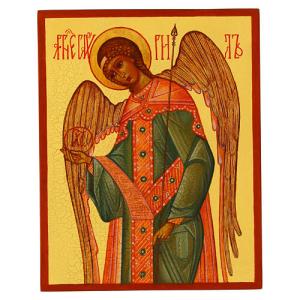
Russian Orthodox Icon of the Archangel Gabriel

Then Rita came forward to tell of how the angel Gabriel came to Mary one fateful night and told Mary, “Do not be afraid.” How often God’s messengers came to God’s people in scary times and told them not to be afraid but before she continued on she brought out from her coat an icon of the angel Gabriel that she had saved from the church before it had been destroyed, and she told of the angel’s message of the virgin Mary and Mary’s words in response, “Here am I, the servant of the Lord; let it be with me according to your word.” Then Rita lit the fourth candle and said, “And we are servants of the Lord.” The community echoed, “And we are servants of the Lord.” Then Rita’s husband Jusef came and told of Joseph, the father of Jesus, who was a righteous man trying to find a way between what God expected of him in the law and mercy for his betrothed Mary who was found to be with child, and how the angel of the Lord came to him in a dream and spoke again the words, “Do not be afraid.” And then explained to Joseph that the child to be born was from God and was the fulfillment of prophecy. “Look, the virgin shall become pregnant and give birth to a son, and they shall name him Emmanuel,” which means, “God is with us.” Perhaps we too need to hear in this godforsaken place that God has not forsaken us, indeed God is with us. And then lighting the fifth candle Jusef declared, “And we serve the God who is with us.” And the community echoed, “And we serve the God who is with us.”
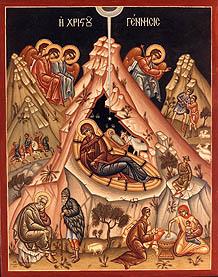
Russian Orthodox Icon of the Nativity

Then Victor came forward and he also took from his coat an icon that had been one from his home, an icon of the Christmas scene, and he told the story from the gospel of Luke of Joseph and Mary coming to Bethlehem and finding no place other than a shed, perhaps not unlike the shed they gathered in that night, and the child was born to them, unseen by relatives or most of the world. But how in the night the angel of the Lord came to shepherds and again told them, “Do not be afraid.” And the angel told the good news of great joy for all the people he had been entrusted with and told these shepherds how to find the child and its parents. How the heavenly host broke into song and the shepherds in their amazement went to find Mary and Joseph and the child promised to them, and described their amazement to anyone who heard, and how Mary treasured these things in her heart. Then Victor said, “And we too treasure these things in our heart.” He lit the sixth candle as the congregation echoed, “And we too treasure these things in our heart.”

Finally, Sophia, the oldest living member of the community at seventy-five years old, came to the front and turned to the gospel of John. She said in a clear voice, “In the beginning was the Word, and the Word was with God, and the Word was God.  He was in the beginning with God.  All things came into being through him, and without him not one thing came into being. What has come into being in him was life, and the life was the light of all people.  The light shines in the darkness, and the darkness did not overtake it.” She lit the final candle and said, “And we are servants of that light.” To which the congregation responded, “And we are servants of that light.” Father Petrov gave a final blessing in the cold winter night and summarized how we were indeed servants of the light who brings light to people living in darkness, who promises us a child who will lead us into a time of peace, who tells his servants not to be afraid, how even in godforsaken places how our God is with us, how we too can treasure these things in our hearts, for the one who was with God in the beginning at creation is here among us bringing light and life into our darkness. He uttered a final blessing for this flock gathered in the shed and then they made their way back to their barracks where they would attempt to shelter from the piercing wind blowing over the lake. But as the left they carried with them a little hope in what before had seemed hopeless, and a small light in the winter.

This story has historical elements, but it is a fictional story. The place and time are real, but the specifics of the situation and the characters only existed in my imagination prior to this night. May this Christmas story from a cold and dark world bring a little light into your season.

Matthew 1: 18-24 The Birth of Jesus

Jean-Marie Pirot (aka Arcabas) The angel of the Lord speaks to Joseph in a Dream

Matthew 1: 18-24

18 Now the birth of Jesus the Messiah took place in this way. When his mother Mary had been engaged to Joseph, but before they lived together, she was found to be with child from the Holy Spirit. 19 Her husband Joseph, being a righteous man and unwilling to expose her to public disgrace, planned to dismiss her quietly. 20 But just when he had resolved to do this, an angel of the Lord appeared to him in a dream and said, “Joseph, son of David, do not be afraid to take Mary as your wife, for the child conceived in her is from the Holy Spirit. 21 She will bear a son, and you are to name him Jesus, for he will save his people from their sins.” 22 All this took place to fulfill what had been spoken by the Lord through the prophet:

 23 “Look, the virgin shall conceive and bear a son, and they shall name him Emmanuel,”

 which means, “God is with us.” 24 When Joseph awoke from sleep, he did as the angel of the Lord commanded him; he took her as his wife, 25 but had no marital relations with her until she had borne a son; and he named him Jesus.

 Matthew’s birth narrative is extremely short and yet, in its efficiency, it links us into the story of God’s people and introduces us to a pattern for what the life of the people of God will look like in this new age. Most Christians know the two highpoints of the church year are Christmas and Holy Week which form the bookends of the life, death and resurrection of Jesus. The ancient creeds of the church (the Apostles Creed and the Nicene Creed) spend almost all their words about Jesus focused on the birth, death and resurrection. Matthew simply tells us, “Now the birth of Jesus the Messiah took place in this way.” And then in seven short, but packed verses, takes us from the announcement of Jesus’ impending birth to the birth and naming of this child from the Holy Spirit.

In contrast to the Lukan birth narratives which primarily focus in on Mary and her relatives Elizabeth and Zechariah, Mary is in the background of Matthew’s narrative. Mary is found to be with child, Matthew informs us that it is from the Holy Spirit, but Joseph initially is placed in the position of having to decide about his betrothed who is suddenly pregnant. Marriages were negotiated between families and during this time men typically were significantly older than women when they married so they could establish a household. The natural assumption by Joseph is that Mary has had intimate relations with another man during this time of betrothal. The legal penalty for her in the law is outlined in Deuteronomy 22: 24-27

23 If there is a young woman, a virgin already engaged to be married, and a man meets her in the town and lies with her, 24 you shall bring both of them to the gate of that town and stone them to death, the young woman because she did not cry for help in the town and the man because he violated his neighbor’s wife. So you shall purge the evil from your midst.
 25 But if the man meets the engaged woman in the open country, and the man seizes her and lies with her, then only the man who lay with her shall die. 26 You shall do nothing to the young woman; the young woman has not committed an offense punishable by death, because this case is like that of someone who attacks and murders a neighbor. 27 Since he found her in the open country, the engaged woman may have cried for help, but there was no one to rescue her.

The practice of stoning was probably no longer used for adultery in the time of Mary and Joseph, but Mary’s public humiliation by Joseph could place her in a vulnerable state and labeled as a sinner and an outcast from the community that she knew. Joseph is called a righteous man, and in the character of Joseph we are exposed for to what righteousness will look like for Matthew’s gospel. Instead of righteousness being a strict adherence to the letter of the law it will be a far more gracious understanding of righteousness. Joseph’s resolution to quietly end the engagement and not expose Mary to public shaming is viewed as a model for the righteousness of the kingdom of heaven. Joseph must resolve how he will interpret the commands of the law in his life and he becomes one who hungers and thirsts for righteousness and will be filled, who shows mercy and will have mercy shown to him as Jesus will later say in the Beatitudes.

Joseph’s namesake in the Hebrew Scriptures is a dreamer and an interpreter of dreams, so it is fitting that Jesus’ father receives his revelations in dreams. The angel of the Lord, the mouthpiece of God in much of the Hebrew Scriptures, appears to Joseph in his dreams and reveals the origin of Mary’s child and tells Joseph to take her as his wife. The only speaker in this narrative is the angel of the Lord, Joseph acts in obedience to the angel’s words in his dream but we never hear him utter a word in the gospel. Two additional times Joseph will receive guidance from the angel of God in a dream and all three times Joseph will obediently follow the instructions of the dreams. Joseph will take Mary as his wife, Mary will bear their son, Joseph will name him, and both the angel and scripture will speak about this child to be born.

The name Jesus, or Iesous in Greek, is the adaptation of the name rendered Joshua in the Hebrew Scriptures. The name means ‘God saves’ and like the original Joshua who brought the people of Israel into the promised land, Jesus will be responsible for bringing about the kingdom of heaven. The act of Joseph naming Jesus also means that Joseph acknowledges the child as his own responsibility and a part of his own household.  But beyond the name of Jesus, we also are told by the angel what his role will be: “He will save his people from their sins.”

The role of Jesus, to save the people from their sins, has received multiple interpretations in recent scholarship. Most people have traditionally linked this to the forgiveness of sins that a person would receive in confession and that Jesus’ ministry is primarily concerned with wiping away the individual transgressions they have made. Yet, I think that Matthew is connecting this vocation with the story of the people of Israel. As Richard B. Hays can state:

Here we see an example of the hermeneutical significance of the genealogy: it compels the reader to understand the “sins” from which God’s people are saved are not merely the petty individual transgressions of a scrupulous legal code but rather the national sins of injustice and idolatry that finally led to the collapse of the Davidic monarchy and the Babylonian captivity. The Messiah, in Matthew’s narrative world, is precisely the one who saves his people from the consequences of their sins by closing the chapter of powerlessness and deprivation that began with the “deportation to Babylon.” The opening chapter of Matthew’s Gospel is strongly consonant with interpretations of Jesus’ work as bringing about an end of Israel’s exile. (Hays, 2016, p. 111)

Just as the first Joshua would close the chapter of the people’s wandering in the wilderness after their liberation from Egypt and initiate their dwelling in the promised land, so Jesus closes the chapter of powerlessness and deprivation that occurred in the exile. Something new is happening in Jesus’ birth.

The other voice that speaks, in addition to the angel of the Lord, is the voice of scripture and here the quotation comes from Isaiah 7:14:

Therefore the Lord himself will give you a sign. Look, the young woman is with child and shall bear a son, and shall name him Immanuel.

Matthew quotes from the Septuagint, the Greek translation of the Hebrew Scriptures, where the Hebrew ‘almah is rendered parthenos in Greek. Unfortunately, any translation into another language locks in certain meanings and while ‘almah is a broader term that includes young women of marriageable age and one gloss of the meaning could be a virgin, in the Greek the term parthenos means virgin. This caused quite a stir in the history of bible translations and is one of the reasons there was a break between RSV (now NRSV) and NIV (and later TNIV) translations. When the RSV translated Isaiah 7:14 as ‘young woman’ many conservative Christian traditions demanded a translation that was harmonious and the NIV translation was formed to address this need.

Aside from the disagreement over a word requiring a new translation is the broader question about how Matthew interprets scripture and how we are to interpret scripture. The language of scripture has been the language of faith and Matthew more than any other gospel will introduce short passages of scripture that prefigure what he and other followers of Christ have experienced in Jesus of Nazareth. This is one of ten times that Matthew will introduce a quotation with, “this took place to fulfill what had been spoken by the Lord through the prophet.”

In the original context of Isaiah 7, King Ahaz of Judah is fearful on an attack by King Rezin of Aram and King Pekah of Israel who have formed an alliance against Judah. The Lord speaks to Ahaz through Isaiah to reassure him and gives him permission to ask for a sign that the words of the Lord will come to pass. When Ahaz refuses to put the Lord to the test, the sign he is given is that a young woman will become pregnant, name her child Immanuel (God with us) and before the child is old enough to choose right from wrong Israel and Aram will no longer be a threat. Matthew applies this verse to his own time, and this is not an unusual practice in scripture-the texts seem to have a certain elasticity in how they were used throughout the bible-and hears in this verse not only a prefiguring of Jesus’ birth by Mary by the Holy Spirit but also a critical idea of who Jesus is, Emmanuel, an idea so important he needs to emphasize it by translating it, ‘God is with us.’

While Mark’s gospel throughout its narrative will allude to the mysterious way that in Jesus, somehow, we are experiencing the presence of God, Matthew will, from the very beginning of the gospel, emphasize that Jesus linkage to several title associated with God throughout the scriptures. The idea that Jesus is Emmanuel, God with us, forms a bookend of the gospel of Matthew. In this first chapter we hear Jesus given this title in a quotation from Isaiah and in the final chapter the resurrected Christ will remind his disciples that,” I am with you always, to the end of the age.” Somehow Jesus will embody God’s presence among the disciples and in taking the language of the scriptures and the presence of the angel of the Lord we are quickly introduced to who this child will be.

Joseph never speaks, but he does obey. Joseph dreams and acts upon those dreams. He will embody a righteousness that is both obedient and merciful. Joseph takes Mary as his wife but waits to consummate the marriage until the birth of Jesus. Joseph gives Jesus the name he receives from the angel of the Lord in the dream, but unlike Luke we don’t hear any stories of shepherd and angels from the night of his birth, instead Matthew has set the scene with the announcement and scripture of who this child is and we end this chapter waiting to see how the world will receive him.

Seeking Christmas

 It isn’t with the Christmas tree
Or presents wrapped for all to see
St.Nick, he didn’t bring it here
Nor Frosty of the Grinch I fear
 
It isn’t in the shopping mall
Nor songs that sing our ‘Deck the Hall’
Or houses decked in Christmas lights
Or people packed on holiday flights
 
Family and friends, feast and gift
Do comfort and my spirits lift
Yet sometimes all the noise and light
Distracts me on this silent night
 
From Joseph’s trip from Galilee
And his new wife, blessed Mary
From Jesus in a manger lay
For no room was found on his birthday
 
Messiah, the Word of God, the Light
That came upon that Holy Night
When the angel proclamation began
Peace on earth, good will to man
 
Come let us go and seek and tell
This child who is Emmanuel
The creator to creation come
A new covenant of grace begun
 
To seek with Magi Bethlehem
To see the king or the great ‘I am’
To ponder deep within our heart
The words the shepherd did impart
 
For that is what I seek this year
In the middle of the holiday cheer
The place where heaven comes to earth
To fill our hearts and souls with mirth

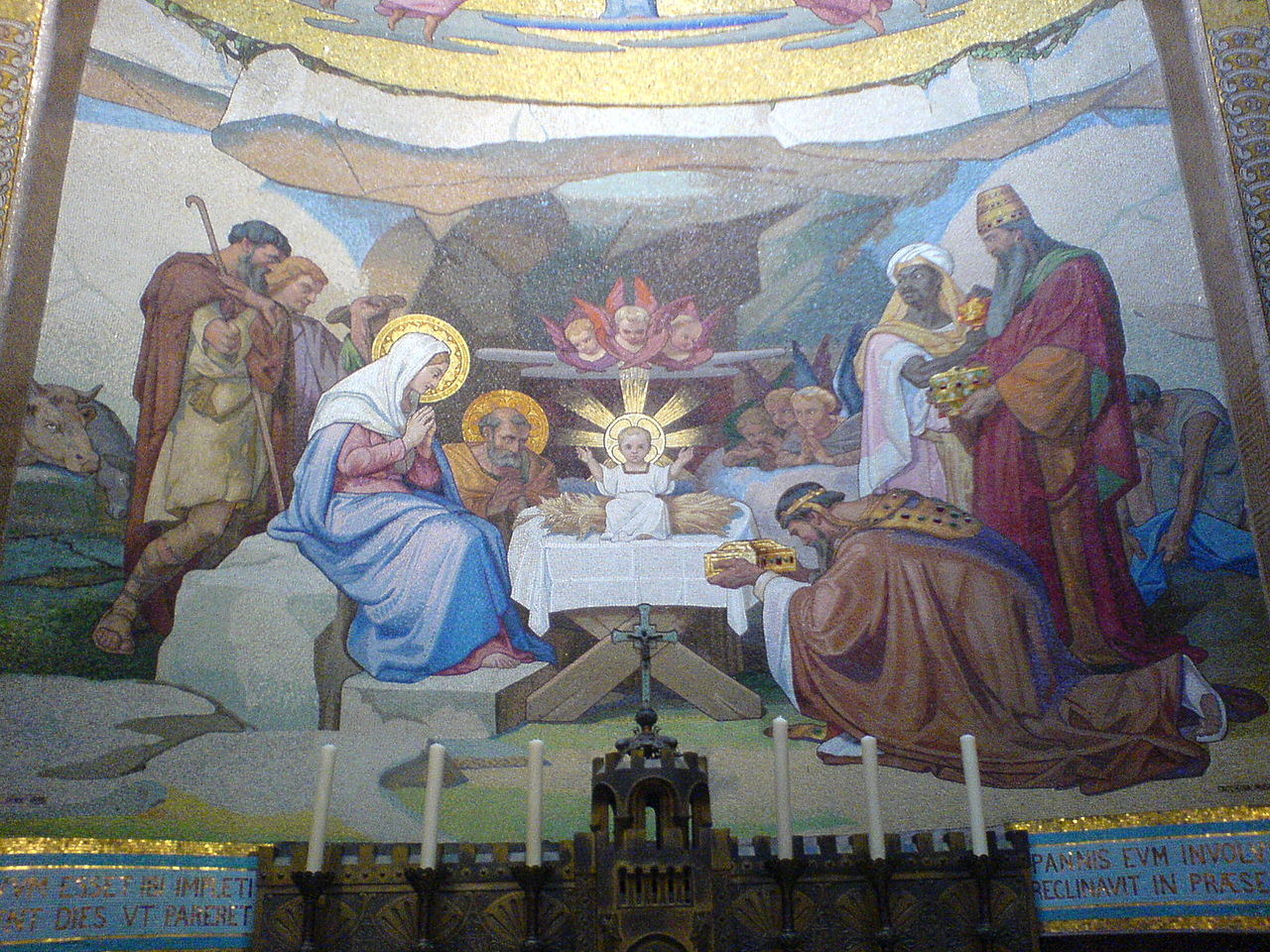
Mosaic in the Rosary Basilica, Lourdes

Mosaic in the Rosary Basilica, Lourdes

Incarnation

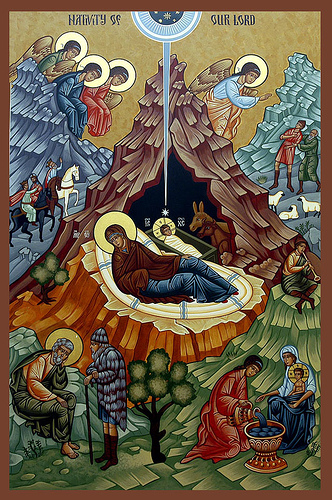
The Nativity of Christ, Icon by Ranosonar

The Nativity of Christ, Icon by Ranosonar


In a world where we have pushed the heavens into the farthest recesses of the universe

And we filled the pores in the world where angels and demons, magic and mystery could enter in

Filling each transcended node with the immanent certainty of rationality and reason

Plugging ourselves into our own isolation connected through patterns of numbers and light

We created a world of which we were our own new gods claiming the generative power of words

Yet, as our own new gods we find ourselves being consumed by the hungry creation we unleashed

Wired into our wireless networks, completely disconnected in our continual connection

Yearning for hope in the tyranny of the soulless world in which nothing is sacred


Yet, there is a memory of a different story from a different time that tugs at my thoughts

Of the transcendent coming to occupy the immanent, of the creator incarnating the creation

Of the infinite coming to occupy the mundane and the ordinary, of making sacred the secular

And perhaps in this season as we remember the narrative of the Word that become flesh

Living among us and daring to enter into a creation that has lost its dreams of tomorrow

That the light may enlighten the present darkness of our permanently lighted world

That we may dream of the truth beyond the facts and the vision beyond our perception

The poetry of a God who invades the impersonal world in the form of a person

Who brings acceptance in the midst of rejection and love in the midst of hatred

In the midst of our perceived wisdom the wisdom of God may appear foolish

And strength comes masquerading as weaknesses and power in the guise of powerlessness


If the Word becomes incarnate and lives among us it comes not to conquer and enslave

But it does come to offer us a dream of a different world and to shape for us a new reality

While it may describe and illuminate and deconstruct the world we shaped for ourselves

It comes as the wisdom that holds the creation together and narrates for us a new story

And in the light of this enfleshed Word we are renamed and our stories have a new frame

Where the sacred inhabits our secular world and life takes on a sacramental reality

And from the soul of the new creation emerges again and ancient hope that we are not alone

For Emmanuel has come and our God is with us, we are among those God favored ones

The ancient angelic host announced in a long ago age when our world still had a place for them.

The Silent Night-A Poem

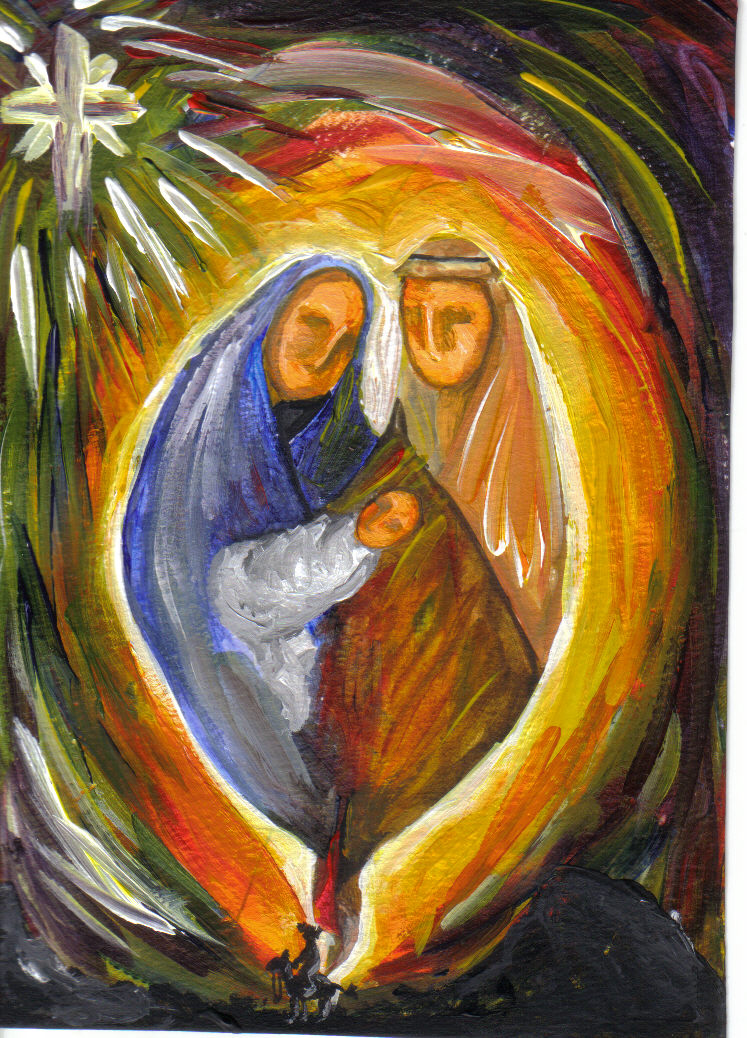
Nativity by Lady Macbeth @deviantart.com

Nativity by Lady Macbeth @deviantart.com

As we hear the story again, that ancient story we know so well
Of the days when heaven and earth touched and angels sang their praises
When shepherds heard and a virgin gave birth in the midst of the stable
There in the magic of the night where simple shepherds knew what kings did not
And somehow God came down to dwell among us in the weakness of a newborn
When the deafness of humanity somehow missed the Word of God
Except for those few gathered together to witness the chorus of new creation
And as we echo the strains in our own key two millennia displaced from that day
May the mystery and majesty of the heavenly chorus blend in harmony
With the songs of the faithful gathered from all corners of the world
To fill the silent night with songs, to join with all creation in singing a new song
And in the cacophony of noise perhaps we too might hear the stirring of angels
Proclaiming the message of peace on earth and goodwill towards humanity
Singing of the love of God that comes down to be among us on this silent night
To share God’s song and to join in ours this day

Neil White, 2013

Blessings to all my friends who will be a part of the song tonight