Tag Archives: bible

2 Kings 6: 1-23 Floating Iron and Opened Eyes

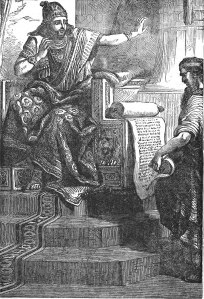
‘Elisha makes the Axe Head Swim’ illustration from The story of the Bible from Genesis to Revelation (1873)

2 Kings 6: 1-7 

1Now the company of prophets said to Elisha, “As you see, the place where we live under your charge is too small for us. 2Let us go to the Jordan, and let us collect logs there, one for each of us, and build a place there for us to live.” He answered, “Do so.” 3Then one of them said, “Please come with your servants.” And he answered, “I will.” 4So he went with them. When they came to the Jordan, they cut down trees. 5But as one was felling a log, his ax head fell into the water; he cried out, “Alas, master! It was borrowed.” 6Then the man of God said, “Where did it fall?” When he showed him the place, he cut off a stick and threw it in there and made the iron float. 7He said, “Pick it up.” So he reached out his hand and took it.

To the modern reader this may seem like a strange story to include among the miracles that are handed on about Elisha. In a world where an ax is a relatively inexpensive tool the loss of an ax head seems like a trivial matter to trouble the prophet Elisha with. But the world of Elisha’s time was very different from our world. At this time iron is a precious resource and smiths in ancient Israel would be rare. This was also a time when Israel is at war with Aram so most iron would be going to create weapons for the military of Israel. Much as the story of Elisha and the widow’s oil (2 Kings 4:1-7), the prophet’s action likely saved this member of the company of prophets from a debt they could not hope to repay. (NIB III: 199) Many of the stories in the previous two chapters have the company of prophets relying on the prophet Elisha to provide food in their want and Gehazi’s foolish (in the eyes of 2 Kings) request for recompense from Naaman (2 Kings 5: 19b-27) is also informed by the group’s poverty. Even if the neighbor who loaned the unfortunate man the ax would not attempt to collect the value of the lost tool, there is a strong concern for neighborly rights among the world envisioned in the Torah.

The story takes place at the Jordan geographically linking it to the previous healing of Naaman. At the Jordan Elisha provided healing for Naaman from his skin disease and relief for this fellow member of the company of prophets with the sunken ax head. Some scholars, both Jewish and Christians, have taken this story and attempted to create a non-miraculous version: the stick was cut to be able to fit into the aperture of the ax head or to have a flat surface for the ax head to rest on as the prophet lifts it out are two examples. Yet, to tell these stories the commenters in their desire to make the story more reasonable have missed the point that the man of God is able to do what others cannot. Elisha who can heal disease or provide adequate food can also through his connection with God make metal float and make an army captive.

2 Kings 6: 8-23

  8Once when the king of Aram was at war with Israel, he took counsel with his officers. He said, “At such and such a place shall be my camp.” 9But the man of God sent word to the king of Israel, “Take care not to pass this place, for the Arameans are going down there.” 10The king of Israel sent word to the place of which the man of God spoke. More than once or twice he warned a place so that it was on the alert.
  11
The mind of the king of Aram was greatly perturbed because of this; he called his officers and said to them, “Now tell me: Who among us is betraying us to the king of Israel?” 12Then one of his officers said, “No one, my lord king. It is Elisha, the prophet in Israel, who tells the king of Israel the words that you speak in your bedchamber.” 13He said, “Go and find where he is; I will send and seize him.” He was told, “He is in Dothan.” 14So he sent horses and chariots there and a great army; they came by night and surrounded the city.
  15
When an attendant of the man of God rose early in the morning and went out, an army with horses and chariots was all around the city. His servant said, “Alas, master! What shall we do?” 16He replied, “Do not be afraid, for there are more with us than there are with them.” 17Then Elisha prayed, “O LORD, please open his eyes that he may see.” So the LORD opened the eyes of the servant, and he saw; the mountain was full of horses and chariots of fire all around Elisha. 18When the Arameans came down against him, Elisha prayed to the Lord and said, “Strike this people, please, with blindness.” So he struck them with blindness as Elisha had asked. 19Elisha said to them, “This is not the way, and this is not the city; follow me, and I will bring you to the man whom you seek.” And he led them to Samaria.
  20
As soon as they entered Samaria, Elisha said, “O LORD, open the eyes of these men so that they may see.” The Lord opened their eyes, and they saw that they were inside Samaria. 21When the king of Israel saw them he said to Elisha, “Father, shall I strike them? Shall I strike them?” 22He answered, “No! Would you strike those whom you have taken captive with your sword and with your bow? Set food and water before them so that they may eat and drink, and let them go to their master.” 23So he prepared for them a great feast; after they ate and drank, he sent them on their way, and they went to their master. And the Arameans no longer came raiding into the land of Israel.

The Arameans are a continual danger to the people of Israel throughout the end of 1 Kings and the beginning of 2 Kings. Yet, Elisha through the previous and following chapter will play a pivotal role in the conflict between the king of Aram and the king of Samaria. Through Naaman, these soldiers who are brought captive by the prophet to Samaria, and the eventual defeat of the siege of Samaria the Arameans will come to know that there is a prophet in Samaria who king Ben-hadad of Aram will eventually consult (2 Kings 8: 7-15). Also reappearing in this story are the ‘horsemen and chariots of Israel’ which are the host of Israel’s God which Elisha first saw at Elijah’s ascension.

The conflict between the king of Aram and the prophet is precipitated by the prophet’s repeated warning of the king of Israel of the movements of Aram’s armies. Convinced that one of his leaders is betraying him, he summons them and asks how this is occurring. One of his officers knows that it is Elisha that is handing on this information, and the king of Aram orders a force sent to seize the prophet from his current location at Dothan. What the king’s men and the prophet’s men are blind to is the ‘horsemen and chariots of Israel’ which are surrounding the prophet and are more numerous than the forces sent by the king of Aram. Apparently, one’s eyes must be opened to be able to see the host of the LORD and that is exactly what Elisha prays for his servant to receive.

Throughout the narrative the movement between blindness and sight plays a critical role. Elisha’s servant may be able to see the forces of Aram, but he is blind to the forces of the LORD who Elisha serves until his eyes are opened. The prophet was able to provide vision for the king of Israel to elude the maneuvers of the king of Aram’s army and so the king of Aram attempts to remove the eyes of Israel by eliminating the prophet. The armies of Aram are struck with blindness by the LORD and led by the prophet to Samaria where the prophet asks for their sight to be restored.

The story ends with the king of Israel asking whether he should strike down this army that has been delivered by the prophet into his city and the prophet opening his eyes to another way. The king of Israel did not capture the Arameans, and their lives are in the prophet’s hands, and the prophet shows a way of peace. The book of Proverbs states, “If your enemies are hungry, give them bread to eat; and if they are thirsty, give them water to drink.” Proverbs 25:21 The prophet models this way of wisdom for the king who prepares a great feast for his enemies, and this brings at least a pause to the conflicts between Israel and Aram. The story moved from blindness to sight and from conflict to peace. Just like Naaman would discover that there is a prophet in Samaria, now these soldiers of Aram would also know both the power of the prophet’s God and the rescue provided in their desperate situation.

2 Kings 5 Elisha Heals Naaman and Gehazi’s Poor Choice

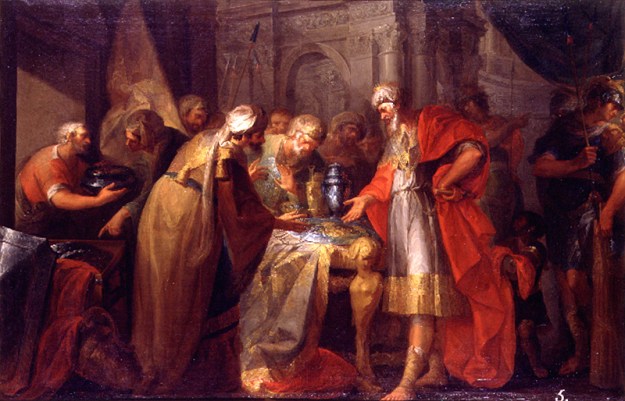
Pieter de Grebber, Elisha Refusing Gifts From Naaman (1630) https://www.theleidencollection.com/artwork/elisha-refusing-naamans-gifts/

2 Kings 5: 1-19a 

1Naaman, commander of the army of the king of Aram, was a great man and in high favor with his master because by him the Lord had given victory to Aram. The man, though a mighty warrior, suffered from a skin disease. 2Now the Arameans on one of their raids had taken a young girl captive from the land of Israel, and she served Naaman’s wife. 3She said to her mistress, “If only my lord were with the prophet who is in Samaria! He would cure him of his skin disease.” 4So Naaman went in and told his lord just what the girl from the land of Israel had said. 5And the king of Aram said, “Go, then, and I will send along a letter to the king of Israel.”
  He went, taking with him ten talents of silver, six thousand shekels of gold, and ten sets of garments. 6
He brought the letter to the king of Israel, which read, “When this letter reaches you, know that I have sent to you my servant Naaman, that you may cure him of his skin disease.” 7When the king of Israel read the letter, he tore his clothes and said, “Am I God, to give death or life, that this man sends word to me to cure a man of his skin disease? Just look and see how he is trying to pick a quarrel with me.”
  8
But when Elisha the man of God heard that the king of Israel had torn his clothes, he sent a message to the king, “Why have you torn your clothes? Let him come to me, that he may learn that there is a prophet in Israel.” 9So Naaman came with his horses and chariots and halted at the entrance of Elisha’s house. 10Elisha sent a messenger to him, saying, “Go, wash in the Jordan seven times, and your flesh shall be restored, and you shall be clean.” 11But Naaman became angry and went away, saying, “I thought that for me he would surely come out and stand and call on the name of the LORD his God and would wave his hand over the spot and cure the skin disease! 12Are not Abana and Pharpar, the rivers of Damascus, better than all the waters of Israel? Could I not wash in them and be clean?” He turned and went away in a rage. 13But his servants approached and said to him, “Father, if the prophet had commanded you to do something difficult, would you not have done it? How much more, when all he said to you was, ‘Wash, and be clean’?” 14So he went down and immersed himself seven times in the Jordan, according to the word of the man of God; his flesh was restored like the flesh of a young boy, and he was clean.
  15
Then he returned to the man of God, he and all his company; he came and stood before him and said, “Now I know that there is no God in all the earth except in Israel; please accept a present from your servant.” 16But he said, “As the LORD lives, whom I serve, I will accept nothing!” He urged him to accept, but he refused. 17Then Naaman said, “If not, please let two mule loads of earth be given to your servant, for your servant will no longer offer burnt offering or sacrifice to any god except the Lord. 18But may the LORD pardon your servant on one count: when my master goes into the house of Rimmon to worship there, leaning on my arm, and I bow down in the house of Rimmon, when I do bow down in the house of Rimmon, may the LORD pardon your servant on this one count.” 19He said to him, “Go in peace.”

The healing of Naaman, along with Elijah’s ascent in the whirlwind, are probably the two best-known and most frequently used stories from 2 Kings in the life of the church. This story, along with Elijah’s provision of meal and oil for the widow of Zarephath, is utilized in Luke 4:27 as an explanation for the expansiveness of Jesus’ ministry, but it is also paired with Jesus’ healing of lepers in the gospels. Naaman is both the victorious mighty warrior who occupies a privileged position with the king of Aram and has servants and slaves along with the access to considerable wealth and power, but in Israel he is also a Gentile, an unclean one, and an oppressor. The story illustrates the fundamental differences between the world envisioned by the king of Aram and Naaman at the beginning of the story and the prophet Elisha when he enters in the middle of the story.

The position of Naaman, in the view of 2 Kings, is a result of the LORD the God of Israel granting him victory leading the Arameans. On the one hand this provides an explanation for the defeat of Israel by a foreign power, the defeat is a judgment on the unfaithfulness of Samaria. On the other hand, it makes the mighty warrior subject, unknowingly at the beginning of the story, to the LORD the God of Israel. Even a captive young woman from Israel knows what this mighty warrior cannot, that the hope for healing resides in Samaria. This young woman who is a captive and the mighty man who is a leader of armies may be on opposite sides of the power differential but in the story they are linked. Captured slaves often have an unfavorable view of their masters, yet in Naaman throughout the story we see that this mighty man is both respected enough by his servants for them to speak truthfully and compassionately to him and Naaman as their master listens. The commander of warriors who can deliver victories depends upon the knowledge willingly shared by a captured young woman residing in his household.

The skin disease which has been traditionally translated as leprosy is probably not what we today categorize as leprosy (or Hansen’s disease) but it was something that ancient cultures took very seriously. Leviticus 13-14 deals with the priestly role in the diagnosis, the social implications for a person diagnosed with this skin disorder and the method that they can also be reintegrated into the community once they are healed. The seriousness of the disease can be demonstrated by the incredible amount of wealth (ten talents of silver, six thousand shekels of gold, and ten sets of garments)[1] which the king of Aram sends to the king of Israel to bring about the healing of his favored commander.

In the ancient world there was no concept of separation of religious and state powers. For most ancient kings, even in Israel, there are religious figures including prophets in the royal court. The prophet Nathan was involved in the court of king David, and earlier in the Omri dynasty we saw the conflict between the prophets who spoke favorably to king Ahab and Micaiah who was a faithful prophet of the LORD but not in royal favor. As Alex Israel notes about the contrasting views of prophets between the kings of Aram and Israel:

The king of Aram was incapable of imagining a scenario in which the prophet would not be fundamentally subordinate to the king, and so he sought the prophet by means of the latter. By contrast, the king of Israel couldn’t conceive a situation in which the prophet would be responsive to his control, and so he failed to entertain the prospect of appealing to Elisha! (Israel, 2019, p. 98)

The king of Aram views the king of Israel as his subordinate who he can command, but Elisha does not answer to the king of Israel. Yet, Elisha does hear of the king’s distress and instructs him to send Naaman to him.

Naaman has probably encountered other healers and prophets in Damascus who attempted to heal his skin disease, and he has ideas of how that process should look for a person of his station. As a person of high status, he anticipated personal attention from the prophet. His status as a mighty warrior and commander of the armies of Aram have allowed him to be a person who is able to fulfill their request, but now he finds that this status means nothing before the prophet, and he is reduced to a “supplicant who comes to the healer as a leper.” (Brueggemann, 2000, p. 334) Yet, as previously we saw with the young woman from Israel, Naaman is a master who his servants are willing to speak to in an honest and compassionate way. Once Naaman has completed his complaint about the command delivered by an emissary to wash in the Jordan, his servants are able to convince him that the prophet has not asked a hard thing, and it is in Naaman’s interest to attempt this novel cure.

The washing in the Jordan results in Naaman’s skin becoming like a young boy. The description of Naaman’s skin utilizing the masculine form of the words used to describe the young girl at the beginning of the story now link the two together. In some way Naaman is now like this enslaved young woman even though they occupy vastly different places in the social hierarchy. Both stand in a place of dependency before God and Naaman has not only learned that there is a prophet in Samaria, but that there is no God in all the earth except in Israel.

After the healing Naaman stands, with all his company before the prophet Elisha. Naaman attempts to offer payment, but Elisha swears that he will take no payment.[2] Naaman then makes two requests when payment continues to be refused. First Naaman requests to take two mule loads of earth. Naaman likely believes that the God of Israel is tied to the land of Israel and bringing the earth will allow him to build an altar or worship space where he can access this God whom he has discovered. Secondly, he requests that in his state functions that God would not hold it against him when he escorts his master into the worship space of Rimmon, the god of Damascus. Elisha does not judge Naaman for these requests and instructs him to depart in shalom.

2 Kings 5: 19b-27

  But when Naaman had gone from him a short distance, 20Gehazi, the servant of Elisha the man of God, thought, “My master has let that Aramean Naaman off too lightly by not accepting from him what he offered. As the LORD lives, I will run after him and get something from him.” 21So Gehazi went after Naaman. When Naaman saw someone running after him, he jumped down from the chariot to meet him and said, “Is everything all right?” 22He replied, “Yes, but my master has sent me to say, ‘Two members of a company of prophets have just come to me from the hill country of Ephraim; please give them a talent of silver and two changes of clothing.’ ” 23Naaman said, “Please accept two talents.” He urged him and tied up two talents of silver in two bags, with two changes of clothing, and gave them to two of his servants, who carried them in front of Gehazi. 24When he came to the citadel, he took the bags from them and stored them inside; he dismissed the men, and they left.
  25
He went in and stood before his master, and Elisha said to him, “Where have you been, Gehazi?” He answered, “Your servant has not gone anywhere at all.” 26But he said to him, “Did I not go with you in spirit when someone left his chariot to meet you? Is this a time to accept silver and to accept clothing, olive orchards and vineyards, sheep and oxen, and male and female slaves? 27Therefore the skin disease of Naaman shall cling to you and to your descendants forever.” So he left his presence diseased, as white as snow.

The stories of the previous chapter seem to indicate that the company of prophets (or sons of the prophets) continually struggle with poverty and this may inform Gehazi’s action contrary to his master Elisha. As Choon-Leong Seow remarks, “the faithfulness of Naaman’s slave girl at the beginning of the story stands in stark contrast to the treachery of Elisha’s servant at the end of the chapter.” (NIB III:192) While Elisha swore an oath (“as the LORD lives”) that he would accept no gift (literally blessing) from Naaman his servant Gehazi swears an oath that he will take something from this Gentile. Gehazi runs after Naaman’s party and Naaman, after dismounting his chariot asks, “Is all shalom?” Gehazi gives a reason for wanting a blessing/payment from Naaman, which Naaman is eager to grant giving double the initial request. For Naaman this is far less than the ten talents of silver he was willing to pay as payment for healing, but the roughly one hundred fifty pounds of silver with two sets of garments[3] which two of Naaman’s servants carry back to the citadel would be an incredible amount of wealth among the company of prophets. Yet, Gehazi’s secret is known by Elisha and the Hebrew indicates that Elisha’s heart went with Gehazi (NRSV ‘spirit’). Silver and clothing, land and livestock, servants and slaves for the company of the prophets is not where their security comes from. Gehazi has trusted in the same things that the king of Aram and Naaman trusted, and Elisha indicates that now Naaman’s skin disease will cling to Gehazi and his descendants.

The healing of Naaman does not end the conflict between Aram and Samaria which will continue in the narrative of the next two chapters. It is also not the end of Gehazi’s role in the story who will reappear in chapter eight. It is possible that the healing of Naaman is brought forward in the story to be a part of an Elisha cycle of miracles which reaches its peak with the thwarting of the king of Aram’s invasion of Israel. The king of Israel’s inability to heal his servant did not provide the provocation for a continued war, but ultimately the healing of Naaman did not end the conflict between Samaria and Damascus.


[1] The NIV notes that 10 shekels of silver is about 750 lbs (340 kg) of silver and 6,000 shekels of gold is about 150 lbs (70 kg).

[2] Numbers 22:18 and Daniel 5:17 are both times where two very different prophets (Balaam and Daniel) indicate that gold will not be acceptable to earn favor or as payment for a servant of the LORD.

[3] Garments in the ancient world are also expensive and an indicator of wealth.

2 Kings 4 A Series of Miracles Performed by Elisha

Carmelite chapel – “Elisha resurrecting the son of the Shunammitee” by Jean-Baptiste Despax (1710-1773)

2 Kings 4:1-7

 1Now the wife of a member of the company of prophets cried to Elisha, “Your servant my husband is dead, and you know that your servant feared the LORD, but a creditor has come to take my two children as slaves.” 2Elisha said to her, “What shall I do for you? Tell me, what do you have in the house?” She answered, “Your servant has nothing in the house except a jar of oil.” 3He said, “Go outside, borrow vessels from all your neighbors, empty vessels—and not just a few. 4Then go in, shut the door behind you and your children, and start pouring into all these vessels; when each is full, set it aside.” 5So she left him and shut the door behind her and her children; they kept bringing vessels to her, and she kept pouring. 6When the vessels were full, she said to her son, “Bring me another vessel.” But he said to her, “There are no more.” Then the oil stopped flowing. 7She came and told the man of God, and he said, “Go sell the oil and pay your debts, and you and your children can live on the rest.”

The fourth chapter of 2 Kings again departs from the normal royal time that structures the book. Throughout these four stories of miracles that Elisha performs the kings of Israel and Judah are never mentioned. The four stories all have thematic connections with the miracles of Elijah and the widow of Zarephath in 1 Kings 17: 8-24 and the four miracle stories where Elijah has two may thematically model the doubling of Elijah’s spirit that Elisha received as his prophetic heir. The stories can be viewed within the chapter as two stories related women and their children and two stories of providing food, of as two stories of miraculous provision which surround two stories of rescue from death. Ultimately all four stories weave together in a tapestry of stories about the man of God who leads the company of prophets.[1]

The kings of Israel and Judah are not ever mentioned in these stories, but in their absence we get in this first story a window into the world at the time of Elisha and the view is not flattering. The story provides, “a disturbing glance of the cruel socioeconomic reality of ancient Israel.” (Israel, 2019, p. 65) A world that is strikingly different from the world imagined in the law. A world in which widows, one of the vulnerable groups in the ancient world, and their children stand vulnerable to creditors. In Exodus widows, along with resident aliens and orphans, are mentioned as recipients of God’s special protection.

You shall not abuse any widow or orphan. If you do abuse them, when they cry out to me, I will surely hear their cry; my wrath will burn, and I will kill you with the sword, and your wives shall become widows and orphans. Exodus 22: 22-24

This entire story responds to this small portion of Exodus 22 when the oppressor in the story turns out to be a creditor/moneylender (Hebrew nosheh) which is mentioned in the verses immediately following Exodus’ warning not to abuse widows and orphans.

If you lend money to my people, to the poor among you, you shall not deal with them as a creditor (nosheh); you shall not exact interest from them. If you take your neighbor’s cloak in pawn, you shall restore it before the sun goes down; for it may be your neighbor’s only clothing to use as cover; in what else shall that person sleep? And if your neighbor cries out to me, I will listen, for I am compassionate. Exodus 22: 25-27

The company of prophets throughout these stories seem to operate from a place of poverty, and there is no economic ability within the community to pay off the creditor without the miracle. This is a story of provision that comes from God acting through the man of God.[2] Interestingly throughout these stories Elisha rarely mentions God and assumes that God will act upon his words.

The action that Elisha narrates for the woman does involve both participation from herself and her children, the community of people around them, and most importantly God. The woman and her children are to collect vessels from the surrounding community. Although the text does not specifically indicate that she does this[3] there are an unknown number of vessels available for her and her children to fill behind closed doors.[4] The oil in the house fills all the available vessels and provides a means to paying off the creditors, providing a source of income for the widow and her children, and providing protection in an world that would enslave the children for their father’s debts.

2 Kings 4: 8-37


  8 One day Elisha was passing through Shunem, where a wealthy woman lived, who urged him to have a meal. So whenever he passed that way, he would stop there for a meal. 9 She said to her husband, “Look, I am sure that this man who regularly passes our way is a holy man of God. 10 Let us make a small roof chamber with walls and put there for him a bed, a table, a chair, and a lamp, so that he can stay there whenever he comes to us.”
  11 One day when he came there, he went up to the chamber and lay down there. 12 He said to his servant Gehazi, “Call the Shunammite woman.” When he had called her, she stood before him. 13 He said to him, “Say to her: Since you have taken all this trouble for us, what may be done for you? Would you have a word spoken on your behalf to the king or to the commander of the army?” She answered, “I live among my own people.” 14 He said, “What then may be done for her?” Gehazi answered, “Well, she has no son, and her husband is old.” 15 He said, “Call her.” When he had called her, she stood at the door. 16 He said, “At this season, in due time, you shall embrace a son.” She replied, “No, my lord, O man of God; do not deceive your servant.”
  17 The woman conceived and bore a son at that season, in due time, as Elisha had declared to her.
  18 When the child was older, he went out one day to his father among the reapers. 19 He complained to his father, “Oh, my head, my head!” The father said to his servant, “Carry him to his mother.” 20 He carried him and brought him to his mother; the child sat on her lap until noon, and he died. 21 She went up and laid him on the bed of the man of God, closed the door on him, and left. 22 Then she called to her husband and said, “Send me one of the servants and one of the donkeys, so that I may quickly go to the man of God and come back again.” 23 He said, “Why go to him today? It is neither new moon nor Sabbath.” She said, “It will be all right.” 24 Then she saddled the donkey and said to her servant, “Urge the animal on; do not hold back for me unless I tell you.” 25 So she set out and came to the man of God at Mount Carmel.
  When the man of God saw her coming, he said to Gehazi his servant, “Look, there is the Shunammite woman; 26 run at once to meet her and say to her: Are you all right? Is your husband all right? Is the child all right?” She answered, “It is all right.” 27 When she came to the man of God at the mountain, she caught hold of his feet. Gehazi approached to push her away, but the man of God said, “Let her alone, for she is in bitter distress; the LORD has hidden it from me and has not told me.” 28 Then she said, “Did I ask my lord for a son? Did I not say, ‘Do not mislead me?’ ” 29 He said to Gehazi, “Gird up your loins, and take my staff in your hand, and go. If you meet anyone, give no greeting, and if anyone greets you, do not answer, and lay my staff on the face of the child.” 30 Then the mother of the child said, “As the Lord lives and as you yourself live, I will not leave without you.” So he rose up and followed her. 31 Gehazi went on ahead and laid the staff on the face of the child, but there was no sound or sign of life. He came back to meet him and told him, “The child has not awakened.”
  32 When Elisha came into the house, he saw the child lying dead on his bed. 33 So he went in and closed the door on the two of them and prayed to the LORD. 34 Then he got up on the bed and lay upon the child, putting his mouth upon his mouth, his eyes upon his eyes, and his hands upon his hands, and while he lay bent over him, the flesh of the child became warm. 35 He got down, walked once to and fro in the room, then got up again and bent over him; the child sneezed seven times, and the child opened his eyes. 36 Elisha summoned Gehazi and said, “Call the Shunammite woman.” So he called her. When she came to him, he said, “Take your son.” 37 She came and fell at his feet, bowing to the ground; then she took her son and left.

Elisha, traveling through the country of Israel, becomes a regular guest of a well-off woman and her husband. This woman shows hospitality to the man of God by providing both a meal and eventually building a room for the prophet and his companions. Elisha seeks to reward the hospitality of the woman and her husband by speaking to the political and military powers in the region, but she has no need to have the prophet speak on her behalf. This woman seems to be a formidable individual even though she is childless. Gehazi, the servant of Elisha, suggests that she is childless and her husband is old, so Elisha promises her in due time she will bear a son.

This story bears a strong resonance with the story of Sarah being promised Isaac in Genesis 18. God promises to return in due season and Sarah will have a child. Sarah challenges God by saying, “I did not laugh,” while this wealthy woman pushes back to the prophet, “do not deceive your servant.” In both stories both age and barrenness are a factor. Yet, in both cases in due season a child comes to a previously childless mother and an aged father.

Yet, after this incredible birth comes an unimaginable tragedy. The promised son mysteriously experiences pain in his head at a time when he is old enough to visit his father in the fields. He dies tragically on his mother’s lap; she lays him on the prophet’s bed and moves into action. This woman gives commands to her husband to provide both a donkey and a servant for her journey to the prophet[5] and this woman sets out do demand the man of God’s presence in this time. Like the story in 1 Kings 17, where the widow goes to Elijah on behalf of her son, it is the woman who impels the man of God to act.

Behind the woman’s response and the prophet’s questions of things being all right is the Hebrew term shalom. When she speaks to her husband she tells him, “It will be shalom.” Elisha’s questions to her (spoken through Gehazi), “Is it shalom to you? Is it shalom to your husband? Is it shalom to your son?” She answers, “It is shalom.” This indomitable woman will not settle for Gehazi as a substitute for the man of God, she clings to his feet and echoes back to him her initial challenge, “Did I not say, ’Do not mislead me.’” Even though Gehazi is dispatched with the staff of Elisha, this woman will not be satisfied without the prophet’s presence and so they both return to the Shunammite woman’s house. Gehazi proves unable to revive the child and so Elisha comes into the house and closes the door.

Elisha attempts to resuscitate the child but is only able to warm the child’s skin. The two of them, presumably Elisha and Gehazi, pray and Elisha walks to and fro in the room before bending over the child one additional time when the child sneezes seven times and revives. Elisha has Gehazi summon the Shunammite woman and restores her son to her. This woman, who like the later Syrophoenician woman in Mark or the Canaanite woman in Matthew, refused to be denied the man of God’s action has their child restored.

2 Kings 4: 38-44

  38 When Elisha returned to Gilgal, there was a famine in the land. As the company of prophets was sitting before him, he said to his servant, “Put the large pot on, and make some stew for the company of prophets.” 39 One of them went out into the field to gather herbs; he found a wild vine and gathered from it a lapful of wild gourds and came and cut them up into the pot of stew, not knowing what they were. 40 They served some for the men to eat. But while they were eating the stew, they cried out, “O man of God, there is death in the pot!” They could not eat it. 41 He said, “Then bring some flour.” He threw it into the pot and said, “Serve the people and let them eat.” And there was nothing harmful in the pot.

  42 A man came from Baal-shalishah bringing food from the first fruits to the man of God: twenty loaves of barley and fresh ears of grain in his sack. Elisha said, “Give it to the people and let them eat.” 43 But his servant said, “How can I set this before a hundred people?” So he repeated, “Give it to the people and let them eat, for thus says the LORD: They shall eat and have some left.” 44 He set it before them; they ate and had some left, according to the word of the LORD.

As mentioned above, the company of prophets throughout this chapter live in a vulnerable position when there is famine in the land. Through both stories God provides for these prophets through the actions of Elisha. The first story is a story of making a poisonous stew palatable. Elisha returns to the company of prophets at Gilgal and has them put a large pot on. One member of the company finds some wild gourds, possibly citrullus colcynthus a small yellow melon known as the “Apple of Sodom” which “is a strong purgative and has been known to be fatal.” (Cogan, 1988, p. 58) Elisha makes the poisonous stew palatable by adding flour and serving it to the company.

The second miracle of provision takes twenty loaves and fresh grain providing more than enough for the hundred people present at Gilgal. A man comes bringing an offering to God to the man of God. This man from Baal-shalishah comes to the man of God instead of the royal shrine at Bethel and the prophet takes on the position as the mediator between the people and God. Elisha’s servant, likely Gehazi from the previous and following story, wonders how it can be enough for such a large group. Elisha declares that the LORD says they will all eat and have some left. Like Elijah with the widow of Zarephath’s meal and oil or the loaves and fishes in the hands of Jesus, the loaves of brought to Elisha are more than enough in the provision of God.


[1] Literally the sons of the prophets, the Benei HaNavi’im in Hebrew.

[2] Throughout the chapter Elisha is mainly referred to by his title ‘the man of God’ rather than his name. This may be due to the honor paid as the leader of the company of prophets and as the heir to Elijah.

[3] Some take this absence as a comment on the woman’s faith and limits the benefit she receives. For me this is reading too much into the story.

[4] In both this and the following miracle the action takes place behind closed doors and out of the public view.

[5] It is possible in the narrative that the father is unaware of his son’s death.

2 Kings 3 A Strange Story of Kings, Elisha, and Conflict

The ‘Mesha Stele’ also known as the Moabite Stone discovered in 1868 which tells of the revolt of Mesha. By Unknown artist – Mbzt 2012, CC BY 3.0, https://commons.wikimedia.org/w/index.php?curid=22090379

2 Kings 3


  1In the eighteenth year of King Jehoshaphat of Judah, Jehoram son of Ahab became king over Israel in Samaria; he reigned twelve years. 2He did what was evil in the sight of the Lord, though not like his father and mother, for he removed the pillar of Baal that his father had made. 3Nevertheless, he clung to the sin of Jeroboam son of Nebat that he caused Israel to commit; he did not depart from it.
  4
Now King Mesha of Moab was a sheep breeder who used to deliver to the king of Israel one hundred thousand lambs and the wool of one hundred thousand rams. 5But when Ahab died, the king of Moab rebelled against the king of Israel. 6So King Jehoram marched out of Samaria at that time and mustered all Israel. 7As he went he sent word to King Jehoshaphat of Judah, “The king of Moab has rebelled against me; will you go with me to battle against Moab?” He answered, “I will; I am as you are; my people are your people; my horses are your horses.” 8Then he asked, “By which way shall we march?” Jehoram answered, “By the way of the wilderness of Edom.”
  9
So the king of Israel, the king of Judah, and the king of Edom set out, and when they had made a roundabout march of seven days, there was no water for the army or for the animals that were with them. 10Then the king of Israel said, “Alas! The Lord has summoned these three kings to hand them over to Moab.” 11But Jehoshaphat said, “Is there no prophet of the Lord here through whom we may inquire of the Lord?” Then one of the servants of the king of Israel answered, “Elisha son of Shaphat, who used to pour water on the hands of Elijah, is here.” 12Jehoshaphat said, “The word of the Lord is with him.” So the king of Israel and Jehoshaphat and the king of Edom went down to him.
  13
Elisha said to the king of Israel, “What have I to do with you? Go to your father’s prophets or to your mother’s.” But the king of Israel said to him, “No; it is the Lord who has summoned these three kings to hand them over to Moab.” 14Elisha said, “As the Lord of hosts lives, whom I serve, were it not that I have regard for King Jehoshaphat of Judah, I would give you neither a look nor a glance. 15But get me a musician.” And then, while the musician was playing, the hand of the Lord came on him. 16And he said, “Thus says the Lord: I will make this wadi full of pools. 17For thus says the Lord: You shall see neither wind nor rain, but the wadi shall be filled with water, so that you shall drink, you, your army, and your animals. 18This is only a trifle in the sight of the Lord, for he will also hand Moab over to you. 19You shall conquer every fortified city and every choice city; every good tree you shall fell, all springs of water you shall stop up, and every good piece of land you shall ruin with stones.” 20The next day, about the time of the morning offering, suddenly water began to flow from the direction of Edom until the country was filled with water.
  21
When all the Moabites heard that the kings had come up to fight against them, all who were able to put on armor, from the youngest to the oldest, were called out and were drawn up at the frontier. 22When they rose early in the morning and the sun shone upon the water, the Moabites saw the water opposite them as red as blood. 23They said, “This is blood; the kings must have fought together and killed one another. Now then, Moab, to the spoil!” 24But when they came to the camp of Israel, the Israelites rose up and attacked the Moabites, who fled before them; as they entered Moab, they continued the attack. 25The cities they overturned, and on every good piece of land everyone threw a stone until it was covered; every spring of water they stopped up, and every good tree they felled. Only at Kir-hareseth did the stone walls remain until the slingers surrounded and attacked it. 26When the king of Moab saw that the battle was going against him, he took with him seven hundred swordsmen to break through opposite the king of Edom, but they could not. 27Then he took his firstborn son who was to succeed him and offered him as a burnt offering on the wall. And great wrath came upon Israel, so they withdrew from him and returned to their own land.

This is a strange story for several reasons. On the one hand it is a story of a bad, but not as bad as his predecessors, king of Israel who calls on an alliance with the kings of Judah and Edom. The king of Israel is not portrayed in a favorable light and Elisha has no regard for him. The act of prophesy by Elisha is also linked to a performance of a musician which sets the mood for a prophetic state. The prophetic command is also strange since it contradicts the rules for war outlined in Deuteronomy. Finally, the strangest note is at the end when the king of Moab’s sacrifice of his firstborn son turns the tide and Israel withdraws. Yet, this is also an interesting passage for historians who have the ‘Mesha Stele’ which provides an independent witness to this time-period from the perspective of Moab.

From a historical perspective the discovery of the ‘Mesha Stele’ confirms several points of the 2 Kings narrative. King Mesha of Moab was ‘oppressed’ by the Omri dynasty, likely paying tribute to the king. In the view of King Mesha this situation is due to Chemosh, the god of the Moabites, being displeased with his people. Finally, it confirms an uprising of Mesha against a son of Omri, presumably Jehoram, in which King Mesha accomplishes some victories. The precipitating events which cause the king of Israel to reach out to his allies and begin to take military action against Moab are given an independent witness by this discovery. This also makes sense within the previous narrative where King Ahab dies and Moab rebels in 2 Kings 1:1. Ahaziah’s brief reign, cut short by his fall and then sending messengers to Ekron seeking insight from Baal-zebub, made him too weak of a leader to respond to this rebellion.

There are numerous similarities between this narrative and the conflict between Aram and the Israel and Judah mentioned in 1 Kings 22. In both narratives King Jehoshaphat of Judah replies both as and ally, but also the weaker party in the relationship, willingly committing his forces to the king of Israel’s conflict. In both stories it is the king of Judah who requests that they seek out the opinion of a prophet of the LORD that is not tied to the royal apparatus of the king of Israel. Unlike the previous story the outcome is mostly favorable for both the king of Israel and the king of Judah.

King Mesha is noted as a sheep-breeder, and his tribute is an excessive quantity of both lambs and wool. There is no time-period for the tribute so it may be an annual tribute, or it may be the tribute over the time of subservience. Although King Mesha may simply preside, “over a semi-nomadic economy in Moab. The principle industry is sheep and the principle products are wool and lamb.” (Brueggemann, 2000, p. 306) It is also worth noting that throughout scripture kings are often portrayed metaphorically as shepherds. The king may be directly involved in sheep-breeding, but it is equally likely that he is the ‘shepherd’ of a people whose primary livelihood revolves around sheep.

The king of Israel moves his army through Judah and through Edom to attack Moab from the south. This move is likely to approach Moab from a direction they do not expect and to utilize the element of surprise, but any advantage quickly dissipates when the army runs out of water.  It is possible that springs or waters they expected to utilize had dried up or that they simply failed to adequately plan and scout the route, but the situation results in an army foundering in the wilderness and vulnerable to the king of Moab’s attack. Jehoram interprets this as a sign of the LORD’s displeasure, but Jehoshaphat suggests they inquire of a prophet of the LORD. Apparently, Elisha has either been traveling in proximity of the company or has at some earlier point moved to the wilderness of Edom to be available at this moment of the kings’ peril.

According to the evaluation of 2 Kings, Jehoram is still a bad king but not as bad as his predecessors. Sometime in his reign he is reported to have removed the pillar of Baal (likely after the LORD’s deliverance in this narrative) and according to the narrative of 2 Kings, he believes that the LORD the God of Israel has called the three kings together in this mission and is also punishing them. Even though it is King Jehoshaphat of Judah who asks to consult a prophet of the LORD, King Jehoram does not seem to resist the kings going to consult with Elisha nor does he push back against Elisha’s harsh words. Elisha, like his predecessor Elijah, has little use for the kings of the Omri dynasty but he does respect the king of Judah.

Elisha requests a musician and then has a moment when the hand of the LORD comes upon him. The hand of the LORD coming upon Elisha was likely viewed by the observers as an ecstatic experience and there is an expectation of prophets being overtaken by an experience they cannot control.[1] Elisha’s message brings an answer not only to the immediate problem of water, but it also foretells victory over their Moabite opponents. Yet, strangely, the prophet’s commands violate the expectations of conflict outlined in Deuteronomy which prohibits the chopping down of trees.[2] There is a biblical desire to preserve the land. In ancient warfare it is common attempt to deny your enemy the fruitfulness of the land, which is what the prophet’s guidance indicates, but the tension between the law in Deuteronomy and the prophet’s guidance is one additional strange element to this strange story.  

The Hebrew storytellers love wordplay and allusion to other narratives, and in the Moabites response to these kings in the wilderness. The waters being red as blood recalls on of God’s first major actions to bring the people out of Egypt by turning the waters of the Nile to blood.[3] But the scene also plays on the origin story of Edom in Genesis being Esau, Jacob/Israel’s brother, whose name means ‘red’ and is famous for selling his birthright for ‘red stuff.’[4] We don’t know why the Moabites interpret the red looking water as blood, but it causes them to camp of Israel in a less cautious manner.

The overall progression of the battle is portrayed as a rout where Israel and its allies overwhelm the Moabite advance on their camp and then proceed to follow Elisha’s guidance against the land and the cities. Only Kir-hareseth’s[5] stone wall briefly stops the advance before slingers attack it. The victories of Israel are not strange in this narrative, but the halting of the success is.

The final verse of this chapter has provoked the greatest debate among interpreters as they wrestle with how to deal with the implications of wrath coming upon Israel as a result of the King of Moab’s sacrifice. The bible shares with the rest of the ancient world the belief that there is power in blood and there is in many ancient belief systems an idea that appears in many fantasy worlds that connects blood, particularly the shedding of blood, in the practice of magic or appeasing deities or demons. The most literal interpretation of the words is that King Mesha sacrifices his first-born heir to Chemosh on the wall and this awakens Chemosh who grants the Moabites power against their foes. The Hebrew scriptures are insistent that the LORD is above all other gods, but it also assumes a world where these other gods of the nations do have power. The offense of this interpretation is that Chemosh successfully resists the LORD and halts the prophesied conquest over Moab. Rabbinic exegetes give an explanation that the son sacrificed is the son of the king of Edom, the ally of Israel and Judah, and this sacrifice causes Edom to turn against his allies. (Cogan, 1988, p. 48) Brueggemann speaks for a lot of modern readers when he states, “The most remarkable fact about the narrative is that everything we would most like to know is left unsaid.” (Brueggemann, 2000, p. 315) It is a strange ending to a strange story. It is unusual that a story where another god may have prevented the outcome the LORD’s prophet indicated to be completed. Yet, the story does not give any reason for the King Mesha of Moab being able to finally resist the kings of Israel, Judah and Edom as well as the LORD who stands behind them.


[1] 1 Samuel 10: 9-13; 19: 23-24.

[2] Deuteronomy 20:19.

[3] Exodus 7: 14-25.

[4] Genesis 25: 25, 30.

[5] Brueggemann notes on Kir-hareseth, “Nothing is known of this city, the site of Israel’s last success in this military campaign. However, the mention of the city in Isa 16;7, Jer 48:31, 36 as a poetic parallel for “Moab” suggest that it was a major site, certainly a freighted item in the prophet’s imagination. (Brueggemann, 2000, p. 313)

2 Kings 2 Elijah’s Departure and Elisha’s Ministry Begins

Elijah the Prophet By Nicholas Roerich – Estonian Roerich Society, Public Domain, https://commons.wikimedia.org/w/index.php?curid=5066171

2 Kings 2: 1-18 A Prophetic Transition

  1Now when the Lord was about to take Elijah up to heaven by a whirlwind, Elijah and Elisha were on their way from Gilgal. 2Elijah said to Elisha, “Stay here, for the Lord has sent me as far as Bethel.” But Elisha said, “As the Lord lives and as you yourself live, I will not leave you.” So they went down to Bethel. 3The company of prophets who were in Bethel came out to Elisha and said to him, “Do you know that today the Lord will take your master away from you?” And he said, “Yes, I know; keep silent.”
  4
Elijah said to him, “Elisha, stay here, for the Lord has sent me to Jericho.” But he said, “As the Lord lives and as you yourself live, I will not leave you.” So they came to Jericho. 5The company of prophets who were at Jericho drew near to Elisha and said to him, “Do you know that today the Lord will take your master away from you?” And he answered, “Yes, I know; keep silent.”
  6
Then Elijah said to him, “Stay here, for the Lord has sent me to the Jordan.” But he said, “As the Lord lives and as you yourself live, I will not leave you.” So the two of them went on. 7Fifty men of the company of prophets also went and stood at some distance from them, as they both were standing by the Jordan. 8Then Elijah took his mantle and rolled it up and struck the water; the water was parted to the one side and to the other, and the two of them crossed on dry ground.
  9
When they had crossed, Elijah said to Elisha, “Tell me what I may do for you before I am taken from you.” Elisha said, “Please let me inherit a double share of your spirit.” 10He responded, “You have asked a hard thing, yet if you see me as I am being taken from you, it will be granted you; if not, it will not.” 11As they continued walking and talking, a chariot of fire and horses of fire separated the two of them, and Elijah ascended in a whirlwind into heaven. 12Elisha kept watching and crying out, “Father, father! The chariots of Israel and its horsemen!” But when he could no longer see him, he grasped his own clothes and tore them in two pieces.
  13
He picked up the mantle of Elijah that had fallen from him and went back and stood on the bank of the Jordan. 14He took the mantle of Elijah that had fallen from him and struck the water. He said, “Where is the Lord, the God of Elijah? Where is he?” He struck the water again, and the water was parted to the one side and to the other, and Elisha crossed over.
  15
When the company of prophets who were at Jericho saw him at a distance, they declared, “The spirit of Elijah rests on Elisha.” They came to meet him and bowed to the ground before him. 16They said to him, “See now, we have fifty strong men among your servants; please let them go and seek your master; it may be that the spirit of the Lord has caught him up and thrown him down on some mountain or into some valley.” He responded, “No, do not send them.” 17But when they urged him to the point of embarrassment, he said, “Send them.” So they sent fifty men who searched for three days but did not find him. 18When they came back to him (he had remained at Jericho), he said to them, “Did I not say to you, ‘Do not go’?”

The well-known imagery of the chariot of fire and the ascension of Elijah into heaven in the whirlwind serves as a transition between the prophetic ministry of Elijah and Elisha. The story is told outside of the framing of time in the succession of kings, likely to enhance the special nature of this moment. As Walter Brueggemann states, “the remarkable moment of prophetic transition is so odd and so exceptional that it cannot be held in royal time or understood in royal rationality.” (Brueggemann, 2000, p. 293) In this moment Elisha beholds that God’s power and might are at work in the world in a way that both reflects the imagery of the kingly power of the day (chariots and horses as the primary military technology of the time) but also transcends it. In addition to the transition between the ministries of Elijah and Elisha it also reminds the readers that God’s work in the world, often unseen, continues and occasionally the faithful servants of God have their eyes opened to see God’s power and presence in surprising ways.

Throughout this journey from Gilgal to Bethel to Jericho and then to the Jordan, a journey of at least twenty-four miles, Elijah tells Elisha three times to “Stay here” and Elisha answers, “As the Lord lives and as you yourself live, I will not leave you.” The story has some resonance with the refusal of Ruth to abandon her mother-in-law Naomi in Ruth 1: 15-17, and there are familial overtones to the Elijah and Elisha narrative as well. Both Ruth and Elisha are not related to the person they are clinging to by blood, but both claim the bond and responsibility of primary relations. This is heightened when one realizes that the word “leave” has the connotation of “abandon” in Hebrew. (Brueggemann, 2000, p. 294) Elisha’s ask of a ‘double share’ of Elijah’s spirit also connects with the ‘double share’ that a first-born heir is to receive according to Deuteronomy 21: 15-17. Elisha is probably not asking to receive twice the spirit endowed charisma as Elijah but instead to be recognized by Elisha and ultimately God as the proper heir to the prophetic ministry of Elijah.

Elisha is aware throughout the narrative of Elijah’s impending departure, a knowledge reinforced by the message of the sons of prophets at each location of their journey. Finally, as Elijah approaches the Jordan River, he utilizes his mantle and causes the waters of the river to be divided. Elijah’s mantle functions in a similar manner to Moses’ staff and Elijah’s authority is the authority promised in Deuteronomy 18:18 of a prophet like Moses. After Elijah’s ascension the same mantle in the hands of Elisha demonstrates that this heir to the prophetic ministry of Elijah is also a prophet with the authority and power that God entrusted to both Elijah and Elisha.

Most religious art depicting the ascension of Elijah pictures the prophet riding in the chariot, but that is not explicit in the text. The chariot of fire and the horses[1] separate Elijah from Elisha. Elisha sees a multitude of chariots, a sight he will later share with his servant in 2 Kings 6:17. Elijah, and presumably the chariots as well, ascend in the whirlwind. The company of prophets who observed this from a distance presumably saw something like the whirlwind but not the chariots of Israel and its horsemen.[2] In their limited vision they press Elisha to allow fifty strong men from their company to seek Elijah’s body to give it a proper burial. Elisha says not to send them but eventually is pressed enough that in embarrassment he allows the fifty to seek Elijah.

Elijah’s influence will continue long beyond his death even though he will only be mentioned one additional time in the Hebrew Bible. Elijah is the forerunner of the day of LORD in Malachi 4: 5-6:

See, I will send you the prophet Elijah before the great and terrible day of the Lord comes.  He will turn the hearts of parents to their children and the hearts of children to their parents, so that I will not come and strike the land with a curse.

Elijah continues to have a role in the practice of both Judaism and Christianity. In Judaism the role of Elijah would be tied to the coming of the messiah and he continues to have a seat at the practice of circumcision, during the Sedar meal, and the prayer at the end of the Sabbath calls for Elijah to come in the coming week. Elijah’s role in Christianity would rest upon John the Baptist and the one who preceded the coming of Jesus and Elijah along with Moses would appear at the transfiguration. Only Elijah and Enoch would not experience death in their stories in the bible, and this allowed both figures to become popular in the stories and hope of later generations.


2 Kings 2: 19-25 A Prophet of Blessing and Curse

  19Now the people of the city said to Elisha, “The location of this city is good, as my lord sees, but the water is bad, and the land is unfruitful.” 20He said, “Bring me a new bowl, and put salt in it.” So they brought it to him. 21Then he went to the spring of water and threw the salt into it and said, “Thus says the Lord: I have made this water wholesome; from now on neither death nor miscarriage shall come from it.” 22So the water has been wholesome to this day, according to the word that Elisha spoke.
  23
He went up from there to Bethel, and while he was going up on the way, some small boys came out of the city and jeered at him, saying, “Go away, baldhead! Go away, baldhead!” 24When he turned around and saw them, he cursed them in the name of the Lord. Then two she-bears came out of the woods and mauled forty-two of the boys. 25From there he went on to Mount Carmel and then returned to Samaria.

The ministry of Elisha as the main prophetic figure of the time begins with two stories that intentionally bring together the potential for blessing and curse in a figure whose life and ministry are closely tied to God. The first story now links Elisha to Moses with a story with multiple parallels to Moses’ making the bitter waters of Marah sweet. Alex Israel identifies the similarities between the two stories:

  • Marah follows the splitting of the Reed Sea. Our Jericho story follows the miraculous parting of the Jordan River.
  • Three Days: Marah followed the crossing of the Reed Sea by three days. Similarly, the events at Jericho transpire three days after the splitting of the Jordan (II Kings 2: 17-18).
  • In both instances, the water is undrinkable. The people voice the problem to the prophet.
  • The water is made drinkable by casting into it (vayashleh) a substance that would seem unrelated to the treatment of water (tree/salt).
  • The proclamation made in God’s name identifies God as their “healer”: At Marah, “I am the Lord, your healer.” (Ex. 15:26) At Jericho, “Thus says the Lord: I have healed this water.” (II Kings 2:21) (Israel, 2019, p. 31)

One could argue, a Choon-Leong Seow does, that Elisha even surpasses the work of Moses by ‘healing’ the waters where Moses only ‘sweetens’ the bitter waters. (NIB III:178) This ministry of blessing in Jericho is now set alongside a curse on the prophet’s journey to Bethel towards the disrespectful small boys.

The second half of these stories cause a fair amount of discomfort for modern readers who view the prophet’s curse and the resulting mauling of the boys as an overreaction to their taunting of the prophet as ‘baldy’ or ‘baldhead.’ Forty-two may be a figure to explain a large number[3] but our modern embarrassment at the mauling of these boys in my view misses the point of the narrative. Elisha, as the prophet of God and speaker of the words of God, is closely tied both to this ministry of Moses and Elijah but more critically to the God of Israel. To disrespect Elisha, for the narrative, is to disrespect God. When the people of entreat Elijah with respect he brings them blessing, when these boys treat the emissary of God with disrespect it brings a curse. A true bearer of God’s message of blessing and curse is a fearful and wonderful thing.

Elisha’s ministry begins by retracing the steps of Elijah from the Jordan to Jericho, from Jericho to Bethel, and finally returning to Mount Carmel. Mount Carmel, as Alex Israel reminds us, is the site of “Elijah’s pièce de resistance” (Israel, 2019, p. 22) where the God of Israel demonstrated victory over the 500 prophets of Baal. (1 Kings 18: 20-40) Now Elisha begins his career by ascending both physically and metaphorically to the zenith of Elijah’s ministry.


[1] The Hebrew word rekeb may refer to a group of chariots (NIB III:176).

[2] This phrase will reappear at the end of Elisha’s ministry in 2 Kings 13: 14-19.

[3] This is also the number of victims slain by Jehu in 2 Kings 10:14

2 Kings 1: The Foolish King Ahaziah Confronted By God Through Elijah

Gustave Dore, Fire Consumes the Soldiers of Ahaziah from the Illustrated Bible. 19th Century Engraving. Cropped Image

2 Kings 1

1 After the death of Ahab, Moab rebelled against Israel. 2 Ahaziah had fallen through the lattice in his upper chamber in Samaria, and lay injured; so he sent messengers, telling them, “Go, inquire of Baal-zebub, the god of Ekron, whether I shall recover from this injury.” 3 But the angel of the LORD said to Elijah the Tishbite, “Get up, go to meet the messengers of the king of Samaria, and say to them, ‘Is it because there is no God in Israel that you are going to inquire of Baal-zebub, the god of Ekron?’ 4 Now therefore thus says the LORD, ‘You shall not leave the bed to which you have gone, but you shall surely die.'” So Elijah went.

5 The messengers returned to the king, who said to them, “Why have you returned?” 6 They answered him, “There came a man to meet us, who said to us, ‘Go back to the king who sent you, and say to him: Thus says the LORD: Is it because there is no God in Israel that you are sending to inquire of Baal-zebub, the god of Ekron? Therefore you shall not leave the bed to which you have gone, but shall surely die.'” 7 He said to them, “What sort of man was he who came to meet you and told you these things?” 8 They answered him, “A hairy man, with a leather belt around his waist.” He said, “It is Elijah the Tishbite.”

9 Then the king sent to him a captain of fifty with his fifty men. He went up to Elijah, who was sitting on the top of a hill, and said to him, “O man of God, the king says, ‘Come down.'” 10 But Elijah answered the captain of fifty, “If I am a man of God, let fire come down from heaven and consume you and your fifty.” Then fire came down from heaven, and consumed him and his fifty.

11 Again the king sent to him another captain of fifty with his fifty. He went up and said to him, “O man of God, this is the king’s order: Come down quickly!” 12 But Elijah answered them, “If I am a man of God, let fire come down from heaven and consume you and your fifty.” Then the fire of God came down from heaven and consumed him and his fifty.

13 Again the king sent the captain of a third fifty with his fifty. So the third captain of fifty went up, and came and fell on his knees before Elijah, and entreated him, “O man of God, please let my life, and the life of these fifty servants of yours, be precious in your sight. 14 Look, fire came down from heaven and consumed the two former captains of fifty men with their fifties; but now let my life be precious in your sight.” 15 Then the angel of the LORD said to Elijah, “Go down with him; do not be afraid of him.” So he set out and went down with him to the king, 16 and said to him, “Thus says the LORD: Because you have sent messengers to inquire of Baal-zebub, the god of Ekron,– is it because there is no God in Israel to inquire of his word?– therefore you shall not leave the bed to which you have gone, but you shall surely die.”

17 So he died according to the word of the LORD that Elijah had spoken. His brother, Jehoram succeeded him as king in the second year of King Jehoram son of Jehoshaphat of Judah, because Ahaziah had no son. 18 Now the rest of the acts of Ahaziah that he did, are they not written in the Book of the Annals of the Kings of Israel?

This final prophetic episode in the Elijah cycle prior to the ascension of Elijah in the following chapter occurs during the year long reign of Ahaziah.[1] The division between 1 Kings and 2 Kings splits the comments on the brief reign of Ahaziah between the final three verses of 1 Kings and the initial chapter of 2 Kings. Ahaziah’s insignificant reign cut short by his injury and offense against God are contrasted with the significant prophet Elijah’s final action. The Book of Kings could easily have been the Book of Prophets, since for most of the book the kings are often secondary characters to the prophets.

Ahaziah fell from his upper chamber to the lower floor and is injured by the fall and confined to his bed. Yet, Ahaziah’s response to his injury is what dominates his portion of the story. Instead of appealing to the LORD, whether through a prophet or through the temple in Jerusalem he sends messengers to Ekron to appeal to the priests of prophets of Baal-zebub. There has been an ongoing animosity between the leaders in Samaria and Jerusalem, and the Omri dynasty has also been hostile to Elijah and other prophets of the LORD so on the one hand the action of Ahaziah to appeal to a foreign god, even a god of the once hostile Philistines, is not out of character for the Omri dynasty. Yet it is an audacious slight of the LORD the God of Israel, one that will have fatal consequences for this insignificant king.

Baal-zebub, the title for the god of Ekron would be the lord of the flies, and this is likely an intended insult of Baal-zebul the lord of the house. This is reflected title Beelzebul in the New Testament when Jesus is accused of being in lead with the lord of demons.[2] This minor spelling change turns the master of the house into the master of something considered a pest and nuisance in the ancient world. It is possible that ‘zebub’ is a local ‘baal’[3] and there is some debate over the rendering of ‘zebub’ as ‘fly’, but the Bible does frequently use insults for the other ‘gods’ that the people of Israel and the surrounding country follow.

Hebrew loves wordplay and it helps to know that the word for messenger (malakh) and angel (malakim) are closely related. Ahaziah sends messengers and the messenger of the LORD comes to Elijah to intercept these messengers of the king. Elijah’s message from the messenger (angel) of God speaks directly to the king’s messengers, “Is it because there is no God in Israel that you (plural) are going to inquire of Baal-zebub, the god of Ekron?” But when the king’s messengers return to the king they now point the blame on the king, “Is it because there is no God in Israel that you (singular) are sending to inquire of Baal-zebub, the god of Ekron?”  The sentence declared on the king is terminal by the LORD. As Brueggemann states:


The particular phrase, “surely die,” is repeated three times by the prophet (1:4, 6, 16). While the phrase looks commonplace in the English translation, it is in fact a quite severe, absolute, and formal pronouncement of a death penalty from which there is no escape or reprieve. (Brueggemann, 2000, p. 284)

From the description of the man who intercepted the prophets, a hairy man with a leather belt around his waist, the king realizes that it is the longtime foe of the Omri dynasty, the prophet Elijah. Elijah’s successor Elisha we will learn in 2:23 is bald and so there is a drastic difference in the appearance of the hairy man and the man ridiculed for being bald. The description of Elijah will also be paralleled, although in an inexact manner, by the appearance of John the Baptist at the beginning of the gospels.[4] Elijah and Elisha will be different in appearance and as we transition to the Elisha cycle it will be worthwhile to compare the ministries of these two prophets.

The king views Elijah as a threat and sends three separate leaders and soldiers to bring Elijah down from the mountain.[5] The king desires to bring Elijah down by force but only manages to cause Elijah to bring down the fire of God upon his forces.[6] The first commander of fifty goes up the mountain to approach Elijah and orders the man of God to come down, yet Elijah demonstrates that the forces of the king are no match for the power of God as the first group of fifty is consumed. The second leader goes up to Elijah, but he may not go up the mountain. There may be some hint in the story that this second commander keeps his distance, but his words indicate that now the king orders Elijah to come down. The second group of fifty meets the same fate as the first. The final commander comes and kneels before the prophet and asks the prophet to show grace[7] for his life and the lives of his men. This final commander also indicates that he is Elijah’s servant instead of the king’s. The messenger (angel) of the LORD lets Elijah know it is safe to go with this commander to deliver the message directly to the king.

For the narrative of 2 Kings, King Ahaziah dies because of the declaration of the LORD not the injuries the king receives falling through the lattice. Throughout the Elijah cycle the people under the Omri dynasty have had divided loyalties. Elijah is an uncompromising in his zeal for the LORD the God of Israel and although the Omri will continue beyond the time of Elijah, it is quickly coming to end. Ahaziah in the narrative of the Book of Kings will be one more king whose brief reign in Samaria will be defined by his disobedience to the LORD the God of Israel.


[1] 1 Kings 22:51 notes that Ahaziah ruled for two years. He came to power in the seventeenth year of Jehoshaphat of Judah and died in his eighteenth year, but his total reign was less than twelve months long. (Cogan, 1988, p. 21)

[2] Matthew 10:25; 12: 24,27; Mark 3:22; Luke: 11: 15, 18, 19.

[3] Baal is a general title for lord, and there were multiple ‘Baals’ worshipped regionally throughout Canaan.

[4] John is wearing camel’s hair as clothing rather than being described as hairy, although he does have the leather belt around his waist.

[5] Choon-Leong Seow notes that the same word har is used here as a Mount Carmel and the NIV and NRSV translation of this as ‘hill’ obscures the linkage to the previous story (1 Kings 18). (NIB III:173)   

[6] Once again there is a Hebrew wordplay between the word for ‘man’ (‘is) and the word for fire (‘es). NIB III: 173.

[7] NRSV entreat. The Hebrew hanan means “to show grace’. (Brueggemann, 2000, p. 286)

The Book of Psalms 1-120

Love is Not a Victory March by Marie -Esther@deviantart.com

Book I (Psalms 1-41)

Psalm 1: Poetry and Law

Psalm 2: The Lord’s Messiah

Psalm 3: Hope in the Heart of Brokenness

Psalm 4: Finding a Space in the Blessing

Psalm 5: The God Who Hears and Protects

Psalm 6: How Long, O Lord

Psalm 7: The God Who Judges

Psalm 8: The Soul Searcher’s Psalm

Psalm 9: Praising the God of Justice and Might

Psalm 10: Calling Upon God to be God

Psalm 11: Confident Faith in the Midst of Trouble

Psalm 12: Save Us From Ourselves

Psalm 13: The Cry from a Godforsaken Place

Psalm 14: The Wisdom of Holding to the Covenant

Psalm 15: Entering the Sacred Presence of God

Psalm 16: Remaining Faithful in a Pluralistic Setting

Psalm 17: An Embodied Prayer

Psalm 18: Royal Thanks at the End of the Journey

Psalm 19: Creation, the Law and a Faithful Life

Psalm 20: In the Day of Trouble

Psalm 21: A Blessing for the King

Psalm 22: A Desperate Cry to God

Psalm 23: The LORD as Shepherd, Host, and Destination

Psalm 24: The Coming of the LORD

Psalm 25: The Struggle of Faith from Aleph to Tav

Psalm 26: Liturgy of the Falsely Accused

Psalm 27: Faith in an Age of Anxiety

Psalm 28: Can You Hear Me LORD?

Psalm 29: The Thundering Voice of God

Psalm 30: The Life of Praise

Psalm 31: Faith, Questions, and the Life of Faith

Psalm 32: A Psalm of Restoration

Psalm 33: The Earth is Full of the Steadfast Love of God

Psalm 34: The Experienced Faithfulness of God

Psalm 35: Lord, Fight for me in the Struggle

Psalm 36: The Way of God and the Way of the Wicked

Psalm 37: A Song of a Wise Life

Psalm 38: A Cry for Forgiveness and Healing

Psalm 39: There Are No Words

Psalm 40: Experienced Faithfulness and the Hope of Deliverance

Psalm 41: The One Who Cares for the Poor

Book II (Psalms 42-72)

Psalm 42: Thirsting for God in an Arid Time

Psalm 43: Calling for God’s Love among a Loveless People

Psalm 44: Demanding a Fulfillment of God’s Covenant Promises

Psalm 45: A Love Song Among the Psalms

Psalm 46: A Mighty Fortress

Psalm 47: God Assumes Kingship Over Creation

Psalm 48: God and Zion

Psalm 49: Wealth, Wisdom and Death

Psalm 50: Recalled to the Covenantal Life

Psalm 51: Seeking the Possibility of Redemption

Psalm 52: The Wicked Will Not Prosper Forever

Psalm 53: Reflecting Again on the Unjust

Psalm 54: A Cry for Deliverance

Psalm 55: A Desperate Prayer from an Unsafe Environment

Psalm 56: Trusting God in the Midst of Trouble

Psalm 57: Fleeing to the Steadfast Love and Faithfulness of God

Psalm 58: A Jagged Prayer for Vengeance

Psalm 59: God’s Steadfast Love as an Alternative to the Dog-Eat-Dog Worldview

Psalm 60: A Plea for God’s Return to the People

Psalm 61: A Life Dependent on God

Psalm 62: Truly Faith Surrounds My Troubles

Psalm 63: Hungering and Thirsting

Psalm 64: Protect the Innocent One from the Words of the Wicked

Psalm 65: A Song of Thanksgiving to a Gracious Creator

Psalm 66: Formed by Steadfast Love

Psalm 67: A Blessing for the Earth

Psalm 68: God as Warrior and Protector of the Powerless

Psalm 69: A Cry for Deliverance from Unjust Suffering

Psalm 70: God Help Me Quickly

Psalm 71: A Prayer for Help Shaped by a Life of Worship

Psalm 72: Leading God’s Covenant People

Book III (Psalms 73-89)

Psalm 73: When Faith if Challenged

Psalm 74: A Psalm When the World Collapses

Psalm 75: God’s Answer to the Boastful and Arrogant

Psalm 76: The Fearfully Powerful Defender of Peace

Psalm 77: Searching for God in a Shattered World

Psalm 78: Telling History to Change the Future

Psalm 79: Words of Pain and Hope in a National Crisis

Psalm 80: A People Waiting for God’s Forgiveness

Psalm 81: Hear, O People

Psalm 82: The God Who Upholds Justice for the Vulnerable

Psalm 83: A Fearful Prayer for Deliverance

Psalm 84: Better is One Day in the House of God

Psalm 85: Waiting for God’s Kingdom to Come

Psalm 86: A Servant’s Plea For Their Lord’s Deliverance

Psalm 87: Mother Jerusalem

Psalm 88: Only Darkness Knows Me

Psalm 89: Shattered Worlds and Broken Symbols

Book IV (Psalms 90-106)

Psalm 90: Remembering the Character of God in Crisis

Psalm 91: Enfolded in God’s Protection

Psalm 92: Song of the Sabbath

Psalm 93: God the King

Psalm 94: Thy Kingdom Come

Psalm 95: Lifting Up Voices and Listening in Silence

Psalm 96: A New Song of God’s Triumph

Psalm 97: The Righteous Reing of God

Psalm 98: A Joyous Song of God’s Salvation

Psalm 99: The Universal King Worshipped by a Particular People

Psalm 100: Know the LORD is God and we are God’s

Psalm 101: A Leader Shaping a Community of Character

Psalm 102: The Song Of One Suffering In Solitude

Psalm 103: A Meditation on the Steadfast Love of God

Psalm 104: Praise the Great God of Creation

Psalm 105: Give Thanks to the Faithful God of Our Story

Psalm 106: Confessing the Unfaithfulness of the People of God

Book V (Psalms 107-150)

Psalm 107: The God of Steadfast Love who Rescues

Psalm 108: Old Words Brought Together For A New Time

Psalm 109: A Prayer for God’s Vengeance

Psalm 110: A Psalm of Enthronement

Psalm 111: The Beginning of Wisdom

Psalm 112: An Authentic Life Shaped by Wisdom

Psalm 113: The God On High Who Lifts The Lowly

Psalm 114: The Awesome God Of The Exodus

Psalm 115: Trusting God Above All Things

Psalm 116: The God Who Delivers from Death

Psalm 117: The Goal of all the Peoples

Psalm 118: A Reflection on the Steadfast Love of God

Psalm 119: An Artistic Articulation of Life Under the Law

Psalm 120: A Pilgrimage To A Place of Peace

Psalm 120 A Pilgrimage To A Place Of Peace

Pilgrim Steps Leading to the Double Gate (Southern Steps of the Temple Mount, Jerusalem) picture from 2009 by Wilson44691 – Own work, Public Domain, https://commons.wikimedia.org/w/index.php?curid=6899573

Psalm 120

A Song of Ascents.

1 In my distress I cry to the LORD, that he may answer me:

2 “Deliver me, O LORD, from lying lips, from a deceitful tongue.”

3 What shall be given to you? And what more shall be done to you, you deceitful tongue?

4 A warrior’s sharp arrows, with glowing coals of the broom tree!

5 Woe is me, that I am an alien in Meshech, that I must live among the tents of Kedar.

6 Too long have I had my dwelling among those who hate peace.

7 I am for peace; but when I speak, they are for war.

The Psalms of Ascent (Psalm 120 – 134) are fifteen psalms that may have been used as a part of the pilgrimage to Jerusalem. Jerusalem sits upon a hill so any approach to Jerusalem is always an ascent, but the ascent may also refer to the ascending of the steps of the temple. Mishnah states there are fifteen steps that lead from the Court of Women to the Court of the Israelites which correspond to the fifteen psalms. (Nancy deClaisse-Walford, 2014, p. 887) It is conceivable that a practice of reciting these fifteen short (except for Psalm 132) psalms as one approaches Jerusalem or as one ascends the steps of the temple. As this psalm indicates, this practice may help the people transition from their exile in a world of war and deceitful tongues to their homecoming in the city of peace.[1]

Too long have I had my dwelling among those who hate peace. The poet is a stranger in a strange land. They are a foreigner/alien(ger) in the midst of a people of different gods, sharp tongues, and unjust practices. Meshech and Kedar are likely metaphors for places both geographically and spiritually distant from the memory of their homeland. The situation of this psalm forms the antithesis of Psalm 133: How very good and pleasant it is when kindred live together in unity. The situation of Psalm 120 could be summarized: how traumatizing it is for one who lives as an alien among those who love division.

In language that resonates with James 3: 1-12, the psalmist describes the tongue as an instrument of violence. The psalmist may be the direct recipient of these deceitful and painful words, or they may exist in a society where the truth has disappeared.[2] Like the son in the parable of the prodigal[3] they may find themselves vulnerable and hungry in a world where no one cares. It may be ironic, as Brueggemann and Bellinger state, that the person who considers themself a person of peace would respond to these deceitful tongues with metaphorical weapons of war (Bellinger, 2014, p. 524) but the psalmist is asking for God to deliver. God is in the position to judge the people who the psalmist lives among. Yet, it is also possible that the description in verse four is merely a continuation of the description of the words of the lying lips and deceitful tongues. Sharp weapons are used metaphorically along with predatory animals to describe people hostile to the psalmist in Psalm 57:4. The broom tree is a hard wood tree known for its long burning fires. (Nancy deClaisse-Walford, 2014, p. 892)

This psalm can resonate with people of all times who attempt to live justly in an unjust world. Who seek peace (shalom) among a people whose words and actions seek conflict. As James L. Mays states about Psalm 120,

It is a poignant expression of the pilgrims’ pain over the world from which they come. It puts that world in the sharpest possible contrast to the peace they desire and seek in coming to Zion. (Mays, 1994, p. 388)

People of peace long for a homecoming where they can live in unity with their brothers and sisters who speak with truthful lips and words that heal instead of these weaponized tongues they encounter in the land of their sojourn. Pilgrimage, either physical or spiritual, is a hopeful ascent to a place of shalom.


[1] Jerusalem’s name comes from a combination of the word for city and shalom.

[2] Similar imagery is used in Psalm 10:4; 12: 1-4; and 31:8.

[3] Luke 15: 11-32.

Psalm 116 The God Who Delivers From Death

The Last Supper by Pascal Adolphe Dagnan-Bouvret

Psalm 116

1 I love the LORD, because he has heard my voice and my supplications.

2 Because he inclined his ear to me, therefore I will call on him as long as I live.

3 The snares of death encompassed me; the pangs of Sheol laid hold on me; I suffered distress and anguish.

4 Then I called on the name of the LORD: “O LORD, I pray, save my life!”

5 Gracious is the LORD, and righteous; our God is merciful.

6 The LORD protects the simple; when I was brought low, he saved me.

7 Return, O my soul, to your rest, for the LORD has dealt bountifully with you.

8 For you have delivered my soul from death, my eyes from tears, my feet from stumbling.

9 I walk before the LORD in the land of the living.

10 I kept my faith, even when I said, “I am greatly afflicted”;

11 I said in my consternation, “Everyone is a liar.”

12 What shall I return to the LORD for all his bounty to me?

13 I will lift up the cup of salvation and call on the name of the LORD,

14 I will pay my vows to the LORD in the presence of all his people.

15 Precious in the sight of the LORD is the death of his faithful ones.

16 O LORD, I am your servant; I am your servant, the child of your serving girl. You have loosed my bonds.

17 I will offer to you a thanksgiving sacrifice and call on the name of the LORD.

18 I will pay my vows to the LORD in the presence of all his people,

19 in the courts of the house of the LORD, in your midst, O Jerusalem. Praise the LORD!

Psalm 116 is the song of praise of one who has been delivered from the power of death. Throughout the psalms the LORD is the one who delivers the life (nephesh)[1] of this faithful one from the power of death. This individual praise has been brought into the practice of the Passover meal where the community now praises the LORD’s rescue of them from their death in Egypt. For Christians this psalm is traditionally read on Maundy Thursday (the Thursday before Easter) in connection with the last supper. In both the religious practice of Jews and Christians this psalm echoes a repeated theme in the psalms of a God who ransoms or save the life of the individual or people from the powers of death.[2]

Even though Deuteronomy 6:5 with its command, “You shall love the LORD your God with all your heart, with all your soul, and with all your might.” is one of the central commandments, and a part of the Shema which the people are to regularly recite, the psalms rarely refer to loving the LORD. J. Clinton McCann highlights three other psalms that reference loving God (Psalm 5:1; 32:23; and 40:16) (NIB IV: 1148) but even Psalm 40:16 refers to “those who love your salvation say continually, “Great is the LORD.” The NRSV and many other translations begin this psalm by stating “I love the LORD, because he has heard my voice and my supplications.” Yet, these translations deviate from the Hebrew which has the LORD as the subject of the verb hear. Nancy-deClaissé-Walford captures this in her translation, “I love because the LORD hears.” (Nancy deClaisse-Walford, 2014, p. 858) The rescued one is able to love because the LORD is one who saves from the time of trouble, who hears and inclines the ear of God to the one who calls upon God throughout their life.

God is the one who sustains life, but death is a constant threat throughout this poem. Death and Sheol are parallel terms for this realm or entity which attempts to lay hold of this faithful one. It is mythologized into a living being or force that can encompass with snares or afflict with pangs. This resonates with Paul usage of a personified death which is the last enemy to be defeated in 1 Corinthians 15:26. The LORD is the one who rescues the life of one who has been pulled close to the realm of death and has restored them to life. Now they walk before the LORD in the land of the living.

Even though this psalmist kept their faith in God in their time of distress other may have viewed this as a judgment from God like Job’s dialogue partners or like the enemies encountered in other psalms of lament. (Bellinger, 2014, p. 501) The psalmist may have had to dispute others who viewed their misfortune as indication of unfaithfulness or sin and who in the psalmist’s words were liars. Instead of receiving compassion from others, this one at death’s door may have received condemnation or even seen others plot to take advantage of his physical distress. Yet the psalmist’s faith was in a God who delivers from the snares of death and returns them to life.

The cup of salvation may have originated as a part of the drink offering or in an offering of thanksgiving for well being[3] but this reference to the cup of salvation likely led to the use of this psalm with the fourth cup at Passover. For Christians the linkage of the Passover with the Last Supper led to this being the traditional psalm on Maundy Thursday. Yet within the psalm this line is a part of the psalmist’s thankful reaction to the deliverance they have received. They pay their vows and the celebrate ritually what God has done for them.

Verse fifteen is a verse that is often used in a way that is opposite to its original intent. The NRSV’s translations Precious in the sight of the LORD is the death of his faithful ones makes it sound like the death of the faithful is something God welcomes when the entire direction of the psalm is about a God who rescues from death. The Hebrew yaqar translated as “precious” also has the meaning of costly or weighty. The NJPS translates this verse as grievous in the LORD’s sight. The word for faithful ones is hasid which are those who practice hesed or those who imitate God’s practice of steadfast love. Throughout the psalm the self-disclosure of God’s character in Exodus 34:6 as merciful and gracious…abounding in steadfast love and faithfulness is echoed in the Hebrew vocabulary of the psalm. For example, in verse five several of these same terms for God echo in this psalmist’s description of God.

For the psalmist the experience of rescue from the snares of death demonstrates the character of God. The psalmist lives in gratitude for the ability to love and live again. The come in worship and exaltation to the house of God and echo the Hallelujah (Praise the LORD) that the hallel psalms are named for. In knowing the deliverance of God, they have come to a fuller appreciation of the character of the God who delivers from death.


[1] The Hebrew nephesh is often translated ‘soul’ (as in verse seven and eight in the NRSV) but the modern concept of soul does not communicate the concept of nephesh. Nephesh is the essence of life or the center of life. Even in this psalm which discusses the place of the dead (Sheol) the contrast is between life and death, not life and afterlife.

[2] Psalm 30:3; 33:19; 49:15; 56:13; and 86:13.

[3] Although the offering of thanksgiving for well-being outlined in Leviticus 7:11-18 does not have a drink element with it.

Psalm 113 The God On High Who Lifts The Lowly

Window on the south wall of St Andrews just outside the Feilden chapel, by Henry Holiday and depicting Holy Women of the Old and New Testaments: Sarah, Hannah, Ruth and Esther in the top four panels and the Virgin Mary, Elizabeth, Mary of Bethany and Dorcas in the lower. By Rodhullandemu – Own work, CC BY-SA 4.0, https://commons.wikimedia.org/w/index.php?curid=73469366

Psalm 113

1Praise the LORD! Praise, O servants of the LORD; praise the name of the LORD.
2
Blessed be the name of the LORD from this time on and forevermore.
3
From the rising of the sun to its setting, the name of the LORD is to be praised.
4
The LORD is high above all nations and his glory above the heavens.
5
Who is like the LORD our God, who is seated on high,
6
who looks far down on the heavens and the earth?
7
He raises the poor from the dust and lifts the needy from the ash heap,
8
to make them sit with princes, with the princes of his people.
9
He gives the barren woman a home, making her the joyous mother of children. Praise the LORD!

The God of the songs and stories of Israel is a God who turns the world upside down. The LORD of Israel is the one who is high above all nations and lords yet this God raises up the “triad of the wretched” (Bellinger, 2014, p. 490) the poor, the needy, and the barren. This is the LORD on high who lifts up the lowly. Psalm 113 echoes this paradoxical reality in Hebrew thought: the LORD is high above all things, and the LORD looks down and sees the lowliest of all things.

Psalm 113 begins and ends with Hallelujah (NRSV Praise the LORD!). Unlike the previous two psalms it is not an acrostic, instead it is a short poem with two easily discerned parts. In the first four verses the praising and honoring of the LORD is the focus. Verse five forms pivot where the psalmist asks, “Who is like the LORD our God, who is seated on high.” The final four verses consider how this LORD who is seated on high cares for the lowly.

The praise of the LORD in the first four verses continually mentions the LORD and the name of the LORD as the focus of the praise of the servants of the LORD. The name of the LORD, enshrined in the commandment to “not make wrongful use the name of the LORD your God,” (Exodus 20:7, Deuteronomy 5:11) is critical to the proper reverence of the God of Israel. Names in the ancient world were powerful things and this God whose name is to be praised at all times (from this time on forevermore and from the rising of the sun to its setting) was due the reverence afforded to the name of the LORD.[1] This God who is above all things and whose name is worthy of reverence is seated on high.

The LORD on high lifting up the lowly is easily seen in the English translations, but when the Hebrew is rendered in a more literal translation[2] the parallel is even clearer as J. Clinton McCann Jr. shows:

A more literal translation captures the effect; God “makes God’s self high in order to sit,” (v.5b) “makes God’s self low in order to see,” (v. 6a) “causes the poor to arise” (v.7a), “makes exalted the needy…to cause them to sit with princes.” (NIB IV: 1139)

God intervenes in the life of the poor, the needy and the barren woman. God uses God’s position and power to lift up the lowly. This is the God of Sarah. Rebekah, and Rachel in the book of Genesis, these formerly barren women who became the joyous mothers of children. This is the God of the exodus who took a poor and needy people out of their captivity through the wilderness into the promised land. This is the God who hears the song of Hannah (1 Samuel 2) and Mary (Luke 1:46-55) which both share common themes with the second half of Psalm 113.

Psalm 113 in modern Jewish life is the first of the “Egyptian Hallel” psalms which are utilized in the Passover celebration. It is possible that this was the psalm that Jesus and his followers sang before they went out to the Mount of Olives after the Last Supper (Mark 14:26). The Psalm resonates strongly with many of the themes of the ministry of Jesus, just as it resonates with the story, songs, and the law. As Deuteronomy reminds the people:

For the LORD your God is God of gods and Lord of lords, the great God, mighty and awesome, who is not partial and takes no bribes, who executes justice for the orphan and the widow, and who loves the strangers, providing them with food and clothing. (Deuteronomy 10: 17-18)

This short psalm captures a central theme of the Hebrew and Christian scriptures: the paradox that the God who is high over all things sees and lifts up the lowly.


[1] The four letters of the divine name given to Moses in Exodus 3:14 are behind the English translation of LORD in all capitol letters. The practice of translating this LORD comes from the practice of using the vowel pointings for ‘Adonai” (Hebrew lord) on the consonants in Hebrew so that the reader knows not to utter the name of the LORD the God of Israel.

[2] Translators have to make a difficult choice when rendering a language into another of how to balance the literal meaning of the words with the different syntax and expectations of the language they are translating into. A “wooden” or “literal” translation is often difficult to read or understand because Hebrew sentences often do not include elements that most English readers are used to.