Category Archives: Book Reviews

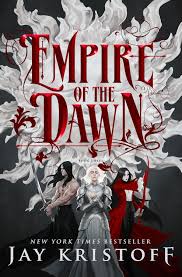
Review of Empire of the Dawn by Jay Kristoff

For me a five-star book is something that either I want to read again or something that is so profound it makes an immediate impact. There are lots of ways that books can be compelling: a unique idea, an interesting set of characters, a complex plot, an artistic use of the English language and more. Reading is also a subjective experience, so what appeals to me as a reader may be very different for you. I read a lot for both pleasure and work, but these short reviews are a way for me to show my appreciation for the work and the craft of the author of the reviewed work.

Jay Kristoff quickly became one of my favorite authors with both the Nevernight trilogy and this worthy conclusion to the Empire of the Vampire trilogy. This narrative journey through Empire of the Vampire, Empire of the Damned and now Empire of the Dawn has been phenomenal. Gabriel de Leon, the last Silversaint (vampire hunter), Celene Castia, Gabriel’s sister and the last Liathe, and Dior le Chance, the young woman who is believed to have the power to end the eternal darkness of their world form the central characters in this final volume. The story is dark, the narration of the conflict scenes so rich I could imagine them as a manga or anime (I think that is the only way you could faithfully replicate the speed and damage of these vampire vs Silversaint fights). The world cloaked in darkness, the place of religion and mysticism, the rich imagery in a perilous world, there is so much to love in this long but engaging story of a world where vampires are no longer consigned to the night and humanity hangs on the precipice. But beyond the incredible plot, worldbuilding, and hard driving action are the characters and their interactions with one another. There were so many times the dialogue between the characters echoed the pattern of conversations I had with people in the army, the way men rib each other to show they care, the language, and verbal duels that went along with the physical trials. There were countless times I would look up from the page and say, “Damn. Jay Kristoff can write.”

Each of the volumes of this trilogy were the best read of the year they were released and there is some regret in coming to the end of this massive journey. Jay Kristoff will not be for every reader: his language is the language of fighting men which includes frequent swearing (and he has some really interesting ways of utilizing the coarser parts of the English language) and there are several very spicy erotic scenes throughout the books. It is a dark world (literally and metaphorically) where no human character or animal character is safe. It is fantasy with horror and romantic elements set in a beautifully imagined (and illustrated if you buy a physical copy) world. It is a poignantly human story of characters who walk through the hell of war, betrayal, death, and times that seem hopeless. People will be divided on the ending of the book, but I thought it was masterful use of a plot device that breaks the fourth wall with a pair of narrators who have their own motivations for why they tell the story they are spinning. I did not want to put this almost eight-hundred-page book down, each time I picked it up it hooked me. I loved this dark gothic story of faith and fighting in a world struggling against four vampiric armies. The symbology and the myth, the conversations and the combat, the characters and the plot all come together to form the favorite trilogy I have ever read.

Reflections on The End of Men and the Rise of Women by Hannah Rosin

This is a part of a selection of readings I gathered to reflect on what a healthy approach to masculine identity would look like. I navigated my own journey into a version of manhood in my late teens and early twenties successfully, but now in middle age I see a lot of young men struggling to navigate this journey and for a variety of reasons failing to launch into life. I come to this with humility and curiosity seeking those who may be able to articulate more clearly the journeys that may lead young men to discover a fulfilling life of work and relationships and to help those moving into the space of elders to support and guide them in this journey.

There are some startling quotes in this book, but the one that stopped me in my tracks as we look at the future was this:

This script has played out once before in American culture. Starting in the 1970s, black men began leaving factory jobs; by 1987 only 20 percent of black men worked in manufacturing. The men who lived in the inner cities had a hard time making the switch to service jobs or getting the education needed to move into other sectors. (88)

There has been a lot of attention paid to the incarceration, unemployment, and the lack of young black men in raising children and the factors behind these men not being successful in society but when you expand the script to the plight of black men being predictive of the future of men as a whole that is bleak. I do believe that especially for men so much of their identity is tied to work and the loss of job opportunities for men without a college degree is a major factor in the failure of men in both the economy and life. Hannah Rosin’s book in 2012 was one the first one that I am aware of to notice the drastic changes occurring in the education and work space of America and she covers a wide range of impacts from the changes. From the changing dynamic of ‘hook-up culture’ in colleges, to the way the upper class still holds onto marriage as an economic advantage, the economic mobility of women and the economic stagnation of men, the drastic change in the makeup of college campuses, the increase in female violence, and the way women are breaking into the top of the job market.

I valued the combination of personal stories gained from interviews placed in the context of the seismic shift in the job and education market. As Hannah Rosin notes about the 2008-2009 Recession:

In the Great Recession, three-quarters of the 7.5 million jobs lost were lost by men. The worst-hit industries were overwhelmingly male, and deeply identified with macho: construction, manufacturing, high finance. (4)

I appreciated her candor in talking about the ‘hook-up culture’ on college campuses where women are also using it to avoid relationships which could derail their progression through college and into the workforce. Women are more educated and doing better economically in their late twenties than their male counterparts. Although college educated men and women were more likely to remain married and to ‘see-saw’ in their primary breadwinning roles, among men with only a high-school diploma the change was drastic. “In 1967, 97 percent of American men with only a high school diploma were working; in 2010, just 76 percent were.” (86) It has been common to note that this generation is not doing as well as the previous generation, but particularly for men:

In 2009, men brought home $48,000 on average, roughly the same as they did in 1969 after adjusting for inflation. In fact, as a recent report written by former White House economist Michael Greenstone discovered, the truth is even more dismal. Calling it stagnation fails to take into account the fact that fewer men are working full-time now or making any salary at all, and many more are incarcerated. If you add in those factors, the median income for men ages twenty-five to sixty-four has not only stagnated, but fallen sharply by almost $13,000 since 1969—a reduction of 28 percent. (125)

There is beginning to be an awareness of the change in the makeup of college classes, now dominated by women, but Hannah Rosin was one of the early voices who noted the vastly larger number of female applicants to college and the beginning of colleges attempting to balance the classes by giving preferential treatment to attract enough men.

What Hannah Rosin does a good job of doing is narrating the change that has occurred in society and how women have adapted while many men have failed to adapt. This is a story that need to be told, but it is also an uncomfortable story that undercuts one of the narratives I hear frequently where men are still assumed to be the ones with political and economic power. I have heard voices that refuse to believe that men are struggling, particularly from women who blazed the trail for the current generation. As Rosin states,

The closer women get to real power, the more they cling to the idea that they are powerless. To rejoice about feminist victories these days counts as betrayal. (272)

Women have made a lot of progress in my lifetime and that should be celebrated and there are still places where progress continues to be needed. Yet, we can want our young women to be successful and reach out to young men who are struggling to find a foothold in the rapidly changing geography of the job and education marketplace.

Review of D-Day: June 6, 1944 by Stephen Ambrose

Review of D-Day:June 6, 1944: The Climactic Battle of World War II by Stephen Ambrose (1994)

For me a five-star book is something that either I want to read again or something that is so profound it makes an immediate impact. There are lots of ways that books can be compelling: a unique idea, an interesting set of characters, a complex plot, an artistic use of the English language and more. Reading is also a subjective experience, so what appeals to me as a reader may be very different for you. I read a lot for both pleasure and work, but these short reviews are a way for me to show my appreciation for the work and the craft of the author of the reviewed work.

Stephen Ambrose’s phenomenal telling of D-Day accomplishes the daunting task of bringing together the first-person experiences of both allied and axis soldiers, placing the experiences together with the units and locations within the overall plan and execution of the D-Day invasion of Normandy. This is like a mosaic where the author takes a variety of perspectives on the invasion and places them together into a coherent picture which still conveys the chaos the soldiers often felt on the beaches. The first third of the book examines the preparations for the invasion. Stephen Ambrose is able to narrate the personalities and styles of both Eisenhower and Rommel who were the respective commanders on D-Day as well as the command structures they operated within. The D-Day invasion was involved a mammoth effort of logistics and construction to mount and the author walks the reader through the construction of the landing craft, the planning of the invasion and the disinformation campaigns designed to keep German forces away from the landing site, and the training of the soldiers, sailors, and coast guardsmen who would conduct the landing and axis construction and forces designated to repel the invasion. The preparation was critical, and it both made the invasion possible and saved lives, but the book demonstrates all the ways that the plans for the invasion could not account for the reality the soldiers on the beach or who were dropped behind the beach encountered. Moving from west to east he narrates the individual experiences of the battle beginning with the experiences of the 82nd and 101st Airborne Divisions in their night drop and ending with the British 6th Airborne Division on the eastern edge of the battlefield. Particularly with the airborne landings and the 16th and 116th Regiments landing on Omaha beach, the author does an excellent job of portraying the chaotic environment that soldiers found themselves in. The battle in these spaces often relied on junior officers and non-commissioned officers rallying any soldiers they could gather and the training these soldiers received. The book does a good job of combining the epic scale of the invasion with the narrow experiences of the individuals who were a part of this. It was readable and comprehensive at the same time, and I greatly appreciate the dedication and devotion that went into this massive narration of one of the critical days of World War II.

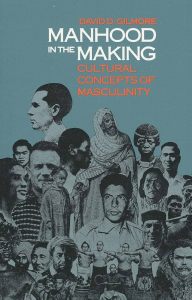
Reflections on Manhood in the Making: Cultural Concepts of Masculinity by David D. Gilmore. (1990)

This is a part of a selection of readings I gathered to reflect on what a healthy approach to masculine identity would look like. I navigated my own journey into a version of manhood in my late teens and early twenties successfully, but now in middle age I see a lot of young men struggling to navigate this journey and for a variety of reasons failing to launch into life. I come to this with humility and curiosity seeking those who may be able to articulate more clearly the journeys that may lead young men to discover a fulfilling life of work and relationships and to help those moving into the space of elders to support and guide them in this journey.

David Gilmore is an anthropologist who taught at the State University of New York whose book Manhood in the Making examines manhood as it is expressed through a number of representative cultures which have been studied by anthropologists. The groups included in the collection of studies are primarily from tribal and traditional societies which are geographically separate from larger cultural influences. With a couple of exceptions, there are expectations of a passage into manhood in these cultures and the possibility of a male child failing to navigate the expectations of manhood and being “unmanly” and unreliable in their society.  As Gilmore states,

there is a constantly recurring notion that real manhood is different from simple anatomical maleness, that it is not a natural condition that comes about spontaneously through biological maturation but rather it is a precarious or artificial state that boys must win against powerful odds. This recurrent notion that manhood is a problematic, a critical threshold that boys must pass through testing, is found at all levels of sociocultural development regardless of what other alternative roles are recognized. (11)

Or more simply, boys through culturally appropriate preparation and testing must be made into men. Simply being physically mature is not enough for the mantle of manhood. Men are made, not born. And although “being a good man” may have less focus than “being good at being a man” (30) there is in most cultures an expectation that “being good at being a man” involves providing for both kin and the larger society. “If a man rejects this provider’s role, he is said to be useless and to be dependent like a woman or like a child (Caughey 1970:69).” (73)

There are two exceptions listed in this study where the men are passive, the Tahiti and Semai. These societies with men who are conditioned to be more passive and peaceful are highlighted by some readers as an ideal for a modern society, but I don’t think these men would function well in modern society. As David Gilmore surmises as he wraps up the study, “When men are conditioned to fight, manhood is important; where men are conditioned to flight, the opposite is true.” (221) He concludes with two long statements which I will quote in their entirety because I find them very helpful:

When I started researching this book, I was prepared to rediscover the old saw that masculinity is self-serving, egotistical, and uncaring. But I did not find this. One of my findings here is that manhood ideologies always include a criterion of selfless generosity, even to the point of sacrifice. Again and again we find that “real” men are those who give more than they take; they serve others. Real men are generous, even to a fault, like the Mehinaku fisherman, the Samburu cattle-herder, or the Sambia or Dodoth Big Man. Non-men are often those stigmatized as stingy and unproductive. (229)

Men adopting the provider role provide more for their society than they take, and they will often do without so that others may have enough. One final quote from Manhood in the Making on the sacrifices men are expected to make for kin and society:

Men nurture their society by shedding their blood, their sweat, and their semen, by bringing home food for both child and mother, by producing children, and by dying if necessary in faraway places to provide safe haven for their people. This too, is nurturing in the sense of endowing or increasing. However, the necessary personal qualities for this male contribution are paradoxically the exact opposite of what we Westerners normally consider the nurturing personality. To support his family, the man has to be distant, away hunting or fighting wars; to be tender, he must be tough enough to fend off enemies. To be generous, he must be selfish enough to amass goods, often by defeating other men; to be gentle, he must first be strong, even ruthless in confronting enemies; to love he must be aggressive enough to court, seduce, and “win” a wife. (230)

I found Gilmore’s work to be helpful. At times he and his fellow anthropologists were a little overdependent on a Freudian framework, but the highlighting of the processes in these cultures to transform boys into men, something missing in any formal way in our society, and the expectation of a competent but generous masculinity in culture was helpful.

Gilmore, D. D. (1990). Masculinity in the Making: Cultural and Concepts of Masculinity. New Haven: Yale University Press.

Review of the Girl in the Tower by Katherine Arden (2018)

Five Star Book Review

Katherine Arden, The Girl in the Tower

For me a five-star book is something that either I want to read again or something that is so profound it makes an immediate impact. There are lots of ways that books can be compelling: a unique idea, an interesting set of characters, a complex plot, an artistic use of the English language and more. Reading is also a subjective experience, so what appeals to me as a reader may be very different for you. I read a lot for both pleasure and work, but these short reviews are a way for me to show my appreciation for the work and the craft of the author of the reviewed work.

The Girl in the Tower is the middle book of the Winternight Trilogy, and it picks up in the aftermath of The Bear and the Nightingale. Vasya and her magnificent horse Solovey now set off to travel away from her home of Lesnaya Zemla where her father can no longer protect her from being viewed as a witch. She sets off on a journey as a traveler but quickly finds herself rescuing girls stolen by bandits and reunited with her brother Sasha who is a monk, a renowned warrior, and a trusted advisor of the crown prince of Moscow. She disguises herself as a boy and her brother, and later her sister Olya in Moscow, are caught up in this deception. From pursuing bandits raiding small villages in the woods to the world of court in Moscow and the appearance of the strange noble Kasyan this is a story with an even richer world than The Bear and the Nightingale. One of the things I appreciate about this story is that it is honest about the danger of Vasya as a woman attempting to navigate a different path where the only two options available for women are marriage and the convent.  

Katherine Arden does a remarkable job of portraying the world of this story. A time where Russia still owed allegiance to the Tatars but is beginning to yearn for independence, when the Russian Orthodox church reigns supreme in Moscow but the old practices and myths still have a hold in the rural areas. It is a winter story, but it is also a story of winter losing its hold to spring. For Vasya it is also a coming-of-age story and I appreciate the tension in the relationship between Vasya and the Winter King Morosko, but that there is an acknowledgement that this cannot be a simple love story. In the words of the characters:

                “Love?” he (Mososko) retorted. “How? I am a demon and a nightmare; I die every spring, and I will live forever.”

                She waited.

                “But yes,” he said wearily. “As I could, I loved you. Now will you go? Live.”

                “I, too,” she said. “In a childish way, as girls love heroes that come in the night, I loved you.” (336)

Even in a world that still has a little magic in it, maidens do not easily surrender their hearts to myths nor do inhuman ‘gods’ warm quickly to the maiden. Yet, Katherine Arden does a remarkable job of creating the tension which is formed by their bond. I really enjoy this mixture of fantasy with historical fiction and myths and folk stories of medieval Russia. I wrote in my review of The Bear and the Nightingale that the story felt like returning to a home I never knew, and the characters and environment made me feel at home with them once again in this second book of the Winternight trilogy. I look forward to returning to The Winter of the Witch later this year.  

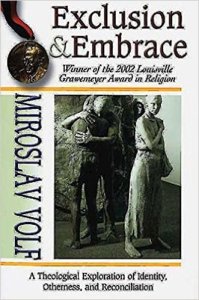
Review of Exclusion and Embrace: A Theological Exploration of Identity, Otherness, and Reconciliation by Miroslav Volf

Review of Exclusion and Embrace: A Theological Exploration of Identity, Otherness, and Reconciliation (1996) by Miroslav Volf.

This is the volume that introduced me to the work of Miroslav Volf and from the first page of the preface, where he lays out what is at stake in this theological exploration, through the final chapter on Violence and Peace it is a passionate and articulate formulation of a theology of the cross for our time. Volf is both honest about the challenges of reconciliation while holding before the reader the dream and hope of embrace as the end for which we are called to work. He powerfully weaves together theology, scripture, philosophy, and personal experience into a work that I have gone back to multiple times in my own ministry. Re-reading this work over twenty years after my initial reading Exclusion and Embrace is still a powerful work, but it also highlights my own evolution as a reader and scholar in the years between readings.

I first saw Exclusion and Embrace at the bookstore at Wartburg Seminary, and I felt drawn to it. I integrated it into an independent study attempting to flesh out Luther’s theology of the cross for our time in my senior year of seminary. At that point I was a young scholar reading everything I could get my hands on, and Volf’s work combined a deeply personal search for a Christian practice that was authentic with an academic rigor that was inspiring. This was the type of scholar I hoped to be. I was still attempting to integrate the diverse voices I had encountered in the previous two years of seminary into something that I could carry beyond the seminary walls. I was still wrestling with postmodernism as a way of thinking, knowing enough to be attracted and repelled by this alien way of encountering the world I was introduced to tangentially (although rarely under the name postmodernism) in academics. In Volf I found someone who was far more versed in authors like Nietzsche, Foucault, Deleuze, Said, and many other authors from a variety of perspectives who still took the scriptures, theology, and Christian practice seriously.

One of the major differences between my original and this reading is I have engaged enough with postmodern, feminist, and other voices to have developed my own perspective. I understand the influence of postmodern voices and perspectives, but in my own journey I have walked away from these perspectives because at their root I find them nihilistic. They serve as good critiques which fail to provide a viable alternative to the modernity they critique. Exclusion and Embrace is still an incredibly valuable work, but I found the central chapters speaking to dialogue partners who have little interest in a constructive dialogue with Christianity. I still believe the first two chapters and final chapter are incredibly important and make this a book that deserves wide reading. These are the places I have found myself referencing over the past twenty years and have caused me to read most of what Volf has written before and after Exclusion and Embrace.

One of the things I am most thankful for in Volf’s work is the way he bridges the divide between the academic world and the world which the academy often neglects. Like the three cities which form the concrete background of the reflection of the initial chapter (Los Angeles where Volf taught at the time, Berlin where he was giving the presentation that formed the chapter, and Sarajevo the war torn city from the land of Volf’s background as a Croatian) this is deals with the broken stories in need of forgiveness. Volf’s critique of the “pleasant captivities of the liberal mind” when he critiques the ‘God of perfect non-coercive love’ (Volf, 1996, p. 304) has stuck with me for the life of my ministry and resonates with my engagement with scriptures. This is a work that helped form my theology and gave me tools that would help me continue to grow as a pastor who engaged the scriptures and the questions of the surrounding world.     

Review of To the Lighthouse (1929) by Virginia Woolf

Time Magazine Top 100 Novels

Book 92: To the Lighthouse by Virginia Woolf (1929)

This is a series of reflections reading through Time Magazine’s top 100 novels as selected by Lev Grossman and Richard Lacayo published since 1923 (when Time magazine was founded). For me this is an attempt to broaden my exposure to authors I may not encounter otherwise, especially as a person who was not a liberal arts major in college. Time’s list is alphabetical, so I decided to read through in a random order, and I plan to write a short reflection on each novel.

To the Lighthouse is like a well painted still life, to utilize an image from the book. More accurately it is two moments in life, each carefully cataloged and described. Virginia Woolf has an artistic flair in her use of the English language as her palette to describe the Ramsay household and the extended number of close guests that occupy the action around the house. This is stream of consciousness writing informed by the sensibilities of a highly educated English family. There is a Freudian Oedipus Complex that emerges between father and son in the story, particularly visible in the second act, and there are times where the language and attitudes of the characters become pretentious to a point that it is distracting. It is a world where communication, especially between men and women, seems nearly impossible and much of the drama of the book is the characters waiting for someone of the opposite sex to intuit what the speaker in that moment of the book needs and relieve the anxiety of the moment.  To utilize another image from the book it looks at the image of a perfectly balanced tray of fruit whose appearance is ruined by someone taking one of the pieces away from the platter. The two visions in the story are separated by the death of several key characters during the ten years that separate the interactions. This dramatically change the balance for each character.

Every book is not for every reader, and when a story fails for me, I often wonder what it is that makes me not the best reader of the book, particularly a book other intelligent readers have enjoyed. I appreciate Virginia Woolf’s utilization of the English language and the flow of her words on the page. Stream of consciousness writing has always been a struggle for me. To utilize the image above of a well painted still life, I can admire the artistry the artist puts into the individual brushstrokes but I only want to look at it for so long. Reading is a subjective experience and both the subject matter and the lack of movement of any type of plot made this a less enjoyable read for me. There have been several novels on the Time Magazine Top 100 novels that are set within a highly educated or very well off-English household in the early 20th Century and this time-period seems a sterile environment for both relationships and life with so much effort being placed into maintaining appearances. I can appreciate the artistry of the book and why so many people consider it one of the great English language novels but maybe I am just not a patient enough reader for the stream of consciousness novels that were popular among the elite of the early 20th Century.

Review of Project Hail Mary by Andy Wier

Five Star Book Review: Project Hail Mary by Andy Wier

For me a five-star book is something that either I want to read again or something that is so profound it makes an immediate impact. There are lots of ways that books can be compelling: a unique idea, an interesting set of characters, a complex plot, an artistic use of the English language and more. Reading is also a subjective experience, so what appeals to me as a reader may be very different for you. I read a lot for both pleasure and work, but these short reviews are a way for me to show my appreciation for the work and the craft of the author of the reviewed work.

Project Hail Mary was a delightful journey with Dr. Ryland Grace on a last chance mission to save humanity from a failing sun caused by a previously unknown species. The story cleverly combines Dr. Grace’s experiences in the Tau Seti system as the sole survivor of the ship named Hail Mary and flashbacks to his role in the discovery of the problem, the conception of a solution and his surprising inclusion on the interstellar mission. This is a novel that is science fiction, heavy on science, but in a delightfully geeky way that allows a non-scientist to enjoy with the scientific main character. Both the portions that take place on earth as well as the portions that occur in space tell a very human story of fear, loneliness, the joy of discovery, and hope. Without providing spoilers, the book is full of unexpected discoveries and friendships, and Ryland Grace is a character who is easy to enjoy as you experience the discoveries, both scientific and personal, through his eyes.

Andy Wier does a great job of creating a book that is a joy to read. He strikes a great balance between science and storytelling. His curiosity expresses itself through his characters and he does a miraculous job of making the scientific experimentation that the story depends upon both accessible and interesting. I listened to the audio version of Project Hail Mary and there are some added benefits to this version of the book which I can’t adequately express without providing some spoilers. One of my sisters gave me this book as a gift after she had enjoyed it, and I thoroughly enjoyed it as well. Great characters caught in an epic journey who are unapologetic in their curiosity about their world. A very human story of space, discovery, curiosity, and hope.

A Review of Call it Sleep by Henry Roth (1934)

Time Magazine Top 100 Novels

Book 18: Call it Sleep by Henry Roth

This is a series of reflections reading through Time Magazine’s top 100 novels as selected by Lev Grossman and Richard Lacayo published since 1923 (when Time magazine was founded). For me this is an attempt to broaden my exposure to authors I may not encounter otherwise, especially as a person who was not a liberal arts major in college. Time’s list is alphabetical, so I decided to read through in a random order, and I plan to write a short reflection on each novel.

Call it Sleep follows a young Jewish boy, David Schearl who immigrates to the United States with his mother Genya. Upon arriving he is introduced to his emotionally unstable and unloving father Albert Schearl. Young David struggles to engage with other children and adults and Henry Roth does a good job of writing a story from the perspective of an early elementary age boy. David is an innocent in a rough world, and he fears both the world outside and of his violent father. The place of an innocent in a fallen and rough world seems to animate the narration as David continually finds himself in situations he is unprepared for. From a neighbor girl who wants to play ‘bad’ to an older Gentile boy who takes advantage of David’s desire for attention to put himself in a position to take advantage of one of David’s cousins. Central to the story is a secret his mother tells her sister, which David overhears, about being in love with a Christian organ player to the disgrace of her family. The one place where David fits in is in chedar, a one room Hebrew school for young boys. David has a talent for Hebrew recitation and it also curious about the little bit of insight into God he receives from Reb Pankower, but this is also where David allows his interpretation of his mother’s secret to slip out to disastrous effects. When a rabbi who hears David’s confession brings it to his mother and father it creates an explosive crisis in the home.

Every book is not for every reader, and when a story fails for me, I often wonder what it is that makes me not the best reader of the book, particularly a book other intelligent readers have enjoyed. Part of my struggle was the language of dialogue between the young people in the narrative in broken English which made it more difficult to follow. The lines spoken in Yiddish are translated into easily read English, but Henry Roth attempts to copy the slang and accent of English spoken in the Jewish ghettos of the early 1900s. I can also appreciate Henry Roth’s ability to convey the mental state of a young boy, but young David is an unreliable interpreter of the world around him. I can understand why young David is fearful, and I appreciate the way his perspective sheds light on the immigrant experience, but it also made for a dull read. Call it Sleep was ultimately a book I could appreciate but not one I enjoyed.

Review of Planting Seeds of the Divine by Yiscah Smith

Planting Seeds of the Divine: Torah Commentaries to Cultivate Your Spiritual Practice, by Yiscah Smith. Jewish Publications Society, 2025.

One of the practices that has enriched my faith has been learning from other faith traditions about their encounter with the divine. As a Christian reader, preacher, and interpreter of scripture I have frequently sought out Jewish perspectives on the scriptures that we share and to glean some of the riches of the Jewish interpretive tradition. I was given an advance copy of Planting Seeds of the Divine: Torah Commentaries to Cultivate Your Spiritual Practice written by Yiscah Smith to review and I appreciate the opportunity to share this spiritual practice with another seeker longing to encounter God through an encounter with scripture. As people of faith, we yearn to connect the entirety of our self with the God who we come to know through both the scriptures and our experiences.

Reading through the introduction of Planting Seeds of the Divine I was struck by some common resonances in the history of my own tradition. The description of the “internal experience of a personal and unique encounter with the Divine is a Jew’s spiritual umbilical cord with one’s Creator” made me remember my characterization of the Romantic Reformed Theologian Fredrich Schleiermacher’s absolute dependence on the divine. The idea of ingesting, chewing, swallowing and digesting the scriptures to sustain our spiritual life is a metaphor that was familiar to my own formation as a careful and attentive reader of scripture. Finally, the desire of the book and its process is to help the reader integrate Torah into the daily life of the individual and the community reminded me of Dietrich Bonhoeffer’s process of forming ministers for the Confessing Church in 1930’s Germany in resistance to the Third Reich. For Christians the central text for formation was the gospels but we have often been impoverished by our inattention to the Hebrew Scriptures which were the scriptures for the writers of the New Testament.

I value Yiscah Smith’s methodology of working through these individual reflections on Torah. In the introduction she introduces the practice of breath awareness, reflection, quieting the mind, and then visualization to go with each reading. It is a helpful process of slowing down and reflecting upon the experiential reading of the text and being open to the experience of the presence of the divine in the moment of reflection. To work with the image in the title of the work, it plants the seeds of openness to the moment of connection or insight.

Some of the reflections were very insightful. I particularly enjoyed her reflection on Sarah’s protest in Genesis 23: 1-2 and the gift of spiritual protest, something that resonates with my experience in psalms and the prophets. Other reflections I could value the way the rabbis referenced in the commentary utilized gematria (assigning numerical values to Hebrew letters) or highly spiritualized readings, but I found them more difficult to place alongside my own readings of the text. Yet, I resonate with the intent of Planting Seeds and really enjoyed Yiscah Smith’s methodology of approaching scripture in an open and patient manner to cultivate the relationship between the individual and the divine.