Category Archives: Psalms

Psalm 5- The God Who Hears and Protects

Gustave Dore, David Mourning Absalom (1866)

Gustave Dore, David Mourning Absalom (1866)

Psalm 5

<To the leader: for the flutes. A Psalm of David.>
 Give ear to my words, O LORD;give heed to my sighing.
 2 Listen to the sound of my cry, my King and my God, for to you I pray.
 3 O LORD, in the morning you hear my voice; in the morning I plead my case to you, and watch.
 4 For you are not a God who delights in wickedness; evil will not sojourn with you.
 5 The boastful will not stand before your eyes; you hate all evildoers.
 6 You destroy those who speak lies;the LORD abhors the bloodthirsty and deceitful.
 7 But I, through the abundance of your steadfast love, will enter your house,
 I will bow down toward your holy temple in awe of you.
 8 Lead me, O LORD, in your righteousness because of my enemies;
 make your way straight before me.
 9 For there is no truth in their mouths; their hearts are destruction;
their throats are open graves; they flatter with their tongues.
 10 Make them bear their guilt, O God;let them fall by their own counsels;
because of their many transgressions cast them out, for they have rebelled against you.
 11 But let all who take refuge in you rejoice;let them ever sing for joy.
Spread your protection over them,so that those who love your name may exult in you.
 12 For you bless the righteous, O LORD;you cover them with favor as with a shield.


The God of the Psalmist, and the God presented throughout the bible, is a God who takes sides and values certain things and does not like others. This is not the impassive, unmoved mover of the philosophy of the 1700s-1900s who set the world in motion and then allowed it to move through time like a machine. The passionate cries of the Psalmist assume a God who not only hears but actively responds to the complaints and needs of the poet. Again and again God is named, implored to hear, listen, heed and ultimately to act. One of the courageous acts of the Psalmist and those who pray the Psalms is calling on God to be the God they expect God to be. They remind God of the contrast between the situation they perceive and the things they understand God to value.

In Psalm 5 the contrast is stated in terms of wickedness, lies, bloodshed, deceit and evil. The Psalmist is one who seeks righteousness, and as in Psalm 1 trusts, “for the LORD watches over the way of the righteous, but the way of the wicked will perish” (Psalm 1.6) and so the poet reminds the LORD again that “you are not a God who delights in wickedness.” Yet the complaint of the Psalmist arises out of the situation where the wicked, the evil, the boastful, liars, bloodthirsty and deceitful are the ones who the Psalmist perceives as their troublemakers. The Psalmist calls on God to act and to do something about this. Perhaps there are those by flattery who are obtaining power or who are accusing the writer of the psalm and the Psalmist asks for the guilt to fall upon them. As in Psalms three and four the Psalmist calls out for protection and for the LORD’s deliverance from the situation that the Psalmist finds themselves caught up within.

There is also the reality that the Psalmist, while attempting to be faithful, relies upon God’s steadfast love. The word translated steadfast love is hesed which also can be translated as grace. This is one of the many places in the Psalms where Martin Luther and others could find evidence of the gracious God who met the hearer in the midst of their own unworthiness. As in the reformation where the response to God’s grace was to love, serve, worship, and obey the LORD, so in the Psalm the steadfast love of the LORD is cause for awe and worship. The LORD is the Psalmist’s refuge and the refuge of all who seek the LORD. In language that would be familiar to many the LORD is refuge and shield, protection in the midst of their trouble and a safe place where the faithful may sing for joy and rejoice.
Psalm 4: Finding A Space in the Blessing

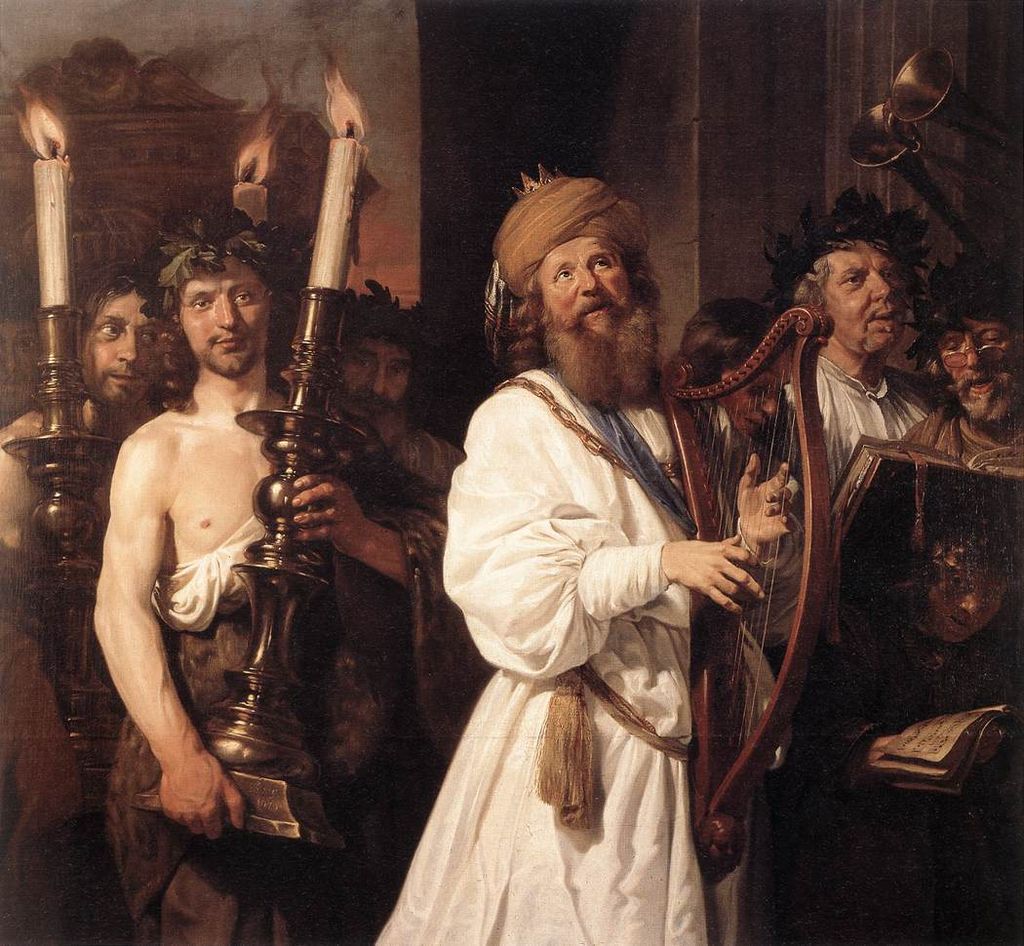
Jan de Bray, David Playing the Harp (1670)

Jan de Bray, David Playing the Harp (1670)

 Psalm 4

<To the leader: with stringed instruments. A Psalm of David.>
Answer me when I call, O God of my right!
You gave me room when I was in distress.
Be gracious to me, and hear my prayer.
2 How long, you people, shall my honor suffer shame?
How long will you love vain words, and seek after lies? Selah
3 But know that the LORD has set apart the faithful for himself;
the LORD hears when I call to him.
4 When you are disturbed, do not sin;
ponder it on your beds, and be silent. Selah
5 Offer right sacrifices, and put your trust in the LORD.
6 There are many who say, “O that we might see some good!
Let the light of your face shine on us, O LORD!”
7 You have put gladness in my heart more than when their grain and wine abound.
8 I will both lie down and sleep in peace;
for you alone, O LORD, make me lie down in safety.

One of the gifts of the Psalter is the range and depth of emotions that it shows as the various Psalmists struggle and rejoice and lament and celebrate their lives with the LORD. Faith is rarely, if ever, a linear progression of growth or a static unmoving reality but a relationship that endures times where one party has moved away or is no longer hearing and times of incredible closeness and intimacy. Psalm 4 is to me a good example of this movement within the life of faith as the Psalmist moves from complaint to reassurance, from question into faith and from need into safety. It begins with a cry, “Answer me when I call” and directs that call to the God who is the source of the Psalmist’s righteousness and identity. The Psalmist reflects back upon the way God has been present: listening, making a space for the petitioner, responding in grace instead of judgment. There is a dissonance between the Psalmist and the people, somehow the Psalmist has fallen out of favor, their name has been dishonored and they are following the words they want to hear rather than the truth. Perhaps the positioning of this psalm encourages us to hear it in the same circumstances as the previous Psalm, while David is fleeing after the rebellion of his son Absalom has taken over Jerusalem. Yet the Psalmist find comfort in their identity.

It is in this identity, the Psalmist considers himself one of the righteous, one who has been set apart, one whom the LORD listens to. In a time when the Psalmist words go unheard by the people, they are heard by the LORD. In a time where the identity of the Psalmist in the eyes of the people is that of the unrighteous in God’s eyes they remain the righteous one. Much as Job can appeal to God’s judgment as he endures the questioning of his friends, or Paul can state in the letter to the Romans 8.31 “If God is for us, who is against us?” the Psalmist can hold tight to the identity they have in the LORD. So the Psalmist returns to the practices of how they will live, not sinning, offering right sacrifices, pondering on one’s bed but not losing sleep over it. And the Psalmist rapidly moves in this brief prayer from complaint into resting in peace and safety, from the moment of anxiety to the gladness and reassurance of the LORD’s blessing. In an echo of the Aaronic blessing from the book of Numbers:

 The LORD bless you and keep you;
the LORD make his face shine upon you and be gracious to you;
the LORD lift up his countenance upon you, and give you peace Numbers 6: 24-26

The Psalmist can say “let the light of your face shine upon us and finds strength and trust in their identity as they continue in their journey as one of God’s set apart ones.

Psalm 3- Hope in the Heart of Brokeness

Gapare Traversi Die Erordung Amnons beim Gastmahl Absaloms (1752)

Gapare Traversi Die Erordung Amnons beim Gastmahl Absaloms (1752)

 Psalm 3

<A Psalm of David, when he fled from his son Absalom.>
 O LORD, how many are my foes! Many are rising against me;
 2 many are saying to me, “There is no help for you in God.” Selah
 3 But you, O LORD, are a shield around me, my glory, and the one who lifts up my head.
 4 I cry aloud to the LORD, and he answers me from his holy hill. Selah
 5 I lie down and sleep; I wake again, for the LORD sustains me.
 6 I am not afraid of ten thousands of people who have set themselves against me all around.
 7 Rise up, O LORD! Deliver me, O my God! For you strike all my enemies on the cheek;
 you break the teeth of the wicked.
 8 Deliverance belongs to the LORD; may your blessing be on your people! Selah

Psalm 1 begins with happy/blessed are those and Psalm 2 ends with happy/blessed are all who take refuge in the the Lord, and then we begin a series of laments in Psalm three and four as well as six and seven. There is something more to this than some simple sort of life and a blessed life (my preferred translation of the word in Psalm one and two) is not an easy life. In my experience some of the people who have the strongest faith are those who have been through the most difficult and harrowing struggles. To be a person ‘after God’s own heart’ does not grant one an untroubled life and there is a need for an expression of desperation, a faithful cry for help in the midst of the struggle.

The superscription of the Psalm takes us back to one of the dark moments in the story of King David and in the narrative this is a part of a series of dark times for the king which so many have placed their trust in. After 2 Samuel narrates the story of David and Bathsheba, where David has sex with Bathsheba and conspires to have her husband Uriah the Hittite killed and the immediate after effects of this with God sending the prophet Nathan to David, the child dying and then a new hope with the birth of Solomon (2 Samuel 11 and 12) we reach a story of a deeply broken royal family. Absalom and his sister Tamar of children of one of David’s wives while Ammon is his son by another wife. Ammon conspires to bring Tamar into his room and then rapes her and King David does nothing to Ammon, his oldest son. Furious with his brother and the king’s inaction Absalom takes vengeance himself and during a banquet murders Ammon, his brother. Absalom flees, but is later welcomed home and forgiven. Once Absalom is home he begins to create his own power base and several years later leads a coup which forces David from Jerusalem and leads to Absalom’s eventual death. (2 Samuel 13-18). In the heart of the brokenness where families have failed, where forgiveness has been turned away, where power has been seized and life is at risk, the superscription places the words within that story.

In a world where we think God helps those who help themselves, the Psalm points to a different reality. God helps those who cannot help themselves. (Elizabeth Actemeir, et. al., 1994, p. IV: 692f). In the narrative world of the story of David evoked in the superscription and in the opening verses the surrounding people believe there is ‘no help for you in God.’ But for the Psalmist, the Lord is shield, refuge and strength. Even in the times where it seems like hope is lost the persistent faith of the Psalmist calls out to God and trusts that there will be an answer. The petitions of the Psalmist are great and their foes are many and yet the confidence that the petitioner holds to comes from the God who has sustained them. There is the trust that even in the crisis that the Psalmist can entrust deliverance into the Lord’s hands and the even as their name may be uttered as a curse, the deeper reality is that they are a part of the people the Lord has set apart as a blessing.

Psalm 2 – The LORD’s Messiah

  Psalm 2

Why do the nations conspire, and the peoples plot in vain?
 2 The kings of the earth set themselves,
and the rulers take counsel together,
against the LORD and his anointed, saying,
 3 “Let us burst their bonds asunder, and cast their cords from us.”
 4 He who sits in the heavens laughs; the LORD has them in derision.
 5 Then he will speak to them in his wrath, and terrify them in his fury, saying,
 6 “I have set my king on Zion, my holy hill.”
 7 I will tell of the decree of the LORD: He said to me,
“You are my son; today I have begotten you.
 8 Ask of me, and I will make the nations your heritage,
and the ends of the earth your possession.
 9 You shall break them with a rod of iron,
and dash them in pieces like a potter’s vessel.”
 10 Now therefore, O kings, be wise; be warned, O rulers of the earth.
 11 Serve the LORD with fear, with trembling
 12 kiss his feet, or he will be angry, and you will perish in the way;
for his wrath is quickly kindled. Happy are all who take refuge in him.
  

Psalms 1 and 2 introduce the Psalter and while Psalm 1 highlights one of the major foci of the Jewish people, God’s law the Torah, Psalm 2 focuses on the Messiah, the Davidic King.  Perhaps this Psalm was at one point used in coronations or in some other ritual setting within the nation of Israel or later the kingdom of Judah, and it reflects back upon some mystical time when Israel was an empire that ruled over vassal kings. There is an idealization of the dominion and power of the Davidic kingship which reached its peak under Solomon and would from that point forward be a small kingdom caught among the rise and falls of empires in Egypt, Assyria and Babylon. Even with the focus on the Lord’s anointed (literally the Lord’s messiah) the focus, as through out the Psalter, is taking refuge in the Lord.

For Christians this is one of the Psalms that has often been read through the image of Jesus, particularly verse 7 “You are my son; today I have begotten you” and while Christians should not forget that this Psalm originally refers back to a Davidic king part of the living witness of scriptures allows people to hear the words echoed in a new way in a new era. Yet if one is going to listen to this Psalm in terms of Jesus one does have to wrestle with the militaristic language of verse 9 (You shall break them with a rod of iron, and dash them in pieces like a potter’s vessel) and yet this is not that much different from some of the triumphal language lifted up by Paul and others in the New Testament.

Bible paintings in the Castra center, Haifa-Samuel Annointing David and David and Goliath

Bible paintings in the Castra center, Haifa-Samuel Annointing David and David and Goliath


Psalm 1 and 2 taken together lift up the Torah and the Davidic King as two of the foci of the way of life outlined within the meditations contained within the Psalter and yet both Torah and King are to point back to the LORD. The linkage at the beginning of Psalm 1 (Happy are those who do not follow the advice of the wicked) and the end of Psalm 2 (Happy are those who take refuge in him) joins the king and the law together as ways in which God establishes God’s rule among God’s people. As in many of the other Psalms the LORD will laugh at the movements of the nations and empires and for a nation that frequently found itself under duress from other kings and rulers perhaps this Psalm was its own revelation of God’s rule in, with and under the movements of the kings and empires around them. Perhaps like King Arthur for the Anglo-Saxon time it reflects back to the time of the once and future king, the one who was a ‘man after God’s own heart.’ To a simpler or perhaps better time. Perhaps it is a part of the imagination and story that allows the people to maintain their identity in the midst of dispersion and exile, of disillusioned hopes of rebuilding the temple and their loss of power and status in the world. Perhaps this was one more way in which they were able to see the shade pulled back and trust that the LORD was the one who was in control rather than the other gods and lords and powers. And perhaps it is wise to remember that the Psalter is poetry which attempts to express truth that transcends the situation that the people may have found themselves in. Or perhaps a more cynical approach would look at this as a form of self-aggrandizement of the Davidic kings, granting themselves divine authority and  granting themselves a position of ‘sons of God’ in a way that the Caesars in Rome would later do in a different way.

I choose to read this in a non-cynical way. I am certainly influenced by the post-modern hermeneutic of suspicion but at a certain level I have had to learn to trust. To let the words wash over and to listen deeply for the wisdom in the poetry. The God of the Hebrew people, the same God the Christian people would come to know, was deeply involved in the world. Politics and power were not separate things but a part of the engaged and sacred reality of their God who engaged the world.  A God who can laugh at the movement of armies and empires and who is their refuge and strength as Psalm 46 and other places will remind them. Who when the kings of the earth seem to be taking counsel against the chosen people in Zion or in all times and places throughout the world, who still reigns and holds those who rebel against God’s rule in derision. The one who reads and approaches and meditates on the Psalter as a way of understanding how God approached them in the earth find the blessedness (happiness) by taking refuge in this hope, this poetry and this narrative.


Psalm 1 Poetry and the Law

The Reading of Torah in Synagogue

The Reading of Torah in Synagogue

Psalm 1

Happy are those who do not follow the advice of the wicked,
or take the path that sinners tread, or sit in the seat of scoffers;
2 but their delight is in the law of the LORD,
and on his law they meditate day and night.
 3 They are like trees planted by streams of water,
which yield their fruit in its season, and their leaves do not wither.
In all that they do, they prosper.
4 The wicked are not so, but are like chaff that the wind drives away.
5 Therefore the wicked will not stand in the judgment,
nor sinners in the congregation of the righteous;
 6 for the LORD watches over the way of the righteous,
but the way of the wicked will perish.
 

 Psalm one introduces what Dietrich Bonhoeffer called “the Prayerbook of the Bible” and Martin Luther once called the “little Bible”. Here in these one hundred and fifty little (and occasionally long) poems and songs we encounter the breadth of emotion and dedication put into poetic form. Many scholars believe that Psalm 1 was added as a forward to the entire collection of Psalms and gives a summary of what is to lie ahead and the structure of the Psalm itself encourages this thought. The Psalm begins with the first letter of the Hebrew Alphabet with the word translated ‘Happy’ (‘aŝrê) and ends with the last word beginning with the last letter forming an inclusio, a device frequently seen in wisdom literature and denotes a completion of a thought or idea.

So why write poetry about the law? Seems strange or foreign to us and why introduce the Psalms with a meditation on the law? For many people poetry and rules are antithetical, but to a Hebrew way of life the law is at the center for their view of a life in harmony with God’s will. The simple dichotomy between the righteous and the unrighteous, the wicked and the law delighters may seem odd. This was a Psalm I never really enjoyed until recently because it seemed to pretentious, to easy to place oneself in the position of the righteous and not in the place of the wicked, but as an introduction to the Psalter and as a way of looking at the law not as something to be dreaded but something to delight in has changed my mind. It is not a coincidence that the Psalter begins with a meditation of the delight of the law and that the longest Psalm (Psalm 119) is a meditation on the law. That in knowing how one is to live, what it means to be in harmony with God’s will for the people and the world is joy. For the Hebrew people the law of the LORD is life and to ignore the way of the LORD is to undercut one’s own life. In a world of easy expedients that may bring short term prosperity the people are called to a way of life that is in harmony with the creator’s desire for the world.

The word translated happy, probably is better translated ‘blessed’ (this Hebrew word would be translated into Greek Septuagint (the Greek Translation of the Hebrew Scriptures) as markarios which is the first word of each of the beatitudes in Matthew 5) and in entering into the poetry and the struggle of the Psalmists (since there are multiple composers of the Psalms) it is also an entry into the meditation on how one is to live in the continual meditation on the law of the LORD. Poetry and wisdom, life and the law, the way of the righteous and the blessed may not be simple and it may be something that continues to be a dialogue between the LORD and the LORD’s people, but entering into the meditation of the law of the LORD may not be an invitation to prosperity but it is an invitation into a blessed life.