Category Archives: Biblical Reflections

Jeremiah 47: Philistia Caught in the Flood

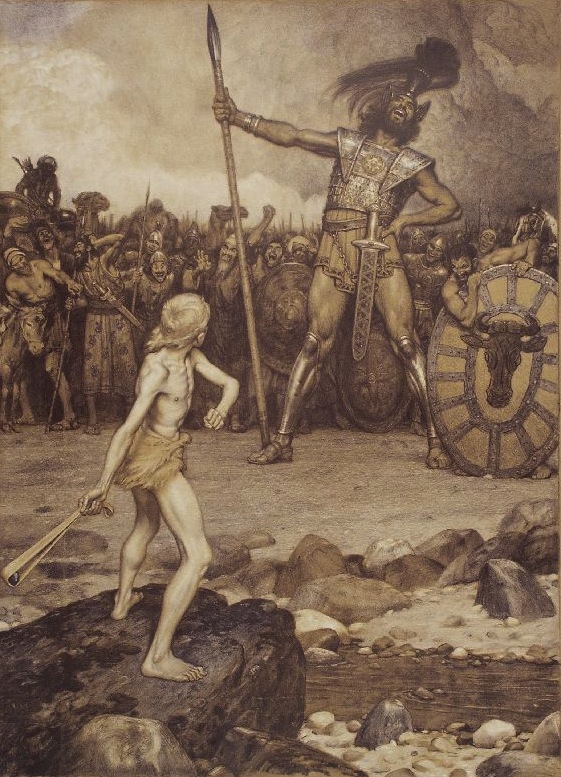
Osmar Schilndler, David und Goliath (1888)

Osmar Schilndler, David und Goliath (1888)

 The word of the LORD that came to the prophet Jeremiah concerning the Philistines, before Pharaoh attacked Gaza:
 2 Thus says the LORD:
See, waters are rising out of the north and shall become an overflowing torrent;
they shall overflow the land and all that fills it, the city and those who live in it.
People shall cry out, and all the inhabitants of the land shall wail.
 3 At the noise of the stamping of the hoofs of his stallions,
at the clatter of his chariots, at the rumbling of their wheels,
parents do not turn back for children, so feeble are their hands,
                4 because of the day that is coming to destroy all the Philistines,
to cut off from Tyre and Sidon every helper that remains.
For the LORD is destroying the Philistines,
the remnant of the coastland of Caphtor.
                5 Baldness has come upon Gaza, Ashkelon is silenced.
O remnant of their power! How long will you gash yourselves?
 6 Ah, sword of the LORD! How long until you are quiet?
Put yourself into your scabbard, rest and be still!
                7 How can it be quiet, when the LORD has given it an order?
Against Ashkelon and against the seashore– there he has appointed it.


The Philistines, Israel’s ancient enemy, has not played a role in Jeremiah up to this point. There is no reason given for Philistia being caught up in the destruction that is playing itself out in the conflicts of empires, in the rise of Babylon and the fall of Assyria and the diminishment of the power and influence that Egypt could exert in the region. The Philistines are not even a part of the regional powers that are mentioned in Jeremiah 27 and perhaps are plotting together how to throw off the yoke of Babylon. Philistia from her absence in the narrative up to this point seems merely to be caught up in the conflict going on around her. Pharaoh does come up from the South to oppose Babylon and Babylon in its pacification of Judah and Egypt and most major armies when they march show little discrimination about cities, towns and fields that can be plundered. As so many times before the Chaldean/Babylonian forces are portrayed as an irresistible force that cut down all in their way. The poetic language captures this in the desperation of parents who do not turn back for their own children, of two of traditional five cities of Philistia (Gaza and Ashkelon are mentioned, Ashdod is implied in the chapter and Gath and Ekron are not mentioned in this chapter) are shown as mourning (bald heads and cutting themselves) but the mourning is to no effect. Perhaps the sack of Ashkelon in 604 BCE by Nebuchadrezzar is reflected in this text, but again there is no reason other than Babylon as extension of the sword of the LORD has been loosed from its scabbard and it will not be still.

There is really no information to understand how the cities of Philistia play into the events of this time, whether they are active players or merely innocent bystanders that become casualties of much larger more powerful forces. Unfortunately war often doesn’t discriminate between innocent and guilty, between civilian and military and all are caught up together in the deluge. Perhaps the Philistines see their children die for someone else’s sins and the end of the chapter is a cry against the seemingly non-discriminatory judgment where guilty and innocent are caught up in the forces that are unleashed.

Jeremiah 46: Judgment for Egypt and Hope for Jacob

Jeremiah 46:1-26 Words for Egypt


The word of the LORD that came to the prophet Jeremiah concerning the nations.  2 Concerning Egypt, about the army of Pharaoh Neco, king of Egypt, which was by the river Euphrates at Carchemish and which King Nebuchadrezzar of Babylon defeated in the fourth year of King Jehoiakim son of Josiah of Judah:
 The word of the LORD that came to the prophet Jeremiah concerning the nations.
 3 Prepare buckler and shield, and advance for battle!
 4 Harness the horses; mount the steeds!
Take your stations with your helmets,
whet your lances, put on your coats of mail!
 5 Why do I see them terrified? They have fallen back;
their warriors are beaten down, and have fled in haste.
They do not look back– terror is all around! says the LORD.
                6 The swift cannot flee away, nor can the warrior escape;
in the north by the river Euphrates they have stumbled and fallen.
                7 Who is this, rising like the Nile, like rivers whose waters surge?
 8 Egypt rises like the Nile, like rivers whose waters surge.
It said, Let me rise, let me cover the earth,
let me destroy cities and their inhabitants.
                9 Advance, O horses, and dash madly, O chariots!
Let the warriors go forth:
Ethiopia and Put who carry the shield,
the Ludim, who draw the bow.
                10 That day is the day of the Lord GOD of hosts,
a day of retribution, to gain vindication from his foes.
The sword shall devour and be sated, and drink its fill of their blood.
For the Lord GOD of hosts holds a sacrifice in the land of the north by the river Euphrates.
                11 Go up to Gilead, and take balm, O virgin daughter Egypt!
In vain you have used many medicines; there is no healing for you.
                12 The nations have heard of your shame, and the earth is full of your cry;
for warrior has stumbled against warrior; both have fallen together.
 13 The word that the LORD spoke to the prophet Jeremiah about the coming of King Nebuchadrezzar of Babylon to attack the land of Egypt:
14 Declare in Egypt, and proclaim in Migdol; proclaim in Memphis and Tahpanhes;
Say, “Take your stations and be ready, for the sword shall devour those around you.”
                15 Why has Apis fled? Why did your bull not stand?—
because the LORD thrust him down.
                16 Your multitude stumbled and fell, and one said to another,
“Come, let us go back to our own people and to the land of our birth,
because of the destroying sword.”
                17 Give Pharaoh, king of Egypt, the name
“Braggart who missed his chance.”
                18 As I live, says the King, whose name is the LORD of hosts,
one is coming like Tabor among the mountains, and like Carmel by the sea.
                19 Pack your bags for exile, sheltered daughter Egypt!
For Memphis shall become a waste, a ruin, without inhabitant.
                20 A beautiful heifer is Egypt– a gadfly from the north lights upon her.
                21 Even her mercenaries in her midst are like fatted calves;
they too have turned and fled together, they did not stand;
for the day of their calamity has come upon them, the time of their punishment.
                22 She makes a sound like a snake gliding away;
for her enemies march in force,
and come against her with axes, like those who fell trees.
                23 They shall cut down her forest, says the LORD, though it is impenetrable,
because they are more numerous than locusts; they are without number.
 24 Daughter Egypt shall be put to shame;
she shall be handed over to a people from the north.
                25 The LORD of hosts, the God of Israel, said: See, I am bringing punishment upon Amon of Thebes, and Pharaoh, and Egypt and her gods and her kings, upon Pharaoh and those who trust in him. 26 I will hand them over to those who seek their life, to King Nebuchadrezzar of Babylon and his officers. Afterward Egypt shall be inhabited as in the days of old, says the LORD.


For the first forty five chapters of Jeremiah the focus has been almost exclusively centered on narrating the events of the end of the first temple period of Judah, from the final attempt at reform under Josiah, to the multiple defeats of Judah at the hand of Babylon, the eventual destruction of the city and exile of much of the population and then finally the chaos among the small remnant that eventually flees to Egypt. Yet from the beginning Jeremiah was called as a prophet to the nations (see Jeremiah 1: 5, 10). The events that have happened in Judah are not isolated from the nations that surround them, they are caught up in the tide of the politics and intrigue of empires and that if the LORD of hosts, literally the LORD of armies, which is one of Jeremiah’s favorite constructs using the name of the LORD, is involved in the movement of the forces of the Chaldeans as the Babylonian empire ascends, then the LORD must also be involved in the disposition of all the events going on in the surround region. To pull on the broader narratives of the Hebrew people about God as the creator and God in the Exodus, the LORD is not a regional god, who only has purview over the terrain of Israel or only has power on Israel’s soil (this type of belief for example is why Naaman asks Elisha for two barrels of oil so that Naaman can worship the LORD on Israel’s soil, see 2 Kings 5: 17) and so like Isaiah, Ezekiel and Amos, Jeremiah now announces God’s words to the nations.

The judgment on Egypt here in these words is focused on the military power of Egypt. Egypt, in contrast to the relatively tiny kingdom of Judah, was one of the ‘super-powers’ of the day and they were heavily involved in projecting their influence through their economic and military might. Judah often found itself making alliances with either Egyptian, Assyrian, or Babylonian might in the previous generation precisely because they were not militarily a threat to any of these empires. Egypt, once viewed as the oppressor of Israel, the place from which they emerged from slavery to become the chosen people, now has become the benefactor, the ally. Egypt’s judgment, in comparison to many of the oracles spoken against Judah and Israel as a whole, are relatively calm. There is little mention of destruction taking place within the Egyptian homeland and what destruction is mentioned is precisely in the areas where the Judean refugees settled (Migdol, Memphis and Tahpanhes) and it causes the causes the refugees there to desire to return back to their own home.

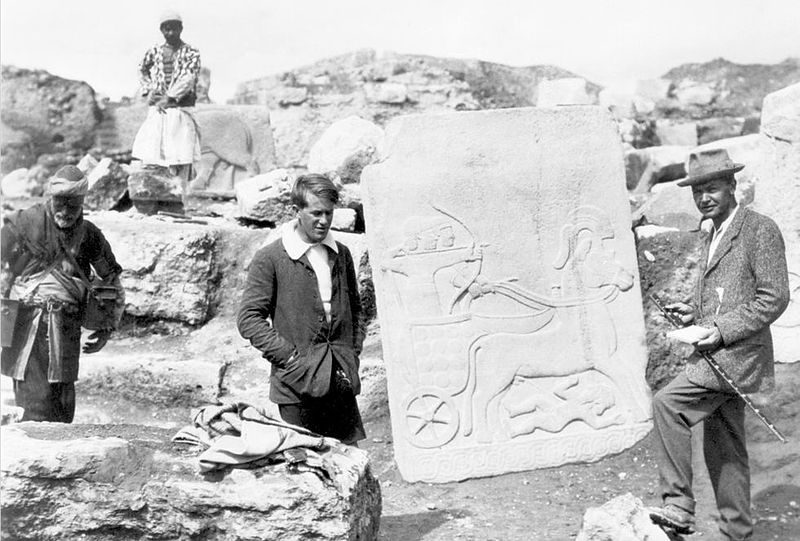
T.E. Lawrence and L. Wooley at Carchemish (1913)

T.E. Lawrence and L. Wooley at Carchemish (1913)

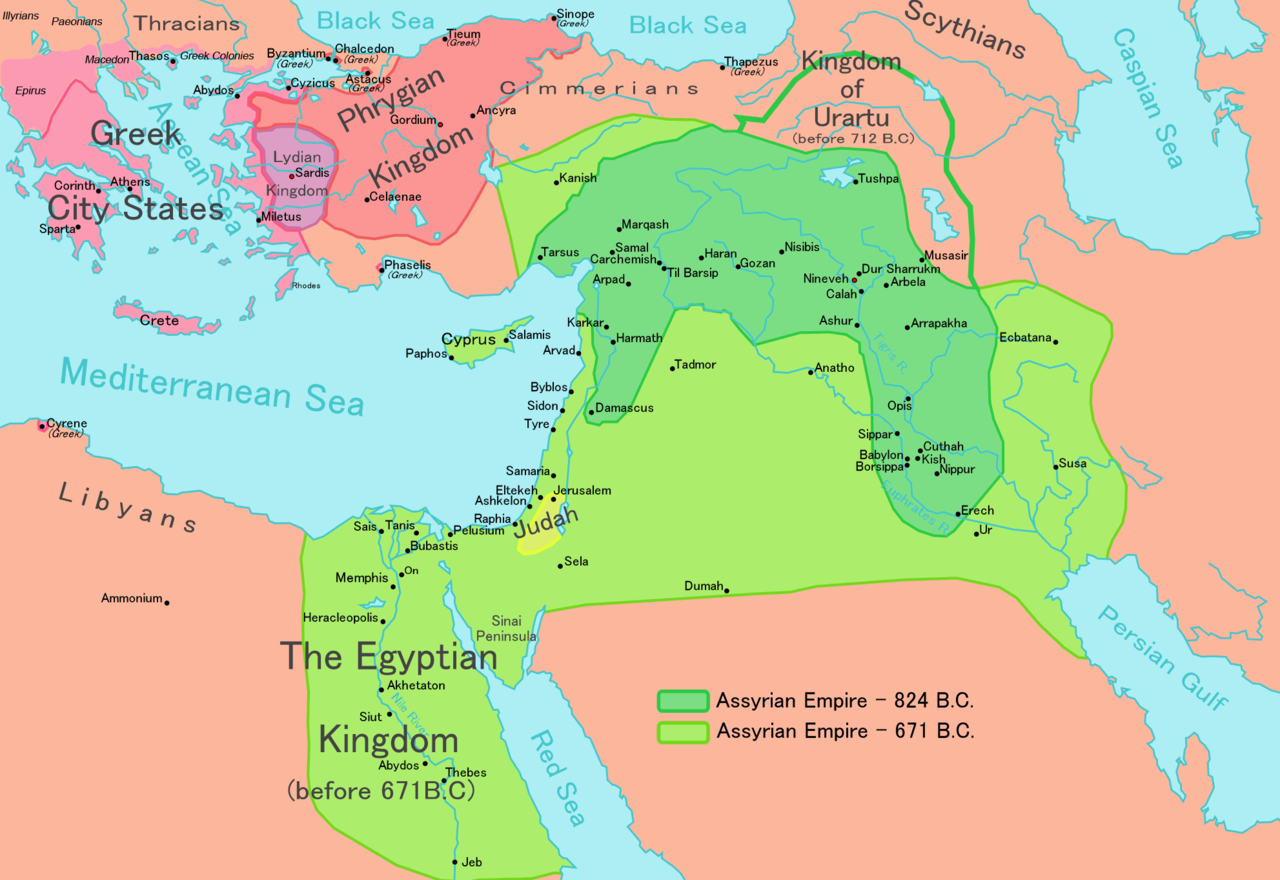
It is military defeat and humiliation that receives the lion share of this oracle. The pride of Egypt is shattered as its military is defeated, first probably referring to the Battle of Carchemish (605 BCE) which has numerous connections with the story of Jeremiah. As Babylon rose to power and continued to drive the Assyrian empire further and further into submission conquering their capitol at Ninevah in 612 BCE and then Harran in 610 BCE the Assyrians moved their capitol to Carchemish. In 609 BCE Pharaoh Neco II marched his forces to aid his ally, Assyria, in resisting the advance of the Babylonian armies. As Pharaoh’s army advance out of Egypt the armies of Judah, led by King Josiah, resisted the advance of Egypt and King Josiah was killed in the battle. When the Egyptian and Assyrian armies met the Babylonian armies of Nebuchadnezzar II the combined Egyptian and Assyrian forces were soundly defeated and this marked the eclipse of the Assyrian empire and the decline of influence of Egypt in the Middle East. As we have seen throughout the journey in Jeremiah there continues to be battles for influence within Judah and the surrounding region’s area, and Jehoiachim embraces a pro-Egyptian policy that leads into conflict with Babylon and then in the time of Zedekiah’s appointed reign there are still internal and external forces encouraging a pro-Egyptian/anti-Babylonian stance.

Map of the Assyrian Empire

Map of the Assyrian Empire

Egypt would have several other confrontations with the Babylonian forces between 604 and 568 BCE, and while Egypt never lost its independence to Babylon it continued to lose its dominance over the region. The imagery of Egypt’s military falling back in disarray, including its proud mercenaries from Ethiopia (Cush), Put, and Ludim which at one time seemed invincible are not merely the result of the military prowess of the Chaldean (Babylonian) forces but in Jeremiah’s eye a sign of the LORD of host at work in the events of the nations. Egypt’s military defeat is tied to the Egyptian gods being put to shame, to her beauty being lost and her impenetrable forests being cut away. Yet, the word of judgment is not final. For Egypt there is also the promise that it shall be inhabited as in days of old. The LORD cares not only for Judah but also for Egypt and the judgment will pass and prosperity return.

Jeremiah 46: 27-28 Words of Comfort for the Exiles

 27 But as for you, have no fear, my servant Jacob,
and do not be dismayed, O Israel; for I am going to save you from far away,
and your offspring from the land of their captivity.
Jacob shall return and have quiet and ease, and no one shall make him afraid.
 28 As for you, have no fear, my servant Jacob, says the LORD, for I am with you.
I will make an end of all the nations among which I have banished you,
but I will not make an end of you!
I will chastise you in just measure, and I will by no means leave you unpunished.


Here again at the beginning of the judgment of the nations there is the reassurance to Israel that there is a future for them as well. Much like the words of hope beginning in Jeremiah 30, the judgment that is coming on the nations is a part of God’s work to return the people of Israel home and to shelter them. After so much judgment on the God’s people, after so much death and pain, after so much disappointment and desolation the time of judgment is passed and the people have a hope for the future.

Jeremiah 45 The Scribe and The Word Endure the Ending

Baruch ben Neriah from Promptuerri Iconum Insigniorum, Published by Guillaume Rouille 1553

Baruch ben Neriah from Promptuerri Iconum Insigniorum, Published by Guillaume Rouille 1553

The word that the prophet Jeremiah spoke to Baruch son of Neriah, when he wrote these words in a scroll at the dictation of Jeremiah, in the fourth year of King Jehoiakim son of Josiah of Judah: 2 Thus says the LORD, the God of Israel, to you, O Baruch: 3 You said, “Woe is me! The LORD has added sorrow to my pain; I am weary with my groaning, and I find no rest.” 4 Thus you shall say to him, “Thus says the LORD: I am going to break down what I have built, and pluck up what I have planted– that is, the whole land. 5 And you, do you seek great things for yourself? Do not seek them; for I am going to bring disaster upon all flesh, says the LORD; but I will give you your life as a prize of war in every place to which you may go.”


This little chapter which marks a closing of this part of the story, after all the desolation there is a small word of hope to Baruch. Like Jeremiah’s offer in the time of Zedekiah and the promise to Ebed-Melech, now Baruch also receives this consolation prize. There is no promise of wealth, riches, power or prosperity, greatness and good fortune-do not seek that in this book, in this time, in this story. This is a story of endings, of pain, of collapse and relationships that come to an end, and death. Yet in the midst of the death there is life for those who hear, who work with God, who are willing to take the more difficult path. It is perhaps important to notice that the opening line takes us way back in the story, to the time of chapter 36 and not in sequence with what has come before, and yet here at the dark end with the people in Egypt turning away from God and God’s prophet, perhaps it is the only way to end this part-to go back to the promise to Baruch, the one who took the spoken word and recorded them and to allow us to know that the words of the LORD, the life of the prophet and the scribe who stood by him will endure beyond the ending of this tragic story. That in the midst of all the harshness that Jeremiah and Baruch go through in being caught between God and the people that there is life in their path. Perhaps the mere existence of this book in all its dark and painful story do indeed bring hope in the midst of hopelessness. The book of Jeremiah is not complete, even though this is culmination of the words to Judah and Israel, there are still words to be spoken to the nations and a final attempt at this book which cannot end with a happily ever after. With the collapse of the world that the people of Judah knew there are no easy answers in their relationship with their God and as Kathleen O’Connor states:

By not settling matters prematurely, by refusing to reduce disaster to one final, settled interpretation. Jeremiah’s three endings honor victims of the Babylonian disaster. They acknowledge the difficulties of closing matters, at least not quickly, not clearly, not finally. The endings leave readers with a set of questions about justice, about Judah’s relationship with God, and about whether or not the nation will have a future. (O’Conner, 2011, p. 116)

Or to end in a more poetic way I will close this section with the words of the poet Uri Zvi Greenberg

                Like chapters of prophecy my days burn, in all the revelations,
                And my body between them’s a block of metal for smelting,
                And over me stands my god, the Smith, who hits hard:
                Each wound that Time has opened in me opens its mouth to him
                And pours forth in a shower of sparks the intrinsic fire.
 
                This is my just lot—until dusk on the road.
                And when I return to throw my beaten block on a bed,
                My mouth is an open wound,
                And naked I speak with my god: You worked hard.
                Now it is night; come let us both rest. (Lau, 2013, p. 98.)

 Jeremiah 44 Plummeting to the End

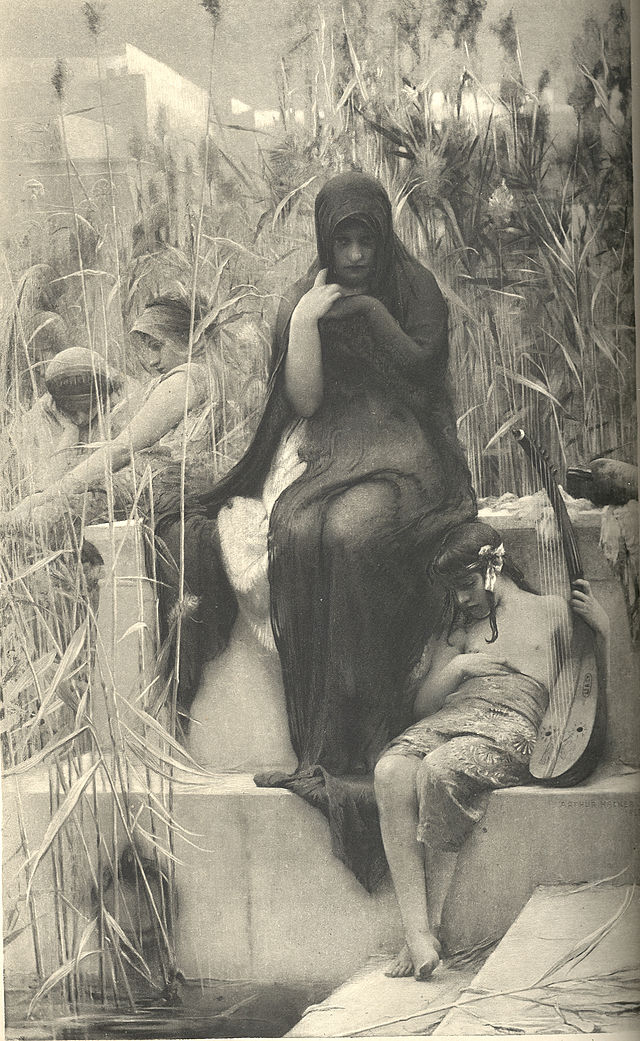
Athur Kacker, By the Waters of Babylon (1888)

Athur Kacker, By the Waters of Babylon (1888)

Jeremiah 44: 1-14 Forty Years and Nothing Changed

The word that came to Jeremiah for all the Judeans living in the land of Egypt, at Migdol, at Tahpanhes, at Memphis, and in the land of Pathros, 2 Thus says the LORD of hosts, the God of Israel: You yourselves have seen all the disaster that I have brought on Jerusalem and on all the towns of Judah. Look at them; today they are a desolation, without an inhabitant in them, 3 because of the wickedness that they committed, provoking me to anger, in that they went to make offerings and serve other gods that they had not known, neither they, nor you, nor your ancestors. 4 Yet I persistently sent to you all my servants the prophets, saying, “I beg you not to do this abominable thing that I hate!” 5 But they did not listen or incline their ear, to turn from their wickedness and make no offerings to other gods. 6 So my wrath and my anger were poured out and kindled in the towns of Judah and in the streets of Jerusalem; and they became a waste and a desolation, as they still are today.

 7 And now thus says the LORD God of hosts, the God of Israel: Why are you doing such great harm to yourselves, to cut off man and woman, child and infant, from the midst of Judah, leaving yourselves without a remnant? 8 Why do you provoke me to anger with the works of your hands, making offerings to other gods in the land of Egypt where you have come to settle? Will you be cut off and become an object of cursing and ridicule among all the nations of the earth? 9 Have you forgotten the crimes of your ancestors, of the kings of Judah, of their wives, your own crimes and those of your wives, which they committed in the land of Judah and in the streets of Jerusalem? 10 They have shown no contrition or fear to this day, nor have they walked in my law and my statutes that I set before you and before your ancestors.The word that came to Jeremiah for all the Judeans living in the land of Egypt, at Migdol, at Tahpanhes, at Memphis, and in the land of Pathros, 2 Thus says the LORD of hosts, the God of Israel: You yourselves have seen all the disaster that I have brought on Jerusalem and on all the towns of Judah. Look at them; today they are a desolation, without an inhabitant in them, 3 because of the wickedness that they committed, provoking me to anger, in that they went to make offerings and serve other gods that they had not known, neither they, nor you, nor your ancestors. 4 Yet I persistently sent to you all my servants the prophets, saying, “I beg you not to do this abominable thing that I hate!” 5 But they did not listen or incline their ear, to turn from their wickedness and make no offerings to other gods. 6 So my wrath and my anger were poured out and kindled in the towns of Judah and in the streets of Jerusalem; and they became a waste and a desolation, as they still are today.

 11 Therefore thus says the LORD of hosts, the God of Israel: I am determined to bring disaster on you, to bring all Judah to an end. 12 I will take the remnant of Judah who are determined to come to the land of Egypt to settle, and they shall perish, everyone; in the land of Egypt they shall fall; by the sword and by famine they shall perish; from the least to the greatest, they shall die by the sword and by famine; and they shall become an object of execration and horror, of cursing and ridicule. 13 I will punish those who live in the land of Egypt, as I have punished Jerusalem, with the sword, with famine, and with pestilence, 14 so that none of the remnant of Judah who have come to settle in the land of Egypt shall escape or survive or return to the land of Judah. Although they long to go back to live there, they shall not go back, except some fugitives.


The book of Jeremiah really doesn’t have just one ending but three, one coming in chapter 45, one at the end of 51 at the conclusion of the judgments on the nations and then chapter 52 gives a final ending narrating what happens back in Babylon. Maybe this reflect the unresolved nature of the people and their relationship with God in the light of the disaster of the destruction of Jerusalem, the kingdom of Judea, the Davidic line of kings, the temple and all these markers of identity that made them the people of the LORD. But as we plummet towards the end of the story of the last remaining group not in Babylon, a group that once sought Jeremiah’s word and now rather than a small remnant we find settlements in three cities and perhaps a larger emigration to Egypt after the confusion of the last several years. It is a group that has already heard and ignored Jeremiah’s words that their actions of turning to Egypt will mean famine, the sword and pestilence. In the midst of this refugee group in Egypt we see Jeremiah dealing with some of the same issues as the beginning of his ministry.

Forty years earlier, when Josiah was king and led a reformation of the temple and worship in Jerusalem and turned the people back to the LORD and away from the practices of adopting the customs and worship of the Assyrians now returns again as they encounter Egypt and its lifestyle, culture and religions. As Benyamin Lau describes it:


Jeremiah wanders around his people in shock. All the reformations of his beloved Josiah are instantly forgotten. The idolatry he had witnessed in his childhood, the legacy of Manasseh, has been resurrected in a different form. He finds himself back where he started forty years earlier, only now he is weary, broken, and drained of all hope. For the last time he summons the strength to warn the people against going astray in Egypt to learn from the sins of their forefathers. (Lau, 2013, p. 216)


At stake are different readings of history and the times. Jeremiah reads the events of the past in light of the LORD’s judgment on the people for turning away from the covenant, law, decrees and worship of the LORD. The group of people who are gathered together one last time to hear the prophet’s final recorded words to them read the events of the last several years in a different light.

Jeremiah 44: 15-23 Different Readings of Reality

 15 Then all the men who were aware that their wives had been making offerings to other gods, and all the women who stood by, a great assembly, all the people who lived in Pathros in the land of Egypt, answered Jeremiah: 16 “As for the word that you have spoken to us in the name of the LORD, we are not going to listen to you. 17 Instead, we will do everything that we have vowed, make offerings to the queen of heaven and pour out libations to her, just as we and our ancestors, our kings and our officials, used to do in the towns of Judah and in the streets of Jerusalem. We used to have plenty of food, and prospered, and saw no misfortune. 18 But from the time we stopped making offerings to the queen of heaven and pouring out libations to her, we have lacked everything and have perished by the sword and by famine.” 19 And the women said, “Indeed we will go on making offerings to the queen of heaven and pouring out libations to her; do you think that we made cakes for her, marked with her image, and poured out libations to her without our husbands’ being involved?”

 20 Then Jeremiah said to all the people, men and women, all the people who were giving him this answer: 21 “As for the offerings that you made in the towns of Judah and in the streets of Jerusalem, you and your ancestors, your kings and your officials, and the people of the land, did not the LORD remember them? Did it not come into his mind? 22 The LORD could no longer bear the sight of your evil doings, the abominations that you committed; therefore your land became a desolation and a waste and a curse, without inhabitant, as it is to this day. 23 It is because you burned offerings, and because you sinned against the LORD and did not obey the voice of the LORD or walk in his law and in his statutes and in his decrees, that this disaster has befallen you, as is still evident today.”


The people answer Jeremiah’s prophecy with a very different reading of reality. From their perspective, prior to Jeremiah’s prophecies, prior to the reformation of Josiah and under the reign of Manasseh forty years ago things were pretty good. The people had adopted a pro-Assyrian policy, adopted their customs and practices and along with that portions of their religious practice. Until that time, in the memory of the people, things went well for Judah. After Josiah’s death at the hands of Egypt and the rise of the Babylonian empire, while they had ceased worshipping the Assyrian gods/goddesses (although apparently the remembrance of the practice and probably the practices themselves lingered). The queen of heaven probably referred to Astarte, a fertility goddess but could also refer here in Egypt to Isis, but somehow there is an amalgamation between the worship of the LORD the God of Israel and this other deity.  The people defiantly resist Jeremiah, claiming ‘we will go on making offerings.’

It is easy to imagine the allure of the culture and worship in Egypt as well as the practices from the past when times seemed easier and more secure being very attractive to the people. It’s also not hard to imagine the allure of a fertility cult at any point in society. Yet, in the midst of these final words between the people and Jeremiah we see the people interpreting reality in light of their prosperity of the past while doing these practices and Jeremiah seeing the judgment of the recent past in light of these practices. Judaism probably was not as monotheistic throughout its history prior to the exile as it became when it emerged again from the exile in Babylon. Yet in the book of Jeremiah this is a new low point, the people feel no need to apologize for their actions or cover them up. They are claiming a new identity in the new land, they are choosing to no longer be the people of the LORD. Perhaps this is that moment where something so drastic has happened that the parent has disowned the child and this is the counter story to the story of the Prodigal Son in Luke 15.  Regardless for this portion of the exiles, who disobeyed Jeremiah’s prophetic words against going to Egypt and now are adopting new practices in this new land the dissolution in nearly complete.


Byzantine Fresca of Joshua from Hosias Loukas Monastery in Boetian, Greece

Byzantine Fresca of Joshua from Hosias Loukas Monastery in Boetian, Greece

Jeremiah 44: 24-30: Choose This Day Who You Will Serve

                24 Jeremiah said to all the people and all the women, “Hear the word of the LORD, all you Judeans who are in the land of Egypt, 25 Thus says the LORD of hosts, the God of Israel: You and your wives have accomplished in deeds what you declared in words, saying, ‘We are determined to perform the vows that we have made, to make offerings to the queen of heaven and to pour out libations to her.’ By all means, keep your vows and make your libations! 26 Therefore hear the word of the LORD, all you Judeans who live in the land of Egypt: Lo, I swear by my great name, says the LORD, that my name shall no longer be pronounced on the lips of any of the people of Judah in all the land of Egypt, saying, ‘As the Lord GOD lives.’ 27 I am going to watch over them for harm and not for good; all the people of Judah who are in the land of Egypt shall perish by the sword and by famine, until not one is left. 28 And those who escape the sword shall return from the land of Egypt to the land of Judah, few in number; and all the remnant of Judah, who have come to the land of Egypt to settle, shall know whose words will stand, mine or theirs! 29 This shall be the sign to you, says the LORD, that I am going to punish you in this place, in order that you may know that my words against you will surely be carried out: 30 Thus says the LORD, I am going to give Pharaoh Hophra, king of Egypt, into the hands of his enemies, those who seek his life, just as I gave King Zedekiah of Judah into the hand of King Nebuchadrezzar of Babylon, his enemy who sought his life.”


At the end of a very different story in the book of Joshua, Joshua presents the people with a choice:


Now therefore revere the LORD, and serve him in sincerity and in faithfulness; put away the gods that your ancestors served beyond the River and in Egypt, and serve the LORD. Now if you are unwilling to serve the LORD, choose this day whom you will serve, whether the gods your ancestors served in the region beyond the River or the gods of the Amorites in whose land you are living; but as for me and my household, we will serve the LORD. (Joshua 24: 14f)


At the end of Jeremiah the people have made a choice, and it is a different choice. Every action has consequences in the world of Jeremiah, but Jeremiah has played his part and done his job. Jeremiah is finished with this people. “By all means, keep your vows and make your libations!” but the consequence of this choice is that the people are no longer to use the name of the LORD. They are no longer Israel, or Judah without their relationship to the God of Israel. Once again the words come prophesying the war, famine, and disease that will reduce the people in Egypt greatly. These words are followed up by a series of events that unfold in the near future when Pharoah Hophra is killed in a rebellion in 569 BCE and then Nebuchadrezzar invades in 568/67 BCE shattering the illusion of the safety of the Egyptian empire. (Elizabeth Actemeir, et. al., 1994, p. VI: 874) From the brokenhearted prophet there is one more word of promise not for the people but for Baruch as the story closes and then inhales for a final scream of judgment against the nations. Light will re-emerge, there will be a hope for the future but it will not be seen by those in Egypt, nor quickly by those in Babylon. The Judean refugees in Babylon will go through a long process of reconstructing their identity as a people no longer identified by land, the temple and its worship or the Davidic king. Now they must begin the long process of gathering their stories, figuring out who they are and imagining a new future for themselves and their LORD.
Jeremiah 43 The Flight to Egypt


Cry Of Prophet Jeremiah on the Ruins of Jerusalem by Ilya Repin 1870

Cry Of Prophet Jeremiah on the Ruins of Jerusalem by Ilya Repin 1870

 
When Jeremiah finished speaking to all the people all these words of the LORD their God, with which the LORD their God had sent him to them, 2 Azariah son of Hoshaiah and Johanan son of Kareah and all the other insolent men said to Jeremiah, “You are telling a lie. The LORD our God did not send you to say, ‘Do not go to Egypt to settle there’; 3 but Baruch son of Neriah is inciting you against us, to hand us over to the Chaldeans, in order that they may kill us or take us into exile in Babylon.” 4 So Johanan son of Kareah and all the commanders of the forces and all the people did not obey the voice of the LORD, to stay in the land of Judah. 5 But Johanan son of Kareah and all the commanders of the forces took all the remnant of Judah who had returned to settle in the land of Judah from all the nations to which they had been driven– 6 the men, the women, the children, the princesses, and everyone whom Nebuzaradan the captain of the guard had left with Gedaliah son of Ahikam son of Shaphan; also the prophet Jeremiah and Baruch son of Neriah.
 7 And they came into the land of Egypt, for they did not obey the voice of the LORD. And they arrived at Tahpanhes. 8 Then the word of the LORD came to Jeremiah in Tahpanhes: 9 Take some large stones in your hands, and bury them in the clay pavement that is at the entrance to Pharaoh’s palace in Tahpanhes. Let the Judeans see you do it, 10 and say to them, Thus says the LORD of hosts, the God of Israel: I am going to send and take my servant King Nebuchadrezzar of Babylon, and he will set his throne above these stones that I have buried, and he will spread his royal canopy over them. 11 He shall come and ravage the land of Egypt,
giving those who are destined for pestilence, to pestilence,
and those who are destined for captivity, to captivity,
and those who are destined for the sword, to the sword.
 12 He shall kindle a fire in the temples of the gods of Egypt; and he shall burn them and carry them away captive; and he shall pick clean the land of Egypt, as a shepherd picks his cloak clean of vermin; and he shall depart from there safely. 13 He shall break the obelisks of Heliopolis, which is in the land of Egypt; and the temples of the gods of Egypt he shall burn with fire.

 Everything in the book of Jeremiah seems to work against the hope that the people will hear and listen and be obedient. Every time Jeremiah has spoken before the listeners have not responded, and yet there was perhaps a small hope that this time, since the leaders and the people had sought him out that the response might be different. Yet, the response by Azariah and Johanan (and I find the fact that Azariah son of Hoshaiah is mentioned first intriguing since in the chapters that proceed Johanan is apparently the dominant leader and when Azariah is mentioned, which isn’t often, it is after Johanan) is not only negative but accusatory. First is the accusation that Jeremiah’s prophecy is a lie, that in Jeremiah’s persistence in telling the people what they do not want to hear that somehow the inconvenient truth is shouted down as the lie. Second, interestingly, is the accusation that Baruch son of Neriah is behind this believed subversion. Other than his role as the scribe of Jeremiah we know very little about Baruch, but in this interconnected and politically charged world it isn’t surprising that Baruch is probably more than a mere scribe and that he (like Gedeliah and his father and grandfather) probably represented the present opposition to the policy of the officials in Jerusalem that led to the cities overthrow by Babylon. Perhaps he, and probably others as well, had been public voices critical of the pro-Egyptian policies of the past and as the people look to flee for safety in Egypt, perhaps Baruch makes a convenient scapegoat. Now the remnant who escaped exile by hiding away in foreign lands is now entering into a self-chosen exile in the land of Egypt. The land is left deserted since the text gives the impression that everyone left is taken away by Johanan and the forces remaining. Interesting that we see that the princesses are also left in Jerusalem and they along with the rest of the people, including Jeremiah and Baruch are carried off into to Tahpanhes (also known as Daphanae by the Greeks).

Once in Egypt, the LORD again calls on Jeremiah to perform a visual representation of the coming judgment in the sight of the people. Taking large stones and burying them in the front of the entrance of the palace of the pharaoh at Tahpanhes (Tahpanhes is not the capitol but this is probably one of many palaces throughout the nation) symbolically marking a place where the feared king of Babylon will again set up his court in the front yard of his biggest challenger in the region. The prophecy points out again that Egypt will not bring safety, that captivity, sword and pestilence will not be avoided and that the Chaldeans are instruments of the LORD of hosts, and that the Egyptians are no more a threat to them than a rat or insect on a shepherd’s robe. This tragic part of the story is approaching its end and not only do the people bring judgment upon themselves, but also upon Egypt and her gods for being the place they have come to for security.  

Jeremiah 42 A Final Prayer And A Final Response

Cry Of Prophet Jeremiah on the Ruins of Jerusalem by Ilya Repin 1870

Cry Of Prophet Jeremiah on the Ruins of Jerusalem by Ilya Repin 1870

Then all the commanders of the forces, and Johanan son of Kareah and Azariah son of Hoshaiah, and all the people from the least to the greatest, approached 2 the prophet Jeremiah and said, “Be good enough to listen to our plea, and pray to the LORD your God for us– for all this remnant. For there are only a few of us left out of many, as your eyes can see. 3 Let the LORD your God show us where we should go and what we should do.” 4 The prophet Jeremiah said to them, “Very well: I am going to pray to the LORD your God as you request, and whatever the LORD answers you I will tell you; I will keep nothing back from you.” 5 They in their turn said to Jeremiah, “May the LORD be a true and faithful witness against us if we do not act according to everything that the LORD your God sends us through you. 6 Whether it is good or bad, we will obey the voice of the LORD our God to whom we are sending you, in order that it may go well with us when we obey the voice of the LORD our God.”

            7 At the end of ten days the word of the LORD came to Jeremiah. 8 Then he summoned Johanan son of Kareah and all the commanders of the forces who were with him, and all the people from the least to the greatest, 9 and said to them, “Thus says the LORD, the God of Israel, to whom you sent me to present your plea before him: 10 If you will only remain in this land, then I will build you up and not pull you down; I will plant you, and not pluck you up; for I am sorry for the disaster that I have brought upon you. 11 Do not be afraid of the king of Babylon, as you have been; do not be afraid of him, says the LORD, for I am with you, to save you and to rescue you from his hand. 12 I will grant you mercy, and he will have mercy on you and restore you to your native soil.

13 But if you continue to say, ‘We will not stay in this land,’ thus disobeying the voice of the LORD your God 14 and saying, ‘No, we will go to the land of Egypt, where we shall not see war, or hear the sound of the trumpet, or be hungry for bread, and there we will stay,’ 15 then hear the word of the LORD, O remnant of Judah. Thus says the LORD of hosts, the God of Israel: If you are determined to enter Egypt and go to settle there, 16 then the sword that you fear shall overtake you there, in the land of Egypt; and the famine that you dread shall follow close after you into Egypt; and there you shall die. 17 All the people who have determined to go to Egypt to settle there shall die by the sword, by famine, and by pestilence; they shall have no remnant or survivor from the disaster that I am bringing upon them.

18 “For thus says the LORD of hosts, the God of Israel: Just as my anger and my wrath were poured out on the inhabitants of Jerusalem, so my wrath will be poured out on you when you go to Egypt. You shall become an object of execration and horror, of cursing and ridicule. You shall see this place no more. 19 The LORD has said to you, O remnant of Judah, Do not go to Egypt. Be well aware that I have warned you today 20 that you have made a fatal mistake. For you yourselves sent me to the LORD your God, saying, ‘Pray for us to the LORD our God, and whatever the LORD our God says, tell us and we will do it.’ 21 So I have told you today, but you have not obeyed the voice of the LORD your God in anything that he sent me to tell you. 22 Be well aware, then, that you shall die by the sword, by famine, and by pestilence in the place where you desire to go and settle.”


Into the space and confusion following the assassination of Gedaliah, the governor appointed by Babylon to rule in Judea over the remnant, the interim leaders, Johanan and Azariah come with the people to Jeremiah asking for a word from the LORD. Based on previous times when kings and leaders have asked for a word from the LORD there is little expectation for the reader that it will be heard and obeyed, yet here in desperation the people come and finally they come to Jeremiah who they have ignored so many times before asking his prayer to God. It is very possible that Jeremiah is tired at this point and yet he consents and goes once again in prayer to the LORD. In contrast to Jeremiah’s reluctance (Very well: I am going to pray to the LORD your God as you request, and whatever the LORD answers you I will tell you, I will keep nothing back from you) and the peoples’ insistence (Whether it is good or bad, we will obey the voice of the LORD our God.) Yet, in the space and time of waiting the people probably don’t sit idle. Why does it take ten days to answer? We will never know the answer, but ultimately God doesn’t work on our time tables, but in that time when Jeremiah returns to give the answer it is clear he knows which way the peoples’ hearts are leaning.

The LORD’s answer presents two choices, one in obedience with an accompanied blessing and on in disobedience with an accompanying curse. Much as the end of Deuteronomy ends with blessings if the people keeps the commandments of the LORD and curses if they do not. If the people listens and stays within the land the LORD promises an end to their disaster. The LORD will build and not tear down, plant and not pluck up, that in the midst of the present threat of Babylon’s retaliation the LORD promises to protect them and to give them mercy. In the response we hear that the LORD is sorry for the pain that God’s people have endured and that this remnant finds themselves within and so if they will obey they will have the opportunity to begin anew. Yet, if they do not obey, if they seek security in Egypt then the very things they fear here in Judah will find them in Egypt. Sword, famine and pestilence will follow them, their name will become dishonored and an object of not only shame but horror. Jeremiah tries desperately to convince the people not to go to Egypt, and it is quite possible that he knows that is the journey the people are preparing for, and yet once again he tries to get the people to see something which seems to run counter to their own intuition.

In the face of the destruction of Jerusalem, the temple, and the taking on much of the people of Judah into exile this small remnant has seen ample reason to fear Babylon. It may be very difficult for the people to trust God at this point, and at points they seem to distance themselves from the LORD (your God) and at other points want to claim God (our God). Egypt being the other major power in the region from a military/political standpoint makes sense as a place to flee to when fleeing the Babylonian empire, but here they are asked to trust the LORD, something they have failed to do to this point, and to listen to the LORD’s prophet, something else they have failed to do.

Jeremiah 41 The Murder of Gedaliah and a Shattered Hope

Edvard Munch, The Scream (Der Schrei der Natur) 1893

Edvard Munch, The Scream (Der Schrei der Natur) 1893

In the seventh month, Ishmael son of Nethaniah son of Elishama, of the royal family, one of the chief officers of the king, came with ten men to Gedaliah son of Ahikam, at Mizpah. As they ate bread together there at Mizpah, 2 Ishmael son of Nethaniah and the ten men with him got up and struck down Gedaliah son of Ahikam son of Shaphan with the sword and killed him, because the king of Babylon had appointed him governor in the land. 3 Ishmael also killed all the Judeans who were with Gedaliah at Mizpah, and the Chaldean soldiers who happened to be there.

 4 On the day after the murder of Gedaliah, before anyone knew of it, 5 eighty men arrived from Shechem and Shiloh and Samaria, with their beards shaved and their clothes torn, and their bodies gashed, bringing grain offerings and incense to present at the temple of the LORD. 6 And Ishmael son of Nethaniah came out from Mizpah to meet them, weeping as he came. As he met them, he said to them, “Come to Gedaliah son of Ahikam.” 7 When they reached the middle of the city, Ishmael son of Nethaniah and the men with him slaughtered them, and threw them into a cistern. 8 But there were ten men among them who said to Ishmael, “Do not kill us, for we have stores of wheat, barley, oil, and honey hidden in the fields.” So he refrained, and did not kill them along with their companions.

 9 Now the cistern into which Ishmael had thrown all the bodies of the men whom he had struck down was the large cistern that King Asa had made for defense against King Baasha of Israel; Ishmael son of Nethaniah filled that cistern with those whom he had killed. 10 Then Ishmael took captive all the rest of the people who were in Mizpah, the king’s daughters and all the people who were left at Mizpah, whom Nebuzaradan, the captain of the guard, had committed to Gedaliah son of Ahikam. Ishmael son of Nethaniah took them captive and set out to cross over to the Ammonites.

11 But when Johanan son of Kareah and all the leaders of the forces with him heard of all the crimes that Ishmael son of Nethaniah had done, 12 they took all their men and went to fight against Ishmael son of Nethaniah. They came upon him at the great pool that is in Gibeon. 13 And when all the people who were with Ishmael saw Johanan son of Kareah and all the leaders of the forces with him, they were glad. 14 So all the people whom Ishmael had carried away captive from Mizpah turned around and came back, and went to Johanan son of Kareah. 15 But Ishmael son of Nethaniah escaped from Johanan with eight men, and went to the Ammonites. 16 Then Johanan son of Kareah and all the leaders of the forces with him took all the rest of the people whom Ishmael son of Nethaniah had carried away captive from Mizpah after he had slain Gedaliah son of Ahikam– soldiers, women, children, and eunuchs, whom Johanan brought back from Gibeon. 17 And they set out, and stopped at Geruth Chimham near Bethlehem, intending to go to Egypt 18 because of the Chaldeans; for they were afraid of them, because Ishmael son of Nethaniah had killed Gedaliah son of Ahikam, whom the king of Babylon had made governor over the land.


In Chapter 40 there was a hope for the remnant in Judah in the appointment of Gedaliah and the return of refugees from the surrounding regions that were joining with those left by Nebuzaradan, the Babylonian captain of the guard, as beginning to pick up the pieces of their destroyed homeland. Yet for a small group that returned, the war is not over and the appointment of Gedeliah as governor to act on behalf of Babylon is further insult to their loss. At the end of Chapter 40 we overheard Johanan son of Kareah inform Gedaliah of the plot by both the king of Ammon and Ishmael so of Nethaniah and at the beginning of chapter 41 we are introduced to Ishmael. Ishmael is of the royal family and an officer of the king, perhaps one of the very officers who continued to lobby for resistance against the Chaldeans as the city languished with no food under the siege, yet unlike the rest of the Davidic line he somehow avoided being taken into captivity and now he returns and is welcomed by Gedaliah. Perhaps Ishmael wants to reign himself, perhaps it is merely the association with Babylon, perhaps he is merely bloodthirsty and loves the destruction of war, whatever his reasons he kills Gedaliah. His act is monstrous, he and his ten men while enjoying the hospitality of Gedaliah kill him. Gedaliah’s other allies are not present and perhaps Gedaliah is intentionally trying to make peace with Ishmael.

Ishmael murders the king, the other Judeans with Gedaliah as well as the Chaldean soldiers who are there, then he manages to keep things quiet for a day. The following day eighty pilgrims come to mourn the fallen temple and they, under deceit, are led to their death. It is significant that these pilgrims are coming from Israel and perhaps in this one scene we see not only the desired coming to Jerusalem by these representatives from Israel but also the failure of the royal family to be open to reunification except in terms of conquest. Seventy of the eighty pilgrims are slaughtered and their bodies discarded into a large cistern, ten escape only by promising their stores of grain, oil and honey. Ishmael and his men are portrayed as bloodthirsty killers and they hold the people of the area in terror by their violence. Once Johanan and his forces arrive the people quickly turn to him and Ishmael flees to Ammon.

The remnant, now under Johanan is terrified that Babylon will respond to the death of their appointed governor. Even though they are innocent of the murder they fear the armies of the Chaldeans will not be very discerning when they return a third time to put down an insurrection so they retreat. Their intended destination is Egypt, a place in the opposite direction from Babylon and a place that may offer them the protection they seek. In rational terms it is a sensible plan because they have no way to oppose Babylon, yet it ends up not being the will of God as well will see in the coming chapter.

There are different opinions on whether Gedeliah only remains in power three months (city is destroyed in the fourth month and he is assassinated in the seventh month) or whether, since no year marker is given, he reigns longer. There is a final deportation to Babylon in 582 BCE, which may have been in reaction to these events (five years later). But it is impossible to tell, especially since it took time to mobilize forces in the ancient world. Gedaliah had been long forgotten in Jewish and Christian memories and he returned to the Jewish collective consciousness following the assassination of Prime Minister Yitzchak Rabin in November 1995. (Lau, 2013, p. 199) The fast of Gedaliah (held on September 28 in 2014) has been promoted by some groups as a day for dialogue, yet for many Gedaliah is a mixed figure. There will always be those who are unhappy with compromises and any type of movement for reconciliation within the political constraints of the day, yet the message of Jeremiah over and over again to the people of Judah was precisely the uncomfortable message of surrender to Babylon and settling in within their empire. At a time where Jeremiah’s message seemed proved correct there were still those who were committed to preventing this type of accommodation while they had any power, and thus the narrative of Jeremiah continues its dark path further away from the promised land.

Jeremiah 40: The Remnant

Jeremiah 40: 1-11 Jeremiah and the Remnant Settle in the Land

Seal of Gedaliah

Seal of Gedaliah

The word that came to Jeremiah from the LORD after Nebuzaradan the captain of the guard had let him go from Ramah, when he took him bound in fetters along with all the captives of Jerusalem and Judah who were being exiled to Babylon. 2 The captain of the guard took Jeremiah and said to him, “The LORD your God threatened this place with this disaster; 3 and now the LORD has brought it about, and has done as he said, because all of you sinned against the LORD and did not obey his voice. Therefore this thing has come upon you. 4 Now look, I have just released you today from the fetters on your hands. If you wish to come with me to Babylon, come, and I will take good care of you; but if you do not wish to come with me to Babylon, you need not come. See, the whole land is before you; go wherever you think it good and right to go. 5 If you remain, then return to Gedaliah son of Ahikam son of Shaphan, whom the king of Babylon appointed governor of the towns of Judah, and stay with him among the people; or go wherever you think it right to go.” So the captain of the guard gave him an allowance of food and a present, and let him go. 6 Then Jeremiah went to Gedaliah son of Ahikam at Mizpah, and stayed with him among the people who were left in the land.

 7 When all the leaders of the forces in the open country and their troops heard that the king of Babylon had appointed Gedaliah son of Ahikam governor in the land, and had committed to him men, women, and children, those of the poorest of the land who had not been taken into exile to Babylon, 8 they went to Gedaliah at Mizpah– Ishmael son of Nethaniah, Johanan son of Kareah, Seraiah son of Tanhumeth, the sons of Ephai the Netophathite, Jezaniah son of the Maacathite, they and their troops. 9 Gedaliah son of Ahikam son of Shaphan swore to them and their troops, saying, “Do not be afraid to serve the Chaldeans. Stay in the land and serve the king of Babylon, and it shall go well with you.10 As for me, I am staying at Mizpah to represent you before the Chaldeans who come to us; but as for you, gather wine and summer fruits and oil, and store them in your vessels, and live in the towns that you have taken over.” 11 Likewise, when all the Judeans who were in Moab and among the Ammonites and in Edom and in other lands heard that the king of Babylon had left a remnant in Judah and had appointed Gedaliah son of Ahikam son of Shaphan as governor over them, 12 then all the Judeans returned from all the places to which they had been scattered and came to the land of Judah, to Gedaliah at Mizpah; and they gathered wine and summer fruits in great abundance.

As happens so often in both the Hebrew Bible and in the New Testament, it is the outsider who perceives what the insiders do not. As Patrick Miller insightfully sees, “The one acknowledgement of the truthfulness of Jeremiah’s prophecy I the whole book comes from the lips of the enemy.” (Elizabeth Actemeir, et. al., 1994, pp. 857, Vol. VI). Like in the book of Jonah when the sailors and the people of Ninevah acknowledge Jonah’s preaching, or in the gospels when either the demons know the identity of the son of man, or it is a Syro-Phonecian/Canaanite woman (Mark/Matthew) who shows great faith, or a Roman centurion who at the end of the gospels (perhaps sarcastically in Mark, but Matthew and Luke remove the possibility of reading it sarcastically) “Truly this man was God’s Son” (Matthew 27: 54, parallels in Mark and Luke). But in a ministry where Jeremiah’s message has been continually challenged and unheard, we hear from an unexpected source-a foreigner, a servant of another empire and different gods, an acknowledgment of the truth of the message of Jeremiah. As Jeremiah has testified all throughout his time, now it unfolds that these foreigners can be instruments of the LORD.

Jeremiah is presented a choice, will he go into exile and into a comfortable life after a long struggle in the nation of Judah or will he return to the remnant of the land. By his own words in Jeremiah 24 (talking about the good and the bad figs), although admittedly referring to the previous exile of the elites from Jerusalem and Judah, he indicated it would be those taken into exile that the future would pass through. Yet Jeremiah chooses to remain with the people of the land where, as Kathleen O’Conner puts it he will find himself with the “baddest of the bad figs” who will carry him with them into Egypt. (O’Conner, 2011, p. 130). Yet, Jeremiah’s choice to remain is consistent with his character to not give up on the people and the land. Other prophets will emerge among the people in the exile that will give them hope as they reconstruct their identity as exiles in a foreign land. Whatever Jeremiah’s motives for remaining we will never know, although perhaps there is some insight in the governor assigned to oversee the remnant in the land.

Gedaliah is given a very positive reading in this text. He comes from an established family. As Patrick Miller highlights:

His grandfather (Shapan) and father (Ahikam) had both been involved in the discovery and handling of the scroll of Torah found in the Temple during Josiah’s reign. Moreover, his father had protected Jeremiah from execution by the people after his trial in chap. 26. (Elizabeth Actemeir, et. al., 1994, pp. 857, Vol. VI)

                        Perhaps Jeremiah feels some loyalty to this family which had protected him and had attempted to be faithful to the LORD. In this short introduction we see Gedaliah urging the people to settle down, to raise their crops and to serve the Chaldeans, words remarkably like those of Jeremiah in other places. With the return of some of the scattered military in the open country and the refugees in the surrounding lands it looks like a miniature return to the land and a possible new beginning. Yet, this is not the ending of this unfortunate and traumatic story.


Jeremiah 40: 13-16: Whispers of Assassination

13 Now Johanan son of Kareah and all the leaders of the forces in the open country came to Gedaliah at Mizpah 14 and said to him, “Are you at all aware that Baalis king of the Ammonites has sent Ishmael son of Nethaniah to take your life?” But Gedaliah son of Ahikam would not believe them. 15 Then Johanan son of Kareah spoke secretly to Gedaliah at Mizpah, “Please let me go and kill Ishmael son of Nethaniah, and no one else will know. Why should he take your life, so that all the Judeans who are gathered around you would be scattered, and the remnant of Judah would perish?” 16 But Gedaliah son of Ahikam said to Johanan son of Kareah, “Do not do such a thing, for you are telling a lie about Ishmael.”

Carl von Clauswitz famously said, “War is a continuation of politics by other means.” Yet within both the modern world and the ancient world there have always been other means to influence the policy within one’s region and to either call attention to oneself or away from one’s desired area of influence. History is often learned from the perspective of which empire is reigning at any one time, but often there is much more going on under the surface. Here we see the king of Ammon meddling in Judean and Babylonian inter-relations and this is not the first time. The king of Ammon in Jeremiah 27 is one of the kings also explicitly linked to the Judean resistance to Babylonian domination, and so the Ammonites may not have been happy with Gedaliah’s policy of cooperation with Babylon. Johanan becomes aware of the plot and comes to warn the king and offers to quell this plot before it has an opportunity to come to fruition. Unfortunately Gedaliah is either to naïve or refuses to believe the accusations about Ishmael plotting his assassination and this will have disastrous consequences for Gedaliah, Jeremiah, and the rest of the remnant in Judah. A foreign power is meddling in the affairs of a weakened Judean homeland, stirring the pot of international intrigue pivots the story once again towards the ending of Jeremiah’s narrative.

Athur Kacker, By the Waters of Babylon (1888)

Athur Kacker, By the Waters of Babylon (1888)

Jeremiah 39: The City Falls

Jeremiah 39: 1-10 The Destruction of Jerusalem

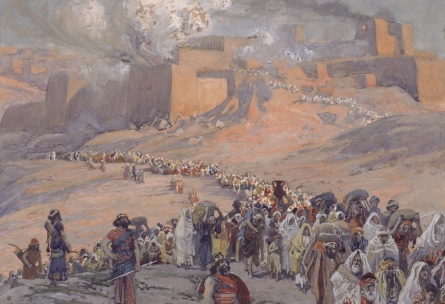
James Tissot, The Flight of the Prisoners

James Tissot, The Flight of the Prisoners

In the ninth year of King Zedekiah of Judah, in the tenth month, King Nebuchadrezzar of Babylon and all his army came against Jerusalem and besieged it; 2 in the eleventh year of Zedekiah, in the fourth month, on the ninth day of the month, a breach was made in the city. 3 When Jerusalem was taken, all the officials of the king of Babylon came and sat in the middle gate: Nergal-sharezer, Samgar-nebo, Sarsechim the Rabsaris, Nergal-sharezer the Rabmag, with all the rest of the officials of the king of Babylon. 4 When King Zedekiah of Judah and all the soldiers saw them, they fled, going out of the city at night by way of the king’s garden through the gate between the two walls; and they went toward the Arabah. 5 But the army of the Chaldeans pursued them, and overtook Zedekiah in the plains of Jericho; and when they had taken him, they brought him up to King Nebuchadrezzar of Babylon, at Riblah, in the land of Hamath; and he passed sentence on him. 6 The king of Babylon slaughtered the sons of Zedekiah at Riblah before his eyes; also the king of Babylon slaughtered all the nobles of Judah. 7 He put out the eyes of Zedekiah, and bound him in fetters to take him to Babylon. 8 The Chaldeans burned the king’s house and the houses of the people, and broke down the walls of Jerusalem. 9 Then Nebuzaradan the captain of the guard exiled to Babylon the rest of the people who were left in the city, those who had deserted to him, and the people who remained. 10 Nebuzaradan the captain of the guard left in the land of Judah some of the poor people who owned nothing, and gave them vineyards and fields at the same time.

The city finally falls, the event which Jeremiah has foretold but also dreaded has finally occurred. Nebuchadrezzar’s army besieges the city of Jerusalem for a year and a half. The parallel telling of this event in 2 Kings 25 also relates, what we learned in the previous chapter of Jeremiah, that food had run out and that at the time the city wall is breached the people are beginning to starve. After a year and a half under siege this part of the narrative shows this final collapse happening with little resistance. The King Zedekiah and the remnants of the army and the officials flee by night, the officials of Babylon set up court in the gate of the city, and even in their fleeing we get the impression that Zedekiah and they are quickly overtaken as they attempt to flee across the Jordan river to Arabah. The punishment of the leaders is swift as the sons of the kin and the nobles of Judah, the leaders who had continued to push for resistance to Babylon, are killed when Nebuchdrezzar passes sentence in Hamath (Syria). Zedekiah is blinded and bound, most likely to be led back through the capitol of Babylon as a spoil of war to show how the might of Babylon has humiliated the Judeans who opposed them. In contrast to the first exile where the majority of the people are left in Judea, now this time Nebuzaradan, the captain of the guard, is charged with organizing a massive exile of those who survived the siege as well as those who fled and surrendered to Babylon. Only the poorest are left, these meek who inherit the earth, the pastures and the vineyards that were once owned by the powerful. Perhaps these are some of the slaves who were freed only to be brought immediately back into captivity (see Jeremiah 34), or those who suffered the loss of everything in the long costly war brought onto them by their leaders. Regardless, for the majority of the Judeans heading into exile it is a bitter pill to swallow. As Psalm 137 laments:

 By the rivers of Babylon—there we sat down and wept when we remembered Zion.
 On the willows there we hung up our harps
 For their our captors asked us for songs,
 And our tormentors asked for mirth, saying,
“Sing us one of the songs of Zion!”
How could we sing the LORD’s song in a foreign land?
If I forget you, O Jerusalem, let my right hand wither!
Let my tongue cling to the roof of my mouth, if I do not remember you,
If I do not set Jerusalem above my highest joy.
Remember, O LORD, against the Edomites the day of Jerusalem’s fall
How they said, “Tear it down! Tear it down! Down to the foundations!”
O daughter Babylon, you devastator!
Happy shall they be who pay you back what you have done to us!
Happy shall they be who take your little ones and dash them against the rock!
 (Psalm 137)

The promise of Jerusalem, the temple, the Davidic dynasty have all failed as the people are marched into a foreign land as exiles. They will have to begin to rediscover who they are as the people of God, and what it means to be the chosen people without the land, a temple or a king. But for this moment they are entering a season of lament and grief. We know from earlier in Jeremiah hope will rise again, but in the midst of the desolation of despair the people may only be able to sings songs of lament and utter prayers of vengeance.

Jeremiah 39: 11-18 Protecting Jeremiah and Ebed-melech

11 King Nebuchadrezzar of Babylon gave command concerning Jeremiah through Nebuzaradan, the captain of the guard, saying, 12 “Take him, look after him well and do him no harm, but deal with him as he may ask you.” 13 So Nebuzaradan the captain of the guard, Nebushazban the Rabsaris, Nergal-sharezer the Rabmag, and all the chief officers of the king of Babylon sent 14 and took Jeremiah from the court of the guard. They entrusted him to Gedaliah son of Ahikam son of Shaphan to be brought home. So he stayed with his own people.

15 The word of the LORD came to Jeremiah while he was confined in the court of the guard: 16 Go and say to Ebed-melech the Ethiopian: Thus says the LORD of hosts, the God of Israel: I am going to fulfill my words against this city for evil and not for good, and they shall be accomplished in your presence on that day. 17 But I will save you on that day, says the LORD, and you shall not be handed over to those whom you dread. 18 For I will surely save you, and you shall not fall by the sword; but you shall have your life as a prize of war, because you have trusted in me, says the LORD.

On the orders of King Nebuchadrezzar of Babylon, Jeremiah is sought out by the officials present in Jerusalem for protection. Jeremiah is freed from his confinement in the court of the guard and placed under the care of Gedaliah who is left in charge of the devastated city and land. Jeremiah is protected, and perhaps for many of his own people this only furthers their conviction that he is a traitor, yet he is sheltered and protected in the midst of the destruction and allowed to remain with the Judean people in the land. Although we only hear the promise of protection to Ebed-melech, the Ethiopian who pulled Jeremiah out of the cistern in Jeremiah 38, he also is promised his life and protection. In contrast to King Zedekiah who heard Jeremiah’s message several times and did not listen and is forced to watch his sons killed and led to Babylon in chains, now this servant of the king who is not a Judean and is a eunuch does hear and inherits his life, the same promise that Jeremiah made again to the king in Jeremiah 38.  This is not a story where Jeremiah or probably Ebed-melech live happily ever after, but in the midst of the death that surrounds them they live and they endure in the midst of the destruction of the nation and city around them.

Jeremiah 38: The Officials, The Prophet, The Eunuch and the King

Jeremiah 38: 1-13 The Persecution and Rescue of the Inconvenient Prophet

Salvatore Rosa, Jeremie Tire De La Cistern, 3rd quarter of the 17th Century

Salvatore Rosa, Jeremie Tire De La Cistern, 3rd quarter of the 17th Century

Now Shephatiah son of Mattan, Gedaliah son of Pashhur, Jucal son of Shelemiah, and Pashhur son of Malchiah heard the words that Jeremiah was saying to all the people, 2 Thus says the LORD, Those who stay in this city shall die by the sword, by famine, and by pestilence; but those who go out to the Chaldeans shall live; they shall have their lives as a prize of war, and live. 3 Thus says the LORD, This city shall surely be handed over to the army of the king of Babylon and be taken. 4 Then the officials said to the king, “This man ought to be put to death, because he is discouraging the soldiers who are left in this city, and all the people, by speaking such words to them. For this man is not seeking the welfare of this people, but their harm.” 5 King Zedekiah said, “Here he is; he is in your hands; for the king is powerless against you.” 6 So they took Jeremiah and threw him into the cistern of Malchiah, the king’s son, which was in the court of the guard, letting Jeremiah down by ropes. Now there was no water in the cistern, but only mud, and Jeremiah sank in the mud.
                7 Ebed-melech the Ethiopian, a eunuch in the king’s house, heard that they had put Jeremiah into the cistern. The king happened to be sitting at the Benjamin Gate, 8 So Ebed-melech left the king’s house and spoke to the king, 9 “My lord king, these men have acted wickedly in all they did to the prophet Jeremiah by throwing him into the cistern to die there of hunger, for there is no bread left in the city.” 10 Then the king commanded Ebed-melech the Ethiopian, “Take three men with you from here, and pull the prophet Jeremiah up from the cistern before he dies.” 11 So Ebed-melech took the men with him and went to the house of the king, to a wardrobe of the storehouse, and took from there old rags and worn-out clothes, which he let down to Jeremiah in the cistern by ropes. 12 Then Ebed-melech the Ethiopian said to Jeremiah, “Just put the rags and clothes between your armpits and the ropes.” Jeremiah did so. 13 Then they drew Jeremiah up by the ropes and pulled him out of the cistern. And Jeremiah remained in the court of the guard.

                 This chapter of Jeremiah does a great deal to highlight the situation at the end of the kingdom of Judah in ways that are surprising. Jeremiah’s long call for what sounds to many of his listeners like a pro-Babylonian policy, where God has sided not with God’s chosen people but with the Chaldean invaders, and he is viewed by many of the ‘officials’ as a traitor. In honesty, imagining myself from my previous time as a soldier in a very different time and army, there was a time when I probably would have looked at someone talking the way Jeremiah does as a traitor as well. Perhaps it would be the easier and more natural reaction for me as well. The officials have bought into the idea that being the covenant people, having the holy city and the temple and the Davidic king guarantees their position. Even now when the siege of Jerusalem has dried up the city’s resources and there is no food left they hold on doggedly to their own positions and ideology, even though Jeremiah’s long message rings truer every day. Their pro-Egyptian alliance and policies have failed them, and perhaps they believe in their desperation that if they can quiet Jeremiah they can quiet the very real voices of dissent that must be emerging at this point. From later in the chapter we see that there are already those who have deserted the city and have either heeded Jeremiah’s words or seen the senselessness of dying of starvation behind the walls that will soon be crumbling. Jeremiah has been once taken out of the house of Jonathan the secretary and the king has offered him some protection, but now the ‘officials’ throw him into the mud-filled cistern to die of dehydration and starvation.

King Zedekiah also occupies a role that most people do not imagine with a king. Zedekiah does not wield total control of the people, in fact many of these officials seem to be the ones able to manipulate the course of how things will go. Zedekiah the son of Josiah, the devout king who attempted to lead the people of Judah back to trusting in the LORD, now finds himself powerless against these officials. Perhaps he is weak and ineffective, or perhaps he finds himself with a position without any real power with others who are skilled at operating the mechanisms of power pulling the strings. Regardless of how Zedekiah found himself in a weak position, here he stands caught between the coming onslaught of Babylon and those in his own government who have locked Jerusalem into a struggle it cannot win.

Finally into the scene enters the unlikely hero, Ebed-melech an Ethiopian eunuch. Not Jewish, not even a person who can enter into the temple, but a person who (unlike the officials) can see that persecuting the LORD’s prophet is wicked. In a scene that is full of compassion, Ebed-melech goes to the king and tells him what is going on. With the king’s approval he goes with three others and not only removes Jeremiah from this cistern where he was sentenced to die but thinks enough to bring padding to protect the abused prophet’s armpits as they lift him out of the pit. These Judean officials are thwarted by the actions of Ebed-melech and again Jeremiah is brought to the court of the guard.

It is a world in chaos with competing agenda and ideologies. Where in the chaos of collapse there are still those grasping for the seats of power on the sinking ship. Yet the prophet continues his impassioned plea to save the city and the temple and the people, in spite of all he has endured.


Jeremiah 38:14-28 The King and The Prophet

                14 King Zedekiah sent for the prophet Jeremiah and received him at the third entrance of the temple of the LORD. The king said to Jeremiah, “I have something to ask you; do not hide anything from me.” 15 Jeremiah said to Zedekiah, “If I tell you, you will put me to death, will you not? And if I give you advice, you will not listen to me.” 16 So King Zedekiah swore an oath in secret to Jeremiah, “As the LORD lives, who gave us our lives, I will not put you to death or hand you over to these men who seek your life.”
 17 Then Jeremiah said to Zedekiah, “Thus says the LORD, the God of hosts, the God of Israel, If you will only surrender to the officials of the king of Babylon, then your life shall be spared, and this city shall not be burned with fire, and you and your house shall live. 18 But if you do not surrender to the officials of the king of Babylon, then this city shall be handed over to the Chaldeans, and they shall burn it with fire, and you yourself shall not escape from their hand.” 19 King Zedekiah said to Jeremiah, “I am afraid of the Judeans who have deserted to the Chaldeans, for I might be handed over to them and they would abuse me.” 20 Jeremiah said, “That will not happen. Just obey the voice of the LORD in what I say to you, and it shall go well with you, and your life shall be spared. 21 But if you are determined not to surrender, this is what the LORD has shown me– 22 a vision of all the women remaining in the house of the king of Judah being led out to the officials of the king of Babylon and saying,
‘Your trusted friends have seduced you and have overcome you;
Now that your feet are stuck in the mud, they desert you.’
 23 All your wives and your children shall be led out to the Chaldeans, and you yourself shall not escape from their hand, but shall be seized by the king of Babylon; and this city shall be burned with fire.”
 24 Then Zedekiah said to Jeremiah, “Do not let anyone else know of this conversation, or you will die. 25 If the officials should hear that I have spoken with you, and they should come and say to you, ‘Just tell us what you said to the king; do not conceal it from us, or we will put you to death. What did the king say to you?’ 26 then you shall say to them, ‘I was presenting my plea to the king not to send me back to the house of Jonathan to die there.'” 27 All the officials did come to Jeremiah and questioned him; and he answered them in the very words the king had commanded. So they stopped questioning him, for the conversation had not been overheard. 28 And Jeremiah remained in the court of the guard until the day that Jerusalem was taken.

King Zedekiah is a tragic figure in this narrative, and I believe that Jeremiah has some compassion for him, if for no other reason than him being Josiah’s son. Jeremiah once again is summoned to meet with the king in ‘secret’ (although it is a secret that everyone knows occurs even if they don’t know the content of what is said). For those who have read George R.R. Martin’s Fire and Ice series (which the HBO series Game of Thrones gets its storyline) it is almost like in King’s Landing where there are the listeners employed by Cersei, Varus, and Littlefinger, all keeping track of everyone’s movements.  King Zedekiah also seems to at least respect Jeremiah, and maybe even believes his words (though he is unable to act on them). This is the last time Jeremiah will make this plea for the King to surrender and his life and the city will be saved. We learn from the king’s words that there are already Judeans who have defected to the Babylonians, and the king is afraid that in his surrender he would fall into their hands. We also know from the official’s words earlier in the chapter when the mention the soldiers ‘who are left’ that either many of the soldiers have fallen or some of them too have defected (very likely in my opinion). Jeremiah’s words again are for naught, the king does not act on them, but he does continue to protect Jeremiah and his excuse that he tells Jeremiah to tell the ears of the already curious eyes watching is a plausible one, ‘to keep him out of the house of Jonathan’ where Jeremiah has already been once and fears to go again. The time is short, Jeremiah’s days in the court of the guard are coming to an end and with them the city of Jerusalem is approaching its end.