Category Archives: Biblical Reflections

Matthew 5: 1-12 The Wisdom of the Sermon on the Mount

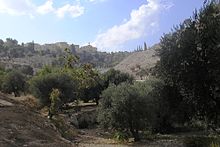
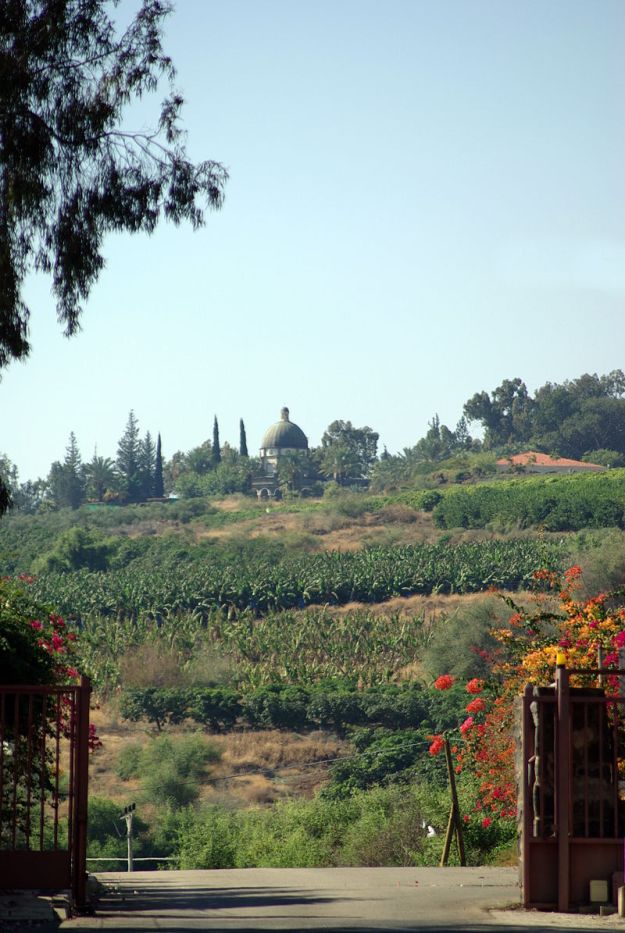
Mount of Beatitudes, seen from Capernaum. Photo by Berthold Werner, public domain

Matthew 5: 1-12

Parallel Luke 6: 20-26

Highlighted words will have comment on translation below

1 When Jesus saw the crowds, he went up the mountain; and after he sat down, his disciples came to him. 2 Then he began to speak, and taught them, saying:

3Blessed are the poor in spirit, for theirs is the kingdom of heaven.
4Blessed are those who mourn, for they will be comforted.
5Blessed are the meek, for they will inherit the earth.
6Blessed are those who hunger and thirst for righteousness, for they will be filled.
7Blessed are the merciful, for they will receive mercy.
8Blessed are the pure in heart, for they will see God.
9Blessed are the peacemakers, for they will be called children of God.
10Blessed are those who are persecuted for righteousness’ sake, for theirs is the kingdom of heaven.
11Blessed are you when people revile you and persecute you and utter all kinds of evil against you falsely on my account. 12 Rejoice and be glad, for your reward is great in heaven, for in the same way they persecuted the prophets who were before you.

The Sermon on the Mount is designed to be heard as one unit, even though we often break it up into individual readings and for the sake of space I will be dealing with smaller sections (even as I try to address it as an intentionally assembled and compact unit of teaching). Matthew constructs the Sermon on the Mount and places it early in the gospel to help the hearers in his time and later times understand what life in the community of disciples can be like, to open their ears, eyes, hearts, minds and imaginations to the kingdom of heaven. We probably do not have a transcript of Jesus’ teaching on at one specific time and place, but I do assume that the teachings collected in the sermon were among the memorable things that Jesus said and were probably used in multiple teaching opportunities. Several similar teachings are placed in different locations in Luke’s gospel, but the gospel writers were concerned with constructing their gospels to highlight what they felt was critical for their churches to understand about Jesus and the kingdom of heaven.

Location matters in the gospels, and Jesus going up the mountain is not only an action that allows him to be seen and heard by the crowds but it also (especially considering the content of the sermon) links him symbolically with Moses. Moses would go up the mountain to receive the law from God, now Jesus goes up the mountain to fulfill the law and the prophets. Jesus here and at the mountain of transfiguration will be linked to Moses (and Elijah and the rest of the prophets) and will also surpass them. But location helps to emphasize that Jesus is one speaking with the authority to declare the things he states. This will be especially important later in the chapter as he expands on the law.

The Beatitudes, the common name for Matthew 5: 3-12, get their name from the word in Latin that we translate as ‘blessed.’ This is another place where translation can obscure a linkage that may have been obvious to the initial hearers of the message. The Greek makarios is often used to translate the Hebrew asre which is often used in wisdom literature. I do think that we are invited into the framework of wisdom literature with its choice between the way of the wise and the foolish, those who follow the law and those who do not and this linkage is heightened in Luke’s similar blessings and woes in Luke 6: 20-26.  Asre is normally translated happy in the NRSV, for example:

Happy are those who do not follow the advice of the wicked, or take the path that the sinners tread, or sit in the seat of scoffers. (Psalm 1:1)

Happy are those to whom the LORD imputes no iniquity, and in whose spirit there is no deceit. (Psalm 32:2)

Happy are those who live in your house, ever singing your praise. Selah

Happy are those whose strength is in you, in whose heart are the highways to Zion. (Psalm 84: 4-5)

Happy are those whose way is blameless, who walk in the way of the LORD. Happy are those who keep his decrees, who seek him with their whole heart, (Psalm 119: 1-2)

Happy are those who find wisdom, and those who get understanding, (Proverbs 3: 13)

Happy is the one who listens to me, watching daily at my gates, waiting beside my doors. (Proverbs 8: 34)

Several other sayings in both Psalms, Proverbs, the prophets and the law take this form encouraging the people to choose the way that is being stated. Although the translation of makarios into blessed brings its own set of meaning to the passage I am going to begin to highlight terms that I would retranslate to bring in a different shade of meaning. For most people ‘blessed’ may have the sense of happiness with it but when they read religious language they simply take it as declarative language where God declares something ‘blessed’ and it is made holy but it doesn’t necessarily change anything for the ‘blessed one.’ While I agree with those who would highlight the aspect of inclusion for those excluded here in this passage (poor in spirit, mourners, meek, and those hungering and thirsting for righteousness) I also think it is important that we hear, in terms of wisdom literature and the language of the beatitudes, that in this kingdom of heaven those who have been unhappy, oppressed and excluded are invited to a community where they will be happy and the things they need to be happy will be given to them.

The gospel writers were each clever in the way they construct their gospels to link critical stories together and Matthew links this initial teaching section with his final section of teaching in Matthew 25, as Richard B. Hays can highlight:

Matthew creates an inclusio with the Beatitudes of Matthew 5: 3-12 by narrating an unsettling last judgment scene in which Jesus/Emmanuel turns out to have been present among us in the hungry and thirsty and naked and sick and imprisoned of this world. (Matt 25: 31-46). This, too, is an integral part of what “God with us” means in Matthew, as exemplified in the story of Jesus’ own suffering, culminating in the cross. To recognize God’s presence truly, then, Matthew’s readers must serve the needs of the poor, for “just as you did it to one of the least of these brothers, you did it to me:” (25:40) (Hays, 2016, p. 170)

Unlike Luke where the blessings and woes are placed next to one another, in Matthew the inclusion allows us to see the invitation at the beginning of Jesus’ teaching and the consequence for not following this wisdom at the end.

Moving into the Beatitudes themselves I will divide them into two sets of four and then a final saying set off by a change in reference (from blessed are the ones/those to blessed are you). The first set of four are those who God is depicted in scripture frequently being their advocate against those in power. The second set addresses those who are attempting to live in the way that they are called to live, and the final phrase addresses those who are persecuted specifically for living on account of Jesus for their rejection among the unwise will mean reward in the kingdom of heaven.

The ideas that will be articulated in the Beatitudes and the rest of the Sermon on the Mount are grounded in the vision of what Israel was to be for the sake of the world. Israel was always intended to be an alternative vision of society to the model used by Egypt, Assyria, Babylon, Greece, Rome or any other empire or nation ancient or modern. It was to be a society where they loved and feared the LORD their God and they loved and protected their neighbor. Much of the law is imagining a society where not only are the landholding members of the people of Israel protected but also the alien, the poor, the widow and the orphan. Israel often failed to embody this type of society, often emulating the practices of the larger nations around them with the powerful enlarging their own property, power, wealth and households by exploiting or failing to protect their vulnerable neighbors. The society gathered around Jesus are invited again into a kingdom where the poor in spirit, the mourning, the meek and those hungering and thirsting for righteousness are protected both by the community and by God.

The poor in spirit, in contrast to the poor in Luke 6:20, has caused a lot of debate about what Matthew means. My reading of this passage is the ‘poor in spirit’ and the ‘poor’ are referring to the same group, it is not a spiritualization of poverty but instead refers to those who have been oppressed and are holding on to their last thread of hope, against all evidence to the contrary, that God will deliver them. The longstanding wisdom of the Hebrew scriptures is that God is the one who will side with the poor against their oppressors and in the words of Proverbs, “Those who oppress the poor insult their Maker, but those who are kind to the needy honor him.” (Proverbs 14:31) The kingdom of the world may have no place for the poor, but the kingdom of heaven will belong to them. They can be happy because in the society that Jesus is presenting to the disciples and hearers they are included, valued and protected. They can be blessed because they have what they need to have the life God desires for them, and, as we will learn in Matthew 25, Jesus will be found among them.

The mourners are those who weep at the state of the world. The mourning may be personal, due to the loss of a loved one, or it may be social due to the loss of property, occupation, meaning or place in society. In contrast to the Greco-Roman worldview which disapproved of mourning (Carter, 2005, p. 132) and the stoic worldview many in the United States inherited, there was an expectation of mourning and a rich tradition of lament included in the Hebrew Scriptures, especially in the Psalms. Yet, there is also a confident hope in a God who could and would reverse the situations in the world that caused the faithful to mourn and lament. Isaiah 25:7-8 is one of the articulations of hope in a God who can destroy every enemy that haunts them and then comfort them in what should be familiar language for most Christians

And he will destroy on this mountain the shroud that is cast over all peoples, the sheet that is spread over all nations; he will swallow up death forever. Then the LORD God will wipe away the tears from all faces, and the disgrace of his people he will take away from all the earth, the LORD has spoken. (emphasis mine)

 Meekness in English means quiet, gentle, submissive or easily imposed upon which is similar in meaning to praus the Greek word behind it, but this word in Biblical usage is not so simple to translate. This word refers to Jesus twice in Matthew:

Take my yoke upon you, and learn from me; for I am gentle and humble in heart, and you will find rest for your souls. (Matthew 11: 29)

Tell the daughter of Zion, Look, your king is coming to you, humble and mounted on a donkey, and on a colt, the foal of a donkey. (Matthew 21:5)

The highlighted terms are both the Greek praus translated as gentle or humble. I think meek captures a shade of what Jesus is alluding to here, for they are those who rather than rising up in violent reaction to the oppression they may encounter are those who wait for God to deal with the wicked. As Psalm 37 can state:

Yet a little while, and the wicked will be no more; though you look diligently for their place, they will not be there. But the meek shall inherit the land, and delight themselves in abundant property. (Psalm 37: 10-11)

The final Beatitude of the first section is those who hunger and thirst for righteousness who will be filled. As with the previous three I read this as those who have suffered under the oppression of the current state of society and need God’s liberation, they are those who seek righteousness in society and before God but are hungry and thirsty in the midst of their attempt to live a righteous rather than a wicked life. When they strive first the kingdom of heaven, they are promised that all the things they need for food, clothing and life will be granted to them as well (Matthew 6: 25-34).

With the second set of Beatitudes are exhortations which point to the way of life that will be further described in the Sermon on the Mount and throughout Jesus’ life and ministry. Throughout Matthew’s gospel the understanding of what righteousness looks like is always read through the lens of mercy. From Joseph being a righteous man and deciding to act with mercy towards Mary (Matthew 1:19), to Jesus frequent transgressions of a literal reading of the law to act in mercy we are shown a hermeneutic[1] of mercy throughout this gospel. The merciful will receive mercy, and this is a way of reading the law that will contrast with the readings of the Pharisees and Sadducees Jesus encounters in Matthew. For example, in Matthew 9: 9-13, Jesus will tell the Pharisees criticizing his practice of eating with sinners and tax collectors, “Those who are well have no need of a physician, but those who are sick. Go and learn what this means, ’I desire mercy, not sacrifice.’ For I have come to call not the righteous but sinners.” (Matthew 9:11) Jesus’ words and actions will embody this hermeneutic of mercy and Hosea 6:6 (quoted in Matthew 9:11) seems to be a key text that Jesus and his followers are to use to unlock what scripture is to mean for their lives. As Richard B. Hays can state,

Clearly, for Matthew, mercy is a central theme. The important thing to recognize, in all these passages, is that the quality of mercy is not set in opposition to the Torah; rather, Matthew’s Jesus discerns within Scripture itself the hermeneutical principle—expressed epigrammatically in Hosea 6:6—that all the commandments are to be interpreted in such a way as to engender and promote the practice of mercy among God’s people. (Hays, 2016, p. 127)

The pure in heart are those who live in faithfulness to the vision of the kingdom of heaven articulated here and throughout Jesus’ ministry. As Psalm 24 can remind us:

Who shall ascend the hill of the LORD? And who shall stand in his holy place? Those who have clean hands and pure hearts, who do not lift up their souls to what is false, and do not swear deceitfully. (Psalm 24: 3-4)

Those of pure hearts and clean hands may approach the place of God in the psalm, and here the pure in heart are prepared to see God. The preparation for God’s approach is not ritual action or sacrifice but a life properly lived. The heart in Hebrew thought is not the instrument of emotion (that would be the gut) but rather the instrument of will and decision. Those who are pure in their will and decision, who live according to the way of righteousness rather than foolishness will see God. Seeing God may be impossible for mortals in several places in the scriptures, but one of the themes of Matthew’s gospel is that in Jesus we encounter ‘God with us.’ Yet, as discussed above this is also the “God with us” who is found with the hungry, thirsty, naked and poor. Those who are not pure in heart may be those who missed the appearance of God because they did not choose a way of righteousness and mercy which sees the need of the community around them, but in the kingdom of heaven the poor in spirit, mourning, meek and the ones hungering and thirsting for righteousness have already been granted a place with God.

Peacemaking in the kingdom of heaven is meant to be understood in contrast to the image of peace practiced by Rome which was peace through conquest and military might. When I served in Nebraska, near the former headquarters for Strategic Air Command, I would sometimes see stickers on vehicles with a B-52 Stratocaster bomber replacing the arms of a peace sign with a caption, “Peace the old-fashioned way.” This would fit with the Roman understanding of the Pax Romana which, in the language of the ancient historian Tacitus, “pacem sine dubio…verum cruentam. Peace there was, without question, but a bloody one” (Zanker, 1988, p. 187) The peace of the kingdom of heaven will only be a bloody one because the one who embraces it may be crucified by the emissaries of the kingdoms of the world, not because they respond in violence. The kingdom of heaven will be a place where reconciliation is more important than sacrifice, where enemies are loved, and where cheeks are turned in response to being struck. Those who practice this type of community will be welcomed into a familial relationship with the daughters and sons of God.

Those who are persecuted for righteousness sake as those who are persecuted for living a life that is shaped by this merciful, pure in heart and peaceful version of righteousness that Jesus will articulate. Structurally we are also linked back to the first Beatitude since both the poor in spirit and those persecuted for righteousness are inheritors of the kingdom of heaven. Ultimately this righteousness that one will be persecuted for involves standing with the poor in spirit, the mourning ones, the meek and the ones hungering and thirsting for righteousness. Disciples will be continually called to take up their cross. It will be a struggle for the kingdom of heaven to enter this world. Rather than responding to violence with violence they will respond with endurance instead.

The final Beatitude switches suddenly to a second person plural (all of you) where those who are gathered around Jesus now are addressed as ones who may be happy in the midst of being persecuted verbally or physically since it bears witness to their faithfulness to this kingdom. Their reward is great in this community because they are like one of the prophets who remained faithful to God in the midst of a faithless time. They are a part of a community, like the prophets, who believed that in a time of injustice the God’s justice would triumph, in a world of bloody peace believed that God’s true peace would come, who believe in mercy more than sacrifice and in a God who stand with the poor in spirit, the mourning ones, the meek and the one hungering and thirsting for a righteousness they’ve yet to see. Yet, they can be happy or blessed because the kingdom of heaven is being embodied in their hearing.          

[1] A hermeneutic is a way of interpretation, a word that is frequent in the world of scholarship but rarely heard outside the worlds of philosophy, scriptural interpretation and theology but I include it because it is a useful word in framing how to read a text.

Introduction to the Sermon on the Mount

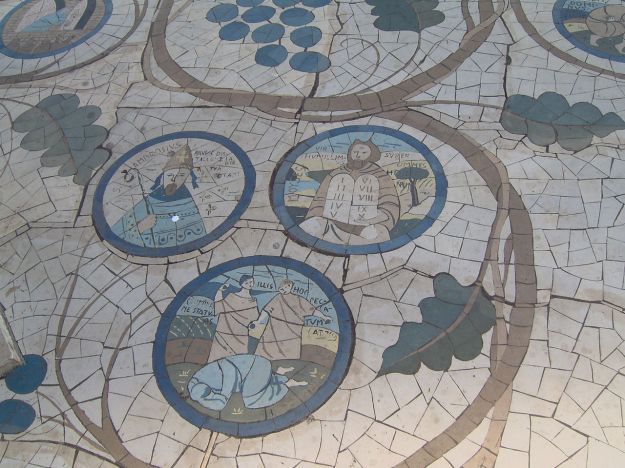
Mosaic on the Mount of Beatitudes in Israel (Images are St. Ambrose,, Moses and the Stoning of Stephen) Shared under Creative Commons 2.5

The Sermon on the Mount (Matthew 5-7) is probably the best know piece that is unique to Matthew’s gospel (as it is assembled, although much of the material in the Sermon is found throughout Luke’s gospel) and there are scholars who have spent their entire careers focused on this small section of Matthew’s gospel. You don’t have to be a scholar to read the Sermon on the Mount and see that it calls the hearer to a different set of values than one will see practiced in the world around them. As a hearer you have the choice of how to respond to this expansion on the law given to Moses, the practices of prayer, fasting, how one values one’s treasurers and what one does with them, judging and more in this initial teaching section of Matthew’s gospel. Matthew constructed the gospel to quickly bring us to this first block of teaching and instruction and Matthew spends a lot of space in the gospel listening to the teaching of Jesus and letting it shape the community that hears it.

The words of the Sermon on the Mount have often been viewed as: an unattainable ethic which serves only to drive us to the grace of Christ, an interim ethic to bring about a radical reorientation in the context of Jesus’ presence and the quickly approaching judgment (which didn’t occur as expected in most reconstructions following this view) or a perfectionist ethic that Christ does expect Christians to follow. Each of these approaches in their own way minimize the imperative to attempt to live into the vision the sermon presents.  Prior to Luther the way of life embodied in the Sermon on the Mount was mainly limited to those who had separated themselves in monastic communities but one of the impacts of the Reformation was the ideal of bringing the reading, interpretation and the living of scripture as actions of the entire church was the perceived impossibility of all the baptized keeping this ethic. The solution for Luther, as one example, was perfect doctrine rather than perfect practice:

We cannot be or become perfect in the sense that we do not have any sin, the way they dream about perfection. Here and everywhere in Scripture “to be perfect,” means in the first place, that doctrine be completely correct and perfect, and then, that life move and be regulated according to it. (LW 21:129)

In fairness to Martin Luther, he did believe that correct doctrine would lead to a reformed way of living, that faith would lead a Christian to be a perfectly dutiful servant of all. Yet the perfectionistic way in which we frame the Sermon on the Mount I believe prevents us from honestly wrestling with the way of life that Matthew is presenting to those who would be disciples of Jesus.

Although I will deal with the translation of Matthew 5:48 when I reach that section, I do believe it is important enough to deal with up front because it is a crucial verse. The NRSV translates this final verse of the fifth chapter, “Be perfect, therefore, as your heavenly Father is perfect.” Many scholars follow the translation in a manner like O. Wesley Allen,

Likewise, there are idealistic expectations in the discourse that seem beyond the reach of any normal, finite, sinful human being or human community summed up in the expression, “Be perfect, therefore, as you heavenly Father is perfect. (Allen, 2013, p. 53)

The word translated as perfect is telios which is a word with the connotation of completeness, or reaching an end/goal, of being mature or grown up. As a person who grew up in the individualistic ethos that is instilled in people who grow up in the United States, perfection is a term which depends upon individual rigor in attending to the letter of the law but one of the things I’ve discovered in my time studying the Hebrew Scriptures is that the law is always directed towards the community. An individual may act righteously or wickedly, they may be innocent or blameless but the law itself is always directed towards the life of the community. When I studied Deuteronomy, for example, I framed my examination of the law in terms of the type of society they were attempting to create. If the Sermon on the Mount is about the type of community that the kingdom of heaven embodies, as I will argue, then perhaps it is a primer in how to live together as the people of God rather than a model for individual perfection.

Jesus doesn’t seem to focus his ministry on attaining moralistic perfection, but instead the kingdom of heaven seems to be much more related toward surprising compassion towards the people Jesus encounters. As E. P. Sanders can state:

Secondly, the overall tenor of Jesus’ teaching is compassion toward human frailty. He seems not to have gone around condemning people for their minor lapses. He worked not among the powerful, but among the lowly, and he did not want to be a stern taskmaster or a censorious judge, who would only add to their burdens…

Thirdly, Jesus did not live a stern and strict life. For most of us the word ‘perfectionism’ calls up images of severe Puritanism: lots of rules, plenty of punishment for error and not much room for fun. This sort of Puritanism, according to Jesus, was all right; an austere life had been fine for John the Baptist, but it was not his own style. (Sanders, 1993, pp. 202-203)

Finally, the way perfection is modeled in the United States does pull on our history of severe Puritanism, even as it has transformed in our secular society under the guise of a non-religious perfectionism.  So for the moment let us set aside our ideas of being perfect or achieving perfection in an individualistic sense and let us enter this world that Jesus is articulating for us in the Sermon on the Mount. Matthew has brought us quickly to the mountain to hear these words from Jesus, so may we have ears to hear, eyes to see, minds whose imagination can dream this dream of the kingdom of heaven, and hearts to courageously strive together for this community of disciples.


Perfection and Blamelessness in the Bible

In looking at how to approach the Sermon on the Mount, I’ve wrestled with how to translate the word translated perfect in Matthew 5:48 and while my suspicion is that perfect is not a good translation for the Greek work telos, I wanted to look more broadly at how the scriptures dealt with the idea of being perfect, perfection or blameless.

Perfect, Perfection and Blamelessness in the Hebrew Scriptures

There are two primary words in Hebrew that end up translated perfect, perfection and blameless and they are related two each other. Hebrew words begin as a verbal form and so the verb root is :תָּם
(Tam) which in its Qal form means to complete, finish, fulfill, to be finished, come to an end and in its Hitp’ael form means finish, complete, perfect, cease doing a thing, complete or shut up.[1]This verb also has a noun form (Tim) and the more common for our current examination adjectival form Tamim. There are a few other Hebrew terms which get translated perfect or blameless (for example Daniel 6:22 translates a term that normally is translated purity (zaku) for blameless and Lamentations and Ezekiel use the word kelil for a poetic reflection of perfection in terms of beauty).

In the Hebrew Scriptures these translations rarely talk about moralistic perfection which is often implied to an English reader of the words perfect, perfection, and blameless and below I am listing my categories of what these translations are referring to:

Innocence/Righteousness

Righteousness/Justice is an important concept in Hebrew thought, but I think it is easy for us to assign a modern interpretation on Justice or the Law which doesn’t coincide with a Hebrew way of understanding the gift implied in these terms. Often when Tam or Tamim is translated blameless it is referring to the concept of a person being innocent or righteous. In both Hebrew and Greek justice and righteousness are rooted in the same term (tszadik in Hebrew, dikaisoune in Greek) and while there is a sense where righteousness is linked to keeping the commands and ordinances of the law, it more broadly encompasses living in a right relationship with God and one’s neighbors. Tamim or Tam can be translated in parallel with righteousness, for example in Genesis 6:9 Tamim is translated blameless in parallel with righteousness and refers to Noah being innocent unlike his generation: “Noah was a righteous man, blameless in his generation” (see also Genesis 17:1 in relation to God calling Abram to be innocent (blameless)). This is also the primary way the book of Job uses the Tam and Tamim family of words, for example: There is no one like him, a blameless and upright man (Job 2:3, see also Job 1:1, 8; 8:20; 9:20, 21,22; 12:4; 22:4). Being blameless is parallel to being upright or righteous but it is not used in the sense of legalistically keeping every possible interpretation of the law, instead it is often used more generally to speak of a person’s character being in accordance with God’s intent for life in the community of faith.

Sacrificial Acceptability or Completion in Dedication to God

Another usage of Tamim or Tam when translated perfect is related to a cultic usage where a sacrifice or item is acceptable for use in sacrifice or the worship of God. Leviticus 22:21 is an example of this usage for a sacrifice, “When anyone offers a sacrifice of well-being to the LORD, in fulfillment of a vow or as a freewill offering, from the herd or from the flock, to be acceptable it must be perfect; there shall be no blemish in it.” This also is used when the temple is dedicated in 1 Kings to talk about the completion of the space in preparation for worship, “Next he overlaid the whole house with gold, in order that the whole house might be perfect; even the whole altar that belonged to the inner sanctuary he overlaid with gold”(1 Kings 6:22). Tamim and Tamm are used to reflect completeness or wholeness, which is the sense of perfect reflected by the translation. A sacrifice must be without injury, illness or blemish or the sanctuary was completely overlaid with gold without missing any area.

Completeness/Righteousness in relation to God

This use of Tamim (always the adjective in this usage) occurs in songs and poetry when talking about God as being complete or whole in relation to God being upright. Deuteronomy 32:4 is the first usage of this type in the song of Moses, “This God—his way is perfect; the promise of the LORD proves true; he is a shield for all who take refuge in him” (also used in this manner in David’s song of Thanksgiving in 2 Samuel 22: 31 and in Psalm 18:30)

Completeness in relation to knowledge or content

In the book of Job, the final human voice to speak prior to God’s answer is Elihu who attempts, like the other friends of Job, to convince Job that he must be unrighteous to merit the suffering he is undergoing. In his boasts he claims to have perfect knowledge (or to be in the presence of God who has perfect knowledge) in the sense of knowing everything correctly or completely. (Job 36:4, 37:16)  Psalm 19:7 can also refer to the law as being complete in a similar (but non-ironic) manner, “The law of the LORD is perfect, reviving the soul; the decrees of the LORD are sure, making wise the simple

Poetic Use in Relation to Beauty or Splendor

Perfect or perfection is often used in compliments to poetically state that a person, city or event was attractive, beautiful or wonderful. This is one of the most common usages of Tamim and Tam in Psalms, Song of Solomon, Lamentations, and Ezekiel (which also uses the Hebrew word kelil) and can be used for a woman, a king, the law or even a city like Jerusalem or Tyre. For example, Song of Solomon can refer to a woman, “Open to me, my sister, my love, my dove, my perfect one; for my head is wet with dew, my locks with the drops of night” (Song of Solomon 5:2, see also 6:9). The king of Tyre is described as a signet of perfection and perfect in beauty (Ezekiel 28:12), the law is perfect in terms of admiration(Psalm 119:96) as are Jerusalem (Psalm 50:2, Lamentations 2:15, Ezekiel 16:14) and Tyre (Ezekiel 27: 3-4, 11).

Translated Perfect or Blameless in the New Testament (other than Telos/Teleo)

There are a couple words that get translated perfect or blameless in the New Testament: amemptos is commonly used in Pauline literature and is translated blameless and echoes the sense of innocence/righteousness discussed above for Tam and Tamim in Hebrew.[2] Other terms that get translated as either perfect or blameless (other than telios which will be the focus of the next section) include: amomos (unblemished in terms of sacrifice, blameless in moral terms, Revelation 14: 5), anegkletos (blameless, irreproachable, 1 Timothy 3:10, Titus 1: 6, 7) akakos (innocent, guileless, Hebrews 7:26) holoklepia (wholeness, completeness, soundness-wholeness of health, Acts 3: 16); kataptisis (being made complete, complete, 2 Corinthians 13:9); pas (all, full, great) and plerow (make full, fill, fulfill, bring to completion, Revelation 3:2). Each of these translations capture one of the senses listed for tam and tamim above but since the focus of this is on the translation of the term telos in Matthew’s gospel, we will now turn our attention to this word.

Translating Telos/Teleo in Matthew and the New Testament.

Teleo (verb) and telos (noun) and their derivatives, especially the adjectival form, in Greek are the most common terms translated perfect by the NRSV. The book of Hebrews frequently uses this term in the sense of completeness or sacrificial acceptability. James and 1 John use the term in the sense of highest in terms of comparison (perfect love, perfect law, perfect gift, etc.).[3]Paul uses telos and teleo derivatives three times to indicate completeness which get translated perfect in the NRSV (Romans 12: 2; 2 Corinthians 7:1; 12:9)[4]

Teleios, the adjectival derivative of telos, occurs three times in the gospels, all in the Gospel of Matthew: Matthew 5:48 (twice) and Matthew 19:21 and the NRSV translates each time as perfect:

Matthew 5: 48 Be perfect, therefore, as your heavenly Father is perfect

Matthew 19: 21 Jesus said to him, “If you wish to be perfect, go, sell your possessions, and give the money to the poor, and you will have treasure in heaven; then come, follow me.

The telos family of words are words of ending, completion and reaching a goal, they don’t carry the connotation of moralistic perfection that placing the word perfect in English does. Apparently, this translation goes back to the Latin Vulgate which translates teleios with the latin perfecti and perfectus and translations tend to value consistency with previous translations when possible. However, the lingering impact of perfect on the history of translation of this passage has caused people to hear the Sermon on the Mount as an unattainable pillar of perfection that is unable for human beings to attain. I would argue for a more literal translation in both Matthew 5:48 and 19:21 of complete instead of perfect for reasons I will argue in the introduction to the Sermon on the Mount and in the comments on Matthew 5: 48.


[1] Hebrew verbs have various forms (Qal, Nif’al, Pi’el, Pu’al, Hitpa’el, Hif’il and Hof’al) the Qal is the simple active form where the Hitpa’el is the reflexive form. The form of the verb can significantly change a meaning, but in the case of Tam they are very similar with minor shades of difference.

[2] Philippians 1:10; 2: 15; 3:6; Colossians 1: 22; 1 Thessalonians 2: 10; 3: 13; 5: 23

[3] Hebrews 2:10; 5:9; 7:19; 9:9, 11; 10:1; 11:40; 12:23; James 1:17, 25; 3:2; 1 John 4:8

[4] I 1 Corinthians 1:8 the NRSV translates telos in its normal meaning as end

Matthew 4: 18-25 Snagging the Fishers for Humanity and Spreading the Kingdom

Calling of the Apostles Peter and Andrew by Duccio di Buoninsegna (1308-1311)

Matthew 4: 18-25

Parallel Mark 1: 16-20, Luke 5: 1-11; John 1: 35-51

18 As he walked by the Sea of Galilee, he saw two brothers, Simon, who is called Peter, and Andrew his brother, casting a net into the sea — for they were fishermen. 19 And he said to them, “Follow me, and I will make you fish for people.” 20 Immediately they left their nets and followed him. 21 As he went from there, he saw two other brothers, James son of Zebedee and his brother John, in the boat with their father Zebedee, mending their nets, and he called them. 22 Immediately they left the boat and their father, and followed him.

23 Jesus went throughout Galilee, teaching in their synagogues and proclaiming the good news of the kingdom and curing every disease and every sickness among the people. 24 So his fame spread throughout all Syria, and they brought to him all the sick, those who were afflicted with various diseases and pains, demoniacs, epileptics, and paralytics, and he cured them. 25 And great crowds followed him from Galilee, the Decapolis, Jerusalem, Judea, and from beyond the Jordan.

The kingdom of heaven may have established a foothold in Capernaum, but now that kingdom and its representative will begin its infiltration of the surrounding region of Galilee. Jesus will go out and actively begin selecting those who will participate in fishing for people and begin to drive out the forces of sickness and demonic possession that have kept the people in the darkness. Matthew condenses the call of his first disciples and the initial acts of healing and casting out of demons into a short space to bring us to Jesus’ teaching on the mountain but this scene is necessary to set the scene for this extended teaching and the crowds that are coming to hear him.

Capernaum is on the north bank of the Sea of Galilee, so Jesus would not have to move far to find fishermen along the bank of the sea. Even though Jesus may not need to move far in seeking these first followers the action of a teacher going and seeking students is unusual in a culture where a Rabbi would set up a school and disciples would seek out the teacher. Yet, the initiative will rest with Jesus in the call, and when others seek Jesus out as potential disciples (Matthew 8: 19-22) they will learn this is a difficult, if not impossible task. We do not know how long Jesus has been in Capernaum proclaiming the kingdom of heaven or if the four fishermen knew him prior to being called but these fishermen will serve as a model of responding faithfully to Jesus’ call. There is resonance with the call that Jesus extends to the disciples and the call of Abram in Genesis 12 where God calls Abram to leave their kindred, their fathers house and go to a land that God will show them. Yet, initially, the disciples will not leave their country, but they will leave behind their vocations and family.

The fishermen are often portrayed as ‘poor fishermen’ but there is no indication that they were poor or that what they were leaving behind was not a stable and sustainable existence. Probably the closest analogy to our time would be small business owners who have enough invested in their business to have a boat and nets, food to eat and homes to live in, money to pay the taxes on the fish they catch and the ability to transport (and process) caught fish for sale. This was a family enterprise that relied upon family members upholding their part of the work of fishing, mending nets, maintaining boats, and selling their catch and the removal of sons from their positions in the family business would have presented a challenge for the remaining family members. Yet, Peter and Andrew and James and John all go when called, leaving their families, their business and their way of life behind. The boats may still be there, and they may still at times fish, but their primary fishing will be kingdom related rather than profit related.

Against the background of the use of fishing metaphors in the scriptures we see the imagery of fishing being used for the regathering of Israel.

Therefore, the days are surely coming, says the LORD, when it shall no longer be said, “As the LORD lives who brought the people of Israel up out of the land of Egypt,” but “As the LORD lives who brought the people of Israel up out of the land of the north and out of all the lands where he had driven them.” For I will bring them back to their own land that I gave to their ancestors.
I am now sending for many fishermen, says the LORD, and they shall catch them; and afterward I will send for many hunters, and they shall hunt them from every mountain and every hill, and out of the clefts of the rocks. Jeremiah 16: 14-16 

How one reads this portion of Jeremiah can be tricky. It can be read, as Richard B. Hays reads it by pulling on the verses that immediately follow what I have quoted above, “the “fishermen” whom God is summoning are agents of judgment, hauling people in so that God can “repay their iniquity and their sin.”” (Hays, 2016, p. 24). Jeremiah 16 is about a new beginning, but only after judgment and exile. I read this portion of Jeremiah 16 as an ingathering of the people after the prophesied judgment. Fishing imagery can be used in terms of judgment (see for example Amos 4: 1-2) but I do believe the theme of gathering in the dispersed people is behind the scriptural resonance here.

The disciples leave their boat and follow, they respond faithfully and these ‘little faith ones’ will become models of what being a disciple of Jesus is for future generations of followers. Jesus has shown the initiative, issued the call and these four men have responded. As Dietrich Bonhoeffer would say in Discipleship, “Discipleship is not a human offer. The call alone justifies it.” (DBWE 4: 63) Jesus, for Matthew and the disciple, is no ordinary rabbi or teacher. Although these four disciples probably do not recognize the significance of the one calling them, Matthew has been trying to get us to hear through his various uses of scriptural quotation and resonance the that Jesus is more than just a herald of the kingdom of heaven. The disciples in Jesus’ time and of all times will have to puzzle about the identity and significance of Jesus during their following but like the ‘little faith ones’ called from their fishing boats we are also called to look for the inbreaking signs of the kingdom of heaven as we travel through the world.

Jesus moves, teaches and acts as Matthew prepares us for the first concentrated block of Jesus’ teaching in the Sermon on the Mount. Mark’s gospel will focus on what Jesus does, but Matthew wants those who are disciples to gather with the crowd to hear Jesus teach. Yet, Jesus and the kingdom of heaven are also known by what Jesus does. His fame spreads by his teaching and his healing and exorcisms. The inbreaking kingdom of heaven casts out sickness, disease, pain, the demon possessed, and those broken in mind or body. Jesus’ power overcomes all these barriers to the people realizing the wholeness and healing of the kingdom of heaven. His fame is said to spread throughout Syria, one of the reasons some interpreters believe Matthew’s gospel was written in Syria, but it may also be the shining of the light in Galilee to the nations, the Gentiles. It may also be a part of the theme of the ingathering of Israel which is already occurring from Galilee, the Decapolis, Jerusalem, Judea and beyond the Jordan and this may be the early catch of God’s fishermen beginning to gather the dispersed people out of the land of the north.

Authority and power rest with Jesus: authority to heal and make whole and the authority to teach in the synagogues and soon on the mountain. The crowds are beginning to gather, the initial fishers of humanity have been called and the kingdom of heaven has been announced and embodied. Matthew has set the groundwork for us to hear the Sermon on the Mount, for Jesus to teach us what being it will mean to be a covenant to the people and a light to the nations. Perhaps we, like the fishermen have been snared. Perhaps we, like the sick, diseased, broken or possessed have been healed and seen the kingdom of heaven’s work in our lives. We are now prepared to go up with the disciples to listen as Jesus talks both to us and the rest of the crowd.

Matthew 4: 12-17 The Kingdom’s Foothold

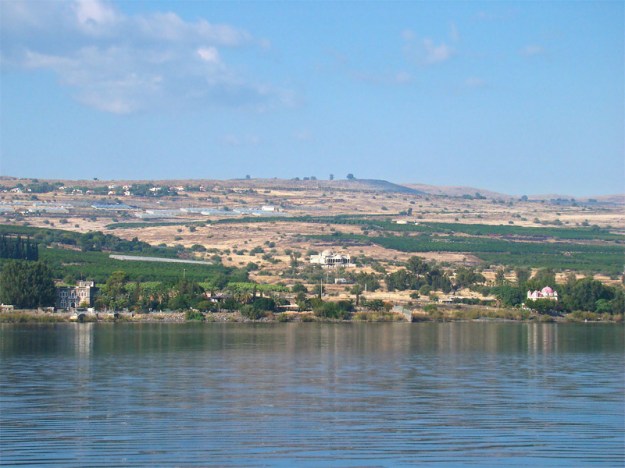
Capernaum as see from lake Tiberius photo by Tango7174 November 13, 2012 shared under Creative Commons 4.0

Matthew 4: 12-17

Parallel Mark 1: 14-15, Luke 4: 14-15

12 Now when Jesus heard that John had been arrested, he withdrew to Galilee. 13 He left Nazareth and made his home in Capernaum by the sea, in the territory of Zebulun and Naphtali, 14 so that what had been spoken through the prophet Isaiah might be fulfilled:

15 “Land of Zebulun, land of Naphtali, on the road by the sea, across the Jordan, Galilee of the Gentiles —16 the people who sat in darkness have seen a great light, and for those who sat in the region and shadow of death light has dawned.”

 17 From that time Jesus began to proclaim, “Repent, for the kingdom of heaven has come near.

When John is arrested Matthew narrates that Jesus withdrew or departed (Greek anechoreo) to Galilee, a place where Jesus’ father Joseph brought the child and his mother for safety earlier. Matthew uses this word for withdrawing or departing much more than the other gospels (Mark and Luke use is twice, Matthew uses it ten times)[1] and it is the same word that describes Joseph’s action to remove Jesus and Mary to Egypt to escape the threat of Herod and Archelaus Matthew 2. The kingdom of heaven may be drawing near but it is not meeting the political threats of Herod or Rome on their own terms, Jesus will not reign in a manner consistent with the peace through military power practiced by Rome and its client states. Even though Jesus withdraws to Galilee from the wilderness of the Jordan he withdraws into the territory of Herod Antipas, who arrested John, and makes his base of operations precisely in this territory. Unlike an earlier time where Joseph’s departure with Jesus and Mary moves away from the threat of Herod, here Jesus withdrawing ironically brings him closer to the immediate threat.

Matthew quickly moves us away from Nazareth, where Jesus lived after returning from Egypt and where his family home may have remained and makes his home in Capernaum. Unlike Mark, where Jesus comes to Capernaum but never settles or has a home (Jesus being continually on the way is a Markan theme) Matthew makes Capernaum the home base for the mission of Jesus. Matthew does not portray Jesus as a homeless wanderer but instead puts him in a social class like the fishermen and tradespeople he would interact with. On the one hand this movement to Capernaum separates his home from the home of Mary and Joseph and sets him off on his own. On the other hand, the location is significant to Matthew as well and the next quotation of scripture highlights this importance.

The quotation is from Isaiah 9: 1-2, which is below in its larger context in Isaiah 9, this may be very familiar to Christians who are used to hearing this reading on Christmas Eve.

But there will be no gloom for those who were in anguish. In the former time he brought into contempt the land of Zebulun and the land of Naphtali, but in the latter time he will make glorious the way of the sea, the land beyond the Jordan, Galilee of the nations. The people who walked in darkness have seen a great light; those who lived in a land of deep darkness — on them light has shined. You have multiplied the nation, you have increased its joy; they rejoice before you as with joy at the harvest, as people exult when dividing plunder. For the yoke of their burden, and the bar across their shoulders, the rod of their oppressor, you have broken as on the day of Midian. For all the boots of the tramping warriors and all the garments rolled in blood shall be burned as fuel for the fire. For a child has been born for us, a son given to us; authority rests upon his shoulders; and he is named Wonderful Counselor, Mighty God, Everlasting Father, Prince of Peace. His authority shall grow continually, and there shall be endless peace for the throne of David and his kingdom. He will establish and uphold it with justice and with righteousness from this time onward and forevermore. The zeal of the LORD of hosts will do this. Isaiah 9: 1-7 (Highlighted portion quoted in Matthew)

Isaiah 9 originally comes from a time where the Assyrian empire is expanding and Northern Israel will be conquered and absorbed by this empire, while Judah retains some measure of independence. Galilee and Samaria were associated with Israel (the tribes other than Judah and Benjamin) which no longer retain their distinctive identity after the Assyrian conquest in 721 BCE. Yet, this passage in Isaiah points to a hope for not only Judah (or Judea) but for all of Israel, even the Israel that has been lost and scattered among the nations. The great light emerges in the place where there had been darkness, where Samaria and Galilee had been isolated from the remnant of Judah. For Matthew, Jesus’ act of establishing his base of operations in Capernaum has a broader theological significance of being the long hoped for member of the Davidic line who can bring about the reconstitution of all of Israel.

The title Galilee of the gentiles (or nations-the Greek term ethnos means both, and Gentiles in general are the non-Jewish people) also points to the inclusive nature of the hope of both Isaiah and Matthew. Throughout Matthew’s gospel we will see Gentiles play significant roles as illustrating what faith looks like. Two figures (the Canaanite woman and the Centurion) will show a faith that is not seen in Israel or in the disciples. From the genealogy and the magi, we have already seen the way non-Jewish people were joined to the story of Jesus and how they often embodied a righteousness that was greater than their Jewish counterparts in the story. The choice of location not only points to the reconstitution of Israel but also to the nations also being the recipients of this light which comes in the darkness.

Ruins of 4th Century synagogue, Photo by David Shankbone shared under Creative Commons 4.0

Ruins of Housing during Roman times in Capernaum, Photo by David Shankbone shared under Creative Commons 4.0

Established with a base of operations in Capernaum, Jesus begins the proclamation of the kingdom of heaven. As mentioned in the discussion of Matthew 3: 2, Jesus’ proclamation is explicitly linked to the proclamation of John the Baptist. Both are calling for repentance and announcing the nearness of the kingdom of heaven. John and Jesus share a common message but a different relationship or role within that message. John may be the herald that announces the kingdom of heaven’s approach and be the Elijah preparing the way, but Jesus will be the long-awaited Wonderful Counselor, Mighty God, Everlasting Father, Prince of Peace. To use the rhythm of John’s gospel, John the Baptist’s authority and role have now decreased, but Jesus’ authority shall grow continually. Jesus not only announces the advent of the kingdom of heaven but will embody the kingdom of heaven’s encroachment on the kingdom of the world and the conquest over the one who claims dominion over these kingdoms.

While Jesus will later send his followers, “to the lost sheep of the house of Israel” (Matthew 10: 6) and not to the Gentiles, their testimony will be a testimony to governors and kings and the Gentiles (Matthew 10:18). Within the vocational understanding of Israel, they were to be a treasured possession of God, a kingdom of priests and a holy nation (Exodus 19: 5-6) and they were called to be a light to the nations for the sake of the Lord. What happens in Galilee or Samaria or Judea is not intended to remain there but to be in the words of the servant song in Isaiah 42:

I am the LORD, I have called you in righteousness, I have taken you by the hand and kept you; I have given you as a covenant to the people, a light to the nations, to open the eyes that are blind, to bring out the prisoners from the dungeon, from the prison those who sit in darkness. Isaiah 42: 6-7

Matthew want to quickly bring us to the point where Jesus is teaching his disciples and forming them into a group that can be a covenant to the people, a light to the nations. Jesus in his actions is not merely about the reconstitution of Israel, but something larger is occurring that will affect the nations as well. The advent of the kingdom of heaven will not merely bring about a return to the nostalgic idea of a united Israel under a Davidic king but will instead impact the kingdoms of the world. The people who once lived in lands of deep darkness—on them light has shined. Or to use the poetic language of John’s prologue:

The light shines in the darkness, and the darkness did not overcome it. John 1: 5

This light will soon instruct his followers on what it means to be ‘the light of the world’ and how they are to “let their light shine before others, so that they may see your good works and give glory to your Father in heaven.” (Matthew 5: 14-15) But for now the light for Israel and the nations has begun to emanate from Capernaum and the kingdom of heaven has established its foothold in the land of the lost tribes of Israel.

[1] Matthew 2: 14, 19-22; 4:12; 10:23; 12: 14-21; 14:13; 15:21; it is also used for the magi withdrawing in 2: 12-13. M. Eugene Boring highlights this in (NIB 8:167)

Matthew 4: 1-11 The Temptation in the Wilderness

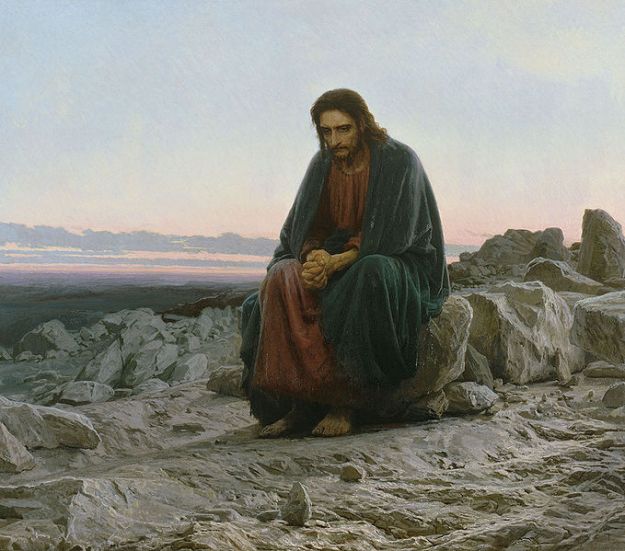
Ivan Kramskoy, Christ in the Desert (1872)

Matthew 4: 1-11

Parallel Mark 1: 12-13, Luke 4: 1-13

1 Then Jesus was led up by the Spirit into the wilderness to be tempted by the devil. 2 He fasted forty days and forty nights, and afterwards he was famished. 3 The tempter came and said to him, “If you are the Son of God, command these stones to become loaves of bread.” 4 But he answered,

“It is written, ‘One does not live by bread alone, but by every word that comes from the mouth of God.'”

5 Then the devil took him to the holy city and placed him on the pinnacle of the temple, 6 saying to him, “If you are the Son of God, throw yourself down; for it is written,

‘He will command his angels concerning you,’ and

‘On their hands they will bear you up, so that you will not dash your foot against a stone.'”

7 Jesus said to him, “Again it is written, ‘Do not put the Lord your God to the test.'”

8 Again, the devil took him to a very high mountain and showed him all the kingdoms of the world and their splendor; 9 and he said to him, “All these I will give you, if you will fall down and worship me.” 10 Jesus said to him, “Away with you, Satan! for it is written,

‘Worship the Lord your God, and serve only him.'”

11 Then the devil left him, and suddenly angels came and waited on him.

Even though a chapter division is introduced between the baptism scene at the end of chapter three and the temptation at the beginning of chapter four these scenes are connected. Within liturgical churches the perceived separation between these scenes is heightened by the traditional reading of the baptism scene after the end of the Christmas season and the temptation scene several weeks later during the first Sunday in Lent. Matthew and Luke share a common telling of this scene (although Luke modifies the order we find in Matthew probably due to Luke’s focus on the temple as being central to the narration of Jesus’ story) both keeping the placement in the narrative with Mark but adding the content of the temptation Jesus undergoes.

Jesus is led by the Spirit into the wilderness, a softening of the language we find in Mark where Jesus is literally ‘thrown’ into the wilderness (using the same term that Mark uses for casting out of demons). Throughout this temptation we are linked to the baptism by the location, the wilderness, the action of the Spirit of God and the continuity of the title used throughout the two scenes, Son of God. Previously the wilderness provided a place of revelation where the Spirit of God and the voice from heaven pronounce Jesus’ identity now it provides a place where Jesus’ identity is challenged. The wilderness will be a place of divine guidance, care and revelation but it is also a place of deprivation, isolation and challenge. Yet, this temptation seems to be if not divinely orchestrated at least an intentionality of movement by the Spirit of God and Jesus. It is a place where danger and revelation will hold hands, to use O. Wesley Allen’s phrase. (Allen, 2013, p. 39) Yet, there is also an element of, for a time, being isolated by God and entering into the suffering of that isolation as the wilderness of temptation becomes a place where the kingdom of heaven’s advent is both prepared for and resisted.

The forty days and forty nights in the wilderness that Jesus fasts prior to the temptation is frequently noted in paralleling the forty years that the people of Israel spend in the wilderness, a time where the people transition from being the slaves of Egypt to the people of the LORD the God of Israel. While the sojourn of the people of Israel is a time of divine guidance, care (providing food and water throughout their journey) and revelation (both the giving of the law and the creation of the tabernacle) and Jesus being identified with Israel is one of the accents within the identity that Jesus will bear there is also a close tying to the story of Moses in this scene. While Moses is not tested by the devil in the manner, we hear in Jesus story he has two forty-day periods on Mount Sinai where he receives the law (see Exodus 24: 18) and intercedes for the people after the incident of the Golden Calf. The intercession for the people after the Golden Calf is like the language of this scene:

He was there with the LORD forty days and forty nights; he neither ate bread nor drank water. And he wrote on the tablets the words of the covenant, the ten commandments. (Exodus 34:28)

Not only is he receiving the law to bring to the people, a parallel we will soon see in the sermon on the mount, but it is also during this forty days on Mount Sinai where Moses goes to make atonement for the people. Jesus, we learned in Matthew 1: 21 is one who will save the people from their sins. I believe this scene want us to hear an echo of Moses going up Mount Sinai to intercede for the people, Moses will say,

“Alas, the people has sinned a great sin; they have made for themselves gods of gold. But now only forgive their sin—but if not, blot me out of the book that you have written.”  Exodus 32: 31-32)

This scene in Exodus (Exodus 32-34) is a scene where God reveals God’s glory to Moses, where the covenant between God and Israel is renewed and God chooses to dwell among the people again. One of the links we may be encouraged to see here is a time where Jesus also initiates a time of fasting to restore the relationship between God and the people of God.

With all these connections and links to various images from the scriptures it can become a little overwhelming as we wonder: Who is Jesus? Is he God with us? David? Moses? Israel? Son of God? The Son of Man? The Christ? And ultimately Matthew feels we need all these titles and linkages to attempt to convey the fullness of who Jesus is and what his story means for those who hear it. Matthew is willing to use the rich language of the scriptures he inherits to attempt to paint his portrait of Jesus for the church to learn from and to follow. In the previous chapter I mentioned two great scriptural rivers that flow into the deep sea that is Matthews gospel (Isaiah specifically and the prophets in general along with the Psalms specifically and wisdom literature in general) but now I want to highlight a third river that flows through the landscape, one that has provided nourishment and hope and now as it reaches its goal in the gospel will be also be a part of the advent of the kingdom of heaven, the law (or Torah). As mentioned above, Jesus is one who becomes linked with Moses and the law in the Sermon on the Mount, but it is also worth noting here because the three quotations that Jesus makes during the temptation all come from the law, specifically the book of Deuteronomy.

Perhaps before we can begin the actual scene of temptation, we need to discuss the antagonist in the scene who is called tempter, devil and Satan. We view the world differently than our ancestors in the time of Matthew and we often don’t see our world as inhabited by devils and demons the way we find in the gospels. Philosopher Charles Taylor uses the language of the porous self in the earlier enchanted world to talk about this reality, where the porous self is vulnerable to spirits, demons and cosmic forces and these forces (both good and evil) actively inhabit the world and possess people within it. With evil forces active in the enchanted world affiliation with a power that could triumph over these forces was an important part of life, and for those within the sphere of Christianity and Judaism that force was God. In Taylor’s language:

Perhaps the clearest sign of the transformation in our world is that today many people look back to the world of the porous self with nostalgia. As though the creation of a thick emotional boundary between us and the cosmos were now lived as a loss. The aim is to try to recover some measure of this lost feeling. So people go to the movies about the uncanny in order to experience a frisson[1]. Our peasant ancestors would have thought us insane. You can’t get a frisson from what is really in fact terrifying you. (Taylor, 2007, p. 38)

That people believed in evil forces being personified in the devil and demons during the time of Matthew is not controversial, the controversy is how we as ones living in the disenchanted world we have inherited from modernity can talk about the devil and the demonic. One approach is taken creatively by C.S. Lewis in The Screwtape Letters where he ascribes the disenchanted world to the action of the devilish forces themselves. As the fictional devil Screwtape writes to a devil who is still learning how to manipulate humans:

Our policy, for the moment, is to conceal ourselves. Of course this has not always been so. We are really faced with a cruel dilemma. When the humans disbelieve our existence we lose all the pleasing results of direct terrorism and we make no magicians. On the other hand, when they believe is us, we cannot make them materialists and sceptics. (Lewis, 2017, p. 203)

Others may attribute social, psychological, or cultural reasons to explain the belief of the devilish and demonic forces in the gospel. The rational bias of the enlightenment encourages us to live within a world separated from the spiritual world or devils and angels, but I refuse to excise from the gospels the critical forces on opposing sides of the kingdom of heaven. Personally, I am all to aware of the persistence of evil in the world in ways that go beyond rational explanations of systemic evil or other modern explanations. Even though I may have never encountered evil personified in either the devil or a demon I am inclined to walk between the two options that C.S. Lewis states at the beginning of the Screwtape Letters: I neither disbelieve their existence nor do I exercise an unhealthy interest in them. (Lewis, 2017, p. 183)

The Spirit has led Jesus to a place where he is to be tempted, and there is an intentionality to this scene as the kingdom of heaven is brought into conflict with one who claims to be able to give all the kingdoms of the world. This conflict sets the stage for everything afterwards, this is the moment when we realize that the tempter is unable to tempt the one who has come to confront him and that the devil is powerless in the presence of the Son of God. The devil’s power here may appear incredible, but ultimately it derives its strength from those he is able to tempt into allegiance to him. Jesus shows us how to read scripture in a way that resists temptation and delivers us from the evil one, Jesus perhaps is led into temptation to show us how the law (Torah) helps us resist the promises of the devil. Yet, perhaps this scene also binds the strongman (see Matthew 12: 29) for immediately after this scene Jesus will announce the kingdom of heaven is at hand, demons will recognize him for who he is (Matthew 8: 28-31) and the forces that have bound people whether demonic or illness will be overcome.

The first temptation, turning stones to bread, begins with the situation of the forty days of fasting and the hunger that Jesus experiences. Jesus’ answer pulls on Deuteronomy 8: 2-3:

Remember the long way that the LORD your God has led you these forty years in the wilderness, in order to humble you, testing you to know what was in your heart, whether or not you would keep his commandments. He humbled you by letting you hunger, then by feeding you with manna, which neither you nor your ancestors were acquainted, in order to make you understand that one does not live by bread alone, but by every word that comes from the mouth of the LORD.

The fundamental issues throughout the temptation: Who is the God who Jesus will serve? Who provides what is needed? And what will Jesus’ title Son of God mean for the way he conducts himself? Jesus again takes on the role of Israel being tested not only by the devil but also demonstrating his obedience to God, being humble and keeping the commandments. The harkening back to this scene in Deuteronomy reminds the hearer with scripture tuned ears that God is the one able to provide bread in the wilderness, and while Jesus will later multiply loaves and fishes, ultimately God is the one who provides what is needed. Jesus enters this space of divine silence and devilish temptation awaiting the word that comes from the mouth of the LORD, and perhaps, to use imagery from the gospel of John, he is that word spoken to the devilish temptation.

Consistent throughout all the temptation is also the challenge of the way Jesus inhabits the title Son of God. Like the serpent in the garden of Eden he attempts to lure the one into believing that God would not deny that which is desirable to one who could be like God. Yet, unlike Eve and Adam, Jesus is not swayed by these words and will not be the Son of God by anyone else’s terms.  Much like the mocking tone of “You are the Christ” sung by King Herod in Jesus Christ Superstar there is a mocking of the way Jesus chooses to embody being the Son of God in Satan’s challenge.

The second temptation introduces a movement away from the wilderness to Jerusalem at the pinnacle of the temple. The proximity to holy space or the ability to quote scripture does not guarantee that one will read scripture correctly, as later conflicts within the temple will demonstrate. Here even the devil in this space uses scripture but uses it incorrectly. The quoted verses are from Psalm 91: 11-12, and as we heard previously the Psalms is one of the major texts that Matthew will use to talk about who Jesus is, but here even the devil can use the Psalms to talk about who he believes Jesus should be. The implied challenge for Jesus is to demonstrate his trust in God and demonstrate that trust through expecting God to rescue Jesus amid trouble. The angels will wait on Jesus after the temptation, but here they are absent, here in this place of temptation (even though they are at the pinnacle of the temple) the divine voice is silenced by the tempter’s words and even scripture is used as the devil’s tool. Yet, Jesus continues to demonstrate a way of reading scripture that models for Israel and the church how to resist temptation. Again, Jesus responds from the law (Torah) and again Deuteronomy speaks:

Do not put the LORD your God to the test, as you tested him at Massah. Deuteronomy 6:17

The testing at Massah refers to Exodus 17 where the people quarreled with Moses and demanded water, Massah is means test so there is a play on words within this verse in Deuteronomy. Jesus continues to embody what Israel was meant to be by refusing to test God even amid temptation. This temptation also echoes at the cross when Jesus is taunted, “If you are the Son of God, come down from the cross.” (Matthew 27: 40)

The final temptation takes place on a high mountain, typically a location of revelation for Matthew, but now the revealer is the tempter claiming dominion over all the kingdoms of the world and offering them to Jesus if he will worship him. Jesus is invited to claim power but at the cost of his identity, no longer is the title, “If you are the Son of God” used because to worship the devil would be abandon that identity. Perhaps within this temptation is the close association of earthly power with those anointed to be kings, which also is the context of Psalm 2 which echoes in the baptismal scene in the previous chapter.

I will tell of the decree of the LORD: He said to me, “You are my son; today I have begotten you. Ask of me, and I will make the nations your heritage, and the ends of the earth your possession. You shall break them with a rod of iron, and dash them in pieces like a potter’s vessel. Psalm 2: 7-9

Jesus is offered here the ends of the earth as a possession and the nations as a heritage, but the one offering is not the LORD, but instead the tempter. Many people will expect Jesus to model his life on those who claim worldly power, but the kingdom of heaven will be different, just like the nation of Israel was to be different than Egypt of Babylon or Rome. Even Peter will later rebuke Jesus when he talks about undergoing suffering and being killed and receive similar words, “Get behind me Satan! You are a stumbling block to me; for you are setting your mind not on divine things but on human things” Matthew 16: 23.

Jesus answers the devils by referencing Deuteronomy 10: 20,

You shall fear the LORD you God; him alone you shall worship; to him you shall hold fast, and by his name you shall swear.

This also refers to the first commandment (Exodus 20: 1-6, Deuteronomy 6: 6-10) where the people are to have no other gods and to worship on the LORD their God. In combination with this quotation Jesus also dismisses the devil. Jesus says, “Away with you, Satan” and the devil leaves. Jesus casts him out like he will later do with the demons. When the devil departs the angels arrive and wait on him. Somehow the devil’s presence made the angelic presence unavailable. Jesus had to enter this space to cast Satan out of it. The tempter has been thwarted, the strong man who claims power over the nations has been bound and the angels minister to Jesus as we approach the announcement of the kingdom of heaven’s arrival.

[1] A frisson is a sudden feeling of excitement or thrill


Matthew 3: 13-17 The Baptism and Revelation of Jesus

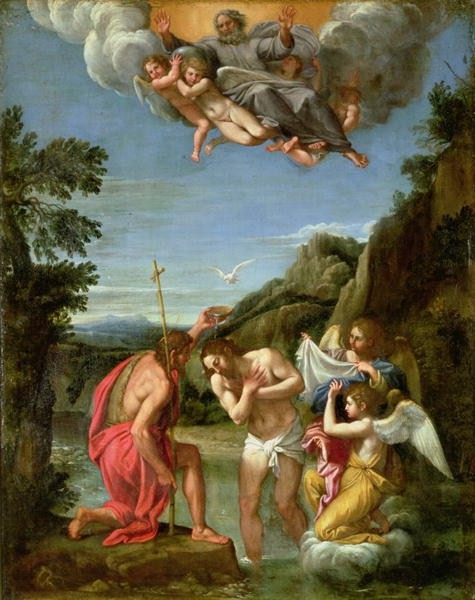
Francesco Albani, Baptism of Christ (1600s)

Matthew 3: 13-17

Parallel Mark 1: 9-11, Luke 3: 21-22

13 Then Jesus came from Galilee to John at the Jordan, to be baptized by him. 14 John would have prevented him, saying, “I need to be baptized by you, and do you come to me?” 15 But Jesus answered him, “Let it be so now; for it is proper for us in this way to fulfill all righteousness.” Then he consented. 16 And when Jesus had been baptized, just as he came up from the water, suddenly the heavens were opened to him and he saw the Spirit of God descending like a dove and alighting on him. 17 And a voice from heaven said, “This is my Son, the Beloved, with whom I am well pleased.”

Matthew’s careful narration of the ministry of John the Baptist reaches its climax with the baptism of Jesus, and just as the identity of John the Baptist and the content of his ministry pulls on the prophetic imagination, particularly from Isaiah in this short narrative of the baptism the hope of Isaiah mingles in with the poetic waters of the Psalms as we continue to wonder who this Jesus who meets us in the midst of the waters is. In the previous section I highlighted Isaiah 43: 1-7 where the people are reminded by the prophet Isaiah:

When you pass through the waters, I will be with you; and through the rivers, they shall not overwhelm you; when you walk through fire you shall not be burned, and the flames shall not consume you. Isaiah 43:2

We heard John proclaim that one who was more powerful was coming after him, one who would baptize with the Holy Spirit and fire, and as we are introduced to Jesus, Matthew invites us into the water to wonder about this one who is coming after John. The day that comes after the announcement of Elijah in Malachi 4: 5-6 is the day of the LORD, could the coming kingdom of heaven and the day of the LORD truly be at hand in this moment Matthew narrates to us? In Matthew 1 we were introduced to a title for Jesus, Emmanuel: God with us, could this Jesus who stands amid the waters with the reconstituted people of Israel in some way be the God of Israel? Mark’s gospel may have made continual allusions and hints that in Jesus we were encountering more than just a Messiah but Matthew continues to link suggestively in ways that would be shocking to those attuned to hear the imagery of scripture referenced in this way that in Jesus we are somehow meeting ‘God with us.’

Jesus reenters the gospel by approaching John at the Jordan and journeying away from his home in Galilee and approaches John to be baptized with the people. Matthew’s short narrative spends longer on this scene than either Mark or Luke wanting us to hear John’s protest and identify Jesus as one who is greater than him, as one who should be baptizing him.  Jesus’ response places him with the people of Israel, those who have come to the waters, those who have turned their hearts to God, those who are repenting and he enters into this space where they have come seeking God’s promised kingdom and is joined to their story. Jesus is not only linked to the story of Israel in the birth narratives, his narrative begins to take on the shape of their story and his identity is typologically joined to the identity and vocation of Israel. As Richard B. Hays proposes:

I would propose that Jesus’ acceptance of a baptism of repentance, performed at the Jordan River, is meant to signify his symbolic identification with sinful Israel (the people whom he will “save from their sins”), and the figurative beginning of that new Israel’s entry into the land of promise. (Hays, 2016, p. 116)

I think it is also important to realize that a continual theme throughout the scriptures is God’s desire to dwell among the people. The kingdom of heaven is being brought to earth rather than the citizens of earth being transported to heaven. God’s desire in the Exodus was to dwell among God’s people in the tabernacle at the center of the community and the sin of the Golden Calf threatened this because God’s anger at their betrayal posed a threat to the people, and yet God forgave and did dwell and go forward with he people. The entire birth narrative of Matthew suggests that this incarnation, to use the language Christians would assign to the birth of Jesus, is God in a new and unexpected ways coming to dwell among God’s people for the sake of the world.

Jesus’ answer to John the Baptist reintroduces us to the concept of righteousness. We first encountered Joseph as a righteous man and righteousness is far more important word to Matthew than to either Mark or Luke who rarely use this term. One the one hand, righteousness in the gospel is held as a contrast to sinners, sometimes in surprising ways, as Jesus will later say, “I have come to call not the righteous but sinners” (Matthew 9: 13) and yet the followers of Jesus are to, “strive first for the kingdom of God and his righteousness.” (Matthew 6: 33) Jesus becomes the fulfiller of what righteousness will look like and the one who can interpret how one is to live a righteous life. Here Jesus models righteousness in standing with the people who are striving for the kingdom of God and God’s righteousness, later in the Sermon on the Mount he will interpret how to approach the Torah (Law) and what the righteousness of the kingdom of heaven will look like. While Jesus has come to ‘save the people from their sins’ he is not leaving them alone in this, but instead he will walk with these new disciples and model and teach them what it means to hunger and thirst for righteousness, how they can embody a righteousness greater than the scribes and the Pharisees, and how they can seek first the kingdom of God and his righteousness.

Matthew in his unique way wants to highlight this story in a way that accents it differently than Mark and Luke. One of the differences between Matthew and Mark is what happens to the heavens. In Mark’s gospel the heavens are ripped open (the word in Greek is schizomenos, the schizo root is where we get schizophrenia-a ripped open mind) but for Matthew they were opened a far less violent act. This may relate to Matthew’s belief that the creation itself cooperates in bearing witness to who Jesus is and what Jesus means, like the star at the birth and the convulsions in the heaven and earth at the crucifixion. This is a significant change because the schizomenos word forms a bookend for the beginning and end of Mark’s gospel and Matthew chooses to narrate the story without using this rare and noticeable word. There is an intentionality in Matthew’s narration of this scene and the way he carefully chooses vocabulary to fit his vision of what is occurring.

Additionally, in Matthew’s narration of this scene, we see the only gospel where the declaration of the voice from heaven being for everyone present and not only for Jesus. In both Mark and Luke, the voice declares, “You are my son”, but in Matthew the declaration is, “This is my son, the Beloved, with whom I am well pleased.” Jesus may be the only one who sees the heavens open and the Spirit descend but the voice declares for those who have ears to hear that Jesus is given the titles of Son, Beloved and one with whom God is pleased. The proclamation in this form will be echoed at the Transfiguration in Matthew 17 and we are meant to hear the connection between these event that allow reveal who Jesus is. It also links us to the centurion’s declaration at the crucifixion that “This man was God’s Son.”

In this declaration of the voice we also hear the echo of another major scriptural current that will flow throughout Matthew’s Gospel, the poetic flow of the Psalms. Here the words go back to the words of Psalm 2 and its words lifting up God’s chosen leader and the close identification between God and that leader:

I will tell of the decree of the LORD: He said to me, “You are my son; today I have begotten you. Ask of me, and I will make the nations your heritage, and the ends of the earth your possession.  You shall break them with a rod of iron, and dash them in pieces like a potter’s vessel.”  Now therefore, O kings, be wise; be warned, O rulers of the earth. Psalm 2: 7-10

Just as Isaiah was one of the major rivers flowing into the deep sea of Matthew’s Gospel, so the Psalms will be one of the other major bodies of water contributing its language and rhythms to the gospel and helping the evangelist to find language to describe who Jesus is and what he means. For the identity of Jesus is critical to those who will pass through the waters with him.

I continued the quotation of Psalm 2 longer than most writers, though most catch the allusion to this Psalm, because there is in this public declaration a challenge to the existing powers. The gospel is a political statement and the kingdom of heaven does challenge the underlying assumptions of any empire: whether Egypt, Babylon, Rome or even a modern world power like the United States. In Jesus’ day it was well known that Caesar Augustus, who reigned during Jesus’ birth, and Emperor Tiberius, who reigned during Jesus ministry, both made claims to be the son of a god. Later in the gospel when Jesus asks for a denarius (Matthew 22:19) it likely bore an inscription stating Caesar Augustus Tiberius son of the divine Augustus. Yet, Jesus being declared Son of God by God’s voice occupies this role in a way that Caesar cannot, Caesar’s divine right may be defended by the might of the empire but for Matthew’s gospel the voice of the God of Israel’s declaration is the only one that matters.  A challenge to this vision of what God’s reign through the Beloved will look like will be encountered next in the temptation narratives of the following chapter.

Matthew also slightly modifies the language around the Spirit of God from Mark in a subtle but important way. In Mark’s gospel the Spirit of God comes down ‘into’ Jesus and the will ‘throw or cast out’ Jesus into the wilderness, but in Matthew the Spirit of God comes down and appears to Jesus and will later ‘lead’ Jesus into the wilderness. For Matthew it is important that Jesus remains in control and that the Spirit of God partners with Jesus rather than controlling or possessing Jesus (which you could argue for in Mark’s gospel).

This critical piece of the story once again points to who this Jesus is. It has been a topic introduced throughout the opening chapters and there have been multiple answers that continue to give richness to the answer Matthew wants us to hear. Yet, Matthew wants us to hear this close identification between Jesus and the God of Israel in an emphatic way that is reinforced throughout these chapters. As O. Wesley Allen can state:

What the angel declared to Joseph, what the magi understood the star to mean, what the prophetic texts confirm, and what John himself proclaimed is now summed up in God’s own voice. (Allen, 2013, p. 38)

Jesus’ identity will present a challenge to both the ruling authorities who desire to claim divine authorization for their own rule and it also reframes the Jewish expectation of the ruler who God reigns on God’s behalf. Matthew’s use of the Hebrew Scriptures stretches their imagination of how God comes to dwell with the people farther than the Psalms or the prophets would have dared, and yet it is the language of the prophets and psalms that underlies the proclamation of the evangelist. Matthew is making bold claims about who Jesus is and how he is related to God. Matthew’s carefully chosen words, along with the words of the other gospel writers, Paul and the other authors of the New Testament would give birth to the Trinitarian way in which Christians would talk about God. Yet, Matthew nor any other writer of the New Testament, would have developed the vast Trinitarian language that forms the creeds of the early Catholic and Orthodox church, that language evolved around the explanation of who Jesus is to a Greek philosophical mindset rather than the mindset immersed in the Hebrew Scriptures. Matthew is far more interested in letting the disciples of Jesus know that in Jesus they are somehow meeting God with them than attempting to describe how Jesus can be fully divine and fully human, or how Jesus, God and Spirit can be one being. Matthew would probably be ambivalent to these philosophical questions but instead would want us to know how the scriptures bear witness to the hope, promise and identity of Jesus and what it means for Israel and the rest of the world.


Matthew 3: 1-12 The Herald of the Kingdom of Heaven

Cristofano Allori, John the Baptist in the Desert, 17th Century

Matthew 3: 1-12

Parallel Mark 1: 2-8, Luke 3: 1-17

1 In those days John the Baptist appeared in the wilderness of Judea, proclaiming, 2 “Repent, for the kingdom of heaven has come near.” 3 This is the one of whom the prophet Isaiah spoke when he said,

“The voice of one crying out in the wilderness: ‘Prepare the way of the Lord, make his paths straight.'”

4 Now John wore clothing of camel’s hair with a leather belt around his waist, and his food was locusts and wild honey. 5 Then the people of Jerusalem and all Judea were going out to him, and all the region along the Jordan, 6 and they were baptized by him in the river Jordan, confessing their sins.

7 But when he saw many Pharisees and Sadducees coming for baptism, he said to them, “You brood of vipers! Who warned you to flee from the wrath to come? 8 Bear fruit worthy of repentance. 9 Do not presume to say to yourselves, ‘We have Abraham as our ancestor’; for I tell you, God is able from these stones to raise up children to Abraham. 10 Even now the ax is lying at the root of the trees; every tree therefore that does not bear good fruit is cut down and thrown into the fire.

11 “I baptize you with water for repentance, but one who is more powerful than I is coming after me; I am not worthy to carry his sandals. He will baptize you with the Holy Spirit and fire. 12 His winnowing fork is in his hand, and he will clear his threshing floor and will gather his wheat into the granary; but the chaff he will burn with unquenchable fire.”

Some time later we arrive at the beginning of story of Jesus as an adult and to set the stage for that story we are introduced to John the Baptist who will share a common message with Jesus but a different role within that message. John will be the Elijah character who proceeds the promised messiah, but there is much more to the story than just preparing the way for the messiah’s coming. Here the story builds on what was revealed to us in the first two chapters to prepare us for the advent of the kingdom of heaven.

Place matters in the gospels and the wilderness of Judea along the Jordan river is a place that is rich in meaning. Wilderness indicates a place away from Jerusalem, Judea and all the inhabited region along the Jordan. It is unsettled and because of that it has the connotation of being a place where one may encounter danger or the divine. The wilderness is the place of baptism, of being joined to the community of the faithful and it is the place of devilish temptation where one’s identity is continually questioned. It can be a place where the voice of God may speak to the one who is listening, and it can also be a place where the demonic voices drive a person to madness. Israel had to pass through the wilderness to become the people of God, they would pass through the Red Sea on leaving Egypt and the Jordan on entering the promised land. The wilderness can also be the place where God’s creative power does new things, particularly the rich language of Isaiah is relevant here:

I am about to do a new thing; now it springs forth, do you not perceive it? I will make a way in the wilderness and rivers in the desert. (Isaiah 43: 19, see also Isaiah 35 and Jeremiah 31: 2)

The beautiful and hopeful language of Isaiah 43 along with Isaiah 35 and Jeremiah 31 add resonance to this theme, these hopeful passages spoken to an exiled people about God making a way in the wilderness and creating a new people enrich our hearing of the hope embodied in this strange prophet in a wilderness space.

The message that John the Baptist is summarized with the exact words that Jesus will use later in the gospel (Matthew 4: 17; 10:7). Both Mark and Luke include the ministry of John the Baptist to introduce the ministry of Jesus, but Matthew links the proclamation of John the Baptist explicitly to the later proclamation the good news that Jesus will proclaim. Both will run into challenges with the Pharisees, Sadducees and Herod and the other political powers, yet according to Matthew they are both sharing a common proclamation. As O. Wesley Allen Jr. state, “the difference between John and Jesus is not their message but the role they play in relation to that message.” (Allen, 2013, p. 35)

Scripture now speaks to give its direct voice to the role that John the Baptist will play in this story. Matthew instead of adopting the mashup of multiple verses used in Mark uses Isaiah 40:3 to identify John as “the voice crying out in the wilderness: ‘Prepare the way of the LORD, make his paths straight.’” Isaiah 40 is a message of comfort and hope to a people who have been exiled and may have felt forgotten by their God, but now Isaiah announces that God is indeed coming and that the people shall see the glory of the LORD together.

John is linked visually with Elijah by wearing clothing of camel’s hair with a leather belt around his waist. Elijah is described in 2 Kings 1:8 as “a hairy man with a leather belt around his waist.” As mentioned above there was an expectation that Elijah would proceed the coming of the messiah, this hope comes both from the manner that Elijah’s death is recorded in 2 Kings 2 and in Malachi (the book that immediately proceeds Matthew in the way many bibles are organized) in the final chapter we hear of a time when God will judge the unrighteous and will lift up the righteous and in this judgment and exaltation:

Lo, I will send you the prophet Elijah before the great and terrible day of the LORD comes.  He will turn the hearts of parents to their children and the hearts of children to their parents, so that I will not come and strike the land with a curse. (Malachi 4: 5-6)

The God of Israel is a God who desires repentance. As the prophet Joel can remind the people, “Return to the LORD your God, for he is gracious and merciful, slow to anger and abounding in steadfast love’ (Joel 2: 13, see also Deuteronomy 30:2, this portion of Joel picks up the language of the thirteen attributes of God from Exodus 34: 6-7) and we hear in Malachi that the expected Elijah was to go before the advent of the Lord to turn families back to the way they were intended to embody so that they would be among the righteous and not the unrighteous ones. They would be those who were greeting the advent of the kingdom of heaven with joy instead of with lamentation.

This first herald of the advancing kingdom of heaven is not the lavishly dressed and well fed ambassador we might see attempting to negotiate a peace treaty between two nations but is instead a strangely dressed (but typologically familiar) prophet who eats the diet of the poorest in the desert (but which was ritually clean). In a kingdom where the poor in spirit are blessed and those who hunger and thirst for righteousness will be filled, where the merciful and peacemakers are those who embody what this kingdom is about, the kingdoms of this world will look more like the kingdom of Egypt that the Israelites escaped from than their hoped for reign where God was their king in the promised land. This heavenly kingdom will be different than the kingdom of Judea or the empire of Rome, but that doesn’t mean that Rome and Herod Antipas wouldn’t hear this proclamation as a challenge to their own kingdoms and wouldn’t oppose it with every tool at their possession.

When the Pharisees and Sadducees arrive in the wilderness to investigate what is occurring with the movement around John the Baptist, we may be surprised by the confrontational language that John uses towards them. For most people who have been trained in reading scripture recently there has been a reappraisal of the Pharisees and Sadducees viewing both movements in a more positive light than the previous generations of scholarship. Often the Pharisees and the Sadducees became embodiments of a legalistic and rigid worldview in Christian writing and like Judaism in general most writing about these two movements was polemical in nature. Hopefully I can provide a more nuanced approach to the topic as we move through the gospel, but it is worth noting that in general both the Pharisees and the Sadducees will find themselves aligned on with the forces opposed initially to John and later to Jesus. Neither group is completely aligned with the goals of the political powers of Herod Antipas in Galilee or Pontus Pilate in Judea, but they have negotiated a way of working with these powers and maintaining their position. There is no separation of church and state in the ancient world, and any close look at the political world of the time of Jesus will quickly illuminate a connection between the religious authorities and the political.

The Pharisees and Sadducees are both movements within second temple Judaism that are connected with both local and national power, and they have struggled with each other for influence for generations, but they are still tied to the existing networks of power. I believe this alliance with the existing networks of power is behind the criticism of John the Baptist when he calls them a brood of vipers fleeing wrath and challenges them to bear fruits worthy of repentance. In John’s view their reforms are not enough, God is doing something new. This symbolically rich baptism of repentance is reconstituting Israel to begin again in a new and forgiven state. The Pharisees were a reform movement attempting to be faithful to the law by reclaiming practices of holiness and the Sadducees were focused on maintaining proper worship at the temple by the priesthood, but John stands within a long line of prophets who continually call the people of Israel to see that repentance is more than ritual or religious practice. As Anna Case-Winters can state, “If they “change their minds” it will change their lives. Where is the evidence of this? Ritual purity without righteousness counts for nothing. This message is strong in the ethical tradition of Judaism.” (Case-Winters, 2015, p. 46) [1]

Matthew wants us to hear John the Baptist in concert with Jesus and just like John using the language of the kingdom of heaven to introduce what his proclamation is about we will also hear almost identical words come from Jesus’ mouth towards the Pharisees about being a brood of vipers and bearing fruit worthy of repentance.

Either make the tree good, and its fruit good; or make the tree bad, and its fruit bad; for the tree is known by its fruit. You brood of vipers! How can you speak good things, when you are evil? For out of the abundance of the heart the mouth speaks. The good person brings good things out of a good treasure, and the evil person brings evil things out of an evil treasure. I tell you, on the day of judgment, you will have to give an account for every careless word you utter; for by your words you will be justified, and by your words you will be condemned. (Matthew 12: 33-37)

Jesus, in Matthew, can be both gracious and direct. He will embody both the prophetic hope and the prophetic critique. John foreshadows this by letting us know that Christ’s coming and the advent of the kingdom of heaven will not be a painless process for everyone. Forgiveness often means that something must die, repentance means that one must turn one’s back on something to turn towards that which you are returning to and grace while it is given freely may indeed cost the recipient much in terms of their relationship with family and the existing power structures of the world. The coming of Jesus means that some trees will be cut down and thrown into the fire so that those with good fruit have the space to flourish providing their fruit in each season for the healing of the nations.

Even though Matthew begins his telling of Jesus’ story with a genealogy he lets us know early that genealogy is not enough. Here in John’s accusation taps again into language from the prophet Isaiah:

Listen to me, you that pursue righteousness, you that seek the LORD. Look to the rock from which you were hewn, and the quarry from which you were dug. Look to Abraham your father and to Sarah who bore you; for he was but one when I called him, but I blessed him and made him many. (Isaiah 53: 1-2)

In Isaiah’s time he is speaking to an Israel that has already drained the cup of the Lord’s wrath (Is. 53:17) but now John is speaking to a people who are being offered a cup at the banquet of the Lord, but like those who will later refuse their place at the wedding banquet (see Matthew 22: 1-14) they will find themselves receiving the king’s judgment because they refused the invitation to turn away from the things that concerned them, their own negotiated settlements with the powers of the day and instead would mistreat and abuse the messengers of the banquet.

J.Ross Wagner in 2000 published a work called Heralds of the Good News: Paul and Isaiah in Concert in the Letter of Romans and if you haven’t guessed by the string of quotations from Isaiah referenced in these initial chapters I believe that Matthew as a herald of the kingdom is placing John the Baptist and later Jesus’ ministry in a key that would be in harmony with the prophetic hope and challenge of Isaiah in particular and other prophets as well. For years Christians have mined the prophet Isaiah for prooftexts that, cut off from their context, could be used as predictors for Jesus’ life and ministry but what if, instead, we actually allowed Isaiah’s words and hope to provide language and richness to the experience of Jesus narrated by Matthew. As I have argued from the beginning of these reflections, Matthew’s narration of Jesus’ story is a uniquely Hebrew way of reading the story of Jesus and as we immerse ourselves in Matthew’s gospel we should expect to be swimming in waters deeply infused with the words of the law, the prophets, the narrative and the poetry of the Hebrew people. Yet one of the major rivers flowing into the deep sea of Matthew’s gospel is the prophet Isaiah with his vision of hope and reinterpretation of what Israel’s identity is to be.

We are introduced here with the actions of John the Baptist baptizing those coming into wilderness a key piece of what Matthew will continue to reinforce: the identity of the chosen people. In a context where the people of Jerusalem and all Judea is now attached to the Roman empire and its emissaries (including the religious authorities in Jerusalem) John is making a prophetic break from the temple and its leaders. What will define the reconstituted Israel will be the God of Israel rather than the newly rebuilt temple but instead an orientation towards the approaching kingdom of heaven. They stand at the Jordan river awaiting a new Joshua to bring them into the kingdom that their Lord has promised them. And to use one final image from the prophet Isaiah they are reminded:

But now thus says the LORD, he who created you, O Jacob, he who formed you, O Israel: Do not fear for I have called you by name, you are mine. When you pass through the waters, I will be with you; and through the rivers, they shall not overwhelm you; when you walk through fire you shall not be burned, and the flame shall not consume you. For I am the LORD your God, the Holy One of Israel, your Savior. I give Egypt as your ransom, Ethiopia and Seba in exchange for you, Because you are precious in my sight, and honored, and I love you, I give people in return for you, nations in exchange for your life. Do not fear for I am with you; I will bring your offspring from the east, and from the west I will gather you; I will say to the north, “Give them up,” and to the south, “Do not withhold; bring my sons from far away and my daughters from the ends of the earth—everyone who is called by my name, whom I created for my glory, whom I formed and made.” Isaiah 43: 1-7

Yet John the Baptist is merely a herald of the good news, but the gospel (and the play on words here is that gospel and good news are the same Greek work euangellion) is not merely about the proclamation of the kingdom of heaven but its advent. One greater than John is coming, John can stand in the waters of the Jordan and reorient the people of God, but he cannot bring in the kingdom. Ultimately, for Matthew, he wants us to see that God will be with the people calling them by name, passing through the waters with them and gathering them from the ends of the earth. John sees God’s harvest approaching where the faithful will be gathered together and not consumed by the flames that are to come.

I’ve hinted that this will be a gracious reading of Matthew’s gospel and if John the Baptist and Jesus both can advocate this type of division between chaff and wheat some might ask from our context where the grace can be in the judgment. Working through Exodus, Deuteronomy, Psalms,  Jeremiah and Revelation you have to come to terms with the judgment of God against those forces either within or beyond the boundaries of the community which have set their will against their creator: Egypt, the people of Israel and Judah, Babylon and Rome all come under God’s judgment for the sake of the life and witness of God’s people and the prosperity of the world. Yet, God’s judgment is always preceded with an opportunity for repentance, with a chance for those who will be sorted to return to the Lord who is gracious and merciful, slow to anger and abounding in steadfast love. God is not content to allows things to remain the way things are, to allow the ways of Egypt, Assyria, Babylon or Rome to be the truth. As Miroslav Volf can state insightfully, “In Pilate’s world, truth and justice were fruits of Caesar’s sword. In Jesus’ kingdom, truth and justice are alternatives to Caesar’s sword.” (Volf, 1996, p. 275) John in heralding the advent of the kingdom of heaven is offering the people to turn to an alternative to Rome or Herod Antipas’ reign, the kingdom of heaven is an alternative to the empire of Rome. A God who changes the world without judgment is, in Volf’s words, a pleasant captivity of the liberal mind[2]. (Volf, 1996, p. 304)

The challenge of John to the religious authorities of his day should also give pause to those with ears to hear when they are tempted to closely align with the political powers of their own day. As one of my readings outside of the work I’ve done on Matthew I’ve been going through Dietrich Bonhoeffer’s writings in the critical years of 1932-33 where the National Socialist Party rose to power and successfully asserted influence on the state churches (Catholic, Lutheran and Reformed) in Germany and effectively coopted the majority of practicing Christians into the rise of the policies that would unfold while the Nazis remained in power until the end of World War II and the destruction of much of Germany. Even though in the United States there is a separation between church and state there is still a great lure to being closely situated to those in political power. Like the people of Israel being reconstituted here in the wilderness of the Jordan, there are times where we will need to return to our own baptism and be reminded that our trust is in the Lord our God who created us and who passed through the waters with us and that we as people of God are called to an alternative to the empires of this world.

[1] See for example Isaiah 29: 13 or Amos 5: 21-24 as two examples of times where God speaks to a people who may be worshipping correctly and yet are not living reformed lives, I also believe that this is behind much of the critique of the prophet Jeremiah during the reforms in reign of Josiah: the people may be worshipping correctly but their lives are still oriented around a way of life that does not reflect the values God desired for Judah (and Israel as a whole).

[2] The liberal mind has little to do with liberal verses conservative politics and instead references the liberalism that arose with the age of Enlightenment upon which both conservative and liberal political groups find their reference. Key to this disenchanted view of the world is a God who is no longer active in the secular sphere but is concerned only with the spiritual realities. This is a very different God than we encounter in the Bible.

Matthew 2: 13-23 Hearing Hope in Tragedy

Jean-Marie Pirot (aka Arcabas) The angel of the Lord speaks to Joseph in a Dream

Matthew 2: 13-23

13 Now after they had left, an angel of the Lord appeared to Joseph in a dream and said, “Get up, take the child and his mother, and flee to Egypt, and remain there until I tell you; for Herod is about to search for the child, to destroy him.” 14 Then Joseph got up, took the child and his mother by night, and went to Egypt, 15 and remained there until the death of Herod. This was to fulfill what had been spoken by the Lord through the prophet, “Out of Egypt I have called my son.”

16 When Herod saw that he had been tricked by the wise men, he was infuriated, and he sent and killed all the children in and around Bethlehem who were two years old or under, according to the time that he had learned from the wise men. 17 Then was fulfilled what had been spoken through the prophet Jeremiah:

 18 “A voice was heard in Ramah, wailing and loud lamentation, Rachel weeping for her children; she refused to be consoled, because they are no more.”

19 When Herod died, an angel of the Lord suddenly appeared in a dream to Joseph in Egypt and said, 20 “Get up, take the child and his mother, and go to the land of Israel, for those who were seeking the child’s life are dead.” 21 Then Joseph got up, took the child and his mother, and went to the land of Israel. 22 But when he heard that Archelaus was ruling over Judea in place of his father Herod, he was afraid to go there. And after being warned in a dream, he went away to the district of Galilee. 23 There he made his home in a town called Nazareth, so that what had been spoken through the prophets might be fulfilled, “He will be called a Nazorean.”

This is a scripture shaped story. In ten short verses Matthew will reference two of the major events in the story of Israel and Judah: the Exodus narrative where God takes Israel out of its slavery in Egypt and the Babylonian exile, already highlighted by one of the major breaks in the genealogy in Matthew 1: 1-17. Matthew will adopt a practice used frequently throughout the bible using the language and imagery from one event and recasting it to bring additional light on the meaning of a current event. Matthew is not looking for prooftexts to prove a point but instead is using this recasting to shed additional light on a densely packaged story which is full of meaning.

Joseph, as in Matthew 1: 21-22, is once again approached in a dream by the angel of the Lord and twice in these ten verses the angel’s message in a dream will set Joseph, Mary and Jesus in motion on a path that will model the story of Israel in Genesis through Joshua. Joseph, like his namesake, will go down to Egypt but unlike the Joseph in the book of Genesis he is not going as one going into slavery but instead as a refugee fleeing the murderous policies of a paranoid king. Jesus has been linked to God, David, and here again he is linked to Israel and their story.

Scripture is again given a voice to interpret what is happening in this narrative when Hosea 11:1 is quoted: “When Israel was a child, I loved him, and out of Egypt I called my son.” Hosea 11 taps into the central defining event for the Jewish people, the Exodus, and uses that event to engage the struggle of the people of Israel in the time before they are conquered by Assyria (722 BCE). In Hosea, God refuses to give up on this people even though they have abandoned God’s ways. Within this chapter in Hosea God proclaims that he will call them back from Assyria and Egypt and they will return to their homes. More than simply the remnant of Judah, in this story somehow all of Israel now has an opportunity to return. Egypt is also one of the major sites for diaspora Judaism and as Jesus, embodying Israel, goes to Egypt we also tap into Hosea’s hope that, “They shall come trembling like birds from Egypt, and like doves from the land of Assyria; and I will return them to their homes, says the LORD.” (Hosea 11: 11)

In addition to tapping into the larger context of Hosea, the quotation of Hosea brings us into the larger narrative of the Exodus and this story will recast the Exodus narrative in some powerful ways. Within this echo of Exodus we see the king of Judea, Herod the Great, acting in the role of Pharaoh by ordering the death of infants who he fears will challenge his power. With Herod now being cast as Pharoah, Jesus now occupies the role of Moses who is saved from the murderous policies of a tyrant, and yet ironically this new Moses is saved by going to Egypt. The rhetorical effect of this is similar to the way the Civil Rights movement was able to use the way the United States adopted the Exodus narrative as their own in being the new Israel and instead prophetically cast the leaders who opposed the Civil Rights movement as embodying Egypt instead.

Francois-Joseph Naves, The Massacre of the Innocents (1824)

Knowing some of Herod the Great’s story may make the actions attributed to Herod in Matthew’s gospel understandable in his worldview and yet this story seems shocking to our modern ears. While the slaughter of the children of Bethlehem is not recorded in any sources external to Matthew, I do believe it is consistent with not only Herod but also the violent nature of the ancient world. Bethlehem was a small town and the number of children killed would have been smaller than an event like Columbine or Sandy Hook in our times, yet for the people of Bethlehem (and Columbine and Sandy Hook and others) these children would become one more example of the terror that violence can bring into families and communities without notice. As humans we attempt to make sense of these stories of violence and Matthew attempts to do this by linking this prophetically to the reign of terror in Egypt. Herod in this story is not a ‘King of the Jews’ but is instead a new Pharaoh whose policies bring death to those he is to shepherd.

I think we also need to remember that the world at the time of Jesus was a violent place and that there were no news reporters to carry the violence to the broader world. In recent times we saw ISIS beheading people as a terrorist act and are rightly horrified, but I think it is worth remembering that in Jesus’ time beheading was a noble way to die, especially in light of crucifixion and other practices. The ancient world was a violent world and the death of innocents rarely makes it into recorded history. Yet, within the gospels we do see a willingness to embrace the prophetic voice that was willing to challenge those in power and in many ways by his very being Jesus becomes a challenge to the Herods of the world.

Scripture speaks for a second time in this section by quoting Jeremiah 31: 15, and with this quotation the additional frame of the Babylonian exile is introduced into the narrative. Rachel crying for her children would be particularly poignant for Bethlehem because it is the site where Rachel is buried according to Genesis 35: 19-20:

So Rachel died, and she was buried on the way to Ephrath (that is, Bethlehem), and Jacob set up a pillar at her grave; it is the pillar of Rachel’s tomb which is there to this day.

Now this matriarch of the Jewish people which cried out at the at the loss of her children during the deportation to Babylon mourns with the mothers who have lost their children as a result of the actions of Herod. Now Herod who attempts to build his credentials as the King of Judea by building the temple is also framed as Nebuchadnezzar who is the destroyer of Jerusalem and the temple. Yet, within this particular choice in Jeremiah is the broader context of hope coming out of the destruction, Rachel’s weeping proceeds a prophesy of the end of the exile. As the next two verses of Jeremiah can state:

Thus says the LORD: Keep your voice from weeping, and your eyes from tears; for there is a reward for your work, says the LORD: they shall come back from the land of the enemy;  there is hope for your future, says the LORD: your children shall come back to their own country. Jeremiah 31: 16-17

The allusions and quotations of scripture in this chapter point to something larger that Matthew wants to communicate about who Jesus is and how he embodies Israel’s story. Matthew’s carefully constructed gospel wants us to understand through tapping into key portions of Israel’s story a bigger picture of who Jesus is and what he will mean for Israel and by extension for the rest of the world. As Richard B. Hays can describe Matthew as an interpreter of scripture:

Matthew is not merely looking for random Old Testament prooftexts that Jesus might somehow fulfill (as is sometimes suggested); rather, he is thinking about the specific shape of Israel’s story and linking Jesus’ life with key passages that promise God’s unbreakable redemptive love for his people. That is why Matthew’s comments on Herod’s slaughter of the children by selecting a citation from the same chapter in Jeremiah that also promises “a new covenant with the house of Israel and the house of Judah.” (Jer 31:31) (Hays, 2016, p. 116)

O. Wesley Allen highlighted that Matthew modifies his normal word pattern when introducing a direct quotation from scripture. Normally Matthew will say that something happens ‘so that’ (Greek hina) but instead Matthew simply says “then (Greek tote) was fulfilled what had been spoken through the prophet Jeremiah.” For those who are familiar with the recurring pattern in scriptures it shouldn’t be surprising that God’s action to set people free is met by violence by those invested in the current order. Yet, even though this violence may be a response to God’s initiative that does not make it God’s will. The slaughter of the innocents may be in Matthew’s view a fulfillment of scripture but unlike the other places where scripture is quoted it doesn’t link this to divine causality. (Allen, 2013, p. 32)

Herod the Great’s death makes the return of Jesus and his family to Israel possible. Herod’s death doesn’t remove his family from the scene and Herod Archelaus (simply called Archelaus here) is reigning in Judea. We aren’t given any clues why Herod Archelaus would be perceived as a threat and his brother Herod Antipas (ruling in Galilee) was not, perhaps it was merely a return to Bethlehem that would have caused questions by those in power. Joseph continues to be guided by the angel of the Lord appearing to him in dreams and this places the family in Nazareth for the beginning of the Jesus’ adult story. Perhaps to answer the perception we see in the gospel of John voiced by Nathanael, “Can anything good come out of Nazareth?” (John 1: 46) Matthew includes this what final attribution to the prophets that Jesus will be called a Nazorean. Matthew is referencing the tradition of Nazorites who were set aside for the Lord as holy (see Numbers 6, both Samson and Samuel were Nazorites).

Even though Matthew will reference multiple pieces of scripture and allude to two major stories of the Jewish people to frame this passage he is also communicating that in Jesus, God is doing a new thing. The original texts will have their meaning broadened and expanded upon. As Anna Case-Winters can state,

For Matthew, new meaning break forth from these texts as God is doing a new thing. Matthew reimagines these texts, if you will, to make a theological claim that God is at work in all these happenings and is bringing to fulfilment what was promised of old. (Case-Winters, 2015, p. 32)

Even though the Herods of the world may seem to be the ones who wield power in these texts, Matthew wants us to understand that God is at work in ways that may seem hidden, but which to a person familiar with the rhythms of scripture are familiar. God is speaking both through scripture, the angel of the Lord, through dreams and the stars in the heavens for those with eyes to see and ears to hear. The king of the Judeans may be acting as Pharaoh, but God has heard the cries of God’s people and even in this time to use Martin Luther’s words in a Mighty Fortress “this tyrant’s doomed to fail: God’s judgment must prevail! One little word shall triumph” (A Might Fortress is our God, verse 3 Fredrick H. Hedge translation)

Matthew 2: 1-12 Magi, the Creation and Scriptures Point to Jesus

James Tissot, The Magi Journeying (Between 1886 and 1894)

Matthew 2:1-12

1 In the time of King Herod, after Jesus was born in Bethlehem of Judea, wise men from the East came to Jerusalem, 2 asking, “Where is the child who has been born king of the Jews? For we observed his star at its rising, and have come to pay him homage.” 3 When King Herod heard this, he was frightened, and all Jerusalem with him; 4 and calling together all the chief priests and scribes of the people, he inquired of them where the Messiah was to be born. 5 They told him, “In Bethlehem of Judea; for so it has been written by the prophet:

 6 ‘And you, Bethlehem, in the land of Judah, are by no means least among the rulers of Judah; for from you shall come a ruler who is to shepherd my people Israel.'”

7 Then Herod secretly called for the wise men and learned from them the exact time when the star had appeared. 8 Then he sent them to Bethlehem, saying, “Go and search diligently for the child; and when you have found him, bring me word so that I may also go and pay him homage.” 9 When they had heard the king, they set out; and there, ahead of them, went the star that they had seen at its rising, until it stopped over the place where the child was. 10 When they saw that the star had stopped, they were overwhelmed with joy. 11 On entering the house, they saw the child with Mary his mother; and they knelt down and paid him homage. Then, opening their treasure chests, they offered him gifts of gold, frankincense, and myrrh. 12 And having been warned in a dream not to return to Herod, they left for their own country by another road.

I am a person who loves to read fantasy novels and to play games set within worlds filled with magic and yet I know that for most of the history of both Christianity and Judaism people who were looked upon as magic users were viewed as dangers to the faithful, at a minimum, and sometimes enemies of the faith aligned with demonic powers. It may be tempting to mock conservative Christians who forbid their children to read the Harry Potter novels, for example, but to understand the scandal of the story of the wise men we need to begin with the beliefs of the Jewish people at the time of Jesus about those who used things like astrology as a tool to understand their world. The advisors to Pharaoh who attempted to replicate the signs and wonders God did through Moses, Balaam who was called upon to curse Israel in Numbers 22-24 and the medium that Saul employs to talk to Samuel are all viewed as cautionary tales that warn against putting one’s trust in those who employ the magical arts. Numerous places in the law prohibit various types of magical practices, for example:

9 When you come into the land that the LORD your God is giving you, you must not learn to imitate the abhorrent practices of those nations. 10 No one shall be found among you who makes a son or daughter pass through fire, or who practices divination, or is a soothsayer, or an augur, or a sorcerer, 11 or one who casts spells, or who consults ghosts or spirits, or who seeks oracles from the dead. 12 For whoever does these things is abhorrent to the LORD; it is because of such abhorrent practices that the LORD your God is driving them out before you. 13 You must remain completely loyal to the LORD your God. 14 Although these nations that you are about to dispossess do give heed to soothsayers and diviners, as for you, the LORD your God does not permit you to do so. (Deuteronomy 18: 9-14, see also Exodus 22: 18 and Leviticus 20:27)

Contrary to our world where we assume magic belongs to the realm of fantasy, a part of the disenchanted worldview that we live in; in the ancient world magic was viewed as a real and dangerous thing. For the Jewish people it was viewed as a temptation which often lured people away from their faith in the God of Israel (and given the number of kings of Israel which would embrace the very practices that Deuteronomy prohibited they must have been a persuasive alternative). Even within the New Testament we hear the story of Simon the Magician in Acts 8 who views the gift of the Holy Spirit in terms of magical power and is condemned by Peter and John and responds by asking for their prayers. Simon, we learn, believed and was baptized and seems to have given up his former magical practices seeing the evidence of the Spirit’s power in the apostles. Likewise, in Acts 19 several former practitioners of magic burn their magical texts as a part of their acceptance of the faith of Christ. Yet, these wise men would not have been looked upon by most Jewish people as simply foreigners, but they would be both foreigners and people whose practices would be viewed, in Deuteronomy’s language, as abhorrent.

The magi were likely Zoroastrians from the Parthian Empire (also known as Persia, modern day Iran) who were known for their practices of discerning events from the stars. The description of the wise men as being from the East also lends support to the idea that these magi were coming from Parthia. Parthia also represented, for the people of the Roman empire, the external threat—they were people from beyond the boundaries of the empire and that in the century before Christ’s birth had harassed and humiliated the Romans and even briefly driven Herod the Great into hiding at Masada (until Rome would regain control of the region).  The star was seen beyond the beyond the boundaries of the Roman Empire and those who came searching to pay tribute to the King of the Jews may have also been potential collaborators with a foreign empire. The magi were not kings themselves, but they were practitioners of a strange religion from a hostile empire. Yet, in line with the scriptures, the God of Israel frequently uses foreigners and even the movement of empires to be a part of God’s working in the world.

Another theme that will occur in Matthew is the way that creation itself reacts to the presence of Jesus. Even though the Jewish people may not have been looking to the heavens for a sign in the stars to let them know that the long-awaited Messiah has come, the creation shows signs that those who know how to see can observe. Many solutions for the start that the magi follow have been proposed, an interesting one is a conjunction of Jupiter and Saturn three times in 7 BCE. Jupiter was known as the “royal” planet and Saturn was thought to represent the Jews, (Case-Winters, 2015, p. 27) but ultimately we will likely never prove exactly what the magi observed. Yet, for those able to see, the creation provides multiple witnesses to who Jesus is and this will be highlighted in the crucifixion scene where Matthew includes not only darkness but also an earthquake which opens the tombs and the resurrection of many who are dead. For Matthew the presence of Jesus, the Emmanuel (God with us), provokes a reaction from the earth and stars as they respond to the presence of their creator.

When I was growing up, I imagined this scene as literally following a star that was in motion like a comet, but likely the magi observed the signs in the heavens and moved to where they anticipated the observed phenomenon occurring. This may be the reason they end up in Jerusalem, in looking for the one born King of the Jews it is only natural to look at the center of power, both religious and spiritual, of the Jewish people. Bethlehem, while it was the birthplace of David, was a seemingly inconsequential place compared to Jerusalem with the temple and with King Herod’s palace. The magi come to the center of power looking for a king who is to be born and probably assume that the king is affiliated with he current king reigning in Jerusalem.

Herod the Great, the ruler of Judea was a shrewd political leader who could be merciless even on his own family. Herod was now Jewish, he was born in Idumea which is south of Judea, but he was raised religiously as Jewish by his father. Herod would reign as the King of Judea for roughly thirty-six years, dying in 4 BCE (shortly after the events narrated in these chapters) and his domain would be divided between his remaining sons. Even though Herod was granted the title ‘King of Judea’ by the Roman Senate his reign was dependent upon the favor of those in power in Rome, his ability to maintain the flow of tax revenue from his region and his ability to navigate the numerous internal threats to his reign. From a modern perspective we may view Herod as paranoid and power hungry, but the world he lived in was much more ruthless than our own and those who held power. Herod’s reaction is foreshadowed by the words that ‘Herod was frightened, and all Jerusalem with him;”

The chief priests and scribes of the people are called upon to unravel the mystery of this child whose birth is written in the heavens and who these magi come seeking. In Matthew’s gospel the ability to read what is going on in the heavens only takes the magi so far, to complete their journey they need the gift of what is written in scripture. The chief priests and the scribes, who along with the ruling authorities like the Herods and the Romans will find themselves frequently at odds with Jesus in Matthew’s gospel, are now called upon to interpret the voice of scriptures. The chief priests and the scribes can, from the scriptures, pull the correct answer. The words in Matthew are closest to Micah 5:2

But you, O Bethlehem of Ephrathah, who are one of the little clans of Judah, from you shall come forth for me one who is to rule in Israel, whose origin is from of old, from ancient days.

As Stanley Hauerwas can remark Herod, the chief priest and the scribes may ultimately oppose Jesus, but they have a role play in the narrative of the life of Jesus. As he states, “without Herod the wise men might not have found the one they sought. The enemies of the kingdom often serve the movement begun in Jesus.” (Hauerwas, 2006, p. 40)

Throughout the gospel Matthew will use scripture to begin to illuminate who Jesus is and what he means. Just as in the genealogy we are linked back to the line of David and the promise of a new David that would lead the people. In the two explicit references to scripture at this point we have heard that Jesus is ‘’God with us” and “the ruler who is to shepherd Israel” (a role that in both Jeremiah and Ezekiel is claimed by God in opposition to the current shepherds). The scriptural claim about a new ruler from an ancient line who is to shepherd the people of Israel also undercuts Herod’s tenuous claim as king of the Judeans due to his political alliance with Rome and his political maneuverings in Judea.

Herod meets with the magi in secret, again this points out the scandal of the magi in a Jewish worldview. King Herod, ever attentive to threats to his power, passes on the information the magi need to complete their search by giving them the location where the scriptures reveal the child is to be born, Bethlehem. With this final piece of information, the search is completed, the heavens align, and these Gentiles can find the new king of the Jews that the chief priests, the scribes, and even King Herod had not. God uses foreigners who are not in possession of the law to be a part of the revelation of God’s story. Just like the genealogy with Gentiles are singled out as a critical part of the story of God’s chosen people and Matthew foreshadows that this gospel, although a Jewish gospel, will be open in the most expansive prophetic hope to the Gentiles who will come to be a part of what God is doing in Israel.

The magi bring their gifts: gold, frankincense and myrrh. There are three gifts, but there are not necessarily three magi. Later tradition would attribute the names Melchior, Caspar and Balthazar with the magi of this story, but in Matthew they are unnumbered and unnamed. Unlike the song “We Three Kings of Orient Are” they were probably not kings and probably not three. Yet, these Gentile magi come from outside the empire and outside the Jewish faith based on how they see the stars move to pay tribute to this one born as a king.

Within the gospel there is an openness to the faith of the outsider and some of the greatest witnesses of faith will be non-Jewish in Matthew’s gospel. These magi are outsiders and yet they too show great faithfulness in coming in search of Jesus, bringing their gifts and paying him homage. They also, like Joseph, will be attentive to the way God will speak to them in dreams and in obedience to the vision they have in the night they leave the country without returning to Herod to report on Jesus and his family.