Category Archives: Exodus

Exodus 10: Pharaoh’s Hardened Heart and the Eclipse of Ra

Exodus 10: 1-2- The Hardening of the Heart

Then the LORD said to Moses, “Go to Pharaoh; for I have hardened his heart and the heart of his officials, in order that I may show these signs of mine among them, 2 and that you may tell your children and grandchildren how I have made fools of the Egyptians and what signs I have done among them — so that you may know that I am the LORD.”

The hardening of Pharaoh’s heart and the heart of the officials of Pharaoh within this story is a place where the hearer has to make a choice based upon their own theological leanings how to take the story. I discuss this initially back in chapter seven, but since we now hear for the first time, “for I have hardened the heart of Pharaoh and his officials” it is worth revisiting this discussion. As Walter Brueggemann can say when we search for an Old Testament theology and way of discussing the LORD, the God of Israel:

Old Testament theology, when it pays attention to Israel’s venturesome rhetoric, refuses any reductionism to a single or simple articulation; it offers a witness that is enormously open, inviting, and suggestive, rather than one that yields settlement, closure, or precision. (Brueggemann, 1997, p. 149)

The people of Israel, and the book of Exodus in particular, do their theology in narrative, prose, proclamation and song. They never construct a systematic way of talking about God nor do they have any struggle with paradox. Modern questions of ‘divine determinism’ verses ‘free will’ do not find a single answer even within the same book and often within the same story seeming contradictory views inhabit the same space. With this suggestive language of Pharaoh’s heart being hardened by the LORD here there are a number of ways to use this narrative. One reading of Pharaoh’s heart being hardened would be centered around the power of the LORD being uncontested. This conflict between the gods of Egypt and the LORD the God of Israel, which occurs around the meetings of Moses and Pharaoh, the LORD’s dominance is demonstrated by the leader of the empire of the day not even being in control of his own will power. In this case Pharaoh becomes a tragic and sympathetic figure who is merely a pawn in a much larger game. It also suggests a side of the LORD that demands to be taken seriously and who will have his actions told for generations to come. The signs may serve a teaching function for both the people of Israel and for Egypt. In the increasing pressure put upon the Egyptians there has always been a restraint where the damage to the Egyptian people was recoverable. Yet, here at the point where the consequences are becoming lethal the LORD seems determined, in the narrative at least, to see these signs go to their end.

Others will resist this type of reading preferring to have Pharaoh retain his free will and thus his culpability in resisting the LORD and the freedom of the people of Israel. We may want to have Pharaoh be the scapegoat, and there will be plenty in what follows where I call attention to an abusive dynamic in Pharaoh’s words, and yet the Hebrew scriptures always seem to resist easy answers to a complex world. Coming from a Christian perspective we often want to blame evil of sin and yet even within the New Testament there is always a place reserved for some external force of evil, whether in the form of Satan, demons or principalities and powers, that resists God. Here again, Brueggemann’s words are illuminating:

We may say that all such evil is the result of sin, but Israel resists such a conclusion, if by sin is meant human failure. Evil is simply there, sometimes as a result of human sin, sometimes as a given, and occasionally blamed on God. (Brueggemann, 1997, p. 159)

At least in chapter ten of Exodus the narrative resists an easy tying of Pharaoh’s actions to the consequences for his will has been hardened. The empire of the Egyptians has been made foolish, it has not acted foolish on its own. It is perhaps an uncomfortable ambiguity that the text invites us into. Yet, perhaps in its suggestive nature it may also enable us to see ourselves in the picture of the oppressor. Whether the power over the people of Israel and the economic benefit at their expense is an addiction for Pharaoh or whether he is unable to see another way or whether he is simply one more example of a leader made foolish we will never know. Yet, as we continue with this narrative I think it is important to not try to force the text to fit a theology we would impose upon it. I believe there is wisdom in its uncomfortable but suggestive way that evades simple answers.

Exodus 10: 3-11- Abusive Dynamics

 3 So Moses and Aaron went to Pharaoh, and said to him, “Thus says the LORD, the God of the Hebrews, ‘How long will you refuse to humble yourself before me? Let my people go, so that they may worship me. 4 For if you refuse to let my people go, tomorrow I will bring locusts into your country. 5 They shall cover the surface of the land, so that no one will be able to see the land. They shall devour the last remnant left you after the hail, and they shall devour every tree of yours that grows in the field. 6 They shall fill your houses, and the houses of all your officials and of all the Egyptians — something that neither your parents nor your grandparents have seen, from the day they came on earth to this day.'” Then he turned and went out from Pharaoh.

 7 Pharaoh’s officials said to him, “How long shall this fellow be a snare to us? Let the people go, so that they may worship the LORD their God; do you not yet understand that Egypt is ruined?” 8 So Moses and Aaron were brought back to Pharaoh, and he said to them, “Go, worship the LORD your God! But which ones are to go?” 9 Moses said, “We will go with our young and our old; we will go with our sons and daughters and with our flocks and herds, because we have the LORD’s festival to celebrate.” 10 He said to them, “The LORD indeed will be with you, if ever I let your little ones go with you! Plainly, you have some evil purpose in mind. 11 No, never! Your men may go and worship the LORD, for that is what you are asking.” And they were driven out from Pharaoh’s presence.

One of the insights I had in looking at this passage this time was the way in which Pharaoh attempts to maintain control of Israel in a dynamic that is similar to what may happen with an abuser. Previously, at the end of chapter nine, Pharaoh has acknowledged that he has sinned, that he has done wrong but refused to let the people go. Here the officials of Pharaoh, who previously the chapter mentioned had their hearts hardened, appeal to Pharaoh and implore him to let the people go. Pharaoh reluctantly is willing to make provision for the men only to go but wants to maintain control of the women, children and flocks of the Hebrews. He attempts to maintain control of the people and property that will force the men (and people as a whole) to return and submit to slavery and servitude.

As Pharaoh’s power becomes less his desperation is becoming greater in dealing with Moses and Aaron. Previously Moses and Aaron have left on their own terms but here they are driven from Pharaoh’s presence. Yet Pharaoh’s words here speak an unintended truth: “The LORD indeed will be with you, if I ever let your little ones go with you!” The presence of the LORD and the action of the LORD on the behalf of the people of Israel will be a major theme of Exodus. The LORD is with Moses and is active in a way that the forces of Pharaoh, the secret acts of the magicians and wise men, and ultimately the gods of Egypt cannot match.

The coming eighth sign once again will use the insignificant to humble a Pharaoh who refuses to be humbled. Previously frogs, gnats (or lice), and flies showed how the smallest of things could bring an empire to its knees. Pharaoh’s officials have seen before that these things are ‘the finger of the LORD’ and that at this point Egypt is ruined. Yet, Moses and Aaron and the people of Israel continue to be a snare that the king of Egypt is trapped within. Whether through his own stubbornness or divine hardening he is trapped within his role as the oppressor and refuses (or is unable) to imagine a world where his empire is not built upon the servitude of an enslaved people.

The Plague of Locusts, Illustration from the 1890 Holman Bible

Exodus 10: 12-20- Locusts and the Loss of Agriculture

 12 Then the LORD said to Moses, “Stretch out your hand over the land of Egypt, so that the locusts may come upon it and eat every plant in the land, all that the hail has left.” 13 So Moses stretched out his staff over the land of Egypt, and the LORD brought an east wind upon the land all that day and all that night; when morning came, the east wind had brought the locusts. 14 The locusts came upon all the land of Egypt and settled on the whole country of Egypt, such a dense swarm of locusts as had never been before, nor ever shall be again. 15 They covered the surface of the whole land, so that the land was black; and they ate all the plants in the land and all the fruit of the trees that the hail had left; nothing green was left, no tree, no plant in the field, in all the land of Egypt. 16 Pharaoh hurriedly summoned Moses and Aaron and said, “I have sinned against the LORD your God, and against you. 17 Do forgive my sin just this once, and pray to the LORD your God that at the least he remove this deadly thing from me.” 18 So he went out from Pharaoh and prayed to the LORD. 19 The LORD changed the wind into a very strong west wind, which lifted the locusts and drove them into the Red Sea;1 not a single locust was left in all the country of Egypt. 20 But the LORD hardened Pharaoh’s heart, and he would not let the Israelites go.

Previous signs have impacted the prosperity of Egypt in significant ways: the livestock were diseased and died, the hail destroyed the flax and barley harvest (as well as any remaining animals in the field and servants), but now the remaining harvest for the year is wiped out. Yet, even with the loss of a complete harvest Egypt probably had the means to survive agriculturally because of the provisions set in place to deal with a famine. Genesis 41 narrates Joseph’s rise to power but also the consolidation of harvesting in centralized granaries to prepare for famine. If these granaries are in place, which the narrative seems to indicate, the people could still survive even the loss of a complete harvest. Yet, this is not to minimize the harshness of a farmer losing the production of their land for an entire year or the impact the individual people of Egypt would have felt in the midst of these signs. Yet, there is also a restraint even here as the pressure has been applied to force Pharaoh to let the people of Israel go. The picture of agricultural and environmental devastation is intense as the signs have progressed, and yet the LORD has continually provided a way for both the people of Israel and Egypt to continue.

This sign also has several points of resonance with the crossing of the Red (or Reed) Sea. Both here and in Exodus fourteen the sign begins with a strong east wind which blows all night which allows the locusts to come here and the sea to be parted later. Also the reverse wind, from the west, is used to get rid of the locusts and to return the sea to its banks after the people of Israel have passed. The link is strengthened by the locust being driven into the Red Sea. At a symbolic level there is also the possible poetic linking of Pharaoh and the people of Egypt with the locusts. They, in their oppression of the people of Israel, have been the ones who have consumed the produce of the productive land and who have transformed harvest into desolation. They too, like the locusts, will be thrown into the sea by the hardness in Pharaoh’s heart. Again, the LORD is the one who Exodus lifts up here as the one who is behind this hardening.
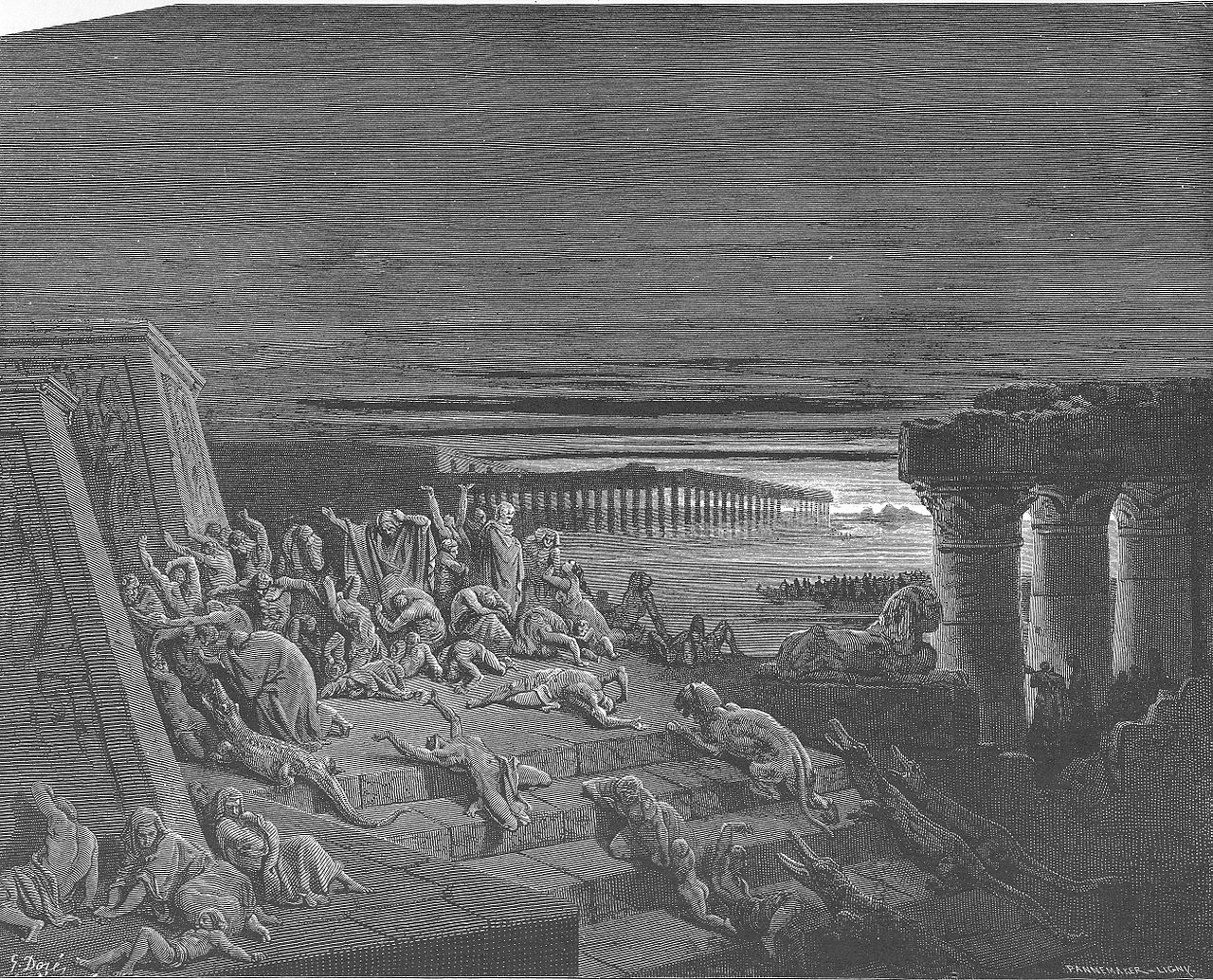
The Ninth Plague, Darkness from Gustave Dore’s English Bible

Exodus 10: 21-29- Darkness and the Defeat of Ra

 21 Then the LORD said to Moses, “Stretch out your hand toward heaven so that there may be darkness over the land of Egypt, a darkness that can be felt.” 22 So Moses stretched out his hand toward heaven, and there was dense darkness in all the land of Egypt for three days. 23 People could not see one another, and for three days they could not move from where they were; but all the Israelites had light where they lived. 24 Then Pharaoh summoned Moses, and said, “Go, worship the LORD. Only your flocks and your herds shall remain behind. Even your children may go with you.” 25 But Moses said, “You must also let us have sacrifices and burnt offerings to sacrifice to the LORD our God. 26 Our livestock also must go with us; not a hoof shall be left behind, for we must choose some of them for the worship of the LORD our God, and we will not know what to use to worship the LORD until we arrive there.” 27 But the LORD hardened Pharaoh’s heart, and he was unwilling to let them go. 28 Then Pharaoh said to him, “Get away from me! Take care that you do not see my face again, for on the day you see my face you shall die.” 29 Moses said, “Just as you say! I will never see your face again.”

The tangible darkness, darkness that can be felt may seem like a strange penultimate sign until you consider that this is not merely a battle between Moses and Pharaoh. At its heart this is a conflict between the gods of Egypt and their emissary, Pharaoh, and the LORD the God of Israel. Ra, the god of the sun in Egyptian mythology, was the central god in the Egyptian pantheon. Earlier chapter seven I mentioned the strange uses of the word tannin for snake (tannin is typically a word for dragon or a chaos monster) and I alluded to the Egyptian myth of Ra entering into a nightly battle with Apep (the snake like evil force of chaos) who attempts to consume Ra and the sun each night in the underworld.  Many of the Pharaoh’s even took the name Ramses (and the traditional Pharaoh viewed behind the narrative of the Exodus was Ramses II- whether the book of Exodus can be traced back to events in his reign ultimately is something that will likely never be proved). Pharaoh, the son of Ra, here would see the chief god of the pantheon and the authorizer of his reign blotted out for three days until the LORD relents. The future commandment that the people shall have no other gods before the LORD goes back to this time where the LORD in bringing the people out of Egypt demonstrated his power over the gods of Egypt.
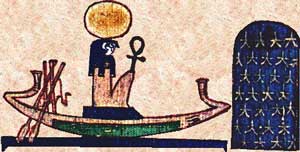
Egyptian god Ra in his Solar Barque

Pharaoh again attempts to maintain control in his demonstrated weakness. Here men, women and children are free to go but the flocks must remain behind. There is a narrative logic to the Egyptians wanting the Israelites to leave their flocks behind as they depart to worship. Remember the Egyptians flocks were wiped out by disease and the hailstorm and even thought the Egyptians in Genesis and here seem to prefer cattle to sheep and goats in a desperate situation it would make sense to retain the herds. That being said, in the narrative it is also about coercion and power and ensuring the people would return to servitude. Pharaoh is still not willing to let the people go from their slavery or to imagine a new system without the Hebrews enslaved.

Exodus 9: Hard Hearts and Hard Consequences

Gustav Dore, The Fifth Plague: Livestock Disease from Dore’s English Bible (1866)

Exodus 9: 1-7 Pestilence and Hard Hearts

Then the LORD said to Moses, “Go to Pharaoh, and say to him, ‘Thus says the LORD, the God of the Hebrews: Let my people go, so that they may worship me. 2 For if you refuse to let them go and still hold them, 3 the hand of the LORD will strike with a deadly pestilence your livestock in the field: the horses, the donkeys, the camels, the herds, and the flocks. 4 But the LORD will make a distinction between the livestock of Israel and the livestock of Egypt, so that nothing shall die of all that belongs to the Israelites.'” 5 The LORD set a time, saying, “Tomorrow the LORD will do this thing in the land.” 6 And on the next day the LORD did so; all the livestock of the Egyptians died, but of the livestock of the Israelites not one died. 7 Pharaoh inquired and found that not one of the livestock of the Israelites was dead. But the heart of Pharaoh was hardened, and he would not let the people go.

While the signs in the chapters seven and eight provided an inconvenience for the Egyptian people, in chapter nine the intensity of discomfort is increased as the pressure exerted by the LORD on Pharaoh and the people of Egypt to let the people go intensifies. Now the food supply and personal health of the people is impacted. Even when the waters of the Nile turned to blood there was a way to dig for drinkable water. Here pestilence and disease and what we would still today call ‘acts of God’ threaten the livelihood of the people in their continued resistance to the LORD.

Like the preceding sign, the LORD differentiates between the Israelites and the Egyptians. The livestock of the Israelites are unaffected by this pestilence while the Egyptian livestock and flocks perish. Yet, the entire food supply is not wiped out, the grain is still in the fields and there is still a path for life to continue. As when the frogs, a sign of abundance and fertility, threatened to overwhelm life and then polluted the land with their dead bodies and smell, now the beasts of labor and the meat producing animals die in the fields- sources of commerce and feasting now lay in waste needing to be disposed of.

Throughout this chapter, we will encounter the rhetorical use of ‘all.’ If truly all the livestock are lost here at the beginning of chapter nine, then the opportunity to bring in ‘slaves and livestock’ to a secure place at the end of the chapter make little rhetorical sense. Yet, the manner of telling the signs does draw a harsh connection between the protection offered to the Israelites and the impact of the pestilence on the Egyptians.

Much later, at the end of the Judean kingdom, prophets like Jeremiah and Ezekiel will use pestilence along with famine and the sword as the complete list of manners in which the people of Judea will be reduced. When Israel or Judea begins to act like Egypt and their kings begin to act like Pharaoh they too will see God’s judgment attempt to call them to repentance. Yet here, as later in Jeremiah, Ezekiel and the pre-exilic prophets we see God continuing to restrain the final cost in human life. Yet, at the end of the time before the exile, as here, the hearts of the leaders were hardened and they would not listen to the prophets speaking God’s word to them. Both Ezekiel and Jeremiah saw that only God was going to change the hearts of the people of their time. As Ezekiel could say, “I will give them one heart and put a new spirit within them; I will remove the heart of stone from their flesh and give them a heart of flesh.” Ezekiel 11.19, see also Jeremiah 31:33)

Exodus 9: 8-12 Sores and the Failure of the Magicians

 8 Then the LORD said to Moses and Aaron, “Take handfuls of soot from the kiln, and let Moses throw it in the air in the sight of Pharaoh. 9 It shall become fine dust all over the land of Egypt, and shall cause festering boils on humans and animals throughout the whole land of Egypt.” 10 So they took soot from the kiln, and stood before Pharaoh, and Moses threw it in the air, and it caused festering boils on humans and animals. 11 The magicians could not stand before Moses because of the boils, for the boils afflicted the magicians as well as all the Egyptians. 12 But the LORD hardened the heart of Pharaoh, and he would not listen to them, just as the LORD had spoken to Moses.

For the first time the signs begin to impact the health of the people of Egypt and the leaders. This will be the first time where the hardening of Pharaoh’s heart will be attributed to the LORD and perhaps it is the first time that Pharaoh himself will feel the direct impact of the signs. Before this point the magicians have acknowledged that the signs (with the gnats/lice) are the finger of God but here the boils have left them unable to even stand before Moses. As Rabbi Sacks can point out, “Remember that Job lost everything he had, but did not start cursing his fate until his body was covered with sores: Job 2.” (Sacks, 2010, p. 71)

Both its place within the groups of plagues (third in a series of three) and its initial form sets this plague up in parallel with the gnats/lice that come from the dust. As mentioned above the magicians in both cases are powerless to replicate (the swarm) or even stand before Moses (here). Both are thrown into the air and it is the air that carries the dust and ash towards the Egyptian people. Yet, suggestively, the ash might come from the kilns used to make the bricks the Israelites have been forced to make. Now the fiery furnaces which were used to build up the Egyptian empire on the backs of the Hebrew slaves may have their own role to play in the humbling of Pharaoh the bringing down the might of Egypt and the liberation of the Israelites. (Myers, 2005, p. 85)

Here is the point in the signs and wonders where both the magicians and Aaron exit the drama and narrative focuses on Moses and the LORD and Pharaoh and the gods of Egypt. Moses has moved beyond the point where he needs a spokesman or a prophet. Even here Moses and Aaron pull out ash from the kiln but only Moses throws it in the air. The intermediaries are no longer needed as the drama enters its critical juncture. Perhaps the drama has gone too far to change course at this point, or perhaps there is still a chance for Pharaoh to repent, as he does briefly below, but as we enter the final contest between the LORD and the gods of Egypt we are entering a moment of life or death significance. To continue in the ways of oppression and slavery will lead to fatal consequences.

Exodus 9: 13-35 An Act of God

 13 Then the LORD said to Moses, “Rise up early in the morning and present yourself before Pharaoh, and say to him, ‘Thus says the LORD, the God of the Hebrews: Let my people go, so that they may worship me. 14 For this time I will send all my plagues upon you yourself, and upon your officials, and upon your people, so that you may know that there is no one like me in all the earth. 15 For by now I could have stretched out my hand and struck you and your people with pestilence, and you would have been cut off from the earth. 16 But this is why I have let you live: to show you my power, and to make my name resound through all the earth. 17 You are still exalting yourself against my people, and will not let them go. 18 Tomorrow at this time I will cause the heaviest hail to fall that has ever fallen in Egypt from the day it was founded until now. 19 Send, therefore, and have your livestock and everything that you have in the open field brought to a secure place; every human or animal that is in the open field and is not brought under shelter will die when the hail comes down upon them.'” 20 Those officials of Pharaoh who feared the word of the LORD hurried their slaves and livestock off to a secure place. 21 Those who did not regard the word of the LORD left their slaves and livestock in the open field.

 22 The LORD said to Moses, “Stretch out your hand toward heaven so that hail may fall on the whole land of Egypt, on humans and animals and all the plants of the field in the land of Egypt.” 23 Then Moses stretched out his staff toward heaven, and the LORD sent thunder and hail, and fire came down on the earth. And the LORD rained hail on the land of Egypt; 24 there was hail with fire flashing continually in the midst of it, such heavy hail as had never fallen in all the land of Egypt since it became a nation. 25 The hail struck down everything that was in the open field throughout all the land of Egypt, both human and animal; the hail also struck down all the plants of the field, and shattered every tree in the field. 26 Only in the land of Goshen, where the Israelites were, there was no hail.

 27 Then Pharaoh summoned Moses and Aaron, and said to them, “This time I have sinned; the LORD is in the right, and I and my people are in the wrong. 28 Pray to the LORD! Enough of God’s thunder and hail! I will let you go; you need stay no longer.” 29 Moses said to him, “As soon as I have gone out of the city, I will stretch out my hands to the LORD; the thunder will cease, and there will be no more hail, so that you may know that the earth is the LORD’s. 30 But as for you and your officials, I know that you do not yet fear the LORD God.” 31 (Now the flax and the barley were ruined, for the barley was in the ear and the flax was in bud. 32 But the wheat and the spelt were not ruined, for they are late in coming up.) 33 So Moses left Pharaoh, went out of the city, and stretched out his hands to the LORD; then the thunder and the hail ceased, and the rain no longer poured down on the earth. 34 But when Pharaoh saw that the rain and the hail and the thunder had ceased, he sinned once more and hardened his heart, he and his officials. 35 So the heart of Pharaoh was hardened, and he would not let the Israelites go, just as the LORD had spoken through Moses.

My wife holding one of the hailstones from the mentioned storms

Last Sunday night a ferocious storm rolled through north Texas, where I live, dropping two inch hailstones on my house (and in some locations hailstones the size of baseballs). In a modern home with both wood and shingles providing insulation for the roof the noise of the storm was intense. When I walked around my property in daylight the next day the yard looked like it had been aerated because of all the divots the hailstones made in the ground. My car looked like someone had taken a ball-peen hammer to the roof and hood. Fortunately, no glass was broken on the house but the force of the storm was incredible. I lived for five years in Oklahoma and have seen the aftermath of tornadoes, though the worst damage I personally experienced was a time when a tornado stripped some of the shingles off the roof and knocked down my fence (neighbors two miles away were not so lucky.) I have been in Houston when a tropical storm rolled in flooding areas and knocking out power. We frequently refer to these natural disasters as acts of God and the power of a storm, a tornado, a hurricane, an earthquake or any other natural disaster can make us realize the minute power we may have to resist the elements at these critical moments. I can only imagine a storm like this in the ancient world where most living conditions are much less robust than modern homes.

This begins the final set of signs and for the first-time things turn deadly to humans who do not heed the warning that is given. Moses becomes the early warning system to Pharaoh and his officials that an ‘act of God’ is indeed coming and how the people should react. The people and the livestock (which remains after the rhetorical ‘all’ in the pestilence above) are to be brought into a secure place. This, like the frogs and the death of the first born, is one of those places where the word plague is used. Here, unlike the previous signs there will be loss of life for those who do not listen as well as the loss of crops. After the preceding signs, there are some who listen and act and yet some remain who are obstinate and refuse to heed the warning that Moses brings. The thunder and lightning, hail and fire bring disaster upon the land and upon the crops. Yet, even here there is every restriction made to avoid the loss of human life. The flax and barley harvest are decimated in the storm but the wheat and the spelt still have the potential to allow life to continue. One of the other dynamics in the story of the people of Israel in Egypt is the gathering in of excess grain to prepare for the famine. As Scripture recollects the story of the Hebrew people there is the memory that since the time of Joseph the Egyptians began laying up grain for a time of famine, and this practice allowed for the ascendance of Pharaoh’s increased power. Now here the decimation of the grain in the fields brings Pharaoh for the first time to repentance.

Here for the first-time Pharaoh seems ready to let the people go in the midst of the hailstorm. The language that, “I have sinned; the LORD is in the right, and I and my people are in the wrong.” For the first-time Pharaoh acknowledges that he has done something wrong and that now the “people may go.” Pharaoh will harden his heart again once the storm relents, but here is the first time where Pharaoh is humbled to this point and the possibility of a lasting freedom is voiced. Repentance here only brought a temporary change of behavior. Like an addict who returns to his chosen addiction Pharaoh’s heart hardens and the status quo remains in place. The pain of the signs and wonders of the LORD is still apparently not sufficient to allow Pharaoh to let the slaves go free and to abandon the economic system which is built upon their backs.

John Martin, The Seventh Plague (1823)

Exodus 8 The Insignificant Brings Low the Mighty

The god Khnum accompanied by Heqet, molds Ihy in a relief from the Mammisi (birth temple) at Dendra Temple complex

Exodus 8: 1-15: The Second Sign

Then the LORD said to Moses, “Go to Pharaoh and say to him, ‘Thus says the LORD: Let my people go, so that they may worship me. 2 If you refuse to let them go, I will plague your whole country with frogs. 3 The river shall swarm with frogs; they shall come up into your palace, into your bedchamber and your bed, and into the houses of your officials and of your people, and into your ovens and your kneading bowls. 4 The frogs shall come up on you and on your people and on all your officials.'” 5 And the LORD said to Moses, “Say to Aaron, ‘Stretch out your hand with your staff over the rivers, the canals, and the pools, and make frogs come up on the land of Egypt.'” 6 So Aaron stretched out his hand over the waters of Egypt; and the frogs came up and covered the land of Egypt. 7 But the magicians did the same by their secret arts, and brought frogs up on the land of Egypt.

 8 Then Pharaoh called Moses and Aaron, and said, “Pray to the LORD to take away the frogs from me and my people, and I will let the people go to sacrifice to the LORD.” 9 Moses said to Pharaoh, “Kindly tell me when I am to pray for you and for your officials and for your people, that the frogs may be removed from you and your houses and be left only in the Nile.” 10 And he said, “Tomorrow.” Moses said, “As you say! So that you may know that there is no one like the LORD our God, 11 the frogs shall leave you and your houses and your officials and your people; they shall be left only in the Nile.” 12 Then Moses and Aaron went out from Pharaoh; and Moses cried out to the LORD concerning the frogs that he had brought upon Pharaoh. 13 And the LORD did as Moses requested: the frogs died in the houses, the courtyards, and the fields. 14 And they gathered them together in heaps, and the land stank. 15 But when Pharaoh saw that there was a respite, he hardened his heart, and would not listen to them, just as the LORD had said.

The first sign which appeared in the previous chapter struck at the bleeding heart of Egypt and here in the second sign or warning, the plague of frogs takes the fertility of the land and now that fertility overwhelms the ability of the Pharaoh, his wise men and the magicians to control. These seems a strange sign and an odd display of power and yet the next three signs use things that on their own are weak and insignificant to bring the mightiest power of that time to the point of begging for Moses and Aaron to intercede for them. Frogs called up from the waters of Egypt will lead even Pharaoh to for a time acknowledge the LORD’s power in the land.

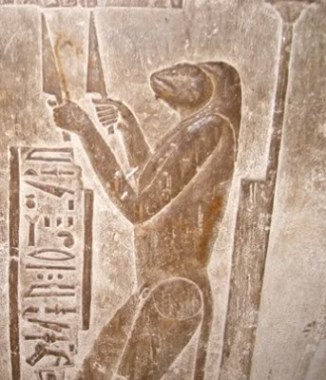
The Egyptian goddess Heqet, a goddess of fertility and childbirth

Frogs seems an odd choice and yet there is perhaps something to be seen in this choice. Frogs and the death of the first born in chapter eleven are the only signs where the language of plague is used (even though we are used to calling them the ten plagues).  Perhaps the connection goes back to fertility. In Ancient Egypt, the goddess Heqet, which is depicted as having a frogs head is one of the goddesses of fertility and seems to be the most ancient of these (since most of the other fertility images seem to be imported from other regions at later times). The association between Heqet, birth and fertility probably goes back to the frogs that would be common with the flooding of the Nile during the germination of the grain. Even midwives were known as servant of Heqet. The prolific presence of frogs at the controlled cultivation of the croplands probably sent a strong signal of fertility and life. Yet, here frogs instead of remaining in the places near the waters of Egypt move beyond their boundaries and cover the land and interfere with the life in the household, in the field and throughout the empire.

That which normally is received as a sign of blessing becomes a plague and fertility threatens to overwhelm that life which is already present. The magicians are able to replicate this sign, to demonstrate that they too can call up additional frogs-or perhaps that their powers to can be a plague. Regardless of their ability to add to the plague of frogs they cannot stem the amphibious infestation. Here Pharaoh for the first time acknowledge the impact of the LORD’s action in Egypt and ask Moses and Aaron to pray (or plead) to the LORD on behalf of Pharaoh. Moses’ prayers do lead to the elimination of the frogs and where once fertility threatened the households of Egypt now they are left with stinking piles of dead frogs.

Exodus 8: 16-19: The Third Sign

16 Then the LORD said to Moses, “Say to Aaron, ‘Stretch out your staff and strike the dust of the earth, so that it may become gnats throughout the whole land of Egypt.'” 17 And they did so; Aaron stretched out his hand with his staff and struck the dust of the earth, and gnats came on humans and animals alike; all the dust of the earth turned into gnats throughout the whole land of Egypt. 18 The magicians tried to produce gnats by their secret arts, but they could not. There were gnats on both humans and animals. 19 And the magicians said to Pharaoh, “This is the finger of God!” But Pharaoh’s heart was hardened, and he would not listen to them, just as the LORD had said.

The Egyptians were one of the first civilizations to be able to control and manipulate the land and the water to bring forth a regularly fertile land. Their control of the elements of creation has often led people to believe that they are now masters of their own destiny and, as in the story of the Tower of Babel in Genesis 11, how they will make a name for themselves. The Hebrew Bible (or Old Testament) loves to use irony and satire and like the Tower of Babel, which God has to come down and see (since even in their desire to reach up to the heavens is apparently isn’t visible from there) and confuses their language and thwarts their desire to make a name for themselves. Here it is in some type of small biting insect (can be translated as gnats, or lice or some other type of biting insect). Yet, here in the smallest of insects the magicians secret arts fail them.

Rabbi Jonathan Sacks is worth quoting at length here:

The Egyptians worshipped a multiplicity of gods, most of whom represented forces of nature. By their “secret arts” the magicians believed that they could control these forces. Magic is the equivalent in an era of myth to technology in an age of science. A civilization that believes it can manipulate the gods, believes likewise that is can exercise coercion over human beings. In such a culture the concept of freedom is unknown. (Sacks, 2010, p. 54)

The irony was that the Egyptian civilization which could harness the power of the Nile river and could build monuments to its leaders which stand even millennia later was shown powerless by a biting swarm of bugs. The magicians and wise men can realize their limits and acknowledge this is ‘the finger of God!’ Yet, in Pharaoh we have a leader whose heart (or will) is set, who knows the truth (even when all the facts contradict that perceived truth).

Chapter eight of Exodus is full of signs that are not lethal but inconvenient. The ecological disaster at this point while perhaps distasteful is not endangering the life or welfare of the people. Pharaoh’s entrenched resistance (whatever its source) allows the conflict between the LORD of Israel and the gods of Egypt to continue. Now for the first time the secret arts of the magicians has failed to replicate the finger of God. In the structure of the signs the third sign closes the first set but there is some wisdom to the way the chapter division occurs in our bibles. The frogs, gnats and flies all are ways in which the smallest and most inconsequential things manage to bring the might of Egypt to its knees.

Exodus 8: 20-31: The Fourth Sign

 20 Then the LORD said to Moses, “Rise early in the morning and present yourself before Pharaoh, as he goes out to the water, and say to him, ‘Thus says the LORD: Let my people go, so that they may worship me. 21 For if you will not let my people go, I will send swarms of flies on you, your officials, and your people, and into your houses; and the houses of the Egyptians shall be filled with swarms of flies; so also the land where they live. 22 But on that day I will set apart the land of Goshen, where my people live, so that no swarms of flies shall be there, that you may know that I the LORD am in this land. 23 Thus I will make a distinction between my people and your people. This sign shall appear tomorrow.'” 24 The LORD did so, and great swarms of flies came into the house of Pharaoh and into his officials’ houses; in all of Egypt the land was ruined because of the flies.

 25 Then Pharaoh summoned Moses and Aaron, and said, “Go, sacrifice to your God within the land.” 26 But Moses said, “It would not be right to do so; for the sacrifices that we offer to the LORD our God are offensive to the Egyptians. If we offer in the sight of the Egyptians sacrifices that are offensive to them, will they not stone us? 27 We must go a three days’ journey into the wilderness and sacrifice to the LORD our God as he commands us.” 28 So Pharaoh said, “I will let you go to sacrifice to the LORD your God in the wilderness, provided you do not go very far away. Pray for me.” 29 Then Moses said, “As soon as I leave you, I will pray to the LORD that the swarms of flies may depart tomorrow from Pharaoh, from his officials, and from his people; only do not let Pharaoh again deal falsely by not letting the people go to sacrifice to the LORD.”

 30 So Moses went out from Pharaoh and prayed to the LORD. 31 And the LORD did as Moses asked: he removed the swarms of flies from Pharaoh, from his officials, and from his people; not one remained. 32 But Pharaoh hardened his heart this time also, and would not let the people go.

The structure of the signs would indicate this is a new set. As mentioned previously the first sign of each set occurs in the morning as Pharaoh is outside, the second occurs after Moses speaks to Pharaoh inside and the third comes without a warning. With each set of signs the intensity of the damage increases as the pressure increases on the Egyptians to let the people of Israel go. Another distinction between the first three signs and the remaining signs is that now there is a distinction between the people of Israel and the Egyptians. The remaining signs will now not afflict the land where the Hebrews dwell, almost as if an invisible barrier is erected to keep out the flies and later afflictions.

After the frogs, had come upon the land the Pharaoh asks for Moses’ and Aaron’s intercession on behalf of him and his people offering to let the people go and worship but once there is a respite Pharaoh’s heart hardens and he forbids the people leaving to go and sacrifice. In a similar way, Pharaoh calls for Moses and Aaron and offers to let the Israelites worship and sacrifice within the land but now cultural differences get in the way. We don’t know exactly what these cultural differences are that the Egyptians would have stoned the people of Israel for. Perhaps it had to do with the animals the Jewish people would sacrifice (mainly sheep and goats which the Egyptians found distasteful, for example in Genesis Joseph warns his brothers not to say they were shepherds for the Egyptians found shepherds abhorrent (see Genesis 46: 34)). Regardless cultural and religious differences would ultimately make cohabitation impossible for the Jewish people in Egypt. As a religious and cultural minority, they felt unsafe within the broader Egyptian culture.

The ancient world was a pluralistic one where multiple religions did encounter one another and sometimes those cultures would live together peacefully. The people of Israel found a home in Egypt for several generations and were welcomed, yet the Exodus relates a time where they were a persecuted and oppressed group. Their present is now that of slaves and their future will be one of being refugees in search of a new home. The economic system of Egypt was built upon forced labor. Change frequently occurs only when the situation becomes so odious it can no longer be maintained. The people of Israel will be reluctant to leave Egypt behind and will long for it when things become challenging in the journey to the promised land. The people and leaders of Egypt are reluctant to let the people go because it means changing the way in which their society functions. In some respects, it is not surprising that Pharaoh continues here to harden his heart and defend the status quo and that only the continued pressure of these strange acts of God makes him even consider the possibility of temporarily granting the people a time to worship. Frogs, swarms of small biting bugs and flies continue to make life in Egypt unpleasant and continue to show

Exodus 7: The Conflict Begins

Ancient Egyptian Art Depicting Apep battling a Diety from the tomb of Inher-kha, Thebes

Exodus 7: 1-13 The Initial Challenge

The LORD said to Moses, “See, I have made you like God to Pharaoh, and your brother Aaron shall be your prophet. 2 You shall speak all that I command you, and your brother Aaron shall tell Pharaoh to let the Israelites go out of his land. 3 But I will harden Pharaoh’s heart, and I will multiply my signs and wonders in the land of Egypt. 4 When Pharaoh does not listen to you, I will lay my hand upon Egypt and bring my people the Israelites, company by company, out of the land of Egypt by great acts of judgment. 5 The Egyptians shall know that I am the LORD, when I stretch out my hand against Egypt and bring the Israelites out from among them.” 6 Moses and Aaron did so; they did just as the LORD commanded them. 7 Moses was eighty years old and Aaron eighty-three when they spoke to Pharaoh.

 8 The LORD said to Moses and Aaron, 9 “When Pharaoh says to you, ‘Perform a wonder,’ then you shall say to Aaron, ‘Take your staff and throw it down before Pharaoh, and it will become a snake.'” 10 So Moses and Aaron went to Pharaoh and did as the LORD had commanded; Aaron threw down his staff before Pharaoh and his officials, and it became a snake. 11 Then Pharaoh summoned the wise men and the sorcerers; and they also, the magicians of Egypt, did the same by their secret arts. 12 Each one threw down his staff, and they became snakes; but Aaron’s staff swallowed up theirs. 13 Still Pharaoh’s heart was hardened, and he would not listen to them, as the LORD had said.

The liberation of the people of Israel from their servitude to the Egyptians in not just a conflict between peoples, at its root it is a conflict between the LORD the God of Israel and the Egyptian gods. Moses becomes the vessel of the LORD’s work against the Egyptians and Pharaoh and the ‘wise men, the sorcerers and the magicians of Egypt’ line up on the other side. The central two characters, Moses and Pharaoh, both become representative or avatars of the divine power behind them. Moses here will be ‘like a God to Pharaoh, and your brother Aaron shall be your prophet.’ Pharaoh derives his authority from a divine claim that the Pharaoh is a ‘son of Ra’ the chief god of the Egyptian pantheon. Two conflicting views of creation (Ra is the chief god of not only the sun but creation for Egypt) and two conflicting views of the way that world should be structured are in play. Within Egypt, the superpower of that era, Pharaoh is all powerful and yet in this narrative Pharaoh plays a tragic character. Pharaoh will not listen to Aaron and Moses initially, but the conflict between competing sources of divine power will be seen not only by the individual players but also by both peoples (the Egyptians and the Hebrews). The end is that even the Egyptians will ‘know that I am the LORD,’ as the coming ecological disasters will testify to the power of the LORD over creation and the inability of Ra and those loyal to him to prevent this upheaval.

One of the places where translations don’t quite do justice to the original language is here with the language about the snakes that come from Aaron’s and what comes out of the Egyptians staffs. The word here in Hebrew is Tannin which is not the typical word for snake but rather for the serpent like chaos monster or dragon. Both sets of Tannin, from Aaron’s staff and the Egyptian magicians, are forces of war and destruction and chaos. Here chaos is unleashed symbolically in a struggle between the LORD of Israel and the lords of Egypt. Interestingly, to me at least, in Egyptian mythology the nightly struggle of Ra is against Apep (or Apophis) the snake like force of evil and chaos but now in matching the display of power by the LORD unleashing the forces of chaos even the emissaries of Pharaoh, son of Ra, must unleash their own forces of chaos. Ultimately it is the tannin released by Aaron which swallows the tannin released by the wise men of Egypt and this initial conflict foreshadows the chaos unleashed on creation that is to come. One of the things that begins here is the inability of the Egyptian wise men, sorcerers and magicians to undo what has been unleashed through Moses and Aaron. They may initially replicate what Moses and Aaron do but they cannot undo it. They can only add to the chaos which threatens to consume all of Egypt.

One of the aspects of this and the following passage to consider is the ‘hardening of Pharaoh’s heart.’ There are certain passages where Pharaoh himself is the one who hardens his heart and others where the heart of Pharaoh is hardened by God. For those looking for a definitive answer to the tricky question of divine determinism I am afraid you are likely to be disappointed. Many interpreters see within this, and each interpreter makes theological choices based on their understanding of God, for Pharaoh’s free will remaining intact and the responsibility for the choices remaining entirely on Pharaoh’s shoulders. Others take serious this hardening of Pharaoh’s heart by the LORD and see the enslaver losing his own free will and becoming the tool that once the enslaved Hebrew people were. The truth is probably subtler as the ancient writers of the Bible were not dogmatically rigid. Divine determinism and free will could coexist without any perceived conflict. Perhaps, as Rabbi Jonathan Sacks can state:

Pharaoh is in fact…a tragic figure like Lady Macbeth, or like Captain Ahab in Melville’s Moby Dick, trapped in an obsession which may have had rational beginnings, right or wrong, but which has taken hold of him, bringing not only him but those around him to ruin. (Sacks, 2010, p. 49)

Perhaps Pharaoh is merely trapped within a worldview that cannot imagine letting the Hebrew slaves go. Perhaps Pharaoh’s heart and mind receive some divine nudge to harden his resolve and will as the chaos unfolds around him and his people. Perhaps Pharaoh, who views himself as the king on the chess board is merely a pawn being played. Regardless Pharaoh, the son of Ra, will be unable to avoid being swallowed up by the chaos unleashed as he struggles against the LORD. The gauntlet has been thrown, the challenge has begun for the lives of both peoples. Warnings are unheeded, hearts are hardened and next the heart of Egypt will bleed.

The Roman Kiosk of Trajan (left) on Agilkia island in the Nile River, near Aswān, Egypt

Exodus 7: 14-25 The Bleeding Heart of Egypt

 14 Then the LORD said to Moses, “Pharaoh’s heart is hardened; he refuses to let the people go. 15 Go to Pharaoh in the morning, as he is going out to the water; stand by at the river bank to meet him, and take in your hand the staff that was turned into a snake. 16 Say to him, ‘The LORD, the God of the Hebrews, sent me to you to say, “Let my people go, so that they may worship me in the wilderness.” But until now you have not listened.’ 17 Thus says the LORD, “By this you shall know that I am the LORD.” See, with the staff that is in my hand I will strike the water that is in the Nile, and it shall be turned to blood. 18 The fish in the river shall die, the river itself shall stink, and the Egyptians shall be unable to drink water from the Nile.'” 19 The LORD said to Moses, “Say to Aaron, ‘Take your staff and stretch out your hand over the waters of Egypt– over its rivers, its canals, and its ponds, and all its pools of water– so that they may become blood; and there shall be blood throughout the whole land of Egypt, even in vessels of wood and in vessels of stone.'”

20 Moses and Aaron did just as the LORD commanded. In the sight of Pharaoh and of his officials he lifted up the staff and struck the water in the river, and all the water in the river was turned into blood, 21 and the fish in the river died. The river stank so that the Egyptians could not drink its water, and there was blood throughout the whole land of Egypt. 22 But the magicians of Egypt did the same by their secret arts; so Pharaoh’s heart remained hardened, and he would not listen to them; as the LORD had said. 23 Pharaoh turned and went into his house, and he did not take even this to heart. 24 And all the Egyptians had to dig along the Nile for water to drink, for they could not drink the water of the river.

 25 Seven days passed after the LORD had struck the Nile.

The Nile River, or to the ancient Egyptians simply the river, is the heart of the Egyptian empire. Egypt was shielded from other early civilizations by deserts on both sides and the Nile river delta provided for an agricultural abundance that allowed the people to focus on the construction of large public projects like the pyramids. The river is a source of food, transportation, and ultimately life. Without the Nile River, there is no Egyptian empire and even though the Nile never becomes a significant source of worship for the Egyptians, it is simply an assumed part of life. Yet, it is here that the LORD instructs Moses and Aaron to strike first. The heart of the Egyptian empire bleeds, life begins to end and an ecological disaster begins to unfold.

This begins a highly-structured telling of the signs and wonders that bring the people out of Egypt. In the three sets of three where the first in each set Moses speaks to Pharaoh outside in the morning, the second Moses speaks to Pharaoh inside in the palace and the third comes abruptly without a warning. Some would argue ecologically that one plague would naturally follow the others because of the ecological devastation, and while that may be true the narrative moves where the LORD is in control of each sign and wonder unfolding.

In Genesis 3, the end of the story of Adam and Eve, the disobedience by Adam and Eve which is supposed to result in their own deaths is ultimately born by the earth (see Genesis 3: 17). Here also it is the earth which bears the consequences of the disobedience of Pharaoh. Of the first nine signs, only the hail is fatal to humans and even then, Pharaoh and his people are warned to bring their people and animals into a secure place with a twenty-four-hour warning. Each sign seems designed to make the Egyptians aware that it is the LORD who is the God who has power over the creation and here the waters of Egypt are the first to bear the consequence of the refusal of Pharaoh to let the people go to worship the LORD.

Again, the magicians of Egypt, by their secret arts, are able to replicate this chaos with some of the uncontaminated water and yet they are unable to reverse or limit the effects. They can only contribute to the chaos. The river turns to blood, the fish die and the waters stink and are unable to drink. The lifeblood of Egypt is now biological waste and yet the people continue to find a way. Even though the river will be contaminated people are still able to dig for freshwater along the banks of the river. The ecological disaster forces the people to change their patterns and yet the Egyptians continue to find the water they need for life to continue. Pharaoh’s heart remains hardened and his will is resolved since his priests can apparently in some way replicate what the LORD is doing through Moses and Aaron. Perhaps, he is also shielded from the immediate effects since he would not dig for his own water, ultimately slaves or servants would do that for him. He retreats to his house without taking to heart the bleeding heart of his empire. He closes his eyes and his doors to the disaster beginning to unfold around him.

Exodus 6: God’s Response and Moses’ Heritage

Exodus 6: 1-13 A God Who Speaks and A People Unable to Hear

Then the LORD said to Moses, “Now you shall see what I will do to Pharaoh: Indeed, by a mighty hand he will let them go; by a mighty hand he will drive them out of his land.”

2 God also spoke to Moses and said to him: “I am the LORD. 3 I appeared to Abraham, Isaac, and Jacob as God Almighty, but by my name ‘The LORD’ I did not make myself known to them. 4 I also established my covenant with them, to give them the land of Canaan, the land in which they resided as aliens. 5 I have also heard the groaning of the Israelites whom the Egyptians are holding as slaves, and I have remembered my covenant. 6 Say therefore to the Israelites, ‘I am the LORD, and I will free you from the burdens of the Egyptians and deliver you from slavery to them. I will redeem you with an outstretched arm and with mighty acts of judgment. 7 I will take you as my people, and I will be your God. You shall know that I am the LORD your God, who has freed you from the burdens of the Egyptians. 8 I will bring you into the land that I swore to give to Abraham, Isaac, and Jacob; I will give it to you for a possession. I am the LORD.'” 9 Moses told this to the Israelites; but they would not listen to Moses, because of their broken spirit and their cruel slavery.

 10 Then the LORD spoke to Moses, 11 “Go and tell Pharaoh king of Egypt to let the Israelites go out of his land.” 12 But Moses spoke to the LORD, “The Israelites have not listened to me; how then shall Pharaoh listen to me, poor speaker that I am?” 13 Thus the LORD spoke to Moses and Aaron, and gave them orders regarding the Israelites and Pharaoh king of Egypt, charging them to free the Israelites from the land of Egypt.

The same message may be heard very differently in different circumstances. When Moses and Aaron relay a very similar message at the end of chapter four the people receive in hope, they bow down and they worship. After the abuse received in chapter five the supervisors have called for the LORD to judge between Moses and them. Oppression changes our ability to hope and believe that a change can happen. One of the dynamics of abuse is that the abused person often feels they have no choice because all their energy is expended on survival. Slavery continues to breed hopelessness among the people and as daily survival becomes harder imagining a change becomes both more essential and increasingly difficult. It will not be words or promises that will move the people of Israel or Pharaoh away from the oppressor/oppressed dynamic.

The upcoming plagues upon the land of Egypt will be harsh and there will be much to wrestle with in these sections as they come up, but here we are at the end of what words can do. Ultimately words, without some type of recognized power and authority behind them, short of their power to convince do not sometimes break through the hardened worldviews of opposing parties. Moses may not be a person who is confident in his speaking ability but we have seen previously he is a man who acts when he sees oppression. Yet, here, where his previous words seem only to have increased the suffering and oppression of the people he again appeals to his poor speaking ability. He is unable to engender with these words of the LORD hope within the people of Israel or fear within the person of Pharaoh.

We as people who hear these words in relative comfort can also hear something new in this moment of revelation, something perhaps Moses and the people could not hear in their oppression engendered deafness. The name of the LORD, revealed to Moses on the mountain in chapter three, we now learn has not been previously revealed. Others have known the LORD and called the LORD by other names (typically describing an attribute of God: God almighty, God who sees, etc.) but now Moses hears again the unique name of the LORD. Again, there are the promises of the land of Canaan, the promise to deliver, the covenant promise that the LORD will be their God and they will be the people of the LORD, these things will unfold as we journey through the Exodus narrative, and yet all these promises are unable to heard at this time. Ultimately it will be in retrospect that the people will be able to look back and in light of the commandments remember “I am the LORD your God, who brought you out of the land of Egypt, out of the house of slavery.” (Exodus 20:2)

We are moving from the time where the time of actions in the future will become the present of the narrative. If this were our story we would move directly into the confrontation between Moses and Aaron and Pharaoh, between the LORD the God of Israel and the gods of Egypt. Yet, there is one more pause before we move into this conflict. The LORD has revealed something of Godself in both name, heritage and promise and we have seen something of who Moses is in his actions. But for the people of Israel there is something else we need to know before we can move forward.

Theo van Doesburg, Moses (1906)

Theo van Doesburg, Moses (1906)

Exodus 6:14-30 Who are Moses and Aaron

 14 The following are the heads of their ancestral houses: the sons of Reuben, the firstborn of Israel: Hanoch, Pallu, Hezron, and Carmi; these are the families of Reuben. 15 The sons of Simeon: Jemuel, Jamin, Ohad, Jachin, Zohar, and Shaul, the son of a Canaanite woman; these are the families of Simeon. 16 The following are the names of the sons of Levi according to their genealogies: Gershon, Kohath, and Merari, and the length of Levi’s life was one hundred thirty-seven years. 17 The sons of Gershon: Libni and Shimei, by their families. 18 The sons of Kohath: Amram, Izhar, Hebron, and Uzziel, and the length of Kohath’s life was one hundred thirty-three years. 19 The sons of Merari: Mahli and Mushi. These are the families of the Levites according to their genealogies. 20 Amram married Jochebed his father’s sister and she bore him Aaron and Moses, and the length of Amram’s life was one hundred thirty-seven years. 21 The sons of Izhar: Korah, Nepheg, and Zichri. 22 The sons of Uzziel: Mishael, Elzaphan, and Sithri. 23 Aaron married Elisheba, daughter of Amminadab and sister of Nahshon, and she bore him Nadab, Abihu, Eleazar, and Ithamar. 24 The sons of Korah: Assir, Elkanah, and Abiasaph; these are the families of the Korahites. 25 Aaron’s son Eleazar married one of the daughters of Putiel, and she bore him Phinehas. These are the heads of the ancestral houses of the Levites by their families.

 26 It was this same Aaron and Moses to whom the LORD said, “Bring the Israelites out of the land of Egypt, company by company.” 27 It was they who spoke to Pharaoh king of Egypt to bring the Israelites out of Egypt, the same Moses and Aaron.

 28 On the day when the LORD spoke to Moses in the land of Egypt, 29 he said to him, “I am the LORD; tell Pharaoh king of Egypt all that I am speaking to you.” 30 But Moses said in the LORD’s presence, “Since I am a poor speaker, why would Pharaoh listen to me?”

This is not how we tell a story because we see the world differently than people in the ancient world. We live in a world where we construct our identities, we are who we are because of our choices and actions is the narrative we try to live our lives within. Yet, in the ancient world you inherited your identity: you are who you are because of your parents, grandparents, etc. This is why the Bible and most ancient texts take extended sections for genealogies. Often an ancient person’s telling of who they are would be a narrative of not only their name but their name within a list of the ancestors. You still see this in the Middle East where names, Osama bin Laden for a famous example, revolve around this pattern (Osama son of (bin) Laden). Here what is interesting to me about this genealogy is its incompleteness. It begins with a telling of the ancestry of the tribe (Reuben, Simeon and Levi) but before it can get to the remaining tribes it holds up within the tribe of Levi focusing both on the upcoming divisions of labor among the descendants of Levi as well as the priestly heritage of both Aaron and Moses. Here for the first time the parents of Moses and Aaron are named: Amram and Jochebed and presumably Aaron is the older son based upon how they are listed. There is a long series of exceptions where the LORD chooses the younger rather than the older son (Jacob and Joseph for example in Genesis) and here is one more of those incidents.

Another unusual piece of this genealogy is that Amram and Jochebed are related more closely than would be allowed in Leviticus (see Leviticus 18:12) and yet here they are a man and his aunt who are lifted up as the ancestors of Moses and Aaron: the great leader of Israel and its first high priest. Again, this is one of those places where a close reading of a genealogy often renders a few surprises in the family tree.

I have done enough work with Family Systems theory and have spent enough time observing families as a part of my ministry within a congregation to know that we are never truly the crafters of our own story. We inherit a lot of our identity, knowingly and unknowingly, from our parent and their parents. Many of our opportunities are opened by the position and standing of those who came before us. In our world, we may simply attempt to judge Moses and Aaron based upon their position and actions but perhaps there is some wisdom in these ancient stories that pause and remind us who are the ancestors of the people in our stories and where are the roots of their family trees. Now that we know where Moses and Aaron came from we are ready to follow them into the rest of the story.

Exodus 5: The Oppression of the Israelites Increases

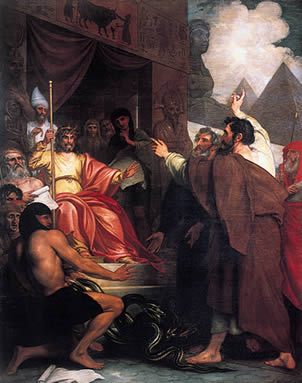
Benjamin West (1738-1820), Moses and Aaron Before Pharaoh

Benjamin West (1738-1820), Moses and Aaron Before Pharaoh

Exodus 5: 1-9: The Initial Audience with Pharaoh

Afterward Moses and Aaron went to Pharaoh and said, “Thus says the LORD, the God of Israel, ‘Let my people go, so that they may celebrate a festival to me in the wilderness.'” 2 But Pharaoh said, “Who is the LORD, that I should heed him and let Israel go? I do not know the LORD, and I will not let Israel go.” 3 Then they said, “The God of the Hebrews has revealed himself to us; let us go a three days’ journey into the wilderness to sacrifice to the LORD our God, or he will fall upon us with pestilence or sword.” 4 But the king of Egypt said to them, “Moses and Aaron, why are you taking the people away from their work? Get to your labors!” 5 Pharaoh continued, “Now they are more numerous than the people of the land and yet you want them to stop working!” 6 That same day Pharaoh commanded the taskmasters of the people, as well as their supervisors, 7 “You shall no longer give the people straw to make bricks, as before; let them go and gather straw for themselves. 8 But you shall require of them the same quantity of bricks as they have made previously; do not diminish it, for they are lazy; that is why they cry, ‘Let us go and offer sacrifice to our God.’ 9 Let heavier work be laid on them; then they will labor at it and pay no attention to deceptive words.”

The initial audience for Moses and Aaron with the Pharaoh makes matters worse instead of better for the Hebrew people. The authority that they can claim from the LORD is immediately met with the question from Pharaoh, “Who is the LORD?” I find it intriguing that the initial threat is on the Israelites, that if they do not go into the wilderness to sacrifice then pestilence and sword will fall on them, rather than the Egyptians. While the LORD has revealed Godself to Moses and Aaron, Pharaoh has not received any type of revelation yet. Pharaoh’s gods are very different from the LORD the God of Israel. Egypt’s gods are the gods that authorize the reign of Pharaoh and the enslavement of the people. Yet, the God of Israel has heard their cry and has called Moses and Aaron to carry to Pharaoh this initial plea to let the people go.

Pharaoh resorts to victim blaming. Although there is perhaps some vulnerability in the statement that, “Now they are more numerous than the people of the land” and the fear of what a day without their immigrants would look like, the Hebrew people are immediately scapegoated as lazy. Pharaoh uses the bureaucracy to separate himself from the suffering of the Hebrew people and to increase it mercilessly. Unlike the LORD, Pharaoh refuses to hear and see. There is no Sabbath rest for the people of Israel, only the iron hand of oppression. In laying before the people the impossible task of making bricks without straw and charging them to gather straw from the remnants of the field Pharaoh insures that they will continue to be less productive and ‘lazy’ in the eyes of the oppressor.

Exodus 5: 10-21: The Oppression Increases

 10 So the taskmasters and the supervisors of the people went out and said to the people, “Thus says Pharaoh, ‘I will not give you straw. 11 Go and get straw yourselves, wherever you can find it; but your work will not be lessened in the least.'” 12 So the people scattered throughout the land of Egypt, to gather stubble for straw. 13 The taskmasters were urgent, saying, “Complete your work, the same daily assignment as when you were given straw.” 14 And the supervisors of the Israelites, whom Pharaoh’s taskmasters had set over them, were beaten, and were asked, “Why did you not finish the required quantity of bricks yesterday and today, as you did before?”

15 Then the Israelite supervisors came to Pharaoh and cried, “Why do you treat your servants like this? 16 No straw is given to your servants, yet they say to us, ‘Make bricks!’ Look how your servants are beaten! You are unjust to your own people.” 17 He said, “You are lazy, lazy; that is why you say, ‘Let us go and sacrifice to the LORD.’ 18 Go now, and work; for no straw shall be given you, but you shall still deliver the same number of bricks.” 19 The Israelite supervisors saw that they were in trouble when they were told, “You shall not lessen your daily number of bricks.” 20 As they left Pharaoh, they came upon Moses and Aaron who were waiting to meet them. 21 They said to them, “The LORD look upon you and judge! You have brought us into bad odor with Pharaoh and his officials, and have put a sword in their hand to kill us.”

It is the supervisors, those from among the people who are placed in a position of

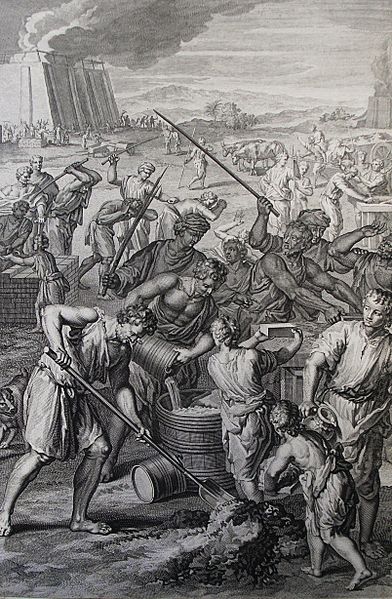
The Phillip Medhurst Picture Torah, Pharaoh Adds to the Work of the Israelites

The Phillip Medhurst Picture Torah, Pharaoh Adds to the Work of the Israelites

authority who will become those most directly impacted by Pharaoh’s words.  The people will fail at their impossible task, Pharaoh will continue to blame the supervisors and the people for being lazy and supervisors now find themselves beaten by the taskmasters. Even though the supervisors go and appeal to Pharaoh they have the request of Aaron and Moses thrown in their faces as evidence of their laziness. Their past loyalty to the king of Egypt does not count when they now find themselves bearing the people’s punishment. Perhaps this drives the supervisors back to being a part of the people rather than primarily aligning with the empire but in Pharaoh’s response they see that their positions of favor have changed to disfavor.

Egypt, as it is portrayed in Exodus, was an empire build upon the enslavement of an immigrant people. The Hebrew people are viewed as other, somehow lesser than the people of the land. Their forced labor allowed for the consolidation of wealth and power among the elite rulers and priestly members of their society. Systems of oppression to not change easily or willingly. There are often elaborate beliefs that are invisibly woven around one group’s privilege and another’s oppression. Even in modern times we are not free from systems where we blame the victim or where one group of people has an often unseen, perhaps obscured by systems of bureaucracy like in our narrative, set of privileges or benefits. In the United States, a country founded on a stated creed that ‘all men are created equal’ it took, for example, a civil war and then one hundred years of struggle (often overlooked) until the voting rights act could make it legal for African Americans to be able to vote and that struggle for voice and vote continues for people of color, women and many other groups.

One of the rhetorical moves of the Civil Rights movement was to take the Exodus narrative, which was so important in the founding of the United States, and recast it where now instead of white Americans being able to claim the mantle of the Hebrews entering the promised land, now it is the African Americans who are the chosen people and whites are recast in the role of Pharaoh and his taskmasters. Within the Civil Rights movement, like in the Exodus story, the oppression of the captive people became harsher before they earned a greater equality than what they had before. The Civil Rights leaders probably had several of their own people accuse them like the supervisors did to Moses and Aaron, for the struggle was not to be over in one day or one set of words. In Egypt, it will take an act of God for the people to leave their oppression. In our day, may our hearts not be so hardened as Pharaohs would be.

Exodus 5: 22-23: Moses’ Accusation of God

 22 Then Moses turned again to the LORD and said, “O LORD, why have you mistreated this people? Why did you ever send me? 23 Since I first came to Pharaoh to speak in your name, he has mistreated this people, and you have done nothing at all to deliver your people.”

Moses has some chutzpah. This will not be the last time Moses speaks boldly to God, nor will Moses be the only exemplar of this. The prophet Jeremiah’s words to God were often very direct and accusing, see for example Jeremiah 15 and Jeremiah 20. Many of the Psalms of lament, for example Psalm 10 or Psalm 22 accuse God of either hiding Godself in times of trouble or forsaking the Psalmist. One of the gifts of our scriptures is the direct way that the people of faith could appeal to God. Here Moses, the one who feared using his voice, can now lift his voice to God in protest God’s mistreatment of the people and sending him as a bearer of sorrow to them. God has not yet fulfilled his promise to deliver the people and as Moses can boldly state he has done nothing to deliver them yet. God will hear the cries of the people and will hear the words of Moses. I stated in an earlier chapter that perhaps one of the characteristics of Moses that God saw and chose was his inability to remain inactive in the fact of oppression. Now Moses lifts up to God the cries and accusations of the people. Unlike Pharaoh, the LORD will not remain unmoved.

Exodus 4: Divine Magic, Anger and The Return to Egypt

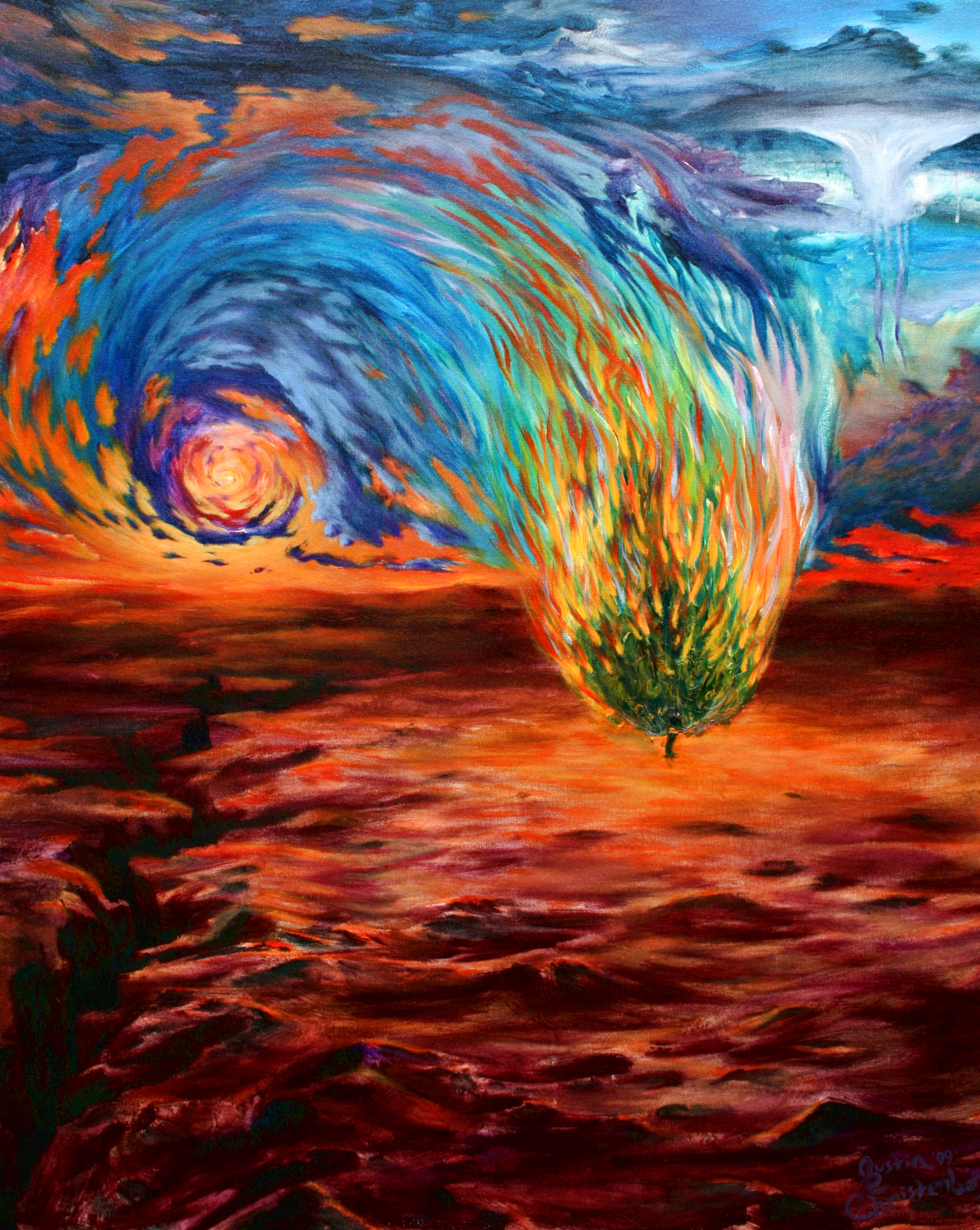
Burning Bush by Quirill at deviantart.com

Burning Bush by Quirill at deviantart.com

Exodus 4: 1-9- So That They May Believe

Then Moses answered, “But suppose they do not believe me or listen to me, but say, ‘The LORD did not appear to you.'” 2 The LORD said to him, “What is that in your hand?” He said, “A staff.” 3 And he said, “Throw it on the ground.” So he threw the staff on the ground, and it became a snake; and Moses drew back from it. 4 Then the LORD said to Moses, “Reach out your hand, and seize it by the tail”– so he reached out his hand and grasped it, and it became a staff in his hand– 5 “so that they may believe that the LORD, the God of their ancestors, the God of Abraham, the God of Isaac, and the God of Jacob, has appeared to you.”

 6 Again, the LORD said to him, “Put your hand inside your cloak.” He put his hand into his cloak; and when he took it out, his hand was leprous, as white as snow. 7 Then God said, “Put your hand back into your cloak”– so he put his hand back into his cloak, and when he took it out, it was restored like the rest of his body– 8 “If they will not believe you or heed the first sign, they may believe the second sign. 9 If they will not believe even these two signs or heed you, you shall take some water from the Nile and pour it on the dry ground; and the water that you shall take from the Nile will become blood on the dry ground.”

Moses’ second objection or clarification leads us to the first demonstrations of divine power in the form of magic. In our modern disenchanted world, we may have trouble trusting a narrative where God acts in concrete physical and magical ways within the world but to remove the magic from Exodus, or the Bible in general, is to remove from the story the active engagement of God in the liberation of the people of Israel. Personally, I have little interest in the enlightenment era portrayal of God as ‘the divine clockmaker’ or ‘the prime mover’ who stands unengaged and uninvolved in the world. The bible does speak to a world where ‘good magic,’ the magic which kept the forces of death and darkness at bay was the purview of the temples and churches. While many of the more fundamentalist churches have been troubled by the popularity of books like the Harry Potter series, The Magicians, and many other fantasy series involving magicians, witches, and a world that is somehow still enchanted I personally enjoy these books and believe in a world that is still more magical than our scientific disenchantment would encourage. To limit faith to that which is seen, observed and controlled is to transform faith into some sort of disenchanted dogmatism. There was wisdom when the council of Nicaea included in the Nicene Creed’s first article “We believe in One God, the Father, the Almighty, maker of heaven and earth, of all that is, visible and invisible.” (Emphasis mine)

These three magical signs are in response to Moses’ fear that they will not believe him or listen. Here with each of these signs the emphasis on believing is placed. The staff becomes a snake and then again, a staff so that they may believe. The hand becomes diseased and then healed and whole again in case they do not believe the first sign, they may believe the second.  This skin disease, probably not Hansen’s disease or what we know today as leprosy, was still a fearful thing in the ancient world and particularly for the purity concerns of the ancient Jewish people. Leviticus chapters thirteen and fourteen are entirely dedicated for how the people are to deal with those who have a skin disease like this, this type of disease would prevent a descendant of Aaron from participating in or receiving the benefits of the offerings and the temple (Leviticus 22:4) the book of Numbers will remind the people again that people with a skin disease are to be put outside of the camp (Numbers 5:2) and later Miriam, Moses’ sister, when she and Aaron challenge Moses’ leadership will also be afflicted with this or a similar skin disease. (Numbers 12) This type of skin disease must have occupied a central place of fear or disgust for the Hebrew people and here the LORD uses this disease as a demonstration of the God of Israel’s power over this feared ailment. Finally, a third sign is given but not demonstrated but it foreshadows one of the coming signs in the conflict between the God of Israel and the leaders (and by extension gods) of Egypt.

The gospel of John will later share a similar view of the signs that Jesus did so that his followers may believe. While that gospel can state that many other signs other than those recorded were done: “But these were written so that you may come to believe” (John 20:31). Yet, these demonstrations of power tend not to create a robust and long lasting faith. One of the continual struggles throughout the book of Exodus will be the people’s continual inability to trust in either Moses or the LORD despite the incredible actions that God will do to bring the people out of Egypt, to bring them across the Red Sea and to sustain them in the wilderness. Yet, these signs and the conflict with Moses and the magicians of Egypt will be an essential part of the way the LORD will triumph and bring about the liberation of the people.

Exodus 4: 10-17- Prophetic Resistance and Divine Anger

 10 But Moses said to the LORD, “O my Lord, I have never been eloquent, neither in the past nor even now that you have spoken to your servant; but I am slow of speech and slow of tongue.” 11 Then the LORD said to him, “Who gives speech to mortals? Who makes them mute or deaf, seeing or blind? Is it not I, the LORD? 12 Now go, and I will be with your mouth and teach you what you are to speak.” 13 But he said, “O my Lord, please send someone else.” 14 Then the anger of the LORD was kindled against Moses and he said, “What of your brother Aaron, the Levite? I know that he can speak fluently; even now he is coming out to meet you, and when he sees you his heart will be glad. 15 You shall speak to him and put the words in his mouth; and I will be with your mouth and with his mouth, and will teach you what you shall do. 16 He indeed shall speak for you to the people; he shall serve as a mouth for you, and you shall serve as God for him. 17 Take in your hand this staff, with which you shall perform the signs.”

Isaiah could proclaim he was a person of unclean lips, Jeremiah was only a boy too young to take up the calling God placed upon him, Gideon, Zechariah and countless others would wonder about their sufficiency for the task that God had entrusted to them. Moses has already asked, “Who am I that I should go to Pharaoh, and bring the Israelites out of Egypt?” (see 3:10) Now Moses claims he is slow of speech and slow of tongue (literally heavy of mouth and heavy of tongue). There is a parallel with the Apostle Paul who, particularly in his correspondence with the Corinthian churches, where his eloquence in person may not compare to the words of his letters. Yet he, like Moses,

“did not come proclaiming to you the mystery of God to you in lofty words or wisdom…My speech and my proclamation were not with plausible words of wisdom, but with a demonstration of the Spirit and of power,” 1 Corinthians 2: 1, 4

Moses’ proclamation of the message to the people of Israel and to Pharaoh will not depend upon his words but as demonstrated with the magical signs immediately before will predominantly be a display of God’s power working through Moses.  Yet, God also wants Moses to know that these words will come from God and that God can empower his mouth and tongue. Yet Moses persists in asking God to send someone else.

The anger of the LORD was kindled against Moses. This is a pregnant statement which may be connected to the strange interlude in verses 24-26, but the LORD’s anger about Moses’ unease at accepting this mantle does not prevent God from attempting to find an accommodation. Here Aaron enters the story as Moses’ previously unknown brother. Moses will not find a way out of the calling that the LORD has placed upon him but now there is the sharing of the mantle between the two brothers. Aaron will become the mouthpiece for Moses and Moses the mouthpiece for God. The words of God will now be doubly mediated but still effective. Aaron’s partnership with Moses will perhaps make the beginning of the process easier on Moses but there will come a time where Aaron and his sister Miriam will also become a challenge to Moses’ leadership of the community. (Numbers 12)

Exodus 4: 18-26- A Strange Interlude

 18 Moses went back to his father-in-law Jethro and said to him, “Please let me go back to my kindred in Egypt and see whether they are still living.” And Jethro said to Moses, “Go in peace.” 19 The LORD said to Moses in Midian, “Go back to Egypt; for all those who were seeking your life are dead.” 20 So Moses took his wife and his sons, put them on a donkey and went back to the land of Egypt; and Moses carried the staff of God in his hand.

 21 And the LORD said to Moses, “When you go back to Egypt, see that you perform before Pharaoh all the wonders that I have put in your power; but I will harden his heart, so that he will not let the people go. 22 Then you shall say to Pharaoh, ‘Thus says the LORD: Israel is my firstborn son. 23 I said to you, “Let my son go that he may worship me.” But you refused to let him go; now I will kill your firstborn son.'”

 24 On the way, at a place where they spent the night, the LORD met him and tried to kill him. 25 But Zipporah took a flint and cut off her son’s foreskin, and touched Moses’ feet with it, and said, “Truly you are a bridegroom of blood to me!” 26 So he let him alone. It was then she said, “A bridegroom of blood by circumcision.”

Moses returns to Jethro and requests his leave for the task the LORD has set before him and begins his journey back to Egypt with his wife and sons. The LORD is now speaking to Moses separate from the theophany at Mount Horeb giving him insight to both the situation back in Egypt and charging him to perform the acts of power he has been given. The dynamic of hardening Pharaoh’s heart will be a theme for much of the coming conflict between Moses and the LORD with Pharaoh. The charge to identify before Pharaoh that ‘Israel is my firstborn son’ serves multiple purposes. First, it demonstrated the close and intimate bond that the LORD has with the people of Israel and the vulnerability that the LORD experiences not only their suffering and oppression but also later the feeling of betrayal. Second, the phrase is connected in parallel to the foreshadowing of the final plague, the death of the firstborn sons in Egypt. Finally, it may be one of the textual insights into the strange interlude that comes immediately afterwards.

Detail of Ziporah from Boticelli's the Trials of Moses (1481-82)

Detail of Ziporah from Boticelli’s the Trials of Moses (1481-82)

Exodus 4: 24-26 is one of the strangest and most cryptic passages in all the bible. Generations of scholars have come at this passage and come away puzzled. Many scholars of a previous generation would have pointed to multiple sources that preceded the final composition of the book of Exodus and this portion being an inclusion from an ancient telling of this story but regardless of how we arrived at the canonical form of Exodus this story has survived any attempts at editing away the uncomfortable image of the LORD coming to kill the messenger. The Hebrew is ambiguous about whether the LORD is coming for one of Moses’ sons or for Moses himself and either argument can be made textually. If the LORD is coming for Moses it is due to the divine anger being kindled in 4: 14. If the LORD is coming for the first-born son of Moses it may be linked textually to the parallel Israel is my firstborn son/killing the firstborn son of Egypt, which may sound like a more stretched link but considering some of the discussion below about foreshadowing the Passover it at least needs to be considered. Regardless of the ambiguity the aggressor is clearly the LORD and the savior is clearly a woman.

One of the themes of the first portion of Exodus is the ways that women’s actions, often foreign women, led to the preservation of the children of the Israelites and particularly Moses. The midwives, Moses’ mother and sister, the daughter of Pharaoh and now Zipporah (the first one to receive a name) all have a part in the preservation of life and making possible the future liberation of the people. Perhaps due to her position as a daughter of Jethro, priest of Midian, she is aware of what is required in this type of encounter with the presence of the LORD. Even though the Israelites did not have women priestesses many Near Eastern cultures did use women in priestly roles. The quick circumcision of her son and then the touching of Moses’ feet (or genitals- feet is often a euphemism in the bible) combined with the unique proclamation of Moses being ‘a bridegroom of blood’ is enough to thwart the LORD’s attempt on Moses’ (or his son’s) life.

Some interesting things, at least to me, to reflect on: the LORD only tried to kill Moses. We have already seen that the LORD can make healthy skin instantly become diseased or turn water to blood and a staff into a snake and we are approaching a phenomenal display of divine power to bring the people out of Egypt, yet here the LORD is unable (or perhaps unwilling) to follow through on the threat to Moses’ life. Perhaps this is a place where Moses is learning that he will be called upon at times to stand up to the LORD, as he will both later in the book of Exodus and throughout the journey of the people of Israel to the promised land. Perhaps it has something to do with perception of uncleanness for Moses’ uncircumcised son (and perhaps self). Literarily the passage has a unique connection with the Passover as Carol Meyers can demonstrate when she says,

It foreshadows the way blood will save the firstborn Israelites from the final plague that God will visit upon the Egyptians (12: 7, 13, 22-23), and it anticipates the role of circumcision in defining the legitimate participants in the Passover (12: 43-49). (Myers, 2005, p. 66f.)

There are some similarities between this story and Jacob’s wrestling with God in Genesis 32: 22-32 and yet this story is unique in the LORD attempting to kill in this way. Perhaps the closest I can come to a resolution on this strange interlude begins in the description of Aslan in the Chronicles of Narnia by Mr. Beaver, “Who said anything about safe? ‘Course he isn’t safe. But he is good. He’s the king, I tell you.” The LORD is many things, but safe is not among them. Walter Brueggemann can speak of the passages witness to, “the deep, untamed holiness of God.” (Actemeir, 1997, p. 2:718) Moses’ entry into the role of mediating God’s presence is one that can be threatening to his very life, and not only by Pharaoh. It is an uncomfortable passage but one that resonates with many of the prophets who found their lives surrendered to God’s message. The God who can turn healthy skin into diseased or a staff into a snake or who will unleash the plagues that will bring the empire of the day to its knees is many things, but safe is not one of them. We can only believe that God in God’s deep untamed holiness is indeed good, the king, and that God’s entry into the ordinary space of our world will ultimately be a force for setting the captives free.

Exodus 4: 27-31 Moses, Aaron and the Israelites

 27 The LORD said to Aaron, “Go into the wilderness to meet Moses.” So he went; and he met him at the mountain of God and kissed him. 28 Moses told Aaron all the words of the LORD with which he had sent him, and all the signs with which he had charged him. 29 Then Moses and Aaron went and assembled all the elders of the Israelites. 30 Aaron spoke all the words that the LORD had spoken to Moses, and performed the signs in the sight of the people. 31 The people believed; and when they heard that the LORD had given heed to the Israelites and that he had seen their misery, they bowed down and worshiped.

At this point in the narrative Aaron is the primary mouthpiece and actor before the people of Israel. Moses’ taking the central role will come soon enough, but for now Aaron acts as the LORD allowed to Moses in 4:14. The words and the signs produce within the people a hopeful faith and they are able to worship knowing their misery and oppression has been seen and heard. Moses has survived his experience with God on the mountaintop and in the wilderness and together he and Aaron and Zipporah have returned to Egypt and the struggle for the people of Israel’s freedom is about to begin. The struggle between the God of the Israelites and Pharaoh of Egypt will unleash a power previously unknown by the people and will allow a captive people to emerge from the superpower of the age.

Exodus 3: The Calling of Moses and the Name of God

Burn by JustinChristenbery from deviantart.com

Burn by JustinChristenbery from deviantart.com

Exodus 3:1-12- Moses, the Mountain, the Burning Bush and the Voice of God

Moses was keeping the flock of his father-in-law Jethro, the priest of Midian; he led his flock beyond the wilderness, and came to Horeb, the mountain of God. 2 There the angel of the LORD appeared to him in a flame of fire out of a bush; he looked, and the bush was blazing, yet it was not consumed. 3 Then Moses said, “I must turn aside and look at this great sight, and see why the bush is not burned up.” 4 When the LORD saw that he had turned aside to see, God called to him out of the bush, “Moses, Moses!” And he said, “Here I am.” 5 Then he said, “Come no closer! Remove the sandals from your feet, for the place on which you are standing is holy ground.” 6 He said further, “I am the God of your father, the God of Abraham, the God of Isaac, and the God of Jacob.” And Moses hid his face, for he was afraid to look at God.

 7 Then the LORD said, “I have observed the misery of my people who are in Egypt; I have heard their cry on account of their taskmasters. Indeed, I know their sufferings, 8 and I have come down to deliver them from the Egyptians, and to bring them up out of that land to a good and broad land, a land flowing with milk and honey, to the country of the Canaanites, the Hittites, the Amorites, the Perizzites, the Hivites, and the Jebusites. 9 The cry of the Israelites has now come to me; I have also seen how the Egyptians oppress them. 10 So come, I will send you to Pharaoh to bring my people, the Israelites, out of Egypt.” 11 But Moses said to God, “Who am I that I should go to Pharaoh, and bring the Israelites out of Egypt?” 12 He said, “I will be with you; and this shall be the sign for you that it is I who sent you: when you have brought the people out of Egypt, you shall worship God on this mountain.”

Chapters three and four are the calling of Moses into his large task of being the leader, law bringer, prophet and teachers of the people of Israel. The call of Moses on the mountain with the burning bush, the angel of the LORD, the voice of God and Moses’ reluctance to take up the call is a very rich text densely condensed into the narrative we have handed on to us. Moses’ transition from tending the flock of his father-in-law to tending the people of the God of Abraham, Isaac and Jacob and the task of confronting the king of Egypt is a daunting one.

Moses’ father-in-law is here called Jethro instead of Reuel. There are multiple interpretations of why the name changes in this part of the story. One is that Jethro is a title, perhaps an honorary title given to a priest of Midian, while Reuel is the name of his father-in-law. Another theory comes from the source theory that was particularly popular in scholarly interpretations of the Pentateuch in the previous generation of scholars. Much as scholars in this vein would discern different source material behind the books of Genesis, Exodus, Leviticus, Numbers and Deuteronomy based on the way that the texts referred to God and their theology (the classic J-E-P-D, or Jehovah {or YHWH}, Elohist {primarily using the term Elohim to refer to God}, Priestly and Deuteronomist divisions that some may have learned in a bible class came out of this theoretical approach). According to this theory we see a seam where the compiler of the book of Exodus uses a different source to tell this part of the story. Regardless, in the narrative of Exodus we have Reuel and Jethro are referring to the same person, the father-in-law of Moses and the one out of whose household the LORD will call the leader to bring the Israelites out of Egypt.

Mountains in ancient literature are the typical places where a theophany (appearances of a divine being) occur, perhaps because of their proximity to the skies (the heavens) and perhaps because of their inaccessibility. Mount Horeb, Mount Sinai, the temple mount, the Mount of the Transfiguration or the mountain where the Sermon on the Mount and even Golgotha in its own way become places where the presence of the divine somehow encounters the people who are on the mountain when God appears. These mountaintop experiences of the immanent presence of the divine are both clarifying and terrifying. They often represent critical points within the communication of God with God’s people and so here, like in the giving of the law, God will set apart the people of Israel for a special purpose within the world and Moses for a special purpose with the people.

Many people of all ages are familiar with the story of the burning bush, where God speaks to Moses out of the fire but the story is more complex than that. Much as in the book of Genesis (example Genesis 22: 15) the angel of the LORD is the one who appears and speaks, and yet God’s voice is heard through this mediating messenger. The burning bush, which is not consumed by the fire, catches Moses’ attention. This magical moment is designed to lure Moses into this experience of the God’s words and call. The LORD is portrayed as watching for the moment when Moses is lured into this experience and encounters the fire and the angel of the LORD. Even though later in Exodus Moses will speak to God ‘face to face’ here the presence of God is mediated. Somehow the angel of the LORD is a messenger and yet an extension of the voice of God and here, even though mediated, the presence of God draws closer and makes this piece of mountainous property a holy place where God is present in a more immediate way. Much as the angel of the LORD will be the mediator of God’s presence to Moses, now Moses is being prepared to be the mediator of God’s presence to the people of both Israel and Egypt.

The fear of the LORD is the beginning of wisdom, and knowledge of the Holy One is insight” Proverbs 9:10 can state, and here Moses’ initial reaction to this intensified presence of the LORD is to hide his face and to fear.  Rabbi Jonathan Sacks has a fascinating discussion of ‘of what was Moses afraid?’ (Sacks, 2010, pp. 35-40) where he pulls on Rabbinic wisdom to draw several parallels in Moses’ life: Moses here hides his face and later the Israelites will see Moses’ face radiant after he talks with God and be afraid to approach him; he is afraid to look upon God here and later in Exodus he will see the form of God. And yet, why is the fear of the LORD the beginning of wisdom, or why is Moses afraid. Rabbi Sacks argument that to see the face of God is also to see ultimate justice of history and to understand why sometimes humans must suffer would be a wisdom whose price was too high. Whether these thoughts in any way parallel Moses’ thoughts we will never know but there is a perspective that we, no matter how broad minded we try to be, cannot see. Certainly, leaders at times must make choices that will cause pain for a portion of their followers to forward some greater good, or parents at times deny their children momentary pleasures for their health, security or well-being. Yet, we as people, while we can say with Martin Luther King, Jr. that ‘the moral arc of the universe is long, but it bends towards justice’ we still are, like Moses, called to become angry and upset about oppression and the injustice of this world. Moses is probably chosen because he could see the injustices, like those committed towards the Hebrew people or the daughters of Jethro in the previous chapter and felt compelled to act upon those injustices.

God has heard and seen the misery of the people and now God is going to act upon that observation. Moses will be the instrument that the LORD uses to bring the people from slavery to the promised land. God’s actions in the world often are mediated through the people God calls, indeed Israel as a people’s calling is to mediate God’s presence and blessing to the world. Being an instrument of God is both an incredible but also a fearful calling, perhaps this is one of the central reason why so often one of the first things said is ‘Do not be afraid’ but that is not said here. Instead the promise of God’s presence with Moses is to be the reassurance that he will need to boldly go before Pharaoh.

The land that the Israelites are to go to is here referred to for the first time as a land of milk and honey. As Carol Myers, can remind us this refers to, “The products of animal husbandry (represented by “milk”) and viticulture (represented by “honey,” or grape syrup) represent the productivity of a land that, in fact, has a difficult topography and chronic water shortages.” (Myers, 2005, p. 54) Honey in the bible is rarely bee honey, there are expectations like Judges 14 in the story of Samson, and mainly this fruit syrup. The land of milk and honey is only a productive land on the condition of the LORD of Israel granting fertility and rains at the appropriate time. It is not, like the American heartland, a comparatively easy place to grow crops and herds. The people’s prosperity, like their entire life will always be dependent upon the generative gift of the LORD their God.

Moses’ response to the call is one of self-doubt. It is easy to forget in the boldness that Moses will need to later embody before the people, before Pharaoh and before God that his initial response is one of self-doubt. Perhaps for most of us this is the natural response. We are unable to see within ourselves the very characteristics that God based God’s calling upon. The things that we may see as challenges, perhaps in Moses’ case his inability to see the injustices occurring without acting, may be the very characteristics that God sees as necessary for the calling we have. Moses will bargain with God here and in chapter four about Moses’ perceived insufficiencies and needs for reassurance and even when it may not be the way the LORD would prefer God accommodates Moses. Moses the man is critical to God’s work of liberation and even though he cannot see who he will become God sees within him the potential and the characteristics that God needs for him to be the instrument chosen for this task.

Hebrew Letters for the Name of God

Hebrew Letters for the Name of God

Exodus 3: 13-22 The Name of God

13 But Moses said to God, “If I come to the Israelites and say to them, ‘The God of your ancestors has sent me to you,’ and they ask me, ‘What is his name?’ what shall I say to them?” 14 God said to Moses, “I AM WHO I AM.” He said further, “Thus you shall say to the Israelites, ‘I AM has sent me to you.'” 15 God also said to Moses, “Thus you shall say to the Israelites, ‘The LORD, the God of your ancestors, the God of Abraham, the God of Isaac, and the God of Jacob, has sent me to you’:

This is my name forever, and this my title for all generations.

 16 Go and assemble the elders of Israel, and say to them, ‘The LORD, the God of your ancestors, the God of Abraham, of Isaac, and of Jacob, has appeared to me, saying: I have given heed to you and to what has been done to you in Egypt. 17 I declare that I will bring you up out of the misery of Egypt, to the land of the Canaanites, the Hittites, the Amorites, the Perizzites, the Hivites, and the Jebusites, a land flowing with milk and honey.’ 18 They will listen to your voice; and you and the elders of Israel shall go to the king of Egypt and say to him, ‘The LORD, the God of the Hebrews, has met with us; let us now go a three days’ journey into the wilderness, so that we may sacrifice to the LORD our God.’ 19 I know, however, that the king of Egypt will not let you go unless compelled by a mighty hand. 20 So I will stretch out my hand and strike Egypt with all my wonders that I will perform in it; after that he will let you go. 21 I will bring this people into such favor with the Egyptians that, when you go, you will not go empty-handed; 22 each woman shall ask her neighbor and any woman living in the neighbor’s house for jewelry of silver and of gold, and clothing, and you shall put them on your sons and on your daughters; and so you shall plunder the Egyptians.”

There is both power and necessity in a name. There is necessity in a name in being able to differentiate creatures, people, things and even God. Just as in Genesis 2: 19-20 where God brings Adam each of the different creatures to name, so there is a need to have a way to distinguish the God of Abraham, Isaac and Jacob from the gods of Egypt or Canaan. One of the things that people throughout the narrative of Genesis did was give names for the God they encountered (for example Hagar will name God ‘El-Roi’, Melchizedek will call God ‘El-Elyon’).  Here God is asked for what God’s name is and God’s response ‘I AM WHO I AM’ and its later four Hebrew Letter YHWH will be the one name that of God that is spoken rarely if ever among the Jewish people.

The divine name is behind the later commandment in Exodus 20:7 “You shall not make wrongful use of the name of the LORD your God, for the LORD will not acquit anyone who misuses his holy name.” Many Jewish people will not even write the word God, substituting G_d. Even in the translation of the Bible the name is not casually written. Only here is the name translated “I AM” and throughout the rest of the Hebrew Scriptures (or Old Testament) the four-letter name of God is translated LORD. A person reading in Hebrew would pronounce ‘Adonai’ the Hebrew word for Lord rather than Yahweh which is scholarship’s best guess at the proper pronunciation of the divine name.

In the fantasy series Eragon to know the true name of something is to have power over that item and magic was worked by knowing something’s true name. This is an ancient idea that Christopher Paolini picked up knowingly or unknowingly in those stories. For example, in an exorcism if one can call upon the name of the demon being exorcised it is a sign of power (an example of this is in the story of Jesus and the Gerasene demoniac in Mark 5: 1-20 and parallels). There is an entire tradition of Jewish mysticism based upon the names of God which have some resonance of magical power. Here the name of God is both necessary and powerful, in a certain sense God unveils a part of God’s identity in releasing this name. Yet, the name itself, “I AM,” has a certain veiling quality as well. Coming from the ‘to be’ verb of Hebrew it both reveals and refuses to reveal. The LORD says, “I exist” and perhaps I am behind all existence (which would fit with the Hebrew understanding of God as the creator of all things) and yet it is only four letters. Yet, those four letters would necessitate a commandment to prevent their misuse, the name of God is a powerful thing. This is also a dynamic that the Gospel of John uses in respect to Jesus’ numerous ‘I am’ sayings (I am the bread of life, I am the good shepherd, I am the gate, I am the way, the truth and the light, etc.)

God calls Moses to go and assemble the elders and then foreshadows much of what is to come in the remainder of Exodus through Joshua. The land to which they are going is now named as the land of the Canaanites, Hittites, Amorites, Perizzites, Hittites and Jebusites. The initial request is to go out for three days to sacrifice, a request that will be denied multiple times by Pharaoh. Also foreshadowed is the conflict between Pharaoh, and by extension the gods of Egypt, and the LORD. Finally, the Egyptians giving to the people of Israel as they begin their journey jewelry, wealth and clothing. God may see what is ahead for Moses and the people and yet Moses will still need to see some evidence from God how this may come about.


Exodus 2: Moses’ Story Begins

Alexey Tyranox, Moses Being Lowered into the Nile by His Mother (1839-1842)

Alexey Tyranox, Moses Being Lowered into the Nile by His Mother (1839-1842)

Exodus 2: 1-10 The Continued Resistance of Women

Now a man from the house of Levi went and married a Levite woman. 2 The woman conceived and bore a son; and when she saw that he was a fine baby, she hid him three months. 3 When she could hide him no longer she got a papyrus basket for him, and plastered it with bitumen and pitch; she put the child in it and placed it among the reeds on the bank of the river. 4 His sister stood at a distance, to see what would happen to him.

 5 The daughter of Pharaoh came down to bathe at the river, while her attendants walked beside the river. She saw the basket among the reeds and sent her maid to bring it. 6 When she opened it, she saw the child. He was crying, and she took pity on him, “This must be one of the Hebrews’ children,” she said. 7 Then his sister said to Pharaoh’s daughter, “Shall I go and get you a nurse from the Hebrew women to nurse the child for you?” 8 Pharaoh’s daughter said to her, “Yes.” So the girl went and called the child’s mother. 9 Pharaoh’s daughter said to her, “Take this child and nurse it for me, and I will give you your wages.” So the woman took the child and nursed it. 10 When the child grew up, she brought him to Pharaoh’s daughter, and she took him as her son. She named him Moses, “because,” she said, “I drew him out of the water.”

The resistance to the policies of the unnamed king of Egypt begins with Shiphrah and Puah, the Hebrew midwives, and continues with a mother, a daughter of the Hebrews and a daughter of the king’s own household. Even in the time of oppression the Israelites continue to marry and bear children, even though the lives of those children are now threatened by a command to all the people of Egypt. Yet, even in ancient Egypt we hear a memory of the subtle and artful resistance to the abhorrent policies of murder. This one child rescued from being thrown into the Nile will later lead the people out of slavery and into a new calling and identity.

A mother looks upon her newborn son and seeing that, in similar language to the creation narratives in Genesis, that he is good attempts to preserve this small piece of God’s creation she holds in her hands. For three months she manages to keep the child hidden but ultimately the wickedness of humanity forces her, like God sealing up Noah and his family in an ark (and the word for the basket here is the same used for the ark in Genesis), places him in the waters of the Nile-the same waters that Pharaoh demanded the Egyptians cast the Hebrew sons into, and hopes against hope for deliverance from those very waters. The mother moves away from the basket leaving a final hope in God’s unseen hands but his sister, perhaps Miriam but unnamed here, continues to watch.

Deliverance comes from the household of the man who ordered the death of the Hebrew children. This daughter of Pharaoh has nothing to gain by being involved in this story. She could’ve easily allowed the basket to remain undisturbed by human hands and still she sees, she acts, and she becomes the deliverance for this child and a medium God will use in the deliverance of the people. She is able to see in this child the human cost of her father’s oppression and she takes pity and acts. She realizes that this indeed must be one of the Hebrew’s children consigned to death and she hears his cries, much as God will later hear the Israelite’s cries. All throughout this beginning of Exodus it is women who prefigure the ways in which God will act.

The surprising nature of the story continues when the daughter of Moses’ mother speaks openly to the daughter of Pharaoh and together they conspire to save the child’s life. It is Moses’ sister who suggests a subtle resistance that allows the mother of Moses’ to be shielded from losing her son and to be compensated by Pharaoh’s household for resisting the deathly order of Pharaoh himself. Moses will grow to be a child of two worlds, both the world of the Hebrews still connected to his family of birth and connected to the household of Pharaoh where he receives not only protection and privilege but also his name. Yet, like Pharaoh’s daughter, his mother and his sister, he too will see the cost of the oppression around him as a young man and be compelled to act.

Lawrence Alma-Tadema, The Finding of Moses (1904)

Lawrence Alma-Tadema, The Finding of Moses (1904)


Exodus 2: 11-15a: Reacting to the Oppression

 11 One day, after Moses had grown up, he went out to his people and saw their forced labor. He saw an Egyptian beating a Hebrew, one of his kinsfolk. 12 He looked this way and that, and seeing no one he killed the Egyptian and hid him in the sand. 13 When he went out the next day, he saw two Hebrews fighting; and he said to the one who was in the wrong, “Why do you strike your fellow Hebrew?” 14 He answered, “Who made you a ruler and judge over us? Do you mean to kill me as you killed the Egyptian?” Then Moses was afraid and thought, “Surely the thing is known.” 15 When Pharaoh heard of it, he sought to kill Moses.

Moses has grown up as a person of two worlds. He has both his identity as a child brought into the household of Pharaoh as well as his identity as a Hebrew. Perhaps he was shielded during his upbringing from the friction between these two identities but upon seeing the oppression of his people he feels compelled, like God will at the end of chapter two, to act. Moses reacts violently, he feels his kinship with the Hebrew being beaten, and he commits murder. His action may not be a reasoned and calm reaction, most likely we would brand this type of action today a terrorist action, and yet he sees the oppression and feels compelled to act. Perhaps this is something that God sees in Moses, one who cannot stand aside while the powerful abuse the powerless. Moses believes that he is able to act without his action being seen and known, yet he soon finds he is now seen by both sets of peoples as a murder. His fellow Hebrew sees his quest for justice in a different manner, as yet another person who acts with violence to achieve his goals.

Moses’ resistance is more violent and less effective than the resistance of the women who came before him. Moses ultimately ends up fleeing to preserve his life and going from being a person of two people to a man without a people. Yet, he will continue to see and act when he sees those with power taking advantage of those without. Moses will be unable to be the liberator of the people from their oppression on his own, ultimately he, like God, needs to see and to choose how to act. For Moses his actions mean giving up the protection that Pharaoh’s daughter was able to provide for him and he identifies with a people who is not ready to accept him.

Ciro Ferri, Moses and the Daughters of Jethro (between 1660 and 1689)

Ciro Ferri, Moses and the Daughters of Jethro (between 1660 and 1689)

Exodus 2: 15b-22: An Alien Residing in a Foreign Land

But Moses fled from Pharaoh. He settled in the land of Midian, and sat down by a well. 16 The priest of Midian had seven daughters. They came to draw water, and filled the troughs to water their father’s flock. 17 But some shepherds came and drove them away. Moses got up and came to their defense and watered their flock. 18 When they returned to their father Reuel, he said, “How is it that you have come back so soon today?” 19 They said, “An Egyptian helped us against the shepherds; he even drew water for us and watered the flock.” 20 He said to his daughters, “Where is he? Why did you leave the man? Invite him to break bread.” 21 Moses agreed to stay with the man, and he gave Moses his daughter Zipporah in marriage. 22 She bore a son, and he named him Gershom; for he said, “I have been an alien residing in a foreign land.”

Moses may have fled Egypt but he has not left his sense of justice behind. In Midian, where he comes to rest after his flight, he feels compelled this time to act on behalf of the daughters of Midian who are being harassed by the shepherd in that region and being made to wait until their flocks are watered so they can water their own flock. Moses again acts and breaks what was apparently an ongoing struggle. When their father is surprised by their early return he realizes something must have changed. Moses again sees and chooses to act and this action opens up a new home for the wanderer.

Reuel, the priest of Midian, after inquiring of his daughters about their early arrival challenges them to welcome in this stranger. “Where is he? Why did you leave the man? Invite him to break bread.” Reuel in extending his hospitality to Moses welcomes the alien residing in his land. This hospitality eventually transforms into a new kinship when he gives his daughter, Zipporah, to become Moses’ wife and later bear Moses his son Gershom. Moses now becomes a man of a third people and family and makes his home in the land of Midian away from the empire of Egypt and away from the oppression of the Hebrew people. His choices have led him to a new home away from the homes he knew. He once again is extended the unexpected saving hospitality of another and his life begins again. It will take God’s call to get him to reluctantly return to Egypt and become the one God uses to liberate the Israelites, and yet in his son’s name there is perhaps the longing for home and the identification of displacement he feels being an Egyptian and an Israelite in the household of the priest of Midian.

Exodus 2: 23-25: The God of the Israelites

 23 After a long time the king of Egypt died. The Israelites groaned under their slavery, and cried out. Out of the slavery their cry for help rose up to God. 24 God heard their groaning, and God remembered his covenant with Abraham, Isaac, and Jacob. 25 God looked upon the Israelites, and God took notice of them.

Up to this point in Exodus we have seen a human drama where the Israelites and Egyptians have struggled to live within the fear of Pharaoh. But the God of the Israelites is a God who, like the midwives, Moses’ mother and sister, Pharaoh’s daughter, and ultimately Moses, sees and acts. Unlike the gods of the Egyptians or the many gods of the nations than will surround the Israelites in the promised land the God of Israel has an eye for the oppressed. The pivot of Exodus is here where God hears their cry, God remembers the promises made to Abraham, Isaac and Jacob, God takes notice and God decides to act.

The death of the king of Egypt doesn’t change the position of the Israelite people. Individual policies may have changed and the order to kill infants may not have continued but the people are reduced to cries and groans. They may be numerous but they also feel powerless in their captivity. The God of the Israelites, who is ultimately the God of the whole earth, will challenge the gods of Egypt and their emissaries to bring out of the empire of the day a slave people who might learn to be the covenant people of God.

Exodus 1: Setting the Stage

Roman collared slaves-Marble relief from Smyrna (Izmir, Turkey), 200 CE

Roman collared slaves-Marble relief from Smyrna (Izmir, Turkey), 200 CE

 Exodus 1: 1-7 Setting the Stage

These are the names of the sons of Israel who came to Egypt with Jacob, each with his household: 2 Reuben, Simeon, Levi, and Judah, 3 Issachar, Zebulun, and Benjamin, 4 Dan and Naphtali, Gad and Asher. 5 The total number of people born to Jacob was seventy. Joseph was already in Egypt. 6 Then Joseph died, and all his brothers, and that whole generation. 7 But the Israelites were fruitful and prolific; they multiplied and grew exceedingly strong, so that the land was filled with them.

The book of Genesis, the preceding book in the Bible, spends the bulk of the book with God working through a specific family, the family of Abraham, Isaac and Jacob, to be God’s covenant partners and to be a blessing to all the nations. As Exodus begins we are joined to the ending of the book of Genesis where the sons of Jacob (Israel) have come down to Egypt and settled in the land of Goshen. Joseph was already in Egypt after being sold into slavery and rising to being second in command of all Egypt and Jacob and his remaining sons come to Egypt seeking relief from a severe famine throughout the land. Throughout the stories of Abraham, Isaac, Jacob, and Joseph God has continued to provide for them in unexpected ways. Yet, now we have left the time of Abraham, Isaac and Jacob and the original sons of Israel behind as that generation passes away.

One of the struggles of many of the stories of Genesis was the struggle against barrenness. Sarah, Rebekah and Rachel all struggle with infertility and these families of the promise struggle with the command in the first creation narrative to ‘be fruitful and multiply’ (Genesis 1. 28). At the end of Genesis and here at the beginning of Exodus there has been a slow increase from the original two of Sarah and Abraham to now a household of seventy born to Jacob. Yet now the increase becomes exceedingly fruitful, they begin to become numerous and this combined with a historical amnesia in the land of Egypt sets the stage for the initial crisis of Exodus and the transition from the people’s lives in Egypt to their journey to the promised land.

Exodus 1: 8-14 Historical Amnesia and the Politics of Fear and Oppression

 8 Now a new king arose over Egypt, who did not know Joseph. 9 He said to his people, “Look, the Israelite people are more numerous and more powerful than we. 10 Come, let us deal shrewdly with them, or they will increase and, in the event of war, join our enemies and fight against us and escape from the land.” 11 Therefore they set taskmasters over them to oppress them with forced labor. They built supply cities, Pithom and Rameses, for Pharaoh. 12 But the more they were oppressed, the more they multiplied and spread, so that the Egyptians came to dread the Israelites. 13 The Egyptians became ruthless in imposing tasks on the Israelites, 14 and made their lives bitter with hard service in mortar and brick and in every kind of field labor. They were ruthless in all the tasks that they imposed on them.

The initial reception in Egypt for the family of Israel was positive and as the book of Deuteronomy can remind the people: “You shall not abhor any of the Egyptians, because you were an alien residing in their land.” (Deuteronomy 23: 7) Yet, as time passes a sense of historical amnesia sets in. A new king, an unnamed king, arises in the land of Egypt. He may rule the superpower of the day but within this book that will become the ‘West’s meta-narrative of hope’ (Sacks, 2010, p. 1) his name remains unspoken and forgotten. He will not be linked to any of the massive construction projects of one of the Egyptian dynasties or to the culture of the land. This nameless ruler will be only remembered for the way in which the ruler of the most powerful empire of that age feared a subset of those in his land.

Until this point the Israelites were a family, they may have grown larger, but here it is the unnamed ruler who for the first time designates them as a unique people. Somehow the Israelites are distinct, they are unlike the people of the rest of the nation and that distinction gives rise to a politics of oppression. Ultimately, as Rabbi Sacks can remind us, “Pharaoh is driven by political motives, not hate.” (Sacks, 2010, p. 4) Throughout the book of Exodus the people of Egypt will be presented as one option, even a shrewd option for a type of society that can capitalize on the fear and distinction of a people to transform them from neighbors into forced laborers. Fear provides the opportunity to not only discriminate against a people but to build a civilization on their broken backs. The people of Israel will be challenged to learn a different way of organizing their lives rather than the manner of the Pharaohs of Egypt or the kings of the nations that surround them. Yet, the politics of fear and oppression continue to be used in our time to set one group of people against another and to transform neighbors into the ones to be feared.

The initial strategy to remove the threat of the Israelites through oppression fails because the more they were oppressed the more they multiplied. While the policy may have the desired effect in the near term by allowing the Egyptians to have a forced labor pool to build the monuments and houses of the empire it continues to create a fear and a dependence upon the very people they wish to eliminate. The oppression and violence has not yet reached its peak and yet it has already begun to change the oppressor. To maintain this separation between Egyptian and Israelite they become ruthless. Fear and oppression has changed them. Their placing of the projects of the empire above the needs of their neighbor changes their culture. Hospitality is replaced with brutality and yet the Israelites endure and continue to multiply even under the heavy burden of the empire’s imposed service.

Exodus 1: 15-22 The Disobedience of Women

15 The king of Egypt said to the Hebrew midwives, one of whom was named Shiphrah and the other Puah, 16 “When you act as midwives to the Hebrew women, and see them on the birthstool, if it is a boy, kill him; but if it is a girl, she shall live.” 17 But the midwives feared God; they did not do as the king of Egypt commanded them, but they let the boys live. 18 So the king of Egypt summoned the midwives and said to them, “Why have you done this, and allowed the boys to live?” 19 The midwives said to Pharaoh, “Because the Hebrew women are not like the Egyptian women; for they are vigorous and give birth before the midwife comes to them.” 20 So God dealt well with the midwives; and the people multiplied and became very strong. 21 And because the midwives feared God, he gave them families. 22 Then Pharaoh commanded all his people, “Every boy that is born to the Hebrews you shall throw into the Nile, but you shall let every girl live.”

This is the first of six stories in the book of Exodus of outstanding moral courage and they are all about women, two (Pharaoh’s daughter and Zipporah) are not Israelites and here with Shiphrah and Puah they may not be Israelites as well. (Sacks, 2010, p. 9) We don’t know whether these two women are simply midwives that are working with the Hebrew women or whether they are themselves Hebrews but they are named while the king of Egypt remains anonymous. They become examples of how women, who would not have a place within the power structures of men, are able to subvert the command of the king.

The king of Egypt asks these women to commit a crime against humanity. Perhaps the Hebrews are no longer valued as humans any longer by Pharaoh and they become a subhuman beast of burden where the master can decide upon their life and death. Yet, for these women it is not only a crime against humanity but also a crime against the LORD of the Hebrew women who keeps granting them the fertility to bring forth children. The Pharaoh has overstepped the line with these two servants and they work in their own way to find a way to allow life to occur when death has been ordered. Shiphrah and Puah have a calling, whether through morality or through faith, to not carry out this order to kill infants. When they are summoned they respond with a lie and it is a lie which also taunts the strength of the Egyptians. Hebrew women are able to deliver without a midwife present, they are much more robust than the more fragile Egyptian women who need to wait upon the ministering of the midwives. This is one of those times where God seems to delight in the craftiness of the servant. The midwives, who may have been in their role because they have no families of their own, are seen and they too are granted fertility and families. They also now have a place with the Hebrews and they become the first to resist the murderous impulses of the empire. Pharaoh, deciding that these women will not do his work for him now extends the murderous command to all his people. Now the murder of Israelites infant boys becomes the work of the nation and doubtless there will be those who are willing to embrace the politics of fear and division and be a part of the ordered purge. Yet, it is from within the oppression of the empire that something new will happen, that the people who were slaves to Pharaoh will be claimed as the first-born children by the God who is not bound to any place or nation but is instead the creator of the heaven and the earth.