Author Archives: Neil

Psalm 98 A Joyous Song of God’s Salvation

Statue of Watts, Abney Park Cemetery


Psalm 98

<A Psalm.>
1 O sing to the LORD a new song, for he has done marvelous things. His right hand and his holy arm have gotten him victory.
2 The LORD has made known his victory; he has revealed his vindication in the sight of the nations.
3 He has remembered his steadfast love and faithfulness to the house of Israel. All the ends of the earth have seen the victory of our God.
4 Make a joyful noise to the LORD, all the earth; break forth into joyous song and sing praises.
5 Sing praises to the LORD with the lyre, with the lyre and the sound of melody.
6 With trumpets and the sound of the horn make a joyful noise before the King, the LORD.
7 Let the sea roar, and all that fills it; the world and those who live in it.
8 Let the floods clap their hands; let the hills sing together for joy
9 at the presence of the LORD, for he is coming to judge the earth. He will judge the world with righteousness, and the peoples with equity.

Isaac Watt’s well known Christmas song “Joy to the World” is inspired by Psalm 98, (Mays, 1994, p. 312) although instead of heaven and nature singing as in “Joy to the World”, the seas and the nations sing in the text of the psalm. The appropriate response of the people of God, the nations of the earth, and the elements and residents of the waters to the victory (or salvation)[1] of God is the boisterous music of praise and worship. The vocal and instrumental music of humanity joins with the harmonic and percussive notes of the earth and the land. The approach of the LORD the God of Israel to judge the world with righteousness and the peoples of the earth with equity is a moment of celebration for all the earth. The faithful ones are the sentinels announcing to the peoples of the world that the time has come to join in the song of creation as the marvel and salvation of God.

The salvation of God and the reign of God’s righteousness is a moment of joyous expectation for all of creation. The house of Israel has experienced God’s steadfast love[2] and faithfulness, but all the nations of the earth also witnessed God’s salvation and the creation itself responds in joy. As Ellen Davis can state,

Judgment is the positive and passionate assertion of God’s will for the world, beginning with the deep foundation of God’s rule in the human heart; therefore, it gives no quarter to deception and self-delusion. (Nancy deClaisse-Walford, 2014, p. 728)

The faithful ones know the internal dimension of God’s reign in their lives and yearn for the revelation of God’s reign in the world seen across governments and nations. Yet, the longing of the faithful is also the longing of the creation for God’s judgement which brings God’s kingdom to earth, so the ways of steadfast love and faithfulness experienced in the heavens may be done on earth. The only response is the joyous song of lyre, trumpet and voice joining the collection of the sounds of the sea, the rains, and the hills. Nature joins the song of heaven and both the faithful and the wicked bear witness to the moment when heaven and nature sing along with the upraised voices of people throughout the world.

[1] The Hebrew verb ysh is typically translated salvation and it occurs in each of the first three verses (victory in NRSV’s translation).

[2] Hebrew hesed.
Psalm 97 The Righteous Reign of God

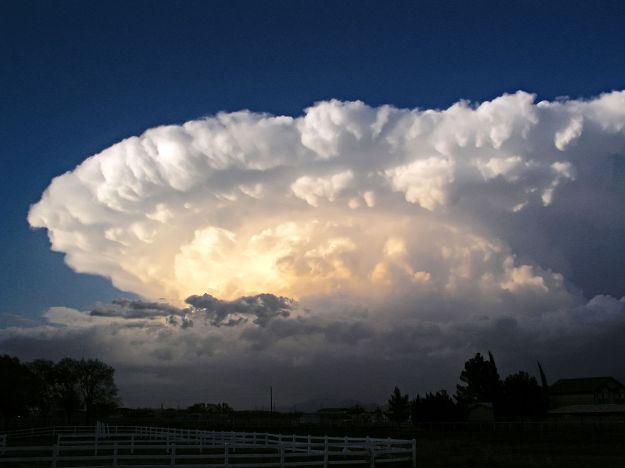
Supercell Thunderstorm over Chaparral, New Mexico on April 3, 2004

Psalm 97

1 The LORD is king! Let the earth rejoice; let the many coastlands be glad!
2 Clouds and thick darkness are all around him; righteousness and justice are the foundation of his throne.
3 Fire goes before him, and consumes his adversaries on every side.
4 His lightnings light up the world; the earth sees and trembles.
5 The mountains melt like wax before the LORD, before the Lord of all the earth.
6 The heavens proclaim his righteousness; and all the peoples behold his glory.
7 All worshipers of images are put to shame, those who make their boast in worthless idols; all gods bow down before him.
8 Zion hears and is glad, and the towns of Judah rejoice, because of your judgments, O God.
9 For you, O LORD, are most high over all the earth; you are exalted far above all gods.
10 The LORD loves those who hate evil; he guards the lives of his faithful; he rescues them from the hand of the wicked.
11 Light dawns for the righteous, and joy for the upright in heart.
12 Rejoice in the LORD, O you righteous, and give thanks to his holy name!

One of the losses of our modern, technology filled world is the patient hope of the psalmist and the prophets for the arrival of God’s kingdom. James L. Mays notes that Psalm 97 shares several key images and ideas with the portions of Isaiah most scholars attribute to Judah’s time in exile.[1] (Mays, 1994, p. 311) The psalmist’s proclamation of God’s reign causing the earth, Judah, and the righteous to rejoice were always contested claims. Israel and Judah lived in a world of multiple religious options and empires who exercised military, economic, and political might over Israel or Judah. Yet, the psalms and the prophets exhibit a persistent faith that despite the evidence to the contrary the God of Israel reigns over creation, is chief among the gods of the nations, and continues to sow joy and righteousness in the upright in heart. It is only through the eyes of faith that these poets can rejoice with the earth and the coastland because their vision has revealed to them that the LORD, the God of Israel and Judah, is king.

The vision of God in the psalms and the prophets may, as Brueggemann and Bellinger comment, retain the “remnants of a storm god.” (Brueggemann, 2014, p. 418) but as in Psalm 29 the use of the language of clouds and darkness, fire, lightning, and earthquake takes the primary language for the power of the Canaanite god Baal and now uses it to describe the power of the LORD the God of Israel. This imagery also resonates with the appearance of the LORD to the people at Mount Sinai in Exodus 19:16-19. The psalmist longs for the day for all the people to see what the eyes of faith trust: that the idols of the nations are worthless, that the kings of the earth and the gods of the nations are powerless before the LORD who is king, and that the power of the wicked over the faithful will end as God rescues them.

God’s righteousness and justice are the foundation of God’s throne, and they are also the foundation for the hopeful imagination of the psalmist. The heavens can proclaim God’s righteousness and the people of Judah can find reasons for rejoicing and gladness because of God’s judgments. Because God’s reign is based on righteousness it opens the possibility that people in Judah and beyond the borders of Judah can live as righteous ones rather than adopting the ways of the wicked. The response throughout the poem to the righteousness and justice of God is joy and gladness. The earth can rejoice, and the coastlands can be glad because the creation bears witness to the just reign of God. Zion can be glad, and the towns of Judah can rejoice because God judges with righteousness. The ones loving the LORD will hate evil[2] and God will guard their lives and sows[3] light and joy in these faithful ones of upright hearts. These righteous ones planted with light and joy in the rejoicing earth now join the earth’s joy at the celebration of God’s reign.

[1] See for example Isaiah 40: 5, 9-11; 42:17, and 52: 7-10

[2] In both the MT (Hebrew) and LXX (Greek translation) the direct translation is “The ones loving the LORD hate evil” as the NIV captures. The NRSV follows the translation of scholars who in their attempt to smooth our the translation change the subject to God, but there is no reason to make this change to the original text. (Nancy deClaisse-Walford, 2014, p. 724)

[3] Some change this word to a similar Hebrew word for ‘rise, shine’ (hence the NRSV translation) but the metaphor of sowing light fits with the imagination of the psalmist. (Nancy deClaisse-Walford, 2014, p. 724)

Review of the Warm Hands of Ghosts by Katherine Arden

I received an advance readers copy of the Warm Hands of Ghosts and I am a fan of Katherine Arden’s The Bear and the Nightingale series as well as her middle grade series Small Spaces. The Warm Hands of Ghosts takes the reader back to the historical fantasy genre of The Bear and the Nightingale, but this time the environment is primarily the hellish environment of Belgium in 1917 during the World War I battle for Passchendaele. Katherine Arden does a phenomenal job of presenting the environment of a world at war through the eyes of Laura and Freddie Iven. Laura begins the narrative home in Canada after several years as a field nurse for the medical corps, while her younger brother Freddie later joins the Canadian army in the trenches near Ypres. There is both a spiritualist and an apocalyptic framing of the war (particularly in a Jehovah’s Witness sense) and into the soul stealing space of war enters the beguiling but also devilish Faland. There are some similarities to the Smiling Man of the Small Spaces series, but the devil in a different context calls a different tune and plays a different game.

The Warm Hands of Ghosts is a story of humans caught in the inhumanity of war, of men and women who will sell their souls to forget what they have endured, of love that allows broken men and women to slowly rebuild their shattered lives, and of the death of a world as it gives birth to a new one. Laura and Freddie are both believably broken and yet still heroic characters who struggle to embrace this world at war instead of becoming ghosts of their former selves. It is the story of an ugly era of history beautifully written, of love struggling against the demons both outside in the world and the ones that dwell in the shattered hearts of the characters, and humanity trying to come to terms with the inhumanity of World War I. I appreciate the careful way she narrates this war that saw the advent of modern technologies like aircraft, long range artillery, submarines, and machine guns which was still primarily fought using the tactics of the 1800s and the disconnect between the experience of the soldiers at the front and the generals making their plans in houses miles away from these hellscapes. Even in this place of devils and destruction love still exists and it is the only hope for the lost men and women who journey to hell and back again for one another.

Psalm 96 A New Song of God’s Triumph

Psalm 96

1 O sing to the LORD a new song; sing to the LORD, all the earth.
2 Sing to the LORD, bless his name; tell of his salvation from day to day.
3 Declare his glory among the nations, his marvelous works among all the peoples.
4 For great is the LORD, and greatly to be praised; he is to be revered above all gods.
5 For all the gods of the peoples are idols, but the LORD made the heavens.
6 Honor and majesty are before him; strength and beauty are in his sanctuary.
7 Ascribe to the LORD, O families of the peoples, ascribe to the LORD glory and strength.
8 Ascribe to the LORD the glory due his name; bring an offering, and come into his courts.
9 Worship the LORD in holy splendor; tremble before him, all the earth.
10 Say among the nations, “The LORD is king! The world is firmly established; it shall never be moved. He will judge the peoples with equity.”
11 Let the heavens be glad, and let the earth rejoice; let the sea roar, and all that fills it;
12 let the field exult, and everything in it. Then shall all the trees of the forest sing for joy
13 before the LORD; for he is coming, for he is coming to judge the earth. He will judge the world with righteousness, and the peoples with his truth.

Psalm 96 is an exultant song of God’s glory and reign over all gods, nations, and the creation itself. 1 Chronicles 16 places the majority of this psalm within the song of thanksgiving appointed by David (1 Chronicles 16: 23-33) which marks the placing the placing of the ark of God in the tent. This psalm might have its origin in the songs of David, and its placement in 1 Chronicles creates an event that would make sense for this song of God’s triumphant ascension. However, this psalm also articulates the defiant faith of the chosen people in their God as they attempt to remain faithful in a multireligious world where they are not dominant among the nations. This new song allows the singers and hearers to articulate a vision of a world already giving glory and praise to the LORD who is enthroned over all gods and kings.

Three times the hearers are commanded to sing to the LORD, and the hearers are not limited to Judah or Israel. All the earth is to join in this song of blessing to the God of salvation. The song proclaims the gospel[1] that God has triumphed over the forces that opposed God’s reign. God’s works and glory are to extend to all the nations as the LORD transcends all the gods of the nations. The gods of the nations are ‘idols’ (NRSV), ‘nobodies’ ( (Brueggemann, 2014, p. 415) or ‘ineffective and incompetent.’ (Mays, 1994, p. 308) The LORD is the creator of the heavens compared to all the ineffective and incompetent nobodies who the nations once gave their allegiance to. The peoples and families of the earth are to bear witness to the glory and strength that is due to God. The nations are to stream to Jerusalem to bring an offering before God as the prophets envision. (Isaiah 2: 2-3, Micah 4: 1-2, Zechariah 8:21-23) The temple of God in Zion now occupies the central place in the world where all the families of the peoples come together in awe filled worship and celebration of the God who reigns over all the heavens and the earth.

God’s reign over the earth is to be a reign of justice that brings joy to the peoples of the earth and to the creation. The heavens, the sea, and the land all join in this praise of the nations. Those who have reigned with injustice, whose actions have done violence to people and the earth are now removed so the nations, the land, the sea, and the sky can all heal. The psalm envisions God’s kingdom coming and God’s will being done on earth as it is in heaven.

The faithful ones who worship God declare God does reign over the earth and then enter into the tension of a world where God’s reign is not realized. Injustice continues to occur. The heavens, sea, and the earth are polluted by those who improperly use the gifts of creation and the blood spilled in conflict and war. The nations continue to give their allegiance to idols that are ineffective nobodies who cannot deliver what they promise. This psalm may be easier to sing in moments of triumph, but the defiant faith of this psalm bears witness to the world of the reality faith allows them to see: that God’s kingdom is already present in the midst of the world and the time will come when the nations will all see, worship, and give glory to the God who reigns over the heavens and the earth.

[1] The Hebrew bissar is the verb “for the duty of the herald who precedes a victor to bring a report to those who await good news from the battle.” (Mays, 1994, p. 308) This verb is normally translated in the Septuagint as the Greek euangelion translated as gospel in the New Testament.

Psalm 95 Lifting Up Voices and Listening in Silence

Pieter de Grebber, Moses Striking the Rock (1630)

Psalm 95

1 O come, let us sing to the LORD; let us make a joyful noise to the rock of our salvation!
2 Let us come into his presence with thanksgiving; let us make a joyful noise to him with songs of praise!
3 For the LORD is a great God, and a great King above all gods.
4 In his hand are the depths of the earth; the heights of the mountains are his also.
5 The sea is his, for he made it, and the dry land, which his hands have formed.
6 O come, let us worship and bow down, let us kneel before the LORD, our Maker!
7 For he is our God, and we are the people of his pasture, and the sheep of his hand. O that today you would listen to his voice!
8 Do not harden your hearts, as at Meribah, as on the day at Massah in the wilderness,
9 when your ancestors tested me, and put me to the proof, though they had seen my work.
10 For forty years I loathed that generation and said, “They are a people whose hearts go astray, and they do not regard my ways.”
11 Therefore in my anger I swore, “They shall not enter my rest.”

Psalm 95 is a psalm which invites the hearer to move with the faithful into a noisy and jubilant time of worship which then is silenced so that God (or a prophet or priest speaking for God) can instruct the people in obedience. The life of worship and a life of obedience are linked here as it is frequently in the psalms and prophets. God in this psalm is the great God who reigns over all gods, is the master and creator of the earth and sea, and the one to whom the faithful owe their obedience. History and the memory of the disobedience of their ancestors becomes the invitation for the current generation to respond with obedience.

The first word of this psalm is the imperative form of the Hebrew halak[1] (to walk) and it impels the people to get moving to meet God in celebration and worship. Yet, within the command to move is also an allusion to a way of walking that is in accordance with God’s commandments and within the movement of the psalm is both the uplifted voices of the worshipping faithful but also the lives of obedience which listen to the voice of God. The invitation to ‘sing’ and ‘make a joyful noise’ while familiar in English are not as strong as the Hebrew verbs which they translate.[2] This is not a timid action of worship but instead is a community in full voice shouting and singing to their God and King. The praise of God echoes the sentiment of Psalm 24, where the earth is the LORD’s and all that is in it. The worldview of the psalms assumes the pluralistic world where the surrounding nations worship other gods, but the LORD is the sovereign over both the gods of the nations and the earth itself. The faithful come in jubilant acclamation to worship, bow down, and kneel before the God who is their maker, their king, and their shepherd who provides shelter and pasture for them. The movement and the noise climax in this acclamation and prepares the people for the time of silence that they may hear the words from their God (or God’s messenger).

The second movement of the psalm begins in the second half of verse seven with the command to listen. The congregation is to move from full voice to silence and from motion to stillness. The command to listen is the Hebrew shema which is the critical verb at key points in the declaration of the law:

Now therefore, if you obey (shema) my voice and keep my covenant, you shall be my treasured possession our of all the peoples. Indeed the whole earth is mine, but you shall be for me a priestly kingdom and a holy nation. These are the words that you shall speak to the Israelites.”  Exodus 19:5-6 (immediately before consecrating the people and receiving the commandments)

Hear (shema) O Israel: The LORD is our God , the LORD alone. You shall love the LORD your God with all your heart, and with all your soul, and with all your might. Deuteronomy 6: 4-5[3]

Hearing or listening in Hebrew is not merely listening to the words but also involves living in response to the words. Lifting up praise to God in full voice without hearing and obeying God’s commands is often condemned in the psalms and prophets[4] and here the actions of the people of Israel at Meribah and Massah (Exodus 17: 1-7; Numbers 20: 1-13) are used as an example of the high cost of disobedience. The inability of their ancestors to listen is remembered as the reason for the long journey in the wilderness and the inability of the first generation that left Egypt to enter their rest in the promised land. The relationship between God and the people of Israel is a covenantal relationship which requires obedience. If the people will listen and obey then God will provide for them in the land, but if they do not hear and obey then they may end up without God’s guidance and blessing.

The two parts of the psalm, the movement and raucous noise and the obedient silence and reverential hearing, belong together. The faithful should move to the place where they can praise God in full voice in a jubilant and joyful way, but we must also remember that God desires our obedience. As Beth Tanner can state truthfully, “In worship today, God can be seen as too friendly, too nice, and too forgiving. We can easily forget the great power of the King God.” (Nancy deClaisse-Walford, 2014, p. 718) The previous psalm reminded us, “Happy are those whom you discipline, O LORD, and whom you teach out of your law,” (Psalm 94: 12). Now Psalm 95 uses the story of the people of Israel as an illustration of the dangers when the people refuse to follow God’s way of walking. The life of the faithful is one of coming (walking, halak), hearing (shema), and living in obedience to the ways of God in both jubilant worship, silent listening, and faithful living.

[1] Halak is an important word in Hebrew. Halakha which derives from halak is the collective body of the Hebrew laws (both oral and written) and it means ‘the way of walking.’ This movement at the beginning of the psalm is both the physical motion to the place of worship and the way of walking in accordance with God’s will.

[2] Ranan and rua in the intensified piel form mean to “call loudly” and “lift up a war-cry or cry of alarm.” (Nancy deClaisse-Walford, 2014, p. 716)

[3] Deuteronomy 6: 4-5 has a central place in the practice of the Jewish people and this entire command is often called the shema because of the command to ‘hear.’

[4] See for example Psalm 50, 81, Isaiah 1, and Amos 5: 21-24

Psalm 94 Thy Kingdom Come

Marc Chagall, Solitude (1933)

Psalm 94

1 O LORD, you God of vengeance, you God of vengeance, shine forth!
2 Rise up, O judge of the earth; give to the proud what they deserve!
3 O LORD, how long shall the wicked, how long shall the wicked exult?
4 They pour out their arrogant words; all the evildoers boast.
5 They crush your people, O LORD, and afflict your heritage.
6 They kill the widow and the stranger, they murder the orphan,
7 and they say, “The LORD does not see; the God of Jacob does not perceive.”
8 Understand, O dullest of the people; fools, when will you be wise?
9 He who planted the ear, does he not hear? He who formed the eye, does he not see?
10 He who disciplines the nations, he who teaches knowledge to humankind, does he not chastise?
11 The LORD knows our thoughts, that they are but an empty breath.
12 Happy are those whom you discipline, O LORD, and whom you teach out of your law,
13 giving them respite from days of trouble, until a pit is dug for the wicked.
14 For the LORD will not forsake his people; he will not abandon his heritage;
15 for justice will return to the righteous, and all the upright in heart will follow it.
16 Who rises up for me against the wicked? Who stands up for me against evildoers?
17 If the LORD had not been my help, my soul would soon have lived in the land of silence.
18 When I thought, “My foot is slipping,” your steadfast love, O LORD, held me up.
19 When the cares of my heart are many, your consolations cheer my soul.
20 Can wicked rulers be allied with you, those who contrive mischief by statute?
21 They band together against the life of the righteous, and condemn the innocent to death.
22 But the LORD has become my stronghold, and my God the rock of my refuge.
23 He will repay them for their iniquity and wipe them out for their wickedness; the LORD our God will wipe them out.

James L. Mays begins his comments on this psalm by quoting a line from Maltbie D. Babcock’s song “This is my Father’s world”: “Though the wrong seems oft so strong, God is the ruler yet.” (Mays, 1994, p. 302) The opening line of the psalm names God as the God of vengeance, and yet God’s vengeance is necessary to avenge the wrongs done to the vulnerable and powerless who suffer in an unjust society. Because of this beginning this is sometimes called a psalm of vengeance, yet it is important to realize this vengeance is an action to restore society and to undo the work of those who utilize their positions of power to oppose God’s justice on earth and to oppress the ones God promised to defend. Much as the petitions in the Lord’s Prayer call for “God’s kingdom to come and God’s will to be done on earth as it is in heaven,” this psalm calls on God to act in concrete and visible ways to repair a society that has become controlled by those who have abandoned the ways of the covenant righteousness.

The proud and wicked have prospered in the society the psalmist lives in and they have turned the dream of a just society on its head. They have killed and oppressed the widow, the stranger, and the orphan who God has promised to protect, and who the leaders who work on God’s behalf are to ensure justice for. These arrogant evildoers perceive that they are not bound by the requirements of the law for the God of Israel has not acted to judge them. In their view, “without God everything is possible.” (Brueggemann, 2014, p. 407) These wicked ones view the LORD the God of Israel as either unwilling or unable to respond to their actions which violate God’s command, oppress the vulnerable among God’s people, and threaten God’s own heritage.

The psalmist testifies to the tension of an unjust present and a life in hopeful expectation of God’s intervention in the world. In the present the wicked are prospering and crime does pay. (NIB IV: 1019) To challenge this honest observation of the present the psalmist relies on the language of the wisdom tradition in scripture. The proud, arrogant, wicked evildoers who profit by oppressing and murdering the vulnerable and believe that God does not see or hear about their actions are foolish. The wise are glad to be disciplined by God and God’s law, but the foolish will ultimately perish. They may prosper in the moment, but that moment is an empty breath.[1] Yet, even though their time in power may be short the threat to the vulnerable is acute and needs God’s intervention.

In the meantime, the psalmist also testifies to the ways God has continued to provide respite and protection for the faithful ones in the midst of injustice. In times where their feet were slipping, God held them fast. When their worries were great God provided consolation. Without God’s protection they would dwell in the silence of the dead. These actions of God may not have brought about the fullness of God’s kingdom for the psalmist, but they have been the necessary provision and protection in their time of waiting and the actions which renewed their hope for God’s intervention which they trust is coming.

For people of faith a part of the desire for God to reign as king comes from the experience of injustice in this world and the desire for the God of vengeance to bring God’s justice to those who exploit God’s people and God’s world. When wicked people sit in the positions of power and the laws and statutes that should provide protection have become warped and utilized to oppress, the faithful cry out for God’s reign and God’s vengeance to create a society where the vulnerable are protected and justice prevails. (Mays, 1994, p. 303) The work of the wicked is a concrete and visible reality in the world of the psalmist and the cry of the psalmist is not for some otherworldly deliverance from the toils of this earth. The psalmist demands the judge of the earth to rise up and cause justice to return to the righteous. The prayer is for God’s justice to be a concrete and visible reality which displaces the injustice of the world.

[1] This is the Hebrew hebel which is translated as vanity in Ecclesiastes. The word means ‘vapor, mist, or emptiness.’ It is an evanescent word which points to the impermanence of the object it describes.

Psalm 93 God the King

Stained Glass window at the Melkite Catholic Annunciation Cathedral in Roslindale, MA depicting Christ the King with the regalia of a Byzantine Emperor


Psalm 93

1 The LORD is king, he is robed in majesty; the LORD is robed, he is girded with strength. He has established the world; it shall never be moved;
2 your throne is established from of old; you are from everlasting.
3 The floods have lifted up, O LORD, the floods have lifted up their voice; the floods lift up their roaring.
4 More majestic than the thunders of mighty waters, more majestic than the waves of the sea, majestic on high is the LORD!
5 Your decrees are very sure; holiness befits your house, O LORD, forevermore.

This short psalm focused on the image of God as king makes explicit one of the assumptions of the psalter and the bible as a whole. Underneath the praise, lament, prayers, and appeals of the psalter is the understanding of God’s position of sovereignty and strength in relation to the people of God, the nations, and the world itself. God is able to respond because God is the sovereign over all creation. The God who is over all gods and who is the creator to whom the creation gives praise is also the object of the worship and the source of hope for the people of is the God. They confess that this God reigns in majesty and strength from everlasting.

The sovereignty of God is not linked to the king of Israel or Judah as in Psalm 2 and it is possible that this psalm emerges in a time where there is no earthly king who is entrusted with authority on behalf of God. In both Christianity and Judaism, “the reign of God is always proclaimed amid circumstances that seem to deny it.” (NIB IV: 1055) No matter the political situation the person proclaiming this psalm finds themselves within, the confession of God’s continuing reign over creation, the nations, and the world becomes a bedrock for the faith of the community. God’s decrees remain established and no floods or crashing waves can wash them away. No rulers or gods can rival God’s sovereignty.

Proclaiming God’s sovereignty in the midst of a secular world is an act of faith and defiance. It is only through the eyes of faith that the faithful one can witness the forces of creation giving praise to God. There may be moments where the reign of God is clearly visible to the faithful, but it often remains hidden by ‘circumstances that seem to deny it.’ Yet, the bedrock trust that God remains in control of the creation and that God reigns in strength is central to the life of faith.

Greenhouse for Faith

The Greenhouse for Faith emerged out of a desire to capture what I would want a person in my community to know about the faith we are a part of. As a person formed by the Lutheran tradition of Christianity I have found it a beautiful, but often misunderstood approach of God. The initial courses in the Greenhouse for Faith begin with the Foundations course which talks about the central ideas of a Lutheran way of approaching faith. Then I will be adding a series of courses called Catechesis which reflects an ancient pattern of faith formation centered on the Ten Commandments, the Creeds of the church, The Lord’s Prayer, what our worship communicates, and a brief introduction to reading scripture.

Foundations Course (Click link for each video discussion)

Catechesis Part I: The Ten Commandments

Catechesis Part II: The Creed

Catechesis Part 3: The Lord’s Prayer

Catechesis Part 4: Introduction to Worship

Catechesis Part 5: Introduction to Scripture

Foundations Course: Session 1 God the Foundation

Greenhouse for Faith Foundations Course: Session 1 (God the Foundation)

The Greenhouse for Faith: What We Grow Here is Meant to be Planted in the World

This is an introduction to a way of thinking about God that is ancient, but it is beautiful. It has brought life and meaning to one of the larger families of faith throughout the world. Yet it is very different from what many churches teach.

These reflections use the image of a greenhouse as a model for thinking about God, our relationship with God and the world God created.

The Foundation: that which everything else builds upon is a way of thinking about God.

This way of thinking focuses in on who God is and what God has already done.

“Let God be God” is a short summary of this way of thinking because we focus on God as the primary actor.

God is the creator, rescuer, and the one who renews this world and our lives.

God loves this world and is active, passionate, and engaged in the world and in our lives.

God also works in ways that may be mysterious, hidden, or unseen by us in our lives.

Questions for reflection:

  • When you think about your relationship with God do you begin with what you believe you need to do or what God has done?
  • Do you think that God is active in the world? In your life?
  • How do you walk through times where God’s working in the world seems hidden from you?
  • What in your life are you thankful for? What is something that is a part of the world that you are thankful for?

Foundations Course: Session 2 Christ-Where God Meets Us

Greenhouse for Faith Foundations Course: Session 2 (Christ)

The Greenhouse for Faith: What We Grow Here is Meant to be Planted in the World

There are four pillars that will be used in this greenhouse: Christ, Word, Faith, and Grace that help us understand the God who is our foundation. These are the classic ‘alones’ or ‘solas’ (Latin for alone) of Lutheran thought.

The first pillar is Christ: We are Jesus people. Jesus is where we come to know primarily what God is like.

The life, ministry, death, and resurrection of Jesus is the key through which we understand everything else about God.

The God who comes down to be among us: the witness of Christmas is of the God who comes to meet us in Jesus. God comes where God can be approached and becomes vulnerable so that we may draw near. We don’t have to ascend to where God is because God approaches us where we are in Jesus.

In Jesus we also come to know the God who suffers for this world and the people God loves. On the cross we find a God who refuses to give up on the world or God’s people. The cross looks like a place where God’s love is absent, but we believe this is where we most clearly understand the depth of God’s love. A love that refuses to give up even when it is rejected and killed.

Questions for reflection:

  • How is Christ’s example of love different from romantic love?
  • How does Christ’s example of love inform romantic relationships?
  • How do you see your own leadership impacted by Christ’s example of love?