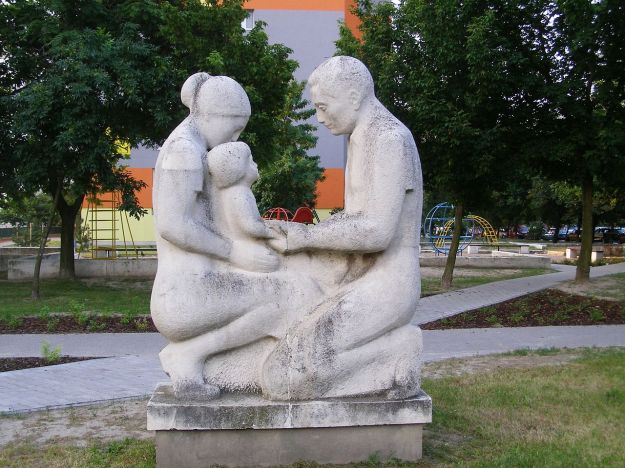
Psalm 128
A Song of Ascents.
1 Happy is everyone who fears the LORD,
who walks in his ways.
2 You shall eat the fruit of the labor of your hands;
you shall be happy, and it shall go well with you.
3 Your wife will be like a fruitful vine
within your house;
your children will be like olive shoots
around your table.
4 Thus shall the man be blessed
who fears the LORD.
5 The LORD bless you from Zion.
May you see the prosperity of Jerusalem
all the days of your life.
6 May you see your children’s children.
Peace be upon Israel!
Bolded words have notes on translation below.
In contrast to the individualistic ways that most people of the modern west conceptualize their world, for most ancient societies and religions the primary unit is not the individual but the family. A good life started with a prospering family and then extended to the prosperity of the city and then to the nation. This way of thinking is reflected in this psalm about a blessed life for a man, his family, Jerusalem, and all Israel. This is a wisdom psalm as the key word happy (Hebrew ‘asre) should alert us.[1] Psalms 127 and 128 share several frequently used wisdom words along with the conception that following the path of wisdom leads to a prosperous household.
Fearing the LORD and walking in the way of the LORD leads to happiness/contentment and enjoying the fruit of their labor. Ecclesiastes may believe that the labor/toil we do is vanity, but even Ecclesiastes can state:
There is nothing better for mortals than to eat and drink and find enjoyment in their toil. This also, I saw, is from the hand of God, for apart from him who can eat or who can have enjoyment? For to the one who pleases him God gives wisdom and knowledge and joy, but to the sinner he gives the work of gathering and heaping, only to give to one who pleases God. This also is vanity and a chasing after wind. Ecclesiastes 2: 24-26
The contentment is not merely for the man (literally mighty one, Hebrew gibbor)[2] but for the entire household. Grape vines and olive trees are two of the critical agricultural products of Israel. The metaphorical linking of the fruitfulness of the land to the wife (or wives) and children of the man coincides with the view that children are a sign of blessing and barrenness is a sign of disfavor.
The blessing of this ‘mighty one’ and their family now is extended to Jerusalem and Israel. Jerusalem is the place where the temple of the LORD resides and where the hoped for blessing would originate from on earth, and the psalmist desires to hearer to see the prosperity (Hebrew tob, literally goodness) of the city throughout their life. Seeing grandchildren is a sign of old age acquired and a family which continues to grow. The psalm ends with the desire of peace (shalom) resting on Israel. The man (mighty one) has received a blessed life for himself, his family, and for his society.
Psalm 128 shares a common worldview with Martin Luther’s explanation of the first commandment as, “We are to fear, love, and trust God above all things.” Fearing the LORD and walking in the ways of the LORD in biblical thought leads to prosperity. There are righteous people who suffer, who may be barren, and the wicked do sometimes prosper, but for the psalms the belief that God will provide for the faithful is fundamental. The stated blessing in this psalm echoes the idea of peace represented in the words of the prophet Micah:
but they shall all sit under their own vines and under their own fig trees, and no one shall make them afraid, for the mouth of the Lord of hosts has spoken. Micah 4:4
It sharply contrasts with the judgment on Cain in Genesis 4:
And now you are cursed from the ground, which has opened its mouth to receive your brother’s blood from your hand. When you till the ground, it will no longer yield to you its strength; you will be a fugitive and a wanderer on the earth.” Cain said to the Lord, “My punishment is greater than I can bear! Today you have driven me away from the soil, and I shall be hidden from your face; I shall be a fugitive and a wanderer on the earth, and anyone who meets me may kill me.” Genesis 4: 11-14
At a fundamental level what the scriptures consider wisdom is simple: fearing the LORD and walking in his ways. Following this path entrusts one’s life, one’s family, and one’s society into the hands of God. The faithful one’s throughout the Jewish and Christian story have entrusted God can care for their life, their family and the world around them.
[1] The Hebrew ‘asre is frequently an indicator of wisdom literature. We may not think of happy or blessed in this way, but for Hebrew writers this is a common word when talking about the path of wisdom. Wisdom writers can interchange the idea of happiness and wisdom, see for example the way Psalm 110:10; Proverbs 1:7; 9:10 can pair wisdom with the fear of the LORD. Walter Brueggemann and William Bellinger, Jr. say of ‘asre, “The term introduces an observation about living: one who walks or lives in ways in line with YHWH’s purposes find wholeness. (Bellinger, 2014, p. 545)
[2] Hebrew gibbor which can refer to physical strength or the economic strength to equip oneself and a group for combat. Ruth 4:11 uses this term for economic ability in reference to Boaz.
 Sign of the Rose