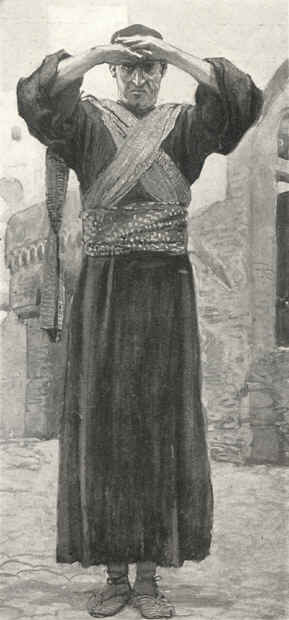
Apophysis-Betrayal (1footonthedawn at deviantart.com)
Ezekiel 16:1-14 Jerusalem as an Abandoned, Rescued, and Claimed Woman
1 The word of the LORD came to me: 2 Mortal, make known to Jerusalem her abominations, 3 and say, Thus says the Lord GOD to Jerusalem: Your origin and your birth were in the land of the Canaanites; your father was an Amorite, and your mother a Hittite. 4 As for your birth, on the day you were born your navel cord was not cut, nor were you washed with water to cleanse you, nor rubbed with salt, nor wrapped in cloths. 5 No eye pitied you, to do any of these things for you out of compassion for you; but you were thrown out in the open field, for you were abhorred on the day you were born.
6 I passed by you, and saw you flailing about in your blood. As you lay in your blood, I said to you, “Live! 7 and grow up like a plant of the field.” You grew up and became tall and arrived at full womanhood; your breasts were formed, and your hair had grown; yet you were naked and bare.
8 I passed by you again and looked on you; you were at the age for love. I spread the edge of my cloak over you, and covered your nakedness: I pledged myself to you and entered into a covenant with you, says the Lord GOD, and you became mine. 9 Then I bathed you with water and washed off the blood from you, and anointed you with oil. 10 I clothed you with embroidered cloth and with sandals of fine leather; I bound you in fine linen and covered you with rich fabric. 11 I adorned you with ornaments: I put bracelets on your arms, a chain on your neck, 12 a ring on your nose, earrings in your ears, and a beautiful crown upon your head. 13 You were adorned with gold and silver, while your clothing was of fine linen, rich fabric, and embroidered cloth. You had choice flour and honey and oil for food. You grew exceedingly beautiful, fit to be a queen. 14 Your fame spread among the nations on account of your beauty, for it was perfect because of my splendor that I had bestowed on you, says the Lord GOD.
The sixteenth chapter of Ezekiel is an extended metaphor utilizing the feminine imagery commonly used for cities in the ancient world and in the bible and extending it in a provocative manner to portray Jerusalem as an unfaithful partner of the LORD. Ezekiel is not the first prophet to utilize this type of imagery for the people of God, both Hosea in the eighth century BCE (Hosea 2) and Ezekiel’s older contemporary Jeremiah (Jeremiah 2, 3) both utilize a similar metaphor for the people of God as a whole. Yet, Ezekiel now focuses the imagery on Jerusalem and presses the metaphor in some even more shocking ways. Many recent Christians may not be familiar with these images since they are unlikely to be utilized in worship and the images are uncomfortable and even offensive. This imagery is still shocking 2,500 years later, but Ezekiel’s ministry was to a people who no longer see and hear. The explicit language of Ezekiel’s prophecy is memorable, especially in the Hebrew which is more graphic than most English translations.
Many modern Christians would prefer to ignore the imagery here and in Hosea and Jeremiah where the image of an adulterous spouse is used as a metaphor for the broken relationship between God and Israel. I can understand why many women and men would be uncomfortable in the rage directed at the metaphorical woman in these passages, but as I wrote about when I reflected on Jeremiah chapters two and three approaching this image made me reflect on the brokenhearted God that the prophet encounters. There is always danger of overgeneralizing one’s own experience but when I reflected on the language of Jeremiah in 2013 I recognized some of the pain, anger, and brokenness that I felt in 2009-2010 when the infidelity of a marital partner and her abandonment of the relationship caused similar feelings to emerge. Did I act upon that anger, no I did not, but even if in the quiet of my own room or in the hearing of a counselor I needed a place to express that hurt so that it did not explode inside of me. Before we discuss the difficulties of the imagery we also need to examine what the metaphor expresses about the betrayal that the LORD experiences and the way it causes emotional pain for the God of Israel.[1]
The prophets are called to stand between the wounded God and the wounding people. Ezekiel in this extended image utilizes the cultural practices of personifying cities and nations a female. As Katheryn Pfister Darr states:
Within Hebrew Scripture, they appear in a variety of female roles—e.g., daughters (Isa 1:8, Lam 2:18); wives (Ezekiel 16 and 23); mothers (Isai 49:14-18); and widows (Lam 1:1). These and other metaphorical depictions of cities draw upon certain (culture specific) stereotypical associations with women (e.g., barrenness and fertility; maternal devotion, nurture, and compassion; objects of familial and conjugal love; bereavement and mourning) in order to present them not as inanimate repositories of stone and mortar, but as characters in the story of Yahweh’s dealings with the world, and more specifically, with the people of Israel. (NIB VI:1222)
As a character in the story of the LORD’s dealings with the earth, Ezekiel recasts Israel’s history in a scandalous way: scandalous in the city’s origins, in the city’s reaction to the rescue and riches bestowed upon it, in the judgment of the city, and eventually in the grace shown to the city and her sisters.
The prophet is instructed to make Jerusalem’s abominations[2] known to her and then begins with a shocking birth narrative. Jerusalem’s origins are traced back to an Amorite father and Hittite mother who abandon their child leaving her laying uncared for in the afterbirth to die a rapid death. Instead of tracing the heritage back to Abraham and Sarah, Moses and Aaron, or even David who made the city his capital, this image utilizes up a polemical tone where the parents are Canaanites who represent the people that the Israelites were to have driven out. Although technically Jerusalem when it was conquered belonged to the Jebusites,[3] we have a child born to, in the eyes of the Jewish hearers, questionable parentage. In addition, the text highlights four expected actions on the arrival of a newborn: cutting the umbilical cord, bathing the infant in clean water, massaging it with a solution of salt, and wrapping it in swaddling bands. (Block, 1997, p. 475)
The parents of this child abandon it to the elements to die, and an infant without care and protection will not last long in the world. The LORD in passing by takes notice of this abandoned child and claims it. This rejected child of questionable parents is now claimed by the LORD and where once death was certain, now the LORD commands life. The narrative does not allow for any passage of time for this infant to transform into a mature young woman. The transformation between powerless infant and a woman with fully formed breast and pubic hair occurs between two occurrences of the LORD passing by. The Hebrew way of telling stories often leave gaps, and the growth, nurturing and development of this woman are unimportant to the image in the ancient imagination, although would be fascinating in our world of child psychology and adolescent development.
Nakedness was untroubling for an infant, but now with a fully developed woman has a different overtone. The LORD extends the wings of his garment over this now mature Jerusalem, a symbolic act we see Boaz do in Ruth 3:9 and enters into a covenant with the personified Jerusalem. The washing off of blood could be the original blood for this image (if there is no passage of time) or could be the menstrual blood or the bleeding after initial intercourse but now this clothed, cleaned, and oiled young woman is brought under the protective relationship of the LORD. The embroidered cloth and fine leather sandals are the clothing of a noble, but they are also the same materials used in the construction of the tabernacle.[4] The choice flour, oil and honey are also used in the offerings of the tabernacle and temple as is the gold and silver. This young woman is adorned like a queen or a priestess and is beautiful in her fine raiment and jewelry. As Daniel Block states, “this remarkable rags-to-riches story ends with an extremely important reminder: Jerusalem’s beauty was not innate—it was a gift, graciously bestowed.” (Block, 1997, p. 485)
Ezekiel 16: 15-34 The Betrayal of the Gifts of God
15 But you trusted in your beauty, and played the whore because of your fame, and lavished your whorings on any passer-by. 16 You took some of your garments, and made for yourself colorful shrines, and on them played the whore; nothing like this has ever been or ever shall be. 17 You also took your beautiful jewels of my gold and my silver that I had given you, and made for yourself male images, and with them played the whore; 18 and you took your embroidered garments to cover them, and set my oil and my incense before them. 19 Also my bread that I gave you — I fed you with choice flour and oil and honey — you set it before them as a pleasing odor; and so it was, says the Lord GOD. 20 You took your sons and your daughters, whom you had borne to me, and these you sacrificed to them to be devoured. As if your whorings were not enough! 21 You slaughtered my children and delivered them up as an offering to them. 22 And in all your abominations and your whorings you did not remember the days of your youth, when you were naked and bare, flailing about in your blood.
23 After all your wickedness (woe, woe to you! says the Lord GOD), 24 you built yourself a platform and made yourself a lofty place in every square; 25 at the head of every street you built your lofty place and prostituted your beauty, offering yourself to every passer-by, and multiplying your whoring. 26 You played the whore with the Egyptians, your lustful neighbors, multiplying your whoring, to provoke me to anger. 27 Therefore I stretched out my hand against you, reduced your rations, and gave you up to the will of your enemies, the daughters of the Philistines, who were ashamed of your lewd behavior. 28 You played the whore with the Assyrians, because you were insatiable; you played the whore with them, and still you were not satisfied. 29 You multiplied your whoring with Chaldea, the land of merchants; and even with this you were not satisfied.
30 How sick is your heart, says the Lord GOD, that you did all these things, the deeds of a brazen whore; 31 building your platform at the head of every street, and making your lofty place in every square! Yet you were not like a whore, because you scorned payment. 32 Adulterous wife, who receives strangers instead of her husband! 33 Gifts are given to all whores; but you gave your gifts to all your lovers, bribing them to come to you from all around for your whorings. 34 So you were different from other women in your whorings: no one solicited you to play the whore; and you gave payment, while no payment was given to you; you were different.
It is important to acknowledge that there are important differences between marriage in the ancient world and marriage in our current culture. Marriage in the United States in 2024 is primarily an emotional relationship with financial implications. People get married primarily for romantic reasons, and although anyone who goes through a divorce will discover the financial implications of dissolving a romantic relationship (and financial stress can be a reason that a divorce is asked for) most modern people view marriage through a romantic lens. In the ancient world, and until recently in historical terms, marriage was primarily an economic transaction which could have emotional and romantic overtones. Julia Galumbush compares marriage in ancient Israel to the suzerain/vassal treaty relationship:
Israelite marriage was, like vassaldom, a relationship of mutual obligations between two parties, one (the husband) superior and the other (the wife) inferior in terms of their legal status. As in a treaty agreement, the husband was required to protect the wife…and the wife was to obey the husband, and to refrain from sexual relationships with other men. The husband, like the suzerain was free of any such obligation of exclusivity. (NIB VI: 1223)
One can hear echoes of this type of relationship for example in the household codes of Ephesians 5:22-6:1 and Colossians 3:18-4:1, as well as the language of Ezekiel. A wife ‘loves’ a husband by being ‘obedient’ to them. There may be more to marriage than obedience in the ancient world, but this was the building block. The danger of an unfaithful woman was to pass the family inheritance to an illegitimate heir and to bring dishonor (a powerful force in the ancient world) upon the husband.
The gifts of the LORD graciously bestowed on Jerusalem have now been utilized in the practice of idolatry (metaphorically described as infidelity). They use the gifts of the LORD to ‘clothe’ and ‘feed’ the idols made from the provided gold and silver. If using the gifts that the LORD clothed his bride with to make and service both shrines and idols, the personified city practices the same disregard for children that her parents showed to her. The children which were dedicated to the LORD are now sacrificed. This may indicate the child sacrifice that the bible attributes to the worship of Molech[5] or the practices of injustice that failed to care for the vulnerable children of the LORD. Jerusalem who has been rescued from death and clothed and cared for by the LORD has misused the clothing, wealth, and food provided for her and delivers her own children to death.
The prostitution to idols extended to the image of prostitution oneself to the surrounding nations. Although this metaphorical recasting of Jerusalem’s history may not link any specific incidences of unfaithfulness with Egypt, Assyria, and Babylon (Chaldea) there are multiple instances of Judea negotiating relationships for protection and trade with each of these powers. The language in English is tidied up in the NRSV.[6] The imagery of a sexually unfulfilled woman continuing to seek new partners and even paying her partners rather than receiving payment while refusing her husband has led the reader to expect the husband to act against the wife who has misused his gifts, killed his children, and brought shame upon his household.
Ezekiel 16: 35-43a The Punishment of the Adulterous Bride
35 Therefore, O whore, hear the word of the LORD: 36 Thus says the Lord GOD, Because your lust was poured out and your nakedness uncovered in your whoring with your lovers, and because of all your abominable idols, and because of the blood of your children that you gave to them, 37 therefore, I will gather all your lovers, with whom you took pleasure, all those you loved and all those you hated; I will gather them against you from all around, and will uncover your nakedness to them, so that they may see all your nakedness. 38 I will judge you as women who commit adultery and shed blood are judged, and bring blood upon you in wrath and jealousy. 39 I will deliver you into their hands, and they shall throw down your platform and break down your lofty places; they shall strip you of your clothes and take your beautiful objects and leave you naked and bare. 40 They shall bring up a mob against you, and they shall stone you and cut you to pieces with their swords. 41 They shall burn your houses and execute judgments on you in the sight of many women; I will stop you from playing the whore, and you shall also make no more payments. 42 So I will satisfy my fury on you, and my jealousy shall turn away from you; I will be calm, and will be angry no longer. 43 Because you have not remembered the days of your youth, but have enraged me with all these things; therefore, I have returned your deeds upon your head, says the Lord GOD.
The metaphor now moves from the adulterous activity (as a metaphor for idolatry) of Jerusalem to the consequences of that activity. The four offenses that caused this response from the LORD are summarized as: (1) your lust was poured out[7] (2) your nakedness was uncovered (3) because of all your abominable idols, and (4) because of the blood of your children that you gave to them. This metaphorical woman who has been richly clothed, given gold and silver jewelry, and well fed now is exposed without her finery. The public act of stripping is an action that occurs multiple times this metaphor of an adulterous bride is used in the prophets[8] and was likely among the practiced punishments of an adulterous woman by her husband. The public act may have indicated a withdrawal of support (a reversal of the action of covering the bride with one’s garment as indicated above). As Daniel Block mentioned, Jerusalem’s beauty was not inherent but bestowed upon it by the gracious clothing and provision of God. Now with that clothing and provision removed this metaphorical woman is not only shamed but is undesirable by her former lovers. They are the ones who perpetrate the physical violence in this image, not the scorned husband. The husband merely removes his protection and provision. The character of her former lovers is revealed when they steal from her and execute violence upon her.
The imagery is culturally specific to the practice of marriage in ancient Israel. Although a spouse in our context may want to humiliate their unfaithful partner that action is not done in this manner. Yet, within this understanding of relationships in the ancient world the image is of a God who as a husband has poured out his love (in the form of protection, rescuing from death, and provision), entered into a covenant with her and pledges Godself to her, lavishes on her benefits which are fit for a princess only to see these benefits used to promote an idolatrous lifestyle. God has loved intensely, acted graciously for a woman who was unloved by her parents, and when that grace has been treated with contempt responds jealously. Yet, at the end of this section we see a moment when the anger for the contempt that God has endured has passed and there is a hope for a future beyond the judgment. Like in Jeremiah, we will see that this moment of shame is not the end of the story and God looks to a future of reconciliation and return.
Ezekiel 16: 43b-52 The Three Wicked Sisters
Have you not committed lewdness beyond all your abominations? 44 See, everyone who uses proverbs will use this proverb about you, “Like mother, like daughter.” 45 You are the daughter of your mother, who loathed her husband and her children; and you are the sister of your sisters, who loathed their husbands and their children. Your mother was a Hittite and your father an Amorite. 46 Your elder sister is Samaria, who lived with her daughters to the north of you; and your younger sister, who lived to the south of you, is Sodom with her daughters. 47 You not only followed their ways, and acted according to their abominations; within a very little time you were more corrupt than they in all your ways. 48 As I live, says the Lord GOD, your sister Sodom and her daughters have not done as you and your daughters have done. 49 This was the guilt of your sister Sodom: she and her daughters had pride, excess of food, and prosperous ease, but did not aid the poor and needy. 50 They were haughty, and did abominable things before me; therefore I removed them when I saw it. 51 Samaria has not committed half your sins; you have committed more abominations than they, and have made your sisters appear righteous by all the abominations that you have committed. 52 Bear your disgrace, you also, for you have brought about for your sisters a more favorable judgment; because of your sins in which you acted more abominably than they, they are more in the right than you. So be ashamed, you also, and bear your disgrace, for you have made your sisters appear righteous.
Before the image moves to reconciliation a final surprising comparison is added. Jerusalem’s family tree is now expanded to show her two sisters. Samaria is an expected choice with the common history of Northern Israel (Samaria) and Judea (Jerusalem) who were once one nation of Israel. Yet, the surprising and offensive potion of this image, to the hearers in Jerusalem, is the inclusion of Sodom as a sister of Israel. Sodom is viewed within scripture as synonymous with injustice and wickedness[9] and Samaria was also viewed, from the perspective of Judea, as a nation which was judged for its idolatrous practices[10]. In Ezekiel 14: 12-20 the imagery of Abraham’s request to spare Sodom for the sake of ten righteous men[11] hangs over the statement that even the presence of three individual who epitomize righteousness would not be able to save the community or even their own families. Jerusalem has moved farther from righteousness and more towards wickedness than even irredeemable Sodom. Sodom’s practices of wickedness as recorded here are specifically that they had pride, excess of food, and prosperous ease, but did not aid the poor and needy. In this image Jerusalem has also had an excess of the best food and clothing, was given a life of ease, but in her pride did not acknowledge the gracious source of all her gifts. Jerusalem, Samaria, and Sodom were all given much, and yet in all their giftedness they did not understand that in a covenantal relationship when one is given much there is also the expectation of loyalty and faithfulness.
In a just world any reconciliation of Jerusalem must also involve a reconciliation with Sodom and Samaria who, in this metaphor, are less wicked than she. Jerusalem in a surprising way is now a part of God’s gracious action beyond the people of Judea. Yet, the proper response of the woman Jerusalem would be one of shame: she has been brought from death to life, from poverty to riches, from being unlovable to loved by the creator of the cosmos and she has thrown it all away. There is no reconciliation without an acknowledgment of her unfaithfulness and the consequences of those actions. The riches, provision, and protection are for a time removed, Jerusalem is brought lower than Sodom and Samaria. Yet, even in the judgment there we move towards an image of hope.
Ezekiel 16: 53-63 A Restoration of Fortunes
53 I will restore their fortunes, the fortunes of Sodom and her daughters and the fortunes of Samaria and her daughters, and I will restore your own fortunes along with theirs, 54 in order that you may bear your disgrace and be ashamed of all that you have done, becoming a consolation to them. 55 As for your sisters, Sodom and her daughters shall return to their former state, Samaria and her daughters shall return to their former state, and you and your daughters shall return to your former state. 56 Was not your sister Sodom a byword in your mouth in the day of your pride, 57 before your wickedness was uncovered? Now you are a mockery to the daughters of Aram and all her neighbors, and to the daughters of the Philistines, those all around who despise you. 58 You must bear the penalty of your lewdness and your abominations, says the LORD.
59 Yes, thus says the Lord GOD: I will deal with you as you have done, you who have despised the oath, breaking the covenant; 60 yet I will remember my covenant with you in the days of your youth, and I will establish with you an everlasting covenant. 61 Then you will remember your ways, and be ashamed when I take your sisters, both your elder and your younger, and give them to you as daughters, but not on account of my covenant with you. 62 I will establish my covenant with you, and you shall know that I am the LORD, 63 in order that you may remember and be confounded, and never open your mouth again because of your shame, when I forgive you all that you have done, says the Lord GOD.
The story of Israel began with God delivering them from their sojourn in Egypt, bringing them out of their slavery, guiding them and providing for them through the wilderness, and gifting them a new home in the promised land. Jerusalem may have broken their covenant with God, but the term covenant in the scriptures is a rich bond that often transcends expectations. God has bound Godself to Israel (both Samaria and Jerusalem) in a way that moves beyond the betrayal. As we see later in Ezekiel and in the later portions of Isaiah the post-exilic future of Israel will be conceived of in language evoking an new Exodus. As Ellen Davis can state:
Israel is brought to recognize YHWH through the same kind of restorative acts by which it was first constituted as a nation. These stir Israel’s memory and sense of shame at its own deeds, and the contrast between its deserving and what YHWH has done leads to a deeper understanding of this God before whom Israel stands for judgment and blessing. (Davis, 1989, p. 115)
Jerusalem long considered itself superior to its metaphorical sisters Samaria and Sodom. Yet, now she stands humiliated before not only her sisters but her longtime opponents the daughters of Aram and the daughters of the Philistines. They have fallen from their state of grace, despised their oath and broken the covenant, yet their unfaithfulness is only overcome by their God’s faithfulness. They hope for reconciliation for themselves but never imagined sharing their restoration with Sodom and Samaria. The prophet has deployed this imagery of the adulterous wife in a way that points to both the curses of disobedience to the covenant but also to the promises of renewal beyond the punishment.[12] As I discussed when reflecting on Jeremiah 3, God transcends the normal expectations where a wife who dishonors the relationship is unable to return. God refuses to give up on Jerusalem, Samaria, and in this image apparently even Sodom.[13]
To modern readers with a different view of women and marriage than the ancient world these words, especially with Ezekiel’s graphic wording, can be offensive. Ezekiel 16 is unlikely to make it into the preaching or teaching of many churches precisely because it is uncomfortable. When I began this project of looking deeply at scripture, particularly the parts of scripture rarely utilized in the teaching and preaching of the church, I knew passages like this would be difficult to wrestle with, but I also trusted there was wisdom to be gained by wrestling with these uncomfortable portions of scripture. Many of the insights I gained from wrestling with Jeremiah eleven years ago apply here as well. Ezekiel has portrayed a broken-hearted God and nowhere is that clearer than when he utilizes this relational imagery. Utilizing the imagery of love in the cultural expectations of ancient Israel God has gone far beyond the expectations of a faithful husband only to be met with the callous contempt of his rescued and treasured bride. Yet, the LORD remains unable to give up on the relationship. Beyond the shame and the pain there is a reconciliation and a new beginning. It is a new beginning that is bound to the original covenant, but it is also something new. It involves forgiveness because the actions of Jerusalem caused both shame and pain to the LORD. If we were to write this metaphor for our time we would do it differently and we should remain, at a minimum, uncomfortable with images that include violence and shaming of women. Yet, we also need to acknowledge that the metaphor was designed to cause the people of Jerusalem to feel guilt, acknowledge their unfaithfulness, and understand their upcoming exile as God’s judgment upon them. The image was offensive in its time as well and was designed to be remembered by a nation who stopped seeing and listening. The fact that this extremely long image was preserved within the prophesies of Ezekiel testifies to its impact. Otherwise, this extended image, longer half of the books in the minor prophets, would have not been continually copied in a world where physical copies required hand copying the text.
[1] Many people are not used to talking about God feeling emotions and have been raised with philosophical view of God as the ‘unmoved mover’ but this is not the picture of God presented in the scriptures. The LORD as described in the scriptures is a passionate (or jealous) God who is vulnerable to the actions of God’s people.
[2] The root t’b which is translated abomination here occurs eleven times in this chapter. (NIB VI: 1226)
[3] Joshua 18:28; Judges 19: 10-11; 1 Chronicles 11: 4-5
[4] Fine leather and embroidered cloth appear throughout the instructions for the Tabernacle in Exodus 26-28 and the construction in Exodus 36, 38-39.
[5] Leviticus 18: 21; 20:2-5; 2 Kings 23:10; Jeremiah 32:35
[6] For example, the Egyptians, your lustful neighbors would be more literally translated the Egyptians, your neighbors with huge organs. This image is expanded in an even more graphic way in 23:20.
[7] The Hebrew points to “feminine genital distillation produced at sexual arousal.” (Block, 1997, p. 500)
[8] Jeremiah 13:22, Hosea 2:9-10.
[9] In addition to the narrative of Genesis 18-19 see also Deuteronomy 29:23; Isaiah 1:9-10; 3:9; 13:19; Jeremiah 23:14; 49:18; 50:40; Lamentations 4:6; Amos 4:11; Zephaniah 2:9.
[10] From the split of Israel after the death of Solomon there is immediate and continual prophetic condemnation of the practices in Northern Israel (Samaria) beginning in 1 Kings 13 through Israel being carried captive into Assyria in 2 Kings 17.
[11] Genesis 18:16-33.
[12] See Leviticus 26, Deuteronomy 27-28 for blessings and curses which underly this imagery.
[13] Daniel Block questions whether the restoration of Sodom is a rhetorical device or whether to take the prophecy at face value. (Block, 1997, p. 513)


 Sign of the Rose