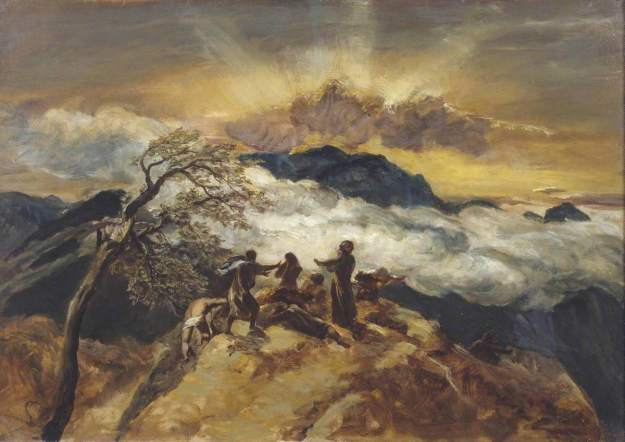
Poole, Paul Falconer; Sketch for ‘Vision of Ezekiel’; Tate; http://www.artuk.org/artworks/sketch-for-vision-of-ezekiel-201293
Ezekiel 3: 1-15
1 He said to me, O mortal, eat what is offered to you; eat this scroll, and go, speak to the house of Israel. 2 So I opened my mouth, and he gave me the scroll to eat. 3 He said to me, Mortal, eat this scroll that I give you and fill your stomach with it. Then I ate it; and in my mouth it was as sweet as honey.
4 He said to me: Mortal, go to the house of Israel and speak my very words to them. 5 For you are not sent to a people of obscure speech and difficult language, but to the house of Israel — 6 not to many peoples of obscure speech and difficult language, whose words you cannot understand. Surely, if I sent you to them, they would listen to you. 7 But the house of Israel will not listen to you, for they are not willing to listen to me; because all the house of Israel have a hard forehead and a stubborn heart. 8 See, I have made your face hard against their faces, and your forehead hard against their foreheads. 9 Like the hardest stone, harder than flint, I have made your forehead; do not fear them or be dismayed at their looks, for they are a rebellious house. 10 He said to me: Mortal, all my words that I shall speak to you receive in your heart and hear with your ears; 11 then go to the exiles, to your people, and speak to them. Say to them, “Thus says the Lord GOD”; whether they hear or refuse to hear.
12 Then the spirit lifted me up, and as the glory of the LORD rose from its place, I heard behind me the sound of loud rumbling; 13 it was the sound of the wings of the living creatures brushing against one another, and the sound of the wheels beside them, that sounded like a loud rumbling. 14 The spirit lifted me up and bore me away; I went in bitterness in the heat of my spirit, the hand of the LORD being strong upon me. 15 I came to the exiles at Tel-abib, who lived by the river Chebar. And I sat there among them, stunned, for seven days.
Throughout this introduction to the book of Ezekiel there are continuous reminders to the prophet that he is to be obedient. In contrast to the stubborn and rebellious nature of the people Ezekiel is almost passive in his response to this call, but that may not be from resistance as some commentaries suggest but instead a desire to be careful. Ezekiel’s call is to be faithful and to embody exactly the words that the LORD entrusts to him to the people. Ezekiel’s God is very precise with the commands and words for Ezekiel and silence is a more faithful response than adding anything to the words he receives.
At the end of the previous chapter Ezekiel is commanded to eat what is given to him and then the scroll is presented, now he is commanded to eat the scroll twice. Repetition is a common feature of Ezekiel’s prophecies, and it does not indicate any reluctancy on the prophet’s part, instead when he is commanded to eat the scroll he opens his mouth, and it is given to him to eat. Once the scroll is given, or perhaps already in his mouth, the second command to eat it and fill his stomach with it comes. This comes almost as an encouragement as the prophet is in the process of consuming the words of God and ingesting them. The words of God being ‘sweeter than honey’ also occur in two of the psalms that meditate on God’s law: Psalm 19:11 and Psalm 119: 103 and Revelation will echo this motif when John receives a scroll from an angel and ingests it in Revelation 10: 9-10.
The obedient prophet who receives and ingests the words of God is now sent to a people in exile but still in rebellion against their God. Although there are probably people from many nations who speak many languages in the region where Ezekiel and the exiles are placed by Babylon, Ezekiel’s focus is only on the house of Israel. God warns Ezekiel that he will be resisted as a bearer of the word of God because the people have repeatedly rejected their God. To enable the prophet to faithfully become the message for this stubborn people he will have to embody the meaning of his name Ezekiel, God hardens. His will be hardheaded like the hardest stone[1] even harder than flint. Ezekiel’s forehead of stone will come against the hard foreheads and hard hearts of the people of Israel.
Once again Ezekiel is lifted up by the ruach (spirit/wind) as the glory of the LORD departs. Now instead of focusing on the overwhelming visual scene the descriptions are primarily auditory. This is appropriate since the focus of Ezekiel is not about dwelling on the glory of God but upon the message he is given to carry. The focus has moved from the approach of the LORD to the call of the prophet as a bearer of the word. Ezekiel is not in control, instead he, like the living creatures, is animated by the spirit that lifts him up and bears him away.[2] By the time he arrives among the exiles at Tel-abib the sweetness of the scroll has been transformed into bitterness and heat in his spirit. If the consummation of the words of the scroll of God and the animation by the ruach of God were not enough to emphasize the prophet’s dependence upon the LORD for his words and actions, we are now informed that the hand of God is also strong upon him. He returns to the river Chebar a man overwhelmed by the divine presence and sits in a stunned silence for a week.
Daniel Block reads this week as a time where Ezekiel resists God’s call and he seems to believe the prophet is, “socially ostracized, physical exhausted, and emotionally disturbed.” (Block, 1997, p. 138) but I think this is reading too much into the scene. As we will see in future scenes, Ezekiel may not go out among the exiles, but he is actively sought out by the elders. Block will later comment on psychologists having a field day with Ezekiel (Block, 1997, p. 152) but perhaps instead of Ezekiel being emotionally disturbed he is in a period of grieving. He has been commanded to ingest a message of “lamentation, mourning and woe” for the house of Israel that he is to bear. Perhaps like Job’s friends he is sitting shiva, but now instead of mourning a friend he is mourning the disasters that await his people.
Ezekiel will become one hardened by God. He will be both the medium and the message which he “digested, internalized, incorporated, embodied, and lived.” (Block, 1997, p. 131) He becomes like the living creatures, animated by the spirit of God and a visible part of God’s often unseen movements. Words that were once sweet on the tongue will lead him on a path to bitterness and heat of spirit as he carries them with the hand of the LORD heavy upon him to a rebellious people of hard foreheads and hard hearts. Ezekiel may be strange to many Christians, but he is not a madman. The prophet is given a difficult task where obedience to the divine word is the only possible choice as the spirit moves him and the hand of the LORD rests upon him.
Ezekiel 3: 16-21
16 At the end of seven days, the word of the LORD came to me: 17 Mortal, I have made you a sentinel for the house of Israel; whenever you hear a word from my mouth, you shall give them warning from me. 18 If I say to the wicked, “You shall surely die,” and you give them no warning, or speak to warn the wicked from their wicked way, in order to save their life, those wicked persons shall die for their iniquity; but their blood I will require at your hand. 19 But if you warn the wicked, and they do not turn from their wickedness, or from their wicked way, they shall die for their iniquity; but you will have saved your life. 20 Again, if the righteous turn from their righteousness and commit iniquity, and I lay a stumbling block before them, they shall die; because you have not warned them, they shall die for their sin, and their righteous deeds that they have done shall not be remembered; but their blood I will require at your hand. 21 If, however, you warn the righteous not to sin, and they do not sin, they shall surely live, because they took warning; and you will have saved your life.
This rearticulation of Ezekiel’s role as a sentinel to the people of Israel echoes a similar passage in Ezekiel 33. The word for sentinel in Hebrew (sopeh) comes from the shofar (trumpet/horn) which the watcher would blow. Ezekiel’s warning to the wicked and even the righteous may not be heeded, but he is under an obligation to sound the alarm announcing God’s judgment regardless. Both Hosea and Jeremiah[3] have performed this role of sounding a trumpet in the land or acting as a sentinel before and even if the people do not heed the trumpet call. Yet the prophet’s calling is to raise the alarm even if the people ignore the sound.
The wicked and the righteous are a common polarity used throughout wisdom literature, and Ezekiel who likely grew up schooled to be a priest was likely familiar with this way of engaging the world. Ezekiel uses the term wicked (rasa) more than any prophetic book, but the character of God is to desire repentance even among the wicked. The prophet is not to judge the worthiness of the recipients of God’s alarm but to raise the sound that they may hear. Even those who were once righteous but who commit iniquity are not exempt from God’s judgment. The ‘stumbling block’ (miksol) is “not an occasion for sin but a cause of downfall and ruin.” (NIB VI: 1135) As Katheryn Pfisterer Darr states about Ezekiel’s task,
His life depends solely on his performance of the task; it does not hang on the people’s response. Lives may be saved as a result of his warning. But Ezekiel is not told to hold that possibility before his audience. (NIB VI: 1135)
Like his older contemporary Jeremiah[4] he is charged with bearing an unpopular message to a resistant people. Yet, as mentioned above the prophet is not in control. The words are not his words, he is animated by a spirit not his own, and God’s hand will be upon him. Any unfaithfulness of Ezekiel will not save the wicked or righteous, but they will endanger the prophet.
Ezekiel 3: 22-27
22 Then the hand of the LORD was upon me there; and he said to me, Rise up, go out into the valley, and there I will speak with you.23 So I rose up and went out into the valley; and the glory of the LORD stood there, like the glory that I had seen by the river Chebar; and I fell on my face. 24 The spirit entered into me, and set me on my feet; and he spoke with me and said to me: Go, shut yourself inside your house. 25 As for you, mortal, cords shall be placed on you, and you shall be bound with them, so that you cannot go out among the people; 26 and I will make your tongue cling to the roof of your mouth, so that you shall be speechless and unable to reprove them; for they are a rebellious house. 27 But when I speak with you, I will open your mouth, and you shall say to them, “Thus says the Lord GOD”; let those who will hear, hear; and let those who refuse to hear, refuse; for they are a rebellious house.
The binding and silencing of the prophet immediately after commissioning the prophet to be a sentinel and sound the trumpet for the wicked and lapsed righteous may at first seem contradictory and in the past many have argued that the previous section was an insertion which echoed Ezekiel 33. Yet, throughout these initial chapters of Ezekiel it has been clear that the prophet is not in control Once again the prophet is summoned to a meeting with God and it is made abundantly clear that when he shares a message with the people it will be coming from God through the prophet and will not be the prophet’s own words. The prophet will become the unmoving and unspeaking scroll awaiting the time when the LORD will release the tongue of the messenger.
The glory of the LORD appears once again to the prophet as he is compelled by the hand of the LORD to go into the valley. Ezekiel has yet to speak and now he is told he will be bound with cords and his tongue will cling to his mouth until God gives him a world to speak. It is unclear whether it is the exiles or the LORD who bind the prophet in his home and place him under a form of house arrest, but it is clear that it is God who is the agent silencing the tongue of the prophet. Yet, the public later in the book will seek the prophet out, so he is not socially ostracized. Throughout the remainder of the book there is no hint of the prophet engaging in a normal life among the exiles and when they do approach him it is in his house.
The tongue which clings to the roof of Ezekiel’s mouth may serve a second purpose which English translations do not capture. The word the NRSV translates as ‘reprove’ is the Hebrew mokiah whose meaning has been heavily debated within the context of Ezekiel. Katheryn Pfister Darr, following M. B. Dick, argues for the meaning of this being an arbiter instead of a reprover,
Ezekiel cannot perform the arbiter’s role, it precludes any possibility of his participation in a formal hearing in which both parties—Yahweh and Israel—might have their say. (NIB VI:1138)
If this is the correct interpretation, then God no longer wants the prophet to advocate for the people. The LORD is done listening. As with the scroll there is no room to add in the prophets’ words, God’s judgment is set. The prophet is to be the faithful articulator of these words when they are given. God is the primary actor; the prophet is merely the medium through which God is acting. His life is not his own, instead it is bound to go only where the spirit and the hand of God move him and speak only when God’s words pass his released tongue.
[1] Modern people may know that the hardest stone is a diamond, but as Daniel Block points out there is no reference to diamonds before 480 BCE almost a century later than Ezekiel is written. The Hebrew word samir here likely refers emery which would be the hardest known rock at the time. (Block, 1997, p. 129)
[2] This is similar to the way the Spirit in the gospel of Mark ‘drove’ (Greek ekballo, cast out or throw out) Jesus into the wilderness.
[3] Hosea 9:8, Jeremiah 4: 5, 19, 21; 6: 1, 17; 51:27
[4] As Daniel Block notes (assuming that the thirtieth year at the beginning of Ezekiel reflects his age) Jeremiah would begin his ministry about the time Ezekiel was born. (Block, 1997, p. 148) It is likely that Ezekiel may have grown up knowing Jeremiah’s voice or message and both prophets share the challenging job of dismantling the theology that had grown up around Jerusalem, the temple, and the Davidic kings. Both were probably never popular but proved to be essential voices to make sense of the destruction of Jerusalem and the temple by Babylon.
 Sign of the Rose
Pingback: Joel 2: 1-27 The Day of the Lord Averted | Sign of the Rose
Pingback: Ezekiel 33 The Beginning of Ezekiel’s Role After Jerusalem’s Fall | Sign of the Rose
Pingback: The Book of Ezekiel | Sign of the Rose