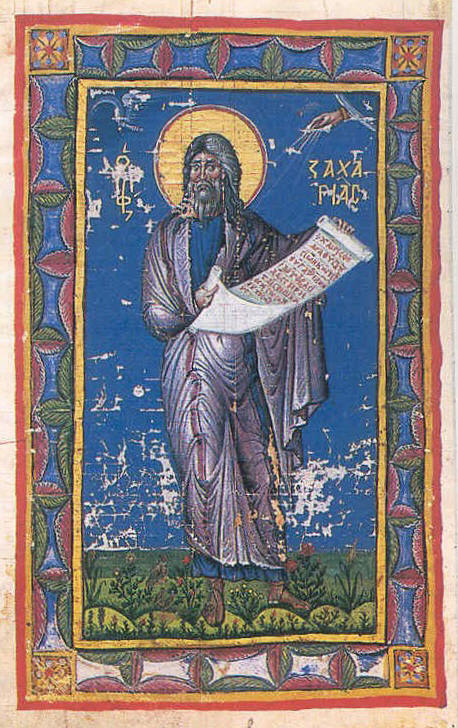
Russian Icon of the Holy Prophet Haggai
Haggai 1
In the second year of King Darius, in the sixth month, on the first day of the month, the word of the LORD came by the prophet Haggai to Zerubbabel son of Shealtiel, governor of Judah, and to Joshua son of Jehozadak, the high priest: 2 Thus says the LORD of hosts: These people say the time has not yet come to rebuild the LORD’s house. 3 Then the word of the LORD came by the prophet Haggai, saying: 4 Is it a time for you yourselves to live in your paneled houses, while this house lies in ruins? 5 Now therefore thus says the LORD of hosts: Consider how you have fared. 6 You have sown much, and harvested little; you eat, but you never have enough; you drink, but you never have your fill; you clothe yourselves, but no one is warm; and you that earn wages earn wages to put them into a bag with holes.
7 Thus says the LORD of hosts: Consider how you have fared. 8 Go up to the hills and bring wood and build the house, so that I may take pleasure in it and be honored, says the LORD. 9 You have looked for much, and, lo, it came to little; and when you brought it home, I blew it away. Why? says the LORD of hosts. Because my house lies in ruins, while all of you hurry off to your own houses. 10 Therefore the heavens above you have withheld the dew, and the earth has withheld its produce. 11 And I have called for a drought on the land and the hills, on the grain, the new wine, the oil, on what the soil produces, on human beings and animals, and on all their labors.
12 Then Zerubbabel son of Shealtiel, and Joshua son of Jehozadak, the high priest, with all the remnant of the people, obeyed the voice of the LORD their God, and the words of the prophet Haggai, as the LORD their God had sent him; and the people feared the LORD. 13 Then Haggai, the messenger of the LORD, spoke to the people with the LORD’s message, saying, I am with you, says the LORD. 14 And the LORD stirred up the spirit of Zerubbabel son of Shealtiel, governor of Judah, and the spirit of Joshua son of Jehozadak, the high priest, and the spirit of all the remnant of the people; and they came and worked on the house of the LORD of hosts, their God, 15 on the twenty-fourth day of the month, in the sixth month.
One of the shorter books in the bible, one of the 12 Minor Prophets[i] Haggai speaks to the people of God with the voice of the Lord and unlike many of the other prophets the people listen. To set the scene this entire short book takes place in the span of about 3 ½ months roughly 18 years after the return of the exiles from Babylon (I deal briefly with this in The Place of Authority: A Brief History Part 4:Re-establishment, Disillusionment and Germination) This is the period covered in the book of Ezra, and it is also the time of the prophet Zechariah.[ii]When the people who returned from the exile in Babylon came back the land was not vacant, many of the poorer people had been left behind to farm the land and so when the people came back there was some period of time where people were “re-claiming” their family lands (or dispossessing others already working the land), hence a focus on individuals rebuilding their houses. To put this all in context, the land of Judah is a small territory within the larger Persian empire at this point (roughly the size of Rhode Island) which is sparsely populated (this is an agrarian society) with land that is not producing well. Haggai’s message is one predominantly of hope coming from the difficult situation of coming together as a post-exilic[iii] people. (Haggai fixes the time of each oracle precisely, unlike most prophets and most scholars seem to agree that the record we have comes from shortly after this point. By our reckoning the first date mentioned in verse 1 is August 29, 520 BCE, and work begins on September 21, 520 BCE. (Actemeier, Elizabeth et. al 1999, 7:711) The re-settlement of Judah has stalled, the people have become focused on their own problems and the temple begun at the beginning of the resettlement remains a great unfinished project, a daily reminder of their weakness in the midst of the nations that surround them. The people have settled into a communal depression where they have settled in and are doing what they feel they need to do, and yet it takes something new to bring them out of this. Haggai, Zechariah, Zerubbabel, and Joshua are all used by the Lord to turn this situation around.
Haggai is a person with no known heritage, unlike Zerubbabel and Joshua we don’t know his family or where he comes from, all we have is the message. The message we have here is like splashing your face with ice water, it is designed to wake up the people, to shake them out of their slumber. It, like all the prophets, is more poetry than dissertation. Haggai is not interested in a debate about when God causes hardship and famines; rather he is focused on the behavior God desires from the people. God desires to dwell among them; God would take pleasure in the temple. Relatively quickly the people do come together, work resumes, and the Spirit of the Lord stirs up the leadership. In this post-exilic period the prophet is actually heard and the prophet-king-priest triumvirate work together and the work begins.

[i] I follow the delineation of minor verses major prophets where Isaiah, Jeremiah and Ezekiel are Major Prophets by the size of their respective works (Isaiah 65 chapters, Jeremiah 52 +5 in Lamentations, and Ezekiel 48) where the Minor Prophets recorded works are significantly shorter. This is not a value judgment on the importance of their words. Daniel is typically classed by Hebrew scholars as a part of the writings rather than being place with either the major or minor prophets.
[ii] Zechariah and Haggai are explicitly mentioned in Ezra 5:1 as prophets working at the same time for the re-establishment of the temple.
[iii] Post-exilic in this context refers to the time after the Babylonian exile which took place beginning in 597BCE, with a more substantial portion of the population taken in 587BCE, post-exilic begins in 538 BCE with the rise of the Persian empire)

 Sign of the Rose