Tag Archives: worship

Exodus 18: Jethro Models Faith, Worship and Leadership to Moses

Jethro and Moses by James Tissot (1896-1900)

Exodus 18:1-12 A Family Reunited

Jethro, the priest of Midian, Moses’ father-in-law, heard of all that God had done for Moses and for his people Israel, how the LORD had brought Israel out of Egypt. 2 After Moses had sent away his wife Zipporah, his father-in-law Jethro took her back, 3 along with her two sons. The name of the one was Gershom (for he said, “I have been an alien1 in a foreign land”), 4 and the name of the other, Eliezer1 (for he said, “The God of my father was my help, and delivered me from the sword of Pharaoh”). 5 Jethro, Moses’ father-in-law, came into the wilderness where Moses was encamped at the mountain of God, bringing Moses’ sons and wife to him. 6 He sent word to Moses, “I, your father-in-law Jethro, am coming to you, with your wife and her two sons.” 7 Moses went out to meet his father-in-law; he bowed down and kissed him; each asked after the other’s welfare, and they went into the tent. 8 Then Moses told his father-in-law all that the LORD had done to Pharaoh and to the Egyptians for Israel’s sake, all the hardship that had beset them on the way, and how the LORD had delivered them. 9 Jethro rejoiced for all the good that the LORD had done to Israel, in delivering them from the Egyptians.

 10 Jethro said, “Blessed be the LORD, who has delivered you from the Egyptians and from Pharaoh. 11 Now I know that the LORD is greater than all gods, because he delivered the people from the Egyptians,1 when they dealt arrogantly with them.” 12 And Jethro, Moses’ father-in-law, brought a burnt offering and sacrifices to God; and Aaron came with all the elders of Israel to eat bread with Moses’ father-in-law in the presence of God.

Jethro, called Reuel in chapter two, re-enters the story and brings with him Moses’ wife and two sons. While we aren’t told exactly when Zipporah returns to her father-in-law’s house with her children we last heard about her and Gershom (their first-born son) in chapter four on the journey back to Egypt. There could be any number of reasons for their separation including: to protect her and her two sons from being able to be used as captives by Pharaoh, to prevent Moses from being distracted from his task for the time, to allow Moses to establish his authority among the Hebrews without his foreign wife being present, or perhaps Zipporah was pregnant and it was easier for her to give birth away from the stresses of the exodus journey (based on Eliezar’s name) and we could imagine many other reasons but ultimately the text remains silent on this. We have a separation of an unknown period and what appears to be a joyous reunion.

The relationship of Moses to Jethro is one of respect and honor. Moses’ actions upon Jethro’s arrival convey respect and welcome. He is welcomed into their camp and into Moses’ tent with warmth. Moses tells the story of what the LORD has done and how they have journeyed to this point and Jethro offers his blessing.

One interesting thing to notice in this passage is the blessing that Jethro offers to the LORD in comparison to the first commandment. The first commandment begins with the statement of what the LORD has done in delivering the people from the land of Egypt and then states that the people are to have no other gods before the LORD. Jethro also begins with blessing the LORD who has delivered the people from the land of Egypt and then exclaims his new knowledge that the LORD is greater than all gods, because he delivered the people from the hands of Pharaoh. Here a foreigner demonstrates before the people what the faith of Israel will look like in the future. Like Melchizedek in the book of Genesis, he becomes one of the people of the nations that point to the LORD the God of Israel.

Secondly, Jethro becomes the first in the book of Exodus to offer a sacrifice to God after the departure from Egypt. This is increasingly surprising, as Carol Myers notices, since the justification give to Pharaoh multiple times in the beginning of Exodus is to let the people enter the wilderness to offer a sacrifice to the LORD their God. (Myers, 2005, p. 137) Yet, it is a priest of Midian who before Moses, Aaron and the elders models what this sacrifice to God might look like. As I mentioned when I was discussing Psalm 29 the Jewish people were not afraid to uses the praises uttered about other gods and modify them to talk about the LORD the God of Israel. Here is another time where a faithful outsider, Jethro, demonstrates to the people of God what a life of praise can look like.

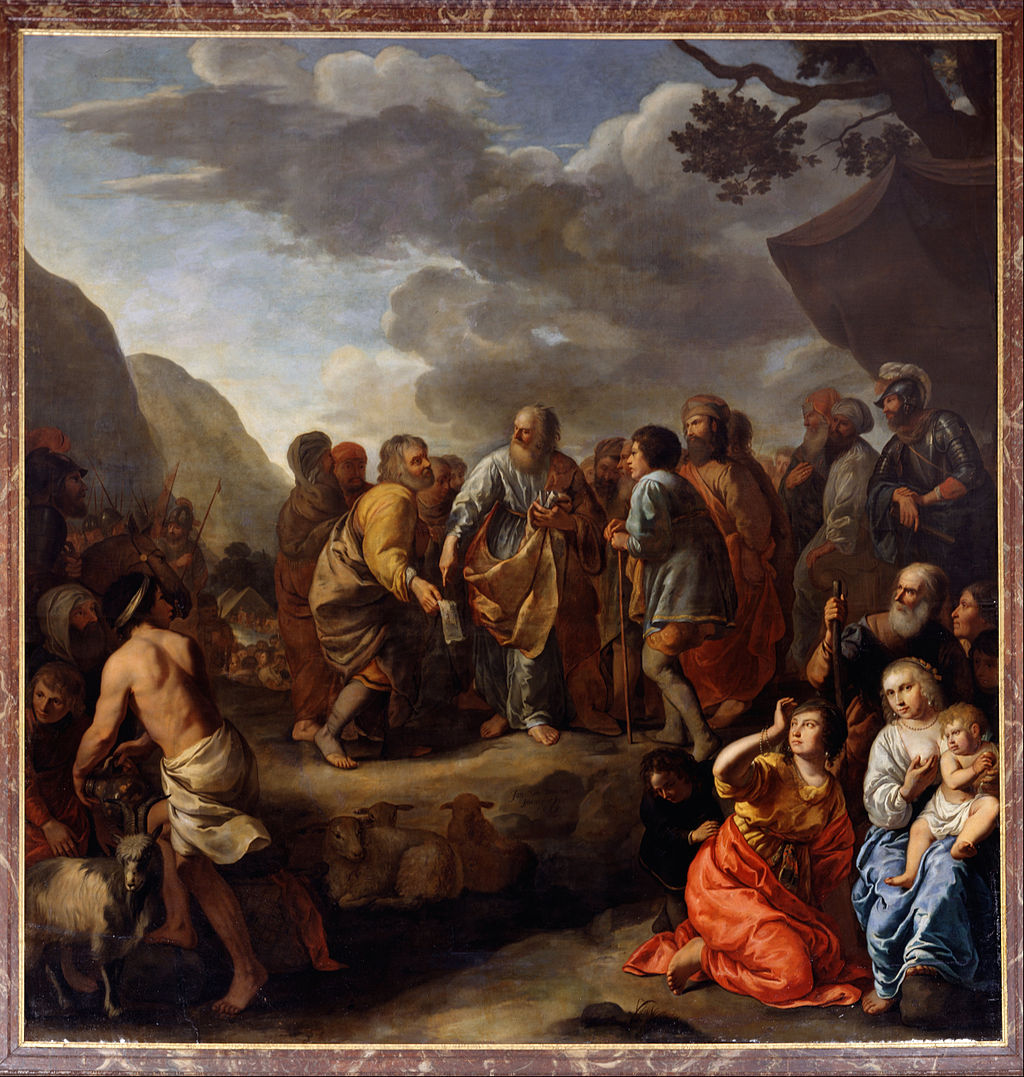
Jan van Bronchorst, Jethro Advising Moses (1659)

Exodus 18: 13-27 Jethro’s Advice to Moses

 13 The next day Moses sat as judge for the people, while the people stood around him from morning until evening. 14 When Moses’ father-in-law saw all that he was doing for the people, he said, “What is this that you are doing for the people? Why do you sit alone, while all the people stand around you from morning until evening?” 15 Moses said to his father-in-law, “Because the people come to me to inquire of God. 16 When they have a dispute, they come to me and I decide between one person and another, and I make known to them the statutes and instructions of God.” 17 Moses’ father-in-law said to him, “What you are doing is not good. 18 You will surely wear yourself out, both you and these people with you. For the task is too heavy for you; you cannot do it alone. 19 Now listen to me. I will give you counsel, and God be with you! You should represent the people before God, and you should bring their cases before God; 20 teach them the statutes and instructions and make known to them the way they are to go and the things they are to do. 21 You should also look for able men among all the people, men who fear God, are trustworthy, and hate dishonest gain; set such men over them as officers over thousands, hundreds, fifties and tens. 22 Let them sit as judges for the people at all times; let them bring every important case to you, but decide every minor case themselves. So it will be easier for you, and they will bear the burden with you. 23 If you do this, and God so commands you, then you will be able to endure, and all these people will go to their home in peace.”

 24 So Moses listened to his father-in-law and did all that he had said. 25 Moses chose able men from all Israel and appointed them as heads over the people, as officers over thousands, hundreds, fifties, and tens. 26 And they judged the people at all times; hard cases they brought to Moses, but any minor case they decided themselves. 27 Then Moses let his father-in-law depart, and he went off to his own country.

Beyond modeling a first commandment faith and a sacrificial worship to God, Jethro brings to the people of Israel and to Moses, its leader, worldly wisdom. Moses has taken the central role in leading the people out of Egypt: he is the spiritual, military, political and legal authority and the one who stands between the people and God. He is the one who everyone comes to for support, legal ruling and whenever there has been a crisis. Already Moses has had to deal with two instances of water related strife, food related anxiety, as well as the people’s first military threat. Now the people are waiting for Moses to address their needs, their internal conflicts and to hear their cries. As Carol Myers states, “Jethro notices more than the supremacy of Israel’s god; he also notices that Israel’s leader is overburdened.” (Myers, 2005, p. 137)

Within this passage we have one of only two places in the first five books of the bible (or torah) where the phrase “not good” is used. Throughout the creation narrative in Genesis one we hear God say repeatedly that is was good, but the only other place where the phrase “not good” is used is Genesis 2: 18 where God says it is ‘not good’ for the man to be alone. (Sacks, 2010, p. 128) Here also it is ‘not good’ that Moses is alone, here he needs appropriate partners for his own good and for the people’s.

The critical task of finding officers, people who can be trusted to hear the people’s concerns and to respond fairly and who are not going to be vulnerable to bribes or coercion makes the life of the people of Israel possible. Here these officers are not given the title of judge, and there are probably several reasons for that. The office of judge in the people of Israel’s history gets developed in the times between Joshua and the time of the kings and the judges are people who lead the people for a time and have more of a Moses-like role than a purely judicial one. Also, throughout the book of Exodus, the people has been referred to in a military manner. Within many military units the commanding officer has legal responsibilities for those who serve under them, for example under the Uniform Code of Military Justice (or UCMJ) which provides the basis for the legal system used in the U.S. Military the commanding officer does hear cases and assign punishment. In disciplinary matter the commanding officers is judge and jury while still being the commander. These people who will mediate the commands and instructions of Moses to the people are foundational to the emerging structure of the people.

Moses role becomes one of intercession, instruction and of finding subordinate leaders. Moses will continue to stand between the people and the LORD their God and this will become an increasingly critical role as the people continue their journey. Moses will also become the teacher of the law that is about to be given as well as interpreting the law to the people. Moses will continue to have to teach the people how they are to live and what they are to do. But Moses cannot do it on his own, he will need multiple leaders to share the burdens and responsibility of leading the people of God. Sometimes this is the hardest task: both finding and trusting these new leaders. I, and many other leaders, struggle with this portion of leadership-with equipping others who will not have the same amount of training and experience that you do. Yet, this worldly advice was deemed important enough by the people of God that it was included within their scriptures.

Communio: A Poem


 candle

There are times when the words and symbols spark
Lighting up our world, illuminating the dark
And in our mundane world magic appears
To strengthen resolve or to calm our fears
With a community of saints on holy ground
Where the remnants of ancient faith are found
 
In those rare times, you can almost feel
The mystery hiding behind the real
Where good and evil struggle and strive
And God and the devil are still alive
Where water and wine and flesh and stone
Unite us together. We are not alone
 
Where God’s presence has come to earth to dwell
And deep runs the water in the spiritual well
Where hope emerges from the pain
And the drought ends in heavenly rain
Where we see again the world made new
And the magic returns to me and to you

Psalm 27- Faith in an Age of Anxiety

The Temple by Radojavor@deviantart.com

The Temple by Radojavor@deviantart.com

Psalm 27
<Of David.>
 1 The LORD is my light and my salvation; whom shall I fear? The LORD is the stronghold of my life; of whom shall I be afraid?
 2 When evildoers assail me to devour my flesh– my adversaries and foes– they shall stumble and fall.
 3 Though an army encamp against me, my heart shall not fear; though war rise up against me, yet I will be confident.
 4 One thing I asked of the LORD, that will I seek after: to live in the house of the LORD all the days of my life, to behold the beauty of the LORD, and to inquire in his temple.
 5 For he will hide me in his shelter in the day of trouble; he will conceal me under the cover of his tent; he will set me high on a rock.
 6 Now my head is lifted up above my enemies all around me, and I will offer in his tent sacrifices with shouts of joy; I will sing and make melody to the LORD.
 7 Hear, O LORD, when I cry aloud, be gracious to me and answer me!
 8 “Come,” my heart says, “seek his face!” Your face, LORD, do I seek.
 9 Do not hide your face from me. Do not turn your servant away in anger, you who have been my help. Do not cast me off, do not forsake me, O God of my salvation!
 10 If my father and mother forsake me, the LORD will take me up.
 11 Teach me your way, O LORD, and lead me on a level path because of my enemies.
 12 Do not give me up to the will of my adversaries, for false witnesses have risen against me, and they are breathing out violence.
 13 I believe that I shall see the goodness of the LORD in the land of the living.
 14 Wait for the LORD; be strong, and let your heart take courage; wait for the LORD!

The fear of the LORD is the antidote to the fear of the things that produce anxiety in the world around the Psalmist. One of the most common commands when there is a divine revelation through a dream, an angel or a prophecy is “Do not be afraid.” Often these words come in situations that would produce fear and yet the one who calls the Psalmist, the prophets and poets, the kings and the shepherds, the young women like Mary and old men like Zechariah becomes their light and salvation throughout their life and journey. As the apostle Paul can write to the church in Rome, “What then are we to say about these things? If God is for us, who is against us?” Or as Martin Luther could explain when talking about what it means to follow the first commandment of having no other Gods, “We are to fear, love and trust God above all things.” The Psalmists faith in God becomes such a central part of their life that they can enter into the darkest valleys without being paralyzed by fear because their LORD is indeed guiding them through those places and times.

The fear of the LORD is not an immunization against bad things happening to the faithful one, the Psalms and even the theology of books like Deuteronomy are not some simple prosperity gospel where trust in the LORD guarantees a return on investment in wealth, happiness, children, flocks and fields. There is a sense in which that trust is rewarded and validated but the Psalmist and those throughout scripture who are lifted up as models of faith often live challenging lives. Job, for example, would continue to believe that he would be vindicated by the LORD even when his household and health were all destroyed and yet, defiantly, Job would trust that God would answer his plea. The martial imagery of enemies that attack in cannibalistic fashion or an army that encamps around the faithful one may be metaphors for the great struggles or, if the Psalm refers backwards into David’s experience, it may reflect the reality of being one who is hunted for. Faith doesn’t make life easy but it may make the incredible struggle that one goes through bearable because faith becomes the antidote to the overwhelming fear and anxiety that may be present otherwise in the Psalmist’s life.

Worship becomes a foundational piece of the faithful life. The desire of the Psalmist is to live their life in the house of the LORD. The temple or tabernacle becomes a place to seek God’s presence, God’s voice and guidance, to reaffirm one’s trust in their God and a place where prayers can go forth. It is a place where defiant shouts of joy and joyous songs and praises can be offered. It becomes a continual reminder that the Psalmist does not journey alone, but that the LORD their God and other faithful ones, perhaps many other faithful ones also join in these defiant shouts and songs. Faith is strengthened in the continual dwelling in the house of the LORD.

Their God to the faithful one becomes shelter, the one who conceals them under the cover of the tent and the one who sets them upon a rock. Shelter, while used only here in the Psalms, reflects a common idea of the LORD sheltering the people of Israel and is the word behind the Feast of Sukkoth (Festival of Booths) remembering how the LORD cared for the people during their Exodus journey. The LORD has been the rock and foundation before, as in Psalm 18, but now the LORD places the Psalmist upon a rock where they are safe and sheltered from their enemies. As Rolf Jacobson can point out the tent can be a reference to the tabernacle or temple but it also has the element of being God’s protective presence. (Nancy deClaisse-Walford, 2014, p. 269) Within the hospitality culture of the ancient world being concealed under the cover of the tent may also allude to the expectation of protection provided for the guest that has been welcomed into one’s home and there are numerous stories throughout the bible, probably the most famous being that of Lot and the two angels that he shields within his house in Genesis 19 (a text often misinterpreted). In the ancient world if someone comes to your house and you extend them hospitality then their lives are entrusted to your care.

Yet, even the faith that knows that the LORD is their light and salvation may have to convince itself to trust in the midst of the challenges of life. For me verses eight through fourteen may be this type of internal dialogue of faithfulness in the midst of challenge. There is the plea to be heard and the reminder spoken to oneself to seek the face of the Lord and a reaffirmation of this seeking followed by a plea not to hide or turn away, a plea not to cast one off or forsake. There is the continual struggle to remember the character of God and yet the falling back into the language of commitment, deeper commitment to the faithful one than even a parental bond may yield. This Psalm has been a Psalm of commitment and trust and the Psalmist calls upon God in the midst of their struggles to uphold that trust: not to give them up to their adversaries and to lead them on the level paths. The Psalm ends on that note of trust as the wait for the LORD and the belief that in the midst of their time of trial the LORD will somehow deliver them or give them the strength and courage to endure.

Psalm 24- The Coming of the LORD

Altar Paraments created for Easter Lutheran Church in Eagen Minnesota by Linda Witte Henke

Altar Paraments created for Easter Lutheran Church in Eagen Minnesota by Linda Witte Henke

Psalm 24

<Of David. A Psalm.>
1 The earth is the LORD’s and all that is in it, the world, and those who live in it;
2 for he has founded it on the seas, and established it on the rivers.
3 Who shall ascend the hill of the LORD? And who shall stand in his holy place?
4 Those who have clean hands and pure hearts, who do not lift up their souls to what is false, and do not swear deceitfully.
5 They will receive blessing from the LORD, and vindication from the God of their salvation.
6 Such is the company of those who seek him, who seek the face of the God of Jacob. Selah
7 Lift up your heads, O gates! and be lifted up, O ancient doors! that the King of glory may come in.
8 Who is the King of glory? The LORD, strong and mighty, the LORD, mighty in battle.
9 Lift up your heads, O gates! and be lifted up, O ancient doors! that the King of glory may come in.
10 Who is this King of glory? The LORD of hosts, he is the King of glory. Selah

This Psalm, which uses the language of the approach of the Creator to the creation and the approach of the faithful to the hill of the LORD where the worshipper and the worshipped one meet taps into the creation narrative and the wonder of Psalm 8 with the questioning nature of Psalm 15 about who may dwell in the LORD’s presence. Power and promise and presence all come together in the prose of this Psalm. We a poetically brought into the presence of the triumphal approach of the Creator’s return to the earth and the joyous reception of the faithful ones.

The Psalm begins with describing the approaching LORD not as an invader or alien to this world but instead as its founder, shaper, creator and rightful owner. In language, like Genesis 1, where the deep with its chaotic waters are moved over by the Spirit of God and the speaking of God pulls life and land out of the seas and rivers. God is the one who places limits upon the seas and the waters as the book of Job can poetically echo:

Or who shut in the sea with doors when it burst out from the womb?—
when I made the clouds its garment, and thick darkness its swaddling band,
and prescribed bounds for it, and set bars and doors,
and said, ‘Thus far shall you come, and no farther,
and here shall your proud waves be stopped’? Job 38: 8-11

Once the Psalm had used the language of praise to testify to the immense power of the Creator whose dominion extends over all the earth and all its creatures it moves to the place where the creature can meet the Creator. The first two verses are pointing to the descent of the LORD to come to the world God created, but now the pivot turns to the worshipper ascending the hill of the LORD to the tabernacle or temple to participate in the celebration of the LORD’s advent. How does one prepare to receive the ultimate honored guest? As in Psalm 15 the preparation is not cultic but ethical. There are no rituals, no prescribed sacrifice but instead what is called for is a life that is ethically right. Clean hands and pure hearts and lives oriented toward God and not towards other gods and finally words spoken truthfully. Approaching the LORD in worship in the Psalm is connected to a life lived authentically. If anything is left on the altar to be sacrificed it is one’s life, as the apostle Paul can state in his letter to the Romans:

I appeal to you therefore, brothers and sisters, by the mercies of God, to present your bodies as a living sacrifice, holy, and acceptable to God, which is your spiritual worship. Do not be conformed to this world, but be transformed by the renewing of your minds, so that you may discern what is the will of God—what is good and acceptable and perfect. Romans 12: 1-2

Yet, if one is offering up to the LORD a life of clean hands, pure hearts, rightly oriented soul and truthful speech what one receives in return is a blessing and vindication. The Creator sees and honors the gift of the created one and as we heard in Psalm 23 provides for and grants the shelter of a shepherd and the protection of a host even amid conflict.

The Psalm concludes with the image of a King returning to their walled city in triumph as a metaphor to describe the advent of the LORD. The city itself is called to have courage that the long-awaited return of the king will occur. They are to prepare for this coming in hope and courage based on the identity of the one who is expected to return. This is the LORD, the creator, the divine warrior, the rock, the mighty one, the LORD of armies (literal rendering of the LORD of hosts), the LORD who could speak to seas and oceans and rivers and stop their advance. The praise echoes in the certainty of the LORD’s descent not only to the earth but specifically to meet the faithful ones in the holy city. Those with clean hands, pure hearts, rightly oriented souls and truthful tongues sing out in praise at the expected coming of the King of glory.

What I Learned About Myself, Life and God from My Divorce Part 3

Apophysis-Betrayal (1footonthedawn at deviantart.com)

Apophysis-Betrayal (1footonthedawn at deviantart.com)

This is the final reflection on this at this point in my journey.

7. The Place of Ritual and the Value of a Worshipping Community- I know that many people have had bad experiences in churches, synagogues and places of worship after a divorce, which is sad but a very real experience of many people-but not every place is like that. For myself, as a pastor I found myself in a new community, where I knew the pastor as one of my colleagues and I showed up with my kids each Sunday and as much as I could be I was anonymous. I did have a few people ask where their mother was in an inquiring and not an accusing way (to which I answered that she had chosen not to be there) and since I was still at the process of trying to save the marriage initially and later going through the divorce I didn’t want to close any doors, but I needed a place to just be. I knew that when I needed I could talk to the pastor as a friend and as a person who knew more of what was happening but mostly I just needed to be around the rituals and around a worshipping community. I needed someone else to sing when there were no songs coming out of my heavy heart. I needed something that was familiar and known in the midst of all the changes. I needed to be reminded that in the bigger picture that I mattered. I needed to hear about forgiveness, that I was valued, that I mattered. I needed to be in a place where I could begin my journey of healing.

8. The Gift of Limitations-For years in my life I would always find a way to dig a little deeper, to draw on some reserve of physical, spiritual or emotional strength and continue to do whatever needed done. In my relationship with my ex, in my work or school, in my life failure was never an option. The time leading up to the divorce pushed me for the first time in my life beyond the breaking point, where I reached a point where my spiritual and emotional strength were exhausted and depression began to sap even my physical strength. At the time, nothing about this seemed like a gift but it forced me to begin to pay attention to my own body and mind for the first time. To accept that my energy had limitations, that I needed to take breaks and pay attention, that there were times that I would need to say no to a commitment because I simply was not in a state of mind to deal with things. I began to listen more closely, to recapture some of the parts of myself that had been lost in pushing so hard for so many years. I began to recommit to listening and paying attention which eventually turned into poetry and writing, and I made space to listen to stories, to read, to listen to music and to make time for myself and not feel guilty about it. In accepting my own limitations I was able to find strengths that I had long forgotten about.

9. Seeing Myself as Worthy of Being Loved Again-I never imagined how deeply the rejection I felt from my ex-wife would reach into my sense of self-worth, but it challenged the core of my identity. I had always been pretty confident, in at least decent physical shape, considered myself fairly attractive and charismatic, emotionally resilient, intelligent and I had done a lot of things in my life that I was pretty proud of. The things that happened in this time caused me to question all of this, through both words and actions everything that I was felt rejected. I felt ugly, emotionally flat, I questioned whether anyone would find me interesting, I wondered whether everything I had done in the past was merely me managing to get through rather than really achieving anything. I wondered what type of future I might have in relationships, I was also wondering what I would do as far as work. Everything seemed in a period of months to have gone away and I really began to wonder who I was. I’m not sure exactly when it happened, and it probably didn’t happen all at once, but slowly I began to see that I really was pleased with the way I had lived my life, that I genuinely was happy with who I was. That I was worthy of being loved again, that I was still creative and intelligent (and in fact the experiences had opened up new avenues of creativity) and that I was OK with who I was. Not that every moment and every day I remembered this, there were occasional dark times and still are every once in a while, but  the emotional resilience did return and that I was able to see myself as worthy of being loved again.

10. The Process of Forgiveness and Reconciliation– Until you’ve really been hurt you don’t understand how difficult forgiveness and reconciliation really are. Even when you have made the choice to forgive there will be times where past actions are reenacted in your mind and you need to let go of them to move forward. It was a journey from the point where I had made the initial decision to forgive my ex (while we were still married) and work towards reconciliation and the possibility of a new beginning, to realizing that the reconciliation which occurred (which involved the divorce which I didn’t want) was much different than what I hoped for, to continually having to commit to trying not to allow things that happened in the past to determine the relationship going forward. It was a journey and not a one-time decision, and yet it was a journey that ultimately led me towards healing.

In the midst of the many challenges and lessons I have changed and grown. It took time and I have been able to walk with several others through their own journeys through broken relationships and divorces. It was not a skill I was seeking or an experience I wanted but you can learn to find the gift in even the most challenging of times.

purple rose 01 by picsofflowers.blogspot.com

The Disconnect Between Worship and Obedience:Jeremiah 6: 15-21

Jeremiah Lamenting the Destruction of Jerusalem by Rembrandt van Rijn 1630

Jeremiah Lamenting the Destruction of Jerusalem by Rembrandt van Rijn 1630

15 They acted shamefully, they committed abomination;
yet they were not ashamed, they did not know how to blush.
Therefore they shall fall among those who fall;
at the time that I punish them, they shall be overthrown, says the LORD.
16 Thus says the LORD: Stand at the crossroads, and look, and ask for the ancient paths, where the good way lies; and walk in it, and find rest for your souls. But they said, “We will not walk in it.”
17 Also I raised up sentinels for you: “Give heed to the sound of the trumpet!”
But they said, “We will not give heed.”
18 Therefore hear, O nations, and know, O congregation, what will happen to them.
19 Hear, O earth; I am going to bring disaster on this people,
the fruit of their schemes, because they have not given heed to my words;
and as for my teaching, they have rejected it.
20 Of what use to me is frankincense that comes from Sheba, or sweet cane from a distant land?
Your burnt offerings are not acceptable, nor are your sacrifices pleasing to me.
21 Therefore thus says the LORD:
See, I am laying before this people stumbling blocks against which they shall stumble;
parents and children together, neighbor and friend shall perish.

Apparently the reality that some people may be faithful church attenders while they live lives that are fundamentally out of touch with God’s desire for their lives is not a new reality. As Walter Brueggemann states:

In place of torah, Israel has substituted cultic action (Jer. 6:20-21): frankincense, cane, sacrifices. Israel has devised a form of religion that reflects affluence, which can be safely administered, and which brackets out all questions of obedience.” (Brueggemann 1998, 73)

It is a nice, safe, easy religion that has allowed the people to slip into a sense of cultic complacency. So long as we have the temple and we keep bringing our offerings to God nothing will happen to us. This is the picture of gods that are common in the ancient world, that you bring pleasing offerings to the gods to entreat their favor and to get them fight for you in your battles, allow your crops to prosper, etc. But this is to fundamentally misunderstand the relationship God wants for God’s people. It is not coincidence that the Old Testament prophets frequently rail against the sacrificial system (and Jesus also directly confronts the temple in his own day). The way things are will not continue indefinitely, God is speaking through the prophet. God is taking away the things that people have placed their trust in, and the temple and the priestly sacrificial system is one of these things.

purple rose 01 by picsofflowers.blogspot.com


Are we willing to ask the difficult questions?

sunrise

As the world continues to change at a dynamic pace and the church continues to attempt to minister faithfully in that changing world it will force us to ask difficult questions, questions that reach right to the heart of our identity. One of the earliest questions we learn as toddlers is “why?” and I think that as the church continues to evaluate what we are called to do going forward we need to be willing to go back and ask that question of why are we doing the things we are doing. Do we even understand why we do many of the actions and say many of the things we do? I am convinced that there is a lot of wisdom in the actions that have been passed down from generation to generation-but if we are unable to ask the why questions what was passed down as a tradition, which to use Jaroslav Pelikan’s famous way of talking about it is the living faith of the dead, can calcify into traditionalism, which Pelikan referred to as the dead faith of the living. Our actions do have meanings but if we find ourselves going through the motions do we have a dead faith? What is the end that we are seeking?
Even Protestant Christians rested for a long time on Cyprian of Carthage’s( a 3rd Century Catholic Bishop) famous dictum “extra Ecclesiam nulla salus” (No salvation outside the church) if not in theology in practice. People came to church because it was a way of earning their salvation (and what people mean by salvation may differ widely, but that is a topic for another time). Attendance in worship was something that people were expected to do, now certainly not everyone attended all the time but there was a societal expectation to attend worship. I remember one of my instructors in Marriage and Family Dynamics at the University of Central Oklahoma whose father had been a minister and who had members of the mob in his community who were at worship every Sunday. That expectation is no longer there in society, and officially in most protestant churches it has not been theologically there since the time of Luther, and so in a time of change maybe we need to be willing to ask the difficult questions of what are people getting out of the time they spend in worship. Reggie McNeal, who I have referred to in other posts, tells of a time when he had to confront the question:

I remember it as if it were yesterday, even though it was over twenty years ago. We had just comleted a midweek leader luncheon at the two-year-old church where I served as founding pastor. Everyone else had left the building. I sat alone in the fellowship hall And the Lord spoke to me. It was in the form of a question: “Are people better off for being a part of this church, or are they just tireder and poorer?” …The question bothered me. A lot. Not only did I not know the answer, I feared knowing! (McNeal 2009, 89)
I am convinced that worship has meaning, that the church as an organization has a purpose and meaning, that we have a mission and things that God calls us to be a part of in the world. Yet, I am also aware that sometimes it is so easy to become distracted by things that are not important. Working my way through Jeremiah, like I am currently, you can’t help but see the disconnect between the cultic practice of the people of Jerusalem in Jeremiah’s time and the ways in which they were not living out of God’s vision of shalom (peace, harmony). If we are merely coming to worship out of a sense of duty, doing the same things we have always done then perhaps we are just tireder and poorer, perhaps it is a traditionalism, a dead faith of the living and God is doing what God does in the midst of death. God is creating new life!
There is meaning in the things that we do, the words that we say, but ultimately our work should be an expression of love. The two great commandments, “you shall love the Lord your God with all your heart, and with all your soul, and with all your mind, and with all your strength” and “you shall love your neighbor as yourself” should be at least one of the ends of our worship-to help us to learn to love. In a world where spirituality and our religious lives have become one segment of our increasingly busy lives perhaps we as church leaders and members need to be asking questions on how our worship and our investment of time and resources are helping us integrate who we are as people of faith into the rest of our lives. It will not be an easy transition, but the bible itself is concerned with life much more than it is with afterlife. We may be the people who to use Dietrich Bonhoeffer’s language from his Letters and Papers from Prison are keeping the archane disciplines-these ancient practices that help us make sense of our faith and our lives-in a world that has come of age. As faithful people and congregations we will continue to wrestle with the difficult questions of how to be faithful in our time and place, and hopefully in the midst of that wrestling we will be shaped by the love of the one we come together to worship so that we may be a blessing to the world we are called to serve.

purple rose 01 by picsofflowers.blogspot.com