Tag Archives: Thanksgiving

Psalm 126 Carrying in the Sheaves Planted in Tearful Moments

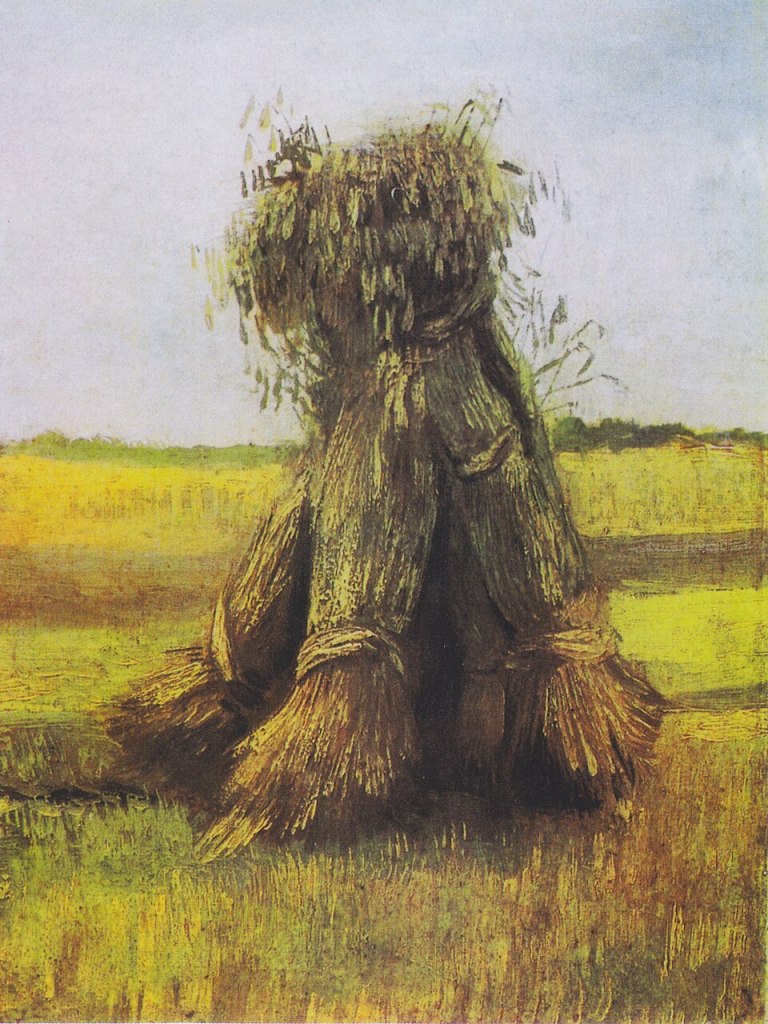
Wheatsheaves in a Field (1885) by Vincent van Gogh

Psalm 126

A Song of Ascents.

1When the LORD restored the fortunes of Zion,
  we were like those who dream.
2
Then our mouth was filled with laughter
  and our tongue with shouts of joy;
 then it was said among the nations,
  “The LORD has done great things for them.”
3
The LORD has done great things for us,
  and we rejoiced.

4
Restore our fortunes, O LORD,
  like the watercourses in the Negeb.
5
May those who sow in tears
  reap with shouts of joy.
6
Those who go out weeping,
  bearing the seed for sowing,
 shall come home with shouts of joy,
  carrying their sheaves.

Bolded words have notes on translation below.

Psalm 126 follows a common pattern in the psalms and throughout the scriptures. It begins with a remembrance of the ways God has acted on behalf of the people in the past and then moves to an appeal for God’s action in the troubles of the present. As J. Clinton McCann Jr. states, “We live in the hope of God’s help always remembering what God has done in the past…and always anticipating what God will do in the future.”(NIB III:1196) The imagery of sowing and reaping have led to the Psalm’s usage on Thanksgiving Day in worship (Year B in the Revised Common Lectionary) and it inspired Knowles Shaw’s song “Bringing in the Sheaves.”

The psalm is structured around two uses of a Hebrew idiom translated “restored our fortunes” in the NRSVue. The phrase is difficult to render in English and has led to a wide variety of translations, but in the prophets it relates to the change in condition brought about by God turning away from God’s wrath and again regarding the people with favor. (Mays, 1994, p. 399) The use of the phrase often refers to the return of the exiles to the homeland of Israel (Deuteronomy 30:3; Jeremiah 30: 3, 18; 32:44; Ezekiel 39:25) and here it may also refer to a homecoming of the exiles from Babylon. (NIB III: 1195) The specific context that the psalm originally spoke to is not required for the reader to understand the relief and joy of those who have experienced the great things God has done for the people of the psalmist. The dreamy state of the remembered joy and laughter of the people emerges from the ways God has provided for and protected the people in the past. From the memory of what God has done in the past comes the hope of God’s action in the present.
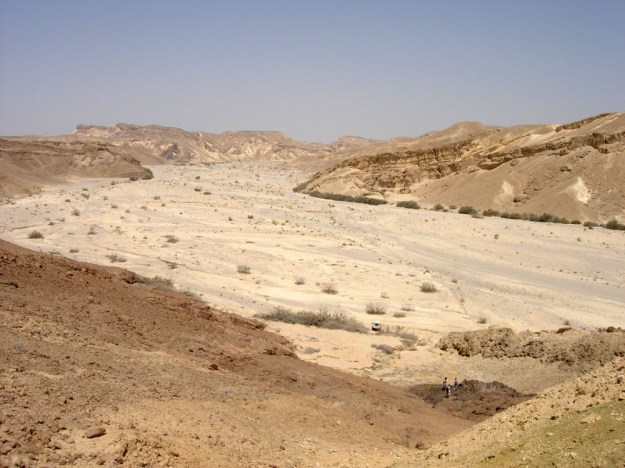
Wadi in Nahal Paran, Negev, Israel By Wilson44691 at English Wikipedia – Photograph taken by Mark A. Wilson (Department of Geology, The College of Wooster).[1], Public Domain, https://commons.wikimedia.org/w/index.php?curid=3140024

The experience of the present is one described metaphorically by the dry watercourses of the Negeb. During the rainy season these creek beds are filled with water but now in the metaphor of the psalm they are dry. Psalm 42 used the imagery of thirsting for water as a metaphor for thirsting for God’s presence:

As a deer longs for flowing streams, so my soul longs for you, O God. Psalm 42:1

The prophet Joel will also use a similar image:

In that day the mountains shall drip sweet wine, the hills shall flow with milk, and all the stream beds of Judah shall flow with water; a fountain shall come forth from the house of the LORD and water the Wadi Shittim. Joel 3:18

It is possible as Walter Beyerin argues that the author of Psalm 126 utilized Joel as a source of imagery as the psalmist, in his reconstruction, attempts to deal with the disappointment that prevailed in Judah after the return from Babylon (NIB III: 1196) but the beauty of the psalms is their ability to fit circumstances frequently encountered in life. Most people can relate to the imagery of drought in the personal, relational, economic, and spiritual struggles of life. The desire for the tears of today to turn to shouts of joy and a desire for the pain of the present to have some harvest of meaning in the future. To live in anticipation that the God who brings an end to the dryness of the watercourses of the Negeb will also turn tears into joy as people come in carrying the sheaves planted in these moments of hardship.
Psalm 65 A Song of Thanksgiving to a Gracious Creator

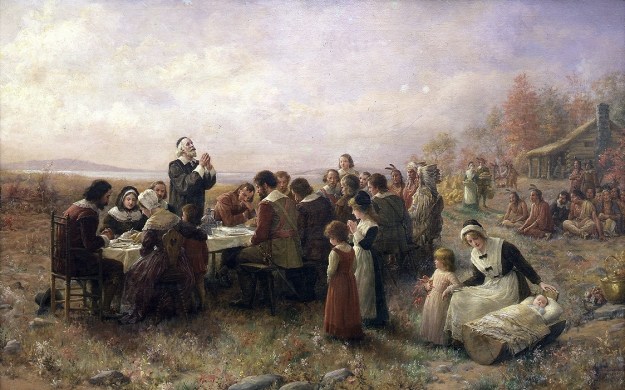
Jennie Augusta Brownscome, The First Thanksgiving at Plymouth (1914) Plymouth Hall Museum, Plymouth, MA

Psalm 65

<To the leader. A Psalm of David. A Song.>
1 Praise is due to you,[1] O God, in Zion; and to you shall vows be performed,
2 O you who answer prayer! To you all flesh shall come.
3 When deeds[2] of iniquity overwhelm us, you forgive our transgressions.
4 Happy[3] are those whom you choose and bring near to live in your courts. We shall be satisfied with the goodness of your house, your holy temple.
5 By awesome deeds you answer us with deliverance, O God of our salvation; you are the hope of all the ends of the earth and of the farthest seas.
6 By your strength you established the mountains; you are girded with might.
7 You silence the roaring of the seas, the roaring of their waves, the tumult of the peoples.
8 Those who live at earth’s farthest bounds are awed by your signs; you make the gateways of the morning and the evening shout for joy.
9 You visit the earth and water it, you greatly enrich it; the river of God is full of water; you provide the people with grain, for so you have prepared it.
10 You water its furrows abundantly, settling its ridges, softening it with showers, and blessing its growth.
11 You crown the year with your bounty; your wagon tracks overflow with richness.
12 The pastures of the wilderness overflow, the hills gird themselves with joy,
13 the meadows clothe themselves with flocks, the valleys deck themselves with grain, they shout and sing together for joy.

It feels serendipitous to arrive at Psalm 65 in the week before the celebration of Thanksgiving in the United States. This psalm is appropriately used in many Thanksgiving services. This song which celebrates a gracious and forgiving God whose awesome actions to deliver, sustain, and protect the people of God along with all of creation evoke praise from God’s people and the earth itself. The praise delivered to God may be done in silence or with shouting and singing for joy, but the poet who composes the psalm recognizes their place among the thankful creation acknowledging all that its gracious creator has done. As Martin Luther could state in explaining God’s act of creation in the Small Catechism, “For all of this I owe it to God to thank and praise, serve and obey him. This is most certainly true.” (Luther 1978, 25)

The initial praise emanates from the chosen people in Zion, likely in the temple or tabernacle. Most translations begin like the NRSV, “Praise is due to you” but the Hebrew states, “to you, silence is praise.” Poetically following the Hebrew makes sense as the psalm moderates back and forth between sound and silence. The things that are audible in the poem are often things that interfere with recognizing the gracious actions of God: words of iniquity (v. 3), the roaring of the seas and their waves and the tumult of the people which God silences (v.7). The two things in the poem that metaphorically shout for joy: the gateways of the morning and the evenings (v.8) and the meadows and valleys (v. 13) are both silent. Perhaps the psalmist is inviting us into silence so that we can observe as the creation responds in praise to God’s actions and we might in our own way learn to do the same.

God is the primary actor in this psalm. God is a redeemer who answers prayers, (v. 2) forgives transgressions, (v. 3) and delivers through awesome deeds. (v. 5) God is the creator who established the mountains, calms the threatening and chaotic water and the tumult of the nations, and who presides over all humanity and creation. (v. 6-8) God is the great farmer who waters the earth and causes the plants to grow into a bountiful harvest. (v. 9-11) The psalmist and all creation only lift up their silent praise together with their shouts and songs of joy. Happy (or blessed) are the ones who by God’s gracious action are brought near to live in the courts of God and to worship in the temple of God for they can see, with the rest of creation, the proper stance towards their gracious redeemer, creator, sustainer, and provider. Part of the wise life is being satisfied with the abundance that God has provided.

One of the gifts of the Lutheran tradition which I was formed within is the focus on God being the primary actor in the world rather than humanity. Much of the Christianity formed in the United States places a large emphasis, due to our individualistic culture, on the actions of the individual in obedience to God. Especially with the secular assumptions that most modern Christians bring to their faith, God’s action seems more distant and human action becomes more central. Reinhold Niebuhr’s incisive critique of the American practice of Thanksgiving from almost a century ago (1927) still resonates:

Thanksgiving becomes increasingly the business of congratulating the Almighty upon his most excellent co-workers, ourselves…The Lord who was worshipped was not the Lord of Hosts, but the spirit of Uncle Sam, given a cosmic eminence for the moment which the dear old gentleman does not deserve. (NIB IV:935)

Perhaps this psalm can help us to join with the rest of creation as it responds with praise to what God is doing in the world regardless of the transgressions of the chosen people who seem unable to live into the obedience to the covenant of God. Perhaps this short song can encourage us to lift our heads and expand our horizons beyond the walls of our community and reflect upon the actions both awesome and miniscule that God does to maintain the harmony of creation. As people gather together for their feasts of Thanksgiving, may it be an opportunity to reflect upon God’s actions of provision from the abundance of God’s harvest which we can gratefully partake in.

[1] The Hebrew text here reads “To you, silence (dumiyya) is praise” Most translations follow the LXX (Greek text) which uses the Greek prepo (fitting or proper) feeling this is a song of praise and sound is a central act. (Nancy deClaisse-Walford 2014, 527) See my comments on this above.

[2] The Hebrew dabar is normally translated word but can have the meaning of things or matters. Within the poetic flow of the Hebrew ‘words’ makes sense.

[3] This is the Hebrew asre which is often translated ‘happy’ in Hebrew scriptures. This word often used in wisdom literature and is the Hebrew equivalent to the Greek word makarios which is translated ‘blessed’ in the New Testament (particularly in the Sermon on the Mount).