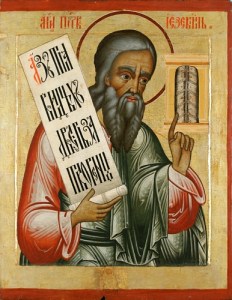
Russian icon of the Prophet Ezekiel holding a scroll with his prophecy and pointing to the “closed gate” (18th century, Iconostasis of Kizhi monastery, Russia)
Ezekiel 2
1 He said to me: O mortal, stand up on your feet, and I will speak with you.2 And when he spoke to me, a spirit entered into me and set me on my feet; and I heard him speaking to me.3 He said to me, Mortal, I am sending you to the people of Israel, to a nation of rebels who have rebelled against me; they and their ancestors have transgressed against me to this very day.4 The descendants are impudent and stubborn. I am sending you to them, and you shall say to them, “Thus says the Lord GOD.” 5 Whether they hear or refuse to hear (for they are a rebellious house), they shall know that there has been a prophet among them.6 And you, O mortal, do not be afraid of them, and do not be afraid of their words, though briers and thorns surround you and you live among scorpions; do not be afraid of their words, and do not be dismayed at their looks, for they are a rebellious house. 7 You shall speak my words to them, whether they hear or refuse to hear; for they are a rebellious house.
8 But you, mortal, hear what I say to you; do not be rebellious like that rebellious house; open your mouth and eat what I give you. 9 I looked, and a hand was stretched out to me, and a written scroll was in it. 10 He spread it before me; it had writing on the front and on the back, and written on it were words of lamentation and mourning and woe.
The narration of Ezekiel’s encounter with the LORD the God of Israel continues with this calling of the prophet as a messenger from the God of Israel to God’s rebellious people. In the midst of the bright and visually overwhelming living creatures, wheels, crystal dome, throne, and the fiery appearance of the LORD in a human like form combined with the sound like thunder and mighty waters the prophet has assumed the proper position of a mortal in the presence of the divine, prostrate on the ground. Ezekiel’s response reflects the practice of ancient royal courts where those summoned would prostrate themselves before the sovereign until they were commanded to rise when the sovereign is ready to address them. Ezekiel is cognizant of the distinction between himself as a mortal servant of the LORD and the overwhelming and powerful divine one who addresses him.
Ezekiel is referred to throughout the book as ‘son of man’ (Hebrew ben-adam, NRSV ‘mortal’). This is the primary way the prophet is addressed throughout the book, and it occurs ninety-three times. Adam in Hebrew is the general word for ‘man’ or ‘human’ and while Ezekiel is both a son of Adam, and a son of man, the NRSV and other translations that render this as ‘mortal’ do capture the way the term distinguishes Ezekiel from the LORD who is addressing him. This ‘son of man’ terminology will be used in a very different way in the book of Daniel (Daniel 7:13) and in the gospels by Jesus as a figure who is commissioned to come from heaven, but here it is a very mortal prophet who finds himself before the throne of God in a foreign land being commissioned as an emissary of God’s word to the people of Israel.
Ezekiel was a passive observer of the approach of the divine chariot in the previous chapter, and remains a passive if obedient vessel throughout this chapter of commissioning. When commanded to rise and stand on his feet, a ruach (spirit, wind, breath) enters into him and places him on his feet enabling the prophet to stand in the overpowering presence of the divine. It could be that a breath of God enters into the prophet, or a spirit of God, or a wind that lifts the prophet upon his feet, and the flexibility of the Hebrew allows for all of these senses to be true simultaneously. Yet, the action begins with the word and the ruach of the God of Israel who speaks and lifts up this son of man.
Ezekiel is commissioned to go to the people of Israel. Israel now refers to what remains of the people of Israel and Judah in the aftermath of the Assyrian dispersion of the Northern Kingdom of Israel (or Samaria), the portions of Judah still in the land around Jerusalem as well as the Judeans in exile in Babylon (where Ezekiel finds himself). It is likely that in the aftermath of the Northern Kingdom’s and Judah’s brief renaissance under Josiah that there was a reclamation of the identity of the people as the people of Israel as well as aspirations of reclaiming these lands that once belonged to the northern tribes. Yet this people of Israel at the time of Ezekiel is a nation (Hebrew goy) of rebels. The Hebrew word goy is normally used in a pejorative sense, the nations (or Gentiles) are the goyim. As Daniel Block highlights:
When the word is used of this nation, it tends to carry a pejorative sense, highlighting Israel’s indistinguishability from other nations and Yahweh’s rejection of Israel. Apart from faith in and fidelity to Yahweh, Israel is just another “heathen” nation. (Block, 1997, p. 118)
The nation of Israel is impudent (literally hard of face) and stubborn (literally hard of heart). Their external actions and the internal state of their heart and mind.[1] Later in Ezekiel 36:26 the remedy to this hardness of heart will be God’s action of placing within the people a ‘heart of flesh.’ For now, Ezekiel is warned that he is going to a people who have set their face and their will against their God and who continue in this rebellion. The people of Israel have become a house of rebellion and the renaming of Israel in this way recalls the way the eighth century BCE prophets Amos and Hosea renamed Bethel (house of God) to Beth-aven (house of iniquity). [2]
Ezekiel’s commission is not dependent on convincing this hard faced and hard-hearted people, but in faithfully delivering the messages that the LORD God hands on to him. When the words Ezekiel delivers come to pass the people will realize they have had a prophet in their midst. The prophets whose words are recorded in scripture were probably not well received as they delivered words of lamentation, mourning, and woe in their time, and it is only afterwards when their words proved true and the words of the prophets made sense of the experience of the people that they were accepted. Yet, within Deuteronomy, this is the only way to recognize a true prophet.
You may say to yourself, “How can we recognize a word that the LORD has not spoken?” If a prophet speaks in the name of the LORD but the thing does not take place or prove true, it is a word that the LORD has not spoken. The prophet has spoken presumptuously; do not be frightened by it. Deuteronomy 18: 21-22
It is only once a prophet’s words prove true that the people can recognize a true prophet has been in their midst, but they are still accountable for their response to these prophets who speak in the name of the LORD.
Ezekiel’s words will not be popular among the exiles or the remnant in Jerusalem and the only protection the prophet has will come from the God who sends him. The briers, thorns, and scorpions which surround the prophet are symbols of the prophet’s protection. Many scholars view the ‘scorpions’ introduced with the ‘briars and thorns’ as a mixed metaphor and wonder if the ‘scorpions’ refers to a ‘scorpion plant’ of thorny appearance or stinging quality. (Block, 1997, p. 121) But Katheryn Pfister Darr points to two incantations in Maqlȗ, a Babylonian series of rituals for warding off the effects of sorcery:
I am the spike of a thornbush; you cannot step on me! I am the stinger of a scorpion; you cannot touch me. Maqlȗ III. 153-154 (NIB VI: 1123)
Even though it may mix plant and animal imagery, the poetic sense of the prophets is elastic enough to encompass two elements like this to point to the divine protection which surrounds this prophet who delivers an unpleasant word to a rebellious people. This mortal who bears the divine word is not to be afraid of mortal words of looks.[3] The people have already rejected the LORD who sends the prophet, so the prophet should not expect a receptive audience for the words he is called to bear.
The elaborate description of the approach of the divine presence and the commissioning of this son of man to carry the message to the rebellious house of Israel have prepared us to approach the message itself. As mentioned above Ezekiel has been a passive recipient of the vision and this calling, but he (unlike Israel) has not actively resisted the LORD’s instructions. But immediately before receiving this message he is to bear, Ezekiel is warned not to be infected by the disease which the people he is sent to have, a refusal to listen and obey. The prophet Jeremiah received the word of God when the words were placed in his mouth:
Then the LORD put out his hand and touched my mouth; and the LORD said to me, “Now I have put my words in your mouth.” Jeremiah 1:9
Yet, for Ezekiel the words are written on a scroll he is given to eat. Katheryn Pfister Darr humorously remarks, “Yahweh’s touch bestows divine words that Jeremiah must proclaim. Yet one does not surmise that God literally stuffs words down his throat.” (NIB VI: 1124) But that is what will happen to the passive prophet who will soon open his mouth to receive that which is normally inedible. The scroll is full of writing, front and back, and there is no place to add or any ability for the prophet to modify the text of lamentation, mourning, woe.[4]
With the presented scroll something has changed in the nature of prophecy. Instead of a personal address by God the prophet is given a scroll to consume, and as Walther Zimmerli can state “It has become a book.” (NIB VI: 1125) The prophet who will be given this scroll to consume will become the written prophecy, and it is likely that many of Ezekiel’s recorded words may have been distributed in primarily written form. Ezekiel is a prophet in a new situation and time, he is separated from the temple and Jerusalem and charged with ministering to a people divided between Jerusalem and exile. Like the apostle Paul in the early Christian church many of his messages will have to be in a written form to minister to these two dispersed communities. Due to the identity of those taken into exile, being the notables of the land, there was probably a higher concentration of literate individuals. Yet, even messages that were directed to the remnant in Jerusalem would be primarily addressed to the priestly and ruling remnant in Jerusalem. I’m indebted to Ellen Davis for these reflections on the character of Ezekiel in her study of Ezekiel as a prophet navigating a new location by utilizing, “a style of prophecy which the immediate audience selected for him by Nebuchadnezzar’s army was especially qualified to understand, if not appreciate.” (Davis, 1989, p. 44) Writing is both a solution to communicating with a separated community, but now this prophet who will become the embodiment of the scroll he consumes will also recreate the content of the scroll he consumes as a written text that can remain a witness for a generation which can understand Ezekiel’s position as a prophet bearing God’s word who is finally ready to receive this word. As Ellen Davis can insightfully state, “Preserved as a text, God’s word is no longer frustrated by the intransigence of any generation; it can wait until such time as it may be heard.” (Davis, 1989, p. 61)
[1] In Hebrew though the heart is the organ of will and decision, not emotion. When someone’s heart is set on something it means they have set their will on gaining or following something. In Hebrew the emotions are the realm of the stomach and guts.
[2] See Amos 5:5-6 where the prophet still uses Bethel but condemns the injustice of the place and Hosea 4:15, 5:8, 10:5 where the name is intentionally changed. This can be confusing since Beth-aven also refers to a different location in Joshua 7:2; 18:12 and 1 Samuel 13:5; 14:23
[3] The idea of ‘looks’ from the people may refer to the idea of cursing a person with an ‘evil eye’. Words, rituals, and actions had a different significance in ancient cultures than we often grant them today, and a word or evil eye or other ‘looks’ were looked upon in ancient societies as powerful things.
[4] The three Hebrew words behind lamentation, mourning, and woe are qina “lament, dirge” which is often associated with funerals, hegeh an onomatopoeic expression of moaning and groaning, and hi which is only used here in scripture and may be another onomatopoeic expression for a cry of pain. (Block, 1997, p. 125)



 Sign of the Rose