Tag Archives: sheol

Ezekiel 32 Concluding the Oracles Against Egypt

Nile Crocodile Eating a Wildabeast in the Masai Mara By Arturo de Frias Marques – Own work, CC BY-SA 4.0, https://commons.wikimedia.org/w/index.php?curid=34596035

Ezekiel 32: 1-16 Egypt as the Dragon of the Seas

1In the twelfth year, in the twelfth month, on the first day of the month, the word of the LORD came to me: 2Mortal, raise a lamentation over Pharaoh king of Egypt, and say to him:
You consider yourself a lion among the nations,
but you are like a dragon in the seas;
you thrash about in your streams,
trouble the water with your feet,
and foul your streams.
3Thus says the Lord GOD:
In an assembly of many peoples
I will throw my net over you;
and I will haul you up in my dragnet.
4I will throw you on the ground,
on the open field I will fling you,
and will cause all the birds of the air to settle on you,
and I will let the wild animals of the whole earth gorge themselves with you.
5I will strew your flesh on the mountains,
and fill the valleys with your carcass.
6I will drench the land with your flowing blood
up to the mountains,
and the watercourses will be filled with you.
7When I blot you out, I will cover the heavens,
and make their stars dark;
I will cover the sun with a cloud,
and the moon shall not give its light.
8All the shining lights of the heavens
I will darken above you,
and put darkness on your land,
says the Lord GOD.
9I will trouble the hearts of many peoples,
as I carry you captive among the nations,
into countries you have not known.
10I will make many peoples appalled at you;
their kings shall shudder because of you.
When I brandish my sword before them,
they shall tremble every moment
for their lives, each one of them,
on the day of your downfall.
11For thus says the Lord GOD:
The sword of the king of Babylon shall come against you.
12I will cause your hordes to fall
by the swords of mighty ones,
all of them most terrible among the nations.
They shall bring to ruin the pride of Egypt,
and all its hordes shall perish.
13I will destroy all its livestock
from beside abundant waters;
and no human foot shall trouble them any more,
nor shall the hoofs of cattle trouble them.
14Then I will make their waters clear,
and cause their streams to run like oil, says the Lord GOD.
15When I make the land of Egypt desolate
and when the land is stripped of all that fills it,
when I strike down all who live in it,
then they shall know that I am the LORD.
16This is a lamentation; it shall be chanted.
The women of the nations shall chant it.
Over Egypt and all its hordes they shall chant it,
says the Lord GOD.

The sixth oracle against Egypt is labeled as a lamentation and is framed by the Hebrew word for lamentation once in the second verse and four times[1] in verse sixteen. Yet, the intervening poem does not share the normal pattern of lifting in praise the object of the lament followed by a fall in most biblical laments. Within the larger structure of Ezekiel, the previous chapter may fulfill this purpose, but this ‘dragon of the seas’ while a mighty beast is not a sympathetic character at the beginning of the lament. Yet, unlike the previous usage of a metaphor for Assyria, as a great tree felled, the imagery is directly related to Egypt’s Pharoah and its military might.

In contrast to the self-perception of Pharoah as a lion among the nations,[2] but the LORD indicates through Ezekiel that he is a ‘dragon of the seas.’ We are again exposed to the Hebrew word tannin, here dragon, which often refers to a mythical sea creature and in chapter 29 referred to Pharoah as a crocodile. Here there are crocodile-like elements, the creature has feet instead of fins or flippers, but instead of being a creature of the rivers it is a creature of the seas. Part of this contrasting set of metaphors may be related to Egypt’s perception of themselves as a land-based power with a strong army (a lion among the nations) but their real power may be in their naval and merchant fleets which would prove less valuable in a defense of the homeland. Yet, this ‘dragon of the seas’ now seems to be confined to thrashing about in its streams, troubling the water with its feet, and fouling the streams. The presence of this ‘dragon of the seas’ presents in the image an ecological crisis for the waters it inhabits.

This massive beast is summarily dealt with when a net is thrown over it and it is brought out of the waters and cast on the land. Previously the LORD had cast his net over Zedekiah,[3] now the Egyptian Pharoah who Zedekiah appealed to for aid against Babylon is also ensnared. The timing of this oracle, indicated by Ezekiel’s date as March 3, 585 BCE would be two months after the exiles learn of the destruction of Jerusalem, may indicate the reason for this oracle.  Although the city is gone there may still be some lingering hope that the great sea dragon of Egypt would rouse itself fully and attack Babylon in retaliation for Jerusalem. For Ezekiel the army of Babylon under Nebuchadrezzar has been functioning on behalf of the God of Israel and now only Egypt opposes the reign of Babylon. Yet, in Ezekiel’s image the sea dragon is out of its element and serves only as food for the birds of the air and the wild animals who gorge on it. The dragon is now the food for vultures and jackals.

The metaphorical destruction of Egypt’s hordes and Pharoah has both grotesque elements and cosmic elements. Egypt is not a land of mountains and valleys, yet the carcass of the beast falls on both mountains and valleys and the blood of the beast fills the land. At the same time the defeat of this beast causes the sun, moon, and the stars to be blocked out.[4] Such a drastic change on the seas and the earth is reflected by the shrouding of the heavens. The impact of Egypt’s departure from the nations causes other kings to shudder when the LORD responsible for this upheaval brandishes his sword at them as well.

The sword of the LORD is quickly indicated to be the sword of the king of Babylon and the swords of his mighty ones. They are both the most terrible among the nations and yet they are still the chosen instrument of God. Both the humans and the animals of Egypt are destroyed, and the land is desolate. Although there is a positive ecological impact on the waters as humans and animals are removed. The once fouled and troubled waters now flow like oil.

The great sea monster, just like the crocodile-like figure in chapter 29, is removed from their element and the predator becomes prey. Isaiah will later utilize a similar praise for God’s strength over Egypt by saying:

Awake, awake, put on strength, O arm of the LORD! Awake, as in days of old, the generations of long ago! Was it not you who cut Rahab in pieces, who pierced the dragon? Isaiah 53:9[5]

Ezekiel has condemned Jerusalem’s leadership for trusting in Egypt instead of the LORD. Ezekiel’s voice was probably not popular during this time when the nation of Judah collapsed, but Ezekiel’s continual emphasis on God’s strength being enacted through Babylon likely helped the people make sense of their shattered lives in the aftermath of the destruction of Jerusalem, the temple, and their political system. Ezekiel’s imagery may have also influenced the beast from the sea in Revelation13:1-10.[6]

Ezekiel 31: 17-32 Egypt Goes Down to the Pit


17In the twelfth year, in the first month, on the fifteenth day of the month, the word of the LORD came to me:
18Mortal, wail over the hordes of Egypt,
and send them down,
with Egypt and the daughters of majestic nations,
to the world below,
with those who go down to the Pit.
19“Whom do you surpass in beauty?
Go down! Be laid to rest with the uncircumcised!”
20They shall fall among those who are killed by the sword. Egypt has been handed over to the sword; carry away both it and its hordes. 21The mighty chiefs shall speak of them, with their helpers, out of the midst of Sheol: “They have come down, they lie still, the uncircumcised, killed by the sword.”
22Assyria is there, and all its company, their graves all around it, all of them killed, fallen by the sword. 23Their graves are set in the uttermost parts of the Pit. Its company is all around its grave, all of them killed, fallen by the sword, who spread terror in the land of the living.
24Elam is there, and all its hordes around its grave; all of them killed, fallen by the sword, who went down uncircumcised into the world below, who spread terror in the land of the living. They bear their shame with those who go down to the Pit. 25They have made Elam a bed among the slain with all its hordes, their graves all around it, all of them uncircumcised, killed by the sword; for terror of them was spread in the land of the living, and they bear their shame with those who go down to the Pit; they are placed among the slain.
26Meshech and Tubal are there, and all their multitude, their graves all around them, all of them uncircumcised, killed by the sword; for they spread terror in the land of the living. 27And they do not lie with the fallen warriors of long ago who went down to Sheol with their weapons of war, whose swords were laid under their heads, and whose shields are upon their bones; for the terror of the warriors was in the land of the living. 28So you shall be broken and lie among the uncircumcised, with those who are killed by the sword.
29Edom is there, its kings and all its princes, who for all their might are laid with those who are killed by the sword; they lie with the uncircumcised, with those who go down to the Pit.
30The princes of the north are there, all of them, and all the Sidonians, who have gone down in shame with the slain, for all the terror that they caused by their might; they lie uncircumcised with those who are killed by the sword, and bear their shame with those who go down to the Pit.
31When Pharaoh sees them, he will be consoled for all his hordes — Pharaoh and all his army, killed by the sword, says the Lord GOD. 32For he spread terror in the land of the living; therefore he shall be laid to rest among the uncircumcised, with those who are slain by the sword — Pharaoh and all his multitude, says the Lord GOD.

This final oracle against both Egypt and the nations consigns Pharoah and his multitude to the Pit along with the nations who went before. There is no month in the Hebrew text for the date and the NRSV assumes that it should be the first month of the twelfth year, although I agree with both Block, and other scholars, who follow the cue of the previous oracle and have it in the first month roughly two weeks after the sixth oracle. (Block, 1998, p. 216) Egyptian royalty invested heavily in creating royal tombs to ensure that in their afterlife they would have both wealth and power, but here they join all the other nations in the Pit or Sheol. Both the Egyptians and Phoenicians mentioned here practiced circumcision, so their coming down to lie with the uncircumcised means a dishonorable death. Instead of the wealth and power they exercised, all that waits for them in Sheol is the presence of the other nations who went before.

This final oracle is highly repetitive using words like horde, go down, uncircumcised, and sword frequently in its descriptions. All these empires or nations had armies, all failed and suffered shame, all were overthrown by a greater empire with a larger army (sword). Assyria’s domain had once been great, and their rule was violent. Empires in the ancient world were violent and the accusation of spreading terror fits with Assyria’s self-description of their rule under Shalmaneser III:

I slew their warriors with the sword, descending upon them like (the god) Adad when he makes the rainstorm pour down. In the moat (of the town) I piled them up, I covered the wide plain with the corpses of their fighting me, I dyed the mountains with their blood like red wool. I took away from him many chariots (and) horses broken to the yoke. I erected pillars of skulls in front of his town, destroyed his (other) towns, tore down (their walls) and burnt (them) down. (ANET 277 quoted in NIB VI: 1442)

Now these once fierce Assyrians with their graves surrounding their leaders who once spread terror in the land of the living occupy the uttermost parts of the Pit. They were violent in life but now in death they are a part of the company of the dishonored who await Egypt. Elam, from modern day Iran, appear in the biblical writing rarely, although Jeremiah has an oracle against the Elamites,[7] and Isaiah portrays Elam as a nation skilled in archery and chariotry (or cavalry) which participated in Assyria’s attack of Judah.[8] Meshech-Tubal appeared in Ezekiel 27: 13 as nations who trafficked in the slave trade and bronze vessels and they will appear in Ezekiel 38:2 as allies of Gog. Unlike some mysterious other warriors who went down to an honorable burial (with their weapon and shield) they have arrived in Sheol bereft of the weapons they once terrified the nations with. Edom received its own oracle in Ezekiel 25: 12-14 and was one of Judah’s close neighbors, while the princes of the north and Sidonians likely refer to the Phoenicians who control Tyre and Sidon.[9]

Sheol or the Pit are not places of torment like the later conceptions of Hell but are places of darkness.[10] It is not the hoped afterlife of the Egyptian rulers, but the consolation that is offered to Egypt is that they are not alone in being consigned to the dustbin of history. They take up their place among these other nations who once terrified the people in the place of the dead, disarmed and dishonored. Katheryn Pfisterer Darr notes insightfully that for all Ezekiel’s threats to Israel, God never consigns them to the Sheol. (NIB VI: 1445)

[1] The Hebrew qina, qonem is behind both lamentation and chant in verse sixteen.

[2] The nations (goyim) and many peoples are repetitive and unifying structures for this oracle.

[3] Ezekiel 12:13, 17:20.

[4] The prophet Joel uses similar darkening of the heavenly lights for the coming day of the LORD in Joel 2:10.

[5] Rahab is a cypher for Egypt as seen in Isaiah 30:7 and Psalm 87:4.

[6] Revelation’s description of the beast from the sea is significantly different from Ezekiel’s description of this ‘sea dragon’ but Ezekiel is one of the dominant influences on the imagery of Revelation.

[7] Jeremiah 49: 35-39.

[8] Isaiah 22:6.

[9] Ezekiel 2628.

[10] See my reflection on Gehenna, Tartaros, Sheol, Hades, and Hell.

Gehenna, Tartaros, Sheol, Hades and Hell

Mauricio Garcia Vega “Visita al infierno’ shared by artist under Creative Commons 3.0


For many Christians the concept of hell has a lot of baggage associated with it. In the New Testament Gehenna, Sheol, or Tartaros which are translated Hades (Sheol) or Hell (Gehenna or Tartaros) did not carry the same level of imagined meaning to its hearers. The New Testament is not primarily concerned with heaven and hell as locations for the afterlife reward and punishment, which is how most people hear these terms today.

The Afterlife in the Hebrew Scriptures

For most of ancient Judaism heaven was the place that God reigned from, but it was not a place where humans (except for a select few like Elijah and Enoch) were brought to be with God. The Hebrew Scriptures are primarily concerned with the relationship between God and the people of God in this life. The blessings of covenant faithfulness were to be experienced in the provision of God for the people and the curse of covenant unfaithfulness was experienced in the struggle and strife that occurred through invasion, famine and illness. There is a long history of lament when the blessings of covenant faithfulness seem to be denied by God unfairly, but this faithful protest to God still expected God’s action within the lifetime of the prophet or poet calling for God’s action. There is a concept of Sheol, a place where the dead rest, but it is not a place of punishment or reward but simply a place where the dead are. Two quick examples of the concept of Sheol in the Hebrew Scriptures: it occurs frequently in Psalms and Proverbs as a place where the dead go and where the faithful one will end up if God does not intervene. In Psalm 6:5 the author attempts to bargain with God to deliver them because, “For in death there is no remembrance of you; in Sheol who can give you praise?” Additionally, there was an understanding that, even though it was prohibited magic for the Jewish people, a medium was summoning the shade of a dead one from somewhere which we see in the story of Saul consulting the medium at Endor. (1 Samuel 28)

Belief about death would evolve near the end of the time where the Hebrew Scriptures were written because the experience of the people appeared to be in tension with the promise of covenant faithfulness. As Samuel Ballentine, quoting Peter Berger, can state:

“All socially constructed worlds are inherently precarious,” P. Berger observes. They are precarious because the socially managed consensus concerning right and wrong, good and evil, actions and abilities that are acceptable and those that exceed tolerable limits, is constantly threatened by chaos. (Ballentine, 1993, p. 139)

At the end of Isaiah, we see the first idea of an everlasting punishment for those who have rebelled against God. This is set within the larger context of an ingathering of the nations where all flesh worships before God but there is articulated a judgment for those who rebel against God that goes beyond this life:

And they shall go out and look at the dead bodies of the people who have rebelled against me; for their worm shall not die, their fire shall not be quenched, and they shall be an abhorrence to all flesh. (Isaiah 66:24)

In the Jewish writings like 2 Maccabees, Enoch and 2 Esdras, which are written between the time of the Hebrew Scriptures and the New Testament, we see the evolution of the resurrection of the dead but at the time of Jesus this is not a universal belief (the Pharisees and Jesus accept it but the Sadducees do not.)

In the New Testament

Tartaros occurs only in 2 Peter 2:4 and refers to a place where the rebellious angels are sent. This is combined in later theology to make hell the domain of the devil and the fallen angels, but this evolution has not occurred at the time when the New Testament is written. Satan has fallen from heaven, but his place seems to be on the earth at the time of the gospels. There is the concept of the Abyss in Revelation as well as angels and demonic forces which are unleashed from the sea and the earth as well as punishment in the lake of fire in Revelation 20: 11-15 where the devil and those who align themselves with him end up.

Sheol in the New Testament is translated Hades and is often in parallel with death. It seems to serve a similar function to the use of Sheol in the Hebrew Scriptures as a place where people are brought down to at death, but it also becomes personified as an entity (along with death) that is resisting God’s reign. In Matthew it is used twice, once in reference to Capernaum which has had ample opportunities to hear Jesus’ message and repent but since there has not been repentance will be brought down to Hades (Matthew 11:23) and most famously after the declaration of Peter:

And I tell you, you are Peter, and on this rock I will build my church and the gates of Hades will not prevail against it. (Matthew 16: 18)

Gehenna is used more in Matthew than in any other book of the New Testament (Matthew 5:22, 29, 30 [parallel Mark 9:43, 45,47] 10:28 [Parallel Luke 12: 5]; 18:9; 23: 15 and 33). The only uses outside of Matthew and Mark and Luke is James 3:6 (speaking about the tongues ability to set on fire being itself set on fire by Gehenna). To further explore Matthew’s concept, I’ve listed each place Matthew uses the idea of Gehenna.

22 But I say to you that if you are angry with a brother or sister, you will be liable to judgment; and if you insult a brother or sister, you will be liable to the council; and if you say, ‘You fool,’ you will be liable to the hell of fire… 29 If your right eye causes you to sin, tear it out and throw it away; it is better for you to lose one of your members than for your whole body to be thrown into hell. 30 And if your right hand causes you to sin, cut it off and throw it away; it is better for you to lose one of your members than for your whole body to go into hell. Matthew 5: 22, 29, 30 [parallel Mark 9:43, 45,47]

28 Do not fear those who kill the body but cannot kill the soul; rather fear him who can destroy both soul and body in hell. Matthew 10:28 [Parallel Luke 12: 5]

8If your hand or your foot causes you to stumble, cut it off and throw it away; it is better for you to enter life maimed or lame than to have two hands and two feet and to be thrown into the eternal fire. 9 And if your eye causes you to stumble, tear it out and throw it away; it is better for you to enter life with one eye than to have two eyes and to be thrown into the hell of fire (Matthew 18: 8-9)

15 Woe to you, scribes and Pharisees, hypocrites! For you cross sea and land to make a single convert, and you make the new convert twice as much a child of hell as yourselves. Matthew 23: 15

33 You snakes, you brood of vipers! How can you escape being sentenced to hell? Matthew 23: 33

Additionally Matthew does have a concept of the age of punishment in contrast to the age of life in Matthew 18:8, 19: 16, 29 and 25: 41 and 46. (I am intentionally not using the NRSV and most modern translations’ usage of eternal punishment and eternal life because these also have a lot of baggage in the Christian tradition).

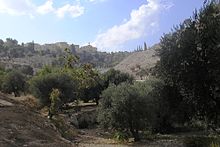
Deror Avi, Picture of the Valley of Hinnom (2007) Shared by photographer under GNU Free Documentation License 1.2

Jesus, especially in Matthew and the synoptic tradition, does include punishment for those who choose the path of the wicked. The gospels use the term Gehenna a term that originates withthe valley of Hinnom, which was considered a cursed place and a place where trash from Jerusalem was burned but it also is used as the opposite of the kingdom of heaven. Choose the kingdom of heaven or choose Gehenna, it is a choice between wisdom and foolishness. I think it is difficult to argue that Jesus does not have some conception of a judgment that goes beyond this life that parallels the resurrection that also transcends this life. Yet, rather than giving us terrifying descriptions to fuel the imaginations, Jesus uses the term in a way that the people of his time would understand and that we can only approach through the accumulated tradition and imagination of the church and artists. Jesus doesn’t focus on Gehenna or heaven as a destination, instead he is focused on the kingdom of heaven’s approach to earth. Gehenna is the place that those who oppose the kingdom of heaven find themselves.

How do we as Christians almost two thousand years after Jesus death and resurrection approach this concept of judgement and hell? Here is some wisdom I can share that I’ve learned from other wise thinkers on our tradition. The first comes from Miroslav Volf in his work Exclusion and Embrace where in the final chapter he makes the point:

Most people who insist on God’s “nonviolence” cannot resist using violence themselves (or tacitly sanctioning its use by others). They deem the talk of God’s judgment irreverent, but think nothing of entrusting judgment into human hands, persuaded presumably that this is less dangerous and more humane than to believe in a God who judges! That we should bring “down the powerful from their thrones” (Luke 1: 51-52) seems responsible; the God should do the same, as the song of that revolutionary Virgin explicitly states, seems crude. And so violence thrives, secretly nourished by belief in a God who refuses to wield the sword.

My thesis that the practice of nonviolence requires a belief in divine vengeance will be unpopular with many Christians, especially theologians in the West. To the person who is inclined to dismiss it, I suggest imagining that you are delivering a lecture in a war zone (which is where a paper that underlies this chapter was originally delivered). Among your listeners are people whose cities and villages have been first plundered, then burned and leveled to the ground, whose daughters and sisters have been raped, whose fathers and brothers have had their throats slit. The topic of the lecture: a Christian attitude toward violence. The thesis: we should not retaliate since God is perfect noncoercive love. Soon you would discover it takes the quiet suburban home for the birth of the thesis that human nonviolence corresponds to God’s refusal to judge. In a scorched land, soaked in the blood of the innocent, it will invariably die. And as one watches it die, one will do well to reflect about many other pleasant captivities of the liberal mind. (Volf, 1996, pp. 303-304)

Additionally, I would add the way we often use the concept of eternal damnation and salvation incorrectly, something I learned from Lesslie Newbingin:

In the debate about Christianity and the world’s religions it is fair to say that there has been an almost unquestioned assumption that the only question is, “What happens to the non-Christian after death?” I want to affirm that this is the wrong question and that as long as it remains the central question we shall never come to the truth. And this for three reasons:

    1. First, and simply, it is the wrong question because it is a question to which God alone has the right to give the answer….
    2. The second reason for rejecting this way of putting the question is that it is based on an abstraction. By concentrating on the fate of the individual soul after death, it abstracts the soul from the full reality of the human person as an actor and sufferer in the ongoing history of the world…
    3. The third reason for rejecting this way of putting the question is the most fundamental: it is that the question starts with the individual and his or her need to be assured of ultimate happiness, and not with God and his glory.(Newbingin, 1989, pp. 177-179)

Ultimately questions of heaven and hell, salvation and damnation are not in my control, and that is something I am thankful for. I do trust that God is wiser than I am in judgment and that ultimately the injustice in this world will not outlast God’s justice. The world’s violence will not ultimately thwart God’s kingdom of peace. Beyond this I can accept that there is an opposite to the kingdom of heaven that Jesus announces to those who hear him, but instead of focusing on Gehenna and the path of foolishness I attempt to follow the path of the kingdom and share it with those who have ears to hear. Beyond this part which I can live and proclaim I leave the rest in God’s capable hands.

Psalm 49 Wealth, Wisdom and Death

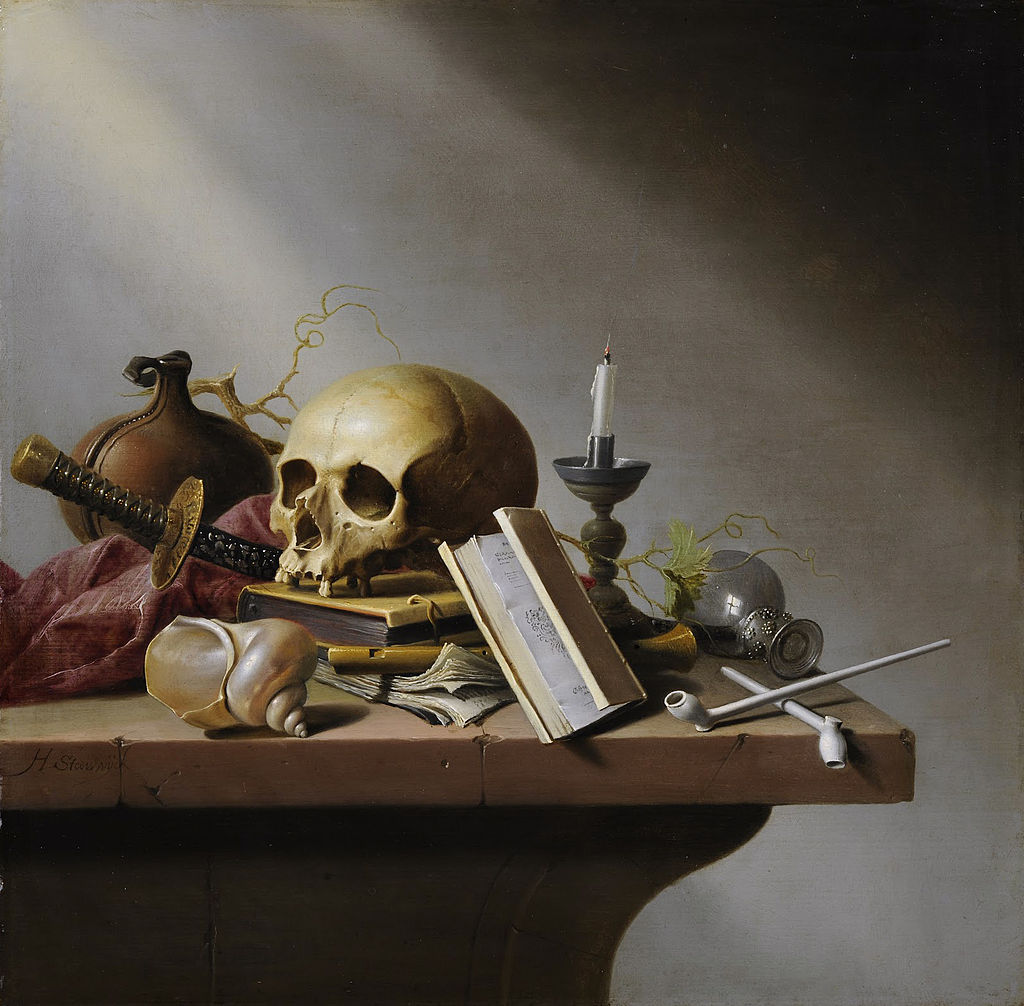
Harmen Steenwijck, Vanitas (1640)

Psalm 49

<To the leader. Of the Korahites. A Psalm.>
1 Hear this, all you peoples; give ear, all inhabitants of the world,
2 both low and high, rich and poor together.
3 My mouth shall speak wisdom; the meditation of my heart shall be understanding.
4 I will incline my ear to a proverb; I will solve my riddle to the music of the harp.
5 Why should I fear in times of trouble, when the iniquity of my persecutors surrounds me,
6 those who trust in their wealth and boast of the abundance of their riches?
7 Truly, no ransom avails for one’s life, there is no price one can give to God for it.
8 For the ransom of life is costly, and can never suffice
9 that one should live on forever and never see the grave.
10 When we look at the wise, they die; fool and dolt perish together and leave their wealth to others.
11 Their graves are their homes forever, their dwelling places to all generations, though they named lands their own.
12 Mortals cannot abide in their pomp; they are like the animals that perish.
13 Such is the fate of the foolhardy, the end of those who are pleased with their lot. Selah
14 Like sheep they are appointed for Sheol; Death shall be their shepherd; straight to the grave they descend, and their form shall waste away; Sheol shall be their home.
15 But God will ransom my soul from the power of Sheol, for he will receive me. Selah
16 Do not be afraid when some become rich, when the wealth of their houses increases.
17 For when they die they will carry nothing away; their wealth will not go down after them.
18 Though in their lifetime they count themselves happy — for you are praised when you do well for yourself —
19 they will go to the company of their ancestors, who will never again see the light.
20 Mortals cannot abide in their pomp; they are like the animals that perish.

Psalm 49 takes on the tone of wisdom literature like the book of Proverbs or Ecclesiastes and engages the topic of wealth in relation to death. The poet believes there is a moral order to the universe that the righteous and unrighteous, the rich and the poor, the wise and the foolish live within. The simple belief that those who do good will prosper and those who are evil will see their ambitions thwarted may not be observed in the daily experience of the psalmist, but death becomes the ransom that no amount of wealth can cover. We are taken into the riddle of: Why should one fear in times of trouble when powerful and presumably wealthy persecutors oppress the righteous one? For the author of the psalm there is comfort in the knowledge that the rich cannot buy their way out of Sheol and that the moral order of God’s universe remains intact.

Humans fear death and we spend an incredible amount of our wealth in the United States attempting to avoid succumbing to death. Even though Christians believe in the resurrection of the dead, many still approach their death with apprehension. To quote a Kenny Chesney song, “Everybody wants to go to heaven…But nobody wanna go now.” But even with all the advances in medical technology and the amount of money that is spent to prolong life being wealthy cannot grant immortality. The idea of being able to secure one’s life through wealth has been explored in futuristic dystopian imaginations, like the 2011 movie In Time, where the poor have their life shortened and the rich have their life extended at the expense of the poor or Jupiter Ascending (2015) where entire worlds are populated so that they can be harvested to provide extended life for the galaxy’s wealthiest clients. In many ways the moral imagination of these dystopian worlds models the economic imagination of Egypt in the Exodus and any society that viewed people as a commodity and wealth as a privilege of a small elite. If wealth were able to ensure immortality fear would drive many to acquire this ransom from death at any cost but thankfully, as I wrote when discussing Ecclesiastes 2, “mortality is the great equalizer in all its unfairness.” Yet, for the psalmist’s moral universe mortality is the great equalizer for, as they are considering it, death is the shepherd which God uses to ensure that those who are materially wealthy and politically powerful do not forever hold power over the righteous ones.

Within the worldview of the psalms the conception of heaven or hell as places that people go in the afterlife has not developed and as we saw in Psalm 6 the conception of Sheol as a place where the dead go is not a place of reward or punishment but simply a place outside of the realm of the living. When the author speaks of God ransoming their soul from Sheol it is trusting that God will not let them die at this point while their persecutors prosper, but instead that the moral order of God’s promises will ensure that their life endures but the life of the wealthy persecutors will reach its end without God’s intervention on their behalf. The God of Israel is a God who intervenes in the life of the faithful to ensure that they are not destroyed, and that God’s promises bear fruit in their lives.

This final Korahite psalm of Book II (Psalms 42-49) is an example of a reflection on situational wisdom. The psalms are more poetry than systematic theology and combine emotion with logic and faith to attempt to discern an answer to the world as the authors of these songs encounter them. Looking at the world from the perspective of one undergoing persecution by a wealthy and powerful oppressor, the psalmist can see death as God’s equalizer. Illness, weakness and impending death in psalms of lament are all brought before God as things that are being unfairly born by the righteous one. But the wisdom of the book of psalms is bringing all these pieces of situational wisdom, cries of lament, praises of joy, love songs and meditations together into a collection of psalms which address the breadth of human emotion and experience.