Tag Archives: Samaria

2 Kings 15 The Stability of Judah in Contrast to the Instability of Samaria

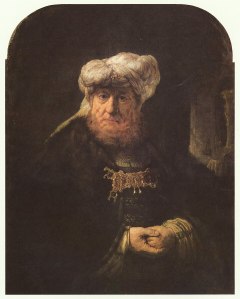
The King Uzziah Stricken with Leprosy, by Rembrandt, 1635.

2 Kings 15: 1-7 King Azariah (Uzziah) of Judah

 1In the twenty-seventh year of King Jeroboam of Israel, King Azariah son of Amaziah of Judah began to reign. 2He was sixteen years old when he began to reign, and he reigned fifty-two years in Jerusalem. His mother’s name was Jecoliah of Jerusalem. 3He did what was right in the sight of the Lord, just as his father Amaziah had done. 4Nevertheless, the high places were not taken away; the people still sacrificed and made offerings on the high places. 5The Lord struck the king so that he had a defiling skin disease to the day of his death and lived in a separate house. Jotham the king’s son was in charge of the palace, governing the people of the land. 6Now the rest of the acts of Azariah and all that he did, are they not written in the Book of the Annals of the Kings of Judah? 7Azariah slept with his ancestors; they buried him with his ancestors in the city of David; his son Jotham succeeded him.

King Azariah, also known as King Uzziah, has a long and successful reign over Judah. Uzziah and Azariah are used interchangeably in scriptures and even in this chapter and Uzziah was likely the name he assumed as king of Judah. His fifty-two-year reign begins in the middle of the forty-one year reign of Jeroboam II and both kings enjoy a period of military success and national resurgence. Azariah’s long and stable reign contrasts with his two predecessors (Joash and Amaziah) who saw the royal and temple treasuries diminished and in their political or military weakness were ultimately assassinated by those who served them. The stability during the time of Azariah in Judah also contrasts sharply with the instability in Samaria after the death of Jeroboam II.

Although 2 Kings does not spend a lot of time on the reign of Azariah/Uzziah his story is greatly expanded in 2 Chronicles 26. According to 2 Chronicles Azariah/Uzziah is a successful military leader who wins victories over Philistia, Ammon and extends Judah’s trade and military influence over the region. 2 Kings 14:22 gives a small window into the king’s success when it notes, “He rebuilt Elath and restored it to Judah after King Amaziah slept with his ancestors.” This small note indicates a large accomplishment only shared by Solomon, Jehoshaphat and Hezekiah. This gave Judah a port on the Mediterranean but also required them to control not only the port but the wilderness between. Alex Israel notes that he controls both major highways between Egypt and Mesopotamia, a lucrative trade route and source of income for the nation. (Israel, 2019, p. 227) 2 Chronicles also notes that King Uzziah strengthened the city walls of Jerusalem and increased the agricultural output of the land by his improvements and built up the army.

2 Kings’ brief account of this king who did what was right in the sight of the LORD ends with the jarring note that the LORD struck the king with ‘a defiling skin disease.’ This skin disease was traditionally rendered leprosy in most translations although we now believe that Hanson’s disease (which is what we call leprosy today) did not exist in the Middle East during this time. Yet, this affliction was normally associated with a judgment from God, and 2 Chronicles tells of the king entering the temple to offer incense, the job of the priests, and being struck with ‘leprosy’ as a punishment. Ultimately in 2 Chronicles the king is punished for overstepping his responsibility, attempting to fulfill both the kingly and the priestly role and ends his life separated from the palace and his responsibilities were assumed by his son Jotham until he died.

It is interesting that 2 Kings does not go into the success and fall of Azariah/Uzziah in the same manner as 2 Chronicles. Perhaps the narrator of 2 Kings doesn’t want to focus on the military success of Azariah in contrast to the lack of success by Joash and Amaziah who are both evaluated as kings who did what was right in the site of the LORD and at the same time does not want to focus on the act that leads to the king’s affliction. Despite the short narration of Azariah’s lengthy reign it is a consequential time as Judah remains stable as Northern Israel becomes chaotic and is one generation from collapse. This is also a time of prophetic voices and Isaiah (first Isaiah), Amos, Hosea, and Micah all give voice to this time in Israel and Judah.

2 Kings 15: 8-12 The Brief Reign of Zechariah King of Israel and the End of the Jehu Dynasty

  8 In the thirty-eighth year of King Azariah of Judah, Zechariah son of Jeroboam reigned over Israel in Samaria six months. 9 He did what was evil in the sight of the Lord, as his ancestors had done. He did not depart from the sins of Jeroboam son of Nebat that he caused Israel to sin. 10 Shallum son of Jabesh conspired against him and struck him down in Ibleam and killed him and reigned in place of him. 11 Now the rest of the deeds of Zechariah are written in the Book of the Annals of the Kings of Israel. 12 This was the promise of the Lord that he gave to Jehu, “Your sons shall sit on the throne of Israel to the fourth generation.” And so it happened.

The message of the LORD to Jehu after the destruction of the Omri dynasty indicated that his line would continue for four generations (2 Kings 10:30) and now after the death of Jeroboam II, the fourth generation, the Jehu dynasty collapses six months later. Jehu’s line ruled in Samaria for ninety-two years and it was enjoying a period of success under Jeroboam II, but the public murder of Zechariah ignites a power for struggle that will be violent and ultimately weaken Northern Israel as the Assyrian empire under Tiglath-Pileser III ascends. Zechariah is the first of a group of inconsequential kings in Samaria whose cumulative impact is very consequential in weakening Israel in a dangerous world.

2 Kings 15: 13-31 A Tumultuous Period in Israel

  13Shallum son of Jabesh began to reign in the thirty-ninth year of King Uzziah of Judah; he reigned one month in Samaria. 14Then Menahem son of Gadi came up from Tirzah and came to Samaria; he struck down Shallum son of Jabesh in Samaria and killed him; he reigned in place of him. 15Now the rest of the deeds of Shallum, including the conspiracy that he made, are written in the Book of the Annals of the Kings of Israel. 16At that time Menahem sacked Tiphsah, all who were in it and its territory from Tirzah on; because they did not open it to him, he sacked it. He ripped open all the pregnant women in it.

  17
In the thirty-ninth year of King Azariah of Judah, Menahem son of Gadi began to reign over Israel; he reigned ten years in Samaria. 18He did what was evil in the sight of the Lord; he did not depart all his days from any of the sins of Jeroboam son of Nebat that he caused Israel to sin. 19King Pul of Assyria came against the land; Menahem gave Pul a thousand talents of silver, so that he might help him confirm his hold on the royal power. 20Menahem exacted the silver from Israel, that is, from all the wealthy, fifty shekels of silver from each one, to give to the king of Assyria. So the king of Assyria turned back and did not stay there in the land. 21Now the rest of the deeds of Menahem and all that he did, are they not written in the Book of the Annals of the Kings of Israel? 22Menahem slept with his ancestors, and his son Pekahiah succeeded him.

  23
In the fiftieth year of King Azariah of Judah, Pekahiah son of Menahem began to reign over Israel in Samaria; he reigned two years. 24He did what was evil in the sight of the Lord; he did not turn away from the sins of Jeroboam son of Nebat that he caused Israel to sin. 25Pekah son of Remaliah, his captain, conspired against him with fifty of the Gileadites and attacked him in Samaria, in the citadel of the palace along with Argob and Arieh; he killed him and reigned in place of him. 26Now the rest of the deeds of Pekahiah and all that he did are written in the Book of the Annals of the Kings of Israel.

  27
In the fifty-second year of King Azariah of Judah, Pekah son of Remaliah began to reign over Israel in Samaria; he reigned twenty years. 28He did what was evil in the sight of the Lord; he did not depart from the sins of Jeroboam son of Nebat that he caused Israel to sin.
  29
In the days of King Pekah of Israel, King Tiglath-pileser of Assyria came and captured Ijon, Abel-beth-maacah, Janoah, Kedesh, Hazor, Gilead, and Galilee, all the land of Naphtali, and he carried the people captive to Assyria. 30Then Hoshea son of Elah made a conspiracy against Pekah son of Remaliah, attacked him, and killed him; he reigned in place of him, in the twentieth year of Jotham son of Uzziah. 31Now the rest of the acts of Pekah and all that he did are written in the Book of the Annals of the Kings of Israel.

Shallum son of Jabesh, Menahem son of Gadi, Pekahiah son of Menahem and Peka son of Remaliah all struggle for power during the stable reign of Azariah/Uzziah and (during Pekah’s reign in Samaria) the transition to Azariah’s son Jothan. Shallum reigns only for a month before he is overthrown by Menahem. Menahem assumes power in a violent manner and his description of sacking Tiphsah and tearing open the wombs of pregnant women describes him like the worst oppressors of Israel[1] and it is the violent ones who have ascended to power. Menahem may reign for ten years in Samaria but the large tribute payment[2] to Assyria under Tiglath-Pileser III[3] that he extracts from the gibbor hahayil (NRSVue ‘wealthy’)[4] likely means he is ruling with the political and even possibly military support of Assyria. When he dies his son is only to reign for two years. There are likely factions looking to align the nation with Assyria or Egypt as Hosea states:

Ephraim has become like a dove,
silly and without sense;
they call upon Egypt, they go to Assyria. (Hosea 7:11)

This is conjecture, but if Peka son of Remaliah ended the alliance with Assyria it would make sense of Tiglath-Pileser III seizing territory as well as dragging the captured people into exile. Records from Assyria indicate that there was a campaign against Israel in 733-732 BC and they took 13,520 people into exile. (Israel, 2019, p. 238) The Assyrian were known for taking exiles and displacing them to where they are totally dependent on Assyria and forced to blend into the larger Assyrian world. (Cogan, 1988, p. 177) The enemy has been within Samaria with this string of strongmen seizing power but now they face a much larger threat which is penetrating their borders and capturing the people and Israel appears powerless to resist.

2 Kings 15: 32-38 King Jothan of Judah


  32
In the second year of King Pekah son of Remaliah of Israel, King Jotham son of Uzziah of Judah began to reign. 33He was twenty-five years old when he began to reign, and he reigned sixteen years in Jerusalem. His mother’s name was Jerusha daughter of Zadok. 34He did what was right in the sight of the Lord, just as his father Uzziah had done. 35Nevertheless, the high places were not removed; the people still sacrificed and made offerings on the high places. He built the upper gate of the house of the Lord. 36Now the rest of the acts of Jotham and all that he did, are they not written in the Book of the Annals of the Kings of Judah? 37In those days the Lord began to send King Rezin of Aram and Pekah son of Remaliah against Judah. 38Jotham slept with his ancestors and was buried with his ancestors in the city of David, his ancestor; his son Ahaz succeeded him.

In contrast to the bloody and dangerous instability of Samaria, Judah continues to function under another king of the Davidic line who does what is right in the sight of the LORD. 2 Chronicles 27 indicates that Jothan continues to build up the walls and defenses of Judah, and the king is likely aware of the growing threat to the north in Assyria. Again, 2 Chronicles portrays Jothan as a militarily successful king and in 2 Kings we have indication of both Aram and Samaria/Northern Israel attacking Judah (possibly as agents of Assyria) yet we do not have any indication that Judah is losing territory. Resin and Pekah may be attempting to raid for resources in their own struggles against the rising might of Assyria, but for the moment the threat to stable Judah is significantly less than it appears to be for Northern Israel.


[1] See for example Elisha’s description of what Hazael will do in 2 Kings 8:12, the accusations against Edom in Amos 1:13, or the judgement oracle of Hosea 13:16.

[2] Roughly seventy five thousand pounds of silver.

[3] King Pul is a nickname in late sources for Tiglath-Pileser III, and the use of this title in 2 Kings indicated the familiarity of the narrator with this leader of Assyria. (Israel, 2019, p. 238)

[4] Gibbor hahayil is often rendered mighty ones and often this was assumed to have military connotations. This term is common in the book of Judges, but it also can refer to landowners like Boaz in the book of Ruth. Wealthy may be the proper translation, but with Menahem being a warrior leader, it may also indicate something like warlords who are maintaining power beneath him.

2 Kings 13 The Death of Elisha, The Reigns of Jehoahaz and Jehoash of Israel, and the Conflict with Aram

The miracle at the grave of Elisha. (Jan Nagel, 1596)

2 Kings 13:1-13 The Reign of Jehoahaz and Jehoash (Joash) of Israel

 1In the twenty-third year of King Joash son of Ahaziah of Judah, Jehoahaz son of Jehu began to reign over Israel in Samaria; he reigned seventeen years. 2He did what was evil in the sight of the LORD and followed the sins of Jeroboam son of Nebat that he caused Israel to sin; he did not depart from them. 3The anger of the LORD was kindled against Israel, so he gave them repeatedly into the hand of King Hazael of Aram, then into the hand of Ben-hadad son of Hazael. 4But Jehoahaz entreated the LORD, and the LORD heeded him, for he saw the oppression of Israel, how the king of Aram oppressed them. 5Therefore the LORD gave Israel a savior, so they escaped from the hand of the Arameans, and the people of Israel lived in their homes as formerly. 6Nevertheless, they did not depart from the sins of the house of Jeroboam that he caused Israel to sin but walked in them; the sacred pole also remained in Samaria. 7So Jehoahaz was left with an army of not more than fifty horsemen, ten chariots, and ten thousand footmen, for the king of Aram had destroyed them and made them like the dust at threshing. 8Now the rest of the acts of Jehoahaz and all that he did, including his might, are they not written in the Book of the Annals of the Kings of Israel? 9So Jehoahaz slept with his ancestors, and they buried him in Samaria; then his son Joash succeeded him.
  10In the thirty-seventh year of King Joash of Judah, Jehoash son of Jehoahaz began to reign over Israel in Samaria; he reigned sixteen years. 11He also did what was evil in the sight of the LORD; he did not depart from all the sins of Jeroboam son of Nebat that he caused Israel to sin, but he walked in them. 12Now the rest of the acts of Joash and all that he did, as well as the might with which he fought against King Amaziah of Judah, are they not written in the Book of the Annals of the Kings of Israel? 13So Joash slept with his ancestors, and Jeroboam sat upon his throne; Joash was buried in Samaria with the kings of Israel.

One of the struggles many readers of 2 Kings have in this, and the surrounding chapters is that the names are often reused by different leaders. In this chapter alone we have a King Jehoash/Joash of both Judah and Israel as well as King Hazael naming his son Ben-hadad, the name of the king he murdered in Aram. It is also worth noting briefly that the math for the time period of the reigns of these two kings in Samaria do not add up: If Jehoahaz begins his reign in the twenty-third year of King Joash of Judah and his son King Jehoash begins his reign in the thirty-seventh year of King Joash of Judah he would reign fourteen years, not seventeen as indicated by 2 Kings. There can be reasons, like a co-regency for three years, that can cause the math to work out. I’m not going to dwell on this because it is ultimately not the focus of the narrative, but it is worth noting.

Jehoahaz and Jehoash of Samaria are descendants of Jehu who in his bloody revolution wiped out the worship of Baal in Samaria but, in the view of 2 Kings, Jehu and his descendants did not go far enough to return Northern Israel to the right worship of God. The sins of Jeroboam son of Nebat are the golden calves which the first king of Northern Israel placed in shrines at Bethel and Dan (1 Kings 12: 25-33) to represent the God of Israel and to prevent the people of Northern Israel from returning to Jerusalem to worship in Solomon’s temple. There is also an Asherah (NRSVue sacred pole) in Samaria. The term refers both to the goddess Asherah and the sacred pole utilized in her worship. These worship sites and practices anger the God of Israel and are a cause for the continued victories of Aram over the kings of Israel in the view of the narrator.

Hazael and later his son Ben-hadad of Aram continue to gain territory from Israel and to humiliate the kings of Israel militarily. King Jehoahaz being left with an army of fifty horsemen, ten chariots, and ten thousand footman points to an army whose maneuver units (horsemen and chariots) have been decimated. Ten thousand footmen is a significant force, but they are vulnerable to the much faster moving horse mounted or pulled forces. Likely this transformed the army of Jehoahaz into a defensive force rather than one that has the speed and maneuverability to be an effective raiding and attacking force. Yet, Israel was never to be a military power and Jehoahaz finally appeals to the LORD from the oppression of the people and the LORD hears.

The narration of this flow where the kings did what was evil in the sight of the LORD causing the LORD to be angry with the people but then crying out to the LORD and the LORD providing deliverance is the basic pattern of the book of Judges. Here King Jehoahaz entreats the LORD, the LORD sees the oppression of the people and sends a deliverer/savior. Yet, this narration is unusual because it never identifies the deliverer. As Choon-Leong Seow can state:

Whereas the “savior” is typically named in the analogous depictions from Israel’s early history (it was typically the next ruler), however, he is not explicitly identified here (v.5). Scholars have variously suggested that the allusion is to a third-party aggressor whose pressure on the Arameans brought a reprieve for Israel (such as the Assyrian king Adad-nirari III or even Zakkur of Hamath), another Israelite king like Joash or Jeroboam (II), or Elisha. (NIB III: 236)

Although there are geopolitical events, like the rise of Assyria, which weaken the Arameans I do think that the likely candidates for the text are King Jehoash or the Prophet Elisha (see below) since Jehoash will recapture the land lost to the Arameans after his meeting with the dying Elisha.

2 Kings 13: 14-20 The Death of Elisha

  14Now when Elisha had fallen sick with the illness of which he was to die, King Joash of Israel went down to him and wept before him, crying, “My father, my father! The chariots of Israel and its horsemen!” 15Elisha said to him, “Take a bow and arrows,” so he took a bow and arrows. 16Then he said to the king of Israel, “Draw the bow,” and he drew it. Elisha laid his hands on the king’s hands. 17Then he said, “Open the window eastward,” and he opened it. Elisha said, “Shoot,” and he shot. Then he said, “The LORD’s arrow of victory, the arrow of victory over Aram! For you shall fight the Arameans in Aphek until you have made an end of them.” 18He continued, “Take the arrows,” and he took them. He said to the king of Israel, “Strike the ground with them”; he struck three times and stopped. 19Then the man of God was angry with him and said, “You should have struck five or six times; then you would have struck down Aram until you had made an end of it, but now you will strike down Aram only three times.”
  20
So Elisha died, and they buried him. Now bands of Moabites used to invade the land in the spring of the year. 21As a man was being buried, a marauding band was seen and the man was thrown into the grave of Elisha; as soon as the man touched the bones of Elisha, he came to life and stood on his feet.

Elisha’s approximately fifty-year ministry comes to an end as he nears his death, yet the text records two final miraculous actions to the prophet. The first involves the deliverance of Israel from its oppression under the Arameans. King Joash/Jehoash of Israel comes to the prophet’s deathbed mourning. It is conceivable that the king has come to seek the prophet’s guidance as he marches to war with Aram. As Mordechai Cogan and Hayim Tadmor note,

Prophets were regularly consulted prior to the departure of the army to battle (cf. e.g. 1 Kgs 22); Elisha even accompanied Jehoram on the Moabite campaign (see above 3:11) Might not Joash have sought the advice of the dying Elisha, just as Israel was setting off to attack Aram? (Cogan, 1988, p. 150)

It is also worth noting that Elisha has been a thorn in the Aramean side before by informing the king of Israel where the Aramean forces would be. (2 Kings 6: 8-23) For the narrator of 2 Kings prophets often have more power than kings to deliver the people.

The phrase, “The chariots of Israel and its horsemen!” first appeared at the ascension of Elijah into heaven and its presence here may link Elisha with his famous predecessor. It appears visually in 2 Kings 6: 8-23 when the eyes of the servant of Elisha is opened to see the horses and chariots of fire which surrounded and protected Elisha and the sons of the prophets. Yet here it may also allude to the reality that Israel no longer has horsemen and chariots after their humiliation by the Arameans. Elisha’s presence may be the necessary replacement for the military inadequacy of King Joash/Jehoash of Israel’s forces and now the prophet is on his deathbed.

Elisha does two sign acts with a bow and arrow.[1] First an arrow is drawn and shot out the east facing window which becomes the LORD’s arrow of victory over Aram. Then the king is instructed to take the arrows and strike the ground with them. The prophet is angered that the king only strikes the ground three times which portends three victories over Aram rather than five or six which would have eliminated Aram as a threat, yet in the text the instructions of the prophet do not indicate the expectation of striking the ground multiple times. Yet, the ways of prophets are often inscrutable to those who seek their counsel and the words of the prophet give immediate hope to a beleaguered people and their king.

After Elisha dies and is buried we hear of another conflict involving the Moabites. This may be a story from a later time, but it also may occur in the continued conflict between Aram and Israel where Moabites take advantage of the instability to raid. Ultimately the conflict is not the primary point of the narrative. Rather, the continuing power of the prophet Elisha is whose bones are enough to bring a dead man back to life are the focal point of the story. Elisha had once brought the son of the Shunammite woman back to life and now even in death his bones continue to bring life in a time of death.

2 Kings 13: 22-25 The Conflict Between Israel and Aram

  22 Now King Hazael of Aram oppressed Israel all the days of Jehoahaz. 23 But the LORD was gracious to them and had compassion on them; he turned toward them because of his covenant with Abraham, Isaac, and Jacob and would not destroy them, nor has he banished them from his presence until now.
  24 When King Hazael of Aram died, his son Ben-hadad succeeded him. 25 Then Jehoash son of Jehoahaz took again from Ben-hadad son of Hazael the towns that he had taken from his father Jehoahaz in war. Three times Joash defeated him and recovered the towns of Israel.

The narrator of 2 Kings views the occurrences in the story of Israel and Judah through a theological lens where the LORD the God of Israel is responsible for both the good and the bad that occurs to the people. Even with the actions of Israel that cause the LORD to be angry the LORD still responds to their entreaties in a gracious manner because of the promises made to Abraham, Isaac, and Jacob. The combination of the story of Elisha’s action with the defeat of Aram by Jehoash son of Jehoahaz illustrate the faithfulness and patience of God with the people. Yet, the narrator of 2 Kings knows that this patience of God will not last forever, and the story is told from the perspective of the exile of Northern Israel by Assyria and Judah by Babylon, hence the ominous “until now” in verse 23.

From a historical perspective this is a time where the Aramean threat is tempered by the rise of Assyria. Northern Israel is still a militarily vulnerable kingdom whose practices continue to, from the perspective of 2 Kings, anger the LORD their God. The prophet Elisha who had been a deliverer of the people in many times is now dead and the promised four generations of Jehu on the throne in Samaria has now halfway to its completion. There are storms brewing to the north of Israel and within the kingdom of Samaria that will break forth in the coming years and chapters.


[1] In Ezekiel 21:21 shaking arrows is used by the Babylonians as a means of divination, but with the prophets of Israel and Judah these are sign acts which enhance the prophet’s words.

2 Kings 10 The Elimination of the Sons of Ahab and the Worshippers of Baal

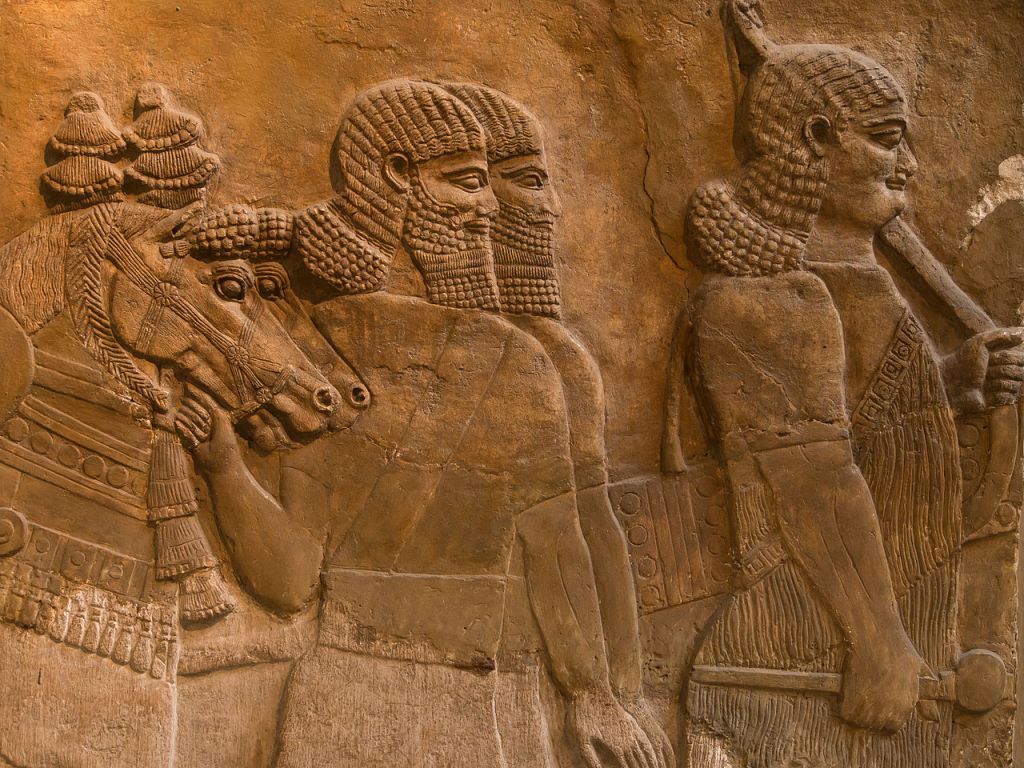
Part of the gift-bearing delegation of King Jehu, Black Obelisk, 841–840 BCE.

2 Kings 10: 1-14

  1 Now Ahab had seventy sons in Samaria. So Jehu wrote letters and sent them to Samaria, to the rulers of the city, to the elders, and to the guardians of the sons of Ahab, saying, 2 “Since your master’s sons are with you and you have at your disposal chariots and horses, a fortified city, and weapons, 3 select the son of your master who is the best qualified, set him on his father’s throne, and fight for your master’s house.” 4 But they were utterly terrified and said, “Look, two kings could not withstand him; how then can we stand?” 5 So the steward of the palace and the governor of the city, along with the elders and the guardians, sent word to Jehu, “We are your servants; we will do anything you say. We will not make anyone king; do whatever you think right.” 6 Then he wrote them a second letter, saying, “If you are on my side and if you are ready to obey me, take the heads of your master’s sons and come to me at Jezreel tomorrow at this time.” Now the king’s sons, seventy persons, were with the leaders of the city, who were charged with their upbringing. 7 When the letter reached them, they took the king’s sons and killed them, seventy persons; they put their heads in baskets and sent them to him at Jezreel. 8 When the messenger came and told him, “They have brought the heads of the king’s sons,” he said, “Lay them in two heaps at the entrance of the gate until the morning.” 9 Then in the morning when he went out, he stood and said to all the people, “You are innocent. It was I who conspired against my master and killed him, but who struck down all these? 10 Know, then, that there shall fall to the earth nothing of the word of the Lord that the Lord spoke concerning the house of Ahab, for the Lord has done what he said through his servant Elijah.” 11 So Jehu killed all who were left of the house of Ahab in Jezreel, all his leaders, close friends, and priests, until he left him no survivor.
  12 Then he set out and went to Samaria. On the way, when he was at Beth-eked of the Shepherds, 13 Jehu met relatives of King Ahaziah of Judah and said, “Who are you?” They answered, “We are kin of Ahaziah; we have come down to visit the royal princes and the sons of the queen mother.” 14 He said, “Take them alive.” They took them alive and slaughtered them at the pit of Beth-eked, forty-two in all; he spared none of them.

There is no avoiding the violence of this text. Jehu and those around him are blunt instruments removing the cancer of both the Omri dynasty and the cancer of Baalism from Israel. Back when I was working through the book of Esther, I did a short reflection on Violence and the Bible, but I still think most modern readers and interpreters find the bloody transition from the heirs of king Ahab to Jehu disconcerting.

The world of the bible was violent as was the ancient world that it was set within. It may not be quite the grimdark world of some recent fantasy made popular in George R.R. Martin’s Game of Thrones, since the world of the bible does assume there is a higher moral power involved in it, but as far as the shocking violence I think this, and the previous chapter, compete with almost anything written by modern authors. There were no bloodless coups in the ancient world. For the necessary transition to happen in both Israel and Judah drastic actions are required (in the view of 2 Kings).

Alex Israel in his writing on Jehu’s overthrown of the Omri dynasty believes that the detail provided is a critique of Jehu’s violence:

Kings is no stranger to military coups, yet not one of these mutinies revel in the explicit gore and detailed descriptions of murder that we find with Jehu. The narrative’s detail communicates Jehu’s barbarism. (Israel, 2019, p. 168)

Although Hosea 1:4 does view Jehu’s violence as excessive, I don’t believe that the narrator of 2 Kings does. Even though the other mention of seventy sons[1] being killed belongs to Abimelech in Judges 9, a story that has several connections with 2 Kings 10, Jehu’s actions are viewed in a positive light in 2 Kings. The violence does not all occur at Jehu’s hands as we will see as the narrative progresses, but Jehu’s evaluation is not tainted by his violent methods in overthrowing the Omri dynasty and the practices of Baal worship but instead that Jehu didn’t go far enough in removing the false worship practices from Northern Israel.

Jehu’s actions at the beginning of this chapter challenge the people with power in Samaria to choose one of the heirs of Ahab to rally behind and to prepare to meet him in battle. Jehu’s rule will never be secure as long as there is another line that can make a claim on the throne, but he does grant the leadership in Samaria the opportunity to make a fight for these heirs of Ahab. We don’t know how the line of Ahab was viewed within Samaria, and the text only mentions the terror of the leaders about this military commander’s ability to conquer whatever resistance they offer. These leaders entreat Jehu for peace and Jehu responds with the command to bring the heads of the seventy sons of Ahab. These leaders of will also have blood on their hands at the conclusion of the coup, but it may not have been necessary for them to directly participate in the bloodshed. As Choon-Leong Seow states on the Hebrew wordplay:

The word “heads” (ra’sim) is ambiguous, for it could refer literally the anatomical heads or figuratively to leaders. The officials assume the literal meaning and decapitate the remaining descendants of Ahab. (NIB III: 223)

There was a time when the leaders could have claimed innocence in this bloody transition since it was Jehu who killed the kings of Israel and Judah as well as Jezebel the queen mother, but now with the seventy heads of the sons of Ahab in baskets they share in this overthrow. Their hands are just as bloody as Jehu’s. Yet, for the narrator of 2 Kings, this bloody event is the fulfillment of the words of Elijah spoken against Jehu in Jezreel. (1 Kings 21)

Finally in this section there is the slaughter of the relatives of Ahaziah. These travelers from Judah seem completely unaware of the situation they walked into as they travel to visit Jezebel and the royal princes of Israel. These kin of Ahaziah are linked by marriage to Ahab’s line and in slaughtering these relatives Jehu weakens the remnants of the house of Ahaziah in Jerusalem. As we will see in the following chapter the remaining child of Ahab, his daughter Athaliah, will violently attempt to hold onto power in Jerusalem.  

2 Kings 10: 15-36

  15When he left there, he met Jehonadab son of Rechab coming to meet him; he greeted him and said to him, “Is your heart as true to mine as mine is to yours?” Jehonadab answered, “It is.” Jehu said, “If it is, give me your hand.” So he gave him his hand. Jehu took him up with him into the chariot. 16He said, “Come with me and see my zeal for the Lord.” So he had him ride in his chariot. 17When he came to Samaria, he killed all who were left to Ahab in Samaria, until he had wiped them out according to the word of the Lord that he spoke to Elijah.

  18
Then Jehu assembled all the people and said to them, “Ahab offered Baal small service, but Jehu will offer much more. 19Now therefore summon to me all the prophets of Baal, all his servants, and all his priests; let none be missing, for I have a great sacrifice to offer to Baal; whoever is missing shall not live.” But Jehu was acting with cunning in order to destroy the servants of Baal. 20Jehu decreed, “Sanctify a solemn assembly for Baal.” So they proclaimed it. 21Jehu sent word throughout all Israel; all the servants of Baal came, so that there was no one left who did not come. They entered the temple of Baal until the temple of Baal was filled from wall to wall. 22He said to the keeper of the wardrobe, “Bring out the vestments for all the servants of Baal.” So he brought out the vestments for them. 23Then Jehu entered the temple of Baal with Jehonadab son of Rechab; he said to the servants of Baal, “Search and see that there is no servant of the Lord here among you but only servants of Baal.” 24Then they proceeded to offer sacrifices and burnt offerings.
  Now Jehu had stationed eighty men outside, saying, “Whoever allows any of those to escape whom I deliver into your hands shall forfeit his life.” 25
As soon as he had finished presenting the burnt offering, Jehu said to the guards and to the officers, “Come in and kill them; let no one escape.” So they put them to the sword. The guards and the officers threw them out and then went into the citadel of the temple of Baal. 26They brought out the pillar that was in the temple of Baal and burned it. 27Then they demolished the pillar of Baal and destroyed the temple of Baal and made it a latrine to this day.
  28
Thus Jehu wiped out Baal from Israel. 29But Jehu did not turn aside from the sins of Jeroboam son of Nebat that he caused Israel to commit: the golden calves that were in Bethel and in Dan. 30The Lord said to Jehu, “Because you have done well in carrying out what I consider right and in accordance with all that was in my heart have dealt with the house of Ahab, your sons of the fourth generation shall sit on the throne of Israel.” 31But Jehu was not careful to follow the law of the Lord the God of Israel with all his heart; he did not turn from the sins of Jeroboam that he caused Israel to commit.

  32
In those days the Lord began to trim off parts of Israel. Hazael defeated them throughout the territory of Israel: 33from the Jordan eastward, all the land of Gilead, the Gadites, the Reubenites, and the Manassites, from Aroer, which is by the Wadi Arnon, that is, Gilead and Bashan. 34Now the rest of the acts of Jehu, all that he did, and all his power, are they not written in the Book of the Annals of the Kings of Israel? 35So Jehu slept with his ancestors, and they buried him in Samaria. His son Jehoahaz succeeded him. 36The time that Jehu reigned over Israel in Samaria was twenty-eight years.

Jehu now meets Jehonadab son of Rachab. The two men are loyal to one another but also share a zeal for the LORD. The descendants of Jehonadab son of Rechab will be the Rechabites that the prophet Jeremiah encounters in Jerusalem who do not drink wine or grow vineyards in obedience to their ancestor’s way. (Jeremiah 35) Now this ancestor of the Rechabites and Jehu move with cunning against the entrenched worship of Baal in Samaria.

In the ancient world the political and religious realms are interconnected, and it would not be surprising for a new ruler to pay for a sacrifice to the gods worshipped in the land. Jehu’s religious connections may not be well known in Samaria, and the prospect of having the new king as a patron would be enticing to the cult of Baal in the land. Yet, Jehu is acting with ‘cunning.’[2] Many modern readers may be confused by the dishonesty of Jehu’s actions, but 2 Kings views these actions positively. After attempting to ensure that only worshippers of Baal are present Jehu orders his guards to slaughter those participating and not to allow any to escape. Jehu in this action eliminates the worship of Baal during his reign and in the view of 2 Kings this causes God to grant him the longest running dynasty in the Northern Kingdom.

Yet the final evaluation of Jehu is negative not because of his violence or dishonesty but because he didn’t go far enough. He allowed the shrines at Bethel and Dan to remain. One the one hand it would be difficult for Jehu to remain in control in Samaria if people had to return to Jerusalem to worship, but in the view of the narrator of 2 Kings this is evidence of idolatry. Northern Israel is slowly losing control of its border to Hazael’s forces out of Damascus, but Jehu and his sons will maintain control in Samaria for four generations.


[1] Seventy is one of the ‘representative’ numbers in Hebrew which may be literal or may represent a large number. Typically multiples of three, seven, and twelve have a connotation of completeness in Hebrew thought.

[2] The Hebrew word for cunning is ‘aqob. This is also the name Jacob. Jacob’s original name and his character in Genesis is that of one who acts with cunning. The trickery here by Jehu is not evaluated in a negative light.

2 Kings 5 Elisha Heals Naaman and Gehazi’s Poor Choice

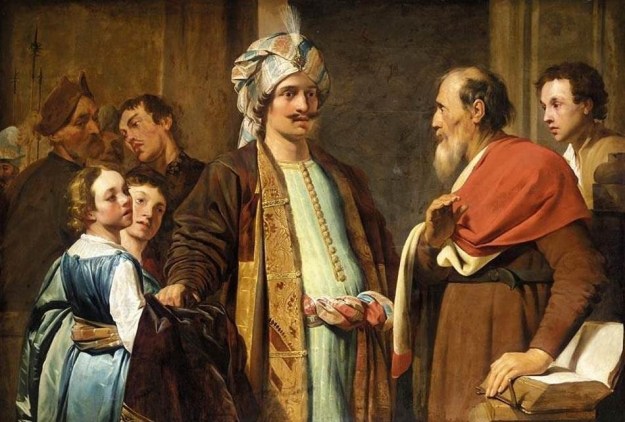
Pieter de Grebber, Elisha Refusing Gifts From Naaman (1630) https://www.theleidencollection.com/artwork/elisha-refusing-naamans-gifts/

2 Kings 5: 1-19a 

1Naaman, commander of the army of the king of Aram, was a great man and in high favor with his master because by him the Lord had given victory to Aram. The man, though a mighty warrior, suffered from a skin disease. 2Now the Arameans on one of their raids had taken a young girl captive from the land of Israel, and she served Naaman’s wife. 3She said to her mistress, “If only my lord were with the prophet who is in Samaria! He would cure him of his skin disease.” 4So Naaman went in and told his lord just what the girl from the land of Israel had said. 5And the king of Aram said, “Go, then, and I will send along a letter to the king of Israel.”
  He went, taking with him ten talents of silver, six thousand shekels of gold, and ten sets of garments. 6
He brought the letter to the king of Israel, which read, “When this letter reaches you, know that I have sent to you my servant Naaman, that you may cure him of his skin disease.” 7When the king of Israel read the letter, he tore his clothes and said, “Am I God, to give death or life, that this man sends word to me to cure a man of his skin disease? Just look and see how he is trying to pick a quarrel with me.”
  8
But when Elisha the man of God heard that the king of Israel had torn his clothes, he sent a message to the king, “Why have you torn your clothes? Let him come to me, that he may learn that there is a prophet in Israel.” 9So Naaman came with his horses and chariots and halted at the entrance of Elisha’s house. 10Elisha sent a messenger to him, saying, “Go, wash in the Jordan seven times, and your flesh shall be restored, and you shall be clean.” 11But Naaman became angry and went away, saying, “I thought that for me he would surely come out and stand and call on the name of the LORD his God and would wave his hand over the spot and cure the skin disease! 12Are not Abana and Pharpar, the rivers of Damascus, better than all the waters of Israel? Could I not wash in them and be clean?” He turned and went away in a rage. 13But his servants approached and said to him, “Father, if the prophet had commanded you to do something difficult, would you not have done it? How much more, when all he said to you was, ‘Wash, and be clean’?” 14So he went down and immersed himself seven times in the Jordan, according to the word of the man of God; his flesh was restored like the flesh of a young boy, and he was clean.
  15
Then he returned to the man of God, he and all his company; he came and stood before him and said, “Now I know that there is no God in all the earth except in Israel; please accept a present from your servant.” 16But he said, “As the LORD lives, whom I serve, I will accept nothing!” He urged him to accept, but he refused. 17Then Naaman said, “If not, please let two mule loads of earth be given to your servant, for your servant will no longer offer burnt offering or sacrifice to any god except the Lord. 18But may the LORD pardon your servant on one count: when my master goes into the house of Rimmon to worship there, leaning on my arm, and I bow down in the house of Rimmon, when I do bow down in the house of Rimmon, may the LORD pardon your servant on this one count.” 19He said to him, “Go in peace.”

The healing of Naaman, along with Elijah’s ascent in the whirlwind, are probably the two best-known and most frequently used stories from 2 Kings in the life of the church. This story, along with Elijah’s provision of meal and oil for the widow of Zarephath, is utilized in Luke 4:27 as an explanation for the expansiveness of Jesus’ ministry, but it is also paired with Jesus’ healing of lepers in the gospels. Naaman is both the victorious mighty warrior who occupies a privileged position with the king of Aram and has servants and slaves along with the access to considerable wealth and power, but in Israel he is also a Gentile, an unclean one, and an oppressor. The story illustrates the fundamental differences between the world envisioned by the king of Aram and Naaman at the beginning of the story and the prophet Elisha when he enters in the middle of the story.

The position of Naaman, in the view of 2 Kings, is a result of the LORD the God of Israel granting him victory leading the Arameans. On the one hand this provides an explanation for the defeat of Israel by a foreign power, the defeat is a judgment on the unfaithfulness of Samaria. On the other hand, it makes the mighty warrior subject, unknowingly at the beginning of the story, to the LORD the God of Israel. Even a captive young woman from Israel knows what this mighty warrior cannot, that the hope for healing resides in Samaria. This young woman who is a captive and the mighty man who is a leader of armies may be on opposite sides of the power differential but in the story they are linked. Captured slaves often have an unfavorable view of their masters, yet in Naaman throughout the story we see that this mighty man is both respected enough by his servants for them to speak truthfully and compassionately to him and Naaman as their master listens. The commander of warriors who can deliver victories depends upon the knowledge willingly shared by a captured young woman residing in his household.

The skin disease which has been traditionally translated as leprosy is probably not what we today categorize as leprosy (or Hansen’s disease) but it was something that ancient cultures took very seriously. Leviticus 13-14 deals with the priestly role in the diagnosis, the social implications for a person diagnosed with this skin disorder and the method that they can also be reintegrated into the community once they are healed. The seriousness of the disease can be demonstrated by the incredible amount of wealth (ten talents of silver, six thousand shekels of gold, and ten sets of garments)[1] which the king of Aram sends to the king of Israel to bring about the healing of his favored commander.

In the ancient world there was no concept of separation of religious and state powers. For most ancient kings, even in Israel, there are religious figures including prophets in the royal court. The prophet Nathan was involved in the court of king David, and earlier in the Omri dynasty we saw the conflict between the prophets who spoke favorably to king Ahab and Micaiah who was a faithful prophet of the LORD but not in royal favor. As Alex Israel notes about the contrasting views of prophets between the kings of Aram and Israel:

The king of Aram was incapable of imagining a scenario in which the prophet would not be fundamentally subordinate to the king, and so he sought the prophet by means of the latter. By contrast, the king of Israel couldn’t conceive a situation in which the prophet would be responsive to his control, and so he failed to entertain the prospect of appealing to Elisha! (Israel, 2019, p. 98)

The king of Aram views the king of Israel as his subordinate who he can command, but Elisha does not answer to the king of Israel. Yet, Elisha does hear of the king’s distress and instructs him to send Naaman to him.

Naaman has probably encountered other healers and prophets in Damascus who attempted to heal his skin disease, and he has ideas of how that process should look for a person of his station. As a person of high status, he anticipated personal attention from the prophet. His status as a mighty warrior and commander of the armies of Aram have allowed him to be a person who is able to fulfill their request, but now he finds that this status means nothing before the prophet, and he is reduced to a “supplicant who comes to the healer as a leper.” (Brueggemann, 2000, p. 334) Yet, as previously we saw with the young woman from Israel, Naaman is a master who his servants are willing to speak to in an honest and compassionate way. Once Naaman has completed his complaint about the command delivered by an emissary to wash in the Jordan, his servants are able to convince him that the prophet has not asked a hard thing, and it is in Naaman’s interest to attempt this novel cure.

The washing in the Jordan results in Naaman’s skin becoming like a young boy. The description of Naaman’s skin utilizing the masculine form of the words used to describe the young girl at the beginning of the story now link the two together. In some way Naaman is now like this enslaved young woman even though they occupy vastly different places in the social hierarchy. Both stand in a place of dependency before God and Naaman has not only learned that there is a prophet in Samaria, but that there is no God in all the earth except in Israel.

After the healing Naaman stands, with all his company before the prophet Elisha. Naaman attempts to offer payment, but Elisha swears that he will take no payment.[2] Naaman then makes two requests when payment continues to be refused. First Naaman requests to take two mule loads of earth. Naaman likely believes that the God of Israel is tied to the land of Israel and bringing the earth will allow him to build an altar or worship space where he can access this God whom he has discovered. Secondly, he requests that in his state functions that God would not hold it against him when he escorts his master into the worship space of Rimmon, the god of Damascus. Elisha does not judge Naaman for these requests and instructs him to depart in shalom.

2 Kings 5: 19b-27

  But when Naaman had gone from him a short distance, 20Gehazi, the servant of Elisha the man of God, thought, “My master has let that Aramean Naaman off too lightly by not accepting from him what he offered. As the LORD lives, I will run after him and get something from him.” 21So Gehazi went after Naaman. When Naaman saw someone running after him, he jumped down from the chariot to meet him and said, “Is everything all right?” 22He replied, “Yes, but my master has sent me to say, ‘Two members of a company of prophets have just come to me from the hill country of Ephraim; please give them a talent of silver and two changes of clothing.’ ” 23Naaman said, “Please accept two talents.” He urged him and tied up two talents of silver in two bags, with two changes of clothing, and gave them to two of his servants, who carried them in front of Gehazi. 24When he came to the citadel, he took the bags from them and stored them inside; he dismissed the men, and they left.
  25
He went in and stood before his master, and Elisha said to him, “Where have you been, Gehazi?” He answered, “Your servant has not gone anywhere at all.” 26But he said to him, “Did I not go with you in spirit when someone left his chariot to meet you? Is this a time to accept silver and to accept clothing, olive orchards and vineyards, sheep and oxen, and male and female slaves? 27Therefore the skin disease of Naaman shall cling to you and to your descendants forever.” So he left his presence diseased, as white as snow.

The stories of the previous chapter seem to indicate that the company of prophets (or sons of the prophets) continually struggle with poverty and this may inform Gehazi’s action contrary to his master Elisha. As Choon-Leong Seow remarks, “the faithfulness of Naaman’s slave girl at the beginning of the story stands in stark contrast to the treachery of Elisha’s servant at the end of the chapter.” (NIB III:192) While Elisha swore an oath (“as the LORD lives”) that he would accept no gift (literally blessing) from Naaman his servant Gehazi swears an oath that he will take something from this Gentile. Gehazi runs after Naaman’s party and Naaman, after dismounting his chariot asks, “Is all shalom?” Gehazi gives a reason for wanting a blessing/payment from Naaman, which Naaman is eager to grant giving double the initial request. For Naaman this is far less than the ten talents of silver he was willing to pay as payment for healing, but the roughly one hundred fifty pounds of silver with two sets of garments[3] which two of Naaman’s servants carry back to the citadel would be an incredible amount of wealth among the company of prophets. Yet, Gehazi’s secret is known by Elisha and the Hebrew indicates that Elisha’s heart went with Gehazi (NRSV ‘spirit’). Silver and clothing, land and livestock, servants and slaves for the company of the prophets is not where their security comes from. Gehazi has trusted in the same things that the king of Aram and Naaman trusted, and Elisha indicates that now Naaman’s skin disease will cling to Gehazi and his descendants.

The healing of Naaman does not end the conflict between Aram and Samaria which will continue in the narrative of the next two chapters. It is also not the end of Gehazi’s role in the story who will reappear in chapter eight. It is possible that the healing of Naaman is brought forward in the story to be a part of an Elisha cycle of miracles which reaches its peak with the thwarting of the king of Aram’s invasion of Israel. The king of Israel’s inability to heal his servant did not provide the provocation for a continued war, but ultimately the healing of Naaman did not end the conflict between Samaria and Damascus.


[1] The NIV notes that 10 shekels of silver is about 750 lbs (340 kg) of silver and 6,000 shekels of gold is about 150 lbs (70 kg).

[2] Numbers 22:18 and Daniel 5:17 are both times where two very different prophets (Balaam and Daniel) indicate that gold will not be acceptable to earn favor or as payment for a servant of the LORD.

[3] Garments in the ancient world are also expensive and an indicator of wealth.

Introduction to 2 Kings

Cry Of Prophet Jeremiah on the Ruins of Jerusalem by Ilya Repin 1870

1&2 Kings together form a narrative that runs from the pinnacle of the nation of Israel under Solomon to its nadir at the beginning of the Babylonian exile. First and Second Kings were initially a common book, the book of Kings, which was later divided into two books in the biblical canon.[1] I worked through 1 Kings in 2022-2023, and now it is time to walk through the remainder of this story of the northern kingdom’s destruction by the Assyrian empire in 721 BCE and the Babylonian empire’s conquering of Judah in roughly 587 BCE. 1 Kings ends during of the ministry of Elijah and Elisha the prophets in northern Israel.

In the Jewish division of the Hebrew Scriptures the Deuteronomic History (Joshua, Judges, 1&2 Samuel, and 1&2 Kings) are all grouped with the prophets. They are history viewed through a theological lens and with the intention of looking backwards to understand the situation of the people in exile. There is a tradition of associating these books with Jeremiah, and they do share a common worldview. This association is heightened by the reality that 2 Kings and Jeremiah end with a narration that is almost identical.

2 Kings narrates the collapse of the land of Israel and the monarchy of both Israel (Samaria) and Judah. The kings throughout the book of Kings are evaluated by the theological perspective of Deuteronomy and with a few notable exceptions most of these kings can be summarized by the phrase, “He committed all the sins that his father did before him; his heart was not true to the LORD his God like the heart of his father David.” (1 Kings 15:3 referring to Abijam, son of Rehoboam, son of Solomon but similar language is used for all the ‘bad’ kings).

If you spend much time working in the Hebrew Scriptures/Old Testament, the impact of the Babylonian exile is unavoidable. It is a central defining crisis for the people of Judah. The books of Jeremiah, Lamentations, and Ezekiel are all centered around this time-period and 2 Kings’ historical narrative ends at the exile. 2 Kings has some stories that are utilized in the life of the church, but as a book the stories of 2 Kings are probably less familiar than the stories of 1 Kings. My journey through 1 Kings provided me a much fuller appreciation of this portion of the story of God’s people, and I look forward to discovering the conclusion of this portion of the story of Israel in a richer way.

Resources Used For This Journey

Brueggemann, Walter. 1 & 2 Kings. Macon, GA: Smith & Helwys Publishing Incorporated. 2000

Walter Brueggemann is one of the most prolific Christian writers on the Hebrew Scriptures and brings a wide breadth of knowledge on both the collection of scripture as whole. His writing is consistently readable and insightful and tends to explore challenging perspectives. The Smith & Helwys Bible Commentary series is a very attractive resource bringing together commentary and discussion with artwork, maps, and other visual resources. This resource is closer to the blogging format which I write in than many books. More of a thematic commentary which is useful for preaching and teaching. I also utilized this volume during my reflections on 1 Kings.

Cogan, Mordechai and Hayim Takmor, II Kings: A New Translation with Introduction and Commentary (The Anchor Bible). New York City: Doubleday & Company, Inc. 1988

The Anchor Bible, Now the Anchor Yale Bible, is a detailed textual commentary. I utilized Mordechai Cogan’s first volume in my work on 1 Kings. This is the longest and most detailed of the works I used for this journey through 2 Kings. This is a volume more directed to the specialist rather than the preacher or teacher and some knowledge of Hebrew is helpful in using this resource.

Israel, Alex. II Kings: In A Whirlwind. (Maggid Studies in the Tanakh). Jerusalem: Maggid Books, 2019.

I utilized Rabbi Alex Israel’s first volume in my reflections on 1 Kings. When looking at a Hebrew Scripture text I like to have a Jewish voice and the Maggid Studies are an approachable resource. Rabbi Israel’s skill as a teacher is on display in this volume as he writes an approachable text which brings 2 Kings into dialogue with the historical context and rabbinic interpretation. A clear and insightful perspective on the people and events of 2 Kings.

Seow, Choon-Leong. “The Books of 1 and 2 Kings.” In New Interpreter’s Bible III: 1-295.12 Vols. Nashville: Abingdon Press. 1999.

The NIB (New Interpreter’s Bible) is a solid resource as a resource for preaching and teaching that covers the entire bible and goes into some textual issues, but it primarily is focused on giving a fuller context to the story. Choon-Leon Seow’s contribution on the 1 and 2 Kings goes into a little more depth on translational issues than some other portions of this commentary set I’ve utilized, and this was a positive since it identified some interesting things to explore in the Hebrew text. This was another solid portion of the NIB and it is a resource worth having on the shelf for a pastor.


[1] The division initially occurred in the translation of the Hebrew Text into Greek (the Septuagint).

Egypt’s Role in the Geopolitics of Israel/Judah During the Time of the Assyrian and Babylonian Empires

The Roman Kiosk of Trajan (left) on Agilkia island in the Nile River, near Aswān, Egypt

Egypt’s Role in the Geopolitics of Israel/Judah During the Time of the Assyrian and Babylonian Empires

Egypt’s connection with the story of Israel goes back to its beginning and is complex. At times the Egyptians have been allies and trading partners and at other times they are antagonists. Egypt was one of the first regional powers to emerge in history, and they would remain independent until they are brought under the Persian Empire in the sixth century BCE (roughly forty years after the siege of Jerusalem and the Babylonian exile). Egypt had been a military and economic power for thousands of years at the emergence of the Assyrian and later Babylonian powers to the north and had exercised both political and commercial influence over the region throughout this time.

One of the ways Egypt continued to exercise influence was by encouraging the rulers throughout the region to resist both Assyrian and Babylonian rule. Egypt was often sought for support or protection once these ruling powers were provoked, aid that sometimes materialized and often did not. For example, 2 Kings records Samaria (Northern Israel) attempting to resist Assyria in 724 BCE:

King Shalmaneser of Assyria came up against him; Hoshea (king of Samaria) became his vassal. But the king of Assyria found treachery in Hoshea; for he had sent messengers to King So of Egypt, and offered no tribute to the king of Assyria as he had done year by year; therefore the king of Assyria confined him and imprisoned him. Then the king of Assyria invaded all the land and come to Samaria; for three years he besieged it. In the ninth year of Hoshea the king of Assyria captured Samaria; he carried the Israelites away into Assyria. 2 Kings 17: 3-6a

Here Egypt is either unable or unwilling to march into Samaria to defend them from the Assyrians. This results in the collapse of Northern Israel (Samaria). Later Assyria would march against the Philistine city of Ekron who also appeals to Egypt for aid. In 701 BCE Egypt does march to the aid of Ekron but its forces are defeated and captured. (NIB VI: 1402) Assyria then turns towards Judah and when Rabshakeh, the commander of the Assyrian forces comes before the walls of Jerusalem he taunts the people:

The Rabshakeh said to them, “Say to Hezekiah. Thus says the great king, the king of Assyria: on what do you base this confidence of yours? Do you think that mere words are strategy and power for war? On whom do you rely, that you have rebelled against me? See, you are relying now on Egypt, that broken reed of a staff, which will pierce the hand of anyone who leans on it. Such is Pharoah king of Egypt to all who rely on him. 1 Kings 18:19-21, Isaiah 36:4-6

Rabshakeh’s siege does not capture Jerusalem when he abruptly turns away to another fight, biblical tradition indicates it is an internal conflict among Assyrian forces, and the threat is resolved.

Eventually Assyria and Egypt would change from opponents into allies at the emergence of the Babylonian empire. This becomes important for Judah’s history for several interconnected reasons. Judah under Josiah was undergoing a time of renewal according to the bible and there was even a hope for Judah to now once again rule over the lands of both Judah and what had formerly been Samaria. A part of this optimism was the alliance with Babylon. In 609 BCE when Pharoah Necho marches his army north to aid Assyria, King Josiah marches the army of Judah out to resist him. Judah’s army is conquered, King Josiah is killed, and Judah comes under Egyptian power with Pharoah Necho appointing Eliakim to rule in Jerusalem as a vassal. In 605 BCE Egyptian forces were defeated by Babylon at the Battle of Carchemish and pursued back to the Egyptian border. Even after Babylon asserted control over Judah and the surrounding region, Egypt continued to attempt to provoke Judah and other regional vassal states to resist Babylon.

When Babylon does react to Jerusalem withholding tribute by besieging the city, Egypt does march to their aid which causes Babylonian forces to briefly lift the siege of Jerusalem to deal with the Egyptian incursion. (Jeremiah 37:5-10) Yet the Egyptian forces quickly return to Egypt and Babylon resumes its siege. Egypt has once again proven to be an unreliable support for Jerusalem in its problems. This history of provocative behavior and unreliability likely informs Ezekiel’s words against Egypt.

1 Kings 21 Naboth’s Vineyard

1 Kings 21: 1-16 Two Competing Worldviews: Naboth and Ahab/Jezebel

1 Later the following events took place: Naboth the Jezreelite had a vineyard in Jezreel, beside the palace of King Ahab of Samaria. 2 And Ahab said to Naboth, “Give me your vineyard, so that I may have it for a vegetable garden, because it is near my house; I will give you a better vineyard for it; or, if it seems good to you, I will give you its value in money.” 3 But Naboth said to Ahab, “The LORD forbid that I should give you my ancestral inheritance.” 4 Ahab went home resentful and sullen because of what Naboth the Jezreelite had said to him; for he had said, “I will not give you my ancestral inheritance.” He lay down on his bed, turned away his face, and would not eat.

5 His wife Jezebel came to him and said, “Why are you so depressed that you will not eat?” 6 He said to her, “Because I spoke to Naboth the Jezreelite and said to him, ‘Give me your vineyard for money; or else, if you prefer, I will give you another vineyard for it’; but he answered, ‘I will not give you my vineyard.'” 7 His wife Jezebel said to him, “Do you now govern Israel? Get up, eat some food, and be cheerful; I will give you the vineyard of Naboth the Jezreelite.”

8 So she wrote letters in Ahab’s name and sealed them with his seal; she sent the letters to the elders and the nobles who lived with Naboth in his city. 9 She wrote in the letters, “Proclaim a fast, and seat Naboth at the head of the assembly; 10 seat two scoundrels opposite him, and have them bring a charge against him, saying, ‘You have cursed God and the king.’ Then take him out, and stone him to death.” 11 The men of his city, the elders and the nobles who lived in his city, did as Jezebel had sent word to them. Just as it was written in the letters that she had sent to them, 12 they proclaimed a fast and seated Naboth at the head of the assembly. 13 The two scoundrels came in and sat opposite him; and the scoundrels brought a charge against Naboth, in the presence of the people, saying, “Naboth cursed God and the king.” So they took him outside the city, and stoned him to death. 14 Then they sent to Jezebel, saying, “Naboth has been stoned; he is dead.”

15 As soon as Jezebel heard that Naboth had been stoned and was dead, Jezebel said to Ahab, “Go, take possession of the vineyard of Naboth the Jezreelite, which he refused to give you for money; for Naboth is not alive, but dead.” 16 As soon as Ahab heard that Naboth was dead, Ahab set out to go down to the vineyard of Naboth the Jezreelite, to take possession of it.

The story of competing worldviews about land has occurred many times throughout history. As white settlers moved across the United States they understood land ownership as something that could be bought legally while the Native Americans understood their relationship with the land very differently, they were tied to the land. Similarly in this story the understanding of land as inheritance comes into conflict with the view of land as commodity. Modern readers live in a commodity-based understanding of land, and yet the covenant that Israel was to live under was always an alternative to this worldview.

The story of Naboth and Ahab takes place in Jezreel, a town in the tribal holding of Issachar roughly nine miles east of Megiddo. (Cogan, 2001, p. 477) It is unclear whether the Omri family (which king Ahab is a member of) had land in Jezreel prior to becoming a royal family or if this is land acquired after their dynasty began, but there is some royal compound here that Ahab hopes to expand. The lower elevation in comparison to Samaria has led some to label this as a ‘winter palace’ which would be warmer in the winter season (NIB III: p. 155) but Jezreel has already figured prominently in the story as the location where King Ahab returned to after Elijah’s duel with the prophets of Baal.

The last of the Ten Commandments addresses coveting that which belongs to the neighbor, and here the importance of this commandment becomes demonstrated through the injustice of the story. Ahab desires the vineyard of Naboth to be converted into a vegetable garden for his own possession. From a commodity-based perspective he offers a fair exchange for the value of the vineyard either in money or in property. The key feature of the vineyard is its proximity to the property that Ahab already owns; he will be joining his neighbor’s property to his own. It is possible that Ahab’s indication that it will be a ‘vegetable garden’[1] may be a subtle way to suggest the land is less value since the only other time this word is used in the Hebrew Scriptures is Deuteronomy 11: 10 which contrasts the bountiful promised land with the ‘vegetable gardens’ which require irrigation in Egypt to be productive. Regardless of appraised value Ahab’s desire to obtain the vineyard is frustrated by Naboth’s adherence to the view that the land is an inheritance which cannot be sold.

Within the law of Israel there is a deep understanding of the land as a gift from God that cannot be sold. Leviticus 25: 23-24 for example states:

The land shall not be sold in perpetuity, for the land is mine; with me you are but aliens and tenants. Throughout the land that you hold, you shall provide for the redemption of the land.

Leviticus 25 outlines the expectation for families to redeem the land of their kin who have fallen into a position where they sell a piece of property. Even if the land is sold it is to revert back to the original family in Jubilee years. This concept of redeeming land underlies the actions of Boaz in the book of Ruth. The prophets often protest against the wealthy who acquire the inheritance of their neighbors and who, in the words of Isaiah: “Ah, you who join house to house, who add field to field, until there is room for no one but you, and you are left alone in the midst of the land.” (Isaiah 5: 8, see also Micah 2:2) Naboth stands in the tradition of the law of Israel when he proclaims that to sell his land would be a profanation of the LORD because it would be viewing the land as his possession to dispose of rather than the land that God has provided for him to work. Yet, Solomon viewed the land as a possession which could be sold off to King Hiram to pay his debts (1 Kings 9:11-13) and the kings of the Omri dynasty parallel many of the actions of Solomon which model their wisdom off the wisdom of the nations which is based on trade and accumulation rather than trusting the provision of the LORD.

Jezebel, who learned the Phoenician values of her family and nation, views the lands as a commodity which can be acquired and royal power as an implement to be used to take what the king desires. The narrative does not include Ahab explaining the rationale for Naboth’s rejection to Jezebel, he merely relates his refusal. Jezebel acts on the king’s behalf, telling him to get up[2] eat and be cheerful as she gifts him the desire of his heart. Whether Ahab is involved in Jezebel’s action of coordinating the fall of Naboth is unclear, but she is acting in Ahab’s name and utilizes his seal to give weight to her letters. Writing letters is a way in which nobles have distanced themselves from being the instrument of death but it is clear that Jezebel and Ahab are behind the death of Naboth. Similar to David sending a letter to his general Joab with instructions that lead to Uriah’s death, Jezebel’s instructions to place two belial[3] men opposite Naboth at the fast and to accuse him cursing God and the king. Exodus 22:28 declares that one is not to revile God or curse a leader of the people, yet the death penalty in the law seems to be reserved for someone who blasphemes the name of God. (Leviticus 24: 16) It does take two witnesses to testify against another, thus the need for two ‘scoundrels’, but the plan involves the knowing consent of the elders and nobles to put the ‘scoundrels’ in place and being complicit in the accusations that these men make at the instructions of Jezebel in the name of Ahab. It takes many accomplices for the innocent man to be declared guilty and stoned outside of town and possibly left unburied.[4]

Ahab’s coveting of Naboth’s vineyard has led to these two ‘scoundrels’ bearing false witness while the elders and nobles maintain a conspiracy by their silence which allowed for the unjust murder of an innocent man. The death of an innocent in the land contaminates the land. Just as the blood of Abel cried out from the ground, the blood of Naboth cries of to God. This is why there is a method of making atonement for an unsolvable death (Deuteronomy 21: 1-9) so that innocent blood may not continue to testify against the people. Now the innocent blood of Naboth speaks against the entire conspiracy of the rulers that have schemed to join field to field and who have disregarded the ways of the God of Israel.

The land is not for Ahab to take, just as the booty from the LORD’s victory was not Ahab’s to spare. (NIB III: 156) Ahab and Jezebel chafe at the way the Israelite way of viewing land which constrains their power to acquire what they desire. Ahab is told to “go”[5] and take possession, which Ahab does. Ahab, Jezebel, and the elders and nobles may feel that their actions have no consequences, but the LORD is ready to respond to the protest of the innocent blood of Naboth which cries out from the land. Desiring has led to death and death is answered by the proclamation of God’s prophet.

1 Kings 21: 17-29 Elijah Confronts Ahab and Ahab’s Repentance

17 Then the word of the LORD came to Elijah the Tishbite, saying: 18 Go down to meet King Ahab of Israel, who rules in Samaria; he is now in the vineyard of Naboth, where he has gone to take possession. 19 You shall say to him, “Thus says the LORD: Have you killed, and also taken possession?” You shall say to him, “Thus says the LORD: In the place where dogs licked up the blood of Naboth, dogs will also lick up your blood.”

20 Ahab said to Elijah, “Have you found me, O my enemy?” He answered, “I have found you. Because you have sold yourself to do what is evil in the sight of the LORD, 21 I will bring disaster on you; I will consume you, and will cut off from Ahab every male, bond or free, in Israel; 22 and I will make your house like the house of Jeroboam son of Nebat, and like the house of Baasha son of Ahijah, because you have provoked me to anger and have caused Israel to sin. 23 Also concerning Jezebel the LORD said, ‘The dogs shall eat Jezebel within the bounds of Jezreel.’ 24 Anyone belonging to Ahab who dies in the city the dogs shall eat; and anyone of his who dies in the open country the birds of the air shall eat.”

25 (Indeed, there was no one like Ahab, who sold himself to do what was evil in the sight of the LORD, urged on by his wife Jezebel. 26 He acted most abominably in going after idols, as the Amorites had done, whom the LORD drove out before the Israelites.)

27 When Ahab heard those words, he tore his clothes and put sackcloth over his bare flesh; he fasted, lay in the sackcloth, and went about dejectedly. 28 Then the word of the LORD came to Elijah the Tishbite: 29 “Have you seen how Ahab has humbled himself before me? Because he has humbled himself before me, I will not bring the disaster in his days; but in his son’s days I will bring the disaster on his house.”

Elijah emerges on the scene once more to carry the condemnation of the LORD to Ahab. Elijah becomes the LORD’s voice to advocate for Naboth. Naboth’s condemnation is similar to the condemnation that David receives when he manipulates the battlefield by letters to cause Uriah’s death and takes ‘possession’ of Bathsheba as his wife. (2 Samuel 12:9) The short declaration to Elijah is essentially blood will pay for blood, the blook of the king for the blood of the innocent Naboth. One may attempt to defend the distance that Ahab introduces into the situation since Jezebel wrote the letters and the elders and nobles put the ‘scoundrels’ in place and carried out the sentence on Naboth, but in God’s view the king is ultimately responsible. His actions and his allowing Jezebel to use his name and seal are leading the elders and the nation astray.

Elijah is viewed by Ahab as his enemy, and Elijah’s role throughout his ministry has been to confront Ahab when he has turned away from the ways of the LORD. His actions are evil, and they are modeling these evil ways for the people of Israel. The LORD is repaying ‘evil’ for ‘evil.’[6] Ahab will bear the same fate as his predecessors who deviated from the way of the LORD, and his punishment parallels the declarations against their houses. (1 Kings 14:11, 16: 4) Some believe that the declaration about Jezebel is a later addition which parallels the story of 2 Kings 9: 30-37. Regardless Elijah’s declaration to Ahab pierces his bluster, perhaps it is the parallels with what happened to his predecessors or the thought of his own life being the cost of ‘purchasing’ the field of Naboth. Jezebel tried to make her king cheerful, but now after the confrontation with Elijah he goes about dejectedly.

The text makes a side note to indicate that Ahab, from the point of view of 1 Kings, is the singular example of doing evil in the sight of the LORD. Yet, the LORD quickly responds with mercy towards Ahab when he fasts, puts on sackcloth, and shows signs of repentance. Like David, the LORD wants to forgive Ahab. The consequences are delayed until the next generation as Ahab is given yet another chance to amend his ways. Elijah has been sent multiple times to the king to get him to change his ways, and this seems to be the nature of God. God does not want to give up on these kings, but when the choose to follow the ways of acquisition and exploitation the God must answer the blood that testifies from the land. God’s forgiveness and God’s justice are always in tension, but it is the tension of a God of hesed (covenant faithfulness) and mercy.

[1] Hebrew gan yaraq

[2] Hebrew qum  (rise, get up, arise)

[3] This is the Hebrew word (beliya’al)that will eventually become one names for the devil or a demon (2 Corinthians 6:15). “It refers to an act that is sinful (Deuteronomy 15:9) and evil (1 Sam 30: 22; cf. Nah 1:11) that upsets “a basic behavioral norm…the violation of the relationship between the individual, community and God.” (Cogan, 2001, p. 479)

[4] Later in verse 19 the indication is that dogs lick up the blood of Naboth and the parallelism with the accusation in verse 24 indicate that Ahab’s curse is to be left unburied and consumed by dogs.

[5] Again, the Hebrew qum. The parallelism between the first time Jezebel tells Ahab to ‘arise’ and here when she again tells him to ‘arise’ is obscured by the NRSV using two words to translate this verb.

[6] The NRSV’s translation: I will bring ‘disaster’ obscures the parallelism in the text.