Tag Archives: religion

Reality TV in the Ancient World: Esther 2: 1-11

the-bachelor-logo21

Esther 2:1-11

After these things, when the anger of King Ahasuerus had abated, he remembered Vashti and what she had done and what had been decreed against her. 2 Then the king’s servants who attended him said, “Let beautiful young virgins be sought out for the king. 3 And let the king appoint commissioners in all the provinces of his kingdom to gather all the beautiful young virgins to the harem in the citadel of Susa under custody of Hegai, the king’s eunuch, who is in charge of the women; let their cosmetic treatments be given them. 4 And let the girl who pleases the king be queen instead of Vashti.” This pleased the king, and he did so.

                5 Now there was a Jew in the citadel of Susa whose name was Mordecai son of Jair son of Shimei son of Kish, a Benjaminite. 6 Kish had been carried away from Jerusalem among the captives carried away with King Jeconiah of Judah, whom King Nebuchadnezzar of Babylon had carried away. 7 Mordecai had brought up Hadassah, that is Esther, his cousin, for she had neither father nor mother; the girl was fair and beautiful, and when her father and her mother died, Mordecai adopted her as his own daughter. 8 So when the king’s order and his edict were proclaimed, and when many young women were gathered in the citadel of Susa in custody of Hegai, Esther also was taken into the king’s palace and put in custody of Hegai, who had charge of the women. 9 The girl pleased him and won his favor, and he quickly provided her with her cosmetic treatments and her portion of food, and with seven chosen maids from the king’s palace, and advanced her and her maids to the best place in the harem. 10 Esther did not reveal her people or kindred, for Mordecai had charged her not to tell. 11 Every day Mordecai would walk around in front of the court of the harem, to learn how Esther was and how she fared.

Here we have the Old Testament’s version of the Bachelor where many young women are gathered up to try to impress a single man. Now the Old Testament version would not be fit to show on network television, even though the book of Esther does not go into any details like modern literature would do, it is quite clear that how these young girls please the king determines whether they are to be the queen or not. There is no rose ceremony, nor have these young girls chosen this path…it is the way of the time: a powerful man has the authority to take the best and brightest to himself. The King has the power, and as Mel Brooks would say, “It’s good to be the king!” If you make a complete fool of yourself and allow your words to become law, law which cannot be revoked and you put your queen, who it seems like King Ahasuerus is missing, aside and prevent her from being in your present-why not get a new and replacement queen.

Power and powerlessness are put side by side in the book of Esther, the king has all the power, but then enters Mordecai, the exile, and Esther (or her Jewish name Hadassah used only here), the orphan, who have no power. Esther is taken into the custody of Hegai, the king’s eunuch, and her life is in another’s hands. From this point forward her life depends upon how she can please others. As much as we may want to rebel against this, in the world of Esther her life is not in her own hands. Because she pleases Hegai she gets cosmetic treatments, food, maids and the best place in the house. On the one hand this is probably like the young teenager who suddenly finds stardom and realizes quickly that their life is no longer their own, but rather many others want a piece of her life. Esther’s life is now contained in the bubble of the king’s harem and she will have her audition night with the king, but she and Mordecai are ultimately powerless in the midst of the powerful king seeking one who pleases him.

purple rose 01 by picsofflowers.blogspot.com

Ashes and Dust

AshWednesday

By the sweat of your face you shall eat bread until you return to the ground, for out of it you were taken; you are dust, and to dust you shall return. Genesis 3: 19
 
The fire of time burns in each of us, slowly consuming our days and our years
In the springtime of our youth we seemed immortal, we didn’t feel the touch of the flames
Nothing could touch us, we burned brightly while our wood was green
Our branches were too tall to be licked by the tongues of flames that licked the ground around us
We were warmed by the risks and the dangers that we believed would never shorten our days
And yet each of us leave a trail of ash on the pathways we walk.
But in the summer of our adulthood, when the air was hotter and drier we begin to feel the touch.
Our joints begin to dry out, the vigor of youth wanes, and the rainment of youth begins to dry
The pain of loss begins to touch our lives and we begin to wonder whether we will endure
For the fire of time burns hotter as the days get longer
As the seeds we planted begin to grow and we marvel at the vigor of youth
We also begin to see the trail of ashes that we left behind
And we pray that the ashes and the dust fertilize the ground for the journeyers behind us
Rather than poisoning the wells from which they and we shall drink
In the fall of our lives, the third age, when leaves begin to fall to join the dust of the ground
We are no longer young, not yet old, and yet we have seen those whose roots caught
Those who the fires of time consumed far too young, and we know we are but ashes and dust
We pray for those who make the journey behind us, and rejoice in the seeds we have sown
We look back at the trail of dust mingled with ash and we wonder what could have been,
What should have been, what still might be, how long the ash and the dust will continue to blend
We wonder what we might do in the autumn days of life as the fires of time continue to dry us for winter
As winter comes, the green has gone and our wood has dried
We are not creatures of iron or bronze that can be melted down and recast into youth,
No, we are dust and to dust we shall return.
Some burn brightly and shortly, other molder on throughout the winter
But the fires consume us all, and the energy of our lives returns to the earth we were taken from.
We are dust and ash, mingled together on our journey through the seasons and ages
We begin and we end, we are all born and we all die, we are mortal as much as we flee our weakness
Yet, dust and ash though we are, we are precious and valued
We desire to live and breathe, to make a difference, to share our journeys and stories
We love, laugh, cry, desire, struggle, we are always life and death mixed together
And yet even though we end, we make a place for others to begin
And life continues, sustained by the hands that formed us from the future and past
The ashes of history that become the dust, the earth of the future
Marked by ashes, we continue our journey to the dust
Trusting the potter who breathes breath into dust and ash
Treasuring dust and ash beyond gold and diamonds
Though diamonds are forever, dust and ash live and die,
Yet dust and ash live, precious under the mark of the cross.

Composed: Neil White, 2013

purple rose 01 by picsofflowers.blogspot.com

If You Make a Decision While Drunk, Make Sure You Have Good Advisers: Esther 1: 13-21

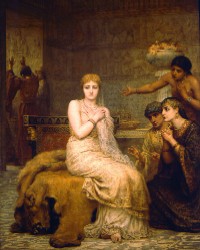
Vashti Refuses the King's Summons, painting by Edward Long (1879)

Vashti Refuses the King’s Summons, painting by Edward Long (1879)

Esther 1: 13-21

                13 Then the king consulted the sages who knew the laws (for this was the king’s procedure toward all who were versed in law and custom, 14 and those next to him were Carshena, Shethar, Admatha, Tarshish, Meres, Marsena, and Memucan, the seven officials of Persia and Media, who had access to the king, and sat first in the kingdom): 15 “According to the law, what is to be done to Queen Vashti because she has not performed the command of King Ahasuerus conveyed by the eunuchs?” 16 Then Memucan said in the presence of the king and the officials, “Not only has Queen Vashti done wrong to the king, but also to all the officials and all the peoples who are in all the provinces of King Ahasuerus. 17 For this deed of the queen will be made known to all women, causing them to look with contempt on their husbands, since they will say, ‘King Ahasuerus commanded Queen Vashti to be brought before him, and she did not come.’ 18 This very day the noble ladies of Persia and Media who have heard of the queen’s behavior will rebel against the king’s officials, and there will be no end of contempt and wrath! 19 If it pleases the king, let a royal order go out from him, and let it be written among the laws of the Persians and the Medes so that it may not be altered, that Vashti is never again to come before King Ahasuerus; and let the king give her royal position to another who is better than she. 20 So when the decree made by the king is proclaimed throughout all his kingdom, vast as it is, all women will give honor to their husbands, high and low alike.”

 21 This advice pleased the king and the officials, and the king did as Memucan proposed;22 he sent letters to all the royal provinces, to every province in its own script and to every people in its own language, declaring that every man should be master in his own house.
In George R.R. Martin’s book (and by extension the television series) The Game of Thrones begins with Robert Baratheon  as king, and King Robert likes his drink and he likes his women (well every woman except the one he is married to, but that is a long story) and he makes a number of brash decisions. In both stories a king’s inebriation leads him to make decisions he will later regret and allows him to  be manipulated by his counselors. What began as an interpersonal refusal, Vashti refuses to appear, becomes an event of national consequence. One adviser leads the king on a drastic course of action that seems to be completely disproportionate to the slight for fear that Vashti’s actions will embolden all women to be rebels against their own husbands, and well anarchy is only one tipping domino away, at least as Memucan fears it.

We can speculate all we want about why Vashti refuses: was it because she knew the kings would make a spectacle of her, some seem to think that she was to appear naked although this is not a part of what is recorded, her reasons in the story are her own and as much as we might want to applaud her, she is but a foil in the story. She has unsuccessfully negotiated the realities of the situation she found herself in. In challenging the king’s authority she lost. In a perfect world with equal power, with no patriarchal systems or favoritism based on authority, position or wealth someone would never have to worry about how they negotiate the realities of the political situations they find themselves in, but Vashti and we do not live in a perfect world. Vashti will open the door for Esther, our protagonist to enter the scene and we will see her enter the story next.

A decision made in anger makes the story turn. The excess of the decision should make us laugh at the king. The story is told by people who are without power at a festival where they have some free space to poke fun, indirectly, at the ruling powers. We should be able to enjoy the sarcastic picture of this ruler of the largest empire of his day as well: the king is a buffoon whose heart is made glad with wine and he is no wiser or more powerful than the rest of us for his own decision will bind him, and bad advice will cost him something he cherishes. Perhaps before we allow our own fears of what might happen if the dominos begin to fall and we find ourselves on the treacherous slippery slope of moral depravity unleashed by one person’s refusal to conform to expectations, we should take a deep breath and perhaps a reality check. Yet the king in this respect is no different than us, for words harshly uttered cannot be taken back, and although we may not find ourselves in the ridiculous position of being unable to unmake a law or ruling many times our words can leave a legacy that we must live with.

purple rose 01 by picsofflowers.blogspot.com

Let the Party Begin: Esther 1: 1-12

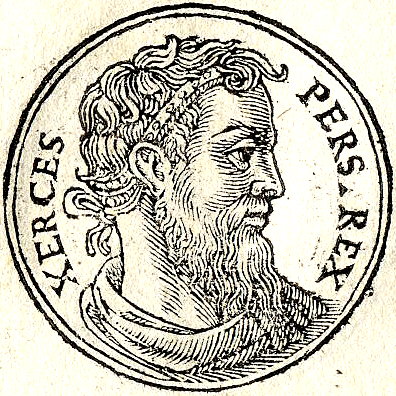
Xerxes_I

This happened in the days of Ahasuerus, the same Ahasuerus who ruled over one hundred twenty-seven provinces from India to Ethiopia. 2 In those days when King Ahasuerus sat on his royal throne in the citadel of Susa, 3 in the third year of his reign, he gave a banquet for all his officials and ministers. The army of Persia and Media and the nobles and governors of the provinces were present, 4 while he displayed the great wealth of his kingdom and the splendor and pomp of his majesty for many days, one hundred eighty days in all.

                5 When these days were completed, the king gave for all the people present in the citadel of Susa, both great and small, a banquet lasting for seven days, in the court of the garden of the king’s palace. 6 There were white cotton curtains and blue hangings tied with cords of fine linen and purple to silver rings and marble pillars. There were couches of gold and silver on a mosaic pavement of porphyry, marble, mother-of-pearl, and colored stones. 7 Drinks were served in golden goblets, goblets of different kinds, and the royal wine was lavished according to the bounty of the king. 8 Drinking was by flagons, without restraint; for the king had given orders to all the officials of his palace to do as each one desired.

 9 Furthermore, Queen Vashti gave a banquet for the women in the palace of King Ahasuerus.

10 On the seventh day, when the king was merry with wine, he commanded Mehuman, Biztha, Harbona, Bigtha and Abagtha, Zethar and Carkas, the seven eunuchs who attended him, 11 to bring Queen Vashti before the king, wearing the royal crown, in order to show the peoples and the officials her beauty; for she was fair to behold. 12 But Queen Vashti refused to come at the king’s command conveyed by the eunuchs. At this the king was enraged, and his anger burned within him.

Roll them bones!

Oftentimes we get too uptight about approaching a Biblical story and we forget the way they are approached by people throughout the generations. Esther is a story told at the Jewish festival of Purim, which quite likely has its origins in Persian or Babylonian celebrations[i], and it is heard with raucous laughter-it should be a fun story perhaps shared over wine or beer. Are there things we can learn from this story: Absolutely, but we should be aware that God is never mentioned in the book, nor are there any indications (other than fasting which was widely practiced beyond Judaism) of any Jewish practice. It is the story of excess and foolishness, of the people of God who are trying to navigate living in the world where they are mixed in with everyone else, trying to make their way in the world of the Medes and Persians. There are things to learn from all of this, but also we need to learn to laugh at the story, to find humor where there is humor. Even Martin Luther who I respect greatly wished the book of Esther did not exist, perhaps this was a moment when Luther was taking himself too seriously.

First, Ahasuerus is probably to represent King Xerxes of Persia, and some translations will automatically change Ahasuerus to Xerxes, but this not intended to be a historical work as much as a story, and the fact that the story was linked with a festival is probably the main reason it was included in the canon. It is a story of excess and the excess begins with a six month long party (take that college students) yet unlike a college student the king has the financial wherewithal to finance a six month long party where the wine flows liberally and people are able to recline on couches of gold and silver in addition to the other lavish surroundings. This is a scene that puts the largest royal banquet in Game of Thrones to shame, and while a banquet that lasts for seven days seems excessive to us in the West for whom eating is functional, I am reminded that for many cultures something like a wedding will last days or even as long as a week.

All this lavishness sets the scene for the king’s command sent through seven eunuchs to retrieve his extremely beautiful wife (who is throwing her own party with the women) to display her before his officials and those with him at his banquet. This is not a fair world, in our society it would not be uncommon for a woman to refuse a drunken request but this is an extremely patriarchal world which women did not have a great deal of freedom, and even queens are only queens so long as it pleases the king. But the amazing happens, Vashti refuses, the king is enraged and the stage is set for the unfolding of a new drama. It will be set with overreactions and a paranoid defense of the patriarchal order (can’t have a queen who disobeys a king, what would that do to the fabric of society-it is a fear we will see expressed.) Most modern women and many men have some empathy for Vashti, but the reaction of the men in the court of Ahasuerus will be much different.

purple rose 01 by picsofflowers.blogspot.com


[i] I owe this observation to Sidnie White Crawford, (Actemeier, Elizabeth et. al. 1999, 3:860). This is not a unique phenomenon, Christians celebrate Christmas and Easter at the times when they are celebrated as a way of displacing holidays celebrated by the people that Christianity was spreading to. Or think of the conjunction of All Saints day (November 1) with All Hallows Eve (or as we call it today Halloween).

The Place of Authority 3-2:Byzantium, Triangles and the Quest for Stasis

As a symbol and expression of the universal prestige of the Patriarchate of Constantinople, Justinian built the Church of the Holy Wisdom of God, Hagia Sophia, which was completed in the short period of four and a half years (532–537).

One of the things I’ve been doing as I took an extended break from my more historical work on the place of authority within society and religion was to do some broader thinking about where this all might be heading and to try to bring in some other disciplines that could help me process the large historical stories in a way that both made sense and was as fair as possible to the historical narrative. I’m going to take you on a brief journey into the sometimes scary process of how my mind thinks through things (clearing away as much of the clutter as possible) and hopefully you will be able to see why I am drawing some of the conclusions I am at this point and as I move forward and then I will apply the scheme I develop to the period of the Byzantine empire (what remains of the former Roman empire after Rome collapses based out of Constantinople) and then we shall see how far I move forward in history before I feel the need to re-evaluate.

One thing that every society seeks is stability, instability is notoriously bad (at least in the short term) for the people in any society and people will endure a lot of things to avoid a drastic upheaval of what is considered normal. That got me thinking about Bowen System Theory and specifically his (and other’s who followed Murray Bowen’s work from the 1970s on) work on triangles:

“The theory states that the triangle, a three person emotional configuration, is the molecule or the basic building block of any emotional system, whether it is in the family or any other group. The triangle is the smallest stable relationship system. A two-person system may be stable as long as it is calm, but when anxiety increases, it immediately involves the most vulnerable other person to become a triangle. When tension in the triangle is too great for the threesome, it involves others to become a series of interlocking triangles”[i]

If any place in this time period could be talked about as stable and able to resist major changes it was the Byzantine empire and the Orthodox Church which was the dominant expression of religion within the empire. Thinking about what a triangular system might look like from the Byzantine perspective might look like took me back to another three fold characterization.

There is an ancient way of talking about Jesus which is called the three-fold office, which goes back into the ancient church, at least to the early church father Eusebius (263-339) and probably earlier than that. It breaks down the offices of Jesus as: prophet, priest and king- and as I mentioned in an earlier post for the early followers of Jesus he occupied the central defining role in forming their identity as Christians. Let me expand each of these roles briefly:

The kingly role is the role of political power, to those familiar with a Lutheran two kingdom way of thinking this is the left handed kingdom which deals with military power and security, taxes and wealth, roads and trade. Typically in every layer of society there is someone who occupies a place of political power and who guarantees safety, peace and security for the price of obedience and taxes. This is the role of the secular power, and it can be abusive or benevolent (although it more often trends towards abusive) and it often depends on the next office for it’s authorization in some manner.

The priestly role is the role of religious authority, this would be the right hand kingdom of Lutheran two kingdom typology, which deals with placing people in a right relationship with the sacred, whatever that may mean for a society. In almost every society that I am aware of the priestly function is carried out by those who are closely aligned with those in the kingly role. In a theocracy the priestly office will dominate the political office, this is less common but there are societies and times where the priestly office will hold sway. More commonly the political office will exercise greater power than the priestly office and the priestly office will give additional legitimacy to the political office. This may sound skeptical and there is give and take in the relationship, however for stability there is a mutual self interest involved since the political office protects the priestly office and the priestly office legitimizes the political office.

The prophetic role is that place, person or thing within a society which places a check on the political and the priestly offices when they are not acting in accordance to whichever divine source of authority , they are the mouthpiece of God that challenges the excesses, abuses, deceptions, oppression, idolatry or hubris of the other two offices. The prophetic role may be occupied by a person or persons or it may be an idea, book, etc…as we will see in some of the upcoming transitions. All three roles are necessary and linked together.

In the Byzantine empire the emperor remained the dominant political figure, and had a lot of authority within all realms of both political and religious authority. The bishops had and exercised their authority with the protection and in cooperation with the emperor, but for the Orthodox church and the Byzantine empire the prophetic role was occupied by tradition. Tradition was what the church had believed and confessed, hence orthodoxy, and anything that deviated from that tradition of the earlier church fathers and councils was considered heresy or at least unorthodox. After the reign of Theodosious I (379-395 CE) the eastern half of the empire based in Constantinople would remain in some form with the emperor reigning and the Orthodox church intact until Constantinople falls in 1453.

In Gruene, Texas there is a dancehall which proudly proclaims “Gently resisting change since 1872” and in many ways the Byzantine empire was able to gently resist significant changes for 1,000 years. The world around its borders changed and went through a number of upheavals and eventually it would find itself caught between the Catholics on one side and the Muslims on the other, and yet the emperor, orthodox priests and the tradition of the fathers provided stability while the world around them was filled with chaos.

purple rose 01 by picsofflowers.blogspot.com


[i] Murray Bowen, 1976 quoted in Roberta M. Gilbert, The Eight Concepts of Bowen Theory: A New Way of Thinking About the Individual and The Group, Falls Church and Basye, Virginia: Leading Systems Press, 2004 and 2006, 47.

Something Different: Are We Losing Faith in Religion?

On the front page of yesterday’s Omaha World-Herald the central story was “Are We Losing Faith in Religion?” The article highlights Gallup’s 2012 survey on the Confidence of Institutions which has been taken annually since 1973. To me this is not surprising, honestly I am surprised that organized religion scored as well as it did, with the way in which the perception of authority is changing. In general people have become much more skeptical of the political process, the economic world, the medical system, news sources, and big business. Organized religion scored better than any institution other than the military, small business and the police.

Gallup does not report reasons, only breaks down responses into six categories of confidence in institutions:

                 Great Deal of Confidence
                Quite a Lot
                Some
                Very Little
                None
                No Opinion

 But since I’ve been doing a fair bit of thinking about authority lately here are some of my reflections:

This is a part of a broader cultural and philosophical trend to distrust authority, as Eileen Burke-Sullivan (who is quoted in the article) says there is “a general malaise in the United States about leadership of any kind.” There has always been some level of questioning of authority built into the type of governmental system that we have, but we live in a time of increasing polarization in many institutions. Television news, for comparison to organized religion’s 44%, only received a 21% great deal/quite a lot of confidence and newspapers only 25%. Even the people communicating the news to us are not to be trusted. Postmodernism’s hermeneutic of suspicion (the idea that every source of information needs to be evaluated suspiciously) is firmly imbedded in our sub consciousness. As the X-Files used to say, “Question everything.”

There are many ways in which each of these organizations have failed to live up to the standards they set for themselves. Probably the two most common examples are sexual and fiscal impropriety. In religion there are certainly numerous scandals across denominations, from the Catholic Church’s continued struggle with priests who sexually abused minors to the indiscretions of mega-church pastors. Financial mismanagement, fraud and theft are not new but it receives more news coverage and visibility than at other times in history. This is not merely a function of religious organizations; it applies in government, economic institutions, and medical. Ultimately the increased visibility of these very real moral failings continues to feed the perception that those in various positions of authority are not looking out for our best interest.

Even though authority of religious institutions has been affected by both of the above criteria, there is a broader set of re-evaluation going on as the church (along with society) enters into a period of re-examining what it believes in light of a rapidly changing world. This is not always an easy process and there will be conflict which sometimes elevates into combat. The way the church has dealt with controversial issues (and it has done this rather frequently since the 1960s) as well as trivial issues has often not been healthy and many have walked away from the conflict wounded and with a deep mistrust of the organization.

For me this is a challenging but exciting time to try to re-think what is means to be Church. I am convinced that at the center are the questions of authority-which ultimately has to do with the ability to narrate the stories in which we make sense of our world. There are a lot of stories out there, Richard Lischer in The End of Words makes the claim that the average American is exposed to 6,000 messages per day (conversations, advertisements, stories, songs, tweets, texts, etc…) and honestly that is one of the primary reason I am doing the work of relooking how the story was told across time and who got to tell it. I’m not convinced I have the answers yet, but I am convinced I am asking the right questions.

On a different note, why did the military, the police and small businesses score as well as they did? Here are my thoughts on that, which are by no means scientific. In contrast to the Vietnam War where the military was lumped in with people’s feelings about authority in general and the war in particular, since the 1980s, regardless of the public’s feelings about a war or a political leader, the perception of the military has remained high. Partially this may be guilt related; since people no longer have the threat of being drafted to serve there is a feeling that the military is making sacrifices that the rest of us are not. Even though the police have had times where they are viewed negatively, for the most part people have a fairly positive attitude towards police officers who they believe put their lives in danger for their protection. Small business has been trumpeted across the political spectrum as the group that will save us from recession and so who doesn’t like small business? Even each of these groups has seen some small declines in recent years, but they still enjoy broad confidence.

purple rose 01 by picsofflowers.blogspot.com

The Place of Authority 2-6: The Constantinian Revolution Part 2-Councils, Canons and Creeds

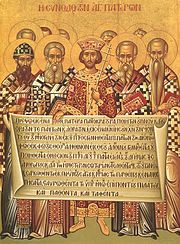
Icon of the Council of Nicea

I mentioned in an early post (see the Place of Authority 2-3) that Christianity came into contact with the Greek culture and even though Christianity attempted to remain true to its Jewish roots, the questions and the terms of the dialogue were set by the Greek culture. The arguments and theology of early church leaders like Justin, Clement of Alexandria and Origen had conducted the debate with the surrounding culture in terms the culture was familiar with. Especially in the Eastern (Greek speaking) half of the church there was an emerging conflict between the philosophical ideas of what God should be like and various readings of Scripture. Remember that almost all of the early Christian leaders read the scriptures allegorically, and just as there are multiple ways of reading scripture today the early church had this struggle with this as well.

In 325 CE Emperor Constantine called the leaders of the early church together at Nicea, a city in modern day Turkey near Constantinople (Istanbul). Many of the issues dealt with were practical, having to do with which leaders and position would carry the greatest authority, how to readmit lapsed Christians, and how to elects individuals to fill the various leadership roles within the church. These were all essential tasks for an organization which had moved from being decentralized and rather small to a much more organized and broad church. It was within this meeting that some of the theological differences present came to the surface and had to be dealt with.

The controversy is named Arianism for a presbyter named Arius who found himself in conflict with the bishop of Alexandria (appropriately named Alexander) over the relation of Jesus and the Father. At the council of Nicea an Alexandrian controversy became a controversy that consumed the first council when a few convinced Arians, led by Eusebius of Nicomedia attempted to have the assembly rebuke Alexander for his condemnation of Arius’ teachings. At stake was whether the person of the Christ was divine with the Father or whether he was a created creature. Originally the assembly wanted to create a confession stringing together biblical texts, but they found it difficult to unmistakably refute Arianism using only scripture, but would eventually create a creed heavily dependent on a mixture of biblical and philosophical language to reject Arianism. This would be the beginning of the Nicene Creed (the Nicene Creed we use today would effectively be finished at the council of Constantinople in 381 CE but the first two paragraphs come from the Council of Nicea). This is the language agreed on in Nicea about Christ:

And in one Lord Jesus Christ, the Son of God, the only-begotten of the Father, that is, from the substance of the Father, God of God, light of light, true God of true God, begotten, not made, of one substance (homoousios) with the Father, through whom all things were made, both in heaven and on earth, who for us humans and for our salvation descended and became incarnate, becoming human, suffered and rose again on the third day, ascended to the heavens, and will come to judge the living and the dead.

The controversy was all about the person of Christ, and I find it interesting that the controversy stays there throughout this period and never moves to consider the work or the teaching of Christ. This creed, begun in a council called and presided over by an emperor not yet baptized, would be the one statement of faith that would be agreed upon by the Western and Eastern Church and would at a later point be a part of the controversy that would split the two, but that is a later story.

Even though the canon was not fixed at the Council of Nicea, as many people believe, the canon had taken the decisive shape by this point. Revelation and Hebrews would eventually gain enough acceptance to be viewed by most as a part of the New Testament. Yet the gospels and the letters of the New Testament began to be used more as a tool for theological ideas rather than understood in their own right. Christianity, like its predecessor Judaism, was moving on its own temple and monarchy trajectory-except now the temple was the church and the monarch was the Roman Emperor. Creeds would begin to become more influential than story, councils would become the interpreter of scriptures and although with the translation of the Bible in to Latin by Jerome made it available in the language of the Western half of the empire both illiteracy and the unavailability of copies of the scriptures in either the Greek or Latin would make the authority rest with the educated elite of both the ruling and clerical class.

There is certainly much to criticize about this era of Christianity’s struggle with authority from many people’s standpoints, especially as we find ourselves coming into a post-Christendom era (according to many commentators) but there is also much to admire. This was a time of theological giants: Athanasius, Eusebius of Caesarea, Athanasius, the Cappadocian Fathers (Basil the Great, Gregory of Nyssa and Gregory of Nazianzus), John Chrysostom, Jerome, Ambrose and perhaps the greatest of this group (from a Western Church perspective) Ambrose’s student Augustine of Hippo. The shape of the church in both the West and the East would be shaped for the next 1,000 years during this era. At the beginning of the fifth century the political climate would change as Rome’s loses its position as the sole imperial authority and we enter what is commonly called the Medieval Era. Much will be lost in the coming era, but the church will be the authority that many look to in the midst of the crisis Christianity will continue to spread throughout Europe, although in the Middle East and Africa a new player will emerge on the scene. It is to this era we will turn next.

purple rose 01 by picsofflowers.blogspot.com

The Place of Authority 2-5: The Constantinian Revolution Part 1-The Rise of Power and the Crisis of Authenticity

The Baptism of Constantine, 1520-1524 by students of Raphael, Public Domain Art

Then the devil led him up and showed him in an instant all the kingdoms of the world. And the devil said to him, “To you I will give their glory and all this authority; for it has been given over to me, and I give it to anyone I please” Luke 6.5f NRSV

In 312 CE when Emperor Constantine adopts a favorable stance towards the church and ends roughly 150 years of various levels of persecution a major change takes place. Christianity moves from the position of powerless to powerful, from being viewed as atheistic to becoming the religion of the empire (although this move is not completed under Constantine, it begins here) from being a persecuted and scattered minority to being an institution able to build large buildings, gather and deliberate in public and to freely communicate back and forth. In short the world that the church knows is turned upside down and it raises a lot of questions then and now. For some the church sold its soul to the devil and aligned itself with Rome, was corrupted and would never be the same. For others this was the Church’s great triumph and it ushered in the new age for the Christian Church. Reality is probably somewhere between these two extremes, but this was an era of such remarkable change in the church’s identity and authority that we need to spend a little time here.

People flocked into the now suddenly popular church. Church buildings became large structures like the temples of other religions, priests and leaders who had previously dressed in common clothes began to wear formal dress, and even incense once the province of the Imperial court became an aspect of the church’s worship. There also is a sense in which the leaders began to model themselves after the Old Testament priesthood and to occupy more of a priestly role within the church and society. Those in the church who viewed the emperor’s favor as a positive thing began to look upon the emperor as the one anointed by God to bring both history and the empire to its apex. But this sudden rise was certainly not without its own set of crises and problems.

There was a major crisis of authenticity within the church. Many Christians had faithfully endured shame, suffering and in several cases death and had not renounced their faith-but others, including some leaders had under the pressure of interrogation or the threat of death sworn an oath of allegiance to Caesar, had handed over Christian scriptures or in some other way renounced their faith. Others had simply fled away from the persecution rather than to become a martyr for various reasons. Now that Christianity was no longer a persecuted religion it raised many new questions: “Do those members and leaders of the community who renounced their faith still have a place within the community?” “Does the work of leaders who renounced their faith still have a valid standing (for example does a person baptized by a leader who renounced the faith need to be re-baptized)?”  “How do we accept new members who have not had to go through the struggles we went through when we became Christians?” “Are these new converts to the faith doing this for reasons of social advancement or are they doing it because of a sincere devotion to God?” These were not questions answered easily or quickly.

One of the early controversies within this change has to do with leaders who failed to remain faithful through the persecution. The Donatist controversy, where the question of “did the faithfulness of the leader impact the efficacy of an act (like baptism or eucharist or forgiveness) or not?” Paired with this question was the secondary question of whether a lapsed or unfaithful leader could return to leadership within the church. Ultimately the church answered that the ministry they did was valid and that it was possible (although not necessarily automatic) that a leader who under pressure had renounced his faith (and it was almost always a male leader at this point) could return to an active role in the leadership of the church.  With this new members were welcomed and many quickly joined the Christian church now that it was no longer a persecuted minority. When in 380 CE Christianity becomes the official religion of the Roman Empire under Emperor Theodosius the church is still trying to sort through the effects of the transition to being the dominant religion.

For some this was a severe dilution of the holiness of the church and they would in many cases flee from the cities and attempt to live a holy life in isolation or in communities. This is not the beginning of Monasticism, where monks and nuns would retreat from the world around them in order to live holy lives, but it certainly marked an escalation in the number of people trying to pull away in order to be faithful.  In contrast to the regality that clergy and worship throughout the empire were beginning to adopt, the monks and nuns fled into the wilderness or out of the cities to practice a simpler and more constant devotion. These monks and nuns would provide one of the major institutions that would be important for the centuries to come. The monks and sisters would evolve into one of the major reforming voices in the church. Monks would both pose a challenge to the bishops and their sometimes very worldly lives and at other times they would find themselves called upon to be leaders of the church. The monks would also be responsible for preserving much of the knowledge that would otherwise be lost in the conflicts of the coming centuries.

Even with all of these challenges the position of the church had changed dramatically. With that change came the ability to focus internally on how it would determine what it would believe, to formalize its doctrine and its cannon, and to move towards becoming the authority the society would look to in the coming collapse. The authority of the church would not go unchallenged, but as the church addressed these challenges it would centralize its authority, its doctrine, and in this age of the theologian bishops two major authorities would hold power-the emperor and the council and it is to this reality that we will turn next.

purple rose 01 by picsofflowers.blogspot.com

The Place of Authority 2-4: The Practices of the Early Church

Baptism Fresco on the Catacombs of St. Marcellinus and Peter, Via Labicana, Rome, Italy

There are two ways, one of life and one of death, but a great difference between the two ways. The way of life, then, is this: First, you shall love God who made you; second, love your neighbor as yourself, and do not do to another what you would not want done to you. Didache (Chapter 1), 2nd Century Christian Writing

There are times I feel like Cuthbert Binns, the History of Magic Teacher from the Harry Potter series who one day falls asleep in the teacher’s lounge, dies and then as a ghost goes on teaching without seeming to realize the difference. I hope that unlike Cuthbert my approach to looking at authority within the history of Judaism and now Christianity is not incessantly boring, and is rather enlightening as we go back through time and examine the story of how we got where we are today. There are times where I want to take a shorter path, but I personally am learning a lot from going back and re-engaging material I haven’t studied since seminary-I have made some new connections that will impact some of my conclusions.

Practices are critical to the formation of identity and they help to shape what the people and any group come to believe. As Prosper of Aquitaine (390-455 CE), a Christian from a later era than I am currently discussing, memorably put it “the rule of prayer should lay down the rule of faith” (Pelikan, The Christian Tradition 1:339) and so the everyday practices of early Christians allowed them to make sense of the persecution they received from the Romans or the struggles they went through in their daily lives. It also gave them the basis of their community and bound them together with Christians across the empire and indeed across the world. Practices may not sound exciting to talk about, but their meaning will be discussed and debated for the millennia to come.

Love is the foundational idea that gets worked out in these practices, a love for neighbor and even for enemy that forms the basis for the actions of the early church. Certainly there will be many times where the early churches (like modern churches) will fail to live up to this ideal, yet in a society with no social safety net the vulnerable (the widows, orphans, immigrant and the elderly or disabled) were often taken in by many of the early churches and given identity and meaning. Certainly there were apologists and early thinkers like Justin Martyr or Origin who tried to make an intellectual case for Christianity, but most people came to Christianity through the example and witness of anonymous Christians, and they were invited into the journey of coming Christian by people who they encountered in the marketplace, their homes and their worksites.

With the persecution by the Roman Empire it was a dangerous thing to become a Christian, and early Christians wanted to make sure that potential converts were truly seekers and not spies. Often there would be a detailed process of catechesis, education in the faith, before a seeker would be admitted to the mysteries of the faith (baptism and then communion or Eucharist). Most of these communities were rather small, meeting in houses, cemeteries, catacombs  or in business places both because they could not have afforded a building dedicated for their meetings, but also for fear of being detected by authorities.

Baptism was the mystery of faith that led to identity with the church and mystically with Christ. A person in the waters was made clean, forgiven of sins, regenerated into a new person and received the Holy Spirit. Once a person was baptized they were a full participant in the life of the community, they could worship with all their new brothers and sisters in Christ, they could partake in the Eucharist. Even without any significant conflict the meaning of baptism was pretty much stabilized by the end of the second century with no real conflict over practice and thought (with one exception) until the time of the Reformation.

Eucharist, the Lord’s Supper or Communion was a community meal in which the people present celebrated their unity in Christ, remembered the actions of Jesus during the last week of his life and shared a meal that they understood having both spiritual and earthly realities. The precision of the debates that would emerge during the time of the reformation are not present, but the idea of the Eucharist having the power to transform the bodies of the early Christians from corruptible to incorruptible or they could call it the ‘flesh of Christ’ or even a sacrifice, but the fact that they didn’t nail down precisely what was happening did not stop them from trying to explain what it meant. It would take focusing in on Christology (who Christ was) before the early Church would have the language for the precision of later centuries.

 Around both of these realities was worship which focused on Jesus, eating together with the community, sharing their lives together and continuing to confess “Jesus as their Lord” even in the face of hardship. As the church moved into the third century it was still a persecuted group, the basics of structure had come into being (offices like bishop, presbyter and deacon were used-people set aside for helping the community function, but it was not a hierarchical as we are used to and there was not a specific class of clergy) and there was the beginning of movement towards what a canon would look like, what practices would be formational, and at least some commonality in what was to be believed, but a major change was on the horizon, a change that would transform the church from top to bottom. For some the early church was about to experience its triumph, for others it was making a deal with the devil, but in 312 CE the emergence of Constantine, an emperor favorably disposed to Christianity, the church would have to redefine itself yet again and ask itself the questions of authority that continually emerge.

purple rose 01 by picsofflowers.blogspot.com

The Place of Authority 2-3:The Early Church’s Identity Problem

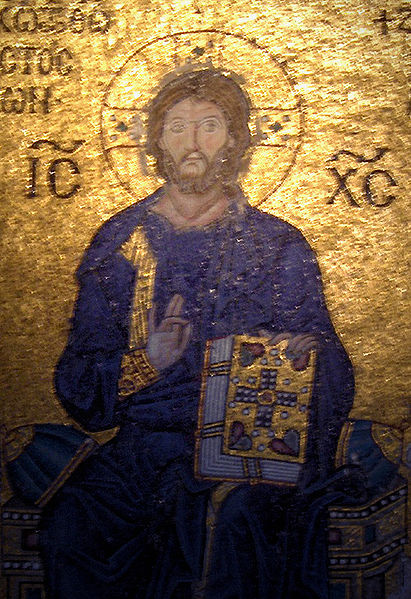
Image of Christ Pantocrator (Almighty or Lord of Hosts), Hagia Sopia, Istanbul, Turkey

When a movement is centered on one person who is no longer present in a corporeal (bodily) form that the members of that movement can continue to speak to and learn from eventually there will come an identity crisis where people begin to ask, “Are we following the right Jesus?” “Are we being faithful to his vision?” “Are we still following the God he pointed to?” As the church entered the second century it was dealing with heavy pressures from the empire around it and at the same time this early church had to figure out who it was from pressures from within.

It was still early in the church’s young life; the canon (the selections of works that would come to make up the bible) was not fixed. The four gospels, Matthew, Mark, Luke and John were in wide circulation as well as many of the letters associated with Paul, but depending where you went the Shepherd of Hermas or the Letters of Clement or the Didache may also be present (which would later be viewed a positive works but not held at the same level as scripture). The challenge to how to tell the story of being the people of Jesus arose from within and to react to this challenge the church adapted and changed.

One of Christianity’s greatest gifts was that it was not tied to one language or culture. As it spread across the known world at that time it would be quickly translated into Greek (the language of the Eastern half of the Roman Empire) and eventually into more and more languages and cultures. The reason that the books that are a part of the New Testament are in Greek, not Hebrew or Aramaic,  is that by the time the stories of Jesus are written down and as Paul and others wrote letters they were going to churches that primarily spoke Greek (at least as a second language). With this encounter with the Greek world and language also came an encounter with Greek thought which was much different from the Jewish or Hebrew worldview that Jesus and all the original apostles came out of. As Greek speaking and thinking individuals encountered Christianity and they translated the message they would both be changed by it and in their own way they would transform the message as well. The question has to emerge what is a valid transformation and what is not? Two long lasting assumptions that many Christians include as central to their thought: the immortality of the soul or the absoluteness of God are Greek ideas not Biblical ones and yet with the introduction of Greek culture they become a part of the thought of the early church.

One of the early challenges came from a wealthy Christian named Marcion. While Hebrew thought has no problem with contradictions and gaps, a Greek thinker like Marcion could not abide contradictions. Among other things, Marcion felt that the God of the Old Testament was not reconcilable with the God of Jesus. Marcion read how in the Old Testament that God called for wars which wiped out entire populations, called down judgments in a harsh and unforgiving manner and came to the conclusion that in combination with these things he read and the reality of suffering in the world that the creator must be evil and different from the God of Jesus. In contrast to almost every other church leader at the time, Marcion read Old Testament literally rather than allegorically. Marcion felt that the Old Testament should not be a part of the Christian scriptures and therefore it should be thrown out. In addition to this, in a Greek way of thinking that viewed sex, childbirth and the body in general as bad, Marcion could not accept that Christ was born of a woman-even if it was a virginal birth God could not be born of a woman. For the first time we begin to see in a very powerful way the emergence of theology more than narrative as formational for a way of thinking about God and Jesus. Marcion quickly identified the contradictions and the differences in the New Testament gospels that were being held in most churches, so he eliminated Matthew, Mark and John and seriously redacted Luke to try to remove anything “impure” to be put alongside of Paul’s letters (also purified of Jewish “interpolations”). These modifications were viewed to be unorthodox by the leaders of the church in Rome and in 144 CE he was expelled from the early church. Marcion became one of the earliest to try to put together a canon, a list of texts that would form the basis for the church’s authority and the church would continue to deal with his followers for decades.

Another threat to the view of who Christ was came from those often referred to as Gnostic Christians. Gnostics are so named because they believed that they had secret knowledge that others, including other Christians, did not have. I am not convinced that there is one direction among the groups and the scriptures that we might label Gnostic, in fact they seem to represent a wide range of things. We are the beneficiaries of the rediscovery of several of the Gnostic gospels at Nag Hammadi in 1945 which give us a window into what Gnosticism may have looked like. Some of these, like the Gospel of Thomas, are very similar to many of the sayings in Matthew and Luke and portray Jesus as a wisdom teacher. Others like the Gospel of Truth associated with the Gnosticism of the Valentinians develop a whole cosmology that put Jesus among many heavenly beings and looks very little like anything we would recognize as Christian. Like Marcion they held the body as bad and the soul as good (or divine spark would be a term you might see in Gnostic gospels) and the purpose of having the proper Gnostic knowledge is for that soul or divine spark to be liberated from the body.  Again the early church made the decision that this was not an accurate representation of the faith and the Gnostic gospels would not become a part of the canon.

Each time a crisis presented itself between a Greek way of thinking and a Jewish way of thinking the church attempted to remain with the Jewish way. At the same time, even while trying to remain close to the Jewish origins of the story, the questions that were being asked were no longer the questions of the Hebrew mind, they were the questions of the Greek world. The Bible began to be viewed in terms that were familiar to the Greek way of thinking, so God had to be omnipotent, omniscient and omnipresent (all powerful, all knowing and present everywhere) and this rather than the narrative became decisive for decisions. The biblical hope of a bodily resurrection at the return of Jesus, the participation in the new creation and all the images that populate the gospels and Paul’s letters began to be read in terms of the soul joining God in heaven. The story when it was read was often interpreted allegorically (there are gifts and challenges that come with this) and theology and a few common practices became the points where identity was formed for the early church. It is to these practices we will turn next.

purple rose 01 by picsofflowers.blogspot.com