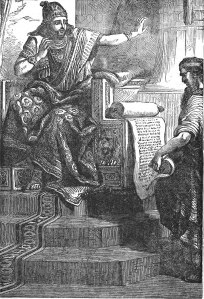
2 Kings 22
1 Josiah was eight years old when he began to reign; he reigned thirty-one years in Jerusalem. His mother’s name was Jedidah daughter of Adaiah of Bozkath. 2 He did what was right in the sight of the LORD and walked in all the way of his father David; he did not turn aside to the right or to the left.
3 In the eighteenth year of King Josiah, the king sent Shaphan son of Azaliah son of Meshullam, the secretary, to the house of the LORD, saying, 4 “Go up to the high priest Hilkiah and have him add up the entire sum of the silver that has been brought into the house of the LORD that the keepers of the threshold have collected from the people; 5 let it be given into the hand of the workers who have the oversight of the house of the LORD; let them give it to the workers who are at the house of the LORD repairing the house, 6 that is, to the carpenters, to the builders, to the masons; and let them use it to buy timber and quarried stone to repair the house. 7 But no accounting shall be asked from them for the silver that is delivered into their hand, for they deal honestly.”
8 The high priest Hilkiah said to Shaphan the secretary, “I have found the book of the law in the house of the LORD.” When Hilkiah gave the book to Shaphan, he read it. 9 Then Shaphan the secretary came to the king and reported to the king, “Your servants have melted down the silver that was found in the house and have delivered it into the hand of the workers who have oversight of the house of the LORD.” 10 Shaphan the secretary informed the king, “The priest Hilkiah has given me a book.” Shaphan then read it aloud to the king.
11 When the king heard the words of the book of the law, he tore his clothes. 12 Then the king commanded the priest Hilkiah, Ahikam son of Shaphan, Achbor son of Micaiah, Shaphan the secretary, and the king’s servant Asaiah, saying, 13 “Go, inquire of the LORD for me, for the people, and for all Judah, concerning the words of this book that has been found, for great is the wrath of the LORD that is kindled against us, because our ancestors did not obey the words of this book to do according to all that is written concerning us.”
14 So the priest Hilkiah, Ahikam, Achbor, Shaphan, and Asaiah went to the prophet Huldah the wife of Shallum son of Tikvah son of Harhas, keeper of the wardrobe; she resided in Jerusalem in the Second Quarter, where they consulted her. 15 She declared to them, “Thus says the LORD, the God of Israel: Tell the man who sent you to me: 16 ‘Thus says the LORD: I will indeed bring disaster on this place and on its inhabitants—all the words of the book that the king of Judah has read. 17 Because they have abandoned me and have made offerings to other gods, so that they have provoked me to anger with all the work of their hands, therefore my wrath will be kindled against this place, and it will not be quenched.’ 18 But as to the king of Judah who sent you to inquire of the LORD, thus shall you say to him: ‘Thus says the LORD, the God of Israel: Regarding the words that you have heard, 19 because your heart was penitent and you humbled yourself before the LORD, when you heard how I spoke against this place and against its inhabitants, that they should become a desolation and a curse, and because you have torn your clothes and wept before me, I also have heard you, says the LORD. 20 Therefore, I will gather you to your ancestors, and you shall be gathered to your grave in peace; your eyes shall not see all the disaster that I will bring on this place.’ ” They took the message back to the king.
The thirty-one years of King Josiah’s reign in Jerusalem are a final window of hope for Judah. Even though as readers of 2 Kings we know that shortly after Josiah’s death we will reach the end of the story of the kings of the line of David and enter into the time of exile in Babylon, for the author of 2 Kings this is a moment of hope for a rediscovery of faithfulness, restoration of the temple, recommittal to the covenant, and even a hope for the reunification of Israel and Judah. The parallel telling of the story of the reign of King Josiah in 2 Chronicles 34-35 has the reformation of Josiah beginning in his twelfth year, but for 2 Kings the critical event is the discovery of the law in the eighteenth year[1] which initiates a period of repentance for the king and a recommittal to the covenant.
The characterization of King Josiah as one who ‘did not turn aside to the right or the left’ echoes the language of Deuteronomy calling for covenant obedience.[2] His obedience to the covenant links him to Moses, and then the text continues to link him to his ancestor David. Then the text takes us to the repair of the temple in language which parallels the actions of King Jehoash in 2 Kings 12: 1-16. In inquiring of the LORD through the prophet he, like his great-grandfather Hezekiah who sought God’s word through the prophet Isaiah. By his actions Josiah is shown embodying the actions of the good kings and leaders that have come before him. Although the prophet Jeremiah is not mentioned in this narrative, we also know that Jeremiah’s ministry begins in the thirteenth year of Josiah’s reign.[3]
The king sends Shaphan, the scribe or secretary, to the high priest Hilkiah[4] to instigate the utilization of the funds brought into the temple for the temple’s repair. As mentioned above, the narrative is similar to the rebuilding under Jehoash, but at this moment there is a critical discovery that is shared by Hilkiah with Shaphan and eventually with the king, the rediscovered book of the law. Shaphan reads this book to the king who responds by rending his garments in an act of mourning and repentance. Walter Brueggemann draws an insightful contrast between this action by Josiah and an opposite reaction by his son Jehoiakim:
Josiah, the good king, hears the scroll and tears his garment in a dramatic act of repentance (22:11). In Jeremiah 36:23, Jehoiakim, Josiah’s son who is a bad king, hears the scroll of Jeremiah and “cuts” the scroll and not his garments; that is, he does not repent but seeks to dispose of the troublesome scroll. (Brueggemann, 2000, p. 545)
Yet Josiah as a king who upon hearing the words of the law humbles himself and seeks God’s guidance is the model of what a good king is supposed to be.
The book of the law mentioned in this portion of 2 Kings has traditionally been thought of as Deuteronomy in some form. Deuteronomy is the only book among the torah[5] that specifically expects worship being concentrated in the city that God places God’s name upon. Deuteronomy also has lengthy sections of ‘curses’ that result from covenant disobedience. (Cogan, 1988, p. 294) We will never know whether the ‘law’ is Deuteronomy, the torah as a whole, or some proto-Deuteronomic document[6] but what 2 Kings wants us to understand is that Josiah received these words as the covenantal expectations of God and responded to them with the appropriate repentance and rigor.
The high priest Hilkiah, the scribe Shaphan, as well as Ahikam and Achbor are sent to the prophetess Hulda to seek God’s will. Ahikam, the son of Shaphan may be the son of the secretary and another advisor to the king, although some scholars are confused by Ahikam’s position in the list ahead of his father if they are related.[7] Ahikam son of Shaphan will be instrumental in preserving the prophet Jeremiah’s life during the reign of Jehoiakim.[8] In contrast Achbor’s son Elnathan will be charged with capturing the prophet Uriah and returning him to King Josiah for execution.[9] Like Josiah and Jehoiakim fathers and sons can take very different paths.
Hulda is the only woman prophet mentioned in either Israel or Judah, and yet she is trusted by the king and his men to speak the words of the LORD. Her message is ominous and hopeful. It is ominous because the king has heard the threats for covenant disobedience in the law correctly and the actions, particularly of Manasseh, have kindled an unquenchable wrath in God against the people. It is also hopeful because the actions of the king have been seen and appreciated by God. The king’s heart was penitent (literally soft in Hebrew) and tore his clothes and wept. God has postponed the disaster and held back the wrath during the reign of Josiah.
The humility and repentance of the king open the possibility for the repentance of the people. God’s judgment has been postponed, and there remains a hope that continued obedience can avert the disaster on the horizon. Jeremiah will continue to testify to the people after Josiah’s death to try to prevent the destruction that comes with this judgment enacted through the Babylonians. Yet Jeremiah will also see that the reforms enacted by Josiah will not change the heart of the people. Just as the people, in the narrative of 2 Kings, were quick to embrace the corruption of Manasseh the reforms of Josiah will unfortunately not survive his death. Yet 2 Kings wants to continue to celebrate this final good king who like Moses, David, Jehoash, and Hezekiah attempted to follow God’s will and to turn neither to the left or right.
[1] King Josiah would be roughly twenty-six at the time of the discovery of the law in the text.
[2] Deuteronomy 5:32; 17:20; 28:14.
[3] Josiah would have been 21-22 at the call of Jeremiah, five years before the rediscovery of the book of the law. Jeremiah is portrayed as a young, ‘only a boy’ in the narrative of his call. Jeremiah 1:6.
[4] Hilkiah is also the name of the prophet Jeremiah, but Jeremiah’s father is a priest at Anathoth, and it is likely that he is the son of a different Hilkiah than the high priest in this story.
[5] Genesis, Exodus, Leviticus, Numbers, and Deuteronomy.
[6] Scholars of the source critical school popular in the middle 20th century were focused on trying to find the source material behind the text. They had some good insights but ultimately, they tended to divide up the text into sections rather than engage the text as it has been received.
[7] Age does normally grant a person higher respect and status in ancient cultures, but Ahikam may also be a contemporary and valued advisor to this king who began his reign as a young boy.
[9] Jeremiah 26:22.
 Sign of the Rose