Tag Archives: Psalms

Living a Godly Life: Prayer

jesus praying

I listen to a lot of different types of music, and each type of music has its own set of emotions that they play to. For example, one of the emotions that rock and metal wrestle with is despair and depression, , rap tends to play towards defiance, popular music towards desire, and country, one of its many emotions is regret. It isn’t hard to come up with song after song in country that deals with regret, in fact there is a long standing joke about what happens when you play a country song backwards, that you get your wife back, your family back, your home back, etc…and often the regret is due to putting efforts into the wrong things, for a brief sampling this is one of George Strait’s older songs King of the Mountain:

I gave her that diamond she dreamed of

And I bought her a home with a view

I took her to the end of the rainbow

But all I left her was blue


Seems I never had time to love her

And now it seems time just stands still

I thought I was king of the mountain

But I was only a fool on a hill

Now I start out this way because one of the reasons we struggle with prayer is we tend to treat God like the fool in the song, if our prayers are mainly asking for things we are setting ourselves up for a relationship of regret. Sometimes I think we treat God in our prayers like Santa Claus, and Santa Claus is great for a lot of things: Dear Santa for Christmas I would like: a new computer, a PS4, Gift Cards to my favorite restaurants and shops so I can get something for me, these books, these CDs, these movies, an even bigger flatscreen TV…OK you get the picture, but let me let you in on a little secret, we don’t love Santa. Oh he’s cool, but we don’t love him and we’re never satisfied with what he brings, there’s no real relationship there-he grants my wishes and as soon as I am done opening gifts I may find myself thinking “what’s next?” George Schwanenburg was the pastor of the church I grew up in, and he used to call the prayers that many people would say, “Gimme” prayers, and by extension the people who prayed them were “Gimme pigs.” God gimme this, God gimme that-and while there is nothing wrong with asking God for what we want and need, prayer is much more than that. Other times the only prayers people send up are the “Help” prayers. God, OK I’ve really made a mess of this and if you bail me out now, well….”

So what is this prayer thing all about, and how does it really help be draw closer to God? How does it help me love God? You see God doesn’t seek a relationship with us that is just based on giving and receiving, but on being present and spending time listening. In the midst of a noisy and busy world, prayer is the time we set aside to listen. There is a story told of Mother Teresa, who would spend hours in prayer each day, when she was interviewed once by a reporter, who asked her, “What do you say to God in all the time you spend in prayer?” and she replied, “Mostly I just listen.” Perplexed the journalist went on to ask her, “So what does God say in all that time” to which she replied, “Mostly God just listens too.”

I love the image from Psalm 141, which I would sing several times a week in seminary:
let my prayers rise up as incense before you, the lifting up of my hands as an offering to you.

It is my offering from my busyness back to God some of my time to be there and listen. It’s not about me, certainly I benefit from the time probably far more than God does, but it is one of the gifts I try to give to the relationship. It’s not that we have to worry too much as Lutherans of people being impressed or dazzled by our prayers, but ultimately it is not about us. And yet I do have to admit I am often skeptical of overtly public forms of prayer that call more attention to the individual than God, particularly with athletes it is pretty easy to wonder are they doing this to call attention to themselves or God. Prayer doesn’t have to be poetic or artistic or beautiful, and yet I sometimes thing we place that expectations on ourselves. For example when I ask in a group for someone to pray, often the response I get is everyone looking down at their toes, thinking, “if I just don’t make eye contact he won’t pick me.”Or the often unspoken feeling that somehow Erik and I are somehow closer to God and God pays more attention to our prayers than the prayers of anyone else.

Maybe from the Lord’s prayer we can learn something of what prayer is all about, and we begin with the relationship, Our Father…to which Luther states, God wants us to come to him boldly and in complete confidence as loving children come to a loving father.  Prayer and all communication takes place in the context of a relationship and God desires to have that close relationship with us. The prayer begins and ends with the desire that God may be praised and honored, and the prayer is offered in a sense of gratitude. One of my practices I have begun is the practice of writing thank you notes, now there are many reasons for me not to write a thank you note: I have horrible penmanship, there will always be things trying to fill my time and well they may even be important things, but I’ve learned that learning to say thank you is important to both my own well being (it puts me in a far better emotional state) and to the valuation of the relationship.

We pray for God’s kingdom to come, and as Luther says, “God’s kingdom comes on its own without our prayer, but we ask in this prayer that it may also come to us.” It is taking the time to ask God, what are your hopes and dreams for the world, what do you desire of me, what do you love? It goes back to learning more and more about the beloved and we ask that God’s will may be done on earth, which is a dangerous prayer for we may find ourselves being drawn into doing God’s will as we are drawn closer to God. Yes, we do ask for what we need, we do ask for forgiveness and we desire to become more like God an become forgiving people

There is no one right way to pray, nor is there one right way to be in love-but it takes time to get to know the beloved and no amount of presents can make up for absence. Without setting aside the time to talk and listen with God we may look back on regret on the relationship we longed for being reduced to wish lists and panic moments when it can be so much more.

purple rose 01 by picsofflowers.blogspot.com

The Place of Authority: A Brief History Part 3a: The Exile, the Crisis of Collapse

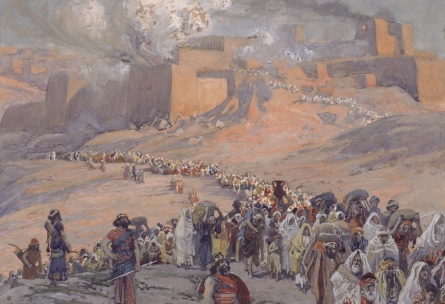
James Tissot, The Flight of the Prisoners

By the rivers of Babylon—there we sat down and there we wept when we remembered Zion. In the willows there we hung up our harps.For there our captors asked us for songs, and our tormentors asked for mirth, saying,

“Sing us one of the songs of Zion!”

How could we sing the Lord’s song in a foreign land? If I forget you, O Jerusalem, let my right hand wither! Let my tongue cling to the roof of my mouth, if I do not remember you,if I do not set Jerusalem above my highest joy. 

Remember, O Lord, against the Edomites the day of Jerusalem’s fall, how they said,

 “Tear it down! Tear it down! Down to its foundations!”

O daughter of Babylon, you devastator! Happy shall they be who pay you back what you have done to us! Happy shall they be who take your little ones and dash them against the rock!   Psalm 137 NRSV

In 721 BCE, after roughly 200 years of separation from the Southern Kingdom of Judah, the Northern Kingdom Israel falls to the Assyrian Empire (which has its origins in the Northwestern Part of modern day Iraq) and the Northern Kingdom is effectively absorbed into the Assyrian nation.  Somehow Judah holds on, even though it becomes completely surrounded by the Assyrian Empire.  Empires come and go, and power shifts to the Babylonian Empire (which has its origins in modern day Southern Iraq) without going into the bloody details: Jerusalem falls, the temple is destroyed, the Davidic monarchy effectively ends and the people of Judah are taken into exile or captivity in Babylon.  The loss of king and temple, as well as the land cause a crisis of authority which leads to one of the most constructive and important periods in Judaism.

The loss of home is catastrophic, it leads to a ton of questions about the future and there may not be any good answers at that point.  The closest cinematic example I could come up with was the loss of Anatevka in Fiddler on the Roof where families try to make the best of their coming exile, belittling what they are leaving behind-and yet families are broken apart, scattered across the world, many will never see each other again.

Something as catastrophic to not only the physical well-being but also to the communal consciousness can lead to several outcomes, many of which do emerge in this time. One response of the conquered is to assimilate with the conqueror, to align oneself with the victor, to adopt their values and practices and to set aside at least a portion of one’s previous identity to become a part of something different.  This is the perceived response of the Northern Kingdom by the Southern Kingdom-they stay on their land, intermarry with the Assyrians, and what emerges will be a hybrid people-no longer really Jewish, already separated from the Davidic monarchy and the temple hundreds of years before they become the other…the Samaritan (yes this is where those Samaritans that Jesus runs into in the New Testament come from).  But to be fair, a large number of the Judeans also assimilate into Babylon, only a small portion of the Judean people will return to their homeland at the end of the exile, most will remain dispersed throughout the nations.

In the lead up to the exile, the prophetic voice becomes very harsh in its critique of the monarchy, temple, the lack of economic justice within the nation, and the perceived idolatry of the shepherds of the nation.  This is the time where the first parts of Isaiah, much of Jeremiah and Ezekiel and many of the Minor Prophets become active in the memory of the people. The prophetic voice leads the way pointing to the ways in which kings and priests, throne and temple have not only failed as sources of authority but are at the very heart of the crisis viewed as a judgment from the LORD.  The prophets announce condemnation for the shepherds (the leaders, the authority in throne and temple) as one example among many:

The word of the Lord came to me: Mortal, prophesy against the shepherds of Israel: prophesy, and say to them—to the shepherds: Thus says the Lord God: Ah, you shepherds of Israel who have been feeding yourselves! Should not the shepherds feed the sheep? You eat the fat, you clothe yourselves with the wool, you slaughter the fatlings: but you do not feed the sheep. You have not strengthened the weak, you have not healed the sick, you have not brought back the strayed, you have not sought the lost, but with force and harshness you ruled them.  So they were scattered, because there was no shepherd: and scattered wandered over all the mountains and on every high hill; my sheep were scattered over the face of the earth, with no one to search or seek for them. Ezekiel 34.1-6 NRSV

 Instead of coming to believe that somehow their God is weaker than the gods of the Assyrians or the Babylonians, something amazing happens in the prophetic imagination (to use Walter Brueggemann’s keen words) and they begin to understand the transitions and the conflict around them as a part of God’s work—that behind Assyrian and Babylonian is the Lord of hosts (literally the Lord of armies-typically we think of this as heavenly armies, but I am beginning to think that in there is something more earthly to this term than often given credit). The coming destruction is a judgment particularly on the leaders, but also within all this death is the chance for something new: a fresh start, a redefinition, a chance to redefine and re-imagine what it means to be the chosen people.

The hand of the Lord came upon me, and he brought me out by the spirit of the Lord and set me down in the middle of the valley; it was full of bones.  He led me around them; there were very many lying in the valley, and they were very dry.  He said to me, “Mortal, can these bones live?” I answered, “O Lord God, you know.” Then he said to me, “Prophecy to these bones, and say to them: O dry bones, hear the word of the Lord. Thus says the Lord God to these bones: I will cause breath to enter you, and you shall live. I will lay sinews on you, and will cause flesh to come upon you, and cover you with skin, and put breath in you, and you shall live; and you shall know that I am the Lord. Ezekiel 37.1-6 NRSV

The prophetic voice will help the people re-imagine a new way forward, a way that is so critical to the way we understand things that we need to take some time with it.  Hope will not die, in fact it will be reborn in a new and powerful way and the people will understand themselves as a chosen people, but what that means takes a dramatic turn in the exile.  To that we shall turn next.

purple rose 01 by picsofflowers.blogspot.com