Tag Archives: Psalm 57

Psalm 108 Old Words Brought Together For A New Time

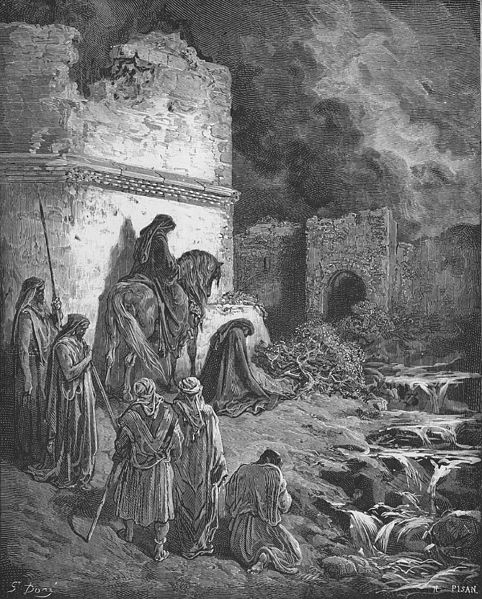
Nehemiah View the Ruins of jerusalem’s Walls, Gustav Dore 1866

Psalm 108

A Song. A Psalm of David.
 1My heart is steadfast, O God, my heart is steadfast; I will sing and make melody. Awake, my soul!
 2Awake, O harp and lyre! I will awake the dawn.
 3I will give thanks to you, O LORD, among the peoples, and I will sing praises to you among the nations.
 4For your steadfast love is higher than the heavens, and your faithfulness reaches to the clouds.
 5Be exalted, O God, above the heavens, and let your glory be over all the earth.
 6Give victory with your right hand, and answer me, so that those whom you love may be rescued.
 7God has promised in his sanctuary: “With exultation I will divide up Shechem, and portion out the Vale of Succoth.
 8Gilead is mine; Manasseh is mine; Ephraim is my helmet; Judah is my scepter.
 9Moab is my washbasin; on Edom I hurl my shoe; over Philistia I shout in triumph.”
 10Who will bring me to the fortified city? Who will lead me to Edom?
 11Have you not rejected us, O God? You do not go out, O God, with our armies.
 12O grant us help against the foe, for human help is worthless.
 13With God we shall do valiantly; it is he who will tread down our foes.

Psalm 108 brings together portions of two psalms attributed to David for a new time. Most interpreters believe that Psalm 57: 7-11 and Psalm 60: 5-12 were written before they were later joined together in the current psalm. This is a common practice in scripture where a key idea or phrase is utilized in multiple contexts[1] but here the entirety of the psalm is a composition of two previous psalms. Psalm 57: 7-11 forms the initial five verses while Psalm 60: 5-12 forms the final eight verses. Based on the position of Psalm 108 in book five of the Psalter the new situation may involve the return of the people to their home after the exile, but even without knowing a concrete situation for the invocation of these words from earlier psalms it points to the long-standing resonance and vitality of these words in the life of the people.

The heart (the organ of will in Hebrew) is steadfast and the proper response to the steadfast love of God is for the entirety of one’s being to respond in praise and song. The steadfast love (hesed) and the faithfulness of God are beyond measure and the psalmist’s gift of song echoes the chorus of a grateful creation to its creator. The joyous ending of Psalm 57 introduces the petition of verse six which initiates the quotation of Psalm 60.

The psalms are spoken from the embodied experience of the covenant people, and that experience involves times where God’s promise and presence feel distant. The beloved ones of God have always understood their continued existence was contingent on God’s continual provision. As in a previous time the people do not need a stronger army or a better military technology, they need the God who reigns over both Israel and the surrounding nations, to come to their aid. As J. Clinton McCann Jr. can articulate.

Their prayer is not that of the powerful, who seek to claim God’s sanction of the status quo. Rather, their prayer is the desperate prayer of those who turn to God as the only possible hope in an apparently hopeless situation (v. 11) (NIB IV:918)

If these words reemerge in the fragile situation of the post-exilic return to Jerusalem where the people are threatened by hostile neighbors, the reminder that Moab, Edom, and Philistia are all under God’s claim[2] is a source of comfort. Yet, the people who claim the title of ‘those whom you love’ now feel the abandonment of God. God no longer goes out with the people or defends them, but they cry out to God for God’s renewed favor.

The psalms understand the dependence of the people upon God’s continual provision but also speak eloquently about the perception of God’s absence. This psalm utilizes two previously utilized psalms to speak of the trust in God’s steadfast love and faithfulness in a time where they feel endangered by God’s absence. Yet, the perception of God’s distance causes the beloved ones of God to cry out to God for deliverance from their current distress. For they can do nothing on their own, but with God they shall do valiantly.


[1] For example, 1 Chronicles 16 brings together Psalm 105: 1-11 and Psalm 106: 35-36, of Isaiah 2: 2-4 is repeated in Micah 4: 2-3. There are numerous other examples of parallels.

[2] The designation of Moab as washbasin, Edom as a place where shoes are hurled, and Philistia as one that the LORD shouts in triumph over may be intended as an insult to these nations, but it also may simply be a way of designating that they too remain under God’s control. Moab, Edom, and Philistia all incur words of judgment in the prophets (Ezekiel 25, Jeremiah 4748, Obadiah 12-13).  

Psalm 57 Fleeing to the Steadfast Love and Faithfulness of God

James Tissot, Moses and Joshua in the Tabernacle (1896-1902)

Psalm 57

<To the leader: Do Not Destroy. Of David. A Miktam, when he fled from Saul, in the cave.>
1 Be merciful to me, O God, be merciful to me, for in you my soul[1] takes refuge; in the shadow of your wings I will take refuge, until the destroying storms pass by.
2 I cry to God Most High, to God who fulfills his purpose for me.
3 He will send from heaven and save me, he will put to shame those who trample on me. Selah God will send forth his steadfast love and his faithfulness.
4 I lie down among lions that greedily devour human prey; their teeth are spears and arrows, their tongues sharp swords.
5 Be exalted, O God, above the heavens. Let your glory be over all the earth.
6 They set a net for my steps; my soul was bowed down. They dug a pit in my path, but they have fallen into it themselves. Selah
7 My heart is steadfast, O God, my heart is steadfast. I will sing and make melody.
8 Awake, my soul![2] Awake, O harp and lyre! I will awake the dawn.
9 I will give thanks to you, O Lord, among the peoples; I will sing praises to you among the nations.
10 For your steadfast love is as high as the heavens; your faithfulness extends to the clouds.
11 Be exalted, O God, above the heavens. Let your glory be over all the earth.

Many of the psalms deal with common themes and use common language. Already in the psalter we have seen psalms repeated[3] and verses 7-11 of Psalm 57 are identical with the beginning of Psalm 108. Well chosen words can make sense within multiple contexts, and the ending of a psalm spoken from the place of trouble (Psalm 57) can be the beginning of a prayer for victory (Psalm 108). For the psalmist, the steadfast love (Hebrew hesed) and faithfulness of God are “the pervasive, fundamental realities of the universe.” (NIB IV, p. 906) The present experience of trouble does not prevent the faithful poet from relying on these realities to provide hope beyond the present moment and meaning in the storms of life they are currently experiencing. With the fundamental realities of the universe being the steadfast love God and the faithfulness of God, the wicked ones which inflict harm and threaten death will find themselves unable to destroy the one finding shelter in the shadow of the wings of God.

The faithful one flees to the presence of God who is their refuge. The powerful image of being sheltered under the wings of God appears for a second time[4] in the psalter and now these wings provide shelter in the midst of the destructive storms (physical or metaphorical) occurring in the psalmist’s life. God provides a safe place in the midst of the troubles, God still has a purpose for the psalmist to fulfill, God will intervene between the faithful one and those who are currently oppressing them. God will send forth the restorative powers of steadfast love and faithfulness which will transform the reality the poet is experiencing and bring an end to the destructive storms.

The opponents here are portrayed metaphorically as lions who devour prey with their sharp teeth and sword like tongues. Perhaps what the psalmist is experiencing is a world where malicious gossip is destroying their name and bringing them shame. If this is the case, those who wound with tongue and tooth and trample with feet to bring shame will be put to shame themselves. Those who set (verbal or physical) snares will find themselves caught within their own snare. The harm the words and actions of these enemies portrayed as lions and hunters are real, and while the poem may speak in metaphors they are not talking about abstract concepts, but the experience of living in a world where individuals wound with words, set traps for the righteous, and use shame to attempt to bring down the faithful.

The psalmist who flees to God’s protective presence, who rests under God’s sheltering wings, and who longs for the expected steadfast love and faithfulness of God knows that their future depends upon God answering their cry. They call upon God to be the God who sees the trampled one and to deliver them. God’s faithful action on their behalf is a demonstration of the reign of God over the earth. They remain steadfast in their heart, the organ of the will in Hebrew thought. Those who have shamed them have now been shamed and their honor (see note 2) now awakens along with their song. They cry out in hope to the dawn, lifting up their song of thanksgiving among their own people and the nations. The steadfast love of God has proven to be as high as the heavens, the faithfulness of God surpasses the earth and extends to the clouds of the sky. The glory of God is over all the earth, and the steadfast love and faithfulness of God have proven to be “the pervasive, fundamental realities of the universe.”

[1] What the NRSV translates ‘soul’ throughout this psalm (with the exception of verse 8) is the Hebrew nephesh which refers to ‘the whole self’ or that which makes a person a person rather than the Greek idea of soul which is separate from life. The Hebrew way of thinking is not about an escape to heaven, but the engagement with the whole of life in the present.

[2] Here the Hebrew kabod refers to ‘honor.’ The NRSV reads this as the similar sounding kabed ‘liver’ in its translation of the word as soul.

[3] Psalm 53 is a close twin of Psalm 14

[4] This imagery is also used in Psalm 17:8, 61:4, 63:7 and 91:4.