Tag Archives: Pharaoh

1 Kings 9 Solomon’s Second Vision and Continued Reign

Isaak Asknaziy, Vanita vanitatum et omnia vanitas (19th Century)

1 Kings 9: 1-9 Solomon’s Second Vision of the LORD

1 When Solomon had finished building the house of the LORD and the king’s house and all that Solomon desired to build, 2 the LORD appeared to Solomon a second time, as he had appeared to him at Gibeon. 3 The LORD said to him, “I have heard your prayer and your plea, which you made before me; I have consecrated this house that you have built, and put my name there forever; my eyes and my heart will be there for all time. 4 As for you, if you will walk before me, as David your father walked, with integrity of heart and uprightness, doing according to all that I have commanded you, and keeping my statutes and my ordinances, 5 then I will establish your royal throne over Israel forever, as I promised your father David, saying, ‘There shall not fail you a successor on the throne of Israel.’

6 “If you turn aside from following me, you or your children, and do not keep my commandments and my statutes that I have set before you, but go and serve other gods and worship them, 7 then I will cut Israel off from the land that I have given them; and the house that I have consecrated for my name I will cast out of my sight; and Israel will become a proverb and a taunt among all peoples. 8 This house will become a heap of ruins; everyone passing by it will be astonished, and will hiss; and they will say, ‘Why has the LORD done such a thing to this land and to this house?’ 9 Then they will say, ‘Because they have forsaken the LORD their God, who brought their ancestors out of the land of Egypt, and embraced other gods, worshiping them and serving them; therefore the LORD has brought this disaster upon them.'”

This second appearance of the LORD to Solomon echoes the covenantal themes that have recurred throughout the initial eight chapters of 1 Kings. Although the consequences for turning aside from keeping the commandments and statutes of the LORD is spoken in more ominous tones directly from the mouth of God, we’ve seen the necessity of obedience in David’s words to Solomon (2:2-4), in the LORD’s first appearance to Solomon (3:14), the word of the LORD during the construction of the temple (6: 11-13), and from Solomon’s own mouth in the extended prayer of dedication (8:22-53). The dedication of the temple and the sacrifices offered there are not enough, nor are they primary to the LORD. The timing of this divine visitation and its charge and warnings should alert us to the danger that Solomon faces as his material prosperity continues. Knowing the failures of the end of Solomon’s reign this warning at the apex of his success may help the attentive reader begin to see that Solomon, “did not fail overnight; darker strands and shadows are revealed, indicating the deep flaws that threatened the impressive national enterprise.” (Israel, 2013, p. 113)

The LORD’s response to Solomon indicates that God is listening to the prayers offered at the temple and that God continues to fix God’s vision and God’s will upon this place where the people can come to offer their petitions and their sacrifices. Yet, it is not Solomon who has consecrated the temple but the LORD. The covenant is once again restated and Solomon who earlier asked for wisdom is again offered the path of wisdom. In stark language the cost of disobedience is spelled out and the presence of the temple is not a guarantee of God’s protection if the people and their king do not practice obedience. The city, the temple and the nation of Israel are all contingent on the provision of the LORD and if they turn away they will be an example that others will ‘hiss’ at to avoid sharing their curse as they pass by.[1] Solomon is asked to navigate the uneasy tension between his consolidation of power and wealth in his ‘royal growth economy’ (Brueggemann, 2000, p. 128) and the principles of the Law of God.

1 Kings 9: 10-14 Entanglement with the Ways of Tyre and Egypt

0 At the end of twenty years, in which Solomon had built the two houses, the house of the LORD and the king’s house, 11 King Hiram of Tyre having supplied Solomon with cedar and cypress timber and gold, as much as he desired, King Solomon gave to Hiram twenty cities in the land of Galilee. 12 But when Hiram came from Tyre to see the cities that Solomon had given him, they did not please him. 13 Therefore he said, “What kind of cities are these that you have given me, my brother?” So they are called the land of Cabul to this day. 14 But Hiram had sent to the king one hundred twenty talents of gold.

15 This is the account of the forced labor that King Solomon conscripted to build the house of the LORD and his own house, the Millo and the wall of Jerusalem, Hazor, Megiddo, Gezer 16 (Pharaoh king of Egypt had gone up and captured Gezer and burned it down, had killed the Canaanites who lived in the city, and had given it as dowry to his daughter, Solomon’s wife; 17 so Solomon rebuilt Gezer), Lower Beth-horon, 18 Baalath, Tamar in the wilderness, within the land, 19 as well as all of Solomon’s storage cities, the cities for his chariots, the cities for his cavalry, and whatever Solomon desired to build, in Jerusalem, in Lebanon, and in all the land of his dominion. 20 All the people who were left of the Amorites, the Hittites, the Perizzites, the Hivites, and the Jebusites, who were not of the people of Israel — 21 their descendants who were still left in the land, whom the Israelites were unable to destroy completely — these Solomon conscripted for slave labor, and so they are to this day. 22 But of the Israelites Solomon made no slaves; they were the soldiers, they were his officials, his commanders, his captains, and the commanders of his chariotry and cavalry.

23 These were the chief officers who were over Solomon’s work: five hundred fifty, who had charge of the people who carried on the work.

24 But Pharaoh’s daughter went up from the city of David to her own house that Solomon had built for her; then he built the Millo.

25 Three times a year Solomon used to offer up burnt offerings and sacrifices of well-being on the altar that he built for the LORD, offering incense before the LORD. So he completed the house.

26 King Solomon built a fleet of ships at Ezion-geber, which is near Eloth on the shore of the Red Sea,1 in the land of Edom. 27 Hiram sent his servants with the fleet, sailors who were familiar with the sea, together with the servants of Solomon. 28 They went to Ophir, and imported from there four hundred twenty talents of gold, which they delivered to King Solomon.

Many readers of 1 Kings will see chapters nine and ten as a testament to Solomon’s wise management of the kingdom of Israel, but on closer inspection it is clear that something is amiss in the administration of Solomon. Solomon has become entangled in the ways of King Hiram of Tyre and the Pharaoh of Egypt. In this and the following chapter the word gold is written seventeen times and this gold standard illustrates Solomon’s focus on indulgence and extravagance.  (Israel, 2013, p. 116) The arrangement with King Hiram was dependent on the continued agricultural prosperity of the land of Israel, but now Solomon has either fallen in arears in his payments to Hiram or is so desperate for gold that he hands over twelve towns in the northern part of the kingdom. The area which the displeased King of Tyre labels ‘Cabul’ is an agriculturally prosperous region, and we have no indication of why Hiram is unhappy with the transaction. It is possible that Hiram is continuing to attempt to manipulate the deal in his favor or that the recording of this being unpleasing land softens the domestic blow for Solomon. Regardless, the ceding of a portion of the land to another nation in exchange for gold (and perhaps debt relief) indicates that the land and the people are less important to Solomon than gold.

We return to the use of forced labor again, and now (in contrast to 5:27-30) the text indicates that it is only other conquered people who are used in forced labor. Yet, the scale of these projects would probably be impossible without the employment of the people of Israel in all these projects. Even if it is only the Canaanites who are now placed in forced labor, this casts Solomon in a similar light as Pharaoh. In addition to the temple and Solomon’s houses there are several other major projects listed: the Millo (likely a terrace system on the eastern side of Jerusalem), walled cities (the primary defensive structure of the time), cities for storage, and for his military garrisons. The last two again parallel Solomon and Pharaoh. The word for ‘storage cities’ (arei miskenot)[2] recalls Israel’s enslavement in Egypt, but now Solomon is the king. (Israel, 2013, p. 117) Solomon’s adoption of an army built around chariots and cavalry also is adopting the primary weapons utilized by Egypt, and this is the item a king of Israel is not to go to Egypt to acquire (Deuteronomy 17: 16). In addition we are reminded of this connection by the mention of Pharaoh’s daughter who Solomon has already constructed a house for.

Finally Solomon continues his alliance with Tyre and learning the ways of this seafaring and trading nation. It is interesting that Solomon constructs his fleet in Ezion Geber in Edom which gives him access to the Gulf of Aqaba and the Red Sea to the south instead of the Great Sea ‘what we call the Mediterranean) in the west. Solomon may no longer be in control of the Philistine territories that his father David subdued, or it may be in Tyre’s best interest to have access to the southern passage which leads to Ethiopia (Cush) and Eastern Africa. Once again the adoption of the ways of Tyre brings Solomon additional wealth from Ophir, but Solomon’s use of wisdom for the acquisition of larger quantities of gold and other objects of luxury, his emulation of the ways of Pharaoh and King Hiram, and his continual employment of forced labor placed alongside his continued piety at the temple suggest the deep flaws in this national enterprise. Solomon seems to have gained the world but to have sold his soul of the nation for gold.

[1] This is a phrase used in Jeremiah 18:16 and 19:8 as Jeremiah attempts to warn the people of God’s coming judgment. (Cogan, 2001, p. 296)

[2] Only used here and in Exodus 1:11 (Cogan, 2001, p. 303)

Exodus 7: The Conflict Begins

Ancient Egyptian Art Depicting Apep battling a Diety from the tomb of Inher-kha, Thebes

Exodus 7: 1-13 The Initial Challenge

The LORD said to Moses, “See, I have made you like God to Pharaoh, and your brother Aaron shall be your prophet. 2 You shall speak all that I command you, and your brother Aaron shall tell Pharaoh to let the Israelites go out of his land. 3 But I will harden Pharaoh’s heart, and I will multiply my signs and wonders in the land of Egypt. 4 When Pharaoh does not listen to you, I will lay my hand upon Egypt and bring my people the Israelites, company by company, out of the land of Egypt by great acts of judgment. 5 The Egyptians shall know that I am the LORD, when I stretch out my hand against Egypt and bring the Israelites out from among them.” 6 Moses and Aaron did so; they did just as the LORD commanded them. 7 Moses was eighty years old and Aaron eighty-three when they spoke to Pharaoh.

 8 The LORD said to Moses and Aaron, 9 “When Pharaoh says to you, ‘Perform a wonder,’ then you shall say to Aaron, ‘Take your staff and throw it down before Pharaoh, and it will become a snake.'” 10 So Moses and Aaron went to Pharaoh and did as the LORD had commanded; Aaron threw down his staff before Pharaoh and his officials, and it became a snake. 11 Then Pharaoh summoned the wise men and the sorcerers; and they also, the magicians of Egypt, did the same by their secret arts. 12 Each one threw down his staff, and they became snakes; but Aaron’s staff swallowed up theirs. 13 Still Pharaoh’s heart was hardened, and he would not listen to them, as the LORD had said.

The liberation of the people of Israel from their servitude to the Egyptians in not just a conflict between peoples, at its root it is a conflict between the LORD the God of Israel and the Egyptian gods. Moses becomes the vessel of the LORD’s work against the Egyptians and Pharaoh and the ‘wise men, the sorcerers and the magicians of Egypt’ line up on the other side. The central two characters, Moses and Pharaoh, both become representative or avatars of the divine power behind them. Moses here will be ‘like a God to Pharaoh, and your brother Aaron shall be your prophet.’ Pharaoh derives his authority from a divine claim that the Pharaoh is a ‘son of Ra’ the chief god of the Egyptian pantheon. Two conflicting views of creation (Ra is the chief god of not only the sun but creation for Egypt) and two conflicting views of the way that world should be structured are in play. Within Egypt, the superpower of that era, Pharaoh is all powerful and yet in this narrative Pharaoh plays a tragic character. Pharaoh will not listen to Aaron and Moses initially, but the conflict between competing sources of divine power will be seen not only by the individual players but also by both peoples (the Egyptians and the Hebrews). The end is that even the Egyptians will ‘know that I am the LORD,’ as the coming ecological disasters will testify to the power of the LORD over creation and the inability of Ra and those loyal to him to prevent this upheaval.

One of the places where translations don’t quite do justice to the original language is here with the language about the snakes that come from Aaron’s and what comes out of the Egyptians staffs. The word here in Hebrew is Tannin which is not the typical word for snake but rather for the serpent like chaos monster or dragon. Both sets of Tannin, from Aaron’s staff and the Egyptian magicians, are forces of war and destruction and chaos. Here chaos is unleashed symbolically in a struggle between the LORD of Israel and the lords of Egypt. Interestingly, to me at least, in Egyptian mythology the nightly struggle of Ra is against Apep (or Apophis) the snake like force of evil and chaos but now in matching the display of power by the LORD unleashing the forces of chaos even the emissaries of Pharaoh, son of Ra, must unleash their own forces of chaos. Ultimately it is the tannin released by Aaron which swallows the tannin released by the wise men of Egypt and this initial conflict foreshadows the chaos unleashed on creation that is to come. One of the things that begins here is the inability of the Egyptian wise men, sorcerers and magicians to undo what has been unleashed through Moses and Aaron. They may initially replicate what Moses and Aaron do but they cannot undo it. They can only add to the chaos which threatens to consume all of Egypt.

One of the aspects of this and the following passage to consider is the ‘hardening of Pharaoh’s heart.’ There are certain passages where Pharaoh himself is the one who hardens his heart and others where the heart of Pharaoh is hardened by God. For those looking for a definitive answer to the tricky question of divine determinism I am afraid you are likely to be disappointed. Many interpreters see within this, and each interpreter makes theological choices based on their understanding of God, for Pharaoh’s free will remaining intact and the responsibility for the choices remaining entirely on Pharaoh’s shoulders. Others take serious this hardening of Pharaoh’s heart by the LORD and see the enslaver losing his own free will and becoming the tool that once the enslaved Hebrew people were. The truth is probably subtler as the ancient writers of the Bible were not dogmatically rigid. Divine determinism and free will could coexist without any perceived conflict. Perhaps, as Rabbi Jonathan Sacks can state:

Pharaoh is in fact…a tragic figure like Lady Macbeth, or like Captain Ahab in Melville’s Moby Dick, trapped in an obsession which may have had rational beginnings, right or wrong, but which has taken hold of him, bringing not only him but those around him to ruin. (Sacks, 2010, p. 49)

Perhaps Pharaoh is merely trapped within a worldview that cannot imagine letting the Hebrew slaves go. Perhaps Pharaoh’s heart and mind receive some divine nudge to harden his resolve and will as the chaos unfolds around him and his people. Perhaps Pharaoh, who views himself as the king on the chess board is merely a pawn being played. Regardless Pharaoh, the son of Ra, will be unable to avoid being swallowed up by the chaos unleashed as he struggles against the LORD. The gauntlet has been thrown, the challenge has begun for the lives of both peoples. Warnings are unheeded, hearts are hardened and next the heart of Egypt will bleed.

The Roman Kiosk of Trajan (left) on Agilkia island in the Nile River, near Aswān, Egypt

Exodus 7: 14-25 The Bleeding Heart of Egypt

 14 Then the LORD said to Moses, “Pharaoh’s heart is hardened; he refuses to let the people go. 15 Go to Pharaoh in the morning, as he is going out to the water; stand by at the river bank to meet him, and take in your hand the staff that was turned into a snake. 16 Say to him, ‘The LORD, the God of the Hebrews, sent me to you to say, “Let my people go, so that they may worship me in the wilderness.” But until now you have not listened.’ 17 Thus says the LORD, “By this you shall know that I am the LORD.” See, with the staff that is in my hand I will strike the water that is in the Nile, and it shall be turned to blood. 18 The fish in the river shall die, the river itself shall stink, and the Egyptians shall be unable to drink water from the Nile.'” 19 The LORD said to Moses, “Say to Aaron, ‘Take your staff and stretch out your hand over the waters of Egypt– over its rivers, its canals, and its ponds, and all its pools of water– so that they may become blood; and there shall be blood throughout the whole land of Egypt, even in vessels of wood and in vessels of stone.'”

20 Moses and Aaron did just as the LORD commanded. In the sight of Pharaoh and of his officials he lifted up the staff and struck the water in the river, and all the water in the river was turned into blood, 21 and the fish in the river died. The river stank so that the Egyptians could not drink its water, and there was blood throughout the whole land of Egypt. 22 But the magicians of Egypt did the same by their secret arts; so Pharaoh’s heart remained hardened, and he would not listen to them; as the LORD had said. 23 Pharaoh turned and went into his house, and he did not take even this to heart. 24 And all the Egyptians had to dig along the Nile for water to drink, for they could not drink the water of the river.

 25 Seven days passed after the LORD had struck the Nile.

The Nile River, or to the ancient Egyptians simply the river, is the heart of the Egyptian empire. Egypt was shielded from other early civilizations by deserts on both sides and the Nile river delta provided for an agricultural abundance that allowed the people to focus on the construction of large public projects like the pyramids. The river is a source of food, transportation, and ultimately life. Without the Nile River, there is no Egyptian empire and even though the Nile never becomes a significant source of worship for the Egyptians, it is simply an assumed part of life. Yet, it is here that the LORD instructs Moses and Aaron to strike first. The heart of the Egyptian empire bleeds, life begins to end and an ecological disaster begins to unfold.

This begins a highly-structured telling of the signs and wonders that bring the people out of Egypt. In the three sets of three where the first in each set Moses speaks to Pharaoh outside in the morning, the second Moses speaks to Pharaoh inside in the palace and the third comes abruptly without a warning. Some would argue ecologically that one plague would naturally follow the others because of the ecological devastation, and while that may be true the narrative moves where the LORD is in control of each sign and wonder unfolding.

In Genesis 3, the end of the story of Adam and Eve, the disobedience by Adam and Eve which is supposed to result in their own deaths is ultimately born by the earth (see Genesis 3: 17). Here also it is the earth which bears the consequences of the disobedience of Pharaoh. Of the first nine signs, only the hail is fatal to humans and even then, Pharaoh and his people are warned to bring their people and animals into a secure place with a twenty-four-hour warning. Each sign seems designed to make the Egyptians aware that it is the LORD who is the God who has power over the creation and here the waters of Egypt are the first to bear the consequence of the refusal of Pharaoh to let the people go to worship the LORD.

Again, the magicians of Egypt, by their secret arts, are able to replicate this chaos with some of the uncontaminated water and yet they are unable to reverse or limit the effects. They can only contribute to the chaos. The river turns to blood, the fish die and the waters stink and are unable to drink. The lifeblood of Egypt is now biological waste and yet the people continue to find a way. Even though the river will be contaminated people are still able to dig for freshwater along the banks of the river. The ecological disaster forces the people to change their patterns and yet the Egyptians continue to find the water they need for life to continue. Pharaoh’s heart remains hardened and his will is resolved since his priests can apparently in some way replicate what the LORD is doing through Moses and Aaron. Perhaps, he is also shielded from the immediate effects since he would not dig for his own water, ultimately slaves or servants would do that for him. He retreats to his house without taking to heart the bleeding heart of his empire. He closes his eyes and his doors to the disaster beginning to unfold around him.

Exodus 5: The Oppression of the Israelites Increases

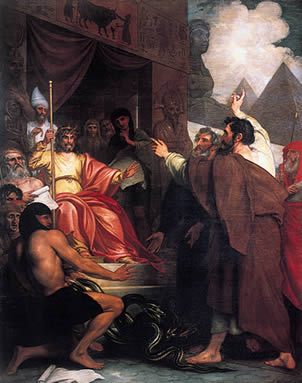
Benjamin West (1738-1820), Moses and Aaron Before Pharaoh

Benjamin West (1738-1820), Moses and Aaron Before Pharaoh

Exodus 5: 1-9: The Initial Audience with Pharaoh

Afterward Moses and Aaron went to Pharaoh and said, “Thus says the LORD, the God of Israel, ‘Let my people go, so that they may celebrate a festival to me in the wilderness.'” 2 But Pharaoh said, “Who is the LORD, that I should heed him and let Israel go? I do not know the LORD, and I will not let Israel go.” 3 Then they said, “The God of the Hebrews has revealed himself to us; let us go a three days’ journey into the wilderness to sacrifice to the LORD our God, or he will fall upon us with pestilence or sword.” 4 But the king of Egypt said to them, “Moses and Aaron, why are you taking the people away from their work? Get to your labors!” 5 Pharaoh continued, “Now they are more numerous than the people of the land and yet you want them to stop working!” 6 That same day Pharaoh commanded the taskmasters of the people, as well as their supervisors, 7 “You shall no longer give the people straw to make bricks, as before; let them go and gather straw for themselves. 8 But you shall require of them the same quantity of bricks as they have made previously; do not diminish it, for they are lazy; that is why they cry, ‘Let us go and offer sacrifice to our God.’ 9 Let heavier work be laid on them; then they will labor at it and pay no attention to deceptive words.”

The initial audience for Moses and Aaron with the Pharaoh makes matters worse instead of better for the Hebrew people. The authority that they can claim from the LORD is immediately met with the question from Pharaoh, “Who is the LORD?” I find it intriguing that the initial threat is on the Israelites, that if they do not go into the wilderness to sacrifice then pestilence and sword will fall on them, rather than the Egyptians. While the LORD has revealed Godself to Moses and Aaron, Pharaoh has not received any type of revelation yet. Pharaoh’s gods are very different from the LORD the God of Israel. Egypt’s gods are the gods that authorize the reign of Pharaoh and the enslavement of the people. Yet, the God of Israel has heard their cry and has called Moses and Aaron to carry to Pharaoh this initial plea to let the people go.

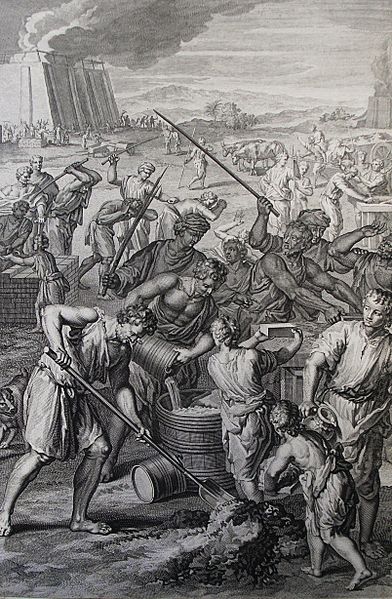
Pharaoh resorts to victim blaming. Although there is perhaps some vulnerability in the statement that, “Now they are more numerous than the people of the land” and the fear of what a day without their immigrants would look like, the Hebrew people are immediately scapegoated as lazy. Pharaoh uses the bureaucracy to separate himself from the suffering of the Hebrew people and to increase it mercilessly. Unlike the LORD, Pharaoh refuses to hear and see. There is no Sabbath rest for the people of Israel, only the iron hand of oppression. In laying before the people the impossible task of making bricks without straw and charging them to gather straw from the remnants of the field Pharaoh insures that they will continue to be less productive and ‘lazy’ in the eyes of the oppressor.

Exodus 5: 10-21: The Oppression Increases

 10 So the taskmasters and the supervisors of the people went out and said to the people, “Thus says Pharaoh, ‘I will not give you straw. 11 Go and get straw yourselves, wherever you can find it; but your work will not be lessened in the least.'” 12 So the people scattered throughout the land of Egypt, to gather stubble for straw. 13 The taskmasters were urgent, saying, “Complete your work, the same daily assignment as when you were given straw.” 14 And the supervisors of the Israelites, whom Pharaoh’s taskmasters had set over them, were beaten, and were asked, “Why did you not finish the required quantity of bricks yesterday and today, as you did before?”

15 Then the Israelite supervisors came to Pharaoh and cried, “Why do you treat your servants like this? 16 No straw is given to your servants, yet they say to us, ‘Make bricks!’ Look how your servants are beaten! You are unjust to your own people.” 17 He said, “You are lazy, lazy; that is why you say, ‘Let us go and sacrifice to the LORD.’ 18 Go now, and work; for no straw shall be given you, but you shall still deliver the same number of bricks.” 19 The Israelite supervisors saw that they were in trouble when they were told, “You shall not lessen your daily number of bricks.” 20 As they left Pharaoh, they came upon Moses and Aaron who were waiting to meet them. 21 They said to them, “The LORD look upon you and judge! You have brought us into bad odor with Pharaoh and his officials, and have put a sword in their hand to kill us.”

It is the supervisors, those from among the people who are placed in a position of

The Phillip Medhurst Picture Torah, Pharaoh Adds to the Work of the Israelites

The Phillip Medhurst Picture Torah, Pharaoh Adds to the Work of the Israelites

authority who will become those most directly impacted by Pharaoh’s words.  The people will fail at their impossible task, Pharaoh will continue to blame the supervisors and the people for being lazy and supervisors now find themselves beaten by the taskmasters. Even though the supervisors go and appeal to Pharaoh they have the request of Aaron and Moses thrown in their faces as evidence of their laziness. Their past loyalty to the king of Egypt does not count when they now find themselves bearing the people’s punishment. Perhaps this drives the supervisors back to being a part of the people rather than primarily aligning with the empire but in Pharaoh’s response they see that their positions of favor have changed to disfavor.

Egypt, as it is portrayed in Exodus, was an empire build upon the enslavement of an immigrant people. The Hebrew people are viewed as other, somehow lesser than the people of the land. Their forced labor allowed for the consolidation of wealth and power among the elite rulers and priestly members of their society. Systems of oppression to not change easily or willingly. There are often elaborate beliefs that are invisibly woven around one group’s privilege and another’s oppression. Even in modern times we are not free from systems where we blame the victim or where one group of people has an often unseen, perhaps obscured by systems of bureaucracy like in our narrative, set of privileges or benefits. In the United States, a country founded on a stated creed that ‘all men are created equal’ it took, for example, a civil war and then one hundred years of struggle (often overlooked) until the voting rights act could make it legal for African Americans to be able to vote and that struggle for voice and vote continues for people of color, women and many other groups.

One of the rhetorical moves of the Civil Rights movement was to take the Exodus narrative, which was so important in the founding of the United States, and recast it where now instead of white Americans being able to claim the mantle of the Hebrews entering the promised land, now it is the African Americans who are the chosen people and whites are recast in the role of Pharaoh and his taskmasters. Within the Civil Rights movement, like in the Exodus story, the oppression of the captive people became harsher before they earned a greater equality than what they had before. The Civil Rights leaders probably had several of their own people accuse them like the supervisors did to Moses and Aaron, for the struggle was not to be over in one day or one set of words. In Egypt, it will take an act of God for the people to leave their oppression. In our day, may our hearts not be so hardened as Pharaohs would be.

Exodus 5: 22-23: Moses’ Accusation of God

 22 Then Moses turned again to the LORD and said, “O LORD, why have you mistreated this people? Why did you ever send me? 23 Since I first came to Pharaoh to speak in your name, he has mistreated this people, and you have done nothing at all to deliver your people.”

Moses has some chutzpah. This will not be the last time Moses speaks boldly to God, nor will Moses be the only exemplar of this. The prophet Jeremiah’s words to God were often very direct and accusing, see for example Jeremiah 15 and Jeremiah 20. Many of the Psalms of lament, for example Psalm 10 or Psalm 22 accuse God of either hiding Godself in times of trouble or forsaking the Psalmist. One of the gifts of our scriptures is the direct way that the people of faith could appeal to God. Here Moses, the one who feared using his voice, can now lift his voice to God in protest God’s mistreatment of the people and sending him as a bearer of sorrow to them. God has not yet fulfilled his promise to deliver the people and as Moses can boldly state he has done nothing to deliver them yet. God will hear the cries of the people and will hear the words of Moses. I stated in an earlier chapter that perhaps one of the characteristics of Moses that God saw and chose was his inability to remain inactive in the fact of oppression. Now Moses lifts up to God the cries and accusations of the people. Unlike Pharaoh, the LORD will not remain unmoved.