Tag Archives: Oracles against Egypt

Ezekiel 32 Concluding the Oracles Against Egypt

Nile Crocodile Eating a Wildabeast in the Masai Mara By Arturo de Frias Marques – Own work, CC BY-SA 4.0, https://commons.wikimedia.org/w/index.php?curid=34596035

Ezekiel 32: 1-16 Egypt as the Dragon of the Seas

1In the twelfth year, in the twelfth month, on the first day of the month, the word of the LORD came to me: 2Mortal, raise a lamentation over Pharaoh king of Egypt, and say to him:
You consider yourself a lion among the nations,
but you are like a dragon in the seas;
you thrash about in your streams,
trouble the water with your feet,
and foul your streams.
3Thus says the Lord GOD:
In an assembly of many peoples
I will throw my net over you;
and I will haul you up in my dragnet.
4I will throw you on the ground,
on the open field I will fling you,
and will cause all the birds of the air to settle on you,
and I will let the wild animals of the whole earth gorge themselves with you.
5I will strew your flesh on the mountains,
and fill the valleys with your carcass.
6I will drench the land with your flowing blood
up to the mountains,
and the watercourses will be filled with you.
7When I blot you out, I will cover the heavens,
and make their stars dark;
I will cover the sun with a cloud,
and the moon shall not give its light.
8All the shining lights of the heavens
I will darken above you,
and put darkness on your land,
says the Lord GOD.
9I will trouble the hearts of many peoples,
as I carry you captive among the nations,
into countries you have not known.
10I will make many peoples appalled at you;
their kings shall shudder because of you.
When I brandish my sword before them,
they shall tremble every moment
for their lives, each one of them,
on the day of your downfall.
11For thus says the Lord GOD:
The sword of the king of Babylon shall come against you.
12I will cause your hordes to fall
by the swords of mighty ones,
all of them most terrible among the nations.
They shall bring to ruin the pride of Egypt,
and all its hordes shall perish.
13I will destroy all its livestock
from beside abundant waters;
and no human foot shall trouble them any more,
nor shall the hoofs of cattle trouble them.
14Then I will make their waters clear,
and cause their streams to run like oil, says the Lord GOD.
15When I make the land of Egypt desolate
and when the land is stripped of all that fills it,
when I strike down all who live in it,
then they shall know that I am the LORD.
16This is a lamentation; it shall be chanted.
The women of the nations shall chant it.
Over Egypt and all its hordes they shall chant it,
says the Lord GOD.

The sixth oracle against Egypt is labeled as a lamentation and is framed by the Hebrew word for lamentation once in the second verse and four times[1] in verse sixteen. Yet, the intervening poem does not share the normal pattern of lifting in praise the object of the lament followed by a fall in most biblical laments. Within the larger structure of Ezekiel, the previous chapter may fulfill this purpose, but this ‘dragon of the seas’ while a mighty beast is not a sympathetic character at the beginning of the lament. Yet, unlike the previous usage of a metaphor for Assyria, as a great tree felled, the imagery is directly related to Egypt’s Pharoah and its military might.

In contrast to the self-perception of Pharoah as a lion among the nations,[2] but the LORD indicates through Ezekiel that he is a ‘dragon of the seas.’ We are again exposed to the Hebrew word tannin, here dragon, which often refers to a mythical sea creature and in chapter 29 referred to Pharoah as a crocodile. Here there are crocodile-like elements, the creature has feet instead of fins or flippers, but instead of being a creature of the rivers it is a creature of the seas. Part of this contrasting set of metaphors may be related to Egypt’s perception of themselves as a land-based power with a strong army (a lion among the nations) but their real power may be in their naval and merchant fleets which would prove less valuable in a defense of the homeland. Yet, this ‘dragon of the seas’ now seems to be confined to thrashing about in its streams, troubling the water with its feet, and fouling the streams. The presence of this ‘dragon of the seas’ presents in the image an ecological crisis for the waters it inhabits.

This massive beast is summarily dealt with when a net is thrown over it and it is brought out of the waters and cast on the land. Previously the LORD had cast his net over Zedekiah,[3] now the Egyptian Pharoah who Zedekiah appealed to for aid against Babylon is also ensnared. The timing of this oracle, indicated by Ezekiel’s date as March 3, 585 BCE would be two months after the exiles learn of the destruction of Jerusalem, may indicate the reason for this oracle.  Although the city is gone there may still be some lingering hope that the great sea dragon of Egypt would rouse itself fully and attack Babylon in retaliation for Jerusalem. For Ezekiel the army of Babylon under Nebuchadrezzar has been functioning on behalf of the God of Israel and now only Egypt opposes the reign of Babylon. Yet, in Ezekiel’s image the sea dragon is out of its element and serves only as food for the birds of the air and the wild animals who gorge on it. The dragon is now the food for vultures and jackals.

The metaphorical destruction of Egypt’s hordes and Pharoah has both grotesque elements and cosmic elements. Egypt is not a land of mountains and valleys, yet the carcass of the beast falls on both mountains and valleys and the blood of the beast fills the land. At the same time the defeat of this beast causes the sun, moon, and the stars to be blocked out.[4] Such a drastic change on the seas and the earth is reflected by the shrouding of the heavens. The impact of Egypt’s departure from the nations causes other kings to shudder when the LORD responsible for this upheaval brandishes his sword at them as well.

The sword of the LORD is quickly indicated to be the sword of the king of Babylon and the swords of his mighty ones. They are both the most terrible among the nations and yet they are still the chosen instrument of God. Both the humans and the animals of Egypt are destroyed, and the land is desolate. Although there is a positive ecological impact on the waters as humans and animals are removed. The once fouled and troubled waters now flow like oil.

The great sea monster, just like the crocodile-like figure in chapter 29, is removed from their element and the predator becomes prey. Isaiah will later utilize a similar praise for God’s strength over Egypt by saying:

Awake, awake, put on strength, O arm of the LORD! Awake, as in days of old, the generations of long ago! Was it not you who cut Rahab in pieces, who pierced the dragon? Isaiah 53:9[5]

Ezekiel has condemned Jerusalem’s leadership for trusting in Egypt instead of the LORD. Ezekiel’s voice was probably not popular during this time when the nation of Judah collapsed, but Ezekiel’s continual emphasis on God’s strength being enacted through Babylon likely helped the people make sense of their shattered lives in the aftermath of the destruction of Jerusalem, the temple, and their political system. Ezekiel’s imagery may have also influenced the beast from the sea in Revelation13:1-10.[6]

Ezekiel 31: 17-32 Egypt Goes Down to the Pit


17In the twelfth year, in the first month, on the fifteenth day of the month, the word of the LORD came to me:
18Mortal, wail over the hordes of Egypt,
and send them down,
with Egypt and the daughters of majestic nations,
to the world below,
with those who go down to the Pit.
19“Whom do you surpass in beauty?
Go down! Be laid to rest with the uncircumcised!”
20They shall fall among those who are killed by the sword. Egypt has been handed over to the sword; carry away both it and its hordes. 21The mighty chiefs shall speak of them, with their helpers, out of the midst of Sheol: “They have come down, they lie still, the uncircumcised, killed by the sword.”
22Assyria is there, and all its company, their graves all around it, all of them killed, fallen by the sword. 23Their graves are set in the uttermost parts of the Pit. Its company is all around its grave, all of them killed, fallen by the sword, who spread terror in the land of the living.
24Elam is there, and all its hordes around its grave; all of them killed, fallen by the sword, who went down uncircumcised into the world below, who spread terror in the land of the living. They bear their shame with those who go down to the Pit. 25They have made Elam a bed among the slain with all its hordes, their graves all around it, all of them uncircumcised, killed by the sword; for terror of them was spread in the land of the living, and they bear their shame with those who go down to the Pit; they are placed among the slain.
26Meshech and Tubal are there, and all their multitude, their graves all around them, all of them uncircumcised, killed by the sword; for they spread terror in the land of the living. 27And they do not lie with the fallen warriors of long ago who went down to Sheol with their weapons of war, whose swords were laid under their heads, and whose shields are upon their bones; for the terror of the warriors was in the land of the living. 28So you shall be broken and lie among the uncircumcised, with those who are killed by the sword.
29Edom is there, its kings and all its princes, who for all their might are laid with those who are killed by the sword; they lie with the uncircumcised, with those who go down to the Pit.
30The princes of the north are there, all of them, and all the Sidonians, who have gone down in shame with the slain, for all the terror that they caused by their might; they lie uncircumcised with those who are killed by the sword, and bear their shame with those who go down to the Pit.
31When Pharaoh sees them, he will be consoled for all his hordes — Pharaoh and all his army, killed by the sword, says the Lord GOD. 32For he spread terror in the land of the living; therefore he shall be laid to rest among the uncircumcised, with those who are slain by the sword — Pharaoh and all his multitude, says the Lord GOD.

This final oracle against both Egypt and the nations consigns Pharoah and his multitude to the Pit along with the nations who went before. There is no month in the Hebrew text for the date and the NRSV assumes that it should be the first month of the twelfth year, although I agree with both Block, and other scholars, who follow the cue of the previous oracle and have it in the first month roughly two weeks after the sixth oracle. (Block, 1998, p. 216) Egyptian royalty invested heavily in creating royal tombs to ensure that in their afterlife they would have both wealth and power, but here they join all the other nations in the Pit or Sheol. Both the Egyptians and Phoenicians mentioned here practiced circumcision, so their coming down to lie with the uncircumcised means a dishonorable death. Instead of the wealth and power they exercised, all that waits for them in Sheol is the presence of the other nations who went before.

This final oracle is highly repetitive using words like horde, go down, uncircumcised, and sword frequently in its descriptions. All these empires or nations had armies, all failed and suffered shame, all were overthrown by a greater empire with a larger army (sword). Assyria’s domain had once been great, and their rule was violent. Empires in the ancient world were violent and the accusation of spreading terror fits with Assyria’s self-description of their rule under Shalmaneser III:

I slew their warriors with the sword, descending upon them like (the god) Adad when he makes the rainstorm pour down. In the moat (of the town) I piled them up, I covered the wide plain with the corpses of their fighting me, I dyed the mountains with their blood like red wool. I took away from him many chariots (and) horses broken to the yoke. I erected pillars of skulls in front of his town, destroyed his (other) towns, tore down (their walls) and burnt (them) down. (ANET 277 quoted in NIB VI: 1442)

Now these once fierce Assyrians with their graves surrounding their leaders who once spread terror in the land of the living occupy the uttermost parts of the Pit. They were violent in life but now in death they are a part of the company of the dishonored who await Egypt. Elam, from modern day Iran, appear in the biblical writing rarely, although Jeremiah has an oracle against the Elamites,[7] and Isaiah portrays Elam as a nation skilled in archery and chariotry (or cavalry) which participated in Assyria’s attack of Judah.[8] Meshech-Tubal appeared in Ezekiel 27: 13 as nations who trafficked in the slave trade and bronze vessels and they will appear in Ezekiel 38:2 as allies of Gog. Unlike some mysterious other warriors who went down to an honorable burial (with their weapon and shield) they have arrived in Sheol bereft of the weapons they once terrified the nations with. Edom received its own oracle in Ezekiel 25: 12-14 and was one of Judah’s close neighbors, while the princes of the north and Sidonians likely refer to the Phoenicians who control Tyre and Sidon.[9]

Sheol or the Pit are not places of torment like the later conceptions of Hell but are places of darkness.[10] It is not the hoped afterlife of the Egyptian rulers, but the consolation that is offered to Egypt is that they are not alone in being consigned to the dustbin of history. They take up their place among these other nations who once terrified the people in the place of the dead, disarmed and dishonored. Katheryn Pfisterer Darr notes insightfully that for all Ezekiel’s threats to Israel, God never consigns them to the Sheol. (NIB VI: 1445)

[1] The Hebrew qina, qonem is behind both lamentation and chant in verse sixteen.

[2] The nations (goyim) and many peoples are repetitive and unifying structures for this oracle.

[3] Ezekiel 12:13, 17:20.

[4] The prophet Joel uses similar darkening of the heavenly lights for the coming day of the LORD in Joel 2:10.

[5] Rahab is a cypher for Egypt as seen in Isaiah 30:7 and Psalm 87:4.

[6] Revelation’s description of the beast from the sea is significantly different from Ezekiel’s description of this ‘sea dragon’ but Ezekiel is one of the dominant influences on the imagery of Revelation.

[7] Jeremiah 49: 35-39.

[8] Isaiah 22:6.

[9] Ezekiel 2628.

[10] See my reflection on Gehenna, Tartaros, Sheol, Hades, and Hell.
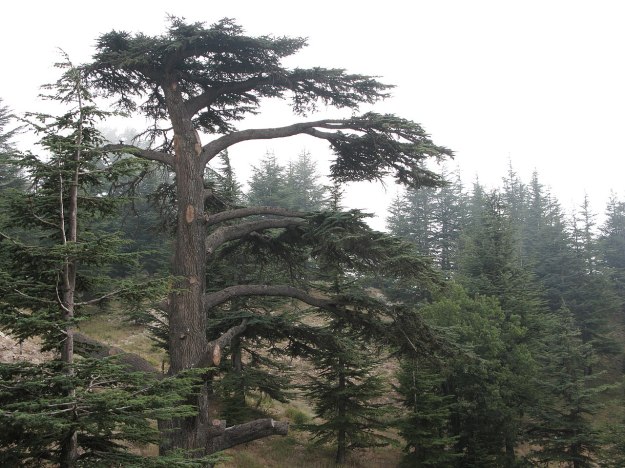
Ezekiel 31 Egypt as a Mighty Tree Cut Down

Cedar of Lebanon (Cedar of God), Lebanon By © Vyacheslav Argenberg / http://www.vascoplanet.com/, CC BY 4.0, https://commons.wikimedia.org/w/index.php?curid=92872076

Ezekiel 31

1In the eleventh year, in the third month, on the first day of the month, the word of the LORD came to me: 2Mortal, say to Pharaoh king of Egypt and to his hordes:
Whom are you like in your greatness?
3Consider Assyria, a cedar of Lebanon,
with fair branches and forest shade,
and of great height,
its top among the clouds.
4The waters nourished it,
the deep made it grow tall,
making its rivers flow
around the place it was planted,
sending forth its streams
to all the trees of the field.
5So it towered high
above all the trees of the field;
its boughs grew large
and its branches long,
from abundant water in its shoots.
6All the birds of the air
made their nests in its boughs;
under its branches all the animals of the field
gave birth to their young;
and in its shade
all great nations lived.
7It was beautiful in its greatness,
in the length of its branches;
for its roots went down
to abundant water.
8The cedars in the garden of God could not rival it,
nor the fir trees equal its boughs;
the plane trees were as nothing
compared with its branches;
no tree in the garden of God
was like it in beauty.
9I made it beautiful
with its mass of branches,
the envy of all the trees of Eden
that were in the garden of God.
10Therefore thus says the Lord GOD: Because it towered high and set its top among the clouds, and its heart was proud of its height, 11I gave it into the hand of the prince of the nations; he has dealt with it as its wickedness deserves. I have cast it out. 12Foreigners from the most terrible of the nations have cut it down and left it. On the mountains and in all the valleys its branches have fallen, and its boughs lie broken in all the watercourses of the land; and all the peoples of the earth went away from its shade and left it.
13On its fallen trunk settle
all the birds of the air,
and among its boughs lodge
all the wild animals.
14All this is in order that no trees by the waters may grow to lofty height or set their tops among the clouds, and that no trees that drink water may reach up to them in height.
For all of them are handed over to death,
to the world below;
along with all mortals,
with those who go down to the Pit.
15Thus says the Lord GOD: On the day it went down to Sheol I closed the deep over it and covered it; I restrained its rivers, and its mighty waters were checked. I clothed Lebanon in gloom for it, and all the trees of the field fainted because of it. 16I made the nations quake at the sound of its fall, when I cast it down to Sheol with those who go down to the Pit; and all the trees of Eden, the choice and best of Lebanon, all that were well watered, were consoled in the world below. 17They also went down to Sheol with it, to those killed by the sword, along with its allies, those who lived in its shade among the nations.
18Which among the trees of Eden was like you in glory and in greatness? Now you shall be brought down with the trees of Eden to the world below; you shall lie among the uncircumcised, with those who are killed by the sword. This is Pharaoh and all his horde, says the Lord GOD.

This fifth oracle against Egypt is like Ezekiel’s earlier oracle against the King of Tyre where the king is highlighted for their beauty and preeminent state among the garden of Eden.[1] Like that previous oracle the one who excels all others is brought low as they exceed their station as a creation of God. Although this oracle is directed against Pharoah and his hordes, it only mentions Pharoah or Egypt in the first and last verse, the rest of the oracle uses Assyria as an example for Egypt to heed. Assyria who was once the great empire in the north has collapsed and dragged all who allied themselves with her down to Sheol, and the same fate awaits proud Egypt in this oracle.

It is likely that Ezekiel is building upon Isaiah’s imagery in Isaiah 2:11-13 linking pride and great trees.

The haughty eyes of people shall be brought low, and the pride of everyone shall be humbled; and the LORD alone will be exalted in that day. For the LORD of hosts has a day against all that is proud and lofty, against all that is lifted up and high; against all the cedars of Lebanon, lofty and lifted up; and against all the oaks of Bashan;

Just as Daniel will probably utilize Ezekiel’s imagery in his own image in Daniel 4: 10-17 and Jesus alludes to this imagery in his parable of the mustard seed.[2] Yet, Ezekiel’s usage is the longest sustained use of this metaphor.

This oracle is dated almost two months after the previous one, June 21, 587 BCE. The city of Jerusalem is still besieged by Babylon, and it is possible that Babylon has already repulsed the Egyptian attempts to lift the siege. Egypt has been one of the significant powers in the ancient world throughout Israel’s history, and Egypt has continually exerted influence in the region around Israel. Now Egypt in this parable is told to look at a metaphor of Assyria. Assyrian was the great empire in the north prior to the emergence of the Babylonian empire. There are some translators who view Assyria’s presence here as a mistake, but thematically it makes sense to use a metaphor about Assyrian to demonstrate to Egypt that it too can fall from its great heights. Even though verses three through nine repeatedly refer to the beauty of this metaphorical tree and portray its majesty in an admirable light, like the earlier references to the King of Tyre, this is a case of prophetic satire. Although the kings of Assyria normally have the date palm as their image, the use of the cedar of Lebanon would be a well-known image of both size and strength, and a tree frequently used in royal and holy construction.

There are mythical elements in the background of this image, but they should not distract from the basic point that Pharoah and Egypt, according to the oracle, will share the same fate as Assyria. Although the waters nourished it and the deep made it grow tall, it will still fall when the prince of nations (King Nebuchadrezzar of Babylon) cuts it down. The waters and deep are the same Hebrew words used in Genesis 1:2 and this tree surpasses the trees of the garden of God (Eden) but ultimately, like the King of Tyre, its beauty, strength, and height cannot prevent its falling into the realm of the dead. The remnants of the tree fall on the mountains and valleys, just as the defeated ‘dragon’ in the next chapter will have its remains fall on the mountains, valleys, and waterways.[3] Now this great tree and all the lesser trees that inhabited the space under its branches find themselves in the Pit.

The very forces which once gave this great tree life now bury it in the depths. The rivers that flowed around it are now restrained and this once beautiful and living tree is now debris scattered upon the ground, or in other places brought down into the pit. The great tree and the empire it represents are now dead, and Egypt who is similarly a great tree is in danger from the same axe wielding prince of the nations. In the oracle Pharoah and all his armies cannot oppose God and God’s chosen instrument of vengeance King Nebuchadrezzar.

As mentioned before there are limited historical records from this period. We do know that Nebuchadrezzar does eventually turn his army to march on Egypt. Although the Babylonians have enjoyed multiple victories over Egypt, Egypt never becomes a part of the Babylonian empire. The great cedar tree which represents Egypt will stand at least for a time longer. Ezekiel interprets the actions of the king of Babylon and his forces as an extension of the will of the God of Israel. Even though Jerusalem is under siege, the LORD’s actions, in Ezekiel’s mind, are just. The LORD is not merely the God of Israel but is at work in the movement of empires to bring about the will of God.

[1] Ezekiel 28.

[2] Matthew 13: 31-32, Mark 4: 30-32, Luke 13: 18-19

[3] Ezekiel 32: 5-6.

Ezekiel 30: Oracles Against Egypt Continued

A stele dating to the 23rd regnal year of Amasis, on display at the Louvre

Ezekiel 30: 1-19 The Third Oracle Against Egypt: The Day of The LORD

1The word of the LORD came to me: 2Mortal, prophesy, and say, Thus says the Lord GOD:
Wail, “Alas for the day!”
3For a day is near,
the day of the LORD is near;
it will be a day of clouds,
a time of doom for the nations.
4A sword shall come upon Egypt,
and anguish shall be in Ethiopia,
when the slain fall in Egypt,
and its wealth is carried away,
and its foundations are torn down.
5Ethiopia, and Put, and Lud, and all Arabia, and Libya, and the people of the allied land shall fall with them by the sword.
6Thus says the LORD:
Those who support Egypt shall fall,
and its proud might shall come down;
from Migdol to Syene
they shall fall within it by the sword,
says the Lord GOD.
7They shall be desolated among other desolated countries,
and their cities shall lie among cities laid waste.
8Then they shall know that I am the LORD,
when I have set fire to Egypt,
and all who help it are broken.
9On that day, messengers shall go out from me in ships to terrify the unsuspecting Ethiopians; and anguish shall come upon them on the day of Egypt’s doom; for it is coming!
10Thus says the Lord GOD:
I will put an end to the hordes of Egypt,
by the hand of King Nebuchadrezzar of Babylon.
11He and his people with him, the most terrible of the nations,
shall be brought in to destroy the land;
and they shall draw their swords against Egypt,
and fill the land with the slain.
12I will dry up the channels,
and will sell the land into the hand of evildoers;
I will bring desolation upon the land and everything in it
by the hand of foreigners;
I the LORD have spoken.
13Thus says the Lord GOD:
I will destroy the idols
and put an end to the images in Memphis;
there shall no longer be a prince in the land of Egypt;
so I will put fear in the land of Egypt.
14I will make Pathros a desolation,
and will set fire to Zoan,
and will execute acts of judgment on Thebes.
15I will pour my wrath upon Pelusium,
the stronghold of Egypt,
and cut off the hordes of Thebes.
16I will set fire to Egypt;
Pelusium shall be in great agony;
Thebes shall be breached,
and Memphis face adversaries by day.
17The young men of On and of Pi-beseth shall fall by the sword;
and the cities themselves shall go into captivity.
18At Tehaphnehes the day shall be dark,
when I break there the dominion of Egypt,
and its proud might shall come to an end;
the city shall be covered by a cloud,
and its daughter-towns shall go into captivity.
19Thus I will execute acts of judgment on Egypt.
Then they shall know that I am the LORD.

This third oracle against Egypt is undated. It may come early (during the siege of Jerusalem) like the first oracle or late (after the failed siege of Tyre) like the second oracle. It is sandwiched between a late oracle and an early one and either situation can fit this declaration against the Egyptians. My best guess is that it follows the timeline of the immediately preceding oracle but ultimately it makes little difference to the interpretation of the prophet’s words of judgment.[1]

Ezekiel’s third oracle against Egypt taps into the thematic day of the LORD. As I mention in my longer discussion on the Evolution of the Day of the LORD, this has been used both as a phrase indicating both judgment for Judah and salvation. Here the terrifying direction of the day of the LORD is directed against Egypt, and by extension the nations. Much of the day of the LORD language is thematic and has resonances across the prophets regardless of the direction of the judgment it implies. Ezekiel echoes Zephaniah 1:15[2] storm imagery:

That day will be a day of wrath, a day of distress and anguish, a day of ruin and devastation, a day of darkness and gloom, a day of clouds and thick darkness.

Although the Hebrew Scriptures continually remind the reader that the LORD is the creator of the heavens and the earth, the LORD’s power is often depicted coming from the sky. But here the judgment from the sky is paired with the judgment by sword from approaching armies. The LORD is both the Lord of heaven and earth and the LORD of hosts[3]. The LORD is moving in judgment against Egypt and any who stand with them in this oracle.

One of the reasons that people have been fascinated with Egypt has been its wealth. The wealth of the nation unearthed from the tombs of the kings of Egypt draws both modern interest but also drew ancient interest as well. Egypt’s elite hoarded this wealth, and this was to be one of the distinctions between the ways of Egypt and the ways of the people of Israel. Now this wealth or horde, (Hebrew hamon) will be taken away by the sword. That which they stored in temples and tombs will now become the reward for the wielder of the sword which causes both death and destruction for this proud empire. This focus on the wealth of Egypt being carried away links this to the previous oracle when Egypt’s wealth is to be the payment to Nebuchadrezzar for the effort and resources he expended against Tyre.

Ethiopia, Libya (Put), Asia Minor (Lud), the Arabians (literally mixed hordes), and an unknown people (NRSV Libya)[4]  and “the sons of the land of the covenant” (NRSV people of allied lands) all find themselves in danger of this approaching sword and storm. The Egyptians, like most ancient armies, had fighters from many lands which formed their army. Some may have been mercenaries; others were allied or vassal kingdoms. A similar dynamic is at work in Ezekiel’s metaphor of Tyre where the men of Paras, Lud, and Put were in their army and men of Arvad, Helech, and Gamad were archers on their walls.[5] The interesting addition to this list is the ‘sons of the land of the covenant’ who were likely Judean soldiers serving Egypt. There are several ancient sources who list Judean mercenaries serving in Egyptian campaigns, and there are Judean settlements in Egypt at the time of Ezekiel’s ministry.[6] Now these Judeans both serving and residing in Egypt are warned of the coming sword (assuming Ezekiel’s missive traveled to these communities).

The terror of this coming sword penetrates the length of the Nile into Ethiopia. Egypt had endured conflict before, but the communities on the eastern and northern edge of Egypt absorbed the threat. Ethiopians at the southern end of the Nile could benefit from the economic advantages of the river while being relatively safe from an invader coming from the Middle East. But now even these places at the edge of the Egyptian empire were no longer safe in the oracle. The ‘hordes’ or ‘wealth’ of Egypt will end under King Nebuchadrezzar of Babylon. This force coming from the north is portrayed as the ‘most terrible of nations.’

The destruction of Egypt’s wealth and military are paralleled by the loss of both the cities and the ‘gods’ of Egypt. Just as the ‘signs and wonders’ that the LORD utilized to bring the people of Israel out of Egypt struck at both the reign of Pharoah and the Egyptian gods[7] now the ‘idols’[8] and ‘images’ are destroyed as well as the cities where the temples are located.

The actions of Nebuchadrezzar’ army are paired with the actions of the LORD against the land. Nebuchadrezzar may wield the sword, but the LORD is drying up the channels of the Nile. At Tehaphnehes the day becomes dark[9] as it is covered by a cloud, echoing the day of the LORD imagery at the beginning of the oracle. The LORD of the heavens and earth wields the natural powers of destruction while the LORD of hosts dispatches the Babylonians with the sword against the Egyptians.

Ezekiel 30: 20-26 The Fourth Oracle Against Egypt Disarming Pharoah

20In the eleventh year, in the first month, on the seventh day of the month, the word of the LORD came to me: 21Mortal, I have broken the arm of Pharaoh king of Egypt; it has not been bound up for healing or wrapped with a bandage, so that it may become strong to wield the sword. 22Therefore thus says the Lord GOD: I am against Pharaoh king of Egypt, and will break his arms, both the strong arm and the one that was broken; and I will make the sword fall from his hand. 23I will scatter the Egyptians among the nations, and disperse them throughout the lands. 24I will strengthen the arms of the king of Babylon, and put my sword in his hand; but I will break the arms of Pharaoh, and he will groan before him with the groans of one mortally wounded. 25I will strengthen the arms of the king of Babylon, but the arms of Pharaoh shall fall. And they shall know that I am the LORD, when I put my sword into the hand of the king of Babylon. He shall stretch it out against the land of Egypt, 26and I will scatter the Egyptians among the nations and disperse them throughout the countries. Then they shall know that I am the LORD.

For this fourth oracle we once again have a date, and the date helps provide a context for this message. April 29, 587 BCE would be almost four months after the initial oracle and roughly four months before the destruction of Jerusalem. Jeremiah 37: 5-10 indicates that Pharoah did come to Jerusalem’s aid causing a temporary removal of the siege while Nebuchadrezzar turned his forces to deal with the Egyptian incursion, and that likely set the background for Ezekiel’s first oracle against Egypt. We know that the Egyptian forces did not remain and either retreated or suffered a defeat before the Babylonians. The time period of this oracle makes sense in a time after Egypt has been forced to retreat without providing liberation to Jerusalem.

The broken arm of Pharaoh is likely his weakened state after his initial defeat by Babylon. Egypt has suffered defeats to Babylon in the region before, but now this metaphorical wound which weakens Pharoah will not be bound or bandaged and allowed to heal properly. Now a weakened Pharoah with one remaining arm is left to oppose a Babylon with two strong arms, but even before the battle the LORD breaks Pharoah’s other arm as the arm of the king of Babylon is made strong and the LORD’s swords placed in his hand for judgment. Pharoah, once mighty, has now been disarmed and Egypt is vulnerable to this warrior who comes to deliver the LORD’s judgment.

[1] Many historical critical interpreters viewed this portion of Ezekiel as a later introduction by a different author of the “Ezekiel school” due to the lack of date and the language. Although it is worth acknowledging the insight of these scholars, Ezekiel often does not include a date and Ezekiel’s language varies widely throughout the book.

[2] Joel 2: 2 also utilizes this imagery, but Joel is most likely at 4th Century BCE prophet and is echoing Ezekiel or Zephaniah.

[3] The host referred to here is a military host in this commonly used title.

[4] Put is modern day Libya. The Hebrew kub could be another North African nation, but we simply do not know.

[5] Ezekiel 27:10-11.

[6] Jeremiah 24:8, 44:1.

[7] See my comments on Exodus 711.

[8] Hebrew gillum, Ezekiel’s coarse image for foreign idols.

[9] Eclipsing the sun god ‘Ra.’