Tag Archives: Old Testament

The Ballad of Ruth

The Ballad of Ruth[i]

William Blake, Naomi Entreating Ruth and Orpah

There was no bread in the house of bread[ii] and so from the house of bread the breadless fled

To Moab went Elimelech and Naomi[iii] the sweet with two sons, departing hungry yet full

Foreigners in a foreign land they seek life but find only death and emptiness

A father dies, but leaves two sons behind to watch over the sweet one and to carry the name on

And yet the names of the sons, Mahlon and Chilion, tell a tale all their own and a short tale it is

For Ruth and Orpah marry men whose part in the story seems only to perish, and perish they do[iv]

So in Moab is left Naomi the sweet made bitter, no longer hungry but empty

And yet in the house of bread, bread has returned

In the land of Moab sweet has turned bitter, bitterness has filled Naomi from bone to bile

In a foreign land the blessing of God seems to have turned to a curse, fullness to emptiness

The joy of wedding and the blessing of hope into the dirge of mourning and sons buried too soon

There is no gift for the wives of her children except to send them home to their father’s house

No sons left to give or bear, only a wish for the Lord’s kindness and a new beginning

For with Naomi there is only death, what is left but to return home to die

Breadless, childless, loveless, hopeless and bitter

And yet to the house of bread, Naomi will return

In the land of Moab, Orpah returns home to her father’s home but Naomi will not return home empty

The love of God comes wrapped in an unexpected form, the Moabite wife of her son

She becomes not only the bearer of grace and mercy but as the agent of God’s love[v] for the wounded child

Ruth’s words that, ‘where you go I’ll go, where you live I’ll live, your people will be my people and your God my God. Where you die, I’ll die and there I’ll be buried.’

You asked for the Lord’s blessing in my departure, but may the Lord judge me if I depart

For neither life nor death, nor things present nor things to come will be able to separate Naomi

From the love of God shown in the Moabitess

To the house of bread, Naomi returns with Ruth as her only harvest

To the house of bread came two women, one known and one unknown

The known is Naomi, gone for a decade or more, returning as Mara[vi]

Departed sweet and returned bitter

The other is the Moabitess, the daughter of former oppressors, the alien, the outsider

She is the immigrant, the unprotected, the dangerous defiler, and yet she is Ruth

The outsider bears God’s grace in a way the insiders do not

At harvest time they return to a home long abandoned with empty fields.

Will there be bread in house of bread for the breadless?

Is there a place for the alien, the outcast, the widow, the poor and the weak?

Will the leftovers be enough to fill their emptiness or will they die forgotten?

Will their bodies be sold or taken for free in the reaping fields?

Or will new life begin in the harvest, will life return to the lifeless and bread to the breadless?

What will be gleaned in the barley harvest? Blessing or curse, life or death?

The fields are ripe in the house of bread and the harvest begins

The worthy man extends the blessing of the Lord’s covering[vii] and offers the shelter of his protection

For he has taken notice of the Moabitess working in the fields and knows of the grace she has shown

The outsider is made equal of the servants out in the fields and return home with a bushel of grain

Bread had returned to the breadless, life to the lifeless

Boaz has spoken to the heart[viii] of Ruth, and his words have returned hope to the bitter one

Bless the one who has covered us, who has not forgotten the dead

Bless the one who grants bread from the house of bread

Harvests come and harvests go in the house of bread, and then comes the celebration

The eating and drinking, the festival and feasting for once again the work is done

On the field of the threshing floor lies the worthy man, the fruit has been separated from the chaff

On the floor, covered[ix] lies the man who provided a covering for Ruth and Naomi

Work done, mercy extended, blessing shared…

Yet in the mystery of midnight what will happen to what lies on the threshing floor?

For in the mystery of midnight Ruth comes, perfumed and prepared

On the threshing floor at midnight the man finds himself uncovered and a woman lying at his feet

“I am Ruth, spread your covering over me” Once you wished the Lord’s covering on me, now be that covering

Can you accept the foreigner as one of your own, can your family be my family and your home my home

Your God is already God, may I go where you go, may I die where you die

In the mystery of midnight are the worthy man and the foreigner

Two agents of grace, two who covered others

Will the mystery of midnight on the threshing floor of the house of bread be fruitful?[x]

The worthy man and the kinsman and the elders at the gate must make settlement

Land must be redeemed, a family saved, life will begin anew

A sandal is passed, the deal is done

The worthy man and the foreigner are now one

God’s covering came, life begins anew

A child named Obed in Naomi’s lap grew

And from Obed, Jesse, and from Jesse , David the King

And a foreigner showed grace, a worthy man covered her and life began anew

In the house of bread begins a line of kings

And in ages to come over the house of bread the angels will sing.

purple rose 01 by picsofflowers.blogspot.com


[i] This is taken from the book of Ruth, this is not a translation or paraphrase but I do stay fairly close to the story and try to capture some of it’s patterns

[ii] Ruth plays on the Hebrew word for bread which is lechem, Bethlehem is literally the house of bread

[iii] Naomi one of the meanings of Naomi is sweet one

[iv] Mahlon’s name is similar to one of the Hebrew words for disease while Chilion name is the Hebrew word ‘to perish’

[v] Another of the key words to Ruth is the Hebrew word ‘Hesed’ often translated kindness in Ruth, but most other places it refers to God’s actions of unmerited grace and mercy

[vi] Mara is the name she gives herself which means bitter, the opposite of her former self

[vii] Another of the keywords in Ruth, kanap which can mean wing, covering or garment and will be used playfully from this point on in the story

[viii] Another Hebraism which may mean speaking kindly to or may indicate sweet-talking

[ix] This is again Kanap, as the blessing of the Lord’s covering was  wished on rush, now this covering will become that covering

[x] This scene is pregnant with images that can go either in an innocent or non-innocent way, it is like a movie where the door is closed and what goes on is based largely on assumptions.
The Place of Authority: A Brief History Part 4: Re-establishment, Disillusionment and Germination

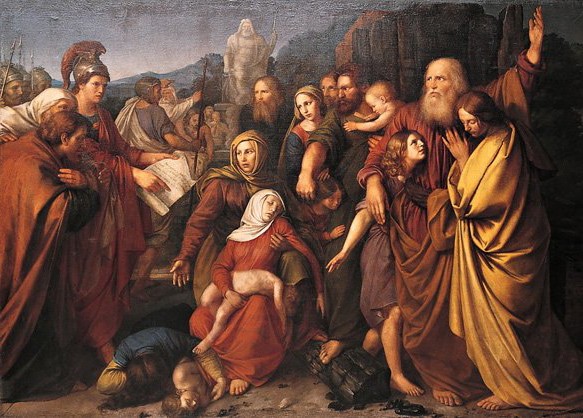
Wojceich Stattler, Machabeusze (Maccabbes) Public Domain Art

I think I need to be clear at this point that while I am doing a historical trek through Israel’s story, I am not trying to do a history of Israel at this point, or even of the Hebrew Scriptures.  I am intentionally trying to locate where authority rested within their story.  Within key transitions the places of authority do change and how the people react to that authority changes and see how that might inform our current questions of authority.  Hence, while it might be interesting to focus in greater detail on particular events, or to spend more time interpreting what is going on within a particular piece of scripture or what the theology of a particular author might be, that will have to be for another time and place as we continue on through the story.

A humorous illustration before we proceed. The Hebrew people remain deeply suspicious of external authorities which exercise authority over them, and so there will remain an antagonism between them and those who come to occupy their land.  In another Monty Python reference we have the scene of the French Castle where the French refuse to recognize Arthur’s authority. For this period the Hebrew people will stubbornly resist assimilation by the empires that they are a part of.

Beginning around 538 BCE, during the reign of Cyrus of Persia, there is the beginnings of the return to Jerusalem and Judea.  There are at least four major stages of the return which span a period of roughly 80 years, longer than the original period of exile, and even with the final return many of the people choose to remain settled and scattered throughout the empires of the day.  The diaspora (the dispersion) those Jewish people scattered throughout the empire continue to at various levels maintain their practices and stories that make them distinguishable from the nations around them, but I will be focusing in on the remnant that returns to the promised land since that is where the final pieces of the remembered story of the Hebrew Scriptures (or Old Testament) come from.

Over the eighty years of re-establishment, many of the people return and their first concern is the reclamation of their land (or perhaps in some cases the claiming of land for their family).Remember that in an agrarian society land is the primary source of wealth and power. It takes a great deal of effort by the leaders and prophets to get the people to focus on the effort to rebuild the temple, and even once it is rebuilt it cannot compete with the memory of the former temple.  In the memory of the people it is a shadow of the greatness of their past.  Even with the codification of the Torah (law-quite possibly Deuteronomy) by Ezra and the completion of the city wall under Nehemiah, Jerusalem and what remains of the former nation are completely dependent on the will of the nations around them.  The temple worship does regain some of its former status as one authority figure, but in the absence of a true monarch-temple authority that has the power to authorize the story of the people, the written and oral set of practices begin to take on a greater and greater role of what it means to be the chosen people.

Internal fault lines begin to emerge, not that they didn’t exist previously, but issues of purity and justice come into conflict with one another.  At least, in the remembered story it seems that in the time of re-establishment purity becomes the dominant issue, the removal of foreign influences—even when it means disbanding families—and being a ‘purer’ Hebrew people who worship the one Lord in holiness. This is the mark of a society intent on establishing and maintaining boundaries between the insider and the outsider—and I don’t mean this to sound as critical as it may sound—when one feels the world is out to destroy you it is natural for an us/them (or Jew/Gentile) dichotomy to emerge. Yet even though this seems to be the dominant voice a counter-voice emerges, the prophetic voice that never went away and attempts to refocus the central focus on justice.  Although there is a strong presence of the prophetic voice in the collected scriptures, it also never seems to gain the influence to reframe the story to create the type of society the prophets imagine.

Certainly within the prophetic voice, but also within the population there is disillusionment with the way things are.  Things are not the way people hoped they would be, the temple is a shell of its former self, different religious groups vie for power and influence among the people, various incarnations of leaders try to rally the people with varying levels of success-but the reality is that for most of this 500 year stretch they are a people under the rule first of the Persians, then briefly under Greece. When the Greek empire splits up into the Ptolemaic Empire (in the South) and the Seleucid Empire (in the North) Jerusalem will find itself firmly at the middle of the struggle for power.

A final defining moment comes in 167 BCE with the Maccabean revolt, an event commemorated by Hanukkah today and remembered in the books named Maccabees, where the pressure of the outside influence to conform to a Hellenistic (Greek) culture causes a religious revolt which for a brief moment grants Jerusalem its independence.  It is short lived, but it gives the people a memory of their practices defining themselves as a people who are willing to die for what they believe in.  Again this is not universal, there are certainly those willing to accommodate, but there are also those willing to revolt, and that fire will not go out again for some time.

Deep divisions continue to grow within Judaism. They will not be fully in control of their own destinies after the fall of the Maccabees , but the hope for a new king, a new David, a messiah will persist.  Religious authority will split between Saducees, who predominantly control the temple and accommodate with the kings like Herod, or whichever government official Rome places to govern Judea.  With Herod the Great (who rules from 40 BCE-6 CE) reconstructing the temple in magnificent fashion (at a magnificent cost) the Sadducees are able to operate from a position of privilege.  The Pharisees in contrast are more of a people’s movement focused on maintaining their identity through purity and right practice of the Torah. There are other groups, the Essenes who pull away and isolate themselves to remain pure, the zealots intent on driving the foreign influence from the promised land.  Herod and Rome have the military authority, the Saducees in partnership with the Roman authorities run the temple and all is in a state of tension at the turning of the ages.  We are approaching a great turning point in the story, from one group will emerge two-one that is new and one that will be completely reshaped.  It is to the turning of the ages that we turn next.

purple rose 01 by picsofflowers.blogspot.com

The Place of Authority: A Brief History Part 3b: The Exile, Reconstructing Identity-Narrative, Practice and Hope

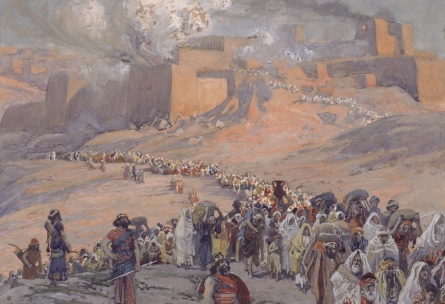
James Tissot, The Flight of the Prisoners

Thus says the Lord of hosts, the God of Israel, to all the exiles whom I have sent into exile from Jerusalem to Babylon: Build houses and live in them; plant gardens and eat what they produce. Take wives and have sons and daughters; take wives for your sons, and give your daughters in marriage that they bear sons and daughters; multiply there, and do not decrease.  But seek the welfares of the city where I have sent you into exile, and pray to the Lord on its behalf, for in its welfare you will find your welfare. Jeremiah 29. 4-7 NRSV

Even when the world as you know it ends, life still goes on, and we have to make sense of the conflict, the struggle and our place within it.  The communal memory becomes important, the stories parents have told their children, the history of families. In the midst of competing narratives what is the story that one can identify with? With the loss of the Davidic monarchy, the temple, the land of their ancestors the people did something amazing, they recast their identity.  They dug deep into their narrative, they began bringing together their stories, and in fact much of the Old Testament is brought together at this point. Stories of creation and exodus begin to be the patterns in which the present is made sensible and the community begins to come up with answers to the hardest question, “why did this happen?” They don’t come up with just one answer, they come up with many. They bring together their stories and the Torah (typically translated into English as law, but it is a term that is much more than what we understand as law in our context) begins to be center of their life.  Practice and story come together to bind together this community in exile.

This does not mean that everyone agrees, there is not a central authorizing authority for the narrative at this point, it is constructed mainly by the remnant of the elite (everyone else would have been illiterate at this point) from both the priestly and prophetic side. Some of the central ideas to emerge include:

Justice: a sense of living in harmony (shalom) with God’s desire for the way things are to be structured in society. This includes a strong sense of economic justice, compassion for the widows, orphan, immigrant, and the dispossessed. It is from this vision that many prophets operate out of, and this is a central image for the prophetic hope. The new Jerusalem, the new Israel is to be a place of justice where the nations around can look and say “Come, let us go up to the mountain of the Lord, to the house of Jacob; that he may teach us his ways and that we may walk in his paths” (Isaiah 3b, NRSV) and within God’s plan the nations will stream to Jerusalem.

Purity/Holiness: For us there is often a tension between Purity/Holiness and Justice, but it was not necessarily seen that way by the Jewish people.  Especially for priests there are practices that are to be done to prevent the contamination of unholiness from infecting them as a people and making them repulsive to the holiness of God. It also becomes a powerful way of distinguishing between themselves as a Hebrew people and the nations around them who are the Gentiles, the unclean ones.  This tends to be more of a priestly focus and there are conflicts between which will dominate going forward, but at the root both justice and holiness are practices which distinguish them from the hostile surrounding culture.

With these two distinctive directions emerges a new strand of a hope for a new beginning, a new temple, a New Jerusalem, a new anointed (and Davidic) king, a messiah.  Wrapped up within the memory of the stories of creation and the exodus of the people from Egypt hope springs forth of a return home and a new beginning:

Do not remember the former things, or consider the things of old. I am about to do a new thing: now it springs forth, do you not perceive it? I will make away in the wilderness and rivers in the desert. The wild animals will honor me, the jackals and the ostriches; for I give water in the wilderness, rivers in the desert, to give drink to my chosen people, the people who I formed for myself so that they might declare my praise. Isaiah 43.18-21

2nd Isaiah (Isaiah 40-55, which reflects the time of preparation for the return home, while Isaiah 1-39 deals with the time before the exile) in particular is full of this vibrant hope, along with other voices.  Empires rise and empires fall, and a generation later Babylon falls to Persia (modern day Iran) and Cyrus (who Isaiah interestingly calls Messiah/Christ-same word in Hebrew/Greek) makes possible the beginning of a return home.  Their stories and practices have maintained their identity and given them hope of a new beginning. With the return to Jerusalem, the land, and the possibility of reconstructing the temple comes yet another transition.  It is to that transition that we turn next.

purple rose 01 by picsofflowers.blogspot.com

The Place of Authority: A Brief History Part 3a: The Exile, the Crisis of Collapse

James Tissot, The Flight of the Prisoners

By the rivers of Babylon—there we sat down and there we wept when we remembered Zion. In the willows there we hung up our harps.For there our captors asked us for songs, and our tormentors asked for mirth, saying,

“Sing us one of the songs of Zion!”

How could we sing the Lord’s song in a foreign land? If I forget you, O Jerusalem, let my right hand wither! Let my tongue cling to the roof of my mouth, if I do not remember you,if I do not set Jerusalem above my highest joy. 

Remember, O Lord, against the Edomites the day of Jerusalem’s fall, how they said,

 “Tear it down! Tear it down! Down to its foundations!”

O daughter of Babylon, you devastator! Happy shall they be who pay you back what you have done to us! Happy shall they be who take your little ones and dash them against the rock!   Psalm 137 NRSV

In 721 BCE, after roughly 200 years of separation from the Southern Kingdom of Judah, the Northern Kingdom Israel falls to the Assyrian Empire (which has its origins in the Northwestern Part of modern day Iraq) and the Northern Kingdom is effectively absorbed into the Assyrian nation.  Somehow Judah holds on, even though it becomes completely surrounded by the Assyrian Empire.  Empires come and go, and power shifts to the Babylonian Empire (which has its origins in modern day Southern Iraq) without going into the bloody details: Jerusalem falls, the temple is destroyed, the Davidic monarchy effectively ends and the people of Judah are taken into exile or captivity in Babylon.  The loss of king and temple, as well as the land cause a crisis of authority which leads to one of the most constructive and important periods in Judaism.

The loss of home is catastrophic, it leads to a ton of questions about the future and there may not be any good answers at that point.  The closest cinematic example I could come up with was the loss of Anatevka in Fiddler on the Roof where families try to make the best of their coming exile, belittling what they are leaving behind-and yet families are broken apart, scattered across the world, many will never see each other again.

Something as catastrophic to not only the physical well-being but also to the communal consciousness can lead to several outcomes, many of which do emerge in this time. One response of the conquered is to assimilate with the conqueror, to align oneself with the victor, to adopt their values and practices and to set aside at least a portion of one’s previous identity to become a part of something different.  This is the perceived response of the Northern Kingdom by the Southern Kingdom-they stay on their land, intermarry with the Assyrians, and what emerges will be a hybrid people-no longer really Jewish, already separated from the Davidic monarchy and the temple hundreds of years before they become the other…the Samaritan (yes this is where those Samaritans that Jesus runs into in the New Testament come from).  But to be fair, a large number of the Judeans also assimilate into Babylon, only a small portion of the Judean people will return to their homeland at the end of the exile, most will remain dispersed throughout the nations.

In the lead up to the exile, the prophetic voice becomes very harsh in its critique of the monarchy, temple, the lack of economic justice within the nation, and the perceived idolatry of the shepherds of the nation.  This is the time where the first parts of Isaiah, much of Jeremiah and Ezekiel and many of the Minor Prophets become active in the memory of the people. The prophetic voice leads the way pointing to the ways in which kings and priests, throne and temple have not only failed as sources of authority but are at the very heart of the crisis viewed as a judgment from the LORD.  The prophets announce condemnation for the shepherds (the leaders, the authority in throne and temple) as one example among many:

The word of the Lord came to me: Mortal, prophesy against the shepherds of Israel: prophesy, and say to them—to the shepherds: Thus says the Lord God: Ah, you shepherds of Israel who have been feeding yourselves! Should not the shepherds feed the sheep? You eat the fat, you clothe yourselves with the wool, you slaughter the fatlings: but you do not feed the sheep. You have not strengthened the weak, you have not healed the sick, you have not brought back the strayed, you have not sought the lost, but with force and harshness you ruled them.  So they were scattered, because there was no shepherd: and scattered wandered over all the mountains and on every high hill; my sheep were scattered over the face of the earth, with no one to search or seek for them. Ezekiel 34.1-6 NRSV

 Instead of coming to believe that somehow their God is weaker than the gods of the Assyrians or the Babylonians, something amazing happens in the prophetic imagination (to use Walter Brueggemann’s keen words) and they begin to understand the transitions and the conflict around them as a part of God’s work—that behind Assyrian and Babylonian is the Lord of hosts (literally the Lord of armies-typically we think of this as heavenly armies, but I am beginning to think that in there is something more earthly to this term than often given credit). The coming destruction is a judgment particularly on the leaders, but also within all this death is the chance for something new: a fresh start, a redefinition, a chance to redefine and re-imagine what it means to be the chosen people.

The hand of the Lord came upon me, and he brought me out by the spirit of the Lord and set me down in the middle of the valley; it was full of bones.  He led me around them; there were very many lying in the valley, and they were very dry.  He said to me, “Mortal, can these bones live?” I answered, “O Lord God, you know.” Then he said to me, “Prophecy to these bones, and say to them: O dry bones, hear the word of the Lord. Thus says the Lord God to these bones: I will cause breath to enter you, and you shall live. I will lay sinews on you, and will cause flesh to come upon you, and cover you with skin, and put breath in you, and you shall live; and you shall know that I am the Lord. Ezekiel 37.1-6 NRSV

The prophetic voice will help the people re-imagine a new way forward, a way that is so critical to the way we understand things that we need to take some time with it.  Hope will not die, in fact it will be reborn in a new and powerful way and the people will understand themselves as a chosen people, but what that means takes a dramatic turn in the exile.  To that we shall turn next.

purple rose 01 by picsofflowers.blogspot.com

The Place of Authority: A Brief History Part 2: King, Temple and the Prophetic Critique

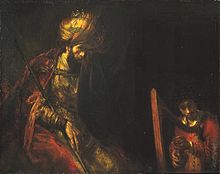
David and King Saul, Rembrandt

David and King Saul, Rembrandt

 So Samuel reported all the words of the LORD to the people who were asking him for a king. He said, “These will be the ways of the king who will reign over you: he will take your sons and appoint them to his chariots and to be his horsemen, and to run before his chariots; and he will appoint for himself commanders of thousands and commanders of fifties, and some to plow his ground and to reap his harvest, and to make his implements of war and the equipment of his chariots. He will take your daughters to be perfumers and cooks and bakers. He will take the best of your fields and vineyards and olive orchards and give them to his courtiers. He will take one-tenth of your grain and of your vineyards and give it to his officers and his courtiers. He will take your male and female slaves, and the best of your cattle and donkeys, and put them to his work. He will take one-tenth of your flocks, and you shall be his slaves. And in that day you will cry out because of your king, whom you have chosen for yourselves; but the LORD will not answer you in that day.” 1 Samuel 8.10-18


At roughly 1,020 BCE a decisive change takes place and Israel enters the time of monarchy.  Power becomes consolidated briefly under King Saul.  Two men, King Saul and Samuel, whose title before had been that of a judge but functioned as a mouthpiece for God at this point, hold the religious and political authority.  Israel begins to act as a powerful actor in the region, constantly moving from one conflict to another, but internal conflict emerges when David emerges on the scene.  Without getting bogged down in the story or trying to parse out what happened historically  by 1000 David would unify his power as king and Israel became for a brief shining moment a power player on the world stage, Jerusalem becomes the capitol, and then perhaps decisively for this era the temple is established under Solomon.   Especially for the Southern Kingdom of Judah this is decisive because the monarchy and the temple become linked as the dominant secular/religious authority. There is a prophetic voice within that critiques the monarchy and temple, but for the most part the people give up a portion of their freedom for the relative security, power and identity of being a part of the unified kingdom of Israel.  That is not to say that family, clan and tribe have lost their power or authority, but that the people become much more linked to the kings and temple than at any previous point in their history.

This is probably a good point for a fun interlude, it is hard for us to imagine being bound in systems where our autonomy is defined so externally.  We don’t have any experience of a monarchical system and so our reaction might be somewhat like the peasants in this scene from Monty Python and the Holy Grail.  Even a romanticized king when we look from our perspective seems like a tyranny or despot.

Even though King David is often looked upon romantically like the King Arthur of legend, one of the incredible things is that the recorded memory of David includes many ugly situations, many family struggles, many times where he is at odds with the prophetic voice of the time.  The whole Bathsheba and Uriah episode (2 Samuel 10-12), incest within the royal family (2 Samuel 13) and eventually the usurpation of the throne by his son Absalom (2 Samuel 15-19) as well as other internal rebellions are a part of David’s roughly forty years of consolidated rule.  Even though the King amasses incredible authority previously unattainable in anyone’s imagination the constant warfare and internal struggles begin to wear on the people.  By the time Solomon, David’s son, ascends to the throne it is a relatively peaceful time but the energy is directed internally on large building projects, the temple, but also many houses and palaces for Solomon and his entourage. The temple becomes, at least for a large group of people, the central focus of worship, and yet again just like with the idea of consolidating power with a king there is a large amount of space dedicated to the critique of the temple

 King Solomon conscripted forced labor out of all Israel; the levy numbered thirty thousand men. He sent them to the Lebanon, ten thousand a month in shifts; they would be a month in the Lebanon and two months at home; Adoniram was in charge of the forced labor. Solomon also had seventy thousand laborers and eighty thousand stonecutters in the hill country, besides Solomon’s three thousand three hundred supervisors who were over the work, having charge of the people who did the work. At the king’s command, they quarried out great, costly stones in order to lay the foundation of the house with dressed stones. So Solomon’s builders and Hiram’s builders and the Gebalites did the stonecutting and prepared the timber and the stone to build the house.  1 Kings 5.13-18 NRSV

This is a huge commitment of people and resources which are directed internally.  In fact it is such a strain that immediately upon Solomon’s death when Rehoboam takes power the people come and plead for relief:

Your father made our yoke heavy.  Now therefore lighten the hard service of your father and his heavy yoke that he placed upon us and we will serve you. 1 Kings 12.4 NRSV

To which the narrative has Rehoboam reply three days later in our language, ‘you ain’t seen nothing yet, you think my father made things hard on you?  Well prepare to be screwed!’ Most translations clean this up significantly…but the little thing that is thicker than his father’s loins is probably not a finger (see 1 Kings 12: 6-15 particularly v.10) Things are not nearly as clean in the Bible as we sometimes want to make them.  The people are offended, the kingdom splits apart and now there are two kings, two places of worship, a prophetic voice that continues to grow louder…but even with this prophetic voice within the Kingdom of Judah in the South and the Kingdom of Israel in the North growing stronger the fate of both nations is linked to the actions of kings and the worship at the temple in Judah and the worship at various sites in the North.  Particularly for the Southern Kingdom of Judah, so long as there is a Davidic king and the Temple who they are as the people of God seems secure.  Yet this too will change….

purple rose 01 by picsofflowers.blogspot.com

The Place of Authority: A Brief History Part 1: Families, Clans and Tribes

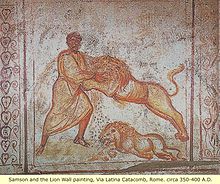
Samson and Lions, Rome 350-400 CE

Samson and Lions, Rome 350-400 CE

For those who despise history, and I know that there are many out there, I will warn you that I am beginning a long engagement with looking back through time at the narrative of where authority has rested at various points in time.  Originally I planned to do this in one, and then a couple, then three, and well I found our as I began wrestling through this I apparently had a lot to say, so to keep it in shorter bites this may be part 1 of many so read what you want, I will try to make it worth your while.

We often think of things in terms of secular and religious authority as if they are nice and discreet things, but that is a recent phenomenon. In reality, authority has rested in a couple key places at any one time but the distinction between secular and religious authority is not as defined as we might expect from our worldview.  Although the breakdown of the time periods is guided by Phyllis Tickle’s breakout in the Great Emergence, what follows are my own thoughts and reflections upon authority at each of these epochs.

Prior to 1,000 BCE, roughly 3,000 years ago authority rested heavily on a family’s ability to influence the course of actions for the realm around them.  For the Abrahamic faiths this is the time of Judges, when the people would rally around a great leader in the time of crisis and these men and at least one woman would provide stability for the rough confederation of tribes and families that would become Israel.  It is a time where these leaders and families would set up a shrine or worship sites but there is relatively little centralized authority.  Family is the central place where authority rests and there is a struggle internally between the tribes and externally with the people of Aram, Moab, Philistia, Cannan, and Ammon for land (the primary source of wealth) and power.  Much as in the song “Tradition” in Fiddler on the Roof a person’s role within the family and the practices, stories and traditions handed down from one generation to another shaped who they were and what they would become.

There was no centralized religious authority, there was no scripture, certainly there were stories but things were much more fluid than we often imagine.  Even in the remembered story of Israel we see that the memory is that of a chaotic time, even a brief survey of the book of Judges within the Bible points to this:

Joshua son of Nun, the servant of the LORD, died at the age of one hundred and ten years.  So they buried him within the bounds of his inheritance in Timnath-heres, in the hill country of Ephriam, north of Mount Gaash.  Moreover, that whole generation was gathered to their ancestors, and another generation grew up after them, who did not know the LORD or the work that he had done for Israel. Judges 2.8ff(NRSV)

Someone will say, but surely there would be the first five books of the bible and Joshua as scripture, and the short answer is no.  Even if one were to believe that Moses wrote the Penteteuch by himself and handed it on to Joshua and the people of Israel (which you would be hard pressed to find any reputable scholar of the Hebrew Scripture/Old Testament who does) even if that were the case, this was a time of very little literacy, very little true priestly/scribal organization, very little rule of law.  In a very real sense might did make right.  Take for example the story of Samson in Judges 13-16, one of those stories that many people have some acquaintance with, which is set within one of the times of crisis.  When I read the story Samson makes Conan the Barbarian look both ethical and smart, and yet the story tells of a person who judges Israel for 20 years, delivers them from the Philistines.  There is no centralized worship place or practice, families set up their own shrines, construct their own ‘idols’ or representations of who their god, gods, of God (depending on how one looks at it) are and if you need a good demonstration of this (this is one of many) take a look at Judges 17, the story of Micah and the Levite.

In a time of heavily decentralized authority, where family, clan and tribe hold the power and the wealth (i.e. land at this point) there is constant struggle and fighting to gain possession of more wealth, more power and to expand one’s familial authority.  The book of Judges for example does not remember this time fondly, it is a dark time where horrible things happen, where former allies are almost exterminated, where enemies are everywhere and as they looked around them and as they remembered their own story they began to see a different way.  As 1 Samuel remembers it:

Then all the elders of Israel gathered together and came to Samuel at Ramah, and said to him, “You are old and your sons do not follow in your ways; appoint for us, then, a king to govern us, like other nations” 1 Samuel 8.4f (NRSV)

And that is where we are heading next…

purple rose 01 by picsofflowers.blogspot.com