Tag Archives: Old Testament

Exodus 1: Setting the Stage

Roman collared slaves-Marble relief from Smyrna (Izmir, Turkey), 200 CE

Roman collared slaves-Marble relief from Smyrna (Izmir, Turkey), 200 CE

 Exodus 1: 1-7 Setting the Stage

These are the names of the sons of Israel who came to Egypt with Jacob, each with his household: 2 Reuben, Simeon, Levi, and Judah, 3 Issachar, Zebulun, and Benjamin, 4 Dan and Naphtali, Gad and Asher. 5 The total number of people born to Jacob was seventy. Joseph was already in Egypt. 6 Then Joseph died, and all his brothers, and that whole generation. 7 But the Israelites were fruitful and prolific; they multiplied and grew exceedingly strong, so that the land was filled with them.

The book of Genesis, the preceding book in the Bible, spends the bulk of the book with God working through a specific family, the family of Abraham, Isaac and Jacob, to be God’s covenant partners and to be a blessing to all the nations. As Exodus begins we are joined to the ending of the book of Genesis where the sons of Jacob (Israel) have come down to Egypt and settled in the land of Goshen. Joseph was already in Egypt after being sold into slavery and rising to being second in command of all Egypt and Jacob and his remaining sons come to Egypt seeking relief from a severe famine throughout the land. Throughout the stories of Abraham, Isaac, Jacob, and Joseph God has continued to provide for them in unexpected ways. Yet, now we have left the time of Abraham, Isaac and Jacob and the original sons of Israel behind as that generation passes away.

One of the struggles of many of the stories of Genesis was the struggle against barrenness. Sarah, Rebekah and Rachel all struggle with infertility and these families of the promise struggle with the command in the first creation narrative to ‘be fruitful and multiply’ (Genesis 1. 28). At the end of Genesis and here at the beginning of Exodus there has been a slow increase from the original two of Sarah and Abraham to now a household of seventy born to Jacob. Yet now the increase becomes exceedingly fruitful, they begin to become numerous and this combined with a historical amnesia in the land of Egypt sets the stage for the initial crisis of Exodus and the transition from the people’s lives in Egypt to their journey to the promised land.

Exodus 1: 8-14 Historical Amnesia and the Politics of Fear and Oppression

 8 Now a new king arose over Egypt, who did not know Joseph. 9 He said to his people, “Look, the Israelite people are more numerous and more powerful than we. 10 Come, let us deal shrewdly with them, or they will increase and, in the event of war, join our enemies and fight against us and escape from the land.” 11 Therefore they set taskmasters over them to oppress them with forced labor. They built supply cities, Pithom and Rameses, for Pharaoh. 12 But the more they were oppressed, the more they multiplied and spread, so that the Egyptians came to dread the Israelites. 13 The Egyptians became ruthless in imposing tasks on the Israelites, 14 and made their lives bitter with hard service in mortar and brick and in every kind of field labor. They were ruthless in all the tasks that they imposed on them.

The initial reception in Egypt for the family of Israel was positive and as the book of Deuteronomy can remind the people: “You shall not abhor any of the Egyptians, because you were an alien residing in their land.” (Deuteronomy 23: 7) Yet, as time passes a sense of historical amnesia sets in. A new king, an unnamed king, arises in the land of Egypt. He may rule the superpower of the day but within this book that will become the ‘West’s meta-narrative of hope’ (Sacks, 2010, p. 1) his name remains unspoken and forgotten. He will not be linked to any of the massive construction projects of one of the Egyptian dynasties or to the culture of the land. This nameless ruler will be only remembered for the way in which the ruler of the most powerful empire of that age feared a subset of those in his land.

Until this point the Israelites were a family, they may have grown larger, but here it is the unnamed ruler who for the first time designates them as a unique people. Somehow the Israelites are distinct, they are unlike the people of the rest of the nation and that distinction gives rise to a politics of oppression. Ultimately, as Rabbi Sacks can remind us, “Pharaoh is driven by political motives, not hate.” (Sacks, 2010, p. 4) Throughout the book of Exodus the people of Egypt will be presented as one option, even a shrewd option for a type of society that can capitalize on the fear and distinction of a people to transform them from neighbors into forced laborers. Fear provides the opportunity to not only discriminate against a people but to build a civilization on their broken backs. The people of Israel will be challenged to learn a different way of organizing their lives rather than the manner of the Pharaohs of Egypt or the kings of the nations that surround them. Yet, the politics of fear and oppression continue to be used in our time to set one group of people against another and to transform neighbors into the ones to be feared.

The initial strategy to remove the threat of the Israelites through oppression fails because the more they were oppressed the more they multiplied. While the policy may have the desired effect in the near term by allowing the Egyptians to have a forced labor pool to build the monuments and houses of the empire it continues to create a fear and a dependence upon the very people they wish to eliminate. The oppression and violence has not yet reached its peak and yet it has already begun to change the oppressor. To maintain this separation between Egyptian and Israelite they become ruthless. Fear and oppression has changed them. Their placing of the projects of the empire above the needs of their neighbor changes their culture. Hospitality is replaced with brutality and yet the Israelites endure and continue to multiply even under the heavy burden of the empire’s imposed service.

Exodus 1: 15-22 The Disobedience of Women

15 The king of Egypt said to the Hebrew midwives, one of whom was named Shiphrah and the other Puah, 16 “When you act as midwives to the Hebrew women, and see them on the birthstool, if it is a boy, kill him; but if it is a girl, she shall live.” 17 But the midwives feared God; they did not do as the king of Egypt commanded them, but they let the boys live. 18 So the king of Egypt summoned the midwives and said to them, “Why have you done this, and allowed the boys to live?” 19 The midwives said to Pharaoh, “Because the Hebrew women are not like the Egyptian women; for they are vigorous and give birth before the midwife comes to them.” 20 So God dealt well with the midwives; and the people multiplied and became very strong. 21 And because the midwives feared God, he gave them families. 22 Then Pharaoh commanded all his people, “Every boy that is born to the Hebrews you shall throw into the Nile, but you shall let every girl live.”

This is the first of six stories in the book of Exodus of outstanding moral courage and they are all about women, two (Pharaoh’s daughter and Zipporah) are not Israelites and here with Shiphrah and Puah they may not be Israelites as well. (Sacks, 2010, p. 9) We don’t know whether these two women are simply midwives that are working with the Hebrew women or whether they are themselves Hebrews but they are named while the king of Egypt remains anonymous. They become examples of how women, who would not have a place within the power structures of men, are able to subvert the command of the king.

The king of Egypt asks these women to commit a crime against humanity. Perhaps the Hebrews are no longer valued as humans any longer by Pharaoh and they become a subhuman beast of burden where the master can decide upon their life and death. Yet, for these women it is not only a crime against humanity but also a crime against the LORD of the Hebrew women who keeps granting them the fertility to bring forth children. The Pharaoh has overstepped the line with these two servants and they work in their own way to find a way to allow life to occur when death has been ordered. Shiphrah and Puah have a calling, whether through morality or through faith, to not carry out this order to kill infants. When they are summoned they respond with a lie and it is a lie which also taunts the strength of the Egyptians. Hebrew women are able to deliver without a midwife present, they are much more robust than the more fragile Egyptian women who need to wait upon the ministering of the midwives. This is one of those times where God seems to delight in the craftiness of the servant. The midwives, who may have been in their role because they have no families of their own, are seen and they too are granted fertility and families. They also now have a place with the Hebrews and they become the first to resist the murderous impulses of the empire. Pharaoh, deciding that these women will not do his work for him now extends the murderous command to all his people. Now the murder of Israelites infant boys becomes the work of the nation and doubtless there will be those who are willing to embrace the politics of fear and division and be a part of the ordered purge. Yet, it is from within the oppression of the empire that something new will happen, that the people who were slaves to Pharaoh will be claimed as the first-born children by the God who is not bound to any place or nation but is instead the creator of the heaven and the earth.

Transitioning Into Exodus

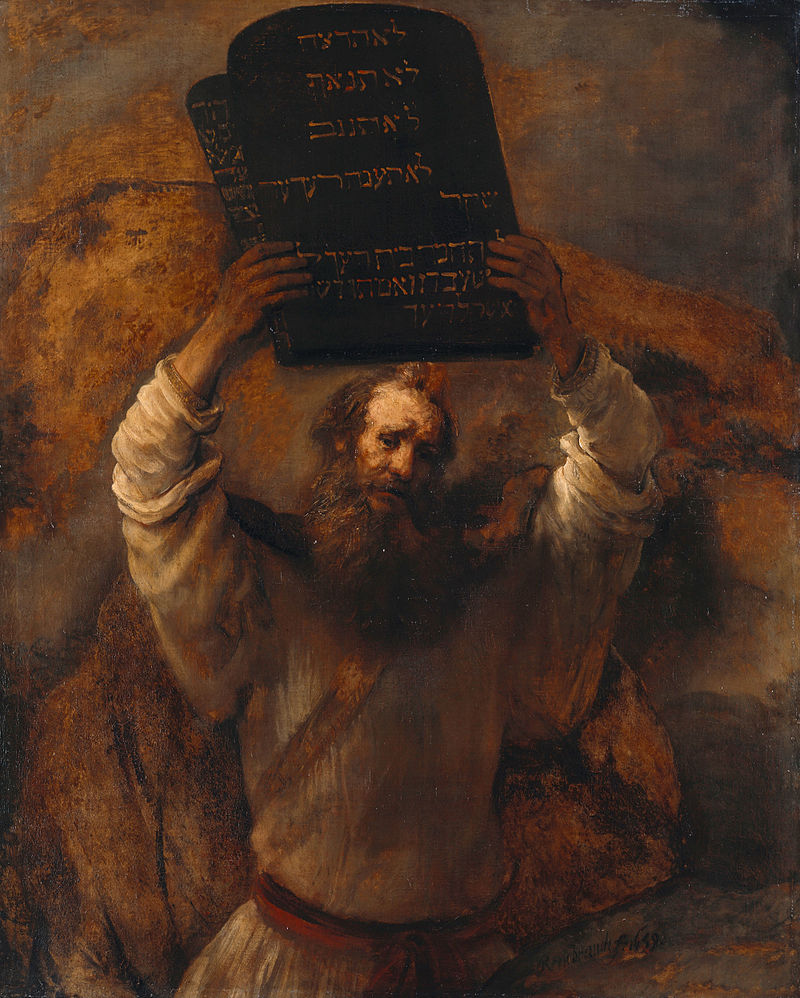
Rembrandt, Moses with the Ten Commandments

Rembrandt, Moses with the Ten Commandments

When I started the biblical reflections portion of this blog almost four years ago, I didn’t realize how much I would learn and how much it would shape my ministry. Many Christians don’t know how to approach the Hebrew Scriptures that many call the Old Testament, and as much as I love the gospels and the letters of Paul I am learning how to hear those writings much more fully as I become more and more familiar with the Psalms, Jeremiah, Deuteronomy, Ecclesiastes, Esther and Haggai. I am understanding more what Dietrich Bonhoeffer meant when he said,

I notice more and more how much I am thinking and perceiving things in line with the Old Testament; thus in recent months I have been reading much more the Old than the New Testament. Only when one knows the name of God may not be uttered may one sometimes speak the name of Jesus Christ. Only when one loves life and the earth so much that with it everything seems lost and at its end may one believe in the resurrection of the dead and a new world. Only when one accepts the law of God as binding for oneself may one perhaps sometimes speak of grace. And only when the wrath and vengeance of God against God’s enemies are allowed to stand can something of forgiveness and love of enemies touch our hearts. Whoever wishes to be and perceive too quickly and too directly in New Testament ways is to my mind no Christian. We have already, discussed this a few times, and every day confirms for me that it is right. One can and must not speak the ultimate word prior to the penultimate. We are living in the penultimate and believe the ultimate. (DBW 8: 213)

As I have wrestled with some difficult pieces of the Bible it has caused me to think about ethics, faith, our current world and so much more. For me this is the more challenging way but it has also been incredibly rewarding. Finishing Psalms 21-30 as a transition between books now I stand ready to begin another large piece. Next will be the book of Exodus, the second of the Pentateuch that I have approached. It is a book that I am more familiar with than I was with Jeremiah or Deuteronomy when I began and it is more of a narrative than any of the books I have done previously. I have two trustworthy companions for the journey. Since this is one of the central books of the Torah and the defining drama of the Jewish people I am delighted to have Rabbi Jonathan Sacks’, Covenant and Conversation: A Weekly Reading of the Jewish Bible as he reads through Exodus: The Book of Redemption as one of my primary dialogue partners. I will also be taking along Carol Meyers commentary on Exodus from the New Cambridge Bible Commentary Series. I have other resources that I have read in the past or that are on my shelf that may also be a part of this journey. With the forty chapters of Exodus the hope is to make the journey in approximately forty weeks, but as journeys go there are often unforeseen stops along the way. I am looking forward to this next exploration as I reenter the journey of the people of Israel from Egypt into the wilderness, from slavery into becoming the people of God and seeing how their journey and faith continue to shape and inform my own.

Ecclesiastes 5-The Gift of Mortality Before God and in the World

Samuel Cursing Saul by Hans Holbein the Younger (1530)

Samuel Cursing Saul by Hans Holbein the Younger (1530)

 Ecclesiastes 5:1-7 Silence Not Sacrifice

1 Guard your steps when you go to the house of God; to draw near to listen is better than the sacrifice offered by fools; for they do not know how to keep from doing evil. 2 Never be rash with your mouth, nor let your heart be quick to utter a word before God, for God is in heaven, and you upon earth; therefore let your words be few.

 3 For dreams come with many cares, and a fool’s voice with many words.

 4 When you make a vow to God, do not delay fulfilling it; for he has no pleasure in fools. Fulfill what you vow. 5 It is better that you should not vow than that you should vow and not fulfill it. 6 Do not let your mouth lead you into sin, and do not say before the messenger that it was a mistake; why should God be angry at your words, and destroy the work of your hands?

 7 With many dreams come vanities and a multitude of words; but fear God.

Perhaps it is my skeptical nature but I’ve always been wary of those who knew too clearly what God wanted from them and others. I think that sometimes the quest for certainty fills that uneasy quiet space of waiting for God to speak. In our own time there has become more common for people to claim they are spiritual but not religious, where that organized religion for various reasons may not speak to them. There are times where Christianity has tried to model itself after the ancient mystery religions where you did certain acts to try to appease a god or goddess to act on your behalf, but the LORD the God of Israel’s ways are not our ways. As Amy Plantiga Pauw can say memorably, “God does not exist to satisfy human aims and desires. God is not a mascot for our favorite causes.” (Pauw, 2015, p. 166) There are many times when people have used their religious piety as a way of bringing glory to themselves or securing their own sense of place within the chosen people. Qohelet encourages us to enter into that space of silence and waiting to draw near and listen to God.

It is possible that the narrative of 1 Samuel 15, where King Saul uses sacrifice as a way to cover up his disobedience to God’s command in the defeat of the Amalekites, informs this portion of Ecclesiastes. Saul is commanded to utterly destroy the people and the animals but when the battle is won in addition to sparing King Agag’s life the people also spared the best of the sheep, cattle, and other valuables. Capturing the spoils of war was a normal practice but here the Amalekites are dedicated as herem where they are consigned to destruction. (For much more about the understanding of war, herem, as well as an ethical reflection on how to address texts like 1 Samuel 15 see my post on Deuteronomy 20). When the next day King Saul is confronted by Samuel he claims that these best animals are to be a sacrifice to God. Samuel informs King Saul that he has earned the LORD’s disfavor and states:

“Has the LORD as great delight in burnt offerings and sacrifices, as in obedience to the voice of the LORD? Surely, to obey is better than sacrifice, and to heed than the fat of rams. For rebellion is no less a sin than divination, and stubbornness is like iniquity and idolatry. Because you have rejected the word of the LORD, he has also rejected you from being king.” 1 Samuel 15: 22f

Guarding one’s actions before God also involves the words that we say and the promises that we make. The misuse of the name of God was a serious offense for the people of Israel, enough so that it became enshrined within the ten commandments. When speaking about vows in verse four, Ecclesiastes begins with a direct parallel of Deuteronomy 23: 21. Making promises before God is a serious measure, in discussing Deuteronomy 23 I mentioned Jephthah’s rash oath and since I have just been discussing King Saul there is his rash oath in 1 Samuel 14: 24 which puts his son Jonathan’s life in danger. Ellen Davis shares, “To vow something before the priest (NRSV: “messenger”) that one has not considered carefully or, even worse, has no intention of fulfilling is to mock God” (Davis, 2000, p. 165)

Ecclesiastes has been pondering the place of humanity with its mortality within the seemingly timeless nature of creation and the eternity of God. Humanity, with all its limits, is placed in the position of listening to the wisdom of the eternal one. Ecclesiastes has striven to pay attention in the present moment to the gifts that God provides. It may be a paradox but a part of wisdom is learning to be patient with the finite gift of time. Making space and silence to be in that place where our words and wisdom fade before the words and wisdom of God.

Jesus, in Matthew’s gospel, can take the words of Ecclesiastes a step further. Ecclesiastes stated it is better to not vow than vow and not fulfill it but Jesus says not to swear an oath at all. For Jesus all words were to be faithful to what is said, whether they are under oath or not, and as in Ecclesiastes our power to fulfill these vows is often limited by the reality that one ‘cannot make one hair on one’s head white or black.’ (Matthew 5: 33-37)

Ecclesiastes 5: 8-20

 8 If you see in a province the oppression of the poor and the violation of justice and right, do not be amazed at the matter; for the high official is watched by a higher, and there are yet higher ones over them. 9 But all things considered, this is an advantage for a land: a king for a plowed field.

 10 The lover of money will not be satisfied with money; nor the lover of wealth, with gain. This also is vanity.

 11 When goods increase, those who eat them increase; and what gain has their owner but to see them with his eyes?

 12 Sweet is the sleep of laborers, whether they eat little or much; but the surfeit of the rich will not let them sleep.

 13 There is a grievous ill that I have seen under the sun: riches were kept by their owners to their hurt,14 and those riches were lost in a bad venture; though they are parents of children, they have nothing in their hands. 15 As they came from their mother’s womb, so they shall go again, naked as they came; they shall take nothing for their toil, which they may carry away with their hands. 16 This also is a grievous ill: just as they came, so shall they go; and what gain do they have from toiling for the wind? 17 Besides, all their days they eat in darkness, in much vexation and sickness and resentment.

 18 This is what I have seen to be good: it is fitting to eat and drink and find enjoyment in all the toil with which one toils under the sun the few days of the life God gives us; for this is our lot. 19 Likewise all to whom God gives wealth and possessions and whom he enables to enjoy them, and to accept their lot and find enjoyment in their toil– this is the gift of God. 20 For they will scarcely brood over the days of their lives, because God keeps them occupied with the joy of their hearts.


Gratitude and joy are the gifts from God in Ecclesiastes, not wealth or wisdom (even though it is better than foolishness). Our desire for wealth, power, possessions, land, position, and numerous other things we think will make us happy is insatiable. When riches and status become the central quest in life they leave the seeker unsatisfied. Governments may be corrupt, the system may be unfair, riches may be lost suddenly and all may be vanity yet joy can be found.

Ecclesiastes can recognize the problems and corruption that are a part of government and bureaucracy and still believe they ultimately benefit the land and the people. The oppression of the poor and the violation of justice and right are real, and a person may not be in a position to change these things. Yet, the author is no revolutionary. Even with all of the government of his time’s flaws he still sees the king (and by extension the rest of the government) put in place to serve the land and the farmer. The people placed in positions of authority may be motivated by a quest for greed or power, yet in the balance there is justice in the midst of the injustice, protection of justice and right in the midst of the injustice and ultimately even a bad government is in service of its people. Ecclesiastes is wisdom literature, not prophetic literature, so do not be surprised that it is invested in the maintaining of the way things are. Yet, there is wisdom in learning the balance of where one can invest in change and where one learns to live in an imperfect system.

Wisdom that is applied to the increasing of goods or the increasing of position and power is never satisfied. The human appetite for acquisition is insatiable. Riches can be hoarded and lost and never enjoyed. The future is never guaranteed, permanent security is never guaranteed, one’s position in society is never guaranteed. If one lives one’s life only for the future never enjoying the food and drink that one has, never giving thanks for the banquets one can be a part of or host, then one lives impoverished. If one spends one’s nights continually plagued by insecurity over one’s possessions or plotting how to increase one’s wealth or stature, one lives an impoverished life. If one never is given the gift of enjoying their labor and their time of leisure, one lives an impoverished life. The paradox of Ecclesiastes wisdom is that it is by embracing one’s limits-one’s mortality, one’s possessions, one’s position, and one’s companions that one is able to be thankful. Gratitude and joy is a gift of God in the midst of our brief days, our limited resources, our imperfect situations and governments and in our families and friends. Ecclesiastes is not, as I once thought, dismissive of life but actively seeks to embrace life as it is lived in the present.

Ecclesiastes 4- The Things That Steal Our Peace

Ecclesiastes 4

1 Again I saw all the oppressions that are practiced under the sun. Look, the tears of the oppressed– with no one to comfort them! On the side of their oppressors there was power– with no one to comfort them. 2 And I thought the dead, who have already died, more fortunate than the living, who are still alive; 3 but better than both is the one who has not yet been, and has not seen the evil deeds that are done under the sun.

 4 Then I saw that all toil and all skill in work come from one person’s envy of another. This also is vanity and a chasing after wind.
 5 Fools fold their hands and consume their own flesh.
 6 Better is a handful with quiet than two handfuls with toil, and a chasing after wind.

 7 Again, I saw vanity under the sun: 8 the case of solitary individuals, without sons or brothers; yet there is no end to all their toil, and their eyes are never satisfied with riches. “For whom am I toiling,” they ask, “and depriving myself of pleasure?” This also is vanity and an unhappy business.

 9 Two are better than one, because they have a good reward for their toil. 10 For if they fall, one will lift up the other; but woe to one who is alone and falls and does not have another to help. 11 Again, if two lie together, they keep warm; but how can one keep warm alone? 12 And though one might prevail against another, two will withstand one. A threefold cord is not quickly broken.

 13 Better is a poor but wise youth than an old but foolish king, who will no longer take advice. 14 One can indeed come out of prison to reign, even though born poor in the kingdom. 15 I saw all the living who, moving about under the sun, follow that youth who replaced the king; 16 there was no end to all those people whom he led. Yet those who come later will not rejoice in him. Surely this also is vanity and a chasing after wind.

The Hebrew word shalom is only used in Ecclesiastes in the previous chapter in the contrast between war and shalom (peace). Yet, beneath all of the vanity and chasing after the wind is perhaps the search for this concept of shalom, which is far more than an absence of conflict. Shalom has the sense of harmony, balance, living at peace with God’s will for one’s life and world. It is a greeting and a wish for one’s friends and neighbors and for one’s own life and yet then and now it seemed illusive. Qohelet turns his wisdom to the things that rob us of the joy and shalom of how life should be. In the brief verses of chapter four he addresses in a form that moves towards proverbs the issues of oppression, comparison and competition, overwork, isolation and institutional incompetency.

Oppression robs us of our humanity, both the oppressed and the oppressor. For the oppressed it means living in a sick society where their lives and work seem to matter less than those who operate in a more privileged state. For the oppressor it often means unconsciously adopting the views of a sick society that have allowed them to prosper only at the (often unseen) expense of others. Wisdom has opened the eyes of the privileged author of Ecclesiastes and it sickens him. The reality of oppression makes death better than life for him because it is not simply that an oppression can be stated and once brought into the open it dies under the light of day. Oppression involves a lifetime of learned and observed behaviors that require patience, prayer, struggle and dis-ease if the disease is ever to be healed. Oppression can be learned in families, in economic structures and in political systems and they in their own way are demonic. They so weave their ways into the thoughts and actions of ordinary people that they become a part of us. When the demons speak through us they reveal the uglier side of our lives and the inability to see one another as a gift, but instead we begin to see others as people who are to be oppressed or are our oppressor.

In the United States there has been a long struggle among people of color, women and people who because of race, sexuality, economic status, religion (or lack of religion), manner of dress, or numerous other reasons have felt their voices and lives did not matter. While I hope that the struggles of the last several years may eventually lead to a society that moves towards greater equality, for now there is no one to console the tears of the oppressed or the comfort those in power as they deal with the ways privilege has stolen a piece of their humanity as well. Perhaps there may come a day when those who have not been born yet don’t have to wonder if black lives, to use one of the red hot points of struggle in our time, matter less than other lives. There are places where our society is sick and its disease has infected all of us making our lives less human and less worth living. The oppression has possessed the soul of our society in the way it allows us to demonize others and to not see or hear them. The conflict that oppression creates robs our lives and our society of the shalom that wisdom seeks. Ecclesiastes does not offer the cure, only the diagnosis of the thing that steals our joy and peace, both the privileged and the excluded.

Envy is what Ecclesiastes names the second element that steals our joy and peace. This seems to encompass the ways we compare and contrast ourselves with one another. One the one hand toil and skill in work come from learning from and measuring oneself from the work of others. The author of Ecclesiastes can find joy in his labor, yet it can also become a source of anxiety. If our lives are continually measured by the gifts, talents and abilities of others then we will rarely, if ever, be satisfied. Our gifts and talents are not another’s gifts and talents. There is joy in learning to do what one is able with one’s gifts and abilities, for seeking what excellence might look like with one’s talents. Yet, envy of another’s gifts can steal the joy we find in our skills and work.

In a transition it appears that Ecclesiastes pulls from some preexisting form of proverbs about laziness and overwork. There are reasonably close parallels within the book of Proverbs:

A little sleep, a little slumber, a little folding of the hands to rest, and poverty will come upon you like a robber, and want, like an armed warrior. Proverbs 24: 33-34

Do not wear yourself out to get rich, be wise enough to desist. Proverbs 23: 4

Which Amy Plantiga Pauw (Pauw, 2015, p. 162) points out as possible connections with Proverbs, but for the second I actually find Proverbs 17: 1 closer

Better a dry morsel with quiet than a house full of feasting with strife. Proverbs 17:1

Especially when one takes into account the following verse about the slave who deals wisely and the child who acts shamefully in the context of the end of chapter four.

Ecclesiastes looks at the contrast between overwork and strife on the one hand and laziness and poverty on the other. Neither pole holds the answer, the wisdom is to find the balance point in the middle. A person who only applies their wisdom and knowledge in the quest for goods, wealth, and the insatiable quest for more will have to face the injustice that others will use the goods and wealth they have acquired. Overwork leads to an inability to the enjoy the gift of joy that God grants to the worker in their toil. Idleness also leads to a different type of challenge when the person doesn’t have what they need to feel filled or fulfilled. In our society being busy is a mark of success and achievement, as if the work of business is the work of busy-ness. As Ellen Davis can highlight,

“We regard work as primary, while the rest of what we do is “time-off.” But it was the opposite in the ancient world. The Latin word for “business” is neg-otium, literally, “not leisure”; the time when one does not have to work is the norm by which other activities are measured.” (Davis, 2000, p. 191)

There is wisdom in the practice of Sabbath, the practice of resting from one’s labor and toil. There is wisdom in finding joy in one’s work and pleasure in one’s leisure and knowing the balance of both. The wisdom of not wearing oneself out to be rich, of knowing when to desist but also not folding one’s hands only to consume one’s own flesh.

Isolation can also be a source that can rob us of joy. Sharing our labor with another, being able to share in the triumphs and the travails is one of the joys of life. Isolation can take many forms in life, isolation in the home, at work, in our leisure time and in our public time. A life that is driven by competition and envy shatters our community with one another. We were built for lives of partnership in our various vocations to support, strengthen and renew one another. In a world of increasing connection through digital media we face the struggle of maintaining the physical and personal connections that once formed the communities of our ancestors. In an unfair and often unjust world we need our solidarity with one another so that together we might be a cord not easily broken by the injustices and oppression of the world.

Qohelet seems to have little faith in the institutional structures of his day to provide wise, fair and just governance and a place where a life of shalom comes naturally. We live in an age where people have also become wary of the institutional structures of government, religion, and economics. There are some who still wonder, like Jesus’ disciples, that if a rich young man cannot easily enter the kingdom of God, then who can be saved, for the wealthy and powerful were supposed to be the blessed and the wise. Too many times we have seen the wealthy act only out of self-interest, the powerful act foolishly, and those supposed to be righteous commit horrible acts. Wisdom still has its place, even without power or wealth or fame, to navigate the way of the world. In the midst of oppression to find those moments of peace and the solidarity of one another. From the blindness of being the oppressor to cherish those moments, as difficult as they may be, when one’s eyes are opened and we can perhaps see a different future. Wisdom finds the balance between idleness and overwork and can find satisfaction in one’s own abilities and accomplishments. Like all things of shalom, they are transient. The seasons continue to turn and times of conflict do arise. The quest for permanence, security, and a lasting name ultimately give way to mortality and the turning of the seasons. These evanescent moments may not last for long but they are the gift of God that gives meaning to the toil and the struggle.

Psalm 19- Creation, the Law and a Faithful Life

James Tissot, The Creation (between 1896 and 1902)

James Tissot, The Creation (between 1896 and 1902)

Psalm 19

 <To the leader. A Psalm of David.>
1 The heavens are telling the glory of God; and the firmament proclaims his handiwork.
2 Day to day pours forth speech, and night to night declares knowledge.
3 There is no speech, nor are there words; their voice is not heard;
4 yet their voice goes out through all the earth, and their words to the end of the world.
  In the heavens he has set a tent for the sun,
5 which comes out like a bridegroom from his wedding canopy,
  and like a strong man runs its course with joy.
6 Its rising is from the end of the heavens, and its circuit to the end of them;
  and nothing is hid from its heat.
7 The law of the LORD is perfect, reviving the soul;
  the decrees of the LORD are sure, making wise the simple;
8 the precepts of the LORD are right, rejoicing the heart;
  the commandment of the LORD is clear, enlightening the eyes;
9 the fear of the LORD is pure, enduring forever;
  the ordinances of the LORD are true and righteous altogether.
10 More to be desired are they than gold, even much fine gold;
  sweeter also than honey, and drippings of the honeycomb.
11 Moreover by them is your servant warned; in keeping them there is great reward.
12 But who can detect their errors? Clear me from hidden faults.
13 Keep back your servant also from the insolent; do not let them have dominion over me.
  Then I shall be blameless, and innocent of great transgression.
14 Let the words of my mouth and the meditation of my heart be acceptable to you,
   O LORD, my rock and my redeemer.

Psalm 19 as a psalm of praise brings together the wonder and mysterious natural knowledge of God uttered in the unheard speech of creation and the revealed wisdom of the LORD in the gift of the Torah (the law). Like Psalm 8, the other psalm of praise we have encountered at this point in the book of Psalms, it reflects upon the majesty of creation from a sense of wonder and awe. It can look at the heavens above, the earth below and the seas in their vastness and be amazed at the creator God who has done all of these things. Here in the first verse the word for God is the generic El which can be either God, a god, or in plural gods, but it is not a name like will be used beginning in verse seven. Yet, the heavens and day and night and sun are all poetically personified in the psalm, speaking in words that are unheard and voices that human ears cannot perceive. Perhaps the psalmist, just straining, can barely hear the silent resonance of the Creator echoing through the creation. Perhaps they can perceive the God that stands behind the creation where others have taken the created parts of creation and deified them. In verses four and five, it is possible that the Psalmist makes use of an existing Akkadian/Summerian bilingual hymn that refers to the sun as a hero, warrior and bridegroom (Nancy deClaisse-Walford, 2014, p. 208) yet instead of leaving the sun as a deity in its right (like the surrounding cultures) now the sun becomes a rejoicing servant reveling in the course that the creator God has set for it.  The first half of the Psalm revels with the song of creation in the artistry and majesty of the creator and the Psalmist lifts up in their own way an audible voice for the unheard creation’s song.

It may seem unusual to bring together creation and the law in a poem, and perhaps these originated in two different places, but bringing these two together makes sense of the broader understanding of how God works with the Hebrew people. Creation is a gift of God for all the world, but the law (the Torah) is the special revealed gift for God’s chosen people. The God referred to initially only with the generic El now receives the revealed name YHWH (frequently pronounced Yahweh, anytime you see LORD in the Hebrew Scriptures (Old Testament) the proper name of God revealed to Moses is behind that, it is typically pronounced Adonai when read (translates to Lord) to not take the LORD’s name in vain). Together with Psalm 1 and the much longer Psalm 119, Psalm 19 praises the law of the LORD. The revealed will of God in the law becomes the nourishment, which revives the faithful, brings wisdom and purity and clarity and are a rich gift fit for a king. The ideal leader was to have the law always before them and to diligently observe and follow it all the days of their life. (see Deuteronomy 17: 18-20) If the king is the one lifting up this prayer the wonder of the cosmos is combined with the revealed wisdom of the Torah to keep them in obedience to God’s will for their life and God’s people.

The Psalm ends with a petition to be kept in this way revealed by the LORD in the midst of all the temptations that life brings forward. There is a humility in realizing that even though the law may reveal the human may conceal from themselves the faults of their hands and hearts. Even with the wisdom of Solomon one may fail to see the divergence in one’s life from the way of the covenant which coheres with God’s law. The Psalmist petitions their LORD to clear them of hidden faults, to keep them away from the insolent and foolish and to allow them to be blameless. God is their rock and their redeemer, the word for redeemer is go’el the kinsman redeemer who is able to, and is expected to, purchase their enslaved kin from slavery. Here the LORD is the one who is able to set the Psalmist free to live the life they are called to live: a life that can revel in God’s creation and delight in God’s law.

Psalm 16- Remaining Faithful in a Pluralistic Setting

Giovanni Francesco Barberi (il Guercino), King David (1651)

Giovanni Francesco Barberi (il Guercino), King David (1651)

Psalm 16

<A Miktam of David.>
1 Protect me, O God, for in you I take refuge.
2 I say to the LORD, “You are my Lord; I have no good apart from you.”
3 As for the holy ones in the land, they are the noble, in whom is all my delight.
4 Those who choose another god multiply their sorrows;
their drink offerings of blood I will not pour out or take their names upon my lips.
5 The LORD is my chosen portion and my cup; you hold my lot.
6 The boundary lines have fallen for me in pleasant places; I have a goodly heritage.
7 I bless the LORD who gives me counsel; in the night also my heart instructs me.
8 I keep the LORD always before me; because he is at my right hand, I shall not be moved.
9 Therefore my heart is glad, and my soul rejoices; my body also rests secure.
10 For you do not give me up to Sheol, or let your faithful one see the Pit.
11 You show me the path of life. In your presence there is fullness of joy;
 in your right hand are pleasures forevermore.
 
When I was growing up I assumed that the world of the Hebrew Scriptures (or the Old Testament) which was written to the people of Israel and Judah was a world that was as monolithic as I assumed things were growing up in my own childhood. Just because everyone I knew growing up was associated with a Christian church and I think the church was still, at least the Lutheran churches I grew up within, operating out of a Christendom concept where everyone at least had a church that they belonged to (even if they didn’t regularly or ever attend). I was wrong about the world that I grew up in and I was wrong about the Hebrew Scriptures. Perhaps being a pastor I have a heightened awareness to the other things that have placed their claims upon people’s lives and I do believe that the church is losing the privileged place it once held in society. There are so many competing voices that the church deals with (and perhaps the church has always dealt with) and I know I spend a lot of time thinking about how I can address the questions that are a part of our world while remaining faithful to the core ideas of my faith.

In Psalm 16 the Psalmist is attempting to remain faithful in the midst of an atmosphere that has several religious choices. The Psalm itself may be from a priest or from David (as its it is attributed to) but in their attempts at faithfulness they feel isolated. The holy ones of the land, presumably those who are remaining faithful, seem to be in conflict with those who are either turning away to other religious options or who are trying to blend together the worship of the LORD with gods like Baal and Asherah (treating the LORD as one among many). Perhaps the Psalmist is trying to distinguish between himself and the others who are willing to present offerings to other gods and take their names upon their lips. The Psalmist in their gut (in verse seven where it speaks in the NRSV translation of my heart instructs me this is literally my kidneys, the guts-where feelings come from in Hebrew thought) knows that what they are doing is right, but it may be unpopular. The more I spend time with the Hebrew Scriptures, the more I realize that there were few, if any, times where the people exclusively worshipped the LORD.

In our own day we too have to struggle with how to remain faithful in a pluralistic world, where many of the other messages may not be associated with another religion but instead may be reflective of the consumeristic society, the allegiance to states, various political ideologies or the continued pressures of a society where entertainment and sports occupy a huge amount of the public’s loyalty. None of these are bad things but they are penultimate (less that ultimate, secondary things). There are many things that may demand our tribute, our own blood offerings. Yet, I think the challenge in this and every age is to trust in the LORD, to know in one’s gut that one’s faith in the LORD is well placed, and even in the midst of other alternatives to let our heart be glad, our soul rejoice and our body secure in the portion that the LORD has allotted to us.

Reflections From A Year Spent with Deuteronomy

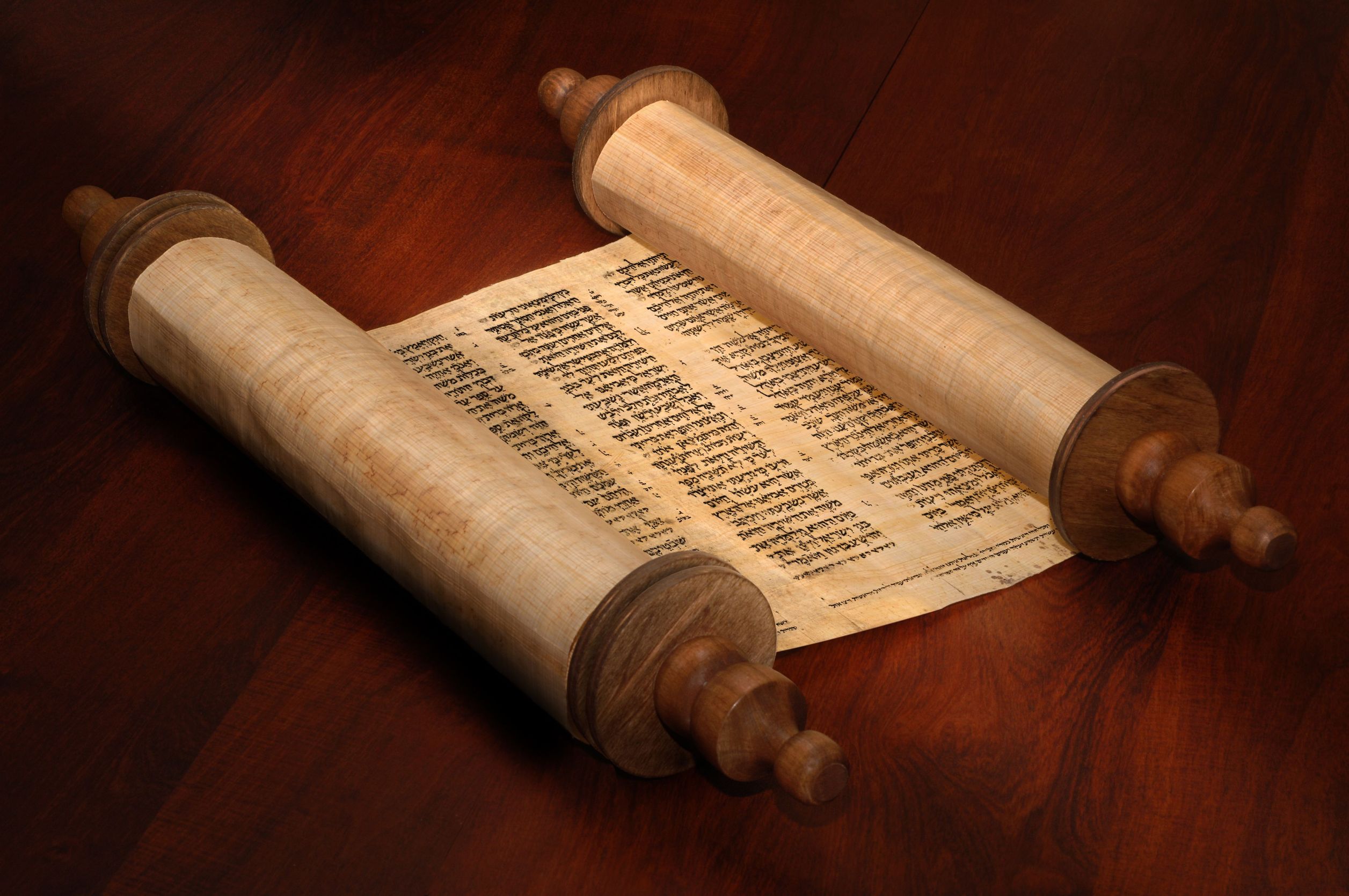
Torah Scroll, Original image from http://www.nachat-austin.org/weekly-torah/

Torah Scroll, Original image from http://www.nachat-austin.org/weekly-torah/

Deuteronomy is the fourth book, and the second large book that I have worked my way through systematically from beginning to end. It took me a little more than a year (13 months and 1 week) from my first post on Deuteronomy 1 to the final entry on Deuteronomy 34. Deuteronomy is not a book that a lot of Christians spend a lot of time with but for our Jewish brothers and sisters it is one of their most important books. Most Christians don’t spend much time with Deuteronomy, well with the exception of Deuteronomy 6 which has become important to those who want to talk about faith formation in the home or Deuteronomy 5 which re-articulates the ten commandments. Many of the ordinances and commandments of Deuteronomy seemed alien to me and yet, I knew that there was a reason that people had gone back to this work for over 2,500 years. Using Walter Brueggemann’s and Deanna A. Thompson’s commentaries on Deuteronomy as my two primary reading companions I began not knowing how the project would turn out but at least motivated to see what wisdom I would glean from this ancient work. I was motivated by the knowledge that I had made it through Jeremiah, a larger and very challenging work, and that I would be able to eventually reach the point of reflecting back again.

I am a Lutheran pastor who has spent most of my time studying the Gospels and Paul’s letters and who comes from a tradition that is open to reading scripture with a critical eye. Deuteronomy has some sections that in the twenty first century we will not be adopting or advocating and so I have tried to bring the issues of the time into conversation with the events and policies and beliefs of our time. I have tried to use Deuteronomy as a helpful conversation partner-trying to understand how the author of Deuteronomy thought about God and society.

Deuteronomy wants to imagine a society ordered around God’s law and living out of the covenant relationship with the LORD the God of Israel. For the people of Israel and Judah their public life was a reflection of their faith and there was no concept of a separation between church and state. In a world where the people of Israel were surrounded by a plethora of religious alternatives the book of Deuteronomy tries to imagine a society centered around the laws and covenant and ordinances of the God of Israel and a manner both catechetically in the home and liturgically in the worship of the community that would pass on this faith from generation to generation. The great anxiety of the book of Deuteronomy is that in the midst of abundance the generations to come would forget the source of their abundance and become attracted by the practices and the gods of the people around them.

I am very aware of the postmodern, secular, pluralistic world in which we live and I have attempted to bring the questions of that worldview into conversation with the strictly ordered worldview of the Deuteronomist. What has emerged at its best is an opportunity to think ethically about what type of world I as a Lutheran Christian in 21st Century would imagine in dialogue with Deuteronomy imagining God’s will for their time. Because our hermeneutics and starting points are different there are times where we come to different answers and that is OK. Even when I may diverge from the way Deuteronomy understands God or the meaning of what God desires I still try to find the wisdom of the people who were wondering God’s story had entered their story through the Exodus and through their experiences.

As a modern scholar I have used a lot of different tools in working through Deuteronomy. The first is an ancient tool, I simply forced myself to listen to the text by slowing down and manually writing out the text as I commented on it. As mentioned above, I am a Lutheran pastor so I do come from a perspective where the cannon within the cannon (or the most important key to understanding scripture) is what conveys Christ and so I have listened to where Deuteronomy spoke in concert and contrast to the witness of Christ throughout the New Testament. I have brought my experiences and listened to the ways my time in the military, as a father, as a divorced person, and as a pastor have been brought into conversation and filled out the way I can hear these texts. I have been intentionally intertextual, allowing Deuteronomy to be in conversation with the rest of the Bible. But I come to this as a person who loves the Bible and the God it tries to bear witness to and as a pastor who wants to communicate this story to others who would have the patience to listen. I am not a PhD in the Hebrew Scriptures, just a willing student of Deuteronomy.

Wrestling with books like Deuteronomy is more challenging than the familiar gospels or even Paul’s letters but there is wisdom. It is hard to understand the way the early church leaders talked about Jesus without understanding the scriptures they were reading. There are portions of Deuteronomy that help make sense of who Jesus was and what he was striving for. For example, look at Deuteronomy 17: 14-20 and then think about what it meant for Jesus to have the title Messiah (anointed king) applied to him. Deuteronomy forms the basic frame that the prophets will work out of as they protest the injustices and idolatry of the nations of Israel and Judah. The thought of Deuteronomy will form one of the loudest voices in informing the rest of the Hebrew Scriptures as they evaluate their history and as they imagine their future.

If you have benefited from these reflections I am thankful. They have been beneficial for me to write. The process continues to allow me to grow in my faith and understanding. I hope that in them I have exercised wisdom. I have benefited from the wisdom of others who have passed on the faith and this tradition to me.

As an update on what is next I am returning to the book of Psalms and will work through Psalms 11-20 as I decide which book I will work through next. I have enjoyed this project but I also am ready to work with something new and there is always a sense of relief at the completion of a work like this (even if I am the only person who ever reads it).


Deuteronomy 31 Preparing for Life after Moses

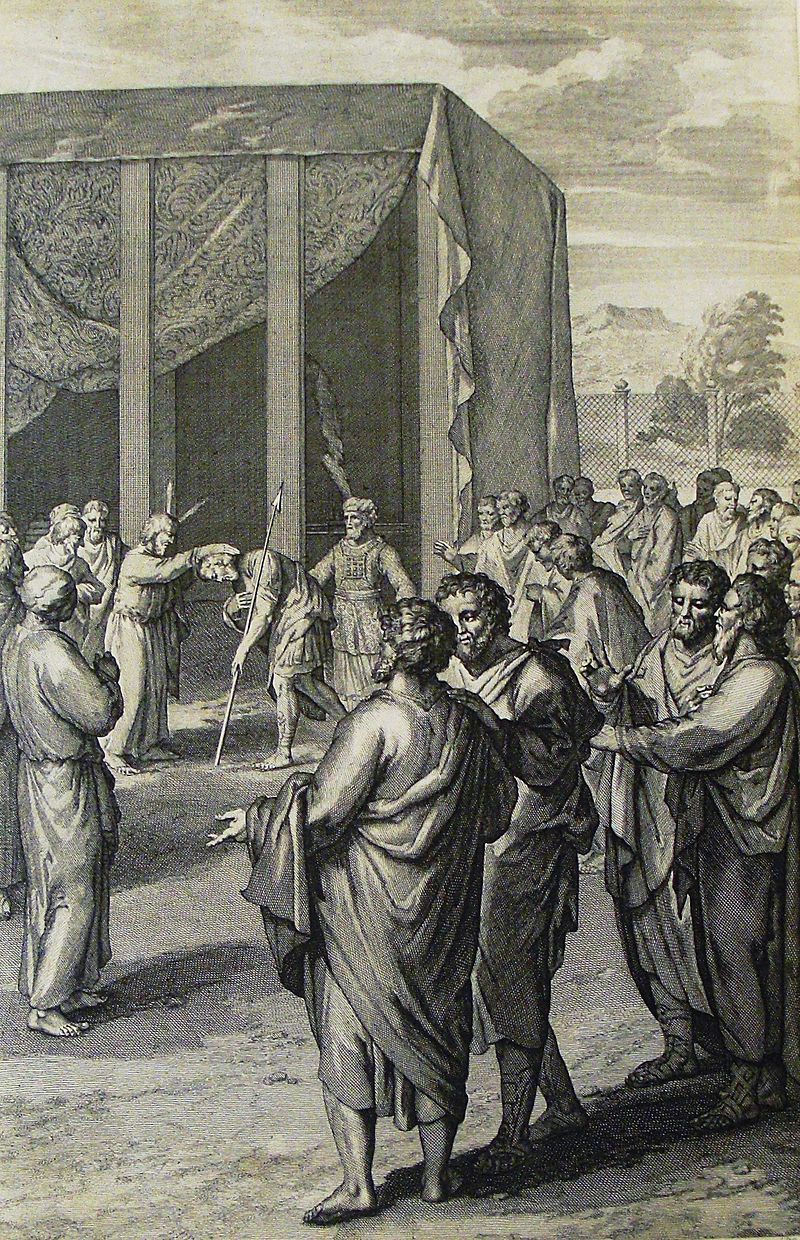
Moses Delivers a Charge to Joshua from th Philip Medhurst Collection of Bible Illustrations

Moses Delivers a Charge to Joshua from th Philip Medhurst Collection of Bible Illustrations

Deuteronomy 31

1 When Moses had finished speaking all these words to all Israel, 2 he said to them: “I am now one hundred twenty years old. I am no longer able to get about, and the LORD has told me, ‘You shall not cross over this Jordan.’ 3 The LORD your God himself will cross over before you. He will destroy these nations before you, and you shall dispossess them. Joshua also will cross over before you, as the LORD promised. 4 The LORD will do to them as he did to Sihon and Og, the kings of the Amorites, and to their land, when he destroyed them. 5 The LORD will give them over to you and you shall deal with them in full accord with the command that I have given to you. 6 Be strong and bold; have no fear or dread of them, because it is the LORD your God who goes with you; he will not fail you or forsake you.”

7 Then Moses summoned Joshua and said to him in the sight of all Israel: “Be strong and bold, for you are the one who will go with this people into the land that the LORD has sworn to their ancestors to give them; and you will put them in possession of it. 8 It is the LORD who goes before you. He will be with you; he will not fail you or forsake you. Do not fear or be dismayed.”

9 Then Moses wrote down this law, and gave it to the priests, the sons of Levi, who carried the ark of the covenant of the LORD, and to all the elders of Israel. 10 Moses commanded them: “Every seventh year, in the scheduled year of remission, during the festival of booths, 11 when all Israel comes to appear before the LORD your God at the place that he will choose, you shall read this law before all Israel in their hearing. 12 Assemble the people– men, women, and children, as well as the aliens residing in your towns– so that they may hear and learn to fear the LORD your God and to observe diligently all the words of this law, 13 and so that their children, who have not known it, may hear and learn to fear the LORD your God, as long as you live in the land that you are crossing over the Jordan to possess.”

14 The LORD said to Moses, “Your time to die is near; call Joshua and present yourselves in the tent of meeting, so that I may commission him.” So Moses and Joshua went and presented themselves in the tent of meeting, 15 and the LORD appeared at the tent in a pillar of cloud; the pillar of cloud stood at the entrance to the tent.

16 The LORD said to Moses, “Soon you will lie down with your ancestors. Then this people will begin to prostitute themselves to the foreign gods in their midst, the gods of the land into which they are going; they will forsake me, breaking my covenant that I have made with them. 17 My anger will be kindled against them in that day. I will forsake them and hide my face from them; they will become easy prey, and many terrible troubles will come upon them. In that day they will say, ‘Have not these troubles come upon us because our God is not in our midst?’ 18 On that day I will surely hide my face on account of all the evil they have done by turning to other gods. 19 Now therefore write this song, and teach it to the Israelites; put it in their mouths, in order that this song may be a witness for me against the Israelites. 20 For when I have brought them into the land flowing with milk and honey, which I promised on oath to their ancestors, and they have eaten their fill and grown fat, they will turn to other gods and serve them, despising me and breaking my covenant. 21 And when many terrible troubles come upon them, this song will confront them as a witness, because it will not be lost from the mouths of their descendants. For I know what they are inclined to do even now, before I have brought them into the land that I promised them on oath.” 22 That very day Moses wrote this song and taught it to the Israelites.

23 Then the LORD commissioned Joshua son of Nun and said, “Be strong and bold, for you shall bring the Israelites into the land that I promised them; I will be with you.”

                24 When Moses had finished writing down in a book the words of this law to the very end, 25 Moses commanded the Levites who carried the ark of the covenant of the LORD, saying, 26 “Take this book of the law and put it beside the ark of the covenant of the LORD your God; let it remain there as a witness against you. 27 For I know well how rebellious and stubborn you are. If you already have been so rebellious toward the LORD while I am still alive among you, how much more after my death! 28 Assemble to me all the elders of your tribes and your officials, so that I may recite these words in their hearing and call heaven and earth to witness against them. 29 For I know that after my death you will surely act corruptly, turning aside from the way that I have commanded you. In time to come trouble will befall you, because you will do what is evil in the sight of the LORD, provoking him to anger through the work of your hands.”

 30 Then Moses recited the words of this song, to the very end, in the hearing of the whole assembly of Israel:

The final chapters of Deuteronomy use the transitions (chapter 31), song (chapter 32) and final blessing (chapter 33) to prepare for the death of Moses in chapter 34 and the transition to the narrative of Joshua. Moses carried enormous power and importance for the generations that left Egypt, wandered in the desert and now stand at the precipice of the promised land. Future leaders will lead differently than Moses did, they will not have the same relationship with the LORD the God of Israel. They will not be called to be the teacher of the law, the political leader, the final judge, and the faithful mouthpiece of God in their midst. Even with Moses’ stature, he would struggle to bring the people out of Egypt, through the wilderness and to this point. Frequently he would find himself between God and the people, pleading for the people who seemed to be unwilling or unable to live up to the ideals of the covenant. The anxiety of the book of Deuteronomy that the people will not remain faithful in the comfort of the promised land is heightened by the knowledge that Moses will not be there to ease their transition from a wandering people into a settled confederation of tribes that will make up the nation of Israel.

Moses’ role becomes divided into three parts in this chapter: as the leader (both politically and militarily), as the witness to the people, and as the teacher of the law. Now Moses will be replaced by a man, a song and a book. Joshua son of Nun first enters the story in Exodus 17 in the battle between the Israelites and Amalek. Joshua is the leader of the people of Israel in the battle in the valley while Moses, Aaron and Hur are on top of the hill with Aaron and Hur supporting Moses’ arms in the battle (for while Moses’ hand is held up the Israelites prevail). Shortly afterwards Joshua becomes Moses’ assistant and he is one of the two Israelite spies who advocate courage and invading the promised land the first time the people arrive. The choice of Joshua as the leader to succeed Moses is not a surprise, but Joshua has some large shoes to fill and a daunting task ahead of him. Joshua is commissioned twice, first by Moses with words that are not identical to, but foreshadow the central command in the book of Joshua, “Be strong and courageous; do not be frightened or dismayed, for the LORD you God is with you wherever you go.” (Joshua 1:9) Then Joshua is commissioned a second time in the tent of the meeting by the LORD. Publically now the mantle of leadership is passed to Joshua for a new task in a new time.

The song, which will come in chapter 32, is to become a witness for the people when they are unfaithful. Deuteronomy does not have an optimistic view of the potential faithfulness of the people of Israel, and the people will not have written copies of the law in their homes, but the song is to become the reminder of who they are called to be. Music does have the power to become the bearer of memory in powerful ways and the Hebrew people, as well as early Christians, dedicate significant portions of their scriptures to songs. The book of Psalms may be the best known example, but there are songs throughout the narrative, the prophets and the other documents that form the scriptures. For example, both Moses and Miriam have songs recorded in Exodus 15, and these songs probably formed a part of the storytelling and worship of the ancient Hebrew people.

Finally, the law is physically written down and place with the priests and the elders. The reading of the law is to be read as a part of the ritual of the festival of booths every seven years as a way of continually reinforcing the law to the people. I have said several times throughout the book of Deuteronomy that this is primarily an aural document meant to be heard instead of read. Most of the people would not have been able to read or write and depended on the scribes and priests to read the law and other holy words to them. Deuteronomy is concerned with passing on the law from generation to generation and here is one more attempt to create the possibility for future generations to know the LORD their God.

Moses is preparing to utter his final two messages to the people, the last song of Moses and the final blessing. Joshua is now to be the leader that will carry the people from the edge of the promised land to become the occupants of that land. The songs they sing will now become witnesses that call them back to faithfulness and the law is entrusted to the Levites and the elders so that they may order the society in accordance with them. Moses will, for the Jewish people, occupy a place that no one else will. He has been the faithful teacher, visionary leader, righteous judge, and the one stood face to face with God. The best that leaders who follow Moses will be able to do is to be ‘strong and courageous’ and to hear and learn the law of the LORD their God.

Moses Delivers the Law to the Priests, Phillip Medhurst Collection of Biblical images

Moses Delivers the Law to the Priests, Phillip Medhurst Collection of Biblical images

 Deuteronomy 21: Death, Rebellious Children, Captured Women and Inheritance

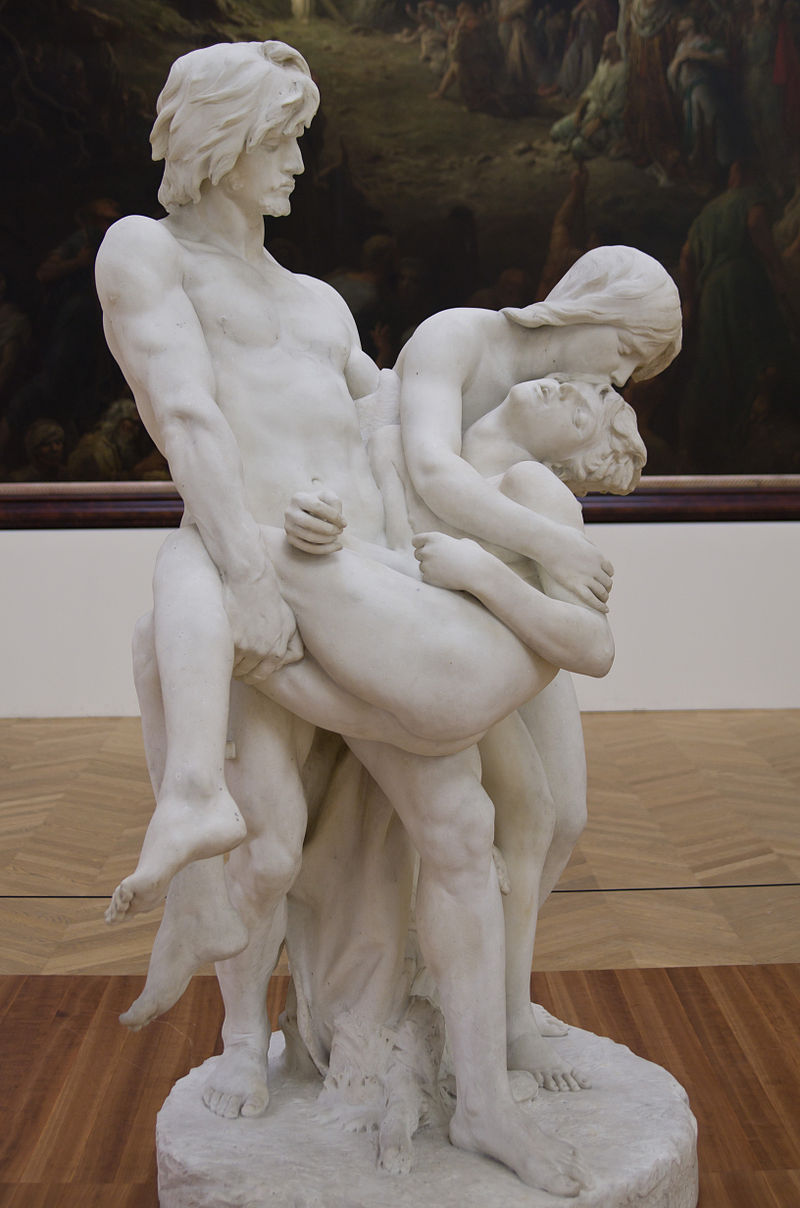
The First Funeral, Louis Ernest Barrias (1883)

The First Funeral, Louis Ernest Barrias (1883)

Deuteronomy 21: 1-9: Dealing with an Unsolvable Death

1 If, in the land that the LORD your God is giving you to possess, a body is found lying in open country, and it is not known who struck the person down, 2 then your elders and your judges shall come out to measure the distances to the towns that are near the body. 3 The elders of the town nearest the body shall take a heifer that has never been worked, one that has not pulled in the yoke; 4 the elders of that town shall bring the heifer down to a wadi with running water, which is neither plowed nor sown, and shall break the heifer’s neck there in the wadi. 5 Then the priests, the sons of Levi, shall come forward, for the LORD your God has chosen them to minister to him and to pronounce blessings in the name of the LORD, and by their decision all cases of dispute and assault shall be settled. 6 All the elders of that town nearest the body shall wash their hands over the heifer whose neck was broken in the wadi, 7 and they shall declare: “Our hands did not shed this blood, nor were we witnesses to it. 8 Absolve, O LORD, your people Israel, whom you redeemed; do not let the guilt of innocent blood remain in the midst of your people Israel.” Then they will be absolved of bloodguilt. 9 So you shall purge the guilt of innocent blood from your midst, because you must do what is right in the sight of the LORD.

The author of Deuteronomy is concerned that the people’s life in the land is not contaminated by bloodguilt and that they have a means for dealing with an unsolvable death in their land. Even though the death may not be solvable there still needs to be action on behalf of the community to atone for the wrong that has been done and to make things right. This issue also comes up in Deuteronomy 19: 1-13 when discussing the cities of refuge to ensure innocent blood is not spilled for an accidental killing. In Deuteronomy’s perspective there is a need to atone for the death that occurs and only blood can do that. The ritual involves the elders of the community and the Levites who come together to absolve the community of guilt.

The ritual itself involves assigning the responsibility to the nearest town, the giving up of something of high value to the community, declaration of innocence of the community, blessing and finally a ritual of surrendering responsibility. The role of the Levites in the judicial process laid out in Deuteronomy 17: 8-13 is now expanded here to involve any case of dispute and assault, but they also oversee the actions of the community to make things right with God. Once the responsibility is assigned to the elders of the town they bring a heifer, a cow that has not been used for agricultural purposes and has not born a calf, and identify a wadi, a ravine which must have running water, that is also not being used in agricultural purposes to conduct the ritual. Breaking the heifer’s neck kills the animal in a non-sacrificial way and unlike the sacrifices (talked about earlier in Deuteronomy 12, in relation to the festivals in Deuteronomy 16, and in relation to the priests in Deuteronomy 18) there is no mention of participating in eating the heifer that has been killed. This animal is lost to the community in the action of absolution. The washing of hands to absolve responsibility is a common practice, but here the elders of the community act on behalf of the community: declaring innocence both in action and in not covering up the crime and attempt to make things right between the community and God.

Deuteronomy is an ancient book and it is sometimes difficult to approach in our world, and one of the reasons I spend the time working through this publicly is there is not much that is available online that is not either using Deuteronomy as a classic case of how irrelevant the Bible and religion is or on the other side lifts up Deuteronomy (often individual verses or sections) as a methodology that we should embrace without reflection in all its harshness. Most Christian pastors, especially in the more liturgical traditions, spend very little time in Deuteronomy other than perhaps chapters 4-6. Yet, as I have moved through these sections of Deuteronomy that deal with interpreting the law for the people of Israel it has become for me a dialogue within and between scripture. Wanting to honor and find what wisdom Deuteronomy has and how its perspective on God’s relationship to God’s people might help our communal life as Christians even when we can’t always agree with either the rules or the perspectives contained within Deuteronomy.

Some passages, including some coming immediately after this one, we would not want to integrate into our life in our society, but in our litigious society there is no way to deal with an unsolved case. It simply remains unsolved unless, somewhere down the road, a new revelation makes the case solvable. In events where a public wrong has been done, like an unsolved murder, perhaps there would be wisdom in finding a way for community leaders and religious leaders to come together, to denounce the wrong that has been done, to ensure that they do not bear responsibility for the actions and to atone on behalf of the community. Perhaps these actions might begin the process of the community’s healing and bring together the community to protect and watch over the fellow members of the community so that this type of action does not occur in the future.

Deuteronomy 21: 10-14 The Female Captive

 10 When you go out to war against your enemies, and the LORD your God hands them over to you and you take them captive, 11 suppose you see among the captives a beautiful woman whom you desire and want to marry, 12 and so you bring her home to your house: she shall shave her head, pare her nails, 13 discard her captive’s garb, and shall remain in your house a full month, mourning for her father and mother; after that you may go in to her and be her husband, and she shall be your wife. 14 But if you are not satisfied with her, you shall let her go free and not sell her for money. You must not treat her as a slave, since you have dishonored her.

War in any time is hellish both for the soldiers involved in it but perhaps even more so for those who are the victims of the conflict. Women and children rarely had any choices when their cities or lands were captured. From a modern standard the idea of forcing a captive woman to marry a warrior of the army that has conquered their land seems abhorrent. Deanna Thompson argues that this passage is a “glimpse of restraint in the midst of the brutal realities of war.” (Thompson, 2014, p. 159) It does set limits on the injustices that (in theory) be committed on a captive of war by the warriors of Israel.

The author of Deuteronomy would not understand the questions that people from a postmodern secular word (or even earlier worldviews) would have with passages like this, it was simply the world they lived in. Even though there are parts of the bible that can be read as sympathetic with a feminist or egalitarian view of sexuality there are large portions, like this one, which simply come from a world that would be alien to us. In the world that Deuteronomy speaks to: polygamy is an accepted and encouraged practice (to quickly grow the nation of Israel), being a brought into the chosen people of God (through conquest) is a privilege that the vanquished should be thankful for (many Christians shared a similar perspective in the conquest of the Americas), and ultimately in a male centered society the feeling of the women doesn’t carry very much weight. In the United States we can joke that, “if mama ain’t happy, ain’t nobody happy” but assuming that type of worldview on the world of Deuteronomy is simply not true.

One of the gifts and challenges of wrestling through Deuteronomy is that it requires us to wonder how do utilize the wisdom and sometimes the wrongness (from a current perspective) of ancient scripture in our time. There isn’t a major calling for a wholesale adoption of the Deuteronomic and Levitical practices as a guide for life in our time, but I think the pieces of Deuteronomy that make me uncomfortable force me to think about questions like, “how then should women be protected in situations involving combat?” “How do we honor the scriptures and those who wrote them even when we disagree?” “Is there wisdom to be learned even in our disagreements?” “Are there places where the ancient scriptures challenged the world of their day?”

In the world of Deuteronomy, where women are looked upon as spoils that were treated however the captors chose: used while desired and then perhaps sold when no longer desired, Deuteronomy does place a restraint upon the power of the male head of the household. While the woman who is captured has no choice, once she is taken up into the household she does have some, albeit small protection. She is given a time to mourn, she is to lose hair and nails and fancy clothes that may have contributed to her being an object of attraction. She is given protection from being sold into slavery, even though being released does subject her to a significant economic challenge without a means of support. The reality is that she may be forced into begging or prostitution by the release but at least the releaser does not become the one to profit financially by this. Ultimately this is probably told in the hope that the one who releases would provide for the captive woman initially like the people of Israel receiving material wealth from the Egyptians prior to their leaving in the Exodus narrative. In its own harsh way I believe that Deuteronomy is trying to communicate a level of personhood and protection for the captured women. This provides a limit to the power over the booty outlined in Deuteronomy 20, not a sufficient limit for our time, but a limit nonetheless.

The reality of the plight of captive women in the ancient world, even within Deuteronomy’s system, forces them into marriages where they have no voice in the matter. The reality that in this world the woman has no choice over how her body is to be used may not be as far away as we would like to admit. Many women, and some men, in relationships may not feel freedom in how their body is used. Throughout history rape has been used as a part of the conquest of an area. Even today in combat zones throughout the world women’s bodies are not safe. As people of faith we need to be willing to answer the difficult questions of how we honor women and men and their bodies in relationship, in society and even in conflict.

Deuteronomy 21: 15-17 The Rights of the Firstborn

 15 If a man has two wives, one of them loved and the other disliked, and if both the loved and the disliked have borne him sons, the firstborn being the son of the one who is disliked, 16 then on the day when he wills his possessions to his sons, he is not permitted to treat the son of the loved as the firstborn in preference to the son of the disliked, who is the firstborn. 17 He must acknowledge as firstborn the son of the one who is disliked, giving him a double portion of all that he has; since he is the first issue of his virility, the right of the firstborn is his.

This is one of those interesting passages where the Biblical narrative, particularly as it relates to God’s freedom, comes into conflict with the ordered worldview of Deuteronomy. This passage places a limit on the freedom of the male head of household with respect to passing on the inheritance. A husband is not allowed to pick a younger son from a (currently) favored wife to inherit in preference to the eldest son. Matters of inheritance were serious business in the ancient world as possessions and land passed from one generation of men to the next. Yet, it is interesting the way that the narrative of the people of Israel comes into conflict with this fairly simple and common understanding of inheritance.

Throughout the book of Genesis there are stories of later sons inheriting the first born portion. Beginning with the story of Abraham and Sarah and Hagar, the first born son, Ishmael, is set aside for the child of promise, Isaac. In this story the argument could be made that Hagar was never the wife of Abraham so the promise wouldn’t flow to Ishmael but to Isaac. Yet in the very next generation there is the stories of Jacob and Esau where Jacob, by trickery, gets both the inheritance and the blessing. Joseph is favored by his father over his brothers because he is the first child of Rachel, the favored wife, and later Reuben, the firstborn, is passed over for Judah because of sleeping with his father’s concubine Bilhah. David is chosen by God to be king even though he is the youngest brother and in the political intrigue surrounding David’s impending death he appoints Solomon to reign instead of older brothers. There are many other examples that could be lifted up, but things are rarely as neat and orderly as Deuteronomy may want them to be.

Deuteronomy 21: 18-21 The Rebellious Son and the Community

 18 If someone has a stubborn and rebellious son who will not obey his father and mother, who does not heed them when they discipline him, 19 then his father and his mother shall take hold of him and bring him out to the elders of his town at the gate of that place. 20 They shall say to the elders of his town, “This son of ours is stubborn and rebellious. He will not obey us. He is a glutton and a drunkard.” 21 Then all the men of the town shall stone him to death. So you shall purge the evil from your midst; and all Israel will hear, and be afraid.

This portion of Deuteronomy links back to the commandment:

Honor your father and mother, as the LORD your God commanded you, so that your days may be long and that it may go well with you in the land that the LORD your God is giving you. Deuteronomy 5: 16

And attempts to legislate how families are to deal with children, particularly male children, who bring dishonor upon the household. Deuteronomy has a harsh view of justice and of honor and being a dishonor to one’s parents is lifted up as a capital offence. However, when you read closely to this passage there is a significant limit placed upon the familial authority. Families are not allowed to take matters into their own hands. The family is expected to be firm in their disciplining of their child but the threat, “I brought you into this world, I can take you out of it!” was not to be left to the discretion of the parents. The disciplining of the stubborn and rebellious son is left to the community, but must be initiated by the parents. Again the elders are expected to take upon themselves the role of judging for their community.

We wouldn’t sanction execution of children, even adult children, in our society for being stubborn and rebellious, being a glutton or a drunkard or refusing to obey parents. We as a society do set limits on what is acceptable for parents with respect to disciplining. Navigating the boundaries between discipline and abuse can be tricky at times but that is one of the decisions we make as a society for the protection of children. How we care for our elderly also is a part of this discussion as we create rules for a society and how their children are allowed to treat them, since the commandment on honoring parents probably primarily refers to how adult children care for their elderly parent as I discuss when talking about Deuteronomy 5. We may not always agree with Deuteronomy’s harsh stance on justice, and working through this part of the book can seem very legalistic, but the author of Deuteronomy is trying to construct a society that is living out of God’s covenant. In our society we also have to figure out how to advocate for rules that protect children and families, providing limits and unfortunately penalties for people who do not live in accordance with those laws.

Deuteronomy 21: 22-23 A Limit on Execution for the Sake of the Land

 22 When someone is convicted of a crime punishable by death and is executed, and you hang him on a tree, 23 his corpse must not remain all night upon the tree; you shall bury him that same day, for anyone hung on a tree is under God’s curse. You must not defile the land that the LORD your God is giving you for possession.

                 For Christians this is one of those rare portions of Deuteronomy that is well known because of its echo by Paul in his letter to the Galatians:

Christ redeemed us from the curse of the law by becoming a curse for us—for it is written, “Cursed is everyone who hangs on a tree”—in order that in Christ Jesus the blessing of Abraham might come to the Gentiles, so that we might receive the promise of the Spirit through faith. Galatians 3: 13-14

As Paul wrestles with the scandal of the cross among both Jewish and Greek audiences he alludes back to this piece of Deuteronomy and recasts it as a part of the language to explain the death of Christ. The passage does not have a problem with the execution, even hanging or crucifixion, but it does place a limit upon the way that body can be used.


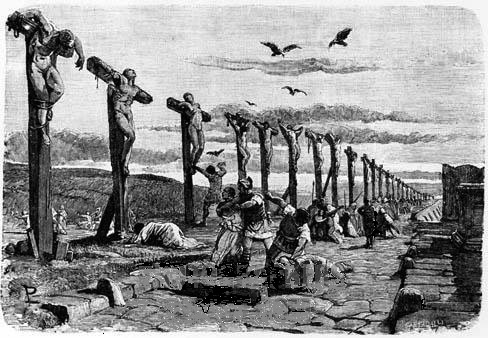
Gladiators Crucified after the Third Servile War (73-71 BCE)

Gladiators Crucified after the Third Servile War (73-71 BCE)

In the ancient world executions had both a physical and a psychological dimension. Physically it killed the person who was executed but it also worked psychologically by making the person a public display of the cost of disobedience. Victims of crucifixion in many cultures were left out to both rot and be dismembered by animals as the executor destroyed not only the person but their honor. In cultures ruled by fear the executed one became a grotesque billboard proclaiming what happened to those who challenged the regimes in power. For the Hebrew people they were to treat the dead differently. As mentioned above in verses 1-9, and in Deuteronomy 19 there is the concept of blood guilt but here it is expanded to a curse upon the land for leaving a cursed person out in the elements. In the world of Deuteronomy the land and people are defiled by failing to deal properly with the dead.

This passage also may help shed some light on the crucifixion narrative in the synoptic gospels where Joseph of Arimathea requests the body of Jesus and buries it on the night of the crucifixion as well as John’s narrative in John 19: 31-37 where the Jewish leaders don’t want the bodies left on the cross. But for the Jewish people they were not to be a culture who relished in death, they were not to display dead bodies or skulls so that others would fear them: instead this would be a source of defilement for them. The prophet Ezekiel can lift up in the vision of the destruction of the armies of Gog, how the burial of the bodies of the vanquished horde will be a part of the cleansing of the land (Ezekiel 39: 11-20)


Deuteronomy 20: The Conduct of War

James Tissot, The Taking of Jericho (1896-1902)

James Tissot, The Taking of Jericho (1896-1902)

Deuteronomy 20

1 When you go out to war against your enemies, and see horses and chariots, an army larger than your own, you shall not be afraid of them; for the LORD your God is with you, who brought you up from the land of Egypt. 2 Before you engage in battle, the priest shall come forward and speak to the troops, 3 and shall say to them: “Hear, O Israel! Today you are drawing near to do battle against your enemies. Do not lose heart, or be afraid, or panic, or be in dread of them; 4 for it is the LORD your God who goes with you, to fight for you against your enemies, to give you victory.” 5 Then the officials shall address the troops, saying, “Has anyone built a new house but not dedicated it? He should go back to his house, or he might die in the battle and another dedicate it. 6 Has anyone planted a vineyard but not yet enjoyed its fruit? He should go back to his house, or he might die in the battle and another be first to enjoy its fruit. 7 Has anyone become engaged to a woman but not yet married her? He should go back to his house, or he might die in the battle and another marry her.” 8 The officials shall continue to address the troops, saying, “Is anyone afraid or disheartened? He should go back to his house, or he might cause the heart of his comrades to melt like his own.” 9 When the officials have finished addressing the troops, then the commanders shall take charge of them.

 10 When you draw near to a town to fight against it, offer it terms of peace. 11 If it accepts your terms of peace and surrenders to you, then all the people in it shall serve you at forced labor. 12 If it does not submit to you peacefully, but makes war against you, then you shall besiege it; 13 and when the LORD your God gives it into your hand, you shall put all its males to the sword. 14 You may, however, take as your booty the women, the children, livestock, and everything else in the town, all its spoil. You may enjoy the spoil of your enemies, which the LORD your God has given you. 15 Thus you shall treat all the towns that are very far from you, which are not towns of the nations here. 16 But as for the towns of these peoples that the LORD your God is giving you as an inheritance, you must not let anything that breathes remain alive. 17 You shall annihilate them– the Hittites and the Amorites, the Canaanites and the Perizzites, the Hivites and the Jebusites– just as the LORD your God has commanded, 18 so that they may not teach you to do all the abhorrent things that they do for their gods, and you thus sin against the LORD your God.

 19 If you besiege a town for a long time, making war against it in order to take it, you must not destroy its trees by wielding an ax against them. Although you may take food from them, you must not cut them down. Are trees in the field human beings that they should come under siege from you? 20 You may destroy only the trees that you know do not produce food; you may cut them down for use in building siegeworks against the town that makes war with you, until it falls.


I would love to be able to say that the remarks made by Jerry Falwell, Jr., the President of Liberty University that his students should arm themselves so that they could ‘end Muslims before they come in’ has no scriptural place to justify it, but that would mean looking aside from passages like Deuteronomy 20. Ultimately, from the way I read scriptures his remarks were not only wrong but inflammatory and yet passages like this probably feel like home for some conservative evangelical Christians who seem to feel the right to bear arms is more important than anyone else’s right freedom of religion. Yet, passages like this are in need of discussion and the warrior image of the God of Israel is a potent image which can be used for both good and ill.  As I discuss when talking about the second half of Deuteronomy 2 the warrior image of God which is used throughout the scriptures can be used in both powerful ways for good and evil. We have uncomfortable, well at least uncomfortable for a Christian who tries to take the witness of Jesus seriously, passages like this as a part of our scriptures. What I will attempt to do below is first talk about this text within the context of war in the ancient world and what it meant then, discuss some of how this powerful language can be used appropriately in our day as well as the challenges of this text in our secular and polarized age.

The Passage in the Ancient World

War is an assumed reality for the people of Israel, especially being at the crossroads for trade and movement of troops in the ancient world. In a world where empires would rise and fall around them the land of ancient Palestine would (and still does) find itself pulled between competing kings and empires. Ancient Israel, with the exception of a brief period under David and Solomon, is never a major military power in comparison to the other ancient empires (and in Deuteronomy 17 we see how Solomon is the opposite of the model king Deuteronomy envisions). And if the people of Israel are not to be a society whose strength relies upon its military might and muscle they probably felt the need for a way to demonstrate their reliance upon God in this reality. If Deuteronomy is finalized within the context of the Babylonian exile it may also be reflecting back upon the ways the focus on their own military solutions failed them in their conflict with Babylon.

The practice of a priest coming forward and blessing the troops for combat would not have been unusual in the ancient world. The soldiers of Israel, especially if they were fighting a larger opponent with better equipment, would want to believe that the fighting they were engaged in was a part of a holy war. Perhaps Psalms like 144 would become individual prayers for the soldiers after the priest gave their blessing:

1Blessed be the LORD, my rock, who trains my hands for war, and my fingers for battle; 2 my rock and my fortress, my stronghold and my deliverer, my shield, in whom I take refuge, who subdues the peoples under me. Psalm 144: 1-2

These words and the sense that the endeavor that they are taking part in is the LORD of Israel’s battle and war may also serve to provide a sense of justification for the horrors of war they are to endure. The charge given by the mustering officer which gives an opportunity for those who have not yet been able to enjoy the fruits of a good life (house, fruit of the harvest and family) to return from battle so that they would not be deprived of these things. These three things the mustering officer allows people to return to also are lifted up as a part of the curse of disobedience:

You shall become engaged to a woman, but another man shall lie with her. You shall build a house, but not live in it. You shall plant a vineyard, but not enjoy its fruits. Deuteronomy 28:30

Also the charge for anyone who is disheartened to return home does point to the reality that fear in combat is contagious, and yet for Deuteronomy this fear is also the result of a lack of trust in the God of Israel. While there is no stigma attached to the previous reasons for release from service in an honor based society there would be for this last one. Military duty was expected of the males of ancient Israel, they were to fight for their God and for their king (or judge or leader).

This passage addresses two types of conflicts, the conflict of occupying the promised land (which is covered second although in the narrative of Deuteronomy its time is near at hand) and the invasion of future enemies.  For the enemies of the future where the people of Israel come to take a city they are to offer terms of peace, the word behind this is shalom, but it is a brutal peace. The only way a city would probably accept these terms was if they saw no possibility of resistance for it ensured forced labor of all the people. In many respects this envisions a society, like Egypt, that is based upon conquest and slavery. Unlike our current world where war is an endeavor which societies go into debt for, war was a profitable endeavor in the ancient world. If a city resists their invasion there is the spoil of the city which goes to the conquerors once the men defending the city are slain. The booty is not just wealth, but also the women and children and livestock which may all serve to enhance the wealth of the invader. War in the ancient world, and in modern society as well, is not kind to women. Even for the Israelites, who have a little more protection for the conquered than some societies, the women are viewed as spoil. Even though we may interpret the commandment on adultery prohibiting the rape of women from a conquered village ancient Israel probably did not, they still viewed women as a commodity and adultery was primarily an offence against the male.  The ancient world was a violent world and war in any time in hellish.  For the list of enemies of the towns they will be occupying there is to be no accommodation, they are to be completely wiped out. There is to be no spoil but they are to be dedicated for destruction, they are herem (those to be destroyed, annihilated). In modern times we would consider this genocide.

A final note is on the environment which is also a victim in times of war. Siege warfare, which is the type of warfare represented in this section of Deuteronomy, involves cutting a city or refuge off from the surrounding resources of food and water and waiting for the supplies within the city to become desperate. Part of siege warfare against a walled city (which is the first line of defense for a city in the ancient world) is constructing siege engines which are designed to either breach or to go over a city wall. Siege engines and the practice of war in the ancient world would often consume the trees for use in these engines or burn them so that they couldn’t be used by an enemy. While crops can grow back in the next growing season the loss of trees involves a long term loss of production. The limit of cutting down only the trees that do not produce fruit to limit the environmental destruction of the siege is unusual, as well as the way the Deuteronomist frames it, “Are the trees human being that they should come under siege from you?” For the author of Deuteronomy, the conflict is with the people and not with the environment.

Militaristic Language and Its Positive and Negative Usage

You do not have to look far for examples of how religion has been used to justify any number of horrors. This is not exclusive to any faith and occurs even in non-religious governments. As Miroslav Volf states memorably:

The majority of the world’s populations is religious, and when they are at war, their gods are invariably at war too. It would seem that if we reconciled the gods we would come closer to reconciling the peoples. The question is, however, who is fighting whose battles in those wars? Are the people fighting the battles of the power-hungry gods or are the gods fighting the battles of their bellicose peoples? The two are not mutually exclusive, of course. My suspicion is, however, that the gods mostly get the short end of it: they end up doing more of the dirty work for their presumed earthly servants than their servants do for them. And when the gods refuse to do the dirty work most people involved in conflicts either discard them in favor of more compliant gods or seek to reeducate them, which amounts to the same thing. The poor gods! What they have to endure at the hands of their humble devotees! (Volf, 1996, p. 284)

And it is not hard to see how passages like Psalm 149 “Praise the Lord!…Let the high praise of God be in their throats and two-edged swords in their hands” (verses 1, 6) can quickly evolve into “Praise the Lord and pass the ammunition. There is great damage that has been done when people are absolutely convinced that the LORD or another god is on their side and that they are involved in a struggle against an unredeemable opponent. Whether it is groups like ISIS/ISIL, or Christian groups calling for the elimination of Muslims, or even the inter-ethnic atrocities like Rwanda and Bosnia that are justified under the belief that they are the righteous ones of a god purging the earth of the infidel. These actions seem to come first from the desire to do violence or oppress another group and then the religious militaristic language is brought in as justification of the work. The poor gods, what they must suffer from the hands of their devotees.

Yet, for all of its danger and the way that militaristic language has been utilized to sanctify violence, oppression, enslavement, rape, environmental destruction and even genocide, I still think there is a place for this language. Psalm 46, which was Luther’s inspiration for “A Mighty Fortress”, is full of militaristic images as the song itself is and yet it also speaks to the conflict that the faithful feel in the world. In the hands of the oppressed it has often been utilized to point to the God of liberation that cares for and lifts up the poor, the oppressed, the forgotten and the least. It has certainly been misused by the powerful as well as the disenfranchised to authorize their violence. Yet, it also has spoken to people in their lives. We may not be able to redeem texts like Deuteronomy 20, or at least not all of it, but it speaks to a people whose lives did involve conflict. We may not share the Deuteronomist’s certainty that God is on our side, and when we are too certain we probably have crafted a god in our own image, but we do need to wrestle with, in a world that is still full of conflict, war and oppression, where our God is in the midst of these struggles.

War, God and our Secular Age

The enlightenment arose out of the ashes of conflicts over religion in Europe and now we live in an age where, in the United States and much of Europe, spirituality has been consigned to the realm of private choice. When pastors and priests blessed the soldiers of the various armies going off to war in World War I, the war to end all wars as it was known then, they believed that their causes were linked directly to God’s cause and that nation and God were closely joined together. After two world wars and countless other wars of the twentieth and twenty first century for most people in the United States our current wars may have religious undertones but they are not authorized by God. There are exceptions to this, but the wars of state are no longer uniformly blessed by the churches, mosques, and temples of the land. In the United States the war on terror has at times moved towards being portrayed as a between Christianity and Islam, yet within many religious circles there has been a continual lament and protest against this conflict as well.

As people of faith how do we engage warfare and conflict? What are the central beliefs that shape our interpretation of the world around us? If faith in merely a private spirituality we never have to engage questions like this but if it is a public faith, then we have to engage our faith in the messiness and the conflicts of the real world. As a Christian and as a Lutheran I do go back to the life and witness of Jesus which continually calls us to love even my enemy and to pray for them, to turn the other cheek in response to being struck and to learn how to forgive. Christians have long struggled with theologically making a case for various wars or military service and I won’t even attempt to answer those questions here. I am a military veteran and that is a part of my own history and the things God used to shape me for my life and thankfully I never had to endure the hell that is war, training for war is hellish enough. And yet, I can hope, with Isaiah, for the time when nations no longer train for war, when swords are beaten into plowshares and spears into pruning hooks.

Let us Beat Swords Into Plowshares, a sculpture by Evgeniy Vuchetich, given by the Soviet Union to the United Nations in 1959

Let us Beat Swords Into Plowshares, a sculpture by Evgeniy Vuchetich, given by the Soviet Union to the United Nations in 1959