Tag Archives: Moab

2 Kings 3 A Strange Story of Kings, Elisha, and Conflict

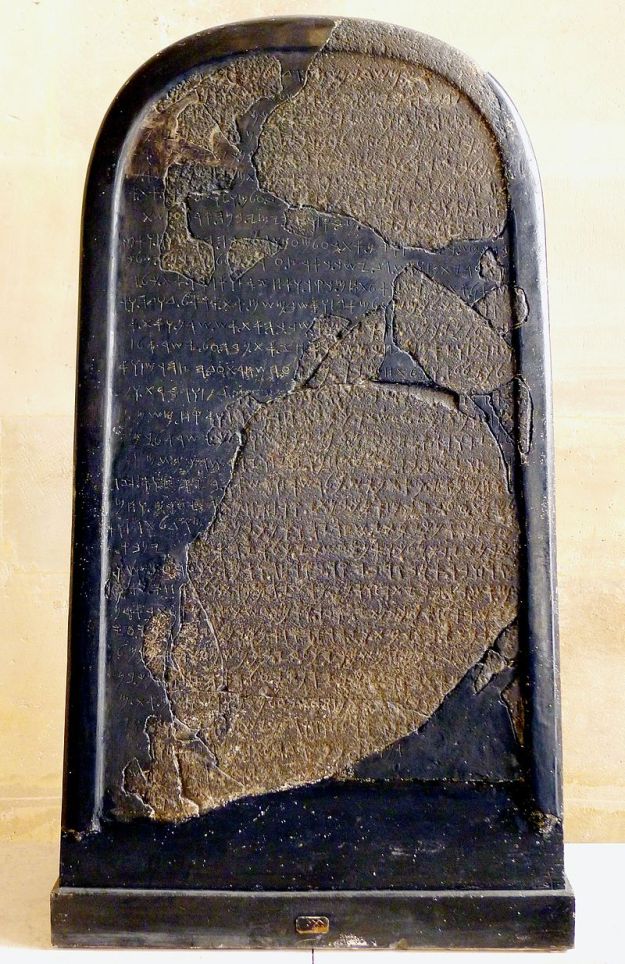
The ‘Mesha Stele’ also known as the Moabite Stone discovered in 1868 which tells of the revolt of Mesha. By Unknown artist – Mbzt 2012, CC BY 3.0, https://commons.wikimedia.org/w/index.php?curid=22090379

2 Kings 3


  1In the eighteenth year of King Jehoshaphat of Judah, Jehoram son of Ahab became king over Israel in Samaria; he reigned twelve years. 2He did what was evil in the sight of the Lord, though not like his father and mother, for he removed the pillar of Baal that his father had made. 3Nevertheless, he clung to the sin of Jeroboam son of Nebat that he caused Israel to commit; he did not depart from it.
  4
Now King Mesha of Moab was a sheep breeder who used to deliver to the king of Israel one hundred thousand lambs and the wool of one hundred thousand rams. 5But when Ahab died, the king of Moab rebelled against the king of Israel. 6So King Jehoram marched out of Samaria at that time and mustered all Israel. 7As he went he sent word to King Jehoshaphat of Judah, “The king of Moab has rebelled against me; will you go with me to battle against Moab?” He answered, “I will; I am as you are; my people are your people; my horses are your horses.” 8Then he asked, “By which way shall we march?” Jehoram answered, “By the way of the wilderness of Edom.”
  9
So the king of Israel, the king of Judah, and the king of Edom set out, and when they had made a roundabout march of seven days, there was no water for the army or for the animals that were with them. 10Then the king of Israel said, “Alas! The Lord has summoned these three kings to hand them over to Moab.” 11But Jehoshaphat said, “Is there no prophet of the Lord here through whom we may inquire of the Lord?” Then one of the servants of the king of Israel answered, “Elisha son of Shaphat, who used to pour water on the hands of Elijah, is here.” 12Jehoshaphat said, “The word of the Lord is with him.” So the king of Israel and Jehoshaphat and the king of Edom went down to him.
  13
Elisha said to the king of Israel, “What have I to do with you? Go to your father’s prophets or to your mother’s.” But the king of Israel said to him, “No; it is the Lord who has summoned these three kings to hand them over to Moab.” 14Elisha said, “As the Lord of hosts lives, whom I serve, were it not that I have regard for King Jehoshaphat of Judah, I would give you neither a look nor a glance. 15But get me a musician.” And then, while the musician was playing, the hand of the Lord came on him. 16And he said, “Thus says the Lord: I will make this wadi full of pools. 17For thus says the Lord: You shall see neither wind nor rain, but the wadi shall be filled with water, so that you shall drink, you, your army, and your animals. 18This is only a trifle in the sight of the Lord, for he will also hand Moab over to you. 19You shall conquer every fortified city and every choice city; every good tree you shall fell, all springs of water you shall stop up, and every good piece of land you shall ruin with stones.” 20The next day, about the time of the morning offering, suddenly water began to flow from the direction of Edom until the country was filled with water.
  21
When all the Moabites heard that the kings had come up to fight against them, all who were able to put on armor, from the youngest to the oldest, were called out and were drawn up at the frontier. 22When they rose early in the morning and the sun shone upon the water, the Moabites saw the water opposite them as red as blood. 23They said, “This is blood; the kings must have fought together and killed one another. Now then, Moab, to the spoil!” 24But when they came to the camp of Israel, the Israelites rose up and attacked the Moabites, who fled before them; as they entered Moab, they continued the attack. 25The cities they overturned, and on every good piece of land everyone threw a stone until it was covered; every spring of water they stopped up, and every good tree they felled. Only at Kir-hareseth did the stone walls remain until the slingers surrounded and attacked it. 26When the king of Moab saw that the battle was going against him, he took with him seven hundred swordsmen to break through opposite the king of Edom, but they could not. 27Then he took his firstborn son who was to succeed him and offered him as a burnt offering on the wall. And great wrath came upon Israel, so they withdrew from him and returned to their own land.

This is a strange story for several reasons. On the one hand it is a story of a bad, but not as bad as his predecessors, king of Israel who calls on an alliance with the kings of Judah and Edom. The king of Israel is not portrayed in a favorable light and Elisha has no regard for him. The act of prophesy by Elisha is also linked to a performance of a musician which sets the mood for a prophetic state. The prophetic command is also strange since it contradicts the rules for war outlined in Deuteronomy. Finally, the strangest note is at the end when the king of Moab’s sacrifice of his firstborn son turns the tide and Israel withdraws. Yet, this is also an interesting passage for historians who have the ‘Mesha Stele’ which provides an independent witness to this time-period from the perspective of Moab.

From a historical perspective the discovery of the ‘Mesha Stele’ confirms several points of the 2 Kings narrative. King Mesha of Moab was ‘oppressed’ by the Omri dynasty, likely paying tribute to the king. In the view of King Mesha this situation is due to Chemosh, the god of the Moabites, being displeased with his people. Finally, it confirms an uprising of Mesha against a son of Omri, presumably Jehoram, in which King Mesha accomplishes some victories. The precipitating events which cause the king of Israel to reach out to his allies and begin to take military action against Moab are given an independent witness by this discovery. This also makes sense within the previous narrative where King Ahab dies and Moab rebels in 2 Kings 1:1. Ahaziah’s brief reign, cut short by his fall and then sending messengers to Ekron seeking insight from Baal-zebub, made him too weak of a leader to respond to this rebellion.

There are numerous similarities between this narrative and the conflict between Aram and the Israel and Judah mentioned in 1 Kings 22. In both narratives King Jehoshaphat of Judah replies both as and ally, but also the weaker party in the relationship, willingly committing his forces to the king of Israel’s conflict. In both stories it is the king of Judah who requests that they seek out the opinion of a prophet of the LORD that is not tied to the royal apparatus of the king of Israel. Unlike the previous story the outcome is mostly favorable for both the king of Israel and the king of Judah.

King Mesha is noted as a sheep-breeder, and his tribute is an excessive quantity of both lambs and wool. There is no time-period for the tribute so it may be an annual tribute, or it may be the tribute over the time of subservience. Although King Mesha may simply preside, “over a semi-nomadic economy in Moab. The principle industry is sheep and the principle products are wool and lamb.” (Brueggemann, 2000, p. 306) It is also worth noting that throughout scripture kings are often portrayed metaphorically as shepherds. The king may be directly involved in sheep-breeding, but it is equally likely that he is the ‘shepherd’ of a people whose primary livelihood revolves around sheep.

The king of Israel moves his army through Judah and through Edom to attack Moab from the south. This move is likely to approach Moab from a direction they do not expect and to utilize the element of surprise, but any advantage quickly dissipates when the army runs out of water.  It is possible that springs or waters they expected to utilize had dried up or that they simply failed to adequately plan and scout the route, but the situation results in an army foundering in the wilderness and vulnerable to the king of Moab’s attack. Jehoram interprets this as a sign of the LORD’s displeasure, but Jehoshaphat suggests they inquire of a prophet of the LORD. Apparently, Elisha has either been traveling in proximity of the company or has at some earlier point moved to the wilderness of Edom to be available at this moment of the kings’ peril.

According to the evaluation of 2 Kings, Jehoram is still a bad king but not as bad as his predecessors. Sometime in his reign he is reported to have removed the pillar of Baal (likely after the LORD’s deliverance in this narrative) and according to the narrative of 2 Kings, he believes that the LORD the God of Israel has called the three kings together in this mission and is also punishing them. Even though it is King Jehoshaphat of Judah who asks to consult a prophet of the LORD, King Jehoram does not seem to resist the kings going to consult with Elisha nor does he push back against Elisha’s harsh words. Elisha, like his predecessor Elijah, has little use for the kings of the Omri dynasty but he does respect the king of Judah.

Elisha requests a musician and then has a moment when the hand of the LORD comes upon him. The hand of the LORD coming upon Elisha was likely viewed by the observers as an ecstatic experience and there is an expectation of prophets being overtaken by an experience they cannot control.[1] Elisha’s message brings an answer not only to the immediate problem of water, but it also foretells victory over their Moabite opponents. Yet, strangely, the prophet’s commands violate the expectations of conflict outlined in Deuteronomy which prohibits the chopping down of trees.[2] There is a biblical desire to preserve the land. In ancient warfare it is common attempt to deny your enemy the fruitfulness of the land, which is what the prophet’s guidance indicates, but the tension between the law in Deuteronomy and the prophet’s guidance is one additional strange element to this strange story.  

The Hebrew storytellers love wordplay and allusion to other narratives, and in the Moabites response to these kings in the wilderness. The waters being red as blood recalls on of God’s first major actions to bring the people out of Egypt by turning the waters of the Nile to blood.[3] But the scene also plays on the origin story of Edom in Genesis being Esau, Jacob/Israel’s brother, whose name means ‘red’ and is famous for selling his birthright for ‘red stuff.’[4] We don’t know why the Moabites interpret the red looking water as blood, but it causes them to camp of Israel in a less cautious manner.

The overall progression of the battle is portrayed as a rout where Israel and its allies overwhelm the Moabite advance on their camp and then proceed to follow Elisha’s guidance against the land and the cities. Only Kir-hareseth’s[5] stone wall briefly stops the advance before slingers attack it. The victories of Israel are not strange in this narrative, but the halting of the success is.

The final verse of this chapter has provoked the greatest debate among interpreters as they wrestle with how to deal with the implications of wrath coming upon Israel as a result of the King of Moab’s sacrifice. The bible shares with the rest of the ancient world the belief that there is power in blood and there is in many ancient belief systems an idea that appears in many fantasy worlds that connects blood, particularly the shedding of blood, in the practice of magic or appeasing deities or demons. The most literal interpretation of the words is that King Mesha sacrifices his first-born heir to Chemosh on the wall and this awakens Chemosh who grants the Moabites power against their foes. The Hebrew scriptures are insistent that the LORD is above all other gods, but it also assumes a world where these other gods of the nations do have power. The offense of this interpretation is that Chemosh successfully resists the LORD and halts the prophesied conquest over Moab. Rabbinic exegetes give an explanation that the son sacrificed is the son of the king of Edom, the ally of Israel and Judah, and this sacrifice causes Edom to turn against his allies. (Cogan, 1988, p. 48) Brueggemann speaks for a lot of modern readers when he states, “The most remarkable fact about the narrative is that everything we would most like to know is left unsaid.” (Brueggemann, 2000, p. 315) It is a strange ending to a strange story. It is unusual that a story where another god may have prevented the outcome the LORD’s prophet indicated to be completed. Yet, the story does not give any reason for the King Mesha of Moab being able to finally resist the kings of Israel, Judah and Edom as well as the LORD who stands behind them.


[1] 1 Samuel 10: 9-13; 19: 23-24.

[2] Deuteronomy 20:19.

[3] Exodus 7: 14-25.

[4] Genesis 25: 25, 30.

[5] Brueggemann notes on Kir-hareseth, “Nothing is known of this city, the site of Israel’s last success in this military campaign. However, the mention of the city in Isa 16;7, Jer 48:31, 36 as a poetic parallel for “Moab” suggest that it was a major site, certainly a freighted item in the prophet’s imagination. (Brueggemann, 2000, p. 313)
Ezekiel 25 Against Ammon, Moab, Edom and the Philistines

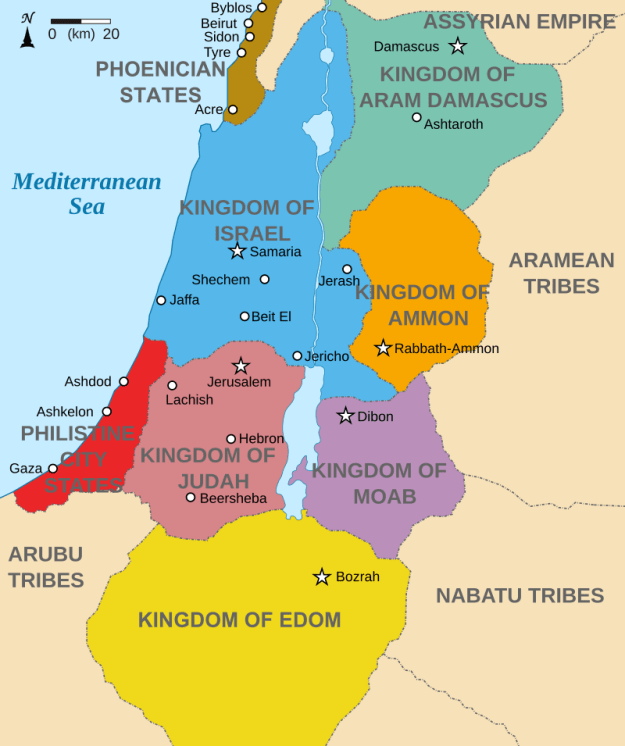
Kingdoms around Israel 830 BCE. *Oldtidens_Israel_&_Judea.svg: FinnWikiNoderivative work: Richardprins (talk)derivative work: Richardprins (talk) – Kingdoms_of_Israel_and_Judah_map_830.svg, CC BY-SA 3.0, https://commons.wikimedia.org/w/index.php?curid=10876701

Ezekiel 25: 1-7 Against Ammon

1The word of the LORD came to me: 2Mortal, set your face toward the Ammonites and prophesy against them. 3Say to the Ammonites, Hear the word of the Lord GOD: Thus says the Lord GOD, Because you said, “Aha!” over my sanctuary when it was profaned, and over the land of Israel when it was made desolate, and over the house of Judah when it went into exile; 4therefore I am handing you over to the people of the east for a possession. They shall set their encampments among you and pitch their tents in your midst; they shall eat your fruit, and they shall drink your milk. 5I will make Rabbah a pasture for camels and Ammon a fold for flocks. Then you shall know that I am the LORD. 6For thus says the Lord GOD: Because you have clapped your hands and stamped your feet and rejoiced with all the malice within you against the land of Israel, 7therefore I have stretched out my hand against you, and will hand you over as plunder to the nations. I will cut you off from the peoples and will make you perish out of the countries; I will destroy you. Then you shall know that I am the LORD.

Ezekiel is a book in the bible that has relatively few readers except for certain well-known passages, and within the book these chapters proclaiming judgment against other nations are probably the least likely to be read and dwelt upon. Yet, within many of the prophets there is a pattern of completing the judgment against Israel or Judah, turning to a judgment against the nations, and then the emergence of hope for a new beginning. Isaiah and Zephaniah follow this pattern and in its Septuagint arrangement Jeremiah does as well.[1] Ezekiel will highlight seven nations in these judgments: Ammon, Moab, Edom, Philistia, Tyre, Sidon, and Egypt. The section is structures with the first six nations receiving their judgments followed by a brief word of hope in Ezekiel 28: 24-26 followed by a judgment against Egypt which is equal in length to the first six nations’ judgments combined. (Block, 1998, p. 5) Although many readers may skim or pass these eight chapters of judgements against the nations, I am going to continue my pattern of working through the book sequentially and reflect upon these sections.

When peering back this far into history there are relatively few sources to help give a broader context to these words against Ammon, Moab, Edom and Philistia. All these nations are neighbors to Israel and have at various times been enemies and allies. Ammon and Moab, according to Genesis, have their origins with Lot, Abraham’s nephew.[2] It makes sense to begin with the judgment against Ammon since they were mentioned as the road not taken by the Babylonians in Ezekiel 21: 18-32 when they proceeded to Jerusalem. Jeremiah also mentions Ammon (along with Moab, Tyre, and Sidon) as the nations who convene with King Zedekiah to discuss forming an alliance against Babylon[3] (presumable with the support of Egypt). There is no way of knowing whether an alliance was formed or whether Ammon or the other nations worked in support of Jerusalem or against them in their conflict against Babylon. Both Jeremiah[4] and Ezekiel indicate that Ammon celebrates the destruction of the city. They shout “Aha” and clapped their hands and stamped their feet against them. Ezekiel had been commanded to clap his hands and stamp his feet against the abominations occurring in the temple (Ezekiel 6:11) and later God strikes God’s hands together against the people (Ezekiel 21: 14, 17; 22:13) but now in the aftermath of the destruction God has once again taken a protective stance towards the people.

Ammon’s judgment is here given to the ‘people of the east.’ These are probably nomadic raiders coming out of the Arabian desert. Josephus (writing shortly after the time of Jesus) states that five years after the destruction of Jerusalem Babylon would conquer both Ammon and Moab, but that is probably not what this prophecy refers to. Ultimately in the oracle Ammon disappears from the list of nations. The prophecy indicates destruction, but historically it seems that the Ammonites assimilated to and merged into the Babylonian, Persian, Greek, and finally Roman empires.

Ezekiel 25: 8-11 Against Moab

8Thus says the Lord GOD: Because Moab said, The house of Judah is like all the other nations, 9therefore I will lay open the flank of Moab from the towns on its frontier, the glory of the country, Beth-jeshimoth, Baal-meon, and Kiriathaim. 10I will give it along with Ammon to the people of the east as a possession. Thus Ammon shall be remembered no more among the nations, 11and I will execute judgments upon Moab. Then they shall know that I am the LORD.

Moab and Ammon share a common origin in Genesis and a common fate in this set of declarations against the surrounding nations. Like Ammon their judgment is left to the ‘people of the east’ and they are to be remembered ‘no more among the nations.’ It was also one of the nations who sent emissaries to King Zedekiah in Jeremiah 27 and who did not assist Jerusalem in the conflict with Babylon. The primary offense laid against Moab is their consideration of Judah like the other nations. Israel and Judah have frequently desired to be like the other nations, but they are not like other nations before God or in relation to the world. As mentioned above Josephus refers to the conquest of Moab by Babylon five years after the destruction of Jerusalem, but Moab, like Ammon seems to have assimilated into the Babylonian, Persian, Greek, and finally Roman empires. Moab receives an entire chapter in Jeremiah’s oracles against the nations. (Jeremiah 48)

Ezekiel 25: 12-14 Against Edom

12Thus says the Lord GOD: Because Edom acted revengefully against the house of Judah and has grievously offended in taking vengeance upon them, 13therefore thus says the Lord GOD, I will stretch out my hand against Edom, and cut off from it humans and animals, and I will make it desolate; from Teman even to Dedan they shall fall by the sword. 14I will lay my vengeance upon Edom by the hand of my people Israel; and they shall act in Edom according to my anger and according to my wrath; and they shall know my vengeance, says the Lord GOD.

Edom seems to have taken a more active role in the humiliation of Judah and Jerusalem. Edom biblically has its origins in Esau, Jacob’s older brother,[5] and the conflicted relationship of the brothers continued in the troubled relationship between the nations. Edom is not present at the discussions with King Zedekiah mentioned in Jeremiah 27. Their actions in this time evoke multiple reactions among scriptural writers. Psalm 137:7 records them crying out against Jerusalem:

Remember, O LORD, against the Edomites the day of Jerusalem’s fall, how they said, “Tear it down! Tear it down! Down to its foundations!”

While Obadiah’s vision is almost completely focused on the Edomites, and Jeremiah’s language for the Edomites is harsh, declaring that they will become an object of horror.[6] In a hopeful note for the people of Judah, they are once again declared ‘God’s people’ and are raised up to take an active role in the vengeance against Edom. Edom is later called Idumea, and this will be the area that Herod the Great and his ancestors hail from.

Ezekiel 25: 15-17 Against the Philistines

15Thus says the Lord GOD: Because with unending hostilities the Philistines acted in vengeance, and with malice of heart took revenge in destruction; 16therefore thus says the Lord GOD, I will stretch out my hand against the Philistines, cut off the Cherethites, and destroy the rest of the seacoast. 17I will execute great vengeance on them with wrathful punishments. Then they shall know that I am the LORD, when I lay my vengeance on them.

The Philistines were the long-time antagonists of Israel and are frequently mentioned in the stories of King Saul and King David. Yet, there is no knowledge of what role the Philistines took in the actions against Jerusalem. Ezekiel and Jeremiah 47 both indicate that the Philistines are to be destroyed and cut off. The Babylonians to conquer the area of the Philistines and take them into exile where they maintain an identity as men of Gaza or Ashkelon but between the Babylonian and Persian period they assimilate with the population between periods of exile and resettlement.

Ezekiel, unlike Jeremiah, is not in Jerusalem to witness any actions by Ammon, Moab, Edom, or the Philistines. His voice is one from a shattered people who have seen their nation humiliated and yet continue to believe that the God of Israel is also the God of the nations. If Judah’s actions have resulted in punishment, so will the actions of these nations who celebrated or participated in Judah’s humiliation. These chapters of judgment on other nations are always difficult to deal with since the other nations are not in a covenantal relationship with the God of Israel. Yet, the scripture spends far less time on these nations than they do on the condemnation of Judah or Israel’s unfaithfulness.

[1] The Septuagint is the Greek translation of the Bible. In English translations (following the Hebrew ordering) Jeremiah concludes his book with these judgments against the nations. (Jeremiah 47-51)

[2] Genesis 19: 30-38.

[3] Jeremiah 27: 1-7. Jeremiah’s focus is on God’s message to these envoys, not on the content or result of these conversations, which it is unlikely that Jeremiah had access to.

[4] Jeremiah 49: 1-6

[5] Genesis 36: 1-8.

[6] Jeremiah 49: 7-22.

Deuteronomy 1: Retelling The Story For A New Time

Moses Speaks To His People at Moab, Charles Mosley, 1747

Moses Speaks To His People at Moab, Charles Mosley, 1747

Deuteronomy 1: 1-8 Retelling the Story

These are the words that Moses spoke to all Israel beyond the Jordan– in the wilderness, on the plain opposite Suph, between Paran and Tophel, Laban, Hazeroth, and Di-zahab. 2 (By the way of Mount Seir it takes eleven days to reach Kadesh-barnea from Horeb.) 3 In the fortieth year, on the first day of the eleventh month, Moses spoke to the Israelites just as the LORD had commanded him to speak to them. 4 This was after he had defeated King Sihon of the Amorites, who reigned in Heshbon, and King Og of Bashan, who reigned in Ashtaroth and in Edrei. 5 Beyond the Jordan in the land of Moab, Moses undertook to expound this law as follows:  

6 The LORD our God spoke to us at Horeb, saying, “You have stayed long enough at this mountain. 7 Resume your journey, and go into the hill country of the Amorites as well as into the neighboring regions– the Arabah, the hill country, the Shephelah, the Negeb, and the seacoast– the land of the Canaanites and the Lebanon, as far as the great river, the river Euphrates. 8 See, I have set the land before you; go in and take possession of the land that I swore to your ancestors, to Abraham, to Isaac, and to Jacob, to give to them and to their descendants after them.”

I was sitting with some of my colleagues earlier this week when someone asked, “Why do you write on things that can be gloomy or less interesting, you spent over a year going through Jeremiah and now you are going to do Deuteronomy. You are about to get married, why not write on something like Song of Solomon.”  And my answer was simply I think there is wisdom in going back to these books that as Christians we don’t spend a lot of time in, that rarely appear, for example, in the Revised Common Lectionary, and that those who do spend time with them do it from a moralistic perspective and may be selectively choosing parts that fit their idea of what is important. I also think there is a need for understanding the God of covenant which is the background for the stories of the gospels and the New Testament as a whole. As a person who understands God primarily as a gracious and loving God I also need to be able to wrestle with the multiple pictures of God that are painted by the numerous authors of scripture. I think it is also important to walk with the God who is present in these stories because it is too easy for us as modern people to reduce God to ideas, God is love or God is the unmoved mover, or God is omnipotent, omnipresent, all knowing, etc. I think without continually going back to the narratives that we have we run the risk of falling quickly into H. Richard Niebuhr’s statements about American Christianity, “A God without wrath brought men without sin into a kingdom without judgment through the ministrations of Christ without a cross.” (Niebuhr, 1988, p. 193) I could easily write on the gospels or Paul’s letters but I also spend time here because it is a part of scripture I don’t know well and I trust that although it may not be the easiest place to engage the story of God, it remains important.

Also for our Jewish ancestors Deuteronomy is at the very heart of their understanding of God, one of the five books of the Torah, and in many ways a distillation of the books of Exodus, Leviticus and Numbers. It is a book which contains the central Jewish command, the Shema, which we will see in chapter 6. Going into the book of Deuteronomy requires me to step into another perspective and another time, and perhaps I like the Psalmist can learn to meditate on this ‘second law’ and find delight. As Psalm 1 states “but their delight is in the law of the LORD, and on his law they meditate day and night.” (Psalm 1.2) The word Deuteronomy comes from a mistranslation and the name literally means second law, and it is a second telling of the story and a highlighting of certain key portions of the law. The narrator of Deuteronomy places these words in the mouth of Moses as the people is almost ready to finally enter the promised land after their generation long sojourn in the wilderness. It is the end of Moses journey and the passing of the torch from Moses who led them out of Egypt to Joshua and the new generation who will move into the promise land.

Deuteronomy is not a neutral retelling of history, nor is any of scripture, but it is told in a way to make certain things clear. It is a book that talks about the faithful covenant God who has journeyed with the people from Egypt and will continue to journey with the people. It expounds and interprets history through the lens of God’s covenant faithfulness. Deuteronomy begins by telling the story of God and interpreting the people’s identity in light of that story. Deuteronomy narrates Israel’s identity at this crucial moment as they stand at the transition between sojourners and residents of the promised land, a generation ago they understood themselves as slaves in Egypt and that identity does not easily pass away, but now they are the chosen people called to live in a covenant with the God of Abraham and Isaac and Jacob. It is an identity that they have failed to live into in the past and it is an identity that they will not easily shoulder in the future but for Deuteronomy their lives and future are at stake as they place the people there in the valley hearing Moses tell about their past so that they may live into their present identity.


Deuteronomy 1: 9-18

 9 At that time I said to you, “I am unable by myself to bear you. 10 The LORD your God has multiplied you, so that today you are as numerous as the stars of heaven. 11 May the LORD, the God of your ancestors, increase you a thousand times more and bless you, as he has promised you! 12 But how can I bear the heavy burden of your disputes all by myself? 13 Choose for each of your tribes individuals who are wise, discerning, and reputable to be your leaders.” 14 You answered me, “The plan you have proposed is a good one.” 15 So I took the leaders of your tribes, wise and reputable individuals, and installed them as leaders over you, commanders of thousands, commanders of hundreds, commanders of fifties, commanders of tens, and officials, throughout your tribes. 16 I charged your judges at that time: “Give the members of your community a fair hearing, and judge rightly between one person and another, whether citizen or resident alien. 17 You must not be partial in judging: hear out the small and the great alike; you shall not be intimidated by anyone, for the judgment is God’s. Any case that is too hard for you, bring to me, and I will hear it.” 18 So I charged you at that time with all the things that you should do.


Moses is characterized as the type of leader who takes everything on his shoulders and the people follow, but this type of leadership not only burns out the leader dealing with every issue that comes up but it also prevents the people from taking ownership for their own calling. Now in the ancient world where most people were not literate and relied on kings, priests, and judges to be not only the interpreters but the readers of the law it was crucial to have people entrusted to this. This may refer back to both Exodus 18 and Numbers 11 which refer to two separate events, but the character of Moses in the retelling is interesting. In Exodus 18 it is Jethro, Moses’ father-in-law, who sees Moses spending all his time adjudicating minor manners and says to him, “What you are doing is not good. You will surely wear yourself out, both you and these people with you. For the task is too heavy for you and you cannot do it alone.”(Exodus 11.18) and so it is at his father-in-laws urging that Moses appoints judges. In Numbers 11 the people are complaining and Moses reaches his breaking point saying, “Why have you treated your servant so badly?…I am not able to carry all this people alone, for they are too heavy for me.” (Numbers 11.11, 14) Now it is Moses who appeals to God from exhaustion, frustration and in desperation looking for assistance and God provides a portion of the spirit that is on Moses and give it to these seventy elders. In Deuteronomy Moses is the wise and trusted leader and Moses comes up with the idea and the people respond, “the plan you have proposed is a good one.”  The story perhaps begins with the appointing of judges because of the critical nature having good judges will play in the story as it goes forward. Living justly requires a set of good and competent judges and a strong and impartial legal system which cares for the poor and the rich, the citizen and the immigrant is critical to living out their identity as the people of God.

Moses by Victorvictori, permission granted by author through WikiCommons

Moses by Victorvictori, permission granted by author through WikiCommons


Deuteronomy 1: 19-33

 19 Then, just as the LORD our God had ordered us, we set out from Horeb and went through all that great and terrible wilderness that you saw, on the way to the hill country of the Amorites, until we reached Kadesh-barnea. 20 I said to you, “You have reached the hill country of the Amorites, which the LORD our God is giving us. 21 See, the LORD your God has given the land to you; go up, take possession, as the LORD, the God of your ancestors, has promised you; do not fear or be dismayed.”

 22 All of you came to me and said, “Let us send men ahead of us to explore the land for us and bring back a report to us regarding the route by which we should go up and the cities we will come to.” 23 The plan seemed good to me, and I selected twelve of you, one from each tribe. 24 They set out and went up into the hill country, and when they reached the Valley of Eshcol they spied it out 25 and gathered some of the land’s produce, which they brought down to us. They brought back a report to us, and said, “It is a good land that the LORD our God is giving us.”

 26 But you were unwilling to go up. You rebelled against the command of the LORD your God; 27 you grumbled in your tents and said, “It is because the LORD hates us that he has brought us out of the land of Egypt, to hand us over to the Amorites to destroy us. 28 Where are we headed? Our kindred have made our hearts melt by reporting, ‘The people are stronger and taller than we; the cities are large and fortified up to heaven! We actually saw there the offspring of the Anakim!'” 29 I said to you, “Have no dread or fear of them. 30 The LORD your God, who goes before you, is the one who will fight for you, just as he did for you in Egypt before your very eyes, 31 and in the wilderness, where you saw how the LORD your God carried you, just as one carries a child, all the way that you traveled until you reached this place. 32 But in spite of this, you have no trust in the LORD your God, 33 who goes before you on the way to seek out a place for you to camp, in fire by night, and in the cloud by day, to show you the route you should take.”


There is no identity without knowing one’s story. The book of Deuteronomy narrates again the story of the people at the edge of the promised land a generation ago in order to construct a different identity in this new generation. They are the children of those who did not trust the LORD at this crucial moment in the story and they have the opportunity to act differently than their ancestors. They are the children of the people who God, “who carried you, just as one carries a child” but still had not learned to trust in the God who journeyed with them. Perhaps learning to trust in the LORD who we don’t always see is one of the hardest things to learn, and even though I think Luther is correct to interpret the first commandment, “We are to fear, love and trust God above all things” (Luther, 1994) It is more difficult to live that ideal out in the realities of life and conflict. Moses can see and interpret reality to the people, that the LORD has given them possession of the land and that it is a good and prosperous land but people will always see the giants and the walled cities.

One thing I noticed about this is that there is a changed dynamic. In the previous section Moses made the suggestion about the judges and the people felt it was a good idea, but here the people make the suggestion of exploring the land and Moses felt the plan sounded good. Perhaps, without reading too much into this, this is one of the dangers that leaders face. Knowing when to listen to the people they lead and knowing when to stick with their own plan. The time of scouting out the land allows many of the doubts to return. The murmurs of the journey through the wilderness return. The people continue to misunderstand who the LORD is and the way they are to relate to this God who has led them or their journey. The people see the LORD’s absence while Moses sees the LORD’s presence and continually calls the people to trust in the LORD who has been present throughout the journey.


Deuteronomy 1: 34-45

 34 When the LORD heard your words, he was wrathful and swore: 35 “Not one of these– not one of this evil generation– shall see the good land that I swore to give to your ancestors, 36 except Caleb son of Jephunneh. He shall see it, and to him and to his descendants I will give the land on which he set foot, because of his complete fidelity to the LORD.” 37 Even with me the LORD was angry on your account, saying, “You also shall not enter there. 38 Joshua son of Nun, your assistant, shall enter there; encourage him, for he is the one who will secure Israel’s possession of it. 39 And as for your little ones, who you thought would become booty, your children, who today do not yet know right from wrong, they shall enter there; to them I will give it, and they shall take possession of it. 40 But as for you, journey back into the wilderness, in the direction of the Red Sea.”

 41 You answered me, “We have sinned against the LORD! We are ready to go up and fight, just as the LORD our God commanded us.” So all of you strapped on your battle gear, and thought it easy to go up into the hill country. 42 The LORD said to me, “Say to them, ‘Do not go up and do not fight, for I am not in the midst of you; otherwise you will be defeated by your enemies.'” 43 Although I told you, you would not listen. You rebelled against the command of the LORD and presumptuously went up into the hill country. 44 The Amorites who lived in that hill country then came out against you and chased you as bees do. They beat you down in Seir as far as Hormah. 45 When you returned and wept before the LORD, the LORD would neither heed your voice nor pay you any attention.

 46 After you had stayed at Kadesh as many days as you did,


Can we learn from our past or are we somehow destined to repeat it? One of the things that the prophets of Israel will do over and over again is to take these central stories, like the story of the exodus and recast them to be heard again in their day. The will use the stories of the past to tell the people of their time the cost of their disobedience to their covenant with God. The God of the Bible does get angry, does show emotions, is become wounded by the disobedience of the chosen people. This time when Israel refuses to hear the word of the LORD leads to the LORD being unwilling to hear them. This is one of those times where the people missed their window of opportunity, and the LORD through Moses (even in the midst of God’s anger) tells Moses to warn the people not to go up, but the people strap on their equipment and proceed to walk into their own defeat.

This disobedience has consequences not only for the people but for Moses. The narrative places the blame for Moses’ inability to reach the promised land at the feet of the people. Their disobedience not only brings anger on themselves but on Moses, and even though Moses has stood in the gap between the people and God, now Moses finds himself caught between the people and the LORD.

One of things this makes me ponder is the God who refuses to hear. We often act as if God hears every prayer regardless of how we interact with the world God has made, and there may be some truth in this, but there is also truth in the view of the Deuteronomist where our actions and our lives matter to God. The LORD presented by Deuteronomy does care about the lives of the people who are supposed to represent God in the world. Yet there is a hope, it is not an immediate or cheap hope. God will not stay angry forever, there will be a time when God listens to the people again. It may be a generation later when the sons and daughters who grow up in the wilderness now are adults ready to enter the promise land but ultimately, for Deuteronomy, God will uphold God’s part of the covenant but not on a human timeline.

Perhaps in a later time, when all the books scholars like to label the Deuteronomic History (Deuteronomy, Joshua, Judges, 1&2 Samuel and 1&2 Kings) are brought together the people are looking back on their history trying to make sense of their world. They are trying to bring order to the chaos of living in the midst of the exile in Babylon. As they look back over their story they find meaning in who they are called to be and how they are called to live. Even without the land or the temple or a king they are still the people of the covenant and perhaps in this time of disobedience where a generation is lost in the wilderness they can find hope in their own lost generation in exile.

Jeremiah 48: Against Moab

William Blake, Naomi Entreating Ruth and Orpah

William Blake, Naomi Entreating Ruth and Orpah

Concerning Moab.
Thus says the LORD of hosts, the God of Israel:
Alas for Nebo, it is laid waste!
Kiriathaim is put to shame, it is taken;
the fortress is put to shame and broken down;
 2 the renown of Moab is no more.
In Heshbon they planned evil against her:
“Come, let us cut her off from being a nation!”
You also, O Madmen, shall be brought to silence;
the sword shall pursue you.
 3 Hark! a cry from Horonaim,
“Desolation and great destruction!”
 4 “Moab is destroyed!” her little ones cry out.
 5 For at the ascent of Luhith they go up weeping bitterly;
for at the descent of Horonaim they have heard the distressing cry of anguish.
 6 Flee! Save yourselves! Be like a wild ass in the desert!
 7 Surely, because you trusted in your strongholds and your treasures, you also shall be taken;
Chemosh shall go out into exile, with his priests and his attendants.
 8 The destroyer shall come upon every town, and no town shall escape;
the valley shall perish, and the plain shall be destroyed, as the LORD has spoken.
 9 Set aside salt for Moab, for she will surely fall;
 her towns shall become a desolation, with no inhabitant in them.
 10 Accursed is the one who is slack in doing the work of the LORD;
and accursed is the one who keeps back the sword from bloodshed.
 11 Moab has been at ease from his youth, settled like wine on its dregs;
he has not been emptied from vessel to vessel, nor has he gone into exile;
therefore his flavor has remained and his aroma is unspoiled.
 12 Therefore, the time is surely coming, says the LORD, when I shall send to him decanters to decant him,
and empty his vessels, and break his jars in pieces. 13 Then Moab shall be ashamed of Chemosh,
as the house of Israel was ashamed of Bethel, their confidence.
 14 How can you say, “We are heroes and mighty warriors”?
 15 The destroyer of Moab and his towns has come up,
and the choicest of his young men have gone down to slaughter,
says the King, whose name is the LORD of hosts.
 16 The calamity of Moab is near at hand and his doom approaches swiftly.
 17 Mourn over him, all you his neighbors, and all who know his name;
say, “How the mighty scepter is broken, the glorious staff!”
 18 Come down from glory, and sit on the parched ground, enthroned daughter Dibon!
For the destroyer of Moab has come up against you; he has destroyed your strongholds.
 19 Stand by the road and watch, you inhabitant of Aroer!
Ask the man fleeing and the woman escaping; say, “What has happened?”
 20 Moab is put to shame, for it is broken down; wail and cry!
Tell it by the Arnon, that Moab is laid waste.
 21 Judgment has come upon the tableland, upon Holon, and Jahzah, and Mephaath, 22 and Dibon, and Nebo, and Beth-diblathaim, 23 and Kiriathaim, and Beth-gamul, and Beth-meon, 24 and Kerioth, and Bozrah, and all the towns of the land of Moab, far and near. 25 The horn of Moab is cut off, and his arm is broken, says the LORD.
 26 Make him drunk, because he magnified himself against the LORD; let Moab wallow in his vomit; he too shall become a laughingstock. 27 Israel was a laughingstock for you, though he was not caught among thieves; but whenever you spoke of him you shook your head!
 28 Leave the towns, and live on the rock, O inhabitants of Moab!
Be like the dove that nests on the sides of the mouth of a gorge.
 29 We have heard of the pride of Moab—
he is very proud– of his loftiness, his pride, and his arrogance, and the haughtiness of his heart.
 30 I myself know his insolence, says the LORD; his boasts are false, his deeds are false.
 31 Therefore I wail for Moab; I cry out for all Moab; for the people of Kir-heres I mourn.
 32 More than for Jazer I weep for you, O vine of Sibmah!
Your branches crossed over the sea, reached as far as Jazer;
 upon your summer fruits and your vintage the destroyer has fallen.
 33 Gladness and joy have been taken away from the fruitful land of Moab;
I have stopped the wine from the wine presses; no one treads them with shouts of joy;
the shouting is not the shout of joy.
 34 Heshbon and Elealeh cry out; as far as Jahaz they utter their voice, from Zoar to Horonaim and Eglath-shelishiyah. For even the waters of Nimrim have become desolate. 35 And I will bring to an end in Moab, says the LORD, those who offer sacrifice at a high place and make offerings to their gods. 36 Therefore my heart moans for Moab like a flute, and my heart moans like a flute for the people of Kir-heres; for the riches they gained have perished.
 37 For every head is shaved and every beard cut off; on all the hands there are gashes, and on the loins sackcloth. 38 On all the housetops of Moab and in the squares there is nothing but lamentation; for I have broken Moab like a vessel that no one wants, says the LORD. 39 How it is broken! How they wail! How Moab has turned his back in shame! So Moab has become a derision and a horror to all his neighbors.
 40 For thus says the LORD:
 Look, he shall swoop down like an eagle, and spread his wings against Moab;
 41 the towns shall be taken and the strongholds seized.
The hearts of the warriors of Moab, on that day, shall be like the heart of a woman in labor.
 42 Moab shall be destroyed as a people, because he magnified himself against the LORD.
 43 Terror, pit, and trap are before you, O inhabitants of Moab! says the LORD.
 44 Everyone who flees from the terror shall fall into the pit,
and everyone who climbs out of the pit shall be caught in the trap.
For I will bring these things upon Moab in the year of their punishment, says the LORD.
 45 In the shadow of Heshbon fugitives stop exhausted;
for a fire has gone out from Heshbon, a flame from the house of Sihon;
it has destroyed the forehead of Moab, the scalp of the people of tumult.
 46 Woe to you, O Moab! The people of Chemosh have perished,
 for your sons have been taken captive, and your daughters into captivity.
 47 Yet I will restore the fortunes of Moab in the latter days, says the LORD.
Thus far is the judgment on Moab.


Moab is Judah’s neighbor and has had its role to play in the region. Unlike the Philistines, the Moabites are mentioned as one of the players in the regional conference mentioned in Jeremiah 27. Perhaps Moab has been one of the forces manipulating the opinions in Israel toward the pro-Egyptian/anti-Babylonian policy that led to so much destruction, but we will never know how exactly the politics and promises played in the events around the exile. Moab receives more direct condemnation than any of the other nations in this long and winding and repetitive poem. Moab is not a regional powerhouse and so it too finds themselves caught up between the two major players (Egypt and Babylon). But as is always the case in Jeremiah it is not just the movement of armies, but it is the LORD of armies, the God of Israel that is behind all the movements in the region around Judah. Jeremiah sees the LORD as not just the LORD of Israel but the LORD of nations.

This judgment on Moab utilizes a repetitive usage of images around Viticulture. Moab is wine, Moab is a vine, Moab is the vessel to hold the wine, and Moab is drunk. The wine presses and the merriment around them have stopped and Moab who has been spared from the consequences of exile and destruction in the past now shares with everyone else in the region in the destruction both at the hands of Babylon, and ultimately in Jeremiah’s view, at the hands of the LORD.

Coming up to the end of Jeremiah, these last judgments on the kingdoms around Judah are both similar to the judgment that Judah receives and the probably does serve a need to vent around the frustration of their own nation’s powerlessness. How these were used and what purpose they serve is  hard to know, but they stand here at the end of the book and are probably a part of how the people of Jeremiah make sense of their world. The God of Jeremiah is wild and uncontainable, incredibly powerful and in contrast to the people of Judah’s weakness this God is passionate and strong. Even though it makes me a little uncomfortable, and the entire direction of this unrelenting judgment is difficult as I have made my way through Jeremiah, it is a part of the people’s experience of God and their world and we continue to wrestle today with how active God is in our world and identifying where things are chance or destiny, divine providence or divine judgment or a series of causes and effects in the natural world.