This is a part of a selection of readings I gathered to reflect on what a healthy approach to masculine identity would look like. I navigated my own journey into a version of manhood in my late teens and early twenties successfully, but now in middle age I see a lot of young men struggling to navigate this journey and for a variety of reasons failing to launch into life. I come to this with humility and curiosity seeking those who may be able to articulate more clearly the journeys that may lead young men to discover a fulfilling life of work and relationships and to help those moving into the space of elders to support and guide them in this journey.
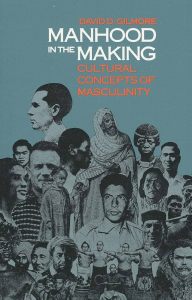
David Gilmore is an anthropologist who taught at the State University of New York whose book Manhood in the Making examines manhood as it is expressed through a number of representative cultures which have been studied by anthropologists. The groups included in the collection of studies are primarily from tribal and traditional societies which are geographically separate from larger cultural influences. With a couple of exceptions, there are expectations of a passage into manhood in these cultures and the possibility of a male child failing to navigate the expectations of manhood and being “unmanly” and unreliable in their society. As Gilmore states,
there is a constantly recurring notion that real manhood is different from simple anatomical maleness, that it is not a natural condition that comes about spontaneously through biological maturation but rather it is a precarious or artificial state that boys must win against powerful odds. This recurrent notion that manhood is a problematic, a critical threshold that boys must pass through testing, is found at all levels of sociocultural development regardless of what other alternative roles are recognized. (11)
Or more simply, boys through culturally appropriate preparation and testing must be made into men. Simply being physically mature is not enough for the mantle of manhood. Men are made, not born. And although “being a good man” may have less focus than “being good at being a man” (30) there is in most cultures an expectation that “being good at being a man” involves providing for both kin and the larger society. “If a man rejects this provider’s role, he is said to be useless and to be dependent like a woman or like a child (Caughey 1970:69).” (73)
There are two exceptions listed in this study where the men are passive, the Tahiti and Semai. These societies with men who are conditioned to be more passive and peaceful are highlighted by some readers as an ideal for a modern society, but I don’t think these men would function well in modern society. As David Gilmore surmises as he wraps up the study, “When men are conditioned to fight, manhood is important; where men are conditioned to flight, the opposite is true.” (221) He concludes with two long statements which I will quote in their entirety because I find them very helpful:
When I started researching this book, I was prepared to rediscover the old saw that masculinity is self-serving, egotistical, and uncaring. But I did not find this. One of my findings here is that manhood ideologies always include a criterion of selfless generosity, even to the point of sacrifice. Again and again we find that “real” men are those who give more than they take; they serve others. Real men are generous, even to a fault, like the Mehinaku fisherman, the Samburu cattle-herder, or the Sambia or Dodoth Big Man. Non-men are often those stigmatized as stingy and unproductive. (229)
Men adopting the provider role provide more for their society than they take, and they will often do without so that others may have enough. One final quote from Manhood in the Making on the sacrifices men are expected to make for kin and society:
Men nurture their society by shedding their blood, their sweat, and their semen, by bringing home food for both child and mother, by producing children, and by dying if necessary in faraway places to provide safe haven for their people. This too, is nurturing in the sense of endowing or increasing. However, the necessary personal qualities for this male contribution are paradoxically the exact opposite of what we Westerners normally consider the nurturing personality. To support his family, the man has to be distant, away hunting or fighting wars; to be tender, he must be tough enough to fend off enemies. To be generous, he must be selfish enough to amass goods, often by defeating other men; to be gentle, he must first be strong, even ruthless in confronting enemies; to love he must be aggressive enough to court, seduce, and “win” a wife. (230)
I found Gilmore’s work to be helpful. At times he and his fellow anthropologists were a little overdependent on a Freudian framework, but the highlighting of the processes in these cultures to transform boys into men, something missing in any formal way in our society, and the expectation of a competent but generous masculinity in culture was helpful.
Gilmore, D. D. (1990). Masculinity in the Making: Cultural and Concepts of Masculinity. New Haven: Yale University Press.
 Sign of the Rose