Tag Archives: Holy Space

Ezekiel 42 Concluding the Survey of the New Temple

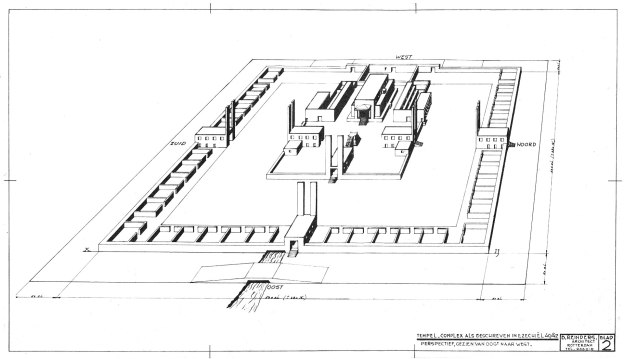
Schematic of Ezekiel’s Temple drawn by Dutch architect Bartelmeüs Reinders, Sr. (1893–1979) released into public domain by artist.

Ezekiel 42:1-14

1 Then he led me out into the outer court, toward the north, and he brought me to the chambers that were opposite the temple yard and opposite the building on the north. 2 The length of the building that was on the north side was one hundred cubits, and the width fifty cubits. 3 Across the twenty cubits that belonged to the inner court, and facing the pavement that belonged to the outer court, the chambers rose gallery by gallery in three stories. 4 In front of the chambers was a passage on the inner side, ten cubits wide and one hundred cubits deep, and its entrances were on the north. 5 Now the upper chambers were narrower, for the galleries took more away from them than from the lower and middle chambers in the building. 6 For they were in three stories, and they had no pillars like the pillars of the outer court; for this reason the upper chambers were set back from the ground more than the lower and the middle ones. 7 There was a wall outside parallel to the chambers, toward the outer court, opposite the chambers, fifty cubits long. 8 For the chambers on the outer court were fifty cubits long, while those opposite the temple were one hundred cubits long. 9 At the foot of these chambers ran a passage that one entered from the east in order to enter them from the outer court. 10 The width of the passage was fixed by the wall of the court.

On the south also, opposite the vacant area and opposite the building, there were chambers 11 with a passage in front of them; they were similar to the chambers on the north, of the same length and width, with the same exits and arrangements and doors. 12 So the entrances of the chambers to the south were entered through the entrance at the head of the corresponding passage, from the east, along the matching wall.

13 Then he said to me, “The north chambers and the south chambers opposite the vacant area are the holy chambers, where the priests who approach the LORD shall eat the most holy offerings; there they shall deposit the most holy offerings — the grain offering, the sin offering, and the guilt offering — for the place is holy. 14 When the priests enter the holy place, they shall not go out of it into the outer court without laying there the vestments in which they minister, for these are holy; they shall put on other garments before they go near to the area open to the people.”

Holy space and holy things are important in the life of a people whose life is centered around a holy God. Holiness is an under appreciated concept in many Christians, particularly in protestant traditions. For many Christians we expect the intimacy of God drawing close to us in Christ and the Spirit without appreciating the terrifying nature of God’s power and holiness. Most of the early followers of Jesus and even the Reformers understood the mystery of God’s was, to use the words of Rudolph Otto, were both fascinating (fascinans) and terrifying (tremendum). There was a deep understanding for reformers like Martin Luther of their own unworthiness to be in the holy presence of God, but in a world where intimacy has eclipsed holiness Ezekiel’s visions of holy space and holy vestments seem strange and alien to many modern readers.

Throughout the bible there is a concern about holiness and its opposite impurity or defilement. Impurity desecrates holy places and things. The idolatrous practices in the previous temple (Ezekiel 810) have led to God abandoning that people and by extension this defiled people. God’s vision was for Israel to be a priestly kingdom and a holy nation (Exodus 19:6) where God’s presence could dwell among them in the temple that bore God’s name. Instead, the people, places and things became corrupted by the abominations that Ezekiel has continually protested.

The recreation of sacred space has been the focus of this and the previous two chapters, a place where God’s presence can again dwell among the people. The text is full of rarely used words and so even the translation is provisional and any visual portrayal lacks both the necessary dimensions and precision, but the complete visualization of the space is probably not the intent. As Daniel Block states:

The burden of the present account is to show that the holiness of the sacred space extends beyond the concentric design of the temple complex to the form of the auxiliary structures, and the conduct of humans within those structures. (Block, 1998, p. 568)

For the priests to work in the presence of the holy God, they must be separated from the rest of the people of Israel. These concentric rings of increasing holiness provide a buffer between the complete holiness of God, the set aside Levites and priests, the people and ultimately the nations. Even the clothing worn in the service of God is not to depart the place and risk contamination beyond the walls. The priests are to dress and eat in this holy place they inhabit before the God of the people.

In the New Testament, particularly with Jesus, holiness will be ‘contagious’ and overwhelm uncleanness and unholiness. A prime example of this is Jesus healing leper who are unclean due to their illness. Yet, throughout the law and the prophets the primary fear is the unclean coming into the presence of the holy. Many scholars use the language of uncleanness contaminating the holiness of God, but I prefer to think of it as offending or perhaps being repellant to God. That is the entire thrust of Ezekiel’s frequent highlighting of the abominations and desecrations of the people that have made all of Israel, even the holy space of the previous temple, abhorrent to the God of Israel.

Ezekiel 42: 15-20

15 When he had finished measuring the interior of the temple area, he led me out by the gate that faces east, and measured the temple area all around. 16 He measured the east side with the measuring reed, five hundred cubits by the measuring reed. 17 Then he turned and measured the north side, five hundred cubits by the measuring reed. 18 Then he turned and measured the south side, five hundred cubits by the measuring reed. 19 Then he turned to the west side and measured, five hundred cubits by the measuring reed. 20 He measured it on the four sides. It had a wall around it, five hundred cubits long and five hundred cubits wide, to make a separation between the holy and the common.

The vision of the new temple moved from the exterior walls, through the gates into the outer courtyard, through a second set of gateways into the inner courtyard and the temple itself along the “central spine of sacrality” (Block, 1998, p. 571) leading to the most holy place. Then remaining in holy space are the places and spaces for the set aside priests to do their work on behalf of the LORD without being contaminated by the people. Now as the description of this holy space is completed we are taken to the exterior of the temple structure to view the total dimensions of the space. This five hundred cubit (eight hundred sixty feet) long walls on each side structure separate the mundane exterior from the holy spaces within these walls.

The walls, which are more like the walls of a fortified city than most temples in the ancient world, could be used as a defensive structure. Yet, for Ezekiel’s purposes they are primarily to separate holy space from mundane space. The walls prevent the unholiness of the people from coming into contact with the holiness of the LORD. Ultimately these walls and gates protect the people from defiling this sacred space and lead to a perfectly ordered temple for a reordered people to assemble around. The return of the divine presence will also need a reestablished priesthood, a renewed practice of the practices of faith, and ultimately a reordered land. Yet, in a Jewish view, this holy space where the presence of God dwells among the people is a central part of this renewed people of God.

Psalm 48 God and Zion

Panorama of the Temple Mount from the Mount of Olives by Bienchido shared under Creative Commons 4.0

 Psalm 48

<A Song. A Psalm of the Korahites.>
1 Great is the LORD and greatly to be praised in the city of our God. His holy mountain,
2 beautiful in elevation, is the joy of all the earth, Mount Zion, in the far north, the city of the great King.
3 Within its citadels God has shown himself a sure defense.
4 Then the kings assembled, they came on together.
5 As soon as they saw it, they were astounded; they were in panic, they took to flight;
6 trembling took hold of them there, pains as of a woman in labor,
7 as when an east wind shatters the ships of Tarshish.
8 As we have heard, so have we seen in the city of the LORD of hosts, in the city of our God, which God establishes forever. Selah
9 We ponder your steadfast love, O God, in the midst of your temple.
10 Your name, O God, like your praise, reaches to the ends of the earth. Your right hand is filled with victory.
11 Let Mount Zion be glad, let the towns of Judah rejoice because of your judgments.
12 Walk about Zion, go all around it, count its towers,
13 consider well its ramparts; go through its citadels, that you may tell the next generation
14 that this is God, our God forever and ever. He will be our guide forever.

In the previous two psalms we have celebrated God as our refuge (Psalm 46) and God as King (Psalm 47) and now we see God’s Kingship occupying a specific place of refuge: the city of Jerusalem and the temple. The city of Jerusalem and the temple were two central signs of God’s promised protection and presence. Although I can understand the remark of Walter Bruggemann and William H. Bellinger, Jr. that the beginning and ending of the psalm in their symmetry and structure of, “nearly equating the God of the temple with the beauty and symmetry of it.” (Brueggemann, 2014, p. 224) I tend to view the message of the psalm in a more positive light appreciating the presence of God in a holy space. There is always a danger of identifying a structure or item designated for God’s worship and glory becoming an idol in the mind of the worshipper. Yet, we do seek places where God’s presence can be felt amid a world where God’s presence may be harder to identify and God’s refuge in a world that can feel fraught with dangers. The city, the mountain and the temple should all be spaces where the LORD is praised. At its best the beauty and security of the temple and city create a little piece of heaven on earth where God’s presence seems closer. Religious buildings, from the humblest to the most elaborate, attempt to create a safe and holy place for God’s people to come together and where God’s presence is felt and communicated.

Jerusalem as city is merely stone, wood, cloth and metal inhabited by the people who dwell in and around it. Yet, in the minds of the faithful it becomes something far greater. As J. Clinton McCann, Jr. can state, “Jerusalem is important because it is God’s place; thus it can serve as a witness to God’s character.” (NIB IV: 821) It becomes a place of hope and aspiration where in the words of the prophet Isaiah:

In the days to come the mountain of the LORD’s house shall be established as the highest of the mountains, and shall be raised above the hills; all the nations shall stream to it. Isaiah 2: 2

Nancy deClaissé-Walford points to how the psalm appropriates the language of the Canaanites that was used to worship Baal. God ss the one who ascends the mountain in the north instead of Baal, Zion replaces Zaphon as the place of sanctuary and the place from which the God of Israel reigns as King over all other gods and nations. (Nancy deClaisse-Walford, 2014, p. 435) Like Psalm 29, the people transformed the language of the surrounding culture to give worship and praise to the LORD of hosts. This serves both a polemical function, the LORD is God and King instead of Baal, but also reflects the process of trying to come up with language that can be used to talk about God and the willingness of the Jewish people to repurpose imagery that seemed appropriate for their LORD.

In contrast to the hope in Isaiah 2 where the nations stream to Zion seeking teaching and wisdom, we see the kings of the earth assembling to assault Jerusalem. Yet, like Psalm 2: 1-6, the conspiring of the kings of the nations only exposes their weakness. It is possible that Psalm 48 references the failed siege of King Sennacherib of Assyria in 701 B.C.E. (2 Kings 18-19) but the psalm may be independent of this experience of liberation in the memory of the Jewish people. The kings who sought to conquer in strength flee in panic and trembling. Kings who are pictured as masculine symbols of conquest are transformed in the psalm to women in childbirth, an image in the ancient world that was the opposite of strength. Although I would disagree with the use of a woman in childbirth as an image of weakness it was a common image in the ancient world because of the intense pain and the high risk of death for women during childbirth in the ancient world. Devastating winds in ancient Israel were east winds. In Exodus 14:21 it was an east wind which drove back the Red Sea and in Jeremiah 18:17 God promise to scatter Israel before their enemy “Like the wind from the east.”

The reality of God as the refuge for the people of Zion moves from being something handed down from previous generations to the experienced reality of the city of Zion. Once they had heard of God’s steadfast love, victory and judgements but now they can rejoice because they have experienced these things. The threat from the other nations has passed and they can walk around an examine both the physical walls and barriers that surround the city but also reflect upon the God who is the true refuge for the faithful people. They will now have their own experience of God’s faithfulness to share with future generations for their God will endure forever and ever.

For those of us who hear the words of this psalm in our own time we may wonder where we go to experience the presence and protection of God? What are times where we experienced God’s power so that we could speak of our own experience of God rather than the experience of our ancestors? What language do we use to talk about God and how has it changed from the language our parents or grandparents used? What places do we consider sacred or holy and why do we consider them to be sacred?

Exodus 26 The Tabernacle

Erection of the Tabernacle and Sacred Vessels by Gerard Hoet (1728)

Exodus 26

Moreover you shall make the tabernacle with ten curtains of fine twisted linen, and blue, purple, and crimson yarns; you shall make them with cherubim skillfully worked into them. 2 The length of each curtain shall be twenty-eight cubits, and the width of each curtain four cubits; all the curtains shall be of the same size. 3 Five curtains shall be joined to one another; and the other five curtains shall be joined to one another. 4 You shall make loops of blue on the edge of the outermost curtain in the first set; and likewise you shall make loops on the edge of the outermost curtain in the second set. 5 You shall make fifty loops on the one curtain, and you shall make fifty loops on the edge of the curtain that is in the second set; the loops shall be opposite one another. 6 You shall make fifty clasps of gold, and join the curtains to one another with the clasps, so that the tabernacle may be one whole.

 7 You shall also make curtains of goats’ hair for a tent over the tabernacle; you shall make eleven curtains. 8 The length of each curtain shall be thirty cubits, and the width of each curtain four cubits; the eleven curtains shall be of the same size. 9 You shall join five curtains by themselves, and six curtains by themselves, and the sixth curtain you shall double over at the front of the tent. 10 You shall make fifty loops on the edge of the curtain that is outermost in one set, and fifty loops on the edge of the curtain that is outermost in the second set.

 11 You shall make fifty clasps of bronze, and put the clasps into the loops, and join the tent together, so that it may be one whole. 12 The part that remains of the curtains of the tent, the half curtain that remains, shall hang over the back of the tabernacle. 13 The cubit on the one side, and the cubit on the other side, of what remains in the length of the curtains of the tent, shall hang over the sides of the tabernacle, on this side and that side, to cover it. 14 You shall make for the tent a covering of tanned rams’ skins and an outer covering of fine leather.1

 15 You shall make upright frames of acacia wood for the tabernacle. 16 Ten cubits shall be the length of a frame, and a cubit and a half the width of each frame. 17 There shall be two pegs in each frame to fit the frames together; you shall make these for all the frames of the tabernacle. 18 You shall make the frames for the tabernacle: twenty frames for the south side; 19 and you shall make forty bases of silver under the twenty frames, two bases under the first frame for its two pegs, and two bases under the next frame for its two pegs; 20 and for the second side of the tabernacle, on the north side twenty frames,21 and their forty bases of silver, two bases under the first frame, and two bases under the next frame; 22 and for the rear of the tabernacle westward you shall make six frames. 23 You shall make two frames for corners of the tabernacle in the rear; 24 they shall be separate beneath, but joined at the top, at the first ring; it shall be the same with both of them; they shall form the two corners. 25 And so there shall be eight frames, with their bases of silver, sixteen bases; two bases under the first frame, and two bases under the next frame.

 26 You shall make bars of acacia wood, five for the frames of the one side of the tabernacle, 27 and five bars for the frames of the other side of the tabernacle, and five bars for the frames of the side of the tabernacle at the rear westward. 28 The middle bar, halfway up the frames, shall pass through from end to end. 29 You shall overlay the frames with gold, and shall make their rings of gold to hold the bars; and you shall overlay the bars with gold. 30 Then you shall erect the tabernacle according to the plan for it that you were shown on the mountain.

 31 You shall make a curtain of blue, purple, and crimson yarns, and of fine twisted linen; it shall be made with cherubim skillfully worked into it. 32 You shall hang it on four pillars of acacia overlaid with gold, which have hooks of gold and rest on four bases of silver. 33 You shall hang the curtain under the clasps, and bring the ark of the covenant 1 in there, within the curtain; and the curtain shall separate for you the holy place from the most holy. 34 You shall put the mercy seat1 on the ark of the covenant 2 in the most holy place. 35 You shall set the table outside the curtain, and the lampstand on the south side of the tabernacle opposite the table; and you shall put the table on the north side.

 36 You shall make a screen for the entrance of the tent, of blue, purple, and crimson yarns, and of fine twisted linen, embroidered with needlework. 37 You shall make for the screen five pillars of acacia, and overlay them with gold; their hooks shall be of gold, and you shall cast five bases of bronze for them.

Constructing holy space is something every religious tradition has to think about and the way in which a tradition creates that space illuminates something about the people who worship there and the god or gods they attempt to worship. The tabernacle serves an unsettled people, a people who are still on their Exodus journey. It is designed to be transported across the wilderness and set up wherever the people dwell. It is a holy space for a God who is not associated with one particular place but rather a God that can move with the people and who desires to dwell among them. Even though there is the desire for a place where the LORD will dwell among the people there is still a need for zones of holiness. Paradoxically the God of Israel is viewed as being both unapproachable and yet approaching to dwell with the people. The tabernacle becomes a place to mediate the presence of the holy God.

The tabernacle is constructed out of the most valuable materials: Gold, silver and copper, acacia wood, died wool and tanned animal skins. Within the curtains, bars, bases and clasps used for the holiest regions the best material is used: gold and precious died wools in purple, blue and crimson. Wool, and in particular the three stated colors, may seem like an ordinary commodity in our time but in the ancient world purple, blue and crimson in particular are self-fixing colors that do not fade with the exposure to sun and water but are expensive to make because of the materials to make them being rare or dangerous to work with. (Myers, 2005, p. 235)  Purple was often a color associated with royalty precisely because of the cost of producing purple cloth. These curtains or sections are probably woven together and the cherubim designs are included as a part of the weaving. Each of these curtains is roughly forty two feet by six feet and a total of ten of these sections are made to enclose the most holy portion of the space. This is a space designed around the ark of the covenant described in the previous chapter that it will contain.

The worship space itself is big for a mobile structure, but it would not be big in terms of worship space that we would design for a modern congregation. Most of the people would never enter the tabernacle and certainly not the holy of holies with the ark, instead they would be outside the tabernacle while the priests would intercede, sacrifice and mediate the presence of the LORD to the waiting people. The curtains and bars and bases all set aside space and the ark, lampstand and table sit within the set aside space. It is the uncluttered worship space of an Exodus people.

Even when King David desires to build a temple (2 Samuel 7) there is resistance to the idea of transitioning from a tent and a tabernacle to a fixed temple. The LORD does not dwell in one specific place and within the construction of the temple there are some often unnoticed contrasts between the temple work and the tabernacle work. The tabernacle work comes from the voluntary offering of the people but the temple built under Solomon will involve conscripted labor and would be a part of the building projects that placed a heavy burden on the people and would eventually lead to the splitting of Israel away from Judah. Eventually the temple itself became such a focal point that it, the Davidic king and the city of Jerusalem became central for the identity of the people. During the Babylonian exile when Jerusalem, the king and the temple were lost the memory of God’s presence moving with the people in a mobile tabernacle may have been a source of comfort as they found themselves separated from their former home in a strange land and wondered how the LORD could be present.

Exodus 25: Holy Things for Holy Space

Exodus 25: 1-9 A Voluntary Offering for the Tabernacle

The LORD said to Moses: 2 Tell the Israelites to take for me an offering; from all whose hearts prompt them to give you shall receive the offering for me. 3 This is the offering that you shall receive from them: gold, silver, and bronze, 4 blue, purple, and crimson yarns and fine linen, goats’ hair, 5 tanned rams’ skins, fine leather,1 acacia wood, 6 oil for the lamps, spices for the anointing oil and for the fragrant incense, 7 onyx stones and gems to be set in the ephod and for the breastpiece. 8 And have them make me a sanctuary, so that I may dwell among them. 9 In accordance with all that I show you concerning the pattern of the tabernacle and of all its furniture, so you shall make it.

For many Christians Exodus 25-31 and 35-40 are portions of scripture they either pass over or perhaps read without much reflection. Yet, particularly in ancient literature where the documents must be hand copied by a scribe, the dedication to such a significant amount of space, ink and time to the preservation of this vision of the tabernacle should make us slow down and take notice. In contrast, the construction of the temple in 1 Kings occupies only two chapters.

Perhaps because I have spent a lot of time over the past two years planning and working with an architectural firm on an expansion for my congregation I have a greater appreciation for the level of detail that goes in taking a vision and attempting to communicate it in text to the people who will construct the expansion. The term tabernacle comes from the Hebrew word which means to dwell and the project they will be constructing will be a place the LORD can dwell with the people. In one sense, it is attempting to create a bit of heaven on earth: the use of the finest resources and specific patterns to emulate in some small way the visions of the throne room of God that Moses and others will see. In another sense, it is a modeling of what creation was supposed to be. There is a creation narrative pattern where the order is brought together and God comes to dwell with humanity in a recreated garden space. Probably both heaven and earth become models for this dwelling place and the greatest resources of the earth are used for this act of creation of a sacred space.

The offering for the space is voluntary not compulsory. Unlike the temple, where Solomon’s building activity places a heavy burden on the people including compulsory labor, the tabernacle will utilize the gifts people freely bring and the divinely gifted artisans that God provides. Unlike the golden calf of Exodus 32 which is hastily molded and cast and whose worship quickly devolves into reveling and disorder, this will be a space where the orderly worship parallels the orderly vision of creation in Genesis.

As we move through the individual components set aside for the tabernacle and the construction of those elements I do believe the construction of this holy space is an act of devotion and worship. There have been times within Christianity where the focus has been upon the building and the collection for those building would also put a high toll on the faithful. My tradition, the Lutheran Church, emerges out of a conflict over the raising of funds through indulgences which would ultimately go to build St. Peter’s Basilica in Rome. But as people of faith we do need sacred spaces, places where God promises to dwell among us. It is faithful for people to give of their own wealth and resources and talents to build these places that are a little taste of heaven here on earth.

James Tissot, Moses and Joshua in the Tabernacle (1896-1902)

Exodus 25: 10-22 The Ark of the Covenant

10 They shall make an ark of acacia wood; it shall be two and a half cubits long, a cubit and a half wide, and a cubit and a half high. 11 You shall overlay it with pure gold, inside and outside you shall overlay it, and you shall make a molding of gold upon it all around. 12 You shall cast four rings of gold for it and put them on its four feet, two rings on the one side of it, and two rings on the other side. 13 You shall make poles of acacia wood, and overlay them with gold. 14 And you shall put the poles into the rings on the sides of the ark, by which to carry the ark. 15 The poles shall remain in the rings of the ark; they shall not be taken from it. 16 You shall put into the ark the covenant1 that I shall give you.

17 Then you shall make a mercy seat of pure gold; two cubits and a half shall be its length, and a cubit and a half its width. 18 You shall make two cherubim of gold; you shall make them of hammered work, at the two ends of the mercy seat. 19 Make one cherub at the one end, and one cherub at the other; of one piece with the mercy seat you shall make the cherubim at its two ends. 20 The cherubim shall spread out their wings above, overshadowing the mercy seat with their wings. They shall face one to another; the faces of the cherubim shall be turned toward the mercy seat. 21 You shall put the mercy seat on the top of the ark; and in the ark you shall put the covenant that I shall give you. 22 There I will meet with you, and from above the mercy seat, from between the two cherubim that are on the ark of the covenant, I will deliver to you all my commands for the Israelites.

Rather than an image of the LORD the people of Israel have a chair or footstool marking where God’s presence will meet them in this holy space. The ark also serves the additional purpose of being a storage space, like a chest, for the covenant or the law. The very best materials are used in this item that will occupy the central and holiest place within the tabernacle. Acacia wood and pure gold form the box and the elaborate lid for the ark of the covenant.

The ark will become a central representation of God’s presence among the Israelites in the time of Joshua, the Judges, King Saul and King David. It is brought out into the battlefield with the armies of Israel. At times when it is captured it bring calamity to the nations who are not the LORD’s priestly kingdom and who place the ark within the pantheon of gods that they worship. It is a place where God’s holiness is reflected to the people and some manner of God’s presence dwells. The ark, which is roughly forty-five inches long and twenty-seven inches wide and deep, (Myers, 2005, p. 227) becomes a mobile seat of God’s presence. Interestingly the mentions of the ark of the covenant disappear during the time a permanent temple is built and it is not mentioned from Solomon’s reign onward. The lost ‘ark of the covenant’ has occupied the imagination of writers of fiction along with items like the holy grail or Noah’s ark as a powerful relic of ancient times.

It is also notable that while the mentions of the ark of the covenant disappear in the time of the monarchy so do the references among the kings to the covenant itself. It is only when the high priest Hilkiah rediscovers the book of the law in the temple that the covenant is for a moment renewed prior to the Babylonian exile. During the exile as the people no longer have the physical structures of the temple to be a place where they can be brought close to God’s presence the written copies of the Torah and other writings become the center of life for the Jewish people. It is during this time without a tabernacle or temple, ark of the covenant or any of the other items used in the worship of God that the Jewish and later Christian followers of God would become people of the written word.

Exodus 25: 23-40 The Table and Lampstand

23 You shall make a table of acacia wood, two cubits long, one cubit wide, and a cubit and a half high. 24 You shall overlay it with pure gold, and make a molding of gold around it. 25 You shall make around it a rim a handbreadth wide, and a molding of gold around the rim. 26 You shall make for it four rings of gold, and fasten the rings to the four corners at its four legs. 27 The rings that hold the poles used for carrying the table shall be close to the rim. 28 You shall make the poles of acacia wood, and overlay them with gold, and the table shall be carried with these. 29 You shall make its plates and dishes for incense, and its flagons and bowls with which to pour drink offerings; you shall make them of pure gold. 30 And you shall set the bread of the Presence on the table before me always.

31 You shall make a lampstand of pure gold. The base and the shaft of the lampstand shall be made of hammered work; its cups, its calyxes, and its petals shall be of one piece with it; 32 and there shall be six branches going out of its sides, three branches of the lampstand out of one side of it and three branches of the lampstand out of the other side of it; 33 three cups shaped like almond blossoms, each with calyx and petals, on one branch, and three cups shaped like almond blossoms, each with calyx and petals, on the other branch — so for the six branches going out of the lampstand. 34 On the lampstand itself there shall be four cups shaped like almond blossoms, each with its calyxes and petals. 35 There shall be a calyx of one piece with it under the first pair of branches, a calyx of one piece with it under the next pair of branches, and a calyx of one piece with it under the last pair of branches — so for the six branches that go out of the lampstand. 36 Their calyxes and their branches shall be of one piece with it, the whole of it one hammered piece of pure gold. 37 You shall make the seven lamps for it; and the lamps shall be set up so as to give light on the space in front of it. 38 Its snuffers and trays shall be of pure gold. 39 It, and all these utensils, shall be made from a talent of pure gold. 40 And see that you make them according to the pattern for them, which is being shown you on the mountain.

Before we have the design of the building we have the details of some of the central items that will occupy the space that will be designed around it. The ark, the table and the lampstand have symbolic and functional purposes. The table is also to be used for holy things and so it is made from acacia wood and pure gold. It may not occupy the same type of visual imagery within the people of Israel’s imagination as the ark of the covenant will, but it does hold a very practical purpose of being a place where the twelve loaves of the bread of the Presence are placed as offering. Bread was the basic element of food for the Jewish people and the twelve loaves probably symbolized the produce of the twelve tribes before God visually. It is these loaves that David is given to eat since there is no other bread in the temple when he is fleeing from King Saul in 1 Samuel 21, which apparently were normally eaten by the priests who worked in the tabernacle.

The lampstand with six branches, three on each side with lamps on each branch and in the center, artistically crafted from gold to look like almond blossoms while serving a practical function of providing light in a time before electricity would also come to serve a symbolic function. Even though the ark disappears from imagery and writing once the temple is built the lampstand would remain and become a central image of Judaism to the present day. For example, when the temple is destroyed in 70 C.E. and items from the temple are brought in procession in Rome one of the easily recognizable images is the lampstand and it becomes reproduced on the arch of Titus in Rome (see below). The Menorah, as this type of lampstand will later be known, is still the Emblem of the State of Israel.

Roman triumphal procession with spoils from the Temple, depicted on the inside wall of the Arch of Titus in Rome