Tag Archives: Historical Fantasy

Review of the Girl in the Tower by Katherine Arden (2018)

Five Star Book Review

Katherine Arden, The Girl in the Tower

For me a five-star book is something that either I want to read again or something that is so profound it makes an immediate impact. There are lots of ways that books can be compelling: a unique idea, an interesting set of characters, a complex plot, an artistic use of the English language and more. Reading is also a subjective experience, so what appeals to me as a reader may be very different for you. I read a lot for both pleasure and work, but these short reviews are a way for me to show my appreciation for the work and the craft of the author of the reviewed work.

The Girl in the Tower is the middle book of the Winternight Trilogy, and it picks up in the aftermath of The Bear and the Nightingale. Vasya and her magnificent horse Solovey now set off to travel away from her home of Lesnaya Zemla where her father can no longer protect her from being viewed as a witch. She sets off on a journey as a traveler but quickly finds herself rescuing girls stolen by bandits and reunited with her brother Sasha who is a monk, a renowned warrior, and a trusted advisor of the crown prince of Moscow. She disguises herself as a boy and her brother, and later her sister Olya in Moscow, are caught up in this deception. From pursuing bandits raiding small villages in the woods to the world of court in Moscow and the appearance of the strange noble Kasyan this is a story with an even richer world than The Bear and the Nightingale. One of the things I appreciate about this story is that it is honest about the danger of Vasya as a woman attempting to navigate a different path where the only two options available for women are marriage and the convent.  

Katherine Arden does a remarkable job of portraying the world of this story. A time where Russia still owed allegiance to the Tatars but is beginning to yearn for independence, when the Russian Orthodox church reigns supreme in Moscow but the old practices and myths still have a hold in the rural areas. It is a winter story, but it is also a story of winter losing its hold to spring. For Vasya it is also a coming-of-age story and I appreciate the tension in the relationship between Vasya and the Winter King Morosko, but that there is an acknowledgement that this cannot be a simple love story. In the words of the characters:

                “Love?” he (Mososko) retorted. “How? I am a demon and a nightmare; I die every spring, and I will live forever.”

                She waited.

                “But yes,” he said wearily. “As I could, I loved you. Now will you go? Live.”

                “I, too,” she said. “In a childish way, as girls love heroes that come in the night, I loved you.” (336)

Even in a world that still has a little magic in it, maidens do not easily surrender their hearts to myths nor do inhuman ‘gods’ warm quickly to the maiden. Yet, Katherine Arden does a remarkable job of creating the tension which is formed by their bond. I really enjoy this mixture of fantasy with historical fiction and myths and folk stories of medieval Russia. I wrote in my review of The Bear and the Nightingale that the story felt like returning to a home I never knew, and the characters and environment made me feel at home with them once again in this second book of the Winternight trilogy. I look forward to returning to The Winter of the Witch later this year.  
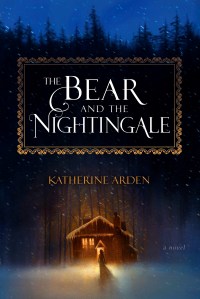
Review of The Bear and the Nightingale by Katherine Arden

Five Star Book Review

Katherine Arden, The Bear and the Nightingale

For me a five-star book is something that either I want to read again or something that is so profound it makes an immediate impact. There are lots of ways that books can be compelling: a unique idea, an interesting set of characters, a complex plot, an artistic use of the English language and more. Reading is also a subjective experience, so what appeals to me as a reader may be very different for you. I read a lot for both pleasure and work, but these short reviews are a way for me to show my appreciation for the work and the craft of the author of the reviewed work.

The Bear and the Nightingale feels like a story told around an oven in a home snowed in for the winter, a story of magical creatures and grown ups who cannot see the magic of the world any longer. Vasya, the main protagonist, is both mischievous and kind and has a strong enough will to resist the machinations of her stepmother and father. There are many of the classic elements you find in fairy tales, for example a wicked stepmother, but I enjoyed the interweaving of distinctive Russian elements to the story: from the Russian orthodox painting of an iconostasis by Father Kostantin to the domovoy, rusalka, leshy, and other elements of eastern European folk stories. Although Morozko and his brother Medved, who the conflict of the story rotates around, have the classic good verses evil polarity, Morozko is not simply good and Medved is more animalistic hunger than evil. It is a story of family, of faith both in the sense of religion and in the sense of magic, and for the main character it is the beginning of a coming-of-age story for a woman who will determine her own course in a world where women do not write their own stories.

I read the entire Winternight trilogy several years ago, and I was deeply impressed with Katherine Arden’s debut novels. Returning to this novel was like returning to a home I never knew. The characters are great, but I think it was the way she narrated the atmosphere of the story that invited me in to dwell in this magical world for a time. This is a work of historical fantasy, so the magical events are caught up in the history of the Russian people and I really appreciated the way she allowed me to live a snapshot of an imaginary life in a magic infused slice of this world defined by winter. I look forward to continuing through the remainder of this series with Vasya, Morozko, and the rest.

Review of the Warm Hands of Ghosts by Katherine Arden

I received an advance readers copy of the Warm Hands of Ghosts and I am a fan of Katherine Arden’s The Bear and the Nightingale series as well as her middle grade series Small Spaces. The Warm Hands of Ghosts takes the reader back to the historical fantasy genre of The Bear and the Nightingale, but this time the environment is primarily the hellish environment of Belgium in 1917 during the World War I battle for Passchendaele. Katherine Arden does a phenomenal job of presenting the environment of a world at war through the eyes of Laura and Freddie Iven. Laura begins the narrative home in Canada after several years as a field nurse for the medical corps, while her younger brother Freddie later joins the Canadian army in the trenches near Ypres. There is both a spiritualist and an apocalyptic framing of the war (particularly in a Jehovah’s Witness sense) and into the soul stealing space of war enters the beguiling but also devilish Faland. There are some similarities to the Smiling Man of the Small Spaces series, but the devil in a different context calls a different tune and plays a different game.
The Warm Hands of Ghosts is a story of humans caught in the inhumanity of war, of men and women who will sell their souls to forget what they have endured, of love that allows broken men and women to slowly rebuild their shattered lives, and of the death of a world as it gives birth to a new one. Laura and Freddie are both believably broken and yet still heroic characters who struggle to embrace this world at war instead of becoming ghosts of their former selves. It is the story of an ugly era of history beautifully written, of love struggling against the demons both outside in the world and the ones that dwell in the shattered hearts of the characters, and humanity trying to come to terms with the inhumanity of World War I. I appreciate the careful way she narrates this war that saw the advent of modern technologies like aircraft, long range artillery, submarines, and machine guns which was still primarily fought using the tactics of the 1800s and the disconnect between the experience of the soldiers at the front and the generals making their plans in houses miles away from these hellscapes. Even in this place of devils and destruction love still exists and it is the only hope for the lost men and women who journey to hell and back again for one another.

Review of Babel: An Archane History by R.F.Kuang

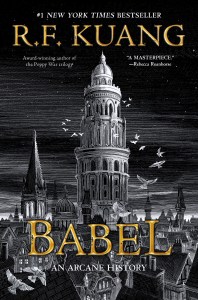
R. F. Kuang, Babel: An Archane History

For me a five-star book is something that either I want to read again or something that is so profound it makes an immediate impact. There are lots of ways that books can be compelling: a unique idea, an interesting set of characters, a complex plot, an artistic use of the English language and more. Reading is also a subjective experience, so what appeals to me as a reader may be very different for you. I read a lot for both pleasure and work but these short reviews are a way for me to show my appreciation for the work and the craft of the author of the reviewed work.

Babel is a book that is going to evoke a strong reaction from its reader. I love languages and have done a lot of work in translating and so a magical system which is built upon the distortion in meaning between languages when they are engraved on a silver bar was a fascinating concept. The attention to translation and understanding languages as systems of value and meaning may be boring to some readers, but for me this discussion resonated strongly. It is a story which can celebrate both the magic of the university but also the dark side of academia when it becomes tangled with the goals of the empire. The book deals with the difficult reality of colonialism and the difficult choice that the non-white students at Babel must make as they discover the ways in which their work is being used to exploit the countries of their birth. This is a smart, well written story set in a nineteenth century world modified by the advantages of enchanted silver working.

Robin Swift loses his family to sickness in China and is given a chance to come to England to be prepared for Babel, the Royal Institute of Translation at Oxford University. Robin Swift and his classmates Ramy, Victoire, and Letty become incredibly close as students at Babel, and as either non-white students or women they must navigate the wealthy, white, and male world of Oxford. They live a privileged life as Babel students who receive a full scholarship and a generous stipend, but they are also asked to commit themselves wholeheartedly to their studies. All of them are gifted students who have been trained for much of their life for this course of study. When Robin meets a person who looks like an older version of himself, he finds himself entangled with a secret society called Hermes. The Hermes society opposes the work Babel does to further the colonialism of the British Empire. Robin later sees the impact of the Royal Institute of Translation on his motherland of China and how it is allied with the trading companies who want to export opium to his home. This experience initiates a chain of events that sets Robin and some of his friends in opposition to the work of not only Babel but the empire itself.

R. F. Kuang does an excellent job of helping the reader see the world through the eyes of Robin, and to a lesser extent Victoire and Letty. It portrays the world of a brilliant young man who is often viewed as both important to the work of the Institute and by extension the empire, but who also is never fully accepted as a person who belongs at Oxford or in England. The characters are caught in the tension between the magic of the place and the devilish manipulation of the world using language. It is a sharp book both in its intelligence and its cutting and sometimes painful perspective on the abuse of both knowledge and people.